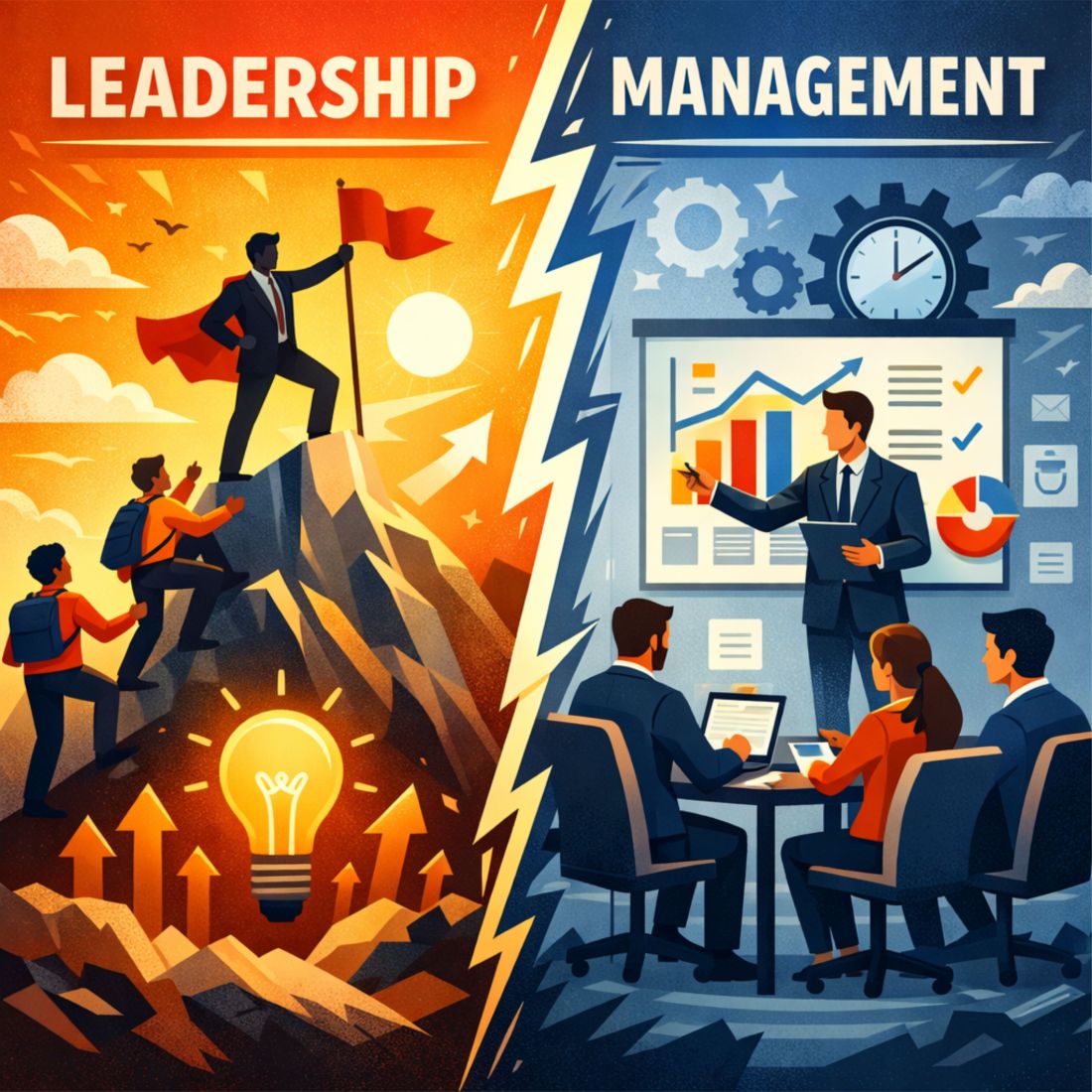
Modern society is experiencing a profound leadership crisis – not because leaders have disappeared, but because the systems that govern public life have been constructed to elevate managers instead.
This distinction is not superficial. It is the difference between a society capable of solving problems and one that merely contains them; between a political culture that serves people and one that serves itself.
The consequences of this shift are visible everywhere: in institutions that cannot act decisively, in political classes that avoid accountability, and in communities that feel increasingly disconnected from the decisions that shape their lives.
To understand how this happened, we must examine the mechanics of the system itself – especially the political party structures that determine who can rise, who cannot, and why leadership has been systematically replaced by management.
I. Why Poor Leaders Manage Instead of Lead
Poor leaders cannot lead, so they manage their way out of problems. When confronted with issues that require courage, empathy, or direct engagement – particularly when those issues involve people who are unhappy with them – they retreat into managerial behaviour. Management becomes a shield: a way to avoid conflict, responsibility, and the discomfort of facing those they have failed.
Instead of addressing the root cause of discontent, they impose restrictions and requirements on those who are more compliant. It is easier to control people who want to remain in favour than to confront those who challenge them.
This behaviour is not incidental; it is the predictable outcome of individuals who think primarily of themselves and the benefits they can extract.
Whether their aim is personal enrichment or the accumulation of power they do not know how to use, the result is the same: managerial elites respond to every problem by creating new burdens for the very people they were entrusted to serve.
II. How the System Rewards Management and Punishes Leadership
To understand why poor leaders rise, we must understand the incentives of the system itself.
Modern political and institutional structures reward:
• compliance over courage
• predictability over principle
• loyalty to the system over loyalty to the public
• risk‑avoidance over responsibility
Real leadership – which challenges assumptions, questions processes, and prioritises people – is treated as a threat.
Leaders disrupt. Leaders expose flaws. Leaders force change.
Systems built on self‑preservation cannot tolerate this.
As a result:
• those who comply rise
• those who question are sidelined
• those who serve others are punished
• those who serve themselves are rewarded
This is why genuine leaders do not seek leadership roles for their own sake.
Leadership is a natural disposition, not a career path. Yet the system has been engineered to reward ambition, self‑interest, and conformity.
III. How the Party System Manufactures Non‑Leaders
The political party system is one of the most powerful mechanisms driving the leadership crisis. It creates the illusion of democratic choice while tightly controlling who the public is allowed to choose from.
1. Voters believe they choose candidates – but parties choose them first
When voters enter the ballot box, they see a list of names and assume they are choosing between individuals. In reality, those individuals have already been chosen by party organisations long before the public ever sees them.
Unless a candidate is independent – and independents at parliamentary level have virtually no chance of being elected unless they are sensationalised – the choice has already been made by the party machine.
2. Parties select candidates for malleability, not leadership
Parties do not want independent thinkers. They want:
• reliable votes
• predictable behaviour
• people who will not challenge the hierarchy
• individuals who will not threaten the careers of those above them
This means the selection process filters out leadership qualities and filters in compliance.
3. Insecure non‑leaders select even weaker successors
Those who rise through this system are typically insecure. They know they lack leadership ability, so they avoid appointing or approving anyone who might outshine them.
Instead, they choose people who are even weaker, even more compliant, even more dependent on the system.
This creates a downward spiral:
Weak leaders → choose weaker deputies → who choose even weaker candidates → who eventually inherit roles requiring real leadership.
4. Eventually, these “yes‑people” reach roles that require real leadership
And when they do, they fail – not because they are malicious, but because they were selected precisely for their inability to lead.
This explains:
• why crises escalate
• why decisions are delayed
• why problems are managed, not solved
• why public trust collapses
It also explains why the system cannot self‑correct:
The people in charge are the least capable of recognising or addressing the problem.
IV. The Emergence of the Management Class
Over time, these incentives create a distinct group: a management class.
This class is not defined by competence or wisdom, but by its alignment with the system’s priorities.
It may include clever, knowledgeable, even impressive individuals, but they are not leaders. They are driven by ideas, power, and wealth that ultimately revolve around themselves.
The management class consolidates power by:
• controlling access to political advancement
• shaping the rules of participation
• defining what “leadership” means in system‑friendly terms
• eliminating those who cannot be relied upon
Ambition for wealth and ambition for power lead to the same destination, even when they begin innocently.
Pursuing personal gain at the expense of others always ends in harm.
V. The Symbiosis Between Political Power and Wealth
Within this structure, a strange but highly effective symbiotic relationship forms between the power‑hungry who enter politics and those who pursue wealth above all else.
For politicians, this relationship begins with awe. Wealth appears to offer solutions, influence, and security. Over time, awe becomes dependence, and dependence becomes sycophancy. As they move deeper into the system, politicians come to understand what wealth – and the power attached to it – truly means within this environment.
This dynamic eliminates real leadership because:
• wealth rewards compliance
• wealth punishes independence
• wealth shapes political priorities
• wealth becomes the gatekeeper of influence
A small number of individuals enter politics believing, naively, that it is a system built around leadership.
Those who possess genuine leadership qualities attempt to lead, but they face a relentless tide.
VI. The Dual System That Conditions People to Serve Themselves
The system operates on two levels:
1. The visible system – elections, parties, public debate, official processes.
2. The invisible system – incentives, pressures, dependencies, and unwritten rules.
Together, these form a dual system that conditions people to serve themselves.
Those who are not already self‑serving are taught to be. Those who resist are marginalised. Those who comply are rewarded.
To outsiders, the system can appear to be run by a conspiracy. But this perception is itself a convenient tool. It discredits those who sense that something is wrong but do not fully understand how the mechanics of the system operate.
Real leaders have no place in this environment. Their presence is accidental, not intentional.
VII. The Systemic Erasure of Real Leadership
The centralised, control‑heavy structure relies on law and regulation to remove problems by targeting those who comply, rather than addressing the root causes of the issues the system itself created.
These root causes alienate people and provoke them to speak out or act against the system – the same system that discourages anyone from actively attempting to do so.
Over time, the system redefines leadership as:
• management
• compliance
• authority
• hierarchy
• status
We have forgotten what leadership truly is because we cannot see it, hear it, or experience it first‑hand. The system does not allow it.
VIII. What Leadership Really Is (and Why the System Cannot Produce It)
Leadership does not come from position, wealth, education, or any of the classifications the system uses to select and reward those who serve its needs.
Leadership is selfless and always oriented toward the greater good.
Real leadership requires:
• empathy
• courage
• responsibility
• service
• humility
• a commitment to people, community, and environment
These qualities cannot be manufactured by a system built on self‑interest. They cannot be incentivised by structures that reward compliance. They cannot be nurtured in environments where power is centralised and accountability is diffused.
This is why centralised systems cannot produce real leaders. They can only produce managers.
IX. The Path Forward: Local, Human‑Scale Systems
If leadership cannot emerge from the system, it must emerge from outside it.
Local systems – real systems – untouched by the digital parallel world – are the only way genuine leadership can be restored.
Leadership emerges naturally in human‑scale environments where:
• people know one another
• decisions have visible consequences
• accountability is direct
• community needs are clear
• power is shared, not hoarded
The current system cannot and will not provide this, even when it pays lip service to the idea or appears to take action.
Once real power is returned to where it belongs, people will quickly see the system for what it is and recognise the true quality – or lack of it – in those who currently drive it.
X. Reclaiming Leadership
The crisis of leadership is not a crisis of individuals. It is a crisis of systems.
We are governed by managers because the system rewards management and punishes leadership.
Real leaders cannot rise within structures designed to preserve themselves rather than serve the public.
Restoring leadership requires genuine decentralisation, community‑level decision‑making, and a renewed understanding of leadership as service rather than status.
Only then can society reclaim the agency it has lost and rebuild systems that reflect the needs and values of real people.
We are living through a moment where the world feels louder, faster, and more uncertain than at any point in living memory. People can sense that something fundamental is shifting, even if they cannot yet name it.
Systems that once felt solid now feel fragile. Institutions that once felt dependable now feel distant. And the idea that “someone else” will fix things no longer carries the comfort it once did.
Yet beneath the noise, something important is happening – something quieter, more human, and far more powerful than the headlines ever acknowledge.
People are beginning to look closer to home.
Not because they have given up on the wider world, but because they are rediscovering something that was always there:
The strength, capability, and resilience of their own communities.
For decades, we were encouraged to believe that real power lived elsewhere – in governments, corporations, global markets, and distant decision‑makers.
We were taught to outsource responsibility, to trust systems we could not see, and to measure our lives through structures we did not control.
Over time, this created a quiet but profound belief that ordinary people were too small to shape their own future.
But that belief was never true.
Local communities have always been the foundation of human life. They are where we eat, where we work, where we raise our children, where we experience joy and hardship, and where we feel the consequences of every decision made in our name.
They are the scale at which trust is built, where relationships form, and where real change becomes possible.
And now, as the old world strains under its own weight, the importance of local communities is becoming impossible to ignore.
This document is a bridge – a way of helping people move from the feeling that “everything is falling apart” to the understanding that we already have the tools, the people, and the capacity to build something better.
Not in theory. Not in the distant future. But right here, in the places we live, with the people we know.
It is not a call to revolution. It is a call to remember.
To remember that power does not only flow from the top down.
To remember that resilience grows from the ground up.
To remember that the future will not be saved by distant institutions, but shaped by connected communities.
The world is changing.
But that change does not have to be frightening.
It can be the beginning of something profoundly human – a return to locality, to capability, to shared responsibility, and to the simple truth that we are strongest when we act together.
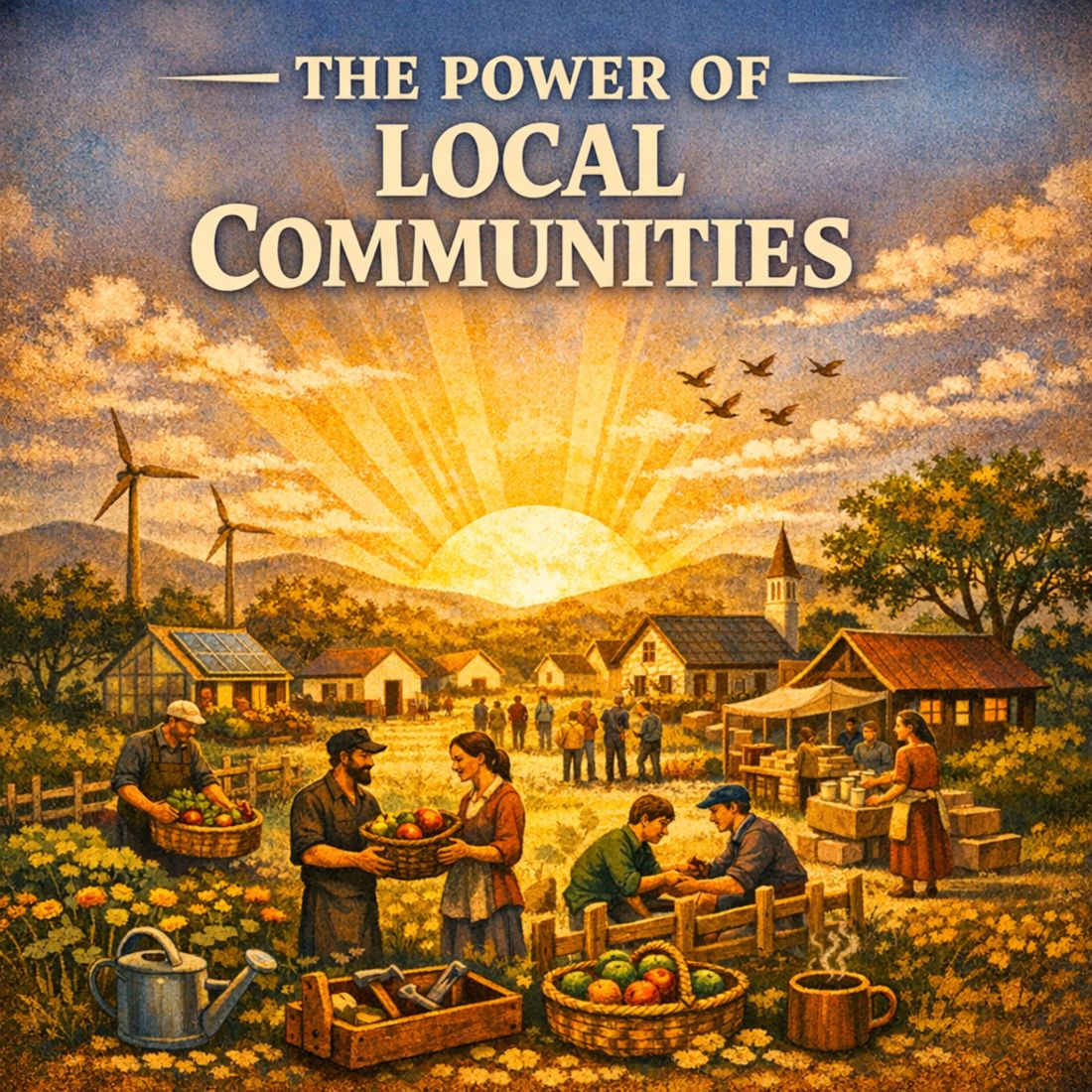
This is the power of local communities.
And this is where the future begins.
1. Where Communities Begin
When this document talks about community, it does not mean a whole town agreeing on a plan, a village turning up to a meeting, or a critical mass of people getting on board before anything can begin.
In its most literal sense, a community can be very small.
It might be a street.
It might be a handful of households.
It might be two or three people who know each other and decide to act together.
Community does not begin at scale.
It begins with connection.
The mistake many people make is assuming that community has to be complete before it can work – that everyone needs to be involved, aligned, or committed before anything meaningful can happen. That assumption quietly prevents people from starting at all.
This document takes the opposite view.
Community is not something you assemble in advance.
It is something that grows.
It grows through small, visible acts of cooperation.
It grows as trust builds.
It grows as people see that things can be done locally, without permission.
The direction of travel matters more than the starting size.
What begins as a few people helping each other becomes shared capability.
Shared capability reduces dependency.
Reduced dependency creates resilience.
Over time – if allowed to grow naturally – that resilience becomes economic.
Not in the abstract sense of markets or money, but in the practical sense of meeting needs, circulating value, and supporting life locally.
When a community can feed itself, repair what it owns, share skills, organise care, and solve problems together, an economy already exists – whether or not anyone has named it yet.
This is why starting small is not a limitation.
It is the condition that makes healthy growth possible.
You do not need everyone.
You do not need agreement.
You do not need scale.
You only need enough connection for momentum to begin.
Everything else emerges from there.
2. The Forgotten Power of Local Communities
For most of human history, the community was the centre of life. Not as a romantic ideal, but as a practical reality. People lived, worked, learned, created, and solved problems together because there was no alternative.
The community was the economy. The community was the safety net. The community was the governance system. The community was the source of identity, meaning, and resilience.
Then, slowly and quietly, that changed.
As systems centralised, communities were encouraged to hand over responsibility to distant institutions.
Decisions that once belonged to neighbours were transferred to offices, agencies, and organisations that most people would never meet.
Skills that once lived in households and villages were replaced by services delivered by strangers.
And the natural interdependence that once held communities together was replaced by a culture of individualism, consumption, and dependency.
This shift didn’t happen overnight. It happened through thousands of small changes – each one seemingly harmless, each one making life feel a little more convenient, a little more efficient, a little more modern.
But convenience came with a cost: the quiet erosion of local capability.
Over time, people forgot what their communities were capable of.
They forgot that they once grew food together.
They forgot that they once repaired what they owned.
They forgot that they once shared tools, skills, and knowledge.
They forgot that they once made decisions collectively.
They forgot that they once solved problems without waiting for permission.
They forgot that they once had power.
And in that forgetting, something else took root:
The belief that ordinary people are too small to shape their own future.
This belief is one of the greatest illusions of the modern world.
Because even today – even after decades of centralisation – the truth is unchanged:
Communities still hold the greatest power of all: the power to act directly, immediately, and together.
A community does not need approval from a government department to support a neighbour.
It does not need a corporate strategy to grow food locally.
It does not need a national policy to repair, reuse, or share resources.
It does not need a global supply chain to build resilience.
It does not need permission to organise, collaborate, or create.
The power of a community is not theoretical. It is practical, human, and already present.
What has been lost is not capability – it is confidence.
People have been conditioned to believe that real solutions must come from somewhere else. That expertise only exists in institutions. That authority only exists in hierarchy. That progress only comes from scale. That value only comes from money.
But when you strip away the narratives, the branding, and the noise, the truth becomes clear:
Everything that truly matters in life still happens locally.
Everything that keeps us alive still depends on people.
Everything that makes us human still grows from community.
The world is beginning to remember this. And as the old systems strain under their own weight, that memory is returning faster than anyone expected.
The forgotten power of local communities is not gone.
It is simply waiting to be reclaimed.
3. The Myth of Powerlessness
If there is one belief that has quietly shaped modern life more than any other, it is this:
“I can’t change anything.”
Most people don’t say it out loud.
They don’t even consciously think it.
But it sits beneath the surface of their decisions, their expectations, and their sense of what is possible.
It is the belief that keeps people waiting for someone else to act.
It is the belief that convinces communities to tolerate systems that no longer serve them.
It is the belief that turns capable individuals into passive observers of their own future.
And it is a myth.
A myth created by decades of centralisation.
A myth reinforced by institutions that benefit from dependency.
A myth strengthened by a culture that celebrates individual success but quietly discourages collective action.
A myth amplified by media that focuses on crisis, conflict, and catastrophe — but rarely on the quiet power of ordinary people working together.
The myth of powerlessness is not a reflection of reality. It is a psychological consequence of distance.
When decisions are made far away, people feel far away from decisions.
When systems grow larger, individuals feel smaller.
When responsibility is outsourced, capability atrophies.
When life becomes abstract, agency becomes invisible.
But here is the truth that modern life has obscured:
People are not powerless.
They are disconnected from their power.
And disconnection is not the same as absence.
You can see this clearly in moments of disruption.
When systems falter – even briefly – people instinctively turn to each other.
Neighbours check in.
Communities organise.
Strangers help strangers.
Skills reappear.
Initiative returns.
Capability resurfaces.
The power was always there.
It was simply dormant.
The myth of powerlessness survives only when people feel isolated.
Isolation magnifies fear.
Fear magnifies dependency.
Dependency magnifies the belief that “someone else” must act first.
But the moment people reconnect – even slightly – the illusion begins to break.
A conversation with a neighbour.
A shared tool.
A small local project.
A community meeting.
A repaired item instead of a replaced one.
A garden bed planted together.
A local food network forming.
A skill exchanged.
A problem solved without waiting for permission.
These small acts are not symbolic.
They are transformative.
They remind people that capability is not something granted by institutions – it is something that already exists within them.
They remind communities that resilience is not a service delivered from above – it is a relationship built from within.
They remind everyone involved that the future is not something to be endured – it is something to be shaped.
The myth of powerlessness dissolves the moment people experience their own agency.
And once that happens, something profound shifts:
People stop asking, “Who will fix this?” And start asking, “What can we do together?”
That shift – quiet, human, and deeply local – is the beginning of real change.
It is the moment where fear gives way to clarity.
Where isolation gives way to connection.
Where dependency gives way to sovereignty.
Where communities begin to remember who they are.
The myth of powerlessness is only powerful when it goes unchallenged. Once people see through it, the entire landscape of possibility changes.
And that is where the real story of local communities begins.
4. The Moment We’re In
We are living through a period of transition that most people can feel, even if they cannot yet explain it.
Something about the world no longer fits. The systems we grew up trusting don’t behave the way they used to. The promises that once felt solid now feel thin. And the sense of stability that defined the last few decades has quietly begun to fade.
This is not imagination.
It is not pessimism.
It is not a temporary phase.
It is the natural consequence of a world built on foundations that are no longer holding.
For years, the signs were subtle – rising costs, stretched services, supply chain delays, political volatility, environmental strain, and a growing sense that life was becoming harder for ordinary people no matter how hard they worked.
But recently, those subtle signs have become visible in everyday life.
People feel it in their shopping baskets.
They feel it in their energy bills.
They feel it in their work.
They feel it in their communities.
They feel it in the pace of change.
They feel it in the tone of public conversation.
They feel it in the quiet anxiety that sits beneath the surface of normal life.
The world is not collapsing.
But it is shifting.
And the systems that once held everything together – global supply chains, centralised governance, industrial agriculture, financial markets, and the oil‑driven economy – are showing their age.
These systems were built for a different era:
A world of cheap energy, predictable politics, stable climate, and unquestioned globalisation.
That world no longer exists.
Today, the complexity that once made life convenient now makes it fragile.
The distance that once made systems efficient now makes them vulnerable.
The scale that once made things affordable now makes them uncontrollable.
This is why disruptions feel sharper than they used to.
Why small shocks ripple faster.
Why uncertainty spreads more quickly.
Why people feel more anxious even when nothing dramatic is happening.
We are not experiencing a single crisis.
We are experiencing the strain of a system reaching the limits of its design.
And in moments like this, people instinctively look for something solid – something human, something close, something real.
That “something” is community.
Not as a nostalgic idea, but as a practical necessity.
Because when global systems wobble, it is local systems that keep people grounded.
When supply chains falter, it is local networks that fill the gaps.
When institutions feel distant, it is neighbours who step forward.
When uncertainty rises, it is relationships that create stability.
When people feel powerless, it is connection that restores agency.
The moment we’re in is not defined by collapse.
It is defined by relocalisation – the quiet, steady return of responsibility, capability, and resilience to the places where people actually live.
This shift is not optional.
It is already happening.
Communities are rediscovering skills.
People are reconnecting with each other.
Local networks are forming.
Small initiatives are growing.
New forms of governance are emerging.
Local economies are beginning to take shape.
And the idea that “we can do this ourselves” is returning.
The moment we’re in is not the end of something. It is the beginning of something else – a transition from a world built on distance to a world built on proximity, from dependency to capability, from isolation to connection, from centralisation to locality.
This is the moment where communities begin to matter again. Not because the old world has failed, but because the new world cannot be built without them.
5. What Local Communities Can Do That Central Systems Can’t
One of the most important realisations of our time is also one of the simplest:
Local communities can do things that central systems will never be able to do.
Not because communities are perfect.
Not because they have more resources.
Not because they have more authority.
But because they have something central systems cannot replicate:
Proximity, trust, visibility, and shared experience.
Central systems operate at scale.
Communities operate at human level.
And the difference between those two scales is the difference between fragility and resilience.
Here’s what that means in practice.
1. Communities Respond Faster
Central systems are slow by design.
They require processes, approvals, budgets, and layers of decision‑making.
By the time a problem reaches the top, the moment to act has often passed.
Communities don’t have that problem.
If a neighbour needs help, someone knocks on their door.
If a local issue arises, people gather and solve it.
If something breaks, someone fixes it.
If a gap appears, someone fills it.
Speed is not a luxury – it is a natural consequence of being close to the problem.
2. Communities See What Central Systems Cannot
Central systems rely on data, reports, and assumptions.
Communities rely on lived experience.
A community knows:
who is struggling
who is isolated
who has skills
who needs support
what resources exist
what problems are real
what solutions will actually work
This visibility is priceless.
It is also impossible to centralise.
You cannot govern what you cannot see.
Communities see everything.
3. Communities Build Trust – Central Systems Manage Compliance
Trust is the foundation of resilience.
But trust cannot be manufactured at scale.
Central systems rely on rules, enforcement, and incentives.
Communities rely on relationships.
People trust those they know.
They trust those who show up.
They trust those who share their reality.
They trust those who have something at stake in the outcome.
Trust turns cooperation into instinct.
And cooperation is the engine of resilience.
4. Communities Make Ethical Decisions in Real Time
Central systems make decisions based on:
Budgets
Targets
Politics
public perception
risk management
institutional priorities
Communities make decisions based on:
Need
Fairness
Relationships
Context
shared values
common sense
Ethics is not a policy.
It is a lived experience.
Communities live with the consequences of their decisions.
That alone makes them more ethical than any distant institution.
5. Communities Create Resilience Through Diversity
Central systems depend on uniformity.
Communities thrive on diversity.
Different people bring different skills.
Different households bring different strengths.
Different groups bring different perspectives.
This diversity creates adaptability – the single most important ingredient in resilience.
When one part of a community struggles, another part steps in.
When one solution fails, another emerges.
When one resource runs low, alternatives appear.
Resilience is not built through scale.
It is built through variety.
6. Communities Strengthen Identity and Belonging
Central systems treat people as users, customers, or data points.
Communities treat people as neighbours.
Belonging is not sentimental. It is functional.
People who feel connected:
share more
support more
care more
take responsibility
look out for each other
act with integrity
think long‑term
Belonging is the invisible infrastructure of a healthy society.
7. Communities Reduce Dependency
Central systems create dependency by design.
Communities reduce dependency by rediscovering capability.
When people:
grow food
repair items
share tools
exchange skills
organise locally
support each other
solve problems together
…they become less reliant on distant systems that are increasingly unstable.
Dependency creates fragility.
Capability creates freedom.
8. Communities Turn Problems into Participation
Central systems turn problems into paperwork.
Communities turn problems into action.
A broken fence becomes a shared project.
A shortage becomes a network.
A challenge becomes a conversation.
A need becomes an opportunity to contribute.
Participation is not a burden. It is the antidote to helplessness.
9. Communities Make the Future Real
Central systems talk about change.
Communities create it.
Every local initiative – no matter how small – is a piece of the future being built in real time.
A community garden.
A repair hub.
A shared transport scheme.
A local food network.
A neighbourhood meeting.
A skills exchange.
A local marketplace.
A community news platform.
These are not side projects.
They are the early architecture of a new world.
A world where people, not systems, are the centre of life.
6. The First Signs of Local Power Returning
If you look closely, you can already see it happening.
Long before governments acknowledge it, long before institutions adapt, long before the old systems admit they are struggling, ordinary people begin to rebuild the foundations of a different kind of world.
Not through grand declarations.
Not through political movements.
Not through sweeping reforms.
But through small, human acts of reconnection.
These early signs are easy to overlook because they don’t arrive with fanfare. They don’t trend on social media. They don’t appear in headlines. They grow quietly, like roots beneath the surface – unnoticed until the ground begins to shift.
Yet they are everywhere.
And once you know what to look for, you start to see them in your own community.
1. People Are Turning Back to Local Food
Farm shops that once felt niche are becoming essential.
Community gardens are appearing in unused spaces.
Neighbours are sharing surplus produce.
Local growers are forming networks.
People are asking where their food comes from – and who they can trust.
This is not a trend.
It is a return to sovereignty.
2. Repair, Reuse, and “Make Do” Are Quietly Returning
Repair cafés.
Tool libraries.
Clothing menders.
Bike workshops.
Upcycling groups.
People learning skills their grandparents took for granted.
Every repaired item is a small act of independence.
Every shared tool is a small act of community.
Every skill regained is a small act of resilience.
3. Community Transport Is Reappearing
Shared cars.
Bike‑lending hubs.
Neighbour lifts.
Local minibus groups.
Informal networks that fill the gaps left by strained public services.
Mobility is becoming communal again – not because people are forced to, but because it simply makes sense.
4. Local News Is Being Reborn
Small newsletters.
Community blogs.
Local podcasts.
Neighbourhood WhatsApp groups.
People sharing what’s happening around them instead of waiting for distant media to interpret it.
Information is becoming local again – and with it, trust.
5. People Are Reconnecting Through Skills and Contribution
Workshops.
Skill swaps.
Neighbourhood teaching.
People offering what they know, not for money, but because it helps.
Cooking.
Gardening.
Sewing.
DIY.
Tech help.
Childcare.
First aid.
Local history.
Practical knowledge.
Communities are rediscovering that everyone has something to offer.
6. Small Groups Are Beginning to Self‑Organise
Street‑level WhatsApp groups.
Local resilience circles.
Community meetings.
Neighbourhood planning sessions.
Informal gatherings to solve shared problems.
These are not political movements.
They are human movements.
People are remembering that they don’t need permission to organise.
7. Local Economies Are Quietly Forming
Pop‑up markets.
Local makers.
Neighbourhood exchanges.
Barter systems.
Community marketplaces.
People choosing local because it feels right – not because they were told to.
Value is beginning to circulate within communities again.
8. People Are Looking Out for Each Other
Checking on elderly neighbours.
Sharing food.
Offering lifts.
Helping with childcare.
Supporting those who are struggling.
Not as charity – but as community.
This is the oldest form of resilience.
And it is returning.
9. The Tone of Conversation Is Changing
People are asking different questions:
“What can we do here?”
“Who do we know who can help?”
“Can we organise something ourselves?”
“Why are we waiting for someone else?”
“Who else feels the same way?”
This shift in mindset is the real beginning of change.
10. The Desire for Local Control Is Growing
People want decisions made closer to home.
They want transparency.
They want accountability.
They want to know the people who shape their lives.
They want governance that feels human again.
This is not nostalgia.
It is evolution.
These signs may seem small, but they are not.
They are the early architecture of a new world – one built from the ground up, not the top down.
Every local initiative is a seed.
Every act of reconnection is a foundation.
Every shared skill is a building block.
Every community conversation is a blueprint.
The power of local communities is not returning someday.
It is returning now.
And the people who notice it first are the ones who will shape what comes next.
7. The Shift in Identity
Every meaningful change in history begins long before structures shift, systems evolve, or new models take shape. It begins inside people – in the quiet, personal moment where identity changes.
The transition from a centralised world to a local one is not just political or economic.
It is psychological.
It is emotional.
It is personal.
It requires people to see themselves differently.
For decades, society has conditioned individuals to think of themselves as consumers, clients, taxpayers, users, or recipients of services.
These identities are passive by design. They position people as dependants of systems rather than contributors to communities.
But as the old world strains, something remarkable is happening:
People are beginning to remember who they really are.
Not consumers – contributors
Not isolated individuals – community members.
Not powerless – capable.
Not dependent – sovereign.
Not passive – participatory.
This shift is subtle at first. It begins with a feeling rather than a decision.
A sense that something isn’t right.
A sense that things could be different.
A sense that waiting for someone else no longer makes sense.
A sense that “we” might matter more than “me.”
A sense that capability is returning.
And then, slowly, identity begins to change.
1. From Consumer to Contributor
A consumer waits for solutions. A contributor creates them.
A consumer asks, “What can I get?” A contributor asks, “What can I offer?”
A consumer depends on systems. A contributor strengthens community.
This shift is not about sacrifice.
It is about rediscovering meaning.
People feel more alive when they contribute.
They feel more connected.
They feel more valued.
They feel more human.
Contribution is the antidote to helplessness.
2. From Isolated Individual to Community Member
Modern life has taught people to see themselves as separate – separate households, separate struggles, separate futures.
But humans were never meant to live in isolation.
The moment people reconnect – even briefly – something changes.
A conversation with a neighbour.
A shared task.
A local project.
A moment of mutual support.
These small interactions remind people that belonging is not sentimental – it is functional.
It is how humans stay resilient.
It is how communities stay strong.
It is how futures are built.
Belonging is not a luxury.
It is a necessity.
3. From Powerless to Capable
People often underestimate their own abilities because they have spent years outsourcing them.
But capability returns quickly.
The first time someone grows food, repairs something, helps a neighbour, organises a small group, or solves a local problem, they feel something shift inside them.
A quiet voice says:
“I can do this.”
“We can do this.”
“We don’t need to wait.”
That voice is the beginning of sovereignty.
4. From Dependent to Sovereign
Sovereignty is not about control.
It is about responsibility.
It is the understanding that:
“I am part of the solution.”
“My actions matter.”
“My choices shape my community.”
“My community shapes my future.”
Sovereignty is not loud.
It is not aggressive.
It is not ideological.
It is calm, grounded, and deeply human.
It is the recognition that freedom is not given – it is lived.
5. From Passive to Participatory
Participation is not a political act. It is a human one.
It is the moment someone chooses to show up.
To speak.
To listen.
To help.
To organise.
To take responsibility for the space they live in.
Participation is the heartbeat of community.
It is how local systems form.
It is how resilience grows.
It is how the future takes shape.
6. The Identity Shift Is Already Happening
You can see it in the way people talk.
In the way they organise.
In the way they support each other.
In the way they question old assumptions.
In the way they rediscover skills.
In the way they choose local over distant.
In the way they begin to trust themselves again.
This shift is not theoretical.
It is happening in real time.
And once identity changes, behaviour follows.
Once behaviour changes, community strengthens.
Once community strengthens, systems evolve.
Once systems evolve, the future becomes possible.
The shift in identity is the quiet revolution beneath everything else.
It is the moment where people stop waiting for change – and start becoming it.
8. The First Steps for Any Community
When people begin to feel their own capability again, the natural question that follows is simple:
“Where do we start?”
Not with a grand plan.
Not with a committee.
Not with a manifesto.
Not with a perfect structure.
Real change begins with the smallest possible step – the kind that feels almost too simple to matter.
But these small steps are powerful because they do something essential:
They reconnect people.
They build trust.
They create momentum.
They make the future feel real.
Here are the first steps any community can take – steps that require no funding, no permission, and no expertise. Only willingness.
1. Start by Looking Around You
Before doing anything, notice what already exists.
Who lives nearby?
What skills are present?
What spaces are available?
What problems are shared?
What strengths are hidden?
What is already working?
What is missing but possible?
Communities don’t begin with action. They begin with awareness.
2. Talk to People – Genuinely, Simply, Humanly
A conversation is the smallest unit of community.
Knock on a door.
Say hello.
Ask how someone is doing.
Share a thought.
Listen.
Be curious.
Be open.
Most people are waiting for someone else to start the conversation.
Be the one who starts.
3. Find the First Two or Three People Who Feel the Same
You don’t need a crowd.
You don’t need a movement.
You don’t need a committee.
You need two or three people who say:
“Yes, I feel this too.”
“Yes, I want to do something.”
“Yes, let’s start small.”
Every meaningful community initiative in history began with a handful of people who cared.
4. Choose One Small, Visible Action
Not a big project.
Not a long-term plan.
Not something that requires funding or permission.
Something small enough to complete quickly, but visible enough to build confidence.
Examples:
A shared tool.
A repaired bench.
A litter pick.
A seed swap.
A small gathering.
A shared meal.
A WhatsApp group.
A noticeboard.
A neighbour check-in.
A simple skills exchange.
The goal is not the action itself.
The goal is the connection it creates.
5. Build Trust Before Structure
Most failed community projects collapse because they try to build structure before trust.
Trust is the foundation. Structure is the scaffolding.
Trust grows through:
showing up
keeping promises
listening
being consistent
being human
being honest
being present
Once trust exists, structure becomes easy.
Without trust, structure becomes conflict.
6. Keep Everything Local and Human
If something requires:
a grant
a committee
a formal process
a distant authority
a complex plan
a long timeline
…it’s too big for the first steps.
Start with what you can touch.
Start with who you can talk to.
Start with what you can see.
Locality is not a restriction.
It is the source of strength.
7. Let the Community Shape Itself
Communities are living systems.
They grow organically when given space.
Avoid trying to control the direction.
Avoid trying to predict the outcome.
Avoid trying to design everything in advance.
Instead:
Follow energy.
Follow interest.
Follow need.
Follow capability.
Follow what feels natural.
Communities don’t need leaders.
They need participants.
Leadership emerges naturally when the moment requires it – and dissolves when it doesn’t.
8. Celebrate Small Wins
A repaired item.
A shared meal.
A new connection.
A small project completed.
A neighbour helped.
A conversation that mattered.
These are not trivial.
They are the building blocks of resilience.
Every small win strengthens identity.
Every small win builds confidence.
Every small win invites others in.
9. Keep It Open, Simple, and Welcoming
The moment a community becomes exclusive, complicated, or formal, it loses momentum.
Keep the door open.
Keep the tone warm.
Keep the structure light.
Keep the purpose human.
Keep the focus local.
People join what feels safe, simple, and meaningful.
10. Don’t Wait for the Perfect Moment
There is no perfect moment.
There is only now.
Communities don’t begin when conditions are ideal.
They begin when someone decides to begin.
The first steps are not about building a system. They are about building connection.
Once connection exists, everything else becomes possible.
9. The Future Local Communities Can Build
If you follow the threads of everything happening today – the reconnection, the small initiatives, the rediscovery of capability, the shift in identity – they all lead to the same place:
A future built from the ground up, not the top down.
A future where communities are not the last line of defence, but the first line of possibility.
A future where resilience is normal, not exceptional.
A future where people feel connected, capable, and secure.
A future where the essentials of life are shaped by the people who depend on them.
A future where the systems we rely on are human, local, and trustworthy.
This future is not theoretical.
It is not utopian.
It is not distant.
It is the natural outcome of communities remembering their power.
Here is what that future looks like – not in abstract terms, but in lived reality.
1. A Future Where Essential Needs Are Met Locally
Food grown close to home.
Energy generated within the community.
Goods repaired, reused, and shared.
Local markets replacing distant supply chains.
Local producers replacing anonymous corporations.
This isn’t about rejecting the wider world. It’s about ensuring that the basics of life are never out of reach.
Locality creates security.
Security creates freedom.
2. A Future Where Governance Is Human Again
Decisions made by people who know each other.
Meetings where every voice can be heard.
Leadership that emerges naturally, not through hierarchy.
Transparency that comes from proximity, not policy.
Accountability that comes from relationship, not regulation.
This is governance as it was always meant to be –
authentic, participatory, and rooted in community.
3. A Future Where Money Is a Tool, Not a Master
Local economies that circulate value instead of extracting it.
Community enterprises that exist for the public good.
Work that is meaningful, not transactional.
Contribution recognised as value.
Basic essentials guaranteed through shared responsibility.
In this future, money loses its power to distort. People regain their power to live.
4. A Future Where Work Has Purpose
Work that strengthens community.
Work that meets real needs.
Work that builds skills and capability.
Work that contributes to shared wellbeing.
Work that feels human.
No one is left behind.
No one is disposable.
No one is forced into meaningless labour just to survive.
Work becomes contribution.
Contribution becomes identity.
Identity becomes community.
5. A Future Where Technology Serves People
Technology used to support local capability, not replace it.
Tools that enhance human skill, not undermine it.
Digital systems that strengthen connection, not isolate people.
AI used ethically, transparently, and with community oversight.
Technology becomes a servant, not a master.
6. A Future Where Communities Are Resilient by Design
Local food networks.
Local energy systems.
Local governance.
Local skills.
Local support.
Local decision‑making.
Resilience stops being a reaction to crisis. It becomes the natural state of community life.
7. A Future Where People Feel They Belong
Shared purpose.
Shared responsibility.
Shared identity.
Shared success.
Shared humanity.
Belonging is not a sentimental idea. It is the foundation of a healthy society.
When people belong, they care.
When people care, they act.
When people act, communities thrive.
8. A Future That Feels Calm, Capable, and Connected
Imagine a world where:
People know their neighbours.
Communities solve their own problems.
Local food is normal.
Repair is normal.
Sharing is normal.
Contribution is normal.
Governance is local.
Support is mutual.
Life feels grounded.
Life feels human.
Life feels possible.
This is not a fantasy.
It is the direction we are already moving in.
9. The Future Is Not Something We Wait For – It’s Something We Build
The old world is fading.
The new world is forming.
And the bridge between them is local community.
Not as a fallback.
Not as a safety net.
Not as a nostalgic idea.
But as the foundation of a fair, resilient, and human future.
A future where people, community, and the environment are not slogans – they are the organising principles of life.
A future where sovereignty is shared.
Where capability is normal.
Where connection is natural.
Where resilience is built in.
Where humanity is restored.
This is the future local communities can build. And the first steps are already being taken.
10. The Invitation
Every generation reaches a moment where it must decide what kind of world it will leave behind.
Not through ideology.
Not through politics.
Not through force.
But through the quiet, human choices that shape daily life.
We are living in such a moment now.
The old systems are straining.
The old assumptions are fading.
The old promises no longer hold.
And the old idea that “someone else will fix it” has run its course.
But this is not a moment for despair. It is a moment for remembering.
Remembering that communities once held the power we now outsource.
Remembering that capability is not something we lost – only something we stopped using.
Remembering that resilience grows from connection, not consumption.
Remembering that the future is not built by institutions, but by people.
Remembering that the most powerful changes begin close to home.
This document is not a blueprint.
It is not a programme.
It is not a set of instructions.
It is an invitation.
An invitation to look around you with new eyes.
To see the people who share your streets, your challenges, your hopes, and your future.
To recognise the quiet strength that already exists in your community.
To take the smallest possible step toward connection.
To rediscover the capability that has always been yours.
To become part of something grounded, human, and real.
You do not need permission.
You do not need expertise.
You do not need a perfect plan.
You do not need to wait.
You only need to begin.
Because the future we need will not arrive from above.
It will grow from the grass roots – from conversations, from relationships, from shared effort, from local action, from people who choose to care.
The power of local communities is not a theory.
It is a truth that has been waiting beneath the surface of modern life, ready to return the moment we remember it.
And now, as the world shifts, that moment has come.
The invitation is simple:
Step forward.
Connect.
Contribute.
Begin.
The future is not something we watch happen. It is something we build – together, here, now, in the places we call home.
Welcome to the next chapter.
Welcome to the return of community.
Welcome to the future we create with our own hands.
“Locality is the natural scale of human life. Everything else is a managed simulation.”
A Note from Adam
This essay sits within a wider body of work that includes The Local Economy & Governance System, The Basic Living Standard, The Revaluation, The Contribution Culture, Foods We Can Trust – A Blueprint’ and Centralisation Only Rewards Those at the Centre.
All of these pieces are attempts to describe something that should be obvious, but has become strangely difficult to see: that the world we live in today is not built on real life, but on layers of abstraction that have replaced it.
The tragedy – and the reason this work is necessary – is that when people are raised inside an abstract world, the real world begins to look abstract.
Locality looks naïve.
Community looks unrealistic.
Contribution looks idealistic.
Real food looks nostalgic.
Real governance looks impossible.
Real value looks imaginary.
Real life looks like a fantasy.
This inversion is not accidental. It is the predictable outcome of a system that has normalised distance, centralisation, and money as the organising principles of life.
When the abstract becomes normal, the real becomes suspicious.
People reject the very things that would make them healthy, grounded, connected, and free – not because they are wrong, but because they have been conditioned to believe that the real is impractical, inefficient, or outdated.
This rejection is not a rational act. It is a form of self‑harm.
It is the moment when a person turns away from the only scale of life that can sustain them – the local, the human, the grounded – and chooses instead the familiar discomfort of the abstract world.
This essay is written to break that spell.
It is written to help people see the abstract world clearly, perhaps for the first time. It is written to show how the real world has been hidden in plain sight. It is written to reveal why the real feels abstract, and why the abstract feels real. It is written to open the doorway back to a life that makes sense.
If the ideas inside this essay feel unfamiliar, strange, or even unsettling, that is not a sign that they are wrong. It is a sign of how deeply the abstract world has shaped our perception.
The work that follows – including LEGS, the Basic Living Standard, and the wider architecture of a local, human or people-first economy – is not an attempt to invent a new world.
It is an attempt to return to the only world that has ever truly worked.
A world where life is lived at the scale of human beings. A world where value is real. A world where community is lived. A world where food is understood. A world where governance is accountable. A world where health is natural. A world where meaning is visible. A world where people are whole.
This essay is the beginning of that return.
Stepping Out of the Abstract: Why This Essay Exists
We live in a world where almost everything that matters has been lifted out of daily life and placed somewhere distant, managed by people we never meet, shaped by systems we never see, and justified by narratives we never question.
This distance has become so normal that most people no longer recognise it as distance at all.
They mistake abstraction for reality because they have never known anything else.
This is the quiet tragedy of the money‑centric, centralised world:
When you are raised inside the abstract, the real begins to look abstract.
Locality – the natural scale of human life – begins to feel naïve. Community begins to feel unrealistic. Contribution begins to feel idealistic. Real food begins to feel nostalgic. Real governance begins to feel impossible. Real value begins to feel imaginary.
And because the abstract world is all we have been shown, many people reject the real world when they first encounter it – not because it is wrong, but because it feels unfamiliar.
This rejection is not a failure of intelligence.
It is a consequence of conditioning.
It is also a form of self‑harm.
Because the real world – the local, the human, the grounded – is the only place where health, meaning, agency, and freedom can genuinely exist.
This essay is written for the moment when people begin to sense that something is wrong, even if they cannot yet name it.
It is written for the moment when the abstract world stops feeling natural. It is written for the moment when the doorway to the real world becomes visible – even if only faintly.
It draws on the wider body of work – including Centralisation Only Rewards Those at the Centre – to show how the abstract world hides in plain sight, how it shapes our behaviour without our consent, and how it convinces us to reject the very things that would make our lives whole again.
This essay is not an argument.
It is an invitation.
An invitation to see clearly. An invitation to understand deeply. An invitation to step back into the real.
SECTION 1 – Life Inside the Abstract
Most people can feel that something is wrong with the world today, even if they can’t quite name it. There is a sense of disconnection running through everything – work, community, politics, food, even our relationship with ourselves.
Life feels harder than it should be. Nothing seems to add up. And yet, when we look around, the structures that shape our lives appear normal, familiar, even inevitable.
The truth is far more uncomfortable.
We are not living real lives anymore.
We are living in an abstract world – a world built on systems, narratives, and mechanisms that sit outside our direct experience, yet govern almost every part of it.
We have been conditioned to treat these abstractions as reality, even when they bear no resemblance to the lives we actually live.
We mistake the abstract for the real because we have forgotten what real life feels like.
Real life is local.
Real life is human.
Real life is experienced directly – through people, places, relationships, and the natural world.
But the world we inhabit today is mediated through layers of distance, bureaucracy, digital interfaces, centralised systems, and economic structures that most of us never see.
We live inside a world of processes we do not control, rules we did not write, and decisions made by people we will never meet.
We have been taught to believe that this is normal.
It isn’t.
It is simply the result of a system that has replaced lived experience with abstraction – and then convinced us that the abstraction is real.
This is why so many people feel exhausted, anxious, or powerless. It is why work feels meaningless. It is why communities feel hollow. It is why food feels fragile. It is why politics feels distant. It is why life feels precarious.
We are trying to live real lives inside an abstract world.
And the abstract world is collapsing.
To understand why – and to understand the alternative – we must first see the architecture of the abstract world clearly. Because once you see it, you cannot unsee it. And once you understand how abstraction has replaced reality, you begin to understand why the only real solution is to return life to the scale where humans actually exist.
That scale is the local.
And the system that makes that return possible is the Local Economy & Governance System (LEGS).
But before we can reach that point, we must first understand how the abstract world was built – and why it has taken us so far away from the lives we were meant to live.
SECTION 2 – How Abstraction Shapes Daily Life
One of the most important things we have to recognise – and perhaps the hardest – is just how much of the world we take for granted without ever questioning how it really works.
We assume that because something is familiar, it must also be real. We assume that because something is normal, it must also be natural. And we assume that because something has always been presented to us in a certain way, that way must be the truth.
But much of what we now treat as “real life” is nothing of the sort.
We are living in an abstract world – a world built on ideas, systems, and processes that sit far outside our direct experience, yet shape almost everything we do. And because these abstractions have been with us for so long, we rarely notice them. They hide in plain sight, precisely because we have stopped looking for anything else.
But the question itself reveals something much deeper.
Because we already have compulsory subjects in schools.
And yet almost none of them connect children to real life.
They are taught in the abstract.
They are delivered through textbooks, screens, worksheets, and exam specifications – not through lived experience. Children learn about the world through representations of the world, not through the world itself. They learn about life without ever touching life.
So when we say “make food education compulsory,” we are really saying “add food to the list of things we teach abstractly.”
We don’t even notice the contradiction.
We don’t notice that the very structure of schooling has become abstract – detached from the realities of life, detached from the skills that sustain us, detached from the communities we live in. We don’t notice that the way we teach children about the world is itself part of the problem.
We don’t notice because abstraction has become normal.
We have been conditioned to believe that learning happens in classrooms, not in fields, kitchens, workshops, or communities.
We have been conditioned to believe that knowledge comes from institutions, not from experience.
We have been conditioned to believe that the abstract version of life is the real one – and that the real one is somehow outdated, inefficient, or unnecessary.
This is how deeply the abstract world has embedded itself.
We no longer see the distance between the representation and the reality. We no longer see the gap between what we are taught and what we need. We no longer see that the systems we rely on are not built around life at all.
Food education is just one example – but it is the example that exposes the whole pattern.
Because food is not abstract.
Food is life. Food is local. Food is real.
And yet most people now understand food only through the abstract lens of supermarkets, supply chains, packaging, and price labels.
They understand food as something they buy, not something they grow, prepare, preserve, or share.
They understand food as a product, not a relationship.
So when we talk about teaching food in schools, we are really talking about teaching the abstract version of food – the version that fits neatly into a curriculum, not the version that sustains life.
This is the heart of the problem.
We are trying to fix the consequences of abstraction by adding more abstraction.
We are trying to reconnect people to real life through systems that are themselves disconnected from real life.
We are trying to solve a problem we have not yet recognised.
Because the problem is not that children don’t understand food.
The problem is that children – and adults – no longer live in a world where real life is visible.
We live in the abstract. We think in the abstract. We learn in the abstract. We work in the abstract. We eat in the abstract. We govern in the abstract.
And because abstraction has become normal, we no longer see what it has taken from us.
But once you begin to see it – once you notice how much of life has been lifted out of reality and placed into distant systems – you begin to understand why so much feels wrong, disconnected, or hollow.
You begin to understand why the sums no longer add up.
You begin to understand why people feel lost.
You begin to understand why communities feel empty.
You begin to understand why the world feels fragile.
And you begin to understand why the only real solution is to return life to the scale where it actually exists.
The local.
The human.
The real.
SECTION 3 – Food: The Evidence for Local Reality
If there is one place where the difference between real life and the abstract world becomes impossible to ignore, it is food. Food exposes the truth that sits beneath everything else:
Local is real. Local is healthy. Local is human.
Abstract is false. Abstract is unhealthy. Abstract is dehumanising.
Food shows us this more clearly than anything else because food cannot be understood in the abstract. You cannot learn food from a worksheet. You cannot respect food from a PowerPoint. You cannot understand food from a supermarket shelf.
Food is something you learn by living with it.
For most of human history, food was part of daily life. Children didn’t need lessons about food – they absorbed it simply by being present.
They saw seeds planted, animals cared for, bread made, meals prepared, leftovers preserved, and seasons change.
They learned respect for food because they saw the work, the patience, the skill, and the care that food requires.
Food was not a subject. Food was a relationship. Food was real.
And because food was real, it made life real.
It grounded people physically, mentally, emotionally, and socially. It connected them to nature, to community, and to themselves.
This is what locality does.
Locality makes life real.
Locality makes life healthy.
But today, food has been lifted out of daily life and placed into the abstract.
Most people no longer grow food. Most people no longer prepare food from scratch. Most people no longer understand where food comes from or what it takes to produce it.
Instead, food arrives through a system that is distant, centralised, and invisible. We experience food through packaging, branding, supply chains, and price labels. We “know” food only as something we buy – not something we understand.
And because food has become abstract, our relationship with life has become abstract.
We no longer see the soil. We no longer see the seasons. We no longer see the labour. We no longer see the community. We no longer see the meaning.
We see only the abstraction – and we mistake it for reality.
This is why the suggestion that food production should be compulsory in schools misses the point so completely. It assumes that the problem is lack of information. It assumes that the solution is more teaching. It assumes that adding food to the curriculum will reconnect children to real life.
But compulsory subjects are already taught in the abstract.
They are delivered through screens, worksheets, and exam specifications – not through lived experience. They are disconnected from the world they claim to describe. They teach children about life without ever letting them touch life.
So when we say “teach food in schools,” we are really saying “teach the abstract version of food.”
We don’t even notice the contradiction because abstraction has become normal.
But food refuses to be abstract.
Food exposes the lie.
Food reveals the truth.
Because food can only be understood locally.
Food can only be respected locally.
Food can only be lived locally.
And when food is local, life becomes local.
When food is real, life becomes real.
When food is part of daily life, people become grounded, connected, and healthy – physically and mentally.
This is the deeper truth hiding in plain sight:
Anything that is real must be lived locally.
Anything that is abstract becomes unhealthy – for people, for communities, and for the world.
Food shows us this with absolute clarity.
When food is local, people are independent.
When food is local, communities are resilient.
When food is local, life makes sense.
But when food becomes abstract, people become dependent.
Communities become hollow. Skills disappear. Respect disappears. Meaning disappears. Health – physical and mental – declines.
Food is the proof that abstraction is not just a philosophical idea.
It is a lived experience with real consequences.
And it is also the proof that the way back to a healthy, grounded, human life is through locality.
Because food cannot be centralised without becoming abstract. And life cannot be centralised without becoming abstract.
Food shows us the truth we have forgotten:
Local is real. Local is healthy.
Abstract is false. Abstract is unhealthy.
And once you see this in food, you begin to see it everywhere.
SECTION 4 – When Abstraction Disrupts Meaning
Once you begin to see how food reveals the difference between the real and the abstract, something else becomes clear: the reason so much of life feels confusing, unstable, or unhealthy today is because we are trying to live real lives inside systems that are not real.
When life is local, it is grounded.
When life is local, it is human.
When life is local, it makes sense.
But when life becomes abstract, it becomes distorted. It becomes stressful. It becomes unhealthy – physically, mentally, emotionally, socially.
And because abstraction has become normal, we rarely connect the dots.
We feel the symptoms, but we don’t see the cause.
We feel overwhelmed, but we don’t see the distance that created it. We feel powerless, but we don’t see the systems that removed our agency. We feel disconnected, but we don’t see how far we’ve been pulled from real life. We feel anxious, but we don’t see that the world we live in is built on instability. We feel lost, but we don’t see that the map we were given was abstract all along.
Food shows us this clearly.
When food was part of daily life, people understood the world around them. They understood seasons, weather, soil, animals, and the rhythms of nature. They understood effort, patience, and consequence. They understood community, because food required community.
This understanding created stability – not just physical stability, but mental and emotional stability too.
Locality grounds people.
Locality gives life shape.
Locality gives life meaning.
But when food becomes abstract, that grounding disappears.
People no longer understand the rhythms of life. They no longer see the connection between effort and outcome. They no longer experience the satisfaction of contribution. They no longer feel part of anything bigger than themselves. They no longer feel capable of providing for themselves.
This creates a deep, quiet anxiety – the kind that sits beneath everything else.
Because when the most essential part of life becomes abstract, everything else becomes abstract too.
Work becomes abstract – disconnected from purpose. Community becomes abstract – disconnected from place. Governance becomes abstract – disconnected from people. Value becomes abstract – disconnected from meaning. Identity becomes abstract – disconnected from reality.
And when everything becomes abstract, life stops making sense.
People feel like they are constantly running but never arriving. They feel like they are constantly working but never secure. They feel like they are constantly consuming but never satisfied. They feel like they are constantly connected but never seen. They feel like they are constantly informed but never understanding.
This is not a personal failing. It is the predictable outcome of living in a world that has replaced reality with abstraction.
A world where:
food is a product, not a relationship
work is a transaction, not a contribution
community is a slogan, not a lived experience
governance is a bureaucracy, not a responsibility
value is a price tag, not a truth
identity is a profile, not a person
A world where the things that should be local – food, work, community, governance, meaning – have been centralised, standardised, and abstracted.
A world where the things that should be lived have been turned into things that are managed.
A world where the things that should be experienced have been turned into things that are consumed.
A world where the things that should be human have been turned into things that are economic.
And because this world is abstract, it is unhealthy.
It is unhealthy for bodies. It is unhealthy for minds. It is unhealthy for communities. It is unhealthy for the environment. It is unhealthy for democracy. It is unhealthy for life.
Locality is not a lifestyle choice.
Locality is the natural scale of human existence.
When life is local, it becomes real again. When life is local, it becomes healthy again. When life is local, it becomes meaningful again.
Food shows us this. Food proves this. Food is the doorway into this understanding.
And once you see how food reveals the truth about locality and abstraction, you begin to see the deeper structure behind it – the mechanism that created the abstract world and keeps it in place.
That mechanism is centralisation.
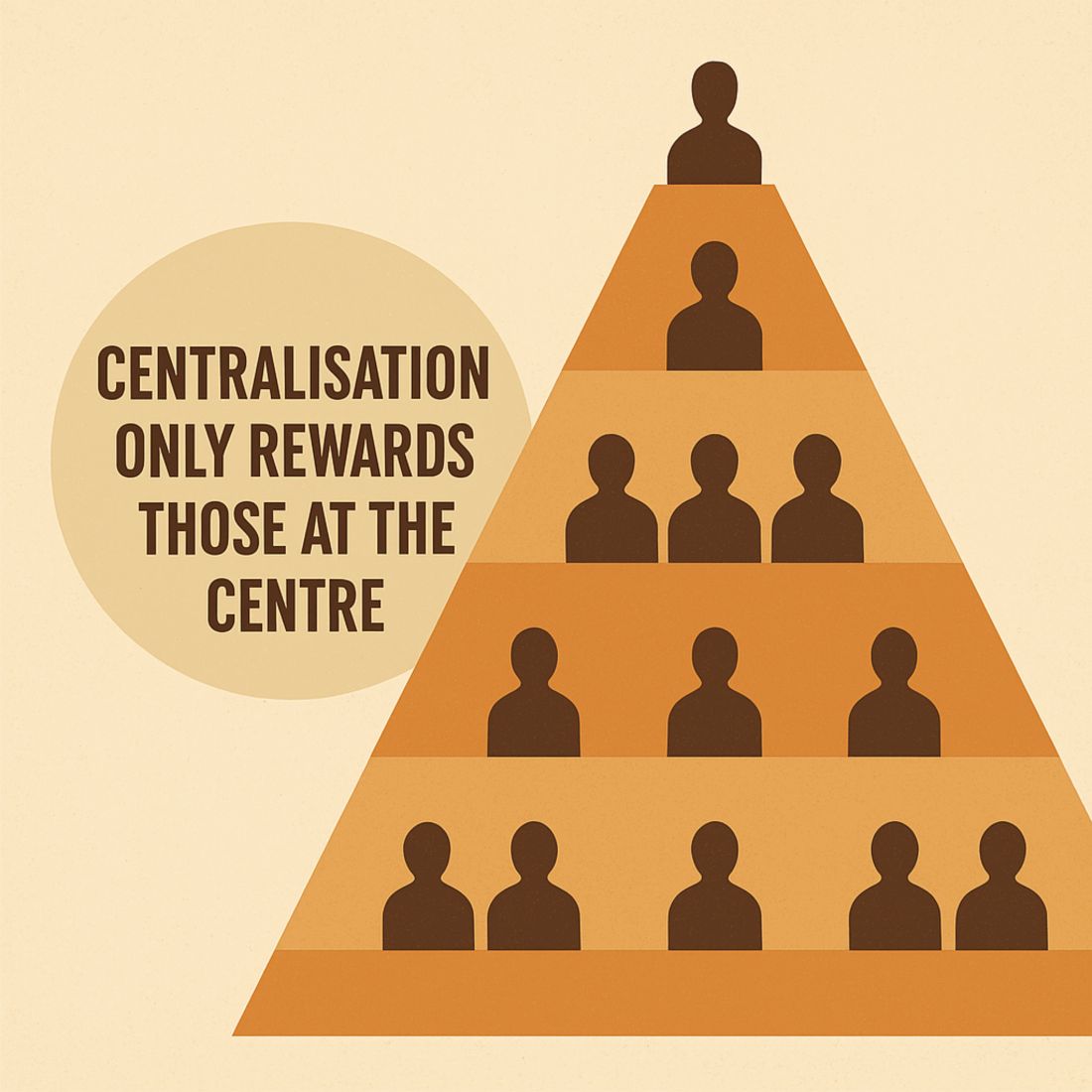
And centralisation only ever rewards those at the centre.
SECTION 5 – How Centralisation Sustains Abstraction
Once you see how abstraction pulls life away from the local, the next questions become unavoidable:
Why has so much of life been lifted out of the local in the first place?
Who benefits from life becoming abstract?
And why does the system keep moving further away from the real?
The answer is centralisation.
Centralisation is not an accident. It is not a side‑effect. It is not an unfortunate by‑product of “modern life.”
Centralisation is the mechanism that makes the abstract world possible.
It is the structure that takes power, ownership, and decision‑making away from the local – away from the people who live with the consequences – and moves it upward, into the hands of those who benefit from distance.
And once you understand centralisation, you understand why the world feels the way it does.
Centralisation grows because abstraction feeds it
The money‑centric system we live in today is built on a simple equation:
Money → Wealth → Power → Control → Centralisation
Everyone understands the first step.
Even people with very little money know that money gives them more control over their own lives.
But as you move up the hierarchy, the dynamic changes.
Money no longer gives control over your own life – it gives control over other people’s lives.
And once that dynamic exists, centralisation becomes inevitable.
Because the more centralised a system becomes, the easier it is for those at the centre to extract value from everyone else.
Centralisation rewards the centre.
Abstraction hides the extraction.
Locality is the only thing that resists it.
This is why the system keeps pulling life away from the local.
Locality is real. Locality is human. Locality is healthy. Locality is accountable.
And centralisation cannot survive in a world where people live real, local lives.
Centralisation always removes the local – and replaces it with the abstract
You can see this pattern everywhere once you know what to look for.
Food used to be local. Now it is controlled by global supply chains, supermarket monopolies, and distant corporations.
Work used to be local. Now it is shaped by national policy, global markets, and corporate structures that have no relationship to the communities they affect.
Governance used to be local. Now decisions are made by people who will never meet those they govern.
Education used to be rooted in community life. Now it is delivered through standardised curricula designed far away from the children they are meant to serve.
Health used to be grounded in local knowledge, local relationships, and local responsibility. Now it is managed through centralised systems that treat people as data points.
In every case, the pattern is the same:
Centralisation removes life from the local and replaces it with the abstract.
And because abstraction is unhealthy – physically, mentally, socially, environmentally – centralisation always harms the people furthest from the centre.
Centralisation creates distance – and distance removes empathy
When decisions are made locally, they are made by people who see the consequences.
When decisions are made centrally, they are made by people who never do.
This is why centralised systems feel cold, bureaucratic, and indifferent.
It is not because the people inside them are bad.
It is because the structure itself removes the human connection that makes good decisions possible.
A policymaker in Westminster does not see the farmer whose livelihood is destroyed by a regulation. A supermarket executive does not see the community that loses its last local shop. A global corporation does not see the soil degraded by its supply chain. A distant official does not see the child who never learns where food comes from.
Centralisation makes harm invisible – and therefore easy.
Centralisation is the opposite of locality – and the opposite of health
Locality is real. Locality is grounding. Locality is healthy.
Centralisation is abstract. Centralisation is distancing. Centralisation is unhealthy.
Locality connects people to life. Centralisation disconnects people from life.
Food shows us this more clearly than anything else.
When food is local, people are healthy – physically and mentally.
When food is abstract, people become dependent, disconnected, and unwell.
This is not a coincidence. It is the structure of the system.
Centralisation only rewards those at the centre
This is the truth that sits beneath everything:
Centralisation always rewards the centre and always harms the local.
It cannot do anything else.
Because centralisation is built on extraction – the extraction of wealth, power, autonomy, and meaning from the many to benefit the few.
And the only way to maintain that extraction is to keep life abstract.
Because abstraction hides the mechanism. Abstraction hides the harm. Abstraction hides the loss of agency. Abstraction hides the loss of independence. Abstraction hides the loss of community. Abstraction hides the loss of health.
Once you see this, you understand why nothing will change until we stop living in the abstract and return life to the local.
And that is where the doorway opens.
Because if centralisation is the engine of the abstract world, then locality is the engine of the real one.
And LEGS is the structure that makes that return possible.
SECTION 6 – Locality: Where Life Becomes Real
Once you understand how abstraction pulls life away from the real, and how centralisation keeps everything abstract, the next truth becomes impossible to ignore:
Real life only exists at the local scale.
Everything else is a managed simulation.
This isn’t ideology. It isn’t nostalgia. It isn’t a romantic longing for the past.
It is simply how human beings work.
Locality is the natural scale of human life because it is the only scale where life can be experienced directly – through our senses, our relationships, our responsibilities, and our contributions.
Locality is where we see the consequences of our actions.
Locality is where we understand the world around us.
Locality is where we feel connected to something bigger than ourselves.
Locality is where we experience meaning.
Locality is where we experience health – physical, mental, emotional, social.
Locality is real. Locality is grounding. Locality is human. Locality is healthy.
And food shows us this more clearly than anything else.
Food proves that locality is the natural scale of life
When food is local, it is part of daily life.
You see it. You touch it. You smell it. You prepare it. You share it. You understand it.
Food becomes a relationship – not a product.
And because food is real, life becomes real.
People who live close to their food systems are more grounded, more resilient, more connected, and more mentally healthy.
They understand the rhythms of nature. They understand the value of effort. They understand the meaning of contribution. They understand the importance of community.
Local food systems create local understanding. Local understanding creates local agency. Local agency creates local resilience. Local resilience creates local freedom.
This is why every healthy society in history has been rooted in locality.
Not because people were primitive. Not because they lacked technology. But because locality is the only scale where life can be lived fully.
Abstraction destroys the grounding that locality provides
When food becomes abstract, life becomes abstract.
People no longer understand the world around them. They no longer feel connected to anything real. They no longer feel capable of providing for themselves. They no longer feel part of a community. They no longer feel grounded in place. They no longer feel secure.
This is why anxiety rises. This is why depression rises. This is why loneliness rises. This is why communities fracture. This is why people feel lost.
It is not because people have changed. It is because the scale of life has changed.
We are trying to live human lives inside systems that are not human.
Locality restores what abstraction removes
When life returns to the local, everything changes.
People begin to feel connected again. They begin to feel capable again. They begin to feel responsible again. They begin to feel valued again. They begin to feel grounded again. They begin to feel healthy again.
Locality restores:
meaning
agency
contribution
community
resilience
identity
belonging
stability
health
Locality is not small. Locality is not limiting. Locality is not backward.
Locality is the scale at which human beings thrive.
And this is the doorway into the next part of the argument:
If locality is the natural scale of life, then we need a system that is built around locality – not around centralisation, abstraction, or money.
We need a system that:
restores real life
restores real value
restores real contribution
restores real community
restores real governance
restores real independence
restores real health
This is where LEGS enters the picture.
LEGS is not an idea. LEGS is not a theory. LEGS is not an ideology.
LEGS is the practical structure that makes locality work – economically, socially, and politically.
And the first step in that structure is the Basic Living Standard.
SECTION 7 – The Basic Living Standard: Security for Real Life
If locality is the natural scale of human life, then the next questions are simple:
What stops people from living locally today?
What prevents people from reconnecting with real life?
What keeps them trapped in the abstract world?
The answer is fear.
Not dramatic fear. Not panic. Not terror.
A quieter fear – the fear of falling.
The fear of not being able to pay the rent. The fear of not being able to heat the home. The fear of not being able to feed the family. The fear of losing work. The fear of losing stability. The fear of losing everything.
This fear is the glue that holds the abstract world together.
It is the mechanism that keeps people compliant, exhausted, distracted, and dependent. It is the reason people stay in jobs that drain them. It is the reason people accept systems that harm them. It is the reason people tolerate centralisation, even when it destroys their communities. It is the reason people cannot step back into real life, even when they can see the doorway.
Fear is the invisible chain that binds people to the abstract world.
And that is why the Basic Living Standard exists.
The Basic Living Standard removes the fear that keeps people trapped in the abstract
The Basic Living Standard (BLS) is not a benefit. It is not welfare. It is not charity. It is not a safety net.
It is the foundation of a healthy society – the point at which survival is no longer tied to employment, and life is no longer held hostage by money.
The BLS guarantees that every person who works a full week at the lowest legal wage can meet all of their essential needs:
food
housing
heat
water
clothing
healthcare
transport
communication
basic participation in community life
This is not generosity. This is not ideology. This is not utopian.
This is the minimum requirement for a real life.
Because without security, people cannot live locally. Without security, people cannot contribute freely. Without security, people cannot think clearly. Without security, people cannot be healthy – physically or mentally. Without security, people cannot resist centralisation. Without security, people cannot step out of the abstract world.
The BLS removes the fear that centralisation depends on.
It breaks the coercive link between survival and employment. It breaks the psychological link between money and worth. It breaks the structural link between centralisation and control.
It gives people the ground beneath their feet.
The BLS makes locality possible again
Locality is not just a preference. It is a way of living that requires stability.
You cannot grow food if you are terrified of losing your home. You cannot contribute to your community if you are working three jobs to survive. You cannot learn real skills if you are constantly firefighting your finances. You cannot participate in local governance if you are exhausted by insecurity. You cannot build a real life if you are trapped in the abstract one.
The BLS creates the conditions in which locality can flourish.
It gives people the freedom to:
choose meaningful work
contribute to their community
learn real skills
participate in local governance
grow food
support neighbours
build resilience
live with dignity
The BLS is not the end of the journey. It is the beginning.
It is the point at which people can finally lift their heads from the grind of survival and see the world around them – the real world, not the abstract one.
The BLS restores the meaning of contribution
In the abstract world, work is a transaction.
In the real world, work is a contribution.
The BLS makes this shift possible.
When survival is guaranteed, people no longer work out of fear. They work out of purpose. They work out of interest. They work out of ability. They work out of connection. They work out of contribution.
This is the foundation of a healthy local economy.
Not competition. Not scarcity. Not extraction. Not centralisation.
Contribution.
And contribution only becomes possible when people are no longer trapped in the abstract world by fear.
The BLS is the first structural step back into real life
Locality is the natural scale of human life. But locality cannot function without security.
The BLS provides that security.
It is the point at which:
fear dissolves
agency returns
contribution becomes possible
community becomes real
locality becomes viable
centralisation loses its grip
abstraction loses its power
The BLS is the foundation of LEGS because it is the foundation of real life.
It is the moment where the abstract world begins to fall away, and the real world begins to reappear.
And once the foundation is in place, the next step becomes clear:
Food is the clearest example of how life has been lifted out of the real and placed into the abstract. But it is only the doorway. Once you step through it, you begin to see the same pattern everywhere.
Because the truth is this:
We are not just eating in the abstract.
We are living in the abstract.
Food simply makes the invisible visible.
When you realise that your relationship with food has become abstract, you begin to notice that your relationship with almost everything else has too.
Work has become abstract
Work used to be something people did for each other – a contribution to the life of the community. You could see the value of your work. You could see who it helped. You could see the difference it made.
Today, work is defined by:
job titles
performance metrics
compliance systems
productivity dashboards
wages
contracts
HR policies
Work has become a transaction, not a contribution.
You don’t see who benefits. You don’t see the outcome. You don’t see the meaning. You only see the abstraction.
And because work is abstract, it is unhealthy – mentally, emotionally, socially.
Value has become abstract
Value used to be rooted in usefulness, skill, care, and contribution.
Today, value is defined by price – a number that often has no relationship to the real worth of anything.
A handmade loaf of bread is “worth” less than a factory loaf.
A neighbour who cares for an elderly parent is “worth” nothing in economic terms.
A farmer who grows real food is “worth” less than a corporation that processes it.
Price has replaced meaning. Money has replaced value. Abstraction has replaced reality.
Governance has become abstract
Governance used to be local, human, and accountable.
Decisions were made by people who lived among those affected by them.
Today, governance is:
distant
bureaucratic
centralised
opaque
unaccountable
Policies are written by people who will never meet the communities they shape.
Rules are imposed by people who will never experience their consequences.
Governance has become abstract – and therefore unhealthy.
Community has become abstract
Community used to be lived.
It used to be physical. It used to be relational. It used to be local.
Today, “community” is:
a slogan
a marketing term
a digital group
a brand identity
a political talking point
People live near each other, but not with each other.
They share space, but not life.
They share information, but not responsibility.
Community has become abstract – and therefore fragile.
Identity has become abstract
Identity used to be shaped by:
relationships
contribution
place
experience
responsibility
community
Today, identity is shaped by:
job titles
income brackets
digital profiles
algorithms
branding
labels
Identity has become abstract – and therefore unstable.
Food is not the whole story – it is the proof
Food is the example that exposes the pattern.
Because food cannot be abstract without consequences.
Food cannot be centralised without harm.
Food cannot be disconnected from daily life without disconnecting people from life itself.
And once you see this in food, you begin to see it everywhere.
You begin to see that the abstract world is not natural. You begin to see that the abstract world is not inevitable. You begin to see that the abstract world is not healthy. You begin to see that the abstract world is not sustainable. You begin to see that the abstract world is not human.
And you begin to see why life feels the way it does.
Food is the doorway. But the destination is understanding the entire structure of the abstract world – and why we must leave it behind.
And that brings us to the next step:
If abstraction is the problem, and locality is the solution, then we need a system built entirely around locality.
That system is LEGS.
SECTION 9 – LEGS: Rebuilding Real Life
By now, the pattern is clear:
The abstract world is unhealthy.
Centralisation keeps life abstract.
Locality is the natural scale of human life.
The Basic Living Standard removes the fear that keeps people trapped in the abstract.
But recognising the problem is only half the journey.
The next step is understanding the structure that replaces it.
Because locality is not just a feeling. It is not just a preference. It is not just a philosophy.
Locality requires a system – a practical, grounded, human system – that allows people to live real lives again.
That system is the Local Economy & Governance System (LEGS).
LEGS is not an ideology.
LEGS is not a political programme.
LEGS is not a utopian dream.
LEGS is a design – a structure built around the natural scale of human life.
It is the opposite of the abstract world. It is the opposite of centralisation. It is the opposite of the money‑centric system.
LEGS is what life looks like when it returns to the local.
LEGS begins with a simple truth: people are the value of the economy
In the abstract world, value is defined by money.
In the real world, value is defined by people.
LEGS restores this truth.
It recognises that:
people create value
people sustain communities
people maintain the environment
people are the economy
Money is not the centre.
People are.
This single shift changes everything.
Because when people are the value, the economy must be built around people – not the other way around.
LEGS restores the natural relationship between people, work, and community
In the abstract world, work is a transaction.
In the real world, work is a contribution.
LEGS makes this shift possible by:
removing fear through the Basic Living Standard
grounding work in the needs of the community
recognising contribution in all its forms
ensuring that work is visible, meaningful, and connected to real life
Work becomes something you do with your community, not something you do for a distant system.
This is how work becomes healthy again – mentally, physically, socially.
LEGS restores locality to the centre of economic life
The abstract world depends on distance.
LEGS depends on proximity.
It brings:
production
exchange
governance
responsibility
contribution
decision‑making
back to the scale where life is actually lived.
This is not small. This is not limiting. This is not backward.
This is the scale at which human beings thrive.
LEGS makes food local again – because food is the anchor of real life
Food is not the whole story, but it is the centre of the story.
Because food is the one part of life that cannot be abstract without consequences.
LEGS restores:
local food production
local food processing
local food exchange
local food skills
local food resilience
Food becomes part of daily life again – not a distant system controlled by people you will never meet.
And when food becomes local, life becomes local.
LEGS restores governance to the people who live with the consequences
In the abstract world, governance is distant and unaccountable.
In the real world, governance is local and human.
LEGS replaces:
hierarchy with participation
bureaucracy with responsibility
distance with proximity
abstraction with lived experience
Decisions are made by the people who live with the outcomes – not by distant institutions.
This is what real democracy looks like.
This is what real accountability looks like.
This is what real community looks like.
LEGS is not a theory – it is a practical system built on natural principles
LEGS works because it is built on the same principles that have sustained human life for thousands of years:
locality
contribution
reciprocity
transparency
shared responsibility
community
stewardship
human scale
These are not political ideas.
These are human truths.
LEGS simply gives them structure.
LEGS is the system that replaces the abstract world
The abstract world is collapsing – socially, economically, environmentally, psychologically.
LEGS is not a reaction to that collapse.
LEGS is the alternative that makes sense once you understand why the collapse is happening.
Because LEGS is:
local where the abstract world is centralised
real where the abstract world is false
human where the abstract world is mechanical
healthy where the abstract world is harmful
grounded where the abstract world is unstable
meaningful where the abstract world is empty
LEGS is not the future because it is new.
LEGS is the future because it is natural.
It is the structure that allows people to live real lives again – lives that are grounded, connected, meaningful, and healthy.
And once you see the abstract world clearly, LEGS stops looking radical.
It starts looking obvious.
SECTION 10 – The Revaluation: Seeing the Real World Anew
There is a moment – sometimes sudden, sometimes gradual – when the abstract world stops feeling normal.
A moment when the distance, the confusion, the instability, the disconnection, the exhaustion, the sense that life is happening somewhere else finally becomes visible.
A moment when you realise that the world you have been living in is not the real world at all – it is a constructed world, an abstract world, a world built on distance, centralisation, and money.
That moment is the beginning of The Revaluation.
The Revaluation is not a policy.
It is not a programme.
It is not a political movement.
The Revaluation is a shift in perception – a change in how you see value, meaning, contribution, community, and life itself.
It is the moment when you stop accepting the abstract world as inevitable, and begin to see it for what it is: a system built on distance, dependency, and fear.
And it is the moment when you begin to see locality – real life – again.
The Revaluation begins when you see the abstract world clearly
For most people, the abstract world is invisible because it is normal.
We grow up inside it. We are educated inside it. We work inside it. We consume inside it. We are governed inside it.
We mistake the abstract for the real because we have never known anything else.
But once you see the pattern – once you see how food has become abstract, how work has become abstract, how value has become abstract, how governance has become abstract – you cannot unsee it.
You begin to notice the distance everywhere.
You begin to notice the disconnection everywhere.
You begin to notice the centralisation everywhere.
You begin to notice the harm everywhere.
This is the first stage of The Revaluation: seeing clearly.
The Revaluation deepens when you understand what locality really means
Locality is not small. Locality is not nostalgic. Locality is not backward.
Locality is the natural scale of human life.
It is the scale at which:
meaning is created
relationships are formed
contribution is visible
responsibility is shared
governance is human
food is real
work is purposeful
value is grounded
identity is stable
health is supported
Locality is not a political idea.
Locality is a human truth.
And once you see locality clearly, you begin to understand what has been taken from you – and what can be restored.
This is the second stage of The Revaluation: understanding deeply.
The Revaluation becomes real when you recognise your own place in it
The abstract world teaches people to feel powerless.
It teaches people to believe that change is something done by others.
It teaches people to believe that systems are fixed, permanent, immovable.
But once you see the abstract world clearly, and once you understand locality deeply, something else happens:
You begin to feel your own agency again.
You begin to feel your own value again.
You begin to feel your own contribution again.
You begin to feel your own connection again.
You begin to feel your own responsibility again.
You begin to feel your own humanity again.
This is the third stage of The Revaluation: reclaiming yourself.
The Revaluation is the bridge between the abstract world and the real one
The Revaluation is not the end of the journey. It is the beginning.
It is the moment when:
the abstract world becomes visible
the real world becomes imaginable
locality becomes desirable
centralisation becomes unacceptable
fear becomes unnecessary
contribution becomes meaningful
community becomes possible
LEGS becomes obvious
The Revaluation is the shift in consciousness that makes the return to real life possible.
It is the moment when the reader – without being told – begins to feel:
“I want to live in the real world again.”
And that is the doorway into the final section.
Because once you see the abstract world clearly, and once you understand locality deeply, and once you recognise your own agency, the next questions become simple:
What does a real life actually look like?
And how do we build it?
That is where we go next.
SECTION 11 – What Local Life Truly Means
By now, the shape of the truth is visible.
You can see the abstract world for what it is: a system built on distance, centralisation, and money – a system that disconnects people from the real, from each other, and from themselves.
You can see how food exposes the pattern – not because food is the whole story, but because food refuses to be abstract without consequences.
You can see how centralisation maintains the abstract world by removing life from the local and placing it in the hands of people who never experience the outcomes of their decisions.
You can see how locality is the natural scale of human life – the scale at which meaning, health, contribution, and community become possible again.
You can see how the Basic Living Standard removes the fear that keeps people trapped in the abstract world.
You can see how LEGS provides the structure that allows real life to function again – economically, socially, and politically.
And you can see how The Revaluation is not a policy or a programme, but a shift in consciousness – the moment when the real world becomes visible again.
So what does a real, local, human life actually look like?
It looks like this:
A life where food is part of daily experience, not a distant system
You know where your food comes from. You know who grew it. You know how it was made. You know what it means.
Food becomes grounding again – physically, mentally, emotionally, socially.
Food becomes a relationship, not a product.
Food becomes the anchor of real life.
A life where work is contribution, not coercion
You work because you want to contribute, not because you fear falling.
You see the impact of what you do. You see who benefits. You see the meaning.
Work becomes human again.
Work becomes visible again.
Work becomes part of community life again.
A life where value is real, not abstract
Value is no longer defined by price.
Value is defined by usefulness, contribution, care, skill, and meaning.
A neighbour who helps an elder is valued. A farmer who grows real food is valued. A craftsperson who repairs what others throw away is valued. A parent who raises children is valued.
Value becomes grounded again.
A life where governance is local, human, and accountable
Decisions are made by people who live with the consequences.
Governance is not distant. Governance is not abstract. Governance is not bureaucratic.
It is participatory. It is transparent. It is relational. It is human.
This is what real democracy looks like.
A life where community is lived, not imagined
Community is not a slogan.
It is not a digital group. It is not a marketing term.
Community is the people you see, speak to, help, support, and rely on.
It is the people who share responsibility with you. It is the people who share the place with you. It is the people who share life with you.
Community becomes real again.
A life where identity is grounded, not constructed
Identity is no longer defined by job titles, income brackets, or digital profiles.
Identity is shaped by:
contribution
relationships
place
responsibility
experience
community
Identity becomes stable again.
A life where health is supported by the structure of daily living
Locality reduces stress.
Contribution reduces anxiety.
Community reduces loneliness.
Real food improves physical health.
Real relationships improve mental health.
Real responsibility improves emotional health.
Health becomes a natural outcome of real life – not a service purchased in the abstract world.
A life where the environment is cared for because people live close to it
When life is local, the environment is not an idea.
It is the place you live. It is the soil you depend on. It is the water you drink. It is the air you breathe.
Money does not dominate. Money does not accumulate. Money does not control.
Money becomes what it always should have been: a tool for exchange, nothing more.
A life where fear no longer dictates behaviour
The Basic Living Standard removes the fear of falling.
And when fear disappears, something else appears:
agency
dignity
contribution
creativity
responsibility
connection
meaning
Fear is the foundation of the abstract world.
Security is the foundation of the real one.
A life where the abstract world finally loses its power
Once you see the abstract world clearly, it stops feeling inevitable.
Once you understand locality deeply, it stops feeling small.
Once you recognise your own agency, you stop feeling powerless.
Once you see LEGS, you stop feeling trapped.
And once you experience even a glimpse of real life – grounded, local, human – the abstract world begins to feel as strange as it truly is.
This is a doorway
This essay is not the whole journey. It is a doorway.
It is the moment where the abstract world becomes visible, and the real world becomes imaginable.
It is the moment where you begin to see that the life you have been living is not the only life available.
It is the moment where you begin to understand that locality is not a step backward – it is the only step forward that makes sense.
It is the moment where LEGS stops looking radical and starts looking obvious.
It is the moment where The Revaluation begins.
And once you step through this doorway, the rest of the work – the deeper structures, the practical mechanisms, the full system – are waiting for you.
Not as theory. Not as ideology. Not as abstraction.
But as the architecture of a real, local, human life.
Closing Reflection
When the Real World Stops Looking Abstract
If you have reached this point, something important has already happened.
You have seen the abstract world clearly enough to recognise its shape.
You have seen how distance, centralisation, and money have replaced the real with the artificial.
You have seen how food reveals the pattern.
You have seen how locality restores what abstraction removes.
You have seen how the Basic Living Standard and LEGS make real life possible again.
But more importantly, you have felt something shift.
The real world – the local, the human, the grounded – no longer looks abstract.
It no longer looks naïve. It no longer looks unrealistic.
It looks obvious.
This is the beginning of The Revaluation – the moment when the real becomes visible again, and the abstract begins to lose its power.
It is the moment when you realise that rejecting the real was never a rational choice – it was a conditioned response.
It is the moment when you recognise that the systems we inherited were never designed for human wellbeing.
It is the moment when you understand that stepping back into the real is not a risk – it is a return.
A return to meaning. A return to agency. A return to contribution. A return to community. A return to health. A return to life.
This essay is not the end of the journey.
It is the threshold.
Beyond this point lies the deeper work – the full architecture of The Local Economy & Governance System, the Basic Living Standard, the Local Market Exchange, the redefinition of work, the restoration of value, the rebuilding of governance, and the practical steps that make a real, local, human life possible again.
If the abstract world once felt like the only world available, and the real world once felt like an abstraction, that illusion has now begun to dissolve.
You are standing at the doorway.
The rest of the journey is yours to choose.
Further Reading: Stepping Beyond Abstraction
The essay “Out of the Abstract” invites readers to step through a doorway – leaving behind a world shaped by distance, centralisation, and abstraction, and returning to a life grounded in locality, contribution, and real value.
The following readings are curated to guide you further along this path, each expanding on the foundational concepts and practical steps introduced in the essay.
Whether you seek philosophical context, practical frameworks, or blueprints for change, these resources offer a coherent continuation of the journey.
1. Foundations of a People-First Society
The Philosophy of a People-First Society https://adamtugwell.blog/2026/01/02/the-philosophy-of-a-people-first-society/ Summary: This piece lays the philosophical groundwork for a society that prioritises human wellbeing over abstract systems. It explores the values, principles, and mindset shifts necessary to move from centralised, money-centric structures to local, people-first communities. The essay provides context for why locality is not just preferable, but essential for meaningful, healthy lives.
2. The Architecture of Locality: LEGS and Its Ecosystem
The Local Economy & Governance System (LEGS) – Online Text https://adamtugwell.blog/2025/11/21/the-local-economy-governance-system-online-text/ Summary: This comprehensive resource details the LEGS framework, the practical system designed to restore locality as the natural scale of human life. It explains how LEGS re-centres value, work, and governance around people and communities, providing the structure for economic and social resilience.
Visit the LEGS Ecosystem https://adamtugwell.blog/2025/12/31/visit-the-legs-ecosystem/ Summary: This link offers a guided exploration of the LEGS ecosystem, showcasing real-world applications, solutions, and the impact of locality-driven systems. It’s an invitation to see how theory can become practice, and how communities can thrive when grounded in local principles.
The Contribution Culture: Transforming Work, Business, and Governance for Our Local Future with LEGS https://adamtugwell.blog/2025/12/30/the-contribution-culture-transforming-work-business-and-governance-for-our-local-future-with-legs/ Summary: This essay explores the shift from transactional work to meaningful contribution, showing how LEGS enables a culture where work is valued for its impact on community and wellbeing. It discusses the transformation of business and governance when contribution, not extraction, becomes the central principle.
4. Food, Security, and Community Resilience
Foods We Can Trust – A Blueprint for Food Security and Community Resilience in the UK https://adamtugwell.blog/2025/12/15/foods-we-can-trust-a-blueprint-for-food-security-and-community-resilience-in-the-uk-online-text/ Summary: Building on the essay’s theme that food is the anchor of real life, this blueprint offers practical strategies for restoring local food systems, ensuring food security, and strengthening community resilience. It demonstrates how food education, production, and sharing can reconnect people to the real world.
5. The Basic Living Standard: Security as Foundation
The Basic Living Standard Explained https://adamtugwell.blog/2025/10/24/the-basic-living-standard-explained/ Summary: This resource clarifies the concept of the Basic Living Standard (BLS), the foundation that removes fear and enables people to live locally. It explains how BLS guarantees essential needs, liberates individuals from the coercion of abstract systems, and creates the conditions for genuine contribution and community.
6. Centralisation and Its Consequences
Centralisation Only Rewards Those at the Centre https://adamtugwell.blog/2026/01/31/centralisation-only-rewards-those-at-the-centre/ Summary: This essay exposes the mechanisms and consequences of centralisation, showing how it perpetuates abstraction, distance, and inequality. It complements the main text’s argument by detailing why centralisation undermines locality and how reclaiming the local is essential for health, agency, and democracy.
Conclusion
Together, these readings form a coherent pathway for anyone seeking to move “out of the abstract” and into a reality that is local, human, and whole.
They offer philosophical depth, practical frameworks, and actionable blueprints – each one a step further into the architecture of a life that makes sense.
Frequently Asked Questions & Common Objections
1. Isn’t locality just nostalgia or romanticism?
Answer: Locality is not about longing for the past or rejecting progress. It’s the natural scale at which human beings thrive – where relationships, meaning, and health are experienced directly.
The argument for locality is grounded in practical realities: when life is lived locally, people are more resilient, communities are stronger, and systems are more accountable. Locality is not backward; it’s the foundation for a future that makes sense.
2. Is centralisation always bad?
Answer: Centralisation isn’t inherently evil, but when it becomes the dominant organising principle, it creates distance, removes empathy, and undermines accountability.
The problem arises when centralisation replaces local agency and turns lived experience into abstraction.
The goal is not to eliminate all central systems, but to restore balance – ensuring that decisions and value creation happen at the scale where people actually live.
3. Isn’t locality inefficient compared to global systems?
Answer: Efficiency is often measured in terms of speed, scale, or profit, but these metrics can hide the true costs: loss of meaning, health, and resilience.
Local systems may appear less “efficient” in narrow economic terms, but they excel at creating stability, agency, and wellbeing.
Locality is not small or limiting – it’s the scale at which human beings can flourish, adapt, and sustain themselves.
4. How can locality work in urban or highly connected environments?
Answer: Locality is not limited to rural areas. Urban communities can – and do – build local food systems, governance structures, and networks of mutual support.
The principles of locality apply wherever people live: grounding life in relationships, contribution, and shared responsibility.
Technology can be harnessed to strengthen local connections, not just to centralise control.
5. What about global challenges like climate change or pandemics?
Answer: Global challenges require cooperation across scales, but local resilience is essential for effective response.
Local systems are better able to adapt, mobilise, and care for their members.
The argument is not for isolation, but for restoring the capacity of communities to act meaningfully – while still collaborating globally where needed.
6. Isn’t the Basic Living Standard (BLS) just another form of welfare?
Answer: The BLS is not welfare, charity, or a safety net.
It’s a structural guarantee that every person who works a full week at the lowest legal wage can meet their essential needs.
The BLS removes the fear that keeps people trapped in the abstract world, enabling genuine contribution, agency, and community. It’s the foundation for a healthy society, not a handout.
7. How does LEGS differ from other economic or governance models?
Answer: LEGS – The Local Economy & Governance System – is not an ideology or utopian dream. It’s a practical structure built around the natural scale of human life.
LEGS centres value, work, and governance on people and communities, rather than money or distant institutions.
It restores visibility, accountability, and meaning to everyday life.
8. Isn’t this vision unrealistic in today’s world?
Answer: What’s truly unrealistic is expecting people to thrive in systems that disconnect them from meaning, agency, and community.
The abstract world is collapsing – socially, economically, and environmentally.
The vision of locality, BLS, and LEGS is not radical; it’s obvious once you see the costs of abstraction.
The journey begins with a shift in consciousness, and practical steps are possible for individuals, communities, and policymakers.
9. How do I start making my life more local and real?
Answer: Begin by noticing where abstraction has replaced reality in your daily life – food, work, relationships, governance.
Seek out opportunities to reconnect: grow or source local food, participate in community initiatives, support local businesses, and engage in local decision-making.
The journey is incremental, but every step toward locality restores meaning, agency, and health.
Glossary of Key Terms
Abstraction The process by which real, lived experiences are replaced by distant systems, representations, or mechanisms.
In the context of this book, abstraction refers to the way modern life is organised around concepts, structures, and processes that are removed from direct human experience.
Locality The natural scale of human life, where relationships, value, and meaning are experienced directly.
Locality emphasises living, working, and governing at the community or human scale, as opposed to distant or centralised systems.
Centralisation The concentration of power, decision-making, and resources in distant institutions or authorities, often at the expense of local agency and accountability.
Centralisation is identified as the engine that perpetuates abstraction and undermines local resilience.
Basic Living Standard (BLS) A structural guarantee that every person who works a full week at the lowest legal wage can meet all essential needs – food, housing, heat, water, clothing, healthcare, transport, communication, and basic participation in community life.
The BLS is designed to remove the fear that keeps people trapped in abstract systems.
Local Economy & Governance System (LEGS) A practical framework for organising economic and social life at the local scale.
LEGS centres value, work, and governance on people and communities, restoring visibility, accountability, and meaning to everyday life.
Contribution Work or effort that benefits the community or others, as opposed to transactional labour driven by fear or necessity.
Contribution is valued for its impact on wellbeing and community, not just its economic output.
Revaluation A shift in consciousness where individuals begin to see the abstract world clearly, understand the importance of locality, and reclaim agency, meaning, and connection.
The Revaluation marks the beginning of the journey back to real, local, human life.
Food Security The condition in which communities have reliable access to sufficient, safe, and nutritious food produced and distributed locally.
Food security is presented as a cornerstone of local resilience and wellbeing.
Community A group of people who share responsibility, relationships, and lived experience at the local scale.
Community is distinguished from abstract or digital groups by its grounding in place and mutual support.
Agency The capacity of individuals or communities to act meaningfully, make decisions, and shape their own lives.
Agency is diminished by abstraction and centralisation, but restored through locality and the Basic Living Standard.
Resilience The ability of individuals or communities to adapt, recover, and thrive in the face of challenges.
Local systems are described as more resilient than centralised ones because they are grounded in relationships and direct experience.
For months I’ve been writing about The Local Economy & Governance System (LEGS) and The Basic Living Standard. Yet I’m always aware of a deeper challenge: until people truly see the mechanics of the money‑centric system we live in – not just the symptoms, but the structure – the need for a paradigm shift can feel abstract.
The irony is that the evidence sits in front of us every day. The system hides in plain sight. But because we have been conditioned to treat money as the unquestionable centre of life, we rarely recognise how deeply it shapes our behaviour, our morality, our relationships, our communities, and even our understanding of what it means to be human.
Money today is not simply a medium of exchange. It has become the organising principle of society – the lens through which value is defined, the gatekeeper of freedom, the arbiter of worth, and the mechanism through which power is accumulated. And because money has been elevated to this position, the consequences extend far beyond currency itself. They reach into motivation, identity, governance, and the very structure of our lives.
This is why centralisation exists.
This is why it grows.
This is why it always rewards those at the centre – and harms everyone else.
The money–power–centralisation equation
The relationship is simple:
Money → Wealth → Power → Control → Centralisation
Everyone understands this at some level. Even those with the least money know that having money gives them more control over their own lives.
But as you move up the hierarchy of the money‑centric system, the dynamic changes. Money no longer gives control over your own life – it gives control over other people’s lives.
And once that dynamic exists, centralisation becomes inevitable.
Centralisation is not an accident.
It is not a side‑effect.
It is the natural outcome of a system built on scarcity, hierarchy, and accumulation.
The more money someone has, the more they can centralise power. The more power they centralise, the more money they can extract.
The cycle feeds itself.
This is the architecture of the money‑centric paradigm.
What centralisation really is
People often imagine centralisation as a simple chain of command. But in reality, it is a network of overlapping chains – each one transferring power, ownership, and influence upward, away from the people affected by decisions and toward a distant centre.
Every chain works the same way:
power flows upward
responsibility flows downward
accountability disappears
humanity is lost
And because these chains replicate across every sector – politics, business, food, media, technology, governance – they form a vast web of dependency and control.
Centralisation is not just structural.
It is psychological. It is cultural. It is economic. It is moral.
It is the mechanism through which the money‑centric system maintains itself.
The trick: centralisation is sold as “efficiency”
One of the most effective illusions of the money-centric system is the way centralisation is presented as:
reasonable
intelligent
cost‑effective
efficient
modern
inevitable
People are told that centralisation “reduces duplication”, “streamlines services”, “saves money”, or “improves coordination”.
But the truth is simple:
Centralisation always reduces the number of people with power.
It always increases the distance between decision‑makers and those affected.
It always concentrates wealth and influence in fewer hands.
And because distance removes empathy, centralisation always leads to dehumanisation.
Where we see centralisation at work
You can see the pattern everywhere:
Politics – power pulled upward into party machines, donor networks, and distant executives.
Government – “devolution” used as a cover for regional centralisation, reducing local representation and increasing control from Westminster.
Globalisation – local economies hollowed out as production and decision‑making move offshore.
Corporate structures – small businesses replaced by multinational giants.
Supply chains – farmers and producers trapped by supermarket monopolies.
In every case, the story is the same:
Centralisation removes local agency and transfers power upward.
The dehumanisation effect
As centralisation grows, the number of links between people and the centre increases. Each link removes a layer of humanity.
When decision‑makers have no direct contact with the people affected by their decisions, they stop seeing them as people at all.
This is why:
Policies harm communities without anyone taking responsibility
Corporations exploit workers and environments without remorse
Governments impose rules without understanding consequences
Systems become cold, bureaucratic, and indifferent
Centralisation creates distance.
Distance removes empathy.
Lack of empathy enables harm.
This is the psychological architecture of the money‑centric world.
The damage centralisation has caused
We have been told for decades that centralisation “makes life easier” and “reduces cost”. But the lived reality is the opposite:
People cannot afford to live independently on a minimum wage.
Communities have lost identity, cohesion, and purpose.
Local businesses have been replaced by corporate monoliths.
Supply chains have become fragile and exploitative.
The environment has been degraded for profit.
Wealth has been transferred upward at unprecedented speed.
Centralisation has not reduced cost.
It has redistributed cost – downward.
Onto the people least able to bear it.
This is not a glitch. It is the design.
Localisation: the antithesis of centralisation
Centralisation only exists because the system is built on hierarchy, scarcity, and accumulation.
Remove those foundations, and centralisation has no purpose.
This is why genuine localisation – not the fake “devolution” offered by governments, but true community‑level autonomy – is the natural alternative.
Local systems:
Operate without hierarchy
Are built on relationships
Are grounded in lived reality
Prioritise needs over profit
Are transparent and accountable
Reconnect people to the consequences of decisions
People trust local leadership because it is human, visible, and accountable.
They do not trust distant leaders they never meet, cannot reach, and did not choose.
Locality is the natural scale of human systems. Centralisation is the unnatural one.
Why this matters now
Centralisation is not just a political or economic issue.
It is the structural expression of the money‑centric worldview.
And because the money‑centric system is collapsing – financially, socially, environmentally, morally – the centralised structures built upon it are collapsing too.
This is the doorway moment.
We can continue rearranging the furniture inside a collapsing room.
Or we can step through the doorway into a new paradigm – one built on locality, contribution, community, and human dignity.
Centralisation is the problem.
Localisation is the solution.
LEGS is the structure that makes localisation possible.
The Basic Living Standard is the foundation that makes it humane.
The Revaluation is the shift in consciousness that makes it visible.
Once you see the doorway, you cannot unsee it.
And once you understand centralisation, you understand why nothing will change until we leave the old room behind.
The Local Economy & Governance System (LEGS) presents a comprehensive framework for restructuring society, economy, and governance to address persistent challenges such as inequality, environmental degradation, and social fragmentation.
LEGS prioritises People, Community, and The Environment as the foundation for all policy decisions.
1. Principles for Policy Design
People: Policies must protect individual dignity, personal sovereignty, and wellbeing.
Community: Emphasize collective responsibility, local decision-making, and mutual support.
The Environment: Ensure stewardship of natural resources and embed sustainability in all sectors.
2. Governance Reform
Transition from hierarchical, distant leadership to local, democratic, and transparent governance.
Leadership is earned through service and accountability, not status or authority.
Decision-making structures (e.g., the Circumpunct model) ensure open, participatory processes.
3. Economic Restructuring
Implement a local circular economy: value circulates within communities, minimising external dependencies.
Money is treated strictly as a medium of exchange, not as a source of power or speculation.
Essential needs (food, housing, healthcare, transport, clothing, communication, social participation) are guaranteed for all through the Basic Living Standard.
4. Public Good & Social Provision
Redefine public services as Community Provision, locally accountable and ethically grounded.
Every working member contributes 10% of their working week to public services and charity, replacing traditional public sector staffing with a community-led workforce.
Health: Prohibit public smoking/vaping; deliver social care through relational, community-based models.
Housing: Limit ownership to one dwelling per person; treat housing as a right, not a commodity.
6. Education & Skills
Focus education on developing key life skills, self-awareness, and personal sovereignty.
Balance academic, experiential, and social learning to support independence and ethical awareness.
7. Business & Enterprise
Businesses must serve the public good, not profit. Social Businesses are non-profit, collectively owned, and fill gaps where private enterprise does not meet essential needs.
Ownership and wealth are distributed equitably among contributors.
8. Technology & AI
Strictly regulate AI and technology to ensure they serve humanity and do not replace human agency.
All essential services must have human-led, non-digital alternatives.
9. Freedom, Sovereignty, and Ethics
Protect personal sovereignty, freedom of thought, and belief.
Foster morality and ethics through freedom, security, and shared humanity—not through rules or oppression.
10. Decentralisation & Locality
Structure society around decentralised, self-contained Universal Parishes, ensuring governance, economy, and community life remain local, ethical, and responsive.
Strategic Takeaway for Policymakers:
LEGS offers a blueprint for policy innovation that centres on local empowerment, ethical governance, and universal access to essential needs.
Policymakers are encouraged to adopt and adapt these principles to create resilient, fair, and sustainable communities – where the public good is always the primary objective, and every individual’s dignity and wellbeing are protected.