

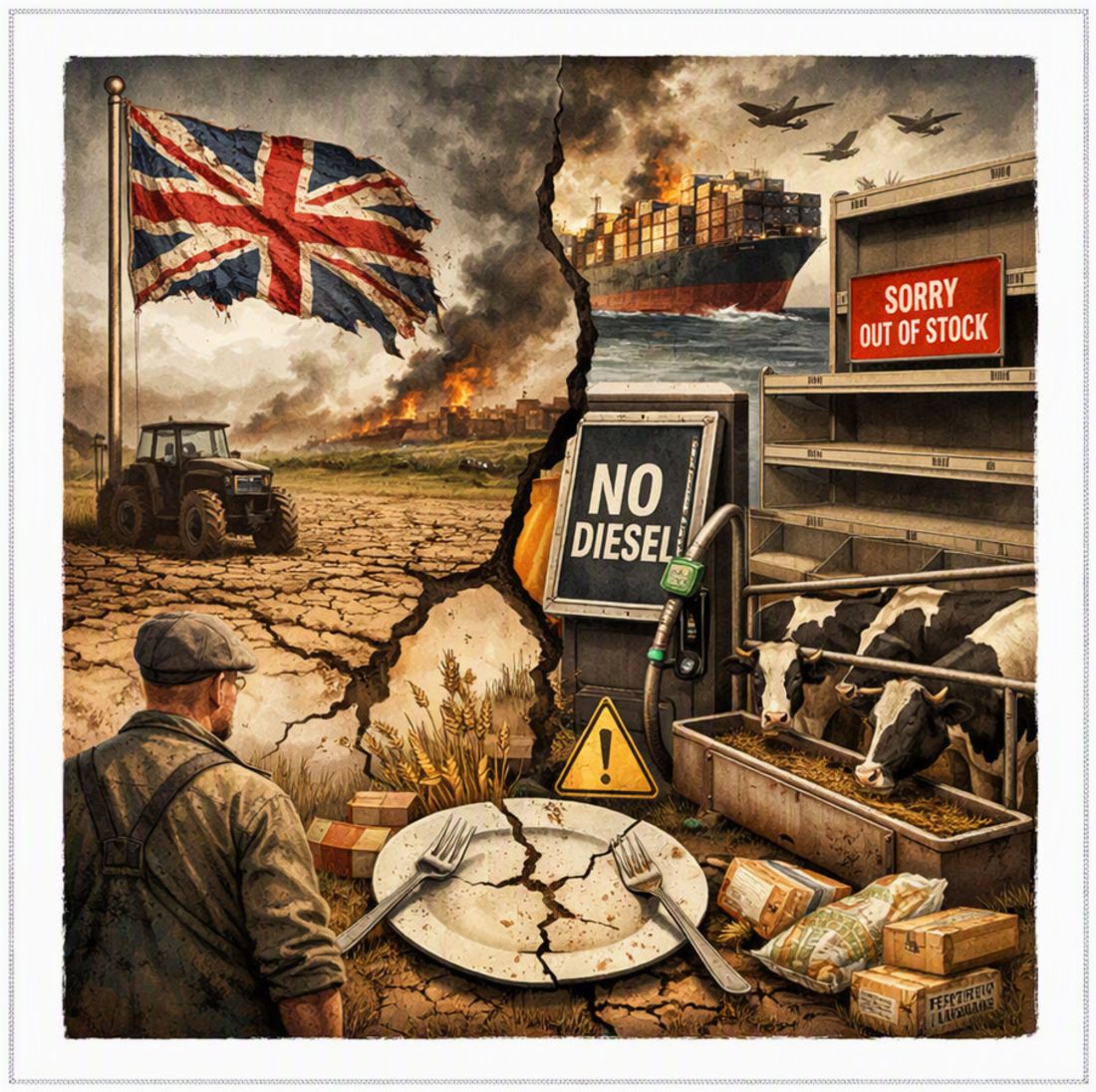
A long-form, accessible analysis of the UK’s declining food production capacity and rising systemic risk
Introduction: A report that tells the truth without meaning to
The Government’s newly published Farming Evidence Pack: A high-level overview of the UK agricultural industry is, on the surface, exactly what it claims to be: a statistical snapshot of British farming. It lists land use, production volumes, livestock numbers, farm incomes, and environmental indicators. It is calm, neutral, and presented without commentary.
But the timing of this report is extraordinary.
It arrives at the very moment when the global supply chain is showing signs of critical fragility. It arrives as shipping through the Strait of Hormuz is under threat, and as diesel shortages are being openly discussed in industry circles. It arrives when farmers, hauliers, processors and retailers are already dealing with rising costs, shrinking margins, and unpredictable supply.
And it arrives at a time when the UK’s own native food production capacity is going backwards.
The report does not say this directly. It does not frame its numbers as a warning. But when you read the data in context – not the context of government narrative, but the context of how food systems actually work – the message becomes unavoidable:
Britain is producing less of its own food, relying more on large corporate operations, and becoming more dependent on a global supply chain that is itself at risk of failing.
This is the opposite of resilience. This is the opposite of security. And this is happening at the exact moment when we should be building capacity at every level.
1. What the Evidence Pack actually shows – if you read it honestly
The pack is not a policy document. It does not tell you what to think. It simply presents numbers.
But those numbers tell a story that is very different from the one government spokespeople and industry bodies prefer to tell.
1.1 Land used for food production is declining
The total agricultural area may look stable, but the land actually used for food production – especially croppable land – is shrinking.
More land is tied up in schemes, non-food uses, or left uncropped. The UK is producing less food on less land.
1.2 Livestock numbers are falling
Cattle, sheep and pig numbers have all declined. Poultry is volatile. These are not small fluctuations – they are structural reductions in the national herd.
1.3 Small and medium farms are disappearing
The pack shows a clear trend: fewer farms overall, and a growing share of production concentrated in larger, corporate-style operations.
Mixed farms – the most resilient type – continue to decline.
1.4 Crop output is unstable and trending downward
Cereal yields fluctuate wildly. Horticulture remains stagnant or shrinking. Sugar beet, potatoes, oilseeds – all show signs of long-term decline.
1.5 Farm profitability is increasingly dependent on price spikes
Farm Business Income rises only when global prices spike. When prices fall, incomes collapse. This is not stability – it is volatility disguised as success.
1.6 The UK’s food production system is becoming more concentrated, more fragile, and more dependent on external inputs
This is the most important point. And it is the point the report never names.
2. The pack’s biggest omission: dependency
The Evidence Pack measures output. It does not measure dependency.
It counts what we produce. It does not count what we rely on.
It tells us how many tonnes of wheat we grow. It does not tell us how much fertiliser, diesel, machinery, chemicals, packaging, feed and energy we import to grow it.
It tells us how many cattle we have. It does not tell us how dependent those cattle are on imported feed, imported medicines, imported genetics, imported equipment, imported fuel.
It tells us how much land is farmed. It does not tell us how much of that land is viable without global inputs.
It tells us how much food we export. It does not tell us how much of that export value is used to pay for the food we import.
In other words:
The pack describes a system that only works if the global supply chain keeps working.
And right now, that assumption is no longer safe.
3. The global supply chain is becoming critically fragile
This is not speculation. It is observable reality.
3.1 Diesel is the single point of failure
Every part of the UK food system depends on diesel:
- tractors
- combines
- sprayers
- feed deliveries
- livestock transport
- milk tankers
- grain haulage
- refrigerated distribution
- supermarket logistics
- emergency response
If diesel becomes scarce or unaffordable, the numbers in the Evidence Pack become meaningless.
3.2 Hormuz is a live stress test
The UK imports most of its diesel. Much of that supply depends on shipping routes that are now under threat.
If shipping slows, reroutes, or becomes more expensive, the UK will face:
- rising fuel prices
- rationing
- delivery delays
- reduced haulage capacity
- prioritisation of high-margin routes
- cold-chain failures
- regional shortages
This is not a theoretical risk. It is a real-world scenario unfolding in real time.
3.3 The UK’s food system cannot operate without global inputs
The Evidence Pack does not mention:
- imported fertiliser
- imported feed
- imported chemicals
- imported machinery
- imported packaging
- imported energy
- imported labour
- imported ingredients
- imported logistics capacity
But every one of these is essential.
The UK’s food system is not independent. It is not sovereign. It is not resilient.
It is globalised, corporatised, and critically exposed.
4. The consolidation problem: why corporate-scale farming is a systemic risk
The pack shows a clear trend: production is increasingly concentrated in fewer, larger operations.
Government and industry present this as efficiency.
But efficiency is not resilience.
Large-scale operations:
- rely heavily on imported inputs
- require stable global markets
- depend on just-in-time logistics
- cannot easily adapt to fuel shortages
- cannot quickly change production models
- cannot operate without machinery, chemicals, and energy
- cannot feed local communities directly
- cannot survive prolonged disruption
Small and medium farms:
- are more adaptable
- are more diverse
- are more locally connected
- are more resilient
- are more capable of feeding communities
- are less dependent on global inputs
- are disappearing
This is the opposite of what a country facing food insecurity should be doing.
5. The illusion of self-sufficiency
The pack does not discuss self-sufficiency directly, but its numbers feed into the narrative that the UK is “around 60% self-sufficient”.
This figure is misleading.
It is based on:
- value, not calories
- production, not availability
- exports counted as domestic output
- imports assumed to be stable
- global inputs ignored
- processed food counted as UK production even when ingredients are imported
If you measure:
- calories
- nutrients
- local availability
- independence from imported inputs
- ability to operate during disruption
The UK’s real independent food production capacity (i.e. Production that goes directly to consumers and would be immediately available in a crisis) is closer to 11%.
The Evidence Pack does not contradict this. It quietly confirms it.
6. What the pack should have said – but didn’t
If the report were honest about the implications of its own data, it would say:
- The UK is producing less food.
- The UK is losing small and medium farms.
- The UK is becoming more dependent on large corporate operations.
- The UK is becoming more dependent on global inputs.
- The UK is becoming more dependent on imports.
- The UK is becoming more vulnerable to global disruption.
- The UK is not building capacity at every level.
- The UK is not prepared for supply chain shocks.
- The UK is not food secure.
But it does not say any of this.
It presents the numbers without context, allowing government and industry to continue telling the story that everything is broadly fine.
Everything is not fine.
7. What we must do now
The Evidence Pack should be a wake-up call. Not because the numbers are shocking, but because they are normalised.
We must:
- rebuild small and medium-scale farming
- restore mixed farming
- increase local food production
- shorten supply chains
- reduce dependency on imported inputs
- strengthen community-level resilience
- rethink land use
- support farmers directly, not through corporate intermediaries
- measure food security honestly
- plan for disruption, not assume stability
This is not about nostalgia. It is about survival.
Conclusion: The truth behind the numbers
The Farming Evidence Pack is not wrong. It is incomplete.
It tells us what we grow. It does not tell us what we depend on.
It tells us what we produce. It does not tell us what we can sustain.
It tells us what exists today. It does not tell us what will fail tomorrow.
The overriding message – the message the report never states but cannot hide – is simple:
Britain’s native food production capacity is declining, our dependence on large corporate operations is increasing, and the global supply chain we rely on is becoming critically fragile.
We should be building capacity at every level. Instead, we are dismantling it.
And at the very moment when the world is showing us how fragile the system is – through diesel shortages, shipping disruption, and geopolitical instability – we are doubling down on the model that cannot survive disruption.
The Evidence Pack is not reassurance. It is a warning.
And we ignore it at our peril.
Further Reading
If you’d like to explore the wider context behind Britain’s declining food production capacity, rising dependency, and the fragility of the global supply chain, the following pieces offer deeper insight. Each one expands on a different part of the story – from the illusion of self‑sufficiency to the risks hidden in our national food strategies – and together they build a clearer picture of why the Farming Evidence Pack matters so much right now.
Feeding Britain on Eleven Per Cent: Farming Inflation and the Illusion of Food Security
This piece breaks down the myth that Britain is “around 60% self‑sufficient” and explains why the country’s real independent food production capacity is far lower. It shows how official statistics mask dependency on imported inputs, processed food, and global supply chains – and why this leaves us exposed when disruption hits.
Response to NAO Report: Resilience of the Food Supply Chain to Disruptions (September 2026)
A direct challenge to the official narrative that the UK food system is resilient. This response highlights how fuel shortages, shipping disruption, and logistical fragility are consistently underestimated – making it a vital companion to the diesel and Hormuz concerns raised in the Farming Evidence Pack analysis.
Foods We Can Trust: A Blueprint for Food Security and Community Resilience in the UK
This is a practical vision for what real food security looks like. It focuses on trust, proximity, and community‑level capacity – offering a grounded alternative to the globalised, corporate model that the Evidence Pack quietly reveals as increasingly fragile.
Response to the Farming Roadmap 2050: A Blueprint for Dependency and Why Britain Must Choose a Different Future
A deep dive into how long‑term policy is steering British agriculture toward greater corporatisation and dependency. This piece shows how the trends identified in the Evidence Pack – fewer farms, larger operations, and rising reliance on global inputs – are not accidents, but the result of deliberate strategic choices.
The Real Implications of the UK’s Food Strategy 2025
This piece unpacks how government strategy documents present dependency as innovation and fragility as progress. It’s an essential read for understanding why the Farming Evidence Pack’s silence on systemic risk is part of a much wider pattern.
A Few Thoughts on Minette Batters’ Farming Profitability Review (FPR)
This reflection explores how farming profitability is measured – and mismeasured – in the UK. It reinforces the point that rising Farm Business Income often reflects volatility, not stability, and why headline figures can hide the real pressures facing farmers.

