

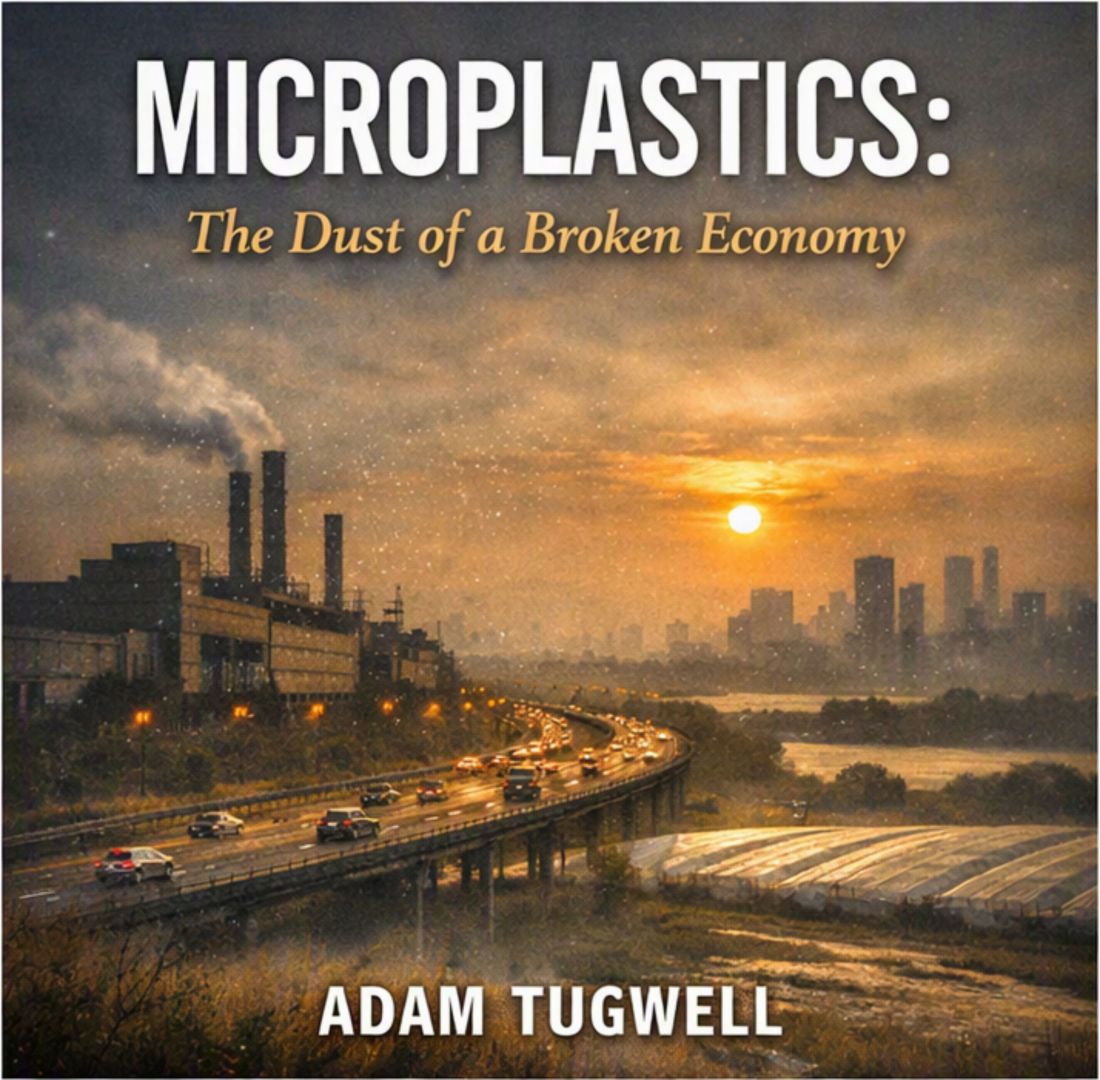
Evidence and Scope
This article summarises current scientific understanding of microplastic release, environmental pathways and potential health effects. Evidence is evolving, and some findings remain under active investigation. All claims are based on publicly available research from recognised scientific and regulatory bodies. Readers are encouraged to consult the cited sources and ongoing studies for the latest developments.
Section 1 – Introduction: The Dust Has a Source
Microplastics are often presented as a waste-management problem or a matter of consumer choice. That framing is convenient, but false. It directs attention towards bottles, bins and personal habits while leaving the machinery of production largely untouched.
Microplastics are the physical residue of costs that a petrochemical economy has externalised for decades. They are the dust of a civilisation that has rebuilt its material world around substances which persist rather than return safely to natural cycles. They are everywhere because the system that creates them is everywhere.
Over the past century, oil has become far more than a fuel. It is the feedstock for fibres, packaging, coatings, tyres, paints, sealants, adhesives, fertilisers and thousands of polymers now woven into ordinary life. These materials may be cheap at the point of sale, but their true cost is dispersed through polluted air, depleted soils, contaminated water, damaged ecosystems and uncertain burdens on human health. The price is not avoided; it is merely transferred to people, places and generations that had no say in the transaction.
Unlike materials that can be metabolised by living systems, most conventional plastics do not simply disappear. They weather, abrade and fragment into smaller particles. Those particles move through air, soil and water; they enter food chains and buildings; and some are small enough to cross biological barriers. What begins as a tyre, a fleece, a coating or a sheet of agricultural film becomes part of the environment-and, increasingly, part of us.
The familiar image of ocean litter therefore captures only a fraction of the problem. Important sources include tyre and road wear, synthetic textiles, industrial pellets and coatings, construction materials, agricultural plastics, sewage sludge and the breakdown of larger plastic waste. These are not marginal products. They are embedded in transport, clothing, farming, housing and trade: the operating systems of the modern economy.
This article follows those particles from production to dispersal and from environmental exposure to possible biological harm. It also asks the harder question: why are we trying to manage the fallout while preserving the economic arrangements that make the fallout inevitable?
The answer is not a fantasy of abandoning every modern material or machine. This is not an argument against medicine, communications, engineering or the measured use of synthetic materials where they clearly serve human need and no safer practicable substitute exists. It is an argument against indiscriminate dependence: against designing whole societies around oil-derived materials because they are cheap to scale, easy to standardise and profitable to sell, while their wider costs are kept off the balance sheet.
The alternative is not retreat. It is reconstruction: more local and regional production; shorter and more visible supply chains; materials chosen for durability, repair and biological compatibility; and communities that retain the skills to make, maintain and adapt what they use. Local systems are not automatically benign, but they make consequences harder to export and responsibility harder to evade. They reconnect production with place.
Microplastics are therefore more than pollutants. They are evidence. They reveal what happens when an economy prizes volume over value, distance over resilience and price over cost. This is not simply a story about plastic. It is a story about the kind of system we have normalised-and whether we are prepared to build one that can endure.
Section 2 – The Synthetic Economy: Why Microplastics Exist
Microplastics did not appear because people failed to recycle carefully enough. They appeared because industrial economies were reorganised around synthetic materials and because those materials were selected for the priorities of scale: low unit cost, uniformity, speed, convenience and market reach.
For most of human history, material production was constrained by place. Wool, linen, hemp, leather, timber, clay, stone and metal came from identifiable landscapes and were worked by people with accumulated local knowledge. These systems were not perfect; no form of production is impact-free. Cotton can consume extraordinary volumes of water, poorly managed grazing can damage land, tanning can pollute and mining is inherently extractive. But material limits were visible. Producers lived closer to the consequences, repair was normal, and many discarded materials could re-enter biological or technical cycles without becoming permanent synthetic dust.
The twentieth century broke much of that relationship between material, maker, user and place. Fossil carbon became clothing, packaging, tyres, paints, sealants, foams, fertiliser inputs and disposable goods. Production was centralised, standardised and stretched across continents. The apparent cheapness of the resulting products rested on three structural advantages.
1. Petrochemical materials scale cheaply
Once oil extraction, refining and polymer manufacturing were established at enormous scale, synthetics could be produced in vast quantities with predictable properties. Natural materials require land, seasons, skill, careful husbandry and time-the very things an economy organised around throughput seeks to compress or remove.
2. Globalisation rewards volume and distance
Long supply chains favour materials that can be made uniformly, packed densely, transported cheaply and processed by automated systems. Profit is increased by selling more units across larger markets, not by making fewer goods that last, remain repairable and circulate within a region. Synthetic materials fit this model exceptionally well.
3. The real costs are externalised
The market price of a synthetic product rarely includes the full cost of extraction, chemical pollution, particle shedding, waste handling, ecosystem damage or long-term health surveillance. Those costs are shifted onto households, public services, workers, landscapes and future generations. The product appears cheap because somebody else pays-and much of the payment never appears in money.
This is the economic logic that created microplastics. When an economy saturates daily life with persistent materials, abrasion and weathering are not accidents at the edge of the system; they are predictable outputs of the system itself. Microplastics are not chiefly a failure of recycling. They are a failure of design, accounting and political choice.
The same transition has weakened local capability. Polyester displaces wool and the networks of grazing, spinning, weaving, repair and reuse that surround it. Plastic-intensive agriculture displaces knowledge rooted in soil, rotation, compost, seed and season. Centralised manufacturing turns communities from makers and maintainers into end-users of goods whose origin, chemistry and repair are beyond their control.
Not every synthetic substitution removes a natural equivalent, and some polymers deliver genuine public value. The issue is proportion and purpose. A sterile medical device is not the same proposition as a disposable fashion garment; an electrical safety component is not the same as unnecessary packaging. A sane material economy would reserve persistent synthetics for applications where their properties are genuinely necessary, design them for long service and safe recovery, and refuse their routine use where durable natural or mineral alternatives can do the job.
Microplastics are the physical evidence of an economy that confuses a low purchase price with low cost. They are what remains when efficiency is measured at the factory gate while consequence is dispersed across the living world.
Section 3 – The Pathways: How Microplastics Move Through the World
Microplastics do not remain where they are released. They circulate between air, water, soil, buildings, food and bodies. That mobility is why end-of-pipe measures cannot solve the problem on their own: by the time a particle reaches a filter or waste facility, many others have already escaped.
The broad pathways below are well documented. Exact exposure levels remain difficult to compare because studies use different sampling and detection methods, especially for the smallest particles. The uncertainty is real-but it concerns scale and effect more than presence.
3.1 Air – the invisible route
Clothing, carpets and upholstery shed synthetic fibres. Tyres and road surfaces abrade under traffic. Construction, coatings and industrial processes generate particles, while wind and sea spray can lift deposited plastics back into the atmosphere. Indoors, particles accumulate in dust; outdoors, they travel on air currents and settle far from their source.
Inhalation is therefore a routine exposure route. Larger particles may be trapped or cleared by the respiratory system, while smaller particles can reach deeper regions of the lung. Studies have detected microplastics in human lung tissue, but the amount retained, the contribution from different sources and the resulting long-term health burden remain active areas of research.
3.2 Water – a distributor, not a disappearance mechanism
Microplastics enter rivers, lakes and seas through wastewater, road runoff, industrial releases, lost pellets, atmospheric deposition and the fragmentation of larger waste. Treatment plants can capture a substantial share of larger particles, but they do not remove everything-particularly the smallest fractions-and captured material may be transferred into sewage sludge that is later spread on land.
Once in water, particles settle into sediments, are resuspended by currents, and are ingested by organisms across food webs. They have been reported in seafood, salt and drinking water. Water does not make them vanish. It moves them.
3.3 Soil and agriculture – the hidden reservoir
Soils receive particles from mulch films, polymer-coated seeds and fertilisers, irrigation equipment, packaging, atmospheric fallout, tyre-contaminated runoff and sewage sludge. Some agricultural plastics are recovered; many weather in place, tear during use or leave residues behind.
Experimental evidence shows that microplastics can alter soil structure, water movement, microbial communities and interactions around plant roots. Effects vary with particle size, shape, polymer, concentration and soil type, and evidence for uptake into edible plant tissues is still developing. What is not in doubt is that repeated application creates a persistent burden in the living system on which food production depends.
3.4 Buildings and homes – exposure by design
People spend much of their lives indoors, surrounded by synthetic textiles, foams, paints, floor coverings, consumer plastics and dust carried in from roads and workplaces. These materials shed through ordinary use. Particles settle on surfaces and food, are resuspended by movement and cleaning, and are inhaled or swallowed.
Children can experience higher contact with floor dust because of hand-to-mouth behaviour. Occupational exposure may be greater in textile work, plastics production, construction, recycling and other dusty settings. The domestic environment is not separate from industrial material choices; it is where those choices become intimate.
3.5 Fragmentation – from microplastics to nanoplastics
Sunlight, heat, oxidation, mechanical abrasion and biological activity weaken plastic. The result is not safe decomposition but continuing fragmentation. As particles become smaller, they become harder to detect and remove and may behave differently in biological systems.
Plastics also contain additives and can carry chemicals or microorganisms on their surfaces. Risk depends on the polymer, additives, absorbed contaminants, particle characteristics, route of exposure and dose. It is therefore misleading to treat every particle as identical-but equally misleading to treat persistence as harmless simply because toxicology has not yet quantified every combination.
3.6 The circulation loop
Air deposits particles on soil and water. Runoff moves them from roads and fields into rivers. Sludge can return captured particles to land. Wind and spray lift them again. Food and drinking water carry a fraction into people; waste streams carry material back into the environment.
This is a circulation problem created by production, not a single stream that can be tidied away. Microplastics connect industrial design to ecological contamination and human exposure in a loop that no consumer can close alone.
Section 4 – Human Health: Presence Is Proven; Harm Is Being Defined
Microplastics are an environmental fact and a human exposure fact. Particles have been reported in blood, lungs, placental tissue and other biological samples. A 2024 scoping review found them across eight of twelve human organ systems examined, while also warning that analytical methods vary and some studies carry a high risk of bias.
That distinction matters. Detection is not the same as proof of disease, and laboratory effects are not automatically evidence of the same outcome in a person at everyday exposure levels. The World Health Organization’s 2022 review concluded that the available evidence was too limited and inconsistent for a confident human risk assessment. It nevertheless called for reduced plastic release and better research, particularly on the smaller particles most relevant to biological uptake.
Scientific caution should prevent exaggeration, not excuse delay. Persistent particles are entering living systems faster than methods, monitoring and regulation can keep pace. The responsible position is neither panic nor complacency: it is precaution grounded in evidence.
4.1 Respiratory effects
Airborne fibres and tyre-related particles are inhaled in homes, cities and workplaces. Research on occupational exposure and experimental models supports plausible pathways involving irritation, oxidative stress and inflammation. Microplastics have been detected in lung tissue, but population-level estimates of ordinary exposure and long-term clinical effects remain uncertain.
4.2 Cardiovascular evidence
Micro- and nanoplastics have been reported in human blood and arterial tissue. In a 2024 observational study of people undergoing surgery for carotid artery disease, particles were detected in a majority of the analysed plaques. Those with detected particles had a higher rate of heart attack, stroke or death during follow-up. This was an association, not proof that the particles caused those outcomes, and it cannot by itself quantify risk for the general population. It is nonetheless a serious signal that exposure may have consequences beyond the lungs and gut.
4.3 Immune and inflammatory pathways
Cells can respond to particles as foreign material. Laboratory and animal studies repeatedly report oxidative stress, inflammatory signalling and altered immune responses. The extent to which these mechanisms translate into chronic human disease at real-world doses remains unresolved. But the mechanisms are biologically credible, and they are among the reasons researchers are asking whether exposure contributes to a wider background burden of inflammation.
4.4 Endocrine and reproductive concerns
Plastics complicate risk assessment because the particle is only part of the exposure. Products may contain plasticisers, bisphenols, flame retardants, stabilisers, pigments and other additives, while environmental particles can acquire contaminants from their surroundings. Some of these chemicals have established endocrine or reproductive hazards independent of the particle itself.
Animal and cell studies report effects on hormone signalling, reproduction and development. Human evidence directly attributing such outcomes to microplastic particles is still emerging. The uncertainty does not make unnecessary exposure desirable; it shows how much of the experiment is taking place after widespread release.
4.5 The gut and microbiome
Food, water and settled dust carry particles into the gastrointestinal tract. Experimental studies report tissue irritation, inflammation and changes in gut microbial communities under some conditions. Human clinical evidence is limited, and results depend heavily on particle size, composition and dose. Even so, the gut is a plausible site of interaction because it is both an entry route and a major interface between the immune system, metabolism and the external environment.
4.6 Neurological questions
Very small particles have crossed biological barriers in animal studies, including barriers protecting the brain. Researchers are investigating whether similar translocation occurs in humans and whether it has neurological consequences. This remains an emerging field and should not be presented as settled human evidence. It should also not be ignored merely because proof is incomplete.
4.7 The combined burden
Real exposure is not to a single, pristine polymer under laboratory conditions. It is to mixtures of sizes, shapes, additives and associated chemicals, alongside air pollution, pesticides, metals and many other stressors. These exposures may interact, yet conventional risk assessment often studies them separately.
The honest conclusion is stark enough: the human health burden has not been fully quantified, but exposure is widespread; particles reach human tissues; biologically plausible mechanisms of harm are documented; and important associations are emerging. Waiting for every causal pathway to be settled while production and dispersal continue would not be scientific restraint. It would be a policy choice to let uncertainty protect the polluter rather than the public.
Section 5 – Reading the Evidence Without Blunting the Warning
The microplastics literature is expanding quickly, but not all findings carry the same weight. Sampling can be contaminated; laboratories use different size thresholds and detection methods; and results from cells or animals cannot simply be translated into human disease. A credible argument must say what is established, what is strongly indicated and what remains open.
5.1 Established
- Microplastics are present across marine, freshwater, terrestrial, atmospheric and indoor environments.
- Important release routes include tyre wear, synthetic textiles, industrial losses, coatings, agricultural uses and the fragmentation of larger plastics.
- People are exposed through inhalation and ingestion.
- Particles have been detected in a growing range of human tissues and biological samples.
- Plastics can contain additives and can transport other chemicals or biological material on their surfaces.
- Once widely dispersed, the smallest particles are exceptionally difficult to recover.
5.2 Strongly indicated
- Particle exposure can produce oxidative stress and inflammatory responses in experimental systems.
- Smaller particles have greater potential to cross biological barriers and reach tissues beyond the original point of entry.
- Tyre and textile particles make substantial contributions to releases in many regions; official bodies including UNEP, the OECD and the European Environment Agency now treat them as priority sources.
- Environmental concentrations will continue to rise unless releases are prevented at source.
5.3 Emerging
- The scale of long-term human health effects at real-world exposure levels.
- Causal links between micro- and nanoplastic exposure and specific cardiovascular, reproductive, metabolic, immune or neurological diseases.
- The combined effect of particles, additives and other pollutants across a lifetime.
- The behaviour and toxicity of the smallest nanoplastic fractions, which remain the hardest to measure.
This hierarchy does not weaken the argument. It strengthens it. The case for prevention does not require claiming that every suspected effect is already proven. It rests on a more basic reality: persistent synthetic particles are being released continuously into systems from which they cannot realistically be retrieved, while the consequences are still being discovered.
There is a familiar political danger here. Demands for perfect certainty can become a licence for endless delay. In environmental health, the absence of complete evidence is often created by the novelty, complexity and ubiquity of the exposure itself. Communities should not have to prove every future illness before producers are required to reduce preventable emissions.
The proper response is proportionate precaution: phase out unnecessary uses; regulate particle release across product lifecycles; make producers responsible for downstream costs; improve measurement and health research; and prioritise materials and systems that do not create persistent pollution through normal use.
Section 6 – The Systemic Alternative: Local, Durable and Accountable
Microplastics cannot be solved by asking households to sort more carefully while production continues unchanged. Better collection, filtration and waste treatment matter, but they operate after materials have been designed, sold, abraded and dispersed. The decisive intervention is upstream: use fewer persistent materials, reserve them for essential purposes, and rebuild systems around substances that can be repaired, recovered or safely returned to natural cycles.
That requires more than substituting one product for another. It requires a different geography and purpose of production.
6.1 Why locality matters
Local and regional systems shorten the distance between cause and consequence. A community that can see the fields, workshops, waterways, workers and waste behind its goods is better placed to judge whether production is genuinely beneficial. Locality does not guarantee virtue, but it limits the ease with which damage can be exported beyond sight and beyond political accountability.
Shorter supply chains can reduce packaging, freight, tyre wear and dependence on volatile global inputs. They retain practical skills, create diverse livelihoods and make repair and adaptation economically possible. They also increase resilience. A system dependent on distant fuel, fertiliser, feedstocks, factories and shipping routes may appear efficient in stable conditions, yet prove brittle when energy prices rise, trade routes close or geopolitical shocks expose how little capacity remains at home.
Localism is therefore not simply an environmental preference. It is a strategy for material security and democratic agency.
6.2 Natural materials, used honestly
Wool, linen, hemp, timber, clay, stone and responsibly used metals do not create conventional plastic microfibres as they wear. Many can be maintained, repaired, composted, recycled or returned to long-lived technical cycles. Their impacts are real and must be managed-through good husbandry, clean processing, durable design and responsible land use-but those impacts are not an argument for saturating life with substances that persist as microscopic debris.
The correct comparison is not between a perfect natural product and a flawed synthetic one. It is between complete systems: extraction, cultivation, labour, energy, transport, use, repair and end of life. When all of those stages are counted, a locally produced, durable and repairable material may be far cheaper to society than a mass-produced alternative whose pollution and disposal costs have been hidden.
6.3 Rebuild natural-fibre economies
Synthetic textiles shed during manufacture, wear, washing, drying and disposal. The European Environment Agency estimates that textiles contribute a significant share of microplastics entering the marine environment globally, with fast fashion intensifying releases through high throughput and short garment life.
Rebuilding wool, linen, hemp and other regionally appropriate fibre systems would reduce persistent fibre pollution while restoring farming, processing, design, tailoring, repair and reuse. This is not a plea to replace every fabric overnight. It is a demand to reverse the economic bias that makes disposable plastic clothing artificially cheap while natural, durable clothing bears its visible costs.
6.4 Farm without turning soil into a waste sink
Agriculture should build living soil, not load it with fragments from films, coatings, pipes, packaging and contaminated sludge. Regenerative and agroecological methods can reduce dependence on petrochemical inputs by using crop diversity, rotations, composting, biological fertility, integrated pest management and knowledge adapted to local soils and climates.
No serious transition can pretend that every farm can abandon plastic and synthetic inputs immediately. Alternatives must be practical, labour must be valued and farmers must not be forced to absorb transition costs created by the wider system. Public policy should support equipment, training, local processing, research and fair prices that make lower-plastic farming viable.
6.5 Reduce unnecessary movement
Tyre-wear particles are among the most abundant forms of primary microplastic released to the environment. Every road kilometre carries an abrasion cost, including journeys made by electric vehicles; heavier vehicles can increase tyre wear even as they reduce exhaust emissions.
The answer is not merely a new tyre compound. It is fewer unnecessary vehicle kilometres: compact settlements, dependable public transport, walking and cycling, rail freight, regional distribution and production closer to use. Cleaner technology helps, but technology cannot compensate for an economic model that continually increases distance and throughput.
6.6 Use technology with purpose
This is not an argument against technology. Human ingenuity has delivered sanitation, medicine, safe buildings, communication, mobility and tools that reduce suffering and expand possibility. Synthetic materials are justified where they provide clear human benefit, where safer materials cannot perform the task, and where production, use and recovery are tightly controlled.
The question is not whether a technology is modern. It is whom and what it serves. Technology should support human and ecological flourishing; it should not be used to make an extractive system faster, larger and less accountable. Filters, improved wastewater treatment, lower-shedding fabrics and better tyre design all have roles. None removes the need to reduce material throughput and unnecessary synthetic use at source.
6.7 Make producers responsible for the whole cost
If a product sheds persistent particles in normal use, that release is part of the product-not an unforeseeable accident. Regulation should reflect that reality through product standards, disclosure, independent testing, extended producer responsibility and the precautionary phase-out of avoidable high-shedding applications.
Public procurement can create markets for durable, repairable and regionally produced goods. Tax and subsidy systems can stop rewarding virgin fossil feedstocks while penalising skilled labour and maintenance. Right-to-repair rules, reuse infrastructure and long warranties can shift value away from turnover and towards longevity.
6.8 Restore agency through capability
Centralised production does more than move factories. It removes knowledge. People become dependent on products they cannot inspect, repair or influence, supplied through chains they cannot see. Rebuilding local capacity means recovering the ability to grow fibres, process food, maintain tools, repair clothes, manage land, fabricate parts and choose materials with an understanding of their consequences.
This is not self-sufficiency in everything, nor a rejection of trade. Regions will always exchange what climate, geology, skill and culture enable them to produce well. The principle is subsidiarity: produce as close to use as is sensible; trade where it adds genuine value; and do not destroy local capability merely because distant production can temporarily undercut its price by exporting costs.
6.9 A transition measured by life, not throughput
The prevailing economy treats growth in material throughput as success even when the result is fragility, pollution and the erosion of useful work. A healthier measure would ask whether production strengthens soil, water, public health, craft, resilience and community control.
Local, natural-material economies are not a sentimental return to the past. They are a practical response to the limits now confronting an oil-dependent global system. They combine inherited knowledge with appropriate modern science; they use technology selectively rather than worshipping it indiscriminately; and they recognise that efficiency without resilience is merely brittleness waiting for a shock.
The aim is not purity. It is direction: away from extraction, distance and disposability; towards stewardship, proximity, durability and accountability.
Section 7 – Conclusion: A Warning Written in Matter
Microplastics are often treated as a side issue: a problem of litter, poor recycling or careless consumers. They are nothing of the sort. They are a warning written in matter.
They show what happens when an economy builds abundance from materials that persist beyond their useful lives, then calls the product cheap because the damage falls elsewhere. They reveal the physical reality of externalised cost: in dust, runoff, sediment, soil, food and tissue.
The evidence must be stated accurately. We know that microplastics are pervasive and that people inhale and ingest them. We know particles have been detected in human tissues. We know that laboratory studies identify plausible pathways of inflammation, oxidative stress and chemical disruption. We do not yet know the full burden of disease caused by real-world exposure, and some alarming associations are not proof of causation.
But uncertainty is not innocence. It is not a rational basis for continuing unnecessary releases at growing scale. Where pollution is persistent, mobile and effectively irreversible, preventing exposure is wiser than waiting for decades of epidemiology to describe the damage after it has become universal.
The answer cannot be reduced to better bins, individual virtue or another consumer label. Nor can it be handed entirely to technology while the underlying demand for ever more extraction, production, transport and disposal remains untouched. Technical improvements are valuable where they reduce harm; essential synthetic materials should be designed and governed with care. But no filter can make unlimited throughput sustainable.
A serious response begins by rebuilding material economies around life rather than oil: natural and mineral materials where they are suitable; persistent synthetics reserved for genuinely necessary uses; goods made to last and be repaired; producers responsible for what their products shed; farming that protects living soil; transport systems that reduce needless distance; and local and regional capacity strong enough to meet more of society’s real needs.
Local systems matter because they reunite decisions with consequences. They make it more difficult to hide pollution in another watershed, labour exploitation in another jurisdiction or vulnerability in a supply chain on the other side of the world. They allow knowledge, ownership, work and accountability to remain closer to the people and places affected.
This is not nostalgia, isolation or hostility to invention. It is a proposal for maturity: to use technology deliberately, trade selectively and produce within ecological limits; to value resilience more than nominal efficiency; and to recognise that an economy cannot be called successful if it undermines the conditions on which health and freedom depend.
Microplastics are the dust of a broken economy. They are also a map. Follow the particles backwards and they lead from lungs, rivers and fields to choices about materials, scale, ownership and power. Change those choices, and the future need not look like the residue of the present.
Selected Sources and Further Reading
World Health Organization. Dietary and inhalation exposure to nano- and microplastic particles and potential implications for human health. 2022.
United Nations Environment Programme. Vehicle Tyre Particles in the Environment. Foresight Brief No. 034, 2024.
European Environment Agency. Microplastics from textiles: towards a circular economy for textiles in Europe. 2022.
OECD. Policies to Reduce Microplastics Pollution in Water, including the typology of releases from textiles and tyres.
Marfella, R., et al. “Microplastics and Nanoplastics in Atheromas and Cardiovascular Events.” New England Journal of Medicine 390 (2024): 900–910. Study summary: American College of Cardiology.
Roslan, N. S., et al. Detection of microplastics in human tissues and organs: a scoping review. Journal of Global Health, 2024.
Related Works by Adam Tugwell
The argument developed here forms part of a wider body of work on how societies can move beyond extractive, money-centred and oil-dependent systems. The following works progress from the economic principles behind that critique, through a framework for local governance and community resilience, to a practical example of how lost productive capability might be rebuilt. They can be read independently, but together they place the microplastics crisis within a broader programme of systemic change.
An Economy for the Common Good
Building, enabling and maintaining good governance, self-sufficiency and freedom for all people and our communities. This work establishes the economic foundation for the present article. It challenges the assumption that an economy must be organised around money, growth and private accumulation, and proposes instead that economic life should serve people, community, environmental stewardship and the common good. Its emphasis on localism and self-sufficiency provides the underlying answer to the externalised costs described here.
The Local Economy & Governance System
This is the structural blueprint behind the local alternative outlined in this article. It develops a people-, community- and environment-first model of economics and governance, with local democratic accountability, circular value, essential provision and human agency at its core. Where the microplastics argument identifies the failure of distant, centralised systems to account for their consequences, this work sets out how authority, responsibility and productive capacity can be brought back within reach of communities.
A Future of Communities: Building the New World without Oil, Manipulated Money and Centralised Control
Building on the LEGS framework, this book turns systemic critique into a practical case for community capability, resilience and sovereignty. It examines how communities can reduce dependence on fragile global supply chains, rebuild local food, energy and resource systems, and create fairer structures based on contribution and shared purpose. It extends this article’s claim that the transition away from oil-dependent centralisation must be built from the ground up rather than delivered from above.
The Capability of Cloth: Reimagining Wool and Clothing Capability for the 21st Century
This work applies the wider economic and governance principles to clothing-one of the most direct sources of everyday microfibre release. It explores how wool, natural fibres, practical skills, repair, cooperative enterprise and appropriately used modern technology can be brought together in resilient, human-scale textile systems. Its central proposition-that capability is infrastructure, not nostalgia-offers a concrete model of the local material economy advocated in this article.
Taken together, these works move from principle to structure, from structure to community action, and from community action to a tangible sectoral example. They provide the wider context for the central claim of this article: persistent pollution cannot be separated from the economic system that produces it, and meaningful prevention depends upon restoring local capability, responsibility and stewardship.

