
PART 1 – Why the World Feels Impossible to Understand Today
There is a quiet moment many of us have felt in recent years: a moment when the world seems to tilt, and the familiar sense of how things work slips just out of reach. The news does not match daily life. Public explanations do not match private experience. Institutions speak, but people still feel unheard. Families argue about events they are all living through together.
This work begins from a simple idea:
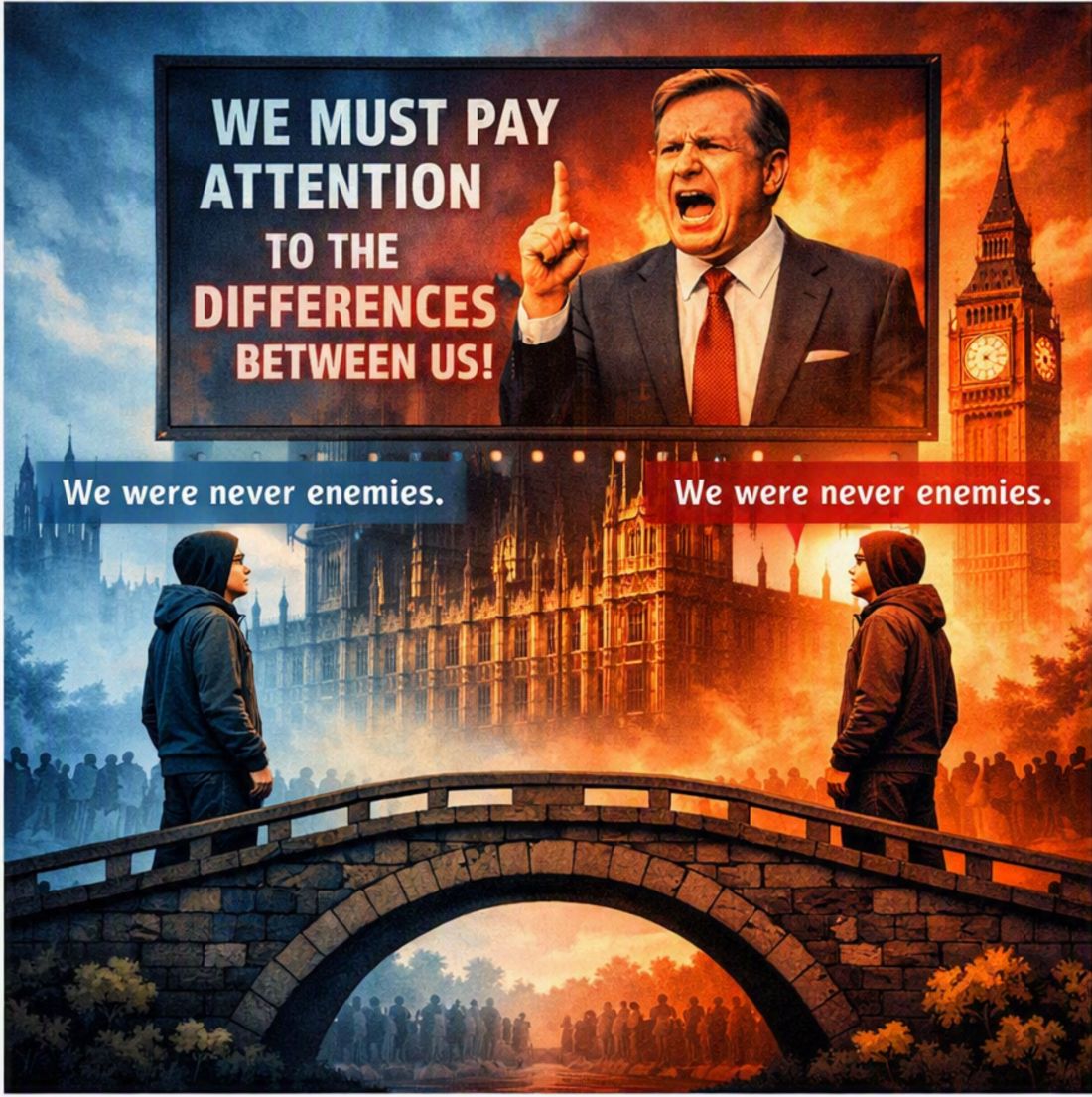
We are not divided because we are enemies. We are divided because we are trying to explain the same pressures using different stories.
The people we think of as opponents are often responding to the same underlying conditions we are – but through different narratives, different fears, different languages, and different inherited loyalties.
That is the bridge this book tries to build: a bridge between people who have been taught to see one another as threats, when in reality they may be carrying the same confusion, pressure, exhaustion, and longing for stability.
For a long time, society moved at a pace that matched human understanding. Institutions behaved predictably enough for people to form a picture of how things worked. Information arrived slowly enough to absorb. Communities shared enough common ground to make sense of each other. Politics followed a rhythm. Economics had a story people could follow.
That rhythm has gone. And the absence of it is what so many of us are feeling.
The world used to explain itself. Now it doesn’t.
There was a time when institutions spoke in a way that made sense. Even if the details were complicated, the overall direction felt understandable. Decisions followed patterns. Policies had reasons. Public services behaved in ways that matched their purpose.
Now the signals are mixed.
Announcements contradict each other. Policies appear and disappear. Systems fail without warning. Explanations feel thin or rushed. Accountability seems to drift.
It is not that people have suddenly lost the ability to understand. It is that the world has stopped offering a coherent story.
When institutions become opaque, confusion becomes a natural response – not a personal flaw.
Information used to be manageable. Now it arrives like weather.
Information once arrived in streams: a newspaper, a conversation, a broadcast. The pace matched human cognition. There was time to think, time to compare, time to understand.
Now information arrives like a storm front – constant, contradictory, and impossible to escape. A single scroll can deliver a crisis, a denial of the crisis, a counter‑narrative, a correction, and a new crisis before the mind has processed the first one.
Human beings aren’t built for this. We’re built for coherence, not contradiction.
When the world becomes noisy, the mind reaches for anything that feels stable enough to hold onto. That isn’t irrational. It’s protective.
Life feels harder because the economic system has become harder to see.
Consider someone who works full time, pays the bills carefully, avoids extravagance, and still feels each month tightening around them. They hear that the economy is growing, that opportunity exists, that inflation is under control, and that the system is broadly functioning. Yet their own life tells a different story. They are not imagining the pressure; they are lacking a public language that explains it honestly.
Many of us feel squeezed in ways that are difficult to articulate. Costs rise. Work intensifies. Stability feels fragile. But when we try to explain why, the language isn’t there.
The economic system has become abstract, hidden behind technical terms, complex mechanisms, and distant decisions.
People feel the pressure directly, but the causes are obscured. The system shapes everyday life deeply, yet it no longer speaks a language people can understand.
When pressures are felt but not named, they become harder to navigate. And harder still to resist.
Politics used to be slow. Now it feels improvised.
Political life once moved at a pace that allowed people to follow it. Even when frustrating, it had a rhythm. Policies took time. Debates unfolded. Decisions were explained.
Now politics feels reactive – a series of rapid shifts, sudden announcements, and unexplained reversals. It isn’t that leaders have become chaotic. It’s that the political system is operating under strain.
Systems under strain behave like people under strain: inconsistently, defensively, and unpredictably.
The instability is visible, but the reasons behind it are not. And that gap creates confusion.
Communities used to share stories. Now they inhabit different worlds.
There was a time when neighbours, colleagues, and families lived inside overlapping realities. Not identical ones, but close enough to understand each other’s experiences.
Now two people living on the same street can inhabit entirely different worlds. Different news. Different feeds. Different fears. Different interpretations. Different truths.
This fragmentation makes it harder to recognise commonality – even when people are experiencing the same pressures. It becomes easier to see difference and harder to see connection.
And when connection weakens, understanding weakens with it.
The world feels confusing because the tools we used to rely on no longer work.
This is the heart of the matter.
The confusion so many of us feel isn’t a sign of personal failure. It’s a sign that the world has outgrown the old explanations.
The interpretive tools that once helped us understand life – stable institutions, coherent narratives, manageable information, shared communities – have broken down.
And when the tools break, the confusion that follows is not a flaw. It’s a signal.
A signal that the world is changing faster than the language we use to describe it.
PART 2 – When the World Stops Making Sense, We Reach for Stories That Do
There’s a point many of us reach when the world becomes too contradictory to understand through the usual channels. It doesn’t happen all at once. It creeps in slowly – through moments of confusion, moments of disbelief, moments where the explanations we’re given simply don’t match what we’re seeing.
When that gap opens between experience and explanation, something very human happens:
We reach for stories that feel coherent enough to hold the confusion together.
This is where conspiracy thinking begins – not as a rejection of reality, but as an attempt to make reality understandable again.
And this is one of the most misunderstood parts of modern life.
Conspiracy thinking isn’t a sign of irrationality. It’s a sign of disorientation.
When people talk about conspiracy theories, they often do it with a tone of dismissal – as if the people who believe them are somehow less capable, less informed, or less grounded. But that’s not what’s happening.
Conspiracy thinking emerges when:
- the world becomes too complex to interpret,
- the official explanations stop making sense,
- the information environment becomes overwhelming,
- and the old frameworks for understanding life no longer work.
In that moment, the mind does what it has always done throughout human history:
It reaches for narrative.
Not because narrative is always accurate, but because narrative is stabilising.
A story – even a flawed one – can feel safer than chaos.
When the world becomes noisy, simple explanations feel like relief.
Most conspiracy narratives aren’t elaborate. They’re simple. They offer a clear cause, a clear villain, a clear intention. They turn complexity into something linear and emotionally manageable.
And when the world feels overwhelming, that simplicity can feel like clarity.
It’s not that people suddenly lose the ability to think critically. It’s that critical thinking becomes impossible when the world is too contradictory to process.
In those moments, a simple story can feel like a lifeline.
Many conspiracy theories are trying to describe real problems – just with the wrong tools.
This is the part that rarely gets acknowledged.
Imagine a retired neighbour who no longer trusts public institutions. On the surface, their language may sound extreme. They may talk about hidden agendas or secret plans. But beneath that language may be a recognisable experience: decisions feel as though they are made far away, by people they never meet, using explanations that do not match what they see in their own town.
The conclusion may be wrong, but the alienation is real.
A lot of conspiracy narratives begin with something true:
- a sense of economic pressure,
- a feeling of political incoherence,
- a recognition of institutional failure,
- a fear of social fragmentation,
- a discomfort with surveillance‑like technology,
- a suspicion that something is happening behind the scenes.
These feelings aren’t imaginary. They’re grounded in real structural changes.
But when people don’t have the language to describe those changes, they reach for whatever language is available – and sometimes that language comes from conspiracy narratives.
It’s not that the underlying concerns are wrong. It’s that the explanations are misapplied.
People are trying to articulate truths they can feel but cannot express.
Myth becomes a tool when reality becomes too complex.
Throughout history, when reality becomes difficult to interpret, people often turn to myths, symbols, and alternative narratives. These stories may not be literally accurate, but they can still resonate because they give shape to feelings that ordinary public language has failed to explain.
Taken literally, some of these claims may be fantastical. Taken metaphorically, they often describe experiences such as:
- elite detachment,
- systemic dehumanisation,
- institutional capture,
- governance without empathy,
- power without accountability.
Myth becomes a way of expressing structural truths that people don’t yet have the vocabulary for.
It is not simply madness. Often, it is metaphor being mistaken for explanation.
And metaphor is one of humanity’s oldest tools for making sense of experiences that feel too large, too hidden, or too complex to describe directly.
Labelling people as “conspiracy theorists” pushes them further away.
When someone reaches for a narrative because the world has become too confusing, and society responds by mocking them, shaming them, or excluding them, something predictable happens:
They retreat deeper into the narrative.
Not because they’re stubborn. But because the narrative is the only place where their confusion feels acknowledged.
This is how divides harden.
People who are trying to make sense of the world become isolated from the very communities that could help them understand it more clearly.
And once someone is isolated, they become vulnerable to voices that offer certainty – even if that certainty is dangerous.
Conspiracy thinking is a symptom of a world that no longer explains itself.
People aren’t turning to conspiracy theories because they’re irrational. They’re turning to them because the world has become too contradictory to understand without a new language.
Conspiracy narratives fill the gap left by:
- institutional opacity,
- political incoherence,
- economic extraction,
- social fragmentation,
- information overload,
- and technological acceleration.
They are not the cause of confusion. They are the consequence of it.
And until we build a shared language that helps people understand the world without needing these narratives, conspiracy thinking will continue to grow – not because people are foolish, but because people are trying to stay sane in a world that no longer makes sense.
PART 3 – How Division Became the Default, Even Though Most of Us Want the Same Things
One of the strangest features of modern life is how divided everything feels. Not just politically, not just culturally, but socially, emotionally, and even morally.
People who would once have been neighbours, colleagues, or friends now find themselves on opposite sides of invisible lines – lines that didn’t exist a decade ago, and lines that most people never consciously chose.
It’s easy to assume this division is intentional, or engineered, or the result of some grand plan. But the truth is quieter and more unsettling:
Division has become the natural output of a system that no longer knows how to hold people together.
Not because people changed. Not because communities failed. But because the structures that once created common ground have eroded.
And when common ground disappears, division fills the space where connection used to be.
We used to share enough of life to understand each other. Now we share almost nothing.
There was a time when people lived inside overlapping realities. Even if they disagreed, they disagreed from a shared foundation – the same news, the same institutions, the same social norms, the same expectations of how life worked.
Now those foundations have fractured.
People live in different information worlds. Different cultural worlds. Different emotional worlds. Different moral worlds.
Two people can look at the same event and see entirely different meanings – not because they’re stubborn, but because their interpretive frameworks have drifted apart.
And when people can’t interpret the world in similar ways, they struggle to interpret each other.
Division isn’t just about disagreement – it’s about disconnection.
Most disagreements aren’t actually about the issue being discussed. They’re about the emotional worlds people are speaking from.
One person might be speaking from fear. Another from exhaustion. Another from frustration. Another from distrust. Another from a sense of injustice. Another from a sense of abandonment.
When these emotional worlds collide, the disagreement becomes personal – even when the underlying concerns are shared.
People aren’t fighting each other. They’re fighting the confusion they’re living in.
But because the confusion is invisible, the fight looks like conflict between individuals rather than conflict between people and the system they’re trying to navigate.
Alignment became a requirement – and a trap.
Somewhere along the way, society developed a new rule:
To be heard, you must be aligned.
Aligned with the right language. Aligned with the right narrative. Aligned with the right group. Aligned with the right interpretation.
But alignment is not neutral. It’s shaped by hierarchy, status, and social policing.
And because every group has its own alignment rules, people end up performing different versions of themselves depending on who they’re speaking to.
This creates a strange dynamic:
- one group’s “alignment” is another group’s “misalignment”
- one community’s “truth” is another community’s “threat”
- one person’s “acceptable view” is another person’s “dangerous view”
Everyone is trying to be heard. Everyone is trying to be understood. But the rules for being heard contradict each other.
So people stop trying.
And silence becomes another form of division.
Visibility and judgement made misalignment harder to escape.
In the past, many moments of misalignment remained local. A poorly phrased sentence, a disagreement, a mistake, or a misunderstanding could be worked through by the people involved.
Now, in a world of constant visibility, those moments travel further and harden faster.
A moment can be captured, shared, judged, and archived before anyone has time to understand what actually happened.
And once a moment becomes content, it becomes a symbol – not of the person, but of the narrative people attach to it.
This makes people cautious. It makes people defensive. It makes people afraid of each other.
And fear is one of the strongest drivers of division.
The tragedy is that most people share the same pressures – but can’t see it.
This is the part that matters most.
People across all groups – political, cultural, social – are experiencing:
A parent worried about rent, a young person anxious about the future, a small business owner drowning in uncertainty, an activist angry at injustice, a pensioner distrustful of institutions, and a worker exhausted by constant change may all sound politically different.
Beneath the surface, though, each may be responding to instability, loss of control, distrust, and the feeling that ordinary life has become harder to interpret.
- economic pressure
- institutional confusion
- information overload
- social fragmentation
- emotional exhaustion
- moral uncertainty
- technological acceleration
These pressures are universal. They cut across every divide.
But because people interpret these pressures through different narratives, they don’t recognise the commonality.
Someone might express their confusion through political anger. Someone else through conspiracy thinking. Someone else through withdrawal. Someone else through activism. Someone else through cynicism. Someone else through humour. Someone else through silence.
Different expressions. Same pressures.
Different narratives. Same experience.
Different tribes. Same humanity.
But the system doesn’t show us the commonality. It shows us the conflict.
And when conflict becomes visible and commonality becomes invisible, division becomes the default.
Division isn’t natural – it’s structural.
We are not divided because we are enemies. We are divided because we are trying to explain the same pressures using different stories.
This does not mean every story is equally accurate or equally safe.
Some explanations harm people. Some narratives scapegoat. Some movements exploit fear.
But if we want to reduce the harm, dismissal is not enough. We have to understand the pressure beneath the story, because that is where reconnection begins.
Division is not a choice. It’s a consequence.
A consequence of:
- fragmented information
- opaque institutions
- contradictory narratives
- constant visibility and social judgement
- social self‑policing
- economic extraction
- political incoherence
- cultural acceleration
People are not fighting each other. They’re fighting the conditions that make connection difficult.
And because those conditions are invisible, the fights look personal.
PART 4 – A Shared Language for Reality: Understanding the World Without Falling Into the Gaps Between Us
By the time we reach this point, something important has become clear:
The confusion people feel isn’t personal, the conspiracy narratives people reach for aren’t irrational, and the divides that separate us aren’t natural.
They’re all symptoms of a world that has changed faster than the language we use to describe it.
And when language falls behind reality, people fall behind each other.
So the next step – the step that matters most – is building a way of speaking about the world that helps us see what’s actually happening, and helps us see each other again.
Not a new ideology. Not a new doctrine. Not a new set of instructions.
Just a shared language.
A way of describing the world that makes sense of the confusion without blaming people for feeling it.
A way of talking about what’s happening that doesn’t require conspiracy thinking to fill the gaps.
A way of recognising commonality even when our experiences look different on the surface.
A way of understanding each other again.
By shared language, I do not mean shared opinions. I mean shared ways of describing reality that allow disagreement without turning the person on the other side into an enemy.
It is the difference between saying, “You are the problem,” and saying, “We are both trying to understand a problem larger than either of us.”
We need a language that explains the world without turning people into villains.
One of the reasons conspiracy thinking spreads so easily is that it offers simple explanations for complex problems. It gives people a villain, a plot, a motive. It turns confusion into a story.
But the world we’re living in isn’t being driven by villains. It’s being driven by systems.
Systems that are overloaded. Systems that are outdated. Systems that are stretched beyond their capacity. Systems that no longer behave in predictable ways.
When systems fail, they don’t fail neatly. They fail in ways that look intentional because they’re chaotic.
A shared language begins by recognising this:
Most of what feels deliberate is structural.
Most of what feels targeted is systemic.
Most of what feels personal is environmental.
This doesn’t make the experience any less real. It just makes the explanation more accurate.
We need a language that explains behaviour without assuming intention.
When institutions contradict themselves, it’s easy to assume deception. When politics becomes incoherent, it’s easy to assume manipulation. When public services fail, it’s easy to assume neglect. When information becomes chaotic, it’s easy to assume control.
But intention is only one way to explain behaviour. And in a failing system, it’s rarely the right one.
Systems under pressure behave like people under pressure:
- inconsistently
- reactively
- defensively
- unpredictably
A shared language helps us see this clearly:
This isn’t a plot. This is what systems do when they’re overwhelmed.
Once people understand this, the need for conspiracy narratives begins to fade – not because the concerns disappear, but because the explanations become clearer.
We need a language that explains fear without turning it into conflict.
Fear is one of the strongest forces shaping modern life. Fear of being filmed. Fear of being judged. Fear of being misunderstood. Fear of being excluded. Fear of being wrong. Fear of being alone.
Fear changes how people speak. Fear changes how people listen. Fear changes how people interpret each other.
A shared language acknowledges fear without weaponising it.
It lets us say:
We’re not enemies. We’re frightened in different ways. And we’re trying to make sense of the same pressures.
Once fear is named, it stops being a silent driver of division.
We need a language that explains exhaustion without turning it into anger.
People are tired. Not just physically, but emotionally, socially, and cognitively.
Exhaustion makes people:
- short‑tempered
- defensive
- withdrawn
- suspicious
- reactive
But exhaustion isn’t a moral failing. It’s a sign that people are carrying more than they can articulate.
A shared language helps us recognise exhaustion in each other instead of mistaking it for hostility.
It lets us say:
We’re not fighting because we disagree. We’re fighting because we’re tired.
And that changes everything.
We need a language that explains difference without losing sight of commonality.
People express their confusion in different ways:
- some through anger
- some through humour
- some through activism
- some through withdrawal
- some through conspiracy narratives
- some through cynicism
- some through silence
Different expressions. Same pressures.
A shared language helps us see the pressure instead of the expression.
It lets us recognise that:
We’re living through the same moment, even if we’re speaking about it differently.
This is how commonality becomes visible again.
We need a language that explains the system without excusing it.
A shared language isn’t about defending institutions or justifying failure. It’s about describing reality clearly enough that people can respond to it together.
It lets us say:
The system isn’t working. But the failure isn’t a conspiracy. It’s a sign that the operating model has reached its limits.
Once people understand this, they can begin to imagine solutions – not alone, not in isolated groups, but together.
Because the moment we stop blaming each other for the confusion, we can start addressing the causes of it.
A shared language doesn’t tell people what to think. It gives people the tools to think together.
We don’t need a new ideology. We don’t need a new tribe. We don’t need a new set of labels.
We need a way of speaking about the world that:
- reduces fear
- reduces confusion
- reduces division
- reduces misinterpretation
- reduces isolation
And increases:
- clarity
- connection
- commonality
- understanding
- cooperation
A shared language is the bridge between people who have been taught to see each other as opponents – even though they’re living through the same pressures and would be natural allies if they could see it.
PART 5 – Rebuilding Commonality: How We Find Each Other Again and Begin Creating Solutions Together
By now, something important has hopefully become visible:
The confusion people feel is shared, the pressures people carry are shared, and the divides that separate us are symptoms of a system that has drifted away from the people living inside it.
And once that becomes clear, something else becomes possible – something that has felt almost out of reach in recent years:
We can begin to see each other again. We can begin to hear each other again. We can begin to help each other again.
Not because the system suddenly improves. Not because the pressures disappear. But because the fog lifts just enough for people to recognise that they were never enemies – they were simply living through the same moment without a shared language to describe it.
This is where commonality begins to return.
And commonality is the foundation of everything that comes next.
Commonality doesn’t require agreement. It requires recognition.
People don’t need to agree on every detail of what’s happening. They don’t need to share the same interpretation. They don’t need to use the same words.
They only need to recognise that:
We are experiencing the same pressures, even if we’re expressing them differently.
Once that recognition appears, the emotional temperature drops. People stop seeing each other as threats. People stop assuming the worst. People stop interpreting difference as danger.
And in that calmer space, connection becomes possible again.
This recognition can begin in ordinary conversation. Instead of asking, “How could you believe that?” we might ask, “What experience made that explanation feel true to you?” Instead of asking, “Whose side are you on?” we might ask, “What pressure are you trying to make sense of?” These questions do not force agreement. They create enough room for honesty to return.
Five practical ways we can begin rebuilding the bridge
- Listen for the pressure beneath the opinion.
- Separate the person from the narrative they are using.
- Ask what fear, loss, or confusion the story is trying to explain.
- Name shared pressures before debating different conclusions.
- Build local trust where large systems have failed to provide it.
These steps are small, but small acts of recognition matter.
A society does not rebuild common ground through declarations alone. It rebuilds it in conversations, neighbourhoods, workplaces, families, meetings, and moments where someone chooses curiosity over contempt.
Connection begins when people stop performing and start speaking honestly.
Modern life has taught people to perform – to speak in ways that feel safe, acceptable, aligned, or defensible.
But performance is exhausting, and it blocks connection.
Honesty doesn’t mean oversharing. It doesn’t mean confession. It doesn’t mean vulnerability for its own sake.
Honesty simply means speaking from the real emotional world we’re living in:
- “This is confusing.”
- “This is frightening.”
- “This is exhausting.”
- “This doesn’t make sense to me.”
- “I’m trying to understand.”
When people speak from honesty rather than performance, others recognise themselves in the words – even if their experiences differ.
Honesty creates resonance. Resonance creates connection. Connection creates commonality.
Commonality makes cooperation possible – even before solutions exist.
One of the biggest myths of modern life is that people need fully formed solutions before they can work together.
Cooperation doesn’t begin with solutions. It begins with orientation.
People don’t need to know what to do. They need to know they’re facing the same direction.
Once people face the same direction, solutions begin to emerge naturally:
- someone shares an idea
- someone else refines it
- someone else adds context
- someone else offers experience
- someone else sees a risk
- someone else sees a possibility
This is how communities have always solved problems – not through hierarchy, but through shared orientation.
And shared orientation begins with shared language.
Solutions don’t come from institutions. They come from people.
This is the part that matters most.
Institutions can support solutions. Institutions can implement solutions. Institutions can scale solutions.
But institutions rarely create solutions.
People do.
People see the problems first. People feel the pressures first. People understand the consequences first. People recognise the patterns first. People adapt, innovate, and respond long before institutions catch up.
The system may be struggling, but people are not powerless. People are capable. People are creative. People are resilient. People are resourceful.
And once people recognise each other again, that capability becomes collective.
Collective capability is what carries communities through difficult moments.
When pressure increases – economic, social, political, or institutional – people need each other more than ever.
Not in a sentimental way. In a practical way.
People need:
- shared information
- shared interpretation
- shared support
- shared problem‑solving
- shared resilience
- shared action
These things don’t require agreement. They require connection.
And connection becomes possible once the divides lose their power.
The divides lose their power when people understand the system that created them.
People aren’t divided because they’re fundamentally different.
They’re divided because the system they’re living in no longer provides the shared experiences, shared narratives, and shared meaning that once held society together.
Once people understand this, the divides stop feeling personal. They stop feeling moral. They stop feeling ideological. They stop feeling permanent.
They become recognisable as structural – and therefore removable.
Not by force. Not by argument. Not by persuasion.
But by clarity.
Clarity does not magically dissolve division, but it weakens the conditions that keep division alive. It helps people see pressure where they once saw hostility. It helps people recognise exhaustion where they once saw malice. It helps people notice the human being beneath the narrative.
And what remains is commonality.
Commonality is the soil in which solutions grow.
Once people see each other clearly again, everything becomes possible:
- cooperation
- creativity
- mutual support
- shared problem‑solving
- community resilience
- local innovation
- collective capability
These are not abstract ideas. They are the practical tools that carry societies through moments of transition.
And we are living through a moment of transition.
Not a collapse. Not an apocalypse. A transition.
A shift from an old operating model that no longer works to a new way of living that people will build together.
Not because they’re instructed to. But because they’re capable of it.
This is where the story lands:
We were never enemies. We were people living through the same pressures, trying to explain them with the stories available to us.
Some reached for politics. Some reached for conspiracy. Some reached for activism. Some withdrew. Some reached for certainty. Some fell silent. But beneath those different responses was the same human need: to understand what was happening, to feel less alone inside it, and to find a way forward that did not require turning other people into enemies.
The bridge begins there. Not in agreement, not in victory, not in one side defeating another, but in recognition: the person across from us may be carrying the same weight in a different language.
Not perfectly. Not instantly. But genuinely.
Because the moment people see each other again, they can begin to help each other again.
And if we can recognise that, perhaps the next chapter of society will not be written by division, but by people who remember how to meet each other again.

