

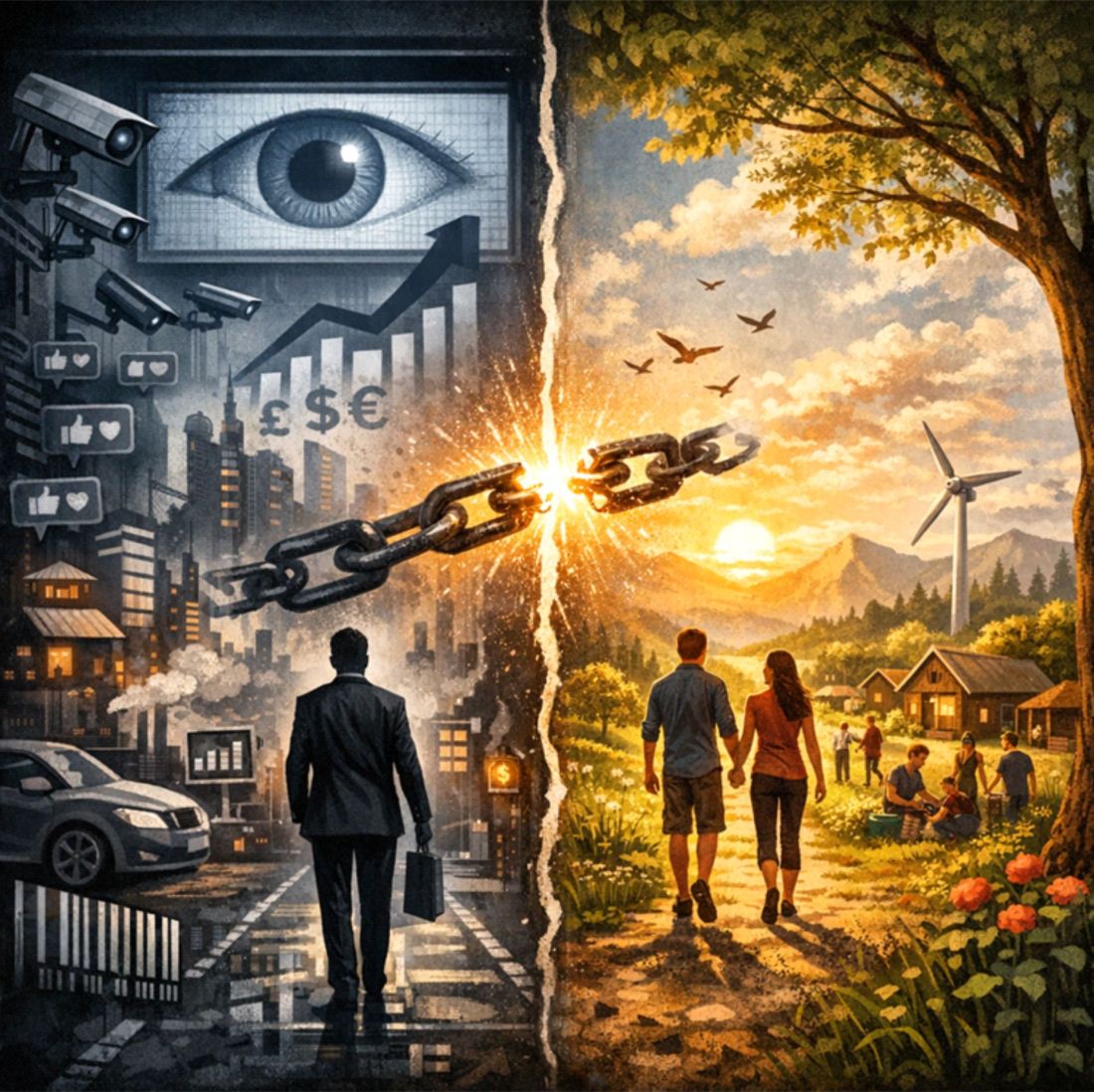
There is a deep irony shaping our world today: the very same ideas, technologies, and lifestyle changes that could genuinely liberate us are being deployed by the system in ways that make them feel threatening, manipulative, and coercive.
The problem is not the ideas themselves. It is the quiet, unspoken understanding that these ideas are being used as tools of control – and it is this instinctive recognition of control that triggers resistance in us all.
Many people sense that something is fundamentally wrong with the world we live in yet remain mentally tied to a money‑centric paradigm that shapes every part of life. We have been conditioned to believe that our security, identity, and worth depend on participating in a world where money is the organising principle of everything.
This conditioning is so deep that even when new ways of living could benefit us, we instinctively reject them because they appear to threaten the familiar structures we rely on.
This is the paradox:
We resist the very things that could free us, because the system is attempting to impose them through mechanisms of control.
The Conditioning That Keeps Us Trapped
Most of us have grown up believing that a “normal” or “successful” life requires an endless list of possessions, achievements, and external validations.
It’s not just the material things – it’s the psychological architecture that sits behind them. We have been conditioned to measure our worth through metrics that have nothing to do with who we really are.
We are told we need:
• A car for every adult
• A house for everyone
• The latest phone
• A giant TV
• Multiple streaming services
• Fast fashion
• Constant entertainment
• Takeaways delivered on demand
• Endless consumption to prove we are “keeping up”
But the conditioning goes much deeper than consumer goods. It extends into the very way we judge ourselves and others:
• The highest possible salary
• The most prestigious job title
• Promotions as proof of personal value
• The biggest house in the best postcode
• The most likes, followers, and subscribers
• The most impressive CV
• The most enviable holidays
• The most “productive” lifestyle
• The most polished online persona
• The appearance of success, even when it’s hollow
• The pressure to “achieve” constantly
• The fear of falling behind peers
• The belief that our worth is defined by external approval
These are not natural human needs. They are manufactured reference points – a system of external markers designed to keep us striving, comparing, competing, and consuming.
They ensure that our sense of identity is always tied to something outside of ourselves.
This is the real trap:
We have surrendered our internal compass to an external world that profits from our insecurity.
We judge ourselves – consciously or unconsciously – by how well we fit into a money‑centric system that was never designed to serve us. And because our sense of worth is tied to these external markers, any suggestion that we might not need them feels like a threat to our identity, not just our lifestyle.
This is why people resist change so fiercely.
Not because the change is bad, but because it challenges the framework through which they have been taught to measure their own value.
Why People Resist Changes That Could Actually Help Them
Try telling someone who has just woken up to the unfairness of the system that:
• We don’t all need to own cars
• We don’t all need to own property
• We don’t need constant consumption
• We don’t need to live isolated, individualised lives
• We don’t need to measure everything in money
They will likely resist – fiercely.
Not because these ideas are wrong, but because they have been weaponised by the system.
It may feel counterintuitive, but concepts like:
• Reduced car use
• Localised living
• Sustainable consumption
• Community‑based economies
• Reduced working hours
• Degrowth
• Circular economies
• Shared resources
• Public transport expansion
…could all be part of a healthier, more human‑centred future if they emerged organically and voluntarily.
But when these ideas are pushed top‑down, wrapped in surveillance, monitoring, behavioural nudging, and centralised control, people instinctively reject them – even when the underlying idea might be beneficial.
The system has taken potentially positive concepts and fused them with mechanisms of power.
So, people aren’t reacting to the ideas themselves. They’re reacting to the control embedded within them.
The Perfect Example: Artificial Intelligence
Artificial intelligence is perhaps the clearest example of this paradox.
AI could be one of the greatest tools humanity has ever created – a way to enhance human capability, reduce unnecessary labour, and support human flourishing.
Used wisely, it could:
• Free people from repetitive work
• Support creativity
• Improve decision‑making
• Strengthen communities
• Expand access to knowledge
• Reduce inequality
But that is not the direction we are currently heading.
Instead, AI is being developed and deployed in ways that:
• Replace human workers
• Concentrate power
• Increase dependency
• Reduce human agency
• Expand surveillance
• Amplify profit for a tiny minority
• Accelerate social fragmentation
The “AI takeover” is not a natural or inevitable outcome. It is a choice – a choice made by those who stand to gain from redundancy, dependency, and control.
The technology itself is not the threat.
The threat is the intention behind its use.
The Race for Control
As more human roles are automated and more decisions are handed to machines, human agency is being eroded.
Every day, more of our lives are mediated by systems we did not design, do not control, and cannot meaningfully influence.
This creates a sense of urgency for those who manage the system. If society is heading toward collapse – economically, socially, environmentally – then maintaining stability becomes their highest priority.
And the fastest way to maintain stability is to:
• Reduce personal independence
• Limit mobility
• Centralise decision‑making
• Monitor behaviour
• Shape public opinion
• Restrict dissent
• Manage consumption
• Control access to resources
This is why so many policies that could be positive are being implemented in ways that feel coercive. The system is not trying to build a better world. It is trying to preserve itself in a world that is rapidly becoming ungovernable.
The Return to Personal Sovereignty: Freedom Through Self‑Awareness and People‑Centric Living
If the conditioning of the current model traps us by tying our identity to external markers, then the antidote – the path back to genuine freedom – lies in reclaiming our internal point of reference.
Personal sovereignty is not a political slogan or a lifestyle trend. It is the natural state of a human being who no longer depends on external systems to define their worth, purpose, or direction.
Sovereignty begins the moment we stop measuring ourselves through the lens of money, status, or approval, and start recognising that our value is inherent, not earned. It grows when we reconnect with the things that make us human: relationships, contribution, community, creativity, purpose, and the physical experience of life itself.
A people‑centric way of living – one built around human needs rather than economic demands – naturally restores this sovereignty.
When life is organised around people instead of profit, several things begin to happen:
1. We rediscover intrinsic value
Worth is no longer tied to salary, job title, or social metrics. It comes from being human.
2. We stop outsourcing our identity
Decisions become grounded in personal truth rather than social expectation.
3. We regain agency over our lives
People become active participants in shaping their own lives and environments.
4. We reconnect with community
Support, collaboration, and shared purpose replace competition and comparison.
5. We experience freedom through simplicity
The absence of excess creates space for meaning.
6. We develop genuine self‑awareness
Without the noise of constant external validation, people begin to understand themselves more deeply.
7. We become resilient
Sovereign individuals and communities can adapt, create, and thrive even in times of crisis.
8. We stop being controlled by fear
When people no longer rely on external systems for identity or security, they become far harder to manipulate.
Why Sovereignty Feels So Threatening to the System
A population that is sovereign, self‑aware, and community‑rooted is a population that cannot be easily controlled.
They do not respond to fear‑based messaging. They do not depend on centralised systems. They do not measure their worth through consumption. They do not need constant management.
This is why the current model promotes versions of change that maintain dependency rather than reduce it.
It prefers:
• monitored communities, not empowered ones
• digital identities, not personal identities
• managed behaviour, not self‑direction
• controlled mobility, not voluntary simplicity
• AI‑driven oversight, not AI‑supported autonomy
• economic compliance, not human flourishing
The system fears the very thing that would heal society: people who no longer need it.
The Paradox Resolved
The future that looks threatening today – local living, reduced consumption, community‑based systems, shared resources, human‑centred technology – becomes liberating when it emerges from sovereignty rather than control.
The difference is simple but profound:
• Forced change removes freedom.
• Voluntary change restores it.
When people choose a simpler, more connected, more human way of living, they do not experience loss. They experience relief. They experience meaning. They experience themselves.
This is the future that is waiting beneath the collapse of the old system – a future built not on money, metrics, or manipulation, but on human beings rediscovering who they are when the noise of the external world finally fades.
Further Reading
If These Ideas Resonated, Here’s Where to Go Next
The Paradox of Control is part of a much wider conversation about how we’ve organised society – and why so many well‑intended changes now feel threatening instead of freeing.
If this piece struck a chord, the articles below explore the same themes from different angles. They move from questioning the role of money itself, through practical alternatives at a community level, and into the challenge of preserving human sovereignty in a world shaped by AI and automation.
You don’t need to read them all at once – they’re designed to be explored at your own pace.
We Can’t Fix Society Because We Won’t Question Money
🔗 https://adamtugwell.blog/2026/01/22/we-cant-fix-society-because-we-wont-question-money/
This piece goes right to the root of the problem. Rather than blaming politics, culture, or technology, it asks a simpler but more uncomfortable question: what if money itself is shaping far more of our behaviour than we realise?
It explores how money quietly defines success, security, and self‑worth – and why real change remains impossible as long as money is treated as untouchable or neutral.
The Local Economy Governance System
🔗 https://adamtugwell.blog/2025/11/21/the-local-economy-governance-system-online-text/
If money isn’t the best organising principle for human life, what could replace it?
This article explores a practical alternative: local, people‑centred systems designed around real needs rather than profit. It looks at how communities could organise work, contribution, resources, and care in ways that feel human, grounded, and meaningful – without relying on distant institutions or centralised control.
A Future of Communities: Building the New World Without Oil, Manipulated Money, and Centralised Control
This is a wider, more expansive look at where all of this could lead.
Rather than predicting collapse or offering a glossy utopia, this article explores how communities might naturally evolve as old systems become less viable.
It focuses on resilience, adaptability, and human connection – and what becomes possible when people stop trying to preserve systems that no longer serve them.
The Human Sovereignty Charter for Artificial Intelligence
- A framework for keeping humans at the centre of an automated world*
🔗 https://adamtugwell.blog/2026/03/07/the-human-sovereignty-charter-for-artificial-intelligence-a-constitutional-framework-for-human-centred-governance-of-ai-full-text/
Artificial intelligence sits at the heart of today’s control paradox.
This piece tackles the fear directly – not by rejecting AI, but by asking who it is really being built for.
It outlines a sovereignty‑based approach to AI governance, arguing that technology should strengthen human agency, not replace it or quietly manage behaviour behind the scenes.


