
We talk about democracy as if it’s a simple mechanism: you vote, a party wins, and that party governs. But this narrow view has hollowed out the meaning of democracy until it resembles little more than a consumer transaction.
Every few years, we’re handed a menu of political brands and told to pick the one that offends us least.
This isn’t democracy. It’s the illusion of choice inside a system that has already decided what choices we’re allowed to have.
Real democracy is something much deeper – and we’ve forgotten it.
What Democracy is – and What it isn’t
Democracy, at its root, is majority choice. But that definition is incomplete. Democracy is not simply the act of voting. It is not the ritual of elections. It is not the expectation that “our” party should win and everyone else should step aside.
Democracy is:
- The collective power of people to shape the conditions of their own lives
- A system that protects everyone’s rights equally – without preference, hierarchy, or special status
- A framework for accountability
- A method for solving shared problems
- A culture of participation, not passive observation
Democracy is not the ballot box. The ballot box is merely the tool.
The purpose of democracy is self-governance – the ability of communities to decide what works for them, based on lived experience rather than ideological dogma.
Where Democracy Came From – and What it Lost Along the Way
Democratic government is most famously associated with Athens in the late 6th and 5th centuries BCE. Following reforms traditionally linked to Cleisthenes, eligible male citizens took part directly in the ekklesia, debating and voting on public decisions. The system excluded women, enslaved people, and resident foreigners, and therefore fell far short of modern standards of political equality. Even so, it established an influential model of citizen self-government rather than rule solely by a monarch or a narrow hereditary elite.
Modern democracy did not develop in a single, continuous line from Athens. It emerged unevenly through conflicts, reforms, institutions, and ideas that gradually broadened political participation and constrained arbitrary power.
Important milestones include:
1215 – Magna Carta
Originally a settlement between King John and rebellious barons, Magna Carta was not a democratic charter in the modern sense. Its later significance lay in the principle that royal authority was subject to law, an idea that helped shape subsequent arguments for constitutional government and legal accountability.
17th–18th centuries – Constitutional conflict and Enlightenment thought
Thinkers including Locke, Montesquieu, and Rousseau developed different accounts of natural rights, limited government, the separation of powers, popular sovereignty, and consent. Their ideas were not identical – Rousseau, for example, was wary of representative politics – but together they profoundly influenced later constitutional and democratic movements.
19th and early 20th centuries – Expansion of suffrage
In many countries, voting rights were extended in stages beyond propertied men to wider sections of the adult population. The process was uneven and often contested, shaped by reform campaigns, labour movements, anti-colonial struggles, and movements for women’s suffrage. Universal adult suffrage was achieved at different times and remained incomplete in practice in some places.
20th century – Post-war constitutions and human rights frameworks
Accountability, equality, and protection from tyranny became foundational.
Each stage widened participation but also centralised administration, gradually shifting democracy from a lived, local experience to a managed national system.
The result is what we see today – a structure that speaks the language of democracy but often forgets its purpose.
What Democracy Should Do
Democracy should be a mechanism that:
- Identifies shared priorities
- Builds consensus rather than division
- Distributes decision-making to the most local level possible
- Ensures leaders serve the public, not party machinery
- Encourages participation beyond voting
- Creates policies that work for everyone, not just for party loyalists
- Protects the rights of all people equally – without preference, hierarchy, or special status
Democracy should not be about choosing who gets to manage decline. It should be about building a system where decline is no longer inevitable.
The Problem: Party Politics isn’t Majority Choice
Political parties do not represent majority choice. They represent the choices of party leadership.
Parties are hierarchical organisations with:
- Leadership-driven agendas
- Internal factions
- Donor influences
- Strategic calculations
- Ideological commitments
When we vote for a party, we are not choosing “the people’s agenda.” We are choosing one group’s pre-written agenda, crafted far from the communities it will shape.
This creates a democratic illusion:
We feel like we’re choosing our future, but we’re mostly choosing between futures someone else has already decided.
Party politics turns democracy into a spectator sport. Citizens become consumers of political brands rather than participants in collective decision-making.
Why National Politics Feels So Distant
National politics is structurally insulated from everyday life:
- Decisions are made by people who often don’t live in the communities affected
- Representatives are pressured to vote with their party, not their constituents
- Media narratives reduce complex issues to tribal conflict
- Citizens are treated as spectators until election day
This distance is not accidental – it is built into the system.
As explored in Regional Centralisation: The Rewriting of England’s Democracy Without a Mandate, power is quietly being moved upward into new regional bodies that:
- Are not elected
- Are not accountable
- Are not transparent
- Are not local
- And were never approved by the public
This is not decentralisation. It is recentralisation – disguised as reform.
When decisions are made too far from the people they affect, democracy becomes symbolic rather than functional.
Why the System Keeps Offering the Wrong Solutions
Whenever public frustration reaches boiling point, the political class responds with a familiar tactic: offer a technical fix that sounds democratic but changes nothing about how power actually works.
This is exactly what we are seeing now with the sudden excitement around proportional representation and alternative voting systems following Andy Burnham’s speech.
The timing is not accidental. The public is angry. Trust is collapsing. The system needs a distraction.
Proportional Representation: The Wrong Answer to the Right Frustrations
PR is being sold as a democratic upgrade – a way to make votes “count” and ensure fairer representation. But as explored in Proportional Representation: The Wrong Answer to the Right Frustrations, PR does not solve the real problem.
PR:
- Keeps power in the hands of political parties
- Deepens tribalism by empowering smaller ideological factions
- Creates permanent coalition governments where deals are made behind closed doors
- Removes accountability by making it impossible to know who is responsible for what
- Does nothing to restore local sovereignty
- And crucially: does not give people more control – it gives parties more control
PR is not a democratic revolution. It is a democratic illusion.
It is a way to change the voting system without changing the power system.
Regional Centralisation: The Quiet Rewrite of Democracy
At the same time, power is being quietly moved upward into new regional bodies that:
- Cannot be removed
- Cannot be challenged
- Cannot be held accountable
- Cannot be replaced by local decision-making
While the public debates voting systems, the real constitutional rewrite is happening behind the scenes.
Democracy Has Become a Name Hiding What’s Really Going On
This is the core truth:
Democracy is now the word used to describe systems that prevent democratic power.
We are told we are getting more choice. We are told we are getting more fairness. We are told we are getting more representation.
But what we are actually getting is:
- More centralisation
- More party control
- More distance between people and decisions
- More insulation for those in power
- More complexity that hides accountability
- More structures that cannot be challenged or removed
Democracy has become a brand. A label. A marketing term.
The system is not being reformed. It is being fortified.
And the public is being encouraged to argue about voting systems instead of asking the real question:
Why don’t we have any meaningful power in the first place?
Identity Politics and the Distortion of Democracy
One of the most damaging shifts in modern politics has been the replacement of individual equality with group‑based identity frameworks.
Democracy is built on the principle that every person is equal in rights, responsibility, and consequence. But over recent decades, politics has increasingly treated people not as individuals, but as members of categories.
This shift has distorted democratic behaviour in several ways:
- People are encouraged to see themselves as representatives of a group rather than as citizens
- Political parties use identity categories as tools for mobilisation, not empowerment
- Public debate becomes moralised, with identity used as leverage rather than reason
- Policy becomes reactive, designed to appease groups rather than solve shared problems
- Accountability becomes blurred, because responsibility is diffused across categories rather than held by individuals
Identity politics reframes democracy as a competition between groups, each seeking preferential treatment, recognition, or protection. But democracy cannot function when rights are distributed according to group membership. It cannot function when political legitimacy is measured by how loudly a category can claim harm. And it cannot function when leaders treat identity as a currency to buy moral authority.
True democracy does not do preferences. True democracy does not do hierarchies of grievance. True democracy does not do special status.
It protects everyone equally – or it ceases to be democracy at all.
Identity politics has not expanded democracy. It has fragmented it.
It has turned citizens into factions. It has turned representation into symbolism. It has turned equality into a negotiation.
And in doing so, it has made the system more fragile, more divided, and more easily manipulated.
This is why so many wheels are now falling off.
How “Minority Protection” Became a Political Weapon
The idea of protecting minorities began as a safeguard – a way to ensure that democratic systems did not allow the majority to strip rights from individuals who were less numerous or less powerful. In its original form, it was a principle of equal protection, not preferential treatment.
But over time, three things happened:
1. Protection became preference
Instead of ensuring equal rights, political actors began using minority status to justify additional rights, special exemptions, or preferential policies. This shifted the principle from equality to hierarchy.
2. Preference became leverage
Once minority status carried political weight, it became a tool. Groups could claim moral authority, political influence, or cultural power by framing themselves as protected categories. This incentivised political actors to amplify identity rather than address shared problems.
3. Leverage became weaponisation
As identity became a political currency, it was used to:
- shut down debate
- delegitimise opponents
- claim moral superiority
- demand policy concessions
- frame disagreement as hostility
This weaponisation did not protect minorities. It used minorities – as symbols, as shields, and as rhetorical tools.
The result is a system where:
- identity is political capital
- grievance is political strategy
- categories are political assets
- and equality is no longer the foundation of democracy
This is not protection. It is distortion.
And it has created a political environment where leaders can manipulate identity to avoid accountability, distract from systemic failure, and divide the public into manageable segments.
Democracy cannot survive when identity becomes a political weapon. Democracy only survives when every person is treated equally – without preference, without hierarchy, and without exception.
Why Democracy Cannot Be Repaired From Within the Existing System
The crisis we face is not simply structural. It is behavioural. It is cultural. It is moral. And this is where two essential truths emerge – truths explored in The Way of Awakened Politics and Officially None of the Above.
The Behavioural Problem: Politics Without Awakening
Democracy cannot function when the people who operate it behave in ways that undermine it.
As explored in The Way of Awakened Politics for Good Government, modern politics rewards:
- ambition over service
- branding over truth
- obedience over integrity
- tribal loyalty over public duty
- manipulation over transparency
This is why every “reform” offered by the political class – PR, alternative voting systems, regionalisation – ends up reinforcing the same system. The people proposing the reforms are shaped by the system they claim they want to change.
They cannot awaken a democracy they themselves are asleep within.
Awakened Politics argues that democracy requires leaders who:
- tell the truth even when it costs them
- serve the public rather than their party
- act from principle rather than strategy
- see power as responsibility, not opportunity
Without this shift, no voting system can deliver democracy.
The Public Problem: Choosing Between Choices That Aren’t Choices
Democracy also cannot function when the public is conditioned to accept false choices.
As explored in Officially None of the Above, people have been taught that:
- voting is the only democratic act
- choosing the least-worst option is responsible
- refusing the ballot is apathy
- loyalty to a party is loyalty to democracy
- representation means picking a tribe
This conditioning is why the system survives. People keep legitimising it.
“None of the Above” is not disengagement. It is the refusal to endorse a system that no longer represents them.
Democracy Has Become a Ritual Without Power
This is the core truth:
Democracy is now the performance of choice inside a system that prevents real choice.
The behaviour of politicians keeps the system intact. The behaviour of the public keeps the system supplied with legitimacy.
This is why PR will not fix democracy. This is why regionalisation will not fix democracy. This is why alternative voting systems will not fix democracy.
Democracy cannot be repaired by the same actors and incentives that broke it.
It can only be rebuilt by awakening – both political and public – and by returning power to the level where accountability is real: the community.
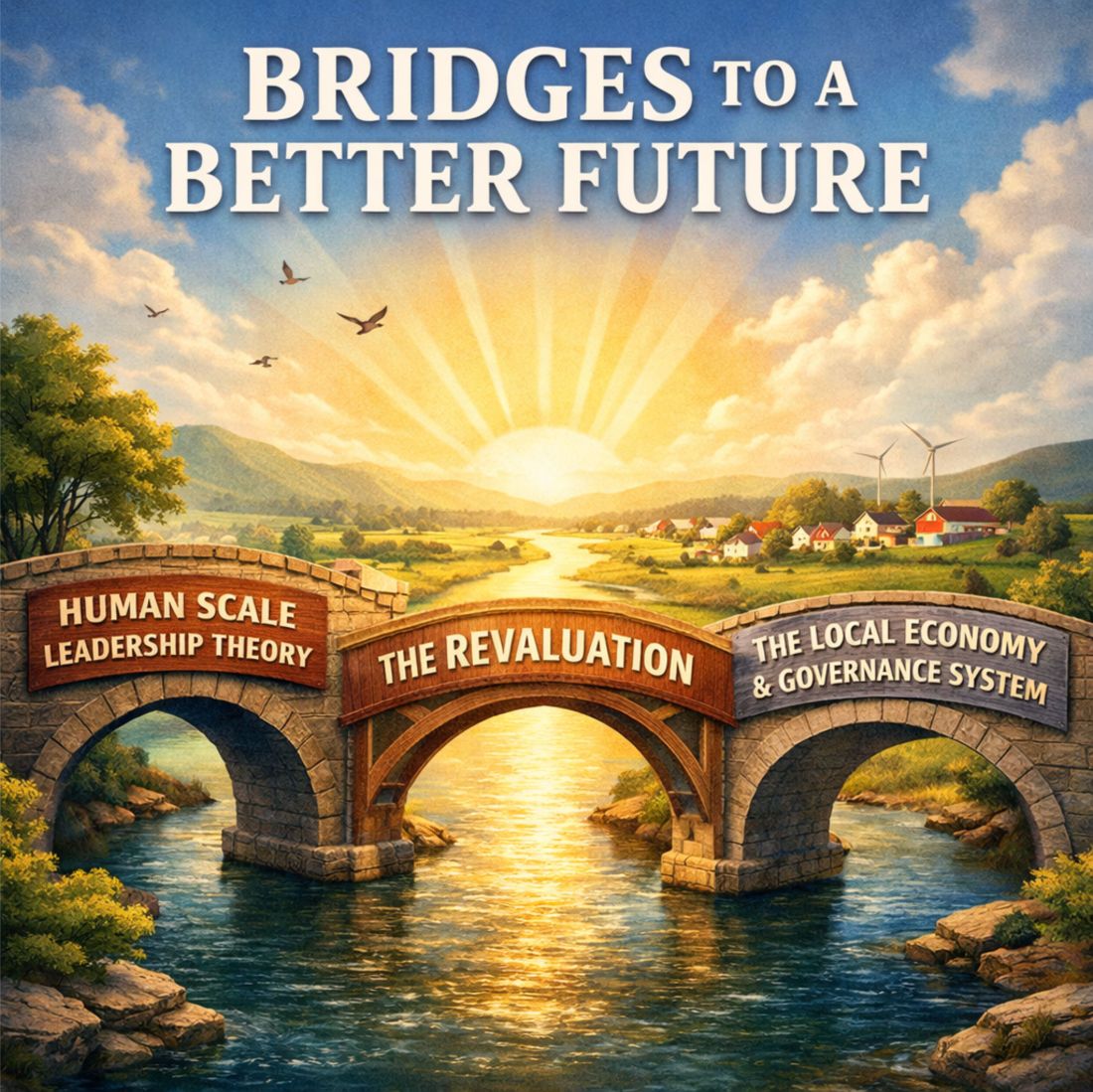
This is the heart of The Revaluation. This is the foundation of People First governance. This is the path back to democracy that works.
The Revaluation: Rediscovering What Matters
The Revaluation is the process of remembering what democracy is for. It is the shift from a money-centric worldview to a people-first one. It is the recognition that value does not come from profit, but from life itself – from people, communities, and the environment that sustains us.
It is the moment we stop asking:
Which party should win?
And start asking:
What kind of system ensures that everyone’s basic needs are met, everyone’s voice is heard, and no one can accumulate the power to harm others?
This shift is already happening. People feel the system breaking. They feel the disintegration of the old order. They see the failures of centralised governance. They recognise that the train we’re riding cannot be repaired – only replaced.
The Revaluation is not a single event. It is a transition. A pivot. A collective awakening.
Democracy Must Return Home
The most important truth we’ve forgotten is that democracy only works when it is local.
National politics is too distant, too insulated, too captured by interests that have nothing to do with ordinary life.
Real democratic decisions must be made where their consequences are felt – in communities, by the people who live in them.
This is the foundation of the Local Economy & Governance System (LEGS): a model where communities regain control over the essentials of life, where value is measured in human terms, and where governance is built around the principle that People First is not a slogan but a rule.
Local democracy is not a nostalgic idea. It is the only scale at which accountability is real.
When decisions are made by people who know you, who share your environment, who rely on the same services, who walk the same streets, democracy becomes meaningful again.
Democracy Should Deliver What People Actually Need
A functioning democracy should guarantee:
- A Basic Living Standard that ensures no one falls below the threshold of a dignified life
- Local control of essential resources
- A governance framework that prevents exploitation
- A culture where contribution is valued more than accumulation
- A system where money is a tool, not a master
- A marketplace where barter, exchange, and community contribution are normal
- A political structure where leaders serve, not rule
Democracy should not be about choosing who gets to manage decline. It should be about building a system where decline is no longer inevitable.
None of the Above: Rejecting False Choice
When the only options on the ballot are parties that serve the same centralised, money-first system, choosing between them is not democracy. It is compliance.
“None of the Above” is not apathy. It is a political statement. It is the refusal to legitimise a system that no longer serves the people it claims to represent.
Democracy begins when people stop accepting the choices they are given and start demanding the choices they need.
The Future of Democracy is Local, Human, and Real
We are living through the collapse of the old world. The question is not whether change is coming. It is whether we will embrace the change that serves everyone, or cling to the system that serves only a few.
Democracy is not the fight between political parties. Democracy is the fight to ensure that people, communities, and the environment come first.
The Revaluation is the rediscovery of democracy’s original purpose: to build a world where everyone has enough, everyone has a voice, and no one has the power to take either away.
This is the democracy we must reclaim. This is the democracy we must rebuild. This is the democracy that works.
Further Reading: Exploring People‑First Democracy and The Revaluation
To deepen your understanding of the ideas behind The Revaluation, People First governance, and the shift away from money‑centric politics, the following works offer a clear pathway through the core concepts.
1. The Way of Awakened Politics for Good Government
A philosophical foundation for People First governance. It explores how politics must evolve beyond party tribalism, ideological entrenchment, and self‑interest. Awakened Politics is presented as a conscious, values‑driven approach to leadership rooted in responsibility and moral clarity.
2. Officially: None of the Above
A challenge to the illusion of democratic choice within the current party system. It argues that refusing to endorse any of the pre‑selected options becomes a legitimate democratic act when all serve the same centralised model.
3. Proportional Representation: The Wrong Answer to the Right Frustrations
A detailed explanation of why PR is not the democratic upgrade it is sold as. It shows how PR entrenches party control, deepens tribalism, and distracts from the real issue: the absence of meaningful public power.
4. Regional Centralisation: The Rewriting of England’s Democracy Without a Mandate
A forensic examination of how England’s governance is being quietly re‑engineered through regional bodies that lack democratic consent. It shows how power is being shifted upward away from local communities and toward unelected administrative structures – under the guise of reform. The piece exposes how this process erodes accountability, weakens local sovereignty, and rewrites democracy without public approval.