
British politics is full of noise, but nowhere is the confusion deeper today than on the political right.
The Conservative Party, Reform UK and Restore are fighting to be recognised as the true voice of the right. Each claims it alone can “save” the country. Each accuses the others of betrayal, weakness or irrelevance. And yet all three are reaching for something that now sits beyond their grasp.
To many voters, this looks like chaos.
To those inside the parties, it feels like a fight for survival.
But the deeper truth is far more important:
All three parties are trying to reclaim the same thing: a form of conservatism that the modern political system no longer allows to exist.
That is the real “race to the bottom”: not a competition to be the most populist or extreme, but a desperate scramble to rediscover a purpose that has slipped out of reach.
In simple terms, this article argues that Britain’s right-wing parties are not merely competing over policies, personalities or slogans. They are fighting over a deeper question: What is the right actually for, when the social, economic and political conditions that once sustained conservatism have been steadily dismantled?
The Right’s Original Purpose: The One Thing They All Should Still Share
Before we can understand the crisis on the right, we need to understand what the right is supposed to be for.
Traditional conservatism was built on six simple but powerful ideas:
- Locality – decisions made close to the people affected by them.
- Community – strong social bonds, shared responsibility and mutual obligation.
- Stewardship – care for land, heritage, institutions and the inheritance passed between generations.
- Continuity – change that is evolutionary and rooted, rather than sudden and destructive.
- Identity – belonging grounded in place, memory and shared experience.
- Self-governance – power held by the governed, not by distant authorities beyond meaningful democratic control.
This is what conservatism is at its root.
This is what the right once existed to conserve.
And this is the foundation that should, in theory, unite the Conservatives, Reform UK and Restore.
But it does not, because the political landscape in which these parties operate no longer supports these principles in any meaningful way.
How the Right Lost Its Purpose – A Story of Drift and Disconnection
To understand today’s fragmentation, we need to understand how the right became detached from its own foundations.
This did not happen all at once. It happened through drift, compromise and disconnection.
1. The 1970s: The Ground Shifts Under the Right’s Feet
From the 1970s onwards, Britain’s move towards more centralised and supranational forms of governance began to erode several of the things on which traditional conservatism depends. Centralisation means decision-making moving upwards, away from towns, counties and communities. Supranational governance means important decisions being shaped beyond the nation state, through institutions and arrangements that sit above national democratic control.
- local autonomy
- national decision-making
- community-rooted politics
Traditional conservatism depends on those things because it is rooted in the belief that people, places and inherited institutions matter.
But much of the right did not see the danger clearly, because it assumed the world it knew would continue unchanged.
2. The 1980s–2000s: Neoliberalism Replaces Conservatism
The decisive break came when neoliberalism began to replace conservatism.
Neoliberalism, in this context, means a market-led, globalised economic outlook that prioritises (corporate) deregulation, competition, finance, corporate scale and consumer choice.
The right increasingly embraced:
- deregulation
- financialisation
- global markets
- corporate power
- consumerism
- managerial politics
These are not conservative values in the traditional sense.
They are economic ideologies and operating assumptions.
Over time, they hollowed out the right’s philosophical core.
Conservatism, rooted in community, identity and stewardship, became a ghost inside a political movement that no longer fully understood itself.
3. The 2000s–2010s: The Hollowing Out Becomes Visible
By the 2000s and 2010s, that hollowing out had become visible.
Without a clear purpose, the right became:
- reactive
- fragmented
- populist in tone
- technocratic in practice
- dependent on media cycles
- unable to articulate what it stands for
This was the moment when the right often appeared to stop conserving people, places and institutions, and instead began conserving the system itself.
That loss of purpose did not remain abstract. It surfaced most clearly in the anti-EU movement.
The Deep Irony: The Anti‑EU Movement was Conservatism’s Last Instinctive Rebellion
Here is the irony that explains much of today’s political confusion:
The anti-EU movement was traditional conservatism trying to save itself, without fully realising that the philosophical ground beneath it had already been removed.
The instincts behind the movement were deeply conservative:
- local control
- national self‑determination
- suspicion of distant authority
- protection of community identity
- desire for continuity and rootedness
But the right that led and shaped the movement had already embraced many of the forces – globalisation, centralisation and corporatism – that had made traditional conservatism so difficult to sustain.
So the movement fought the symptoms of the drift, rather than the drift itself.
It tried to reverse a trend that the right had already helped create.
For example, a politics that speaks about local control cannot easily thrive in a country where planning, infrastructure, public services and economic life are increasingly shaped by distant institutions, large corporations, national targets and global pressures.
That is why the argument goes deeper than Europe alone.
The Modern Split: Conservatives, Reform UK and Restore Are Fighting Over the Same Lost Purpose
This is the part we all need to understand.
The Conservative Party, Reform UK and Restore are not divided as they are because they stand for completely different philosophies.
They are divided because they all want to reclaim the same thing – traditional conservatism – but none of them can reach it within the current system.
The Conservatives
The Conservatives are trying to defend a system that no longer reflects conservative values. They carry the name, history and institutional memory of the right, but they have become too closely associated with the very political and economic structures that displaced traditional conservatism.
Reform UK
Reform UK is trying to break the system, or at least disrupt it, without always making clear what durable conservative order should replace it. It channels anger at drift, centralisation and betrayal, but protest is not the same as reconstruction.
Restore
Restore is trying to revive traditional conservatism in a landscape where the conditions that once supported it have been weakened to the point they no longer function the way they once did. Its instinct is to return to first principles, but those principles now have to operate in a system built against them.
The three visible parts of the right are fighting each other because:
- they feel the same loss
- they sense the same drift
- they are chasing the same instincts
- they are trying to conserve something the system itself has dismantled
Their conflict is therefore not simply ideological.
It is existential.
They are competing to represent a philosophy that the political operating system no longer allows to function.
Why the Left Appears More Unified
This contrast matters.
The left achieved much of its historic mission decades ago:
- suffrage
- workers’ rights
- the NHS
- the welfare state
These were extraordinary achievements.
Once achieved, the left’s original foundational purpose was essentially complete.
So the left adapted.
It became:
- flexible
- narrative‑driven
- culturally aligned
- institutionally embedded
- comfortable with centralisation
- comfortable with supranationalism
The left arguably appears unified today not because it has a clear purpose, but because it has no foundational mission left to betray.
It can adapt to remain relevant.
The right struggles to adapt cohesively and together because it has forgotten, or lost the conditions for, what it is supposed to conserve.
The Real Problem: Conservatism Cannot Meaningfully Exist in the Current System
This is the truth the right often refuses to face:
Conservatism cannot meaningfully exist within the current system.
Conservatism requires:
- local decision‑making
- community autonomy
- stewardship
- identity
- continuity
- self‑governance
But the current system is built around:
- centralisation
- corporatism
- globalisation
- managerialism
- technocracy
- distant authority
These two worldviews sit in deep tension.
That is why the right is in a race to the bottom.
It is trying to rediscover a purpose that the system itself has made effectively impossible to practise.
In practical terms, this can be seen when local communities feel they have little control over development, when national economies depend on global supply chains, when public institutions are managed through targets rather than relationships, or when identity is treated as a branding exercise rather than a lived bond between people and place.
So What Is the Right Really For?
If the right rediscovered its purpose, it would stand for:
- Local power
- Community‑rooted economies
- Stewardship of land and environment
- Identity grounded in place and shared experience
- Governance by the governed
- Institutions that serve people, not systems
This is not nostalgia.
This is not ideology for its own sake.
This is not populism.
This is real conservatism: the kind that protects people, places, institutions and the bonds between them.
But until the right recognises that the system itself prevents these values from flourishing, it will continue its race to the bottom, mistaking noise for purpose, populism for philosophy, and survival for renewal.
The Message That Needs to Be Heard
Britain’s right-wing parties are not simply enemies.
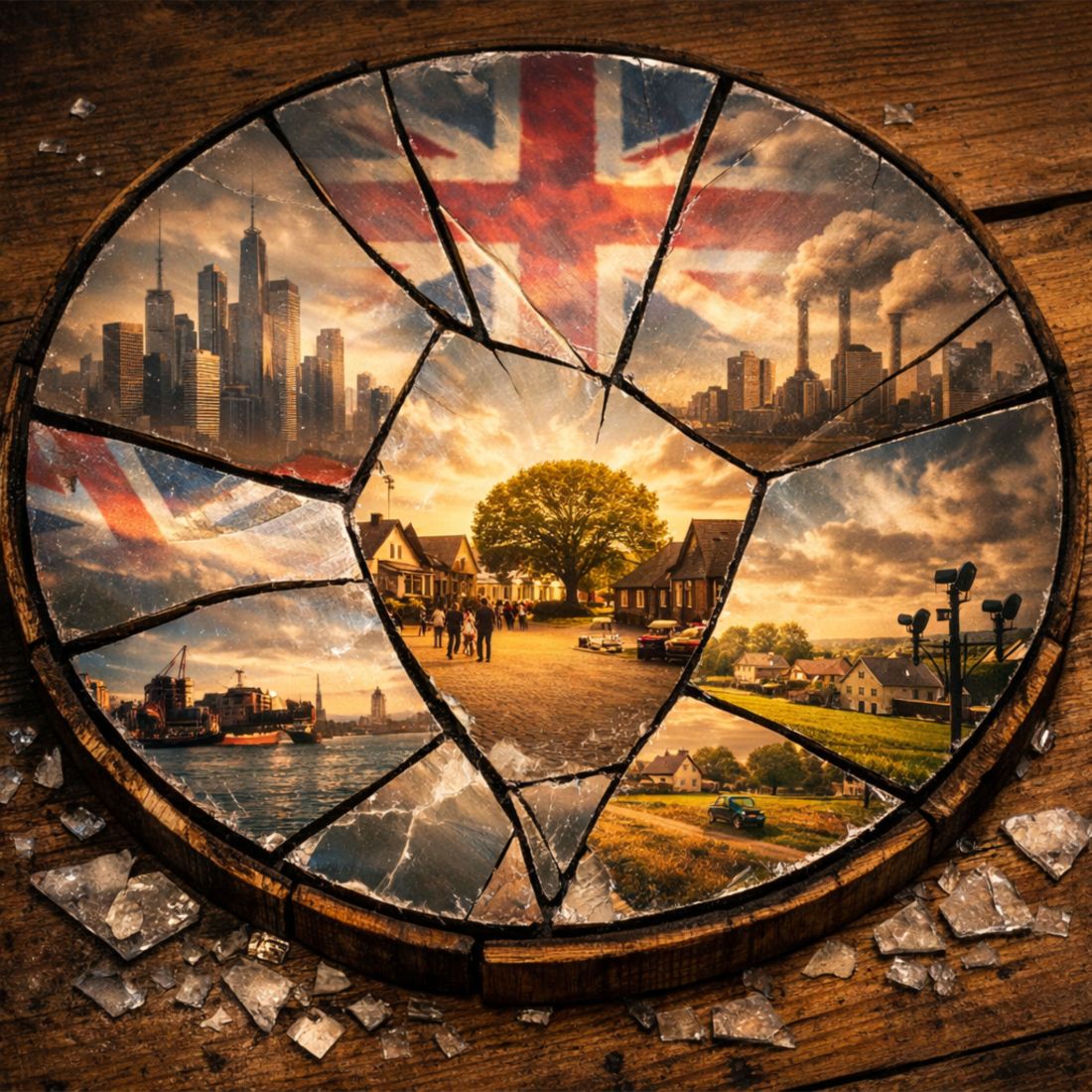
They are fragments of the same broken whole.
They are all trying to reclaim a conservatism that the modern political system has made effectively impossible to practise.
Until they recognise this, they will keep fighting each other and keep losing sight of the very thing they should exist to protect:
People.
Places.
Communities.
And the continuity that binds them together.
Until the right redefines its purpose for the system as it is, not the one it remembers, it will keep fighting itself instead of shaping the country.

