Gloucestershire’s Unitary Authority: The Local Earthquake That Signals a National Democratic Crisis

The decision to abolish Gloucestershire’s six district councils and replace them with a single unitary authority is being presented as modernisation – a way to save money, streamline services, and “bring power closer to people”. But what is happening in Gloucestershire is part of a much bigger national pattern, and its consequences reach far beyond council boundaries.

This is not just administrative reform. It is the removal of an entire layer of democratic representation. And it is happening without a mandate, without a plebiscite, and without meaningful public consent.

The sales pitch: cost savings and efficiency

The Government’s argument is simple:

  • One council instead of seven
  • Fewer managers
  • Shared back‑office functions
  • Lower overheads
  • “Joined‑up services”

But Gloucestershire has already been delivering shared services for years. Ubico, shared legal teams, joint waste contracts, pooled planning policy work – these arrangements already exist and already save money.

So the real question is this:

If shared services save money, why abolish the councils themselves?

This is where the core truth sits:

Public services are a cost to be saved. Democracy is not.

Supporters of unitarisation argue that residents care more about effective services than institutional structures, and that streamlined governance can reduce duplication and improve outcomes.

That argument deserves consideration. But efficiency and representation are not interchangeable values. A system can be administratively cleaner while being democratically weaker.

The democratic layer being abolished is one that people can actually reach

People rarely contact MPs for everyday issues. They sometimes contact county councillors. But they do contact district and borough councillors – because they are accessible, local, and directly connected to the issues that shape daily life.

Planning. Licensing. Housing. Environmental health. Local development. These are not abstract policy areas. They are the things people feel.

District councillors are among the most accessible and consequential democratic representatives in England. Abolishing them anywhere removes one of the few layers of democratic power that people can routinely reach, challenge, and hold to account.

Parish and town councils: accessible but powerless

Parish and town councillors are arguably the most accessible representatives of all. But they do not hold meaningful authority.

They deal with dog bins, bus shelters, flower beds, small grants, and being “consulted” on planning applications they cannot decide.

This is not power. It is administrative housekeeping.

And while parish and town councils should be dealing with more, they aren’t – because their powers have been systematically stripped away.

Removing district councils leaves a democratic vacuum that parish councils cannot fill.

As argued in the linked Cheltenham town council piece, parish and town councils may be necessary if borough-level representation disappears, but they are not an equivalent democratic substitute. They can help preserve local civic identity, but they cannot replace the statutory powers, responsibilities, and political weight of district councils.

Fewer political posts means fewer choices – and fewer independents

A unitary authority means:

  • Fewer councillors
  • Larger divisions
  • Bigger campaign areas
  • Higher barriers to entry
  • More professionalised politics
  • More reliance on party machines
  • Fewer independents
  • Fewer small‑party candidates
  • Less diversity of representation

This is not good for democracy. It is not good for communities. And it is not good for anyone who believes politics should be open to ordinary people, not just those backed by national party resources.

The fewer the seats, the fewer the voices.

The direction of travel: regionalisation

County councillors are more accessible than MPs – but they are still far less accessible than district councillors. And once districts are gone, counties become the natural building blocks for the next stage of restructuring:

Regional mayors. Regional authorities. Regional governorships.

This is already happening across England:

  • Greater Manchester
  • West Midlands
  • West Yorkshire
  • Tees Valley
  • North East
  • East Midlands
  • Liverpool City Region

Critics of regionalisation argue that many of these arrangements began with the language of shared services and combined authorities, before moving towards directly elected regional mayors and larger strategic bodies with significant executive influence.

Gloucestershire may now be being positioned for the same trajectory.

Unitarisation is not the end. It is a stepping stone.

This is the concern set out in the linked piece on Regional Centralisation: that the language of devolution can conceal the movement of power away from local communities and towards larger, more remote political structures.

The biggest democratic problem: no mandate, no plebiscite, no consent

This is the heart of the issue.

Local people did not vote directly for this. The public was not asked through a referendum or plebiscite. Voters were not given a clear democratic choice on whether this layer of representation should disappear.

The “consultation” was lip service – a procedural box‑tick that allows officials to say:

“We asked, and you had the opportunity to speak.”

But the public did not get a real choice. They did not get a referendum. They did not get a plebiscite. They did not get a meaningful democratic process.

This is the removal of integral parts of the democratic system. It is constitutional change because it alters who citizens can elect, how close decision-makers are to the communities they serve, the number of elected representatives available to scrutinise power, and the scale at which local decisions are made.

It is structural change. It is irreversible change.

And it is being done without the one thing that makes change legitimate:

The informed consent of voters.

There is one democratic reform that does not require direct public consent in the same way: genuine devolution of power from the centre to communities. If Whitehall gives people more power, more control, and more local choice, that is an expansion of democracy.

But this is not that. This does not move power downwards. It removes a local democratic layer and concentrates authority further away from the people affected by it.

Politicians should not be deciding this. Voters should.

The truth: this is not reform – it is centralisation

The Gloucestershire unitary authority is being presented as modernisation. But it is part of a national pattern:

  • Fewer councils
  • Fewer councillors
  • Fewer elections
  • Larger authorities
  • More distant decision‑making
  • More insulated leadership
  • More regionalisation
  • Less accountability
  • Less representation
  • Less choice
  • Less democracy

This is not bringing power closer to people. It is removing it from the places where people can actually reach it.

And the core truth remains:

Public services are a cost to be saved. Democracy is not.

Conclusion: Gloucestershire is the warning – England is the subject

What is happening in Gloucestershire is not unique. It is not isolated. It is not accidental.

It is part of a national restructuring of English democracy – one that is happening quietly, without a mandate, without a vote, and without the public understanding what is being taken away.

The question is no longer whether shared services can save money. They can. They already do.

The question is whether democracy should be sacrificed in the process.

The debate is not really about council structures. It is about who should decide how local democracy is organised.

If elected layers of government can be abolished without direct public approval, the question is not merely what kind of councils England wants. It is what role voters themselves are expected to play in determining the future of democratic representation.

Further Reading:

The arguments above draw on two earlier pieces that explore the same democratic problem from different angles: first, what should happen locally if borough-level representation disappears; and second, how the language of devolution can be used to justify regional centralisation without a direct public mandate.

If the Borough Goes, Cheltenham Must Have a Town Council

This piece argues that if Cheltenham Borough Council is abolished, a town council becomes necessary to preserve civic identity and local representation. However, it also makes clear that town and parish councils are not a full substitute for borough or district councils because they lack the same statutory powers and democratic weight.

Regional Centralisation: The Rewriting of England’s Democracy Without a Mandate

This piece examines the growth of regional mayoralties and combined authorities, arguing that what is often described as devolution may in practice become regional centralisation. It develops the point that genuine devolution means transferring power downwards to communities, not replacing accessible local democracy with larger and more distant political structures.

Regional Centralisation: The Rewriting of England’s Democracy Without a Mandate

England is undergoing a constitutional transformation of unusual scale and significance. Under the banner of “devolution,” political leaders – most prominently Andy Burnham – are advancing a model that appears to empower regions but may, in practice, centralise authority at a higher tier, away from the most immediate and accessible forms of local democracy.

This is not a partisan project; politicians across the spectrum have expressed interest in similar reforms. But its implications for democratic legitimacy, local representation, and constitutional balance are profound.

What is emerging is not devolution in the traditional sense. It is regional centralisation: the consolidation of power into larger, higher-tier executive bodies that sit above existing councils, accompanied by the quiet removal or hollowing out of the lower tiers of government that citizens interact with most directly.

Crucially, this transformation is proceeding without a clear, direct mandate from the public.

The argument is not for preserving the current system unchanged, but for reform that deepens local accountability rather than bypassing it. Genuine devolution would move authority downward – to parish, town, district, and borough levels – granting councils meaningful fiscal autonomy and policy discretion within broad national frameworks.

The Disappearing Layers of Local Democracy

Most people are unaware of how many layers of local government currently represent them.

In much of England, people have:

• Parish or town councils, handling hyper‑local matters such as parks, community centres, and neighbourhood issues.

• District or borough councils, responsible for housing, planning applications, waste collection, and local services.

• County councils, overseeing education, social care, highways, libraries, and major infrastructure.

This multi‑layered system reflects the principle of subsidiarity: decisions should be made at the lowest possible level, closest to the people they affect. It provides multiple democratic access points, enabling residents to contact representatives who live nearby, understand local issues, and are accountable to small electorates.

Yet these layers are increasingly vulnerable to being reduced, merged, or bypassed. The shift toward unitary authorities and combined regional structures can replace large numbers of locally elected councillors with a smaller number of higher-tier decision-makers.

Accessibility shrinks, accountability thins, and decision-making moves further away from communities.

This is not administrative tidying.

It risks removing some of the most accessible forms of democracy.

Why Local Councils Already Feel Arbitrary – and Why That Matters

This loss is not always immediately visible. One reason it is easy to overlook is that many people already feel disconnected from their local councils.

Planning decisions, licensing rules, and other supposedly “local” policies often feel arbitrary or unresponsive. But this is not because councils are inherently flawed; it is because much of their power has already been stripped away.

Over the past two decades, local authorities have increasingly operated as delivery arms for central policy, rather than as fully autonomous democratic bodies.

In areas such as planning, licensing, housing, and social care, councils frequently:

• interpret national frameworks rather than create their own,

• implement centrally defined targets within strict statutory guidance,

• and make decisions constrained by national funding formulas.

This hollowing-out has helped create the impression that local government is ineffective or irrelevant. In reality, many councils have been significantly constrained by central policy, statutory obligations, and funding arrangements.

Regional centralisation now risks removing what remains.

Some may argue that if councils already feel powerless, their abolition is no great loss. But this misunderstands the problem. England’s democratic malaise stems from too much power already being held at the centre.

The remedy is not to remove even more local autonomy, nor to dismantle the structures that facilitate it. The remedy is to restore genuine local power, not to eliminate it.

Regional Executives: Power Upwards, Not Downwards

The emerging model concentrates authority in large, combined authorities led by regional executives. These bodies already oversee, or are being positioned to oversee, areas such as transport, housing, skills, infrastructure, and potentially wider fiscal powers.

They are designed to be strategic and streamlined – but streamlining comes at a democratic cost.

Where multiple tiers of local representation are replaced or subordinated to a higher regional executive, several consequences may follow:

• People may have fewer directly accessible representatives.

• Decision‑makers become more distant.

• Local dissent may carry less institutional weight.

• Party machinery may gain greater influence over candidate selection.

• Central government may face fewer local veto points.

This is why the term regional centralisation is so important.

Power is not being devolved to neighbourhoods or communities. It is being consolidated into larger units that are easier to manage from the centre.

As governance becomes more distant, electoral participation and civic engagement may weaken further, reinforcing the perception that local democracy is symbolic rather than meaningful.

A Constitutional Change Without Public Consent

The most serious issue is not merely structural; it is constitutional.

Changes of this magnitude alter the relationship between people and the state. They redefine how democracy functions and reshape the architecture of representation.

Yet England’s electorate has not been asked whether it wants:

• the abolition of district and county councils,

• the creation of regional executives with sweeping powers,

• new layers of governance with tax‑raising authority,

• or a restructured democratic system that reduces local access.

These reforms have not been clearly set out as a comprehensive constitutional settlement in recent national manifestos. They have not been subject to sustained public debate or submitted to referendum. Instead, they are largely being advanced through administrative and legislative pathways: secondary legislation, funding agreements, centrally negotiated devolution deals, and institutional restructuring rather than direct electoral mandates.

The constitutional principle is simple:

Consent in this context does not require unanimity, but it does require clear public awareness and an explicit opportunity to approve or reject change.

As a democratic principle, reforms of this scale can only claim legitimacy without a public vote where they clearly return power to people – not where they remove or distance it.

Regional centralisation does the latter while presenting itself as the former.

Historical Context: England Has Rejected This Before

This is not the first attempt to reorganise England into regional units.

During the early 2000s, the Blair government – in which Burnham served as a minister – supported proposals for elected regional assemblies in England. Wales and Scotland accepted their own forms of devolution; England did not follow the same path. In the North East, a referendum was held, and voters decisively rejected an elected regional assembly.

That earlier process, whatever its flaws, respected democratic norms. It asked the public. It held plebiscites. It acknowledged that constitutional change requires consent.

Today’s process does not.

A comparable regional logic is now being revived, but without referendums, without equivalent transparency, and without comparable public debate.

The electorate is being asked to accept institutional change after the fact, even though the principle at stake remains similar: who governs England, and at what level?

Why Policymakers Favour Regionalisation

To remain balanced, it is important to acknowledge why regional centralisation appeals to policymakers, particularly within the constraints of modern governance, fiscal pressure, and fragmented local structures.

Supporters argue that fragmented local governance cannot deliver the scale of planning required for modern transport, housing, skills, and economic development.

Larger regional bodies promise:

• clearer strategic planning,

• simplified negotiation with central government,

• economies of scale,

• more coherent transport and housing systems,

• and the ability to deliver large infrastructure projects.

These aims are understandable. In several areas, existing district and county structures have already or are being replaced by single unitary authorities as a precursor to, or companion of, wider combined regional bodies.

But administrative efficiency does not, by itself, justify reducing democratic access or proceeding without clear public consent. It cannot substitute for legitimacy.

Taxation: Local Powers, Higher Burdens

One of the most consequential elements of regional centralisation is the possible expansion of local or regional tax-raising powers. These are framed as tools for flexibility and investment. But England’s fiscal reality makes additional taxation a plausible and, in many cases, likely outcome.

Regional authorities may be handed responsibilities without matching resources.

Central government is under severe financial pressure. The Treasury is unlikely to provide substantial new funding.

The likely result is that local taxes and levies could rise, often in areas least able to absorb the cost.

This is not empowerment.

It risks downloading fiscal strain onto households already struggling with living costs. Citizens may pay more while having less influence over the bodies that set those taxes.

Party Control and the Rise of Regional Governors

Regional executives are not simply administrative leaders. They are political figures whose authority derives from national party structures.

As regional governance expands, these executives increasingly function as de facto regional governors – each representing a potential “Number 10 of the North” within their region – negotiating directly with central government and overseeing large budgets.

If proportional representation or party-list systems are introduced at the regional level – a possibility discussed in several political circles – party control could intensify. Candidate selection may move further from communities and closer to party headquarters.

Local independents may struggle to compete. Citizens may find themselves voting for party lists rather than individuals they know.

This is not an expansion of democracy.

It risks becoming a consolidation of party power.

Global Governance and Public Distrust

Regional centralisation also sits within a broader global context.

International governance networks often favour larger-scale, technocratic models of administration.

Such frameworks emphasise efficiency, coordination, and strategic planning, but can do so at the expense of local autonomy.

Whether one supports or opposes these trends, the perception that power is drifting upward – toward larger units, distant executives, and global networks – contributes to public distrust.

Citizens may come to feel that decisions are being made far away, by people they did not choose directly, within systems they do not understand.

Regional centralisation amplifies that feeling.

The Manchester Question: Optics Versus Outcomes

Advocates of regional governance often point to Manchester as a success story. The city-region has made visible progress in areas such as transport branding, homelessness initiatives, and cultural identity.

But the deeper metrics are mixed:

• productivity growth has remained challenging,

• inequality remains persistent,

• housing affordability has worsened in many areas,

• transport integration remains incomplete,

• and health outcomes continue to vary sharply across neighbourhoods.

Manchester’s experience is complex. It may demonstrate the power of regional branding and strategic coordination, but it does not justify scaling up a model that simultaneously removes local councils, increases tax powers, and reduces democratic access.

Conclusion: A Democratic Architecture Being Rewritten Without Consent

England’s democratic architecture is being reshaped through regional centralisation.

This process:

• risks removing accessible local councils,

• concentrates power in regional executives,

• may expand party control,

• may introduce new tax burdens,

• proceeds without clear public consent,

• and revives a regional model that England has previously rejected when it was put directly to voters.

The narrative is empowerment.

The reality is consolidation.

The danger is not that regional centralisation might fail.

The greater danger is not failure, but success on these terms: England could wake up with fewer democratic access points, higher taxes, more insulated political elites, and a governance structure it never explicitly agreed to.

The constitutional principle remains clear:

A change of this magnitude can only be considered legitimate without a public vote if it demonstrably returns power to the people – not if it removes or distances it.

Regional centralisation risks doing the latter while presenting itself as the former.

The Absence of Leadership in a System Built for Managers and Nothing More

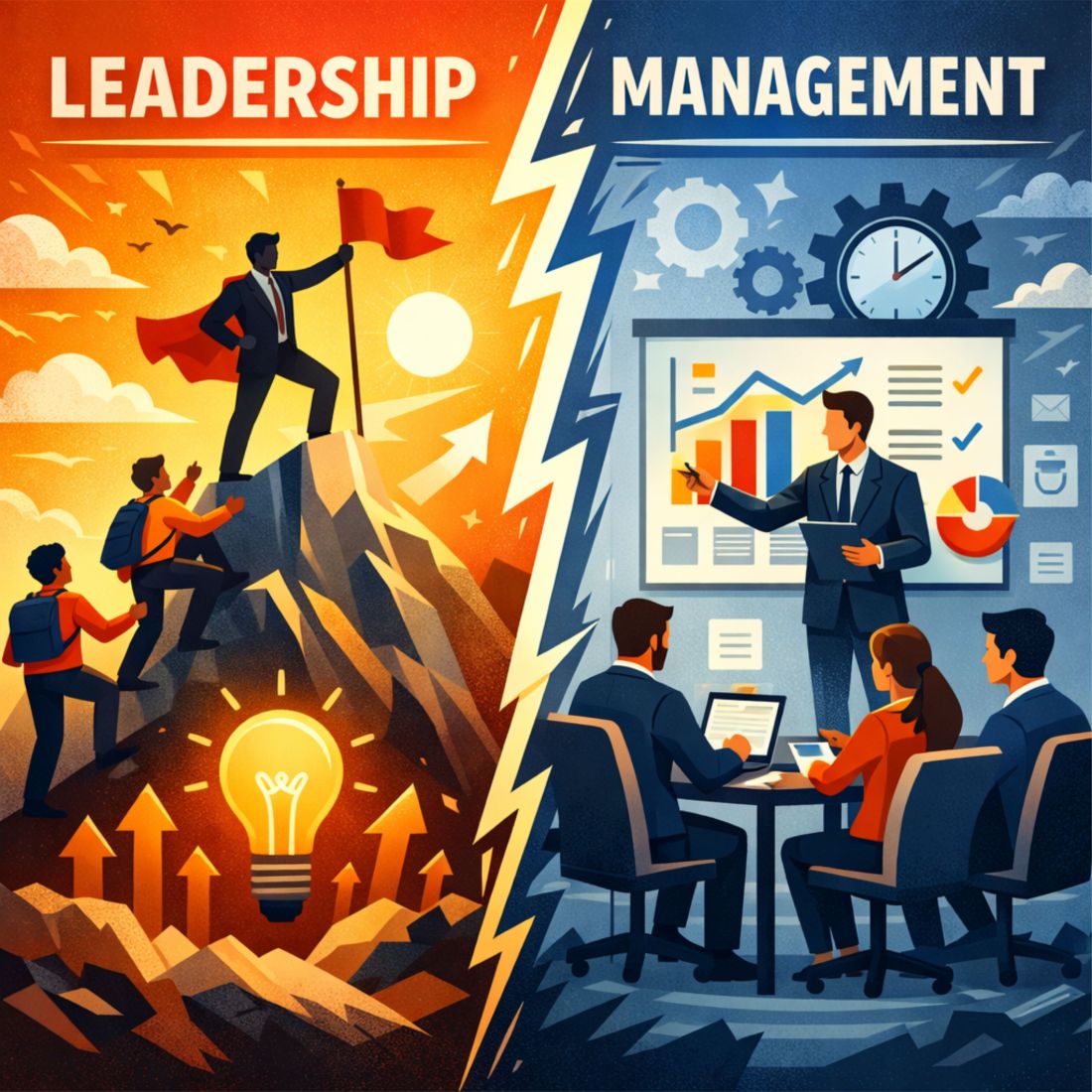
Modern society is experiencing a profound leadership crisis – not because leaders have disappeared, but because the systems that govern public life have been constructed to elevate managers instead.

This distinction is not superficial. It is the difference between a society capable of solving problems and one that merely contains them; between a political culture that serves people and one that serves itself.

The consequences of this shift are visible everywhere: in institutions that cannot act decisively, in political classes that avoid accountability, and in communities that feel increasingly disconnected from the decisions that shape their lives.

To understand how this happened, we must examine the mechanics of the system itself – especially the political party structures that determine who can rise, who cannot, and why leadership has been systematically replaced by management.

I. Why Poor Leaders Manage Instead of Lead

Poor leaders cannot lead, so they manage their way out of problems. When confronted with issues that require courage, empathy, or direct engagement – particularly when those issues involve people who are unhappy with them – they retreat into managerial behaviour. Management becomes a shield: a way to avoid conflict, responsibility, and the discomfort of facing those they have failed.

Instead of addressing the root cause of discontent, they impose restrictions and requirements on those who are more compliant. It is easier to control people who want to remain in favour than to confront those who challenge them.

This behaviour is not incidental; it is the predictable outcome of individuals who think primarily of themselves and the benefits they can extract.

Whether their aim is personal enrichment or the accumulation of power they do not know how to use, the result is the same: managerial elites respond to every problem by creating new burdens for the very people they were entrusted to serve.

II. How the System Rewards Management and Punishes Leadership

To understand why poor leaders rise, we must understand the incentives of the system itself.

Modern political and institutional structures reward:

• compliance over courage

• predictability over principle

• loyalty to the system over loyalty to the public

• risk‑avoidance over responsibility

Real leadership – which challenges assumptions, questions processes, and prioritises people – is treated as a threat.

Leaders disrupt. Leaders expose flaws. Leaders force change.

Systems built on self‑preservation cannot tolerate this.

As a result:

• those who comply rise

• those who question are sidelined

• those who serve others are punished

• those who serve themselves are rewarded

This is why genuine leaders do not seek leadership roles for their own sake.

Leadership is a natural disposition, not a career path. Yet the system has been engineered to reward ambition, self‑interest, and conformity.

III. How the Party System Manufactures Non‑Leaders

The political party system is one of the most powerful mechanisms driving the leadership crisis. It creates the illusion of democratic choice while tightly controlling who the public is allowed to choose from.

1. Voters believe they choose candidates – but parties choose them first

When voters enter the ballot box, they see a list of names and assume they are choosing between individuals. In reality, those individuals have already been chosen by party organisations long before the public ever sees them.

Unless a candidate is independent – and independents at parliamentary level have virtually no chance of being elected unless they are sensationalised – the choice has already been made by the party machine.

2. Parties select candidates for malleability, not leadership

Parties do not want independent thinkers. They want:

• reliable votes

• predictable behaviour

• people who will not challenge the hierarchy

• individuals who will not threaten the careers of those above them

This means the selection process filters out leadership qualities and filters in compliance.

3. Insecure non‑leaders select even weaker successors

Those who rise through this system are typically insecure. They know they lack leadership ability, so they avoid appointing or approving anyone who might outshine them.

Instead, they choose people who are even weaker, even more compliant, even more dependent on the system.

This creates a downward spiral:

Weak leaders → choose weaker deputies → who choose even weaker candidates → who eventually inherit roles requiring real leadership.

4. Eventually, these “yes‑people” reach roles that require real leadership

And when they do, they fail – not because they are malicious, but because they were selected precisely for their inability to lead.

This explains:

• why crises escalate

• why decisions are delayed

• why problems are managed, not solved

• why public trust collapses

It also explains why the system cannot self‑correct:

The people in charge are the least capable of recognising or addressing the problem.

IV. The Emergence of the Management Class

Over time, these incentives create a distinct group: a management class.

This class is not defined by competence or wisdom, but by its alignment with the system’s priorities.

It may include clever, knowledgeable, even impressive individuals, but they are not leaders. They are driven by ideas, power, and wealth that ultimately revolve around themselves.

The management class consolidates power by:

• controlling access to political advancement

• shaping the rules of participation

• defining what “leadership” means in system‑friendly terms

• eliminating those who cannot be relied upon

Ambition for wealth and ambition for power lead to the same destination, even when they begin innocently.

Pursuing personal gain at the expense of others always ends in harm.

V. The Symbiosis Between Political Power and Wealth

Within this structure, a strange but highly effective symbiotic relationship forms between the power‑hungry who enter politics and those who pursue wealth above all else.

For politicians, this relationship begins with awe. Wealth appears to offer solutions, influence, and security. Over time, awe becomes dependence, and dependence becomes sycophancy. As they move deeper into the system, politicians come to understand what wealth – and the power attached to it – truly means within this environment.

This dynamic eliminates real leadership because:

• wealth rewards compliance

• wealth punishes independence

• wealth shapes political priorities

• wealth becomes the gatekeeper of influence

A small number of individuals enter politics believing, naively, that it is a system built around leadership.

Those who possess genuine leadership qualities attempt to lead, but they face a relentless tide.

VI. The Dual System That Conditions People to Serve Themselves

The system operates on two levels:

1. The visible system – elections, parties, public debate, official processes.

2. The invisible system – incentives, pressures, dependencies, and unwritten rules.

Together, these form a dual system that conditions people to serve themselves.

Those who are not already self‑serving are taught to be. Those who resist are marginalised. Those who comply are rewarded.

To outsiders, the system can appear to be run by a conspiracy. But this perception is itself a convenient tool. It discredits those who sense that something is wrong but do not fully understand how the mechanics of the system operate.

Real leaders have no place in this environment. Their presence is accidental, not intentional.

VII. The Systemic Erasure of Real Leadership

The centralised, control‑heavy structure relies on law and regulation to remove problems by targeting those who comply, rather than addressing the root causes of the issues the system itself created.

These root causes alienate people and provoke them to speak out or act against the system – the same system that discourages anyone from actively attempting to do so.

Over time, the system redefines leadership as:

• management

• compliance

• authority

• hierarchy

• status

We have forgotten what leadership truly is because we cannot see it, hear it, or experience it first‑hand. The system does not allow it.

VIII. What Leadership Really Is (and Why the System Cannot Produce It)

Leadership does not come from position, wealth, education, or any of the classifications the system uses to select and reward those who serve its needs.

Leadership is selfless and always oriented toward the greater good.

Real leadership requires:

• empathy

• courage

• responsibility

• service

• humility

• a commitment to people, community, and environment

These qualities cannot be manufactured by a system built on self‑interest. They cannot be incentivised by structures that reward compliance. They cannot be nurtured in environments where power is centralised and accountability is diffused.

This is why centralised systems cannot produce real leaders. They can only produce managers.

IX. The Path Forward: Local, Human‑Scale Systems

If leadership cannot emerge from the system, it must emerge from outside it.

Local systems – real systems – untouched by the digital parallel world – are the only way genuine leadership can be restored.

Leadership emerges naturally in human‑scale environments where:

• people know one another

• decisions have visible consequences

• accountability is direct

• community needs are clear

• power is shared, not hoarded

The current system cannot and will not provide this, even when it pays lip service to the idea or appears to take action.

Once real power is returned to where it belongs, people will quickly see the system for what it is and recognise the true quality – or lack of it – in those who currently drive it.

X. Reclaiming Leadership

The crisis of leadership is not a crisis of individuals. It is a crisis of systems.

We are governed by managers because the system rewards management and punishes leadership.

Real leaders cannot rise within structures designed to preserve themselves rather than serve the public.

Restoring leadership requires genuine decentralisation, community‑level decision‑making, and a renewed understanding of leadership as service rather than status.

Only then can society reclaim the agency it has lost and rebuild systems that reflect the needs and values of real people.