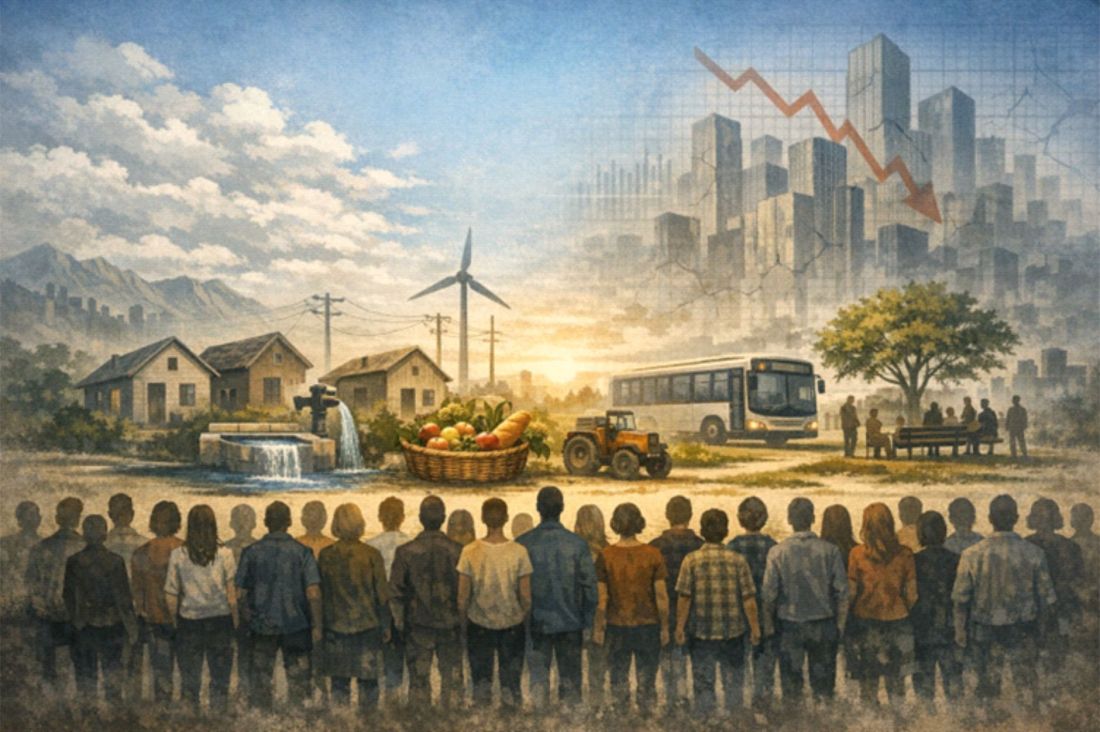

This essay is not a policy proposal, nor a prediction. It is an attempt to describe the direction our systems are moving in, to examine why that direction is increasingly unstable, and to outline the minimum foundation required if we are to avoid recreating the same failures under new labels. It is an exploration of what it would mean to build a future around people rather than money – before events force that reckoning upon us.
It is nearly four years since I published Levelling Level, written at a time when “levelling up” dominated public debate. The purpose of that book was not to analyse the policy itself, but to expose how political narratives are used to obscure reality. “Levelling up” was a perfect example: a phrase so elastic it meant something different to everyone, and therefore meant nothing at all.
The Conservatives used it to imply people would be lifted up through public action – a promise that was, at best, disingenuous. Labour and the left, meanwhile, often approached inequality through a lens that effectively levels down. Ironically, these opposing approaches tend toward the same destination: a system in which people have less control over their own lives while centralised authority grows stronger. That is why successive governments have found it so easy to adopt and repurpose the term. Its vagueness is not a flaw; it is a tool.
Levelling Level was my attempt to show how narratives like this mask what is happening beneath the surface. What I did not anticipate was that it would become the starting point for a much larger inquiry: understanding where our system is heading, why it is heading there, and what a future genuinely built around people – not money – might require.
My confidence in the need for change comes from lived experience: a childhood shaped by poverty; early work in farming; later training in management; years spent in corporate services, charities, not‑for‑profits, and my own businesses; alongside time volunteering and serving as a frontline politician. These experiences offered a broad view of how the current system functions – and why its trajectory is increasingly unsustainable.
When our systems are examined honestly, their flaws point toward profound structural change. Ideally, such change would come by choice. In reality, it is more likely to be triggered by events arising from a money‑centric system that has been out of balance with the needs of people, communities, and the environment from its inception.
A system built on extraction and exploitation can only persist for so long before it exhausts the mechanisms designed to sustain it. Eventually, the myths fail, the smokescreens thin, and the underlying mechanics become visible.
It is tempting to explain this moment through conspiracies or shadowy coordination. And while the behaviour of certain global institutions may provide circumstantial evidence that fuels such beliefs, I do not accept that our predicament is the result of a single, unified plot.
The explanation is both simpler and more human: greed, self‑interest, and the misuse of power by those with sufficient influence to shape outcomes – and insufficient moral restraint to stop themselves.
The money‑centric system now sits on a knife edge. Not because of any one leader or institution, but because it was never designed to endure indefinitely. It was always a question of which pressure point would give way first, and what chain reaction would follow.
This system – encompassing globalism, neoliberalism, fiat money, modern monetary theory, centralisation, and the gradual drift toward supranational governance – rests on a single organising principle: the concentration of power, freedom, wealth, and resources in the hands of the few at the expense of the many.
Greed and selfishness are not new. What is new is the extent to which ordinary people are losing the freedom to shape their own lives. The natural lessons that arise from genuine choice – including the freedom to fail – have been replaced by frameworks that quietly dictate outcomes. Often, this happens without people fully realising it.
When decisions made by distant others constrain our ability to live freely and to make the choices that determine our own direction – for better or worse – fundamental natural laws are broken.
To say the system is out of balance is an understatement. Human life was never meant to revolve around the accumulation of material wealth or the pursuit of externally imposed values. Yet this is precisely what the money‑centric world demands.
As the old system falters, another dynamic is emerging – one that must be addressed with equal clarity.
People and groups are already forming new “bubbles”, each convinced they have found the answer: political movements, spiritual communities, ideological tribes, eco‑centric visions, decentralisation evangelists, and countless others. Many of these arise from genuine care and real harm. They offer belonging, meaning, and direction at a time of uncertainty.
The problem is not intent. It is structure.
These bubbles present themselves as new beginnings, but they often become new routes back to the same value system.
Any framework that requires qualification – whether political, religious, spiritual, environmental, or ideological – inevitably recreates hierarchy. It divides people into those who belong and those who do not. It rewards conformity and punishes difference. It produces insiders and outsiders. Once this happens, the conditions are in place for power to concentrate again, for value to be externally measured again, and for the money‑centric mindset to re‑emerge under a different name.
This is why the Basic Living Standard matters so profoundly.
The Basic Living Standard is not compatible with a money‑centric system.
They cannot coexist without one undermining the other.
One is built on extraction, hierarchy, and conditional value.
The other is built on universality, integrity, and unconditional human worth.
In practical terms, the Basic Living Standard means that no person’s survival, dignity, or basic participation in society is conditional on productivity, compliance, belief, or alignment. It is the floor beneath which no one can fall – not as charity, not as reward, but as a structural guarantee embedded in how the system operates.
But the BLS is also incompatible with agenda‑driven futures that seek to define the world in their own image.
It requires no qualification.
It does not ask you to be spiritual, religious, political, green, or ideologically aligned.
It does not demand belief, membership, or adherence to a worldview.
The only qualification is that you are a human being.
That universality is not an abstract ideal. It is the integrity upon which any future system must rest if it is to avoid manipulation, coercion, and the slow drift back into the very structures we claim to be leaving behind.
A people‑centric world cannot be built on agendas, however well‑intentioned.
It cannot be built on tribes, identities, or movements that claim to speak for everyone.
It cannot be built on frameworks that elevate some while excluding others.
It must be built on a foundation that treats every person the same – not rhetorically, not aspirationally, but in the actual mechanics of how the system functions.
The Basic Living Standard is that foundation.
It is the pivot that prevents the future from being bent to the will of the few.
It is the safeguard against the return of the money‑centric mindset.
It is the universal benchmark that keeps the system grounded in people, not agendas.
We are approaching a point where the old system can no longer hide its failures. Change is becoming unavoidable. That is why we must think clearly now – before events dictate the terms for us.
If we can let go of inherited assumptions, follow the implications of a people‑centric system to their full conclusion, and imagine life beyond the money‑centric lens, we may begin to see what the Basic Living Standard truly offers.
Not agreement.
Not conformity.
But a future in which no one’s humanity is conditional.
There is growing disquiet, fear, and quiet concern about the turbulence we are experiencing in the world, alongside a deep, intrinsic sense that nothing is as it should be – and that it will never be the same again.
Yet at the heart of this unsettling feeling lies confusion. The prevailing narratives insist that with AI now here, and the technology it commands about to permeate every conceivable part of our lives, humanity should be grateful.
We are told we stand on the cusp of a new age, where surrendering to AI will deliver a dream life unlike anything mankind has ever known.
Some are already suspicious, beginning to question what the rollout of this digital revolution will truly mean.
Others believe the only way to progress – or to feel in control of either the real or digital worlds – is to recapture what they perceive as the “good times,” attempting to fix everything as if it were possible to freeze life and live forever in a single moment of the past.
Uncomfortable as it may be, the time has arrived for everyone to begin asking the hard questions: what happens next, and where will we find ourselves in a future that is no longer a distant shadow on the horizon, but already towering above us right now.
The Watershed Moment We Cannot Ignore
The Coming Crisis of Agency & Survival
The answer to the question so many wish to avoid is that, if we continue on our current path, ordinary people will be left with no means to provide for themselves. They will have no income to pay others to do so, and neither government nor business will exist with the resources or the intent to supply even the basic essentials necessary for the masses to survive.
Everything we know – whether or not we recognise its connection to our current reality – has been moving in this direction for as long as most of us have been alive.
There has been a steady erosion of agency, independence, and self‑resourcefulness for ordinary human beings, first through the transfer of all forms of wealth, and now, taking place through the progressive takeover of every aspect of working life and function by both existing and rapidly emerging forms of AI.
Whilst many today spend quiet moments fearing the apparent opening of immigration floodgates and the erasure of Western culture, society, and life as we know it, others, for reasons seemingly unknown, appear to have embraced a suicidal empathy that insists the only correct behaviour of Western society is to destroy itself in order to prioritise all others.
AI’s Encroachment on Everyday Life
Yet everyone fails to see that the impending and critical threat to everything we hold dear has already been welcomed into our governments, our businesses, our technology, and the very functionality of daily life, and is so deeply embedded that it now resides in our computers and our phones.
The Myth of Effortless Utopia
AI, along with the robotics and technology now emerging to support it, is becoming the option of choice for carrying out the majority – if not all – tasks across what we currently understand as life.
This development will soon mean that, for the majority of us, there will soon be no reason for work to continue to exist.
Exploitation and Systemic Transformation
Whilst many of us hear talk of the AI takeover, the reduction in new hiring and training opportunities across numerous professions and industries, and the replacement of jobs of all kinds, we fail to connect these developments with the rising welfare bill as people find themselves with no choice but to accept a life of unemployment.
The New Divide: Inclusion and Exclusion
Nor do we pause for a moment to consider the pressing question: What does it mean when there is no job left for you?
The Last Chance for Human Agency
Yes, many truly believe the stories openly shared by members of the elite community driving this change – that in no time at all, life will become cheap and effortless for everyone because AI and machines can do everything.
The Value of Effort and Contribution
People really do believe we are about to step into a new and previously unrecognisable utopia, where the system has eliminated the need for human industry, effort, and value in the form of contribution, and instead provides everything we can imagine, free of charge and experienced as if life were one giant, permanent holiday for us all.
Historic Patterns and Systemic Endgame
Such benevolence, hinted at in the form of words from these few, and the feeling it inspires about our future, is one that few can fail to imagine.
Indeed, the words and the ease with which life now comes at us makes it very easy to accept the disproportionate levels of wealth for the few that has been encouraged by the progress of this new technical revolution.
People are taking for granted that once the evolution of everything needed to perform every task that human beings carried out across all functions of life is complete, these are the very same few who will then happily smile and sit back while everything they own and have developed works and provides for all of us in return for absolutely nothing. All whilst we continually maintain an ever‑improving standard of life and receive a universal basic income that covers every requirement beyond the luxurious permanence of 24‑hour leisure, which is somehow ever present and that we somehow believe we would actually enjoy.
In truth, we do not need to understand how or why we arrived here to see the situation for what it really is. The fundamental truths are already available for us all to observe, consider, and comprehend, hiding in plain sight: the masses have been used and exploited to create the very means that will ultimately be implemented to destroy humanity as we know it.
As this has all progressed, we have all been fed and indoctrinated with stories, technology, forms of easy wealth, and advances convincing us that things can only ever improve along this path and that a golden age awaits.
At the same time, we have given our consent to puppet politicians who have willingly changed and enforced every rule necessary to facilitate this under the veil of progress -driven not by principle, but by submission to those with power and self‑serving agendas, lured by promises of glory and gain that appeal to their true, hidden selves.
Many struggle to believe that those we have elected, and those who have grown rich or benefitted so greatly from the rewards of leadership in a modern world and society, could truly be so cruel. Yet does it matter whether we – or even they – accept that as truth, when the outcome fast approaching, without a change in our direction, will inevitably be exactly the same?
Within the world and its structures – The System as it operates, functions, and controls every part of life today – the true divide of them and us lies between those whom the system will continue to carry and cater for once the concept of human independence no longer exists, and the masses who have no further use, whom the system will either choose to exclude or find some means to remove.
This is neither a horror story nor a work of fiction. The only uncertainty – without a change in direction – lies in when and how events will unfold that bring about the critical period of transition.
Today, humanity still possesses agency, choice, and the power to pursue an alternative pathway – even though so many of us are sleep‑running toward the end of freedom’s existence, actively embracing and welcoming the very tools that will soon replace the need for us within our own lives.
The fundamental truth of any life worth living is that there can be no reward without effort, and that effort itself is the pathway to reward when life is grounded in truth.
We hold no value to anyone or anything if we do not contribute or participate when we are able. There are no free rides for anyone or anything, unless they come in the form of charity – or unless we ourselves assume the role, if deemed desirable, of pets.
History repeats this truth time and again. We need only look further to see how power is abused by the powerful—how they seek to control everything they find useful, and how quickly they dispose of it when they do not.
Everything about the moneocratic, money‑centric, top‑down, centralised, hierarchical, and patriarchal system was ultimately designed to end this way.
The arrival of technology – and finally AI – has brought humanity to a genuine watershed moment, an endgame in which we must either abandon the unsustainable way of life to which we have become addicted and embrace one that restores balance, fairness, and justice for all, or continue living the lie created by those who profit from our subservience.
If we choose the latter, we will participate in it until the moment we realise we no longer hold any value, and the destiny imposed upon us by others has arrived.
The Alternative Pathway
The temptation for many, upon realising what has happened and what is happening, is to believe that all we need to do is step back a few years and remove the most corrosive technological advances that have entered our lives.
As simple as the removal of AI might seem – even if we were able to overhaul politics and replace politicians with those who agree – the real damage to society and culture has not come from technology or its advances themselves. It comes from the reasoning, motives, intent, and forms of control behind them.
These forces have long been at work, reshaping how everything functions across society – manipulating and redirecting life so that what we have already become is accepted as normal.
The way we live, work, conduct business, relate to others, and even relate to ourselves must return, rediscover, and recreate a way of being that transforms our system of values.
Our entire value set must shift so that we understand and expect meaning from life in ways that, by today’s standards, may seem counterintuitive or even alien.
The Human Value Imperative:
We must embrace the reality that everyone is equal, and that the only difference between us lies in our roles, functions, and contributions within society—roles that are always dynamic and open to change.
We all need to accept that differences do not make us different when it comes to what is ethically, morally, and fundamentally right.
We all need to accept, understand, and embrace that no person should be advantaged over another by circumstances beyond their own efforts or control.
We must accept that deviation or allowances beyond these principles will always lead to growing unfairness—even when special circumstances seem justified or privileges are believed not to be abused.
We must accept that hierarchies are not a natural system of order, even though the need for order in society means that some will naturally take the lead.
We all need to share responsibility and take part in collective choices that shape the aspects of life we share.
We all need to contribute to the community in whatever ways we can.
We all need to work and actively contribute to shared life whenever we are genuinely able.
We must live by the principle that the responsibility we have toward others is the same responsibility we owe to ourselves.
We all need to accept that once our needs are met, nothing is gained if any one of us seeks to have, take, or control more.
We must accept that true abundance means having as much as we need, not everything we want.
We must accept that people are the greatest source of value, and that real economics should be centred on that value.
We must embrace the reality that full employment is both natural and normal when employment is defined by all forms of contribution, not just financial return.
We must welcome and protect the truth that locality, and the transparency it brings to every kind of relationship, is key to maintaining and benefiting from a system we can trust to be fair, balanced, and just.
We must ensure that AI and all technologies are used only to support human life and enhance working practices—not to replace jobs or create circumstances in which any human being is considered useless.
When we commit to all of these principles, we can begin to envision a society and way of life that truly functions as it should with equity, equality and accountability for all – one that is transformed in almost every possible way.
The Turning Point: Choosing Freedom and a Better Future
For many of us, the uncomfortable reality we must face is that passive inaction – or continuing to accept life under the control of others, believing things will simply carry on as they are – poses an existential threat that is all too real. It is a danger that extends beyond the confines of Orwell’s 1984 and, for those who truly value their lives, could mean something far worse.
The choice – while we still have one- is to not only accept but to embrace an alternative path.
This path, though carrying forward some familiar aspects of the world around us, demands that every part of our lives be lived in a fundamentally different way: a way where people, community, and the environment come first; where power rests with the individual, their freedom, and their personal sovereignty; and where the whole experience of life unfolds in a completely new direction.
The Local Economy & Governance System Framework: A Path to Empowerment
Exploring the Local Economy & Governance System
Visualising a different world – how it operates, what it requires of us, what we must give, how we work together, and how frameworks of rules function (rather than laws that micromanage every part of life, as is increasingly the case today) – may sound simple. Yet their adoption, interpretation, and our response to them within a system centred on empowering every person, rather than controlling them in every conceivable way, will be fundamentally different.
This shift will inevitably provoke resistance, not least because we have become addicted to the unsustainable, money‑centric way of living that dominates our lives today.
The Local Economy & Governance System provides a detailed picture of these frameworks, showing how this new people‑centric model will look and how it can be implemented.
Perhaps the most important element of this new world is that it will be built upon direct, participatory democracy – a system entirely unlike the hollow or pretend democracy that defines the moneyocratic world we currently inhabit.
Participatory Democracy: Power in the Hands of People
Participatory democracy means that everyone takes part in the decision‑making processes that shape public policy.
It ensures that we all hold the power to change or remove the public representatives we choose and appoint.
This requires a level of accountability and participation that is not only regular and personal, but far greater than the limited choice we currently have – voting every four or five years for candidates selected by someone else.
There is much to consider about the processes that enable true participatory democracy and how it can work effectively and diligently.
One of the most striking differences between this future system and what we have today is that there will be no political parties.
Instead, public representatives will be chosen directly by the community – respected individuals with proven commitment to serving the best interests of everyone involved.
From Possibility to Reality: A System That Works for Everyone
The Local Economy & Governance System will work because it prioritises people, community, and the environment in ways that may seem inconceivable today.
It places value on personal sovereignty and the freedom that comes from living lives defined by who we truly are, rather than by external factors and reference points that remain under someone else’s control.
Yes, the practical mechanics of LEGS will work – and they will work well – if we choose to embrace them.
After all, the dysfunctional world we inhabit today has appeared to “work” only because we came to believe in it, even as it has harmed so many of us.
We must not underestimate the ability, ingenuity, and creativity of humankind to deliver and implement solutions that succeed under any circumstances, when motivated and convinced it is right to do so.
Together, we can reclaim power and value and build a new world and system that functions with equity, equality, and open accountability for everyone – just as a truly civilised society always should.
Together, we can turn possibility into reality and create a society that truly works for everyone.
The Choice Before Us
We stand at a decisive moment in human history.
The turbulence we feel, the erosion of agency, and the encroachment of systems that strip away our independence are not distant threats. They are realities already shaping our lives.
The arrival of AI and the technologies that support it has brought us to a genuine watershed: either we continue down the path of dependency and control, or we choose to reclaim balance, fairness, and justice through new systems built on empowerment, community, and sovereignty.
The Local Economy & Governance System, grounded in participatory democracy and people‑centric values, offers a practical and principled alternative.
It is not a utopia promised by elites, nor a nostalgic return to the past, but a framework for living that restores meaning to contribution, accountability, and shared responsibility.
Human ingenuity has always risen to meet the greatest challenges. If we believe it right to do so, we can build a society that works for everyone – where equity, equality, and open accountability are not ideals but lived realities.
The choice is ours. To continue sleepwalking into a future where humanity holds no value, or to awaken and embrace the possibility of a new civilisation. One that honours freedom, restores dignity, and ensures that life itself remains worth living.
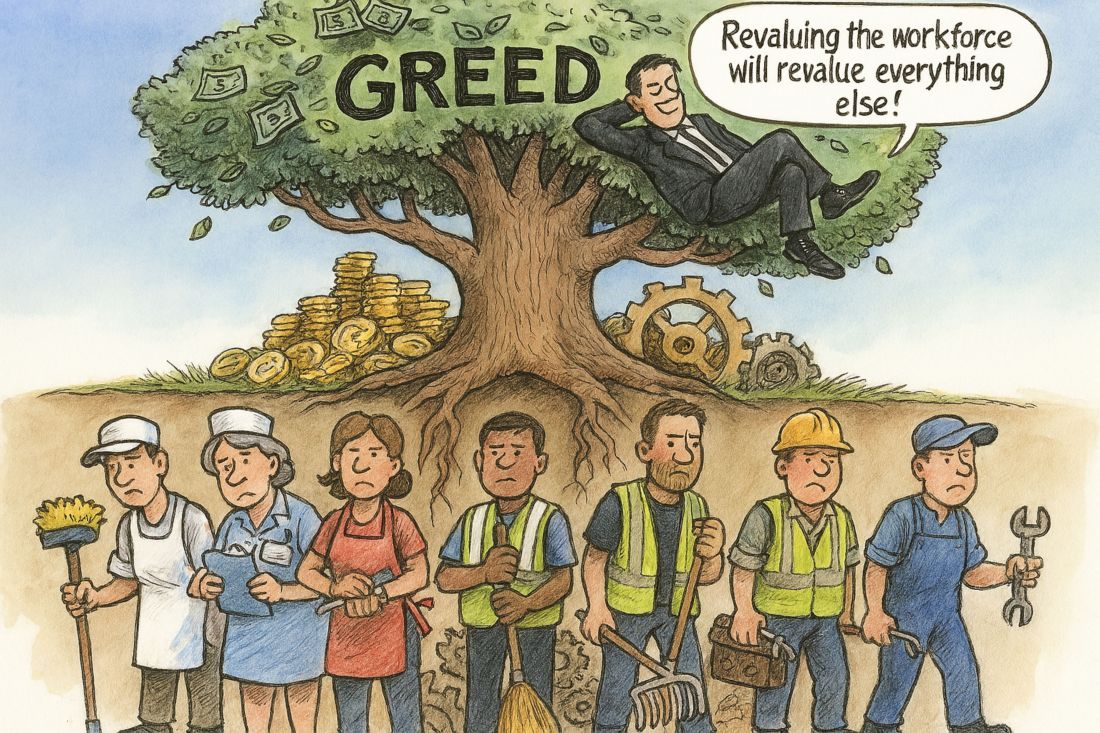
Life didn’t become expensive because it had to be. It became expensive because too many people wanted more than they needed, and in chasing profit they made freedom unaffordable for millions.
That greed has shaped the way we live, the way we work, and even the way we imagine what’s possible.
The Illusion of Permanence
We’ve been conditioned to accept the system as if it has always been this way and always will be.
For those who benefit, that’s convenient blindness. For those who suffer, it’s a kind of brainwashing – convincing them that change is impossible.
But everyday life tells a different story. Anyone who shops regularly knows how quickly prices rise.
A £3 item can jump by 30p in a week, far beyond the official inflation rate. At Christmas, tins of chocolates are dressed up as “reduced,” even though they cost 20 to 50% more than they did a year ago. And energy bills keep climbing even when wholesale prices fall. These aren’t natural increases; they’re engineered.
The Myth of Big
This manipulation is reinforced by another illusion: the myth of big.
We’re told that scale equals legitimacy, that size equals strength. But “big” doesn’t mean better. It means the system has grown so vast that exploitation can hide behind its scale.
The bigger it gets, the smaller we feel – and the easier it becomes to believe we can’t change it.
The Machinery of Exploitation
Once you see through the myth, the machinery becomes clearer.
Supply chains and hierarchies strip away accountability, amplifying selfishness until exploitation feels normal.
At the heart of it all sits money – created, policed, and controlled by those with power.
Profit comes first, people last, and the system is designed to make us accept it as normal.
The Human Cost
This isn’t about people failing. It’s about people being failed.
Lives are destroyed not because individuals did something wrong, but because others took more than they needed.
The uncomfortable reality is that we don’t have to live like this.
There is another way.
Redefining What We Value
We’ve been taught to believe success means others must lose, that material wealth defines worth.
That’s the great lie. It externalises our humanity, making us dependent on possessions instead of recognising our intrinsic value.
To change course, we have to learn to value who we are, not what we own.
Putting People First
Imagine a system where everyone’s basic needs are guaranteed.
This isn’t a pipe dream or a challenge to the “law of the jungle.” It’s simply the right thing to do.
A good life depends on the contributions we all make together, knowing that at the end of the week we’ve done our part and received what we need.
Beyond Division
We are not isolated individuals. We are members of the human race.
Hierarchies and divisions are tools of oppression, legitimising greed and selfishness.
Those who benefit from them do so only by exploiting the needs of others, however distant those others may seem.
A Framework for Fairness
Enshrining the Basic Living Standard in law would be the transformative step toward a society where dignity and security are guaranteed for all.
This principle ensures that every individual’s essential needs are met, fostering resilience and social stability.
The adoption of the Local Economy & Governance System and the framework it offers would strengthen communities by decentralising decision-making and empowering local actors.
Such a system encourages sustainable growth, supports small businesses, and keeps resources circulating within the community, thereby reducing dependency on distant, impersonal structures.
Together, these frameworks dismantle exploitation, promote fair contribution, and prevent the concentration of wealth and power that undermines collective prosperity.
By prioritising fairness and local empowerment, society will lay the foundations for enduring economic vitality and shared well-being.