Disclaimer
This publication is an independent analysis and represents the author’s personal views. It is provided for informational and educational purposes only. While every effort has been made to ensure accuracy at the time of writing, the author accepts no responsibility for errors, omissions, or the consequences of applying the information contained herein.
Nothing in this book should be interpreted as legal, financial, or professional advice. Any references to government departments, organisations, or individuals are for critique, commentary, or contextual discussion only. This work is not endorsed by, affiliated with, or sponsored by any public body or institution.
Readers should conduct their own research and exercise their own judgement when evaluating the issues discussed.
Introduction
The Government’s Farming Roadmap 2050 presents itself as a long-term plan for a resilient, productive and sustainable future for British agriculture. It is framed as a partnership with farmers, a commitment to food security, and a vision for a thriving rural economy. Yet beneath that reassurance lies a more difficult question: does the roadmap strengthen Britain’s ability to feed itself, or does it deepen the dependencies that already make the food system fragile?
This response examines the roadmap as a statement of intent. It asks what kind of food system it is building, who it empowers, who it marginalises, and what it means for national resilience in an increasingly unstable world.
Across the roadmap, several themes recur:
- inflated claims about food security
- a deepening reliance on global markets
- the transfer of power from farmers to supply chains and investors
- the centralisation and financialisation of land use
- and a vision of farming that risks placing metrics, markets, and technology ahead of people, place, practical knowledge, and sovereignty
Together, these themes raise the central concern of this response: the roadmap speaks the language of resilience while relying heavily on the structures that have weakened resilience in the first place.
There is another path: one rooted in local production, regenerative practice, community infrastructure, farmer-led collaboration and appropriate innovation. This does not mean rejecting technology or attempting to recreate the past. It means taking the best of modern tools and the best of traditional husbandry, and aligning both with the public interest: a robust, accessible, uncaptured food supply that is fit for the future.
This response is not written to oppose change, but to argue for the right kind of change: change that strengthens farmers, communities and the nation rather than weakening them.
The stakes are high. This is not just about farming. It is about whether Britain intends to remain a country capable of feeding itself.
Section 1 – Food Security: The 65% Myth and the Illusion of Resilience
The Farming Roadmap 2050 opens its case with a claim that needs careful scrutiny. It states that:
“Farmers produce 65% of our food, manage 70% of England’s land…”
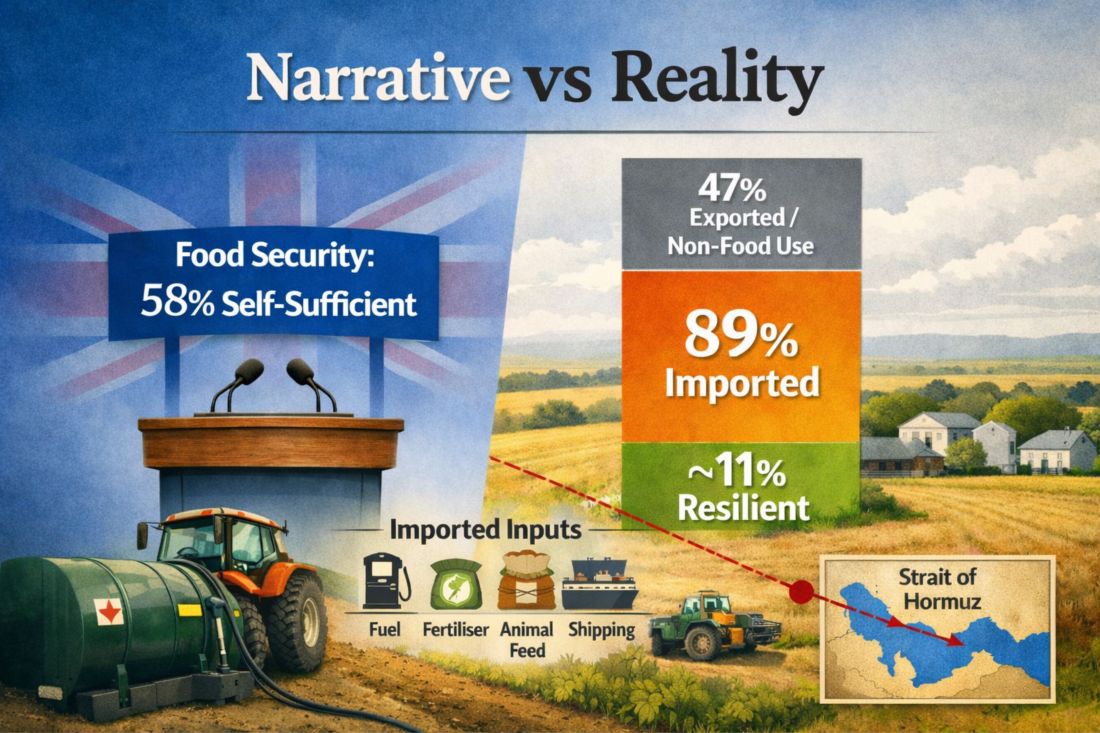
This figure is often presented as if it reflects the proportion of food available to feed the British public in a crisis. It does not. It is a gross production figure and, depending on the methodology used, can include food that is exported, production destined for animal feed, non‑edible crops, and commodities that never reach a British plate.
As I have argued previously in Feeding Britain on Eleven Per Cent, once the analysis is narrowed to food that is directly edible, domestically available, and capable of feeding the public rather than circulating through wider commodity flows, the UK’s practical edible self‑sufficiency may be closer to 11%.
That figure should not be confused with the official production‑to‑supply ratio; it is a stricter measure of resilience under crisis conditions.
The roadmap’s use of the 65% figure risks creating a false sense of security. It encourages policymakers and the public to believe that the UK is more resilient than it may be under crisis conditions.
It masks the reality that our food system is structurally dependent on:
- imported calories
- imported fertiliser
- imported energy
- imported labour
- imported animal feed
- imported inputs for every major supply chain
In strategic terms, this is less a foundation of resilience than a point of exposure.
The roadmap acknowledges global volatility, but only in passing. It notes that:
“Geopolitical instability, climate impacts… and supply chain disruptions are increasing exposure to price, input and output volatility.”
Yet it does not fully confront the harder conclusion: a nation that can feed only a limited proportion of its population from its own land, under crisis conditions, cannot assume that it is food secure.
It may be food‑supplied in ordinary times, but it remains food‑dependent in times of disruption. And dependence is vulnerability.
In The Fragile Nation and Understanding the Fragile Foundations of the UK Food Chain, I set out how the UK’s food system has been hollowed out by decades of globalisation. We have traded local resilience for global efficiency, and in doing so we have built a system that works only when the world is calm.
The roadmap continues this pattern. It assumes that global markets will remain open, stable, and affordable. It assumes that shipping lanes will remain safe. It assumes that geopolitical shocks will be temporary and manageable.
But as I wrote in Iran and the Prospect of Food Shortages, the closure of a single strategic chokepoint can send shockwaves through global food and energy markets within days. The roadmap mentions this exact example, noting that:
“The ongoing pressure on fertiliser and fuel prices because of the closure of the Strait of Hormuz underlines the need to shift to a more resilient farming system…”
Yet it draws too narrow a lesson. The problem is not simply the price of fertiliser or fuel. The deeper problem is that the UK has built a food system that cannot function without them. A system that falters when a shipping lane closes is brittle, not resilient.
The roadmap’s answer is to place considerable emphasis on technology, data, market integration and productivity. These tools can have value, and they should not be dismissed. Precision farming, robotics, data‑enabled soil management, and better input monitoring can all help farmers reduce waste, improve margins, and protect natural capital.
But technology is only resilient when it is embedded within a balanced food system. If innovation deepens dependence on proprietary platforms, imported inputs, centralised data systems or capital‑intensive models that exclude smaller farms, it risks reinforcing the very fragility it claims to solve.
What is needed is a hybrid approach: modern technology where it genuinely strengthens farm resilience, traditional husbandry where it protects soil, livestock, landscape knowledge and local adaptability, and farmer judgement at the centre of both.
Food security begins with local production for local consumption, supported by innovation that serves farmers and communities rather than capturing them.
The roadmap claims that:
“Food is one of the UK’s Critical National Infrastructure sectors.”
If that is true, the first duty of government is to ensure that the nation can feed itself in a crisis. The roadmap does not yet meet that test. It presents a vision of food security that remains heavily dependent on global markets, multinational supply chains and financialised land-use systems.
In Who Controls Our Food Controls Our Future, I argued that the greatest threat to national security is not a lack of technology or innovation, but a lack of sovereignty over the essentials of life. The roadmap risks reinforcing that threat by handing more power to retailers, processors, investors and data-platform owners, while reducing the autonomy of the people who produce our food.
The central point is simple: food security cannot be outsourced. It cannot rest on the assumption that the rest of the world will always be willing and able to feed us.
Until the UK is willing to examine the gap between the official 65% figure and a stricter estimate of around 11% edible self-sufficiency under crisis conditions, every roadmap, strategy and framework will rest on an incomplete understanding of risk.
Section 2 – Who Really Controls the Future of Farming?
If Section 1 exposes the limits of the roadmap’s food security assumptions, Section 2 examines the question of farmer agency.
The Farming Roadmap 2050 repeatedly uses the language of partnership, but much of its substance points towards a future shaped by markets, supply chains, investors and data-driven corporate structures, with government acting as the enabler.
The roadmap states plainly:
“Markets will play a central role in shaping the future of the sector, enabled by an active and strategic state.”
This is one of the most revealing sentences in the document. It suggests that the future of British agriculture will be shaped substantially by market forces – the same forces that have contributed to consolidation, financialisation and the extraction of value away from primary producers.
The roadmap goes further:
“Food businesses, processors, retailers, investors and other supply chain participants will play an important role in shaping the conditions in which farmers operate.”
This may be presented as partnership, but it risks becoming subordination if farmers do not retain meaningful power within those relationships.
It formalises a trend that has already been developing for decades: the transformation of farmers from independent producers into contract‑bound suppliers whose autonomy is steadily eroded by the demands of supermarkets, processors, and global commodity markets.
In Who Controls Our Food Controls Our Future, I argued that the most dangerous shift in the modern food system is the transfer of power from those who produce food to those who control the flow of food.
The roadmap risks accelerating this shift. It embeds supply-chain dominance into the architecture of agricultural policy and treats farmers less as decision-makers than as implementers of standards, data requirements and production models designed elsewhere.
The danger is that the future farmer becomes less a steward of land and producer of food, and more a compliance operator within a vertically integrated system.
A system in which:
- retailers dictate specifications
- processors dictate volumes
- investors dictate land use
- data platforms dictate practices
- government dictates environmental obligations
- and farmers carry all the risk
That would not strengthen resilience. It would deepen dependency.
The roadmap claims that government will intervene where “unfair practices” arise, but the structure it endorses could make those practices more likely unless safeguards are much stronger.
When a small number of retailers dominate the grocery market, when processors consolidate into fewer larger players, when data platforms become gateways to contracts, and when farmers must share operational data to secure market access, the outcome may not be fair competition. It may become a form of corporate dependency that leaves farmers with ownership on paper but less practical control in reality.
Farmers may still own their land, but the roadmap risks weakening their control over key decisions.
This is exactly the pattern I described in Understanding the Fragile Foundations of the UK Food Chain: the more centralised and financialised the system becomes, the more vulnerable it is – and the less control farmers have over their own futures.
The parallels with the pub trade – which I explored in The Pub Crisis: How an Industry Lost Its Soul – are striking.
In both cases:
- independent operators are squeezed by corporate intermediaries
- data and contracts replace autonomy
- margins collapse while compliance costs rise
- ownership remains, but control evaporates
The roadmap’s insistence that farmers will “benefit” from supply-chain alignment echoes promises made in other sectors before independent operators were weakened by consolidation.
The risk is similar: a small number of large operators thrive within a corporate ecosystem, while smaller, independent businesses are pushed towards dependence or exit.
The roadmap also makes clear that government intends to withdraw support once markets “mature”:
“As private markets mature… government will step back.”
This is the same pattern we have seen in energy, water, housing, and transport.
Government sets the direction, private actors take control, and then government steps back, leaving the public exposed to the consequences.
In farming, the consequences will be even more severe, because food is not a discretionary service. It is a necessity.
In Food, Land and Power, I argued that the central question of our time is who gets to decide how land is used and for whose benefit. The roadmap answers that question clearly: land use will be shaped by markets, investors, and supply chains, not by farmers or communities.
Spatial targeting, nature markets, and data‑driven land‑use planning all point toward a future where the economic logic of the supply chain overrides the lived reality of the land.
This is not simply a roadmap for farming. Unless carefully rebalanced, it risks becoming a roadmap for the consolidation of control over food.
That matters because once control is lost, it is difficult to regain.
Section 3 – The Minette Batters Problem and Manufactured Consent
One of the most politically significant features of the Farming Roadmap 2050 is the way it leans on the Farming Profitability Review (FPR) and, by extension, on Minette Batters.
The roadmap repeatedly cites her work as if it provides a mandate for the direction the government has chosen. It states:
“It is published alongside our detailed response to the Farming Profitability Review, authored by former National Farmers’ Union President Minette Batters, because profitability is central to everything we are trying to achieve.”
But the reality is far more complex – and far more revealing.
In the Farmers Guardian, Minette Batters publicly warned that Defra lacks:
“the commercial expertise and acumen needed right now to appropriately address food security.”
This is not a minor criticism. It is a direct challenge to the very premise of the roadmap: that government is acting strategically, competently, and in partnership with farmers to secure the nation’s food future.
If the department responsible for food security lacks the commercial understanding to manage it, the roadmap’s claims of strategic clarity deserve closer examination.
Her concerns did not stop there. In evidence to the EFRA Committee, she admitted that she had been warned her review would be:
“filleted and changed”
and that she might not be able to publish it in her own words. She insisted on retaining control of the text precisely because she feared political manipulation.
This is crucial. It shows that even the author of the FPR understood the risk: that her work could be used to legitimise a direction she did not endorse.
The roadmap risks doing precisely that.
It cites her review as if it represents a unified industry position, while pursuing policies that contradict the concerns she raised – particularly around supply‑chain power, commercial competence, and the structural extraction of value from primary producers.
The roadmap’s heavy emphasis on markets, data‑driven compliance, and corporate‑led supply‑chain governance is the very model that has undermined farm profitability for decades.
That does not read as full collaboration. It risks looking like co-option.
In A Few Thoughts on Minette Batters’ Farming Profitability Review, I argued that the FPR risked becoming an elephant trap – not because Batters lacked integrity, but because the government could use her involvement to claim credibility for a predetermined agenda.
The roadmap appears to justify that concern. It uses her name and review to create the appearance of consensus, while giving insufficient weight to the substance of her warnings.
The roadmap claims it is:
“grounded in engagement with farmers, growers and land managers across the country…”
Yet the policies it proposes – increased regulatory consolidation, spatial land‑use targeting, mandatory data sharing, and the primacy of markets – are the very policies farmers have consistently warned against.
The roadmap acknowledges concerns about fairness and supply‑chain power, but then hands even more influence to the very actors responsible for those problems.
Consultation is not the same as co-design if farmers are heard but the direction of travel remains largely unchanged.
It is also part of a wider pattern. As I wrote in The Need for a Collaborative Approach, genuine collaboration requires shared power, shared understanding, and shared responsibility.
What we have instead is a political model where government consults selectively, cites strategically, and then proceeds with a direction shaped by Treasury orthodoxy and corporate interests.
The roadmap’s use of the FPR therefore needs careful handling. It allows ministers to claim that the direction of travel is grounded in industry engagement, while the policies themselves remain aligned with markets, supply chains and investment logic more than with farmer agency or food security.
The danger is that Minette Batters’ credibility is used to legitimise a direction that does not fully reflect the warnings she raised.
That is why the narrative should be challenged now: not because Batters acted in bad faith, but because her warnings deserve to be read on their own terms, rather than absorbed into a roadmap that may serve interests far removed from the needs of British farming.
Section 4 – Land, Power and the New Feudalism
If Sections 1–3 expose problems of food security, farmer agency and collaborative policymaking, Section 4 raises a deeper question: who controls the land itself?
The Farming Roadmap 2050 presents this shift as a technical necessity – a matter of “spatial targeting”, “nature markets”, and “land‑use optimisation”. But beneath the language lies a profound reordering of power.
The roadmap states that:
“Some payments… will be spatially targeted… Landscape Recovery will be spatially prioritised.”
This is not a minor administrative detail. It is the beginning of a system in which central government – guided by market logic, investor priorities, and environmental modelling – determines what land is for, where, and by whom.
Farmers are no longer the primary decision‑makers. They become operators within a land‑use framework designed elsewhere.
In Food, Land and Power, I argued that the most important question in any society is who decides how land is used.
Land is not just a resource; it is the foundation of food, community, culture, and sovereignty.
When control over land shifts away from those who live on it and work it, the consequences ripple through every part of national life.
The roadmap accelerates this shift. It introduces a model in which:
- government sets the land‑use categories
- markets determine the incentives
- investors determine the value
- environmental metrics determine the obligations
- and farmers are expected to comply
This is less stewardship than centralised land management by proxy.
The roadmap also makes clear that environmental actions currently funded through SFI will be moved into regulation:
“Future payments for actions in this group will be time‑limited and will be phased out as regulation is introduced.”
This means that what is currently voluntary will become mandatory – not because farmers have chosen it, but because the regulatory framework will require it. And once these actions are embedded in regulation, they will be enforced through inspections, data monitoring, and compliance systems that farmers have no control over.
The roadmap promises to “double the EA’s farm inspection capacity”. It promises new permitting regimes for livestock. It promises consolidated water regulation. It promises tighter ammonia rules. It promises mandatory data sharing.
All of this is presented as environmental necessity, but the effect is unmistakable: control moves upward, away from farmers and toward regulators, markets, and corporate intermediaries.
This risks creating a new kind of dependency – not based on aristocratic landowners, but on corporate, financial and bureaucratic power.
Farmers may still hold the deeds to their land, but they will not hold the decisions.
Their autonomy will be replaced by compliance with a system designed to serve the needs of:
- retailers
- processors
- investors
- carbon and biodiversity markets
- and the Treasury
The roadmap even acknowledges that land will be taken out of production. It states that meeting water‑quality targets alone will require:
“up to 9% land use change away from agricultural use…”
This is a significant admission. In a country that can feed only a limited proportion of its population from its own land under crisis conditions, the planned removal of agricultural land from production deserves far greater scrutiny.
In The Fragile Nation and Understanding the Fragile Foundations of the UK Food Chain, I argued that the UK’s food system is already dangerously exposed. Reducing agricultural capacity in this context should not be treated as a technical adjustment; it is a strategic choice with food security consequences.
The roadmap’s answer is that productivity gains will compensate for land loss. But this assumes a future of high‑tech, capital‑intensive farming that only large operators can afford.
It assumes that small and medium farms – the backbone of rural communities – will either scale up, specialise, or exit.
It assumes that land not used for food will be used for carbon, biodiversity, or energy markets – markets dominated by financial actors, not farmers.
Unless safeguards are built in, this is not only a roadmap for farming. It risks becoming a roadmap for the financialisation of land.
In The Glyphosate Era is a Warning, I argued that the real danger is not any single chemical or technology, but the mindset that treats land as a unit of production rather than a living system. The roadmap continues that mindset – only now the unit of production is not food, but carbon credits, biodiversity units, and environmental metrics.
Farmers become service providers to markets they do not control.
Communities lose the ability to shape their own landscapes.
And the nation loses the ability to feed itself.
That is the deeper risk: ownership without sufficient power, land without sufficient autonomy, and farming without sufficient agency.
Section 5 – Globalisation, War and the End of the Old Assumptions
If the earlier sections reveal the internal contradictions of the Farming Roadmap 2050, Section 5 reveals the external one – the assumption that the world of the next 25 years will look like the world of the last 25.
The roadmap is built on a belief that global markets will remain open, stable, and affordable; that geopolitical shocks will be temporary; and that the UK can continue to rely on imports to fill the widening gap between domestic production and national need.
That is a highly optimistic assumption, and one that deserves far more scrutiny than the roadmap gives it.
The roadmap acknowledges, almost in passing, that:
“Geopolitical instability, climate impacts, environmental degradation and supply chain disruptions are increasing exposure to price, input and output volatility.”
But it treats these pressures as background conditions rather than as structural threats. It does not fully confront the reality that the global food system is already fragmenting, that the era of cheap, abundant imports is ending, and that the UK’s dependence on global supply chains is a strategic liability.
In The Fragile Nation, I argued that Britain’s food system is built on assumptions that no longer hold: that shipping lanes will remain open, that exporting nations will continue to sell, that global markets will remain liquid, and that geopolitical tensions will not spill over into trade. These assumptions are now breaking down.
The roadmap itself references the closure of the Strait of Hormuz – a single chokepoint whose disruption sent shockwaves through global energy and fertiliser markets. It notes:
“The ongoing pressure on fertiliser and fuel prices because of the closure of the Strait of Hormuz…”
But it draws the wrong lesson. The problem is not simply the price of fertiliser. The problem is that the UK has built a food system that depends heavily on imported fertiliser, imported fuel, imported feed, imported chemicals, imported labour and imported food.
In Iran and the Prospect of Food Shortages, I argued that the UK’s exposure to global shocks is not theoretical. It is immediate. A single geopolitical event can disrupt the flow of calories, inputs, and energy into the country within days.
The roadmap acknowledges the risk but then proceeds as if the solution is simply to “improve productivity” and “support markets”.
That is not sufficient resilience. It is an overreliance on optimistic assumptions.
The roadmap’s entire strategy depends on the continued functioning of a global system that is already fracturing. It assumes:
- stable shipping
- stable energy
- stable fertiliser
- stable commodity markets
- stable geopolitics
- stable climate
- stable trade relationships
None of these conditions can be guaranteed. Many are already failing.
In The Fragile Foundations of the UK Food Chain, I argued that the UK’s food system is built on imported sand. The roadmap does too little to change this. It relies on the same dependencies, the same vulnerabilities, and the same belief that globalisation will continue to provide what domestic production cannot.
This is why the roadmap’s claim that the UK is “food secure” is so dangerous. It is based on a definition of food security that assumes global markets will always be there to rescue us.
But as I argued in Feeding Britain on Eleven Per Cent, true food security is not measured by how much we can import. It is measured by how much we can produce, store, and distribute within our own borders.
The roadmap does not yet offer a credible route to greater domestic resilience.
It removes land from production. It increases regulatory burdens. It centralises land‑use decisions. It prioritises environmental metrics over food output. It hands more power to supply chains and investors. It assumes productivity gains will compensate for land loss. It assumes global markets will fill the gaps.
This is not a sufficient plan for resilience. It risks becoming a plan for managed decline.
In The Fragile Nation, I wrote that Britain can no longer rely on a global food system that is itself under strain.
The roadmap refuses to accept this reality. It clings to the old assumptions of globalisation – assumptions that are already collapsing under the weight of war, climate shocks, resource scarcity, and geopolitical fragmentation.
A resilient nation does not outsource its food security. A resilient nation does not depend on shipping lanes for calories. A resilient nation does not assume that other countries will feed it in a crisis.
The roadmap relies too heavily on these assumptions, and that is why it falls short.
Section 6 – The Alternative: Local, Regenerative, Collaborative
If the Farming Roadmap 2050 risks a future of consolidation, dependency, and centralised control, then the alternative must be a future built on local resilience, regenerative practice, appropriate innovation, and farmer‑led collaboration.
This is not a romantic ideal. It is a practical necessity, and one I have outlined repeatedly in Food From Farms Guaranteed, Foods We Can Trust, Risk and Responsibility, and Reclaiming Food.
The roadmap assumes that food security can be delivered through global markets, corporate supply chains, and technological intensification.
But as I argued in Food From Farms Guaranteed, true food security begins with a simple principle:
A nation must be able to feed its own people from its own land.
This requires a shift away from the current model of export‑driven production, long supply chains, and dependency on imported inputs. It requires a commitment to producing food for domestic consumption first – not as an afterthought, but as a national priority. It requires a food system designed around public need, not market demand.
In Foods We Can Trust, I set out what this looks like in practice: local food networks, community processing facilities, short supply chains, and transparent relationships between producers and consumers.
These are not nostalgic ideas. They are practical foundations of resilience.
When food is produced, processed, and distributed locally, the system becomes less vulnerable to global shocks, less dependent on corporate intermediaries, and more accountable to the people it serves.
The roadmap’s vision of resilience is strongly technological and market‑facing. But real resilience must also be ecological, practical and distributed.
It should be built on:
- mixed farming
- regenerative soil management
- diversified enterprises
- local markets
- community infrastructure
- farmer‑led decision‑making
- precision farming and appropriate technology that reduce input dependency rather than increasing it
- traditional knowledge, stockmanship and soil stewardship embedded alongside modern methods
This is the model I described in Reclaiming Food: a food system rooted in place, culture, and community – not in financial markets or supply‑chain metrics.
Food is not just a commodity. It is a public good, a cultural asset, and a foundation of national sovereignty. When control over food is lost, control over everything else soon follows.
But this alternative cannot be delivered by government alone. In Risk and Responsibility, I argued that farmers themselves must choose to rebuild the food system – not by waiting for permission, but by acting collectively to create new structures of production, distribution, and trust.
This means:
- forming local cooperatives
- investing in shared infrastructure
- building direct‑to‑consumer markets
- reclaiming processing capacity
- refusing dependency on corporate contracts
- collaborating across farms and communities
The roadmap treats farmers as implementers of policy. The alternative treats farmers as leaders of a national renewal.
The roadmap assumes that resilience comes largely from technology, data and markets. The alternative recognises that technology has an important role, but only when it is aligned with relationships – between farmers and land, farmers and communities, and communities and their food.
The roadmap centralises power. The alternative decentralises it.
The roadmap financialises land. The alternative roots land in community.
The roadmap reduces farmers to compliance operators. The alternative restores them as custodians and producers.
The roadmap assumes globalisation will continue to absorb the risk. The alternative prepares for a world in which it may not.
This is not a rejection of innovation. It is a rejection of dependency and absolutism.
The future should not be framed as technology versus tradition, or productivity versus ecology. It should take the best of both worlds: precision farming, robotics, data and scientific insight where they genuinely support farmers, and mixed farming, soil stewardship, local knowledge and regenerative practice where they build resilience that technology alone cannot provide.
It is a call for a food system that is:
- local
- regenerative
- collaborative
- sovereign
- resilient
- farmer‑led
- innovative without being captured
- accessible to the whole population, not only profitable for those who control the system
This is the future that the Farming Roadmap 2050 does not yet fully imagine – because its centre of gravity remains markets, metrics and centralised control.
But a more balanced approach could deliver genuine food security, community resilience, and national sovereignty by ensuring innovation serves the food system rather than capturing it.
Section 7 – Conclusion: This Isn’t Just About Farming, It’s About Sovereignty
The Farming Roadmap 2050 presents itself as a plan for the future of British agriculture.
But when you strip away the language of partnership, productivity, and environmental ambition, what remains is something far more consequential: a redefinition of who controls food, land, and the means of national survival.
This is not only a farming document. It is also a sovereignty document. In its current form, it points in the wrong direction.
- Food security is misrepresented through inflated production figures and a dangerous reliance on global markets.
- Farmer agency is eroded, replaced by compliance with supply‑chain demands and regulatory frameworks designed elsewhere.
- Land use is centralised, financialised, and increasingly dictated by markets, investors, and environmental metrics rather than by farmers or communities.
- Government withdraws, leaving corporate actors to shape the future of farming while claiming that this is “market‑led progress”.
- Resilience is too narrowly defined as technological efficiency, rather than as a balance of ecological stability, local self‑reliance, farmer knowledge, and appropriate innovation.
This is not yet the path to food security. It is a path that risks deepening dependency.
In Who Controls Our Food Controls Our Future, I argued that control over food is the foundation of every other form of power.
A nation that cannot feed itself cannot claim to be sovereign. A community that cannot shape its own food system cannot claim to be resilient. A farmer who cannot decide how their land is used cannot claim to be independent.
The roadmap risks accelerating the loss of all three.
It hands more power to retailers, processors, investors, and data platforms. It reduces farmers to operators within a system they do not control. It treats land as a financial asset rather than a national resource. It assumes globalisation will continue to provide what domestic production cannot.
Unless rebalanced, the roadmap risks taking Britain towards 2050 more dependent on global supply chains, more vulnerable to geopolitical shocks, and more disconnected from the land that sustains it.
But there is another path – one rooted in the ideas I have set out in Food From Farms Guaranteed, Foods We Can Trust, Risk and Responsibility, and Reclaiming Food. A path built on:
- local production for local consumption
- regenerative, mixed farming systems
- short, transparent supply chains
- community processing and distribution
- farmer‑led collaboration
- land used for food first, markets second
- innovation that blends precision farming and technology with traditional farming knowledge
- a robust, accessible and uncaptured food supply for the UK population
- sovereignty over the essentials of life
This is not nostalgia. It is strategy. It is resilience. It is a model that can withstand the shocks already reshaping the world – war, climate disruption, resource scarcity and the fracturing of global markets – while still embracing the tools and methods that make farming fit for the future.
The roadmap is still built on assumptions that are becoming less reliable: globalisation, financialisation, centralised control, and the belief that markets will always provide what domestic production cannot.
Those assumptions are weakening. Policy must now catch up with that reality.
The question is whether the roadmap will be allowed to define the future, or whether farmers, communities and policymakers will insist on a more resilient alternative.
Because the truth is simple:
A nation that cannot feed itself is not fully secure. A farming system that cannot meaningfully shape its own future is not fully resilient. And a government that allows control of food to drift too far toward markets is not adequately protecting its people.
This is why the debate over the Farming Roadmap 2050 matters. Farmers, communities and citizens must challenge it constructively, and help build an alternative – local, regenerative, collaborative, sovereign – before the window to do so closes.
This is not just about farming. It is about who we are, who we serve, and whether we intend to remain a nation capable of feeding itself.
And that is a question far bigger than any roadmap.
Further Reading & Contextual Analysis
The following works provide deeper insight into the themes explored in this response.
They offer a coherent body of analysis on food security, land use, supply‑chain power, global fragility, and the urgent need for a farmer‑led, community‑rooted transformation of the UK food system.
Together, they form a comprehensive alternative to the assumptions embedded in the Farming Roadmap 2050.
1. Understanding the Fragility of the UK Food System
1.1 Feeding Britain on Eleven Per Cent
🔗 https://adamtugwell.blog/2026/05/21/feeding-britain-on-eleven-per-cent-farming-inflation-and-the-illusion-of-food-security/
Summary: A foundational piece that dismantles the myth of UK food self‑sufficiency. It explains why headline figures like “65% domestic production” are misleading, and shows that once exports, animal feed, and non‑edible crops are removed, the UK can directly feed only around 11% of its population. Essential for understanding why the roadmap’s food security claims are dangerously complacent.
1.2 The Fragile Nation: Why Britain Can No Longer Rely on a Global Food System
🔗 https://adamtugwell.blog/2026/05/19/the-fragile-nation-why-britain-can-no-longer-rely-on-a-global-food-system/
Summary: Explores the geopolitical and economic fragility of global supply chains. Demonstrates how war, climate shocks, and trade disruptions can rapidly undermine the UK’s food supply. Provides the strategic context missing from the roadmap’s assumptions about global stability.
1.3 Understanding the Fragile Foundations of the UK Food Chain
🔗 https://adamtugwell.blog/2026/04/29/understanding-the-fragile-foundations-of-the-uk-food-chain/
Summary: A deep dive into the structural weaknesses of the UK food system – from dependency on imported inputs to the collapse of local processing capacity. Shows how decades of globalisation have hollowed out domestic resilience.
1.4 Iran and the Prospect of Food Shortages: Ask the Farmers, Go Local
🔗 https://adamtugwell.blog/2026/04/16/iran-and-the-prospect-of-food-shortages-ask-the-farmers-go-local/
Summary: Uses the Strait of Hormuz crisis to illustrate how quickly global shocks can translate into domestic food insecurity. Reinforces the argument that resilience must be built locally, not outsourced to global markets.
2. Power, Policy and the Erosion of Farmer Agency
2.1 A Few Thoughts on Minette Batters’ Farming Profitability Review (FPR)
🔗 https://adamtugwell.blog/2025/12/19/a-few-thoughts-on-minette-batters-farming-profitability-review-fpr/
Summary: Examines the political risks of the FPR and how government could use it to legitimise predetermined policies. Essential for understanding how the roadmap uses Batters’ involvement as manufactured consent.
2.2 The Government’s Biodiversity National Security Report Misses the Real Threat
🔗 https://adamtugwell.blog/2026/02/03/the-governments-biodiversity-national-security-report-misses-the-real-threat-our-food-system-is-already-on-the-brink/
Summary: Critiques the government’s focus on biodiversity metrics while ignoring the far more immediate threat: the fragility of the food system itself. Shows how policy is being shaped by narratives that sidestep food sovereignty.
2.3 UK Farmers & Inheritance Tax Changes: What Does the Government’s Christmas Announcement Really Mean for Food Security?
🔗 https://adamtugwell.blog/2025/12/24/uk-farmers-inheritance-tax-changes-what-does-the-government-christmas-announcement-really-mean-for-food-security/
Summary: Explores how tax policy interacts with land ownership, succession, and long‑term food security. Highlights how government decisions often undermine the very farmers they claim to support.
2.4 Our Politicians Sold Out Our Farming and Fishing Communities…
🔗 https://adamtugwell.blog/2018/12/01/our-politicians-sold-out-our-farming-and-fishing-communities-to-appease-other-eu-members-when-we-joined-it-would-be-as-contradictory-as-it-would-be-treacherous-for-them-to-do-so-again-when-the-britis/
Summary: A historical perspective on how political decisions have repeatedly sacrificed farming and fishing communities. Provides essential context for understanding why trust in government policy is so low – and why the roadmap continues this pattern.
3. Land, Markets and the Fight for Control
3.1 Food, Land and Power: Why the Future of Britain Depends on Rebuilding Local Food Economies
🔗 https://adamtugwell.blog/2026/03/20/food-land-and-power-why-the-future-of-britain-depends-on-rebuilding-local-food-economies-some-thoughts-on-the-land-use-framework/
Summary: Explains how land‑use decisions shape national sovereignty. Shows why centralised land‑use frameworks and nature markets risk transferring control away from farmers and communities.
3.2 Who Controls Our Food Controls Our Future
🔗 https://adamtugwell.blog/2025/11/23/understanding-who-controls-our-food-controls-our-future-everything-you-need-to-know/
Summary: An analysis of how supply chains, retailers, and corporate actors have taken control of the food system. Essential for understanding the roadmap’s shift toward market‑led governance.
3.3 The Glyphosate Era is a Warning, Not the Future of Agriculture
🔗 https://adamtugwell.blog/2026/05/12/the-glyphosate-era-is-a-warning-not-the-future-of-agriculture/
Summary: Uses glyphosate as a symbol of the dangers of industrial dependency. Argues for regenerative, ecological systems that build resilience rather than relying on chemical or technological shortcuts.
4. Building the Alternative: Local, Regenerative, Collaborative
4.1 Food From Farms Guaranteed
🔗 https://adamtugwell.blog/2025/03/14/food-from-farms-guaranteed-full-text/
Summary: Sets out a national food security guarantee based on domestic production for domestic consumption. A cornerstone of the alternative model to the roadmap.
4.2 Foods We Can Trust: A Blueprint for Food Security and Community Resilience
🔗 https://adamtugwell.blog/2025/12/15/foods-we-can-trust-a-blueprint-for-food-security-and-community-resilience-in-the-uk-online-text/
Summary: A practical blueprint for rebuilding local food systems, community processing, and short supply chains. Shows how trust and transparency can replace dependency on corporate intermediaries.
4.3 Risk and Responsibility: Why Farmers Must Choose to Rebuild the UK Food System
🔗 https://adamtugwell.blog/2025/11/22/risk-and-responsibility-why-farmers-must-choose-to-rebuild-the-uk-food-system-before-its-too-late/
Summary: A call to action for farmers to reclaim agency and rebuild local infrastructure. Argues that waiting for government or markets to fix the system is no longer viable.
4.4 Reclaiming Food
🔗 https://adamtugwell.blog/2026/04/15/reclaiming-food/
Summary: A philosophical and political argument for treating food as a public good, not a commodity. Frames food sovereignty as essential to national resilience and democratic control.
How to Use This Reading List
This collection is designed to help readers:
- Understand the structural weaknesses of the UK food system
- See how government policy has contributed to those weaknesses
- Recognise the dangers of the Farming Roadmap 2050
- Explore a coherent, farmer‑led alternative
- Engage with the deeper political and cultural questions around food, land, and sovereignty
Together, these works form a comprehensive body of thought – one that challenges the assumptions of the roadmap and offers a credible, grounded, and urgently needed alternative vision for the future of British farming and food security.