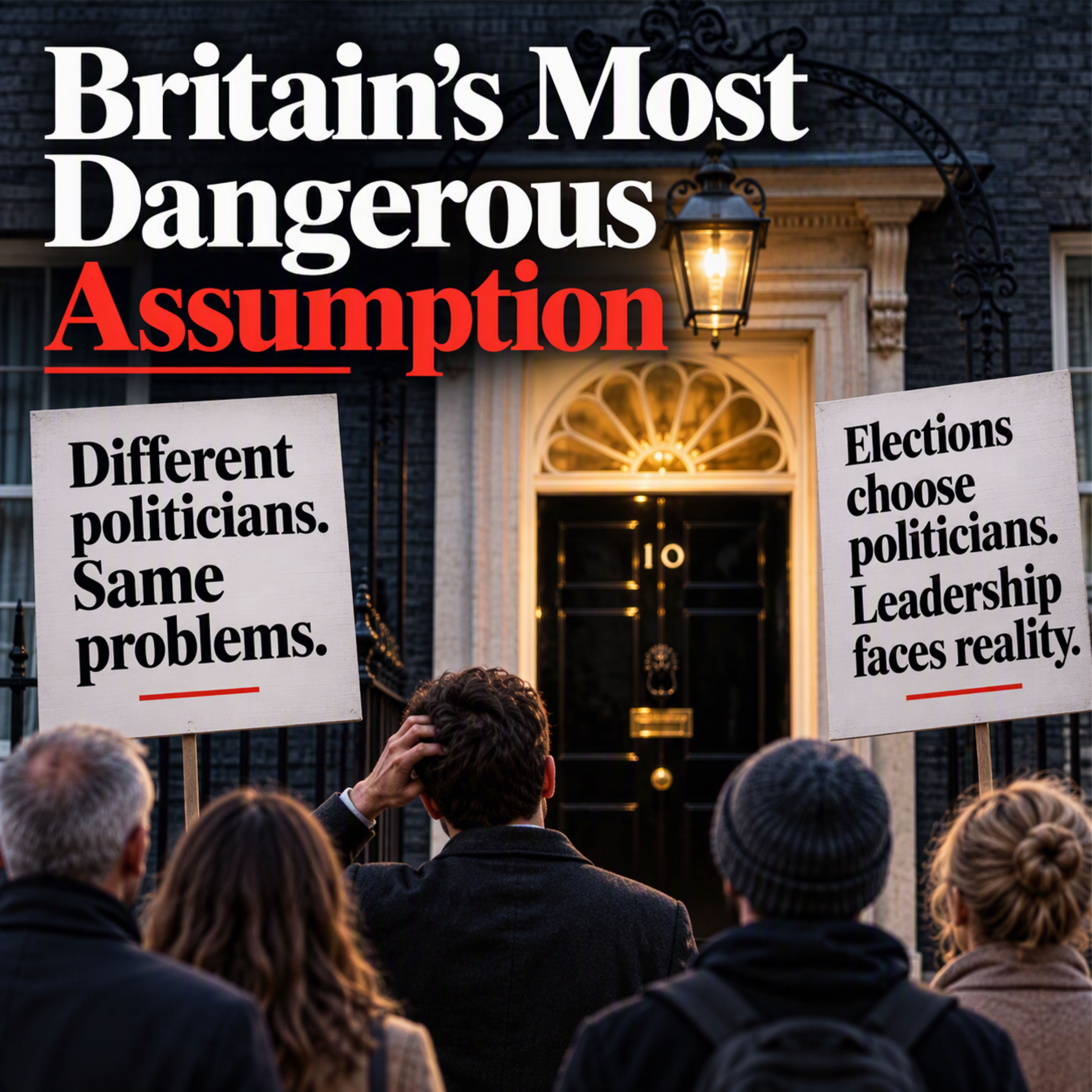

As another Budget arrives, Britain is once again engaged in a familiar ritual.
Ministers are accused of incompetence. The Chancellor is criticised for decisions already taken and decisions yet to come. Commentators debate taxes, spending and who deserves the blame for the country’s economic position.
Beneath all these arguments sits an assumption so familiar that we rarely notice it.
We assume that being elected and being capable of governing are essentially the same thing.
But what if they aren’t?
What if Britain’s most dangerous assumption is not that our politicians are incompetent, but that electoral success somehow confers expertise?
The moment someone becomes an MP, a Cabinet Minister, a Mayor, a Chancellor or a Prime Minister, something curious happens. We begin to assume that their office tells us something about their ability. We assume they possess insights we lack. We assume they have demonstrated the qualities necessary to deal with the immense responsibilities they now carry.
Yet what has actually been proven?
That they won an election.
That they navigated a political party.
That they persuaded enough people to support them over someone else.
None of those achievements are easy. All require skill. But they are not necessarily evidence of an ability to navigate the increasingly complex economic, financial and institutional challenges that governments now face.
The distinction matters.
If your accountant successfully stood for Parliament tomorrow, would you automatically assume they had the skills required to run the NHS?
If a successful entrepreneur became Chancellor, would that alone qualify them to reform housing, welfare, policing, local government and infrastructure simultaneously?
Of course not.
We instinctively understand that success in one field does not automatically translate into competence in another. Yet politics occupies a unique position in public life. Election itself often becomes a form of qualification.
At least in our minds.
I was reminded of this recently while discussing the political situation today with a friend.
Imagine walking into a busy pub on a Thursday evening. Pick a reasonably intelligent person at random and tell them they need to be outside Number 10 on Friday morning because they are now Prime Minister.
Most people would laugh at the absurdity of the suggestion.
But why?
What exactly is the qualification that separates that person from the one who eventually walks through the black door?
I’m not suggesting they would make a better Prime Minister. Equally, I’m not convinced they would automatically make a worse one.
The point is that we often imagine the gap between ordinary citizens and political leaders to be far larger than it really is.
Strip away the titles, the advisers, the official cars and the ceremony, and we are left with human beings attempting to make sense of situations that would challenge almost anyone.
That is not a criticism. It is simply reality.
In fact, I increasingly find myself feeling a degree of sympathy for many of the people who reach the highest offices in the country.
Not because I agree with them.
Not because they should be excused for poor decisions.
But because many appear to spend years pursuing power only to discover that power is not quite what they imagined it would be.
They arrive in office. The briefings begin. The numbers become clearer. The constraints emerge. The choices narrow.
And many of the assumptions they held while seeking office fail to survive contact with the realities of governing.
Recent weeks have provided examples of senior politicians admitting that the true state of affairs only became clear once they briefed in their roles. Many interpreted those admissions as evidence of incompetence.
I took something different from them.
They suggested a growing disconnect between politics and governing.
If people can reach the highest offices in the country before fully understanding the position they are inheriting, what does that tell us about the system that selected them?
This question matters because the challenges facing Britain today are very different from those faced by governments even a generation ago.
For decades, economic growth offered political room for manoeuvre. It increased tax receipts, supported borrowing and softened difficult choices. Governments could often postpone problems without immediately paying the price.
That space appears increasingly limited.
Today’s governments inherit enormous financial commitments, ageing infrastructure, mounting pressures on public services and an economy that no longer responds as predictably as political models often assume.
Yet our political system still primarily rewards people for becoming good politicians.
It does not necessarily reward them for understanding the deeper structural constraints they may eventually be asked to confront.
More importantly, it does not necessarily reward leadership.
Leadership is often confused with authority, but the two are not the same.
Authority comes with a title. Leadership is earned through judgement, trust and a willingness to confront reality as it is rather than as we might wish it to be.
A person can hold high office without ever truly leading. Equally, some of the finest examples of leadership are found far from the corridors of power.
Representative leadership, at its best, is fundamentally selfless. It is service-oriented. It is not driven by personal advancement, ideological purity or the pursuit of power for its own sake. It is rooted in a willingness to place the long-term interests of the public above personal or political convenience.
Above all, it requires an unwavering commitment to the common good.
That commitment becomes most visible when circumstances are difficult, when trade-offs are unavoidable and when there are no easy answers. Those are the moments when leadership matters most.
That may help explain why successive governments often encounter the same difficulties.
Different parties promise different things.
Different leaders arrive with different personalities.
The rhetoric changes.
The names change.
Yet the same constraints continue to reappear.
At some point we have to ask whether this is simply a story about individual politicians succeeding or failing.
Or whether it is a story about a society that has placed extraordinary faith in a political class whose preparation no longer matches the nature of the challenges before it.
As the Budget reaches Parliament, scrutiny of ministers and their decisions is entirely appropriate.
But perhaps we should spend some time thinking about a deeper question.
Britain’s problem may not simply be that we keep electing the wrong people.
It may be that we continue expecting an electoral process to produce something it was never designed to guarantee: leadership.
Winning power and exercising power are not the same skill.
Campaigning is about persuading people to place their trust in you.
Leadership is about proving that trust was justified.
It demands the courage to confront reality, the humility to recognise constraints and the judgement to place the common good above personal or political interest.
Leadership begins where campaigning ends.
The longer we pretend that electoral success automatically produces those qualities, the more surprised we will be when governments of every colour encounter the same limits, the same constraints and the same disappointments.
That possibility is far more unsettling than the idea that we simply elected the wrong government.

