
I’ve spent a lot of time thinking about the realities of the minimum wage and what this benchmark actually represents.
The biggest misconception surrounding the National Minimum Wage is the widespread assumption that it bears some meaningful relationship to the cost of living. It doesn’t.
Somewhere along the way, we began treating the minimum wage as though it were a measure of what it costs to live independently, build financial security, and participate fully in society. It was never designed to be any of those things.
Yet each increase is inevitably presented as evidence of progress, a sign that government understands the pressures facing ordinary people, whilst employers often use it as a benchmark to justify the legitimacy of their own pay structures.
The reality is that the minimum wage remains far below the level that many people require to live independently without relying on debt, family support, benefits and welfare, or a combination of all three.
That matters because independence is the issue at the heart of the wider debate.
In recent months I have written about what poverty really is and why small businesses are struggling. Whilst those may appear to be separate conversations, they are in fact different manifestations of the same underlying problem.
The minimum wage debate provides perhaps the clearest example of how disconnected our understanding of that problem has become.
Poverty Begins Where Independence Ends
The way poverty is commonly discussed tends to focus on income alone.
We talk about poverty lines, earnings thresholds, and household statistics. We compare one figure against another and decide whether someone falls above or below a particular measure.
But poverty is not fundamentally about numbers.
Poverty begins where independence ends.
A person enters poverty when they can no longer meet their essential needs without external support. Whether that support comes from the state, from family members, from charities, or from borrowing money that will eventually need to be repaid, the outcome is essentially the same. Independence has been lost.
This is why so much of the debate surrounding wages misses the point.
If someone receives a higher hourly wage but still cannot afford housing, energy, transport, food, insurance, and the basic costs of modern life without additional support, have we actually solved anything?
Or have we simply moved the numbers whilst leaving the underlying condition untouched?
The uncomfortable reality is that increasing numbers of people are discovering just how fragile their own independence has become. A redundancy, an illness, a rent increase, a mortgage rate adjustment, or an unexpected expense can rapidly expose how little resilience exists beneath the surface.
The minimum wage may rise.
The insecurity remains.
The Problem Facing Small Businesses is the Same Problem Facing Workers
The political framing of minimum wage debates often creates the impression that there are two opposing sides.
On one side are workers who quite understandably need higher wages.
On the other are businesses that supposedly do not want to pay them.
The reality is rarely that simple.
Most people earning the minimum wage need more money.
Most small businesses are already struggling to survive.
Both statements can be true at the same time.
The reason is that workers and small businesses are often facing different symptoms of the same underlying pressures.
Workers need higher wages because the cost of living has become increasingly unaffordable.
Small businesses struggle to pay higher wages because they are operating on margins that become thinner every year.
Neither side created the conditions that produced this situation.
For decades, economic value has become increasingly concentrated amongst larger organisations with greater market power, easier access to capital, and the ability to operate at scales that smaller competitors simply cannot match.
At the same time, communities have become less economically resilient. Housing costs have risen. Living costs have risen. Debt has grown. Disposable income has shrunk.
Consumers buy differently because they have to.
Small businesses operate differently because they have to.
The local shop owner trying to meet payroll and the employee struggling to pay rent are frequently experiencing different consequences of the same economic architecture.
Yet public debate encourages them to see one another as the problem.
Why Minimum Wage Rises are Politically Attractive
The argument here is not that minimum wages should not increase.
They should.
The lowest-paid members of society deserve better compensation for their work and contribution.
The problem is that minimum wage policy is increasingly being presented as a solution to issues that are far bigger than wages alone.
For governments, minimum wage increases possess obvious political advantages.
They are visible.
They are measurable.
They create clear headlines.
They allow politicians to demonstrate action.
What they do not do is address the deeper causes of economic dependency.
Raising the minimum wage does nothing to reduce the cost of housing.
It does nothing to tackle the underlying drivers of energy prices.
It does nothing to confront the growing concentration of market power.
It does nothing to resolve the increasing cost of raising families.
It does nothing to address the structural conditions that leave both workers and businesses struggling for survival.
Instead, it attempts to compensate for those pressures after they have already been created.
And in doing so it risks becoming another temporary intervention in a system that continues to generate the same outcomes.
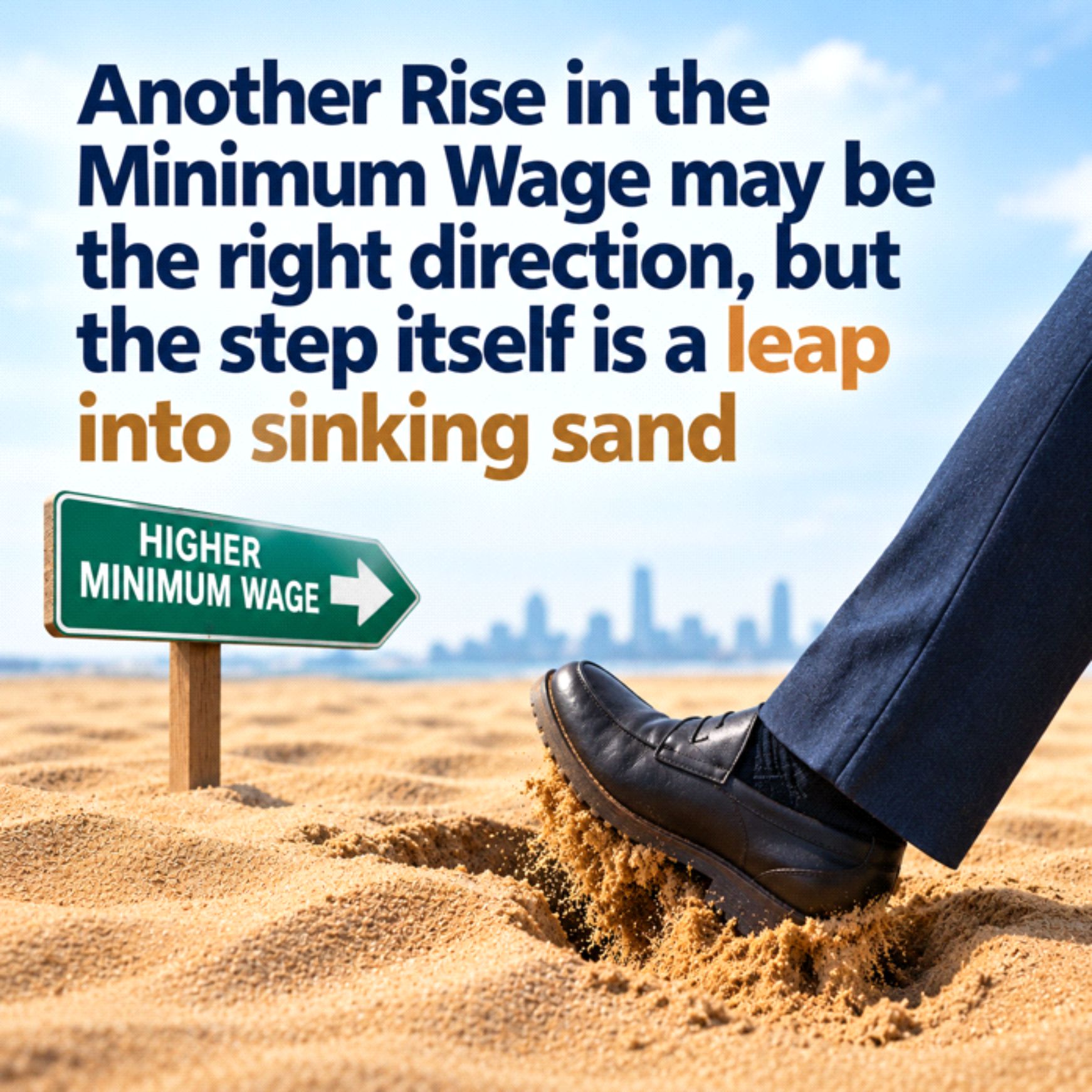
The Ground Beneath Us is Still Sinking
On paper, a significant increase in the minimum wage can look generous, particularly at a time when governments are themselves struggling to balance competing financial pressures.
But appearances can be deceptive.
Large corporations may absorb increased wage costs for a period before finding ways to pass them on through higher prices, improved efficiencies, reduced staffing levels, or increased productivity demands.
Small businesses often have far fewer options.
Many will absorb the costs and accept lower profits.
Others will attempt to raise prices in markets that are already stretched beyond comfort.
Some will simply close.
Meanwhile, those receiving the wage increase may discover that rising rents, rising bills, rising insurance costs, and rising prices steadily erode much of the benefit that was intended.
Everyone moves.
Very few move forward.
This is why the minimum wage debate often feels strangely circular. Every year we now find ourselves having the same conversation once again.
The minimum wage must rise because people cannot afford to live.
Yet people increasingly cannot afford to live despite repeated rises in the minimum wage.
At what point do we stop discussing the symptom and start discussing the cause?
The Real Question
The question is not whether the minimum wage should rise.
The question is why it has to keep rising simply to prevent more people from falling behind.
If full-time work cannot reliably provide economic independence, the problem is not the minimum wage itself.
If small businesses are becoming less viable whilst workers remain financially insecure, the problem is not either side of the employment relationship.
If governments repeatedly return to minimum wage increases as one of their primary responses to economic hardship, the problem is not necessarily the intention.
The problem may lie in the architecture itself.
Modern poverty, struggling small businesses, and constant debates about wages are not separate crises.
They are different warnings emerging from the same system.
And until we start questioning the structure that produces those warnings, every increase in the minimum wage, however well-intentioned, risks becoming another step forward on ground that is still sinking beneath us.
Further Reading
1. The Independence Threshold: A New Definition of Poverty for a Modern Economy
Before discussing wages, it is worth understanding what poverty actually is. This article argues that poverty begins where independence ends, proposing a definition based not on arbitrary income thresholds but on a person’s ability to sustain themselves without relying on external support. It provides the conceptual foundation for understanding why rising wages alone do not necessarily solve poverty.
Read: The Independence Threshold: A New Definition of Poverty for a Modern Economy
2. The Architecture of Modern Poverty
If poverty is ultimately about dependency, what creates that dependency? This article explores the structural forces that increasingly undermine economic independence, from rising living costs and housing pressures to the broader systems that leave more people vulnerable despite living in a wealthy society. It examines the architecture that produces poverty rather than simply its visible symptoms.
Read: The Architecture of Modern Poverty
3. Why Small Businesses Are Struggling – And Why the Real Problem Runs Much Deeper Than Anyone Wants to Admit
The same pressures affecting individuals are also affecting local businesses. This article argues that the challenges facing small businesses cannot be explained solely by taxes, labour costs, energy prices, or regulation. Instead, they are part of a much deeper economic shift that increasingly concentrates advantage amongst larger organisations whilst leaving smaller firms and communities with diminishing resilience.
Together, these articles explore a common theme: that modern poverty, economic dependency, struggling small businesses, and the continuing debate over wages are not separate problems. They are different manifestations of the same underlying economic architecture.

