With the Farmer’s March planned for this coming Tuesday, talk of all sorts of militancy and acts of rebellion from our Farmer’s have added to the chorus, with postulations and threats suggesting that a ‘Farmer Revolt’ could be on the way that will bring everything to a standstill, if the Farm Inheritance Tax changes aren’t overturned and the Farmers are seen to have got their way.
As covered in my blog yesterday, there really is no question that the Policy should be overturned. Because it will do damage to UK Farms, Farming and UK Food Security that we may very soon find ourselves unable to repair or restore to the correct place.
However, threatening or even talking up a ‘Revolt’ of any kind, could easily lead to consequences that nobody who is emotionally entrenched in this debate will have in mind. And they will certainly not expect.
It is vital we understand that Farmers are not dealing with real Leaders in our Government. These ‘politicians’ are not going to respond in ways that reflect anything other than who they are, why they are there and what they see as being the most important considerations for them – No matter how grounded the alternative and logic of the pro-Farming arguments levelled against them and their policies might be.
The culturally conditioned deference that we have for people because of job titles, roles, celebrity or even the number of people who follow, like and subscribe to them on social media, means that we automatically apply credibility to whatever they do.
We do so, without realising that we do so because we believe that they act, behave and approach everything in the same way we are, or that we believe we would do so, if we should find ourselves in exactly the same position as they are.
This ‘understanding’ works brilliantly until we disagree. But then we fall into the trap of believing and applying the same rationality for how they will behave, if we find ourselves on what we perceive to be the opposite side, whatever the reason might be.
There is much more to everything that this Government and the Government before it has done, is doing and will continue to do, if the political classes continue unhindered as things currently suggest that they will be.
The actions and words during the 2024 Budget and all of the interviews and messaging that has followed since, tell us that this really is the direction of travel that is ‘baked in’ for this Government.
It means these people really see no value in UK Farming as it is right now. Even though they may not be sharing what they anticipate the future of UK Food Production will be.
One thing we can be sure of however, is that our politicians are very smallminded and fearful. No matter what the drivers behind all of this really are.
If anyone genuinely believes that militancy and obstructive action will yield anything other than direct impact to anyone and everything effected on the days of the events themselves in this climate, they really should re-read the room.
Small, minded politicians are led by their own fears in everything they do. Cause they a big public problem that makes bad headlines for them and they will not hesitate to use every power at their disposal to end even the remotest possibility that Farmers could act this way or do the same to them again.
Its not communism or even the stupidity of incompetent politicians within the Political Party in power that led to this. WE keep electing people as public representatives who are fundamentally just the same.
They are coin-operated, do not understand what they are even supposed to be doing and will always look to whoever is complaining about what they are doing as the ideal direction to apportion blame.
However, even MORE importantly than the incompetence of our politicians; there are 39 days until Christmas – or less than 6 weeks.
For better or worse, the Supermarket aisles are filled up with everything for what has sadly become an annual 3-month festival of consumerism that the British Public have now bought into.
The last thing that Farmers should contemplate doing this week is deliberately leveraging themselves into the middle of this equation, pissing off precisely all of the people they most need to be aligned with.
The Food Revolution we do need is one that places Food Production right back at the heart of Our Local Communities. With Farmers leading and playing their part from the very front.
The destinies of Our Farmers, Our Communities and Our People are intricately entwined. Because of just how important Food is to each of us for survival and the role at the centre of life that Food plays, that we have been deliberately encouraged to overlook or forget.
We must not allow the establishment to diminish the role of UK Food Security any further. Irrespective of whether the reason for all they have done is just stupidity or maligned intent.
However, we also need to be clear that for as long as we have the same kinds of People running the Country, speaking with the same voices and influencing people just because of the platforms they have, they and only they remain the ones who legitimately get to set and control the national agenda. No matter how damaging to all of us it really is.
They will continue to do so, until an agenda that legitimately sits outside of their control exists and grows to benefit all of us and take their place.
I don’t even want to look into the number of terminally ill and people who have faced life changing challenges in that time, who have not been able to choose an early exit, just in the UK.
If we can step outside of what should be the irrational fear of having no choice, We can be sure that if we were facing that very same situation ourselves, we would want the option of a painless exit at a time and place of our own choosing, surrounded by the people we love.
Sadly, as with so many of the realities of life that cause so much pain and distress because of others standing in the way, the penny doesn’t drop on issues like this unless you’ve known some one very close who has gone through it, or you’ve ‘had a whiff of the box’ yourself and have found out.
What makes the whole debate all the more frustrating is the reality that very few of us would disagree that it is not the principle of Assisted Dying or Assisted Suicide that are really what the rejections are really about.
The problem, as it was when I last wrote about it, and for as long and wherever this debate raises its head, is that there is no, or rather there appears to be no foolproof method of ensuring that Assisted Dying is and can only ever be 100% voluntary.
Indeed, few would disagree that the circumstances and legal framework should never exist that could mean that anybody – and particularly older people, the infirm, disabled of those who are vulnerable in any way, could ever be compelled to make such a choice, for the benefit of others, rather than only themselves.
Regrettably, it is a sign of the times that so many of us have sympathy for the suggestion that there is no way to create adequate protections and safeguards that cannot be manipulated in some way. Because we live in times where morality and ethics have been deliberately confused with regulation, laws and rules that may be ‘legal’, but are no longer fit for purpose within a legal system that isn’t serving us with the unquestionable impartially that it should.
However, such arguments and positions do miss the obvious point that saying no to legalising Assisted Dying without even contributing to the search for a workable solution, because of what might happen, should not be nearly as compelling as the fact we are failing people who are already living with the personal hell of this experience and are crying out for our humanity and help.
Whilst it can only be good that Kim Leadbeater’s Terminally Ill Adults (End of Life) Bill is heading for a vote, the truth is that whilst the intention cannot be questioned, this whole question should always have been a government driven process rather than being left to be a private members bill, because the leaders wont lead when anything this controversial is in the public policy mix.
Had this Bill had effective cabinet level or prime ministerial leadership and the departmental resources that really should be applied to any matter with implications of this kind, the breadth and depth of the practical options and the governance that would support a successful outcome could really have been exhausted in a comprehensive process and debate.
Instead, we run the risk that either the Bill will fall and the question will not again return until at least the next Parliament.
If it should succeed, there will also be the risk that the necessary safeguards will not be in place and that cases will follow where questions could be raised over whether people are or have been effectively bullied into choosing an early death. Worse, that the gates are opened to wider forms of abuse that we should not even have to consider being possible in what we believe to be the civilised 21st century society we are in.
Assisted Dying is an ethical, moral issue and cause that sits way beyond party politics. Because the outcome has the ability to affect each and every one of us in exactly the same way.
As such, it is deserving of being considered, researched and thought through with the significance that it truly deserves.
Watching developments since the 2024 Budget on the 30th of October has seen, debate, support and plans for the Farmers March in London evolve – which we have every reason to believe is being planned as well and responsibly as a protest can, by The Farming Forum.
The growing strength of feeling really does risk giving those directly involved that Farmers have the power to solve every problem in one hit. And that they should therefore take it.
However, issues surrounding changes to Farmers Inheritance Tax do not stand alone in isolation. The breadth and depth of issues about how the entire UK Food Chain is being misused are both highly complex and considerably bigger than many farmers even realise.
And whilst any Farmer or Supporter may believe that headlines and commentary suggest the Government is ‘now on the run’ and will make concessions or change their mind if pushed hard enough, militancy of any kind at this stage, is more likely to lead to even worse outcomes for the industry than the drastic improvements and turnarounds that those banging drums and driving tractors may have on their current wish list.
Former Labour Advisor, John McTernan has told everyone, very loudly and very openly in an interview that that the U.K. does not need Small Farmers.
Whilst Starmer has attempted to ‘disown’ this suggestion, and whether our politicians are stupid and are doing stupid things or not, we would all be foolish to not accept and work with the reality that the people running this country until perhaps 2029, no longer see value in the UKs Small Farms.
We must all be very clear that if the Government believes that ‘Small Farms aren’t necessary, when they are not talking about Farms that are actually that small, the Government is not going to do anything to reward an industry for causing them problems, when they already have a picture of the future that surely resembles many if not all Small Farms being closed down.
We shouldn’t doubt that the Inheritance Tax move itself was a very big ‘tell’.
Politicians have now reached the stage in an ongoing process of UK Farming viability removal, where they no longer believe it necessary to show any care for Farmers.
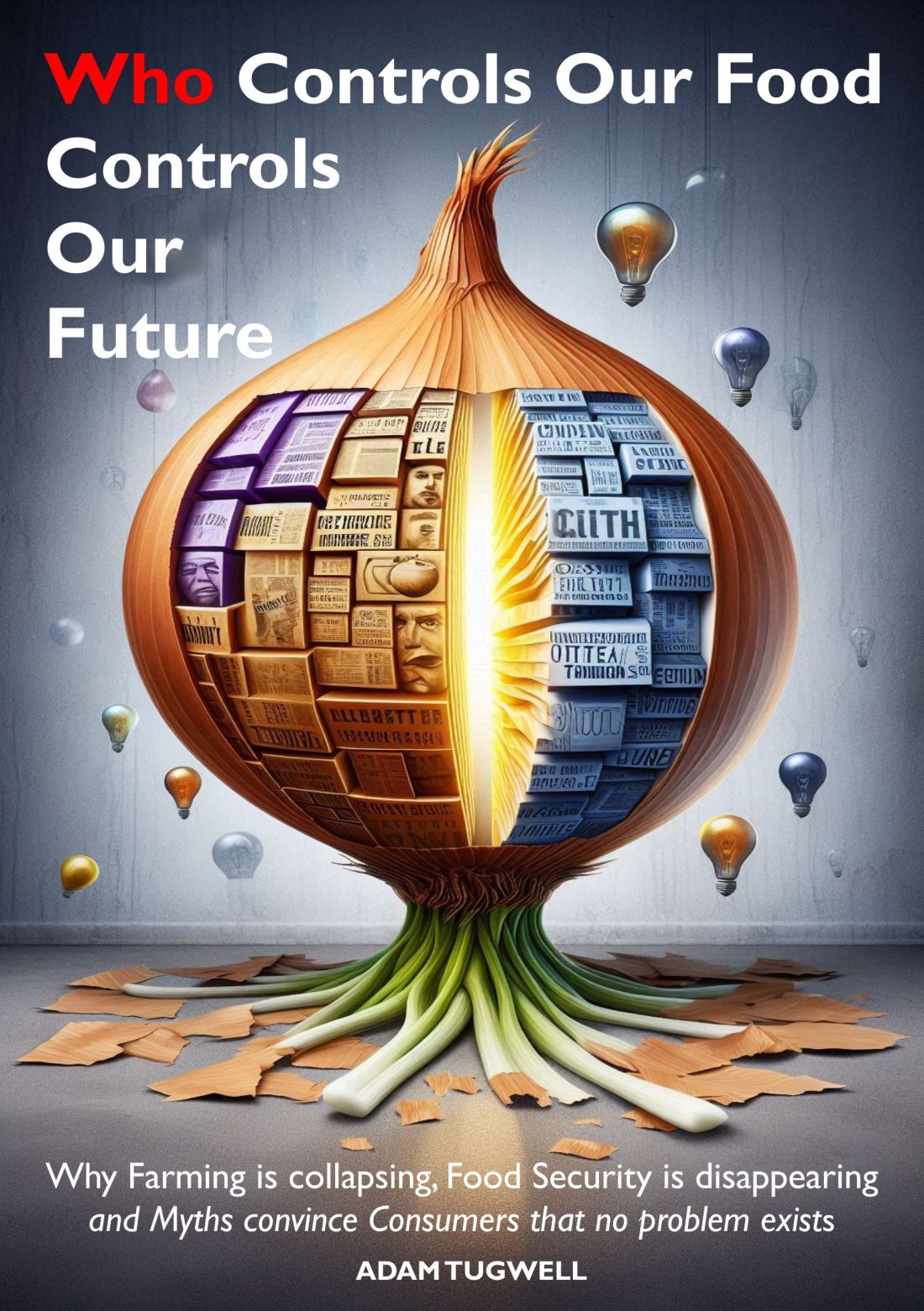
With the belief that the only helpful thing I can do is to share what I know and understand, I sat down to write Who Controls Our Food Controls Our Future with the aim that anyone genuinely interested would have the option of a quick walk through the entire background of the hidden Food Crisis.
I had been writing about our politicians and why they no longer care, and had a jaw dropping moment when the very serious warning from the political classes which is the McTernan comment was so very quickly shared after the 30th October Budget.
Right now, the direction of travel for U.K. Farming as we know it is terminal. 3rd party interests right across the Food Chain – NOT just the politicians themselves – believe in a future where the Food we eat will either be a source of guaranteed profit for corporate giants or just another governance tool for societal control.
Such aims require that Food Production cannot be left in even the most isolated pair of hands. Because any form of independence in the Food Chain will be a massive threat.
The evidence is there and no longer even hiding in plain sight.
Politicians across our political sphere today do not fear losing Small Farmers. But they will be very fearful of even a moment of social unrest and are unlikely to respond well to any acts that create problems for them that might suggest to the Public that they are not in control.
Much like the follow-up to the unrest in Southport in the Summer this Government is likely to work like they are on steroids to achieve anything they believe necessary to stop Farmers from ever having the opportunity to make them look bad again.
We ALL need to realise that the dystopian nightmare is already here.
We just haven’t stood back to view the whole wood yet, rather than each of our different trees.
We all need to wake up quickly and begin playing a very different game, before it really is too late.
The next step, could regrettably come very quickly following any action or events that aren’t thought through properly. And such actions – even if only involving just a few, would be akin to the whole Farming Industry shooting itself in the foot.
Not only do People across the UK need OUR Farming industry to survive. WE ALL need UK Farmers to take back all of the control that they have lost, putting Food and Food Production back at the very heart of our Local Communities, as just the start.
No help and certainly nothing good will come now from anyone or any organisation that profits in any way from where UK Farming is heading today. Other than lip service, contractual devices, sops and incentives that will keep Farmers doing what those interests want Farmers to do and keep Farmers believing that things will get better at some unknown point in the future.
Meanwhile these interests will continue to rinse every last penny that they can from ALL of us, whilst systematically destroying the ability of Farmers, People and Communities to have Food Chain Independence at any level and of any kind.
Please don’t fall into the trap of giving any of them even the slightest reason to make things worse for Farmers, whilst they still can.
Otherwise, what is left of UK Farming may not be able to recover.
UK Farming is now in an endgame-level crisis, and UK Food Security, or the guarantee that we will always have enough Food for us to eat, has disappeared out of the door.
The problem is we don’t even know it. We are experiencing a kind of Situational Bias on a mass scale, and many of those who hear the term ‘Food Security’ believe that the subject is about something entirely different.
We certainly don’t accept that the problems our Farmers face are even bigger than the Farmers themselves accept them to be.
Written and Published between the UK Budget on 30th October 2024, when the now infamous changes to Farm Inheritance Tax were announced, and The Farmers March in London on 19th November 2024, Who Controls Our Food Controls Our Future unpicks the layers of truth that surround and influence The Food Chain.
Using the metaphor of The Food Chain Onion, Adam peels back the layers to expose the roles and motives of a significant list of People and 3rd party organisations that influence what we eat, how our Food gets to us, what we pay for it, when and if we can afford to access it.
Sharing the many Food Chain Myths, Narratives and Shibboleths that are gaslighting us into accepting the many carefully crafted stories that govern our relationship with the Food we eat, Adam opens the door to understanding that Food Production and Supply is now so complicated, The Food Chain has become the perfect place for greed, profiteering and other maligned interests to hide and profit excessively whilst reshaping OUR Future – all in plain sight.
None of us can eat money to survive. No matter how much money we might have.
Why Farming is collapsing, Food Security is disappearing, and Myths convince Consumers that no problem exists
Introduction
In the few days since the 2024 Budget in the U.K., the issues surrounding the change of Inheritance Tax rules on Farms has touched Farm closures, UK Food Security, Food shortages, Food prices, support for Farmers, the mental health of Farmers and even the Farming Minister’s choice of wellies.
Other than the idea that wearing £420 footwear will put a politician in touch with rural life at grassroots level, every one of these issues is as real and as important as many others besides.
Sadly, however, it’s too easy for the broader list of issues to be tied to any one of the others. As is the case with NFU President Tom Bradshaw being quoted by the media in a way that suggests the Inheritance Tax issue and UK Food Security are one and the same thing.
Whether or not the NFU President actually said this, it was what the journalist heard, or it is what readers will conclude from the manner in which the article was written, the outcome will ultimately be the same. But it is not even a fraction of the whole truth about the UK Food Chain that even some of our Farmers and Politicians certainly don’t appreciate.
Everyone has a different perspective on Food and the issues around the Food Chain. As is the case with every issue that needs to be addressed within the public policy sphere.
Just like peeling the layers of an onion, without looking closely at the onion itself, it is easy from a distance to believe that the onion as we see it is all there is to see.
Yet each layer of that onion holds different truths, and the next layer that we may not be able to see, may present the story in ways that run contrary to the content of the last, even though we believe that it would be impossible for it to be so.
In the case of the UKs Food, Food Security and what is called The Food Chain, or the supply chain that does everything with the raw ingredients that make up our food and get it to us so that we can eat it, the Food Chain Onion has many different layers that need to be unpicked, before the whole picture and its implications can be understood.
Sadly, even academics and thought leaders who advise governments and train industry professionals don’t understand or have a real-world-perspectives about what each and every layer of the Food Chain Onion is really all about, how it works and what impact it has had, is having and will have on the Future of Our Food, and as such, the Future of People like you and me.
The Importance of Food
The truth that should be at the forefront of everyone’s mind is, ‘To be healthy, each and every one of us requires access to at least two nutritious, calory appropriate, fresh and properly prepared meals every day.’
Yet the reality is much different. We rarely think consciously about what we are eating when we are thinking about our next meal and will be influenced by what Food is available, what Food is accessible, and for a growing number of us, what Food we can actually afford, to eat.
The second truth, far more profound than the first is, ‘Food is as important as the Water that we drink and the Air that we breathe.’
Again, we live each day without applying conscious value to the importance of the Food we eat. Probably because the majority of us who are alive today have not experienced being short of Food or had to think about where our next meal will come from.
The UK can no longer guarantee the supply of an essential for Life
We take the availability and the access that we have to ‘Food’ for granted. But the Food Supply and therefore the UKs Food Security is at risk.
In fact, UK Food Security is fragile to a point that few of us are prepared to believe. And many of us don’t.
We should all be able to rely upon the people we elect to represent us in government having the skills, experience and cognitive ability to fully understand processes like The Food Chain and how they are influenced. But they don’t.
What is more, whether deliberate or because of stupidity, todays political classes are actively facilitating the collapse of UK Farming and the loss of UK Food Security.
The UK is fast approaching a point that if our borders were closed for any reason, for any prolonged period of time, there wouldn’t be enough food readily available in the forms that many millions of people across the UK would need, every day.
The threat to UK Food Security is very real. This level of risk and vulnerability to The UK Food Chain could only have been reached through deliberate intent or through a non-stop chain of ignorance or self-interest in public policy making that should be too ridiculous to believe.
Food Quality
The ongoing or continual availability of Food for People across the UK is critically important. However, just as important and overlooked is the nutritional and calorific value of the Food we eat.
A significant proportion of the UK Population believe that food is food and counts as healthy food, no matter what that food might be.
We have reached the perverse situation where unhealthy, heavily processed, highly calorific and low nutrition food is considered a ‘normal’ diet for many of us.
Poor quality ‘Food’ is more readily available, accessible and affordable in forms other than Basic or Essential Foods that resemble their original forms or source, and typically contain multiple types of ingredients. Many of which that will have been shipped across numerous international borders and processed in many different factory locations.
Eating poor quality and unhealthy ‘Food’ is considered to be ‘normal’ for no better reason than every narrative or marketing campaign we experience in daily life tells us that this is how the food supply works.
We are constantly bombarded with information flows insisting that we are very lucky to have access to such wonderful products that taste so good, as and when we want them and all for prices that everyone can afford.
Why would anyone want to trouble themselves with cooking and preparing food from the basics, when the basics are so expensive anyway and are a luxury that only those who go to Farmers Markets and Farm Shops can actually afford?
Narratives of this kind are where the steady progress of a Global, Neoliberal business model that swears the consumer is always getting the best value and the best price, crashes – or rather should crash down.
Food today increasingly looks less and less like real Food. Depends upon ingredients that are manufactured rather than being natural, and can only come from factory derived processes or megafarms.
It means that anyone not thinking about what these messages say will unwittingly believe that Small, Local, Family Farms – that DO have the potential to supply everything people need locally – are not only archaic and out of date. They are something out of history that a ‘growth’ obsessed economy can easily leave behind.
The ‘globalised system’ is highly profitable, and those who either control of benefit from it are uncompromisingly clear that the global model is in their best interests.
Because money rules, this ‘truth’ must be communicated and supported as being in the best interests of all. Even to the extent that traditional methods and systems that existed previously must be extinguished and erased. So that what those driving change control and what they want to control cannot be replaced.
Part 1. The Truths hidden by The Food Chain Onion
The Layers of the Food Chain Onion
It is normal to see The Food Chain as being the shops or Supermarkets where we buy or order our Food from, and simply understand that the Food probably came from a Farm.
This is how most of us perceive The Food Chain.
It’s the way we are encouraged to think about it too.
However, like everything in this World that touches our Lives today, the Food Chain is massively complex, and has many different interests and therefore agendas involved.
The Food Chain is very complicated, is multilayered and within those layers sit a range of different nuances too.
Describing the way that the layers work, function and influence each other may be best described as being like the layers of an Onion, or The Food Chain Onion, if you will.
Like the paragraph at the beginning of this section, few of us consider the true depth and complexity of the layers of The Food Chain Onion, even when we work within and arguably have a good understanding of layers other than those that include the Two Key Food Chain Stakeholders – The Farmers and Consumers.
It is easy to write off questions and concerns over UK Food Security when we take what we see at face value.
However, if we really want to understand why UK Farming and UK Food Security is at risk and why People are increasingly concerned, it is important to consider as many of the different influences or ‘stakeholders’ that exist in The Food Chain today. So that we can understand where the real priorities lie and how all those different influences work.
Welcome to the layers and hidden truths that are The Food Chain Onion:
Consumers: The People who eat the Food
The consumers are us.
We are the people who eat the food that is available. Whether we grow the food we eat ourselves, or we rely completely upon being able to visit or order from a Supermarket, takeaway, pub or restaurant, every time that we need to eat a meal.
We are the end user.
This means we are one end of a very important supply chain.
The fact that we all need to be able to eat at least 2x meals a day means that we all have the same interest in the Food Security and Food Supply issue. Even though very few of us currently see it that way.
Food is as important as the water we drink and the air we breathe.
Yet we increasingly take for granted that food will always be available and that those who control The Food Chain always have our best interests at heart.
What many of us do not realise is that the Food we eat and the eating habits that we have – often as a direct result, are making us sick.
What we eat and the Food that we are addicted to is unhealthy.
Poor, unhealthy Food is leading to chronic disease, debilitating health problems and in regrettable numbers, growing numbers of deaths too.
The healthiest food we can eat resembles its original form or source when it’s on our plate.
Unfortunately, much of what we eat doesn’t resemble its original form or source. Nor does it resemble the form that it would be in if it had been processed in traditional or the equivalent of ‘handmade’ ways, where nothing ‘manufactured’ or that cannot be found in an unprocessed natural form has been added. Such as Dairy Products, Breads and meat ‘products’ such as hams, burgers and sausages that only have ‘natural’ additives added.
Our role and the influence we should have on The Food Chain
Regrettably, the majority of us today behave as if we are just passengers at the end of the Food journey. As if we don’t have any choice or influence over whatever Food or ‘Food’ products come our way.
We just accept the choice that is given us, depending on what we can access or afford.
As the consumer, or end user, we are one of Two Key Stakeholders in The Food Chain.
Our influence, requirements and best interests should therefore be at the forefront of Food Chain Strategy, alongside that of The Farmers, who are the other Key Stakeholder.
The Retailers: The Companies making money by making food shopping ‘easy’
It cannot be understated just how complex the supply chains are that bring the Food Products that each of us buy or order from Supermarket shelves or storerooms.
The threat to Our Food Security and our Farmers wouldn’t be anywhere near as high as it now is, had it not been for the role that Supermarkets play in the UK Food Chain – along with that of the Processors and Manufactures who often sit directly between them and Farmers – which we will focus on in wider detail later.
The common misperception is that the Supermarket shelves will always be full. That they will be stacked with whatever Foods that each and every one of us considers to be our ‘normal’ choices to eat, each and every time we have reason to shop.
This is one of the greatest and most dangerous Food Chain Myths.
Money is the only thing that matters
It doesn’t matter whether we shop at one of the higher end Supermarkets, one of the biggest and most commonly used ‘Names’, one of the smaller ‘local’ brands or one of the European style discounters. The majority of these Retail businesses are owned by Shareholders.
Shareholders are often BIG money investor funds or pension funds that will typically invest heavily to gain influential shareholder rights within Supermarket companies.
Obtaining large shareholdings provides Big Money with power and control over the direction of the Supermarket businesses and how they behave in their relationships with their suppliers and customers.
This in turn has a direct and very serious impact right across The Food Chain.
However we view the Supermarket Trade and the tone of the messages, advertising and marketing narratives that they use and push at us in whatever way they can, particularly as we approach Christmas, the purpose of everything Supermarkets do is to grow and maintain profits, doing whatever they need to, in whatever way that they can.
Loyalty cards and ‘offers’
Yes, we all see the loyalty cards that the BIG retailers use and the ‘reduced prices’ that are now increasingly available only to those who have signed up to the card that the store we are shopping with provides.
Supermarkets make significant profit on the lower prices only accessible to us as ‘cardholders’, when we have ‘shown loyalty’ by signing up and surrendering personal data.
The Supermarkets would still make this profit and more from the added margin that any of us would be required to pay, if we didn’t have the necessary loyalty card, had forgotten it, or were perhaps minded to accept that the surrender of data about our shopping habits comes at a very high price.
Supermarkets use data from us and from Farmers to exploit us
It is important to understand the role that data harvesting by Supermarkets can play.
Not only because Supermarkets are using or selling these consumer insights so that we can be manipulated in an increasing number of ways.
Supermarkets, Processors and Manufacturers use the data that they are able to access about UK Farmers to understand the Farm business models.
However the level of data being ‘farmed from the farmers’ is also available to companies holding contracts with Farmers to influence what Farmers grow, how much they grow and how they grow it.
Most chillingly, data enables Supermarkets and any business between them in the Food Chain calculate what the Farmers income versus outgoings are, down to a forensic level.
Using rules and regulations to hide and justify profiteering
We are told that Supermarkets and companies like Highstreet name fast food chains, that currently rely on UK Farmers, have very stringent quality control management systems in place.
Such companies use the harvest of Farm data simply to ensure quality and welfare standards are met.
However, this is a story that is used to encourage us to assume much more. Because it suggests that Companies that we buy Food from have very close – ‘partnership’ style relationships with our Farmers.
It leads many of us to believe that we can only benefit from Our Farmers being tied into contractual commitments with Supermarkets, Processors and Manufacturers.
Dictating the prices that Farmers ‘sell’
One of the most difficult parts of the existing relationship between Farmers and Supermarkets, Processors and Manufacturers are the contractual arrangements that Farmers now seek and become tied to. Often because they believe there isn’t any other way for their Businesses to exist.
For instance, some of the ‘Offers’ that we experience when we shop at Supermarkets for Fresh Fruit and Vegetables grown in the UK are simply breathtaking in the sense that they are made on the basis of offering value to us. However, to make these ‘offers’ the Supermarkets may have dictated that Farmers and sometimes even Manufacturers and Processors must absorb the discount themselves – so that the Supermarkets can keep making the same profits as before.
Just because they can do this, doesn’t make it right.
The level of power that the Supermarkets have over Farming businesses that exist today and are in contractual arrangements with them, is stunning.
Farmers are vulnerable because of the state that the whole industry is in.
Farmers should be able to rely upon the businesses they have key relationships within The Food Chain always putting the supply of the best food for Consumers first, above all things.
Sadly, profit is god to the Supermarkets and Big Retailers. They are ruthless about making more of it and they don’t care what the consequences are for the businesses they destroy or the lives of the Consumers, as long as they believe they are winning and have a plan that will allow them to continue to win.
Commercial Exploitation?
The Supermarkets, Processors and Manufacturers arguably misuse the commercially sensitive relationships and data they demand and harvest from Farmers to understand every part of each Farmers Business.
They are now able to do this to the point where they can understand what the Farmer and every member of their staff earn, once all other known costs have been considered.
Let’s just say that it’s unlikely to be an accident that many of the Farmers who we are hearing from in the media and across social media channels today, tell us that in real terms they are earning less than the National Minimum Wage.
They are NOT telling us lies.
We will come back to the difficult truths about Farmers shortly. But it is fair to say that the behaviour of the Supermarkets and the companies that work between themand Farmers speaks for itself when these profit-driven layers of The Food Chain Onion are quite happy to break Farmers and their Businesses. Just so that they can rinse every penny of profit that exists at the Growing and Production End of The Food Chain – which isn’t theirs to take.
Unfortunately, it also tells us that the Supermarkets are not worried about a future for UK Food Production, where Small, Family run Farming Businesses don’t exist.
Today, Supermarkets, Processors, Manufacturers and all the other layers of The Food Chain Onion are contributing to the destruction of UK Farming and Our Food Security.
We shop the way we do because its easy. Not because its cheap
The lies, myths and stories that tell us cost is the most important factor when it comes to what we eat are a common theme throughout Who Controls Our Food, Controls Our Future.
We will cover the issue in more and more detail as we go along.
However, what we pay and what we believe we are prepared to pay are perhaps the biggest ‘hide behinds’ that most of us use to excuse the way we approach Food Shopping and our Diet.
The majority of the layers of The Food Chain Onion use our lack of thought and interest in what we eat against us.
And they are getting very rich from doing so.
The Processors:
A prominent part of a Food Chain Onion that brings so many different kinds of ‘Foods’ and ‘Food’ products to us, are the ‘Processors’.
If there was ever an incidence where the meaning of a word can be skewed to benefit others at the cost of those who still believe that it means something else, ‘processing’ or to be ‘processed’, in the context of the Food that we all regularly eat, is probably one of the most misused and abused.
It can rightly be argued that unless we quite literally pull a carrot from the ground or an apple from the tree and eat it there and then, without doing anything to it – including cutting it, then the carrot or the apple have been through a ‘process’ of some kind.
By being cut, the carrot and the apple have been ‘prepared’ as part of that ‘process’ so that they are ready to eat.
Humans have been ‘processing’ Food, since before any kind of records began.
But there is a difference between the kind of ‘traditional’ processing or ‘handmade’ equivalent that enhances, preserves and broadens day-to-day access to seasonally available foods, and the kinds of processing today which are motivated by very different aims, and take Farming and Food Production in a very different and damaging direction.
The only ‘Good’ Food Processing is Food Processing that could be done ‘By Hand’
Traditional, healthy and minimal processing methods are distinguishable from the modern profit-driven alternatives by the reality that whilst we can use machines to assist or even complete the process, that process could typically be carried out by hand, with the aid of little more than hand tools or pre-industrial age variants.
Examples might be where meats are hung, salted with natural salt or smoked; milk is churned and natural salt is added to make butter; or wheat is milled and then water and yeast are added so that we can have oven-baked bread.
The kinds of processing that are problematic for us, are the forms of processing where raw or natural Foods or ingredients, that were edible and healthy in their basic forms, go through machine, chemical or other forms of processing to remove, filter or break up different ingredients and elements such as sugars, proteins and parts that are not available elsewhere in any other forms.
These parts are then used as enhancers, preservatives, colourings and in some cases to knowingly make chemical changes within the mechanisms of the bodies of those who consume them at the end of The Food Chain.
Sometimes, these ‘additives’ are made from ingredients or raw products that we would never knowingly eat.
We often don’t even know that they are contained within the packaged products and takeaway Foods that we buy. Even though there will almost certainly be signposting in the form of codes in very small print on the packaging or even on a website that will tell us openly what we are consuming. IF we are minded to actually make the effort and take the time to look.
Fashion, Habit and Addiction is how the profit in Food is really made
It is this kind of modern processing that leads to the types of enhancements of Foods that becomes attractive, fashionable, habit forming and ultimately addictive.
It also enables Food Manufacturers to preserve Food and ingredients so that Food Chains can cross whole continents and include processing at potentially many different factory locations.
The whole ‘process’ enables the businesses and corporate giants who really control the Food Chain today to suggest that the Food and the ingredients we are eating – if we can still call it that – is actually ‘cheap’.
All whilst they keep a straight face.
The health risks of processed Foods
The human body does not need nor require ‘processed’ foods, and certainly not ‘Ultra Processed Foods’ or UPFs.
It is because there are so many ingredients within processed foods that our bodies do not recognise the structure of the Food that we are eating. Often because the ingredients have lost the nutritional value that was only present in their natural or traditionally processed forms.
This ‘masking’ is a reason ‘bad’ food tastes so good. However, it is also a key reason that we are becoming less healthy.
Many of us are steadily becoming overweight and growing numbers of us are now suffering with health conditions like inflammation that have consequences through issues such as heart disease, which are potentially very serious indeed.
We are being led towards harmful Foods because they are more profitable
Today, we are being pushed more and more towards the kinds of Foods that have the potential to hurt us, because these are the kinds of Foods that are most profitable.
Ironically however, they are only highly profitable to the different layers of The Food Chain Onion that shouldn’t even be influencing what we eat – because there’s no need for them to even be there!
Food becomes more and more profitable the less natural it is and the less ‘hands in the Food Chain’ that have touched it. Because all of the different people who ‘process’ it or handle it unnecessarily, are not adding genuine value to what we eat.
These ‘extra hands’ are certainly adding things that aren’t good for us. But as their influence and control over The Food Chain grows, the easier it becomes for them to convince decision makers that what they are making is good for us, is what we actually need and is the only kind of Food Production that is viable for Our Future.
Small, Local Family Farms are not part of The Plan
Small, local Farms have never been part of the ‘Food Plan’ that anyone paying close attention can now see unfolding. Other than to remain part of The Food Chain until such time as a narrative is created that is credible and persuasive enough to convince the Public at large, the ‘useful’ Politicians and their advisors, that ‘naturally grown, basic and essential food in its raw, fresh forms’ is something that we no longer need.
That is where The UK Food Chain is today. It is where the attack on UK Farmers has now burst into the open in the 2024 UK Budget. Even though this attack has been underway for the decades leading up to this point where we are openly experiencing it now.
The Processors that we need
There ARE types of Food Processing that are not only good. But that are actually necessary. Not least of all so that we can all have access to the Food that we need, all year round.
However, these types of processing do not need to be carried out at industrial scale.
This kind of ‘good processing’ would serve us even better if it were carried out by small local businesses and the type of infrastructure that existed before technology and open borders made it possible to hide the real cost of globalisation. Deceptively making it look like todays Food Chain is available to us all at very low cost.
We’ve touched on the work of Butchers, Dairies, Millers and Bakers before.
All of these businesses can run as small businesses locally within Our Communities. And that is where they should be.
The lower level, traditional or handmade processing necessary to make the best and broadest use of Good, Healthy, Basic and Essential Foods can be carried out within these businesses, by Farmers who diversify, or by Farm-supporting cooperatives.
The Global model is hollow. It relies on destroying anything that invalidates it or stands in its way
The bureaucracy of EU Membership and the rules dictated from Brussels and rubber stamped by our own Politicians and Public Sector are the tools and devices that have made it near impossible for Small, Local Farm Businesses to survive.
This includes the many abattoirs that no longer exist. But should be revived or replaced so that we can once again guarantee the highest standards of animal welfare.
Globalists have deliberately used legislation and regulation that they can then buy their own way through using high powered legal teams to stop small businesses and Farmers thriving within our communities.
The loss to us being that we have not been allowed to keep everything in The Food Chain local, transparent and trustworthy, in every possible sense.
Our Food Supply will not be safe and will continue to be vulnerable, for as long as we continue to allow modern ‘Food Processing’ and for ‘Processed Foods’ to be manufactured and brought to our plates in any way that is considered more normal than eating food that comes from local Farms and Growers.
Merchants, Manufacturers and ‘Landowners’:
As we work our way through the layers of The Food Chain Onion, there are some layers that have murkier roles and raise even more questions about the influence they have on what we eat, whilst adding very questionable value. If that is they add any value at all.
Merchants (Agents or Wholesalers)
Merchants are the businesses or organisations that typically buy Food in its raw, original or harvested forms to then sell on without any processing; or, adding a rudimentary form of processing, such as grain drying or seed treatment, then providing temporary storage or coordinating transport from the Farm, Port or wherever to the location the Food needs to get to next.
Merchants add value in terms of the way that The Food Chain works, today. However, they are also the first layer of The Food Chain Onion able to apply their own desired profit margins and actively involve themselves in relationships with other speculators across The Food Chain.
Manufacturers
If there is one elephant in the Food Chain room standing head and shoulders above the rest, it will is the role, influence and impact of ‘Food Manufacturers’.
Bearing in mind that the healthiest and therefore the best food we can consume is Food that resembles its original form or source, the question that we should be asking ourselves is ‘Should Food be ‘manufactured’ at all?’
There is a distinct difference between Basic or Essential Foods, and ‘Foods’ that have been manufactured.
Manufacturing alters, enhances and makes ‘Food’ products more appealing.
Manufactured Foods are a luxury and NOT Basic, Essential or what anyone could reasonably argue should be a ‘staple’ – unless there is profit involved and it serves somebody’s purposes for it to seem that way.
Manufacturers typically make the snacks, sweets, boxed cakes, branded tins and generally packaged Foods that most of us buy and now consider a normal part of a weekly shop and consume as part of our regular diet.
When asked, we would almost certainly add cost into the reasoning for relying heavily on Manufactured Foods.
However, the cost factor isn’t just about money.
It’s the availability, reduced time and of course the addictive ingredients that are used to enhance taste as well as shelf life, that make us ‘want’ more of whatever the ‘Food’ product might be.
Manufactured Foods are not made with our health or wellbeing in mind.
They are made to make profit from the first sale, and then increase those profits with every sale that comes afterwards. Once we or the People around us who we feed are hooked and believe that the ‘Food’ product is something that we cannot do without.
Manufacturers are as cynical as the Supermarkets and Processors when it comes to market share and profitability.
They often pay supermarkets to promote their products or place them in very prominent positions within the Stores where we shop.
Manufacturers increasingly engage in making ‘Food’ product sizes or the quantities contained within ‘Food’ packages smaller. So that we pay the same money for less, often without realising in the first instance, and then have to buy more if we want the same amount that we thought we were buying or bought before.
Manufacturers have also been known to change the ingredients of well known ‘Food’ products, replacing them with cheaper versions and then make extraordinary claims about a ‘New Improved Taste’ or something equally misleading, when the truth is that the taste isn’t what it was and Consumers do know the difference.
We have a habit of believing that it can only be us who is experiencing the downgrading of quality – as with so many other things, as the narratives being pumped out tell us its actually all good and will look at Mass Gaslit Isolation in Part 3.
Manufacturers could not do any of this without working closely with the Supermarkets.
Profit is always their common aim.
The Supermarkets clearly gain from what Manufacturers do, as it provides greater scope to increase their own profits whilst making it appear that they are offering us even greater deals than before, when the ‘Food’ products concerned are ‘discounted’ or pushed at us under ‘offers’ or ‘discounts’ that aren’t genuinely reduced prices at all.
Foods that are manufactured are highly profitable, precisely because we don’t need them. We actually want them (because we are often addicted to them) and therefore we believe that wanting them is the same thing as need.
Landowners
Landowners are the People, Businesses and Organisations that buy up Agricultural Land and Farms for the purpose of ‘investment’ or simply because they ‘want to live on a Farm’. Rather than, but not exclusively because they themselves want to ‘Farm’.
The benefit of having Small, Local Family Farms is that the Farmers are usually part of the Local Community and often Farm because that is how they earn their living.
Local Farmers care about what they do. In most cases Farmers would prefer to be serving and working with Local Communities to support a very localised Food Chain. IF that is they were not facing the situation they now are, primarily because of the behaviour and actions of 3rd parties, right across The Food Chain.
When Landowners don’t need to make a living from the land and properties that they own, they are free to pursue their own agendas or the agendas of the People, businesses or even governments that they wish to develop and maintain beneficial relationships with.
Food Production and Food Security isn’t a priority for anyone who doesn’t believe that they are vulnerable to the issues that end users and genuine Farmers are exposed to, themselves.
In the case of ‘introductory landowners’ who have inserted themselves into ownership of Agricultural Property, the reality we face is that if they haven’t already taken land out of ‘Production’ – so that it is no longer ‘Farmed’, they certainly can and will if advised or paid to do so.
It is only fair to add that some People who have become wealthy because of whatever they have done elsewhere in Life, who then buy a Farm, certainly have embraced the Farming ‘way of life’ and are committed to making their Farming Enterprises work*.
However, ‘new Farmers’ of this kind are very few and far between in number. Because buying land has reached a level where those who would like to enter Farming as a career without resources of their own, find it almost impossible to start. Given the perilous state that the industry and the standard Farming Business Model is now in.
*If you would like to understand what the learning curve and true depth of the costs and pressures that now accompany ownership of a Farm in the UK today mean, watching Clarkson’s Farm on Amazon Prime is a very good place to start.
The Money Markets & Financiers:
It would be very easy to question how The Money Markets and Financiers could possibly be involved or have any influence over The Food Chain.
Unfortunately, we currently live and exist in a money-centric economic and monetary system, where the value of money sits at the heart of everything.
An appropriate name for the system that we are in is A Moneyocracy.
The Moneyocracy exists and continues to exist in the way that it does, because pretty much everyone in it – that’s you and me too, are either addicted to it, and the way it works, or are unable to live and exist without playing along with it in some, but usually many different ways.
This is no accident.
Those at the top of the money tree, who understand how everything really works, have been key players and influencers in pushing changes through that have removed, changed and installed rules, regulation and laws that have legalised whatever they wish to do.
The changes that have been made don’t only relate to the Food Chain directly itself. They have affected The Food Chain and everything touched by money, because they have used ‘useful’ Politicians to remove the very frameworks that have historically prevented people like them from dreaming up, creating and then implementing new financial tools and devices which serve only them, but exploit everyone else.
With the help of Politicians who should all know better, the People controlling money use these highly beneficial changes to make more and more money. Usually at a financial cost to everyone else who isn’t in on the plan – whether they can afford it or not.
In just about every part of life where we spend money, that also includes us.
Anything goes for those in the know
The best example of the role that the Money Markets and Financiers play in everything was demonstrated by the Great Financial Crisis of 2007-08.
In the period running up to the Crisis, elaborate financial devices and tools were used repeatedly to package up and resell bad debt as a good deal for unsuspecting buyers.
Or, if you find watching a little easier, the 2015 Film ‘The Big Short’ based on the Book by Michael Lewis will provide a very good idea of what was then and is still going on with money.
It is important for us all to understand that nothing has changed. Even though the Great Financial Crisis should have been a massive warning to us all.
Money is a rigged game with a real-life cheat code
We have been deliberately insulated from the reality that the Markets are one big betting shop.
Even though adverts for apps that offer spread betting and various ways to make money by playing the markets are rarely hidden from our view, few of us think about how ‘money is made’ from these activities and what influence even we are having upon others.
We don’t register what the consequences of playing with or taking actions that can manipulate the value of companies and entire sectors that are providing essential goods and services for end users like you and me.
We certainly don’t appreciate what it can, will or does actually mean for those impacted by what ‘playing the markets’ can and will do to real lives.
There are financial products known as ‘Futures’ which are openly traded and treated like a legitimate thing.
In the case of Farming, these ‘Futures’ are quite literally promises of what Farmers will produce this year, next year and increasingly over a period of many years’ in the future of time.
The irresponsibility that accompanies the buying and selling of raw, unharvested and unprocessed agricultural products, that haven’t even been planted, grown or will come from animals that haven’t even been born yet, is beyond frightening.
And the implications of ‘Futures Trading’ are not as simple as Traders making gains or losses either.
Futures are treated as being real. Much in the same way that we attribute and believe in the value of Cash, on the basis that it is just like a promissory note or even an asset in its own right.
The difference being that Futures are contractually tied to certain things that come from certain places. And right now, they are perfectly legal.
Whoever owns Futures can do whatever they want with them, including selling them to whoever and sending them wherever they want.
Those who hold these traded contracts also have the power to influence and make demands upon the businesses of the Farmers who have committed to delivering for them.
The misuse of Futures is just another area where the growing pressures on UK Food Production lies.
The BIG Money & Corporations:
The BIG Money and the BIG corporate interests are the real players, influencers and increasingly the dictators when it comes to The Food Chain.
Few of us realise just how hungry the rich are to become even richer. And what lengths the rich and powerful will go to develop, manipulate and control systems which deliver growing profits.
They guard the control over The System that they already have jealously. They consider the power they have to be a right, and that the hold they have is indefinitely theirs to continue and implement as they see fit.
Many of us are unaware of the control that just a handful of large companies have over The World Food Chain.
Large Corporations have gained that control by pushing weak and malleable politicians to change rules, remove laws and create bureaucratic systems that have ended many of the protections that existed or should now be in place to support Farmers, Food Producers and Consumers. Not just in the UK, but right across the World.
Without the Regulatory frameworks that are needed to protect Farmers and Our Food Supply from profiteering and those seeking to control the production of Food for whatever reason, BIG companies are free to use civil and commercial law, and therefore the Courts and Legal system, to control Farmers, Food Producers and many other interests in The Food Chain.
Big Corporations quite literally use the Law to stop anything that enables Farmers and Food Producers of all sizes to farm what they want to, where they want to and how they want to, unless the Corporations themselves have full control, and are making money from it.
The power and influence that BIG money has now gained through the lie that deregulation is good for the consumer is breathtaking.
The stories and narratives that have been carefully crafted to support what they are doing, by manipulating us in to believing that their actions are selfless and in our best interests, make the whole situation and the damage they are doing to life and the planet itself, considerably worse.
Once understood, it could be argued that we are all victims of the perfect crime. Because the crime being committed has been made legal.
The Politicians:
Our Politicians are far from being the people that they believe themselves to be. Just because they have been elected and become an MP, Councillor, Mayor, Police and Crime Commissioner or other form of publicly elected ‘representative’.
Nevertheless, our mainstream media automatically places disproportionate levels of value upon what all politicians have to say.
Whilst it has been suggested there are only 3 MPs in the current UK Parliament who have direct links to UK Farming, having direct experience of Farming, The Food Chain, or indeed any of the vast number of Public Policy areas that our Politicians are expected to work responsibly with, is NOT what being a Public Representative is about.
Being a Public Representative is about being a Leader before anything. And it’s about being a Good one too.
Good Leaders know how to use what they do know effectively. They know how to ask the right questions of the right people when they don’t. And they are self-aware and big enough to know the difference, and have the integrity to always do what’s right, no matter how their actions might be perceived..
These are skills that Good Leaders have. It makes it easy for them to access the information and understanding that they need to be able to reach the right conclusions and therefore the right decisions about whatever we need them to, on our behalf.
In this respect, we need our Public Representatives to either have clear understanding or to be able to access clear understanding specifically about the growing danger and risk to the Supply of Our Food.
Politicians want the job, not the responsibility
The problem we have with the Politicians who fill the seats across all tiers of UK Government today, is that they aren’t the right people for us.
They are the right people for them and the Political Parties that select them.
Meaning that when we pick up the ballot paper on election days, and when we vote for any Political Party Candidate, we are choosing from a list of choices that have already been made by people with very different interests and aims to ours, who we are unlikely to ever meet or know.
Other People who have chosen the candidates we are then given to choose from on the basis of what they will do for them once they have been elected, by us.
Politicians aren’t interested in the breadth and depth of issues like Food Security and what is happening to UK Farmers and every part and dimension of The Food Chain Onion that we are revealing here.
The Politicians that we have almost certainly see all of the Food-related issues and problems in the same way as the General Public. Because there is nothing that distinguishes the Politicians we have as being different to any ‘normal’ member of the British Public, in any meaningful way.
It is fair to conclude that the Politicians we have today, have the same perspective as you or me, and there is nothing that makes them or what they can do special. Just because they have been elected and we have not.
In so far as specific issues like UK Food Security are concerned, it is important for us all to recognise that the Politicians that we have want the ‘job’, but they don’t want the responsibility.
If they wanted the responsibility, Politicians wouldn’t be the Politicians that they are today and we certainly wouldn’t be facing the problems that we are.
Remember, we are in a Moneyocracy, NOT a democracy
The financial and monetary system we have and The Moneyocracy that it supports is very compelling – whatever our role and relationship with it.
This is no different for our politicians, who are not the leaders that they should be.
The price for all of us for our weak and gullible politicians being able to buy their way out of trouble, is that they must turn a blind eye to the list of growing social problems across our culture that make no logical sense to any of us.
When we question them, the politicians have no genuine answer to the questions we ask and politicians have now resorted to casting the shadow of blame upon anyone who asks questions that they cannot answer, without revealing their true hand.
What we do get is talk about ‘growth’, ‘GDP’, ‘trade’ and other jargon that is used to make it sound like they have plans, are competent, know what they are doing and where they are taking us.
However, The System or Moneyocracy can only now continue to survive by working towards its own destruction.
The Moneyocracy must devalue everything that has meaning other than money itself in order to survive. Whilst the comfort blanket is maintained for those who are insulated from the unfolding reality at the top, by cash continually being funnelled towards them.
The System is already collapsing and is over. But we don’t know when it will end
Every issue that is causing harm, fear or pain for us today is tied up within this mess.
However, few can really see what is happening.
Even fewer believe that The System we have could have been manipulated to serve the selfish interests of just a Few People and cause so much harm to so many of us, in so many different ways – when we have done NOTHING to deserve this.
The comfort blanket of obscene and disproportionate wealth has given those at the top or those who we know as ‘The Few’ or ‘The Elites’, an extraordinary amount of [fiscal] power to skew and twist what we know or used to know as or normality.
This is a power that will remain with them until The System completes its own self-destruction, or everyone being harmed by what these People are doing understands what is happening to them, why it is happening and then acts to stop them from continuing to do all that they doing.
It is not enough for us only to say “NO MORE!”.
These are people who have encased and protected themselves so well within The System, that words and protests mean nothing to them, anymore.
Money IS The BIGGEST Lie of all
If you still believe that money is ‘real’ you will also believe that the power the politicians and big business have over all of us is real too.
Whether intended or because of their own stupidity, the actions and decisions of the world elites are destroying the systems that sustain our lives. Just so they can keep making money.
The ‘reality’ they have created that enables them to keep creating disproportionate wealth for themselves whilst impoverishing others is the reality that we believe in.
This is how they remain legitimised and their actions continue to be justified and fuelled.
Difficult Times for the World’s Political Classes lie ahead
The structure of The Moneyocracy and within it, the sham democracy that we have are only held together by OUR belief in the actions of the decision makers, influencers and people who have responsibility for everything that is happening within our system of governance and the tentacles that reach out from it into every part of our Lives.
This includes direct influence upon the role of Our Farmers and the Supply of Our Food.
IF and when the majority of us understand what Politicians and those around them have done to obtain power, to keep power, and to keep those who they are influenced by happy, we will then see what the unnecessary and avoidable cost has been to us, to our culture and what we thought was our democracy.
We will realise how they have done this by using, changing and manipulating laws, against us all, and then finding ways to blame us for what they have done.
The changes they have made and have facilitated are erasing our humanity, our relationships, our values, our cultural identity and everything that works for the good of normal people, whilst legitimising what is good for them.
All because to them, money is the greatest and only cause.
Government and NGO Officers, Experts, Specialists and SPADS
We should be able to rely upon the professionalism and impartiality of the statutory or public sector, to deliver whatever is in our best interests, and to advise politicians and decision makers of the policy models and solutions that will achieve that same outcome at all times.
Unfortunately, as is the case with the politicians themselves, many of the officers and executives that make up the public sector departments and organisations within The Food Chain Onion have lost sight of the difference between what is right for them, and what is right for everyone.
The Public Sector and its NGOs are a Protectionist Zone
The Public Sector at large has forgotten or deliberately overlooks that no part, department or organisation within it exists as a stand-alone organisation, with its own purpose and agenda.
Public Sector departments, organisations and NGOs are run as if they are separate businesses and that they are the only business that matters.
They also overlook the reality that the only purpose of government – whether political or service based – is the delivery of what the PUBLIC actually need.
What the public needs will always be in the public’s best interests, NOT that of the organisation which delivers it.
So far as the purpose of the Public Sector is concerned, the real giveaway is in its name.
Regrettably, education, intellect and the level of responsibility or the position that government officers, experts, specialists and SPADS have doesn’t insulate them from behaving in the same way that most of us do today as we go about normal life.
Without being aware, we equate our own beliefs and what we believe our needs to be as being exactly the same as everyone else, and that the way we see and value everything will be the same – with anyone disagreeing being an outlier or lone voice.
The absence of genuine political leadership across all the tiers of UK Government has made the situation significantly worse than it might have been. As it has allowed fiefdoms and parochialism to develop and takeover the entire system unchecked.
The Public Sector isn’t driven by Public Service in the way that it either should be or that most of us would expect it to be.
That is why so much of the policy that they recommend and protect, and the delivery itself, is so far detached from our expectations.
It is why such horrific issues such as Rotherham, Grenfell and The Post Office Scandal have happened, why they happened before, are probably happening right now and if not addressed, are likely to happen again.
But it is also why the public polices and regulations surrounding UK Food Security, Food Production, Farming, Fishing and everything that we can call the Essential Basics for Life serve all the wrong interests, and as far as members of the Public are concerned, are in fact so very weak.
Idealism and Agendas
The rot at the core of The Public Sector and Politics are forms of the same idealism.
Idealism is being shoehorned into our lives using public policy. With problems such as wokeness, political correctness and the massively impractical approaches being forced upon us culturally, and in direct, potentially lifestyle-changing ways through initiatives like Net Zero, closing down fossil-fuel power stations and coercing us to buy electric cars, when there is neither the infrastructure or resource in place to support these kinds of change.
Whilst it is essential that we all open ourselves to a very different, sustainable way of lifethat can only really work if Food is prioritised and placed at the centre of Community life, it is just as important that we do not indulge any form of change that rather than repurposing technology and previous advances that help us, just attempts to erase them without any care for the impact and problems that the void they create will leave behind.
Consumers and Farmers alike are led to believe that Government Departments such as DEFRA and NGOs like The Environment Agency – which both have massive impacts on what Farmers do – are driven by the best interests of Producers and the Public, in all that they do.
Regrettably, this is rarely the case.
Officers and advisors within all of these organisations treat their roles and responsibilities as if they are the only ones who know what is best for everyone, and how it everything should be done.
As these ‘public servants’ operate in isolation, or what some would call ‘as a law unto themselves’, what they do and the outcomes that they ‘achieve’ are almost always disjointed and just add to the growing list of public sector problems.
A list that wouldn’t even be there, if every public servant were living up to their responsibilities and doing the best for everyone they serve – as they always should.
The Lobbyists and Activists:
Lobbyists and activists cover a broad spectrum of interests ranging from groups focusing on climate change and Net Zero, to specialist environmental groups dealing with issues such as water pollution, anti-hunting, animal cruelty and wildlife protection.
If a Lobbyist or Activist Group or Organisation of any kind has aims that touch on the countryside, the environment, climate change, animals or Food in any sense, we can be assured that their campaigns can and often do bear influence on The Food Chain.
It’s important to recognise that many of the Lobbyist and Activist organisations that touch The Food Chain certainly have worthy goals. Many of us would also be surprised at how closely aligned all of our thinking is, when we are prepared to listen and discuss what each of us think.
The problem is that these groups are often idealistic. Do not consider the practical implications of changes that they are pursuing, and are usually driven by People who are either insulated from the consequences of the changes that they desire.
Alternatively, they are so emotionally entrenched in the pursuit of their aims, they have passed the point of concern over the real implications of the changes they are proposing upon things they don’t even understand. i.e. they simply don’t care.
Regrettably, with today’s media working in the way it does, emotion-bating issues and causes that make a noise and that are crafted to sound highly credible make good copy, sell papers and subscriptions and get likes, follows and clicks.
The only proportionality being in relation to just how frightening the threats or predictions are.
With the weak-minded and self-serving political class that we have, fashion, popular issues and any story that makes headlines carries much more weight than it would do if we had leaders who actually led.
Whilst the story we being told by those with their own agendas is that greedy and rich farmers won’t suffer by being forced to follow a few more rules, the truth is far more complicated. It will have a direct impact on The Food Chain, for us all.
Regrettably, in a world that currently revolves around an economic model where money is the common factor in everything, the cost of public policy changes that reflect impractical idealism are always much broader than we appreciate when a cause sounds ‘nice’ or justified without us asking what the issue is really about.
The implications of any type of lobbying based on myopic agendas reach far beyond money.
In very basic terms, BIG ideas sound great, and they might be.
But without being considered properly and in their full context, it is almost inevitable that Lobbying of any kind raises the price of the Food we eat, by even more.
Machinery and Technology:
There is a significant ancillary sector that provide machinery, technology and other forms of support across The Food Chain and to Our Farmers in particular.
In terms of how The Food Chain operates today and what the various interests require of Farmers and Food Producers, these allied businesses are vital providers of everything that Farmers need to meet the requirements of their buyers.
The future of many of them is inextricably linked to that of Our Small, Local, Family Farmers.
However, they also provide access to the practical means that assist the requirements of organisations such as DEFRA, who not only police Food Production regulations, but also set and manage the terms of Subsidies and Grants that come from Government and other ‘policy bodies’.
The industrialisation and development of Agricultural Technology over the past Century has been extraordinary.
However, the forces pushing technological development across the sector are very much aligned with the forces of globalisation and production-driven business models.
These typically demand speed, precision, reliability, higher output and increasingly, less and less human involvement.
When progress doesn’t progress, but harms industries and People instead
Farms across the UK of the kind that are being targeted by the Government in the October 2024 Budget, typically used to provide lifetime jobs, accommodation for employees, and a way of life that reflected the vocational nature of Traditional UK Farming.
The UK was once an Agricultural Economy – and Farming was predominantly all that life was built around.
Because food was and Food still is one of the most Basic and Essential things that we all need.
However, with machinery getting bigger, being capable of much greater output and becoming increasingly advanced technologically too, the numbers of Farm employees across the UK has dropped to a level where some Farmers only work part-time themselves. Because there isn’t the same ‘need’ and Farm income available to work in the ways that the industry used to.
However, the narrative that we accept about this change is that what we are being exposed to and experiencing is ‘progress’.
We are told that this ‘progress’ demands that industry always keeps going forward and that it leaves past methods behind.
Even when it becomes clear that former methods were actually better and served us all in ways that supported positive outcomes and life experiences that ‘progress’ never takes into account.
The challenge we face to change our thinking about the technology that we already have available, AND THEN what developments we are being told that Artificial Intelligence will bring, is to understand and accept that:
Progress is NOT one directional
Change for the sake of change doesn’t help anything or anyone other than those who are pushing it
When we have made a mistake with Progress, pushing forward is to Progress without solid foundation
Progress can just mean doing better with what we already know and understand (no matter how old or simple the system, process or technology might be)
The real driver of technological advances today is profit and control, NOT better working conditions, quality standards and People working in the industries themselves – as we are led to think.
It is the desire for increased profit that makes and has made jobs redundant
Technology should only be used to enhance and support The UK Food Chain and those employed within it; not to replace it.
Human Progress can only be achieved if Progress takes ALL Humans with it, rather than leaving even a single person behind.
The Current Farming Mindset
The influences on Farm and Food Producers are many. But many – and some of the most damaging of them – are The Food Chain Myths that we will come to shortly.
The idea that Farming has to be as technical as it is today and MUST become more technical is at the heart of the disaster that is unfolding around UK Farming and the viability of Farming.
Because what we believe about ‘the march of technology’ is giving credibility to the lie that Traditional Farming and Farming as we know, it is harmful to us in some way.
What should be clear, but isn’t, is that FARMING TO GROW FOOD IS NOT HARMFUL.
It is the technologies that are in use in Farming and that have increasingly been in use in Farming over the past 50 years, that are playing a significant role in damaging soil and the environment across the countryside and around Our Farms.
The problem exists because of the soil overuse and the chemicals and additives that those who controlling Farmers insist on them using so that they can make more profit.
Again, there are many very convincing narratives that have been carefully crafted to suggest that we cannot and should not take UK Farming back to more traditional forms of Farming in their real sense.
These narratives are clear, but contradict the current fashion for Politicians, Government Departments, Supermarkets, Processors, Manufacturers and other layers of The Food Chain Onion, to adopt versions of farming that have names such as ‘Sustainable Agriculture’ and ‘Regenerative Farming’ that for them have different meanings and directions to what they really should.
Yes, they certainly tip the hat to much better ways of Producing Food. But only in so far as those making demands upon The Food Chain can maintain profit and control!
We will touch on The Alternative in Part 3.
For now, it is safe to say that Farmers, Farming and Food Production can only thrive in the Future and deliver the Food Security that the UK needs, IF much of the current thinking or methodologies are sidelined, when and where they don’t deliver real and tangible benefits beyond the profits that 3rd parties are able to make, without adding genuine value.
Wherever someone, somewhere is taking real value out of The Food Chain, without putting anything that genuinely helps the process back, they always do so at incalculable cost to Farming and Food Producing Businesses – and to us.
Academia: The Agricultural Universities, Colleges and Higher Education System
Perhaps the most surprising layer of The Food Chain onion, are the seats of Agricultural Learning and the thought centres, where we would be right to hope that the voices of reason, fact and helpful directionwould emerge in a time of need.
Venturing on to a Postgraduate Course in Sustainable Agriculture and Food Security in the Autumn of 2023, my hope that there would be a light shining the promise of new direction and tangible solutions was quickly extinguished.
To be very fair, there are some brilliant minds within the sphere of Agricultural Learning.
I would extend this view to the many pieces of research and the books that have been published that recognise and make clear that change is required, not only with The Food Chain. But also in relation to every part of life that our economy touches.
In particular, where British People are unable to afford an independent life without having to call upon Benefits and the Welfare System, Charities such as Food Banks, or going into Debt.
However,
We are all failing to recognise that Food is not only important. Food and Food Production should also be central to Life as well as the economy.
The economic system we have today that controls and influences everything is a Moneyocracy.
We are all either addicted and therefore blind to it. Or we have just accepted that we cannot avoid ‘playing along’.
There is a culture-wide acceptance of, ‘That’s just the way it is’.
Worse still, we believe and take for granted that the way we live and the way that life and our economic system revolves around money, is the way that it will always be.
Everyone looks for solutions within the existing Paradigm, when it’s the Paradigm itself which is the real problem
The troubling reality is the lack of understanding of the need for change within academia and thought leadership.
The acceptance of change that does exist within academia and thought leadership only extends only as far as suggestions of change within the current money-centric paradigm.
Although as a culture we are experiencing mass situational bias, the existence of this condition within Academia and Thought leadership has potentially disastrous implications for everyone. We will return to the role of situational bias in Part 3.
Academia and thought leaders look at The System as it exists today, and how The System works, and work from it as the inevitable stepping off point which we are tied to, in respect of any kind of change.
Being anchored to the mechanics of a flawed paradigm means change can only come in the form of what is perceived as being progress in steps. By building upon what we have or already know, with the restriction being that change can indeed be radical, but that change can only take place within the money-centric system that we have, with money as we know and understand it today, remaining right at its very core.
High level learning does recognise the damage that corporate manipulation and interference in Food Chains and Farming Systems across the World is doing and has already done.
But Academia treats the whole matter as if ‘it’s just the way it is’ and what we must live with. They teach that this is what we now have to accept.
However, money isn’t real.
It’s only the belief that we have in money and currency as being real today that has allowed us all to be manipulated into believing trends like globalisation. And that Food being brought to us across whole continents is not only good for us but is a transaction that actually makes logical sense.
Food is a basic essential of life. It is therefore a public good and must be treated with the prioritisation that it always should have been.
This means putting UK Farms, Farming and Food Production right out in front.
Academia should be there, as the champions of change, too.
Only Practicality and Common Sense can save Farming and Our Food Security
The Revolution in Farming that we now need can only come with a complete paradigm shift – even if the process of change begins with change to The Food Chain and our Food Chain as it is increasingly reasonable to expect.
Sadly, whilst there are certainly academics who get this – and I have met and talked to some of them myself, the Agricultural Education system – like every other part of UK Higher Education today, only has integrity when it comes to preserving and taking itself and its income forward.
Higher Education in the UK is now driven by the aim of securing the largest number of fees possible and has been privatised or commercialised as a result.
The irony must not be lost that it was the last Labour Government (1997-2010) that was responsible for this with the creation of Student Loans and the related mechanisms built around the ideal that everyone could and should have degree.
It is important to recognise that the UKs Higher Education institutions and the concept of higher-level education is and has been under attack from idealism for a long time.
The problems that are now embedded with Agricultural Universities and Colleges are reflective of an entire education system that is in crisis.
Regrettably, the impact on the direction of The Food Chain by Academia ‘not being in the room’ is incalculable.
Academia and our thought leaders will continue to be absent, for as long as their approach remains fixed and anchored the current money-centric paradigm.
Membership and Advocacy Organisations:
As I write this section, we are less than two weeks away from a Farmers March being planned in London on the 19th of November 2024 to protest against the Government’s changes to Inheritance Tax on Farm Businesses, that were tabled as part of the Budget on 30th October 2024.
Overtly, the NFU and their President Tom Bradshaw stand at the forefront of the campaign to get the changes overturned. With support coming from across the industry, Farming Press, the Media and also activists’ groups specifically in this case in the form of No Farmers No Food.
Official membership and high-profile advocacy organisations like the NFU are considered publicly to be the credible voice of Farmers and the Farming Community.
However, if you take the time to read the editorial pieces like the recent article in The Financial Times ‘British Farmers have nothing left to give’, written either by or for Mr Bradshaw, no matter how accurately they portray the feeling of hardship within UK Farming today, it also reads very much like the plea of someone playing a victim. In that they are focused only on the impact to themselves within their own bubble.
That, very regrettably, is how it reads and is perceived to anyone reading or looking on from the outside of the industry, who is paying close attention and stepping beyond the current populist anti-government sentiment.
The real story is much, much bigger.
The fate of the British People and our Communities is intricately entwined with that of British Farming.
The relationship and our inseparable destiny should be championed as such.
Will Farmers advocates, membership representatives and activists make Inheritance Tax the hill that the future of U.K. Food Security dies on?
Uncomfortable to read as it may be, the well-known membership and advocacy organisations that supposedly enjoy ‘real’ influence on government and the other layers of The Food Chain Onion, and purportedly represent their members interests before anything else, are actually just players in an establishment game.
The officers and leaders amongst them value the access or relationships that they have with government departments, politicians and representatives above everything and to a level where they will not do anything that will risk those relationships.
When the wishes of the advocacy and membership organisations are aligned with what the government of the time is doing, we can be sure that industry representatives will walk away with what appear to be some great wins.
Just as they will appear to do so when the aims aren’t aligned and the politicians will make some sort of concession so that they can misrepresent and link to other issues that they will not rescind on.
Thismay regrettably yet prove to be the case with Inheritance Tax and linking it to UK Food Security. Just so that a narrative can be created that the UK Food Security issue has been solved with the intent that it heaps together all the issues Politicians and Government Departments don’t want to deal with, and builds the spurious narrative that ‘The Food Security problem is now solved’.
Although we can all be sure that representatives of these Organisations make very reasoned representations to those they meet and communicate with, they also take any reassurances and promises they obtain at face value.
They regrettably fall back on the way of thinking that ‘It’s just the way it is’ and that it is better and more beneficial to be ‘in the tent’ than to do anything that would risk their position, and might stop them from being allowed back in. As many smaller less well known organisations will have tried to their cost.
Advocacy isn’t working and isn’t going to work, because you cannot reason with those who are unreasonable
In many cases without even understanding why they are being unreasonable, our politicians and the officers and public sector representatives that surround them only see reason in doing and pursuing the public policies and actions that they believe to be best for everyone, whilst actually only doing what’s best for them.
Populist ‘activism’ and their current approaches
In the case of activist ‘organisation’ No Farmers No Food, whose yellow branding with the black silhouette tractor is capturing support, they are certainly well-meaning and led by good intention.
However, like the advocacy and membership organisations that are in The Food Chain mix, they are also missing the point that the best people to solve the problem aren’t the same ones that caused it.
And the problem we are all facing is much bigger than lots of talking and protesting about whatever gets traction in the media and appears to stick.
The priority of UK Politics today simply isn’t UK Farming and Food Security
In respect of Government and the Politicians we are dealing with, the faces and the branding might have changed in July. But the motives and the direction that drives them is very much the same as those who were in Power before.
As I write and publish in November 2024, there is nobody and no political movement or party out there in the Public realm that has the ability, system-wide understanding or the properly reasoned intent to tackle and change any of the problems we face, when the next General Election in the UK comes. Whether its within months OR in 5 years’ time.
This is a very serious problem for us all.
The Farmers: Difficult Truths stand in the way of the Farming Revolution that is no longer a choice for UK Farming to survive
UK Farmers are no longer fulfilling the role that they should be.
What is more, many members of the Farming community have lost sight of the magnitude of the role that not only they could but should be playing at the heart of all of our local communities.
No matter how far away any of us believe we may physically be away from a food producing farm.
UK Agriculture has been under attack for over 50 years.
It is no accident that the UKs entry to the ‘Common Market’ and precursor to The EU was orchestrated in the early 1970’s, in the period immediately following 1971.
This was an economic watershed moment when the ‘Western World’, led by then President of the United States Richard Nixon, left the ‘Gold Standard’ and embraced neoliberal orthodoxy in monetary and financial form, through the FIAT System.
This same regrettable period saw the arrival of such devices as GDP (Gross Domestic Product) as an economic benchmark or standard that has proven to be little better than an elaborate public accounting fudge.
Its also no accident that this is when the real push towards global supply chain models took hold – bearing in mind that the EU is itself a regionalised, and heavily politicised form.
Relating everything in the Economy to GDP has allowed governments of all political kinds that have operated within the Neoliberal FIAT and Global system ever since, to create a narrative where the public debt they keep incurring can be presented as being less. IF they can create and maintain an economic environment where they can keep saying that the UK has a growing GDP.
This is why we all too often hear Politicians talking about the importance of ‘growth’.
Growth in today’s political and economic spheres literally relates to the growth of GDP.
Growth is being achieved in ways that defy imagination.
The obsessive prioritisation of growth provides the real explanation behind many of the social and wealth-inequality-related issues that are causing public-wide concern today.
Growth is a matter of political life and death to politicians who are signed up to the way The System currently works.
What is happening to government priorities over UK Farms, Food and Food Security sits within this overall mix.
The Globalisation side-project that is The European Union, was never a good investment for any country or nation that is led by Politicians who are motivated to do the very best they can for their own people.
The point was proven all too quickly when the UK joined ‘The Common Market’, through the sacrifices made, not only through the restrictions placed upon UK Farmers, but also with the opening up of the UKs extensive fishing grounds to the European Fleet, and what that in turn meant for UK Fishing Communities too.
The sweetest lies conceal the hardest truths
UK Farmers have been bought off and distracted with subsidies for decades.
Subsidies of the kind that Farmers have become used to, were the sugar cube that made the pill of quotas and production restrictions that followed joining The Common Market easier to swallow.
They diverted attention and credibility away from anyone who outed the changes for what they were, and helped propagate the lie that government here and in Brussels were genuinely committed to a good future for the Farming businesses that existed at the time.
The Subsidies and Financial Incentives should have been ringing alarm bells everywhere. Given that this was all happening within 30 years of when the UK had experienced wartime rationing from food shortages that only ended in 1954.
Questions over the political motives for the European tie-in aside, the effect on UK Farming had many unforeseen consequences that few either will or can openly acknowledge.
Because they have resulted in changes to the way that the Farming community and UK Food Producers actually think about business and what the future will hold.
Subsidies have led UK Farmers to believe that government and politicians will always take the lead when it comes to change and that the public purse will pay for it.
This may soon prove to have been a catastrophic mistake.
Farmers have systematically been programmed to behave like employees, rather than to be the business leaders that they really are.
The restrictions that have come with quotas, the production and management requirements of subsidies and what the bureaucracy of being tied to the EU involved, has meant that younger generations of our farmers no longer have the knowledge, understanding or drive to make the very best of the relationship that they have with their own land.
It is an absolute travesty that Farming no longer works in sync with nature and the very idiosyncratic nature of soil and environmental factors that can vary considerably just across the structure of one field*.
The growing dependency of being led by people and organisations that are pursuing their own agendas, with no care of the consequence for UK Farmers, nor the real-life impact of productionism on end users or consumers also made Farmers highly vulnerable to the schemes, contracts and offers that have been directed at UK Farming by 3rd party organisations within the Food Chain Onion.
Supermarkets, merchants, processors, manufacturers, agents or other speculators who have offered up contractual arrangements with the promise of regular income levels and continuity have walked straight in with a loaded deck, offering all sorts of contracts and income guarantees – just so long as the Farmers signed up to whatever the requirements were pinned to the door as they willingly stepped inside.
This was no accident.
The outcome of political expediency, political mismanagement and self-service, commercial exploitation and sadly, the avoidance of the truth on the part of Farmers themselves, has been a downward trajectory for the whole industry and any business tied to its fortunes and direction.
UK Farming today finds itself in a life-critical position that not even its own membership or advocacy organisations dare speak of loudly – in case it should offend the politicians, government department and corporate monoliths that they still believe have the industries best interests at heart.
The Farmers want everyone to change. But they haven’t accepted that change must begin with them, if they want change that will benefit them
Farmers are intrinsically some of the most creative and entrepreneurial people that I have met and know.
But UK Farmers have lost sight of their own reality and role in a situation that they no longer control.
Many UK Farmers do not understand that the deck is completely stacked against them and what they stand for – which is UK Food Security for all of us.
It is UK Farmers, and only UK Farmers who can today take the steps necessary to turn around a degenerating situation where only the Farmers themselves and the other key stakeholder – that’s us – have the power, together, to turn things around and make the UK Food Chain ‘Safe’ once again.
Part 2: Narratives, Myths and Shibboleths
The Narratives
We have now considered the different layers of The Food Chain Onion that we can identify structurally, because they involve people, processes, physical activities and in many cases geographical locations and the transport of Food or the ingredients that make it too.
However, there is one aspect of The Food Chain Onion that is arguably more powerful, more influential and therefore more damaging than the rest of them all together.
This layer serves the purposes of all of those interests that are using The Food Chain only to obtain profit and control.
Yet it is something that when used effectively, lives within, is encouraged and is all too often championed by us all.
The narratives, the marketing initiatives and the stories that guide what we eat are the greatest weapon being used against us and our relationship with Food.
Our failure to see the risks or harm that The Food Chain and unhealthy Food are doing to us and how we are overlooking the destruction of Our Food Security, is the layer of The Food Chain Onion doing the most harm to us. It poses the greatest risk to Our Future.
Without the narratives and the way their presence hide the truth, the many layers and parts of The Food Chain Onion that we don’t need, wouldn’t even be there – Because we would see them and the motives for them being there for what they truly are.
Accepting any truth is hard when we feel foolish as a result
None of us like to admit that someone else has told or spun us a story that we have not just believed but has made us change our behaviour to do ‘what we have been told’.
Especially when we later realise that our decision to do so has disadvantaged us or even exposed us to harm.
However, when the information that we receive tells us only about the benefits and how good they will be for us or how they will make us feel better, it takes an extraordinary amount of understanding and self-awareness for each and every one of us to see straight through what can be highly convincing stories and campaigns, all of the time.
Low cost, popularity and fashion, attractive packaging, the ease of availability, perceived quality, speed of delivery, enhanced taste and all sorts of other ‘benefits’ are used to manipulate us through advertising.
And sometimes we don’t even recognise the messages as advertising.
Nudging us into making decisions using our environment
Big retailers and Supermarkets place products in certain locations and play around with lighting in their different Stores, so that they can manipulate what we buy, how much we buy and keep us coming back for more.
The information overload that comes with the internet and smart phone age helps keep us distracted from asking the questions that we need to.
It shields us from using the natural inquisitiveness that we have and should always employ in respect of anything that we are about to consume. Whether it be Food, Drink or even the Information itself that we are about to absorb into our bodies.
We don’t question narratives because they have become a normalised part of life
Regrettably, narratives are woven into just about anything and everything, when it comes the interactions and relationships that we have with the world outside of ourselves.
The power and influence that narratives, myths and shibboleths have over our Lives is a question that we will all be required to answer and accept, IF we are to change the way Life works, so that it works better for everyone – as it should.
In many ways, the different layers of The Food Chain Onion are narratives themselves. Even though those narratives have taken on physical or tangible form.
There are many Food-related narratives that influence our relationship and understanding of Food that don’t.
The most important follow next.
Globalisation makes food cheaper
We believe that Food is cheaper as a result of global supply chains and the trading relationships that our Politicians seem to fall over themselves to secure with other countries and ‘trading partners’, like the EU.
This lie is built around the concept of economies of scale. Where big organisations and supply chain networks are supposedly able to offer significantly lower prices. Because they produce so much of what they sell and work tirelessly to source materials and ingredients and site their processing facilities in locations which are always the most competitive.
However, the real motive is profit and growing that profit as much and as quickly as possible, all of the time.
Cheap really doesn’t mean as cheap as cheap should really be
The frightening thing about the myth that global goods are cheaper is that the methods used that create this perception are extremely profitable. Even though the prices that we pay will almost certainly appear cheaper than buying locally produced and good provenance equivalents from Local Small Businesses and of course from UK Farmers, direct.
However, the low prices aren’t as low as they could be, IF globalisation were actually all about making goods as cheap as cheap could be for us.
Prices have inflated as the corporate giants have been able to squeeze smaller producers and retailers to close. Because small, local businesses cannot compete with what appear to be the lower prices of goods that have come from across the world, that the big companies are still profiting from, even though the prices seem so cheap.
Even when Supermarkets were still ‘competing’ with the Local Small Businesses that their presence led to the closure of, they were still making obscene levels of profit – as every unnecessary 3rd party across The Food Chain usually has.
However, perception is everything. And for as long as the Supermarkets are able to convince us that what they offer is the cheapest – as well as the easiest and most reliable option, we will continue to not question whether there is any better way.
Cost is the only important thing
If you are a Food Bank user or simply find yourself financially stretched with little room for manoeuvre – as many of us increasingly do, you will probably wince (or swear out loud) when anyone or any message suggests that any Food and what it now costs to eat regular meals can be called cheap.
Cost is the only important thing when you don’t have enough money to cover what it costs to live.
In difficult and trying circumstances, any Food will do.
Otherwise, cost is used to create the idea that we are getting better value and are therefore being financially advantaged by paying less money for whatever Food or Food Product we are being offered, or encouraged to buy.
Whilst being able to afford to eat and choose our Food, or not have enough money for any Food are two distinctly different positions, they are unlikely to be accepted as the alternative realities that millions of us will be experiencing, probably living on the same roads, by anyone who has not experienced Food Poverty directly themselves*.
When we cannot afford Food, we will eat whatever we can get.
However, the variables in this equation cover many other factors beyond the affordability of the Food itself, including Fuel Poverty, preparation costs, kitchen and equipment access, pester power and many other factors.
The diversity of these growing social issues make it easy for anyone not experiencing real life at the Frontline of the Food Scarcity problem, to equate the lifestyles of those experiencing Food Poverty, with what that same behaviour would mean for them. When for those experiencing shortages, those behaviours or the factors that facilitate them differently for those judging, simply don’t exist.
Is cost the dead cat when it comes to understanding the realities surrounding Our Food?
We only talk about Food in terms of Cost, because we live in a world today where Money sits as the benchmark value for everything.
Regrettably, it also means that we are getting all the things that are and should be important about Food, our Food Supply and our Food Security, completely wrong.
It doesn’t make commercial sense for the UK to have Small Farms and to rely on small Food Producing businesses today, purely because a very compelling narrative has been created that we – and more importantly our Politicians – currently accept as the truth.
That narrative tells us that Locally produced, Fresh, basic Foods that we can recognise in their original form or that have only been processed in traditional ways is too expensive in money terms. And that as such, the systems that produce it are out of date, and that we only need prioritise the supplies of ‘Food’ that make sense in money terms and that come to us at ‘low cost’.
Only the rich can afford Healthy Food
What the narrative doesn’t tell us is that eating Food with a recognisable origin or that has only been processed in traditional ways is the only way that each and every one of us can be sure that we are consuming healthy, nutritious, fresh food that is good for us, whenever we can.
The suggestion that ‘synthesised food’ can provide a balanced, nutritionally rich diet that will keep human bodies healthy defies all logic. Not least of all because the only naturally occurring sources of all the nutrients that our bodies need can come only from plants, or animals that have fed on plants, that have been grown on healthy and well managed soil, where the original forms of all these are to be found.
Some things are more important than money.
Until we accept that Good Food is more important than money, The Food Chain itself will become more and more financially expensive, but will never become genuinely ‘cheap’. Because profit is always the aim.
Getting over the money addiction that so many of us have will be a great challenge.
But if you can see that Good Food will cost significantly less, when Basic and Essential Foods are grown, produced, traditionally processed, sold and transported to us locally is normal for everyone, then the monetary cost or value associated with Good Healthy Food, with high provenance and full transparency, will become the cheapest food that we have ever known or had.
‘BIG’ Farming is the only way Farming is now viable
If there was ever an example of how narratives, myths and shibboleths are so dangerous – because we just accept them, our relationship with ‘Big’, ‘Bigger’ and ‘Biggest’ will probably top them all.
Because the last thing ‘Big’ is about, is making anything ‘Big’!
Few of us will fail to recognise the sayings ‘Big is better’ or ‘Big is beautiful’.
If we stop and think about it, and then maybe take a look outside the window or even stop walking and observe everything that is man-made around us, we will see how the influence of aiming for or possessing big, bigger and biggest has and is still playing out.
Big anything is an easy way for one person to demonstrate what (they believe) makes them different to others and show that they are special in some way.
But that’s not all.
Yes, Big often manifests itself in the material differences between us.
But Big also plays out and is symbolic of the ways that greedy, profiteering and above all controlling people behave in areas of life where relationships with people are directly involved.
It’s one of the very big myths that sits right at the heart of The Food Chain Onion too.
Big is an integral influence within The Food Chain Onion, because ‘Big’ is synonymous with money and control.
Big and bigger has been the pathway of Farming, Supermarkets, Processing, Manufacturing, Tech, Machinery and everything in and around the Food Chain for a very long time. Because of economies of scale, speed and output.
It’s all about how money is made and continually increasing the power of those who control the processes that make it for them.
However, isn’t it funny that ‘small’ is what is now being sidelined or left behind, when the myth around Growing Food and Food Production Methods on UK Farms for decades has been that ‘big is progress, only big is viable and big is the future’ – with big and bigger seeming to get ever bigger, more out of reach and more elusive for those trying to keep up?
So, although it’s not an accurate term and many members of the British Public would see Farms the size of Diddly Squat or Clarkson’s Farm as being actually quite large, ‘Small’ in relation to control of The Food Chain relates directly to UK Farmers and their Families who are operating as what most of us would recognise as ‘Small Businesses’.
Through the behaviour of Politicians and their recent Budget changes, we can now clearly see where the real forces of control are pushing the direction of The Food Chain.
Local, Family Farms across the U.K. are considered to be small and they are not part of the ‘bigger picture’. Because small farms are where there’s less money left for others to make.
More importantly, Small Local Farms that are the centre of our Communities and embrace, but are not led by technology, are also where Our Future Independence, Freedom and Control over The Food Chain lies.
The difference between Big and Small, when it comes to The Food Chain Onion, is the same as the differences between prioritising money or People.
We cannot prioritise both money and People at the same time.
We are approaching the watershed moment where we either accept the myth of ‘big’ has been used to manipulate us to steel Our Independence and Control. Or we just go along with the next stage of a money-centric world where everything about money, debt, credit, and its impact on everything we do, has slowly enslaved all of us, so that the few can continue to be free to do whatever it is that they now want to do – irrespective of the impact and consequences for us.
Money can only solve every problem when money is the only thing that is important.
The System that we live and exist in values money and everything that money can buy or can be valued in a way linked to the value of money as being the most important thing.
But life is about so much more than money. And the focus on money has just created the problems that we have and is on its way to creating many more.
Because money and the value that we attribute to it has become so important, it is rare that we see solutions to any problems, other than very personal ones that we all have, in anything other than monetary terms.
‘If I had the money’, ‘If I spend this’, ‘If I borrow this’, ‘If I save for this’, ‘If I earn this’, and this list goes on.
One of the most obvious times we experience the way we culturally reference problem solving to money and our belief that money can fix any problem is one that we can all easily see.
Whenever politicians and the media talk about problems in the public sector – perhaps with the NHS, improving Defence or Education, and finding ways to do just about anything that the government of the say would like to do, the solution or answer to the question always comes in terms of money; what we can afford, what we can save, what the politicians can take from us using Tax.
The political classes do this, because money, using money, printing money, spending money, donating money, lending money, taxing money and everything to do with money, is the only solution they have.
Politicians won’t take the risk of using real solutions that require genuine change. Because doing so will upset the people who they genuinely want to be popular with.
And that’s the People who control money – NOT you or me.
Politicians gain and retain power by paying lip service to solving problems and by spending and creating money that always flows towards the people whose help, influence and favour they believe they really need.
We are all the losers as a result.
Not least of all because money cannot solve the problems that money caused.
Money won’t help the Farmers
One of the biggest problems that UK Farmers face is accepting that the change that will help them can only come if they begin by being that change, themselves.
Because the outcome of what most of the Food Chain Onion is doing to Farmers and how Farmers are being exploited, is loss or absence of income, it is natural that the simplest and most obvious solution that the Farmers recognise, is for that income to be replaced in some way, by someone else and probably the government.
It is assumed that Politicians know that Farming and Food Production is important – and that if they don’t, some protests and angry words will soon wake them up.
Regrettably they won’t. Politicians are now in the open with their support for the end of UK Farming that they have been quietly facilitating for over half a century.
Politicians see no need for Farms and Farming as we know them. Because they have been assured by those with agendas that sources of Food that are just as good will always be available and accessible to us all, in every conceivable way.
Equally, whilst the Supermarkets, Merchants and Processors are already pledging what sound like massive amounts of money towards supporting UK Farmers, this money will not simply flow into the bank accounts of the Farmers that need it.
Such help will only come with many more conditions, restrictions and caveats that will help the disintegration of the Sector, rather than help it in any way.
Whilst anyone looking closely will see that the global model is already in trouble, we are dealing with an entire establishment filled with politicians and people who genuinely believe that messaging, narratives and laws can be used so that what happens in the future will be whatever they decide to say it will be.
A rude awakening is coming for anyone exploiting others for personal enrichment or agendas of their own. But the timeline is uncertain and change of the kind that we all need from within the establishment or political spheres isn’t in the offing as things stand – anytime soon.
The only way that Farmers and we – together as Communities, can change anything, is by changing the way that we see and think about everything that is happening around us.
Farmers have the power to change themselves and their industry. By doing so, they could quickly become the catalyst of change that will then effect everything else. Because Food really is that important within all of our Lives.
However, as far as the cost of that initial surge of change across the industry is concerned, it is the Farmers themselves who must take the lead and therefore take the risk.
Otherwise, the situation could quickly exist where they having nothing left to risk.
We will return to the Solutions in Part 3. But for now, focusing only on the relationship with Consumers and other Small Businesses across our Local Communities is where the Future lies.
The Food Chain Myths & Shibboleths
The different layers of The Food Chain Onion have either created or have had the way we think about them effected not only by the creation of narratives. But also by a wide range of Food Chain Myths and Shibboleths.
Food Chain Myths and Shibboleths are the narratives that have been around for long enough and have had such a long-lasting effect that they have become hard-wired, even though they are actually destructive and not helping us at all.
Spoken or information-based traditions can be the Myths and Shibboleths from times past that have lingered on.
Food Chain Myths are ultimately responsible for so many of us taking the Supply of Food for granted, and just accepting our relationship with Food, what we eat and how we eat it in the ways that we do.
UK Farmers ARE vital to a Future that will work for everyone
Perhaps the best argument for Farmers being back in control of The Food Chain and the most direct relationship with us is this:
A direct relationship between Farmers, Small Local ‘By-hand equivalent processors’ and the consumer, is the only form of Food Chain that we can genuinely trust.
Because everyone involved will be people we can access or know.
However, we are today a very long way from returning the Food Chain to the responsibility of our Communities, with a relationship where we are all working closely alongside our Farmers and Local Small Businesses.
It is therefore vitally important that we are both aware of and that we consider some of the greatest lies that have been created about our relationship with Food.
Lies that today ensure that we believe that far from being one of the most important relationships we can have with anyone in the outside world, that we no longer need Small Local Farms!
Here are The Food Chain Myths (In no particular order):
Myth No.1: All the Food we need can come from outside of the UK
It stands to reason that the best food is the freshest food. Unless there is no genuine option.
For as long as we have Small, Local, Family Farms in the UK, there certainly is.
If all the food we have access to came to us only from outside of the UK, it wouldn’t be fresh or as fresh as it could be, if that Food were grown or produced somewhere that we could easily visit every day.
In a world that looks less and less peaceful, we take for granted that wars and the impact of wars are not something that we will ever have to experience in the UK, ever again.
Regrettably, this is just foolish.
The reality we face is that Food and goods that are Essential to Life travel to the UK from around the world today, often passing through areas that could explode into war zones at any time.
Food Shortages are often hidden from us today, because there is so much variety on offer and available to us.
However, if the UK borders were to close for any prolonged period, or we were cut off from any of the significant sources of Food from outside of the UK that we currently use, People just like you and me would go hungry very quickly, right across the UK.
Myth No.2: UK Farms supply 54% of the Food we eat
The UK produces the EQUIVALENT of 54% (or thereabouts) of the Food that British People consume*.
However, the 54% produced isn’t all Food that makes up the Food available that we buy or have delivered from shops.
Because of the way that Globalised Food Production works, much of the Food that our Farmers and Food Producers produce is used as the source of ingredients that are transported and used in all sorts of different Food ‘products’ in different parts of the Global Food Chain.
What many of us don’t realise is many of the Crops that we enjoy seeing being harvested across the UK every summer, aren’t even harvested to be used for human consumption.
Many of the crops grown and harvested across the UK are used as animal food. Because of the way that the profit-driven influences across The Food Chain Onion work, using quality benchmarks that they have created to benefit themselves to force the viability and £value of UK Produced Foods downwards.
Farmers are also pushed to grow varieties of crops, just because of the protein and nutrient values they contain.
In the instance of Bread or Milling Flour, this is so that the refined flour contains excessive gluten which gives us the lovely, bouncy white loaves of bread we buy in supermarkets and other forms of very attractive bread-based foods.
Gluten intolerance and inflammation are just one of the side effects of this processing alone.
Were we to experience the Food Shortages tomorrow that are becoming a greater and greater threat, the amount of Food produced across the UK that could go straight to our plates is much smaller than the 54% figure for UK self-production of Food.
In itself, these figures should already be setting off alarm bells everywhere.
Myth No.3: Farms are bad for the Environment and Climate Change:
Farms are NOT bad for the Environment.
It’s what we do WITH Farms and the systems and processes that we have introduced into Farming and Food Production that are bad for the Environment.
Farms, Farming and Food Production Methods are under attack and being sidelined by the very People, Politicians and Corporate interests that introduced them to control and profit from Farming.
They are attacking UK Farming because they recognise that the methods they have pushed and required of farmers are now unsustainable and must be changed.
BUT they still want to guarantee they will continually make profit and that means having a Food Production System that they control.
Guaranteed Profit isn’t sustainable in any sense. Because it requires that those making the profit are always taking more from across the system, than the system can actually sustain.
And the cost of that unsustainable profit they take can be in just about any form.
Farms can either Produce Food that serves the best interests of People, or the bottom line of the few people who are making and controlling the obscene profits that come from controlling The Food Chain.
It is impossible to have both a profit and a people-driven system.
Because profit and agendas are being prioritised today, we are being told that Farming isn’t good for the Environment and that we don’t need Farms, as we know them, anymore.
Myth No.4: We no longer need Farms because everything we need to eat can be manufactured
The human body is a natural creation and it works like a well-designed machine.
The human body relies upon and can only function in a healthy way by having regular access to naturally produced Food. Or Food that contains appropriate levels of naturally occurring chemicals, proteins and other nutrients, that have not been masked or changed by additives to confuse how our bodies work.
The further away The Food Chain moves from Basic and Essential Food that is recognisable in its original form or has had traditional processing, the unhealthier we will become. And the more reliant we will also become on supplements, healthcare and remedies that hurt us, but play fully into the corporate, greedy and profiteering hands.
A healthy life is a simple one.
his statement has never been truer than when it comes to sourcing our Food.
To eat well means eating Fresh Locally Produced Food, with the minimum number of 3rd party interests in Our Food Chain.
Only Farms can directly give us or play a key role in providing this guarantee, with the support of Small Local Businesses that process and prepare Foods in ways that could be carried out by hand.
Myth No.5: You never see a poor Farmer
Farming is a lifestyle business or vocation.
Those working in Agriculture are committed to a way of working that cannot run to a schedule and very rarely upon any kind of realistic demand.
Modern or rather contemporary Farming Practices require massive investment in up-to-date technology and equipment, that meets the ‘standards’ and ‘regulations’ that have all too often been set by different 3rd party influences across The Food Chain.
To anyone peering into a ‘working’ farm from the outside, it is very easy to see the £value of everything. But not to understand what Farmers earn or actually own.
Farmers buy things that look expensive. Usually, because they need them.
Yes, Farmers often live in nice houses and the lifestyle lends itself to families growing up and doing things that those of us living in suburbia believe to be some kind of rural idyll or bucolic dream.
The facts, however, are that Farmers typically work many more hours than anyone else would normally do.
Farmers only earn whatever is left, after all the bills and wages for everyone else have been paid.
There probably was a time when Farming could be argued to have paid well enough that every Farmer could indeed have been called rich.
But like every other industry that we have and that is being crushed by the forces of greed and political incompetence today, the truth is that Farmers are now completely under the control of the parts of The Food Chain Onion that either buy from them or supply to them.
Farmers and Farm Businesses are being squeezed into non-viability as businesses by every relationship that they have with The Food Chain.
What many just see and assume to be wealth, is actually a very long way from whatever it might seem.
Farming and therefore our Food Security is being impoverished. Just so that someone somewhere makes a fortune.
Because those enriching themselves have made it so that they can.
Myth No.6: Good Healthy Nutritious Food is too expensive
Good Healthy, Nutritious Food IS NOT expensive.
But many of us find that the availability, preparation costs, and the time it takes to prepare Good Healthy Food and the price compared to processed, ready prepared and takeaway food, seems to make it so that it is.
It’s been said that perception is everything and there is significant truth to this, especially today.
If our unquestioned, unreasoned perception is that Good Food is too expensive – whatever the reason may be and however true it might be, the idea that Good, Healthy Food is too expensive, is what we will believe.
As with the narrative that ‘Cost is the only important thing’ that we discussed earlier, we have some very skewed views of what is most important when we consider what we eat.
We have a habit of piling in and prioritising all sorts of lifestyle factors that simply shouldn’t be in the way – IF we want to be healthy, and put what is in our best interests first.
The Food Chain today makes it difficult for us to eat well. Especially if we are on a low income or find ourselves financially short at the end of the month.
IF the UK Food Chain was working as it should be and UK Farms and Food Producers were right at the centre of our Communities, our Economy and prioritised in the way that the importance of Food means they should; cost, access, availability and factors like time would soon make Good Food cost only what it really should.
Good Healthy Food will then be an Essential Basic for life that we can all afford.
Myth No.7: Politicians work in Our Best Interests
Politicians or Public Representatives SHOULD always be working in the best interests of the People THEY REPRESENT.
Whether that is the constituency that elected them, or the whole Council or Parliament and therefore the entire Electorate that body represents.
Regrettably, that’s not the way that Politics works in the UK today.
No matter which Political Party, Philosophy or Ideology we support or want our Politicians to pursue, ALL of the Politicians that we have, who are either elected or hope to be as I write, are motivated in the same way.
A Political Myth that we must consider is that we choose our politicians.
We don’t.
Political Parties choose the people they want to represent their Party.
As voters, only then do we get a list of the different Party Candidates to choose from on the Ballot Paper, each time we go to Vote in an Election.
Yes, we can vote for ‘Independent’ Candidates in any election where they have put themselves forward.
But as things stand today, Independents rarely have the resources, knowledge, understanding or support to run a campaign for a Parliamentary Seat. Because trying to compete with ‘organised’ Political Parties is too big a task for one person to do over this kind of geographical area. Unless there is a very big local issue, or the candidate has a name and level of public backing that would really make them a ‘shoe in’.
Regrettably, we are all playing a part in the political problem.
We have just accepted that ‘That’s just the way it is’. When in fact, we could actually give ourselves and our communities a very different Political Choice as soon as the Next Election. IF we got involved with other People in Our Local Communities and worked together to provide everyone around us a real choice*.
Politicians represent the Parties. Not the People.
The Political Parties select People who will do what they are told and will either not question it, or will vote or be ‘whipped’ to vote the way that they are told to, usually with the threat that they will lose their seat or be passed by for promotion, if and when they try to not comply.
People who want to be politicians today rarely have service to others in mind. They want the job, not the responsibility and they are in Politics only to serve what they believe in, what’s in their best interests and ultimately only themselves.
Myth No.8: Supermarkets are driven by delivering value
As I write, the first seasonal Christmas ads for the big Supermarkets are already appear to be in circulation.
The dedicated aisles in Stores are already filled with everything that we have been conditioned to believe that we will want for our Christmas – with want for many of us being confused with need.
Loyalty cards, discount vouchers, coupons, 3 for 2, 2 for 1 and all these kinds of promotions are presented to us as ways to save money.
But the unspoken truth is that the Supermarkets set the prices and they will still be making profit on the goods that they sell us as part of any promotion they announce.
We get pulled in by these ‘offers’ and whatever we are attracted by, because of the benefits to us from whatever we perceive that they will be.
However, the only reason that the Supermarkets run offers and provide loyalty cards is so that they can sell more and keep selling more. Hopefully to us, rather than any of us choosing to go to some other Company’s store.
About a year ago, just after their latest turnover figures had been publicised, I did the maths on what a well-known Supermarket would be taking in profit, based on an average weekly shop and the company’s profit figures that were released.
On a weekly shop of say £100, the margin the Company was making was around £10 or 10%.
10% doesn’t sound like it’s a lot for a small business that might be turning over just a few thousand pounds a week.
But for a supermarket business making annual profits that run into the £Billions, £10 of profit on every £100 taken is disproportionately BIG.
If you take the time to consider these figures and what a small business is likely to receive, you will quickly appreciate why the big business model thrives and does so by finding it easy to offer ‘value’ that a small retailer – that could be our local Farm Shop – currently cannot.
This same business model is responsible for putting countless thousands of small businesses out of action. Taking away jobs, arguably much better customer service and the benefits that come from all parts of Our Food Supply being managed within our own Communities.
We have lost all of the untold benefits of proper local retail businesses so that big companies can make a lot of money and have the power to control the marketplace and supplies and continue to ensure that they do.
The value that supermarkets provide is just a Myth and no more.
It is a Myth that is only able to work in the way that it does because of how we regard money.
True value is far more than being about just money.
Real value is about the different parts of Our Lives that we overlook.
Because there isn’t an app, statistic, meme, popular thread, video or TV programme that is able to take count.
Myth No.9: The UK will have enough food in a crisis. We know this because we didn’t go hungry in the Covid Lockdowns
The Covid Pandemic, The Lockdowns and Social Distancing measures in response to it took place only 4 years ago.
However, despite these events being the source of so many of the impacts that we are still experiencing, Covid and everything linked to it is now treated as if the whole thing took place many lifetimes ago.
If you start to think back and focus, you’ll probably remember that flour, eggs and toilet rolls were running short or disappearing from Supermarket shelves, just as soon as the shops reopened, and the government published its instructions on how we were all now expected to behave.
We considered the absence of these Foods and ‘Essentials’ to be a ‘shortage’. But the truth is that we were not short of anything.
It appeared that the Supermarkets were short of some goods because of the way that supply chains work today under a system called ‘just in time’.
Just in Time is what’s known as a lean principal which many will have heard of as a business management tool too.
Just in Time cuts costs for retailers, manufacturers and any company that uses or works with stock, products or goods of any kind. By managing supply processes so that there is enough of everything to meet expected or planned needs and no more.
Supermarkets plan their business operations years, seasons, months, weeks, days and holidays, months if not years ahead.
And because of the data that Supermarkets are now recording about everything we do when we shop, Just in Time has become the basis of a fine art when it comes to planning and a system that they are able to rely on. Or so the Supermarkets believe.
What happened in the Lockdowns was our shopping habits changed. And they changed more quickly than any data could explain.
The issue was irresponsible hoarding in many cases. But the Supermarkets had never planned for Covid and so even the hoarding that we can be sure the Supermarkets would be able to make allowances for if they knew it was coming, was never part of the plan.
Yes, it took a few days and in some respects a few weeks for the shelves to look ‘normal’ again in every possible sense.
But the Supermarkets and The Food Chain as we know it, was never actually ‘short’ in a way where anyone went hungry.
The supermarkets just weren’t prepared.
If we were to experience the real shortages that war, a genuine pandemic and anything else that could close the UKs borders could easily guarantee, the Supermarket shelves would certainly empty. Many people and their families would quickly go short.
Covid and the shortages that were created unnecessarily were bad.
But in terms of a future crisis that is outside of political control, the problems would be like nothing we have ever seen.
Nobody is planning or putting the resources and infrastructure in place to ensure that we all have access to the basic essentials that everyone needs, in a time of national crisis that could now arrive and impact us at any time.
Myth No.10: The Supermarkets value UK Farmers and Food Producers properly
If you’ve been reading through this Booklet in the order it was published, you will have noted that we have already touched on the truths that underpin the relationship between Farmers and the Supermarkets.
However, it also important to recognise that when it comes to narrative creation and maintaining the narratives that are already in place, the Supermarkets and all the companies that manufacture or process Food for the Supermarkets, that they originally bought from Farms, are regularly advertising to tell us how much they value and support the Farmers that ‘grow’ for them.
Its almost as if it’s the way that you and I would expect Supermarkets to behave…
The proof of the pudding is in the eating. By reading industry publications like The Farmers Weekly or researching reports from any business that deals with or watches everything on agricultural markets that are being bought or sold, we can see that the money that Farmers and Food Producers are actually earning, after all their costs have been taken out, are wafer thin. IF that is any viable earnings exist at that point after all.
We talked about data harvesting earlier in the section ‘The Retailers: The Companies that make money by making food shopping easy for you’ and what the data retailers and the companies who buy from Farmers now have, enables them to do.
It is an uncomfortable truth to accept. But the situation exists where the companies that buy from Farmers can manipulate their contracts and arrangements to the extent that they have the same influence over Farming Businesses and Enterprises that they would have, if each of those Farms were just another site or department, and they owned them.
The travesty is that Supermarkets, Processors and Manufacturers have probably worked out to the penny what each of Our Farmers need to live. Based only on the Myth that is the National Minimum Wage.
The contract prices that the Farmers are offered by the buyers almost certainly reflect this accurately. And will be generously maintained, just so long as the Farmers continue to meet the targets that they have agreed.
Supermarkets, Retailers and those companies that insist they are there to support Farmers are paying lip service to public expectations and no more.
Yet we and our Farmers are poorer in countless and growing numbers of ways as the result of trusting them at their word.
Myth No.11: UK Farms aren’t suitable for growing the Food we need
In ‘Myth No.2: UK Farms supply 54% of the Food we eat’ we considered the way that different layers of The Food Chain Onion demand that our Farmers grow certain crops and that they grow certain varieties of those crops in certain ways.
A big part of what makes that Myth successful is that it helps convince us that there are many Foods that include Fresh Fruit and Vegetables that UK Farms are simply not able to grow.
The truth is very different.
If you were to undertake research into traditional crops, varieties and foods that can and have been produced across the UK, you will quickly see that the UK has the ability to supply all the Food that it needs, IF we were to focus Food Production on what we actually need, rather than what the pursuit of what profiteering tells us all that we want.
Need is the important thing to bear in mind. Need is not the same thing as want.
Here’s another from The Marine and Seafood Council that lists all the wonderful fish that is available from our brilliant Fishing Businesses located around the UK Coastline too.
Yes, there is seasonality to consider. But People have been living and thriving on the Islands that we call our home for thousands of years without ever needing to ship in or transport food in from overseas.
Any suggestion that our Farms and Food Producers cannot produce the Food that we need is no better than a Myth.
Myth No. 12: The Minimum Wage reflects what it costs to live
However, The Food Chain isn’t just about how Food gets to us.
A layer of the Food Chain Onion is also the question or questions that surround whether or not we can actually access the Food that we need – not least of all because of the pressing question “Is Food something that we can all afford?”
The truth is that the 2x healthy, nutritious, fresh and calory appropriate meals, that we all need each and every day, is something that not all of us can afford.
Many do ask the question “How can that possibly be, when the UK has a good Minimum Wage?”
The reality we face is the Greed-driven system we are considering only a part of within this Booklet, has effected just about everything else in and across our lives too.
The UK has a growing underclass of People who cannot afford to live independently, even when they work and receive the National Minimum Wage, without claiming Benefits, using Charities (such as Food Banks) or by going into debt.
The figures that the government and the people who advise them use to calculate how much the Minimum Wage should be, use average costs to calculate what any ‘normal’ person would need to live.
Yet ‘averages’ can be dangerously out of touch with reality. Not least of all because in this case they don’t take into account such changes as real-time inflation, local prices, what is essential vs what are luxuries, and what it really takes to live with the world as it is today.
So, even with the rise that will come in April 2025, this would leave a single person, working 40 hours a week, short by some £71.60 weekly – IF prices had not by then changed since October 2023.
And we know that they have…
With the way that our money-centric culture works today, we are often encouraged to pay for everything over the lifetime we have it, or on the basis that we can only get the best price by perhaps by paying over a year or longer, IF we contractually tie ourselves in.
This means that many of us must meet these commitments that we have made, whether we have an unforeseen change in circumstances, whether we experience inflation, and whether we then have enough money for food or not.
Because Food is one of the few things that we actually pay for as we go, if we do find ourselves short of money, some of what we eat is usually the first thing to go missing from the list.
Myth No.13: The Price we pay for everything reflects the genuine cost
Business and commerce have existed for a very long time.
It is only reasonable to expect that those who are entrepreneurial enough to take the risk and make the investments necessary for a business to be launched, to survive and ideally thrive, must gain some kind of reward that reflects this appropriately.
However, what is genuinely appropriate and what is considered appropriate today, when laws or regulations now exist to suggest otherwise – often because someone with influence has had them changed or removed – are two very different things.
They lead to very different outcomes for everyone who is impacted, whether they are aware of it or not.
Because something is ‘legal’ doesn’t automatically make it right.
We really do neglect to understand that deregulation is NOT good for everyone.
Deregulation is only good for those whose businesses have been deregulated.
The businesses and interests that have been able to influence politicians to remove and change regulations are usually the ones that need to be regulated most of all.
Meanwhile, Farmers, Small Businesses and Voters, who have no real influence at all, are usually the ones that are suffering because new regulations are being imposed that control what WE all do!
Deregulation of businesses that aren’t adding genuine value to supply chains of every kind adds unnecessary profit margins to whatever Foods, Goods or Services pass through their hands.
Just one layer of The Food Chain Onion adding cost without adding genuine value pushes the prices of the Food we buy up beyond where it should be.
That’s before we consider whether every other layer of the Food Chain Onion, beyond Farmers and Consumers, will inevitably add their own additional profit as Food ‘products’ pass through their hands and ownership too.
Regrettably, the approach to printing money that the previous Tory and now current Labour government has, means Retailers and providers of any goods or services that meet our Basic and Essential needs – like water and energy companies – can keep pushing up their margins. Because they believe the government will always find a way to pay.
This reality across businesses is now a very real problem for us as it is encouraging greed and the record levels of inflation that go with it in every direction.
The genuine costs of everything we need or that is essential to eat is massively overinflated. For no better reason than so many different 3rd party interests have inserted themselves into The Food Chain, where there is no need for them to be, where proper regulation and governance would otherwise stop them from being.
Ultimately, the problem reflects the way that we live and The Moneyocracy that life revolves around today.
Its all driven by greed.
Part 3: Perceptual Barriers; Solutions; Our Local Future
Situational Bias and Group Gaslit Isolation
Yes, these terms sound like a mouthful and they are. But its safe to say that they shouldn’t even exist for us to have to think about chewing on.
Situational Bias: the biggest barrier to change
A theme that the reader may well have noted throughout this Book, is that we are typically set in our ways, take for granted that everything is OK, and there is a culture-wide belief that somebody somewhere else has both the responsibility AND will use that responsibility to sort everything our for the best – as and when it needs to be sorted.
Prominently running alongside or more likely in the driving seat is the relationship that we have with money and the influence that it has across every part of life.
Many of us simply do not believe that it is possible for the world to even work without money playing the role that it does and continuing to have the power and influence that it does.
Because we are completely bought-in to the idea and belief system that tells us ‘that’s just the way it is’.
However, there isn’t just an alternative system available to us. Everything within that alternative system would be much happier, healthier, safer, more secure, just, balanced and fair to us all, too.
We don’t see it. We aren’t open to it. We get angry at the mere suggestion of it.
Because it’s a change that would mean life would work and resemble a very different way of being, with values and priorities that just don’t seem to make any sense with where we are now.
We have a collective Situational Bias, that is holding us back and preventing us from rejecting The System that is actually in the process of destroying everything in life that has any value or ‘real’ worth.
Group Gaslit Isolation: Being conditioned together to believe we cannot trust ourselves, alone
Theres a good chance that if you already know, deep down, that there is something wrong, not just with The Food Chain, but across society itself, you will have had moments – and possibly many – where you have watched, read or heard narratives being shared that you know are either wrong or deliberately misleading.
However, because the messaging is in the mainstream, you question if you are the only one who sees the situation that way, and then question if it is you who are wrong.
It may or may not be reassuring to learn that you are not alone and that the majority of people probably feel exactly the same way.
The problem for all of us is that unless we are really thinking about everything, what we are feeling and asking ourselves why we feel it all of the time, we are more likely to assume that its safe and reliable to ‘go with the group’.
In an age when we are too distracted to have the great social interactions that People once had with everyone in their Communities and those immediately around them, we look to our ‘leaders’ for direction on ‘what the group’ is doing instead.
For many, ‘the group’ and therefore ‘the leaders’ are the establishment, the mainstream media and the politicians, or alternatively the new public figures and celebrities with large followings and subscriber lists on social media.
What so many don’t realise is that the way that information is being used, manipulated and pushed at us from every direction has enabled a situation to exist where we are being gaslighted, not only to believe that we are wrong, but that we are also alone in what we think.
This Group Gaslit Isolation* means that we are likely to either follow the establishment narratives religiously and scoff at anyone who doesn’t.
Or, if we have reached a point where we know that the direction of the establishment is not aligned with what is best for us, we are likely to jump behind these new public figures or what are in many cases false prophets instead.
*If you have a better term to describe what I have called ‘Group Gaslit Isolation’, please get in touch and let me know!
Trust Your Instinct. Trust the Evidence of Your Own Eyes
Regrettably Situational Bias and Group Gaslit Isolation are effective tools that are effecting us all.
They are skewing our reason and judgement, because of the way that we have also been culturally led to believe that Truth can only be quantified and confirmed with real, tangible evidence.
It should by now be evident to us that evidence of anything cannot be relied upon and that absence of evidence is not evidence of absence.
Likewise, when regulations, rules and laws have been created, changed, implemented to legalise or legitimise the actions of those who are able to influence the processes and people who legislate, we can be sure that any evidence used to uphold any of them that serve specific interests rather than what is in the best interests of all, is questionable evidence in itself.
Just because something is legal, doesn’t make it morally or ethically right.
There is a very big difference. As we are now experiencing at significant cost.
Nobody has the right to make a profit
Profit and the greed that drives it are at the core of the problems that The Food Chain and every part of Society faces.
People who haven’t yet snapped out of the money-addicted-haze that has clouded everything meaningful in life will certainly snap at any such suggestion and will protest that this is what business and commerce is all about.
That may be so.
But there is profit that comes as a happy side effect or consequence of serving the customer well.
And there is the profit that is achieved, because that is all the business or organisation now focuses upon.
The majority of supply chains that are made up only of parts or layers that add real value and no more, can be and should be very healthy businesses. Because they have only got service and product delivery to customers at heart.
However, when businesses of any kind insert themselves into any supply chain, especially by using resources that only an already broken system has enabled them to obtain, they are taking from and making life harder for everyone downstream of their impact.
They are doing so without any morally or ethically justifiable cause.
Nobody has the right to make a profit. No matter what they have invested, speculated or bet on the ‘opportunities’ they have exploited.
This is especially so when the supply chain is like The Food Chain and supplies Basic Essentials that People need just to survive and enjoy an acceptable standard of life.
The People who create and manage the financial systems and devices, the shares and other tools like futures that are making them money from the Food Chain, when they are putting nothing with genuine value back in, may not know or ever meet the Farmers who are going out of business, or the People in poverty across the UK who are using Foodbanks.
They are responsible for what is happening and the disaster that is now unfolding, nonetheless.
The Alternative: A Farmer and Community Led Food Chain Revolution
Very few of us don’t know that there’s a problem.
In fact, many of us see the problem – as it affects us – very clearly indeed.
However, the solution is itself a problem.
Firstly, because so many of us don’t agree, understand or accept what the problem that must be solved really is.
Secondly, because many of us already believe that the solution to the problem as we see it, is also the best solution for everyone else.
Thirdly, because we have lost the ability to discuss different solutions to find the best answer or a hybrid of the best solutions where everyone can win and solve the problems that we share, because it’s easier to make everyone wrong who doesn’t agree that we are right.
Whilst I have spent many hours thinking and writing about solutions, what they would look and feel like and the steps that we will all need to take to get there, I have long been aware that the answers and therefore the solutions must come from us all.
Of the many reasons that we have reached the terrible state that the UK and the World is experiencing in every sense, the lack of real leadership and the insertion of people into government who are playing at being politicians, but have their own agendas, is right at the heart of the mess we are in.
Leadership isn’t a right. Its not something that can be bought. Its not something that belongs only to people who can pretend that they are special in some way.
But leadership can be a process that each and every one of us can play an active role in.
The leadership that we all need must come from the grassroots up.
Food and our Food Security is not only important so that we can live and maintain happy healthy lives.
Food sits at the centre of a different, people-centric way of thinking about life, where we have removed the damage that is done by the constant prioritisation of money and replaced it with values that put people and our needs first and fairly in everything.
The Food Revolution that is now essential and will save, revalue and reinvigorate UK Farming requires that UK Farmers take a leading role.
But it is the relationship between Farmers and The Members of their Local Communities that will matter most.
It is the potential that exists to build and rebuild local Food Chains and genuine circular economies that become the cornerstone of Local Community Life that holds the even greater potential to begin a revolution that will change everything for the better, throughout our system of governance and Life.
If you would like to know or discuss more
Who Controls Our Food Controls Our Future was never intended as a platform for any of the Solutions as I see them.
If you would like to read more about my ideas, experience and the solutions that I have published to date, please visit my Blog, Downloads Page, and Amazon Bookshelf.
I will be very happy to answer questions or discuss any of the content of this or any of my work with legitimate enquirers. Please get in touch by e-mail at acommunityroute@gmail.com
I will end here by saying only:
“It is essential that we all make ourselves open to new learning and that we are ready to listen to others. Because that is the only way we and the solutions now needed are going to be heard.”
Thank you for reading.
A Free to Download PDF Copy of Who Controls Our Food Controls Our Future is available immediately below. Alternatively, f you would like to purchase a copy to download for Kindle from Amazon (£1.99 UK Price at time of Publication), please find the link below the PDF version.