Sadly, many of us are in a state of learned helplessness.
We sincerely believe that the only people who can directly help us or have the means and ability to provide solutions to the problems that affect us personally and as part of our wider community, are the people who we have elected to represent us.
By default, we only see anyone else as being able to influence change based on what they are financially worth; because they have a public platform or are a celebrity; or because they hold or have obtained a role which allows them to do so.
You may well believe that change will come just as soon as the current government is removed from power, and the party that you now support has been elected into office.
Regrettably, however ‘right’ you might feel, or whatever you have until now accepted about the way that everything gets done, the news you need to consider is that at the very least, your views on the political situation could be very wrong.
You may not agree – and that’s perfectly understandable.
However, whatever your beliefs are and whatever your political background or ‘tribe’ might be, there is very little to be gained by engaging in yet another debate about what’s right, what’s wrong and who has the best ideas about the future – that we should all then just accept and adopt.
If you want to live in a world that treats you as well as anyone and does the same for every other person you know, the time has come to realise that policies and public services are no longer something that it is safe for us all to leave to somebody else.
You and I already know this. Because the somebody else’s have been left with that power and responsibility for too long already. They have repaid all of us by going their own way.
Your power, as a member of the community, is your own. It has only ever been on loan and the time has now arrived for you and others like you and I, to take it back.
Young children are now suffering health problems that just decades ago were likely only to be experienced by a much older and very unlucky few. Obesity not only affects a significant part of the population, but it is also being championed as if it is normal, and we are vilified for daring to speak openly about such a point of view.
Like the rise in so many different health related conditions that are seriously compromising far too many people’s quality of life, the biggest proportion of all of them would be no more than an afterthought, if we were to bring back healthy eating and balanced diets in the form of basic and essential foods.
Sadly, the belief that cheap, sweet, salty, easy to buy, quick to eat ‘food’ is healthy for us is a well-crafted and massively convincing lie. We have had this nonsense repackaged by advertisers and the media in the same way that we are being told that if everyone were to consume healthy, basic and unprocessed foods, it would be more expensive than it is for us to eat it as the apparently luxury we have been conditioned to believe that it has now become.
We have been encouraged to eat the way that we eat and to feed our families the way that we do, not because it will benefit any of us. But because the foods, drinks and treats that we have become addicted to make somebody somewhere VERY rich.
What many of us don’t even realise that all of these ‘wonderful’ foods – and even the takeaways that have become a staple diet for some rather than just being an irregular treat – will have travelled many miles and been constructed artificially using ingredients that themselves may have been made in many different factories. They have traveled across continents before the end product you recognise has even been made.
It’s all part of the con called globalisation. A lie we are told we must celebrate and embrace as the legitimised truth. Because globalisation is all about international trade – which is how wars are stopped and how good relationships between different countries are made.
What the Establishment salesmen never talked about, and their pet media ignored, was the reality that jobs and communities have been lost, as well as the livelihoods that went with them.
Stupidly, we never really questioned the whole process because we were taught to become obsessed with speed of delivery, availability and what we still believe to be the lowest cost.
The reprogramming of our buying habits has contributed to or given the excuse necessary for almost all hope of this Country being Self-Sustainable in Essential Food Production being destroyed.
Meanwhile, the equally destructive EU policies that were supposed to be good for our economy within a so-called single market, also represented an advanced politicised form of the globalisation franchise. EU doctrine on food production has progressively made UK Farms all but impossible to run.
Globalisation was good whilst it lasted. Or rather, that’s what the majority of us are still expected to believe.
However, because of many different reasons that only include government responses to Covid, to Brexit, The War in Ukraine and the idiocy of Free Markets and Neoliberalism in the way that everything has been run, the supply chains that crisscross the world are now collapsing.
Forced change and possible shortages too, are only a matter of time.
As part of the so-called Great Reset or Agenda 2030, the solution to this coming problem that the elites created themselves isn’t to go back to basics and focus on localised supply chains. Indeed, whilst they actively ignore the crisis within UK Farming and in other countries where their counterparts are actively taking steps to see highly productive farms destroyed, they are instead telling us that we will all be happy eating ground up crickets and foods that have been made in a lab.
There is no good or humane reason for People to be treated this way, other than it being part of a strategy or plan to ensure that those who hold power over us now, remove our ability to support ourselves in the future.
As the crisis the Elites have created takes deeper and deeper hold, the agenda they are pursuing will ensure they will have and be able to maintain their grip on power, and we will all be dependent to a dystopian system where these few have absolute control. Unless we use the opportunity, their stupidity and greed has created, to take our own power back.
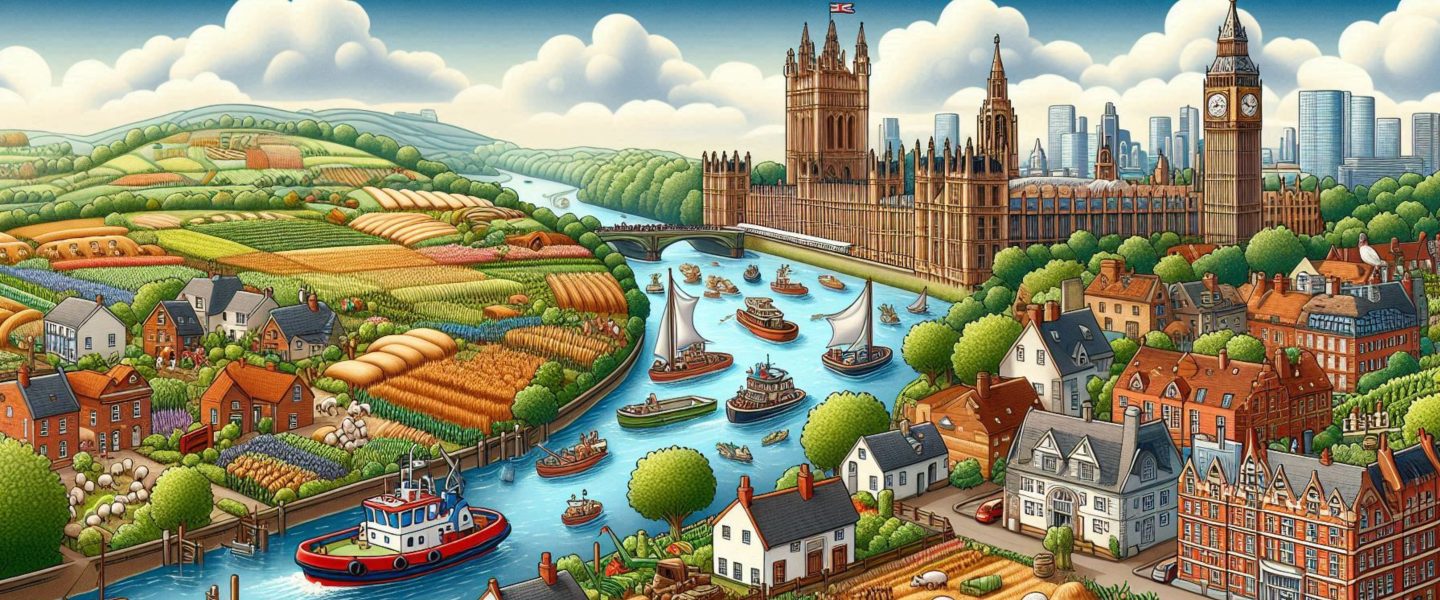
As part of The Grassroots Revolution and the rejection of everything held dear by the leaders of this dying ‘old world’, we MUST embrace a return to the most localised forms of food production and supply chains.
Food production must focus on healthy, basic and essential food items, using the absolute minimum of additional ingredients, so that our basic diets are home-produced, and this system of production is prioritised over everything else, so that the food we need, will always be available to us all in the cheapest and most accessible form.
Regrettably, because UK Agriculture has been deliberately pointed in the wrong direction for a very long time, younger generations of farmers have no working experience of anything like a truly localised food growing-to-production-to-retail system in anything like the way it historically was and will be needed now.
This means that the process of change will take time and that for reasons outside of our control, certain foods may become short.
It is therefore essential that everyone who is able use gardens, allotments, window boxes and whatever form of growing space available to ‘grow your own’. So that there will be sufficient basic and healthy essential foods available, whilst we all get behind our Farmers and develop the resources and cooperatives that will be necessary in every area.
We must do this to ensure that we have Food Security for the UK and achieve the National Self Sufficiency that we would have long since had, if politicians had been doing their job, and the greed and self-interest of the few, hadn’t been allowed to flourish and lead instead.
I have covered the subject of Basic Foods and Home Growing in detail within Levelling Level, the first book in the series leading to The Grassroots Manifesto. To read Levelling Level online or Download a FREE PDF copy, please Click HERE.
Levelling Level discusses the wider issues that we now face, how we got here and begins focusing on many of the things that we and our communities have the power to do.
In Part 3 of The Grassroots Manifesto, a series of Public Policies have been suggested for a new people-centric age. This is one of a number that relate specifically to this issue:
The Grassroots Manifesto | Policy 4 | Food Production, Security & Supply | Home Growing | xviii
Self-sufficiency of people is essential to achieving the aim of the UK becoming self-sufficient in food production and providing the Community with Food Security.
On a voter turnout of 67.3%, this actually means that the government was elected by around 29.3% of the people of this Country – which in this sense is significantly less that one third of the population.
Few will need anyone to walk them through the list of events and changes that we have faced throughout the period of time since. But the reality is that despite one or two By Elections, we are still being governed by the same government that is responsible in no small part for many of the problems that we have today, as well as many that are yet to come.
We may still be over 20 months away from the opportunity to have a say within the same system, and vote for what will only appear to be different – for changes sake.
Many of you who read this blog will have backed one of the three main political parties in the General Election of December 2019. Of those, there will be those who will happily focus upon what are, to many, the deliberately confusing figures and facts that surround how our so-called democracy works, so long as they favour their own ‘tribe’ and political affiliations – and therefore who either is now, or who they next wish to be in power.
Bizarrely, the greatest travesty of all this goes beyond the ridiculousness of a situation where over 70% of us are not being represented by a majority vote.
Election Manifestos are little more than a glossy brochure that invite us, the punter, to back a horse in just one election race that normally runs only once, every 4 – 5 years. If it wins, that horse will then have to win or get placed in race after race amongst other horses wearing the same colours for the duration of the next parliament. These are votes that we have absolutely no say or influence over – and that’s only if enough of the horses with ‘our colours’ won against all the others in the first round too. Everyone else, is usually just left out in the cold…
The way that our ‘democracy’ works isn’t the easiest thing to explain. And regrettably, the confusion that it causes even the politicians, really only helps those with an interest in democracy and power in this Country in maintaining what is basically a complete sham. Those people are the ones we know as ‘the few’.
If we are VERY lucky, the MPs that we have representing us in the Westminster Parliament today, will have grown up and have at least some understanding of the area in which we live. Regrettably, this is not always the case.
The reality is that today, with the majority of us tending to identify as being Conservative, Labour or Liberal, we have all played a part in allowing and fuelling a system to exist where the decision over who represents us in Government, isn’t made by whoever we vote for on Polling Day. It’s made by people who are members of these political parties, with whatever rules they decide upon for selecting the candidates who will then turn up with a Blue, Red or Yellow rosette, when it’s time for us to vote.
At this point, it’s only fair to acknowledge the debate and proposition for change to the electoral system, to one of ‘Proportional Representation’ (PR) – as is used in some of the local level election processes.
The argument has been made that seats to any government being awarded proportionally will be much fairer. Because PR represents the true picture, rather than what we have with the current First Past The Post system – which on this basis of the above, few of us would be able to argue against the idea that the result is massively skewed.
PR would indeed be a great fix for the situation that we are in today, if fixing the mechanics of the electoral system were truly to be the only point.
Yet there are many more issues that are far more important. These not only include the problems with the need for constant compromise that mean none of us are likely to ever see anything happen that we want. Also the fact that even though we only pay lip service to it now, we would never again be voting directly for one named candidate. Also, the fact that no government will ever work properly if politicians aren’t in-touch and putting voters needs first. Finally, and worst of all, that to make sense of the way that PR actually works, the catchment area for each vote we took part in would become much larger than what are todays recognisable Parliamentary Constituencies and would create even greater distance between voters and the already out-of-touch politicians that we vote for.
The reality is that the democratic system that we have does not work democratically. It doesn’t work democratically because it has been played by the self interest of politicians from all sides over decades or an even longer period of time, in which everything has been changed, replaced or manipulated to make the system we have now resemble something like a closed shop.
Indeed, the democracy we all believe we are a part of and take part in by voting to select our public representatives is little more than an elaborate lie.
Furthermore, within the number of ‘public representatives’ that we supposedly elect to take decisions on our behalf, it is only a very small and potentially unique number of those politicians – at the top of their own hierarchies and internal trees – that have any real influence, power or sway.
Our so-called democracy is to all intents and purposes an autocracy. All the evidence anyone will ever need for this will be the disastrous and wholly unnecessary behaviour on the part of this conservative government in response to the Covid Pandemic, and pretty much everything that has happened next.
If none of this had any meaning for the rest of us, it really wouldn’t matter who we have elected to sit and rule over us at the top.
Indeed, one of the reasons why we only experience typically around 66% or approximately two thirds of those who are eligible to vote then turning out at a General Election, is because those that haven’t bothered to vote have become detached or disenfranchised from the system. And in many cases, they really don’t believe it matters whether or not they vote.
The problem, for us all, is that it really does. Or rather, it would do, if there was any meaning to what we could all agree upon being or constituting a genuine majority vote.
We will not achieve a genuine majority vote for a national government or the decisions that it makes, with the system, the politicians, the parties and the way that they are driven and motivated now.
Decision making is too far away from people – and needlessly so – for it to be engaging for non-political people.
The decision-making structure that we have today has not been created because it’s the best way for it to work. It’s been created and maintained as it is, because it’s the most effective way for just a few to make the decisions that affect us all, and above all, for them and those like them, to take and keep control.
***
Although we are experiencing tough and challenging times that may well get much worse before they can get better, the opportunities for change of a kind that will be genuinely beneficial to all have never been as good as they are now, and will become. However, nothing is guaranteed. Everyone needs to play their part as well as working with others who they may not yet even identify with.
Over the past 12 months, I have published 5 books that cover the reasons we are here, why we need to change, how we can change, and what we will need to do to achieve it. The two e-books that relate to what I have written about in the blog above can be found and downloaded from Amazon for Kindle. Here are the links:
Of all the points being missed by the political classes, probably the worst as well as the most troubling is the absence of any understanding or appreciation that life is now too expensive for anyone to pay for, working full time and on the minimum, basic or working wage.
Whilst it may be logical to believe that everyone is hardwired to work at and do whatever they can to earn money when they don’t have enough, the next of those points being missed is that if you cannot do the most basic of jobs and still not pay your own way without help, the rubicon has already been crossed when it comes to ‘helping ones self’.
For many, a lot of help or borrowing is the same thing as receiving just a little.
Why should anyone who doesn’t have enough even if they work a 50 hour week, struggle and destroy their life, if they cannot even then gain the benefit of being able to fully support themselves with the self-respect that it gives?
In a money obsessed society, where the politicians and elites are even more obsessed with what that means for them than most, it sadly stands to reason that government cannot think of any problem and therefore come up with any solution which isn’t itself derived in monetary terms.
On the face of it, focusing on getting people earning – and identifying that this can be achieved through the acquisition of new skills, does indeed sound like a genuinely good way to address a small element of truth that exists when answering the question of how to get more of the low paid back into work.
Yet many of the jobs that need to be filled don’t actually need or require people who are not being treated like the adults they are to have any additional skills beyond common sense, being motivated and to be genuinely happy with who they are.
The problem here is very much the difference between what it is when you are required to live to work, instead of being able to simply work to live.
Politicians will continue coming up with diversionary schemes to help themselves, that just make more and more people feel disillusioned with a life where the system doesn’t legislate to allow anyone who so chooses, just to simply exist. They will continue doing so until they and The System that they are promoting, supporting and facilitating is called out for the life, community, country, planet, values and humanity destroying lie that it all is.
When the lowest wage for a working week can pay for all of the basics in life that any person genuinely needs, and the way that government and governance works is to promote and maintain that standard in all things and all it does, pretty much all of the societal problems that are plaguing life and dividing people will quickly cease to exist.
If you aren’t asking this question right now, you should be. The Bank of England has announced it is working on a Central Bank Digital Coin and it is likely to be in use in just a few years time. But why?
If you use online banking to move money around, pay your bills, transfer money to someone else, or have your wages paid electronically into your bank account, you are already using digital money within each and every part of that transaction.
Under the guise of simplifying life with easy to use technology, just about every part or function of life is now being ripped away and replaced with a machine function of some kind.
If you don’t believe me, look up the new AI bot that a leading search engine is about to launch which will write pretty much anything and everything that you want it to, and then ask yourself the question ‘If I use this, who is actually in control?’
Conspiracy theories abound in these times. But conspiracies sit out on the periphery and distract. They don’t have a profound affect on life within.
And this is the point. Technology to improve quality of life: YES. Technology to control life: NO!
The problem is that those pushing all of this; all of these changes; all of this ‘progress’ are ignoring the No that all of us would consciously give if we were actually asked, and amalgamating it all so that it equates to exactly the same thing.
We are quite literally being tricked into surrendering our freedoms with a series of lies that make us think that we are the winners as we progressively lose.
The only purpose of a single, universal central bank digital coin is control. Nothing will be private. Everything you do with money will be seen. And it won’t stop there. As the Canadian government did with their protesting truckers, if you do or say anything that someone in control doesn’t approve of or doesn’t like, they can simply switch your money supply off. You should think about what that would mean.
The crypto craze has been fun for those who have played the game and won. But it was based on nothing more than belief. And whilst the original idea that launched cryptos like Bitcoin was decentralised finance, the reality was that it was as pretend, fake or created as the FIAT money it sought to replace.
By buying into the myth that we can get rich by taking bets and speculating on money and currencies that simply don’t exist, we have actively played a part in creating our own living lie. A lie that is about to hurt and damage us beyond repair, taking away anything that resembles freedom of choice and freedom to be who we actually are as it does.
The technology is good. The ownership and purpose is rotten to the core. We need to retake control of the way that everything works before we are all inescapably and completely enslaved within a system that works for nobody other than those who control it.
If any of this makes sense, use cash.
If you are a business owner, reject the cash bribes from card companies and banks to refuse to take cash.