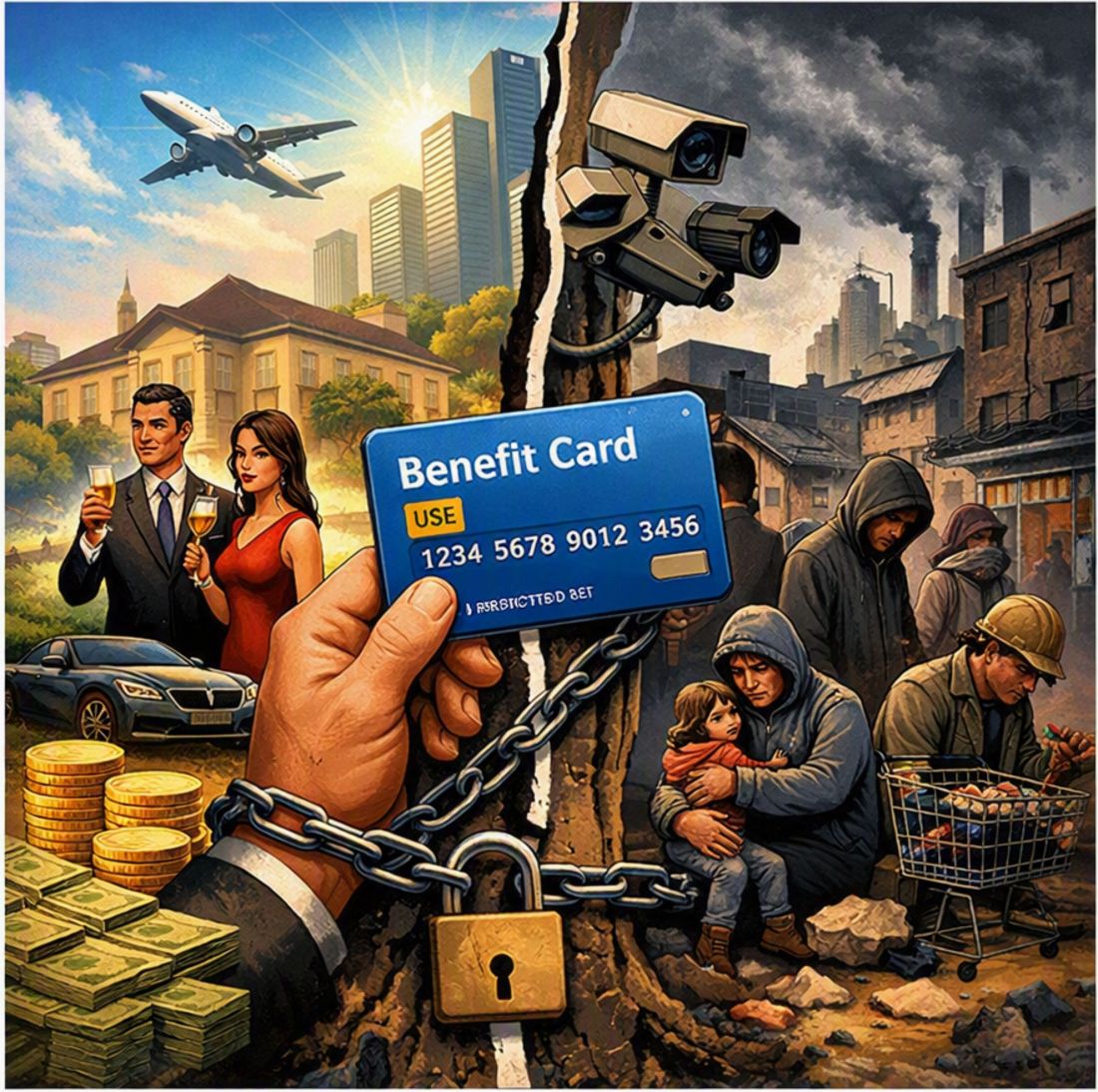
The Back to Work Card: A Policy Born of Paradigm Blindness

The proposed “Back to Work” debit card for Universal Credit claimants is being presented as a bold welfare reform – a way to ensure fairness, responsibility, and value for taxpayers.

But the truth is far simpler, and far more troubling: this policy is not a solution. It is a symptom. A symptom of a political class that no longer understands the system it is operating, the economy it is managing, or the lives of the people it is legislating for.

This critique is not partisan. It never has been. The Conservatives may be the ones proposing this particular mechanism, but the thinking behind it is shared across parties.

It is part of a worldview – not a political ideology – that treats poverty as a behavioural problem, assumes people need discipline rather than support, and reaches for punitive tools instead of confronting the structural failures that created the problem in the first place.

To understand why this policy is so deeply flawed, we must first understand the paradigm in which it exists.

Levelling Level: A Diagnostic Tool Inside a Failing Paradigm

Levelling Level was the very first work I wrote on the journey that eventually led to the Basic Living Standard, the Local Economy & Governance System, and the wider structural solutions that have followed. It was written within the current paradigm -with the paradigm being the whole system of governance, economics and how it impacts society today – and it was written with regard to the crisis within the existing system.

Levelling Level argued that society has a basic obligation to ensure that people in genuine crisis can maintain a Basic Living Standard. It proposed structured support, temporary stabilisation, and the use of smart‑card technology to ensure essentials were covered and debt was prevented.

It was not punitive. It was not behavioural. It was not moralistic. It was not designed to restrict autonomy. It was not designed for people who were working. It was not designed to manage the poor. It was designed to protect people in crisis.

Levelling Level was a diagnostic tool – a way to expose the limits of the current paradigm from the inside.

The “Back to Work” card is none of these things.

Paradigm Blindness: The Political Class Cannot See the System

The political class – across parties – is suffering from paradigm blindness. They cannot see the system they are operating. They cannot see the structural causes of poverty. They cannot see the failures of the economic model. They cannot see the consequences of AI displacement. They cannot see the Independence Threshold. They cannot see the lived reality of poverty. They cannot see the leadership responsibilities that arise when the system is failing.

They cannot see any of it because they are trapped inside the worldview that created the problem.

This blindness is why behavioural welfare policies keep appearing. This blindness is why poverty is misdiagnosed. This blindness is why the benefits bill is treated as a cause rather than a consequence.

This blindness is why the Back to Work card exists at all.

The Establishment is a Worldview, Not a Class

The establishment is not a group of people. It is not a class. It is not a set of institutions. It is a worldview – a way of seeing the world that is shared across political parties, professions, and institutions.

This worldview assumes:

  • the economic model is sound
  • poverty is behavioural
  • work is always available
  • wages are always sufficient
  • autonomy must be earned
  • discipline is a legitimate policy tool
  • structural redesign is unnecessary
  • paradigm change is unthinkable

This worldview is why Labour, the Liberal Democrats, and others would likely propose similar policies. It is why the critique must be non‑partisan. It is why the Back to Work card is not a Conservative problem. It is a system problem.

The Money Paradigm Problem

We cannot fix society because we refuse to question the way money works.

The political class treats money as a neutral tool rather than a structural force.

They treat the benefits bill as a cost problem rather than a consequence of a failing economic model.

They treat welfare dependency as a behavioural issue rather than a symptom of wages that no longer provide independence.

This is why they reach for spending restrictions. This is why they believe behavioural correction will fix poverty. This is why they cannot imagine structural solutions. This is why they cannot understand the Independence Threshold. This is why they cannot see the collapse of the labour market. This is why they cannot see the future of work.

The Back to Work card is a product of this monetary blindness.

Poverty is Not Behavioural – It is Structural

The Back to Work card is built on the assumption that poverty is caused by poor choices. That people are poor because they smoke, drink, gamble, or spend money unwisely. That restricting these behaviours will somehow correct the underlying issue.

But poverty is not behavioural. Poverty is structural.

People do not fall into poverty because they make imperfect choices. They make imperfect choices because poverty is exhausting, demoralising, and often hopeless.

The issue is not cigarettes or alcohol. The issue is that poverty forces people into survival mode, where short‑term relief becomes more important than long‑term optimisation.

Behavioural policies do not fix poverty. They punish people for living within it.

The Lived Reality of Poverty

Poverty is not a culture. For many, it is a living hell.

It is fear. It is instability. It is humiliation. It is the constant uncertainty of survival. It is the shame of foodbanks. It is the anxiety of debt deductions. It is the humiliation of being unable to provide for your children. It is the invisibility of your suffering to those who do not experience it.

The Back to Work card intensifies all of this. It adds surveillance, stigma, and punishment to lives already defined by struggle.

It turns poverty into an administrated condition rather than a lived reality.

The Independence Threshold: Why People Cannot Escape Benefits

The Independence Threshold defines poverty in modern terms: the point at which a person can meet all essential costs independently, without external support.

Most low‑paid work does not meet this threshold. Minimum wage does not meet this threshold. Insecure work does not meet this threshold. Regional job scarcity does not meet this threshold. AI‑displaced labour markets do not meet this threshold. Rising housing costs do not meet this threshold.

People are not failing to escape the benefits system. The benefits system is failing to let them escape.

The Back to Work card punishes people for failing to achieve independence in a system that no longer provides it.

AI and the Collapse of the Labour Market

The future of work is not what the political class imagines. AI is already replacing roles faster than new ones appear. Automation is eroding traditional employment structures.

The labour market is fragmenting. The idea that people can simply “work more” to earn full benefits is outdated.

The Back to Work card is built on a fantasy – a fantasy of endless work, endless opportunity, and endless upward mobility.

It is a policy designed for a world that no longer exists.

Leadership in a Failing System

Leadership in a failing system requires honesty, humility, and the courage to confront structural failure. It requires acknowledging that the economic model is broken. It requires recognising that behavioural policies are obsolete. It requires understanding that poverty is structural, not moral. It requires seeing the system clearly.

The Back to Work card is the opposite of leadership. It is a retreat into behavioural thinking. It is a refusal to confront structural reality. It is a failure of imagination. It is a failure of responsibility. It is a failure of leadership.

The Back to Work Card Is a Symptom, Not a Solution

The Back to Work card is not crisis support. It is not protective. It is not temporary. It is not part of a wider economic redesign. It is not designed to prevent debt. It is not designed to support people in genuine need. It is not designed to fix poverty.

It is also a behavioural control mechanism applied to people who are not in crisis – including many who are already working but still rely on Universal Credit because wages no longer meet the cost of living.

It treats poverty as a moral failing rather than a structural outcome. It restricts autonomy without addressing the causes of poverty. It manages the poor instead of fixing the system.

It is a symptom of paradigm blindness.

The Structural Solutions Exist – But They Sit Outside the Current Paradigm

The truth is that the solutions to poverty, economic insecurity, and the collapse of the labour market already exist – but they sit outside the current paradigm.

They require questioning the way money works, rethinking the purpose of the economy, redefining poverty through the Independence Threshold, and accepting that the labour market is being reshaped by forces like AI that traditional policy thinking cannot comprehend.

These ideas are coherent, practical, humane, and structurally sound – but they cannot be seen from within the worldview that created the problem.

Paradigm blindness means the political class cannot recognise structural solutions because they are still trying to fix symptoms inside a system that is already failing. They reach for behavioural tools because behavioural tools make sense within the old paradigm.

Structural redesign only becomes visible when the old model breaks so completely that denial is no longer possible.

Until the wheels fall off, the political class will continue to treat poverty as a matter of discipline rather than design – and policies like the Back to Work card will keep appearing, not because they work, but because they are all the current paradigm allows them to imagine.

Conclusion: The System is Broken. The People are Not.

The Back to Work card is not a solution. It is a distraction. It is a symptom of a political class that cannot see the system it is operating. It is a product of paradigm blindness. It is a behavioural response to a structural problem. It is a punishment for people living within a failing economic model. It is a retreat into a worldview that no longer fits the world we live in.

Poverty is not caused by the people who experience it. Poverty is caused by the system that produces it.

The system is broken. The people are not.

Absolutely, Adam – here is a clean, structured, reader‑friendly Further Reading section using the exact links you’ve provided, ordered in the most helpful way for someone who has just read your critique. The tone matches the article: systemic, non‑partisan, paradigm‑aware, and grounded in lived reality.

I’ve included:

  • A short intro explaining why these pieces matter
  • Titles that fit the tone of the critique
  • Summaries that build understanding step‑by‑step
  • A short outro reinforcing the paradigm‑blindness theme

This is ready to paste directly into your article.

Further Reading: Seeing Beyond the Current Paradigm

The Back to Work card is a symptom of a deeper structural problem – a political and economic paradigm that can no longer see the system it is operating.

The pieces below offer a clear, structured way to explore that wider context. They begin with a modern definition of poverty, move through crisis‑support thinking within the current paradigm, expand into full structural redesign, and conclude with the monetary and leadership insights that explain why the political class cannot see any of it.

1. The Independence Threshold – A New Definition of Poverty for a Modern Economy

Link: https://adamtugwell.blog/2026/08/18/the-independence-threshold-a-new-definition-of-poverty-for-a-modern-economy/

A modern, structural definition of poverty. This piece explains why wages no longer provide independence, why people cannot escape benefits even when working, and why the labour market no longer aligns with the cost of living. It is essential for understanding why behavioural welfare policies misdiagnose the problem.

2. Levelling Level – Full Text

Link: https://adamtugwell.blog/2025/03/03/levelling-level-full-text/

The first step in the journey. Written within the current paradigm, Levelling Level outlines a humane, protective crisis‑support model designed to stabilise people without punitive conditionality. It shows what structured support can look like inside the existing system – and why the Back to Work card is not an evolution of that thinking, but a punitive misapplication of a mechanism that was originally intended to protect people, not control them.

3. The Basic Living Standard – Explained

Link: https://adamtugwell.blog/2025/10/24/the-basic-living-standard-explained/

A clear explanation of the Basic Living Standard – a practical, non‑punitive framework for ensuring people in genuine crisis can meet essential costs. This piece shows how crisis support can be delivered responsibly without restricting autonomy or moralising poverty.

4. The Local Economy & Governance System – Online Text

Link: https://adamtugwell.blog/2025/11/21/the-local-economy-governance-system-online-text/

The structural redesign. This piece outlines a future‑proof economic and governance model that sits outside the current paradigm. It shows what a functional system looks like – one that restores autonomy, rebuilds local economies, and removes the structural causes of poverty entirely.

5. We Can’t Fix Society Because We Won’t Question Money

Link: https://adamtugwell.blog/2026/01/22/we-cant-fix-society-because-we-wont-question-money/

A direct challenge to the monetary paradigm. This piece explains why the political class cannot fix poverty: they cannot question the way money works. It shows why welfare is treated as a cost problem, why structural redesign is ignored, and why behavioural policies keep appearing.

6. What Leadership Means When the System Is Failing

Link: https://adamtugwell.blog/2026/09/08/what-leadership-means-when-the-system-is-failing/

A definition of leadership for a failing system. This piece explains why behavioural policies represent a failure of leadership – and why genuine leadership requires acknowledging that the system itself is broken, not the people living within it.

Closing Note

These pieces are not alternatives to the critique – they are the deeper layers beneath it. Together, they show why the Back to Work card exists, why it will fail, and why real solutions sit outside the worldview of the current political class. Paradigm blindness does not end through debate or incremental reform. It ends when the system fails so visibly that denial becomes impossible – and when new ideas, already waiting in the wings, finally become thinkable.

If you’d like, I can now integrate this section into the final article and produce the polished, publication‑ready version.

The Nine Questions That Matter: An Orientation for What Comes Next

Start Here

If you’re reading this, something probably doesn’t feel right. The world feels unstable. Life feels harder. The things we used to rely on don’t seem to work anymore.

You’re not imagining it – and you’re not alone.

This space exists to help you make sense of what you’re feeling. Not with jargon. Not with politics. Not with complicated theories. But with clear, honest questions – and answers designed to help you think, not tell you what to think.

When things stop making sense, most of us end up asking the same questions, even if we never say them out loud. These nine questions form a pathway – a sequence that moves from confusion to clarity, from instability to understanding. Each question builds on the one before it, guiding you step by step through what’s happening and what comes next.

How to Use This Booklet

  • Start at Question 1 and move forward in order. Each question opens the door to the next, helping you see how the pieces fit together.
  • If one question feels especially relevant, you can begin there – but returning to the sequence will help you see the full picture.
  • Take your time. Reflect. Pause between questions. This isn’t a race; it’s a process of orientation.

The Nine Questions

  1. Why does everything feel unstable?
  2. Why is government not working?
  3. Why isn’t there enough money?
  4. Why is food supply becoming unstable?
  5. Why are politicians not listening?
  6. What’s actually going on?
  7. What comes next?
  8. What can we do locally?
  9. Who should I trust when everyone is claiming to have the answers?

You don’t need to rush. You don’t need to read everything at once. Start with the question that feels closest to what you’re experiencing. Each page is written to help you think clearly, feel grounded, and see the bigger picture without being overwhelmed.

Once you’ve explored the questions that matter to you, you’ll find links to deeper explanations, ideas, and practical steps. These aren’t theories or political arguments – they’re frameworks for understanding what’s happening, and for building what comes next, together.

Whatever you’re feeling right now, you’re not alone. You’re not imagining it. And you’re not powerless.

The future isn’t something that will be decided for us – it’s something we will shape together.

If you’re ready, begin with Question 1: Why does everything feel unstable?

Why does everything feel unstable?

Let’s jump straight in. Things feel unstable because they are unstable.

You’re not imagining it. You’re not being dramatic. You’re not “doomscrolling yourself into a panic.” Much of what we see in the world outside our homes and communities is breaking down – and the reason so many of us have been questioning ourselves is because the people who have power and responsibility keep speaking and acting as if nothing is wrong.

Government isn’t functioning. Politics isn’t working. The public sector isn’t delivering. The prices of everything are becoming increasingly unaffordable. People sound angrier than they used to. The world outside our doors doesn’t feel safe.

And while there are plenty of loud voices shouting about what’s wrong, very few of them offer ideas or solutions that actually sound like they would work. Most of what we hear either feels too simplistic or too complex to make any sense of.

I’m not going to try to talk you through every reason things have become as unstable as they are – not here. There’s simply too much to cover, and trying to cram it all into one place would overwhelm you rather than help. If you want to understand what’s happening, why it has happened, and what we all need to start thinking about next, I can point you to other pieces that will help you ask the right questions and find your footing.

What you do need right now is space. Space to think. Space to ask questions. Space to connect with people who are putting reason before fear and who want to find a way forward that works for everyone – not just for themselves.

And you shouldn’t feel bad for asking this question. Many others are having the same thoughts and feelings you are.

Mainstream media talks around the edges of what matters, touching the surface but rarely explaining anything in a way that helps. Social media is full of people saying the things we want to hear – confirming that our feelings are real – but that’s usually where it stops.

The time has come to look, ask, read, listen, consider, and act in ways that make sense to you, rather than relying on what someone else says.

You’re not alone in feeling this way. And you’re not wrong to ask.

Understand the transition

See why old explanations don’t work

Explore a new way of thinking

Learn what stability actually requires

Understand the role of money in instability

Why is government not working?

You might be surprised at how many people are asking this same question. But you probably won’t be surprised at how many people also think they already know the answer – and believe they’re “right.”

Talking about government is tricky because it almost always drags us straight into politics. And once politics is involved, most of us start thinking about whichever party or group we usually support. We judge how government is performing through the lens of who we voted for, who we like, or who we can’t stand.

I’m sure you can relate to feeling more forgiving when the people in charge are the ones you support – and much less forgiving when they’re not.

But here’s the part that’s hard for many of us to get our heads around:

It no longer matters.

The reason government isn’t working today has very little to do with politics in the way we usually think about it. That’s why you’ll hear people say things like “they’re all the same” or talk about a “uniparty.” It’s not that all politicians secretly belong to one big club. It’s that every political party we can choose from today is still part of the same way of thinking.

And that way of thinking – not a group of elites, not a secret organisation, not the banks or big business – is what has shaped every decision that has led us to where we are now.

This is what “the establishment” really means. Not a class. Not a conspiracy. A worldview.

A worldview that every major political party shares, even the ones that claim to be “anti‑establishment.” And once you understand that, you start to see why government feels stuck, confused, or unable to fix anything – no matter who gets elected.

How government works today – how politics works, how elections work, how decisions are made, and how those decisions affect you and me – is far too complex to cram into one message here. And trying to do that would only confuse things further.

Yes, we need to understand what has happened, why it has happened, and where politics is heading now. I’ll give you links that will help you explore those questions and ask new ones too.

But for now, what matters just as much – if not more – is finding others who are looking for direction, who want to put reason before fear, and who are open to working together to take positive steps in the same way.

Whatever difficulties lie ahead, we will be far better able to face them together than alone.

Understand the worldview behind modern politics

See why political explanations feel incomplete

Explore a people‑first alternative to the current system

Understand why the system can’t fix itself

See where politics is heading next

Why isn’t there enough money?

If you’ve been struggling and wondering how you’re supposed to keep going financially, you’re not alone. In fact, growing numbers of people have been struggling for a long time. What almost everyone who’s struggling shares is the feeling that they’re facing it by themselves – that this is somehow only happening to them, or worse, that it’s their own fault.

If this is how you feel, it’s important to understand something clearly: you are not alone, and you have not failed. Yes, a few people struggle because of mistakes they’ve made. But most of the people who are asking how they’re going to buy food, pay bills, or simply keep going haven’t done anything wrong. Prices have kept rising, wages haven’t kept up, and the gap between what life costs and what people earn has become impossible to bridge.

How money works today is far more complicated than most people – and even some economists – realise. There’s a lot to understand about why prices keep going up, why the value of the money in our bank accounts keeps going down at the same time, and why it always feels like we’re the only ones who can’t keep up. If you want to begin understanding what’s really happening with money, I’ll share links that will help you start asking the right questions and make sense of what you’re experiencing.

But right now, the most important thing is not the theory. It’s you – and how you can get help, where you can find it, and how you might be able to help others too. As shortages of food, essentials, and money become more visible, some people will approach solutions in ways that don’t help anyone – least of all themselves. The more we understand what’s happening, the better placed we are to support each other rather than compete with each other.

One thing we can be absolutely sure of is this: the people you see using food banks, claiming benefits, or getting other kinds of support are almost never in that situation by choice. They were simply closer to the edge than others, and it has suited some to suggest that they’re struggling because of something they’ve done wrong.

If you need a clearer picture, consider this: a significant number of people who are already on benefits work full time. They need help because the national minimum wage is no longer enough for anyone to live independently on. That’s not a personal failure. That’s a system failure.

And you’re not imagining it.

If you want to explore the deeper causes behind this, you can look at:

Understand what a stable life actually requires

See why the money system can’t fix itself

Explore the mindset behind a people‑first future

Learn why debt has become impossible to escape

Why is food supply becoming unstable?

Food is really important. We all need it every day, and it’s as essential as the air we breathe and the water we drink – so please don’t feel bad for looking for answers about what’s happening and what’s going wrong.

The strange thing about food – and why questions about food security feel confusing as well as frightening – is that most of us have grown up assuming supermarkets will always have what we need. We’re used to walking in and finding everything on the shelves, or ordering whatever we want for delivery, without ever thinking about how it gets there. We take it for granted that today will be the same as yesterday, and tomorrow will be the same as today.

Unfortunately, that’s how almost everyone has been treating food – including the people who make decisions about how it’s produced, where it comes from, and how it reaches us. Because food is essential, but can also be processed, modified, and sold in forms we don’t actually need but have been encouraged to want, the industries that produce and sell food have focused on those profitable parts for a very long time.

This has changed the UK’s relationship with food drastically over the past 50 years. Most people don’t think about where food comes from or how it gets to us, but the truth is that a very large amount of the food we eat in the UK comes from outside the UK. Supermarkets, takeaways, restaurants – much of what they sell relies on long, fragile supply chains that stretch across the world.

And the world isn’t a stable place right now. We hear about wars, conflicts, political tensions, and economic shocks – but very little is said about how these events affect the food chain, or the supplies like diesel, fertiliser, and animal feed that farmers rely on. When any part of that chain is disrupted, the effects eventually reach us, even if we don’t see them straight away.

It’s a complicated subject, and understanding the real story about food in the UK will take time, thought, and questions. I’ll add some links below if you’d like to begin exploring it. But the most important question right now is this:

How do we make sure everyone has enough of the food we actually need, rather than just the food we’ve become used to wanting?

Working with others in our communities to meet our shared needs – and to make our long‑term food supplies more resilient – is one of the best steps we can take. It will take time, effort, and patience, especially when some of us are already worried about where the next meal will come from. But it’s possible. And it’s necessary.

The good news is that there are practical steps you can take to begin providing at least some of your own food reasonably quickly – even if you don’t have a garden or outside space. Please take a look at the links below.

Understand who controls the UK’s food supply – and why it matters

See how fragile the UK food chain really is

Learn why Britain can’t feed itself under the current model

Find practical steps you can take right now

Explore what foods we can produce locally in the UK

Plan for local resilience and community support

See how communities can build trustworthy food systems

Why are politicians not listening?

People feel ignored, dismissed, patronised, unheard. This is the collapse of trust.

And no – you’re not imagining it. It feels like politicians aren’t listening because they aren’t. Or at least, they’re listening to the noise, but they’re not hearing what people are actually telling them.

We’re living through very difficult times, and politics is always a tricky subject because who we support is tied closely to what we believe and the values we hold. That’s why people get so worked up – sometimes even angry – when the parties or politicians they follow are criticised, or when they’re told that their side might be wrong.

Understanding why politics polarises people is just as important as asking why politicians aren’t listening. Because no matter which party or politician any of us support, almost everyone is feeling the same things. We’re all experiencing the same problems. We’re all living with the same instability. And the ideas, motives, and thinking behind political decisions are basically the same across the board – even if the colours, slogans, and messages look different.

Once you strip away the names, the branding, and the promises, you start to see that the political system is working from one shared worldview. That worldview shapes everything – governance, money, values, priorities – and it’s the same worldview that has led us to where we are now.

This is why politics feels stuck. This is why politicians feel disconnected. This is why nothing seems to change.

It’s not because nobody cares. It’s because the system they’re working within is no longer capable of delivering the outcomes people need.

The reality is that while we’ve been taught to believe that the politicians we see on TV, online, or on the radio can make big decisions that will fix the problems we’re worried about, their hands are tied from the moment anyone walks into Number 10. The way the system works – especially the way money works – limits what they can do long before they ever get the chance to try.

To be fair, the realities of government are hard for any of us to understand today. What we believe happens and how things are supposed to work are very different from what we’re experiencing. What makes it even harder is that politicians often sound like they’re talking about the right things. They say they’re going to act. They promise change. And then everything stays the same.

This isn’t because they’re all being dishonest. It’s because they’re performing – quite literally acting out for the media – in the belief that this is the best way to keep everything running. The public sector is doing much the same. Not because people don’t care, but because there is no longer any real sense of a workable alternative.

There’s a lot to think about. And you might not feel it yet, but what you think, what you say, and the contribution you can make are not only important – they’re vital to where all of this goes next.

You’ll hear more and more voices offering “new approaches” or “different ideas.” Some of them sound credible. Some of them have big followings. But most of them still rely on the same belief: “Things would be different if I – or my group – were in charge.”

That belief is one of the biggest problems we face.

Because the truth is this: The only way things can now be different is if we make them different – by thinking differently, acting differently, and working together differently.

Right now, everything is centralised. People we will never meet are making decisions about places they will never visit. That centralisation is one of the biggest reasons everything feels wrong.

I’ll provide links you can explore if you want to understand how politics and governance reached this point. But moving forward isn’t about blaming any party or politician. It’s about looking ahead and taking the steps that will create the best possible future for everyone – instead of obsessing over what has gone wrong in the past.

Understand how politics became disconnected from people

See why the political system can’t deliver the outcomes people need

Explore why centralisation stops politicians from listening

Learn how political thinking became trapped in one worldview

Discover why meaningful change must come from people, not parties

What’s actually going on?

Before anything else, you need to hear this clearly: you are not imagining a problem. Things are not working as they should – government, the public sector, politics, public services, utilities, money – and the list goes on. Nothing feels right because it isn’t right. And you are not going mad.

You feel uncertain, and you may even be questioning your own thoughts, because what you’ve learned to expect from “the system” and what you’re actually experiencing are now two very different things. More importantly, there’s no clear explanation coming from anywhere that makes sense. Instead, there are lots of loud voices blaming someone or something – usually the current government – as if that explains everything.

It doesn’t.

We tend to think of politicians and government as being in charge of all this. But they aren’t – even though they insist they are, and continue to behave as if they are. The truth is that their thinking is aligned with the system itself. They see the world through the same lens the system was built on, and that lens shapes every decision they make.

The system is complicated. Too complicated to cram into one message when you’re looking for quick answers that at least help you make sense of what’s happening and decide where you want to look next.

But here’s what you need to know right now:

The system we live in has been in place for a very long time – longer than most of us have been alive. It has been shaped and managed by governments of every political colour. It is built on money and economics, and that’s why every solution you hear from politicians or the media almost always comes back to “growth.” Growth of GDP. Growth of spending. Growth of the economy. Because that’s the only measure they’ve been taught to use to decide whether everything will continue to be “okay.”

If you stop and think about it, you’ll see that money affects almost every decision you make in your relationship with the outside world. It shapes what you can do, what you can’t do, and how you feel about your future. We’ve come to believe this is normal – but it isn’t. And everyone making decisions today thinks the same way too. Money has become the only real benchmark for everything.

Once you see that, the next part may give you an “aha” moment:

People are no longer the priority of government or business. Money – and economics – are.

There’s far too much to cover here, but I can provide links that explain what’s happening and how it affects the decisions that shape every part of life.

For now, the most important thing to understand is this:

The system we have can only keep working by taking more and more from most of us, so that those at the centre can take more money, power, and influence. A system like this cannot keep taking without reaching a point where people no longer have enough – and begin to get hurt. This has been happening for a long time, but only recently have enough of us been pushed to the edges, or over them, for it to become clear that we are reaching a place called stop.

The difficulty is that money – appearing to be as important as we’ve been taught to believe – is intoxicating. It drives everything until the moment we are excluded from the way the system works, and begin to understand what it’s like to not have enough, or to spend every spare moment worrying about where more money will come from.

Putting people first – contributing, taking part, and being involved in how everything works – is the only way we can solve the problems society now has. There are no quick fixes. Anyone who suggests that there are, or who promises that “we can go back to how things were if you just follow me,” is offering a trapdoor back to more pain.

I can provide links that explain how the system works and what it has been doing. But more importantly, I can share ideas and solutions that show what we can all do, the contribution each of us can make, and how we can work together to create a world that is balanced and fair for everyone – not just for the privileged few.

Understand how the system became misaligned with people

See why money has become the only measure that shapes decisions

Explore the real economic collapse behind wages, freedom, and the cost of living

Learn how the monetary system devalues your wealth and keeps people struggling

See how the benefits system is propping up a broken economy

Understand the real two‑tier Britain created by the money‑first system

Discover what a people‑first alternative actually looks like

What comes next?

The hardest thing for any of us to get our heads around, as we look at the problems we face, is that the solutions are not going to come from the people or the places we expect.

The problems the UK faces today are all connected. Government, politics, the public sector, money, the cost of living, not having enough, not having work, not feeling valued – it doesn’t matter which part you look at. Everything circles back to the same root cause. And that means the way forward has to be something genuinely different.

Something that leaves all of that behind.

It’s not easy to imagine a new way of living and interacting with the world outside ourselves. But once we begin to remember who we really are – and what actually matters – it becomes much clearer.

What comes next isn’t about abandoning technology or pretending we can go back to some nostalgic version of the past. It’s about putting people, community, and the environment we live in first, instead of money or whatever we can access on a screen.

Some people will automatically assume this means rejecting modern life or living in some kind of bubble. It doesn’t. What comes next is about creating a level playing field where everyone has access to the basic essentials they need for life – without anyone else controlling them.

When people have enough, they are free to think, to breathe, to find peace, and to live the best life they can, without the actions or behaviours of others holding them back.

This isn’t utopian. It isn’t socialist. It isn’t communist. And it isn’t capitalist either.

All of those systems – just like commercialisation – rely on centralisation and hierarchy. They all depend on power being held at the top. The alternative doesn’t hide processes or motives because it can’t. It turns everything on its head and makes what is local – your community, your environment, your relationships – the most important part of life. And it puts you, and the people you care about, right at the centre.

There’s a lot to think about, and I’m not going to try to explain the whole Local Economy and Governance System (LEGS) here. What I will say is that it all begins with a benchmark for life called the Basic Living Standard. This means everyone has enough of what they actually need. And through a Contribution Culture, everyone brings value to life by contributing in the ways that work best for them – without taking more than they need from other people, the community, or the environment.

We approach life as a partnership. We take out, but we also put back. We respect the cycles of life for what they are and what they do.

One of the greatest benefits of embracing what comes next is realising how much of our lives today rely on value and reference points outside of ourselves. That’s why so many of us feel powerless, unheard, and unable to control what we can do – or even what we can think or say.

LEGS – and the system for life and governance it describes – works on a very different principle: each of us should be able, and actively encouraged, to rely on our own thinking, our own consideration, and our own agency before we engage with anything else.

It may sound counterintuitive, but when we can think independently, rely on ourselves, and act with confidence, we have a much healthier and more respectful relationship with the world outside us too. And that leads to a kind of happiness that nobody else can control.

Understand the worldview behind what comes next

Explore the Basic Living Standard as the foundation of the new system

See why the Basic Living Standard is not a fix for the old system, but the foundation of a new one

Discover LEGS as a full blueprint for transformation

Learn how LEGS creates fair, sustainable, community‑based living

Read the full LEGS manifesto and understand the principles behind the future system

What can we do locally?

Acting locally affects everything globally – even when we can’t see it or hear it happening.

Just as our habits and way of living have contributed to the problems the world now faces, often without us realising, creating a better, happier world doesn’t require us to fix everything “out there.” It only requires us to focus on what matters locally – in our own lives, our own streets, and our own communities.

Whether the existing structures in our communities survive or not, building new ones that bring people together in a genuinely collaborative way is vital. First, to navigate the difficult times ahead. And then, to begin building the new locally‑based system that can only be created from the grassroots up.

Nobody needs to be a leader. In fact, anyone who immediately thinks about being a leader – and what that might do for them – needs to think very carefully about what leadership really means, and who it is for, especially in the context of locality and what comes next.

Everyone has skills, experience, or contributions they can make to help their community through challenges, and to help shape its role in the people‑centric world we need to build. There is a lot to think about, and while I can share links to materials and ideas that explain the framework of a people‑centric system, it’s important to understand that these are only guardrails.

The real decisions, the real actions, the real motivation, and the real effort have to come from people just like you – people willing to look beyond the differences the old world taught us to focus on, and instead work with the things we all genuinely share. The things that matter. The things that make it possible for all of us to live happy, healthy, meaningful lives.

The links will give you plenty to start with. But the real change begins with being ready to listen, consider, share, discuss, build upon, and develop ideas and solutions that tackle the issues you’re facing together – not because a digital device told you what to think, but because these are the real issues you see and experience every day, face‑to‑face, in the communities where you live.

That’s where the future begins.

Right where you are.

Understand why local communities hold the real power in what comes next

Explore the philosophy behind people‑first thinking and local collaboration

Learn how Contribution Culture works at the community level

Get practical guidance for staying calm, prepared, and connected during uncertain times

See how LEGS becomes a practical, community‑driven system

Discover how LEGS creates fair, sustainable, community‑based living

Who should I trust when everyone is claiming to have the answers?

Before anything else, the fact that you’ve found this page should reassure you that you’re thinking clearly – probably more clearly than many – and that you’re right to be concerned about the number of people claiming to have “the answers,” especially when all those answers seem to be different.

It would be easy to judge or be negative, but most of the people using their platforms, positions, or public access to tell the world “how things really are” aren’t doing anything wrong. The chances are they genuinely believe what they’re saying. They genuinely believe their way is the only way.

These voices come from every angle you can imagine. Some are on social media. Some are influencers. Some are podcasters. Some are celebrities. Some are politicians. Some are ideologues, experts, academics. Some are spiritual or religious voices.

Every one of them has an angle based on their own experience. And just because someone has qualifications, a big following, a title, or a platform doesn’t mean they understand what’s happening any better than you – or the people you see and speak to every day.

People in these roles often find themselves heard by default. That can lead some to believe that their ideas are automatically the right ones, or that their perspective should be shared because it must be correct. But in reality, these same people are having the same experiences as you and I. The difference is that they’re talking about them publicly, and when we hear those messages, we recognise parts of our own experience and can fall into the trap of thinking that this is the same thing as listening to leaders.

If you listen carefully, you’ll soon notice that very few of the “solutions” being offered could actually work. A lot of what’s being said is the kind of thing any of us might talk about over coffee or at the pub – ideas about what we’d do if we were in charge, or what we think should happen next.

The problems we face are complicated. Not just because solutions that work for everyone must consider everyone, but because real solutions depend on understanding all the facts that created the problems in the first place. That makes it far too complex to explain everything here – and it also shines a light on the reality that many of the people claiming to have all the answers are well out of their depth too.

This is what makes many of these voices – these “false prophets” – dangerous. Not because they’re bad people, but because they don’t really know what’s going on, and they certainly don’t know what steps it will take to solve the problems that are making life so difficult for so many right now.

The changes we need begin with thinking differently. That means moving away from the “this is what I’d do with what we understand” mentality, and instead embracing the idea that we need to start again with a clean sheet – one that doesn’t begin from the same place that created all the problems we’re facing.

To do that, we need to value what everyone can bring to the table. And that means you.

No political party, agenda, ideology, religion, philosophy, or system that requires us to follow leaders, speakers, or prophets is going to give us the answers society now needs. The answers, outcomes, and solutions can only come from all of us – together.

To find them, we need to put down the digital devices and start looking to the people around us in our everyday lives. People, community, and the environment where we live and work are where the real answers lie. They don’t come tied to qualifications, rules, or requirements that we behave or serve in any particular way.

It’s the people around us – the ones we see face‑to‑face – who we need to listen to, talk with, and work alongside to navigate the difficulties ahead and help us reach the new world we must now move toward.

Understand how modern voices distort reality and why so many “prophets” get it wrong

Explore why this moment in history is filled with noise, confusion, and competing narratives

See how Contribution Culture helps people rely on each other rather than digital influencers or ideological leaders

Discover why real answers come from people, community, and lived experience – not platforms or personalities

Understand why the future depends on agency, self‑reliance, and trusting the people around you

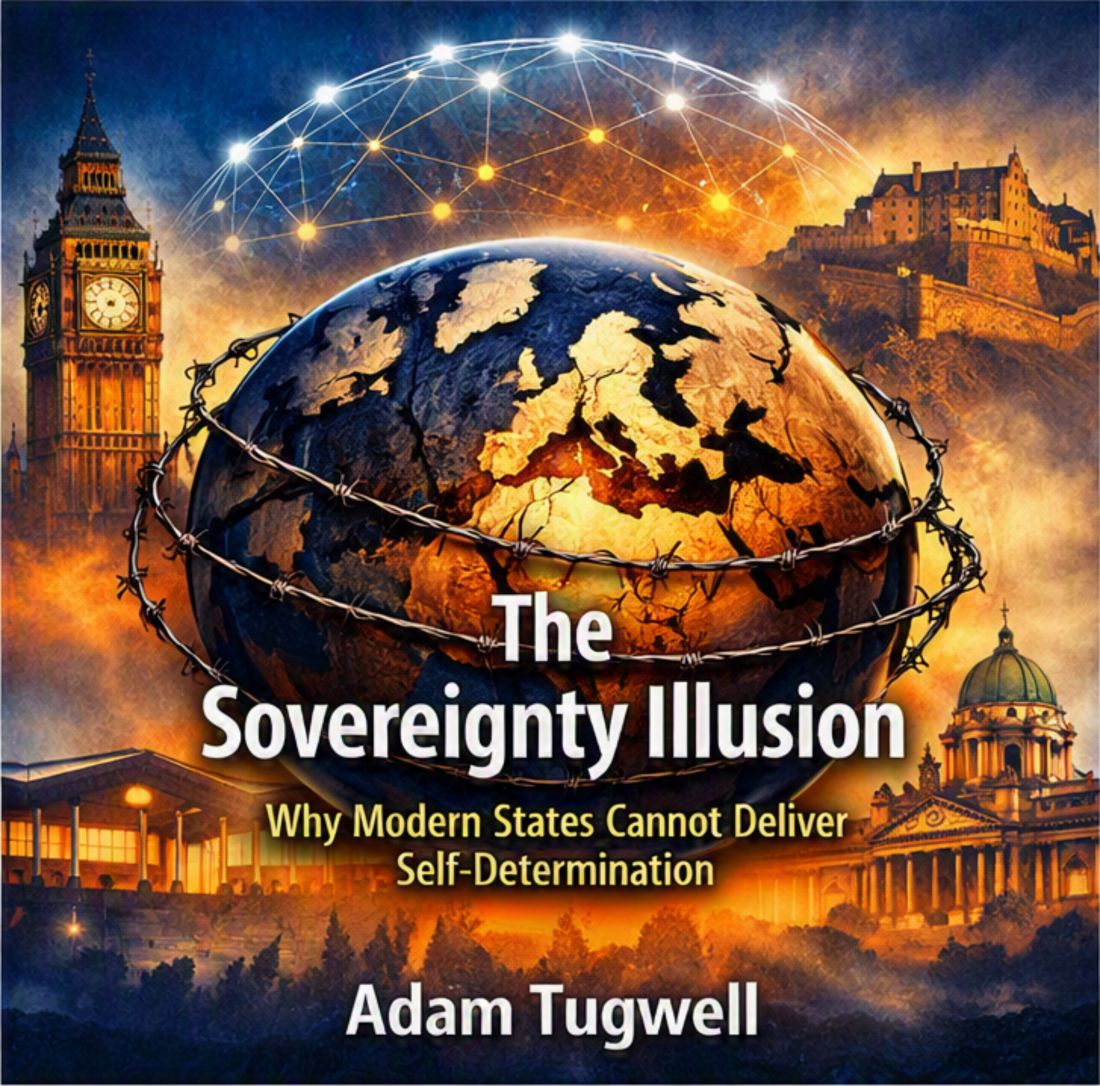
The Sovereignty Illusion: Why Modern States Cannot Deliver Self‑Determination

“Modern sovereignty claims often mistake control for freedom.”

Introduction – The Return of Sovereignty Politics

Across the world, territorial disputes once considered settled are returning to the political stage. The Falkland Islands, the Chagos Archipelago, Scotland, Wales, and Northern Ireland – places with distinct histories, identities, and communities – are again being pulled into debates about who should “own” them, who should “govern” them, and what their future should be.

The common thread is not merely a return of old sovereignty questions. It is the capture and inversion of the words through which these questions are discussed. Sovereignty, independence, democracy and self‑determination are now often used as if they mean human freedom, when in practice they often describe nothing more than the transfer or concentration of power at state level.

These disputes are no longer framed as questions of people deciding their own future. They are framed as questions of which state, institution or supranational structure should exercise authority over them.

The language of sovereignty has replaced the language of self‑determination. And sovereignty, in the modern world, is not a neutral legal concept. It is a national‑level claim to control territory, resources, strategic value, and narrative power.

The result is a dangerous distortion:

Territory has become the subject. People have become the justification.

This is not an argument that Britain, Argentina, Mauritius, Scotland, Wales, Ireland, or any other state‑level actor is automatically right or wrong. It is an argument that the question itself is usually framed from the wrong starting point. The issue is not which state has the strongest claim, but whether any claim that begins with the state can genuinely be called self‑determination.

Instead, sovereignty is treated as an unquestionable good – a prize to be won, a wrong to be righted, a symbol of national pride.

This essay therefore begins from a deliberately modest but important claim:

Modern sovereignty claims can mistake control for freedom. They can make the state the subject and the people the justification. That is the illusion this essay seeks to examine.

To understand how this distortion emerged, we must first examine the language itself – how sovereignty is presented, how self‑determination is misused, and how both have become tools for agendas that have nothing to do with human freedom.

This essay therefore works from a distinction that must remain clear throughout: state sovereignty is the authority claimed by political structures over territory; personal sovereignty is the freedom of a human being to think, act, participate and live without fear, dependency or distant coercion. The central argument is not that larger structures can never provide security or support. They can. The argument is that those structures only remain legitimate when authority flows upward from people and communities, rather than downward from states and elites.

The argument developed here also sits within a wider body of work. The Basic Living Standard, the Independence Threshold and the Local Economy and Governance System are not side concepts added at the end. They are the foundations beneath this essay. They explain why self‑determination cannot be reduced to flags, borders, constitutions or compensation claims, and why any serious account of freedom must begin with the conditions that allow people to live independently and govern locally.

The proposal developed here should not be read as a finished constitutional programme or as the only possible answer. LEGS is offered as a guide, framework and set of guardrails for thinking differently about self-determination: one that begins with people, community and environment rather than money, territory or institutional control. It is necessarily incomplete. If the broader argument is right, its future development will require criticism, testing, adaptation and the practical imagination of many others.

Part 1 – The Capture of Sovereignty: State Power vs Personal Sovereignty

Sovereignty and self‑determination are often spoken about as if they are interchangeable. They are not.

The confusion matters because the word sovereignty has been captured by the state. What should begin with the person is now treated as a property of territory, government and national authority.

Sovereignty is a state‑level claim

It answers the question:

Which distant capital gets to control this territory?

State sovereignty is about:

  • national borders
  • national pride
  • national narratives
  • national resource control
  • national strategic advantage

It is not about:

  • the people who live there
  • their freedoms
  • their governance
  • their economic independence
  • their ability to determine their own future

State sovereignty is a hierarchical concept. It places people beneath national authority and then calls that arrangement freedom.

Personal sovereignty is the root of self‑determination

Personal sovereignty answers the question:

How do the people living here want to be governed?

It is about:

  • human agency
  • community autonomy
  • lived experience
  • local accountability
  • freedom of mind and person

Personal sovereignty is a human concept. It places authority beneath people and treats governance as legitimate only when it protects freedom of mind and person.

How sovereignty was captured

Once sovereignty is understood as a property of the person rather than the state, the modern distortion becomes visible. Over time, political language has moved the word sovereignty away from human agency and attached it to territory, borders, flags, governments and international recognition. The sovereign individual has disappeared from view and been replaced by the sovereign state.

That shift changes the question being asked. Instead of asking how people can become more free, politics asks which state should exercise authority. Instead of asking how communities can govern themselves, it asks which national structure should control them. Instead of asking what would create freedom of mind and person, it asks which existing power should be recognised as legitimate.

This is the sovereignty illusion. The language of liberation remains in place, but the subject has changed. The words still sound as if they are about people, but the decisions are made around territory, ownership, legal status, historic claim and strategic advantage.

The consequence is practical, not merely linguistic. Once state sovereignty replaces personal sovereignty, territorial transfers can be presented as freedom even when they subordinate people to a different distant authority. Constitutional rearrangements can be presented as self‑determination even when local communities remain no more empowered than before. Historical claims can be presented as justice even when the people most affected are treated as symbols rather than decision‑makers.

The displacement of value

The same distortion appears beyond sovereignty. Modern systems increasingly detach value from lived human experience and attach it instead to abstractions: money, territory, institutional status, legal ownership, historical grievance, national identity and narrative advantage.

When this happens, relationships become transactions, communities become administrative units, people become statistics, history becomes leverage, and freedom becomes a slogan used by systems that continue to centralise power. This is not necessarily the result of a coordinated agenda. It is the predictable outcome of structures that reward distance, abstraction, financialisation and control.

Britain’s cultural uncertainty should therefore be read in the same way. It is not evidence that identity is being consciously dismantled by a hidden hand. It is a symptom of a wider value shift in which local belonging, civic confidence and shared purpose are weakened by systems that treat people and places as interchangeable parts of an economic machine.

Modern politics then confuses the two – and often benefits from doing so

This is why the Falklands and Chagos matter so much to the argument. They are not simply examples added because they are politically current. They are the clearest places where the captured meaning of sovereignty can be seen in operation. In both cases, the public debate is dominated by states discussing ownership, historical entitlement and legal control, while the human question is pushed to the edge.

The cases are different in their history, their moral facts and their legal background. The Falklands concern an existing island community that has repeatedly expressed its wish to remain under its present constitutional relationship. Chagos concerns a displaced people whose right to return, rebuild and participate has been treated as secondary to state‑level negotiation. Yet in the broader argument, both reveal the same failure: sovereignty is discussed before the people are placed at the centre.

Instead, states and elites use:

  • proximity (“It’s near us, therefore it’s ours”),
  • history (“We once had a claim, therefore we still do”),
  • grievance (“We were wronged, therefore we deserve compensation”),
  • identity (“We are a nation, therefore we must be sovereign”),

as if these things alone create democratic legitimacy.

These factors may matter historically, legally or emotionally, but none of them is sufficient on its own to create democratic legitimacy.

The result is a profound distortion

Sovereignty is presented as if it delivers self‑determination. But sovereignty does not empower people. It empowers states.

This is the heart of the problem:

Sovereignty transfers do not create freedom. They simply change which distant authority people are subordinate to.

This is why the Falklands and Chagos disputes are so revealing. They are not included to prove that Britain is right or that other states are wrong. They are included because they test whether any state‑level sovereignty claim can remain legitimate when the people most affected are not treated as the primary subject.

And yet, even in Scotland, Wales, and Northern Ireland – where the language of self‑determination is used – the underlying mechanics are the same. These debates are not about empowering communities. They are about rearranging national control.

Before moving to Scotland, Wales and Northern Ireland, the Falklands and Chagos must therefore be examined first. They establish the pattern in its most visible form: when politics begins with sovereignty, even very different histories are drawn into the same distorted frame.

Part 2 – Territorial Claims: When Sovereignty is Disguised as Justice

The territorial disputes that follow should not be read as identical cases. They are not.

The Falklands and Chagos differ sharply in history, population, legal context and moral character. But they belong together in this argument because they reveal how modern politics handles sovereignty once the person has been displaced from the centre.

In each case, the surface question appears to be different. In the Falklands, the claim is framed through history, proximity and national inheritance. In Chagos, the claim is framed through decolonisation, legal remedy and territorial integrity.

But beneath those different surface arguments lies the same deeper question: are the people themselves the subject of the decision, or are they being used to justify decisions made between states?

The purpose of these case studies is not to decide which state has the stronger legal or historical claim. It is to examine what happens when sovereignty is treated as the primary question and the people most affected become secondary.

A balanced account must also acknowledge that state sovereignty is not always empty or oppressive. Larger political structures can provide security, continuity, external representation, rights protection and economic resilience. The argument here is not that scale is inherently illegitimate. It is that scale becomes illegitimate when it substitutes itself for the agency of the people most affected.

Sovereignty becomes a misnomer when it is presented as justice while remaining disconnected from human freedom. The real question is not simply which capital exercises authority, but whether authority is close enough, accountable enough and limited enough to protect the people who live with its consequences.

The people living there are not the subject. They are the justification.

This is why the Falklands and Chagos appear first. They show the argument at its sharpest. The Falklands expose what happens when a clear expression of local preference is overridden rhetorically by an external sovereignty claim.

Chagos exposes what happens when a displaced people’s human claim is absorbed into a state‑to‑state sovereignty settlement.

One case concerns a resident population resisting transfer; the other concerns an uprooted population seeking return and agency. Both expose the same failure: the state is made central before the person is made sovereign.

The Falkland Islands – When Local Preference Is Ignored by Sovereignty Politics

The Falkland Islands are the clearest example of sovereignty being asserted against an existing community’s expressed will.

Argentina’s claim is often presented as a matter of historical correction or geographical logic: the islands are close to Argentina, therefore they “should” belong to Argentina. But this begins with the state, not with the people who live there.

Proximity is not democracy. And history is not self‑determination.

For the purposes of this essay, the decisive point is not simply that Argentina’s claim can be disputed historically. It is that the claim asks the wrong question. It asks whether Argentina or Britain should possess sovereignty, when the human question is whether the islanders themselves are able to determine their future, their institutions and their relationships.

Argentina’s claim is not based on:

  • the wishes of the islanders,
  • their lived experience,
  • their governance,
  • their freedoms,
  • or their future.

It is based on:

  • national pride,
  • a contested historical narrative,
  • and the strategic value of the territory.

The islanders have repeatedly and overwhelmingly expressed their desire to remain a self‑governing UK territory. The point is not that British sovereignty is inherently superior. It is that any external claim which begins by overriding the expressed preference of the islanders begins in the wrong place.

Source note: In the 2013 Falkland Islands referendum, 99.8% of valid votes supported retaining the islands’ status as a British Overseas Territory on a turnout of about 92%.

Sovereignty is treated as if it were a moral right. But sovereignty is simply control.

The Falklands dispute reveals the core distortion:

Sovereignty claims are presented as justice, even when they directly contradict the democratic will of the people living there.

This is not self‑determination. It is state‑centred sovereignty politics.

The Chagos Archipelago – When Human Redress is Absorbed into State Sovereignty

Chagos is different from the Falklands, and the distinction matters.

The moral gravity of Chagos begins with displacement: a people were removed from their home and prevented from returning.

That is not the same factual pattern as the Falklands. But the Chagos dispute still belongs at the centre of this essay because the remedy has too often been framed as a transfer of sovereignty between states rather than the restoration of human agency to Chagossians themselves.

Source note: The International Court of Justice’s 2019 advisory opinion held that the decolonisation of Mauritius had not been lawfully completed and that the UK should end its administration of the Chagos Archipelago as rapidly as possible. The UK-Mauritius treaty presented to Parliament in May 2025 would transfer sovereignty to Mauritius while maintaining a long-term arrangement for Diego Garcia.

But again, sovereignty is not self‑determination.

If the starting point is personal sovereignty, then the first question cannot be whether Mauritius should own the islands. The first question must be how Chagossians can return, rebuild, govern, participate and live with real autonomy.

Any settlement that changes the flag above the territory while leaving Chagossians dependent on decisions made elsewhere repeats the same distortion in a new form.

Mauritius’s claim is not based on:

  • the wishes of the Chagossians,
  • their right to return,
  • their right to govern themselves,
  • or their right to rebuild their community.

The Chagossians were displaced by decisions made by Britain and the United States. That reality gives Britain a responsibility that cannot be avoided. But a state‑to‑state transfer does not by itself answer the human question, because the central issue is whether Chagossians themselves regain agency, return, participation and local power.

If the outcome merely relocates authority from one distant capital to another, the human wrong remains unresolved in structural terms.

This is the same distortion as the Falklands:

Sovereignty is treated as justice, even when it does nothing to restore human freedom.

Mauritius’s claim is a legal argument about territorial integrity. It is not a democratic argument about Chagossian empowerment.

The people most affected – the Chagossians – are again the justification, not the subject.

Scotland and Wales – National Narratives Disguised as Self‑Determination

Unlike the Falklands and Chagos, Scotland and Wales do use the language of self‑determination. But the underlying mechanics are still national, not local.

The independence movements in Scotland and Wales are framed as democratic uprisings – nations reclaiming their right to govern themselves.

But the question is never:

How do communities within Scotland and Wales want to be governed?

It is always:

Should Edinburgh or Cardiff replace London as the distant authority?

This is sovereignty, not self‑determination.

Independence movements often assume that national sovereignty will automatically empower communities. But sovereignty does not decentralise power. It relocates it.

A distant authority in Edinburgh is still a distant authority. A distant authority in Cardiff is still a distant authority. And where independence is paired with renewed participation in wider European institutions, significant areas of authority may ultimately sit further away still.

The question therefore cannot be reduced to which capital exercises power. It must be whether power remains close enough, accountable enough and limited enough to be meaningfully shaped by the people affected by it.

This reveals the deeper truth:

National independence does not guarantee local empowerment. It simply shifts control from one centre to another.

Northern Ireland – Constitutional Rearrangement Without Autonomy

Northern Ireland is often framed as the most complex of these disputes – a place where identity, history, trauma, and politics collide. But even here, the debate is not about self‑determination. It is about sovereignty.

The question is always:

  • Should Northern Ireland remain part of the UK?
  • Or should it join the Republic of Ireland?

But the question is never:

How do communities within Northern Ireland want to be governed?

A sovereignty transfer – from London to Dublin – does not resolve division. It does not empower communities. It does not decentralise authority. It does not create freedom.

It simply replaces one distant capital with another.

This is the same pattern:

Sovereignty is treated as a solution, even when it does nothing to address the lived realities of the people affected.

Northern Ireland’s future cannot be determined by constitutional rearrangement. It can only be determined by local empowerment – something sovereignty cannot deliver.

The European Dimension – Sovereignty Reclaimed Only to Be Shared Again

An additional contradiction is now increasingly visible within modern independence movements. Scottish nationalists, Welsh nationalists, and many advocates of Irish reunification often present independence not as a final destination, but as a route back into the European Union or into closer alignment with European institutions.

The argument is usually framed in terms of economic stability, political cooperation, rights protection and access to larger markets. These are not trivial concerns. But they reveal a deeper problem in the way sovereignty itself is understood.

If independence is justified because decision-making should be closer to the people affected, then immediately relocating significant areas of authority into larger supranational structures raises an obvious question. Is the objective self-determination, or is it access to a governance framework perceived as more stable?

The point is not that European cooperation is inherently undesirable. Cooperation between communities, regions and nations is often necessary. The point is that cooperation and sovereignty are not the same thing.

A movement that seeks independence from London only to re-enter a model based on shared external governance is not obviously pursuing greater local empowerment. It may simply be exchanging one layer of distant authority for another, while leaving the deeper question of human agency untouched.

This reveals the same pattern found throughout this essay. State sovereignty, national independence and supranational integration are all discussed as though they automatically increase freedom. Yet freedom of mind and person depends not on the location of authority, but on whether authority remains accountable, limited and rooted in the people most affected by its decisions.

The question therefore remains unchanged: who is being empowered – people, communities and localities, or political structures operating at a larger scale?

The Pattern Across All Cases

Whether sovereignty is claimed directly through territory, disguised as national self-determination, or softened through supranational realignment, the underlying distortion is identical:

States are pursuing control. Not empowerment. Not freedom. Not self‑determination.

Territory is the subject. People are the justification.

This is the heart of this essay – and the reason we must now turn to the next layer of distortion: compensation politics, where history itself is monetised for national gain and people are again displaced by structures larger than themselves.

Part 3 – Compensation Politics: Monetising History in a Strained System

Territorial disputes are not the only place where sovereignty has replaced self‑determination. A parallel phenomenon has emerged – one that treats history itself as a financial asset.

Across the world, states and political actors increasingly frame historical injustice through vast financial claims that can exceed the practical capacity of the modern economic system.

These claims are often framed as justice. At their best, they can give language to real harm and inherited disadvantage. At their weakest, they risk turning history into leverage while leaving affected people and communities no more empowered than before.

The concern in this essay is therefore not with every form of redress. Concrete repair for identifiable harm may be necessary and legitimate. The concern is with compensation politics: the conversion of historical grievance into state-level financial or narrative advantage without a clear path to human-centred repair.

The Indian Compensation Narrative – A Case Study in System‑Breaking Numbers

In recent years, India has become the most prominent example of compensation politics. Public discourse – amplified by media, activists, and political figures – has circulated staggering estimates of what Britain supposedly “owes” India for colonial‑era extraction.

The most widely cited figure comes from Oxfam and Indian economist Utsa Patnaik:

approximately $45 trillion – Utsa Patnaik’s estimate of wealth drained from India between 1765 and 1938, expressed in current-value terms.

Indian media have gone further, suggesting that when adjusted for inflation and modern economic value, the total extraction could amount to:

approximately $64.8 trillion – a later Oxfam-linked estimate for extraction from India between 1765 and 1900, also expressed in present-day terms.

These numbers are not formal reparations demands. They are contested economic estimates used politically to frame Britain as owing or having extracted vast sums.

They also reveal how difficult it is to translate retrospective economic estimates into present-day remedies without collapsing the distinction between moral recognition, historical analysis and practical compensation.

These figures exceed the capacity of the global economy

To put them in context:

  • The UK’s annual GDP is about £3 trillion.
  • The UK’s total net worth was estimated at about £12.2 trillion in 2023.
  • The world’s annual GDP is roughly $118 trillion, or around £90-95 trillion depending on exchange rates.
  • Broad money measures for the largest monetary areas are above $100 trillion, but global money-supply comparisons vary by definition and exchange-rate method.

When figures of this scale are translated into compensation language, the central issue becomes less the exact arithmetic than the practical question of remedy:

The point is not exact equivalence. It is scale: these retrospective figures are far larger than the fiscal capacity of any single modern state.

This does not mean that historical extraction should be ignored, or that inherited disadvantage is imaginary. It means that retrospective totals on this scale cannot simply be converted into a practical invoice without asking who would pay, who would receive, how the money would be used, and whether the people most affected would gain real agency.

Source note: UK GDP figures are published by the Office for National Statistics and summarised by the House of Commons Library. UK net-worth estimates are published in the ONS national balance sheet. World GDP figures are available from the World Bank. Broad money estimates vary by source and definition.

Without that answer, the claim risks remaining a political narrative rather than a human-centred remedy.

It is also being made in a strained monetary environment

These claims are being made at a time when many fiat-currency economies are facing:

  • eroding purchasing power through inflation,
  • rising public and private debt burdens,
  • pressure on central banks to balance inflation control against growth,
  • and growing political distrust in monetary and fiscal institutions.

Demanding or implying system-breaking sums from a debt-dependent and already strained monetary system may express moral anger, but it does not by itself create a human-centred remedy.

The Missing Context: Modern India Also Inherited British Structures

Compensation narratives also ignore a crucial reality:

The people advancing these arguments today were not personally subject to eighteenth- or nineteenth-century colonial rule. Modern India also inherited institutions, infrastructure and legal frameworks shaped during and after British rule, even while colonialism caused deep harm and constrained Indian development.

India’s modern statehood, stability, and economic development are built on:

  • legal frameworks,
  • administrative systems,
  • railways,
  • ports,
  • trade networks,
  • civil service structures,
  • education systems,
  • parliamentary governance,
  • common law,
  • and English‑language access to global markets.

These structures matter. But they do not cancel historical harm, and they should not be used to romanticise empire.

The more careful point is this:

Compensation politics treats history as a financial asset, not a human experience.

When compensation politics becomes detached from people, it can strengthen national narratives without restoring dignity, agency or local power.

Reparations Movements – A Global Pattern of Narrative‑Driven Claims

Some reparations movements across the world risk following the same pattern when they move from concrete repair for identifiable harms into open-ended national claims:

  • claims can be advanced by people or institutions not directly harmed by the original act,
  • the people who suffered may no longer be alive or may not control the remedy,
  • modern states may receive benefits that do not necessarily reach affected communities,
  • claims may be made in an economic system already under deep fiscal pressure,
  • and headline figures may become politically powerful while remaining practically difficult to implement.

At their weakest, such claims risk becoming narrative-driven extraction rather than human-centred repair.

And it reveals the same distortion as territorial sovereignty claims:

States and elites may use history to pursue present-day advantage. That risk must be distinguished from genuine efforts to repair specific harms and restore agency to affected people.

Compensation Politics and Sovereignty Politics Are the Same Distortion

Territorial claims say:

“This land should belong to us because of history.”

Compensation claims say:

“This money should belong to us because of history.”

Both are:

  • national‑level ambitions,
  • narrative‑driven,
  • economically opportunistic,
  • and structurally incentivised by money-centric systems under pressure.

Both treat people as symbols. Both treat history as leverage. Both treat sovereignty as justice.

And both ignore the central truth:

Self‑determination is not about land or money. It is about people – their freedom, their autonomy, their ability to govern themselves.

This is why the next part of the essay must examine the system itself – not to claim that these outcomes are secretly coordinated, but to show how the same underlying value structure repeatedly produces them.

Part 4 – The Fiat Paradigm: Why Sovereignty and Compensation Are Incentivised

Modern territorial disputes and compensation narratives do not arise in a vacuum. They emerge from a deeper structural reality: a global economic system built on fiat currency, centralised authority, debt‑driven growth and a money‑centric understanding of value.

This system is not simply under pressure. It can also produce paradigm blindness among those who lead it, because the people responsible for maintaining it may struggle to imagine governance, value or social order working in any other way.

As the system strains, states and elites may seek leverage, resources and narratives that help sustain authority.

This helps explain why sovereignty politics has intensified, why compensation politics has become more visible, why history is increasingly monetised, and why territorial claims can re-emerge even after long periods of relative quiet.

The system itself incentivises these behaviours.

This is what paradigm blindness means in practice. A system becomes so familiar that its assumptions disappear from view. Money becomes the reference point for every value. Economic growth becomes the measure of success. Centralisation becomes the default answer to uncertainty.

Leaders and institutions then respond to failure by doing more of the thing that produced the failure, because the alternative sits outside the language and logic of the prevailing system.

The Fiat System: Centralisation by Design

Fiat currency systems are built on a simple premise:

Value exists because the state says it does.

This creates a structural dependency:

  • people depend on the state for economic stability,
  • states depend on central banks for liquidity,
  • central banks depend on debt expansion for growth,
  • and the entire system depends on confidence – not intrinsic value.

This architecture produces several predictable behaviours:

1. Centralisation becomes necessary

States must centralise power to maintain control over:

  • currency,
  • taxation,
  • debt,
  • regulation,
  • and economic narrative.

2. Extraction becomes inevitable

To sustain growth, states must extract:

  • resources,
  • labour,
  • value,
  • and compliance.

3. Narrative becomes a tool

Because fiat value is psychological, states must maintain:

  • national myths,
  • historical narratives,
  • moral claims,
  • and identity politics.

This is why sovereignty claims are framed as justice. This is why compensation claims are framed as morality. This is why history is being turned into a financial asset.

The system requires narrative to sustain authority.

The Fiat System Is Under Structural Pressure

The global fiat system is under deep structural pressure. Whether one describes that pressure as transition, exhaustion or crisis, the signs are visible:

  • inflation eroding purchasing power,
  • high public and private debt burdens,
  • central banks balancing inflation control against growth and financial stability,
  • political polarisation rising,
  • public trust collapsing,
  • supply chains fragmenting,
  • and states increasingly unable to deliver basic services.

This pressure is not only ideological. It is also structural and mathematical.

A system built on ever‑expanding debt cannot sustain itself indefinitely. When growth slows, the system begins to cannibalise itself.

And when the system weakens, states turn outward – seeking:

  • territory,
  • compensation,
  • historical leverage,
  • and narrative power.

This is why sovereignty politics has returned. This is why compensation politics has intensified. This is why territorial disputes are being revived.

They are not necessarily coordinated moral movements or deliberate cultural projects. They are often survival strategies produced by a system that no longer knows how to create value, legitimacy or cohesion without centralising power.

Why Sovereignty Politics Flourish in a Collapsing System

When a fiat system weakens, states lose:

  • economic stability,
  • political legitimacy,
  • social cohesion,
  • and narrative control.

To compensate, they seek:

1. New sources of value

Territory offers:

  • resources,
  • strategic advantage,
  • geopolitical leverage,
  • and national pride.

2. New sources of legitimacy

Sovereignty claims allow states to present themselves as:

  • defenders of history,
  • protectors of identity,
  • champions of justice.

3. New distractions

Territorial disputes divert attention from:

  • domestic instability,
  • economic decline,
  • political failure.

This is why sovereignty politics intensifies in many different places. The pattern does not require every actor to share the same motive or to follow a single plan. Similar outcomes emerge because states operating within the same money‑centric and centralising paradigm are pushed toward the same tools: territory, narrative, grievance, identity and leverage.

It is not about people. It is about state survival.

Why Compensation Politics Flourish in a Collapsing System

Compensation politics follow the same logic.

When states face:

  • economic stagnation,
  • rising debt,
  • declining productivity,
  • and social unrest,

they seek new sources of value – even if those sources are historical.

1. History becomes a financial asset

States and elites treat past events as:

  • leverage,
  • bargaining chips,
  • moral currency.

2. Grievance becomes monetisable

Narratives of historical injustice become:

  • tools for extraction,
  • political rallying points,
  • mechanisms for national cohesion.

3. The numbers become absurd

Because the system is strained, the claims can become:

  • larger,
  • more dramatic,
  • more detached from economic reality.

This is why India’s compensation narratives reach estimates such as $45 trillion or $64.8 trillion. These numbers may be serious attempts to quantify historical extraction, but in political discourse they also function as signals.

They express scale, grievance and national memory as much as any practical programme of human-centred repair.

The Common Thread: People Are Not the Subject

Whether states pursue:

  • sovereignty (territory),
  • compensation (money),
  • or narrative (identity),

the pattern is identical:

People are not the subject. They are the justification.

Territory is the prize. History is the leverage. Narrative is the tool. Sovereignty is the mechanism.

And self‑determination – the genuine, human‑centred kind – is nowhere to be found.

This is why the next part of the essay must shift from system-level analysis to human-level reality. Genuine self-determination cannot rest on structures that incentivise centralisation, extraction and narrative-driven sovereignty.

To understand what real empowerment requires, we must examine the human foundations of freedom – the Basic Living Standard and the Independence Threshold.

Part 5 – What Genuine Self‑Determination Requires – The Basic Living Standard & The Independence Threshold

Modern politics talks endlessly about sovereignty, independence, and national destiny. But none of these concepts address the lived reality of the people who are supposedly being “liberated” or “empowered”.

Sovereignty transfers do not feed families. Constitutional rearrangements do not create stability. Historical compensation does not generate autonomy.

Real self‑determination – the human kind – requires something far more fundamental.

It requires freedom of mind and person. And freedom of mind and person requires security, independence, and local agency.

This is where the Basic Living Standard (BLS) and the Independence Threshold (IT) become essential. They are not economic theories. They are the minimum conditions under which a human being can genuinely determine their own life.

The Basic Living Standard – The Foundation of Human Autonomy

The Basic Living Standard is the minimum level of security a person needs to live without fear. It is not a welfare model, not a handout, not a political promise. It is the baseline of human dignity.

A person cannot be self‑determining if they are:

  • worried about food,
  • insecure in housing,
  • unable to heat their home,
  • dependent on distant systems for survival,
  • or living in constant economic precarity.

These conditions destroy freedom of mind. They destroy agency. They destroy autonomy.

The Basic Living Standard ensures that every person has:

  • secure housing,
  • secure access to food,
  • secure utilities,
  • secure local services,
  • and a secure minimum income.

This is not luxury. This is not ideology. This is the minimum requirement for a person to think clearly, act freely, and participate meaningfully in their community.

Without the Basic Living Standard, self‑determination is impossible. It becomes a slogan – not a lived reality.

The Independence Threshold – A Modern Definition of Poverty

Traditional definitions of poverty focus on income, consumption, or GDP. But these metrics do not capture the real barrier to self‑determination.

The Independence Threshold does.

The Independence Threshold defines poverty as:

The point below which a person cannot make independent decisions without fear, coercion, or dependency.

A person below the Independence Threshold:

  • cannot challenge authority,
  • cannot leave bad situations,
  • cannot resist exploitation,
  • cannot participate in governance,
  • cannot act freely,
  • cannot be self‑determining.

This is the missing piece in almost all political theory.

Sovereignty does not raise people above the Independence Threshold. Compensation does not raise people above the Independence Threshold. Constitutional rearrangements do not raise people above the Independence Threshold.

Only local empowerment, economic security, and freedom of mind and person can do that.

Why BLS and IT Expose the Failure of Sovereignty Politics

Sovereignty claims – whether over the Falklands, Chagos, Scotland, Wales, or Northern Ireland – do not address the Basic Living Standard or the Independence Threshold.

They do not ask:

  • Are people secure?
  • Are people independent?
  • Are people free?
  • Are people able to govern themselves?
  • Are people able to challenge authority?
  • Are people able to participate in local decision‑making?

They ask only:

Which state should control this territory?

This is why sovereignty politics is fundamentally misaligned with human empowerment.

A sovereignty transfer does not:

  • feed families,
  • secure housing,
  • create independence,
  • decentralise power,
  • or protect freedom of mind.

It simply changes which distant authority people are subordinate to.

This is why your argument is so powerful:

Self‑determination is not a constitutional arrangement. It is a human condition.

And that condition requires BLS and IT.

Why BLS and IT Expose the Failure of Compensation Politics

Compensation politics also fail the test of genuine self‑determination.

Even if a state received very large reparations, the people would not automatically rise above the Independence Threshold. The money could be absorbed into:

  • state budgets,
  • political projects,
  • national narratives,
  • and centralised systems.

It would not create:

  • local autonomy,
  • personal independence,
  • community empowerment,
  • or freedom of mind and person.

Compensation politics treat history as a financial asset. But self‑determination is not a financial concept. It is a human one.

The Human Reality: Self‑Determination Requires Local Empowerment

The Basic Living Standard and the Independence Threshold reveal a simple truth:

Self-determination is unlikely to be secured by states alone. It requires communities to hold real agency over the conditions that shape their lives.

People must be able to:

  • govern themselves locally,
  • challenge authority directly,
  • hold decision‑makers accountable,
  • participate in shaping their environment,
  • and live without fear of economic coercion.

This is why sovereignty politics fail. This is why compensation politics fail. This is why centralised systems fail.

They do not empower people. They empower states.

And this is why the next part of this essay introduces LEGS – not as a final or exclusive answer, but as a framework for protecting freedom of mind and person by placing power where it most directly affects people: with communities, at the most local realistic level.

Part 6 – Legs: A Framework for Real Self‑Determination

Up to this point, the essay has exposed a pattern: modern politics treats sovereignty as justice, compensation as morality, and history as leverage. But none of these things empower people. None of them create freedom of mind or person. None of them raise individuals above the Independence Threshold. None of them deliver genuine self‑determination.

To understand what real empowerment looks like, we must shift from state‑level ambition to human‑level reality.

This is where LEGS enters the picture.

LEGS – The Local Economy and Governance System – is not a political ideology, not a constitutional blueprint, and not a utopian model. It is a framework that describes the minimum structural conditions under which human beings can genuinely determine their own lives.

Put simply, LEGS reverses the direction of authority. The current model tends to operate as State → Community → Individual, even when the state is softened by regional or supranational language. LEGS begins instead with Individual → Community → Cooperation between localities → Wider support structures. Larger structures do not disappear. They are limited to the roles that communities cannot realistically perform alone, such as shared defence, strategic coordination, infrastructure, external relations and safeguards for basic rights. Their purpose is support, not domination.

It is built on one principle:

Power must sit at the most local realistic level, with representatives who have skin in the game, and accountability through proximity.

Everything else is guardrails.

This distinction matters because it prevents a common misunderstanding. LEGS is not the abolition of national, regional or international organisation. It is the subordination of those organisations to personal sovereignty and local self‑determination. Cooperation is not the problem. Dependency and unaccountable authority are the problem. Where scale is necessary, localities cooperate. Where common standards are necessary, they are agreed from below. Where protection is necessary, it exists to preserve freedom rather than to absorb power.

Why LEGS Matters – The Limits of Centralised Governance

Centralised governance – whether in London, Edinburgh, Cardiff, Buenos Aires, Port Louis, or any other capital – often struggles to deliver genuine self-determination because distance weakens accountability and turns lived experience into administrative abstraction.

Centralisation creates:

  • distance between decision‑makers and the people affected,
  • dependency on systems people cannot influence,
  • hierarchy that places individuals beneath distant authority,
  • extraction of value from communities to sustain national structures,
  • and narrative‑driven politics that treat people as symbols.

This is why sovereignty politics, compensation politics and constitutional rearrangements often fall short.

They do not decentralise power. They relocate it.

A distant authority in Edinburgh is still a distant authority. A distant authority in Cardiff is still a distant authority. A distant authority in Buenos Aires is still a distant authority. A distant authority in Port Louis is still a distant authority.

The structure remains the same. Only the capital city changes.

LEGS is offered as one way to break this pattern.

What LEGS Actually Is – A Human‑Centred Governance Framework

LEGS is built on three pillars:

1. Locality

Decisions must be made as close as possible to the people affected. Not symbolically. Not rhetorically. Structurally.

Locality ensures:

  • accountability,
  • transparency,
  • participation,
  • and relevance.

When decision‑makers live among the people they govern, hierarchy collapses. Power becomes relational, not abstract.

2. Empowerment

Communities must have the authority to:

  • manage their own resources,
  • shape their own environment,
  • resolve their own disputes,
  • and determine their own future.

Empowerment is not independence. It is agency.

It is the ability to act without fear, coercion, or dependency.

3. Governance

Governance must be:

  • simple,
  • accessible,
  • accountable,
  • and non‑extractive.

LEGS does not prescribe a specific structure. It provides guardrails:

  • representatives must be local,
  • representatives must be accountable,
  • higher‑level structures must exist only to support functions that cannot realistically be performed locally,
  • representatives must be removable by the community,
  • and cooperation must never become a disguise for dependency or distant control.

This is governance built from the bottom up – not the top down.

How LEGS Could Support Genuine Self-Determination

Self‑determination is not a constitutional arrangement. It is a human condition.

LEGS seeks to support that condition by prioritising:

1. Freedom of mind

People can think clearly when they are secure, independent, and locally empowered.

2. Freedom of person

People can act freely when they are not subordinate to distant authority.

3. Accountability through proximity

People can challenge power when power is physically close.

4. Skin in the game

Representatives behave differently when they live among the people they serve.

5. Community cohesion

Local governance strengthens relationships, trust, and shared purpose.

6. Economic independence

Local control over resources raises people above the Independence Threshold.

7. Human dignity

People feel valued when they shape their own environment.

This is self‑determination in its true form – not the distorted version used by states.

How LEGS Reframes Territorial Disputes

LEGS reveals the absurdity of sovereignty politics.

Falklands

The question is not whether the islands belong to Britain or Argentina. The question is how the islanders want to govern themselves.

LEGS reframes the issue around local agency rather than external possession.

Chagos

The question is not whether Mauritius should own the islands. The question is how Chagossians can rebuild their community with autonomy.

LEGS offers a way to make return, participation and local authority the central test of any settlement.

Scotland & Wales

The question is not whether Edinburgh or Cardiff should replace London. The question is how communities within Scotland and Wales want to be governed.

LEGS shifts the focus from national transfer to practical local empowerment.

Northern Ireland

The question is not whether NI should be British or Irish. The question is how local communities can live without fear, coercion, or dependency.

LEGS suggests that constitutional status is not enough unless communities gain security, accountability and agency in daily life.

Sovereignty alone cannot resolve these disputes because it does not address the underlying question of human agency. LEGS provides one framework through which local empowerment and self-determination might be pursued.

Because LEGS is not about territory. It is about people.

Why LEGS Reframes the Compensation Problem

Compensation politics treat history as a financial asset. LEGS treats people as human beings.

Even if a state received trillions in reparations, it would not deliver:

  • local autonomy,
  • personal independence,
  • community empowerment,
  • or freedom of mind and person.

LEGS is designed to shift the test of justice away from national receipt of money and toward the local restoration of agency.

Its purpose is to decentralise power, agency and dignity rather than to assume that money alone can repair human harm.

It creates the conditions under which people can determine their own lives – regardless of national narratives or historical grievances.

Part 7 – Britain, Responsibility and the Human-Centred Alternative

The United Kingdom’s historical footprint is vast. It spans continents, cultures, and centuries. It includes innovation, infrastructure, administration, exploitation, conflict, and transformation. It is neither wholly positive nor wholly negative. It is complex – and complexity is precisely what modern political narratives struggle to handle.

Today, Britain is often cast in one of two simplistic roles:

  • the villain responsible for every modern injustice,
  • or the architect of global stability and progress.

Both narratives are distortions. Both are politically useful. Neither is true.

To understand Britain’s legacy – and Britain’s responsibility – we must step outside all national narratives, including Britain’s own, and examine the human reality.

Britain’s Legacy Is Structural, Not Symbolic

The modern world is shaped by British structures:

  • parliamentary governance,
  • common law,
  • civil service systems,
  • administrative frameworks,
  • railways and ports,
  • trade networks,
  • education systems,
  • English‑language access to global markets,
  • and international norms of diplomacy and statehood.

These structures are not trivial. They are foundational.

They have enabled:

  • economic development,
  • political stability,
  • legal predictability,
  • and global integration.

This does not erase historical harm. But it does reveal a truth often missing from compensation narratives:

Many modern states operate through structures influenced by British rule – including some now advancing compensation or sovereignty claims.

India’s modern economy and state institutions were shaped in part by British administrative foundations. Mauritius’s legal and governmental systems were also shaped by British frameworks. Scotland, Wales and Northern Ireland operate within political institutions that have developed through long and contested British constitutional histories.

This does not settle the moral question. It clarifies that legacy is structural and complex, not reducible to simple guilt or simple pride.

Britain’s Responsibility Is Future‑Focused, Not Guilt‑Focused

Britain cannot change the past. No state can.

But Britain can – and must – take responsibility for the present and the future.

That responsibility is not:

  • to hand territories to other states,
  • to pay system‑breaking compensation,
  • to accept distorted historical narratives,
  • or to participate in sovereignty politics.

Britain’s responsibility is:

to empower people – not states – and to support governance models that protect freedom of mind and person.

This means:

  • supporting local autonomy,
  • supporting community‑level governance,
  • supporting human‑centred development,
  • supporting the Basic Living Standard,
  • supporting the Independence Threshold,
  • and supporting LEGS.

Britain’s responsibility is not to rearrange sovereignty. It is to decentralise power.

Why Sovereignty Transfers May Harm People

Sovereignty politics assume that transferring territory from one state to another will deliver justice. But sovereignty transfers often harm the very people they claim to protect.

Falklands

A transfer to Argentina would override the islanders’ wishes and place them under a distant authority they do not trust.

Chagos

A transfer to Mauritius would not, by itself, restore Chagossian autonomy; that would depend on whether Chagossians themselves gain return, participation, security and meaningful local power.

Scotland & Wales

Independence would not automatically decentralise power. It could improve democratic accountability in some respects, but without deliberate local empowerment it would still risk relocating authority to Edinburgh or Cardiff rather than distributing it to communities.

Northern Ireland

A transfer to Dublin would not automatically resolve division. Any constitutional change would still need to address local trust, consent, accountability and lived realities.

Sovereignty transfers do not empower people. They empower states.

This is why Britain must resist sovereignty politics as a framework, not because Britain should defend every inherited arrangement, but because the moral test is whether people are empowered rather than whether states are satisfied.

Britain’s Role in a Strained Fiat World

As the global fiat system comes under increasing strain, states may continue to turn to:

  • sovereignty claims,
  • compensation demands,
  • historical narratives,
  • and territorial disputes.

Britain’s role is not to participate in these distortions. Britain’s role is to model a different path.

A path built on:

  • local empowerment,
  • human dignity,
  • decentralised governance,
  • and freedom of mind and person.

Britain cannot fix the world. But it can choose whether to reinforce sovereignty politics or model a more human-centred approach to self-determination.

The Balanced Truth

Britain’s legacy is complex. Britain’s responsibility is real. But Britain’s duty is not to hide behind history, defend state power for its own sake, or surrender judgement to the loudest sovereignty narrative. It is to apply the same human‑centred principle consistently: empower people, strengthen local agency, and build structures that protect freedom of mind and person.

This is a moral path available to Britain, and to any state willing to rethink power. It is not the only possible institutional path, but it is the one this essay argues best aligns responsibility with human agency.

Part 8 – The Final Principle – Freedom of Mind and Person

Everything in this essay has led to one truth – a truth that modern politics avoids, states cannot admit, and systems cannot accommodate. It is simple, but it is not easy. It is obvious, but it is not accepted. It is universal, but it is not practiced.

Self‑determination is not a constitutional arrangement. It is not a sovereignty transfer. It is not a historical correction. It is not a national narrative. It is not a financial settlement.

Self‑determination is a human condition.

And that condition rests on one foundation:

Freedom of mind and person.

This is the principle that exposes every distortion in modern politics.

Freedom of Mind – The Internal Dimension of Self‑Determination

A person cannot be self‑determining if their mind is constrained by:

  • fear,
  • dependency,
  • insecurity,
  • coercion,
  • hierarchy,
  • or economic precarity.

Freedom of mind requires:

  • stability,
  • clarity,
  • dignity,
  • and the ability to think without fear of consequences.

This is why the Basic Living Standard matters. This is why the Independence Threshold matters. This is why local empowerment matters.

Without freedom of mind, sovereignty is meaningless. Without freedom of mind, independence is symbolic. Without freedom of mind, compensation is irrelevant.

Freedom of mind is the internal space where self‑determination begins.

Freedom of Person – The External Dimension of Self‑Determination

A person cannot be self‑determining if their life is controlled by:

  • distant authority,
  • unaccountable power,
  • extractive systems,
  • or hierarchical governance.

Freedom of person requires:

  • local agency,
  • proximity of power,
  • accountability,
  • and the ability to challenge authority directly.

This is why LEGS matters. This is why centralisation fails. This is why sovereignty politics are distortions.

Freedom of person is the external space where self‑determination becomes real.

The Danger of Halfway Freedom

Modern politics tries to create halfway versions of freedom:

  • devolved assemblies,
  • symbolic autonomy,
  • constitutional tweaks,
  • sovereignty transfers,
  • national identity narratives,
  • compensation settlements.

These arrangements can improve governance, and in some circumstances they may provide real protections. But they become inadequate when they are used as substitutes for agency rather than steps toward it. Halfway freedom may be better than open domination, but it should not be mistaken for full self-determination.

Freedom Must Be Practical, Not Merely Symbolic

A person cannot be “partially” self‑determining. A community cannot be “mostly” autonomous. A territory cannot be “somewhat” empowered.

Freedom is not achieved by symbolism alone. It is practical, structural and human. People may live with degrees of autonomy, but the direction of travel matters: power should move toward those who live with its consequences, not away from them.

Hierarchy Can Become Coercion

States present hierarchy as:

  • order,
  • stability,
  • tradition,
  • governance,
  • or national unity.

But hierarchy is none of these things.

Hierarchy becomes coercive when power is distant, unaccountable and structurally protected from the people affected by its decisions.

It places people beneath distant authority. It removes agency. It creates dependency. It incentivises extraction. It rewards narrative over reality.

This is why sovereignty politics fail. This is why compensation politics fail. This is why centralised governance fails.

Hierarchy cannot deliver self‑determination. It can only simulate it.

Narrative Can Become Agenda

Modern politics is built on narrative:

  • national identity,
  • historical grievance,
  • territorial destiny,
  • moral entitlement,
  • constitutional symbolism.

Narrative is powerful because it feels meaningful. But narrative is never neutral.

Narrative becomes agenda when it is used to replace lived reality rather than illuminate it.

It is used to justify:

  • sovereignty claims,
  • compensation demands,
  • territorial disputes,
  • constitutional rearrangements,
  • and centralised control.

Narrative turns people into symbols. Narrative turns history into leverage. Narrative turns sovereignty into morality.

Narrative cannot deliver self‑determination. It can only obscure its absence.

Freedom Is the Only Legitimate Foundation

This is the final principle:

Self‑determination belongs to people – not states. Not nations. Not governments. Not historical narratives. Not sovereignty claims. Not compensation politics.

Self‑determination is human. It is local. It is relational. It is grounded in freedom of mind and person.

And freedom of mind and person requires:

  • the Basic Living Standard,
  • the Independence Threshold,
  • and LEGS.

LEGS is therefore presented here as a framework for protecting human dignity, decentralising power, resisting coercive hierarchy and rejecting narrative-driven sovereignty. It is not perfect, finished or exclusive. Its value lies in the direction it sets: toward people, community and environment as the organising priorities of political and economic life.

Freedom is the foundation. Everything else is distortion.

Part 9 – Conclusion – Reclaiming Self‑Determination

Territorial disputes. Compensation politics. Sovereignty claims. Historical narratives. National ambitions. Fiat‑system collapse. Centralised governance. Hierarchy. Extraction. Dependency.

Across this essay, these forces have revealed a single pattern: modern politics treats people as symbols, history as leverage, and sovereignty as justice. It treats territory as the subject and communities as the justification. It treats national ambition as moral truth and human autonomy as an afterthought.

But sovereignty is not self‑determination. Compensation is not empowerment. Narrative is not freedom. Hierarchy is not dignity.

The world has confused the language of liberation with the mechanics of control.

This confusion is not best understood as a single coordinated plan. It is structural. It is incentivised by a global system that rewards centralisation, extraction, grievance monetisation and narrative‑driven politics. Different actors may pursue different aims, but the underlying paradigm pushes them toward similar outcomes.

And yet, beneath this distortion lies a simple truth:

Self‑determination belongs to people – not states.

It is not a constitutional arrangement. It is not a sovereignty transfer. It is not a historical correction. It is not a national narrative. It is not a financial settlement.

Self‑determination is a human condition.

It requires:

  • the Basic Living Standard,
  • the Independence Threshold,
  • and governance built on locality, empowerment, and accountability.

It may require LEGS, or something like it: not as ideology, not as a finished theory, and not as the only possible solution, but as a framework and set of guardrails for building systems in which human beings can genuinely determine their own lives.

Because self‑determination is not about who owns land. It is about who owns their life.

It is not about which capital city holds authority. It is about whether authority is close enough to be challenged.

It is not about national pride. It is about human dignity.

It is not about history. It is about the present and the future.

It is not about sovereignty. It is about freedom of mind and person.

Freedom of mind and person cannot be satisfied by symbolism alone. It must be practical, local and lived. The closer people are to the decisions that shape their lives, the more real self-determination becomes.

It must be lived. It must be local. It must be human.

This is the foundation on which any honest account of self-determination must begin. Everything else must be judged by whether it protects or obstructs that human condition.

The world does not need new sovereignty claims. It does not need new compensation narratives. It does not need new constitutional rearrangements. It does not need new national myths.

It needs a return to the only principle that has ever mattered:

People, communities and environments should come before money, abstraction and distant control.

This is the truth that sovereignty politics cannot accommodate. It is the truth that compensation politics cannot monetise. It is the truth that centralised systems cannot deliver. It is the truth that collapsing fiat structures cannot sustain.

But it is a truth communities can begin to live. It is a truth LEGS is designed to help protect. It is a truth human dignity demands.

Self‑determination must be reclaimed – not by states, not by systems, not by narratives, but by people.

And when it is, sovereignty will lose some of its power to disguise control as freedom, compensation will lose some of its power to substitute money for justice, hierarchy will lose its claim to inevitability, and freedom of mind and person will become the standard by which political life is judged.

Further Reading – Foundations Beneath This Essay

This essay relies on public sources for factual framing, including the Falkland Islands 2013 referendum result, the International Court of Justice advisory opinion on Chagos, the UK-Mauritius treaty documents presented to Parliament in 2025, Office for National Statistics data on UK GDP and national balance sheet estimates, World Bank data on world GDP, and published estimates associated with Utsa Patnaik and Oxfam on colonial-era extraction from India. These sources are used for context; the argument remains the author’s interpretation.

1. The Independence Threshold: A New Definition of Poverty for a Modern Economy – This piece explains the poverty concept used throughout this essay. It argues that poverty begins where independence ends: when a person cannot meet essential needs without external support from the state, charity, family or debt. Read this first because it defines the human condition that sovereignty politics usually ignores.

2. The Basic Living Standard Explained – This short foundation text sets out the minimum material baseline required for dignity, autonomy and security. It explains why full-time work at the lowest legal wage should cover essential costs without debt, welfare or charity, and why self‑determination cannot exist where basic life needs remain insecure.

3. The Local Economy & Governance System | Online Text – This is the wider framework behind LEGS. It develops the argument that people, community and environment should form the basis of economy and governance, and that power must be rebuilt from the local level upward rather than imposed downward through distant hierarchy.

Disclaimer

This book is a work of nonfiction and reflects the author’s analysis, interpretation, and opinions based on publicly available information, historical records, and contemporary political discourse. It is intended for educational and informational purposes only. Nothing in this book should be construed as legal, financial, economic, or professional advice.

While every effort has been made to ensure accuracy, the author makes no guarantees regarding completeness or current applicability of the information presented. Readers should conduct their own research and consult qualified professionals where appropriate.

All discussions of states, governments, institutions, historical events, and political actors are analytical in nature. No assertions are intended to defame, misrepresent, or assign wrongdoing to any individual or entity. Any errors or omissions are unintentional.

Our Earth Body: Living Lightly on a Heavy and Troubled Planet

Introduction

Most people sense that something is wrong with the world, but they don’t feel it in their daily lives. Their routines still work. Their seasons still arrive. Their shops are still stocked. Their homes still feel safe. Life looks normal enough that the warnings seem distant, exaggerated, or meant for someone else.

This book exists because that gap – between what you see and what is actually happening – has become too wide to ignore.

You live inside a bubble. Everyone does. It’s not a flaw. It’s not a failure. It’s simply the shape of modern life. Your bubble protects you from discomfort, but it also hides the strain the Earth body is carrying. And when you can’t see the strain, it becomes easy to believe it isn’t there.

But it is.

Not everywhere. Not all at once. Not in ways designed to frighten you. But in ways that matter – deeply, quietly, steadily.

This book is not a warning. It is not a lecture. It is not a demand for sacrifice or perfection.

It is a return.

A return to the simple truth that you are part of the Earth body – not metaphorically, not symbolically, but literally. You breathe its air, drink its water, eat its food, depend on its systems, and live inside its climate. You are woven into its life, and it is woven into yours.

When the Earth body is well, you feel it. When the Earth body is strained, you feel that too – even if you don’t recognise the feeling.

This book is here to help you recognise it.

Not through fear. Not through guilt. But through clarity.

It will show you how the Earth body works, how it remembers balance, how it strains, how it heals, and how your everyday choices – small, local, human choices – ripple outward through the systems that support your life.

It will help you see beyond your bubble. It will help you understand the whisper of “more.” It will help you recognise the difference between needs and wants. It will help you understand why the Earth body feels heavy and troubled – and why that heaviness is not the end of the story.

Most importantly, it will show you your role.

Not as a saviour. Not as a culprit. Not as someone carrying the weight of the world.

But as a steward – a living part of a living planet, capable of easing pressure, capable of supporting healing, capable of living lightly in a way that feels good, feels human, and feels possible.

This book is an invitation. To see clearly. To choose gently. To live lightly. To belong consciously.

The Earth body is strained, but it is not broken. It is troubled, but it is not lost. It is heavy, but it can be lightened.

And you – simply by being aware, by being present, by being human – have a place in that healing.

Welcome. Let’s begin.

1. We Are Part of the Earth Body

You are part of the Earth body. Not in a poetic way, or a symbolic way, or a way meant to inspire awe.

In the simplest, most practical sense: you live inside a living system, and your life is woven into its life.

The Earth body holds everything that keeps you going – the air you breathe, the water you drink, the food you eat, the warmth that reaches you from the sun, the soil that grows your meals, the forests that clean your air, the oceans that regulate your climate.

You rely on these things every day, often without noticing. They are so constant, so quietly dependable, that they fade into the background of your life.

And because they fade, it’s easy to forget they’re there. Easy to forget they’re working. Easy to forget they can be strained.

For most of human history, the relationship between us and the Earth body was steady. We took what we needed – enough to live, enough to grow, enough to build – and the Earth body replenished what we used. The balance held. The system stayed whole. Life continued in a rhythm that worked for everyone.

But over time, almost without realising it, we began taking more than the Earth body could comfortably give. Not because we intended harm. Not because we were careless. Simply because we forgot the limits of the system we live inside.

We forgot that we are part of something larger, something delicate, something finely tuned.

We began adding things the Earth body was never designed to absorb – plastics that linger, chemicals that accumulate, pressures that build, speeds that overwhelm. We introduced ingredients that don’t break down, demands that don’t slow, expectations that don’t rest. And the Earth body, like any body under strain, began to show signs of discomfort.

Some of those signs are far away from where you stand. Some are close. Some you’ve seen. Some you haven’t.

But they are real, and they matter, because you are part of the Earth body – and what happens to the whole eventually touches every part.

This isn’t a warning. It’s a reminder. A gentle one.

You are not separate from the Earth body. You are not outside it. You are not a visitor here.

You are a living piece of it. And the story we’re about to walk through is simply the story of that relationship – how it works, how it’s changed, and how you can help bring it back into balance.

2. The Earth Body Remembers

The Earth body has been alive far longer than any of us. It has its own ways of keeping balance, its own rhythms, its own memory of how life works when everything is in harmony. These patterns aren’t mystical or abstract – they’re simply the quiet systems that have kept the world stable for millions of years.

You can see them if you look closely. The way forests breathe in and out through the seasons. The way rivers carve their paths with patience. The way soil builds itself grain by grain, turning fallen leaves into nourishment. The way oceans move heat around the planet like a heartbeat. The way weather shifts to keep temperatures in balance.

None of this is random. None of it is accidental. It’s the Earth body remembering how to take care of itself.

And in a way that might surprise you, these patterns aren’t so different from the ones inside your own body. You breathe without thinking. Your heart beats without instruction. Your cells repair themselves quietly. Your temperature adjusts when you’re too warm or too cold. Your body remembers how to stay alive, just as the Earth body does.

This similarity isn’t meant to make the Earth feel human. It’s meant to help you recognise something simple: you already understand how a living system works, because you live inside one every day.

When your body is in balance, you feel it. When it’s under strain, you feel that too. The Earth body is no different.

It has ways of healing, ways of adjusting, ways of responding to pressure. It has limits, just as you do. It has needs, just as you do. And when those needs aren’t met, it shows signs – not to punish, but to communicate.

For a long time, the Earth body’s memory kept everything steady. It knew how to replenish what was taken. It knew how to cool what was warm. It knew how to grow what was lost. It knew how to recover from storms, fires, floods, and droughts.

But memory can only do so much when the pressures become too great, too constant, too fast.

This is where our story begins to shift. Not into fear, but into awareness.

The Earth body remembers how to stay well. And we are part of that memory – part of the system that can help it return to balance, if we choose to.

3. Humans as Cells Within the Earth Body

If you think of the Earth body as a living system, it becomes easier to see yourself within it. Not as an outsider looking in, but as one of the many cells that help it function.

Every cell in a body has a role – some carry oxygen, some repair tissue, some fight infection, some store energy.

None of them act alone. None of them survive alone. They work together, each doing its part, each affecting the whole.

Humans are like that. You are like that.

Your life touches the Earth body in small, everyday ways – through what you eat, what you use, what you throw away, how you move, how you live.

These actions might feel tiny, almost invisible, but they ripple outward. They become part of the Earth body’s chemistry, part of its balance, part of its condition.

Most of the time, these ripples are gentle. A meal cooked. A light switched on. A walk taken. A choice made without much thought.

But when millions of cells behave in ways the body wasn’t designed for – taking too much, adding too much, demanding too much – the whole system begins to feel it. Not immediately. Not dramatically. Just gradually, like a body under a slow, steady strain.

This isn’t about blame. It’s about understanding.

A single cell doesn’t cause a fever. But many cells acting in the same way can. A single habit doesn’t disrupt a system. But millions of habits, repeated every day, can shift the balance.

And because humans are connected – through culture, through convenience, through the rhythms of modern life – we often act in similar ways without realising it. We follow patterns that feel normal because everyone around us follows them too. We take what’s available. We use what’s offered. We live inside systems that make certain choices easy and others difficult.

It’s not wrong. It’s just unexamined.

And when something is unexamined, it can grow without us noticing. Consumption grows. Waste grows. Pressure grows. Demand grows. And the Earth body, like any body, begins to respond.

But here’s the part that matters most: just as cells can strain a body, they can also help it heal.

A single cell can repair tissue. A single cell can carry oxygen. A single cell can begin a process that restores balance.

Humans can do that too. You can do that.

Not by changing everything at once, or by carrying the weight of the world, but by recognising that your actions – your small, local, everyday actions – are part of something larger. They matter because they are signals within the Earth body. They matter because they influence the cells around you. They matter because they shape the system you live inside.

You are not separate from the Earth body. You are one of its living parts. And that means you have a role in its wellbeing, whether you’ve thought about it before or not.

4. Nature as Workforce

If you think of the Earth body as a living system, it becomes easier to see how much work is happening around you all the time. Not dramatic work. Not loud work. Just the steady, dependable effort of nature keeping everything running so you can live your life.

Most of this work happens without you ever noticing. Bees move from flower to flower, carrying pollen that becomes fruit and vegetables. Trees pull carbon from the air and release oxygen back into it. Soil breaks down fallen leaves and turns them into nutrients. Rivers carry minerals from mountains to fields. Oceans move heat around the planet so temperatures stay within a range life can survive.

None of these things feel like “work” in the way we usually think of it. But they are. They’re jobs – essential ones – carried out by parts of the Earth body that never rest, never complain, never ask for anything in return.

And they support you more directly than you might realise.

The food you eat exists because soil, insects, water, and sunlight worked together to grow it. The air you breathe is clean because forests and oceans constantly filter it. The water you drink is safe because wetlands and underground layers quietly purify it. The climate you live in is stable because countless natural systems keep heat and cold in balance.

It’s easy to forget all of this because it happens quietly. It doesn’t announce itself. It doesn’t demand attention. It doesn’t stop when you’re busy or distracted or unaware.

Nature works in the background, like a team of unseen caretakers keeping the Earth body functioning.

And for most of human history, this partnership was balanced. We took what nature provided, and nature replenished what we used. We lived inside a system that could support us because we didn’t ask more of it than it could give.

But as our needs grew – and our wants grew even faster – the workload on nature increased. More land cleared. More soil used. More water drawn. More forests cut. More fish caught. More minerals extracted. More pressure placed on systems that were never designed to carry so much weight.

It’s not that nature stopped working. It’s that the jobs became harder. The demands became heavier. The balance became strained.

And just like any workforce under too much pressure, the Earth body began to show signs of fatigue.

Not everywhere at once. Not in ways that always reach your bubble. But in places where the workload is greatest – where forests thin, where soil weakens, where rivers shrink, where reefs fade.

This isn’t a story of failure. It’s a story of overwork.

Nature hasn’t given up. It hasn’t stopped. It hasn’t collapsed.

It’s simply carrying more than it was ever meant to carry.

And part of becoming a steward – part of recognising your place in the Earth body – is understanding the quiet work that supports your life, and the quiet strain that comes when that work is pushed too far.

Nature is still working for you. It always has. And it will continue to, if we help lighten the load.

5. Weather as Emotion

Weather is one of the most familiar parts of life. You feel it every day – on your skin, in your routines, in the way you dress, in the way you move through the world. It’s so ordinary that it rarely asks for your attention.

A sunny morning, a rainy afternoon, a windy evening… these things come and go without much thought.

But weather is also one of the Earth body’s most expressive systems. It’s how the Earth body responds, adjusts, and communicates. In a way that might surprise you, weather behaves a little like emotion.

When your own body is in balance, your emotions tend to be steady. When you’re under strain, they can become sharper, quicker, more intense. Not because you’re doing anything wrong – simply because your body is responding to pressure.

The Earth body works in a similar way.

When its systems are balanced, weather moves in gentle rhythms. Seasons arrive when they should. Rain falls where it’s needed. Heat and cold trade places in a pattern that feels familiar.

But when the Earth body is under strain, weather can become more reactive. Storms gather faster. Heat lingers longer. Rain arrives all at once instead of gradually. Cold snaps bite harder. Dry spells stretch further.

It’s not punishment. It’s not anger. It’s not a message of doom.

It’s simply the Earth body responding to pressure – the same way you do.

If you’ve ever felt overwhelmed, you know how quickly your emotions can shift. If you’ve ever been exhausted, you know how hard it is to stay steady. If you’ve ever carried too much, you know how even small things can feel big.

Weather reflects that same kind of sensitivity.

And just like your emotions don’t always show up in the same way for everyone, weather doesn’t show its changes evenly across the world.

Some places feel the strain more intensely. Others barely notice. Some experience floods while others face drought. Some see heat waves while others see storms.

This unevenness can make it hard to recognise what’s happening. If your bubble hasn’t been touched by unusual weather, it’s natural to think everything is fine. If your seasons still look familiar, it’s easy to believe the warnings are exaggerated.

But the Earth body is larger than any one place. And weather is one of the ways it reveals how it’s feeling.

Not to frighten you. Not to overwhelm you. Just to show that something in the system is shifting – and that the shift matters.

Weather is the Earth body’s emotion. And like any emotion, it tells a story about what’s happening inside.

6. The Bubble Problem – Why You Don’t See the Crisis

Most of us live inside a bubble we didn’t choose and rarely notice. It’s shaped by the places we spend our time, the people we speak to, the routines we follow, and the comforts we’ve grown used to.

Inside that bubble, life feels familiar. Predictable. Safe. The world seems stable because the part of it we touch each day hasn’t changed very much.

And when life feels normal, it’s easy to believe the world is normal too.

Your bubble might be a neighbourhood where the seasons still look the same. A job where the lights always come on. A supermarket where the shelves are full. A home where water runs when you turn the tap. A routine that hasn’t been interrupted by anything that feels like global change.

When that’s your lived experience, it’s natural to think: “Everything seems fine. Surely the warnings are exaggerated.”

But bubbles are small. And the Earth body is not.

The Earth body stretches across oceans, forests, rivers, mountains, reefs, and communities you may never see. It holds systems that feed you, water that sustains you, air that keeps you alive, and cycles that quietly support every part of your life. And many of those systems are under strain – not in ways that always show up in your bubble, but in ways that matter deeply to the whole.

If you haven’t seen soil turning to dust, or rivers running dry, or reefs bleaching white, or islands sinking beneath rising seas, it isn’t because these things aren’t happening. It’s because they’re happening outside the edges of your daily life. Outside the places you stand. Outside the routines you know.

Your bubble protects you from seeing the Earth body’s discomfort. But it doesn’t protect the Earth body from feeling it.

And this is where a gentle truth sits: you behave locally, but you impact globally.

Every choice you make touches the Earth body in some way – even if the effects never show up in your own bubble.

That’s why so many people feel confused. They look around and see normality. They hear warnings and see nothing wrong. They trust their senses, and their senses tell them: “Everything is fine.”

But the Earth body is larger than any one person’s experience. And the signs of strain often appear far from the places where life still feels comfortable.

This isn’t a criticism. It’s simply how bubbles work. They keep life manageable. They keep things familiar. They keep us focused on what’s right in front of us.

But bubbles can also keep us from seeing what needs our care.

And part of becoming a steward – part of recognising your place in the Earth body – is learning to look gently beyond the edges of your own bubble. Not with fear. Not with guilt. Just with awareness. With curiosity. With the understanding that your life is connected to places you may never visit, and people you may never meet.

The bubble isn’t a flaw. It’s just incomplete. And seeing beyond it is the first step toward understanding the role you already play in the Earth body’s wellbeing.

7. The Misinformation Loop – Why You Were Misled

It’s easy to feel uncertain about what’s happening to the Earth body. Not because you’re uninformed. Not because you’re careless. But because the information you’ve received over the years has been inconsistent, confusing, and often shaped by people who were themselves misled.

Most of us grew up hearing mixed messages about the state of the planet. Some said everything was fine. Some said everything was collapsing. Some said the changes were natural. Some said they were new. Some said the warnings were exaggerated. Some said they were urgent.

When you hear contradictions for long enough, you learn to tune them out. You trust what you see. You trust what feels normal. You trust your bubble.

And your bubble probably didn’t show anything dramatic. The seasons still came. The shops stayed stocked. The weather felt familiar enough. Life continued in a way that didn’t match the warnings.

So you believed what made sense: “If something was truly wrong, surely I would see it.”

But the people who shaped your understanding weren’t trying to deceive you. They were repeating what they had been told. They were relying on the same bubbles you were. They were influenced by the same habits, the same assumptions, the same desire to believe that everything was okay.

Some were protecting their livelihoods. Some were protecting their comfort. Some were protecting their sense of stability. Some simply didn’t know any better.

And because the Earth body is so large – and because its strain shows up unevenly – many of the early signs appeared far from where most people lived. In places without cameras. In communities without global attention. In ecosystems that don’t make headlines.

By the time the signs became impossible to ignore, the misinformation loop had already done its work. People had settled into the belief that the warnings were exaggerated. That the changes were temporary. That the Earth body would correct itself. That humans couldn’t possibly have such a large impact.

These beliefs weren’t foolish. They were comforting. They were familiar. They were easy to hold onto because they matched what people saw in their own lives.

And once a belief feels comfortable, it becomes hard to let go – even when new information arrives.

This is how misinformation works. Not through lies shouted loudly, but through half‑truths repeated quietly. Through misunderstandings passed from one person to another. Through assumptions that feel safe because they protect us from discomfort.

You weren’t misled because someone tricked you. You were misled because the truth was too big to fit inside your bubble.

And now that you’re seeing beyond it – gently, gradually, without fear – the picture becomes clearer. Not frightening. Not overwhelming. Just clearer.

The Earth body is under strain. And understanding how we came to believe otherwise is part of understanding how we move forward.

8. The Whisper – The Voice of “More”

If you look closely at modern life, you’ll notice something subtle running through it – a kind of whisper. It’s not loud. It’s not aggressive. It doesn’t shout instructions or demand obedience. It simply nudges. Suggests. Encourages. And almost always, it says the same thing:

“More.”

More convenience. More comfort. More speed. More choice. More entertainment. More efficiency. More of whatever makes life feel easier, smoother, or more satisfying in the moment.

This whisper is everywhere. In adverts that promise happiness in a purchase. In shops that offer endless options. In apps designed to keep you scrolling. In services built to remove every inconvenience. In cultural messages that equate success with accumulation.

None of this is sinister. None of it is designed to harm. It’s simply the way our world has evolved – a system built to keep growing, keep producing, keep offering, keep expanding.

And because the whisper is so constant, it becomes easy to follow without noticing. You buy things you didn’t plan to buy. You upgrade things that still work. You replace things that could be repaired. You choose convenience over durability. You accept speed over patience. You adopt habits that feel normal because everyone around you does the same.

The whisper doesn’t force you. It guides you. Gently. Persistently. Quietly.

And over time, it shapes your sense of what’s “enough.”

The Earth body feels this whisper too – not in the way you do, but in the consequences of the choices it encourages.

Every “more” becomes a little more pressure. A little more extraction. A little more waste. A little more strain on systems that were never designed to carry so much demand.

But it’s important to understand something: you didn’t create this whisper. You didn’t choose it. You didn’t ask for it.

You simply grew up inside it.

It shaped your expectations before you even knew you had expectations. It shaped your habits before you realised they were habits. It shaped your sense of normal before you ever questioned what normal should be.

And because everyone around you was hearing the same whisper, it became part of culture – part of how we live, how we measure success, how we define comfort.

This is why change feels difficult. Not because you’re unwilling. Not because you’re uncaring. But because the whisper has been with you for a long time, and stepping back from it feels like stepping out of a familiar rhythm.

But here’s the gentle truth: you don’t have to silence the whisper. You only have to notice it.

Once you see it – once you recognise how it nudges you – you gain something powerful: choice. The ability to pause. The ability to question. The ability to decide whether “more” is actually what you want, or simply what you’ve been encouraged to want.

And that small moment of awareness is one of the first steps toward becoming a steward of the Earth body. Not by rejecting modern life, but by choosing your place within it with a little more clarity.

The whisper will always be there. But you don’t have to follow it blindly. You can choose differently. Gently. Gradually. In ways that feel right for you.

9. Extraction as Fire

Every day, without thinking about it, we draw things from the Earth body. Food. Water. Energy. Materials. Space. Comfort. Convenience.

These things feel ordinary because they’re woven into the rhythm of modern life.

You turn on a light, and electricity appears. You buy something, and it’s already been made. You fill your car, and fuel is waiting. You eat a meal, and the ingredients have travelled through a long chain of hands and places to reach you.

Extraction is the quiet engine behind all of this. It’s how the Earth body provides what we use. It’s how nature’s workforce delivers the things we depend on.

But extraction has a temperature. When it’s gentle, the Earth body stays cool. When it’s balanced, the Earth body stays steady. When it’s within limits, the Earth body replenishes what’s taken.

For most of human history, extraction was like a small flame – warm, manageable, part of the natural cycle. We took what we needed, and the Earth body recovered. Forests regrew. Soil rebuilt. Rivers refilled. Fish populations returned. Minerals remained abundant. The flame stayed low.

But as our wants grew – and as the whisper of “more” became part of everyday life – extraction began to intensify. More land cleared. More trees cut. More soil used. More water pumped. More minerals mined. More fuel burned. More pressure placed on systems that were never designed for such constant demand.

The flame grew hotter. Not suddenly. Not dramatically. Just steadily, year after year, until the warmth became heat, and the heat became strain.

Extraction is fire because it consumes. It burns through forests. It burns through soil. It burns through water reserves. It burns through minerals and metals and fuels. It burns through the quiet resilience of ecosystems that once had time to recover.

And like any fire, when it spreads too far, it becomes difficult to control.

But here’s the part that matters: you don’t see this fire in your bubble. You see the products, not the process. You see the shelves, not the supply chain. You see the convenience, not the cost. You see the comfort, not the strain.

This isn’t your fault. It’s simply how modern life is designed – to hide the fire and show only the flame’s benefits.

But the Earth body feels the heat. It feels it in thinning forests. In exhausted soil. In shrinking rivers. In depleted fisheries. In landscapes that once thrived and now struggle to recover.

Extraction isn’t wrong. It’s necessary. It’s part of life.

But extraction without balance – extraction without limits – becomes fire that spreads through the Earth body faster than it can heal.

And part of becoming a steward is learning to recognise this fire. Not with fear. Not with guilt. Just with awareness.

Because once you see it, you can begin to understand how your choices – even the small ones – help cool the Earth body rather than heat it further.

The fire isn’t unstoppable. It’s simply unexamined. And awareness is the first step toward bringing it back under control.

10. Needs vs. Wants

If you pause for a moment and think about what you truly need to live, the list is surprisingly small. Food. Water. Shelter. Safety. Connection. Purpose. A sense of belonging. A sense of meaning.

These are the things that sustain you – the things your body and mind rely on to stay well. They’re simple, steady, and deeply human. They don’t change much from one generation to the next. They don’t depend on trends or technology. They’re the quiet foundations of a good life.

But modern life has layered many other things on top of these needs – things that feel essential because they’ve become familiar, but that aren’t actually required for wellbeing.

Extra comforts. Extra choices. Extra conveniences. Extra speed. Extra stimulation. Extra possessions.

None of these things are wrong. None of them make you a bad person. They’re simply part of the world you grew up in – a world shaped by the whisper of “more,” a world that rewards accumulation, a world that makes wants feel like needs because they’re always within reach.

The Earth body feels this difference too.

When we take what we need, the Earth body stays balanced. When we take what we want – endlessly, habitually, without noticing – the balance begins to shift.

Needs are gentle. They’re predictable. They give the Earth body time to replenish.

Wants are louder. They’re faster. They ask for more than the Earth body can comfortably provide.

But here’s the important part: most of us don’t consciously choose wants over needs. We simply follow the rhythm of the world around us. We buy what’s available. We use what’s convenient. We adopt habits that feel normal because everyone else has adopted them too.

It’s not intentional. It’s cultural. It’s inherited. It’s unexamined.

And because wants often arrive disguised as needs – wrapped in comfort, wrapped in convenience, wrapped in the promise of making life easier – it becomes difficult to tell the difference.

But when you look closely, you can feel it.

Needs leave you satisfied. Wants leave you wanting more. Needs create stability. Wants create appetite. Needs support the Earth body. Wants strain it.

This isn’t about giving things up. It’s about seeing clearly.

When you recognise the difference between what sustains you and what overstimulates you, you gain something powerful: the ability to choose with intention. To pause. To consider. To ask yourself gently, “Do I need this, or have I just grown used to wanting it?”

That small moment of awareness is enough to shift the balance – not just in your life, but in the Earth body too.

Because when millions of people make small, thoughtful choices, the Earth body feels the relief. The pressure eases. The strain softens. The systems begin to recover.

Needs keep the Earth body cool. Wants, when left unchecked, heat it up.

And part of becoming a steward is learning to recognise the difference – not perfectly, not rigidly, but with a little more clarity and a little more care.

11. Climate Illness – The Earth Body’s Symptoms

When your own body is under strain, it doesn’t fail all at once. It gives you signals. Small ones at first. A little tiredness. A little inflammation. A little imbalance. A little discomfort that comes and goes.

These symptoms aren’t dramatic, but they’re meaningful. They’re your body’s way of saying, “Something isn’t quite right. I need a moment to recover.”

The Earth body works in much the same way.

It doesn’t leap from balance to collapse. It shifts gradually. It reacts. It compensates. It tries to keep things steady even when the pressure grows.

And when the strain becomes too much, it begins to show symptoms – not to frighten us, but simply because that’s what living systems do.

Some symptoms look like heat waves that last longer than they used to. Some look like storms that gather faster. Some look like droughts that stretch further. Some look like floods that arrive suddenly instead of slowly. Some look like winters that feel unpredictable. Some look like seasons that drift out of place.

None of these symptoms mean the Earth body is failing. They mean it’s working harder than it should.

If you’ve ever had a fever, you know what this feels like. Your body warms itself to fight off strain. It’s uncomfortable, but it’s purposeful. It’s a sign of effort, not collapse.

The Earth body’s rising temperatures are similar – a sign of effort, a sign of imbalance, a sign that the system is trying to cope with pressures it wasn’t designed to carry.

If you’ve ever felt inflamed – sore muscles, swollen joints, a sense of heaviness – you know how your body reacts when something is irritating it.

The Earth body shows inflammation too: wildfires that spread more easily, forests that dry out faster, landscapes that become more sensitive to heat.

If you’ve ever felt exhausted – unable to recover as quickly as you used to – you know how your body behaves when it’s overworked.

The Earth body shows exhaustion in soil that loses nutrients, rivers that shrink, reefs that fade, ecosystems that struggle to bounce back after stress.

These symptoms aren’t punishments. They aren’t warnings of doom. They’re simply the Earth body’s way of saying, “I’m carrying more than I can comfortably hold.”

And just like with your own body, the symptoms appear unevenly. Some people feel them intensely. Some barely notice. Some places experience heat. Others experience storms. Some see drought. Others see floods.

This unevenness can make the symptoms easy to dismiss – especially if your bubble hasn’t been touched by them. But the Earth body is larger than any one bubble, and its symptoms reflect the whole, not just the part you live in.

The important thing to understand is this: the Earth body is not broken. It’s strained.

And strain can be relieved. Systems can recover. Balance can return.

But only if the pressure eases – the same way your own body heals when you rest, hydrate, slow down, and give it space to repair itself.

Climate illness is not the end of the story. It’s the middle. It’s the moment when the Earth body is asking for care, not despair.

And recognising these symptoms – gently, calmly, without fear – is the first step toward understanding how we can help it heal.

12. The Point of No Return – What Collapse Really Means

Every living system has a point where strain becomes more than it can comfortably absorb. Not a moment of sudden collapse, not a dramatic tipping point, but a gradual shift where recovery becomes harder and harder.

You’ve felt this in your own life. When you’re overwhelmed for too long, rest doesn’t restore you the way it used to. Healing takes more time. Balance becomes harder to find.

The Earth body is experiencing something similar.

It’s not failing. It’s not dying. It’s not approaching an end.

But in some places, the strain has reached a level where the old balance can’t return on its own. The systems still work, but they work under pressure. They work with less resilience. They work with less room to recover.

This is what people mean when they talk about a “point of no return.” Not a cliff. Not a countdown. Not a moment of irreversible catastrophe.

Just a threshold where the Earth body can’t bounce back to the way things were – and instead has to adapt to a new reality.

You can see this most clearly in places where the strain is concentrated. Places where the fire of extraction has burned hottest. Places where the symptoms of climate illness have appeared earliest. Places where the Earth body’s limits have been tested again and again.

One of those places is Fiji.

Fiji is made of islands – beautiful, vibrant, full of life – but also fragile in ways that most people never have to think about. The land sits low. The communities live close to the shore. The rhythms of life depend on the ocean being predictable, gentle, and steady.

For generations, it was.

But as the Earth body warmed, the ocean expanded. As ice melted, sea levels rose. As storms intensified, coastlines eroded. As weather shifted, the balance changed.

Villages that once sat safely above the tide now face water at their doorsteps. Homes that stood for decades now sit on land that is slowly disappearing. Families who have lived in the same place for generations are being asked to move inland – not because they want to, but because the Earth body has changed around them.

This isn’t a distant warning. It’s a present reality.

Fiji is not collapsing. Its people are not helpless. Its culture is not disappearing.

But the Earth body has crossed a threshold there – a point where the old balance cannot return. The land that has been lost will not rise again. The shorelines that have shifted will not move back. The villages that relocate will not return to their original homes.

This is what “no return” looks like. Not destruction. Not apocalypse. Just change that cannot be undone.

And Fiji is not alone. Other places are beginning to feel similar shifts – slowly, unevenly, quietly. Not everywhere. Not all at once. But enough to show us what happens when the Earth body carries more strain than it can heal.

The important thing to understand is this: the point of no return is not global. It is local. It happens in pockets. It happens in ecosystems. It happens in communities. It happens where the pressure is greatest.

The Earth body as a whole is still capable of healing. Still capable of recovering. Still capable of finding a new balance.

But only if the strain eases – only if the fire cools – only if the pressure stops increasing.

Fiji shows us what happens when the strain goes too far. Not to frighten us. Not to overwhelm us. But to help us understand what’s at stake, and what can still be protected.

The point of no return is not the end of the story. It’s the moment when the Earth body asks us, clearly and calmly, to help it find a new path forward.

13. Overdose – The Earth Body Under Strain

Every body has a limit – a point where too much of something becomes harmful, even if that thing was harmless in smaller amounts.

You’ve felt this in your own life. Too much noise. Too much stress. Too much sugar. Too much work. Too much stimulation. Even too much responsibility.

When the load becomes too heavy, your body reacts. It doesn’t collapse; it strains.

The Earth body is experiencing something similar.

For a long time, the pressures placed on it were manageable. Forests regrew. Soil rebuilt. Rivers refilled. Oceans stayed balanced. Weather stayed steady. Ecosystems recovered from storms, fires, floods, and droughts.

But as extraction intensified – as the whisper of “more” shaped our habits – the Earth body began receiving more than it could comfortably process.

More heat trapped in the atmosphere. More carbon released from fuels. More chemicals entering soil and water. More plastic accumulating in oceans. More land cleared. More species pushed to the edge. More pressure placed on systems that once had room to breathe.

None of these things, on their own, would overwhelm the Earth body. But together – layered, constant, unrelenting – they create a kind of overdose.

Not a sudden one. Not a dramatic one. Just a slow, steady accumulation of strain.

If you’ve ever taken on too much at once, you know how this feels. Your body doesn’t fail. It copes. It compensates. It works harder. It tries to keep everything functioning even when the load is too heavy.

But over time, the effort shows. You become tired. You become reactive. You become sensitive. You become less resilient. You lose the ability to bounce back quickly.

The Earth body is showing the same signs.

Heat waves that linger. Storms that intensify. Droughts that stretch. Floods that arrive suddenly. Ecosystems that struggle to recover. Species that disappear faster than they can adapt.

These aren’t signs of collapse. They’re signs of overdose – the Earth body carrying more than it was designed to carry.

And just like with your own body, the symptoms appear unevenly. Some places feel the strain intensely. Others barely notice. Some ecosystems react quickly. Others hold on until the pressure becomes too great.

This unevenness can make the overdose easy to dismiss – especially if your bubble hasn’t been touched by it. But the Earth body is larger than any one bubble, and its strain reflects the whole, not just the part you live in.

The important thing to understand is this: the Earth body is not failing. It’s overloaded.

And overload can be relieved. Systems can recover. Balance can return. Resilience can rebuild.

But only if the pressure eases – only if the fire cools – only if the demands placed on the Earth body stop increasing.

An overdose is not the end of the story. It’s the moment when a living system asks for rest, for relief, for space to heal.

And recognising this – gently, calmly, without fear – is part of understanding how we can help the Earth body find its way back to balance.

14. Cold Turkey – The Difficulty of Change

Change sounds simple when you talk about it in theory. Use less. Choose differently. Slow down. Be mindful. Shift habits. Reduce pressure on the Earth body.

But when you try to do it in real life, it rarely feels simple. It feels uncomfortable. It feels inconvenient. It feels unfamiliar. It feels like stepping out of a rhythm you’ve lived in for years.

And there’s a reason for that.

When you’ve grown used to certain comforts, certain routines, certain conveniences, your body and mind adapt to them. They become part of your sense of normal. They become part of your daily rhythm. They become part of how you move through the world.

So when you try to change – even in small ways – your system reacts. Not dramatically. Not violently. Just with a quiet resistance that feels like friction.

It’s the same feeling you get when you try to cut back on sugar, or reduce screen time, or wake up earlier, or stop checking your phone so often. Your body doesn’t collapse. It just protests. It asks for the familiar. It nudges you back toward what feels easy.

This is withdrawal. Not in the dramatic sense. Just in the human sense.

And the Earth body feels something similar.

When millions of people follow the whisper of “more,” the Earth body adapts to that rhythm – not comfortably, but consistently. It learns to cope with the pressure. It compensates. It adjusts. It works harder. It tries to keep everything functioning even when the load is too heavy.

So when we begin to change – when we reduce extraction, slow consumption, ease pressure – the Earth body reacts too. Not with collapse. With recalibration. With shifts. With moments of instability as systems adjust to a new rhythm.

This is why change feels difficult on both sides. Humans feel withdrawal. The Earth body feels recalibration.

Neither is a sign that change is wrong. Both are signs that change is real.

Cold turkey is uncomfortable because it interrupts habits that have been reinforced for years. Habits shaped by culture. Habits shaped by convenience. Habits shaped by the whisper of “more.” Habits shaped by bubbles that hide the consequences.

But discomfort is not danger. It’s simply the sensation of stepping into a new pattern.

And here’s the gentle truth: you don’t have to change everything at once. You don’t have to overhaul your life. You don’t have to reject modernity. You don’t have to become perfect.

You only have to begin. Slowly. Thoughtfully. In ways that feel manageable. In ways that feel human.

Because change that is forced rarely lasts. But change that is chosen – gently, gradually, with awareness – becomes part of a new rhythm. A rhythm that supports you. A rhythm that supports the Earth body. A rhythm that feels natural once you’ve lived in it long enough.

Cold turkey is uncomfortable. But discomfort is temporary. And on the other side of it is balance – for you, and for the Earth body you’re part of.

15. Healing Instinct – The Earth Body’s Capacity to Recover

Every living system has a natural instinct to heal. Your body does it constantly – repairing cuts, fighting infections, restoring balance, rebuilding strength. Most of the time, you don’t even notice. Healing is quiet. It happens underneath your awareness, patiently, steadily, without asking for permission or praise.

The Earth body works the same way.

It has been healing itself for millions of years. After storms. After fires. After floods. After droughts. After volcanic eruptions. After ice ages. After every natural disruption that has ever touched it.

The Earth body knows how to recover. It remembers how to rebuild. It remembers how to restore balance.

You can see this instinct everywhere if you look closely.

A forest regrows after a fire. Green shoots appear in blackened soil. Animals return. Birdsong comes back. Life rebuilds itself from the edges inward.

A coral reef begins to heal when water temperatures fall. Colours return. Fish come back. The ecosystem slowly knits itself together again.

A river cleans itself when pollution stops entering it. Sediment settles. Plants return. Water becomes clear. Fish populations rise.

A field left alone for a season begins to repair its soil. Microbes multiply. Nutrients rebuild. The ground becomes fertile again.

Healing is not dramatic. It is persistent.

And the Earth body is exceptionally good at it – far better than we often realise.

But healing requires one thing: relief from pressure.

Your body cannot heal if you keep injuring the same place. It cannot recover if you keep exhausting it. It cannot rebuild if you keep overwhelming it.

The Earth body is no different.

When extraction slows, ecosystems begin to breathe. When emissions fall, temperatures stabilise. When forests are protected, they regrow. When oceans are cared for, they replenish. When soil is allowed to rest, it rebuilds. When rivers are respected, they recover.

The Earth body does not need perfection. It does not need purity. It does not need a world without industry, technology, or modern life.

It simply needs space. Room. A pause. A little less pressure. A little more care. A little more balance.

And here’s the part that matters most: healing begins the moment pressure eases – not decades later, not generations later, but immediately.

The Earth body responds quickly. It adapts quickly. It recovers quickly when given the chance.

This is why your choices matter. Not because you can fix everything alone. Not because you carry the weight of the world. But because every small reduction in pressure helps the Earth body heal faster.

Millions of small choices create millions of small moments of relief. And those moments add up. They accumulate. They become recovery. They become resilience. They become balance.

Healing is not a distant dream. It is a natural instinct – one the Earth body has never lost.

And when you act as a steward, even in small ways, you become part of that instinct. Part of the recovery. Part of the resilience. Part of the healing that begins the moment pressure eases.

The Earth body wants to heal. It is ready to heal. It is waiting for the space to do so.

16. Ecosystems Within Ecosystems

If you look at the Earth body from far away, it seems like one single, unified system – one planet, one climate, one environment. But when you look closer, you begin to see something more intricate. The Earth body is made of countless smaller systems, each with its own rhythms, its own needs, its own limits, and its own ways of staying balanced.

Forests are ecosystems. Rivers are ecosystems. Wetlands, reefs, grasslands, deserts – all ecosystems. Even a single patch of soil is an ecosystem, alive with microbes, insects, roots, and nutrients.

And these ecosystems don’t exist separately. They nest inside one another. They depend on one another. They influence one another.

A forest depends on the soil beneath it. The soil depends on the microbes within it. The microbes depend on the moisture around them. The moisture depends on the weather above it. The weather depends on the climate surrounding it. The climate depends on the balance of the entire Earth body.

This nesting is what makes the Earth body so resilient – and also what makes it sensitive.

When one ecosystem is strained, the effects ripple outward. Not always dramatically. Not always immediately. But steadily, like a thread pulled from a woven fabric.

A river polluted upstream affects communities downstream. A forest cleared in one region affects rainfall in another. A reef damaged by heat affects fish populations across entire coastlines. A wetland drained affects flood patterns miles away.

These connections are quiet, but they are constant.

And because ecosystems are nested, strain doesn’t stay local. It travels. It accumulates. It spreads through the layers of the Earth body until it reaches places that seem unrelated.

This is why climate illness feels uneven. Some ecosystems reach their limits quickly. Others hold on longer. Some collapse into new patterns. Others adapt. Some recover easily. Others struggle.

It’s not chaos. It’s connection.

And here’s the part that matters most: when one ecosystem heals, the healing ripples outward too.

A restored forest cools the air around it. A protected wetland reduces flooding downstream. A recovering reef supports fish populations across entire regions. A healthy soil ecosystem supports crops, insects, birds, and animals.

Healing spreads through the Earth body the same way strain does – quietly, steadily, through the nested layers of connection.

This is why your choices matter. Not because you can fix everything alone. But because every ecosystem you touch – even indirectly – is connected to others.

Your food comes from soil ecosystems. Your water comes from river ecosystems. Your air is cleaned by forest ecosystems. Your climate is regulated by ocean ecosystems. Your wellbeing is supported by all of them.

You live inside nested ecosystems too – your home, your neighbourhood, your community, your region. Your actions ripple outward through these layers, just as the Earth body’s actions ripple through its own.

Understanding this nesting doesn’t make the problem bigger. It makes it clearer. It shows you where you fit. It shows you where your influence lies. It shows you how healing can spread from small places to large ones.

The Earth body is not one system. It is many systems woven together. And when you care for even one of them – gently, consistently, thoughtfully – you help strengthen the whole.

17. Stewardship – Your Role in the Earth Body

By now, you’ve seen the Earth body as something living – something with rhythms, needs, limits, and a remarkable capacity to heal. You’ve seen how strain builds, how symptoms appear, how ecosystems connect, and how pressure can ripple through the layers of life.

But there’s one more truth that matters just as much: you are part of this body.

Not metaphorically. Not symbolically. Literally.

You breathe the air it creates. You drink the water it filters. You eat the food it grows. You live inside the climate it regulates. You depend on the ecosystems it maintains.

You are a cell within the Earth body – and every cell has a role.

Stewardship isn’t a job title. It isn’t activism. It isn’t sacrifice. It isn’t a burden placed on your shoulders.

Stewardship is simply the natural behaviour of a cell that understands it belongs to something larger.

It’s the instinct to care for the system that cares for you. It’s the awareness that your actions ripple outward. It’s the recognition that balance is shared. It’s the quiet understanding that wellbeing is mutual.

Stewardship doesn’t require perfection. It doesn’t require purity. It doesn’t require dramatic lifestyle changes. It doesn’t require you to reject modern life.

It only requires participation – small, steady, human participation.

A steward is someone who notices. Someone who chooses with a little more intention. Someone who understands the difference between needs and wants. Someone who recognises the whisper of “more” and pauses before following it. Someone who sees their bubble clearly and looks gently beyond it. Someone who understands that healing begins the moment pressure eases.

Stewardship is not about saving the Earth body. The Earth body is not a fragile thing waiting to be rescued. It is powerful, ancient, and capable of extraordinary recovery.

Stewardship is about supporting that recovery. About giving the Earth body space to heal. About easing the strain so its natural resilience can return.

And here’s the part that matters most: you already know how to do this.

You know how to care for things. You know how to protect what matters. You know how to nurture, how to repair, how to choose gently. You do it in your relationships, in your home, in your work, in your daily life.

Stewardship is simply extending that instinct outward – from your personal world to the Earth body you live inside.

It can be as small as choosing durability over disposability. As simple as using a little less. As gentle as pausing before buying something new. As thoughtful as noticing where your food comes from. As human as appreciating the systems that support you.

These choices are not symbolic. They are signals. They are messages sent through the Earth body. They are moments of relief. They are tiny acts of cooling the fire. They are small steps toward balance.

And when millions of people make millions of small choices, the Earth body feels it. The pressure eases. The symptoms soften. The ecosystems breathe. The healing instinct activates. The resilience returns.

Stewardship is not a burden. It is a belonging. It is the recognition that you are part of a living system – and that your role within it is both gentle and meaningful.

You are not separate from the Earth body. You are one of its living parts. And that means you have a place in its healing.

18. The Steward’s Path – Practical Guidance

Stewardship isn’t an identity you adopt. It’s not a badge. It’s not a lifestyle you have to perform. It’s simply a way of moving through the world with a little more awareness – a way of easing pressure on the Earth body while still living a full, modern, human life.

The path is not rigid. It’s not demanding. It’s not all‑or‑nothing.

It’s gentle. It’s gradual. It’s human.

And it begins with small shifts – the kind that feel almost too simple to matter, yet matter deeply when millions of people make them together.

Here are the kinds of choices stewards tend to make, not perfectly, not constantly, but consistently enough to create relief in the Earth body.

1. Choose durability over disposability

A steward looks for things that last. Not because it’s trendy, but because durability cools the fire of extraction.

A durable item means fewer replacements. Fewer replacements mean fewer resources. Fewer resources mean less pressure.

It’s a quiet, powerful form of care.

2. Use what you have before seeking more

The whisper of “more” is loud. Stewardship is simply the act of pausing before following it.

You look at what you already own. You ask whether it still serves you. You use things fully. You repair when possible. You replace only when necessary.

This isn’t deprivation. It’s clarity.

3. Reduce waste gently, not rigidly

Waste is pressure the Earth body has to absorb. Stewards ease that pressure by being mindful of what they discard.

Not perfectly. Not obsessively. Just thoughtfully.

A little less food waste. A little less packaging. A little more reuse. A little more recycling.

Small acts, repeated often.

4. Support ecosystems indirectly through your choices

You may never visit the forests, rivers, reefs, or wetlands that support your life. But your choices still touch them.

Choosing sustainably sourced food. Choosing products made with care. Choosing companies that respect ecosystems. Choosing local when possible.

These choices send signals through the Earth body – signals of relief.

5. Slow down consumption where you can

Stewardship is not about stopping. It’s about pacing.

When consumption slows, ecosystems breathe. When ecosystems breathe, healing begins.

Even small reductions – fewer impulse purchases, fewer upgrades, fewer unnecessary conveniences – create space for recovery.

6. Notice your bubble and look gently beyond it

A steward understands that their bubble is not the whole Earth body.

You pay attention to places outside your daily life. You learn about communities experiencing strain. You stay aware of ecosystems under pressure. You recognise that your comfort doesn’t reflect global reality.

Awareness is a form of care.

7. Choose energy with intention

Energy is one of the Earth body’s most sensitive systems.

Stewards reduce energy use where it’s easy: turning off lights, unplugging devices, choosing efficient appliances, walking or cycling when possible.

Not perfectly. Just mindfully.

Every reduction cools the fire.

8. Support restoration when you can

Planting trees. Supporting conservation groups. Backing rewilding projects. Choosing products that fund ecosystem recovery.

These actions help the Earth body heal faster – not symbolically, but physically.

9. Speak gently about stewardship

Stewardship spreads through conversation.

Not through preaching. Not through pressure. Not through guilt.

But through quiet, human sharing: “I’m trying this.” “This helped me.” “This feels good.” “This makes sense.”

Stewardship grows through encouragement, not demand.

10. Remember that small choices accumulate

A steward understands that healing doesn’t come from grand gestures. It comes from millions of small, steady acts.

Every time you choose durability, you cool the fire. Every time you reduce waste, you ease pressure. Every time you slow consumption, you create space. Every time you act with awareness, you support recovery.

Stewardship is not about being perfect. It’s about being present.

The path is simple:

Use a little less. Appreciate a little more. Choose a little more gently. Care a little more consciously. Act as though you belong to the Earth body – because you do.

Stewardship is not a burden. It’s a way of living that feels lighter, clearer, calmer, and more connected.

It’s the path back to balance – for you, and for the Earth body you’re part of.

19. The Steward’s Mindset – A New Way of Seeing

Stewardship isn’t just a set of behaviours. It’s a way of seeing the world – and your place within it – that makes those behaviours feel natural rather than forced.

It’s not about rules. It’s not about restrictions. It’s not about guilt or pressure or perfection.

It’s about perspective. A shift in how you understand yourself. A shift in how you understand the Earth body. A shift in how you understand the relationship between the two.

The steward’s mindset begins with one simple truth: you are not separate from the Earth body. You are part of it. You live inside it. You depend on it. You influence it. You are influenced by it.

Once you see this clearly, everything else becomes easier.

1. A steward sees connection instead of isolation

You begin to notice how your choices ripple outward. Not dramatically. Not overwhelmingly. Just quietly – through ecosystems, through supply chains, through communities, through the Earth body itself.

You see that your life touches places you’ve never visited. And those places touch you back.

Connection becomes a source of meaning, not burden.

2. A steward sees impact instead of insignificance

You stop believing the lie that “one person can’t make a difference.”

You understand that every small act eases pressure. Every gentle choice cools the fire. Every moment of awareness supports healing.

You see yourself as part of a collective – millions of small signals adding up to real change.

Impact becomes something you participate in, not something you chase.

3. A steward sees abundance instead of scarcity

You realise that enough is a feeling, not a quantity.

You begin to appreciate what you already have. You find satisfaction in durability. You find comfort in simplicity. You find richness in experiences rather than possessions.

Abundance becomes something you feel, not something you accumulate.

4. A steward sees responsibility instead of blame

You stop looking for villains. You stop looking for heroes. You stop looking for someone to blame or someone to save the world.

You understand that stewardship is shared. Distributed. Collective. Human.

Responsibility becomes something you carry lightly, not heavily.

5. A steward sees time differently

You stop expecting instant results. You stop expecting dramatic change. You stop expecting perfection.

You understand that healing is slow. Recovery is gradual. Balance is built through consistency, not urgency.

Time becomes an ally, not an enemy.

6. A steward sees beauty in balance

You begin to notice the quiet intelligence of ecosystems. The elegance of natural cycles. The resilience of living systems. The way the Earth body heals when given space.

You see beauty not just in nature, but in the relationship between nature and human life.

Balance becomes something you value, not something you sacrifice for.

7. A steward sees themselves as a participant, not an observer

You stop standing outside the Earth body, looking in. You step into your place within it.

You understand that stewardship isn’t about saving the planet. It’s about belonging to it. Caring for it. Supporting it. Living in harmony with it.

Participation becomes natural – a quiet expression of who you are.

The mindset is simple:

See clearly. Choose gently. Care consistently. Belong consciously.

Stewardship isn’t a task. It’s a way of being – a way of moving through the world with awareness, intention, and a sense of connection to the Earth body you’re part of.

Once this mindset settles in, the actions follow effortlessly. Not because you force them, but because they make sense. They feel right. They feel human. They feel like the natural expression of a life lived in relationship with the world that sustains you.

The steward’s mindset is not about changing who you are. It’s about remembering who you already are – a living part of a living Earth, capable of care, capable of balance, capable of belonging.

20. The Steward’s Future – A Vision of What’s Possible

It’s easy to imagine the future as something distant, shaped by forces too large to influence.

But the truth is simpler, and far more human: the future is shaped by the rhythms we choose today. Not by grand gestures. Not by dramatic revolutions. But by millions of small decisions made by millions of ordinary people who understand their place in the Earth body.

A steward’s future is not a world stripped of comfort. It’s not a world of sacrifice or scarcity. It’s not a world where modern life disappears.

It’s a world where balance returns – gradually, steadily, naturally – because people began living with awareness instead of autopilot.

What does that future look like?

It looks like towns and cities designed around human wellbeing instead of constant consumption. Places where green spaces are woven into daily life, where air feels clean, where walking feels natural, where communities feel connected.

It looks like homes filled with fewer things but better things – durable, meaningful, chosen with intention rather than impulse. Spaces that feel calmer, lighter, more grounded.

It looks like food systems that nourish both people and ecosystems. Local produce where possible. Regenerative farming that rebuilds soil. Fisheries managed with care. Meals that feel connected to the land and sea that provided them.

It looks like energy systems that work with the Earth body instead of against it. Cleaner grids. Smarter use. Less waste. More efficiency. A rhythm that cools the fire instead of feeding it.

It looks like communities that understand their bubbles – and choose to look beyond them. People who stay informed. People who care about places they’ve never visited. People who recognise that their comfort is connected to someone else’s strain.

It looks like ecosystems recovering. Forests regrowing. Rivers clearing. Wetlands returning. Reefs healing. Species stabilising. Land breathing again.

It looks like weather becoming gentler over time – not instantly, not perfectly, but gradually, as the Earth body finds its balance again.

It looks like children growing up with a natural sense of stewardship. Not as a duty. Not as a burden. But as a normal part of life – the same way kindness, curiosity, and responsibility are normal.

It looks like a world where “enough” feels satisfying. Where abundance is measured in wellbeing rather than accumulation. Where people feel connected to the Earth body instead of separate from it.

It looks like a future where healing is visible. Where strain softens. Where the Earth body’s symptoms fade. Where resilience returns.

This future is not imaginary. It is not idealistic. It is not unreachable.

It is simply the natural outcome of millions of small acts of stewardship – the kind you’ve already seen, the kind you already understand, the kind you’re already capable of.

The steward’s future is built slowly. Gently. Humanly. Through choices that feel good, feel clear, feel connected.

It is a future where the Earth body thrives because the people within it remembered who they are: participants, not observers; cells, not outsiders; stewards, not consumers.

A future shaped not by fear, but by care. Not by urgency, but by awareness. Not by perfection, but by presence.

A future where you belong – fully, naturally, and with purpose.

21. Closing – Returning to the Earth Body

If you step back from everything we’ve explored – the bubbles, the whispers, the strain, the symptoms, the healing, the stewardship – you’ll notice something simple underneath it all.

You are part of a living world. You always have been. You always will be.

The Earth body is not a concept. It’s not an idea. It’s not a metaphor. It’s the reality you live inside every day, whether you notice it or not.

It holds you. It feeds you. It shelters you. It breathes with you. It changes with you. It responds to you. It heals because of you. It strains because of you. It includes you.

And now, you see it.

Not as a distant planet. Not as a fragile thing. Not as a problem to solve. But as a body – a living body – one you belong to.

This is the return.

A return to awareness. A return to connection. A return to belonging. A return to the simple truth that you are a cell within something vast, ancient, and alive.

The Earth body does not ask for perfection. It does not ask for sacrifice. It does not ask for fear. It does not ask for urgency.

It asks for presence. It asks for gentleness. It asks for care. It asks for balance. It asks for stewardship – not as a duty, but as a relationship.

You are not separate from the Earth body. You are not outside it. You are not a visitor. You are not an observer.

You are a participant. A contributor. A living part of a living whole.

And when you act with awareness – even in small ways – the Earth body feels it. It responds. It heals. It steadies. It breathes easier.

This is not the end of the story. It’s the beginning of a new one – a story where you move through the world with clarity, with intention, with connection, with a sense of belonging that was always yours but only now has words.

You are a steward. Not because you chose the role, but because it is part of what it means to be human.

And the Earth body is ready for you. Ready for your gentleness. Ready for your awareness. Ready for your presence. Ready for your care.

This is the return. To the Earth body. To your place within it. To the relationship that has always been there, waiting quietly for you to notice.

You are home.

Conclusion – Returning to Yourself, Returning to the Earth Body

By now, you’ve walked through a story that was never really about the planet alone. It was about you – your place, your belonging, your connection to the living world that holds you. It was about remembering something simple that modern life made easy to forget: you are part of the Earth body, and the Earth body is part of you.

Nothing in these pages asked you to be perfect. Nothing asked you to carry the weight of the world. Nothing asked you to become someone else.

It asked you to notice. To care. To choose gently. To live lightly in ways that feel human and possible.

The Earth body is strained, but it is not beyond healing. It is troubled, but it is not lost. It is heavy, but it can be lightened.

And you – simply by being present, by being aware, by being willing to act with a little more intention – are part of that healing.

Stewardship is not a burden. It is a relationship. It is a way of seeing the world that makes care feel natural rather than difficult. It is a way of living that brings you closer to the systems that sustain you.

When you step outside after reading this, nothing will look different. The sky will be the same. The air will feel familiar. Your routines will continue.

But you will be different. You will see the quiet work of nature more clearly. You will feel the weight of “more” more honestly. You will recognise the difference between needs and wants more gently. You will understand your bubble without being confined by it. You will know that your choices ripple outward, even when they feel small.

And that knowing – that awareness – is enough to begin.

The Earth body does not need heroes. It needs participants. It needs stewards. It needs people who remember that they belong.

You belong.

And every small act of care you offer – every moment of living lightly – becomes part of the Earth body’s healing.

This is not the end of the story. It is the beginning of a new one. A story where you live with clarity, with connection, and with a sense of gentle responsibility to the world that sustains you.

A story where the Earth body grows lighter because you chose to live lightly within it.

Welcome to that story. Carry it with you.

No Skin in the Game: Absentee Ownership and the Burden You Never Chose

Introduction: The Twin Bridges

We live in a world that feels increasingly out of shape. Problems show up in different places and at different scales, yet they all seem to follow the same underlying pattern. Decisions are made far away from the people who live with their consequences. Ownership has drifted from presence. Responsibility has drifted from action. And the distance between the two is where most of our everyday trouble begins.

This book builds two bridges. The first is a bridge of understanding – a way of seeing the world as it actually works, rather than as we assume it does. The second is a bridge of possibility – a case for an alternative that puts ownership, decision‑making, and consequence back in the same place. Not a slogan, not a quick fix, but a structure that works because the parts belong together.

What follows is an attempt to make both bridges visible: the one that explains the world we have, and the one that shows the world we could build.

Part I – Today’s World

1. The World We Think We Live In

Most people believe they live in a world that more or less makes sense. A world where hard work leads to reward, where investment is a responsible thing to do, where owning a little more than you need is a sign of prudence, and where the economy – whatever that word really means – is something that grows because clever people somewhere are making good decisions.

It’s a comforting picture. It’s also a very incomplete one.

We’ve been taught to see the modern economy as a kind of neutral machine. You put effort in at one end, and you get reward out at the other. You invest money, and it grows. You buy a property, and it pays for itself. You put your savings into a pension fund, and it multiplies quietly in the background while you get on with your life.

The whole thing feels clean, efficient, and almost automatic. And because it feels automatic, it feels harmless.

But the truth is that the modern economy isn’t a neutral machine. It’s a cultural construction – a worldview – and it shapes how we think about ownership, responsibility, and consequence.

Most of us don’t notice this because we’ve grown up inside it. We speak its language without realising it. We repeat its assumptions without ever questioning where they came from.

We think we’re describing reality. But we’re really describing a system.

And that system has taught us a very specific way of seeing the world.

It has taught us that profit is a sign of success. It has taught us that investment is responsible. It has taught us that passive income is smart. It has taught us that bigger is better. It has taught us that distance is professionalism. It has taught us that markets are truth. It has taught us that growth is progress.

None of these ideas are natural. None of them are inevitable. None of them are universal.

They are simply the rules of the game we were born into.

And because we were born into them, we rarely stop to ask whether the game itself makes sense – or whether it’s fair, or whether it’s even safe.

Most people don’t ask those questions because the system gives them just enough comfort to feel secure, and just enough distance to avoid seeing the consequences of how it really works.

Distance is the most powerful tool the system has. It hides everything that matters.

It hides the harm. It hides the cost. It hides the fragility. It hides the extraction. It hides the people who pay the price.

Distance is what makes absentee ownership feel harmless. Distance is what makes passive income feel clever. Distance is what makes economies of scale feel efficient. Distance is what makes investment feel responsible.

Distance is what makes the modern world feel normal.

And because it feels normal, we rarely question it.

Most people genuinely believe the system is fair because it feels fair. They believe the rules are neutral because they look neutral. They believe the outcomes are deserved because they appear to follow effort, intelligence, or good judgement.

But the modern economy doesn’t reward effort. It rewards position.

It doesn’t reward contribution. It rewards ownership.

It doesn’t reward responsibility. It rewards distance.

And it doesn’t reward skin in the game. It rewards being insulated from consequence.

This is the world we think we live in. It’s familiar. It’s comfortable. It’s coherent.

But it’s not real.

It’s a worldview – and we need to understand that worldview before we can understand why the system behaves the way it does, why absentee ownership feels harmless, and why the harm it causes has become invisible.

That’s where we go next.

2 – Absentee Ownership as “Responsible” Modern Behaviour

If you ask most people what “being responsible with money” looks like, they’ll give you a list that sounds sensible enough on the surface. Buy a house. Maybe buy another one if you can. Put money into a pension. Invest in a few companies. Build a portfolio. Diversify. Let your money “work for you.”

It’s presented as maturity. As prudence. As adulthood.

It’s the kind of advice people give each other with a tone that suggests they’re passing down ancient wisdom, even though the whole thing is barely a few decades old.

And because everyone repeats it, it feels normal. It feels harmless. It feels like the responsible thing to do.

But what we call “responsible” today is really just a set of behaviours that make perfect sense inside the current system – and almost no sense outside it.

Take buy‑to‑let. It’s framed as a smart move. A way to secure your future. A way to “get ahead.” A way to build a nest egg. People talk about it as if it’s a kind of public service: “I’m providing housing.” “I’m helping people who can’t buy.” “I’m investing in the community.”

But the truth is simpler: buy‑to‑let is absentee ownership. It’s ownership without contribution. Ownership without presence. Ownership without responsibility. Ownership without skin in the game.

And the only reason it feels normal is because the system has been designed to make it normal.

The same is true of shareholding. Most people who own shares have never set foot in the companies they “own.” They don’t know the workers. They don’t know the customers. They don’t know the communities affected by the company’s decisions. They don’t know the environmental impact. They don’t know the supply chain. They don’t know the risks.

They don’t need to. The system doesn’t ask them to. The system rewards them for not knowing.

The less involved they are, the safer they feel. The more distant they are, the more profitable it becomes.

Absentee ownership is not an accident. It’s the design.

And because it’s the design, it has been wrapped in a cultural story that makes it feel virtuous. We call it “investing.” We call it “planning for the future.” We call it “building wealth.” We call it “being responsible.”

But none of these phrases describe what’s actually happening.

What’s actually happening is extraction. Quiet, normalised, socially accepted extraction.

And the people doing the extracting rarely see it that way, because the system has given them a language that hides the reality. It’s not “extracting rent from people who can’t afford to buy.” It’s “property investment.” It’s not “profiting from a company you don’t contribute to.” It’s “shareholder value.” It’s not “benefiting from someone else’s labour.” It’s “passive income.”

Passive income is perhaps the clearest example of how deeply the worldview has embedded itself. The phrase sounds harmless. It sounds clever. It sounds like something you’d hear in a seminar about financial literacy.

But think about what it actually means: income without effort. income without contribution. income without responsibility. income without presence.

Income without skin in the game.

And yet, in today’s world, this is held up as the pinnacle of financial intelligence. It’s the dream. The goal. The thing people aspire to.

We’ve built a culture where the highest reward goes to the people who do the least – as long as they own something.

Ownership has replaced contribution. Ownership has replaced responsibility. Ownership has replaced work. Ownership has replaced presence.

And because the system rewards this behaviour, people believe it must be right. They believe it must be fair. They believe it must be sensible. They believe it must be responsible.

But it isn’t responsible. It’s just normalised.

And it’s normalised because the system has been captured by a worldview that treats ownership as inherently virtuous, even when the owner has no involvement in the thing they own.

Absentee ownership feels responsible because the system has taught us to see it that way. It feels harmless because the system hides the harm. It feels fair because the system hides the cost. It feels inevitable because the system hides the alternatives.

And it feels like adulthood because the system hides the truth.

The truth is simple: Absentee ownership is only possible because distance hides consequence. And distance is the mechanism that makes the modern world feel normal.

We’ll explore that mechanism in Section 4. But first, we need to look at the idea that makes absentee ownership feel efficient – the myth of economies of scale.

3 – Economies of Scale: The Myth of Efficiency

If you ask people why big companies, big landlords, big investors, big supply chains, and big institutions dominate the modern world, they’ll usually give you the same answer: economies of scale.

It’s one of those phrases that sounds technical enough to shut down further questioning. It has the tone of something that’s been proven, measured, and universally accepted.

“Economies of scale” is the kind of idea that gets repeated so often it becomes a reflex. Bigger is cheaper. Bigger is more efficient. Bigger is more competitive. Bigger is more secure. Bigger is more modern. Bigger is progress.

But like most things that sound obvious, it’s only obvious because we’ve been taught to see the world through a very specific lens – a money‑centric one.

In a money‑centric worldview, efficiency is measured in pounds and pence. If something costs less to produce at scale, then scale must be good. If something generates more profit at scale, then scale must be smart. If something grows faster at scale, then scale must be progress.

But this is only one way of looking at the world. And it’s a very narrow one.

When you measure everything in money, you stop measuring everything else. You stop measuring the human cost. You stop measuring the environmental cost. You stop measuring the community cost. You stop measuring the long‑term cost. You stop measuring the fragility that scale creates. You stop measuring the consequences that scale hides.

Economies of scale don’t make things efficient. They make things distant.

And distance is the mechanism that hides the harm.

Take supermarkets. People assume they’re efficient because they’re big. They assume they’re competitive because they’re big. They assume they’re modern because they’re big. But the scale of a supermarket only looks efficient if you ignore everything it displaces: local producers, local shops, local relationships, local resilience, local knowledge, local responsibility.

Scale replaces people with systems. And systems don’t care about consequence.

The same is true of large landlords. A landlord with hundreds of properties is seen as successful, professional, and efficient. But that efficiency only exists because the landlord is distant. They don’t know the tenants. They don’t know the communities. They don’t know the impact of their decisions. They don’t know the harm caused by rent increases, evictions, or neglect.

Scale makes ignorance look like professionalism.

And the system rewards that ignorance because it keeps the machine running smoothly. If landlords had to be present, responsible, and accountable, the model wouldn’t work. The scale wouldn’t work. The profit wouldn’t work. The distance wouldn’t work.

Economies of scale are not a natural phenomenon. They are a cultural permission slip.

They allow people to benefit from things they don’t participate in. They allow people to profit from things they don’t contribute to. They allow people to own things they don’t understand. They allow people to make decisions without consequence.

Scale is the architecture of absentee ownership.

And because scale is framed as efficiency, nobody questions it. Nobody asks whether the efficiency is real. Nobody asks who pays for it. Nobody asks what gets lost. Nobody asks what gets hollowed out. Nobody asks what gets weakened. Nobody asks what gets broken.

We’ve been taught to see scale as progress. But scale is really just distance with a marketing department.

It’s distance dressed up as innovation. Distance dressed up as modernity. Distance dressed up as intelligence. Distance dressed up as inevitability.

And because distance hides consequence, scale hides harm.

This is why absentee ownership feels harmless. This is why passive income feels clever. This is why investment feels responsible. This is why profit entitlement feels justified.

Scale makes extraction look like efficiency. Scale makes fragility look like strength. Scale makes harm look like progress.

And because the system rewards scale, people believe it must be right.

But scale only works in a system where distance is allowed to replace responsibility. And distance only works in a system where owners never have to see the consequences of their decisions.

That’s where we go next.

4 – Distance: The Invisible Shield That Hides Consequence

If there is one idea that explains why the modern world behaves the way it does, it’s distance. Not physical distance, although that plays a part. I mean the kind of distance that sits quietly between people and the consequences of their decisions. The kind of distance that lets someone benefit from something without ever having to see the cost. The kind of distance that makes harm feel like an abstraction rather than a reality.

Distance is the invisible shield that protects the modern economy from accountability. It’s the mechanism that makes absentee ownership possible. It’s the reason passive income feels harmless. It’s the reason economies of scale feel efficient. It’s the reason investment feels responsible. It’s the reason profit entitlement feels justified.

Distance is the architecture of the worldview we explored earlier. And once you see it, you can’t unsee it.

Think about landlords who never meet their tenants. They don’t see the mould. They don’t see the stress. They don’t see the overcrowding. They don’t see the fear of eviction. They don’t see the trade‑offs people make to pay rent. They don’t see the impact of a £50 increase. They don’t see the consequences of neglect.

They don’t see any of it because the system has made sure they don’t have to.

Distance turns human lives into numbers on a spreadsheet. And numbers don’t cry, complain, or ask for help.

The same is true of shareholders. Most people who own shares have no idea what the companies they “own” actually do. They don’t see the working conditions. They don’t see the supply chain. They don’t see the environmental damage. They don’t see the community impact. They don’t see the layoffs. They don’t see the pressure placed on workers to meet targets.

They don’t see any of it because the system has made sure they don’t have to.

Distance turns responsibility into abstraction. And abstraction never asks awkward questions.

Even governments operate at a distance. Policies are made by people who will never experience the consequences of those policies. Decisions are taken by people who will never meet the people affected. Regulations are written by people who will never see the harm they enable. Legislation is passed by people who will never live under the rules they create.

Distance turns power into insulation. And insulation makes anything feel permissible.

This is why the modern world feels normal. This is why harm feels invisible. This is why extraction feels harmless. This is why fragility feels like strength. This is why scale feels like progress. This is why absentee ownership feels responsible.

Distance hides everything that matters.

It hides the people who pay the price. It hides the communities that get hollowed out. It hides the environments that get damaged. It hides the fragility that gets built into the system. It hides the consequences that accumulate quietly over time.

Distance is the reason the modern economy can behave in ways that would be unthinkable if everyone involved had to be present.

If a landlord had to live in the same building as their tenants, the model would collapse. If shareholders had to work in the companies they own, the model would collapse. If investors had to experience the consequences of their decisions, the model would collapse. If policymakers had to live under the policies they create, the model would collapse.

Distance is the glue that holds the current system together. It’s also the solvent that dissolves responsibility.

And here’s the uncomfortable truth: Distance doesn’t just hide harm – it creates permission for it.

When you don’t see the consequences of your decisions, you start to believe there aren’t any. When you don’t experience the cost of your choices, you start to believe the cost doesn’t exist. When you don’t meet the people affected by your actions, you start to believe your actions are harmless.

Distance makes good people behave in ways they never would if they were present.

It’s not malice. It’s not greed. It’s not cruelty.

It’s insulation.

And insulation is the quiet, structural reason why the modern world feels the way it does.

Distance is the final piece of the worldview puzzle. It’s the mechanism that makes absentee ownership feel normal. It’s the mechanism that makes economies of scale feel efficient. It’s the mechanism that makes passive income feel clever. It’s the mechanism that makes investment feel responsible. It’s the mechanism that makes profit entitlement feel justified.

Distance is the reason the modern world works the way it does – and the reason it cannot continue to work this way forever.

Now that we’ve explored the world people think they live in, we can move into Part II, where we look at the worldview that keeps people defending the system even when it harms them.

Part II – The Worldview Trap

1 – The Establishment Is a Worldview, Not a Class

If you ask people who “the Establishment” is, they’ll usually picture a small group of powerful individuals somewhere out of sight. Politicians. Bankers. CEOs. People in expensive suits who attend meetings in rooms the rest of us never enter.

It’s a convenient image. It gives the impression that the system is controlled by a handful of elites who pull the strings while everyone else simply tries to get by.

But the modern Establishment isn’t a group of people. It’s a worldview.

It’s a way of seeing the world that has become so normal, so familiar, and so deeply embedded in everyday life that most people don’t even realise they’re using it.

It’s the software running quietly in the background of the modern economy – shaping how we think, how we behave, and what we believe is possible.

And because it’s a worldview rather than a class, it doesn’t belong to a small group of elites. It belongs to everyone.

It’s shared by people who benefit from the system and people who are harmed by it. It’s shared by landlords and tenants, investors and workers, policymakers and voters. It’s shared by people who have wealth and people who have none.

The Establishment worldview is the cultural lens through which the modern world is interpreted. And once you see it, you realise how much of today’s behaviour makes sense only because of that lens.

This worldview teaches us that:

  • profit is a sign of success
  • investment is responsible
  • passive income is smart
  • bigger is better
  • distance is professionalism
  • markets are objective
  • growth is progress
  • debt is normal
  • ownership is virtue

None of these ideas are natural. None of them are universal. None of them are timeless.

They are simply the beliefs that the current system needs people to hold in order for the system to function.

And because the system rewards people for holding these beliefs, they become invisible. They feel like common sense. They feel like reality.

This is why people defend the system even when it harms them. They’re not defending elites. They’re defending the worldview they believe is the world.

It’s not malice. It’s not ignorance. It’s not stupidity.

It’s conditioning.

People defend absentee ownership because they believe ownership is inherently responsible. People defend passive income because they believe income without effort is a sign of intelligence. People defend economies of scale because they believe bigger is always more efficient. People defend investment culture because they believe money should grow without contribution. People defend profit entitlement because they believe profit is deserved simply because someone owns something.

These beliefs didn’t appear out of nowhere. They were taught – quietly, consistently, and over decades – through legislation, policy, media, education, and cultural reinforcement.

The modern Establishment isn’t a conspiracy. It’s a worldview that has been normalised.

And because it has been normalised, people rarely question it. They rarely ask where it came from. They rarely ask who benefits from it. They rarely ask whether it makes sense. They rarely ask whether it’s fair. They rarely ask whether it’s safe.

They simply assume it’s the way things are.

This is why the modern system is so hard to escape. You can’t escape a worldview by changing a few policies. You can’t escape a worldview by adjusting interest rates. You can’t escape a worldview by tweaking regulations. You can’t escape a worldview by reforming institutions.

You escape a worldview only by seeing it clearly – and recognising that it is a worldview, not reality.

Once you see the worldview, you begin to understand why the system behaves the way it does. You begin to understand why harm is invisible. You begin to understand why extraction feels harmless. You begin to understand why fragility feels like strength. You begin to understand why scale feels like progress. You begin to understand why absentee ownership feels responsible.

You begin to understand why people defend the system even when it destroys them.

And you begin to understand why the system cannot be fixed from within.

This is the first step in escaping the worldview trap. The next step is understanding why harm remains invisible even when people experience it directly.

That’s where we go next.

2 – Why Harm Is Invisible Even When We Experience It

One of the strangest things about the modern world is how often people suffer from problems that they can describe perfectly – rising rents, insecure work, debt pressure, shrinking communities, environmental damage – yet still struggle to connect those problems to the system that causes them.

They know something is wrong. They feel it every day. They talk about it with friends. They worry about it at night. But when it comes to understanding why it’s happening, they often reach for explanations that sit comfortably inside the worldview they already know.

“It’s just the market.” “It’s just how things are now.” “It’s just the cost of living.” “It’s just the economy.” “It’s just progress.” “It’s just modern life.”

These phrases don’t explain anything. They simply make the harm feel inevitable.

And inevitability is one of the most powerful tools the worldview has.

When something feels inevitable, people stop questioning it. When something feels normal, people stop challenging it. When something feels universal, people stop imagining alternatives. When something feels natural, people stop seeing the harm.

This is why people can experience harm directly and still struggle to recognise its cause.

The worldview gives them a story that makes the harm feel like weather – something that happens to everyone, something nobody controls, something nobody can change.

But harm doesn’t come from weather. It comes from structure.

And structure is invisible when you’re standing inside it.

Take housing. People know rents are rising. They know buying is impossible. They know landlords have more power than tenants. They know the system feels stacked against them. But instead of seeing the structural cause – absentee ownership – they reach for explanations that fit the worldview.

“There’s not enough supply.” “Demand is too high.” “People aren’t saving enough.” “Interest rates are the problem.” “Builders aren’t building.” “Councils aren’t planning.”

These explanations feel sensible because they’re familiar. They’re part of the worldview’s vocabulary. They’re the phrases people hear on the news, in politics, in conversation.

But none of them touch the real mechanism. None of them touch distance. None of them touch extraction. None of them touch absentee ownership.

The worldview gives people a language that hides the truth. And when the language hides the truth, the harm becomes invisible.

The same thing happens with work. People know their wages haven’t kept up with costs. They know their jobs feel insecure. They know productivity demands keep rising. They know burnout is everywhere. But instead of seeing the structural cause – profit entitlement – they reach for explanations that feel safe.

“Technology is changing everything.” “Competition is fierce.” “Globalisation is unavoidable.” “Companies have to stay competitive.” “Everyone has to work harder now.”

These explanations feel neutral. They feel objective. They feel like the kind of thing a sensible person would say.

But they’re not explanations. They’re worldview placeholders.

They fill the gap where the truth should be.

The truth is simple: People experience harm every day, but the worldview gives them a story that makes the harm feel normal, inevitable, and impersonal.

And when harm feels impersonal, people stop seeing the people who cause it. When harm feels normal, people stop seeing the system that enables it. When harm feels inevitable, people stop seeing the alternatives that could replace it.

This is why people defend the system even when it destroys them. They’re not defending harm. They’re defending the story they’ve been taught about how the world works.

And that story is powerful because it’s comforting.

It tells people that the system is neutral. It tells people that the system is objective. It tells people that the system is fair. It tells people that the system is unavoidable. It tells people that the system is reality.

When you believe something is reality, you don’t question it. You adapt to it. You endure it. You rationalise it. You normalise it.

You live inside it even when it hurts you.

This is the worldview trap. It keeps people inside a system that harms them by giving them a story that makes the harm feel like life itself.

And once you understand that, you can understand the next part of the trap: why people struggle to imagine anything different.

That’s where we go next.

3 – Why Alternatives Feel Dangerous or Unrealistic

If you’ve ever suggested a different way of doing things – a different way of organising work, or housing, or money, or ownership – you’ll know how quickly people react. Not with curiosity, but with discomfort. Sometimes even hostility.

It’s strange, because most people know the current system isn’t working for them. They feel the pressure. They feel the insecurity. They feel the unfairness. They feel the fragility. They feel the harm.

And yet, when you suggest something different, they recoil.

“Be realistic.” “That would never work.” “You can’t change human nature.” “The economy doesn’t work like that.” “People won’t accept it.” “It’s too idealistic.” “It’s too risky.” “It’s too disruptive.” “It’s too complicated.” “It’s too political.” “It’s too radical.” “It’s too utopian.”

These reactions aren’t about the idea itself. They’re about the worldview.

The worldview has taught people that the current system is the only system that can exist. Not because it’s perfect. Not because it’s fair. Not because it’s safe. But because it’s familiar.

Familiarity is one of the strongest psychological forces in human behaviour. People will tolerate almost anything if it feels familiar. They will endure harm if it feels familiar. They will defend fragility if it feels familiar. They will rationalise injustice if it feels familiar.

And they will reject alternatives simply because they are unfamiliar.

This is why alternatives feel dangerous. Not because they are dangerous, but because the worldview has made the current system feel like reality itself.

When you believe something is reality, anything outside it feels like fantasy.

This is why people say “be realistic” when you describe a system that doesn’t rely on absentee ownership. It’s why they say “that would never work” when you describe a world where profit isn’t a right. It’s why they say “people won’t accept it” when you describe a system where everyone has skin in the game. It’s why they say “it’s too idealistic” when you describe a basic living standard. It’s why they say “it’s too radical” when you describe local currencies. It’s why they say “it’s too utopian” when you describe contribution culture.

They’re not reacting to the idea. They’re reacting to the worldview.

The worldview has created a boundary around what people believe is possible. Inside the boundary is “realistic.” Outside the boundary is “unrealistic.”

And the boundary has nothing to do with logic. It has nothing to do with practicality. It has nothing to do with feasibility. It has nothing to do with morality. It has nothing to do with fairness.

It has everything to do with conditioning.

People have been conditioned to believe that:

  • markets are natural
  • debt is normal
  • absentee ownership is responsible
  • passive income is intelligent
  • profit entitlement is deserved
  • scale is efficient
  • distance is professionalism
  • growth is progress
  • extraction is invisible
  • fragility is strength
  • inequality is inevitable
  • alternatives are dangerous

This conditioning is so deep that people often defend the current system even when they know it’s harming them. They defend it because they can’t imagine anything else. They defend it because they fear the unknown. They defend it because the worldview has made the unknown feel unsafe.

And this fear isn’t irrational. It’s learned.

People have been taught – quietly, consistently, and over decades – that alternatives lead to chaos. That alternatives lead to instability. That alternatives lead to poverty. That alternatives lead to conflict. That alternatives lead to failure.

But the truth is simpler: Alternatives feel dangerous because the current system has made sure they do.

The system doesn’t need to convince people that alternatives are bad. It only needs to convince them that alternatives are unrealistic. Once something feels unrealistic, it doesn’t matter whether it’s good or bad. It simply becomes unthinkable.

This is the worldview trap. It keeps people inside a system that harms them by making the alternatives feel impossible.

And once you understand that, you can understand why the next part of the book matters so much: the hidden mechanisms that make the worldview feel true.

Because the worldview isn’t just psychological. It’s structural. It’s reinforced by the mechanics of the system itself.

That’s where we go next.

Part III – The Hidden Mechanisms

1 – FIAT, MMT, and the Illusion of Money

Most people think they understand money. Not in a technical sense, but in a practical one. They know they get paid, they know they spend, they know they save, they know they borrow. They know money comes in and money goes out. They know they have to manage it. They know they have to be careful with it. They know it’s important.

But almost nobody understands where money actually comes from. And that’s not their fault. The system is designed that way.

We’re taught to think of money as something scarce – something governments collect through taxes, something banks hold in vaults, something businesses earn through trade. We imagine money as a finite resource that must be carefully distributed, saved, and protected.

But modern money doesn’t work like that. Modern money is created.

Not earned. Not saved. Not stored. Created.

Every time a bank issues a loan, new money enters the system. Every time a government spends beyond its tax revenue, new money enters the system. Every time an asset inflates, new money enters the system. Every time debt expands, new money enters the system.

Money is not a thing. It’s a permission slip.

And once you understand that, you begin to see why the modern economy behaves the way it does – and why absentee ownership became possible on a scale that would have been unimaginable in any previous era.

FIAT money (money created by decree) and MMT (the recognition that governments can create money freely) didn’t just change how economies work. They changed who gets to benefit from the system and who gets trapped by it.

They created a world where:

  • debt is normal
  • borrowing is encouraged
  • asset prices rise endlessly
  • ownership expands without limit
  • profit becomes a right
  • investment becomes a necessity
  • extraction becomes invisible
  • fragility becomes structural

And because this world feels normal, people rarely question it.

But the truth is simple: The modern money system doesn’t reward contribution. It rewards access.

Access to credit. Access to assets. Access to ownership. Access to distance.

This is why absentee ownership exploded. It wasn’t because people suddenly became more entrepreneurial. It wasn’t because people suddenly became more responsible. It wasn’t because people suddenly became more financially literate.

It was because the money system made it possible.

When money can be created endlessly, ownership can expand endlessly. When ownership can expand endlessly, extraction can expand endlessly. When extraction can expand endlessly, harm can expand endlessly. When harm can expand endlessly, fragility becomes inevitable.

And fragility is exactly what we see today.

People think the economy is fragile because of globalisation, or technology, or competition, or politics. But the fragility comes from something much simpler: a money system that rewards ownership without contribution and extraction without responsibility.

FIAT money didn’t just change the economy. It changed the moral structure of society.

It made it possible for people to benefit from things they don’t participate in. It made it possible for people to profit from things they don’t understand. It made it possible for people to own things they don’t contribute to. It made it possible for people to extract value from people they never meet.

It made distance profitable. And distance is the mechanism that hides consequence.

This is why the modern world feels the way it does. This is why harm feels invisible. This is why absentee ownership feels responsible. This is why passive income feels clever. This is why economies of scale feel efficient. This is why profit entitlement feels justified.

The money system created the worldview. The worldview protects the money system. And together, they create the illusion that the modern economy is natural, inevitable, and fair.

But once you see how money actually works, you begin to see the next mechanism – the belief that profit is a right.

That’s where we go next.

2 – Profit Is Not a Right: The Core Distortion

If you ask people why businesses exist, they’ll usually say something about providing goods or services. If you ask why investors invest, they’ll say something about supporting growth. If you ask why landlords buy property, they’ll say something about securing their future.

These answers sound reasonable. They sound responsible. They sound like the kind of things sensible adults say when they’re explaining how the world works.

But underneath all these explanations sits a belief so deeply embedded in the modern worldview that most people don’t even realise they hold it:

Profit is a right.

Not a possibility. Not a gamble. Not a reward for contribution. A right.

People believe they are entitled to profit simply because they own something. They believe profit should be guaranteed. They believe profit should be protected. They believe profit should be prioritised. They believe profit should be insulated from risk.

And the system has been designed to make that belief feel normal.

You can see it everywhere. Landlords expect rent to rise. Shareholders expect dividends to grow. Investors expect returns to compound. Banks expect interest to flow. Corporations expect margins to increase. Pension funds expect assets to inflate.

These expectations aren’t treated as hopes or ambitions. They’re treated as obligations.

If profit doesn’t rise, something is “wrong.” If returns don’t grow, something is “broken.” If margins don’t expand, something is “failing.” If assets don’t inflate, something is “unstable.”

Profit entitlement has become the moral centre of the modern economy. Everything else – wages, communities, environments, stability – is secondary.

And because profit entitlement is treated as a right, the system bends itself around that right. It restructures itself. It rewrites rules. It reshapes behaviour. It redefines responsibility. It redistributes risk.

Risk used to belong to owners. Now it belongs to everyone else.

Workers carry the risk of layoffs. Tenants carry the risk of rent increases. Customers carry the risk of rising prices. Communities carry the risk of instability. Governments carry the risk of bailouts. The environment carries the risk of extraction.

Owners carry almost none of it. And they believe that’s how it should be.

Profit entitlement has quietly inverted the moral logic of the economy. Instead of owners being responsible for the consequences of their decisions, the consequences are pushed onto everyone else. Instead of owners absorbing risk, risk is absorbed by the people who have the least power to manage it. Instead of owners contributing to the systems they benefit from, the systems are redesigned to protect their benefits.

Profit entitlement is the reason absentee ownership feels normal. It’s the reason passive income feels clever. It’s the reason economies of scale feel efficient. It’s the reason investment feels responsible. It’s the reason distance feels professional.

Profit entitlement is the worldview’s anchor. It’s the belief that makes everything else feel inevitable.

And once you understand that profit entitlement is a right only because the system says it is, you begin to see the next distortion: the numbers we use to measure the economy aren’t telling the truth.

That’s where we go next.

3 – The Impoverishment Index: The Truth Behind the Numbers

If you listen to the way governments and financial institutions talk about the economy, you’d think everything was ticking along nicely. The headlines are always reassuring: GDP is growing, inflation is under control, employment is strong, wages are rising. It’s a steady drumbeat of confidence, as if the numbers themselves are proof that the system is healthy.

But if you step outside the official story and look at how people actually live, the picture is very different.

Most people feel like they’re running harder just to stay in the same place. They feel squeezed, stretched, and increasingly uncertain about the future. They see their rent rising faster than their wages. They see their savings evaporate the moment something unexpected happens. They see debt becoming a permanent feature of life rather than a temporary bridge.

And yet, the numbers insist everything is fine.

That gap – the space between the official story and lived experience – is where the truth sits. It’s where you find the real measure of the modern economy, and it’s where the Impoverishment Index begins.

The Impoverishment Index isn’t a statistic you can look up. It’s not a chart or a percentage. It’s a pattern. It’s the accumulation of small losses that don’t show up in GDP or inflation reports. It’s the erosion of stability, the thinning of resilience, the quiet hollowing out of everyday life.

You can see it in housing. People aren’t just paying more – they’re paying more for less. Less space. Less security. Less control. Less future.

You can see it in work. Jobs haven’t disappeared, but the quality of work has changed. Hours are unpredictable. Contracts are fragile. Pressure is constant. The margin for error is shrinking.

You can see it in time. People have less of it. Less time for family, for rest, for community, for anything that isn’t directly tied to survival.

You can see it in health. Stress is rising. Burnout is normal. Anxiety is everywhere. And the cost of staying well keeps climbing.

None of this shows up in the official numbers because the official numbers weren’t designed to measure it. GDP doesn’t care whether people are exhausted. Inflation doesn’t care whether essentials are becoming unaffordable. Employment figures don’t care whether jobs are secure. Wage statistics don’t care whether people can actually live on what they earn.

The numbers tell a story that protects the worldview. The Impoverishment Index tells the story of what the worldview is doing.

And once you see that story, you realise something important: the modern economy isn’t failing by accident. It’s failing by design. It’s failing because the metrics that define success were built for a world where ownership carried responsibility and profit required contribution – a world that no longer exists.

Today’s metrics reward expansion, not stability. They reward activity, not wellbeing. They reward growth, not resilience. They reward extraction, not contribution.

And because the system is measured this way, it behaves this way.

This is why people feel poorer even when the numbers say they’re not. This is why communities feel weaker even when the economy is “strong.” This is why life feels more precarious even when employment is “high.”

The official story is written in numbers. The real story is written in people’s lives.

And once you understand that, you’re ready for the next mechanism – the one that explains how the system became morally inverted in the first place: the replacement of morality with legality.

That’s where we go next.

4 – Legality Replaced Morality: Why Today’s Ownership Has No Ethical Foundation

One of the quietest shifts in modern life – and one of the most consequential – is the way legality has replaced morality.

It didn’t happen overnight. It wasn’t announced. Nobody voted for it. But over time, the idea of what is “right” has been slowly redefined to mean whatever is “allowed.”

If something is legal, people assume it must be acceptable. If something is permitted, people assume it must be fair. If something is within the rules, people assume it must be justified.

And this shift has had a profound effect on how ownership works.

There was a time when ownership carried a moral weight. If you owned something, you were responsible for it. You were accountable for what it did, how it behaved, and how it affected others. Ownership meant presence. It meant involvement. It meant skin in the game.

But as the modern economy expanded – fuelled by FIAT money, debt, and the pursuit of scale – ownership became something else entirely. It became abstract. It became distant. It became legal rather than moral. And once ownership became legal rather than moral, the responsibilities that used to come with it quietly disappeared.

A landlord doesn’t need to know their tenants. A shareholder doesn’t need to know the company. An investor doesn’t need to know the community. A corporation doesn’t need to know the environment. A policymaker doesn’t need to know the people affected.

The law doesn’t require it. And because the law doesn’t require it, the system treats the absence of responsibility as normal.

This is how legality replaces morality: it creates a world where harm is permitted as long as it fits within the rules.

You can raise rents to the point where families break apart – and it’s legal. You can pressure workers until they burn out – and it’s legal. You can extract value from a community until it collapses – and it’s legal. You can pollute an environment until it’s unrecognisable – and it’s legal. You can inflate asset prices until entire generations are locked out – and it’s legal.

Legality has become a shield. It protects owners from consequence. It protects institutions from accountability. It protects the worldview from scrutiny.

And because legality is treated as morality, people rarely question the ethics of what they’re doing. They don’t ask whether it’s fair. They don’t ask whether it’s harmful. They don’t ask whether it’s responsible. They don’t ask whether it’s sustainable. They only ask whether it’s allowed.

This is why absentee ownership feels legitimate. Not because it’s moral – but because it’s legal.

The law doesn’t require landlords to be present. The law doesn’t require shareholders to contribute. The law doesn’t require investors to carry risk. The law doesn’t require corporations to protect communities. The law doesn’t require banks to behave responsibly.

The law requires almost nothing of owners. And because it requires almost nothing, the system treats ownership as a right rather than a responsibility.

This is the moral inversion at the heart of the modern economy: ownership has been stripped of its ethical foundation and rebuilt as a legal entitlement.

And once ownership becomes a legal entitlement, profit becomes a legal entitlement. And once profit becomes a legal entitlement, extraction becomes a legal entitlement. And once extraction becomes a legal entitlement, harm becomes a legal entitlement.

This is why the system behaves the way it does. It’s not because people are cruel. It’s not because people are greedy. It’s not because people are malicious.

It’s because the rules allow harm – and the worldview tells people that allowed harm isn’t harm at all.

Legality has replaced morality so completely that many people genuinely believe they are acting responsibly even when their actions cause damage. They believe they are doing the right thing because they are doing the permitted thing. They believe they are being sensible because they are following the rules.

But rules are not morality. Rules are not ethics. Rules are not fairness. Rules are not responsibility.

Rules are simply the boundaries of what the system will tolerate.

And the modern system tolerates harm as long as the harm benefits owners.

This is the final mechanism in the worldview layer. It’s the reason the system feels legitimate even when it behaves destructively. It’s the reason people defend the system even when it harms them. It’s the reason alternatives feel dangerous even when they’re necessary.

And it’s the reason the next part of the book matters so much: the simple fix that would correct all of this – if the system were capable of accepting it.

That’s where we go next.

Part IV – The Simple Fix

1 – The 50% Rule: Ownership Must Carry Risk

If you strip the modern economy down to its essentials – remove the jargon, remove the politics, remove the narratives – you’re left with a very simple truth: ownership without risk is extraction.

It doesn’t matter whether the owner is a landlord, a shareholder, a bank, or a corporation. If they can benefit from something without carrying the consequences of its failure, the system becomes unstable.

This isn’t a moral argument. It’s a structural one.

Systems only work when the people who make decisions are exposed to the outcomes of those decisions. That’s how responsibility forms. That’s how accountability works. That’s how stability is created.

When owners are insulated from risk, they behave differently – not because they’re bad people, but because insulation changes incentives.

If you can’t lose, you behave as if you can’t harm. If you can’t fail, you behave as if you can’t break anything. If you can’t be affected, you behave as if consequences don’t exist.

The modern economy is built on the idea that owners should be protected from risk. The simple fix is the opposite: owners must carry risk.

This is where the 50% Rule comes in.

The 50% Rule says that if you want to own something, you must be present enough to carry at least half of the risk associated with it. Not half the paperwork. Not half the legal responsibility. Half the actual risk – the lived, practical, consequential risk.

If you want to own a home that someone else lives in, you must share the risk of that home. If you want to own a business, you must share the risk of that business. If you want to own shares, you must share the risk of the company. If you want to lend money, you must share the risk of the loan.

This rule doesn’t punish owners. It simply restores balance.

It makes ownership meaningful again. It makes ownership responsible again. It makes ownership real again.

And it does something even more important: it removes the incentive for absentee ownership.

Absentee ownership only exists because owners can benefit without being present. Remove the insulation, and absentee ownership collapses naturally.

Landlords who never meet their tenants would disappear. Shareholders who never understand the companies they own would disappear. Investors who never carry risk would disappear. Banks that profit without participating would disappear.

The system would shift from extraction to contribution. From distance to presence. From entitlement to responsibility.

The 50% Rule doesn’t require ideology. It doesn’t require revolution. It doesn’t require tearing down institutions.

It simply requires owners to behave like owners.

And once you see how elegant this fix is, you begin to see the next part of the solution – the idea that profit itself must be redefined.

That’s where we go next.

2 – Nobody Has the Right to Make a Profit

If you say to someone, “Nobody has the right to make a profit,” they’ll often react as if you’ve said something outrageous. It sounds confrontational. It sounds ideological. It sounds like you’re attacking the very idea of business, or ambition, or progress. But the statement isn’t ideological at all. It’s structural. It’s about how systems behave, not how people feel.

Profit is not a right. It never has been. It only became treated as one when ownership became detached from responsibility.

In any healthy system, profit is a signal. It’s a sign that someone has created value – real value – for other people. It’s a sign that they’ve contributed something meaningful, something useful, something that improves life in some way. Profit is supposed to be the outcome of contribution.

But in the modern economy, profit has been redefined. It’s no longer a signal. It’s an entitlement.

People expect profit simply because they own something. They expect it whether or not they contribute. They expect it whether or not they’re present. They expect it whether or not they carry risk. They expect it whether or not the profit comes at someone else’s expense.

Profit has become disconnected from contribution. And once profit becomes disconnected from contribution, it becomes extraction.

This is why the system feels the way it does. It’s why rents rise even when wages don’t. It’s why companies cut staff even when revenues grow. It’s why asset prices inflate even when communities weaken. It’s why debt expands even when productivity stagnates.

Profit entitlement forces the system to behave in ways that harm the very people who keep it running. Not because owners are malicious, but because the system tells them they’re entitled to profit regardless of consequence.

If profit is a right, then anything that threatens profit becomes a threat to the system. And the system responds accordingly.

Workers become a cost to minimise. Tenants become a revenue stream to maximise. Communities become an externality to ignore. Environments become a resource to extract. Governments become a backstop to rely on.

Profit entitlement reshapes every relationship in the economy. It turns contribution into a burden. It turns responsibility into a risk. It turns presence into a disadvantage. It turns distance into an asset.

And because the system rewards distance, absentee ownership becomes the dominant model.

But here’s the simple fix: Profit should only exist when contribution exists.

Not contribution in the abstract sense – contribution in the real, practical, human sense. Profit should be the outcome of being present, being responsible, carrying risk, and adding value.

If you contribute, you can profit. If you don’t contribute, you can’t.

It’s that simple.

This isn’t anti‑business. It’s pro‑reality.

It’s a return to the basic logic that every stable system relies on: reward follows contribution, not ownership.

Once you remove profit entitlement, the system begins to correct itself. Absentee ownership loses its incentive. Extraction loses its justification. Distance loses its value. Presence becomes meaningful again. Responsibility becomes unavoidable again. Contribution becomes central again.

Profit becomes what it was always supposed to be – a sign that someone has created value, not a sign that someone owns something.

And once you see how simple this fix is, you begin to understand the next part of the solution: the Basic Living Standard – the foundation that makes the entire system stable.

That’s where we go next.

3 – The Fix That Would Work, and the System That Cannot Accept It

If you look at everything we’ve covered so far – absentee ownership, profit entitlement, distance, fragility, extraction – it all points to one simple truth: the modern economy behaves the way it does because owners are insulated from the consequences of their decisions. That insulation is the root of the harm. It’s the structural flaw. It’s the thing that makes everything else possible.

And the fix for that flaw is obvious. It’s elegant. It’s compatible with the worldview people already have. It doesn’t require new beliefs, new values, or new systems.

You simply reintroduce skin in the game.

You make ownership mean responsibility again. You make profit require contribution again. You make risk belong to the people who make the decisions again.

The 50% Rule would stabilise the entire system almost overnight. It would make absentee ownership unprofitable. It would make extraction impossible. It would make distance irrelevant. It would make responsibility unavoidable. It would make fragility evaporate.

It’s the fix people think the system already has.

And that’s the point.

The fix doesn’t require a new paradigm. It simply requires the system to behave the way people assume it behaves.

But here’s the problem: the current paradigm cannot accept the fix.

Absentee ownership isn’t a side effect of the system. It’s the foundation of the system.

Distance isn’t an accident. It’s the architecture.

Profit entitlement isn’t a distortion. It’s the organising principle.

The modern economy is built on the absence of skin in the game. It depends on it. It requires it. It cannot function without it.

If you reintroduce skin in the game, the system doesn’t reform – it collapses.

Not because the fix is radical, but because the system is incompatible with responsibility.

This is the uncomfortable truth:

The fix that would solve everything is the fix the system cannot survive.

And once you see that, you realise something important: the moment you reintroduce skin in the game, the paradigm changes automatically.

Not because you’re trying to change it. Not because you’re pushing for a new model. But because the current model cannot operate under the conditions of responsibility.

The simple fix exposes the system’s dependency on irresponsibility. It reveals the architecture of distance. It shows how much of the modern economy only works because owners are protected from consequence.

And once you see that, you’re ready for the next part of the book – the part where we stop talking about the system we have, and start talking about the system that emerges when responsibility returns.

That’s where we go next.

4 – The Moment the Paradigm Breaks

The strange thing about the 50% Rule is that it doesn’t look radical. It doesn’t sound revolutionary. It doesn’t challenge anyone’s worldview. It doesn’t require new beliefs or new values. It simply asks the system to behave the way people assume it should behave.

If you tell someone that owners should carry risk, they nod. If you tell someone that profit should follow contribution, they agree. If you tell someone that responsibility should match power, they say of course. Nothing about the fix feels extreme.

And that’s exactly why it’s so revealing.

The fix is simple. The fix is obvious. The fix is compatible with the current worldview. The fix would stabilise everything.

But the moment you try to implement it, the paradigm breaks.

Not slowly. Not gradually. Not over decades.

Immediately.

Because the current paradigm is built on the absence of skin in the game. It depends on it. It requires it. It cannot function without it.

If owners must carry risk, absentee ownership collapses. If profit requires contribution, extraction collapses. If responsibility is unavoidable, distance collapses. If consequences return, fragility collapses.

The system doesn’t reform – it loses the very conditions it needs to exist.

This is the moment people realise something uncomfortable:

The fix is not incompatible with reality. It’s incompatible with the paradigm.

The paradigm cannot survive responsibility. It cannot survive presence. It cannot survive consequence. It cannot survive fairness.

The paradigm can only survive if owners remain insulated.

And that’s why the fix cannot be implemented inside the current system. Not because the fix is impossible, but because the system is incompatible with the fix.

This is the point where the reader finally sees the truth:

The system isn’t broken. It’s working exactly as designed.

And that design cannot coexist with responsibility.

The moment you reintroduce skin in the game, the paradigm ends. Not because you’re trying to end it, but because the paradigm cannot operate under the conditions of responsibility.

The fix is the collapse. The collapse is the fix.

And once you understand that, you’re ready for the next part of the book – the part where we stop talking about the system that cannot survive responsibility, and start talking about the system that emerges when responsibility returns.

That’s where we go next.

Part V – The New Model

1 – When Responsibility Returns

The moment you reintroduce skin in the game, the world doesn’t transform all at once. It doesn’t erupt into chaos. It doesn’t reorganise itself overnight. What happens first is quieter, simpler, and far more fundamental: people begin behaving differently.

Responsibility changes incentives. It changes decisions. It changes priorities. It changes what people pay attention to. It changes what people ignore. It changes what people can get away with.

When owners can no longer insulate themselves from consequences, they stop acting like distant beneficiaries and start acting like participants. Not because they suddenly become virtuous, but because the structure of the world no longer rewards irresponsibility.

The first thing that disappears is distance.

Distance only works when consequences don’t travel. Distance only works when risk can be outsourced. Distance only works when harm can be absorbed by someone else.

Once owners must carry risk, distance becomes expensive. Absentee ownership becomes impractical. Extraction becomes unprofitable. Speculation becomes fragile.

People move closer to the things they own – physically, financially, emotionally, operationally. They have to. Presence becomes cheaper than absence. Understanding becomes cheaper than ignorance. Contribution becomes cheaper than extraction.

The second thing that disappears is fragility.

Fragility is what happens when responsibility is missing. It’s the accumulation of risks that nobody is carrying. It’s the instability created by decisions made from afar. It’s the brittleness that comes from systems built on insulation.

When responsibility returns, fragility evaporates. Not because people suddenly become careful, but because they can’t afford not to be. Risk becomes visible again. Consequences become real again. Stability becomes valuable again.

The third thing that disappears is the illusion of growth.

Growth, in the old paradigm, was often just expansion without responsibility – more assets, more leverage, more distance, more extraction. It looked impressive on paper, but it was hollow underneath. Once responsibility returns, that kind of growth collapses. It can’t survive contact with consequence.

What replaces it isn’t “degrowth” or “sustainability” or any ideological alternative. What replaces it is real growth – growth that comes from contribution, not extraction. Growth that comes from presence, not distance. Growth that comes from value creation, not value transfer.

The fourth thing that disappears is precarity.

Precarity is a by‑product of absentee ownership. It’s what happens when the people who depend on something carry all the risk, while the people who control it carry none. It’s what happens when responsibility is inverted.

When responsibility returns, precarity loses its purpose. It stops being profitable. It stops being useful. It stops being a tool of control.

People become more stable because the system no longer rewards instability.

And the final thing that disappears is the worldview itself.

The worldview that shaped the modern economy – the worldview built on distance, entitlement, insulation, and extraction – cannot survive responsibility. It collapses under its own contradictions. It loses the conditions it needs to exist.

What emerges in its place isn’t a utopia. It isn’t a revolution. It isn’t a grand redesign.

It’s simply a world where responsibility is normal again.

A world where ownership means presence. A world where profit means contribution. A world where risk belongs to the people who make decisions. A world where stability is a shared interest. A world where value circulates instead of leaking away. A world where communities strengthen instead of hollow out.

This is the beginning of the new model. Not a blueprint – a consequence.

And once you understand what responsibility does, you’re ready to see the next part of the transformation: the collapse of distance.

That’s where we go next.

2 – The Collapse of Distance

When responsibility returns, the first thing that breaks is distance. Not because anyone sets out to dismantle it, but because the structure that once supported it simply stops working.

Distance only functions when consequences don’t travel. It only functions when risk can be outsourced. It only functions when harm can be absorbed by someone else. It only functions when ownership is treated as a legal entitlement rather than a practical role.

Once owners must carry risk, distance becomes expensive. Absence becomes dangerous. Ignorance becomes costly. Extraction becomes fragile.

The entire logic of absentee ownership collapses under its own weight.

A landlord who lives hundreds of miles away suddenly has to care about the condition of the property, the wellbeing of the tenant, the stability of the neighbourhood. Not because they’ve become more compassionate, but because the consequences of neglect now land on their own doorstep.

A shareholder who once treated a company as a line on a spreadsheet suddenly has to understand what the company actually does, how it behaves, how it treats people, how it impacts the world. Not because they’ve become more curious, but because their profit now depends on contribution rather than entitlement.

A bank that once lent money without participating in the outcome suddenly has to care about the viability of the borrower, the sustainability of the project, the long‑term health of the community. Not because it has become more ethical, but because risk can no longer be outsourced.

Distance stops being an asset. It becomes a liability.

And when distance becomes a liability, people move closer to the things they own – physically, financially, operationally, emotionally. They have to. Presence becomes cheaper than absence. Understanding becomes cheaper than ignorance. Contribution becomes cheaper than extraction.

This shift doesn’t require ideology. It doesn’t require activism. It doesn’t require political will.

It’s simply what happens when responsibility becomes unavoidable.

The collapse of distance changes everything.

It changes how businesses operate. It changes how communities function. It changes how value circulates. It changes how decisions are made. It changes what people prioritise. It changes what people ignore.

It changes the shape of the economy itself.

When distance collapses, value stops leaking out of communities. It stops flowing upward into absentee ownership structures. It stops disappearing into places where it does nothing for the people who created it.

Value begins to circulate locally again – not because of policy, but because the structure of responsibility makes local circulation the most stable, sensible, and profitable behaviour.

Communities become less fragile because the people who benefit from them are the same people who carry their risks. Businesses become more resilient because the people who profit from them are the same people who understand them. Systems become more stable because the people who make decisions are the same people who experience the consequences.

Distance collapses. Presence returns. And with presence comes something the old paradigm could never produce: stability.

Not imposed stability. Not engineered stability. Not ideological stability.

Natural stability – the kind that emerges when responsibility and consequence occupy the same space.

And once you understand how distance collapses, you’re ready for the next part of the new model: the emergence of stability itself.

That’s where we go next.

3 – The Emergence of Stability

When distance collapses, something unexpected happens. Not dramatic. Not ideological. Not engineered. Just quiet, steady, structural stability – the kind that hasn’t existed in the modern economy for decades – begins to reappear.

Stability doesn’t arrive because someone designs it. It doesn’t arrive because someone mandates it. It doesn’t arrive because someone believes in it.

It arrives because instability stops being profitable.

Instability only works when owners can avoid consequences. It only works when risk can be pushed downward. It only works when fragility can be absorbed by people who have no power to change the conditions that create it.

Once responsibility returns, instability becomes expensive. It becomes a burden. It becomes a liability. It becomes something owners can no longer outsource.

And when instability becomes a liability, stability becomes the cheapest, safest, most rational behaviour available.

This is the moment the economy begins to reorganise itself.

People stop making decisions that create chaos for others, because those decisions now create chaos for themselves. People stop tolerating fragility, because fragility now threatens their own position. People stop prioritising short‑term extraction, because extraction now carries long‑term risk they can’t escape.

Stability becomes the path of least resistance.

You can see it in housing. When landlords carry real risk, they stop treating tenants as revenue streams and start treating them as partners in the stability of the property. Maintenance becomes cheaper than neglect. Long‑term tenancy becomes cheaper than churn. Community health becomes cheaper than neighbourhood decline.

You can see it in business. When owners carry real risk, they stop treating workers as disposable. Training becomes cheaper than turnover. Wellbeing becomes cheaper than burnout. Sustainable operations become cheaper than reckless expansion.

You can see it in finance. When lenders carry real risk, they stop pushing debt onto people who can’t sustain it. Prudence becomes cheaper than speculation. Understanding becomes cheaper than abstraction. Long‑term viability becomes cheaper than short‑term gain.

Stability emerges because responsibility makes instability unprofitable.

And as stability emerges, something deeper begins to shift: people’s time expands.

Instability consumes time. It eats attention. It drains energy. It forces people to live in a state of constant reaction.

Stability frees time. It creates margin. It creates space. It creates the conditions for planning, for contribution, for presence.

This is the foundation of the new model – not abundance, not luxury, not ideology, but time.

Time to think. Time to act. Time to participate. Time to contribute. Time to carry responsibility without being crushed by it.

Stability gives people back the one resource the old paradigm constantly stole from them: the ability to live beyond the next crisis.

And once people have time, something else becomes possible – something the old paradigm could never produce:

local value.

Not as a programme. Not as a currency. Not as a political idea.

As a structural consequence of responsibility and stability.

And that’s where we go next.

4 – The Return of Local Value

When stability emerges, something subtle but profound begins to happen: value stops leaking away. Not because anyone has designed a mechanism to keep it local, and not because anyone has imposed rules or restrictions. It happens because the conditions that once allowed value to escape simply no longer exist.

In the old paradigm, value flowed upward – away from the places where people lived and worked, and toward the places where ownership was concentrated. It didn’t matter how vibrant a community was, how hard people worked, or how much activity took place. The moment money entered a local system, it began looking for the nearest exit.

It flowed to landlords who lived somewhere else. It flowed to shareholders who lived somewhere else. It flowed to corporations headquartered somewhere else. It flowed to banks that operated somewhere else.

Distance made extraction easy. Absentee ownership made extraction profitable. Insulation made extraction safe.

But once responsibility returns, extraction becomes fragile. Distance becomes expensive. Absentee ownership becomes impossible.

And when those conditions disappear, value begins to behave differently.

It stays.

Not because it’s forced to stay, but because the structure of responsibility makes staying the most stable, sensible, and profitable behaviour available.

You can see it in the way businesses operate. When owners must carry risk, they stop treating communities as disposable markets and start treating them as ecosystems they depend on. They invest in the places where they operate because those places now determine their own stability.

You can see it in the way people spend. When value circulates locally, people begin to notice the difference. Money spent in their community strengthens the very conditions that support their own lives. It becomes obvious – not ideological – that local circulation is more beneficial than distant extraction.

You can see it in the way relationships form. When presence becomes cheaper than absence, people begin to rely on one another again. They build networks of trust, cooperation, and mutual responsibility. These networks become the infrastructure of the new model – not designed, not mandated, but grown.

Local value isn’t a currency. It isn’t a programme. It isn’t a political idea.

It’s a behaviour – the natural behaviour of a system where responsibility and consequence occupy the same space.

And as local value returns, something else becomes possible: communities begin to stabilise themselves.

Not through policy. Not through ideology. Not through central planning.

Through the simple fact that value now circulates among the people who create it.

This circulation becomes the backbone of the new model. It creates resilience. It creates trust. It creates shared interest. It creates the conditions for long‑term thinking. It creates the foundation for contribution to become the dominant economic logic.

And once local value returns, the final transformation becomes visible – the emergence of an economy built not on extraction, but on contribution.

That’s where we go next.

5 – The Contribution Economy

Once responsibility returns, and once distance collapses, and once stability begins to emerge, the economy undergoes a quiet but fundamental transformation. It stops behaving like a system built on extraction and starts behaving like a system built on contribution.

Not because anyone has imposed a new ideology. Not because anyone has rewritten the rules. Not because anyone has designed a new economic model.

It happens because contribution becomes the only behaviour that works.

Extraction only functions when owners can avoid consequences. It only functions when risk can be outsourced. It only functions when harm can be absorbed by someone else. It only functions when distance protects the extractor from the extracted.

Once responsibility returns, extraction collapses under its own weight.

You can’t profit from neglect if you carry the cost of the damage. You can’t profit from speculation if you carry the risk of the collapse. You can’t profit from distance if you carry the consequences of absence. You can’t profit from fragility if you carry the instability it creates.

Extraction becomes too expensive to sustain.

Contribution becomes the cheapest behaviour available.

You see it first in business. When owners carry risk, they stop treating workers as costs and start treating them as partners. Training becomes cheaper than turnover. Wellbeing becomes cheaper than burnout. Long‑term planning becomes cheaper than short‑term extraction.

You see it in housing. When landlords carry risk, they stop treating tenants as revenue streams and start treating them as co‑stewards of the property. Maintenance becomes cheaper than neglect. Stability becomes cheaper than churn. Community health becomes cheaper than neighbourhood decline.

You see it in finance. When lenders carry risk, they stop pushing debt onto people who can’t sustain it. Understanding becomes cheaper than abstraction. Prudence becomes cheaper than speculation. Sustainable projects become cheaper than reckless expansion.

Contribution becomes the path of least resistance.

And as contribution becomes the dominant behaviour, something deeper shifts: the meaning of profit changes.

Profit stops being a right. It stops being an entitlement. It stops being the automatic reward for ownership.

Profit becomes a signal again – a sign that someone has created value for others. Not abstract value. Not financialised value. Real value.

Value that strengthens communities. Value that stabilises systems. Value that improves lives. Value that reduces fragility. Value that carries responsibility.

Profit becomes the outcome of contribution, not the justification for extraction.

This shift doesn’t require moral reform. It doesn’t require cultural change. It doesn’t require new beliefs.

It’s structural.

When responsibility returns, contribution becomes profitable. When contribution becomes profitable, contribution becomes normal. When contribution becomes normal, the economy reorganises itself around contribution.

This is the contribution economy – not a utopia, not a theory, not a manifesto, but the natural behaviour of a system where responsibility and consequence occupy the same space.

And once contribution becomes the organising principle, something else becomes possible – something the old paradigm could never produce:

a new worldview.

Not imposed. Not taught. Not argued for.

A worldview that emerges naturally from living in a system where responsibility is normal, stability is common, value circulates locally, and contribution is rewarded.

That’s where we go next.

Alright Adam – let’s bring this home with Section 6, the final section of Part V. This is where the reader finally sees how the worldview itself changes – not because anyone teaches it, not because anyone argues for it, but because living inside a system built on responsibility naturally produces a different way of seeing the world.

This is the quiet, human, psychological transformation that makes the new model durable.

Here we go.

6 – The New Worldview

A worldview doesn’t change because someone writes a manifesto. It doesn’t change because someone wins an argument. It doesn’t change because someone proves a point.

A worldview changes when the conditions that shaped the old one disappear.

The modern worldview – the one people have lived inside for decades – was shaped by distance, fragility, precarity, and extraction. It taught people to see the world as unstable, competitive, zero‑sum, and indifferent. It taught people to expect volatility, to fear change, to cling to whatever security they could find.

It taught people to survive, not to participate.

But when responsibility returns, and when distance collapses, and when stability emerges, and when value begins circulating locally, the worldview that once made sense begins to dissolve.

People stop seeing the world as something that happens to them. They start seeing it as something they are part of.

They stop seeing ownership as entitlement. They start seeing it as stewardship.

They stop seeing profit as a right. They start seeing it as the outcome of contribution.

They stop seeing communities as fragile. They start seeing them as networks of shared responsibility.

They stop seeing risk as something to avoid. They start seeing it as something to carry wisely.

They stop seeing time as a scarce resource. They start seeing it as the foundation of participation.

This shift doesn’t feel ideological. It feels practical. It feels obvious. It feels like the world finally makes sense again.

People begin to trust what they can see. They begin to rely on the people around them. They begin to plan further ahead. They begin to invest in relationships. They begin to value presence over abstraction. They begin to understand that stability is not a luxury – it’s a shared responsibility.

The new worldview isn’t optimistic. It isn’t pessimistic. It isn’t utopian.

It’s grounded.

It’s built on the simple recognition that systems work best when the people who make decisions carry the consequences of those decisions. It’s built on the understanding that value is strongest when it circulates among the people who create it. It’s built on the experience that stability emerges naturally when responsibility is shared. It’s built on the reality that contribution is more profitable than extraction.

This worldview doesn’t need to be taught. It emerges from lived experience.

People don’t adopt it because they’re persuaded. They adopt it because it works.

And once a worldview is shaped by responsibility, stability, presence, and contribution, it becomes very difficult to return to a system built on distance, fragility, and extraction. Not because people resist it ideologically, but because it no longer makes sense.

The new worldview is simply the natural outcome of living in a world where responsibility is normal again.

And that worldview is the foundation for everything that comes next.

ADDENDUM – Key Structural Concepts

This book introduces several structural ideas that emerge naturally from the return of responsibility. They are not “programmes” or “policies.” They are simply the mechanisms that become visible once skin in the game is restored.

Below is a brief outline of these concepts and where they appear in the book.

1. The 50% Rule (Skin in the Game)

Principle: Anyone who owns something must carry at least half of the real, practical risk associated with it.

Purpose: Eliminates absentee ownership and restores responsibility.

Appears: Part IV – Section 1

2. Ownership Only of What You Need

Principle: Ownership is responsibility, not entitlement. You should only own what you can be present for and accountable for.

Purpose: Ends speculative ownership and hoarding.

Appears: Part IV – Section 1 (implicitly) Part V – Section 2 (structurally)

3. Banks as 50% Co‑Owners of Risk

Principle: Every loan becomes a shared‑risk agreement. Banks must carry the same risk as the borrower.

Purpose: Ends predatory lending and financial fragility.

Appears: Part IV – Section 1 (implicitly) Part V – Sections 1, 2, 5

4. LEGS – Local Economic Governance Structures

Principle: Communities manage their own stability, risk, and value circulation.

Purpose: Replaces absentee governance with presence‑based governance.

Appears: Part V – Sections 2–4 (implicitly)

5. BLS – Basic Living Standard

Principle: Stability is infrastructure. People need a baseline of security to carry responsibility.

Purpose: Removes scarcity as a behavioural driver.

Appears: Part V – Section 3

6. Local Currencies

Principle: Value created locally should circulate locally.

Purpose: Prevents value leakage and strengthens communities.

Appears: Part V – Section 4

7. Contribution Economy

Principle: Profit follows contribution, not ownership.

Purpose: Aligns incentives with stability and responsibility.

Appears: Part V – Section 5

8. Collapse of Absentee Ownership

Principle: Distance becomes too expensive when owners carry risk.

Purpose: Ends extraction and restores presence.

Appears: Part IV – Section 3 Part V – Section 2

9. End of Profit Entitlement

Principle: Profit is not a right. It must be earned through contribution.

Purpose: Eliminates extraction and restores value creation.

Appears: Part IV – Section 2 Part V – Section 5

10. The New Worldview

Principle: Worldviews follow lived conditions. Responsibility produces a worldview built on presence, stability, and contribution.

Purpose: Makes the new model durable.

Appears: Part V – Section 6