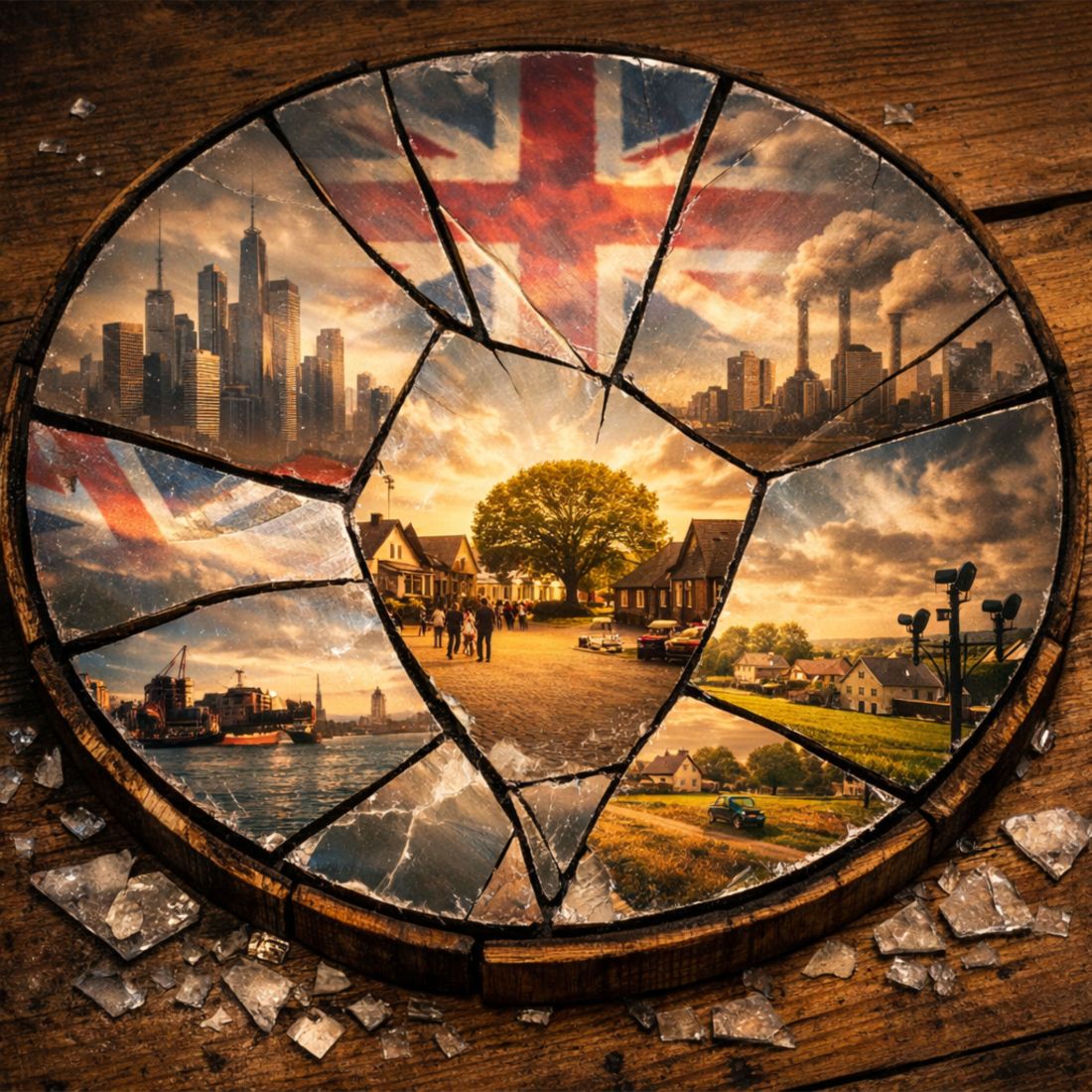
For generations, representative democracy relied on a simple, unspoken contract: those who win seats must use them.
Not occupy them. Not perform within them. Not protect them. But use them – to act, to decide, to govern, to take responsibility for the present.
Yet in today’s politics, that contract has quietly collapsed.
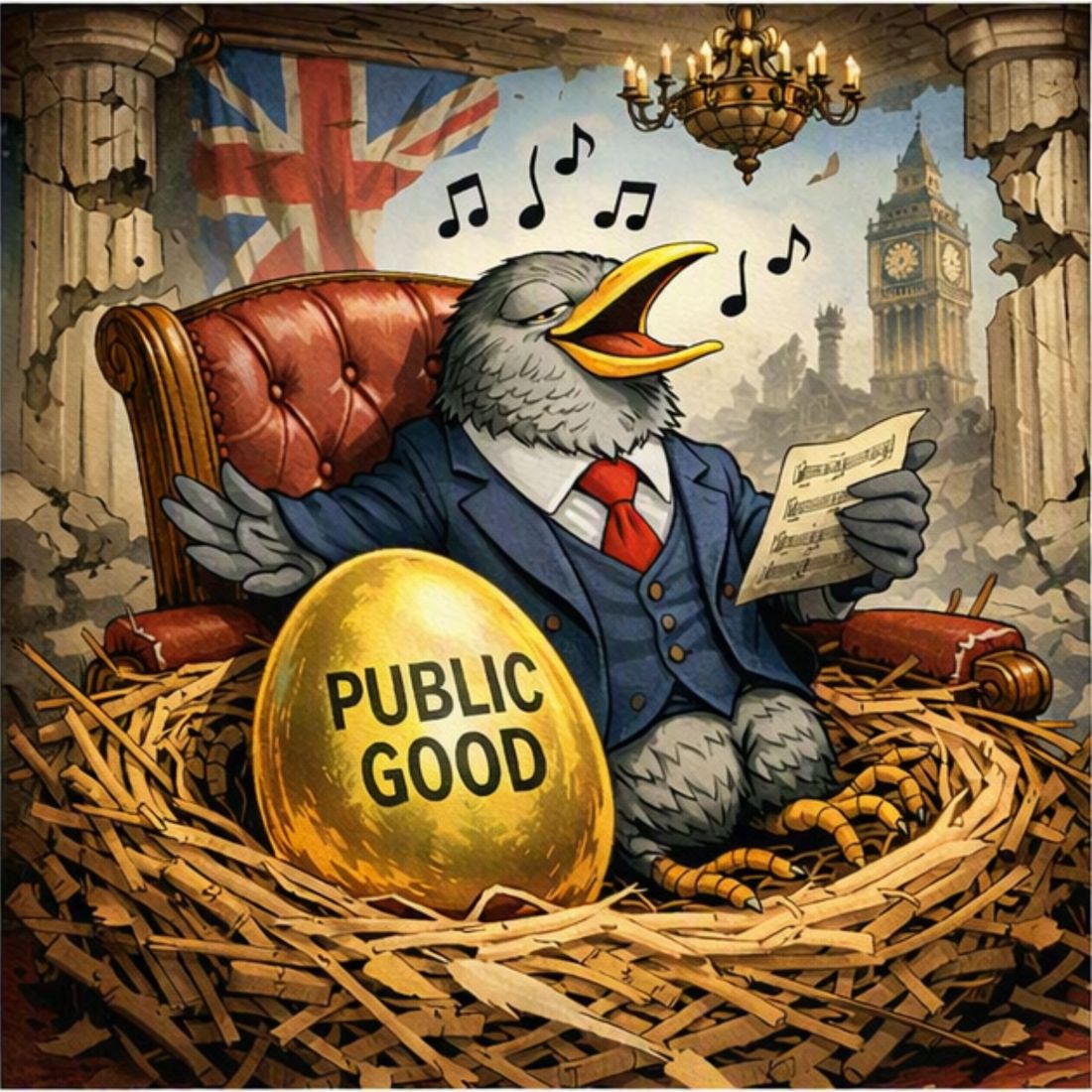
A new behaviour has taken root in Westminster and beyond. It is subtle, structural, and deeply corrosive. It is the habit of taking over seats simply to occupy them – to be seen to be there, to enjoy the insulated safety of incumbency – while rejecting the golden egg that comes with the role: the opportunity, and the responsibility, to do what is right for everyone now.
This is political cuckooism.
Like the cuckoo that lays its eggs in another bird’s nest, today’s political class lays its promises, its reforms, its responsibilities, and its obligations into the future – the next Parliament, the next cycle, the next government. The present becomes a perch. The future becomes a dumping ground.
And representative democracy is the real victim.
1. What Political Cuckooism Really Means
Political cuckooism is not procrastination. It is not caution. It is not long‑term planning.
It is the deliberate practice of deferring meaningful policy into the next Parliament so that incumbents can enjoy safety today.
It works like this:
take the seat
occupy the role
perform competence
announce reform
schedule it for “next time”
avoid consequences
avoid responsibility
and repeat
It is leadership without action. Authority without obligation. Presence without purpose.
It is the political class behaving as if the seat itself is the achievement – not the work that must be done from it.
2. The Golden Egg: The Opportunity They Refuse to Hatch
Every seat in representative democracy comes with a golden egg: the chance to act in the present.
To make decisions that matter. To confront reality. To govern.
But political cuckoos reject the egg.
They sit in the nest. They enjoy the perch. They protect the seat. They perform the role. But they refuse to hatch the egg.
Instead, they push every meaningful decision into the future:
tax reform
public service restructuring
constitutional change
welfare redesign
infrastructure investment
economic strategy
democratic renewal
All of it becomes “next time”.
The egg remains unhatched. The nest remains occupied. The seat remains safe.
And democracy remains unfed.
3. How We Got Here: The End of Britain’s Operating Model
Political cuckooism did not appear out of nowhere. It is the late‑stage behaviour of a political system whose operating model has already failed.
For forty years, Britain relied on a Thatcher‑era framework built on:
deregulation
privatisation
asset inflation
consumption‑driven growth
and the belief that markets could solve structural problems
That model worked – until it didn’t.
By the mid‑2010s, the machinery was visibly failing. By the early 2020s, it was exhausted. By the mid‑2020s, it was no longer capable of delivering meaningful outcomes.
The system now produces obligations rather than opportunities, constraints rather than choices, and risk rather than capacity.
Political cuckooism is the behavioural adaptation to that failure.
When the system can no longer deliver meaningful reform, politicians stop trying to deliver meaningful reform. They start performing it instead.
They occupy the seat. They protect the seat. They defer the egg.
And the system continues to fail.
4. The Contemporary Politicians’ Dilemma: The Mechanism Behind Cuckooism
Once in office, politicians discover a truth that the public never sees:
the system cannot absorb meaningful action – yet they must still appear to act.
They learn that:
every lever they pull has unintended consequences
every reform destabilises something else
every decision carries risks they cannot control
every structural change threatens the machinery
and every attempt at real‑time governance exposes the system’s fragility
So they face a choice:
Act meaningfully and risk collapse,or act symbolically and remain safe.
They choose safety.
They choose symbolism. They choose narrative. They choose performance.
And they choose to defer meaningful policy into the future – where it cannot hurt them.
This is political cuckooism’s engine.
5. The Rise of Performance Politics
Performance politics emerged because:
the machinery no longer responds to real‑time decisions
the levers of government no longer produce predictable outcomes
the public finances no longer support meaningful reform
and the political class no longer understands the system they are managing
So politicians adapted.
They learned to:
narrate competence
perform direction
announce future reform
avoid present‑tense responsibility
Performance became the product. Narrative became the tool. The future became the nest.
Political cuckooism is performance politics applied to policymaking.
When leaders cannot imagine a new model, they cling to the old one. When they cannot act in the present, they promise action in the future. When they cannot confront structural reality, they narrate structural optimism.
This is why so many reforms are framed for “the next Parliament”. It is not strategy. It is not vision. It is not long‑term planning.
It is the inability to act now.
Paradigm blindness turns the future into a storage unit for every difficult decision.
Political cuckooism is the behavioural expression of that blindness.
7. Leadership in a Failing System
Leaders cannot lead if the system cannot respond.
When the machinery is failing:
leadership becomes symbolic
decision‑making becomes performative
accountability becomes abstract
and responsibility becomes deferrable
This is why today’s leaders occupy seats rather than use them.
They are not lazy. They are not cowardly. They are not incompetent.
They are trapped.
The system cannot absorb meaningful action, so leaders stop attempting meaningful action.
Political cuckooism is the survival instinct of leaders inside a system that no longer works.
8. They Sing All the Right Songs
They sing all the right songs. They say all the right things. They perform all the right gestures.
But the actions at the heart of everything tell us the only story we all need to know:
they will not act now.
They will not hatch the egg. They will not confront the present. They will not use the seat for what it is meant for.
They will only occupy it.
This is political cuckooism in its purest form – the performance of leadership without the practice of leadership.
9. The Media’s Role: Mistaking the Nest for the Egg
Political cuckooism thrives because the media consistently misreads future‑facing commitments as present‑tense policy.
The media still reports politics as if:
the system works
timelines are meaningful
governments have agency
and policy announcements reflect real‑time decisions
So when politicians announce reforms “for the next Parliament”, the media treats them as if they are happening now.
This creates:
the illusion of action
the illusion of direction
the illusion of leadership
It allows political cuckoos to occupy the nest without ever hatching the egg.
10. Representative Democracy Cannot Survive Without Present‑Tense Action
Representative democracy relies on one fundamental principle:
Governments must act in the present.
Not the next Parliament. Not the next manifesto. Not the next cycle.
The present is where accountability lives. The present is where consequences exist. The present is where democracy happens.
Political cuckooism destroys this.
When governments push meaningful policy into the future:
accountability evaporates
consequences disappear
mandates become meaningless
elections become theatre
and representation becomes symbolic rather than functional
Democracy becomes a ritual rather than a mechanism.
People vote for change. Politicians promise change. The system defers change.
And the public is left with the performance.
11. The Nest Is Full of Cuckoos – And No One Is Hatching Anything
The problem is not one or two individuals behaving this way. The problem is that the nest is full of cuckoos.
Every seat becomes a perch. Every Parliament becomes a holding pattern. Every government becomes a caretaker administration. Every manifesto becomes a list of future eggs.
And none of them hatch.
The political class has become a colony of cuckoos – each one eager to take control of the seat, each one unwilling to take responsibility for the egg.
The nest is occupied. The egg is ignored. The system is failing.
12. What Happens When “Next Time” Finally Arrives?
Political cuckooism works only as long as the future remains abstract.
But eventually, “next time” becomes this time.
Eventually, the deferred reforms pile up. Eventually, the structural failures converge. Eventually, the system runs out of future.
And when that moment arrives, the political class will face a crisis they cannot defer.
A crisis they cannot narrate. A crisis they cannot perform their way through. A crisis they cannot push into the next Parliament.
Political cuckooism is not sustainable. It is a temporary survival mechanism inside a system that is already failing.
And when it fails, representative democracy will face its reckoning.
13. The Only Honest Conclusion
Political cuckooism is the defining behaviour of the modern political class.
It is the habit of taking over seats simply to occupy them – to be seen to be there – while rejecting the golden egg: the opportunity to do what is right for everyone now.
It is the survival instinct of a political class that no longer knows how to govern.
It is the performance of leadership without the practice of leadership.
They sing all the right songs. They say all the right things. But the actions at the heart of everything tell us the only story we all need to know.
The future has become the nest. The present has become the performance. And democracy has become the victim.
Further Reading
To understand how Britain’s political, economic, and cultural systems have evolved – and why they now appear to be reaching a breaking point – the following essays offer a structured path through Adam’s analysis.
They begin with the broad systemic shift, then move through establishment dynamics, political behaviour, economic assumptions, and finally the personal dilemmas facing today’s leaders.
1. The End of Britain’s Current Operating Model: Thatcherism’s Forty‑Year Reign and the Beginning of the Post‑Thatcher Era
A foundational essay explaining how Thatcherism shaped the UK’s political and economic architecture for four decades – and why its underlying assumptions are now collapsing. This piece provides essential context for all the others, outlining the structural shift Britain is entering.
2. The Establishment Is Not What You Think It Is: Why the Modern Establishment Is a Worldview, Not a Class – and Why That Makes It So Hard to Escape
This essay reframes the “establishment” as a shared worldview rather than a social elite. Adam argues that the real power structure is cultural and psychological, not institutional – making it far more pervasive and difficult to challenge.
3. The Performance of Politics: Why Power No Longer Serves People
A critique of modern political behaviour, exploring how politics has become performative rather than functional. Adam shows how leaders increasingly prioritise narrative, branding, and spectacle over meaningful public service.
4. We Can’t Fix Society Because We Won’t Question Money
An exploration of how deeply‑rooted assumptions about money limit society’s ability to solve major problems. Adam argues that economic orthodoxy has become a cultural belief system that prevents genuine reform.
A shorter, more personal reflection on the pressures facing modern politicians. It highlights how systemic constraints, public expectations, and party dynamics trap leaders in cycles of reactive decision‑making.
There is a particular sound British politics makes when it is running out of road. It is the sound of people reaching once again for the language of grip, delivery, seriousness, experience and competence, as though the right combination of better managers and sterner faces might somehow make the old machinery work as it once appeared to.
That search is understandable. When services deteriorate, living standards stall, housing becomes unreachable, debt rises and trust drains away, people naturally look for someone capable of restoring order. They ask who has the experience, who understands the markets, who can command the machine, who can finally make government work.
But the question itself may already be too narrow. If the machine is misfiring because the wrong people are operating it, then better operators might help. If the machine is misfiring because its assumptions no longer match reality, then the search for better operators becomes part of the problem.
The wrong question
Much of the current debate still assumes that Britain’s difficulties are failures of competence. The state needs to be run better. Budgets need to be managed more tightly. Growth needs to be revived. Productivity needs to improve. Departments need sharper leadership. Public services need reform. Markets need reassurance. Voters need confidence.
None of that is necessarily wrong. Competence matters. Money matters. Institutions matter. A government that cannot manage basic administration will not guide a country through anything more difficult. But competence inside a failing model is not the same as leadership capable of recognising that the model itself may be failing.
That is the possibility British politics keeps circling without quite naming. The country may not simply be suffering from a temporary downturn, a poor fiscal rule, a succession of disappointing governments or another bad phase in the electoral cycle. The fact that leaders with very different personalities, priorities and political traditions keep encountering similar limits should itself prompt a deeper question: are we looking at failures of individuals, or failures of the system within which those individuals are operating?
For decades, public assets have been sold and called efficiency. Value has been extracted from communities and called growth. Productive capacity has been hollowed out and replaced with financial engineering. Promises have been funded through debt, asset inflation and claims on the future. Success has been measured in ways that often fail to describe whether ordinary people can afford homes, raise families, access care, build security or live in communities that still function.
So when politicians talk about investment, fiscal space, renewed growth or national renewal, they often sound as though they are describing fresh capacity. Too often, they are doing something more limited: relabelling existing spending, moving costs into future years, borrowing more expensively, hoping growth returns, or trusting that markets will tolerate one more round of improvisation.
That does not mean money has literally disappeared. It means the real economic surplus, institutional resilience and productive base needed to sustain the promises of the existing model have been dangerously weakened. There is still money in circulation. There is less real capacity behind many of the promises attached to it.
Two mistakes, not one
This is where the leadership debate becomes confused. The failure is usually described as though the political class suffers from one shared defect. In reality, there are at least two, and they point in opposite directions.
One group knows the machinery but cannot imagine a future beyond it. The other does not understand the machinery and still imagines that power simply stops at No.10.
The first might be called the paradigm-blind managers. They speak the language of debt, markets, fiscal rules, productivity, investment and economic credibility. They understand how the existing system is supposed to work. Their failure is not that they know nothing. Their failure is that they know the current grammar so well that they struggle to imagine another language.
For them, every problem eventually returns to the same family of answers: more growth, better productivity, tighter management, smarter investment, stronger fiscal discipline, market credibility, business experience and technocratic competence. These things are not irrelevant. But if the model itself is producing the outcomes, fluency in that model is not enough.
The second group suffers from almost the opposite problem. These are the institutional romantics: people who speak as though the Prime Minister can simply decide, Parliament can vote away financial constraints, borrowing is only a matter of courage, and market reality can be dismissed as ideological pressure.
They imagine government as a command structure with No.10 at the top. But modern Britain is not arranged so simply. Government sits inside a dense web of Treasury rules, central bank decisions, debt markets, international capital, existing obligations, public expectations, legal commitments and real economic capacity. Political authority still matters, but it does not float above these constraints.
Both groups are dangerous, but for different reasons. The managers mistake system failure for poor administration. The romantics mistake structural constraint for cowardice or betrayal. One cannot imagine a future beyond the existing model. The other cannot understand the model they are already inside.
Why governments keep disappointing people
This distinction matters because it explains why successive governments so often disappoint people once they enter office. Campaigns take place in abstraction. Government takes place inside systems. Some of the people who have occupied No.10 in recent years might have been better suited to a different political moment. The point is not that every individual has been uniquely inadequate. The point is that very different people have repeatedly collided with similar institutional and economic realities.
The rhetoric of opposition, leadership contests and party conferences is full of choice, courage and renewal. But once inside government, ministers confront the hard edges of the state: debt servicing, spending commitments, market reactions, departmental fragility, contractual obligations, institutional inertia and the gap between what the country has been promised and what the system can actually deliver.
What looks like betrayal is therefore not always betrayal. Sometimes it is the moment when rhetoric collides with reality. Sometimes it is the discovery that the money imagined during the campaign does not exist in the form assumed, that the choices described to voters are narrower than claimed, and that the levers of power do not move the machinery in the way politicians implied. In that sense, politicians are not only agents of the system. They can also become its prisoners.
This does not absolve them of responsibility. They choose to seek power. They choose the promises they make. They choose the stories they tell about what power can achieve. They should know more before they obtain the roles they seek. But the repeated pattern also reflects the system that selects, rewards and promotes them: a system that often prizes confidence over understanding, fluency over wisdom and the appearance of control over an honest account of constraint.
This is not simply a failure of character. It is a failure of diagnosis. If people enter power believing the crisis is mainly political, they will be unprepared for an institutional and economic crisis. If they enter power believing the existing model only needs better management, they will be unprepared for the possibility that the model itself is the problem.
What leadership actually means
That is why the leadership question matters. But leadership is often misunderstood. It is confused with expertise, business experience, technical fluency, personal conviction, rhetorical force or the ability to dominate a room. None of these things is leadership.
No Prime Minister can be the country’s best economist, accountant, engineer, scientist, military strategist, financier, social worker and historian at the same time. No Chancellor can personally understand every consequence of every decision. No government can function if leadership means knowing everything.
Leadership means something else. It means bringing together people with different forms of expertise, understanding the realities they identify, recognising the limits of their assumptions, asking questions that fall between disciplines, and making decisions in the public interest even when those decisions are difficult, unpopular or hard to communicate.
expertise is necessary, but not sufficient
financial knowledge is necessary, but not sufficient
political authority is necessary, but not sufficient
conviction is necessary, but not sufficient
process is necessary, but not sufficient
Managers optimise within a system. Leaders make judgements when the system itself is in question.
This is not an argument against expertise. Economists matter. Financial specialists matter. Engineers, scientists, business leaders, local government officers, community organisations and public service professionals all matter. The problem begins when expertise is mistaken for leadership, or when one form of expertise becomes the only lens through which every public problem is viewed.
A leader must be able to listen without becoming captured, decide without pretending certainty, and act without reducing society to a spreadsheet. The defining feature of leadership is not avoiding difficult choices. It is accepting responsibility for choices where every available option carries a cost.
The danger of confusing leadership with control
There is another danger here. When institutions lose credibility, living standards decline and familiar solutions stop working, people understandably begin to hunger for clarity and action. The attraction of the decisive individual grows stronger. The argument becomes that Britain does not need more consultation, more process or more excuses. It needs someone who will take control.
That temptation should not be dismissed lightly. A theoretical case can always be made for a wise, selfless and temporary crisis leader: someone capable of seeing the whole system, gathering the right minds, making hard decisions and relinquishing power when the work is done. The problem is not the theory. The problem is the real world.
How would such a person be found? How would the country know they were genuinely selfless rather than merely claiming to be? How would power be limited once concentrated? How would dissent be protected? How would succession work? How would the person remain the same after acquiring the authority that changes almost everyone who holds it?
The answer to managerial paralysis is not authoritarian certainty. The manager says, “The process will save us.” The strongman says, “I will save us.” A leader says, “Show me what is real, tell me what I am missing, let the strongest arguments be heard, and then I will decide.”
The distinction matters because desperation changes political judgement. Once people stop believing that ordinary politics can respond to reality, they often stop looking for leadership and start looking for saviours. That is when the void becomes dangerous, especially if some of those already close to power exhibit the habits of certainty, grievance, domination or contempt for constraint before they have even acquired it.
The lucid moment has to come before desperation
What Britain needs, then, is not simply another leader, another party, another slogan or another economic forecast. It needs a lucid moment: a collective recognition that the old model is no longer producing the outcomes promised, that changing personnel is not the same as changing assumptions, and that preserving social cohesion during transition matters more than defending the credibility of a failing worldview.
The danger is that such recognition arrives too late. Systems can continue long after their underlying assumptions have weakened because admitting the scale of the problem is professionally, politically and psychologically difficult. The people most rewarded by the existing paradigm are rarely the first to acknowledge that it has reached its limits.
That is why the question of leadership cannot be reduced to personality. Britain does not need people who merely know how to operate the machinery, nor people who imagine they can command it by will alone. It needs leaders capable of understanding the machinery, recognising when it is failing, gathering knowledge beyond their own worldview, and making decisions that serve people rather than the abstractions of the system.
That means rebuilding productive local economies, reconnecting institutions with lived reality, asking how value is created and circulated in communities, and developing forms of governance that serve people rather than forcing people to serve markets, models and metrics.
The greatest danger is not decline itself. It is that decline remains misunderstood until frustration turns into desperation. If that happens, the search for leadership can become a search for certainty, and the search for certainty can become the path to something far worse.
The lucid moment needs to come before that. Britain needs real leadership not because one person can save it, but because only real leadership can help a society understand reality before reality forces the lesson on harsher terms.
The time for performance is over. The music has stopped, and the old system no longer has a chair.
For years, British politics has carried on as if the stage were still set in the old way. Leaders step forward, deliver their lines and reassure us that the familiar rhythms still apply: make the right choices, pull the right levers, announce the right reform, and the country will respond as it once did.
But the stage has changed. The machinery behind it has changed too, and many of the people standing beneath the lights have not yet grasped how completely.
What I Mean by ‘the System’
By ‘the system’, I mean two things that have fused into one. The first is Britain’s post-1980 operating model: an economy organised around growth, consumption, finance, property, flexible labour, centralised fiscal control and the promise that market incentives will allocate resources better than public institutions can. The second is the establishment worldview that treats this arrangement not as one political settlement among others, but as common sense itself.
That worldview is not simply a club of powerful people. It is a shared mental map, carried through the Treasury, Whitehall, political parties, business, the media and much of public life. It assumes that growth will return, that fiscal management is the first test of seriousness, that decisions are safest at the centre, that incentives can repair most failures, and that institutional continuity is preferable to disruptive change.
For a long time, those assumptions worked well enough to look like laws of nature. Growth created room for compromise. Cheap energy and dependable supply chains kept costs down. Borrowing and rising asset values softened conflict. Public services could be asked to do more because the wider model usually produced enough movement to disguise what was being lost.
That is the causal chain at the heart of this essay. The old assumptions shaped the institutions; the institutions narrowed the choices available to government; repeated use of those choices weakened capacity and resilience; and, as the world became less stable, a model built for continuity became less able to absorb change. What looks like a failure of individual leadership is often the final, visible consequence of a much deeper design failure.
This is why capable people can enter government with good intentions and still end up making versions of the same decisions. They are trained to operate the inherited machinery, not to question the worldview that designed it.
The Human Tragedy
If there is a tragedy here, it is not that politicians have suddenly become uniquely foolish or uncaring. It is that they were prepared for a world that is disappearing.
They learned how to build teams, negotiate policy, manage a news cycle and communicate through a crisis. Those skills mattered in a system with functioning levers and thick enough buffers to absorb mistakes. They matter less when the levers are no longer connected to the outcomes they are meant to produce.
So they do what they know. They perform. They reassure. They reorganise a department, rename a programme, launch a review and promise delivery. When the policy meets depleted local capacity, fragile supply chains, high costs or Treasury limits, it slows, shrinks or quietly disappears. The announcement survives longer than the action because the state can still produce language more easily than results.
You can see the strain in the repetition. Every government arrives promising renewal and leaves speaking of ‘tough choices’. Every minister discovers that the service they were asked to reform is tied to half a dozen other systems already under pressure. Pull one thread and the fabric does not become neater; it begins to tear.
None of this absolves leaders of responsibility. People in power still make choices, and choices still have consequences. But blame on its own explains very little. The more useful question is why different people, parties and temperaments are repeatedly funnelled towards the same narrow set of answers.
The answer is that the system does not merely constrain action. It defines what respectable action is allowed to look like.
The Structural Reality
Britain’s operating model depended on conditions that were never permanent: affordable energy, stable geopolitics, reliable imports, manageable debt, rising or at least tolerable living standards, and public institutions with enough spare capacity to absorb shocks.
As those conditions weakened, the model did not adapt. It compensated. Low pay was supported through benefits. Housing costs were carried through household debt and public subsidy. Local government was asked to preserve social stability with fewer resources. Infrastructure maintenance was deferred. Public services pursued efficiency until efficiency became the removal of every margin that might once have absorbed a bad year.
Each response made sense within the worldview of the system. Together, they made the country more vulnerable. When wages lagged behind costs, support payments prevented immediate hardship but also became indispensable to the functioning of the lower half of the economy. When local capacity was cut, central control appeared more necessary. When growth disappointed, more weight was placed on the next forecast of growth. The remedy for each weakness deepened dependence on the model that had created it.
The pandemic exposed this structure and temporarily concealed it. Government could still write cheques on a scale large enough to hold everyday life together. That spending bought time and prevented far worse damage, but it did not rebuild the underlying capacity. It left a more indebted state facing the same structural problems in a harsher fiscal and geopolitical climate.
Today, governments have less room to borrow, institutions have less room to improvise and households have less room to absorb another rise in costs. The runway is shorter because the margins have been spent.
This is why politics feels repetitive and strangely weightless. The language of control remains, but the capacity behind it has thinned. Ministers speak as if the machine were merely jammed. In reality, many of its parts were removed in the name of efficiency, while others were designed for conditions that no longer exist.
The Domino Field
People naturally ask what will set the next crisis off. Energy? Food? Debt markets? Supply chains? AI? A geopolitical event nobody has yet named?
At this stage, the first domino matters less than the field on which it falls. A resilient system contains failure. It has stores, slack, alternative suppliers, institutional memory and people with permission to act. A vulnerable system transmits failure.
Britain has spent decades tightening the connections while thinning the buffers. Energy feeds into food and transport; food and transport feed into inflation; inflation feeds into interest costs and household distress; those pressures feed into public services and political legitimacy. A shock travels because there are fewer places left for it to stop.
The danger is therefore not one spectacular event but a chain: an external pressure raises costs; households and firms cut back; tax receipts weaken while demand for support rises; fiscal rules narrow the response; public and local institutions are asked to carry more with less; delays and failures multiply; trust falls; and the state becomes even less able to mobilise consent for the changes it needs.
AI belongs in this picture as one dependency among many, not as a magical cause or a singular villain. It may raise capability in some places and fragility in others. What matters is whether the systems around it have the energy, skills, governance and resilience to use it without becoming more exposed.
The next crisis will be defined less by where it starts than by what it lands on.
What This Argument Is – and Is Not
This is not a prediction of imminent collapse. Systems can limp on for a long time. Britain remains wealthy, capable and institutionally resourceful, and decline is never a straight line. Nor is this generic declinism: the comforting habit of declaring that everything was better before and that national failure is inevitable.
The argument is more specific. A particular operating model is losing its ability to turn inputs into the outcomes it promises, while the worldview around it keeps excluding alternatives. That can produce sudden crisis, but it can also produce years of drift, uneven deterioration and local adaptation. The point is not to forecast a date. It is to recognise the mechanism while there is still time to change it.
Nor does acknowledging fragility mean denying agency. Quite the opposite. If the problem were simply fate, there would be little to do. If it lies in institutions, assumptions and the distribution of power, then those things can be redesigned.
The Lament
There is no satisfaction in watching the old assurances lose their force. No vindication. Only the weight of what it means for people who rely on services already stretched, for households with no cushion, and for public servants asked to hold together systems that no longer have the strength to hold themselves.
A lament is not despair. It is the honest recognition of what has been lost: spare capacity, local knowledge, institutional confidence, time to think, and the belief that public action can shape the future rather than merely manage decline.
It also asks us to see the people inside the system as people. They are neither all villains nor all fools. Many are conscientious, intelligent and trapped inside incentives that reward continuity. They reach for the familiar because the familiar is what their institutions recognise as serious.
That recognition is painful, but it clears the ground. Once the performance stops, we can ask not how to revive the old rhythm, but what kind of country could function without depending on it.
The Opportunity That Still Exists
The alternative is not a grand blueprint lowered from Whitehall. It is a different distribution of security, capacity and power: a national state strong enough to guarantee a floor and coordinate what must be shared, alongside local institutions trusted and funded to solve what must be rooted in place.
Start with security. A basic living standard would establish a reliable floor beneath income, housing, energy, food and essential services. The purpose would not be to withdraw people from economic life, but to remove the permanent emergency that prevents them from participating in it. Security gives households room to plan, workers room to retrain, carers room to care and communities room to organise.
Then rebuild local capacity. Give councils and community institutions dependable multi-year resources rather than short competitive grants. Let places retain more of the value they create. Restore teams able to plan housing, energy, transport, care and skills together, because those systems meet in real lives even when Whitehall keeps them in separate departments.
Make resilience a practical test of policy. Ask not only whether a service is cheap in a normal year, but whether it still works in a difficult one. Maintain strategic stocks where dependence is dangerous. Support diverse suppliers instead of single brittle chains. Invest in repair, maintenance and redundancy. Treat spare capacity not as waste, but as insurance.
Use national policy to create common standards and long horizons, then allow local variation in how they are met. A coastal town, a former industrial city and a rural county do not need identical institutions. They do need equal dignity, clear rights, accountable decision-making and access to the resources required to act.
Change the measures that govern decisions. Growth can remain useful without being the sole proof of success. Security, health, ecological stability, household resilience, institutional capacity and the time people have to live should matter too. What we measure becomes what officials are permitted to defend.
None of this is quick, and none of it removes the need for hard choices. It changes what those choices are for. Instead of repeatedly sacrificing capacity to preserve the appearance of control, we would invest in the ability of people and places to withstand shocks, learn and adapt.
The new model would be more distributed, but not abandoned to postcode luck; more local, but held within national guarantees; less dependent on endless consumption, but not hostile to enterprise; more cautious about concentrated power, but more ambitious about public purpose.
That is the opportunity hidden inside this moment: not a promise of perfection, but the possibility of building something that works in the world as it is.
The Chair Is Gone
There is a moment in any long performance when the audience realises the actors are still speaking but the play has already ended. The lines continue, the gestures continue, the familiar choreography continues – but the story has moved on.
That is where Britain is now. The rituals of politics remain, but the system that once gave those rituals meaning no longer has the same strength beneath it. The chair the old model relied on – growth, stability, buffers and room to manoeuvre – has been pulled away.
This is not a moment for triumph or fatalism. It is a moment for honesty: about the limits of the inherited model, about the worldview that keeps it in place, about the human cost of pretending, and about the work required to build something else.
The performance is over. The music has stopped. The old system no longer has a chair.
What comes next depends on whether we keep reciting the old lines, or finally face the silence and begin building a system that fits the world as it is – not the world as we once hoped it would remain.
Further Reading
The essays below develop the argument from different directions. Begin with the worldview that defines what the system considers possible, then move through the operating model and its structural consequences before turning to practical alternatives. URLs are shown in full so every source remains usable even where an earlier search-generated link was malformed.
Defining the System and Its Worldview
The Establishment Is Not What You Think It Is
Why the Modern Establishment Is a Worldview, Not a Class – and Why That Makes It So Hard to Escape
This is not a story about one villain, one party, one prime minister, or one conspiracy. There is no need to imagine a hidden committee deliberately setting out to hollow out a country. The reality is both simpler and more disturbing: systems can produce destructive outcomes without most of the people inside them intending destruction at all.
Power, money and institutional habit tend to protect themselves. Incentives reward certain kinds of behaviour and punish others. Those who adapt to the system rise within it; those who do not are filtered out. In that sense, decline is often passed on less like a plan than like a relay race: each generation inherits a machine already in motion, modifies it slightly, and hands it on to people who fit it, or can be conditioned to fit it.
The tragedy is that many of the people making the decisions never experience the consequences directly. They do not wait for a council repair that never comes, rely on a failing bus route, choose between heating and food, or watch a local high street collapse into betting shops, empty units and managed decline. Distance makes harm abstract. Abstraction makes harm easier to justify. Over time, a money-centred system can teach intelligent, respectable people to describe human damage as efficiency, discipline, reform, or growth.
This essay argues that Britain’s present crisis is best understood as the long result of that process: not a single betrayal, but an accumulated failure of measurement, ownership, accountability and imagination. What once appeared to be modernisation often behaved, in practice, like extraction. What looked like growth often depended on borrowing against the future. And what felt, for a time, like national wealth was too often the conversion of inherited assets into private balance sheets. It is written not as a prosecution of individuals, but as an attempt to describe the machinery clearly enough that people who already sense something is wrong can see how the pieces fit together.
If this feels abstract, it is not. It appears in ordinary life as rent rising faster than wages, public services becoming harder to access, young people locked out of ownership, older people fearing insecurity, councils struggling to meet basic duties, and communities watching essential functions become more expensive, more remote and less accountable. The argument is about systems, but the consequences are human.
Act I – When the map stopped matching the territory
1. 1971: the quiet break no one saw
The story does not start with Thatcher, Blair, or Brexit. It starts in the early 1970s, when three shifts combined in ways almost nobody understood in real time:
Money was cut loose from gold.
GDP became the main scoreboard of “success”.
Britain moved towards the European project and deeper economic integration.
On paper, nothing looked catastrophic. The shops were open, factories still ran, people went to work. But underneath, the rules of the game had changed.
Money was no longer anchored to gold in the way it had been under the post-war monetary order. In the modern economy, most money would increasingly exist as bank deposits created through lending: when commercial banks make loans, they create matching deposits, rather than simply passing on pre-existing savings. This is not a fringe claim; the Bank of England explains that most money in the economy is created in this way, while also stressing that banks are constrained by regulation, profitability, liquidity, capital requirements and monetary policy.
At the same time, GDP became the dominant scoreboard of national success. That mattered because GDP measures activity more easily than quality. It can rise when a factory is built, but also when house prices surge, assets are sold, debt is issued, or disaster is repaired. It can record movement without asking whether a country is becoming more resilient, more skilled, more productive, or more capable of looking after its people.
From that moment, Britain’s leaders were increasingly flying with instruments that described the financial weather but not always the real terrain beneath them.
2. The great masking: the 1980s and 1990s
The next two decades were the masking years.
North Sea oil poured in. The old industrial base – steel, shipbuilding, cars, engineering – was still there, even if shrinking. The City of London began to boom. GDP rose. Wages, for many, rose too. Home ownership expanded. To most people, life looked like it was getting better.
But under the surface, something else was happening.
Public assets were being prepared for sale.
The financial sector was being deregulated.
The logic of “markets know best” was becoming doctrine.
The new fiat-credit system was quietly learning how to feed.
The country still felt solid because there was still something to consume: assets to sell, industries to close or restructure, oil to pump, infrastructure to sweat, and inherited civic capacity to run down. Decline, where it was happening, did not yet feel like collapse. Momentum hid it.
Act II – The extraction engine switches on
3. Money as ledger entries, not savings
By the time we hit the 1980s, the new money system was fully in play.
Private banks did not merely move money around. Through lending, they helped create it. This is not a fringe claim; it is how modern banking is described by the Bank of England. A loan creates both an asset for the bank and a deposit for the borrower. The money appears as spendable purchasing power, even though it is matched by a debt.
This did not mean banks could create money without limit. They were constrained by regulation, confidence, liquidity, capital and the central bank. But it did mean that, once deregulation and global finance accelerated, credit could expand far beyond the old intuition that investment had to come from prior saving.
The same mechanism funded:
Corporate takeovers
Private equity roll-ups
Infrastructure acquisitions
Property speculation
Foreign buyouts of British companies
Leveraged purchases of utilities, ports, airports, energy grids, rail, telecoms
Too many of Britain’s productive and strategic assets were not bought with patiently accumulated wealth. They were bought with debt, and that debt was often then loaded onto the assets themselves.
The water company didn’t just get a new owner; it got a new mortgage. The rail franchise didn’t just change hands; it inherited a balance sheet. The infrastructure that once belonged to the public became collateral in a global credit system.
On the surface, this could look like investment. In some cases it was. But in too many cases, the pattern behaved less like renewal and more like extraction: fees first, dividends first, debt first, maintenance later.
4. Thatcher: liberation on the surface, financialisation underneath
Right to Buy did something similar with housing:
It turned homes into financial assets.
It depleted council housing stock.
It created a political constituency that needed house prices to rise.
From that point on, rising asset prices weren’t just a side effect – they were a political necessity. A government that let house prices fall would be punished at the ballot box.
Thatcher arrives in this context as the political face of a deeper structural shift. She did not invent the forces that followed, and it is too simple to blame one person for them. She did, however, give political form to privatisation, deregulation, home ownership, market discipline, the Big Bang in the City and a smaller role for the state. To many people, these were not cynical ideas. They felt like release from bureaucracy, stagnation and decline.
The problem was not that every reform failed, or that every sale was corrupt. The problem was that these reforms arrived just as credit, deregulated finance and global capital were learning how to scale. Once public assets entered that system, they could be bought, leveraged, merged, sold and refinanced in ways that ordinary citizens could neither see nor control. The supertanker was moving. Whether anyone fully understood its destination is almost beside the point.
Act III – Narrative, identity and institutional capture
5. Blair: modernisation and the softening of resistance
Blair did not reverse Thatcherism; he normalised it and extended it into culture, identity and institutions. Devolution, the creation of the Scottish Parliament and Welsh Assembly, the reshaping of Northern Ireland’s institutions and the attempted regionalisation of England were sold as bringing power closer to people. There was truth in that argument. These reforms answered real democratic pressures. But they also changed the structure of sovereignty. Political authority became more fragmented, and the idea of a single shared British political identity became harder to sustain.
The expansion of higher education also had genuine benefits. It opened doors for many people who would previously have been excluded. But structurally, it also helped turn education into a debt-funded sector whose success was measured by throughput, fees and credentials. Practical, vocational, craft and experiential learning – harder to monetise and harder to flatter through headline targets – lost status.
Blair’s political genius was narrative. Modernisation, opportunity and social justice were compelling enough that many people did not notice the deeper continuity: the financialised model remained intact, citizens were increasingly treated as consumers, and identity became a powerful tool for organising political loyalty.
6. Brown: the state locks itself to the City
Brown’s period in government revealed how closely the British state had become tied to the City. Light-touch regulation, rising tax receipts from finance, an expanding credit boom and the political prestige of London as a global financial centre all reinforced one another. When the Global Financial Crisis arrived in 2008, the dependence became impossible to ignore: the state had little choice but to rescue the banks because the wider economy had become inseparable from them.
After 2008, Britain became more visibly dependent on borrowing, low interest rates and asset support. Public debt rose sharply. The Bank of England entered a world of extraordinary monetary measures. The state had rescued the financial system, but in doing so revealed how dependent it had become on that system’s continued functioning.
The point of no return may not have been a single moment, but the direction was clear: the country could no longer easily separate fiscal policy, housing, banking, pensions, public services and market confidence. They had become one machine.
Act IV – The administrative hollowing-out
7. The EU as structural amplifier
EU membership was not the sole cause of Britain’s decline. It brought trade, cooperation, rights, funding streams and a larger economic framework. Any honest account has to acknowledge that. But it also amplified some existing tendencies in the British model.
The UK becomes the EU’s financial centre rather than its industrial engine.
Procurement rules limit the state’s ability to favour domestic suppliers.
Free movement helps plug labour gaps but masks the collapse of domestic skills and training.
Regionalisation and devolution align with EU “Euro-region” thinking.
The result was not simple cause and effect. It was a reinforcing pattern. Britain leaned further into services and finance, while the political and institutional will to rebuild a serious productive base weakened.
8. The quango state and the death of responsibility
From the 1990s onward, more and more functions of the state are handed to:
regulators
agencies
authorities
commissions
non-departmental bodies
On paper, this looks modern and technocratic. In practice, it diffuses responsibility.
No one is clearly accountable for:
water quality
energy resilience
rail reliability
housing supply
infrastructure planning
productivity strategy
The effect was subtle but profound. Decisions were still made, but responsibility became difficult to locate. Ministers could blame regulators, regulators could cite frameworks, companies could point to contracts, and voters were left trying to work out who was actually in charge. A state that cannot clearly assign responsibility slowly loses the ability to act strategically.
9. The collapse of local government
At the same time, local government is quietly gutted.
Funding is cut.
Assets are sold.
Services are outsourced.
Expertise is lost.
Councils take on debt.
Local authorities were once the practical layer of the state – the people who actually knew where the pipes were, how the roads worked, who needed help, what the town needed.
As local government was hollowed out, the country lost its most grounded layer of public competence. This is where the argument stops being abstract. It shows up as potholes that do not get fixed, social care packages that cannot be funded, libraries closing, planning departments overwhelmed, youth services disappearing, and councils forced into emergency financial measures. The civic fabric frays not all at once, but service by service, street by street.
Act V – Austerity, panic and the first visible cracks
10. Austerity: pretending the system can be managed
After 2008, austerity was sold as living within our means. There was a case, on paper, for worrying about debt and deficits. But austerity also attempted to maintain the appearance of fiscal discipline inside an economy whose deeper problem was weak productivity, over-reliance on asset inflation, and a damaged public realm.
Infrastructure investment is slashed.
Public services deteriorate.
Local government implodes further.
Productivity falls again.
Austerity did not repair the underlying model. In many places, it accelerated the decay of the state’s capacity to respond. Cutting maintenance can make a spreadsheet look better this year while making the eventual bill larger. Britain did this with buildings, roads, courts, prisons, councils, hospitals and people.
11. The triple lock: a small act of mercy
The triple lock was, in part, a political device. But it was also an admission that some people were exposed to a system they could no longer realistically escape. Older people without significant assets, private pensions or family support were vulnerable to poverty in a way that sat uneasily beside the country’s claims about decency.
That does not mean the policy is beyond debate. Any serious fiscal settlement must ask hard questions about intergenerational fairness, working-age poverty and the tax base. But the symbolism matters. When even modest protections are treated mainly as accounting problems, it reveals how little shelter remains for people who did nothing wrong except grow old inside a system that changed around them.
12. The multiplier effect: confession in technocratic language
The multiplier is a real economic concept, not a trick. Public spending can generate more output than it costs, especially when it builds capacity, skills, infrastructure or resilience. But when it becomes the only acceptable justification for doing almost anything, it reveals a deeper anxiety: spending must be defended not because it is necessary for national survival, but because it can be made to flatter the growth figures enough to reassure markets.
In that sense, technocratic language can become a confession. It says: we are no longer arguing from abundance, confidence or strategy. We are arguing from constraint.
13. Defence: the unaffordable necessity
Defence exposes the limits of the system in a different way. Security requires long-term commitments, industrial depth, stockpiles, engineering capacity and political patience. It does not always produce the kind of immediate, flattering GDP effect that short-term fiscal politics prefers.
A country with little fiscal room and a weakened industrial base can promise seriousness more easily than it can fund it. The question is delayed because answering it honestly would expose a hard truth: sovereignty is not a slogan. It is a capability, and capability has to be paid for before the emergency arrives.
Act VI – Permanent crisis and the end of easy recovery
14. The triple shock: Brexit, Covid and Ukraine
From 2016 onwards, crisis stopped being an event and became a governing condition. Brexit, Covid and the war in Ukraine each had different causes and different arguments around them. But each revealed the same weakness: the productive base was too thin, the state too hollowed out, the housing and energy systems too fragile, and the public finances too dependent on confidence. The repeated response was to borrow, inflate, patch and move on.
15. The gilt market: the real constraint in the room
For decades, Britain could borrow because:
It had industry.
It had oil.
It had productivity.
It had political stability.
It had a reputation for seriousness.
Those days are gone.
Now:
Debt is high.
Productivity is low.
Growth is weak.
Assets are foreign-owned.
Infrastructure is degraded.
The tax base is strained.
The gilt market – those who buy and price UK government debt – is not a conspiracy. It is a mechanism. But mechanisms can rule countries as effectively as people do. When debt is high, productivity weak and credibility fragile, the price of borrowing becomes a political force.
A small misstep in borrowing, a hint of fiscal adventurism, and yields can move quickly. The Truss mini-budget offered a glimpse of that vulnerability. Whatever one thinks of the politics, the lesson was stark: market confidence is now part of the constitution in all but name.
The brutal truth is not that Britain cannot borrow at all. It is that borrowing now carries far less room for error than it once did.
16. The IMF shadow: why old rescue routes look weaker now
In the past, an IMF bailout was painful but survivable because:
There was industry to revive.
There were exports to grow.
There were assets to leverage.
There was domestic capital to mobilise.
There was institutional capacity to implement reforms.
Today, those levers are gone.
Industry is hollowed out.
Exports are weak.
Assets are already leveraged or foreign-owned.
Domestic capital is thin.
The state has lost competence.
An external fiscal crisis today would therefore be more than a technical adjustment. It would collide with already stretched households, weakened services, low trust and limited institutional capacity.
Deep cuts to services.
Mass unemployment.
Social unrest.
A collapse in living standards.
Unlike earlier periods of crisis, there is no obvious unused reserve of productive capacity waiting to be revived quickly. The recovery mechanisms have not vanished entirely, but many have been weakened, sold, outsourced or neglected.
Act VII – Politics without power
17. The incentive trap in Westminster
Inside Westminster, the incentives are all wrong.
GDP rewards consumption and asset inflation, not production.
Borrowing boosts GDP in the short term.
Voters punish visible pain and reward short-term stability.
Politicians are on short cycles and think in headlines, not decades.
So they:
Avoid structural reform.
Lean on borrowing.
Talk about “growth” without saying how.
Perform competence rather than exercise it.
This is not because every politician is stupid or malicious. It is because the incentive structure punishes honesty. Voters punish visible pain. Markets punish fiscal recklessness. Parties punish internal dissent. Media cycles punish complexity. The result is a politics that performs control while avoiding the deeper admission that control has been lost.
18. Citizen to consumer, nation to market
Culturally, the shift is complete.
People are treated as consumers, not citizens.
Politics is treated as a product, not a duty.
Identity is fragmented and politicised.
Shared narratives are replaced by targeted messaging.
Institutions that once bound people together – churches, unions, civic groups, local associations – are weakened. The sense of “we” erodes.
A country that no longer sees itself as a collective cannot easily mobilise for sacrifice or renewal. This matters because rebuilding is not only a financial problem. It is a moral and cultural one. People will not accept hardship for a future they do not believe exists, led by institutions they do not trust, in a country they no longer feel part of.
19. The collapse of trust
Trust has drained away:
in government
in media
in experts
in markets
in public services
in the political class itself
Without trust, you cannot ask people to endure pain for a better future. You cannot ask them to believe in a plan. You cannot ask them to hold the line.
So politicians do not ask. They perform. They manage. They delay. They speak in words that sound large – growth, fairness, security, change – but often avoid the smaller, harder question: what capacity do we actually still possess?
Act VIII – Where we are now
We arrive at the present with:
A state that costs more than the country can produce.
A political class that has the appearance of power but very little real agency.
A money system that has already strip-mined the productive base.
A bond market that will not tolerate serious borrowing.
An IMF option that would put people on the streets.
A population already on the edge, with many one shock away from crisis.
Institutions too weak to manage a controlled transition.
A culture too fragmented to agree on what should come next.
Those closest to the numbers can see the bind. Public debt remains high by post-war standards: the Office for National Statistics placed public sector net debt excluding public sector banks at around the mid-90s as a percentage of GDP in 2025, levels last seen in the early 1960s. The Office for Budget Responsibility has also warned that debt has ratcheted upward over the past 25 years, while long-term pressures from demographics, pensions, health, climate risk and weak productivity continue to narrow the room for manoeuvre. The country is not bankrupt in a simple household sense, but it is constrained in ways that make the old political promises increasingly implausible.
The fear in government is not simply losing an election. It is being in office when the illusion finally breaks: when borrowing becomes too expensive, cuts become socially explosive, tax rises become politically intolerable, and growth does not arrive to save the arithmetic.
So they cling to narrative. They talk about “growth”, “investment”, “fairness”, “security”, “change” – but never in a way that confronts the core reality:
We have borrowed against a future that may no longer arrive on the terms we assumed.
We have sold or leveraged assets that could have helped us rebuild.
We have hollowed out institutions that might have managed the transition.
We have allowed money, ownership and measurement to outrun the real economy beneath them.
And now we are at the point where:
More borrowing risks a crisis we cannot recover from.
Less borrowing exposes how little real capacity we have left.
An IMF route would be socially explosive.
Doing nothing just runs the clock down.
Act IX – What comes next
The future is unlikely to be designed successfully by the same thinking that produced the present. Much of current politics still treats a money-centred, growth-led system as the only realistic framework. It is the lens through which problems are defined, and therefore the lens through which solutions are proposed. But if the diagnosis in this essay is even partly right, that framework is no longer enough.
It would have been easier if this had been recognised earlier, when institutions were stronger, public trust was higher and the margin for error was wider. But money is persuasive. It buys access, comfort, insulation, influence and the illusion of control. For those who benefit from a money-centred system, the system can appear not broken but successful. For those outside its protection, its consequences arrive as insecurity, dependency and the steady loss of genuine choice.
The alternative cannot simply be another slogan about growth. It has to begin from a different organising principle: from money-centred to people-centred; from remote control to local responsibility; from maximum financial efficiency to real-world resilience; from treating essentials as opportunities for extraction to treating them as the foundation of human freedom.
That does not mean pretending Britain can retreat from the world, or that every supply chain can be made local. It means asking, honestly, which things are too important to leave entirely exposed to distant markets, fragile logistics, leveraged ownership or geopolitical shocks. Food, energy, water, housing, care, transport, basic services and practical skills are not just sectors of the economy. They are the conditions under which people can live independently and with peace.
A more serious model would rebuild local and regional capacity wherever possible. It would shorten supply chains where doing so improves resilience. It would restore practical competence inside government. It would distinguish between markets that serve people and markets that hold people hostage. It would ask whether a basic living standard should be treated as a civilised floor beneath which no one is allowed to fall, rather than as a residual outcome of whatever the market happens to deliver.
This is where the wider body of work linked below matters. The local economy and governance system, the basic living standard, contribution culture and a people-first society are not decorative appendices to this argument. They are attempts to explore what comes after the diagnosis: how communities might regain agency, how essentials might be secured, how work might be valued beyond extraction, and how governance might be brought close enough to reality that responsibility can once again be seen and felt.
The choice may still be voluntary. But the window is narrowing. If change is not chosen while there is still some room to shape it, it may arrive through necessity: through scarcity, breakdown, fiscal constraint, institutional failure and social pain. The task now is to make the humane alternative visible before circumstances make it unavoidable.
The final question
The question, then, is not whether everything can go on as it is. It cannot. The question is whether change will be shaped honestly and deliberately around people and real communities, or forced on the country by events.
An honest politics would begin by admitting that the old story is over. It would stop pretending that every problem can be solved by another round of borrowing, another slogan about growth, another institutional reform, another private finance structure, another delay. It would ask what Britain must be able to do for itself, what must be rebuilt, what must be protected, and what can no longer be afforded.
When the state costs more than the country can sustainably support, when the system serves itself more easily than it serves the people, and when the tools that once worked now deepen the damage, what matters more: preserving the appearance of government, or preserving the life and dignity of the people?
That is the question this whole story leads to. It is not a call for despair. It is a call for seriousness, responsibility and imagination. A country can survive a great deal if it is willing to look directly at reality and rebuild around the dignity of its people. What it cannot survive forever is a governing class, a financial system and a public conversation built around not seeing what is already in front of us.
Further Reading: Building What Comes After the Old Model
The works below expand the constructive side of this argument.
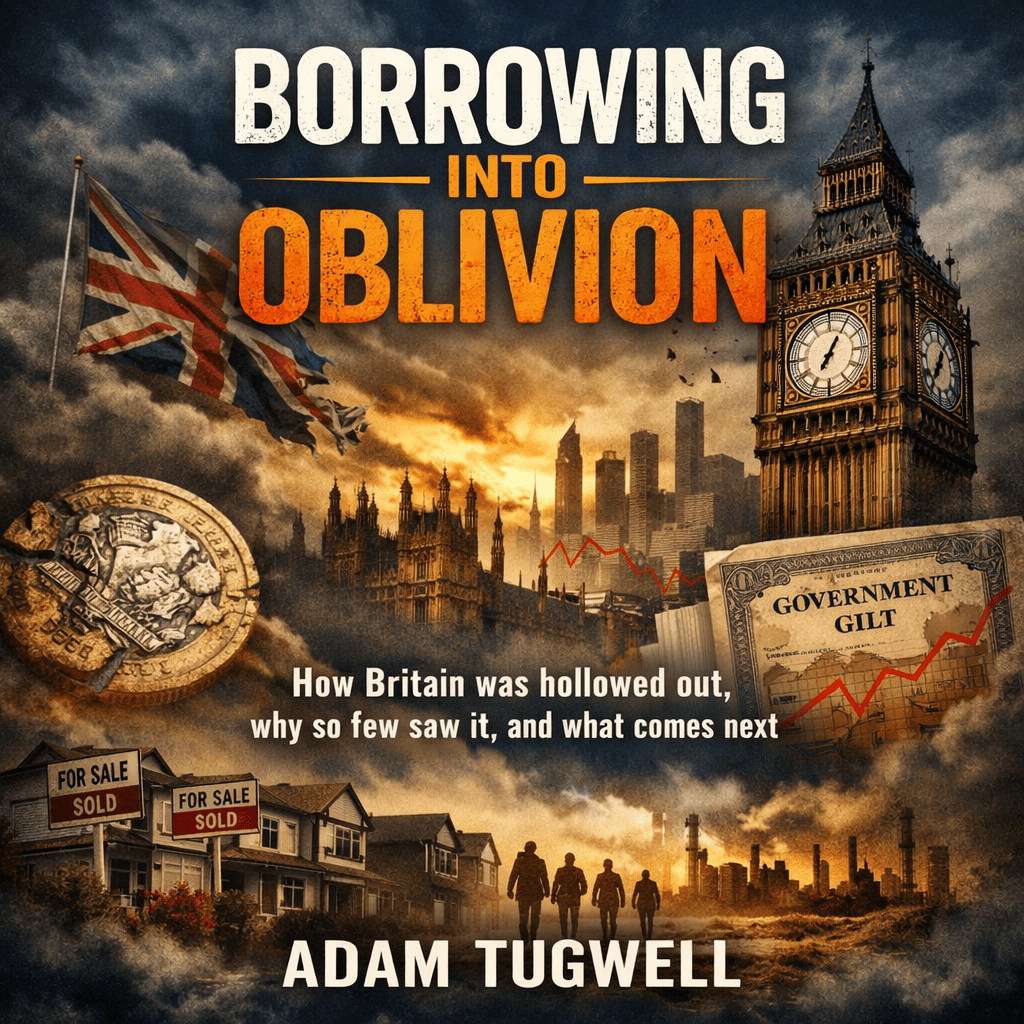
If Borrowing into Oblivion explains how Britain was hollowed out, these pieces explore how a people‑centred, locally grounded, resilient model could be built in its place.
They are arranged in a logical reading order: foundations → systems → culture → philosophy → future communities → wider context.
A complete, detailed outline of the Basic Living Standard: a guaranteed foundation beneath which no one falls. This text explains the model’s structure, purpose and practical implications, and serves as the core reference for the people‑first framework.
A concise, accessible introduction to the Basic Living Standard. Ideal for readers who want a clear overview before exploring the full technical version.
A deeper exploration of the mechanics behind the model. This piece explains why the Basic Living Standard strengthens communities, reduces fragility and avoids the dependency traps of traditional welfare systems.
A practical blueprint for rebuilding local economies and restoring local governance. It describes how decision‑making can be brought closer to communities, and how real production, skills and civic competence can be revived.
5. The Contribution Culture: Transforming Work, Business and Governance
A vision for shifting society from extraction to contribution. This work explores how businesses, public bodies and communities can operate on shared purpose, mutual responsibility and long‑term value rather than short‑term gain.
6. A Deep Dive Guide to the Philosophy of a People‑First Society
The philosophical foundation for the entire model. This guide explains the values and worldview behind a society organised around people rather than markets, metrics or centralised control.
7. A Future of Communities: Building the New World Without Oil, Manipulated Money and Centralised Control
A long‑form exploration of how communities can thrive in a world where old economic assumptions – cheap energy, easy credit, centralised authority – no longer hold. It describes what resilient, self‑directed communities might look like in practice.
A reflective piece examining how many of the promises of the late‑20th‑century economic model were illusions. It provides the emotional and cultural context for why a new model is not only desirable but necessary.
Source notes
Key factual claims in this essay are supported by publicly available material from the Bank of England on money creation, the Office for National Statistics on public sector finances, and the Office for Budget Responsibility on fiscal risks and debt sustainability. These sources do not prove every interpretation offered here, but they ground the central factual context: modern bank lending creates deposits, UK debt remains high by post-war standards, and official fiscal institutions continue to warn about long-term pressures.
British politics is full of noise, but nowhere is the confusion deeper today than on the political right.
The Conservative Party, Reform UK and Restore are fighting to be recognised as the true voice of the right. Each claims it alone can “save” the country. Each accuses the others of betrayal, weakness or irrelevance. And yet all three are reaching for something that now sits beyond their grasp.
To many voters, this looks like chaos.
To those inside the parties, it feels like a fight for survival.
But the deeper truth is far more important:
All three parties are trying to reclaim the same thing: a form of conservatism that the modern political system no longer allows to exist.
That is the real “race to the bottom”: not a competition to be the most populist or extreme, but a desperate scramble to rediscover a purpose that has slipped out of reach.
In simple terms, this article argues that Britain’s right-wing parties are not merely competing over policies, personalities or slogans. They are fighting over a deeper question: What is the right actually for, when the social, economic and political conditions that once sustained conservatism have been steadily dismantled?
The Right’s Original Purpose: The One Thing They All Should Still Share
Before we can understand the crisis on the right, we need to understand what the right is supposed to be for.
Traditional conservatism was built on six simple but powerful ideas:
Locality – decisions made close to the people affected by them.
Community – strong social bonds, shared responsibility and mutual obligation.
Stewardship – care for land, heritage, institutions and the inheritance passed between generations.
Continuity – change that is evolutionary and rooted, rather than sudden and destructive.
Identity – belonging grounded in place, memory and shared experience.
Self-governance – power held by the governed, not by distant authorities beyond meaningful democratic control.
This is what conservatism is at its root.
This is what the right once existed to conserve.
And this is the foundation that should, in theory, unite the Conservatives, Reform UK and Restore.
But it does not, because the political landscape in which these parties operate no longer supports these principles in any meaningful way.
How the Right Lost Its Purpose – A Story of Drift and Disconnection
To understand today’s fragmentation, we need to understand how the right became detached from its own foundations.
This did not happen all at once. It happened through drift, compromise and disconnection.
1. The 1970s: The Ground Shifts Under the Right’s Feet
From the 1970s onwards, Britain’s move towards more centralised and supranational forms of governance began to erode several of the things on which traditional conservatism depends. Centralisation means decision-making moving upwards, away from towns, counties and communities. Supranational governance means important decisions being shaped beyond the nation state, through institutions and arrangements that sit above national democratic control.
local autonomy
national decision-making
community-rooted politics
Traditional conservatism depends on those things because it is rooted in the belief that people, places and inherited institutions matter.
But much of the right did not see the danger clearly, because it assumed the world it knew would continue unchanged.
2. The 1980s–2000s: Neoliberalism Replaces Conservatism
The decisive break came when neoliberalism began to replace conservatism.
Neoliberalism, in this context, means a market-led, globalised economic outlook that prioritises (corporate) deregulation, competition, finance, corporate scale and consumer choice.
The right increasingly embraced:
deregulation
financialisation
global markets
corporate power
consumerism
managerial politics
These are not conservative values in the traditional sense.
They are economic ideologies and operating assumptions.
Over time, they hollowed out the right’s philosophical core.
Conservatism, rooted in community, identity and stewardship, became a ghost inside a political movement that no longer fully understood itself.
3. The 2000s–2010s: The Hollowing Out Becomes Visible
By the 2000s and 2010s, that hollowing out had become visible.
Without a clear purpose, the right became:
reactive
fragmented
populist in tone
technocratic in practice
dependent on media cycles
unable to articulate what it stands for
This was the moment when the right often appeared to stop conserving people, places and institutions, and instead began conserving the system itself.
That loss of purpose did not remain abstract. It surfaced most clearly in the anti-EU movement.
The Deep Irony: The Anti‑EU Movement was Conservatism’s Last Instinctive Rebellion
Here is the irony that explains much of today’s political confusion:
The anti-EU movement was traditional conservatism trying to save itself, without fully realising that the philosophical ground beneath it had already been removed.
The instincts behind the movement were deeply conservative:
local control
national self‑determination
suspicion of distant authority
protection of community identity
desire for continuity and rootedness
But the right that led and shaped the movement had already embraced many of the forces – globalisation, centralisation and corporatism – that had made traditional conservatism so difficult to sustain.
So the movement fought the symptoms of the drift, rather than the drift itself.
It tried to reverse a trend that the right had already helped create.
For example, a politics that speaks about local control cannot easily thrive in a country where planning, infrastructure, public services and economic life are increasingly shaped by distant institutions, large corporations, national targets and global pressures.
That is why the argument goes deeper than Europe alone.
The Modern Split: Conservatives, Reform UK and Restore Are Fighting Over the Same Lost Purpose
This is the part we all need to understand.
The Conservative Party, Reform UK and Restore are not divided as they are because they stand for completely different philosophies.
They are divided because they all want to reclaim the same thing – traditional conservatism – but none of them can reach it within the current system.
The Conservatives
The Conservatives are trying to defend a system that no longer reflects conservative values. They carry the name, history and institutional memory of the right, but they have become too closely associated with the very political and economic structures that displaced traditional conservatism.
Reform UK
Reform UK is trying to break the system, or at least disrupt it, without always making clear what durable conservative order should replace it. It channels anger at drift, centralisation and betrayal, but protest is not the same as reconstruction.
Restore
Restore is trying to revive traditional conservatism in a landscape where the conditions that once supported it have been weakened to the point they no longer function the way they once did. Its instinct is to return to first principles, but those principles now have to operate in a system built against them.
The three visible parts of the right are fighting each other because:
they feel the same loss
they sense the same drift
they are chasing the same instincts
they are trying to conserve something the system itself has dismantled
Their conflict is therefore not simply ideological.
It is existential.
They are competing to represent a philosophy that the political operating system no longer allows to function.
Why the Left Appears More Unified
This contrast matters.
The left achieved much of its historic mission decades ago:
suffrage
workers’ rights
the NHS
the welfare state
These were extraordinary achievements.
Once achieved, the left’s original foundational purpose was essentially complete.
So the left adapted.
It became:
flexible
narrative‑driven
culturally aligned
institutionally embedded
comfortable with centralisation
comfortable with supranationalism
The left arguably appears unified today not because it has a clear purpose, but because it has no foundational mission left to betray.
It can adapt to remain relevant.
The right struggles to adapt cohesively and together because it has forgotten, or lost the conditions for, what it is supposed to conserve.
The Real Problem: Conservatism Cannot Meaningfully Exist in the Current System
This is the truth the right often refuses to face:
Conservatism cannot meaningfully exist within the current system.
Conservatism requires:
local decision‑making
community autonomy
stewardship
identity
continuity
self‑governance
But the current system is built around:
centralisation
corporatism
globalisation
managerialism
technocracy
distant authority
These two worldviews sit in deep tension.
That is why the right is in a race to the bottom.
It is trying to rediscover a purpose that the system itself has made effectively impossible to practise.
In practical terms, this can be seen when local communities feel they have little control over development, when national economies depend on global supply chains, when public institutions are managed through targets rather than relationships, or when identity is treated as a branding exercise rather than a lived bond between people and place.
So What Is the Right Really For?
If the right rediscovered its purpose, it would stand for:
Local power
Community‑rooted economies
Stewardship of land and environment
Identity grounded in place and shared experience
Governance by the governed
Institutions that serve people, not systems
This is not nostalgia.
This is not ideology for its own sake.
This is not populism.
This is real conservatism: the kind that protects people, places, institutions and the bonds between them.
But until the right recognises that the system itself prevents these values from flourishing, it will continue its race to the bottom, mistaking noise for purpose, populism for philosophy, and survival for renewal.
The Message That Needs to Be Heard
Britain’s right-wing parties are not simply enemies.
They are fragments of the same broken whole.
They are all trying to reclaim a conservatism that the modern political system has made effectively impossible to practise.
Until they recognise this, they will keep fighting each other and keep losing sight of the very thing they should exist to protect:
People.
Places.
Communities.
And the continuity that binds them together.
Until the right redefines its purpose for the system as it is, not the one it remembers, it will keep fighting itself instead of shaping the country.