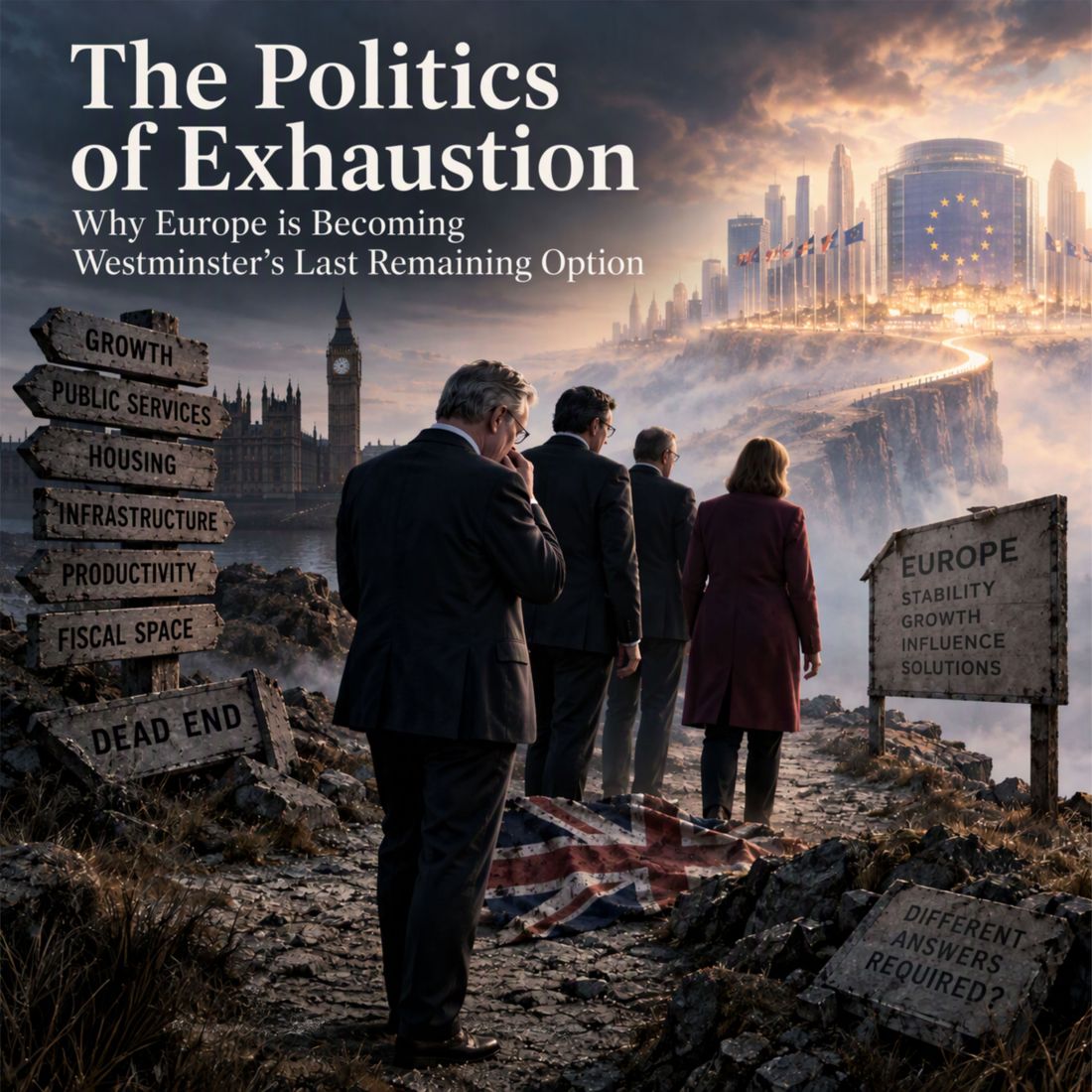
The Politics of Exhaustion | Why Europe is Becoming Westminster’s Last Remaining Option

There are moments in politics when a government appears to be making choices.

And there are moments when it becomes apparent that it is simply running out of them.

Increasingly, Britain feels like the latter.

The significance of the recent interventions by Andy Burnham and Rachel Reeves is not that they have reopened the European question. That process has been creeping forward for years through the language of resets, partnerships, alignment and cooperation.

What has changed is something subtler.

For the first time since Brexit, influential figures are beginning to talk as though Britain’s long-term future may ultimately lie back inside the European project itself. What was once implied is increasingly being stated. What was once political subtext is beginning to look like political direction.

Most commentary has focused on what this says about rejoining The EU.

The more interesting question is what it says about Westminster.

Because the growing attraction of Europe may reveal less about the strength of the European option than the weakness of every other option now visible to Britain’s governing class.

The Halfway House Reaches its Limit

Since leaving the European Union, Britain has existed in an uncomfortable halfway house.

The country formally left the institutional structures of the bloc, yet many of the deeper forces that shaped Britain’s economy remained largely untouched. Financialisation continued. Centralisation continued. Dependence on debt-fuelled growth continued. Productive capacity remained weak. Regional imbalances remained stubbornly entrenched.

The reconstruction that was supposed to follow Brexit never truly arrived.

As a result, Britain has spent much of the last decade trapped in an increasingly peculiar position. Outside enough of The EU to lose some of the advantages of membership, yet without having undertaken the structural reforms necessary to exploit the opportunities of departure.

It is a position that satisfies almost nobody.

And because it satisfies almost nobody, a conclusion has gradually become stronger within parts of the political establishment that ‘leaving’ was the mistake.

But that conclusion rests upon a significant assumption.

It assumes that Britain’s difficulties were created by Brexit rather than revealed by it.

Running Out of Road

The political reality confronting any government today is brutal.

Economic growth remains weak. Public services require resources that governments struggle to provide. Infrastructure demands investment measured in decades while politics increasingly operates in electoral cycles. Housing remains dysfunctional. Productivity remains stagnant. Debt constrains everything.

Every government enters office promising change.

Every government eventually discovers the same limitations.

The result is a political system that increasingly appears trapped.

There is no obvious tax solution.

There is no obvious spending solution.

There is no obvious growth solution.

There is certainly no quick solution.

Eventually a point is reached where governments stop searching for better answers and start searching for larger frameworks.

That is where Europe enters the picture.

Not necessarily as an ideal.

Not necessarily even as a conviction.

But as a mechanism.

A system that appears capable of creating options where none currently exist.

A framework large enough to absorb problems that national governments increasingly struggle to solve.

A route that appears, at least superficially, to lead somewhere.

The Last Remaining Answer

Viewed through this lens, the recent interventions from Burnham and Reeves take on a different significance.

They can be read not simply as endorsements of Europe but as acknowledgements of a deeper reality.

Westminster is running out of ideas.

This is not an accusation of incompetence. Almost any government would likely arrive at a similar position. The constraints are structural rather than personal.

Yet the consequences are profound.

When political systems exhaust their available options, they begin returning to familiar territory. Solutions previously rejected acquire new appeal. Paths once abandoned begin to look attractive again.

EU membership increasingly feels like such a path.

Not because it has suddenly become irresistible.

But because it is increasingly difficult for many within the political establishment to imagine anything else.

The attraction lies not necessarily in EU strength.

It lies in domestic weakness.

The Electoral Calculation

This is why the next general election may prove far more significant than many currently realise.

At present, no government possesses a clear mandate to pursue eventual re-entry into the European Union.

That obstacle remains substantial. But obstacles in politics have a habit of becoming opportunities.

A future manifesto offering a pathway towards deeper integration, closer institutional alignment or eventual membership would solve an immediate political problem.

It would place responsibility back in the hands of voters.

And from the perspective of the governing class, it creates a remarkably attractive outcome regardless of the result.

If such a programme is rejected, the government falls and someone else inherits Britain’s problems. The incoming administration then encounters exactly the same fiscal constraints, infrastructure challenges, demographic pressures and economic limitations as its predecessor.

The reality does not change simply because the occupants of Whitehall do.

If the programme succeeds, however, the government acquires something it presently lacks: democratic legitimacy for a strategic shift towards Europe.

Either way, the dilemma is resolved.

Either the burden is transferred.

Or the mandate is secured.

That is what makes the European question increasingly attractive politically.

The Problem with Desperation

There is, however, a danger in all of this.

Political exhaustion can easily disguise itself as strategic clarity.

When governments become sufficiently constrained, the remaining options inevitably begin to look more attractive than they actually are. Familiarity starts to resemble foresight. Necessity starts to resemble wisdom.

Yet there is remarkably little evidence that the forces constraining Britain are uniquely British.

Many of the pressures visible in the United Kingdom are visible throughout the wider developed world. Weak growth. Demographic strain. Debt burdens. Housing shortages. Growing distrust of institutions. Political fragmentation.

The assumption now quietly emerging within Westminster is that these problems become more manageable inside the European framework.

Perhaps they do. But that remains an assumption rather than a demonstrated fact.

After all, the European Union itself is increasingly confronting profound questions about its own future direction. Debates around fiscal sustainability, economic divergence, governance and political legitimacy are becoming more frequent, not less.

This raises an uncomfortable possibility.

What if Westminster is treating Europe as a solution to pressures that Europe itself is struggling to resolve?

Paradigm Blindness

Perhaps the most important aspect of this debate is not Europe at all. It is the lens through which Britain’s political class sees the world.

Every generation becomes captive to certain assumptions. Over time those assumptions become so deeply embedded that they cease to appear ideological. They simply become reality.

The assumption that larger systems are inherently more stable.

The assumption that deeper integration necessarily produces better outcomes.

The assumption that political problems can ultimately be solved through better administration and larger frameworks.

These assumptions shaped much of the modern political era. They also shaped the generation of politicians currently running it.

This is why the growing movement towards Europe may represent something deeper than policy.

It may represent the limits of political imagination.

Faced with mounting pressures and shrinking room for manoeuvre, Westminster continues searching for solutions inside the framework that produced its understanding of the world.

Europe remains visible because Europe belongs to that framework.

Everything else appears increasingly unimaginable.

Conclusion

The emerging debate about Europe is often presented as a debate about Britain’s future relationship with the European Union.

In reality, it may be a debate about something else entirely.

It may be a debate about what happens when a political class reaches the edge of its available options.

Britain’s governing institutions increasingly appear to believe that Europe represents the last remaining route back towards growth, stability and governability. That belief may yet shape the next general election. It may even become the defining strategic proposition offered to the electorate.

Whether it succeeds is another matter entirely.

Because the central question is not whether rejoining the EU can be presented as an answer.

The central question is whether Britain’s problems are actually the kinds of problems EU membership can solve.

That distinction may determine far more than the next election.

It may determine whether Westminster is identifying a genuine path forward, or simply pursuing the last answer it still knows how to imagine.

If you can measure it, you can control it: Has GDP been the most dehumanising tool that humanity’s so-called leaders have ever created?

Just before Christmas, I published an e-book called ‘One Rule Changes Everything’. Within it, I identified the common theme of all the problems that society faces being built on the reality that the value of money is the benchmark that we use for everything in life and that the cultural selfishness that is now prevalent across mankind has become the greatest obstacle to us moving forward into a much healthier and happier way of living. Not least of all, because to do so would allow us to address all of the problems we have at their root cause.

The fact that we exist within a money-based paradigm today and have lost sight of values and what being human really means isn’t an easy idea for anyone to grapple with. After all, even those who can see and fully appreciate how ‘The System’ works, cannot escape living within it and being touched by the impact of it at each and every turn.

For the whole of humanity to reach this point without even realising it means that there has been a process at work that we have not seen or have been unconscious of.

Because so few are able to recognise that process, it is safe to assume that we have been steadily conditioned, in ways that could have been as simple as each of us accepting changes and leaps in money-related technologies, how we buy things, what products are available to us and what we have to do to get access to them. All without ever taking the time or making the effort to question any of these things and what they mean.

Experience changes our expectations. So, the true impact of technology like the internet has been far more significant than the ease of shopping or borrowing money. It has actually changed our values set, and how we think about our relationship with other human beings too.

But where did this process of unacknowledged change really begin? What were the building blocks that really started to make it that ‘life is all about money’, and nothing else?

The Human Condition

A reality that we all need to face is that a default setting of being human without being self-aware, is that we behave as an individual and as if we are separate to anyone and everything else. Therefore, we consider every interaction that we have in terms of how it will affect us, whether it will ultimately be a benefit or a cost to us.

Few will consciously place themselves in any situation where they believe that the costs of doing so  will outweigh the advantages. Even when they are fully conscious of all the facts and consequences of what they have the choice to do.

This is how selfishness works at its basic level, and there is an argument to be made that it is certainly a healthy way to be, IF you cannot be sure that anyone or everyone else can take a fully altruistic approach to every interaction in life. Which there are many arguments available to suggest that they cannot.

If humankind were able to police itself and ‘keep itself honest’ by being content that everyone should always be aware of the facts before they are expected to make any decision that could have a negative impact upon them in any way, the world would already be a much happier, much healthier, much more equitable and much more human place.

But for some, the basic ingredients of life have and never will be enough.

Ideologies and Hidden Truths

As soon as a process of any kind is invented or introduced to ‘create value’, whether that’s income, efficiency or anything else that can be considered to be advantageous at any level to the end user or to the recipient, without that end user or recipient being aware of the process that’s involved or why it’s really being carried out, the doors are immediately opened up to breaches of trust and for the confidence of anyone without full knowledge of what’s happening to be abused.

Historically, that abuse of trust could be based upon something as simple as the distribution of power and how certain people found themselves in control whilst others did not.

More recently, and particularly into the 20th century, that abuse has been based more upon the accumulation, distribution and creation of money and wealth. Manifested through wealth inequality or the wealth divide, which paints those who have much as being special, when those have less or very little, are most certainly not.

The most frightening thing about the way that ‘The System’ works and how it creates the myth that only those with wealth and power are special, is just how simple the ingredients or technical aspects that allow such stories and lies to exist, really are. So simple, that for anyone questioning how money and finance works for the first time, the simplicity itself makes the truth very hard to believe.

The most effective of all those ingredients is the framework of measurements that put figures against everything that ‘The System’ values, and gives the lie that ownership and direction of those measurements is what constitutes the real power over everything, therefore surrendering our control, because it’s what we believe.

GDP: The Tool of Measurement for a corrupt, self-serving and dehumanising ideal

It’s easy to think that the problems facing the Country have been caused by and are the sole responsibility of  whoever is in government at the time. Attributing blame in that way plays no small part of the way that our broken political system actually works and its why so many of us believe that the choices of political parties that we are given will result in change, whenever the next General Election comes.

What Politicians (from any side), The Media and all the public figures sprawled across social media don’t tell us, as they whinge and make out they are the only ones who really understand the injustice and pain that everyone faces, is that everything collapsing around us today has come from an accumulative effect of policy after policy and decision after decision, that has been taken by multiple generations  of politicians – from all sides, pretty much since just after the end of the Second World War.

Built on an economic idea or theory called Neoliberalism, there has been push after push to deregulate everything that was once regulated by government – on our behalf in some way, and for trust in the markets to be allowed to work beneficially on behalf of everyone and for the idea of ‘Free Markets’ to be embraced in its place.

Regulations that were once there to restrict , encourage and maintain certain behaviours of those private or commercial interests with the power to affect others lives have been steadily removed. Measurements relating to productivity, output and ‘growth’ have been inserted in their place, with little or no attention being paid to the way that the driving interests have increasingly used civil and corporate law to create their own system of checks and balances, regulated or enforced by expensive lawyers across what should still be an open or ‘free space’.

Every bit of the economy, or rather every product made, grown, produced, transported and every service carried out is measured by the financial value of each and every transaction that follows it through supply chains.

Meanwhile, this system of measuring everything in terms of the outputs generated has perverted just about every part of the public sphere. So that measurement, rather than the experience of  the end user, has become what everything in business, not-for-profits and worst of all, the public sector is all about.

Measurement drives behaviour because behaviour is driven by measurement

What few have realised is that measurement offers or rather appears to offer something concrete outside of ourselves that just knowing we have done the right thing or done the best job that we could do does not.

The ability to measure, record and document also gives poor leaders, who do not trust the people who they lead, the opportunity to control those people and to increase the ways that they do so. Right up to the point where politicians and the establishment believe it right to police the way that other people think.

Yes, it seems hard to believe. But GDP and the Neoliberal obsession with measurement to ensure performance, productivity and therefore growth has actually influenced and conditioned workplace behaviours and service to the public is not what public service is now actually about.

Removing value from real life

Measurement of everything that can be measured has created and encouraged a process where people have increasingly forgotten to trust each other. In turn, ‘experts’ and ‘professionals’ rely on figures that can be illustrated, and more often than not manipulated in whatever form they can then be laid out and presented on a page.

Real life and human interaction cannot be measured in any kind of quantitative form.

We have unwittingly and therefore foolishly allowed an economic system, derived not for the benefit of the people, but so the selfish could become even more selfish, to use measurement to blame us for the flaws in ‘The System’  the few manage and the mistakes they keep making. Bringing us ever nearer to a situation where we, the guilty masses can only be saved by surrendering the few freedoms that we have left, so that we can be saved from ourselves from this ever more greedy few.

Growth

For those needing evidence or a way to understand that we are today welcoming in a form of totalitarianism that once across the threshold of daily life will then be very quickly imposed, you only need listen out to the obsession that so many of the politicians and media bods we are forced to listen to by the ‘credible’ mainstream media has with growing the economy and specifically the word ‘growth’.

In whatever context it comes at us, the fact is that the ‘growth’ people made credible by their position and platform talk about, always relates to growth of GDP or ‘Gross Domestic Product’.

GDP is the Neoliberal ethos of continually growing the amount of money in circulation, so that public debt and all the other damage that the proponents of this twisted ideology create that keeps hurting us, can be covered up and hidden from view. Until the time that it is impossible to hide it from view any more.

Our politicians, many of whom are either too greedy, too stupid or too ignorant to understand how the mechanics of ‘The System’ they are supposed to be there to legislate upon even works, only know and understand what their advisers and the people who control them tell them.

This is likely to be something along the lines that politicians can only keep spending money for as long as everything they do with the power we gave them keeps on allowing big money, big business and big everything else to grow, through a process that is steadily breaking us all.

If it cannot be measured, it doesn’t exist

The harm that having lunatics in control who have placed a financial or monetary value on so many aspects of human life, is that is has genuinely affected the way that every one of us thinks.

It has progressed to the point where the unhuman aspects of ‘The System’ we are being led under has now corrupted just about every part of life.

The fact is that deep down, we all know that the work we do, the food we grow, the products we make, the services that we provide are all about providing the things that each and every one of us need for life. And that’s what many of us still unconsciously think.

However, the hard reality we face is that a life based on values – which is where every function we carry out is about people, communities and the world we live in, is no longer what life is really about.

Life has been changed, manipulated, reformed and redirected so that money, wealth and influence is all that matters.

Anything that cannot be measured has no financial value to those who want to measure and control it.

So it becomes worthless. Because what anything is worth is what everything is now all about.