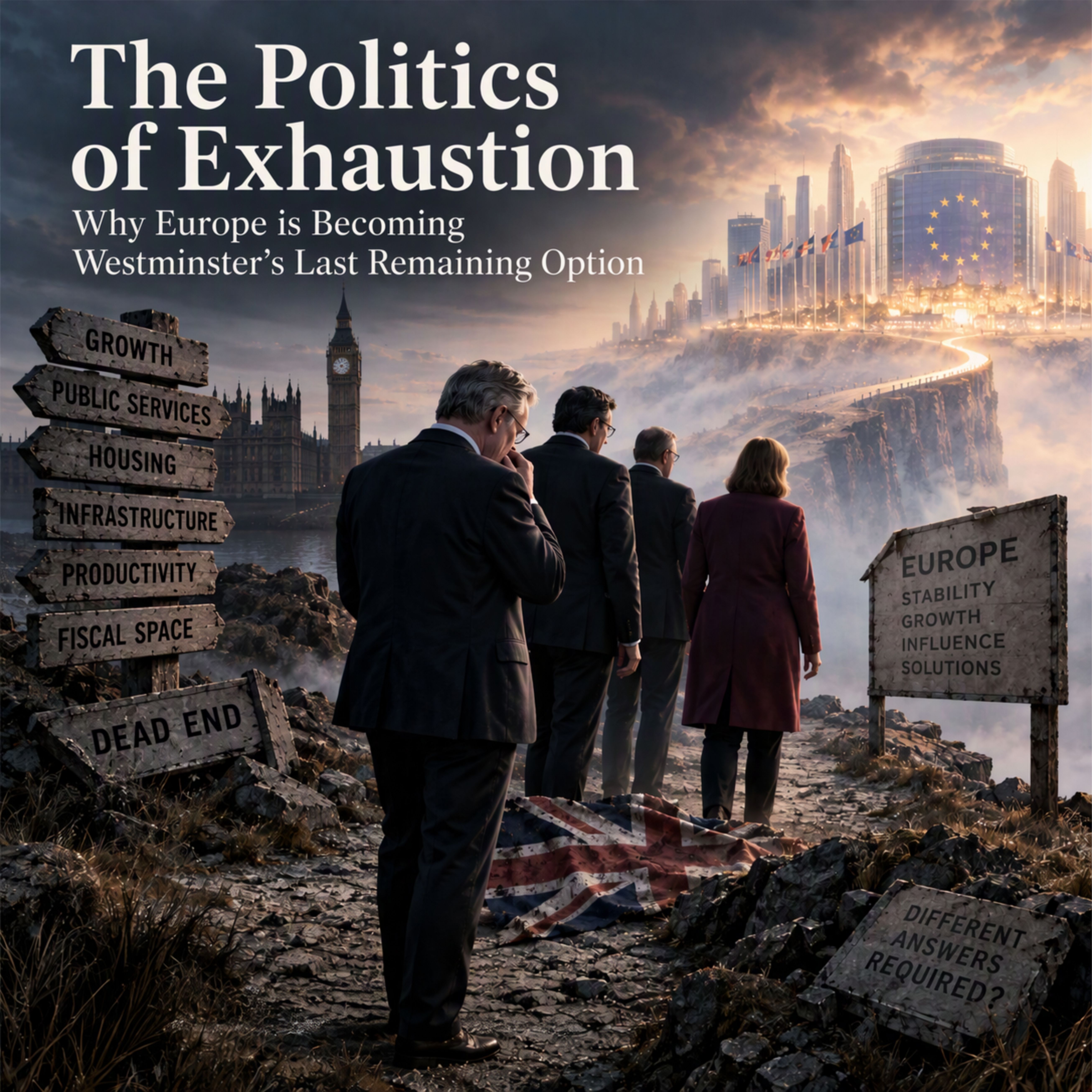

There are moments in politics when a government appears to be making choices.
And there are moments when it becomes apparent that it is simply running out of them.
Increasingly, Britain feels like the latter.
The significance of the recent interventions by Andy Burnham and Rachel Reeves is not that they have reopened the European question. That process has been creeping forward for years through the language of resets, partnerships, alignment and cooperation.
What has changed is something subtler.
For the first time since Brexit, influential figures are beginning to talk as though Britain’s long-term future may ultimately lie back inside the European project itself. What was once implied is increasingly being stated. What was once political subtext is beginning to look like political direction.
Most commentary has focused on what this says about rejoining The EU.
The more interesting question is what it says about Westminster.
Because the growing attraction of Europe may reveal less about the strength of the European option than the weakness of every other option now visible to Britain’s governing class.
The Halfway House Reaches its Limit
Since leaving the European Union, Britain has existed in an uncomfortable halfway house.
The country formally left the institutional structures of the bloc, yet many of the deeper forces that shaped Britain’s economy remained largely untouched. Financialisation continued. Centralisation continued. Dependence on debt-fuelled growth continued. Productive capacity remained weak. Regional imbalances remained stubbornly entrenched.
The reconstruction that was supposed to follow Brexit never truly arrived.
As a result, Britain has spent much of the last decade trapped in an increasingly peculiar position. Outside enough of The EU to lose some of the advantages of membership, yet without having undertaken the structural reforms necessary to exploit the opportunities of departure.
It is a position that satisfies almost nobody.
And because it satisfies almost nobody, a conclusion has gradually become stronger within parts of the political establishment that ‘leaving’ was the mistake.
But that conclusion rests upon a significant assumption.
It assumes that Britain’s difficulties were created by Brexit rather than revealed by it.
Running Out of Road
The political reality confronting any government today is brutal.
Economic growth remains weak. Public services require resources that governments struggle to provide. Infrastructure demands investment measured in decades while politics increasingly operates in electoral cycles. Housing remains dysfunctional. Productivity remains stagnant. Debt constrains everything.
Every government enters office promising change.
Every government eventually discovers the same limitations.
The result is a political system that increasingly appears trapped.
There is no obvious tax solution.
There is no obvious spending solution.
There is no obvious growth solution.
There is certainly no quick solution.
Eventually a point is reached where governments stop searching for better answers and start searching for larger frameworks.
That is where Europe enters the picture.
Not necessarily as an ideal.
Not necessarily even as a conviction.
But as a mechanism.
A system that appears capable of creating options where none currently exist.
A framework large enough to absorb problems that national governments increasingly struggle to solve.
A route that appears, at least superficially, to lead somewhere.
The Last Remaining Answer
Viewed through this lens, the recent interventions from Burnham and Reeves take on a different significance.
They can be read not simply as endorsements of Europe but as acknowledgements of a deeper reality.
Westminster is running out of ideas.
This is not an accusation of incompetence. Almost any government would likely arrive at a similar position. The constraints are structural rather than personal.
Yet the consequences are profound.
When political systems exhaust their available options, they begin returning to familiar territory. Solutions previously rejected acquire new appeal. Paths once abandoned begin to look attractive again.
EU membership increasingly feels like such a path.
Not because it has suddenly become irresistible.
But because it is increasingly difficult for many within the political establishment to imagine anything else.
The attraction lies not necessarily in EU strength.
It lies in domestic weakness.
The Electoral Calculation
This is why the next general election may prove far more significant than many currently realise.
At present, no government possesses a clear mandate to pursue eventual re-entry into the European Union.
That obstacle remains substantial. But obstacles in politics have a habit of becoming opportunities.
A future manifesto offering a pathway towards deeper integration, closer institutional alignment or eventual membership would solve an immediate political problem.
It would place responsibility back in the hands of voters.
And from the perspective of the governing class, it creates a remarkably attractive outcome regardless of the result.
If such a programme is rejected, the government falls and someone else inherits Britain’s problems. The incoming administration then encounters exactly the same fiscal constraints, infrastructure challenges, demographic pressures and economic limitations as its predecessor.
The reality does not change simply because the occupants of Whitehall do.
If the programme succeeds, however, the government acquires something it presently lacks: democratic legitimacy for a strategic shift towards Europe.
Either way, the dilemma is resolved.
Either the burden is transferred.
Or the mandate is secured.
That is what makes the European question increasingly attractive politically.
The Problem with Desperation
There is, however, a danger in all of this.
Political exhaustion can easily disguise itself as strategic clarity.
When governments become sufficiently constrained, the remaining options inevitably begin to look more attractive than they actually are. Familiarity starts to resemble foresight. Necessity starts to resemble wisdom.
Yet there is remarkably little evidence that the forces constraining Britain are uniquely British.
Many of the pressures visible in the United Kingdom are visible throughout the wider developed world. Weak growth. Demographic strain. Debt burdens. Housing shortages. Growing distrust of institutions. Political fragmentation.
The assumption now quietly emerging within Westminster is that these problems become more manageable inside the European framework.
Perhaps they do. But that remains an assumption rather than a demonstrated fact.
After all, the European Union itself is increasingly confronting profound questions about its own future direction. Debates around fiscal sustainability, economic divergence, governance and political legitimacy are becoming more frequent, not less.
This raises an uncomfortable possibility.
What if Westminster is treating Europe as a solution to pressures that Europe itself is struggling to resolve?
Paradigm Blindness
Perhaps the most important aspect of this debate is not Europe at all. It is the lens through which Britain’s political class sees the world.
Every generation becomes captive to certain assumptions. Over time those assumptions become so deeply embedded that they cease to appear ideological. They simply become reality.
The assumption that larger systems are inherently more stable.
The assumption that deeper integration necessarily produces better outcomes.
The assumption that political problems can ultimately be solved through better administration and larger frameworks.
These assumptions shaped much of the modern political era. They also shaped the generation of politicians currently running it.
This is why the growing movement towards Europe may represent something deeper than policy.
It may represent the limits of political imagination.
Faced with mounting pressures and shrinking room for manoeuvre, Westminster continues searching for solutions inside the framework that produced its understanding of the world.
Europe remains visible because Europe belongs to that framework.
Everything else appears increasingly unimaginable.
Conclusion
The emerging debate about Europe is often presented as a debate about Britain’s future relationship with the European Union.
In reality, it may be a debate about something else entirely.
It may be a debate about what happens when a political class reaches the edge of its available options.
Britain’s governing institutions increasingly appear to believe that Europe represents the last remaining route back towards growth, stability and governability. That belief may yet shape the next general election. It may even become the defining strategic proposition offered to the electorate.
Whether it succeeds is another matter entirely.
Because the central question is not whether rejoining the EU can be presented as an answer.
The central question is whether Britain’s problems are actually the kinds of problems EU membership can solve.
That distinction may determine far more than the next election.
It may determine whether Westminster is identifying a genuine path forward, or simply pursuing the last answer it still knows how to imagine.

