
Why the modern Establishment is a worldview, not a class – and why that makes it so hard to escape.
Introduction – The Establishment Is Not What People Think It Is
Everyone claims to know what “the Establishment” is. Politicians campaign against it. Commentators blame it. Voters distrust it. Reformers promise to dismantle it. Yet when pressed to define it, most people reach for different answers – government, elites, the civil service, the media, finance, the judiciary, universities, “the blob”, or some hidden network of insiders.
All of these interpretations contain fragments of truth – but none of them capture the whole.
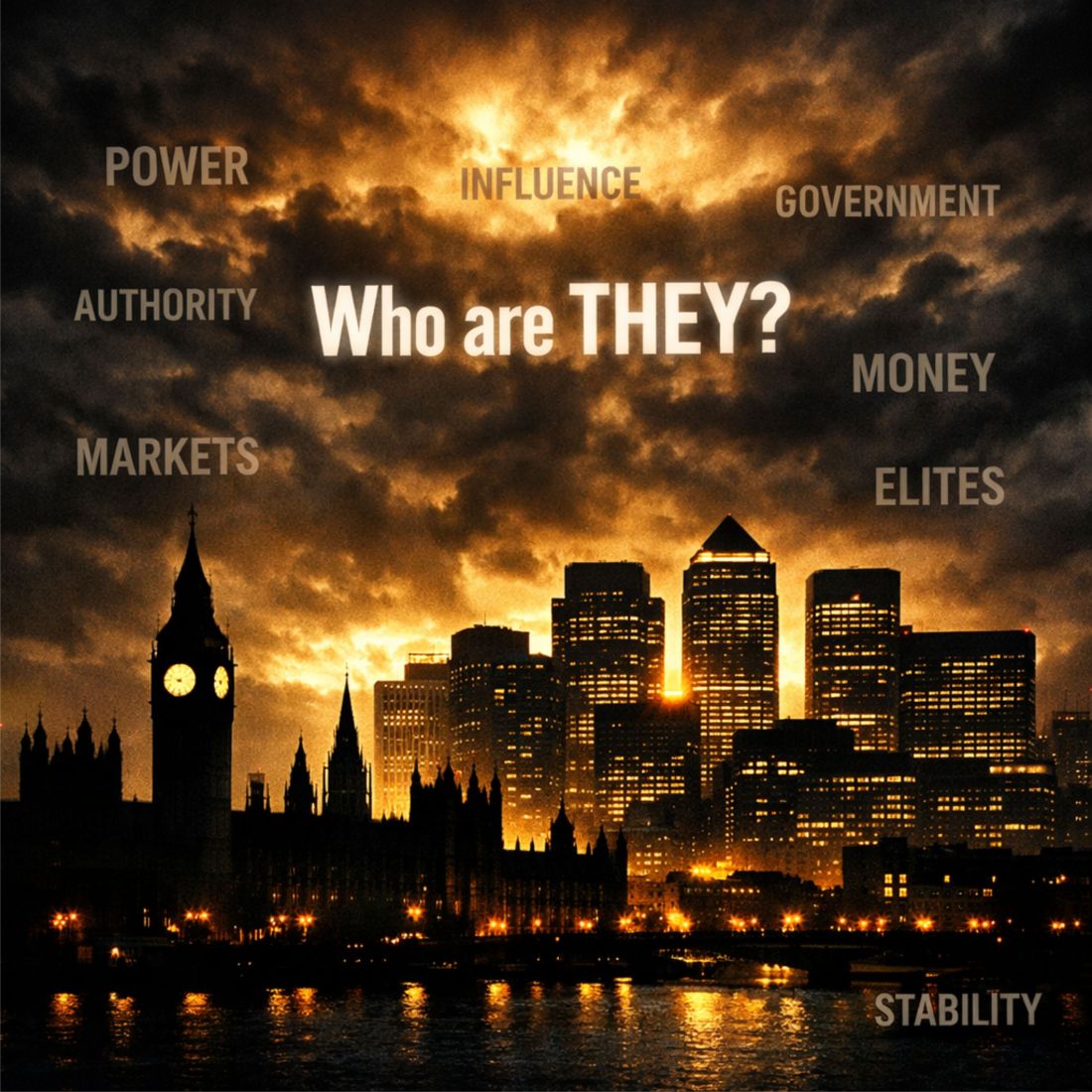
The Establishment is also the “they” that appears in countless political conversations. When people say “they won’t allow it”, “they don’t understand”, “they’ve already decided”, or “they’ll never let that happen”, they are usually trying to describe a force that feels real but is difficult to identify.
When challenged to explain who “they” are, many people struggle – not because they are foolish, irrational or imagining things, but because they are trying to describe a worldview as if it were a group of people. They can see the effects. They simply lack the language to explain the mechanism.
That is what the word “they” often signifies: an awareness of power without a clear map of how that power works. It is a tell. People know, at some level, that something larger than any one minister, party, company or institution is shaping outcomes. The mistake is not sensing it. The mistake is assuming it must be a single hidden group rather than a shared operating system.
The real Establishment is a worldview. A way of thinking. A mental operating system.
It is not a group of people. It is not a secret bunker. It is not a coordinated conspiracy.
It is a belief system that has become so dominant, so embedded, and so pervasive that it shapes everything – including many of the people who think they’re fighting it.
The Old Establishment: A Visible Hierarchy
Historically, the Establishment was simple:
- aristocracy
- inherited power
- the Church
- the military
- the judiciary
- Whitehall mandarins
- elite universities
- old boys’ networks
It was a visible hierarchy. You could point at it. You could name it. You could see who was in and who was out.
This is the Establishment people still imagine – even though it no longer exists in that form.
The Modern Perception: A Spectrum, Not a Consensus
Today, people see the Establishment through very different lenses.
1. Those who benefit from the system
They see the Establishment as:
- competent
- stabilising
- necessary
- expert
- responsible
They trust it because it works for them.
2. Those harmed or excluded
They see it as:
- distant
- unaccountable
- elitist
- opaque
- indifferent
They experience its decisions as disconnected from real life.
3. Those who see conspiracy
They imagine:
- puppet‑masters
- hidden committees
- coordinated elites
This is understandable – the system behaves in ways that look coordinated – but it is not accurate.
4. Those who think they’re outside but are actually inside
This includes:
- anti‑establishment politicians
- populists
- disruptors
- commentators
They believe they are fighting the Establishment. But their actions, not their words, reveal that they operate fully within its worldview.
This is not unique to one party, faction or ideology. A politician can denounce “the elites” while still judging success by market confidence. A newspaper can attack bureaucrats while still treating financial credibility as the final test of seriousness. A reformer can call for renewal while still assuming that centralised management, competitive funding, external consultancy and measurable outputs are the only acceptable forms of action.
The important point is not the behaviour of one individual, but the wider pattern: much of what presents itself as anti‑establishment politics is actually a more intense expression of the same underlying worldview.
5. Those who see clearly but cannot escape
Analysts, academics, journalists and reformers may understand parts of the system, but still live inside it.
Because unless you become an off‑grid hermit, you cannot avoid interacting with the Establishment.
It is not something you leave. It is something you wake up inside.
The Real Establishment: A Worldview That Saturates Everything
The modern Establishment is not a group. It is a belief system.
By “worldview”, I do not mean a formal doctrine or a book of rules. I mean a shared set of assumptions about what is realistic, responsible, credible, modern and possible.
A worldview is powerful precisely because it usually does not feel ideological to those inside it. It feels like common sense.
It is a worldview built around:
- market primacy
- financial credibility
- growth as the unquestioned good
- competition as the organising principle
- state restraint
- technocratic management
- institutional self‑protection
- distance from consequences
This worldview has become the centre of gravity for anyone who wants to succeed in politics, media, finance, business, or public institutions.
It is not enforced by conspiracy. It is enforced by incentives.
How the Establishment Was Captured: The Slow, Invisible Drift
The capture was not deliberate. It was not planned. It was not coordinated.
It was a slow drift driven by:
- globalisation
- financialisation
- deregulation
- privatisation
- market‑centric policy design
- media consolidation
- think‑tank influence
- political professionalisation
- legislative entrenchment
Over decades, the worldview became:
- normal
- sensible
- realistic
- responsible
- inevitable
This is cognitive capture – not a personal failing, but a structural condition.
Here, “capture” should not be read as a claim that one group seized control of everything. It is more subtle than that.
It is the process by which institutions, careers, policy choices and public language gradually align around the same underlying assumptions until alternatives appear naive, dangerous or unserious.
People didn’t choose the worldview. They inherited it. They were rewarded for it. They were insulated by it. They were promoted for it. They were praised for it.
It became the mental furniture of their lives.
Cognitive Capture – The Human Mechanism Behind the System
This is the part many of us may find hardest to accept. Not because it is an accusation, but because it asks us to recognise something uncomfortable: if we live and work inside today’s version of normal life, then we have almost certainly been shaped by the Establishment worldview in some way.
That does not make us foolish, corrupt or guilty. It makes us human. But it does mean that real change cannot begin while we continue to tell ourselves that everything is basically fine, or that the system is only temporarily out of sync, or that the problem is simply the wrong government, the wrong leader, or the wrong party.
Deep down, many people already know this is no longer enough. The unease is not just political disappointment. It is the recognition that something more fundamental has stopped working.
Cognitive capture does not mean people are:
- stupid
- corrupt
- malicious
- incompetent
It means:
The system shapes how people think, and they don’t realise it because it feels like reality.
Anyone can be shaped by a system this pervasive.
This worldview becomes:
- familiar
- rewarded
- reinforced
- socially validated
- professionally required
This is why even intelligent, well‑intentioned people struggle to imagine alternatives.
And this is why telling people “you’re captured” feels insulting – because it sounds like saying they don’t understand their own world.
But the truth is gentler:
Everyone is shaped by the systems they inhabit. Some systems are just more pervasive than others.
The Anti-Establishment Paradox: Why Rebels Reinforce the System
This is one of the most important dynamics.
Many “anti‑establishment” actors:
- use establishment logic
- reinforce establishment incentives
- pursue establishment definitions of success
- rely on establishment structures
- defend establishment assumptions
They think they’re outside. But they’re inside.
The paradox can be seen repeatedly in modern politics.
Many figures present themselves as insurgents, outsiders or challengers of the Establishment. They speak the language of disruption, renewal and rebellion. Yet when examined more closely, their proposed solutions often rely upon the same assumptions, incentives and measures of success that define the existing system.
In some cases, they are not challenging the Establishment worldview at all. They are intensifying it. They push its logic further, pursue its assumptions more aggressively, and then interpret the resulting resistance as evidence of conspiracy or institutional sabotage.
This is why anti‑establishment rhetoric is not the same thing as anti‑establishment thinking. Some of the people waiting in line to inherit power may be more deeply embedded in the worldview than many of the people who currently hold it.
This is the paradox:
People who think they’re outside are often the ones most deeply inside.
And the most chilling part:
Even those who can see the system clearly are still inside it, because the Establishment exists in the assumptions, incentives and institutions that shape ordinary life.
Unless you become a literal hermit, you cannot avoid interacting with it.
How the Establishment Works: The Operating System of Society
The Establishment operates through:
- incentives
- norms
- legislation
- finance
- institutional culture
- professional pathways
- institutional memory
- risk aversion
- narrative control
This creates a self‑reinforcing loop:
- The worldview shapes institutions.
- Institutions reward conformity.
- Conformity strengthens the worldview.
- The worldview becomes invisible.
- The system becomes fragile but self‑protecting.
- Attempts to challenge it are absorbed or neutralised.
- Anti‑establishment actors end up reinforcing it.
- The worldview becomes even more entrenched.
It behaves like a deep state even though it isn’t one.
How the Establishment Shapes Everyday Life
The worldview defines:
- housing
- healthcare
- education
- wages
- taxation
- public services
- infrastructure
- media narratives
- political debate
- what counts as “affordable”
- what counts as “possible”
- what counts as “responsible”
People feel the consequences:
- rising costs
- stagnant wages
- degraded services
- insecure work
- unaffordable housing
- shrinking local government
- political cynicism
- social fragmentation
But they rarely see the worldview behind it.
This is why “they” is such a revealing word. People feel decisions arriving from somewhere, but the source is dispersed across policy, finance, professional norms, media narratives, institutional habits and inherited assumptions. The power is real, but it is distributed. It speaks through many mouths while often belonging to no single person.
This is where abstract language becomes concrete. Housing is not simply a market outcome; it is the result of land policy, credit conditions, planning rules, investment incentives and political tolerance for scarcity. Public services are not merely “inefficient”; they reflect choices about taxation, outsourcing, central control, workforce morale and what forms of care are valued. Local government does not shrink by accident; it shrinks when national systems treat local capacity as a cost rather than as democratic infrastructure.
Why the Establishment’s Belief System Has Reached Its Limit
The worldview appears to have reached its limit because:
- the economic model is fragile
- the social contract is fraying
- public trust has weakened sharply
- inequality has widened
- services have degraded
- infrastructure is under visible strain
- markets are volatile
- the worldview struggles to solve the problems it helped create
- each crisis leaves the system with less room for manoeuvre
This is not merely a mood. Recent UK evidence points in the same direction: official statistics show that homes remain unaffordable for many households; public attitude research has recorded deep dissatisfaction with major services and low trust in governing arrangements; and income research has shown weak living‑standards growth across the period since the financial crisis and through the cost‑of‑living shock.
The system increasingly appears to be defending a model that is struggling to meet the challenges it claims to solve.
None of this proves that every institution is failing, or that every person inside those institutions is acting badly. That would be too crude. The point is narrower and more important: a worldview that promised efficiency, prosperity and competent management now struggles to explain why so many people experience the system as expensive, remote, fragile and unresponsive.
The Strongest Objection
The strongest objection to this argument is that what I am calling an Establishment worldview may simply be the unavoidable logic of a complex modern society. Perhaps advanced economies need expertise, central institutions, financial discipline, legal continuity and professional management. Perhaps markets, whatever their failures, remain the least bad way of coordinating activity at scale. Perhaps the alternative to the current system is not renewal, but chaos.
That objection deserves to be taken seriously. Expertise matters. Institutions matter. Stability matters. The answer is not to romanticise disorder or imagine that sincerity can replace competence.
But this objection only goes so far. The issue is not whether societies need institutions. They do. The issue is what assumptions those institutions are built around, who they are accountable to, what outcomes they privilege, and whether they remain capable of learning from failure. When expertise becomes detached from consequence, when stability protects dysfunction, and when “responsibility” means preserving a failing model, the language of competence becomes part of the problem.
Why Change Requires Awakening, Not Rebellion
Even if a crisis creates the conditions for paradigm change, nothing will change unless enough people:
- see the worldview clearly
- recognise its limits
- recognise its harms
- recognise their own participation in it
Otherwise they will:
- circle back
- rebuild the same logic
- re‑establish the same hierarchy
- re‑entrench the same worldview
People rebuild the cage from the inside.
Conclusion – The Establishment Is Not Something You Overthrow, It’s Something You Wake Up From
The Establishment is not a deep state. It is a worldview that saturates the entire system. People who think they’re outside are often deeply inside. Even those who see it clearly still have to interact with it. And this is why change is so hard – because the Establishment is not something you defeat, it’s something you outgrow.
Its belief system has reached its limit. The question now is whether enough people can see it clearly enough to imagine something better – not merely a different leader, party or slogan, but a different set of assumptions about how economies, institutions and communities should function.
That is why the direction of travel matters. If the Establishment is a worldview, then meaningful change has to be practical as well as intellectual. It has to ask how value is created locally, how decisions are made, how communities govern themselves, how money circulates, how public capacity is rebuilt, and how institutions become answerable to lived reality rather than insulated from it.
Whether that alternative succeeds is a separate question. But no alternative can emerge until the limitations of the existing worldview are recognised. Before systems can change, assumptions must change. Before new institutions can be built, people must first stop mistaking the existing model for reality itself.
Next Step
For a more practical exploration of the direction implied by this argument, see the following text on local economy and governance:

