
We live in a culture where money has quietly become the central organising principle of almost everything. It shapes our choices, our opportunities, our identities, and even our sense of self‑worth – often without us realising it.
We walk through life believing we are making free decisions, when in reality many of those decisions are filtered through a deeply conditioned relationship with money: what we fear losing, what we believe we deserve, and what we think we must accumulate to feel secure.
This isn’t accidental. The systems we live within – from neoliberal economics to globalisation, from centralised governance to fiat‑based monetary policy – are built on extractive logic.
They rely on continual growth, continual consumption, and continual financialisation of life.
Tools like markets, GDP, and monetary expansion aren’t neutral; they infuse every corner of society with the assumption that more is always better, that profit is natural, and that accumulation is a sign of success.
Centralisation plays a major role in this. It creates distance between action and consequence, between producer and consumer, between decision‑maker and those affected by the decision.
That distance dehumanises. It makes it easier not to see the harm. It allows people and institutions to believe that if something is legal, it must also be right. And it enables a kind of collective blindness to the impact of financialising everything – from housing to healthcare, from education to the environment.
But the national‑level systems are only half the story. The other half is personal.
Because the system’s logic doesn’t just operate “out there”; it operates through us.
The belief that profit is a right – that we are entitled to charge not what we need, but whatever the market will tolerate – has become normalised.
Businesses do it. Individuals do it. And every time we take more than we need simply because we can, we reinforce the very dynamics we claim to oppose.
The evidence is everywhere. Owning multiple houses when you can only live in one. Collecting cars you can only drive one at a time. Choosing extravagance not because it nourishes you, but because it signals status.
None of these things are inherently immoral – but they are symptoms of a culture that confuses abundance with excess, and wealth with accumulation.
True abundance is something different.
It’s having enough – enough to live, enough to thrive, enough to contribute – without taking from others or from the world more than you genuinely need.
It recognises that legality is not the same as morality. Just because the system allows accumulation that harms people or the planet doesn’t mean it is right.
Nobody has an inherent right to profit when that profit is built on someone else’s loss, someone else’s struggle, or the degradation of something irreplaceable.
There’s nothing wrong with wealth. But there is something deeply wrong with harm disguised as success, extraction disguised as enterprise, and excess disguised as freedom.
If we want a healthier relationship with money – individually and collectively – we have to start by recognising the difference between wealth that enriches life and wealth that drains it.
And that begins with a simple truth:
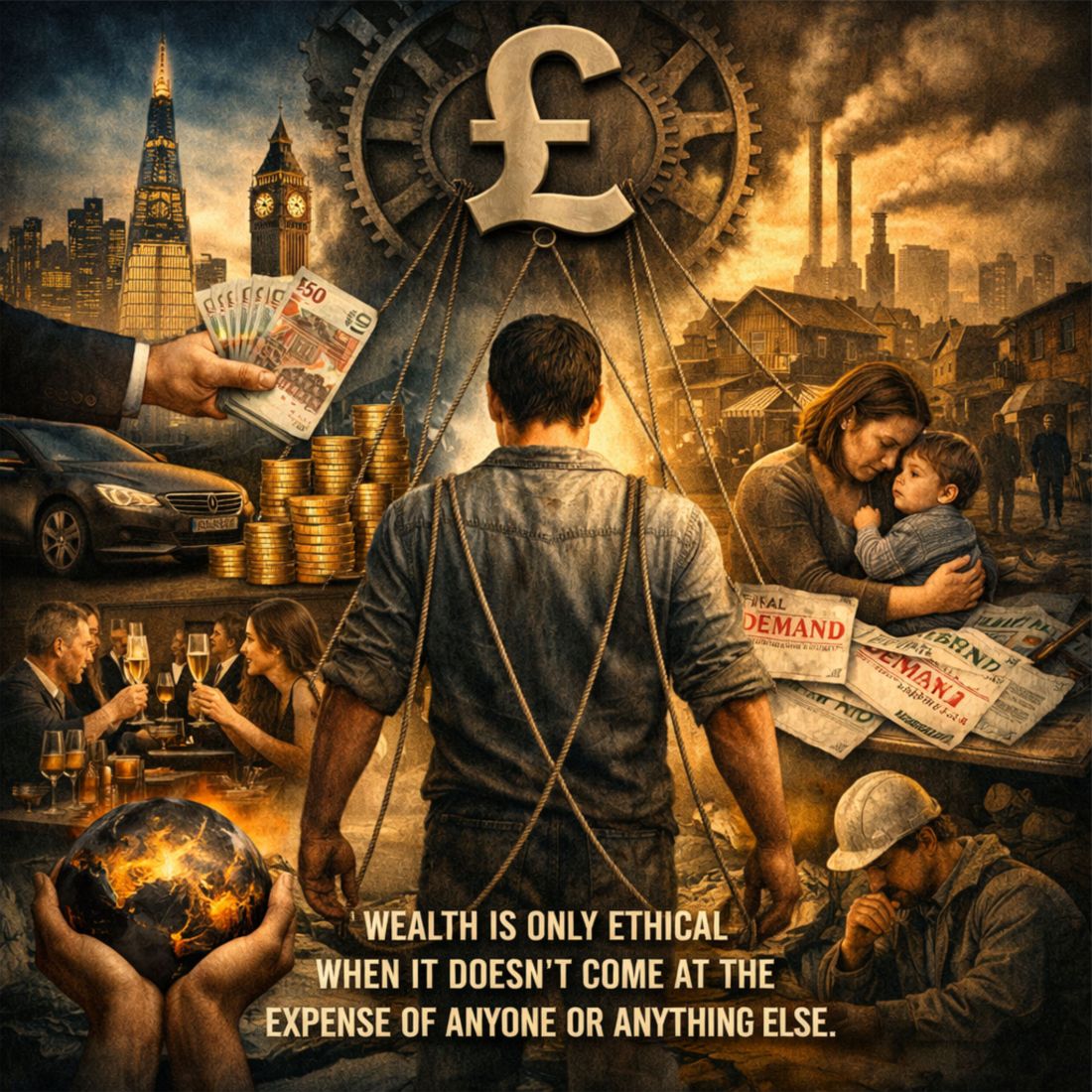
Wealth is only ethical when it doesn’t come at the expense of anyone or anything else.
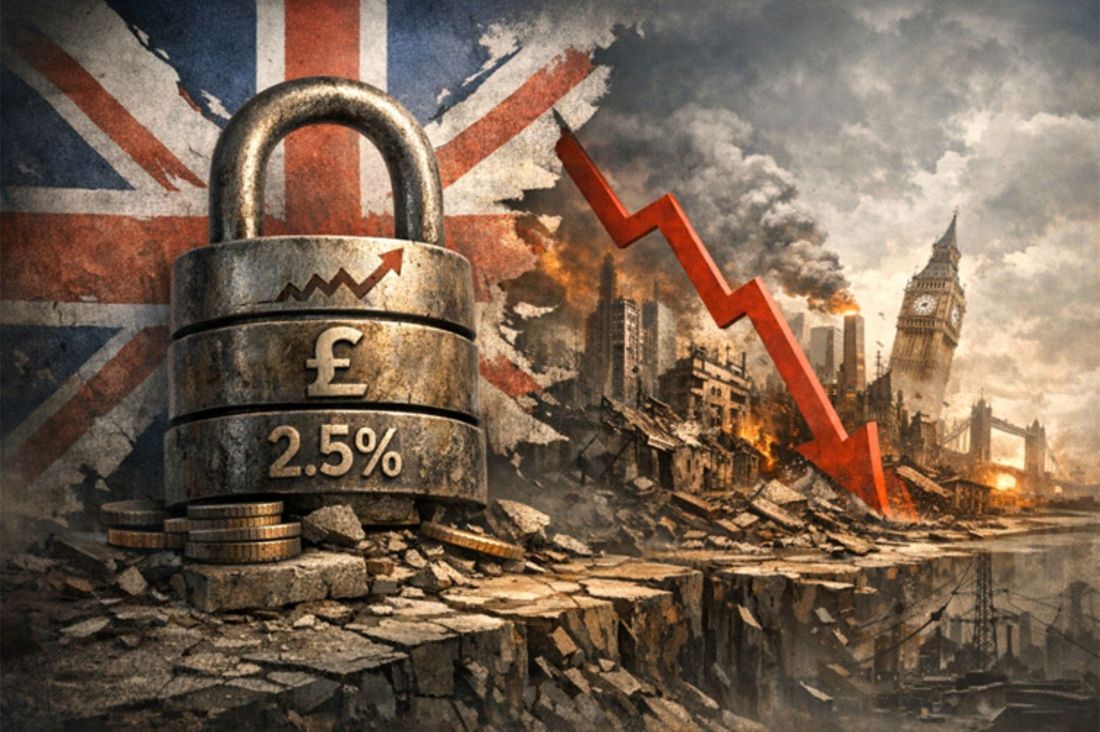
The debate over the future of the State Pension triple lock is often framed as a simple question of fairness: should pensions rise each year by the highest of inflation, wage growth or 2.5%? But the timing of Reform UK’s recent pledge to retain the policy – announced immediately after the party removed its housing spokesperson over comments about the Grenfell tragedy – highlights something more political than economic. The announcement reflected the sensitivity of the moment, not a deeper understanding of what the triple lock represents within the wider economic system.
The triple lock itself, introduced in 2010 by the Conservative–Liberal Democrat coalition and applied since 2011, was designed to ensure the State Pension kept pace with living costs. On paper, it is a straightforward mechanism. In practice, it has become a symbol of intergenerational tension and a lightning rod for wider anxieties about the sustainability of the welfare state.
Yet much of the public debate rests on a misunderstanding – not of the triple lock, but of the system that surrounds it.
The National Insurance Illusion
A significant part of the resentment directed at pensioners – and at benefit claimants more broadly – stems from a widespread belief that National Insurance functions like a personal contribution scheme. The idea is simple: pay in during working life, draw out later if needed. It is a reassuring narrative, and one that shapes how people judge who is “deserving” of support.
But it is not how the system works.
National Insurance is, in practice, another form of taxation. It creates the impression of a ring‑fenced fund, but the money is not stored or invested on behalf of contributors. It flows into the wider fiscal system, supporting pensions, disability benefits, the NHS and more. The distinction between NI and income tax is largely psychological – a way of obscuring the true scale of the tax burden.
This misunderstanding fuels the belief that some groups are “taking out” more than they “put in”.
Pensioners are portrayed as receiving disproportionate benefits, while claimants are accused of drawing on funds they have not earned. Yet both groups are navigating a system shaped not by individual choices, but by structural economic forces that have made independent living increasingly difficult.
Few pensioners enjoy the “gold‑plated” incomes often imagined. And for many, the wealth tied up in property is not liquid wealth at all – it is simply the roof over their heads.
A Safety Valve in a Distorted Economy
The official justification for the triple lock is to protect pensioners from falling living standards. But its deeper purpose is more systemic.
It acts as a safety valve in an economy where wages have failed to keep pace with the cost of living for years, and where millions rely on top‑up benefits simply to survive.
Recent calculations suggest that the real minimum income required for independent living is around £14.92 per hour for a full‑time worker – far above the statutory minimum wage. In this context, the triple lock is not generosity. It is a stabiliser in an economy where the fundamentals no longer align with the lived reality of ordinary people.
The triple lock attracts scrutiny precisely because it exposes this gap: the distance between what the economy delivers and what people need to live.
The Extractive System Behind the Debate
To understand why the triple lock is under pressure, it is necessary to look at the broader economic model. Since the financial crisis of 2007–08 – when the Labour government bailed out the banks on the grounds that they were “too big to fail” – the UK has relied increasingly on debt‑fuelled growth. Public money, or rather public borrowing, was used to stabilise a financial system whose own excesses had caused the crash.
The result was an acceleration of an extractive economic system: one that draws value out of industry, infrastructure and natural resources faster than it replaces them.
Over time, this leaves the state with fewer productive assets and greater reliance on financial engineering to keep the system afloat.
The Covid‑19 pandemic and the war in Ukraine intensified these pressures. Government spending surged, supply chains fractured, and inflation returned with a force not seen in decades.
In such an environment, policies like the triple lock become both more expensive and more politically contentious – even as they become more essential for those who rely on them.
Reform UK and the Politics of Constraint
Reform UK’s pledge to retain the triple lock, while simultaneously promising deep cuts to welfare, illustrates the bind facing all political parties.
The party argues that reducing benefits will free up resources to protect pensioners. But most people receiving benefits are not living comfortably; they are surviving on the margins of a system that no longer delivers affordable housing, adequate wages or predictable costs.
The irony is that many of the people who would be affected by such cuts were encouraged to come to the UK in the first place to sustain a model that depends on population growth and consumer spending to generate GDP. The same pounds circulate through the economy, creating the appearance of growth even when underlying productivity is stagnant.
Reform’s position is not unique. Every major party faces the same structural constraints. None can deliver the full range of promises they make without confronting the underlying economic model – something no mainstream political actor has yet been willing to do.
There is, ultimately, no way to rob Peter to pay Paul when both are already struggling.
A System at Its Limits
The triple lock debate is therefore not really about pensioners. It is about a system approaching the limits of what can be sustained through borrowing, population growth and statistical measures of economic activity.
When the government can no longer create enough debt to paper over the cracks, policies like the triple lock become flashpoints.
The question is not whether the triple lock is fair. It is whether the economic model that makes it necessary can continue in its current form.
Conclusion
The triple lock has become a symbol of a deeper truth: Britain’s cost‑of‑living crisis is not a temporary shock but a structural feature of an economy that no longer aligns with the needs of its people.
Pensioners are not the cause of this problem, nor are benefit claimants. They are simply the most visible participants in a system that has been stretched to breaking point.
The debate over the triple lock is, in the end, a debate about the future of the UK’s economic model – and whether any political party is prepared to confront the realities that underpin it.
Wealth is the only major difference between human beings that humans themselves create, manipulate, and distribute. We do not choose our biology, our innate abilities, or the circumstances of our birth. But wealth – its accumulation, its distribution, and its meaning – is entirely a human invention. And because it is human‑made, it is also subject to human abuse.
Across history, whenever wealth has been allowed to concentrate excessively, societies have fractured. Today, we are witnessing the same pattern repeat on a global scale. The imbalance created by extreme accumulation is no longer just an economic issue; it is a structural risk to the stability of communities, nations, and even the long‑term viability of humanity.
Excess Wealth Is Never Neutral
Those who display an excess of material wealth rarely acquire it through neutral means.
The ability to accumulate far beyond one’s needs almost always depends on taking more than is necessary, inflating value beyond what is reasonable, or benefiting from systems that reward disproportionate gain.
This is not an argument against wealth itself. It is an argument against the illusion that extreme wealth can be innocent.
Common sense tells us that nobody needs luxury versions of goods, services, or experiences. A cheaper alternative would meet the same purpose.
The difference between the two is not necessity – it is access. And access is determined by systems that allow some to accumulate far more than others.
History Shows What Happens When Wealth Concentrates
Extreme inequality has destabilised societies for thousands of years.
In ancient civilisations, concentrated land ownership displaced ordinary people and contributed to political collapse.
In pre‑revolutionary France, privilege and wealth were held by a tiny minority while the majority struggled, fuelling unrest that reshaped the nation.
During the Industrial Revolution, vast fortunes were built on the back of exploited labour, leading to social upheaval and demands for reform.
Periods of extreme wealth concentration have repeatedly coincided with instability, unrest, and systemic breakdown.
The pattern is consistent: when wealth becomes too concentrated, societies become fragile.
Wealth as a Human‑Made Difference
Unlike physical ability, intelligence, or personality, wealth is not a natural trait. It is a social construct. It exists because humans invented it, assigned value to it, and built systems around it.
This means:
Wealth can be redistributed
Wealth can be regulated
Wealth can be hoarded
Wealth can be weaponised
And when it is abused – as it has been throughout history – it creates divisions that threaten the stability of society itself.
The Modern Wealth Divide Is Not Accidental
Today’s wealth divide is not the result of individual virtue or failure. It is the product of systems that reward accumulation over contribution, speculation over labour, and ownership over participation. Markets, tax structures, labour practices, and financial mechanisms all play a role in concentrating wealth upward.
When someone accumulates far beyond their needs, that surplus does not appear from nowhere. It is extracted – from labour, from communities, from the environment, and from future generations.
The Cost of Excess Is Now Impossible to Ignore
We are living in a moment where the consequences of extreme wealth concentration are visible everywhere:
Housing markets distorted by investment capital
Essential workers priced out of the communities they serve
Environmental damage driven by patterns of overconsumption
Political systems influenced by wealth rather than democratic will
Social fragmentation as inequality erodes trust and cohesion
There is no innocent way to consume or possess far beyond one’s needs when the social and environmental costs are so clear.
A Threat to the Foundations of Mankind
When wealth becomes the primary measure of human worth, and when access to it becomes increasingly unequal, the result is instability.
History shows that societies cannot sustain extreme inequality indefinitely. Eventually, the imbalance becomes too great, and the system breaks – through revolution, collapse, or transformation.
Wealth is the only major human difference that humans themselves control. When we allow that difference to grow unchecked, we create a hierarchy that undermines the very idea of shared humanity.
The question is no longer whether inequality is unfair. The question is whether it is survivable.
As the cost of living continues to climb across the United Kingdom, many households find themselves struggling to maintain even the most basic standards of financial independence.
With impending tax rises on the horizon, the pressure on those already living near the edge is set to intensify, pushing even greater numbers below the threshold of self-sufficiency.
This is not a temporary crisis, but a symptom of a deeper, systemic failure—a collapsing economic model that now survives only by extracting more from those who can afford it least.
The money-centric economic system that we have – The “Moneyocracy” – perpetuates itself by shifting the burden onto workers and taxpayers, while the promise of prosperity grows ever more distant for the majority.
Against this backdrop, it is essential to confront a fundamental question – one that exposes the uncomfortable realities at the heart of our economy.
A Question:
Do you believe the minimum wage is enough for a full-time worker to live on – and if so, why?
The answer to this question, which varies depending on one’s relationship with the minimum wage, reveals uncomfortable truths about the foundations of our economy and the way work is valued in this country.
What is not surprising is that those who already have financial security often agree in principle that low-paid workers should earn more. Yet when confronted with the implications of paying every worker enough to live independently, many recoil. Why? Because such a change would disrupt their own relationship with the economy.
The Minimum Wage Reality
Let us be clear: the national minimum wage in the UK is not enough for anyone working a full-time 40-hour week to live independently—free from reliance on benefits, charity, or debt.
The widespread acceptance of this wage stems from government and establishment narratives.
What is legally mandated is presented as morally and practically sufficient.
Yet, in truth, the minimum wage is a carefully placed rock covering a pit of myths and lies.
Those who benefit from the system prefer not to lift that rock, because doing so would expose their complicity in maintaining the illusion.
The Employee
A worker earning the minimum wage – currently £12.21 per hour, equating to £488.40 per week or £25,396.80 annually – cannot afford the basic essentials required for independent living.
The gap between what they earn and what they need is effectively the amount by which they are underpaid.
Employers exploit workers by failing to cover the true cost of living.
Regardless of how the deficit is filled—through benefits, charity, or debt—someone else is subsidising both the employee and the employer.
The Employer (Small Business)
Small business owners often insist they pay fairly because they comply with the law. Yet compliance does not equate to fairness.
Paying the legal minimum is not the same as paying enough for employees to live independently.
Common justifications include:
• “They can top up with benefits.”
• “I can’t pay more or I’ll go out of business.”
But these arguments miss the point. The government—and by extension, taxpayers—should not subsidise businesses that cannot afford to pay workers a living wage.
In reality, small businesses are also exploited: they cannot operate independently within the current economic system, because they too are constrained by models that undervalue their work.
The Employer (Big Business)
Large corporations differ because they can afford to pay more.
Supermarkets and other major employers of minimum-wage staff generate enormous profits – even during a cost-of-living crisis, like the one we are experiencing now.
They could easily pay wages that allow workers financial independence, if boards and shareholders accepted smaller returns.
Instead, big businesses exploit both employees and taxpayers. Workers are underpaid, while the government subsidises wages through benefits.
This allows corporations to maximise profits while keeping the mechanics of exploitation hidden from public debate.
The Government
Why does the government subsidise wages so small businesses can survive and big businesses can thrive? Why not simply set a minimum wage that reflects the true cost of living?
The answer is stark: doing so would collapse the system.
The economy functions by undervaluing the majority of jobs deemed “low-skilled” or of “little value.”
If wages reflected reality, the house of cards would fall.
The Taxpayer
The system is a con. The complex machinery of what can be called a Moneyocracy manipulates trust and deference so effectively that taxpayers rarely ask basic questions.
Why, in an economy where corporations make billions annually, must taxpayers top up their employees’ wages through taxes?
Why are we threatened with price hikes whenever government policy shifts, while corporate profits remain largely unscrutinised?
Following the money reveals the truth: wealth is funnelled in one direction, made possible only by exploiting workers, taxpayers, and weak governments.
Corporations profit by underpaying staff, then spin narratives that justify charging consumers more.
Reality Bites
Exploitation of normal people has gone too far. The system enriches the few by exploiting the many – sometimes multiple times over – so profits can grow while wages stagnate or reduce in real terms.
The Moneyocracy survives by perpetuating the myth that it is acceptable for many to grow poorer while a few grow disproportionately rich.
The promise dangled before workers – that if they play the game long enough, they too might “live the dream” – is false.
Humanity is destroying itself chasing a dream that continually recedes, because playing the game requires forgetting our true worth.
The basic equation of the Moneyocracy is simple: for some to be rich, most must be poor.
This is neither humane nor true.
The Alternative
There is another way. A system built on real values – where people, communities, and the environment come first – can replace the current money-centric model.
This alternative requires transparency, local systems, and a commitment to prioritising human worth over profit. Instead of hiding self-interest behind complex structures, society must embrace a model where business and life are conducted openly, sustainably, and with fairness at the core.
The choice is absolute: continue with a Moneyocracy that exploits us all or build a future centred on people.
Path Forward
The Local Economy & Governance System provides the foundational framework for a truly people‑centric future – one where People, Community, and Environment sit at the heart of every decision.
At its core lies a new benchmark: The Basic Living Standard, a guarantee that every individual receives a weekly wage sufficient to cover all essential needs.
This principle of equity and equality is not an optional add‑on, but the priority that guides every part of the system.
By shifting away from exploitation and toward fairness, transparency, and sustainability, this model offers a pathway to rebuild trust and resilience in our economic and social structures.
To explore how this vision can be realised and what it means for the future, please follow these links:
Each of us sees the problems this country is facing from different points of view.
Whilst conversations about the crisis now unfolding with a range of different people would almost certainly deliver a range of common themes, the emphasis, value or meaning of each of those conversations will almost certainly be different.
However, the one commonality, which isn’t about anything that we all have in common, would be the solutions that almost all of us will have based on our own world view, that in the bigger scheme of things, may be in no way similar at all.
Ironically, because so many of us have so many interpretations of the whys, hows and whats that have got us all here, and share them with what will be a relative few, we spend next to no time – if indeed any time at all, thinking about the common problems that we all really do share.
We certainly don’t think about the ways we can work together to create a better way of life for everyone and then how we get the leaders and mechanisms in place that will actually get us there.
The devil is in the detail
It really is no accident that the UK is in the kind of mess that it is. Because life has become so very complicated – and deliberately so.
The more detail, the more distracting and the more impossible a solution to just about anything might seem. Even to those amongst us who really can see that the status quo cannot continue and that no matter how bought into the things we like about the way we live – which we want to keep but don’t recognise that they are actually the part of the problem that’s making everything so impossible to fix – we really do need to snap out of the fixation with noise that’s doing none of us any good.
We must recognise that the things that work well for everyone and will work even better for everyone are much simpler than what we have been convinced we need.
It is inevitable that we will keep tripping ourselves up each and every time we think of the next step as being only about putting our own self-interest first.
Unfair, Unjust and Unworkable living, demonstrated best by Tax
Perhaps the best example of how we get lost and misdirected by the detail of what needs to change for us, rather than focusing on what needs to change so that it works for everyone, relates to the question of tax, taxation and everything else that means people like you and I are stumping up cash that we could often do with being able to spend, just so we can live without debt or in some cases rely on handouts or even food banks.
Yes, even framing the ‘tax issue’ this way will make some prickly – and that really is the point.
The UK Tax code is today thought to be over 21,000 pages and 10 million words long, giving everyone the distinct impression that the subject of how the bill for government action and delivery gets paid for (ostensibly on our behalf), needs to be tailored specially to everyone as if bespoke governance is the only kind of governance that’s really fair to everyone.
This is ‘The day when Britons stop paying tax and start putting their earnings into their own pocket’. Or alternatively, the final day of the year when every penny we’ve earned goes to the government – if we start counting on January 1st, which was this year (2025) calculated as being June 11th by the Adam Smith Institute.
The reason I’m using this figure isn’t to upset anyone by drawing attention to the fact that as an average, we arguably all work for no other reason than to keep the wheels of government turning every year for at least 5 months.
I’m doing so because it may be the only way to look at the relationship all taxpayers have with the government in the same way. Given how easy it is to get sidetracked by the question of what everyone earns!
June 11th 2025 was the 162nd day of the year (as 2025 is not a leap year), and with 365 days in 2025, this means that in comparative terms, people are giving over 44% of their earnings (162 divided by 365 days), before they can even begin to think about what they need to spend money on, in turn before anything that they might actually want.
For a moment, let’s forget the amount anyone is actually earning for themselves, as we know that some have considerably more than others, whilst many just don’t have anywhere near what it takes to live without struggling to make ends meet, and then take it as read that everyone is giving up 44 Pence in every Pound they earn (£0.44).
After realising just how much of everything we do have taken from wages and then what we pay for that includes some form of tax, it doesn’t take much to realise that government or rather the model of government that we have is simply unaffordable, unsustainable and that we must do everything we can to find a different and much better way to pay for the things that we share.
Regrettably, the complexity of rules and regulations supposedly there to benefit and protect us don’t stop at taxation.
One of the reasons that every part of life, that doesn’t already relate to the question of financial affordability in some way, seems so difficult or restricted, is because our freedoms and therefore our independence from the system and government are already being actively controlled in many different silent rules that have deliberately been put there using the excuses like health and safety, and protecting us or someone in some way.
Even if we aren’t actively being followed around by a police officer all the time the fact that we are aware of and abiding by these rules usually adds up to being the same.
Government isn’t what it should or was ever supposed to be
Whilst many would actually like to see the wealthiest in our society directly paying at least 44% of their income to the government to help run everything outside of our front doors, we still need to keep some perspective when it comes to the obvious question we will come back to in a moment about who pays and begin with the question, ‘Does government actually work?’
Government certainly functions. Even the deepest or most vocally critical of what government in the UK does will find it difficult to argue otherwise.
Because no matter the organisation or service that comes under the rather large umbrella of government, they all continue to do something. Even if they are not delivering what we might agree to be the correct results. And that’s the only reason it can be argued that it all works.
However, functioning and succeeding are not the same thing.
The time is long overdue that we all took a very hard and questioning look at every part of government and decided what, if anything, public services should or could be; just exactly where the scope and reach of government should end, and then and only then, what many believe to be the most important question of all, ‘How whatever government and the public sector does is paid for and by whom’.
Whilst it remains the case that there are services, infrastructure and even public facing roles that every modern society needs to be provided by the community, so that everyone can have universal experiences and opportunities which will always be the same, no matter who, where or what you are, the practical approach to not-for-profit service delivery – which this really should in almost all cases be, is not the same as the public sector and system of governance that we have today.
Every part of government and the public sector that we have today is focused on delivering (political) and therefore biased agendas which will inevitably advantage some people more than others in some way. Or is all about the jobs, terms and conditions for whoever the incumbent employees are who currently have the jobs.
There have always been politicians, officers and suppliers who for many reasons have chosen to advantage themselves in some way, if and where they failed to have the integrity to exercise their roles properly. And regrettably, it’s the position of trust we gave them all that enabled them to behave in such questionable ways.
Yet even more shocking reality that we all face today is that the whole public sector and everything that runs within it is now dysfunctional in terms of delivery in some of the most critical ways.
It has only been able to become this way because decisions have either been made (or not made) at the very top by people who really should have known better, and whose actions have allowed or facilitated everything that serves the public unwinding in this way.
Money before People
Regrettably, like so many areas of life today, the role of money – which stretches far beyond the scope of the tax question that we’ve already considered – is also the key element within the dysfunctionality of government and public services across the UK. Because the poor leaders that we have are obsessed with the idea that the only way any problem can and will be fixed is by having enough money to spend – no matter where it comes from, which is itself is these days even better for some politicians who dare not do anything which could restrict what they are already committed to spend.
Idealism and agendas cost a lot of money. Because their implementation requires the creation of systems, rules and infrastructure somebody wants but nobody needs.
The very perverse outcome from decades of government and the public sector serving itself, its people and whoever or whatever influences them, is that the changes that have been made in every way imaginable to support this are now costing too much for either the Taxpayer or government itself to sustain.
We have a VERY BIG problem. Because nobody in government or who wishes to form one either can or will be honest about the true depth and breadth of the mess that the UK is now in.
With Tax rises thought to be well on their way this coming Autumn, the reality that too many of us face is the 44% (or probably much more) that we are already contributing to this public sector black hole through so many of the things that we buy, pay for or earn, are set to keep going up.
All to cover the exploding costs of incompetence, waste and the furtherance of playing up to what are very dangerous egos. Because somewhere in amongst all of this the point has been lost that government does not and never did have the right to exist over the people that it was created to represent.
For any kind of government to be unrepresentative of the people it represents, would by its very nature and intended purpose mean that it represents someone or something else.
Money: The drug wrecking everything to enrich and empower the few
The way that money actually works, how it is controlled and worst but not least, how it is actually created at will, is the truth that sits behind everything bad, that few of us will willingly believe.
It’s much easier to believe that it is all good rather than even having the potential to be bad – even when almost everyone can see the destruction that money or the lack of it is causing to everyone in some way or form.
At the heart of the money tree and its root and branch system sits the mechanisms that supposedly fund government, but actually do so by doing everything to help grow the volume of money that is in circulation, so that the public spending – and the only way that politicians know how to get themselves out of trouble, can leverage ‘growth’ so that the depth and scope of the real problem can be hidden from public view.
Unfortunately for all of us, the exponential growth of the ‘money’ that has entered circulation, particularly since the responses of government to the Global Financial Crisis of 2008 and the Covid Pandemic of 2020, has wildly contributed to the inflationary spiral that accompanies such an expansion of available cash.
The creation of money that doesn’t relate to anything else like productivity or output devalues the money and incomes that normal people already have, as well as what they have the ability to earn.
It does so at breakneck speed whilst the real value of everything is funnelled towards those who control and benefit from what is a fully legal, legitimised but nevertheless completely corrupt system that appears real, because they have typically become millionaires and billionaires in the process.
Put simply, the lowest paid and most vulnerable now have zero chance of ever being able to earn enough to live independently of benefits, charity, debt or worse.
For as long as the money madness continues, the bubble containing all of those who are branded as being a drain on the system will rapidly continue to expand.
The leadership void or black hole
When a country has such questionable leadership, and has done for the period of time that the UK has, it wouldn’t be unfair for any of us to be asking, ‘How did we get them?’ and ‘How did they get to where they are?’.
However, as we all need to realise, very few of us do ask these questions or indeed any questions that are like them. And because we don’t, each time an election takes place locally or nationally, we are, as a majority, making the same mistakes over and over again.
We are chewing at the very same dogs dinner with the bits just wrapped differently with words, rosettes and faces – all hiding the same miserable self-interested and dangerously incompetent content that always delivers outcomes that are the same.
Because we have a very bad, self-destructive habit of going along with the idea that the political fairies come along and give us all a genuine choice at election time – as all good democracies surely would, we have not only accepted that government after government and council after council has worked on all of our behalf. We have also jumped into an elephant trap of our own making that tells us these same fairies will deliver the politicians to choose from at the next election, who will sort out and solve the very same mess that they and their own kind created (with a little help from their friends) in the first place.
Sadly, there are no exceptions to the reality that we must face that there are no real leaders in politics today.
The so-called leadership we see, and what the people we identify as leaders say, is much more likely to be aligned with us hearing and seeing whatever we need to fuel our own confirmation biases than it either is or ever will be about the solutions and outcomes that we might not be ready to hear about, but nonetheless actually need.
Victim or Victimiser: There is no longer an in-between
As a society and culture, we are collectively suffering what might be the worst type of addiction of all. Simply because it is majority of us are addicted rather than the few.
Meaning that that same majority is completely out of touch with the realities of what that addiction does and will remain so, until the supply runs out – which is where all those who cannot afford to live independently within the current system have or are beginning to find out.
Money, or rather the way that money is used by those who control the system – and that means government and politicians, who are very much under their control too, has become the key factor in every equation and consideration in our lives.
The role of money and its reach has dehumanised everything to the point where money and the power, influence and control it is perceived to give at every level of life has become more important than the value of life and community itself.
Few realise just how their lives are completely at the mercy of the ability to spend, borrow and achieve the momentary of transitory hit that this money centric, Moneyocracy we inhabit demands of everyone and which is enforced by the barrage of non stop marketing and remote, typical digital pressure which comes at us constantly and demands that we all conform.
Money; what it does, what it can do and what it says about you is the qualification and gatekeeper that runs through every part of functional life and if you are in, you are in and if you are out, you really are all the way out and fully at the mercy of those who continue to be ‘in’.
The tragedy of the system is the ruthless and methodical way that human behaviour has been used against the masses by the few and the experts they pay who understand it.
The sweeties and trinkets that have been flowing towards for decades have only been bettered by what has appeared to be the endless ability to secure more and more credit to buy it with, all the time becoming more and more essential to secure as real earnings and wealth have been stripped by the printing of all this extra ‘pretend’ or non existent money that even relatively wealthy people have no chance of keeping up with.
The irony is that those of us who continue to believe we benefit from what the establishment is doing and therefore acquiesce or go along with it are – through our actions – making those who cannot the victims.
All for no better reason than this whole situation could not exist without the elites treating the masses as a resource that is not real. But is instead just like oil, coal, precious metals, forests, farms, land and even animals – and just something else for those who ‘own them’ to exploit.
We all need to contribute to what we share in life. But real life cannot continue if we are required to contribute everything we have
Whilst we must all accept it is correct for everyone to contribute to the upkeep and maintenance of the systems and infrastructure that serve us all, from the moment we step onto the pavement or road outside of our homes, what we share is not and never should become more important than the right to have a fully independent, functioning and self supported life experience.
The system that we have discussed is at breaking point and cannot continue as it has, or as it is today.
Those in charge don’t know how to do anything other than borrow or tax us. And as the system can no longer sustain the borrowing that idealism and agendas have made necessary, the current government are now looking at everything they can tax beyond everything they already do.
One way or another, the system is going to collapse. Because we are all living unsustainably in a system that itself is unsustainable and at the centre of which is a plague which is the absence of real leadership, replaced with what is instead no better than incompetent management that makes it the most unsustainable part of it all.
Real life and a money-centric economy are mutually exclusive outcomes
Government already costs us way too much – even at 44%.
That’s before we even begin to consider the work and additional value to public service that charities and other nonprofit organisations bring, that we are all in one way or another contributing to too.
The whole model of economics needs to be restructured and redeveloped so that it supports life, rather than feeding off it like the giant parasite that the financial system and the role that government plays in it now is.
A realistic level for everyone to contribute to ‘the community’ would be around 10% – without any form of exception for anyone.
We should also be considering the added requirement that everyone able to work also contributes the equivalent of 10% of their working time and the skills and experience they offer, to help make our communities, their governance and infrastructure work.
Thereby creating real buy-in and ownership for what we all share, whilst drastically cutting the scope and influence of an out-of-control sector, and the ballooning costs that are actually paying for lots of agendas and idealistic ideas, but very little that is actually about people and certainly nothing that’s doing everyone equally any good.
The identity, qualification and process of finding good leaders
Good public leaders, public representatives and public servants, would not facilitate or contribute to the creation, implementation and furtherance of agendas, ideologies and idealism that doesn’t serve the genuine best interests of those who they have been elected, appointed or recruited to serve.
Yet we have been experiencing decades of exactly that. And we have no hope that this will change if we continue to rely on a system that needs to change giving us the leaders who will then do the right thing when it comes to the delivery of that change.
Contrary to accepted thought, we do not need money to play the role across society that it has been deliberately engineered to do.
Power and control are certainly not a gift that should be secured within the hands of a distant, faceless, unanswerable few who we will never meet and whether intended or not, are treating humanity as a resource and no better than a numbers game that they can do with as they like. All as if they are now, as the result of decades of manipulating the system and bending it to their will, the new gods of everything with everyone else’s destiny theirs and only theirs to decide.
The truth that few see is that the centralisation and push for remote control of everything that globalisation and everything that walks alongside it has been, has been the active and complete restructuring of our society and culture, so that nothing can or will work without the say so and direction of those who make all the decisions.
None of this was accidental. Locality, local relationships, local businesses, local supply chains, local decision making and everything that goes with it promotes sovereignty and independence. It encourages and grows a living environment and cultural model that is good for everyone other than those who want to advantage themselves and be in power or control.
Meanwhile, the downsides of centralisation and everything that goes with it are the for every one of us to see.
However, despite the various attempts, compelling rhetoric and highly credible narratives that work so well when playing up to the addiction for material living that we currently have, there is an alternative and much better alternative to running life and everything that we and our communities need. And the real upside of this real alternative is that it centres completely around putting normal people and our local communities back in control.
The fact that generations of political leaders and those they favour or are influenced by have misused and abused their position to create a system with faux legitimacy – simply by legalising immorality to make it appear moral and therefore unquestionable, doesn’t make it right. And it certainly doesn’t become right, just because those in power today continue to insist and behave as if it is so.
We have a legitimate right to hold power and control over our own destiny.
The power of collective decision making should sit as part of a new structure of governance within our communities, amongst people and representatives who we ourselves select and know we can trust.
A moral obligation arguably also exists to reset the entire system and the various devices such as money and the tools of governance the existing system uses, so that we once again bring the focus of everything in life back to people, to humanity and to creating the best kind of environment that we can to ensure that every person has the life experience that everyone – and not just a selective few should have.
However, nobody else will step up or step in to do this for us – no matter how compelling or necessary this might seem.
Whether addicted or not, the choice and the steps necessary to return power to people and to our communities, and with it the creation of a genuine democracy we can all trust and believe in, are ours and only ours to take.
Nobody in the public sphere today can or will do this. None of them will give us back the influence that is rightly ours. Because they all imagine themselves as leaders who can only lead by having absolute control over everyone and everything else.
We don’t have a roadmap agreed for the future.
But there are plenty of ideas we can share about the outcomes that will serve all of us equally well and in a balanced, fair and just way.
This is where the conversation must start.
The one thing we can be sure of is that real leaders do actually lead. But also know that it is real equality, balance, fairness and justice that applies equally to everyone where the pathway to everything good for everyone really starts.