Risk and Responsibility: Why Farmers Must Choose to Rebuild the UK Food System Before It’s Too Late

Introduction

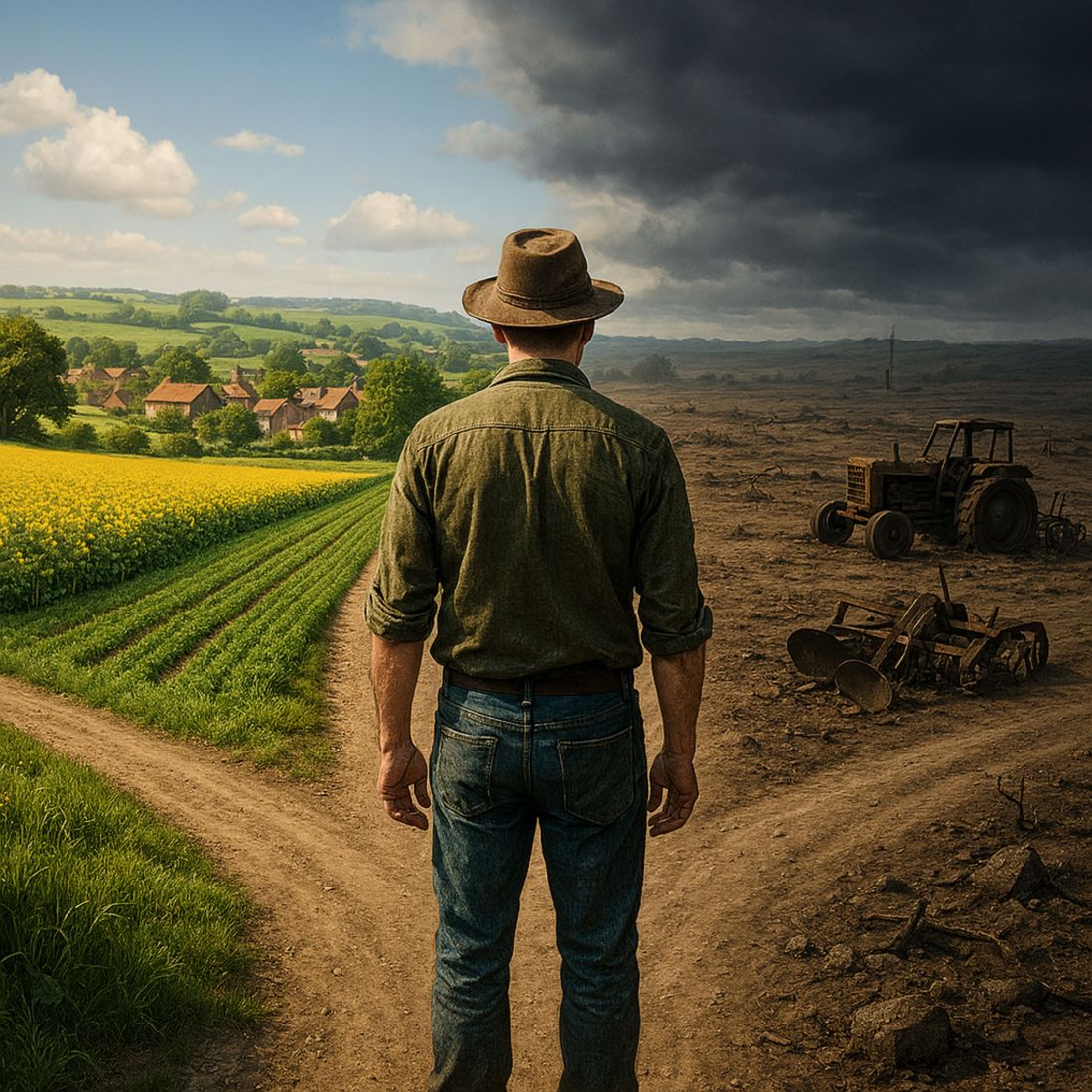
The future of UK farming stands at a crossroads.

In recent years, mounting challenges have threatened not only the livelihoods of farmers but also the nation’s ability to control its own food supply.

As policies and industry practices increasingly sideline independent food production, farmers face a pivotal choice: continue operating within a system that undermines their independence, or take bold steps to reclaim control and rebuild the UK food chain from the ground up.

This article explores the urgent need for change, the systemic issues facing agriculture, and the powerful impact that farmers’ decisions will have on the future of food security, communities, and the environment.

Farmers’ Choice: Reclaiming Control of the UK Food Chain

Farmers in the UK face a critical decision: either take back control of the nation’s food chain now, or risk losing everything—including the freedom that comes from managing our own food supply.

Background

In the summer of 2023, I published The Glos Community Project, which later evolved into An Economy for the Common Good.

Originally written as a book, The Future is Local, this project explored localising the supply of essential goods and services when our current system collapses.

It offered a practical vision for local communities, emphasising business models that prioritise people, communities, and the environment over profit. The central idea was to shift away from money as the core value and put people first.

Food and food security have always been central themes since I wrote Levelling Level in 2022. Through examining food production within a localised, circular economy, I realised just how pivotal food is to our future.

Unfortunately, the UK food chain’s importance is being sidelined and overlooked today.

The State of UK Agricultural Academia

My focus on UK food security led me to postgraduate study at the Royal Agricultural University in late 2023, where my concerns about the establishment’s approach to agriculture were only amplified.

There are glaring contradictions in the current system – contradictions that academic institutions seem unwilling to address. This reluctance raises questions about the true purpose of agricultural academia if it won’t challenge the status quo.

However, this malaise isn’t unique to agriculture; it reflects a broader trend in UK higher education, which has shifted from providing world-class centres of learning to institutions focused primarily on turnover and getting every student they can through the door.

Challenges Facing Farmers

The experience at the RAU mirrors the state of UK farming today. There is widespread recognition that something is fundamentally wrong, yet calls for change are often muted and deferential to the establishment.

Many across the industry still believe that government, the public sector, and corporate players will prioritise the needs of small businesses and farmers. However, history shows that this is rarely the case.

While farmers, industry speakers, and advocacy groups continue to speak out, their efforts often amount to little more than noise. Many hope that politicians will eventually address the industry’s difficulties, or that a change in government will bring solutions.

But the reality is that UK food security is not being treated as a matter of common sense or urgency.

Who Controls Our Food Controls Our Future

The Farm Inheritance Tax issue highlighted how every part of the UK food chain lacks the priorities that working family farmers and the public deserve.

The system is rigged against independent UK food production because the establishment resists any sector that could foster independence from the current system.

Sadly, instead of helping, advocacy organisations often reinforce the myth that government supports UK farming by prioritising the relationship they have with politicians and officials, even as policies make it increasingly difficult for independent producers to survive.

The reality is that no matter how they are presented, the changes are all designed to encourage the end independent food production in the UK.

Control over the food supply is power. Like other productive industries, UK farming has been systematically undermined under the guise of progress, innovation, and economic policy.

This process began with the adoption of the Neoliberal FIAT money system and the push for global business, and deliberately misled previous generations into believing that joining the Common Market and making increasing commitments to the EU methodologies would benefit everyone.

The Consequences of Inaction

For decades, we have been distracted by consumer culture and promises of continuous improvement, while key industries have been hollowed out.

This has allowed a small group of wealthy individuals and corporations to consolidate control over land, businesses, and resources, often through changes in rules and regulations that once existed to support people, communities and the environment.

While some may dismiss these concerns as conspiracy theories, the evidence is clear: the consequences of these actions have been real and damaging. Many still struggle to believe that such harm could be inflicted for the sake of control and profit.

The Reality Today

Food and our food supply are critically important, yet many fail to grasp this.

Some policymakers believe traditional farming is obsolete and that future food will be produced in factories, regardless of the health or freedom implications.

Reports on farming profitability are rarely taken seriously, as the industry’s problems are symptoms of long-term, deliberate changes.

Governments of all parties are invested in a collapsing system, unable or unwilling to enact meaningful change.

Their solution is now to tax everything in hopes of reviving that failing system, but this approach is unsustainable too.

The Choice for Farmers

Farmers now face a pivotal choice: continue operating within a system that works against them, or walk away from government and industry expectations.

By starting anew and rebuilding the UK food system from scratch, farmers can reclaim control and create a future that prioritizes people, communities, and the environment.

Key Points Summary

  • Urgency for Farmers: UK farmers must act now to reclaim control of the food chain, or risk losing their livelihoods and the nation’s food security.
  • Local, People-Focused Economy: We must shift from profit-driven business models to ones that prioritise people, communities, and the environment, as outlined in the newly published Local Economy & Governance System.
  • Systemic Issues in Agriculture: There are deep-rooted problems in UK agriculture and academia, with institutions reluctant to challenge the status quo, and a broader trend of prioritising financial gain over genuine learning and improvement.
  • Government and Industry Inaction: Despite widespread recognition of problems, calls for change are often muted. Many in the industry hope for government intervention, but history shows that politicians rarely prioritise farmers’ needs.
  • Control and Power: The UK food system is structured to prevent independent food production, consolidating control among a small group of powerful interests. Advocacy organisations often reinforce the myth of government support, even as policies undermine farmers.
  • Consequences of Policy: Decades of policy have hollowed out key industries, transferring land, resources, and businesses to wealthy corporations and individuals, leaving communities and the environment vulnerable.
  • Dismissal of Concerns: While some may dismiss these issues as conspiracy theories, most recognise that the negative impacts are real and significant.
  • Misguided Beliefs: Policymakers increasingly believe traditional farming is obsolete, favouring factory-produced food without considering health or freedom implications. Reports and studies on farming profitability and the  problems the industry faces are rarely taken seriously.
  • System Collapse: The current system is unsustainable, and governments are unable or unwilling to enact meaningful change, resorting to increased taxation in a failing attempt to keep the system afloat.
  • A New Path Forward: Farmers are encouraged to reject the expectations of government and industry, and to rebuild the UK food system from scratch, prioritising independence, community, and sustainability.
Farm Inheritance Tax didn’t arrive in isolation. That’s why it defies common sense

Watching the continuing bewilderment, frustration, fear and anger from so many across the UK farming community is not easy.

But the real difficulty for someone like me is not only the avoidable hardship that is now being felt. It is the sense that this policy sits within a much wider and deeply troubling direction of travel.

It is the reality that we cannot properly address what is happening, or why it is happening, until many more of us, and not least of all people from within farming and its related industries, begin to accept that what we are seeing, experiencing and increasingly becoming victims to, does not sit comfortably with our reasoned expectations of government and governance. It appears instead to reflect a much deeper worldview about food, markets, land, value and centralised control that many understandably find difficult to recognise, let alone accept.

Whilst many within the farming industry may feel that you can only understand and relate to the turmoil that this one change in public policy has caused if you are a farmer and have obvious skin in the game yourself, the action taken by the government and its failure to respond to months of concern in any way which makes practical sense is far from isolated. Not least of all because the tax that could be raised by the policy is, in public spending terms, trivial. That makes it very difficult to believe that tax revenue alone explains what this change is really about.

Indeed, what appears at first to be a harsh attack on ‘rich farmers’ is better understood as part of a much wider argument about food, food security, and the independence that locally controlled food production gives us. It is this that should concern us all more than anything.

It is vitally important for anyone who wants to address the real issues that UK food production faces to stop and look beyond the question of Farmers IHT itself.

To begin understanding how the bigger and deliberately complicated picture works, we all need to see how the IHT policy did not arrive in isolation. It appears to be the latest step in a long chain of policy changes and their implementation, which have been reforming, remodelling and steadily weakening, if not killing off, significant parts of UK food production for a period that now exceeds 50 years.

We should be under no illusion that the Farm Inheritance Tax policy belongs within a much bigger policy environment. Whether by intention, inertia, neglect or the worldview that now dominates public policy, that environment is placing the future of independent farming and food production of all kinds across the UK under severe pressure.

Likewise, we must recognise that food is power. And Who Controls Our Food Controls Our Future.

If food is power, we should not be surprised that influence over food production, processing and distribution has become increasingly important to the systems that shape modern life. Food is not simply another commodity. It is an essential requirement of daily living and, as such, influence over its supply carries consequences far beyond agriculture alone. The more concentrated decision-making becomes within the food chain, the less independence remains for producers, communities and consumers alike. That reality deserves far greater attention than it currently receives.

The last thing any centralised system of political or commercial power naturally encourages is a network of people and businesses capable of giving individuals and communities genuine independence. Yet that is precisely what independent food production can do.

Whilst this broader drift towards centralisation and dependency can be seen across many areas of life today, including the growth of rules intended to create safety and the shift towards digital and online alternatives to ‘real life’, few areas have the same level of potential impact on all of us as food and the supply of it.

Many of those farming smaller, ‘family sized farms’ or rather farm businesses that lie outside of corporate control, understandably perceive a specialised business landscape that cannot exist without subsidies, commercial contracts and the revival of the golden egg – which is a fair income from whatever they produce.

However, contrary to the accepted narrative that tells us ‘This is just how things work’ or this is where ‘progress’ has taken food production in the 21st century, the truth that we all have to wrestle with a very serious paradox indeed, namely:

The only business sector that can genuinely provide UK Food Security, and with it the freshest, most nutritious, healthiest, most cost-effective food supply, that every person’s body across the UK needs at least twice daily is currently unable to provide the producers with a viable, unsupported or independent income.

Truly, the idea that growing the food we genuinely need cannot provide those who produce it with a viable living only begins to make sense when we recognise how the market and policy environment has been shaped. The practical result has been that scale, consolidation, dependency and financialisation are repeatedly rewarded, while farmers and consumers are left carrying the consequences.

Far from being the anachronism that many of today’s politicians would like voters to believe, small independent family farms are the future of food as part of a better future for us and for our communities.

The relatively easy to solve problem for farmers and consumers, and the deeply uncomfortable question for those invested in centralised power structures and business models, is whether we might rediscover the legitimacy of food independence and realise that communities can thrive without depending so completely on systems that no longer serve them well.

That possibility should be taken seriously, because it challenges assumptions that have shaped policy and business for decades.

All the rules that have slowly choked small farmers out of business, following policy change after policy change, heralded by major frameworks such as the Common Agricultural Policy, and by bureaucratic initiatives that have cascaded down into practical business operations in ways that have made support industries like abattoirs unviable, through health, environmental and quality rules, have all had long-term outcomes that now need to be viewed with clear eyes.

Policy after policy has been created, changed and implemented that has, at best, redirected and, at worst, damaged or destroyed businesses that could have adapted to the needs that people genuinely have for food. Needs that could otherwise be met more fully by functioning and supported UK food producers, rather than by leaving what remains of UK food producing industries trapped within circumstances that tell everyone they are unnecessary and therefore done.

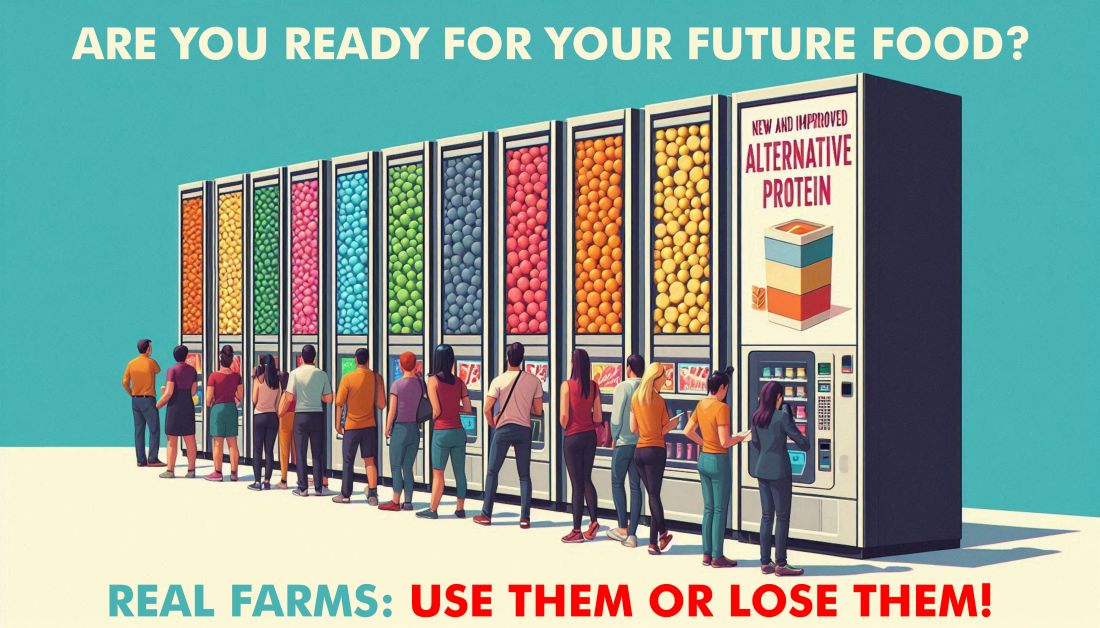
6365 farming businesses have closed in this past year alone and with suggestions made that over 100,000 were lost between 1990 and 2023, it is hard to avoid the conclusion that as wider pressure builds around the control of the food supply and public dependency is pushed towards sources such as factory made ‘alternative proteins’, remaining independent food growing and producing businesses, still capable of changing direction to meet direct public need, are being placed under pressure to close or conform.

Some will argue that these changes are simply the result of economics, modernisation, efficiency, regulation or changing consumer preferences. There is truth in parts of that argument. But it is increasingly difficult to accept it as the whole explanation when viewed alongside the cumulative loss of farms, processing infrastructure, local food capacity and practical independence across the sector.

Whilst even now, many reading this essay may well disagree with what I am sharing, the evidence of this direction of travel is becoming increasingly difficult to ignore as it emerges into public view at speed.

To be fair, it certainly defies the logic and expectations of so many of us, who have always believed that we could trust public representatives to actually do what’s best for us.

Dealing with this problem should be as simple as getting politicians to change their minds. Perhaps do a U-turn. Or even waiting until the next government comes in behind just the latest in a long line who everyone believes to be solely responsible for wrecking everything today.

But it’s not as simple as that in any kind of way.

Government and politics no longer appear to work in the way many of us expect them to. Or in the way they should.

With many of the politicians we can publicly identify seeming unable or unwilling to lead as they should, and with government increasingly reliant upon advice and direction from advisers, institutions, lobbyists and other influencers who are presented as ‘experts’, we have to begin to understand that politicians may be acting within a worldview they have inherited, absorbed and been rewarded for accepting, rather than simply making isolated choices that can be reversed at will.

Even then, if we knew what politicians honestly believe, the full purpose or consequence of what they are being advised or directed to do may not be something that they themselves fully understand.

Regrettably and rather worryingly, the establishment understood as a worldview, and any political party, group or movement that remains aligned with that worldview, rather than with the people and what remains of all independent businesses themselves, is unlikely to change this direction of travel without sustained public, producer and community pressure.

This means that to reshape and redirect UK food production, farmers, growers and fishers must themselves voluntarily step away from the reliance and expectation historically placed upon centralised political and institutional systems, as well as upon those who wish to become part of them.

Food producers must take all steps necessary to develop a new, direct relationship with the public and therefore go it alone.

Regrettably, the alternative is to keep shouting whilst continuing to accept the status quo, and in effect sitting back and watching as UK food production and everything that still remains able to provide us with genuine freedom is weakened further, right up to the point that traditional, ‘natural’ farming and food growing practices may no longer exist in any meaningful form, and people may find it increasingly difficult to function independently and away from centralised systems of dependency ever again.

This blog and accompanying PDF were edited and updated on 22 August 2026 to improve clarity, flow and readability. No substantive changes have been made to the core arguments or conclusions.

Food is as important as the air we breathe and water we drink. So why can’t we talk openly about the real threat to Food Supplies?

Regrettably, I long since realised that whilst many of us talk about change, kick and scream about the need for change, and discuss how we’re going to get those in power to facilitate change, very few of us are actually prepared to do what it would take to embrace and create the kind of change that all of us actually need.

This leaves writers, bloggers, commentators and thinkers either massively frustrated and in some cases falling into the trap of sensationalising their messages to get attention. Or like me, just accepting that people aren’t yet ready to accept that an unsustainable situation can no longer be sustained.

My back catalogue therefore quietly grows. The upside is I can at least say that through the 29 books and the material now published and available to read on the internet, I’m pretty sure I’ve covered all the bases when it comes to attempting to shine some light on everything that’s wrong; what needs to change; what is preventing change; what will create change and of course what change might actually look like. Which is where I have just left the desktop, now.

I’ve been busy over recent weeks writing Our Local Future. Published as a free-to-read website, which is now available to buy as a book for Kindle too.

The reason change isn’t happening, isn’t because we don’t have the ideas, energy, guts, commitment and values present across our society to bring about significant change. It’s because we are too busy arguing over the first step; who’s right; who’s wrong and who should be in charge.

Because of this, I felt it was time to take a leap into the future and commit to writing what the world would need to look like, feel like, and how it would need to function, IF we were to open ourselves up to a way of living that genuinely works for the greater good and is beneficial to us all.

But doing so means dealing with some very uncomfortable truths, and those aren’t easy to convey without being open about where things really are today.

Our Local Future is, by design, abstract. There’s so much about the world we live in today that is out of balance – that we must leave much of it behind – including things that we think are good but are actually hurting us – rather than expecting that we can keep everything we like and simply leave the damage it causes behind.

We leave the damage in our wake each and every day. And it’s the problems that wider society and the environment we live in now face that are manifesting as a result.

What we fail to see is that taking everything for granted and as entitled as we have increasingly become, means that the basic essentials of life are now at significant risk.

The issue of Food Security and the growing risk that the UK population could go hungry or experience serious food shortages are what concern me as a former politician and community leader myself.

So much so that I attended and completed a postgraduate course in Sustainable Agriculture and Food Security at a well-known UK university earlier this year.

Acknowledging the role of so many stakeholders in the Food Security problem remains important. But it’s not enough, as almost without exception, everyone on the problem end of everything still believes that the usual suspects will have a lucid moment of realisation, then change their approach.

The truth is simpler, and I believe it’s correct to be open about the reality that the empty shelves we experienced during the COVID lockdowns could very quickly become normal in times ahead – especially when it comes to our access to basic, essential types of food.

Never mind the heavily processed and unhealthy stuff that many of us mistake as being just that.

In publishing Our Local Future, I have lent heavily on the opportunity to use an AI image generator, and after publishing nearly 100 created images to accompany every published page, I was alarmed to discover that no matter how I instructed the software to create an image, there was no way that the programme would produce anything to illustrate what empty supermarket shelves would look like.

The words and title used were clearly also ringing algorithmic alarm bells somewhere in the cloud, as Facebook then also rejected the post after I adopted a different approach to the imagery – within seconds of publication – telling me that I had committed a community violation and that the post had immediately been deleted.

We can only speculate upon why there is a refusal to allow open and honest discussion about the genuine risk to UK Food Security and how it is increasingly likely to affect the UK population.

The harsh reality we face is that the food supply and food production are quickly becoming a key method of societal control.

Increasingly so, as British Agriculture – the industry that provides it – seems to be in what can only be described as a form of terminal decline that looks remarkably deliberate. Even to the untrained eye.

Many who still trust The System may well ask, ‘How could it possibly be the case that someone wants to control access to what we eat, when food is as important as the air that we breathe and the water that we drink?’