A story about money, integrity, and the bill we keep passing on to people who haven’t arrived yet
‘The process by which banks create money is so simple that the mind is repelled.’
– J. K. Galbraith, Money: Whence It Came, Where It Went (1975)
Everyone has at least been tempted to delay, put off or put on hold a problem when it feels like there is actually a choice. We know, deep down, that we aren’t helping ourselves when we do this, especially if there is an unknown or unpredictable outcome involved – which is probably why it feels so appealing, if not easy, to literally put it off for another day.
Think of the letter that sits unopened in the drawer. The damp patch on the ceiling that we tell ourselves we’ll get looked at in the spring. The conversation we rehearse in our heads a hundred times but never quite start. None of these problems go away because we stop looking at them. If anything, they quietly grow.
So, let’s imagine all the things we would like to put off. To not deal with. Those things that will have a price once dealt with or acted upon, which it would just be nice to leave behind and pretend that they, or the need to address them, simply don’t exist. A difficult message to a loved one? A truth about a new partner to a friend? A relationship or friendship that it would feel better not to have to tell someone in particular, or anyone else, about? The list could be endless if we think about it, and what all these things have in common is that they are about things like honesty, integrity, respect, care and consideration for others – or, collectively, what we might call doing the right thing.
My guess is that most people reading this will have experienced a situation like this at least once in their lifetime, if not on a number of occasions. I know I have.
Something these things always seem to share is that the longer they are left alone or remain hidden, the greater and more far-reaching the consequences of waiting become – particularly if the truth comes out without it being our choice to tell it.
Because a problem left for tomorrow doesn’t sit still. A small untruth needs a second one to protect it. A debt left unpaid gathers interest. A crack left unfilled lets in the water that widens it.
The cost of putting something off is almost never the same as the cost of dealing with it. It is almost always bigger – and it is very often paid by someone other than the person who chose to wait.
The funny thing is that when we don’t make that choice – when we know we could keep quiet, hide things or put the consequences off, but we do the right thing at the time anyway – these things have a habit of working out for the best. There is a moral pay-off, even when there isn’t a material one.
Now imagine something much bigger. Imagine finding a way of doing things that brings a massive reward, with the potential to provide many more – and, this is the important part, a way that means, if you are clever and stick to some boundaries and rules, any reckoning can be put off not just for another day, but for so many days that it might never be a day that you, your children or even their children will have to face. The ultimate problem for tomorrow. All you would have to do is make sure everyone keeps playing by the rules – even if they don’t know the game that’s actually being played.
Do that, and you might never have to face it at all. Nor would anyone you appointed, or anyone appointed by those who followed – because most of them wouldn’t even know…
What I am really talking about here is doing the right thing, even when nobody is watching. There is a word for that: integrity. Funnily enough, integrity isn’t the main subject of this story. But it sits underneath every part of it, and if there is one thing I would ask you to take away, it may well be this.
Integrity is easy when people are watching. The real test comes when we know we could get away with something – when the consequences won’t land on us, or won’t land for years, or will land on somebody we’ll never meet.
So here is a question to carry with you. If it would be wrong for one person to quietly push the cost of their choices onto someone else, does it become any less wrong when it is done by a bank? Or a government? Or a whole society?
Does something stop being wrong just because it is done on a bigger scale, by more people, over a longer time?
Let me tell you a story that might help us answer it.
Imagine, if you will, a man who works in a bank. Not one of the friendly faces behind the counter at your local high street branch, always sounding lovely as they reset passwords and talk new customers through everything they’ll need. He works at a bank with a name you often hear newsreaders mention in the same breath as markets, economics, how public borrowing is going, and jargon like GDP.
He isn’t just someone crunching the figures or talking to the media about monetary policy. He is one of the people with whom the buck really stops – deciding what is done with the bank’s money, who it lends to, what bonuses are paid, how much help is given to others, and of course who those others will actually be.
I’ll simply call him the Banker.
The Banker has everything he wants. But he would like to have more, and to be able to do bigger things – things that have a much bigger pay-off than before.
All his time in banking has taught him how money makes people think and how it makes them behave. He knows all the formulas that sit behind the psychological levers of money – whether someone is rich or poor, a business or a government, and whatever it is they need money for.
Before we go on, pause for a moment. If you were him, and you knew what he knew – what would you do with it?
Because he knows everything about money, and how every part of the system that surrounds it works, the Banker has worked out what people will believe about money – or are willing to believe.
And that means he could literally create more of it. So long as the people who weren’t in on the secret still believed that the money in their hands was exactly the same the day after he changed the system as it was the day before.
Most people, then and now, picture money as a thing. Something solid, kept in a vault, once backed by gold sitting in a basement somewhere.
For a long time that picture was at least partly true: a pound or a dollar was a promise that could, in theory, be swapped for something real.
But the Banker knew the picture didn’t need to be true. It only needed to be believed.
The magic of creating money from nothing rests on creating a debt that isn’t really owed to anyone – but which he knows will be repaid, because he is confident that anyone he lets into the secret, or lends this new money to, will always pay it back, in a way and on a timeline where nobody need ever know that this new way of doing things exists.
And it is astonishingly simple. When the Banker approves a loan, he doesn’t go to a safe and count out notes that someone else deposited. He simply types a new number into the borrower’s account.
That money did not exist a moment before. There is no lorry delivering it, no vault opening, no gold changing hands. There is only a promise to pay it back – and that promise becomes money. When the loan is repaid, the money quietly disappears again.
He calls this money creation ‘credit’ for short. And he imagines all the things that could be done with an almost endless supply of it, and all the people who could be helped – as long as it is legal, and as long as one golden rule is kept: never create money that could not have come from a ‘normal’ route, over what would be considered a ‘normal’ period of time.
Which raises a question worth sitting with. If money can be created simply by a promise to pay it back, what is money, really?
And then, what happens if the promises start to grow faster than the real things – the homes, the food, the skills, the work – that the money is supposed to stand for?
Rules won’t be a problem, the Banker reasons. If the people who actually run the country are brought on board, they will benefit from the new system too, because it will make it a lot easier for them to do whatever they want to do – as long as they play by the same rules of money creation, and change whatever rules and laws need changing to make it all legal.
‘We can give money to whoever we decide,’ he tells himself, ‘and nobody will ask where it comes from, because we are the banks. Nobody will see what’s really going on, as long as we play it right.’
So the Banker, and a few other bankers who share his world view and understanding, decide to go ahead. They bring in the people they need, all of whom benefit in some way from being on board – politicians who can suddenly pay for the things that make their lives easier, other bankers who are paid well, and key business people who know their stuff and can be trusted to pay back on time.
‘With the power we have,’ they agree, ‘we will be able to make whatever adaptations we need to do what we want – as long as we keep it real.’
Of course, money has a different effect on different people – especially when power and influence are involved – so, as the scope and dark brilliance of the new system rolls out, frameworks are put in place to make it all look responsible.
‘We will police the system by creating credit agencies,’ the Banker decides, ‘and as time goes by we will be able to judge everyone’s credibility by the records we keep on them.’
It would be easy to make the Banker a villain. But I don’t think that would be fair – and it would let the rest of us off far too lightly. Schemes like his are rarely born out of pure greed. More often they are born out of a problem that seems too big to solve any other way. A war that has to be paid for. A country that has to be rebuilt. A crisis that won’t wait. It is no accident that the Bank of England itself was founded, back in 1694, to lend money to a government that needed to fight a war.
And at first, it works. Roads are built. Homes are bought. Businesses start that would never otherwise have got off the ground. Wars are fought and, in some cases, won.
If you’re honest, you might even be on the Banker’s side by now. What’s the problem? It sounds brilliant.
Which brings us to one of the oldest moral questions there is: can something be wrong if the outcome is right? If the secret bought a victory, a recovery, a generation of prosperity – does the way it was done still matter?
Hold on to your answer. We will need it later.
Everything depends on the golden rule: never create more money than could have come about by a ‘normal’ route, over a ‘normal’ period of time.
In other words – never let the promises get too far ahead of the real world.
I think it is quite possible that the Banker kept to that rule. He may have been confident – perhaps over-confident – but he understood what he had made, and why the limits mattered.
For anyone with a strong sense of what is right and what is wrong, it’s difficult to fathom the idea that money can be created literally by saying ‘this money now exists’ – especially if you’ve never had a lot, and have perhaps struggled to make ends meet with what you had.
But for those who have grown used to money, and comfortable with it, the morality looks very different.
And a rule like the Banker’s has a weakness built into it. It relies entirely on the restraint of whoever comes next. And whoever comes after them. And whoever comes after them.
Can you build a system that relies, forever, on the self-control of people you will never meet?
It started out well. The key was to stick to the rules. But the Banker, who designed the system and understood its limits, saw it very differently from those who came after him and had never known anything else.
The secret – or rather the open secret this system always really was, hidden only because so many people still thought all the money flowing around was ‘real’ – was passed like a baton from one generation of beneficiaries to the next. And with each handover, the new hands lost a little more sight of what was needed to keep it all under control.
Think about how a habit forms in any family or organisation. The first generation makes an exception, for a good reason, in a time of need. The second gets used to the exception. The third mistakes the exception for the rule. And the fourth cannot imagine there was ever any other way.
By the time the baton reaches that fourth pair of hands, nobody is asking whether the system is right any more. They are only asking how to get more out of it. And most of them aren’t bad people. They are doing exactly what they were trained to do, in the only system they have ever known.
The Banker’s successors started to believe it would be possible – realistic, even – to pay for whatever they wanted, especially if it gave them greater control over the profits and incomes they could then use to pay the ‘debt’ from the ‘credit’ back.
Around the 1980s, they found a philosophy to match. Economists today often call it neoliberalism, but at its heart was a simple belief: that markets, left free to buy, sell, compete and borrow, would always make better decisions than governments or communities could.
So industries that had been built and owned in common were sold off. The rules on banks and borrowing were loosened. Money was set free to go wherever it could earn the highest return, as fast as it could get there.
Put that belief together with the Banker’s secret, and something powerful happens. Money stops flowing mainly towards the things a community needs, and starts flowing towards whatever makes more money fastest.
And the question nobody inside the system seemed to ask was the simplest one of all: what happens to the places, the jobs and the people that the money flows away from?
Unfortunately, whether by design or by accident, having control over what so many people see as real wealth also made those at the centre of the system, and those they helped, blind to consequence – blind to what money that is only believed to be real actually does when everyone who believes in it behaves as if it really is.
Over time, everything was hollowed out. People’s lives, communities and the environment were all hollowed out, and the value they once held was replaced by that giant IOU called credit. It took away the real value and left behind an extraordinary form of human debt: the loss of being able to identify with, and relate to, who we all really are.
That hollowing out rarely makes the headlines in one go. It happens a little at a time.
A family firm that has made things in the same town for eighty years is bought with borrowed money – and the debt used to buy it is loaded onto the firm itself. The buildings are sold and rented back. The profitable parts are sold off, the pension fund is squeezed, and what is left is closed when it can no longer carry the weight.
In the City, it is called a successful deal. In the town, a trade that took generations to learn disappears in a couple of years.
Homes stop being places to live and become places to put money. Prices rise faster than wages, year after year, because it is easier to lend against a house than to build a business. The parents who bought a home on one wage watch their children struggle to rent on two.
Water, energy, railways and the other things that were once built and owned in common are sold, borrowed against and run to produce a return. When the pipes leak, the rivers suffer and the bills rise, the debt is still there – and someone still expects to be paid.
The high street empties. The skills leave. The young people leave. And slowly, a place forgets what it was for.
None of this shows up as a debt on anyone’s bank statement. But it is a debt all the same. And from very early on, it was the people at the bottom of the ladder – the workers, the small towns, the communities with the least say – who paid it first, and paid it in full.
The debt was never only financial. The real bill was paid in lives, in places, and in the world around us.
At some point, the people doing well out of the system must have noticed. Not all of them, and perhaps not all at once.
But you cannot close that many factories, sell off that many shared assets, or watch that many town centres empty without someone, somewhere, beginning to ask questions.
And this is where the story becomes less about money and more about people. Because when a system that everyone depends on starts to show its cracks, the easiest thing to do is not to fix it. It is to explain it.
So we were given stories. That the jobs went because of technology, or global competition, or because people simply didn’t want to work. That the money had run out because of whoever was easiest to blame that year. That if prices rose, it was always someone else’s fault. That the answer to too much debt was more debt. That growth – measured by a number called GDP – would sooner or later lift everyone.
Some of those stories had grains of truth in them. Many were told by people who honestly believed them. But they all had one thing in common: they kept attention away from the system itself.
When the whole thing nearly fell over in 2008, it wasn’t allowed to. The banks were rescued. Then the central banks – the Bank of England among them – reached for the Banker’s oldest trick on the grandest scale yet. They created hundreds of billions of pounds of new money and called it ‘quantitative easing’.
The new money was used to buy up government debt and other assets, holding interest rates down and propping up prices. It kept the system going. Many have argued that it also made those who already owned property, shares and other assets a great deal richer, while those who owned nothing watched the things they needed slip further out of reach.
By then, some economists had begun to say out loud what the Banker had always known. A school of thought called Modern Monetary Theory argued that a country which creates its own currency can never simply ‘run out’ of money the way a household can – and that the real limit on what it can do isn’t money at all, but real things: people, skills, materials, energy and land. Push beyond those, and prices rise.
Whatever you think of that idea, notice where it lands. Even the theory that says money itself isn’t the problem agrees that real things are the limit. And real things – the skills, the industries, the communities, the land and the environment – are exactly what had been hollowed out.
You can create money from nothing. You can’t create a lost trade, a living river or a community’s sense of itself the same way.
Underneath it all sat one belief, so comfortable that it rarely needed saying out loud: that this is a system where everyone can have whatever they want, and worry about paying the bill later.
Of course, nobody can. Not a person, not a bank, not a country. A system that only survives by bringing in ever more borrowing to pay for the promises it has already made starts to look uncomfortably like a giant Ponzi scheme – and the thing being borrowed against, in the end, is the future itself.
Over time, governments became completely beholden to the system too. Their success was measured by GDP – a number that counts how much is bought and sold, not whether life is getting any better. And when they needed more money than they raised in taxes, they borrowed it by selling bonds – in Britain, they are called gilts. A gilt is simply an IOU: lend the government money today, and it promises to pay you interest every year and give your money back on a set date.
Those IOUs are held by banks, pension funds, insurers and investors at home and abroad – and, after all that quantitative easing, by the Bank of England itself. Every year, interest has to be paid on every one of them.
It was only when things had gone so far that a once-rich country like the UK could no longer afford to do the things it used to do that ordinary people began asking the same question: where has all the money gone? And if we are now paying more in interest on what the country owes than we spend each year on educating our children – where do all those interest payments actually go?
The answer is simple, and uncomfortable. A large part of it goes to those who already hold money – paid for by those who do the work, through their taxes, through public services that no longer stretch as far, and through all the things that quietly stop being done.
Which brings us back to where this story began. Who decided this was a problem for tomorrow? And who did they think would be standing there when tomorrow arrived?
You may have realised by now that this is where – exactly where – we are right now.
The Banker’s story was never really about one banker. It is the story of the money in your pocket, the mortgage on your home, the pension you are counting on, and the country you live in. It is the story of the system we were all born into – the only one most of us have ever known.
And tomorrow didn’t arrive with a bang. There was no single day when the bill landed on the doormat. It arrived the way the damp patch on the ceiling does – slowly, and then all at once.
It arrived as a generation that cannot afford a home. As the potholes, the closed libraries and the waiting lists. As towns that have forgotten what they were for. As rivers that are no longer safe to swim in. As wages that buy less every year. As a growing sense, shared by people who agree on almost nothing else, that something has gone badly wrong – and that nobody in charge will say what.
And here is the cruellest part. The bill isn’t calculated in pounds. It is calculated in lost skills, lost trust, lost places and lost time. It can’t simply be refinanced, rolled over or printed away. The problem was never really put off at all. It was only passed on – to whoever happened to be standing there when tomorrow came.
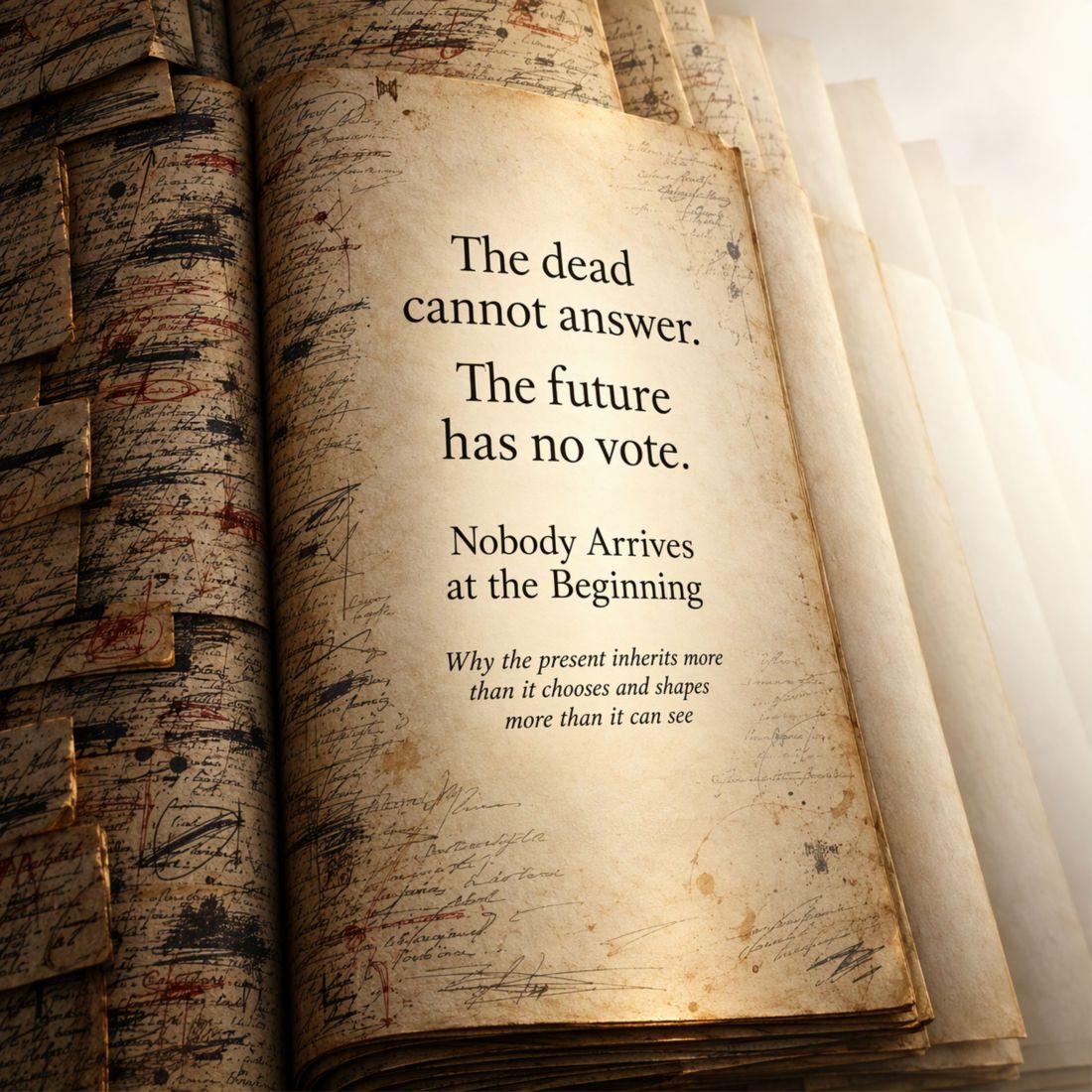
The future has no vote. That is exactly why it was so easy to spend.
So was this a crime? Perhaps even the greatest one of all time?
It is tempting to say yes, and to go looking for the people to blame. But remember how this story started.
Maybe the Banker had a genuine problem to solve. Maybe he kept to his own rules. Maybe most of those who followed him were decent people doing what they had been taught, in a system they never designed and never saw from the outside.
None of that makes it right. A harm doesn’t become acceptable because nobody meant it, or because it was spread across millions of hands over a hundred years. If anything, that is what makes it so serious.
A crime with a villain can be punished. A crime that everyone took part in, and that almost everyone benefited from in some small way, is far harder to face – because facing it means facing ourselves.
Which leads to the most uncomfortable question in this whole story. If you have ever had a mortgage, a pension, a loan or a credit card – or simply lived in a country that borrowed to keep the lights on – where do you stand in the chain?
And remember the question I asked you to hold on to: can something be wrong if the outcome was right?
What is your answer now?
We started with the small things – the message we didn’t send, the truth we didn’t tell, the letter we left in the drawer. And we said that the longer they are left, the bigger the consequences become, especially if the truth comes out without us choosing to tell it.
The same is true here. Tomorrow is already knocking at the door. The only real choice left is whether we open it ourselves – honestly, together, and with our eyes open – or wait for it to be kicked in.
Doing the right thing, even when nobody is watching, starts with being willing to look. To ask where money really comes from, who it really serves, and who really pays. To value the things that can’t be printed – skills, communities, places, the natural world and each other – as the real wealth they always were. And to stop handing our problems to people who aren’t here yet to argue back.
That is what integrity looks like when it is scaled up from one person to a whole society.
It isn’t easy. It never was. But as I hope this story has shown, the alternative was never really easier either.
It was only later.
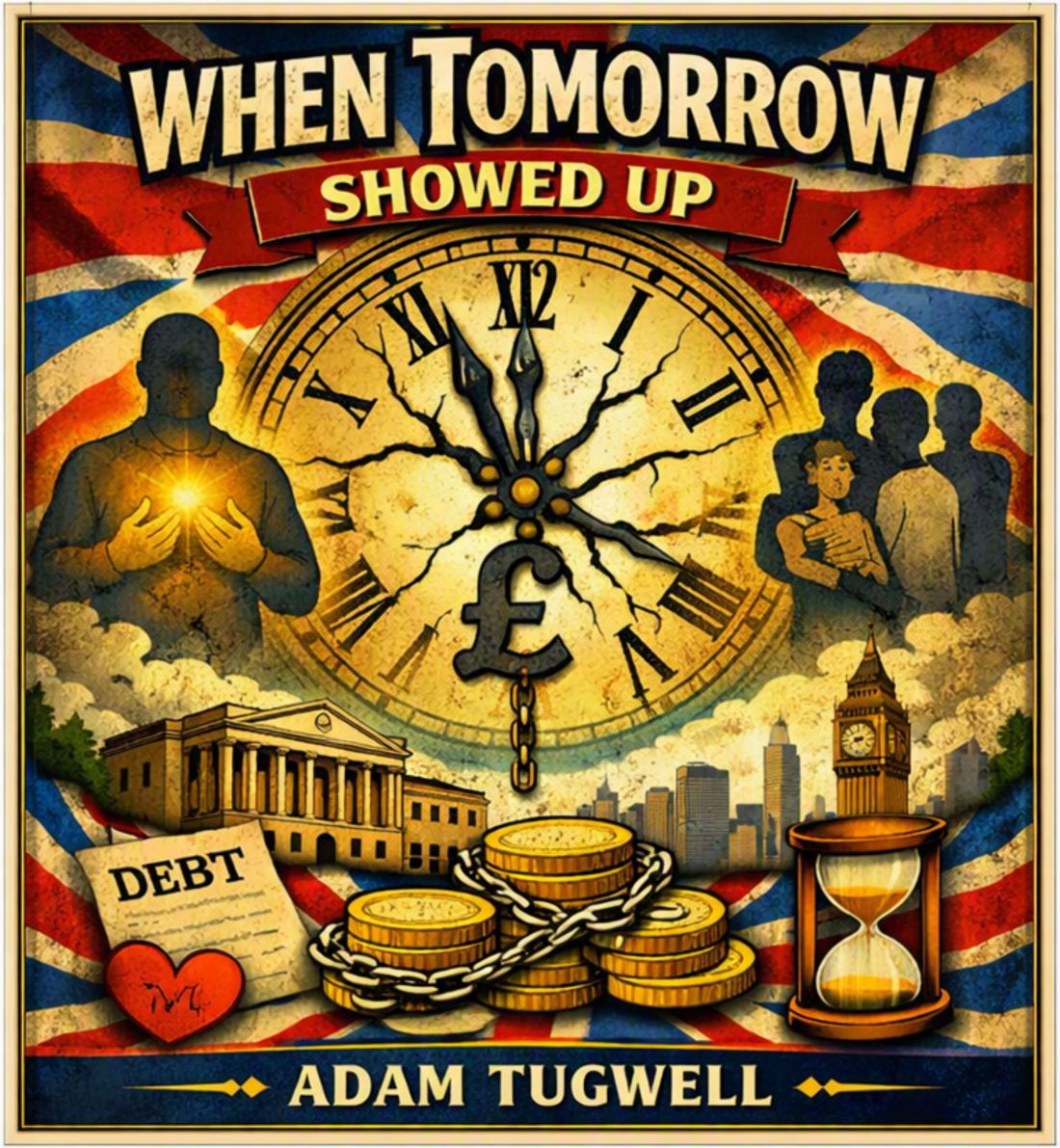
Tomorrow has shown up. The only question left is what we do today.
The Banker is not a real person. He is a way of telling a story that is far too big, and spread across far too much time, to be told any other way. He stands for the many people – bankers, politicians, officials and business leaders – who built, inherited and ran the monetary system we live with today.
Some of the details are simplified. Some of the steps may have happened in a different order, and some may have happened by accident rather than by design. Many of them were taken – and are still being taken – by people who have never seen or understood the monetary, financial and economic system in any other way. None of that changes the question at the heart of the story.
This was never meant to be an economics lecture. You didn’t need to know what a bond is, what fiat money means, or what anyone means by MMT or neoliberalism to follow it – and if you didn’t before, I hope you have a clearer idea now. What I hope you take away is a single question, and that you keep asking it: is this a problem for today, or a problem for tomorrow – and who decided?
For your own reflection, or for discussion with others:
- Does something stop being wrong just because it is done on a bigger scale, by more people, over a longer time?
- Can something be wrong if the outcome is right? Has your answer changed since you first met the question?
- If you had been the Banker, what would you have done with the secret?
- Where in your own town or community can you see the hollowing out? Who paid the bill – and who was paid?
- Which of the stories we were told have you believed? Which do you still believe?
- What would doing the right thing look like now – for you, for your community, and for the country?
- Credit – money lent to someone on the promise that they will pay it back. In today’s system, most new money comes into existence this way.
- Debt – the other side of credit: what is owed, usually with interest on top.
- Fiat money – money that has value because a government declares it to be money and people accept it, rather than because it can be swapped for gold or anything else.
- Interest – the price of borrowing money; what the borrower pays the lender on top of the amount borrowed.
- Bonds and gilts – IOUs that governments and companies sell to borrow money. A gilt is a UK government bond.
- GDP (Gross Domestic Product) – a measure of the total value of everything bought and sold in a country in a year. It counts activity, not wellbeing.
- Credit rating agencies – organisations that judge how likely a person, company or country is to repay what it owes.
- Quantitative easing (QE) – when a central bank creates new money to buy government bonds and other assets, usually to keep interest rates low and the financial system running.
- Neoliberalism – a set of ideas, dominant since around the 1980s, that markets usually make better decisions than governments, leading to privatisation and looser rules on finance.
- MMT (Modern Monetary Theory) – an economic theory that says a country issuing its own currency can’t run out of money, and that the real limits are inflation and real resources.
- Asset stripping – buying a business, often with borrowed money, and selling off its valuable parts for a quick profit, frequently leaving the rest to fail.
- Ponzi scheme – a scheme that pays existing investors with money from new ones, and so collapses when the new money runs out.
- The Bank of England was founded in 1694 to lend money to the government of William III, largely to fund war against France.
- The end of the gold link: in August 1971 the United States suspended the conversion of dollars into gold, ending the last formal tie between the world’s major currencies and gold.
- How banks create money: the Bank of England explains this in ‘Money creation in the modern economy’, Quarterly Bulletin, 2014 Q1.
- Quantitative easing: the Bank of England’s asset purchases reached a peak of £895 billion between 2009 and 2021.
- Debt interest and education: how UK debt interest compares with education spending depends on the year and on how each is measured. Check the latest figures from the Office for Budget Responsibility and HM Treasury before publication.
- Epigraph: J. K. Galbraith, Money: Whence It Came, Where It Went (1975).