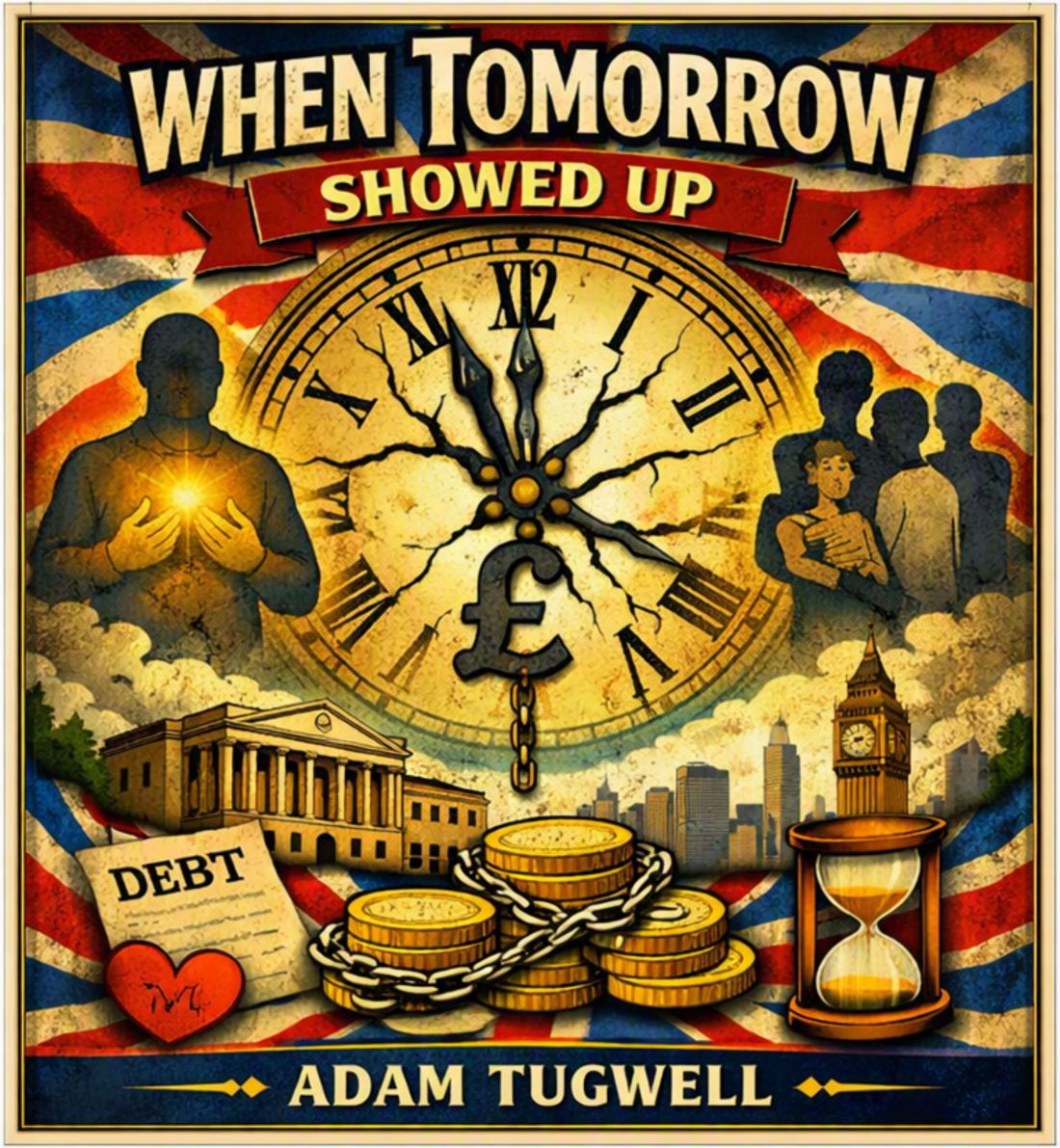
When Tomorrow Showed Up

A story about money, integrity, and the bill we keep passing on to people who haven’t arrived yet

‘The process by which banks create money is so simple that the mind is repelled.’
– J. K. Galbraith, Money: Whence It Came, Where It Went (1975)

One: The Problem for Tomorrow

Everyone has at least been tempted to delay, put off or put on hold a problem when it feels like there is actually a choice. We know, deep down, that we aren’t helping ourselves when we do this, especially if there is an unknown or unpredictable outcome involved – which is probably why it feels so appealing, if not easy, to literally put it off for another day.

Think of the letter that sits unopened in the drawer. The damp patch on the ceiling that we tell ourselves we’ll get looked at in the spring. The conversation we rehearse in our heads a hundred times but never quite start. None of these problems go away because we stop looking at them. If anything, they quietly grow.

So, let’s imagine all the things we would like to put off. To not deal with. Those things that will have a price once dealt with or acted upon, which it would just be nice to leave behind and pretend that they, or the need to address them, simply don’t exist. A difficult message to a loved one? A truth about a new partner to a friend? A relationship or friendship that it would feel better not to have to tell someone in particular, or anyone else, about? The list could be endless if we think about it, and what all these things have in common is that they are about things like honesty, integrity, respect, care and consideration for others – or, collectively, what we might call doing the right thing.

My guess is that most people reading this will have experienced a situation like this at least once in their lifetime, if not on a number of occasions. I know I have.

Something these things always seem to share is that the longer they are left alone or remain hidden, the greater and more far-reaching the consequences of waiting become – particularly if the truth comes out without it being our choice to tell it.

Because a problem left for tomorrow doesn’t sit still. A small untruth needs a second one to protect it. A debt left unpaid gathers interest. A crack left unfilled lets in the water that widens it.

The cost of putting something off is almost never the same as the cost of dealing with it. It is almost always bigger – and it is very often paid by someone other than the person who chose to wait.

The funny thing is that when we don’t make that choice – when we know we could keep quiet, hide things or put the consequences off, but we do the right thing at the time anyway – these things have a habit of working out for the best. There is a moral pay-off, even when there isn’t a material one.

Now imagine something much bigger. Imagine finding a way of doing things that brings a massive reward, with the potential to provide many more – and, this is the important part, a way that means, if you are clever and stick to some boundaries and rules, any reckoning can be put off not just for another day, but for so many days that it might never be a day that you, your children or even their children will have to face. The ultimate problem for tomorrow. All you would have to do is make sure everyone keeps playing by the rules – even if they don’t know the game that’s actually being played.

Do that, and you might never have to face it at all. Nor would anyone you appointed, or anyone appointed by those who followed – because most of them wouldn’t even know…

Two: When Nobody Is Watching

What I am really talking about here is doing the right thing, even when nobody is watching. There is a word for that: integrity. Funnily enough, integrity isn’t the main subject of this story. But it sits underneath every part of it, and if there is one thing I would ask you to take away, it may well be this.

Integrity is easy when people are watching. The real test comes when we know we could get away with something – when the consequences won’t land on us, or won’t land for years, or will land on somebody we’ll never meet.

So here is a question to carry with you. If it would be wrong for one person to quietly push the cost of their choices onto someone else, does it become any less wrong when it is done by a bank? Or a government? Or a whole society?

Does something stop being wrong just because it is done on a bigger scale, by more people, over a longer time?

Let me tell you a story that might help us answer it.

Three: The Banker

Imagine, if you will, a man who works in a bank. Not one of the friendly faces behind the counter at your local high street branch, always sounding lovely as they reset passwords and talk new customers through everything they’ll need. He works at a bank with a name you often hear newsreaders mention in the same breath as markets, economics, how public borrowing is going, and jargon like GDP.

He isn’t just someone crunching the figures or talking to the media about monetary policy. He is one of the people with whom the buck really stops – deciding what is done with the bank’s money, who it lends to, what bonuses are paid, how much help is given to others, and of course who those others will actually be.

I’ll simply call him the Banker.

The Banker has everything he wants. But he would like to have more, and to be able to do bigger things – things that have a much bigger pay-off than before.

All his time in banking has taught him how money makes people think and how it makes them behave. He knows all the formulas that sit behind the psychological levers of money – whether someone is rich or poor, a business or a government, and whatever it is they need money for.

Before we go on, pause for a moment. If you were him, and you knew what he knew – what would you do with it?

Four: The Secret

Because he knows everything about money, and how every part of the system that surrounds it works, the Banker has worked out what people will believe about money – or are willing to believe.

And that means he could literally create more of it. So long as the people who weren’t in on the secret still believed that the money in their hands was exactly the same the day after he changed the system as it was the day before.

Most people, then and now, picture money as a thing. Something solid, kept in a vault, once backed by gold sitting in a basement somewhere.

For a long time that picture was at least partly true: a pound or a dollar was a promise that could, in theory, be swapped for something real.

But the Banker knew the picture didn’t need to be true. It only needed to be believed.

The magic of creating money from nothing rests on creating a debt that isn’t really owed to anyone – but which he knows will be repaid, because he is confident that anyone he lets into the secret, or lends this new money to, will always pay it back, in a way and on a timeline where nobody need ever know that this new way of doing things exists.

And it is astonishingly simple. When the Banker approves a loan, he doesn’t go to a safe and count out notes that someone else deposited. He simply types a new number into the borrower’s account.

That money did not exist a moment before. There is no lorry delivering it, no vault opening, no gold changing hands. There is only a promise to pay it back – and that promise becomes money. When the loan is repaid, the money quietly disappears again.

He calls this money creation ‘credit’ for short. And he imagines all the things that could be done with an almost endless supply of it, and all the people who could be helped – as long as it is legal, and as long as one golden rule is kept: never create money that could not have come from a ‘normal’ route, over what would be considered a ‘normal’ period of time.

Which raises a question worth sitting with. If money can be created simply by a promise to pay it back, what is money, really?

And then, what happens if the promises start to grow faster than the real things – the homes, the food, the skills, the work – that the money is supposed to stand for?

Five: Bringing Everyone on Board

Rules won’t be a problem, the Banker reasons. If the people who actually run the country are brought on board, they will benefit from the new system too, because it will make it a lot easier for them to do whatever they want to do – as long as they play by the same rules of money creation, and change whatever rules and laws need changing to make it all legal.

‘We can give money to whoever we decide,’ he tells himself, ‘and nobody will ask where it comes from, because we are the banks. Nobody will see what’s really going on, as long as we play it right.’

So the Banker, and a few other bankers who share his world view and understanding, decide to go ahead. They bring in the people they need, all of whom benefit in some way from being on board – politicians who can suddenly pay for the things that make their lives easier, other bankers who are paid well, and key business people who know their stuff and can be trusted to pay back on time.

‘With the power we have,’ they agree, ‘we will be able to make whatever adaptations we need to do what we want – as long as we keep it real.’

Of course, money has a different effect on different people – especially when power and influence are involved – so, as the scope and dark brilliance of the new system rolls out, frameworks are put in place to make it all look responsible.

‘We will police the system by creating credit agencies,’ the Banker decides, ‘and as time goes by we will be able to judge everyone’s credibility by the records we keep on them.’

It would be easy to make the Banker a villain. But I don’t think that would be fair – and it would let the rest of us off far too lightly. Schemes like his are rarely born out of pure greed. More often they are born out of a problem that seems too big to solve any other way. A war that has to be paid for. A country that has to be rebuilt. A crisis that won’t wait. It is no accident that the Bank of England itself was founded, back in 1694, to lend money to a government that needed to fight a war.

And at first, it works. Roads are built. Homes are bought. Businesses start that would never otherwise have got off the ground. Wars are fought and, in some cases, won.

If you’re honest, you might even be on the Banker’s side by now. What’s the problem? It sounds brilliant.

Which brings us to one of the oldest moral questions there is: can something be wrong if the outcome is right? If the secret bought a victory, a recovery, a generation of prosperity – does the way it was done still matter?

Hold on to your answer. We will need it later.

Six: The Golden Rule

Everything depends on the golden rule: never create more money than could have come about by a ‘normal’ route, over a ‘normal’ period of time.

In other words – never let the promises get too far ahead of the real world.

I think it is quite possible that the Banker kept to that rule. He may have been confident – perhaps over-confident – but he understood what he had made, and why the limits mattered.

For anyone with a strong sense of what is right and what is wrong, it’s difficult to fathom the idea that money can be created literally by saying ‘this money now exists’ – especially if you’ve never had a lot, and have perhaps struggled to make ends meet with what you had.

But for those who have grown used to money, and comfortable with it, the morality looks very different.

And a rule like the Banker’s has a weakness built into it. It relies entirely on the restraint of whoever comes next. And whoever comes after them. And whoever comes after them.

Can you build a system that relies, forever, on the self-control of people you will never meet?

Seven: Passing the Baton

It started out well. The key was to stick to the rules. But the Banker, who designed the system and understood its limits, saw it very differently from those who came after him and had never known anything else.

The secret – or rather the open secret this system always really was, hidden only because so many people still thought all the money flowing around was ‘real’ – was passed like a baton from one generation of beneficiaries to the next. And with each handover, the new hands lost a little more sight of what was needed to keep it all under control.

Think about how a habit forms in any family or organisation. The first generation makes an exception, for a good reason, in a time of need. The second gets used to the exception. The third mistakes the exception for the rule. And the fourth cannot imagine there was ever any other way.

By the time the baton reaches that fourth pair of hands, nobody is asking whether the system is right any more. They are only asking how to get more out of it. And most of them aren’t bad people. They are doing exactly what they were trained to do, in the only system they have ever known.

The Banker’s successors started to believe it would be possible – realistic, even – to pay for whatever they wanted, especially if it gave them greater control over the profits and incomes they could then use to pay the ‘debt’ from the ‘credit’ back.

Around the 1980s, they found a philosophy to match. Economists today often call it neoliberalism, but at its heart was a simple belief: that markets, left free to buy, sell, compete and borrow, would always make better decisions than governments or communities could.

So industries that had been built and owned in common were sold off. The rules on banks and borrowing were loosened. Money was set free to go wherever it could earn the highest return, as fast as it could get there.

Put that belief together with the Banker’s secret, and something powerful happens. Money stops flowing mainly towards the things a community needs, and starts flowing towards whatever makes more money fastest.

And the question nobody inside the system seemed to ask was the simplest one of all: what happens to the places, the jobs and the people that the money flows away from?

Eight: The Hollowing Out

Unfortunately, whether by design or by accident, having control over what so many people see as real wealth also made those at the centre of the system, and those they helped, blind to consequence – blind to what money that is only believed to be real actually does when everyone who believes in it behaves as if it really is.

Over time, everything was hollowed out. People’s lives, communities and the environment were all hollowed out, and the value they once held was replaced by that giant IOU called credit. It took away the real value and left behind an extraordinary form of human debt: the loss of being able to identify with, and relate to, who we all really are.

That hollowing out rarely makes the headlines in one go. It happens a little at a time.

A family firm that has made things in the same town for eighty years is bought with borrowed money – and the debt used to buy it is loaded onto the firm itself. The buildings are sold and rented back. The profitable parts are sold off, the pension fund is squeezed, and what is left is closed when it can no longer carry the weight.

In the City, it is called a successful deal. In the town, a trade that took generations to learn disappears in a couple of years.

Homes stop being places to live and become places to put money. Prices rise faster than wages, year after year, because it is easier to lend against a house than to build a business. The parents who bought a home on one wage watch their children struggle to rent on two.

Water, energy, railways and the other things that were once built and owned in common are sold, borrowed against and run to produce a return. When the pipes leak, the rivers suffer and the bills rise, the debt is still there – and someone still expects to be paid.

The high street empties. The skills leave. The young people leave. And slowly, a place forgets what it was for.

None of this shows up as a debt on anyone’s bank statement. But it is a debt all the same. And from very early on, it was the people at the bottom of the ladder – the workers, the small towns, the communities with the least say – who paid it first, and paid it in full.

The debt was never only financial. The real bill was paid in lives, in places, and in the world around us.

Nine: The Stories We Were Told

At some point, the people doing well out of the system must have noticed. Not all of them, and perhaps not all at once.

But you cannot close that many factories, sell off that many shared assets, or watch that many town centres empty without someone, somewhere, beginning to ask questions.

And this is where the story becomes less about money and more about people. Because when a system that everyone depends on starts to show its cracks, the easiest thing to do is not to fix it. It is to explain it.

So we were given stories. That the jobs went because of technology, or global competition, or because people simply didn’t want to work. That the money had run out because of whoever was easiest to blame that year. That if prices rose, it was always someone else’s fault. That the answer to too much debt was more debt. That growth – measured by a number called GDP – would sooner or later lift everyone.

Some of those stories had grains of truth in them. Many were told by people who honestly believed them. But they all had one thing in common: they kept attention away from the system itself.

When the whole thing nearly fell over in 2008, it wasn’t allowed to. The banks were rescued. Then the central banks – the Bank of England among them – reached for the Banker’s oldest trick on the grandest scale yet. They created hundreds of billions of pounds of new money and called it ‘quantitative easing’.

The new money was used to buy up government debt and other assets, holding interest rates down and propping up prices. It kept the system going. Many have argued that it also made those who already owned property, shares and other assets a great deal richer, while those who owned nothing watched the things they needed slip further out of reach.

By then, some economists had begun to say out loud what the Banker had always known. A school of thought called Modern Monetary Theory argued that a country which creates its own currency can never simply ‘run out’ of money the way a household can – and that the real limit on what it can do isn’t money at all, but real things: people, skills, materials, energy and land. Push beyond those, and prices rise.

Whatever you think of that idea, notice where it lands. Even the theory that says money itself isn’t the problem agrees that real things are the limit. And real things – the skills, the industries, the communities, the land and the environment – are exactly what had been hollowed out.

You can create money from nothing. You can’t create a lost trade, a living river or a community’s sense of itself the same way.

Underneath it all sat one belief, so comfortable that it rarely needed saying out loud: that this is a system where everyone can have whatever they want, and worry about paying the bill later.

Of course, nobody can. Not a person, not a bank, not a country. A system that only survives by bringing in ever more borrowing to pay for the promises it has already made starts to look uncomfortably like a giant Ponzi scheme – and the thing being borrowed against, in the end, is the future itself.

Ten: Where Has All the Money Gone?

Over time, governments became completely beholden to the system too. Their success was measured by GDP – a number that counts how much is bought and sold, not whether life is getting any better. And when they needed more money than they raised in taxes, they borrowed it by selling bonds – in Britain, they are called gilts. A gilt is simply an IOU: lend the government money today, and it promises to pay you interest every year and give your money back on a set date.

Those IOUs are held by banks, pension funds, insurers and investors at home and abroad – and, after all that quantitative easing, by the Bank of England itself. Every year, interest has to be paid on every one of them.

It was only when things had gone so far that a once-rich country like the UK could no longer afford to do the things it used to do that ordinary people began asking the same question: where has all the money gone? And if we are now paying more in interest on what the country owes than we spend each year on educating our children – where do all those interest payments actually go?

The answer is simple, and uncomfortable. A large part of it goes to those who already hold money – paid for by those who do the work, through their taxes, through public services that no longer stretch as far, and through all the things that quietly stop being done.

Which brings us back to where this story began. Who decided this was a problem for tomorrow? And who did they think would be standing there when tomorrow arrived?

Eleven: When Tomorrow Showed Up

You may have realised by now that this is where – exactly where – we are right now.

The Banker’s story was never really about one banker. It is the story of the money in your pocket, the mortgage on your home, the pension you are counting on, and the country you live in. It is the story of the system we were all born into – the only one most of us have ever known.

And tomorrow didn’t arrive with a bang. There was no single day when the bill landed on the doormat. It arrived the way the damp patch on the ceiling does – slowly, and then all at once.

It arrived as a generation that cannot afford a home. As the potholes, the closed libraries and the waiting lists. As towns that have forgotten what they were for. As rivers that are no longer safe to swim in. As wages that buy less every year. As a growing sense, shared by people who agree on almost nothing else, that something has gone badly wrong – and that nobody in charge will say what.

And here is the cruellest part. The bill isn’t calculated in pounds. It is calculated in lost skills, lost trust, lost places and lost time. It can’t simply be refinanced, rolled over or printed away. The problem was never really put off at all. It was only passed on – to whoever happened to be standing there when tomorrow came.

The future has no vote. That is exactly why it was so easy to spend.

Twelve: The Greatest Crime of All Time?

So was this a crime? Perhaps even the greatest one of all time?

It is tempting to say yes, and to go looking for the people to blame. But remember how this story started.

Maybe the Banker had a genuine problem to solve. Maybe he kept to his own rules. Maybe most of those who followed him were decent people doing what they had been taught, in a system they never designed and never saw from the outside.

None of that makes it right. A harm doesn’t become acceptable because nobody meant it, or because it was spread across millions of hands over a hundred years. If anything, that is what makes it so serious.

A crime with a villain can be punished. A crime that everyone took part in, and that almost everyone benefited from in some small way, is far harder to face – because facing it means facing ourselves.

Which leads to the most uncomfortable question in this whole story. If you have ever had a mortgage, a pension, a loan or a credit card – or simply lived in a country that borrowed to keep the lights on – where do you stand in the chain?

And remember the question I asked you to hold on to: can something be wrong if the outcome was right?

What is your answer now?

Thirteen: Doing the Right Thing

We started with the small things – the message we didn’t send, the truth we didn’t tell, the letter we left in the drawer. And we said that the longer they are left, the bigger the consequences become, especially if the truth comes out without us choosing to tell it.

The same is true here. Tomorrow is already knocking at the door. The only real choice left is whether we open it ourselves – honestly, together, and with our eyes open – or wait for it to be kicked in.

Doing the right thing, even when nobody is watching, starts with being willing to look. To ask where money really comes from, who it really serves, and who really pays. To value the things that can’t be printed – skills, communities, places, the natural world and each other – as the real wealth they always were. And to stop handing our problems to people who aren’t here yet to argue back.

That is what integrity looks like when it is scaled up from one person to a whole society.

It isn’t easy. It never was. But as I hope this story has shown, the alternative was never really easier either.

It was only later.

Tomorrow has shown up. The only question left is what we do today.

Afterword: A Note on This Story

The Banker is not a real person. He is a way of telling a story that is far too big, and spread across far too much time, to be told any other way. He stands for the many people – bankers, politicians, officials and business leaders – who built, inherited and ran the monetary system we live with today.

Some of the details are simplified. Some of the steps may have happened in a different order, and some may have happened by accident rather than by design. Many of them were taken – and are still being taken – by people who have never seen or understood the monetary, financial and economic system in any other way. None of that changes the question at the heart of the story.

This was never meant to be an economics lecture. You didn’t need to know what a bond is, what fiat money means, or what anyone means by MMT or neoliberalism to follow it – and if you didn’t before, I hope you have a clearer idea now. What I hope you take away is a single question, and that you keep asking it: is this a problem for today, or a problem for tomorrow – and who decided?

Questions to Carry With You

For your own reflection, or for discussion with others:

  1. Does something stop being wrong just because it is done on a bigger scale, by more people, over a longer time?
  2. Can something be wrong if the outcome is right? Has your answer changed since you first met the question?
  3. If you had been the Banker, what would you have done with the secret?
  4. Where in your own town or community can you see the hollowing out? Who paid the bill – and who was paid?
  5. Which of the stories we were told have you believed? Which do you still believe?
  6. What would doing the right thing look like now – for you, for your community, and for the country?

A Few Words in Plain English

  • Credit – money lent to someone on the promise that they will pay it back. In today’s system, most new money comes into existence this way.
  • Debt – the other side of credit: what is owed, usually with interest on top.
  • Fiat money – money that has value because a government declares it to be money and people accept it, rather than because it can be swapped for gold or anything else.
  • Interest – the price of borrowing money; what the borrower pays the lender on top of the amount borrowed.
  • Bonds and gilts – IOUs that governments and companies sell to borrow money. A gilt is a UK government bond.
  • GDP (Gross Domestic Product) – a measure of the total value of everything bought and sold in a country in a year. It counts activity, not wellbeing.
  • Credit rating agencies – organisations that judge how likely a person, company or country is to repay what it owes.
  • Quantitative easing (QE) – when a central bank creates new money to buy government bonds and other assets, usually to keep interest rates low and the financial system running.
  • Neoliberalism – a set of ideas, dominant since around the 1980s, that markets usually make better decisions than governments, leading to privatisation and looser rules on finance.
  • MMT (Modern Monetary Theory) – an economic theory that says a country issuing its own currency can’t run out of money, and that the real limits are inflation and real resources.
  • Asset stripping – buying a business, often with borrowed money, and selling off its valuable parts for a quick profit, frequently leaving the rest to fail.
  • Ponzi scheme – a scheme that pays existing investors with money from new ones, and so collapses when the new money runs out.

Notes and Sources

  • The Bank of England was founded in 1694 to lend money to the government of William III, largely to fund war against France.
  • The end of the gold link: in August 1971 the United States suspended the conversion of dollars into gold, ending the last formal tie between the world’s major currencies and gold.
  • How banks create money: the Bank of England explains this in ‘Money creation in the modern economy’, Quarterly Bulletin, 2014 Q1.
  • Quantitative easing: the Bank of England’s asset purchases reached a peak of £895 billion between 2009 and 2021.
  • Debt interest and education: how UK debt interest compares with education spending depends on the year and on how each is measured. Check the latest figures from the Office for Budget Responsibility and HM Treasury before publication.
  • Epigraph: J. K. Galbraith, Money: Whence It Came, Where It Went (1975).
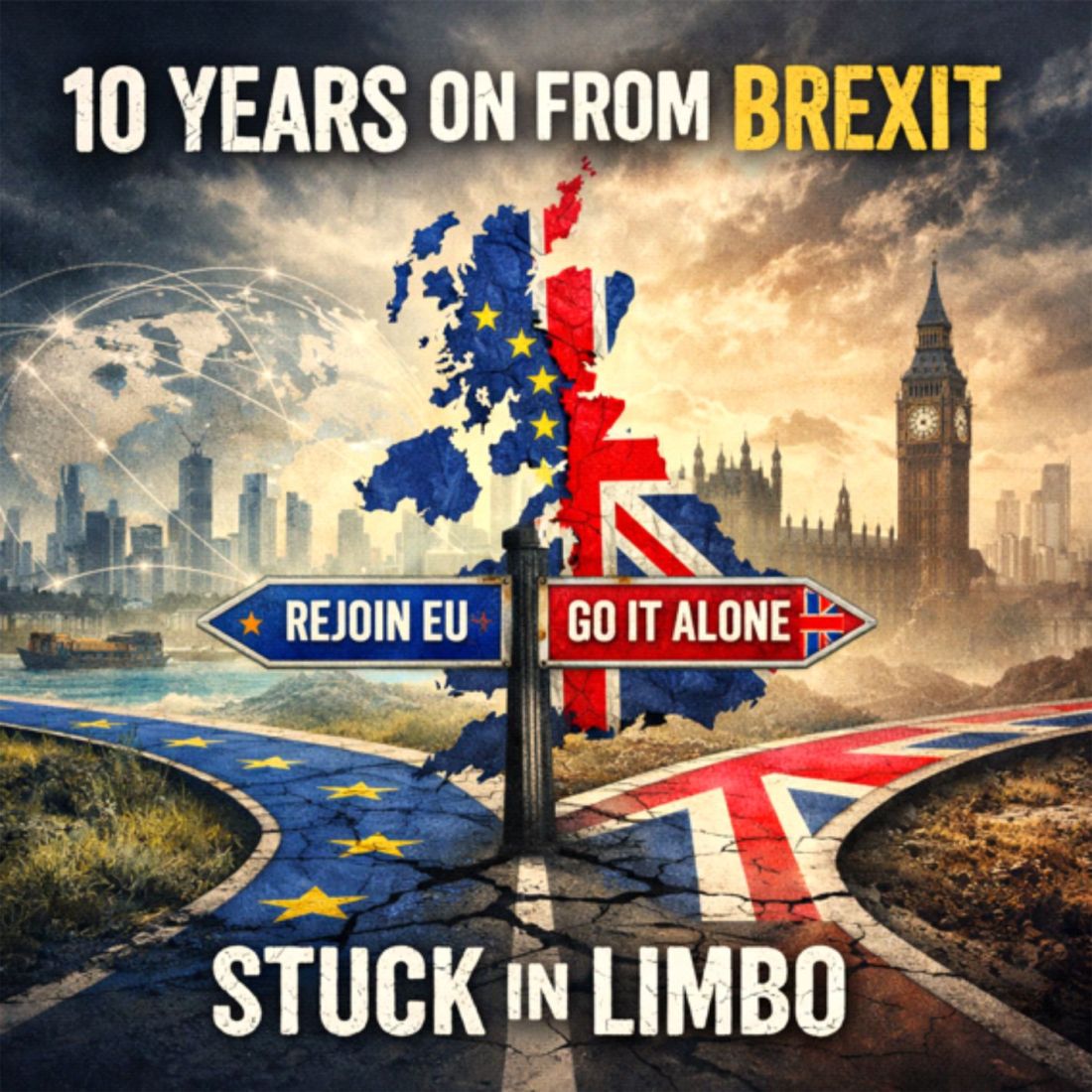
Ten Years On: Brexit, Globalisation, and the Halfway House Britain Still Can’t Escape

Ten years after the Brexit vote, Britain should be clearer about where it stands. Instead, the country remains stuck in a political and economic halfway house: no longer fully inside the European Union, not meaningfully outside the global system the EU represents, and still without a national strategy for either path.

The problem was never simply Brexit.

The deeper problem is that Brexit exposed forces that had been shaping Britain for decades, and our political class treated the referendum as an end point rather than the beginning of a serious national reckoning.

The EU Was Never the Whole Story

Much of today’s debate still treats the EU as if it were either a guaranteed route to financial prosperity or the root cause of Britain’s problems.

However, the EU has always been something larger in disguise: globalisation with a regional structure and a political language of rules, markets, mobility, and managed integration.

By globalisation, I do not simply mean trade with other countries. I mean a money-centric and increasingly extractive system in which capital moves more freely than people, production is shifted wherever costs are lowest, assets are financialised, and national governments are pressured to organise their economies around global markets, investor confidence, and regulatory alignment rather than the long-term needs of their own citizens.

The EU is one expression of that model. It gives globalisation a regional form: rules-based, legally embedded, and institutionally durable. It can protect some standards, but it also limits the space in which national electorates can demand a fundamentally different economic settlement.

The pressures on public services, the loss of local industry, the dependence on imported labour and goods, the rise of unaccountable governance, the hollowing out of productive capacity, and the sense that politics no longer answers to voters are all symptoms of this wider settlement. They were not created by membership of a single regional bloc, even if EU membership helped give them shape.

Brexit didn’t create these problems.

It accelerated our collision with them.

Once outside the EU, Britain could no longer pretend that Brussels alone was the thing holding it back. We had to face a harder truth: the UK had no coherent plan, no institutional structure, and no leadership prepared to build a post-globalisation nation-state rooted in productive capacity, democratic accountability, and national resilience.

And a decade later, we still don’t.

Rejoining Wouldn’t Take Britain Back – It Would Take Britain Further In

Calls from some Labour figures and pro-European commentators to “rejoin” often imagine a return to the EU Britain voted on in 2016. But that EU no longer exists in the same form.

Over the past decade, the EU has moved further toward deeper integration: fiscal, political, regulatory, and strategic. Its direction of travel is toward more centralisation, not less.

Rejoining today would not mean stepping back into the old argument. It would mean entering a more integrated project, from a weaker position, after having surrendered the leverage Britain once had as a member.

Rejoining now would mean:

• paying to enter a more integrated EU;

• accepting rules Britain no longer helped to shape;

• and accelerating the same direction of travel our own halfway-house politics has already pushed us further into.

In reality, rejoining would not reverse Britain’s drift.

It would simply mean paying to arrive faster at the place Britain is already drifting towards.

The Right Is Fighting Over Something None of Them Can Reach

Meanwhile, the Conservative Party, Reform UK, and Restore are locked in a struggle over the language of “taking back control”. But none has yet shown how that control can be restored while Britain remains embedded in the same globalised framework that weakened it in the first place.

They are fighting over a steering wheel that no longer controls the direction of travel.

You cannot deliver meaningful sovereignty inside a globalised framework unless you are willing to break with the assumptions of that framework: cheap labour over national cohesion, financial flows over productive industry, managed decline over strategic renewal, and international approval over democratic consent.

So far, none of them has been willing to say that clearly.

So the Right fights each other.

Labour dreams of rejoining.

And the country stays stuck.

The Real Difficulty of This Anniversary

The difficulty isn’t Brexit.

The difficulty is that Britain still has not accepted what Brexit revealed:

• The EU wasn’t the root cause of our problems.

• The deeper cause was globalisation: financialised, extractive, and hostile to genuine national decision-making.

• Brexit gave us a chance to rethink everything.

• We voted for it.

• But we didn’t take it.

• And now we’re paying the price for standing still.

Ten years on, the choice is no longer Leave vs Remain.

It is this:

• Finish the job of becoming a self-governing country by rebuilding domestic industry, restoring democratic control over economic choices, reducing dependence on fragile global systems, and placing national resilience above global approval;

or

• pay to rejoin a system that is heading exactly where Britain’s own political drift has already taken it.

The halfway house is the one place Britain cannot stay. It cannot govern itself properly from there, and it cannot re-enter the old world because that world has moved on.

Ten years after Brexit, the question is no longer whether Britain was right to leave. The question is whether it still has the courage, imagination, and seriousness to become something more than a country permanently suspended between dependence and sovereignty.

Further Reading

These two earlier pieces develop the argument behind this anniversary essay. Together, they explain why Britain’s post-Brexit position is not simply a question of Leave or Remain, but part of a wider crisis of sovereignty, political purpose, and national direction.

Brexit & the Halfway House: Why Britain Cannot Move Forward or Back

This article sets out the original halfway-house argument: that Britain has left the institutional structure of the EU without building the national capacity, political confidence, or strategic direction needed to operate as a genuinely independent country. It explains why simply drifting, rejoining, or pretending Brexit is complete all fail to answer the deeper problem.

What Is the Right Really For? Why Britain’s Conservatives, Reform UK, and Restore Are Fighting Over Something None of Them Can Reach

This companion piece examines the struggle on the British Right over sovereignty, control, and political identity. It argues that parties can promise to “take back control”, but unless they confront the globalised economic settlement itself, they remain trapped inside the very system they claim to oppose.

Future Economics must be tied only to people, their contribution, what is important to sustain good, fair and balanced lives, and legal currency must never again be open to speculation and manipulation

You don’t need to be a trained economist to know that the model of economics the world uses and the way economics is revered like work of the gods today is wrong.

In fact, it is probably better if you aren’t, and that you aren’t involved in economics, banking or corporate wealth creation either. As you are much more likely to be objective and untainted by ‘being in the tent’ in some way.

The misplaced ingenuity of the economic system and how it works has made it as complex as it is mind boggling. But that doesn’t give any surety or guarantee that how it works and what it achieves is in any way good.

For those actually thinking about why money is the common factor in everything across the world that is now going wrong, the complexity of the economic system is being exposed to light as the smokescreen that it is giving the hallucination of credibility to all the darkness and malevolence that has been so cleverly hidden within.

How can something so clever and complex not be real, is a question that many would employ as a riposte to counter the suggestion that there is absolutely no legitimacy to the FIAT monetary system, MMT, Free Markets, Globalisation and Neoliberal Orthodoxy that we have been subjected to for 5 decades or more.

But isn’t it the case that any good game that feels good to play is only good for those playing, because of the complexities and therefore levels for ‘the players’ that are involved?

How many carrots does it cost to buy a wheel?

To really understand why the world now has got the relationship with money so wrong – even though it was deliberately made this way by corrupt interests who have changed the laws so that their crimes have been legitimised and wiped clean – we really do need to stop for a moment, count to ten and think about what money is, or rather was really intended for.

In so far as the accepted narrative of human history goes, the whole pathway of our development has been progress that moved towards today in a linear fashion, stepping off from very primitive times when man couldn’t even speak, let alone farm for food.

The point here is not to argue whether or not any accepted version of the evolution of man is true. But to set the first picture back at a point when everything was considerably more simple. Long before more and more of those complex ideas or complexities became involved in how people trade.

Then, as now; different people did different things and produced different foods, goods and services to others as the direct result of whatever it was that they did.

For the purposes of this explanation, let’s assume that there are already fishers, farmers, growers, millers, bakers, saddlers, farriers, blacksmiths, cheese and butter makers, butchers, water carriers and pretty much someone or some small business providing all the different forms of foods, goods and services that we need to provide for life, from around a village green.

Some days a baker doesn’t want fish and a fisher certainly doesn’t want a saddle or leather goods daily. Even though they probably need something made to protect them against the elements from time to time.

However, everyone needs something regularly. Whether it’s for their own consumption, or it’s there to help them complete and provide output or goods from their own work.

Bartering and exchange, or swapping goods or even hours of work are of course a very straightforward and sensible way for two parties to make a transaction when one has something available that the other needs.

But the real benefit of bartering and exchange comes from being localised. And its weakness soon showed when the transactions were required to take place over distance, or for items – like that saddle or something equally special – which in day-to-day terms, are rather obscure.

Money, or coins of some kind used at first, created a transactional value, or to be more accurate, a medium of exchange.

The creation of a medium of exchange meant that one person’s goods or efforts could be exchanged for coins that could then be exchanged for whatever that person wanted themselves. All without there being any excessive delays or the need for a very complex or convoluted chain of different transactions to be involved.

The beauty of the system, at that point, was that the money in use could only relate to the agreed value of the transaction.

It would have been good for everyone, once the related practicalities involved were ironed out, if that system had continued without further ‘progress’. The relationship we all have with money could then have remained the same in relative terms – as that unit of exchange and nothing more.

Unfortunately for mankind, progress very quickly created wealth disparity or what we call wealth inequality today.

This imbalance was itself made progressively worse by the inter-generational transfer of property and wealth (and the power it buys) which has snowballed over time. Quite literally meaning that people can be advantaged or disadvantaged by birth, even before any one of the many other factors that skew life opportunities can come into view.

One of the most unfortunate elements of the human condition is the innate desire to always possess and accumulate more. For no better reason than the basic fear we all have of experiencing lack. With the rather perverse dimension that those who have more guard it more jealously than others, probably because they believe they have much more to lose.

The power and influence that money has given people who really weren’t fit to have the responsibility they had over the lives of others, has only got worse over time.

As industry and technology has improved and made it easier and easier to avoid genuine consideration for the consequences of their actions upon others, the human cost has become increasingly irrelevant, whenever the opportunity to make more profit was involved.

When promissory notes or what we know as cash came into being, a giant leap forward was taken towards the system that we have now, where the accepted wisdom is that the value of the money – or what we are agreeing to exchange as being representative of money – is being exchanged under a mutual understanding of trust, that is shared across society, and not just between the people where the specific transactions are involved.

Trust is of course belief. And as those with power and influence at the centre of the banking system realised that having currencies pinned or anchored to anything meant that they could only ever use or suggest they were able to use the money or sensible multiples of the money that they knew they either held, were owed or could earn within a certain time frame, they knew that they would have to create a new system that would release these chains. So that in terms of the money that they could create and use in the future, the only restraints would be dictated by them.

We should be under no illusion that this process of creating an economic system that could lead to limitless wealth and the control of everything for those who controlled it, wasn’t a plan that developed overnight.

The economic system that we have today was created and implemented over decades and carefully constructed so that it would make life much easier for the interests and in particular the politicians who needed to be bought. So that the useful idiots who gained power under the illusion of democracy would obligingly pave the way with system changes that have legitimised this otherwise criminal system at every step of the way therein.

When everything is about money, the answers to every question can only be found in monetary terms.

The money we have today and the way that it comes to and is taken from us – the economy – is the direct result and design of this massive, corrupt and inhuman game that the worlds wealthy, powerful and influential – the elites, decided to play.

The money we have in our pockets, bank accounts and have the ability to earn changes value quickly at the will or as a result of the actions of others.

Meanwhile, the direction of travel for the general population has always been that we are and always would become increasingly poor, as the value of the money which is typically what the poorest in society have only been able to hold, decreases faster than the rate at which our skills and experience develop or there is any chance to earn more so that we can keep up with or counteract the fall.

It was always intended to be this way. As those with wealth always knew that the real wealth was the control of assets and anything and everything that could then rented out to everyone. All as the world became increasingly poorer and their ability to grow control and rent out everything the money they created had bought them gave them even more.

It is ironic that billionaires now have so many zeros on their balance sheets. As everyone who has been a victim of what is probably mankind’s greatest con is now beginning to realise that they have been left with zero. Or if they are lucky, a diminishing amount of liquid capital that isn’t worth a lot more.

I would like to add at this stage that this essay is not an attack on any individual for whatever it is that they may believe they possess, control or have influence over today. Many of those with excessive wealth, power and influence today have just played along with the rules of a very clever game. One that has removed the balance, Justice and morality from every part of life and has done it so successfully that the poison it has replaced values with is embedded across cultures and normal life to the point that even the academics and leaders in finance and economics believe in the legitimacy and correctness of an entire system which is bewilderingly anti-human at its very core.

In simple terms

The simplicity of the mechanics of an economic system and more specifically a monetary system that revolves around private banks creating money from nothing – a process which is carefully hidden from view – so that government always looks like it is borrowing  or rather selling bonds to private interests to finance everything, whilst those banks also lend money that doesn’t exist to us through loans, finance, credit cards and even pay day loans, really do make it horrendously difficult to accept that this is one massive confidence scam. Especially as everything is hidden in plain sight by little more than the disinterest that we typically have in anything that goes beyond having our perceived needs met.

However, let’s think about it as if we were reading a story about two friends at the start of their working lives; one with the motivation to work hard and deliver through their own industry, whilst the other has had life easy and just wants to find another easy way to get more, and we can then perhaps see how this gargantuan scam rolls out when exposed to light.

The diligent and easy living friends talk one day, looking at property that they would both like to own.

The diligent friend commits to working hard and earning the money to buy what they would like to own and leaves, promising to catch up when this outcome has been achieved.

Meanwhile, the easy living friend knows that he has the contacts and ideas necessary to go away and print enough of the money he needs to buy that same property today. And that he can do this from nothing, which will work out well for him but not his friend, so long as he doesn’t speak openly about what he’s doing. Uses his contacts to change a few rules so that what he’s doing is legal. And he doesn’t keep printing more money to buy everything else so that it becomes obvious what he’s been doing all along. Afterall, nobody will know if he uses the money he then earns from renting out that property to pay all that money back…

The money that the easy living friend has created, has just increased the amount of money that exists.

This means that because there isn’t actually any more property, production or anything else with ‘real’ value that corresponds to the increasing  pool of money, all of the money that’s available is now worth much less than it was.

The real world impact of this fantasy being made reality is that the diligent friend will have to worker harder, longer or both, to pay for the property that the easy living friend has just taken without effort.

What is more, the easy living friend is now offering to rent the property he’s bought to the diligent friend who now realises that he may never be able to afford to buy it.

If you can see and understand the basic mechanics of how this situation works, you only need scale up the same principles to understand how the massive, growing amount of money – and the ridiculous inflation and the growing cost of living problem we are all facing, has been created and is now growing at a ridiculous rate.

It is an unavoidable, inescapable fact that if one person or set of people are able to buy real, tangible things that have value to us – whatever those things might be – with money that doesn’t actually exist, they can take lawful possession of those things and do with them whatever they so choose – as any legitimate owner would be able to do so.

However, the illegitimate creation of the money and the legitimised theft of assets, businesses, infrastructure and everything else imaginable that it has financed means what they have been doing is just one part of a multifaceted crime against everyone else.

The crimes that follow the created money pathways include the impoverishment of the masses.

Yet they become even worse when we consider that public services and infrastructure such as utility companies have been bought up with fake money.

Entire business sectors like the pub trade and small, local shops have also all become unviable because fake money has financed industry expansion of big retail and all their centralised supply chains, that would not otherwise have been possible.

To cap that all off, markets and the practices of big business and finance have been deregulated through the drive for ‘Free Markets’. So that those making money can make more and more, because the rules that once protected us all and small independent businesses have been removed, whilst regulations that cost us, exclude us and disqualify us from our own independence and from taking part have instead been imposed under the pretence that they help and protect us.

The whole pathway of illegitimate money creation using the FIAT system leads or rather has led to the doorstep of nothing less than worldwide system control.

The only thing that now gives us the opportunity to save ourselves from a very challenging fate is the reality that those with their hands in the till have already broken too many of the rules of their own game.

The whole system is starting to collapse before the great reset or imposition of the next new world order has conclusively been imposed.

The Future of Money

I could stop there. But in lifting the stone or exposing what lies beneath it to light I am certainly not alone.

Before continuing further, I would encourage anyone who has read this far to do their own research and use as many different sources and mediums as they can to uncover and draw their own conclusions about all of this and what is really going on.

My real interest and passion is what happens next for us and for our future. Once we have got through this horrid time and whatever turbulence and challenges that we now face, once we have got to the other side and left them all behind.

Whilst I have written extensively about what a good working model for our future society would look like in Our Local Future, I have also spent time sharing thoughts and ideas about the way money and commerce would work, in books from Levelling Level, to An Economy for the Common Good and The Basic Living Standard too.

What we should perhaps all be able to conclude – once we have dealt with our own addictions and attachment to the way that endless money supposedly works for us all now – is that money should never hold its own value. Should never be speculated upon, and the power of its creation and policing should never be under private control.

What is more, the value of legal currency should never be pinned to anything that can itself vary in value, especially when whatever that currency is pinned to is in short supply or can be controlled manipulatively or otherwise at will.

People are the only legitimate economic constant

If everyone did what they do, only took what they need and were happy to share or exchange what they didn’t with whoever needed it in return for something they did in return, there would never be need of money of any kind, ever again.

Whilst I can see that to many the idea that everyone just does what they do today for nothing and that in return, they get just enough of what they need of everything else in return might seem fanciful, this suggestion does nonetheless make a very important point about everyone only taking or expecting to have access to what they actually need.

Need is NOT the same thing as want.

Too much want is what has led to a situation where there are people right across the world today who don’t have access just to the things that they need.

An economy – a legitimate economy – will function only to provide for the needs of people within it.

There isn’t an argument that can counter this legitimately. Any argument made against this, no matter how compelling or well elucidated, is inevitably built upon one person being able to obtain or accumulate more things than others. Because the alternative system favours their interests more.

These are the fundamental basics of greed.

Locality based economies and economics

Everyone who can, should play their part or contribute to the function of a legitimate economy, in whatever role they are able. So that everyone who is active, then comes together to become the sum of all the parts – with the sum of those parts being the community, which because of what members can do together collaboratively, will be greater than what everyone would be able to do by working alone.

The value of a legitimate economy should therefore be based upon the number of people who are active within it and include what they input or contribute to that economy individually and therefore collectively.

If every member of the community does what they should be doing, and the needs of everyone being met are always prioritised and planned for or budgeted for as they should be, the whole system will move closely towards self-containment, with the amount of money in circulation always being closely related to the number of heads within the population.

A localised and online local market exchange system that focuses on bartering and exchange for foods, goods, services and work being made universally available alongside cash and digitally transferable money, should also exist so that everything works in a circular fashion and everyone’s particular needs are always met in ways that favour everyone.

The needs for public service, infrastructure, community activities and everything beyond should be met by everyone who is able to work volunteering the equivalent of 1/10 of their working week and their skills or experience to the community. Thereby meeting whatever needs and community income generation requirement there may then be.

Excess goods produced, surplus service capacity and over production which is specialist to the community would also be traded with other communities and traded where any additional requirements beyond the scope of community production exist.

The blight of greed-driven thinking

The only reason that an economic system that will work like this, which promotes freedom and financial independence of the masses, would not work, is because those who would no longer be able to define themselves as being different to others through the accumulation of additional and unnecessary wealth will argue that it isn’t practical and cannot work.

Even within a genuinely egalitarian approach to economics based along these lines, it is a fact that some could always do better, because they choose to do so through their own industry. Whilst many others – and the majority at that, would be happy to just make the contribution that was absolutely necessary, knowing that they would be happy, healthy, safe and secure because all of their basic and essential needs were being met.

It is part of the capitalist myth that entrepreneurialism and creativity in commerce cannot exist when the ability to earn or rather profit is capped.

The real truth of the matter is that everyone will be productive and make a valuable contribution when anything that goes beyond what it takes to look after themselves and those who depend on them is a choice and the ability to just live a normal life without dependency on anything beyond themselves hasn’t been denied by the actions of others.

Nobody has the right to take or have more than they need and certainly not when it can only come to them through the exploitation and infliction of pain and suffering of any kind upon others.

Further Reading (Updated 14/1/26):

1. Breaking the Money Myth: Rethinking Value, Exchange and Equality

https://adamtugwell.blog/2025/11/12/breaking-the-money-myth-rethinking-value-exchange-and-equality/
Summary:
Challenges conventional beliefs about money, exploring how value and exchange have been distorted by modern economic systems. This article lays the groundwork for understanding why current monetary practices are problematic and why rethinking these fundamentals is essential for a fairer society.

2. The Basic Living Standard Explained

https://adamtugwell.blog/2025/10/24/the-basic-living-standard-explained/
Summary:
Explains the concept of a “basic living standard” – the minimum requirements for a dignified life. It discusses how economies should prioritise meeting everyone’s essential needs, and why this principle is central to building a legitimate, people-focused economy.

3. An Economy for the Common Good (Full Text)

https://adamtugwell.blog/2025/02/24/an-economy-for-the-common-good-full-text/
Summary:
Presents a comprehensive vision for an economy designed to serve the common good, rather than private interests. It explores practical models and policies that could shift economic priorities toward collective wellbeing and sustainability.

4. The Role of Barter and Exchange in the Local Economy Governance System

https://adamtugwell.blog/2025/12/03/the-role-of-barter-and-exchange-in-the-local-economy-governance-system/
Summary:
Delves into how barter and local exchange systems can strengthen community resilience and independence. Offers practical insights into alternative economic mechanisms that bypass traditional currency, supporting the idea of locality-based economies.

5. The Local Economy Governance System (Online Text)

https://adamtugwell.blog/2025/11/21/the-local-economy-governance-system-online-text/
Summary:
Provides a detailed framework for governing local economies, emphasizing community participation, transparency, and sustainability. Ties together previous concepts, showing how they can be implemented at the local level for maximum impact.