We often look for a moment when everything changed.
A document. A leader. A law. A decision.
History becomes easier to understand when it appears to have a beginning.
Yet the deeper we look, the more difficult beginnings become to find. What seem like origins often turn out to be moments when longer processes become visible.
The question is not simply where something started.
The question is what made it possible.
The illusion of beginnings
The essay makes a distinction between two very different things:
The beginning of an arrangement
and
The beginning of all the conditions that made that arrangement possible.
The two are rarely the same.
A law may come into force on a particular day.
An institution may have a founding date.
A memorandum may propose a new strategy.
Yet the assumptions, interests, habits and circumstances that made those things possible often stretch back decades or centuries.
What we call a beginning is often a point in the middle of a longer story.
How assumptions survive
Ideas do not survive only because people keep repeating them.
Often they become embedded in the world around us.
They appear in:
systems
incentives
measurements
routines
institutions
Over time they can stop looking like assumptions and start looking like reality.
One generation establishes them.
The next generation inherits them.
The generation after that may treat them as obvious.
Direction without destiny
The essay rejects two simple explanations of history.
The first is that everything happens according to some hidden master plan.
The second is that everything happens by accident.
Reality is usually more complicated.
People make decisions.
Those decisions create incentives, institutions and expectations.
Future decisions are then made within the world those earlier decisions helped create.
Patterns emerge.
Trajectories develop.
Yet nobody possesses complete knowledge of where they will lead.
A question worth asking
When an arrangement seems inevitable, ask:
Is this genuinely necessary, or have we simply become accustomed to it?
Familiarity is often mistaken for necessity.
History reminds us that they are not the same thing.
The challenge of responsibility
None of us begins with a blank page.
We inherit:
institutions
traditions
debts
opportunities
assumptions
Inheritance explains part of the story.
It does not remove responsibility.
We may not have chosen the circumstances we receive, but we still influence the circumstances we leave behind.
Two silences
At the centre of the essay sit two simple observations:
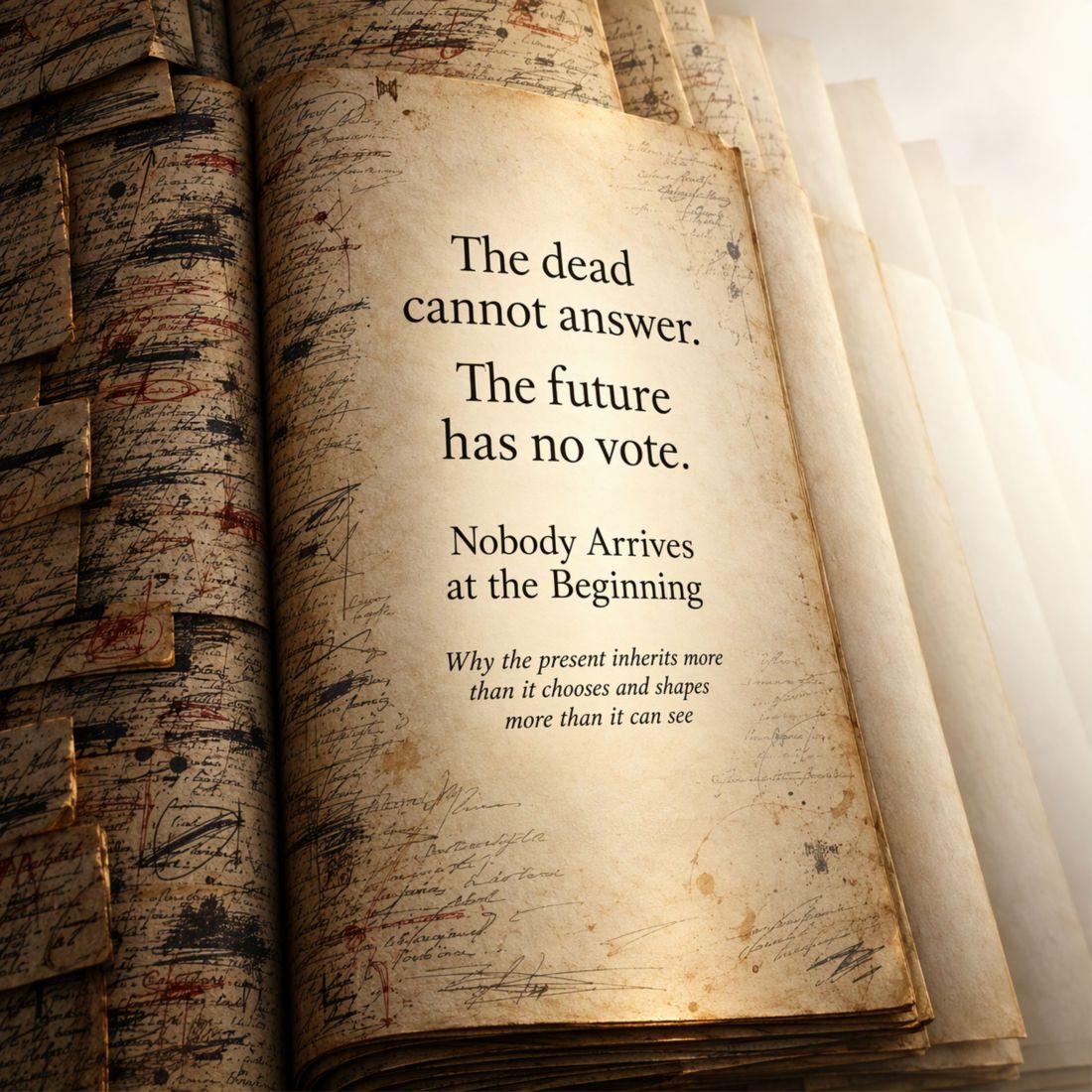
The dead cannot answer.
The future has no vote.
The first reflects a limitation of historical understanding.
We can study the past, but we cannot ask it to respond.
The second reflects a limitation of political responsibility.
Future generations may live with the consequences of today’s decisions, but they cannot participate in making them.
Between those two silences sits the present.
Nobody arrives at the beginning
The deeper the inquiry goes, the harder it becomes to find anyone standing at the start of the road.
The people of the past inherited a world they did not create.
So do we.
Every generation enters the story in the middle.
Every generation mistakes some assumptions for reality.
Every generation leaves something behind.
The challenge is not to find the beginning.
The challenge is to understand our place within the process.
A final reflection
Future generations may look back on some of our assumptions the way we now look back on assumptions held by those who came before us.
The uncomfortable question is not whether this will happen.
The uncomfortable question is:
Which of our own assumptions will seem obvious, unquestioned and mistaken to those who come after us?
Why the present inherits more than it chooses and shapes more than it can see
Introduction
As the results of the November 2026 United States midterm elections began to come in, I was listening to James Talarico’s appearance on The Diary of a CEO with Steven Bartlett. The interview had been recorded on 8 September, while Talarico was campaigning for the United States Senate in Texas. By the time I began writing, NBC News had projected his victory. Yet it was a reference to a much older document, rather than the election itself, that stayed with me.
The conversation ranged across affordability, inequality and the relationship between money and political power. During it, Talarico mentioned the Powell Memorandum. I had never heard of it. Curiosity, rather than agreement with any particular account of its influence, led me to read further.
What I found was a confidential memorandum written by Lewis F. Powell, Jr. on 23 August 1971 for Eugene B. Sydnor, Jr., chair of the Education Committee of the U.S. Chamber of Commerce. Its title was Attack on American Free Enterprise System. Powell believed that business faced a broad challenge to its legitimacy and urged a more organised response. The document has since attracted sharply differing interpretations of its importance.
Initially, I thought I was investigating a memorandum. Then I noticed the date.
1971.
That year had appeared repeatedly in my own explorations of money, debt, institutions, governance and the relationship between people and systems. It seemed to sit near several changes that mattered to the world I was trying to understand. Finding it again made me wonder whether I had encountered an explanatory turning point: a place where the present might begin to make sense.
But there was a problem with that thought. Even if Powell’s memorandum had been extraordinarily influential, why had he written it? His concerns, his assumptions and the institutions through which he sought to act already had histories of their own.
What began as a question about one document became a question about the way I was reading history. Was I recognising a significant moment – or mistaking significance for a beginning?
These were consequential developments. Their proximity in time, however, does not establish that they shared a cause, formed a single programme or explain everything that followed. A date can organise an inquiry without answering it. I needed to distinguish what the historical record showed from the connections I was tempted to draw.
The appeal of an origin is easy to understand. It offers a place to begin the story and somewhere to locate responsibility. A document, an organisation or a decision can turn a complicated process into a sequence that feels manageable: first this happened, then the world changed.
Sometimes that is a useful simplification. Institutions have founding dates. Laws come into force. Decisions can close one route and open another. There is no need to deny these beginnings in order to question the larger claim that one of them marks the origin of the present.
The distinction is between the beginning of a particular arrangement and the beginning of all the conditions that made it possible. Powell could propose a strategy, but he did not create the business interests, educational institutions or political disputes to which he was responding. A new organisation can alter a debate without inventing the problems that brought its members together. Industrialisation can transform a society while drawing upon developments already underway.
Nor does an inherited context make an event merely a symptom. A turning point can accelerate a process, consolidate an advantage or produce a genuine break. The question is not whether it mattered, but how it mattered: what it changed, what it carried forward and what would plausibly have happened without it.
The history of Bretton Woods offers a concrete reminder. Nixon’s decision was dramatic, but the pressures behind it were not new. The Federal Reserve’s account describes years of attempts to defend the dollar and sustain confidence in gold convertibility. Even after August 1971, governments tried to preserve fixed exchange rates through the Smithsonian Agreement. The transition continued into 1973. A moment that looks decisive in retrospect was also one stage in a prolonged struggle to maintain, then replace, an inherited arrangement.
This did not make 1971 less interesting. It made my question more precise. Rather than looking for the moment everything started, I began asking which processes became visible there – and how choices made within them could influence a future nobody could fully know.
Direction Without Design
If no single event supplies an absolute origin, why do some historical patterns persist? Why can institutions, incentives and familiar ways of thinking survive the people who established them?
By direction, I do not mean that history has one purpose or moves inevitably towards one destination. I mean something more limited: a recognisable tendency within a particular process. A system can repeatedly favour certain choices without everyone participating in it agreeing about the outcome.
There is a temptation to treat that consistency as evidence of comprehensive design. If similar interests benefit repeatedly, perhaps someone must have planned the whole result. Yet the alternative is not to insist that everything happened by accident. Between a finished blueprint and pure chance lies a world of deliberate decisions, inherited constraints, competing interests and unforeseen consequences.
A blueprint specifies a destination. A trajectory describes a course whose destination may remain unknown. The distinction is useful, but it must not become an excuse to ignore actual planning. People organise, exercise power and pursue long – term goals. The absence of complete foresight neither disproves coordination nor diminishes the influence of those with the resources to act.
Likewise, inheriting a world does not mean inheriting an equal share of power over it. A business leader, a policymaker and a worker may all operate within existing institutions, but their ability to change those institutions can differ greatly. Any account of historical direction needs to ask whose choices count, whose interests are protected and whose objections are excluded.
What inheritance helps explain is why even deliberate strategies do not operate on a blank canvas. People act through institutions that already exist, using concepts and expectations they did not invent. Their plans interact with other plans, with resistance and with circumstances beyond their control. The eventual result can differ from the intentions of every participant.
Continuity can also arise without renewed commitment to the original purpose. An arrangement becomes easier to extend than to replace. Skills, resources and expectations accumulate around it. Later decisions are made within the possibilities it has created, and those decisions may reinforce its course even when the people making them have different ambitions.
This is a way of understanding persistence, not a law that makes change impossible. Institutions can fail. Assumptions can be challenged. Political struggles can redirect a process. The fact that a route has been travelled does not mean it must be followed indefinitely.
History, viewed this way, is neither an elaborate plan executed across generations nor a collection of unrelated accidents. Its larger patterns can emerge from choices that are intentional in their immediate purposes but incomplete in their understanding of what comes next.
The question then becomes more concrete. What connects those choices across time? What do people inherit that makes some possibilities seem sensible, others impractical and others almost unthinkable?
What Gets Passed Forward?
Ideas, policies and institutions are part of the answer. But the thread I found most useful was the assumption: a judgement about how the world works, or what matters within it, that helps determine which decisions appear reasonable.
Some assumptions are stated openly and defended. Others are embedded in rules, incentives and routines. They are not necessarily unconscious, and they are not necessarily wrong. Their importance lies in how easily they can become the starting point of a decision rather than its subject.
Consider a hypothetical institution that judges success principally by the volume of work completed. Initially, this may be a practical response to a backlog. It then designs its reporting around volume, rewards staff for increasing it and allocates resources accordingly. New managers inherit those measures and use them to demonstrate improvement. Eventually, the question “Are we completing more?” can displace the question “Are we completing the right things well?”
No one needs to have intended that displacement. The original measure may have served a legitimate purpose. But once it shapes reporting, rewards and resources, it begins to structure the choices of people who were not involved in selecting it. An assumption about what counts as success has acquired institutional consequences.
The example is illustrative, not evidence about a particular organisation. It shows the mechanism I have in mind: a judgement becomes a rule; the rule shapes behaviour; the resulting behaviour makes the judgement seem natural. Later participants encounter not just an idea, but a working environment built around it.
Such continuity need not depend on universal agreement. Someone may question a measure and still be required to report against it. A policymaker may doubt an inherited arrangement while finding its replacement costly or politically difficult. What persists is not always a belief held equally by everyone, but the influence of a belief already built into the terms of participation.
This also complicates the distinction between an assumption and the reality it helped create. If an institution consistently rewards one kind of behaviour, people adapt to it. Their adaptation can then be presented as proof that the institution was responding to human nature all along. An outcome partly produced by a rule becomes a reason to keep the rule.
That possibility is why examining assumptions matters. It asks us to distinguish necessity from familiarity, evidence from convention and an arrangement’s present effects from its original justification. It also reminds us that inheritance is selective. People resist, reinterpret and discard what they receive; continuity is something to explain, not simply presume.
My interest in the Powell Memorandum changed at this point. Rather than asking it to explain the whole subsequent world, I wanted to see which assumptions it expressed, how they supported its recommendations and what evidence would be needed to trace their later influence.
The Powell Memorandum Revisited
Returning to Powell’s memorandum, I could see more clearly why it had caught my attention. It records both an interpretation of the world and a proposal to act upon that interpretation.
Its opening presents the American economic system as being under broad attack. Powell’s concern extends beyond explicitly revolutionary opponents to criticism from universities, the media, religious institutions and other established parts of society. These are Powell’s assessments, not neutral descriptions that a reader must accept. Their value for this inquiry is that they make his premises visible.
For Powell, defending the enterprise system was an urgent task. From that premise followed the case for an organised business response. The movement from diagnosis to action is the important point: what he believed was threatened shaped what he thought should be done.
It would therefore be misleading to say the memorandum was only a snapshot and not a plan. It was a snapshot of assumptions expressed through a strategic intervention. Deliberate action and historical inheritance coexist within the same document. The question is how far that intervention reached, not whether intention was present.
That gives us evidence of circulation and of implementation as reported by the Chamber. It does not, by itself, establish the memorandum as the cause of everything later associated with corporate political influence. Similarities between a recommendation and a later development require investigation: who adopted it, through which institution, with what resources, and alongside what other influences?
Hindsight can illuminate consequences, but it can also make intentions look more comprehensive than they were. The fact that later events resemble an earlier proposal does not mean its author foresaw their full form. Equally, the absence of such foresight does not make the proposal harmless or irrelevant.
For me, the memorandum became a waypoint rather than an absolute origin: a place where a particular set of assumptions and ambitions can be inspected. Its importance need not rest on its ability to explain the whole road. It can help us understand one consequential attempt to influence the route.
And that is what makes it uncomfortable to read. The people of the past do not have a monopoly on assumptions that seem reasonable from within their own moment. Reading theirs raises a question about ours.
The Future Has No Vote
It is easier to notice an assumption once we can see some of its consequences. A historical document lets us compare what its author believed with what later happened. We have no equivalent vantage point from which to inspect the full consequences of our own decisions.
That limitation should encourage humility, but not moral indifference. Understanding the circumstances in which people acted does not settle whether their actions were justified. A person can inherit an assumption, sincerely believe it and still be responsible for how it is used. Nor must a decision’s consequences be wholly unforeseeable simply because its most distant effects remain unknown.
The task is to distinguish what could reasonably have been recognised at the time from what becomes apparent only afterwards. Who warned of a risk? Whose experience challenged the prevailing account? What alternatives were available? These questions preserve responsibility without granting historical actors knowledge they could not have possessed.
They also prevent a reflective account of history from becoming too generous to power. Saying that everyone operates within inherited conditions is true of both those who impose a decision and those who bear its costs. It does not erase the difference between them.
The thought that kept returning to me was this:
The dead cannot answer.
The future has no vote.
The first line names a limit of historical interpretation. We can examine surviving records, compare accounts and challenge conclusions, but we cannot ask those who are gone to respond. Their silence should not become permission to assign them either perfect foresight or motives unsupported by evidence.
The second names a problem of responsibility. People not yet born cannot participate in today’s decisions, although they may live with their consequences. The future is not entirely absent from public discussion – people can argue on its behalf – but its eventual inhabitants cannot tell us directly what they need.
Between those two limits sits the present. We inherit consequences we did not choose, and we contribute to consequences others will not have chosen. That does not require us to predict everything. It does require us to take the limits of our perspective seriously.
Perhaps the most useful way to think about this is as navigation rather than the construction of a finished destination. We must choose a route without knowing every condition ahead. Good judgement then involves more than confidence in our current map. It involves listening to those who encounter different terrain, noticing when evidence contradicts our expectations and preserving the ability to change course.
For me, that gives the inquiry a practical edge. What do our institutions count as success? Which costs fall outside their measures? Whose interests are treated as obstacles rather than evidence? Which arrangements do we call inevitable because we have become accustomed to them? And how readily could those who follow us revise the choices we are making?
These questions do not guarantee better answers. But they make assumptions available for examination before they harden into the terms on which everyone else must act. They move responsibility beyond the search for a culprit in the past and towards scrutiny of the choices available now.
History cannot place us outside the process. It can only help us recognise our position within it.
Nobody Arrives at the Beginning
One thought continued to return throughout this inquiry. Whenever I believed I had found a starting point, it proved to be another stage.
The Powell Memorandum responded to circumstances that already existed. So did Bretton Woods, industrialisation and the Fabian Society. The deeper I looked, the harder it became to find anyone standing at the beginning of the road. Instead, I found people joining a process already underway.
This distinction changes how responsibility appears. Historical narratives encourage us to search for the decisive person, document or decision: the point at which somebody understood what was happening and set everything else in motion. Real life rarely offers such clarity.
The people living through 1971 did not experience it as a completed historical period. They faced uncertainty, disagreement and incomplete information, just as we do. The same was true of those who drafted constitutions, built institutions or designed economic systems. They were not standing outside history and directing it from above. They were responding to the circumstances they could see.
Perhaps that is the value of a historical milestone. It need not begin a process to make that process visible.
The Powell Memorandum is one such moment. It records assumptions while they were still being stated and defended. It captures people attempting to influence a future they could not see, allowing us to observe historical direction from within rather than only through its consequences.
Every generation enters the story in the middle. It inherits assumptions it did not create, mistakes some of them for reality and contributes something of its own. In doing so, it leaves the road different from the way it found it.
The people who came before us never possessed the complete picture.
Neither do we.
Conclusion: Standing in the Middle
The Powell Memorandum did not provide the beginning I had gone looking for. It provided something more useful: a view of people acting within history rather than outside it.
The dead cannot answer.
The future has no vote.
Between those limits lies our responsibility: not to stand outside history and explain it once and for all, but to participate in it with greater care. We cannot know the whole destination, but we can question the assumptions guiding our route and preserve room for those who follow to choose differently.
Future generations may see limitations in our assumptions that remain difficult for us to recognise. They may ask how we mistook a particular arrangement for the way the world had to be. We cannot supply their answer in advance. We can begin by asking the question ourselves.
Sources and Notes
This is a reflective essay, not a comprehensive history of corporate influence or monetary change. The historical sources below support its factual frame; the broader argument about inheritance, assumptions and responsibility is an interpretation. Temporal proximity is not offered as proof of a shared cause. The institutional example in “What Gets Passed Forward?” is hypothetical.