
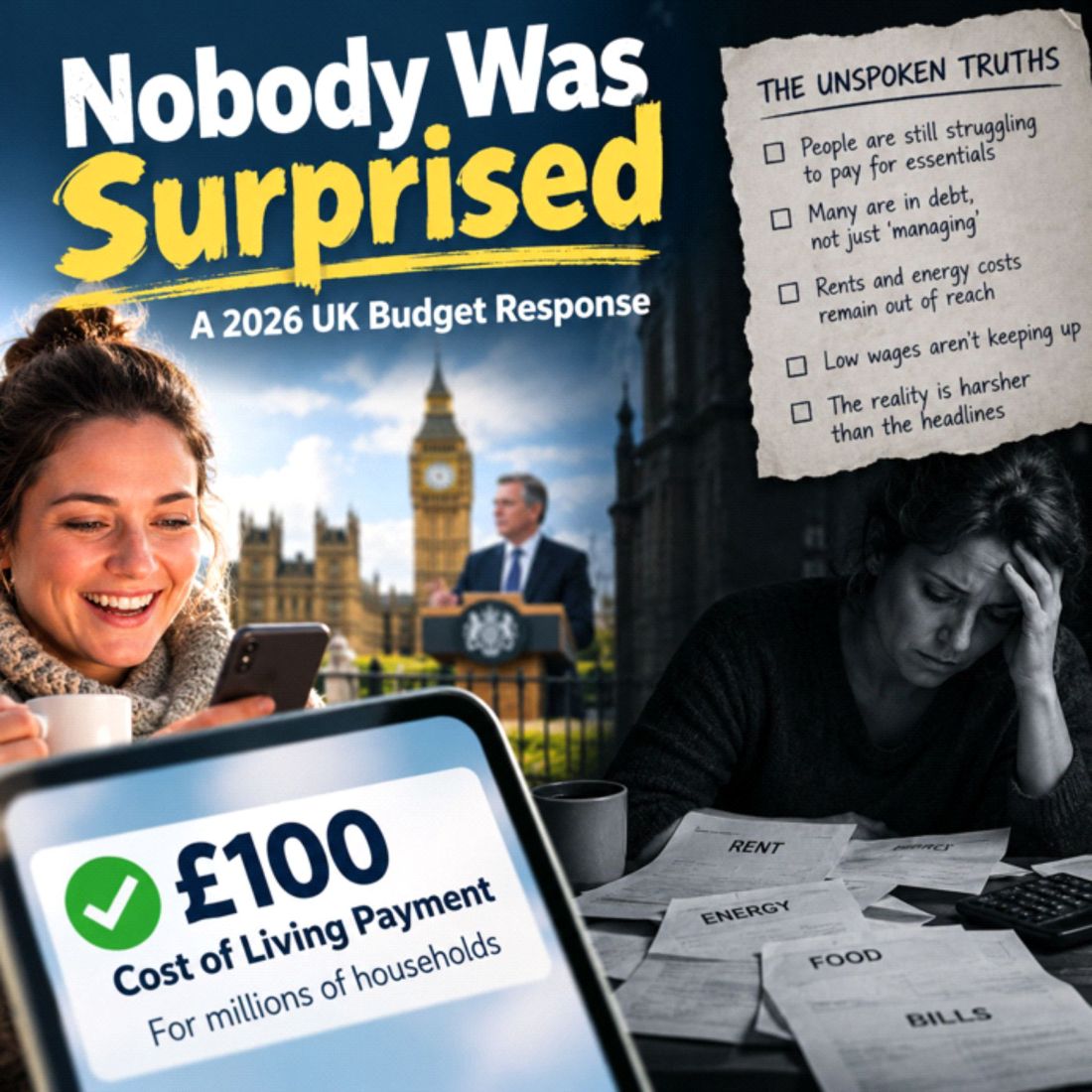
When the Chancellor announced that around twenty million households would receive a £100 payment towards their energy bills, the political reaction was entirely predictable. Ministers hailed it as proof that the Government understood the pressure facing ordinary families.
Opposition politicians dismissed it as another example of short-term thinking. Commentators immediately settled into familiar arguments about affordability, fairness and electoral timing.
Within minutes, people were checking council tax bands and eligibility criteria, while websites struggled under the weight of demand.
What interested me was none of this.
Instead, I found myself drawn to something much simpler. For all the arguments about whether the payment was good policy or bad policy, generous or cynical, necessary or inadequate, almost nobody seemed surprised by the premise itself.
There was remarkably little discussion about why a government had concluded that such a large proportion of the population required direct support towards an ordinary household bill. The debate skipped straight past that question and moved immediately to whether individuals would receive the money.
People did not ask, “How have we arrived at a point where this is necessary?”
They asked, “Do I qualify?”
The more I thought about that reaction, the stranger it began to feel.
The Story We Were Asked to See
From the very beginning of the Budget speech, the Chancellor was careful to establish a frame. Britain, we were told, was facing external pressures. Rising energy costs, international instability and the consequences of conflict affecting global markets had combined to create difficulties for households and businesses.
The Government’s role was to help the country navigate these challenges and provide what was repeatedly described as “breathing space”.
On one level, this is entirely reasonable. Energy prices are affected by global events. Governments cannot control geopolitics. Most people understand that external shocks have consequences.
Yet there is something incomplete about the explanation.
External events can expose vulnerabilities. They rarely create them overnight.
If a storm reveals a leaking roof, the storm is not really the story. The roof is. Nobody claims that the rain created the weakness. The rain merely made existing weaknesses impossible to ignore.
It seems to me that the same distinction applies here.
The Hormuz crisis may help explain why energy prices have increased. What it does not explain is why twenty million households are considered likely to benefit from direct financial support. That vulnerability did not appear the moment energy prices rose. It existed beforehand. The external shock simply illuminated it.
That observation matters because modern politics increasingly encourages us to focus on events rather than conditions.
Events are dramatic. They generate headlines. They create clear villains and tidy explanations.
Conditions are different. They develop slowly, often over years or decades, and they are much more difficult to reduce to a soundbite.
The Budget asked us to look at the event.
The public reaction revealed the condition.
The Thing We Already Knew
The longer I reflected on the announcement, the more convinced I became that the public had not actually learned anything new.
People recognised something.
There is a profound difference between those two things.
Most people do not require an economist to tell them that life feels less secure than it once did. They already know. They know because they experience it every day. They see it in the cost of housing, in the shrinking margin between income and expenditure, in the increasing difficulty of building savings and in the growing anxiety that accompanies unexpected expenses.
The details vary from household to household, but the underlying experience is remarkably widespread. A broken boiler has become more worrying. A rent increase carries more weight. A period of illness feels riskier. A redundancy seems harder to absorb.
People may not describe these experiences in economic language. They may never talk about resilience, dependency or structural fragility. Yet they understand the feeling intuitively because they live with it.
That is why the £100 payment landed so easily.
The public did not need persuading that the pressure existed. They already knew.
The announcement mattered because it reflected a reality that had long since become familiar.
The Slow Art of Adaptation
Human beings are extraordinarily adaptable creatures. It is one of our greatest strengths. We can endure conditions that would have seemed intolerable to previous generations. We can adjust our expectations, recalibrate our assumptions and continue functioning long after circumstances have changed.
The difficulty is that adaptation often disguises deterioration.
A society rarely experiences decline as a dramatic event. History can make it look that way, because historians have the luxury of hindsight. They can identify turning points, label eras and draw neat boundaries around periods of change. The people living through those changes experience something very different.
They experience ordinary life.
They experience another bill arriving through the letterbox.
Another policy announcement.
Another political argument.
Another compromise.
Another adjustment.
The idea that decline arrives with a dramatic fanfare is largely an illusion created by distance. More often it arrives as a series of accommodations. Something that once felt unusual becomes familiar. Something that once triggered alarm becomes accepted.
Expectations quietly shift and the adjustment becomes so complete that people stop recognising it as an adjustment at all.
This is what makes the reaction to the Budget so fascinating.
The payment itself is not extraordinary.
The familiarity of the reaction is.
The Things We Stop Seeing
There was a time when food banks would have been treated as evidence of a serious failure. There was a time when tents appearing in public spaces would have been regarded as shocking. There was a time when an entire generation finding home ownership increasingly unattainable would have dominated political debate.
None of these things has disappeared.
What has changed is our relationship to them.
They have become ordinary enough to coexist with daily life.
People still care. People still worry. People still complain. Yet the underlying reality no longer produces the same sense of alarm because it has become woven into the fabric of normality.
That process is subtle and deeply human. No individual decides one morning that a problem should be normalised. Instead, millions of people slowly adapt to the same reality at the same time.
The extraordinary becomes familiar.
The familiar becomes expected.
Eventually, what would once have been recognised as a warning sign is simply described as life.
Three Performances
Listening to the responses that followed the Budget, I was struck by how differently the political actors described the same moment and yet how little attention any of them paid to the condition underlying it.
The Government spoke about support, stability and responsible intervention. The Opposition focused on borrowing, debt, welfare spending and economic competence. Reform speaking ahead of Budget day itself continued to advance its argument that Britain could unlock growth through deregulation and the removal of barriers.
The disagreements were genuine.
Yet there was also something they shared.
All three responses were fundamentally concerned with management. The question was not whether the system itself was producing growing insecurity. The question was which political group could manage the situation most effectively.
This has become one of the defining characteristics of modern politics. It talks primarily in market-facing language. Growth. Productivity. Borrowing. Fiscal rules. Investment. Competitiveness.
Meanwhile, the public experiences an entirely different reality. Rent. Energy bills. Food prices. Mortgages. Childcare costs. The practical business of trying to build a stable life.
Both perspectives matter. Yet they are not the same.
And increasingly they appear to be speaking past each other.
The Country Beneath the Forecasts
This is what makes the wider forecasts surrounding the Budget so interesting. Taken together, they do not describe a country becoming more resilient.
Welfare spending continues to increase. Real household disposable income is weaker than previously expected. Unemployment is forecast to rise. Pressures in housing remain stubbornly unresolved.
No individual forecast proves anything on its own. The significance lies in the pattern.
The direction of travel is not towards greater independence. It is towards increasing stabilisation.
That distinction matters.
A healthy economy should gradually expand people’s ability to absorb shocks, sustain themselves and plan for the future.
Increasing resilience should be one of its outcomes. Yet much of modern policy increasingly resembles a series of interventions designed to prevent deterioration rather than create genuine security.
The £100 payment sits within that context.
Viewed in isolation, it looks like temporary support.
Viewed against the broader backdrop, it looks more like a stabilisation mechanism.
The difference is subtle, but important.
One implies progress.
The other implies maintenance.
Nobody Was Surprised
By the end of the day, what stuck in mind was not the Chancellor’s speech, the Opposition’s criticism or Reform’s alternative vision. It was the reaction of ordinary people.
Nobody seemed confused by the announcement.
Nobody required a lengthy explanation.
Nobody struggled to understand why it might matter.
The response was immediate because the reality being acknowledged was already familiar.
That is what makes this moment so revealing.
The public already knew.
Not necessarily through statistics, forecasts or economic theory. They knew because they had been living the experience long before it received official recognition.
Perhaps the most dangerous stage of any long-term deterioration is not when warning signs first appear. It is when those warning signs become so familiar that they stop being recognised as warning signs at all.
Twenty million households were offered support towards an ordinary household bill.
The remarkable thing was not the payment.
The remarkable thing was that almost nobody found it remarkable.
And perhaps that should concern us more than the detail of the October 2026 Budget itself.

