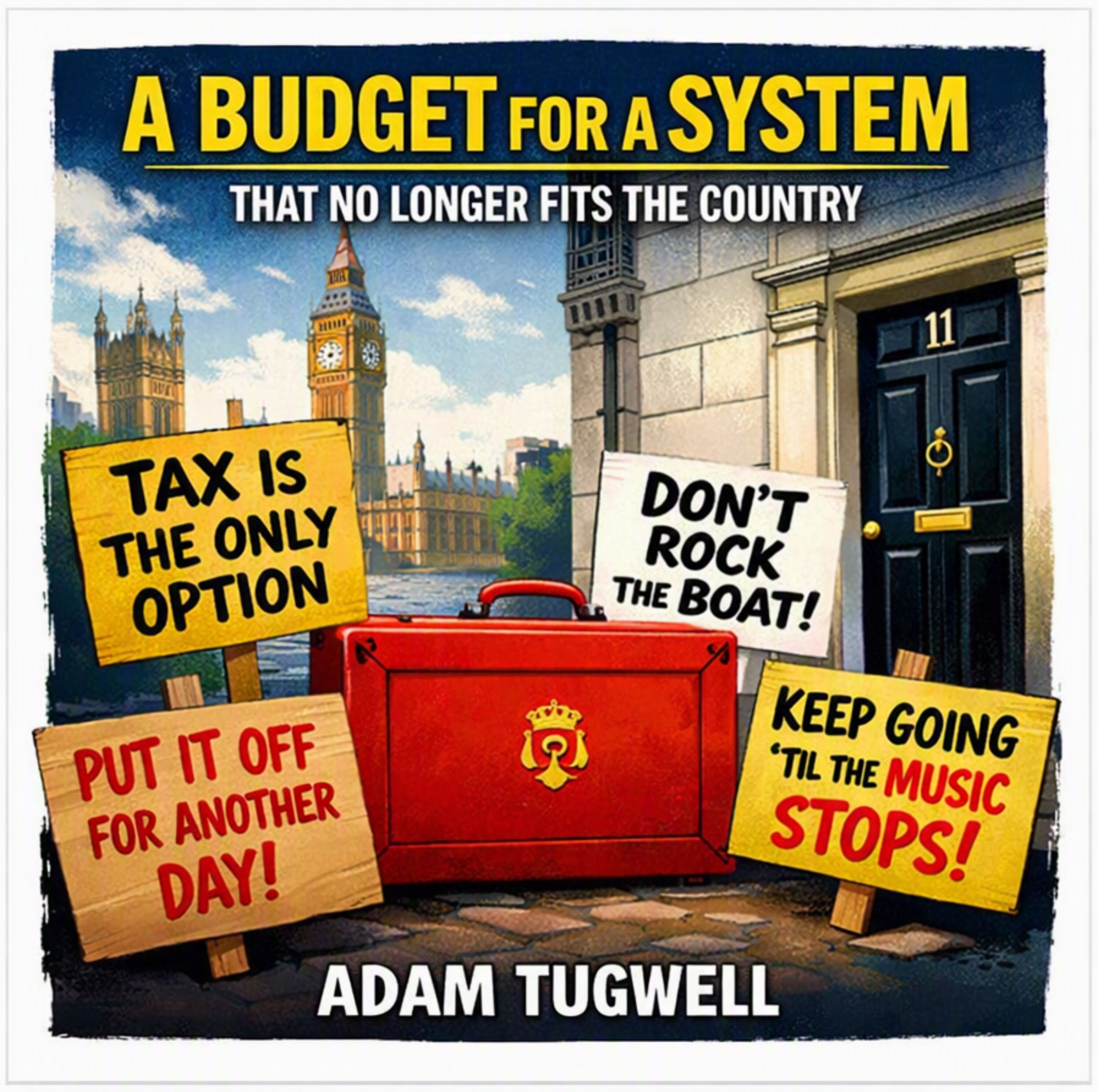

Why the numbers and everyday life keep drifting apart – and why a change of leader, Chancellor or party cannot, on its own, close the gap
On 28 October the Chancellor will deliver a Budget built around growth, stability and fiscal credibility. Many households and small businesses will hear those words and struggle to recognise the country being described. This piece does not try to guess what will be announced. It tries to explain why that gap exists, why it affects any government of any party, and why it matters more than any single measure in the Red Box.
A note on approach: This is not a prediction, and it is not a case for or against any party. It is my own analysis of the conditions in which any Budget is now written. Where I reach conclusions, I have tried to show how I got there – and to set out the strongest objections to them.
In Brief
- Every Budget is now judged on two scales: what it means for the markets and the public finances, and what it means for everyday life. Those two scales are drifting further apart.
- When I talk about “the system”, I do not mean a party, a conspiracy, an economic theory or a group of people. I mean a shared worldview – unspoken assumptions about what counts as realistic, responsible, affordable and possible – that shapes every government, and many of those who oppose it.
- The economic model those assumptions support was built for conditions that no longer hold: cheap energy, expanding globalisation, favourable demographics, falling interest rates and rising asset values.
- Governments are not powerless. But the tools they inherit, and the institutions that use them, face the markets first and the public second.
- That is why changing the leader, the Chancellor or the party does not, on its own, change the direction of travel.
Two Budgets on the Same Day
When the government delivers its Budget on 28 October, the country will once again hear the language of growth, stability and resilience. Forecasts will be revised. Headroom will be calculated. Commitments to the fiscal rules will be restated. In Westminster, that is how a Budget is judged.
But a second Budget is being written at the same time – at kitchen tables, in small business accounts, and in the monthly calculations millions of people make about food, rent, energy and fuel. For many of them, the numbers celebrated in the Commons will bear little resemblance to the reality they live in.
That feeling is not imagined, and it is not simply disappointment with one government. It is the result of a deeper problem – one that affects any government, of any party, operating inside the current economic model.
To explain why, I first need to be clear about what I mean when I talk about “the system”.
What I Mean by “the System”
Most people already sense it. It is the “they” that appears in so many conversations about politics: “they won’t allow it”, “they’ve already decided”, “they’ll never let that happen”.
When pressed to say who “they” are, people reach for different answers – the government, the Treasury, the civil service, the City, the media, “the elites”. Each answer contains a fragment of truth. None captures the whole.
That is because “they” is not really a group of people. It is a worldview – a shared set of assumptions about what is realistic, responsible, credible and possible.
In The Establishment Is Not What You Think It Is, I described this as the modern Establishment: not a class, a cabal or a secret network, but something closer to an operating system that runs quietly beneath politics, finance, the media and public institutions.
It is important to be clear about what this is not. It is not an economic theory, a party programme or a particular school of thought about money and markets.
People who disagree fiercely about policy can share it completely. It sits beneath those arguments, in the assumptions that decide which arguments are allowed to count as serious.
It shows up in what is treated, usually without discussion, as:
- “realistic” – and what is dismissed as naive
- “responsible” – and what is labelled reckless
- “affordable” – and what is ruled out before it is ever costed
- “credible” – and who is listened to, and who is not
- “possible” – and what never reaches the table at all
None of this is enforced by conspiracy. It is enforced by incentives. Careers, institutions, budgets and reputations are rewarded for working within these assumptions and quietly penalised for questioning them.
Over time, the assumptions stop feeling like choices and start feeling like common sense. That is what makes them so powerful – and so hard to see from the inside.
It also means that anyone who lives and works within today’s version of normal life, including me, has been shaped by them in some way.
This is why decisions can feel as though they arrive from somewhere without anyone quite making them. The power is real, but it is distributed – spread across policy, finance, professional norms, media narratives and institutional habit. It speaks through many mouths while belonging to no single person. And because it protects the institutions that carry it, and keeps those who make decisions at a distance from the consequences, it is remarkably good at absorbing challenges – including from people who sincerely believe they are fighting it.
Today, that worldview is bound up with a particular economic model, built in Britain over roughly the last forty years.
That model relied on:
- cheap energy
- cheap labour
- expanding globalisation
- privatisation and outsourcing
- low and falling interest rates
- rising asset values, especially property
My argument is simple to state, even if its consequences are not: the assumptions are still in place, but the conditions they were built for are not.
The 2026 Budget is being written by people working with tools designed for a world that has changed beneath them.
Why the Budget Will Feel Detached From Real Life
For most people, the economy is not a set of numbers. It is the cost of food, the rent or mortgage payment, the energy bill, the price of diesel, the viability of a small business and the ability to plan for the future. Yet the Budget will be framed around growth – a measure that has become increasingly detached from lived experience.
That is not to say growth is meaningless. Within the current model it matters a great deal: tax revenues, borrowing capacity, pensions and public services all depend on it, which is precisely why every government pursues it.
The problem is what growth has become. It now functions primarily as a system metric – a number that stabilises borrowing, reassures markets and keeps the machinery turning.
It does not tell you whether your household is secure, whether your business can survive, or whether your community is thriving.
Part of the reason lies in what we take money to be. As I explore in The Money Illusion, money is real in its effects, but it is not a fixed substance. It is a social and legal system of claims, promises and credit – and we do not all enter that system on equal terms.
When new purchasing power is created through lending, it becomes real title over real things: homes, land and businesses. A growing economy, measured in money, can therefore sit alongside households and small firms steadily losing ownership, security and room to manoeuvre, under terms they never chose.
Behind this sits a more fundamental point. The tools of economic government – fiscal rules, growth forecasts, borrowing costs, market confidence – face outward towards the markets first and inward towards the public second.
A Budget built with those tools will naturally speak the language of the markets. That is why so much of what is announced can sound reasonable in Westminster and remote almost everywhere else.
And this year, the gap between the two is being widened by pressures that sit largely outside Westminster’s control.
The Pressures Shaping This Budget
The UK is not facing one crisis. It is facing multiple overlapping pressures, many of which have little to do with the domestic choices of any single government.
They are structural, global and long-term – and together they define the space within which any Chancellor must work.
1. Energy and Fuel: The Hidden Tax on Everything
Diesel prices, oil volatility and gas markets are not just energy issues. They are cost-of-everything issues. Higher fuel and energy costs feed into food distribution, construction, farming, manufacturing, public services and the running costs of small businesses – often long before they show up in the inflation figures.
2. Global Shipping and Chokepoints
The Strait of Hormuz is one example, but the vulnerability is wider: disruption in the Red Sea, drought restrictions on the Panama Canal, rising shipping insurance costs, container shortages and geopolitical tensions along key trade routes. Britain’s supply chains are global. When the world’s arteries narrow, Britain feels it quickly.
3. Fertiliser, Farming and Food Security
Fertiliser costs rise with gas prices. That affects planting decisions, crop yields and livestock feed – and, months later, supermarket prices. As I argued in The Fragile Nation, Britain’s reliance on global food systems leaves it far more exposed to shocks than is often acknowledged. This is not a short-term issue. It is structural.
4. Climate Volatility and Extreme Weather
Floods, droughts, storms and heatwaves are not only environmental stories. They are economic ones. Climate pressures now shape food production, insurance costs, infrastructure resilience, supply chain reliability, water availability and energy demand.
5. Demographics, Health and the Workforce
Britain faces an ageing population, rising demand for health and social care, workforce shortages, weak productivity and long-term sickness at record levels. Together, these increase the demands on public spending while narrowing the base that pays for it.
6. Debt, Interest Rates and Fiscal Constraints
Higher interest rates mean more expensive government borrowing and less fiscal headroom, alongside higher mortgage costs, pressure on renters and squeezed small businesses. But the question is no longer simply how much borrowing costs. It is whether borrowing is possible at all on terms the country can bear. The ability to borrow rests on market confidence, and that confidence is now wafer-thin. When borrowing is expensive, conditional on the markets’ continued patience and growth is weak, the levers left to a Chancellor narrow sharply. That is why, as I have argued before, tax increasingly becomes “the only tool they have left”.
7. Technology, AI and Circular Fragility
Financial markets, supply chains and AI-driven industries are now so interlinked that they are set to rise and fall together. That brings higher volatility, the potential for faster contagion, more systemic risk and less room for error. AI is also widely presented as the route to renewed productivity – a claim I return to below, because it contains a tension that rarely features in Budget debates.
8. The End of the Operating Model
Beneath all of these sits the pressure that connects them. The model built over the last forty years depended on cheap energy, cheap labour, expanding globalisation, low and falling interest rates and rising asset values. None of those conditions can be relied upon today. Each of the pressures above would be difficult on its own. Together, they arrive at a model that no longer has the slack to absorb them.
This is the core constraint behind the Budget.
Why Changing the Leader Does Not Change the Rules
Much of our political debate assumes the answer lies in better people: a more competent Chancellor, a bolder Prime Minister, a different party. That assumption is understandable. It is also, I believe, increasingly misleading.
In The Contemporary Politicians’ Dilemma, I explored what happens when people arrive in office and come face to face with the system they have inherited. Read as a whole, it points to an uncomfortable conclusion: that the system is already failing, and that the job on offer is not to fix it but to manage its decline.
That discovery is not confined to one government. Those now in Downing Street and the Treasury have themselves acknowledged that they did not fully understand the state of the country until they were briefed in post.
It is fair to ask what that says about readiness for office. But the more important point is that they are no different from anyone else who might stand in their place.
The deeper question is about a system in which people can reach the highest offices in the country without a clear view of what they are inheriting.
Once in office, the pattern repeats. Whatever a new government intends, it quickly finds itself managing borrowing costs, market reactions, fiscal rules, service pressures and the next set of headlines.
The machinery of government – the Treasury, the fiscal rules, the forecasting process, the relationship with the bond markets – is itself oriented towards the markets. Its instinct is continuity, because continuity is what the markets reward.
This is why I describe many of today’s political figures as managers rather than leaders. It is not a personal criticism. It is a description of what the system rewards.
Even those who arrive intending to lead are gradually turned into managers by the incentives and institutions around them.
A large parliamentary majority creates real agency on paper. In practice, that agency is overwritten by the cost – economic, political and social – of using it to change direction.
It is also why so much of the gesturing from other parties and leaders should be treated with caution. The promise that a change of leader or party will, by itself, put things right is a powerful one. But many of those presenting themselves as outsiders operate within exactly the same assumptions: success judged by market confidence, growth treated as the unquestioned goal, competition as the organising principle.
Anti-establishment rhetoric is not the same thing as anti-establishment thinking – and in some cases it is a more intense version of the same worldview.
When a change of leadership is no longer the solution, presenting it as one is not just unhelpful. It is dangerous, because it directs public frustration at people rather than at the assumptions they share.
There is a second, quieter version of the same problem. British politics is showing signs of a two-part messiah complex: the belief among some politicians that they are uniquely equipped to lead the country – the self-anointed – and the belief among some supporters that stability will come from choosing the right individual rather than from strengthening the system itself – the self-comforted.
It is not confined to one party, or one wing of a party. It can be heard in the suggestion that the markets would simply “fall in behind” a particular leader, as though systems respond to personalities rather than to signals, and in support for would-be leaders built on tone and managerial polish rather than on defined proposals.
These two instincts look like opposites, but they meet in the same place. Both assume that leadership is primarily about the individual. Both assume the public will accept personality in place of substance. And both assume the system will wait while politics settles its internal contests.
It is not waiting. Local authorities are warning that they cannot meet their statutory duties. Public services are running with little slack. The pressures set out above are already shaping the country’s direction. A politics preoccupied with succession and positioning at such a moment is facing not so much a crisis of ideology as a crisis of focus – and focus is the one thing the country cannot afford to lose.
Testing the Argument: The Strongest Objections
An argument like this should be tested against the strongest case against it. These are the objections I take most seriously – and why I do not think they overturn it.
“Governments are not powerless”
They are not. Governments can still tax, spend, regulate, legislate, invest and reform. Choices on planning, energy, skills and infrastructure make real differences to people’s lives. Anyone who claims otherwise is overstating the case.
But agency is not the same as freedom of direction. The tools available to government are system tools, and the institutions that use them are market-facing.
Governments can choose how to manage the existing model; what they find far harder is choosing a different one.
The model expects them to keep extracting – from households, businesses, public services and public assets – to sustain it, and it offers no natural point at which that extraction stops.
Those who can read the bigger picture are left with an uncomfortable question: can I lead us out of this?
In practice, the honest answer is a choice between managing the model for as long as it can be managed, or deliberately changing direction – something that would demand far more disruption than any Budget statement could contain.
“Britain is not uniquely fragile”
That is true, and it matters. Ageing populations, rising debt, energy constraints, weak productivity and political fragmentation are visible across much of the developed world. Britain is not special.
My argument is not that Britain is on a different path, but that it may be further along the same one.
The shocks and choices of the last decade – including Brexit and the economic response to Covid – have amplified pressures that were already building and brought them into focus sooner here than elsewhere.
Several of our closest neighbours face versions of the same strain, some acutely. That is worth remembering whenever closer alignment with Europe is presented as a straightforward way out: our neighbours are travelling in the same direction, and in some cases are not far behind.
“Growth still pays for everything”
Within the current model, it does. Tax revenues, public services, pensions and borrowing all depend on it, and no responsible government can ignore that.
But that is precisely the point. Growth is essential only for as long as we remain bound by the mechanics of this model.
If managing decline remains the only direction anyone in government is prepared to take, growth will remain the master metric.
The question is not whether growth matters within the system, but whether a system that depends on it can still deliver security to the people living inside it.
“We have been here before”
Every generation believes its problems are uniquely difficult, and systems do adapt. Britain came through the crisis of the 1970s, including the 1976 IMF loan, and through the financial crisis of 2008. Perhaps this is simply another painful period of adjustment.
But the comparison with 1976 is less reassuring than it first appears. Britain then still had a substantial productive base – manufacturing, industrial and energy capacity that recovery could be built around.
Much of that has since been hollowed out, and the economy is now organised around growth, consumption and asset values rather than genuine productive capacity.
Households, too, have far less resilience. Conditions of the kind that come with external rescue would land on a society already dealing with homelessness, food insecurity and stretched public services – and they would not, on their own, address the underlying issue.
“Technology will lift productivity”
It may. AI, automation and energy innovation could raise output significantly, and it would be wrong to dismiss that possibility.
But productivity only becomes prosperity if people still have secure incomes. Much of the current wave of technology is built on the assumption of a large base of paying customers and subscribers – many of whom are the same people whose work it is designed to replace.
That is not an argument against technology. It is an argument that technology alone cannot resolve a problem rooted in how the model distributes its gains.
The Choice Few Are Willing to Name
If this analysis is broadly right, the choices facing this government – and any that follow it – are stark, even if they are rarely stated openly. Neither is easy, and each carries real costs.
Option 1: Manage the model for as long as possible
This is the path most governments take, and it is not hard to see why. It is politically safer. It avoids immediate shocks. It keeps services running, markets calm and the machinery turning. It buys time. Its cost is that the underlying pressures continue to build, each crisis leaves less room for manoeuvre, and the gap between the numbers and lived experience keeps widening.
Option 2: Change direction by choice
This would mean openly acknowledging the limits of the current model and beginning to redesign it: how value is created, how success is measured, how money circulates locally, how public capacity is rebuilt, and how institutions are made answerable to lived reality rather than to the markets alone.
It could offer a path to longer-term stability. Its cost is significant short-term disruption – economic, political and social – and it would mean confronting the very incentives that brought today’s leaders to power.
Describing the second option as blowing up the existing model would not be an overstatement. That is why few politicians focused on re-election are prepared to risk it.
The incentives of the system reward caution over candour, performance over transformation and management over leadership.
There is also a third possibility that nobody chooses: that change eventually arrives on terms set by events rather than by policy. Nothing in this piece predicts whether or when that happens. But it is the quiet consequence of treating the first option as the only responsible one.
What to Look For on 28 October
Rather than guessing what the Chancellor will announce, it may be more useful to ask a few questions of whatever is announced:
- Is success being measured by what reassures the markets, or by what changes for households, businesses and communities?
- Do the measures address the structural pressures – energy, food, housing, health, local capacity – or manage their symptoms?
- Is local government and community capacity treated as a cost to be contained, or as part of the country’s resilience?
- Does growth appear as a means to better lives, or as an end in itself?
- Does anything in the Budget question the assumptions behind the model, or does it simply restate them?
These are not partisan questions. They can be asked of any Budget, from any government.
Conclusion: The Wrong Tools for the World We Now Live In
The point of this piece is not to predict what the Chancellor will say. It is to explain why so much of what is said may feel disconnected from everyday life.
It is because the Budget is written, first and foremost, for the machinery: the markets, the fiscal rules and the forecasts. It is because the pressures shaping the economy – energy, shipping, food, climate, demographics, debt and technology – are global, structural and long-term. And it is because politics is still operating inside a worldview that defines what counts as realistic, responsible and affordable by the standards of a model built for conditions that have passed – even as that model explains less and less about how people actually live.
None of this is the fault of one Chancellor, one Prime Minister or one party. In their different ways, they are all in the same boat.
The Budget cannot fix these things because it was never designed to fix these things. Not because politicians lack will, but because the tools they have inherited are the wrong tools for the world we now live in.
Whether this Budget is judged a success in Westminster will depend on forecasts, headroom and the reaction of the markets.
Whether it is judged a success by the public will depend on something much simpler: whether everyday life feels any more secure in six months’ time than it does today.
The growing distance between those two measures may be the most important economic story of all.
Real change will not begin with a new leader, a new party or a new slogan. It begins when enough people stop mistaking the existing model for reality itself – and start asking what a system built for the world we now live in might look like.
Further Reading
This piece draws on a wider body of my work. The essays below follow the same arc as the article: what “the system” is, why growth has drifted away from everyday life, how households and businesses are being squeezed, why Britain has become more fragile, and what leadership means when the model itself is under strain.
I. Understanding the System
The Establishment Is Not What You Think It Is
Why the modern Establishment is a worldview rather than a class, and why even those who oppose it often operate inside it. The foundation for what this piece means by “the system”.
The Contemporary Politicians’ Dilemma
How politicians discover, on entering office, that the system they inherit is already failing – and why that leaves them with so few meaningful levers.
Why We Keep Looking for Answers in the Direction That Created the Problem
On paradigm blindness: the tendency to reach for the same tools, even when those tools helped create the crisis.
The End of Britain’s Current Operating Model: Thatcherism’s Forty-Year Reign and the Beginning of the Post-Thatcher Era
A structural account of the forty-year model behind today’s economy, and why the conditions that sustained it no longer hold.
II. Growth and the Gap With Everyday Life
Why Politicians Obsess Over Growth – And Why It Has Nothing To Do With You
Why GDP has become a political ritual rather than a measure of public wellbeing.
The Harmful Truths Hidden Behind Political Growth
How growth narratives can mask deeper structural weaknesses – and why governments hold on to them.
The Money Illusion
Why money is not a fixed substance but a social and legal system of claims, promises and credit – and how created purchasing power becomes real title over real things, in a system whose rules were never equal.
Why Britain Feels Like We Are Being Priced Out of Everyday Life
A structural explanation of why essentials – food, housing, energy and transport – feel increasingly out of reach.
III. Households, Small Businesses and the Squeeze
When Tax Is the Only Tool They Have Left
Why traditional economic levers have worn out, leaving taxation as the mechanism governments can still use – and what that means for households and businesses.
Why Small Businesses Are Struggling
How rising costs, fragile supply chains and systemic pressures are squeezing small firms – and why the model treats them as revenue sources rather than partners.
Stop Blaming Welfare for Problems This Economic Model Created
Why public frustration is so often directed at welfare rather than at the structural failures of the economic model itself.
IV. A Fragile Nation: Food, Supply Chains and Global Systems
The Fragile Nation: Why Britain Can No Longer Rely on a Global Food System
How global food systems are becoming less reliable, and why Britain’s dependence on imports leaves it exposed to shocks.
Feeding Britain on Eleven Per Cent: Farming, Inflation and the Illusion of Food Security
How limited domestic production interacts with fertiliser costs, climate pressures and global volatility.
The Age of Circular Fragility: Why AI and the World Economy May Now Rise and Fall Together
How financial markets, supply chains and technology have become so interlinked that volatility rises and resilience falls.
V. Leadership and the Performance of Politics
The Performance of Politics: Why Power No Longer Serves People
How political actors have become performers of power rather than exercisers of it – leaving the public trapped in narrative rather than action.
The Time for Performance Is Over
A call for political honesty at a moment when performance can no longer hide structural decline.
What Leadership Means When the System Is Failing
What real leadership looks like inside a failing system, and how it differs from the management politics that now dominates Westminster.
Closing Note
Taken together, these essays form a map of the moment Britain now occupies: a worldview that still defines what counts as realistic, an economic model built for conditions that have passed, a politics increasingly focused on personalities and performance, fragile supply chains, and a public squeezed by forces far larger than any single policy.
They do not predict what will happen next. They explain why the choices available to any government – including the one delivering the 28 October Budget – are shaped by pressures far larger than any single party or personality.

