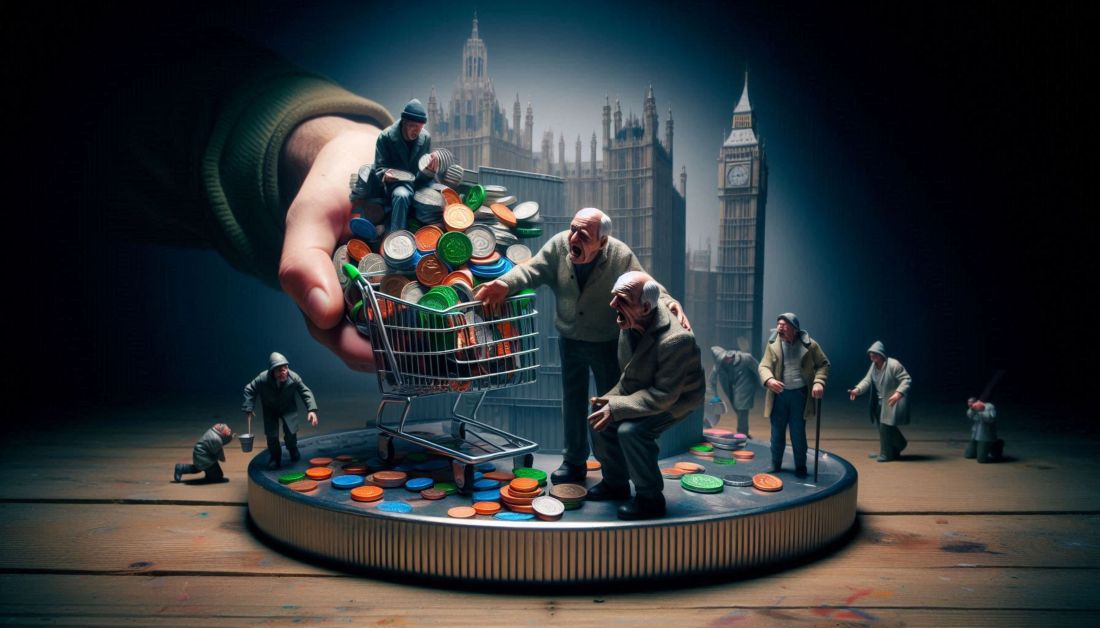
Creating a New, Independent Food Chain Assurance Scheme, then using it to begin a Farmer and Consumer led Revolution in UK Food Security and Production
‘Food From Farms – Guaranteed’ (3FG), is an idea, or rather a set of ideas that have the potential to begin a conversation, then a process which will enable farmers and food producers to take back control of their own destiny and with it, the independence and autonomy that any business should legally be entitled to achieve.
The 3FG concept itself is responsive to the wider disconnect that many across related industries now feel.
Growing frustration and anger with the Red Tractor Scheme is indicative of the loss of control that farmers and food producers feel, with many now questioning a future where public policy, rules, regulations, laws, standards and direction itself, seems so out of touch.
Red Tractor itself is perceived to be out of touch and working on behalf of outside interests in the creation, monitoring and administration of standards relating to farming and food production within the supply chain that takes everything that UK farms and food producing businesses create, along the journey to where consumers buy or receive it.
The question being left unanswered is ‘Where should the balance of power and influence in the farm to consumer relationship naturally lie?’
3FG will answer that question and explain why. 3FG will then suggest the ways that the balance of power and influence can be restored to the people who should be making all the decisions that really matter, and how that relationship can be developed, strengthened and secured.
The focus of 3FG is local. Because working locally is the only way that food chain assurance of the kind that farmers and consumers now need can be managed and applied consistently and fairly to every part of the process that is involved.
3FG isn’t a perfect work, plan or strategy. It is not intended to be.
The knowledge, experience, drive and motivation that has the power to change everything in farming and food production for the better will come from the people and businesses within farming and food production, with help from consumers themselves.
It is for the people that matter in the farm to consumer relationship that this book has been written and the creation of a completely new food chain assurance scheme is therefore proposed.
Introduction
UK farming and food production is in crisis.
Latest figures suggest that the UK only produces around 52% of the food that we consume. Yet we are increasingly reliant on trading relationships threatened by war and the collapse of global supply chains, making the supply of imported food increasingly vulnerable and insecure.
Despite the risk to UK food security, politicians and big business keep pushing UK farms and food production towards profit making systems. This approach increases consumer reliance on unhealthy and highly processed foods and manufacturing, is quickly leading to the destruction of agriculture and our ability to grow food naturally in the UK, and it uses organisations and standards like the Red Tractor scheme to exert ever more influence and control, knowing that significant change can be achieved without question, if guidance and direction comes from organisations that farmers and growers trust.
The short-, medium- and long-term future of UK farming and food production now hangs in the balance.
If UK Farmers don’t begin to take risks to save their own industry today; there will no longer be anything left of UK Farming worth taking a risk on in just a few tomorrows.
However, the risk taken to secure the future of UK farming needs to be measured and considerate of all the ingredients necessary to secure permanent change, putting locally grown, healthy and nutritious food back at the centre of consumer and community life.
This cannot be achieved through populist protests and civil disruption that will damage the relationships that we now need to cement.
The creation of a new food chain assurance standard, led by farmers, with the help of consumers and everyone who genuinely believes in and champions UK food production, offers the opportunity to achieve change that will not be possible in any other way.
This is 3FG.
The Aim of this Book: Let’s think about an alternative to the Red Tractor Scheme. One that prioritises Farmers and Consumers and not the profiteers and idealists ruining everything in between.
Whilst farming and the rural community have never been far away from my life, recognising the massive risk to food security and the health of our nation because of the direction that UK farming, Food Production and everything related has been taken has still come as a shock. I feel passionate about finding practical, real-world solutions that will help us all, right now.
As an experienced politician with an understanding and perspective that doesn’t align with the direction that Politics and government in the UK has gone, broadening my understanding to focus on the issues that are causing real problems within the industry and academia too has been immensely frustrating and at a personal level, quite challenging.
Not least of all because I am a ‘doer’ and hate being able to see so many of the issues and potential solutions so clearly. Whilst also recognising the perceptual and cultural barriers that exist right across and that surround the industry, that have created massive walls that stand in the way of anything meaningful being done.
I dip in and out of social media to follow what’s really going on for everyone (no matter what side of the political divide they think they might be on) and whilst there are other important issues that I have already and will certainly talk about later in this book, the one that keeps popping up regularly for me is the reality that UK Farming and the Public desperately need a replacement for the Red Tractor Scheme: One with all the hangers on and vested interests left out.
The Organisations involved in food policy today are all about the interests of those Organisations.
Whilst I am hesitant to say anything that suggests that I intend to place the NFU and what any of the representatives who speak for them in a bad light, because I don’t, it has to be said that no matter what meetings they have, what promises they receive or whatever headlines they make, lobbyist organisations like them will not achieve the results that farmers need. Because for them, the approach that would be needed and the perceived risk to the relationships that they have with politicians, government departments, NGOs, business and retailers, or many other organisations by doing what needs to be done, is perceived to be too high.
This isn’t a criticism. This is how established and well-known lobbying organisations work, right across every area of public policy.
They value the relationship that they have with the establishment more than they do the need to do whatever it will take to achieve meaningful solutions for the people and businesses that they represent. That results in compromise, fudges and being grateful for nothing more than politicians, business and public sector leaders paying lip service to the idea that the change they offer is the same thing as a genuine outcome being achieved.
To be fair, one of the myths that too many of us have bought into is the idea that politicians and the establishment do actually know and understand what they are doing. That they have integrity with the responsibility they have to the electorate, and that they are therefore people we can trust.
Few have a real appreciation of the interconnectedness of every problem that exists within the realm of Public Policy, and I’m afraid that I speak from experience when I say that this very much includes the politicians who are supposedly in Westminster to legislate on our behalf.
Waiting for a Top-Down solution will inevitably result in more of the same.
The Red Tractor issue and the kinds of complex issues that it represents is about so much more than a quality benchmarking scheme or system that has been taken over by the people taking all the profit out of UK Farming and Food Production.
It’s about the misuse of power, influence and position by people who are now obsessed with change in a direction that goes against everything that Farmers know and are now using every tool that they can employ to exert pressure and therefore to increase control.
A completely new Red Tractor, or rather, what replaces it could become the catalyst that Farmers, Food Producers and a very tired public employ to turn the whole balance of power and what is an increasingly unworkable and therefore Food-Security-destroying situation around.
But to do so, Farmers need to wake up to the direction that the industry is now being deliberately taken.
There is an industry or lifesaving need to accept that it’s a situation where everyone who appears to have any control over what Farmers do and produce, other than the farmers themselves, are well and truly committed to farming in the UK becoming unrecognisable. That their priorities are money and profit, idealistic theories, and keeping and increasing control over a public and businesses whose current level of independence they are massively afraid of and want to end, no matter the real cost of doing so.
3FG offers a process that can be the basis of the conversation that everyone who has a genuine stake in this needs to take part in.
3FG could be the start.
About me and why am I proposing 3FG (or something similar)
My name is Adam Tugwell, and I wrote and published ‘Food From Farms – Guaranteed’ in the early part of February 2024.
I have become increasingly concerned about UK Agriculture and food production. Where everything that surrounds the UK food chain is being taken, and the troubling reality that attempts are now being made by populists to try and harness the growing frustration and anger that now exists within the farming community, to stoke up protests that have no real direction. Action that could easily be used to make the situation that Farmers face even worse than it already is.
Although I’m not a farmer, farming and industries that are traditionally affiliated to farming and rural industry are part of my heritage.
My father and his wife were smallholders. My uncle was one of the early pioneers in Agri-contracting. My grandfather was a wheelwright and his father before him a steam ploughman.
After many summer holidays riding a bale sledge and annoying my older cousins, I had a number of jobs on farms in my early career that included harvest driving and lots of relief milking. It was through working with a former President of the County YFC Federation that I became a member myself and made many farming friends who I remain in contact with today.
I went ‘back to school’ in my early 20’s to do the qualifications that a disrupted experience of school never provided. Doing so helped me into management training with Pickford’s and what at the time was the National Freight Consortium (NFC).
I’ve since run a local authority refuse and recycling operation. I’ve managed and developed people centric projects and services for a Rural Community Council and for a county council based Rural Transport Partnership, supporting charities. My last full-time job was as a regional manager for the British Lung Foundation where I had a big focus on managing and developing a network of volunteer led user groups.
When I was 30, I set up my first proper company, and as a startup won a large distribution contract with the Northcliffe Press which was then part of the Daily Mail Group or what is known as DMGT. I created the kind of working environment for others that I always wanted to experience myself, and committed to building systems and procedures around quality benchmarks like Investors in People and what was then the DWP Two Ticks scheme, right from the start.
I set up and ran a number of businesses that have included an online local and organic food delivery business, and have advised different businesses, and coached their managers and owners. I also tutored business planning to final year undergraduates at a University Business School.
I’ve been interested in politics and public policy since I was a teenager. I believe the first letter I ever wrote to the media was published in The Farmers Weekly when I was 18.
I first became a Councillor in 2003 at Tewkesbury Town Council (Where I also chaired the committee that looked after the Town’s Severn Ham – a 70Ha SSSi). In 2007 I was elected as a District Level Councillor at Tewkesbury Borough where I served for 8 years and was heavily involved in the local response to the 2007 Gloucestershire Floods and the water shortages that followed. I also joined the newly formed Ashchurch Rural Parish Council in 2008 to help as a founding member.
For my second term at Tewkesbury Borough, I was elected and then reelected every civic year to serve as Chairman of the Licensing Authority, with lead responsibility for the Council’s Regulatory Licensing service. My role oversaw local Licensing, Licensing Policy development, National Licensing Policy implementation and Licensing hearings and Reviews.
Theres a lot more that I could say about my professional and political experiences and everything else that I have experienced in life. However, the important thing has been the insight and understanding that I have gained about how public policy, government, the establishment, the public sector, charities, businesses, people and communities’ work.
With other priorities since 2015, I have continued to blog and write books in the hope that they will help others and broaden perspectives about things that not everyone can or has the time to see or understand.
At the time of writing, I have been studying and researching an MSc in Sustainable Agriculture and Food Security at the RAU. It has regrettably been an experience that has served to consolidate and amplify my own view of just how bad things really are. It is because I now have a clear, up to date understanding of the role that academia plays and more importantly doesn’t intend to play in the future of farming and food production policy, that I refer to its role later in this Book.
Farming and Food Production in the UK is not in a good place. But neither are any of the organisations (government and public sector) that should be falling over themselves to support it. That isn’t going to change because of a General Election with the options we currently have.
Challenging as it is to try and convince anyone that government and the public sector doesn’t and will not do what it says on the can is hard enough.
But the issue that has the greatest potential to destroy any chance that UK Agriculture and the organisations that Farmers should be working with to succeed in turning things around and getting the industries and its allies to the place they should be, is that so many influencers and people who have useful and beneficial things to say are losing sight of the truth that many others do too.
Regrettably, solutions built on commonality and practices that could work for us all are being lost.
If anyone can take the bull by the horns and turn UK agriculture and food production around, it will be UK farmers and the brilliant people that populate this wonderful community.
However, even those who know a lot more about farming than I ever will also need to listen to views and perspectives that can fill the holes in their understanding of everything else. We all need to be open to the realities of how different parts of a very unfriendly world work.
This Book is my contribution to the conversation.
Adam Tugwell
Cheltenham, 16 February 2024
Part 1: The Important Stuff
What Farmers and Food Producers need to consider for a new Food Chain Assurance Scheme
Over the following pages, I have outlined a number of different opportunities, suggestions and functions that 3FG has the ability to create and provide as part of a new food chain assurance and standards scheme.
These pages cover different ways of thinking, alternative approaches and practical approaches that will make sense of where the real opportunity for approaching the assurance question and relationship between key stakeholders can begin.
It’s not a perfect list. There is no specific order, and the reader will need to continue through the following sections covering issues like 3FG structure and governance, and then the future of farming before the most informed picture will be available of what 3FG has the power to do and to create.
The Key Stakeholders in Farming Standards and Food Quality are the Farmers and Consumers
We need to ask the questions: ‘What does it mean to be a stakeholder?’ and ‘Who are the real stakeholders?’
Because the interests of the people who are guiding, influencing and controlling the most visible forms of food standards that communicate what farmers do to those who consume the food produced, are not focused or aligned with the interests of the most important players who are located at each end.
Their focus is instead the many middle parts of what is in the main an otherwise unnecessary chain, where no value is added. But production prices are squeezed whilst the price to the consumer is repeatedly being raised.
I will come to the role of other organisations who affect the food chain. But any argument that statutory authorities have the right to dictate the direction of an assurance, standards or benchmarking organisation as a key stakeholder, is willfully and deliberately misplaced and, in all honesty, wrong.
The key principle for 3FG is transparency of the food chain
Any new standards, food production benchmarking or quality assurance system must revolve around farming today and what it will be in the future, along with what’s best for the consumer in mind.
Farms, food producers and the consumer must not be expected to change their habits to meet the requirements of businesses that have become involved in the supply chain, whose only interests are making money – as has been the case now for a significant period of time.
The role of government, regulation and legislation in 3FG
One of the most back to front or upside-down realities of the way people believe government and any organisation that regulates or legislates today works, is the idea and sadly the acceptance that these bodies exist to ‘tell us what we are allowed to do’, rather than being there ‘to serve us’.
Whilst regulatory organisations are there to regulate and advise on the interpretation of those regulations, none of them should have a controlling interest in the management of any assurance or standards scheme that they are not paying for and that can only thrive and deliver in the many ways that it has the potential to do so, by maintaining its independence and autonomy.
Following rules or laws doesn’t take away independence. It’s what all businesses do and businesses that take their responsibilities seriously, are likely to exceed any standards or guidelines that regulating bodies set.
It is vital for 3FG to have independence from any form of government or political control. As such, it must be funded, managed and maintained in ways that do not mean taking funds from anyone who will require adherence to agendas of any kind. No matter how innocent they might appear to be.
Operating areas and governance to reflect and promote community links and localism.
One of the first important opportunities that establishing a new assurance mark or brand creates is to localise and federate the structure of the organisation before it is even launched.
By creating a localised model built upon the same frameworks, 3FG can:
Allow better access to the Board of Governors and the advisory team.
Create localised branding for the most local produce.
Help to rebuild local production identities, brands and styles that help promote and market food products with a geographical area alignment.
Keep control localised.
Promote better relationships with other businesses and organisations at community level that farmers and food producers are increasingly likely to need to develop productive working relationships with as globalisation ends and the need for much more localised supply chain models are recognised.
Provide an improved and arguably more democratic system of governance.
Support transparency and provenance for consumers when they buy food that has come from other areas of the country.
Many do not see it yet. But there is good reason to believe that a new model of operation for UK Agriculture that is led by farmers, will take a much more community-based approach that is similar to the current Small Scale Farming model, rather than the production and output focused model that is disintegrating around us now.
Farming has the opportunity to return to being financially independent and commercially viable in a way that frees the ties, restrictions and the damage from supermarket-type contracts and subsidies.
These will always have agendas attached that will inevitably push Farming in all sorts of different and often detrimental directions, the motivations usually being unseen.
Agreeing, Implementing and Maintaining Standards that provide Assurance
It is very important to understand and accept that the regulatory standards that farms and food production must adhere to today, are not the property of a private organisation or person. They are owned by the public and are therefore in the public domain.
The farmers, food producers and business owners that 3FG is aimed at all know the rules and regulations that govern their practices, operations and what they already do.
3FG is not about hacks, go-arounds or finding ways to ignore any system that protects farmers and consumers already.
3FG is about redefining, reestablishing and reenforcing the relationship between farmers, food producers and the consumer. So that quality, experience and fair prices paid and received at each end of the food chain are the only priorities that sit beyond the level where public health, animal health and legal requirements exist to protect any of us.
Farmers, food producers and consumers don’t need anyone else, any outside organisation or any of the agendas that they bring with them to create a new standard mark that offers any of this on a universal basis.
Using the right knowledge
The answers, solutions, knowledge and experience already exist within the groups of key stakeholders that 3FG is looking to as future members.
Beyond proactive, respectful, dynamic communication and respect for the laws of the land that we are all obligated to, that is where all of the focus and responsibility for the success of 3FG and the role in securing the future of farming in the UK lies.
Funding
Sustainability is a big word in Farming today, and it’s no less important in terms of creating, developing and maintaining a food chain assurance scheme that can pay for itself.
Financial independence is essential to keep self-serving and other destructive agendas away, that could all too easily corrupt or redirect the purposes and objectives of a new food chain assurance scheme that should be about nothing more than being able to offer quality standards and guarantees of provenance and production, to the people who eat the food produced.
It is the development of executive and so-called ‘professional functions’ of any organisation that really starts to rack up the costs.
When you have growing numbers of staff who are shielded or insulated from what the work of the organisation is really all about, they soon start finding ways to take the organisation and its objectives in a very different direction – especially if the only contact they have with others is people who fund them or they otherwise wish to carry favour with in some way.
As much as possible of the management and decision making of 3FG should be made by volunteers.
It keeps costs down and removes all sorts of potential governance and management issues that we will come to a little later.
3FG should be as near as self-funding as possible.
This can be achieved through:
A standard per item charge to retailers, which could be tiered and would be applied either per item sold or weight/wholesale unit delivered.
A Membership fee for all farmers and food producers
Tiered Membership Fees for Retailers, based on number of shops, size of business etc.
A token consumer membership fee for members of the public who want to support the Scheme.
Ongoing crowdfunding initiatives
3FG MUST be financed by suppliers, supporters, consumers, sales and fundraising. Not by other interests which are not aligned with those of the Key Stakeholders.
A Rating system based on location, length of supply chain and size of business
The visibility of 3FG (or whatever it might be called) is very important.
Using an emblem like a Plough, Tractor, Windmill or a traditionally attired farmer will certainly draw recognisable links to food and food production in ways that schemes such as the Red Lion mark for eggs will not.
However, creating ‘just another brand’ or assurance mark that can quickly be incorporated into the design and print of supermarket packaging isn’t the answer either. It isn’t what a live, considered, recognisable and meaningful link for the relationship between Farmer and consumer is all about.
Many will have seen environmental rating badges that are awarded and regularly updated for pubs, takeaways, supermarkets and any business that sells freshly prepared food to the public.
The award is made on a premises-by-premises basis by the local district level authority or council and can be clearly seen as a 1-to-5-star rating, illustrated on a green sticker that is usually displayed as you enter, pay or order at the premises.
It is arguable whether consumers really take that much notice of food assurance marks in the forms offered today.
The primary reason for this is that especially now, during a genuine cost of living crisis, at the point of purchase, it is cost rather than anything other than a quick look at whatever the consumer can see, that is the real determinator of whether a product will be bought.
Creating a dynamic badge system with the potential to identify different sources, size of farm, method of farming and distance travelled, would offer engagement that would provide consumers with a very different level of meaning.
Giving the ‘end product’ a real identity for the food chain that it followed would create further forms of buy-in that large retailers resist because of the costs involved. Yet they are very happy to create different ‘created’ farm brands to give consumers the impression that what they are about to buy from the supermarket, came from a farm with a nice name and the feeling that the food was grown (or prepared) just around the corner or just down the road.
Please bear in mind that administering and adding this level of detail about the food chain journey – which consumers do want to see, is only resisted by the big retailers because of:
The perceived cost for margin obsessed businesses, and
That by offering a tag that makes clear whether the food purchased really is local or came on a 600-mile journey, the consumer would demand of the retailer that they guarantee legitimacy to the promises about food quality that they make.
By adopting a new food chain assurance scheme with a standards mark that clearly promotes local, identifiable businesses or perhaps cooperatives of a number thereof, 3FG will be encouraging and promoting the decentralisation (deglobalisation) of food production, whilst redirecting political influence as well as commercial power back into Farmers’ hands.
The immediate kick back from retailers to any kind of food chain assurance system that recognises production at individual farm level will be built around protecting what is a genuinely impractical model of supply and distribution that must control every contributing part within what is a machine that must continue to grow margins to survive.
The direction of travel for supermarkets is the extinction of small, recognisable farms and food production units. However, the big retailers will always be very happy to suggest to the consumer – through marketing – that their priorities are directed only at the benefit to the customer and that everything they do is achieved in completely the opposite way to what they actually do.
Payment structure from Retailers for branded or qualified products
Retailers should always pay for the standards marks that are applied to products. Because they will pass on that charge to the consumer.
However, it doesn’t mean that big retailers have any right to dictate how food is produced or made.
Perhaps the most challenging aspect of creating a grassroots-up food chain assurance scheme is that favouring local production and short supply chains, in ways that run counter to the operating models of retailers that currently hold so much of the market share, is that in the first instance and early days of 3FG, the implementation of a scheme which offers transparency will not have the volume of products or wholesale units passing through it to keep the product or unit price at a negligible level.
It will therefore be necessary to subsidise the implementation of 3FG until this can be achieved.
Remember, the format for 3FG being proposed in this book isn’t one that is expected to grow into some massive HQ near London type organisation, where there are departments full of staff who have never seen a farm or upon doing so, would immediately hold their nose.
The role of academia
Anyone in UK farming or food production wanting real change must be very careful about the role of academia in creating the solutions to the problems that the industry faces.
Academia is a very useful source and resource for the supply and collection of technical data that relates to how things have been; how they work and what known technologies and working methods can do for farming and food production, today.
However, academia, like the lobbyist organisations discussed earlier, is very focused on the relationship that it has with government, politicians, the public sector, big business and people who fund what it already does, rather than creating, identifying or endorsing solutions that might change market directions or contradict what is currently accepted or what establishment narratives say.
Being tied to accepted and establishment thinking, often for no better reason that funding is involved, means that there are incredible biases at work, that academics and the institutions they represent are highly unlikely to admit to, even though some quietly will off the record.
As such, if you approach an academic institution – even a highly revered one and ask them for a review of anything new or ‘outside of the box’, they may well pay lip service to whatever benefits they may perceive to exist.
But they will also do everything they can to refocus attention on methodologies, systems and ways of working that already exist or have already been tried. Even when it is quite clear to third parties that delivery is either weak, serving agendas, or doesn’t actually work or deliver the results that it was supposed to.
Creating an ecosystem putting Farmers and Consumers first
Thoughts become things.
So, changing the way that the industry thinks about measuring and promoting food standards, the transparency of the food chain and the direct relationship with consumers will quickly deliver benefits that cannot be seen. Simply because a leap of faith has been taken in the direction of putting right a lot of things that are currently wrong.
Knowing the land as farmers and many food producers do so well will mean that many with the power to embrace change will already appreciate how ecosystems work. And that within big ecosystems, there can be a great many more besides.
This thinking can be applied to businesses, to the public sector and the way that businesses or a range of different organisations have a shared interest, goals or set of aims too.
The important thing to consider is that although the players in a flipped, localised supply chain may appear to be obvious when we think about farms selling whatever they produce as an end product to people the farmers knows, the reality is that with a grassroots-up, rather than a top-down focus, 3FG will open the doors to the central role that food should always have within the community.
Working at the heart of the local community means that there are likely to be many more potential working partners – a good proportion of which will be unique to specific locations – that farmers will not immediately recognise as being there, today.
Putting the key stakeholder or farmer and consumer relationship first will open the doors to new ways of working, new partnerships, new opportunities and new ways of taking the food that farmers produce to market, and to the consumer, that will benefit everyone involved.
This type of symbiotic relationship with the community – with models that might resemble Small Scale Farming, but with much more significant scaling involved – is what a genuinely sustainable future for UK Agriculture is likely to now be all about and how genuine UK Food Security can be achieved.
Regional, Localised meets for Members that inform localised standards marks for sales in stores.
3FG is all about being local. Being localised and bringing a level of power and autonomy back to farmers that will not be possible again, if the industry continues to be led on the path that it is currently on.
Farmers will never again feel powerless if they choose to work with and trust only the people and businesses that they regularly see.
From the community members that come together as a steering group to create the local and primary form of 3FG, the most able and appropriate representatives can then be nominated and elected, to represent and report back to a meeting of all local representatives who can then define what the common, cross-UK governance for 3FG should be.
The real power of this new food chain assurance system is keeping it as local and as locally or community attuned as it can be.
By doing so, the idiosyncrasies of farming practices such as fruit growing, hill farming or even hop farming can gain the specialised consideration and promotion that a truly holistic and UK-wide food production system should champion throughout.
One of the reasons that government, the public sector and even lobbyist organisations are so out of touch, is because they do not have or share the appreciation or understanding of what being a farmer, food producer and regrettably – a consumer in every sense genuinely means, at organisational level.
Nobody with genuine issues about the public policies that affect them will continue to shout, once they know that their concerns have been heard AND have been listened to.
With power focused on locality and community, 3FGs direct contact with the two key stakeholders will make responsive and therefore attuned proactive action hard to resist.
3FG cannot involve big money interests or retailers as influencers
BIG retailers and market players might today be responsible for a high proportion of the business that UK Agriculture does.
But that does not mean that big retailers have any right to dictate farm management or food production practices at any level or in any way.
The two key stakeholders in the food chain are the farmers (and food producers) and the consumer.
Nobody else should be making demands or forcing the direction of either food production or consumer eating habits from any part of the food chain in between.
Farmers and food producers have a VERY GOOD range of products to sell, and it is they who should be setting the production terms and standards – that with feedback from the consumer, ensure that UK Agriculture is providing the food and food products that people who with 3FG will experience full transparency over the whole supply chain – wish to buy.
The 3FG Membership
The organisations that will constitute the farm business, food production, preparation and supply side of the 3FG Membership will include:
Any farm or farm business committed only to UK Agriculture, sustainable Food Production and Food Security with prioritisation of supply to the consumer in the most localised way possible, with the production of the widest range of foods and food products that the land can produce sustainably.
Along with SME (non-public or shareholder) owned:
Abattoirs
Bakeries
Butchers
Dairies (Milk & Dairy Product creation and Home Delivery)
Farm Shops
Fishmongers
Greengrocers
Independent Food Retailers
Independent Fisheries
Independent Trawler & Fishing business owners
Independent Garage Forecourts
Mills
Pubs (Genuine Free Houses and those without Food Ties), Independent and non-franchised Takeaways, Cafes and Hotels
Along with any other independent retail or food production business able to meet and maintain the standards agreed by the primary and secondary governance requirements and member agreement of 3FG.
Universality to include Farm Shops, Farmers Markets and the smallest UK Food producers
It is no accident that the main focus of existing food assurance schemes are labels on products sold by big retailers that pushes the narrative that food standards are only really applicable to food that ends up in BIG shops, BIG supermarkets and that is handled by BIG business.
It is the upside-down reasoning that underpins this idea, that gives BIG retailers and the businesses and organisations they work with the apparent power to dictate what any farm or food business that sells to them must do, to secure that sale – and to be grateful for whatever they are given in return.
There is no reason why the food chain assurance labelling that a consumer sees on a farm product on a shelf in one of the large UK supermarkets isn’t the same as what that same consumer could see if they were to travel to the local farm shop and look at the same kind of product on the same day.
That the BIG retailers don’t push for this universality in standards or that this level of assurance doesn’t exist already, tells us all we need to know about what the real priorities for the parts of the food chain that they control.
3FG Offers the opportunity to create a universal system of food chain assurance and quality standards benchmarking that means a consumer can look for the same guarantee of quality and information upon where the food they are about to buy came from, no matter where they buy it.
Yes, such an approach certainly favours localised food production and smaller farm businesses. But that is where the focus of food production for Farmers and Consumers desperately needs to be.
Committing to detail certainly doesn’t preclude any large food retailer from supporting a food chain assurance system, that under the exclusive governance of the two key stakeholders, will far exceed any of the standards those businesses currently use to control the industry. Existing commercially driven ‘standards’ that are not about people or farmers, but all about the profit-obsessed monoliths that supermarkets really are.
A QR code for every 3FG farm, food producer and every product too
Farms and food producers are businesses that play a very important role in life and the community.
Sadly, the way the world works today means that three meals a day are often taken for granted in the same way that we don’t even think about the air that we breathe.
Farms producing the food or ingredients that contribute to any food or drink deserve to be recognised for the importance of the role that they play.
However, it is just as important to allow consumers to reconnect with the reality that surrounds every part of the food chain. Where their meals have come from.
By embracing this dynamic by making the relationship between farmer and consumer direct, power will be returned to the most important part of the food supply relationship, whilst taking back influence from all the hangers on.
If you hadn’t realised it yet, 3FG isn’t about rejecting technology.
3FG is about embracing technology that helps to make things better.
QR codes that any smart phone can instantly read, offer the opportunity to make every farmer and food producer’s portfolio, story, aims and objectives available in live time, as consumers do their weekly shop.
Websites, blogs, videos and downloads offer farmers and food producers the opportunity to open up their businesses as virtual worlds. Golden moments of discovery where value of a kind that only comes from human interaction and the sense of reality that these mediums are able to provide, mean that added value and credibility of supply can be given in a way that globalization and big supermarkets cannot offer, and that no form of money can buy.
Accepting that money always comes with ties and UK Agriculture is currently tied down to a pathway of destruction
The 3FG proposal will be controversial to some, as it’s all about changing direction from the way we are all used to things working now. That means that it’s about changing the way that we think.
From the direction I have found myself looking at UK Agriculture, Food Production, its relationships with business, retail, government and academia too; and arriving here with the experience that I have, there is nothing great about trying to talk through the mechanics of a situation that many farmers now face. One that whichever way you write it, has the ability to suggest that the very people reading about 3FG are wrong.
The truth is that nobody is doing anything wrong. But what a great many of the people involved in farming and food production are doing right now, is looking at the problems that UK Agriculture faces in a way where they are expecting the answers and the solutions to come from the same places, the same faces and the same organisations that at least two and increasingly three generations of farmers have grown use to as being the centre of everything.
Farmers are financially savvy people. Most know only too well that subsidies have been the lifeblood of viability for a long time, with the promises of regular contract payments from relationships with retailers and market-focused organisations sitting almost too snugly alongside.
Most across the industry already know that the price is too high.
For those that don’t, it is impossible to ignore the evidence of our own eyes, as farm businesses close and land is sold without any hint or suggestion that it will ever return to productive use once again.
The reality of UK farms and food production today
Whatever politicians and business leaders tell us, paying lip service to solving problems and even shouting out loud warnings about the direction UK farming and where food production is being taken, this is not evidence that they can or will doing anything constructive to help. Because even in the rare cases that you are listening to a farmer who has decided to wear a different cloak, they are still only one of an overwhelming number who have to understand and think the same way as farmers and food producers before there will be real and meaningful change that comes from them.
Help isn’t coming from the government in any way that will save UK farming in the long term.
What politicians and public sector managers will do is just enough to keep giving farmers hope – and what will probably be just enough to keep the majority bought in to the accepted narrative, because the risk of doing otherwise will appear to be too high.
Meanwhile, the big retailers and traders will continue using every underhand contractual trick that they can, to keep farmers tied to them in just the same way, all the time pushing everything across the industry in a direction where for many farmers, the problems will soon reach a point where it is no longer possible to turn back.
If you ever wanted to understand how obvious the lies of the system that underpins the way that government, big business and the economy work, please stop reading and think about the so-called freedom that UK Farmers currently have.
The system or economic philosophy that runs everything today is called Neoliberalism.
Neoliberalism is based on the principle of free markets and deregulation.
So, the question to consider if you are a farmer is ‘How is freedom of the marketplace working out for you?’
The thinking that all farmers need to change is the reliance upon someone else coming up with and then delivering the solutions, along with the expectation that whatever the change someone else decides upon looks like and what it will cost to be implemented, the government or someone else will step in and pay.
If farmers and food producers want freedom, want a future and want to continue to exist, the time to act and take the risk of breaking away from a system that doesn’t serve UK Agriculture is now.
Not in perhaps as little as just a few years’ time, when the current course will be run and there will be nothing left of UK farming to take a risk on.
Part 2: 3FG Governance and Structure Development
3FG governance can be built around farms and food production standards.
The real strength in a new food chain assurance scheme is keeping as much of the management and strategy in the hands of volunteers who have skin in the game.
That’s Farmers, Consumers and then representatives of local small businesses that buy, use and sell the produce that comes from those farms.
Man cannot have two masters. So, the priority of those influencing the food chain could be many things other than farming or food production itself, IF the net is allowed to be cast too far and wide.
The priorities of influence that would damage 3FG could be:
Career advancement or Personal Ambition
Currying favour
Idealism
Money, Profit and Greed
Political Gain or keeping specific people or interests happy
The easiest choice
Creating a Central Framework (Created in reverse)
The best forms of governance are those that guide and give direction, rather than aim to instruct and control.
There is a fine line between them that once crossed can quickly find the metaphorical pendulum that swings between them picking up speed and travelling in the opposite way.
Governance is important to:
Confirm and govern the terms of membership and the standards themselves
Create a management structure
Document aims, priorities and methods of working
Identify responsibilities
Maintain the integrity of the organisation and protect it from malign influences that will change the direction of the organisation and its priorities if they can
Manage relationships with other organisations
Provide direction if and when anything goes wrong
However, whilst the immediate temptation would be to believe that creating a centralised system of governance or the instrument of governance itself is the first step, this is not so.
The ‘magic’ ingredient that will make 3FG work, be successful and for it to fulfill the aims of bringing real power back to farmers and to the consumer, will be in the creation of governance that comes from the grassroots up, rather than from immediately falling into the trap pf falling back on a system of governance that is created from the top-down.
The central framework or instrument of governance must therefore be created and updated by representatives of all the localised regions or areas, once they have been formed.
Local Governance of the New Standards Scheme (The first step)
Farmers, local food producers, food retailers and pubs/restaurants/cafes that are local, small businesses, supported by qualified local public interest is where the first steps of creating a governance framework for 3FG should begin.
Everyone involved in growing, producing, processing, preparation and the sale of food today is already well aware of the Standards, Regulations and Laws that exist.
There is therefore no need for look beyond any business owner or person with a legitimate interest in supporting the creation of 3FG at local level, for the knowledge, ideas and experience that will identify the rules framework that will:
Be used to inform the creation and further development of the central framework or instrument of governance, or
Be used to inform the creation and further development of the local framework, which would be localised rules or by-rules that constitute a sub-framework or addendum to the central framework
Once a local ‘meet’ or ‘committee’ has been convened and the basic objectives of that meeting or committee have been agreed, the process can be used to identify and elect a representative who will then attend and discuss the objectives, ideas and priorities of the local group at a meeting of representatives of all the local groups, where a central steering group or pre-committee can be formed.
The Members Charter or Agreement
The nuts and bolts of 3FG will be the commitment that everyone makes as a member of this new food chain assurance scheme and the standards it will require of them.
It cannot be emphasised strongly or repeated enough that 3FG offers the opportunity for Farmers to reclaim and maintain their power and independence from organisations and interests that do not see the future of farming in the same way that they do.
However, 3FG isn’t some kind of pathway to Farmer anarchy and rebellion.
3FG is a legitimate tool that has the ability to be very successful in achieving its aims, whilst reaching well beyond them in terms of the added value that it can deliver for everyone – BUT only if those involved are committed to doing everything that is agreed that 3FG is there to do.
Some will understandably feel resistant to rejecting one set of contractual relationships with government and commercial partners just to commit to another.
But contracts aren’t always the same thing.
Setting up a membership charter or agreement, which is of course a contract using different words, offers 3FG members the opportunity to build both an evolving and dynamic type of agreement, that when run, operated and promoted by members who have ‘skin in the game’, will genuinely work with the best interests of all involved in mind.
The 3FG membership charter or agreement will be a dynamic, living document. Because unlike subsidies from government and contracts from retailers and buyers, the growth and success of 3FG will create opportunities to give members opportunities and incentives back that will support and enhance their businesses, rather than being designed to take more and more from them at every turn.
The need for and function of the 3FG members charter or agreement
The core function of a membership agreement or charter is to provide the framework rules of what 3FG expects from every member on a universal basis. The only variations being those that will be necessary to accommodate the different functionality of the relationship.
For example, a dairy business producing cheese will have very specific rules that apply to the production of cheese. Meanwhile there will be many other rules that apply to food production or processing business that would also be specific to those similar at another level. And there will then be rules and requirements that apply to every member universally, no matter who they are or what they do.
Whether rules are applied at 3 levels, as the example above suggests, or there is a need for even more levels – perhaps because they are location specific, it is essential that every like for like business that joins 3FG is treated the same.
Equality of Interest
Fairness and the integrity that underpins it is an essential part of the pathway to 3FGs success.
A situation should never exist or be encouraged in any way where a business of any kind is single out and is deliberately prejudiced in some way with the rules of membership that everyone is expected to follow.
Membership rule infringement is another matter entirely. There should be zero tolerance of any breaks in membership rules that have the potential to bring the 3FG relationship between members and with consumers into dispute.
Give and Take – What a membership agreement or charter will expect from 3FG members
The steering groups at primary and secondary level will need to agree what the key requirements and standards of membership will be in respect of:
The member relationship with 3FG
The food chain assurance standards themselves
The 3FG membership agreement or charter will probably include the requirement:
To attend local meetings regularly in person or online
To pay any agreed fees on time or as scheduled
To provide regular feedback to help inform the development of new and evolution of existing standards
To undertake to meet all agreed food production or growing standards
To undertake to meet all agreed food handling standards
To undertake to meet all agreed animal husbandry standards
To not enter into new contract arrangements that have the ability to prejudice 3FG in any way
To meet and where possible exceed all legal requirements
To join and promote the 3FG marketing system
To report to the local meet when circumstances create difficulty for the member in their ability to meet any or all of the above
The membership agreement or charter would also include a non-disclosure agreement (NDA) that requires ongoing confidentiality of shared commercial data, and the protection of any personal information, from beyond the public realm, that is shared as a direct result of membership.
Give and Take – What a membership agreement or charter will give back to farmer and food-producer members
The benefits of joining and contributing to 3FG must go beyond the obvious and give back more and more to those supporting the scheme as its reach, influence and the access to opportunities grow.
The kind of support that is likely to be offered to 3FG farm and food production members will include:
Access to any cooperative support businesses that are created locally within the 3FG network
Business Mentoring and Coaching from other members of the 3FG Community and signposting to other, more specialised support services when and where needed.
Complaint handling system
Discounts with commercial suppliers wishing to offer support to 3FG member businesses
Industry representation that is always focused on the needs of members and the issues that they face in real time, rather than at government or establishment speed
Proforma websites, training and support with all forms of social media
Regular Meetings with local members where feedback will be prioritised as part of the agenda
Regular social events with members (and consumers)
Regular updates, information and advice bulletins
Membership for ‘affiliate businesses’
The real strength or foundation that 3FG has the ability to build something very special upon isn’t just a repurposed and revitalised farm and food production industry. It is all of the small businesses and independent retailers of various kinds that work with or retail food, who will also benefit from an interactive membership arrangement with 3FG.
Technology used for the right purposes offers ways of working to build upon commonality of purpose across a wide range of different businesses that were not even available just a few years ago.
The costs are often negligible, and the creation of very productive relationships are all about the governance and engagement practices that focus on what is practical and what will work well for everyone, rather than what anyone would ‘like to see’.
The suggestion made for the purpose of sharing the 3FG concept is that the primary and secondary governance steering groups use the lists above and below to apply to this very important prospective pool of members and partners.
Membership for Consumers
Some will be surprised that there is even mention of extending membership of 3FG to consumers.
But facts are facts, and as the other key stakeholder in the food chain assurance relationship, it is essential that the relationship between farmers, food producers and consumers be developed and enhanced in every conceivable way.
No opportunity to engage consumers should ever be missed and whilst there is always some fear of trolling and negative approaches from activists, where handled correctly and where rules are followed and maintained, the oxygen that such people need to thrive can quickly be removed from any potential interaction, whilst legitimate consumer interest can be welcomed in.
3FG will not need to offer consumers anything that you wouldn’t expect any business to consider offering a loyal customer base – which is the way that 3FG will need to consider every legitimate consumer to be.
In return, it is likely that a minimum membership fee, or donation can be attracted by consumer members who can pay.
Once the legitimacy and integrity of 3FG has been fully established, which won’t take long, some will willingly make additional donations that will support 3FG and running costs.
What 3FG could offer to consumer members includes:
Complaint system
Discounts for specific businesses or products
Food Preparation Training
Home growing training and advice
Job board
Online feedback on experience of 3FG member businesses and products
Opportunities to take part in member meets, speak and ask questions
Recipes, cooking tips and regular cooking competitions
Regular Newsletter, updates and links including highlighted businesses and member stories
Visits to 3FG member businesses, farm open days
The Benefits of 3FG (Or something very similar)
For now, at least, we have reached the end of the list of suggestions that underpin the creation of 3FG and the system that manages it as well as the food chain assurance scheme that it offers.
So, before we move on to the next steps and what happens next, here is a quick run through just some of the benefits of the 3FG food chain assurance scheme:
Creating immediate opportunities for individual farm and food production businesses to build direct relationships with the consumer
Encouraging natural or organic development towards local farm-centred food supply chains
Introducing a new, definable and clearly branded form of food chain quality standards and assurance
Moving towards sustainable agriculture and UK food security
Prioritising the relationship between the key stakeholders: farmers & consumers
Reestablishing the farming community and food production at the heart of local life
Removing political influence
Stopping imported and mixed foods being rebranded as being from a specific farm, being local or being from the UK
Taking power away from big retailers, big business and big money
Supporting an immediate, practical drive towards healthier, affordable, nutrition-focused eating without making a complete meal of it
Part 3: Where do we Begin?
The interesting thing about creating 3FG (or whatever it ends up being called) is that local farming and food producer communities have the opportunity to begin work on developing this new food chain assurance scheme immediately.
One business owner on their own cannot do much. But perhaps as few as 12 will have the links, networks, knowledge and skills between them to get many more people involved and to quickly build momentum towards 3FGs early governance development goals.
Arranging the early (Primary) Meetings
One thing farmers and the farming community are good at is getting people together.
Face to face will always be better. Especially when people coming together for the first time are looking for reassurance that those, they could be about to work with are motivated in the right way and that they are people they feel it likely they can trust.
Not everyone can be at meetings whenever they are called. So, the use of streaming, or video chat software like Microsoft Teams or Zoom can be offered as a way to broaden participation – which will always be good.
The advantage of recording meetings using video is that there is an immediate record of everything discussed.
As long as there is not commercially sensitive or personal data being discussed on a video (which could be edited out if it’s there), this will immediately provide the opportunity to publish the whole meeting so that everyone can see it, and feedback online.
If you are keen to get started and would like some ideas or pointers, please drop me a line: ourfoodproblem@gmail.com
Embrace formality to play by the rules on the pitch
Whilst the direction within this book is nothing less than a revolution within UK Farming, Food Production and the relationship they have with consumers and the community, the tools suggested and offered are all about action and taking positive, proactive steps to create change.
There are no empty gestures or protests of any kind involved.
Whilst it’s a term that many don’t like to use where real life is concerned, the fact is that where anything that will have an impact upon public policy is concerned and you want things to change in a meaningful way, there is a game to be played.
That means that there are rules involved that need to be followed – and some of those rules are rules that might not easily be seen.
Therefore, the way to play the game the best way possible is to do things the right way from the beginning and to use creativity, outside of the box thinking and reinterpretation of existing rules and shibboleths to make the existing system work for farmers and consumers, until the public sector, business and government catch up and start to help with what they will then and only then recognise as inevitable change.
Common Purpose is Key
Doing things the right way sounds very time consuming.
As someone who has witnessed just how slow the wheels of government and the public sector turn when there is so much competing self-interest involved, there is no doubt that the success and depth of the change that is possible for farming and food production in the UK – which could realistically add up to what it will now take for the industry to be saved – will not be possible if competing ideas, self-interest or egos get in the way of agreeing objectives and what needs to be prioritised.
For example, there is an existing misconception that any form of commercially viable agriculture and forms of farming that are genuinely environmentally friendly are mutually exclusive propositions and that one can only truly exist without the other.
Whereas the reality and truth is that there are already commercially viable forms of farming that not only promote but depend upon a very holistic approach to land and the environment in a very balanced and sustainable way.
The difference is that they are not purist in such senses as accepting that the end result can only be achieved through ending the production of animals for food, but meet somewhere in the middle with the general acceptance that it would actually be a lot healthier for us all to eat less meat – But that our priority is moving towards a self-sustainable food producing and food secure UK, before jumping the gun on what might be the finishing touches of how future food production across the UK runs.
Few of us really understand the mechanics of:
How we got to a place where we have forgotten how the mechanics of good farming and land management works
How cheap, unhealthy food is the outcome of increased profitability for the few, all at the cost of small producers who are going out of business at an alarming rate
Why we were duped into allowing this to happen
How traditional management practices which are both respectful of and aligned with good soil management, sustainable farming practices and the direction it takes us into food production, which is once again much more community led, will save the industry for our future.
Why the future of farming in the UK really is in UK farmers’ hands
The common purpose is for those who step up and use their voices for themselves and to genuinely represent the best interests of others to decide.
However, the core priorities will be clear. They will be outcomes and will not focus on the detail of the map that dictates the route of the journey – which will inevitably lead to a failure to launch, even before anything begins.
Building The Structure of 3FG
In the first instance, the creation of the Primary (local) Meets which will then feed in Member Representatives to the Secondary (national) Meets will not immediately require a formal arrangement between founding members and those others who are early to join.
It is the shared commitment to 3FG and what it means that is most important at this stage.
With the knowledge already being available within the prospective membership that will allow a draft constitution or whatever formal document to be created that gives legitimacy to both the Secondary and Primary structures, the biggest decision that members will then need to make is a) whether and when a legal organizational structure will be required, and b) what kind of legal organizational structure is most appropriate and therefore which it will be (i.e. Limited Company, Partnership, Charity or Other)
No matter the speed with which 3FG and its systems are formed, any formal structure and governance agreements (including membership agreements) MUST be in place and be available to read BEFORE any business relationships between members or between members and outside parties is opened up for discussion with a view to being agreed.
Getting advice on the 3FG structure and governance
Whilst even mentioning organisational structures and membership or contractual arrangements can set some on a path to worry, the creation of a structure that works locally (Primary) and at national level (Secondary) isn’t difficult, as long as there are no hidden agendas or motives in the room.
With the level of success and reach that 3FG could have, getting someone to cast a legal eye over anything that is agreed before it is documented and signed off is essential. However, it is very important to be selected regarding where such help and support comes from.
Under no circumstances should the creation of any part of the 3FG governance structure be influenced or have the potential to be influenced by anyone who is linked to companies or any kind of organisation that would itself be excluded from having 3FG membership of any kind – even if that ‘help’ is offered as a donation of some kind, is apparently pro bono or given ‘free’.
The chances are that once 3FG gets known and starts to build momentum, there will be legitimate volunteers of different kinds who will step forward and be able to offer exactly the kinds of skills and knowledge that the process of signing off governance tools will need.
3FG as a Functioning Organisation
As I continue to write, I am acutely aware that many of you reading this will be experienced business owners and professionals.
Every one of you will have skills, knowledge and experience that will be helpful to 3FG – depending on what and how much of it you are happy and willing to give.
Once the governance structure is in place, the next step will be to agree strategy and who is going to do what.
Tasks to consider include:
Coordinating the Research, Creation and testing of the ‘Standard’ of the New Food Chain Assurance Scheme
Consulting with 3FG Members and Consumers over the proposed ‘Standard’
Appointing Inspectors/Trainers to conduct 3FG Member and prospective Member Farms and Businesses
Creation, design and procurement of the Guarantee ‘Stamp’, Logo or information badge for products
Web design and web training
Social Media Training
Public Relations Training
‘Trade’ representation and negotiation between member organisations
‘Trade’ representation and negotiation with external organisations
Cooperative Coordinators
Local Board Members
Membership Officer (Trade)
Membership Officer (Consumer)
Events Officer(s)
Treasurer or Finance Officer
3FG Ambassadors
Newsletter editors, writers and news reporters
And more.
These are all people that 3FG can expect to volunteer from within the 3FG membership, or as consumers who are independent of any of the food related businesses that are excluded from membership of the scheme.
You will know which areas are most important and which will need to be prioritised first.
The key thing to bear in mind that the responsibilities at national (secondary) level will be fully and comprehensively universal for 3FG, whilst those at local (Primary) level will be much more tailored to the needs and requirements of the locality, rather than being in an umbrella form.
Part 4: Thoughts on the Future of Farming
Accepting the need for change
Whatever your interest or role in Farming and Food Production, or even if you are just interested in 3FG as the consumer that the supply of food is really all about, it is unlikely that you would not agree that Farming and Food Production across the UK has massive problems, and something has to change.
We all recognise that the need for change is something that we have in common. This is a great start.
Barriers to progress
The real problem and barrier to progress is agreeing on what change is needed and what that change will therefore be.
The number of people, business owners, organisations and lobbying organisations that have an interest in the future of farming and food production, simply because of the many areas that the food chain touches and relates to, is mind boggling.
Every one of them has a different take on what’s happening, what the real issues or causes and effects of the problems are, and therefore what the solution needs to achieve.
In many cases, that also means they will already have an idea of what the solution needs to be.
This is where everything hits the metaphorical brick wall. Because we all have a habit of getting emotionally tied into the dynamic of the experience we have vs the problem as we see it vs what we know the solution needs to be or look like for us.
Work together. Find all that we have in common. Then we will have common cause
It’s frustrating to watch the same old arguments unfold and play out between different interests that have so much more in common than what are probably just a few ideas that divide them. Ideas that would probably be progressed anyway, by focusing on what aims we share in common, with the people that we might today be refusing to listen to, because the few things we appear to disagree on appear to make everything else they have to say or can do to help us, wrong.
For instance, we all:
Need to eat (healthy food that will not harm us)
Need to drink (clean, healthy water)
Need food and water that is natural with a good nutritional base
Want eating healthy food to be ‘normal’ or easy
Want food to be readily accessible to us at a price that we can afford
Need Food Security
Need the UK Food supply to be sustainable
Need the planet to continue being able to support our lives
Want to be happy
And there will certainly be more.
However, the issues we see about issues like climate change (and whether its real), money, being vegetarian or vegan, rewilding, wild animals, animal welfare standards, who deserves to be guaranteed access to food, hedgerows, building on productive land, what a sustainable life really is and just about everything else that can be argued as being personal to us and therefore how we see ourselves is a belief.
It isn’t what we have in common.
That’s why adopting a purist approach and saying anyone or all of these MUST be the end result, in order for us to agree, is what stops us all from coming together to achieve something that could quickly become very good.
Reading the room
The default setting for most of us when we think about the future or rather how we would like the future to be, is based upon everything we know and experience now, with all the things we find uncomfortable ended or addressed in whatever way we believe they will be.
However, if we stop, stand back and look at the way the world is working today, it isn’t difficult to understand that small changes will no longer do. That the people who should be changing things and helping us aren’t changing anything for the better.
Whilst ‘influencers’ might give a good talk, we struggle to recognise the last time that anyone with responsibility in the public realm really did anything that really helped – but rather just created different problems that in time added up to feeling exactly the same.
The knowledge, experience, skills and determination needed to revive UK farming and Food production and do it in a way that respects the environment, is sustainable and makes the UK Food Secure, already lies dormant and untapped, at rest within the community that surrounds the industry and way of life that so many of us love.
Making predictions can soon come back to bite us. Because none of us know what factors may come into play. Nor do we know what events will take place that will lead to change of some kind anyway.
However, there are things that we can all see happening today that tell us that things that we know and expect as being normal today, cannot continue to go on in the same way.
For instance:
Politicians aren’t listening. They hear and they talk a good talk. But they aren’t doing anything that really helps. They just do and say things that make it look like they are.
Farming and food production is not respected by the establishment – even though every one of us needs to eat each and every day.
There is an undertone in everything we read and experience in the media that suggests UK farming and food production is archaic, and that any need for food that the UK has for the future will be met by other sources, most of which don’t exist in the UK and which external businesses or other countries have.
Politicians believe in market freedom. Just not freedom in the markets of the kind that small, independent autonomous businesses have.
However:
Globalisation is over. It just hasn’t ended yet. This means that the food supply that the UK currently relies upon to come from outside, could stop at any time.
The UK is bankrupt. The money that we have is created and the more that gets created, the wider and wider grows the distance between the wealth divide.
The wars and growing talk of war is likely to speed up the collapse of global supply chains – in one way or another, especially if conflict of a kind that the UK is directly involved in should come at any time.
The EU or ‘European Project’ is collapsing. It was a sub-project of globalisation that never did anything for UK Farming or Food Production in ways that actually helped. It just taught farmers and food producers to be dependent upon handouts which always came with a cost which was always about destroying the independent functions and autonomy of once great industries leading to ever greater reliance on big business and tech that is destroying the usefulness of farms – as we are now painfully finding out.
And yes, once again there is much, much more.
After reading and considering all this, you may still believe that UK farming and food production has a future, left in the hands of the people and the type of people who are running everything now.
Personally, I don’t. And what is more, I believe that the future of UK farming and food production will not only be safer and much more secure, but it will also be massively successful and play a beneficial role for everyone – IF the future is guided and stewarded by people like YOU.
Not undoing the shackles of one set of chains to be quickly shackled by another
A challenging aspect of the kind of change and the change in thinking that Farmers and Food Producers will need to embrace for an independent and autonomous future is that the rejection of the level of influence that so many establishment level organisations currently have, doesn’t mean that farming and food production can operate and thrive within a bubble.
Farming and food production are probably the most important industries for continuing human life.
Yet as things stand today, the narrative tells us that these vital functions and industries that provide the fuel for life deserve to be treated as being subservient to all others.
The true role of farming and food production is at the heart of the communities that they feed.
Because of the role that food plays in the life of everyone, it necessarily follows that farming and food production has links of one kind or another with everyone and everything.
The future is about the dynamics of that role and how farming and food production must change to fulfil that role in a relationship that will save them and place them back at the heart of everything.
Progress is not one directional.
People from all backgrounds fall into the deliberately manufactured trap of believing that progress goes only one way.
It’s the kind of argument that says we no longer need meat in our diets because someone clever has found a way to replace the nutrients that meat provides, another way.
What those same people don’t tell anyone, is that what we have done before and what we have always done, is the foundation stone upon which everything is built that we currently think we are.
To attack the foundations of life is like standing in a bucket and then lifting the handle*.
It doesn’t matter if it’s a healthy diet, or tractors that today can do the work that seven tractors did fifty years ago.
There are principles and values at work that tell us very clearly that when something is wrong or something isn’t working because of the direction that things have gone or the choices that have been made, there is no good reason for us to continue on a pathway that’s hurting us and keep taking dangerous steps into the unknown.
Big, productionist farming methods and all the hidden agendas that go with them haven’t helped farmers.
The obsession with output hasn’t helped UK agriculture, food production or the quality of our food.
It certainly hasn’t helped the health of the people who eat food in the UK, nor has it provided the security of knowing that whatever trials and tribulations may come, there will always be an adequate supply of food for everyone across the UK to eat.
However, what big, productionist farming methods and all the hidden agendas that go with them have achieved has been the funneling of power away from farms, communities and the industry, which has passed through the sieve-like hands of incompetent politicians and establishment apparatchiks, to the wants and desires of big money and ways of thinking that have nothing beneficial for day-to-day farmers and consumers in mind.
The globalist, neoliberal propaganda, the narratives and the endless barrage of marketing that comes with it is frighteningly good and effective. Because over decades, through conditioning, it has successfully changed all that we believe, so that we look at our options today and conclude that there is no way that we can go back.
But we can.
*(Sir Winston Churchill is quoted to have said this in relation to a nation taxing itself into prosperity)
Going back to make progress from where we are now is the leap forward that we need.
No matter how we feel about sustainable agriculture, UK food security, regenerative farming or any of the words that can cause as much concern as they can create reassurance, traditional farming methods and systems of production that look much more like they did a hundred years ago, are where the real answers for UK Farming’s future and longevity now lie – in a scaled-up way.
However, the future of farming also lies at the centre of a 21st century version of life based around local communities. Where industrial scale monocropping and transporting food across continents and countries was just a misguided phase that we went through in the past.
Farming has allies waiting to step in, alongside. Independent business and community leaders who are ready to help this transition and change, who don’t yet realise that the commonality in purpose that we all share is the most important thing.
We can live life very well with everyone else, if we just concentrate on doing what’s important to everyone together and respect that the need to be right and the need to agree stops there.
Set up a Cooperative System to support the development of a not-for-profit supply chain between Farmers and Consumers
Farmers are good at what they do. Growing whatever they grow.
Yet the surrender of responsibility for whatever happens once it passes the farm gate has not helped the industry in any way.
The world appears to be successful in ways that we overlook and take for granted today, because it has become ‘normal’ for so many different ‘specialists’ to take on different roles and responsibilities within supply chains.
Regrettably, this splitting up, distillation or ‘professionalisation’ of certain roles or functions has also opened the gate to many additional roles that add cost, but don’t add value, squeezing down on farmer earnings at one end of the supply chain, whilst unnecessarily pushing up retail prices for consumers at the other.
Farmers might not need the responsibility of taking control of the entire food supply chain. But it is in the interest of the whole industry to redefine the roles and responsibilities of any party that has a role in the chain between farmers and the consumer, and to ensure that those involved add value without taking anything out.
Relocalisation of the food supply chain offers the opportunity to do just that. And whilst many farmers won’t want to return to running their own lorries, setting up their own abattoirs, butchery or even a farm shop on site, there are others who certainly will.
The establishment of non-profit making cooperatives or social enterprises that are ‘owned’ and ‘governed’ by those who have skin in the game will mean farmers can keep a higher proportion of the retail (or wholesale) value of everything they produce. Whilst the consumer will also benefit twice – because they have improving access to higher quality, higher nutritional value food, whilst prices will lower and then be genuinely reflective of what food really costs.
Skin in the game
The idea of what ‘skin in the game’ means and why it is important to the future of UK Agriculture cannot be underestimated or underplayed.
Skin in the game is a phrase or name given to the presence of those who genuinely have a stake in the success or failure of any enterprise, activity or policy.
Sadly, farming in the UK is in the mess that it is today because there are far too many people and organisations with influence over what UK Agriculture does, that don’t have skin in the game.
Therefore, they have no real commitment to and therefore no concern over the direction of UK farming and food production, or what it really does.
To be clear, investing in farming or food production at any level or in any way without being committed to what UK farming, food production and its true purpose is all about, isn’t having ‘skin in the game’.
It’s what’s called ‘making a bet’.
Politicians, Legislators and Decision makers don’t have skin in the game
Regrettably, Politicians, Legislators and Decision makers today don’t have ‘skin in the game’ either, because they aren’t focused upon or representing either farmers OR consumer’s needs.
The political and therefore the government and public sector ‘system’ is broken and massively out of touch with everyone and everything that sits outside of the sphere of its own influence.
That’s why we have the unfolding tragedy that is beginning to lay a very dark blanket over every part of UK life and the businesses, organisations and communities that fall outside.
A snapshot of where Farming and Food Production fits?
I’ve mentioned the series of ten books that I wrote and published before this one. They are listed in the ‘Books by this Author’ section which follows at the back of this book.
One of them ‘The Future is Local’, isn’t really a book or booklet in the same sense of this one.
It represents a proposal or call to action for different people from across local communities, who may wish to take on the role of becoming community business leaders or social entrepreneurs.
The Future is Local offers a pathway to creating a franchise-type system of turnkey enterprises that represent the key businesses and functions that local communities of our future are likely to need. Especially if, as many now expect, things generally take a turn for the worse and we have to approach the mechanics of life and community in a very different way.
Farming and Food production is at the centre of that proposition. What I called ‘The Glos Community Project’, for no other reason than it is where I am based and Gloucestershire and some of its Towns represent the areas and the communities that I know.
If you really would like to think about how things could be run in a much more people centric way, without all the woo-woo nonsense and bullshit that comes from people who have got a little too high on impractically idealistic views, please do take a look.
We could all soon be running good, healthy and viable businesses, or have work and be able to afford good, healthy and happy lives – without exploiting anyone or profiting unnecessarily through the abuse of rules and power.
Change your mind. Change the world
Farmers are truly some of the most creative and entrepreneurial people that I know.
Not only that, working 24/7 in an operational environment, where the unexpected is what you are conditioned to expect, means farmers are comfortable dealing professionally with uncertainty, when dealing with the responsibilities that are within their realm of control.
So, whilst many within UK agriculture are effectively paralyzed by the industry-wide reliance on government subsidies and sales which are contract led, there is absolutely no doubt that if any business sector and the people within it could take control of a very bad situation and turn it around, it will be farmers who do it first and do it comfortably, before anyone else.
It sounds like a tall order to create something new that would be big enough and powerful enough to have real meaning and impact anytime soon.
But it is only perception, experience and acceptance of the narratives that we are all regularly fed that tell any of us that change is something that can only be achieved by other people and other organisations who are established, that have a name or have what we therefore recognise often wrongly as experience, knowledge and understanding that we don’t have.
Revolutions come in very different ways and whilst nothing less than a revolution in UK Agriculture and food production will now save the industry, there is still time for Farming to save itself without resorting to meaningless gestures and protests that an establishment capable of misleading so much in life will have absolutely no problem spinning, so that the public and the people who should now be farmers allies, look on and see what’s happening in a very different and very negative way.
Farmers still represent one of the last great communities that the UK has left. And it is the power that the farming community has, alongside all those interests that sit alongside, who believe in it and feed into it, that will really make a very different grassroots-up, reprioritized way of presenting food chain assurance and quality standards work, work quickly and work very well.
The opportunities that await the industry and the ability it has to redesign, repurpose and redirect its own future, with new alliances that will be very different from what experiences today tell us to expect, will quickly become apparent. Once the people that count here – that’s farmers and consumers – begin to look at the relationship that we have with big business, government and the public sector in a much healthier, appropriately deferential and non-subservient way.
Your Feedback
This book has been written with the best interests of everyone in mind who wants to be able to continue to eat good, healthy and nutritious food, whatever events may be thrown at us, or we will experience in the months and years ahead.
It is up to you how you interpret the content of 3FG and what you then choose to do with it.
Either way, whether you feel enthusiastic, hopeful, uncertain, scornful or don’t agree with me in any way, I will always be very happy to respond to questions and discuss the material I have written – as long as the feedback being shared is informative and helpful in some way.
3FG is not a finished idea. It is food for thought.
I am, like I hope anyone reading this booklet will be, very open to ideas and suggestions that can improve what is in the pages above or offers something that is genuinely better to any or all parts of it.
Whatever you decide to do, I wish you good luck and happy eating.
More Reading
Food From Farms Guaranteed supports or sits alongside a series of books that I have written and published since early 2022 that began with Levelling Level.
It was really brought into the frame by the work I did on The Glos Community Project and An Economy for The Common Good, where I began to focus on the central role that food production should be playing in life and within every community, and which itself led me to take up a place at the RAU.
To see how Food and Food Production could sit at the centre of our future and our communities, please read Our Local Future and do bear in mind that it is providing a suggestion rather than a prediction of exactly how everything will look or how things should be.
It would be better for everyone, if instead of waiting for everything we know to collapse without taking any kind of voluntary or proactive action before hand, that we embrace the options and exercise the real power that we can to precipitate change, right now.
This is where Food From Farms Guaranteed steps off and every title below will add perspective for the read in some different but simultaneously real way.
All of the following titles are available to purchase as complete eBooks for Kindle from Amazon using the links provided.
Where indicated, titles may also be available to download FREE as PDF Copies from my Blogsite in different forms, using the links provided.
If you would like to discuss any of the works listed, please get in touch.
If you would like to download a FREE to read PDF copy of Food From Farms Guaranteed or alternatively buy the Book for Kindle, please find the links at the bottom of this page.
The coming weeks are likely to be a bleak time, not only for those on benefits who receive payments that could be cut. But also for growing numbers of the low paid, whose employment is likely to be at risk because of national insurance changes and yes – the April rise in the National Minimum Wage.
Appropriate credit should of course be given where it is due and the Labour Government certainly do appear to be digging themselves further and further into a hole with every policy decision that they make.
However, nothing is as straightforward as it looks in politics. And as I wrote in a blog in early December when I asked if Labour has been set up as ‘custodians of the collapse’, there is much to suggest that when it comes to the quality of politicians that we currently have in the UK today, the group filling the government benches are the unfortunate ones who have been left to carry the can.
I say this, as the collapse that there is very good reason to believe the collapse that is now underway, could, in theory have began at any time, since the decision to bail out the banks during the Great Financial Crisis of 2007/08.
The chances that a collapse would arrive sooner and more severely has grown significantly as a result of the Government response to the Covid Pandemic, the War in Ukraine, and basically everything that the politicians in power have been printing money to cover the cost of, ever since.
A collapse is and has always been inevitable. Because the financial, economic or monetary system that we have had since 1971 is to all intents and purposes little more than a massive game or perhaps what we might call man’s greatest confidence trick.
The financial, monetary and economic system that we currently have was put together, successfully implemented (adopted) and pushed so that those ‘in the tent’ would become rich beyond their wildest dreams.
Meanwhile, control of the greater population has slowly but surely been passed to the same set of interests, using all manner of manipulation and incentives that mean people have effectively been surrendering their freedom – usually through financial means.
Hard as the reality may be to swallow, many people have been unaware of what has been happening to them; how their approach to life, relationships and everything has changed and in real terms, what a small set of very selfish and self-serving interests have so-far successfully done to everyone else, just so that they could become very rich.
The big flaw in ‘the game’ and with it the source of the greatest risk – which is the loss of control when that flaw inevitably becomes too obvious to hide, is the only way that money can be created or printed in the increasing amounts that it has been and still is, is for the value of the money that normal people possess or are able to earn to lessen much quicker than wage rises or the value of property they have the ability to own to rise and offset it. Let alone go beyond in the wealth creating sense that any does who is part of the clique who ‘rigged the game’.
By now, you are probably wondering what any of this has to do with welfare, benefits or the National Minimum Wage.
The National Minimum Wage, which was conveniently brought into being by the Blairite Labour Government on 1 April 1999, was of course sold to us all as a tool to ensure that everyone received a fair wage for every hour worked.
And as far as that story was sold, the people who the establishment needed to believe what was being suggested, almost certainly did and have done ever since, not least of all as the National Minimum Wage has increasingly become known as the National Living Wage too.
The problem is that even at the rate of £12.21 which will be the hourly rate of the National Minimum Wage from this coming April, it is and will continue to be nowhere near enough for any single person to live independently, self-sufficiently and without the help of benefits, charity (like Foodbanks), by going into debt or raiding savings – or falling back on them all.
The National Minimum Wage is certainly nowhere near enough for anyone to live on!
Done properly and with the intentions that should have underpinned its implementation, the National Minimum Wage could have performed and impacted lives very differently to the way that it has.
However, what it has actually done has been to serve as a wage suppressant. Keeping the wage ceiling deliberately low for significant numbers of people within a system that has been funnelling money in one direction only.
Let’s be clear. Not having the guarantee of taking home enough to ‘pay their own way’ makes it near impossible for people to feel in control of their own lives.
However, the legal requirement to pay the National Minimum Wage itself has the perverse consequence of ensuring that small businesses can no longer succeed. Because the margins that big global businesses are working to have made it impossible to keep paying the same number of people they could previously afford to.
Meanwhile, those big businesses themselves could actually afford to pay what it costs their lowest paid employees to live, but too often don’t. Instead choosing to move everything that they possibly can to countries where they can pay exactly what they want to, whilst everything we need is quickly becoming a luxury that more of us can no longer afford.
Guaranteeing that everyone on the minimum wage earns enough to live without help would solve problems that many simply wouldn’t believe
In my recent Paper ‘Is Poverty Invisible to those who don’t Experience it’, I talked about the experience of being on benefits today. What that actually means to those unfortunate enough to find themselves claiming them, and what it is like for normal, decent people to step through a door where only the most resilient could ever maintain the levels of confidence and self-surety needed to navigate a system where anyone who cannot fend for themselves financially is treated like a pariah, at each and every turn.
To put it bluntly, most people who find themselves within the benefits system today, without a career background or experience that makes them employable in a way that almost certainly guarantees they would never be there anyway, are damned. They are unable to escape, because the most basic of jobs that are readily available do not offer an income level that is genuinely realistic enough to provide anyone with the kind of independence and freedom that only a genuine wage that links directly to what it costs to live can afford them.
For those who need it to be spelled out; the number of people who are on benefits because they want to be there or because they cannot function in any way without benefits is very small and much smaller than any of the statistical evidence that is available would suggest.
However, working a ridiculous number of hours per week, to only then have to rely upon benefit top ups and the bewildering experience that goes with it; to struggle enough that you have to ‘qualify’ for an emergency food package from a Foodbank or to have to go into debt or use money that was put aside for living rather than to simply stay alive, holds no great incentive for anyone. Especially when the work itself usually attracts scorn and ridicule from others who see themselves as better and look down on those they see as beneath them or without the same value.
Solving the benefits problem should be as simple as government telling every employer that they have to pay everyone whatever it costs to live.
Yet we have long since passed the time when this would have been possible without collapsing the economy. Even if it would only have made a difference for a short period of time.
People are on benefits and living with less than what anyone needs to live, in this day and age, because for many of them it really is the lesser of the evils. Even though the evils that they are being subjected to still hurt and reach very deeply indeed.
The Government ‘view’
At the other end of the problem, the growing welfare bill is fast approaching a cost that simple mathematics has long since told us that the UK can no longer afford.
However, politicians have continued to do ‘find’ or create the money to keep covering the welfare bill (even though they talk up the mean actions that they do take), as the political fall out from exposing the truth, that there is a significant and growing underclass of people whose incomes are nowhere near what it actually costs to live and that businesses of ALL sizes are effectively having wages subsidised by the state, whilst vested interests are pretty much taking every bit of available wealth from everyone, would mean a confrontation and battle with the system itself that only a very rare breed of politician would be big enough to tackle.
The cost for everyone is the society and culture we were once proud of now crumbling around us, having its destruction accelerated by those in power who have become so desperate that they are turning everything to ash, just so that they can be seen to remain in control.
The reality is that politicians no longer have enough legitimate or morally workable options available to them to justify creating enough money out of thin air to save them now or to ensure their re-election, when the UK has for a long time already been technically broke.
What so few can or are prepared to either accept or to see, is that money doesn’t work for people in the system that we have and never did. Even though generations have regularly been conditioned to believe that getting wealthy or having everything would come quickly to all of us on the cheap. Just as long as we all went along with the lie.
The UK is now caught within a whirlwind of parallel death spirals. Where the poor and those with less can only become even poorer. Whilst the ability of government to do anything meaningful has been hollowed out.
The situation leaves the entire political class on the edge of a precipice where government is about to become unable to do anything. And all of this has been inflicted upon us so that a few could become wealthy and obtain power, always knowing that they would have to achieve oppressive levels of control over society, before anyone who would be brave enough to speak out and be believed by enough people had worked it all out.
If you are able to overlook the impact and outcomes that come from such a chaotic mess, the current political environment and the media circus that surround it can certainly provide a lot of entertainment.
Sadly, growing numbers of us are either feeling the pain of many years of political incompetence or at the very least having our breath taken away by the constant flow of unbelievable actions and decisions that politicians are taking not just in the UK, but across the world.
In the UK, many who had been hoping that the Reform UK party would prove to be our saviours when the next General Election comes (whenever that might actually be) have found themselves awakening with a jolt this week as the real character and depth of the Party has been exposed by the expulsion of MP Rupert Lowe and the allegations that have been made, after he openly questioned the prime ministerial credentials of Nigel Farage.
However, behind the ‘let’s back whatever we can see as being different’ facade – which is regrettably just a second attempt at what the UK basically voted into No.10 last July – there exists the rather unsettling reality for everyone that Reform offer nothing that is fundamentally different to any of the other Political Parties that we currently recognise.
The Reform MPs and active members who are working towards elections and seats across the Country are motivated like the majority of the political class that exists in and across the UK today, in the very same way. And doing more of the same, isn’t going to deliver change, no matter how different the choice may seem or look.
A good example of the many problems that any political movement or group that has a genuine desire to change anything that the UK government and public sector system faces, can be illustrated by how well people (especially on the political ‘right’) have been responding to DOGE (Department of Government Efficiency) in the USA, since Trump returned to Office and Elon Musk began his ‘job’. As it demonstrates just how out of touch with the way our own system of government and the public sector in the UK works, and how little regard there is for the consequences and impact of doing anything with public policy in isolation, without considering the interconnectedness and links between all policies and how everything works.
Regrettably, it is unlikely that even a Parliament filled with 650 of the best MPs that we could identify as being available and willing to take on the real responsibility that each of them has to the British Public would be able to deliver the kind of change that we need in the UK today, because they wouldn’t be able to agree on the way to make change work, without having to reach compromises and going down the same routes where all of today’s problems could be viewed as having began.
Whilst the idea conjures up all sorts of negative parallels, the reality we face is that achieving the type and level of change that decades of the wrong politicians has given us now requires a level of single-mindedness that can only come from having one person at the very top.
Yes, that one person would have to be a very unique kind of leader, who not only understands the true realities and depth of all the problems alongside how everything works; they would also have to be incorruptible and driven with a sense of public service and selflessness that we simply haven’t seen in politics as we know it at any time before.
No, it’s not impossible. But it’s certainly a lot to ask.
However, with things going as they are and in the circumstances we are already experiencing and where many of us are now realising where everything is already heading, there may never before have been such a need for a Good Dictator and the leap of faith from us all that would back them to do what it will take to get everything done.
Published as an eBook for Kindle on Amazon on 31 March 2022, Levelling Level follows here in the form of the original text, with some minor editing principally to allow publishing in PDF form and this online format.
Much has changed in the political environment over the 3 years since the original publication and it is important for the reader to bear this in mind. Not only because of the 2024 change in government and change of name for the ‘Levelling Up’ Agenda, which certainly still exists. But because only 8 months on from the end of the Tory government, many have already forgotten what the Conservatives did.
The one thing that will become clear, if it hasn’t done so already, is that the answers, solutions and outcomes that will solve all the problems will not come from any of the political parties that we know in their current form (as at 3 March 2025) and it is just as likely, if not certain that a better future will only be reached under the stewardship, guidance and leadership of something that doesn’t resemble anything we recognise in today’s political terms at all.
Levelling Level has been written to discuss the need for change so that life actually works for the poorest and most disadvantaged in our society, and how we will achieve that change by making the very best of events and circumstances that are out of our control to do so.
It is the ability of the poorest and those on the lowest incomes to be self-sufficient, without external intervention or without their situation having a negative impact upon wider society, that reflects just how healthy we are as communities, as a nation and how together we operate and work.
To achieve the aim of real equality, there are many problems that our society faces. Problems that must be fixed.
You cannot fix any problem unless you understand both the effects of it and how the problem was caused.
You cannot fix any problem unless you have people in charge at the top of Government who know what to do to fix that and every problem, and are prepared to do it too.
Creating a balanced and fair society, where everyone has access to what they genuinely need, but not necessarily all that they might actually want, cannot and will not be achieved by a process of levelling up or by levelling down.
Levelling down or levelling up are the only solutions that the politicians we currently have can offer as solutions to the problems that increasing numbers of us have quietly been facing for decades, and that many more of us are beginning to experience now.
As someone who reads a lot of very different material, I understand how appealing it can be to have a quick look through the index and then cherry pick the bits that I think I might like to read, when there is a specific topic or answer that I’m trying to find. I would ask you to resist doing so if you can.
Levelling Level, or what Levelling Level will really mean will only be achieved as a whole outcome by those with the leadership skills and power to influence change for the better.
The power within that influence can only come from fully understanding the real problem, or rather, by gaining complete fluency of the real causes of the problems that we face, and the relationship with other problems, that each of the problems we face really has.
The problems that we face today have been created by taking a bit by bit, step by step or piecemeal approach. We can only deal with the problems that this has created by dealing with every problem that has been created as a whole, in a joined-up and wholly comprehensive way.
Levelling level is an outcome that will only be achieved by considering the types of solutions and options that will be open to us under good leadership, and then drawing conclusions of our own, before we then seek to work together as a community with everyone who feels the same way as us.
The subject matter of Levelling Level is massively complex. So complex in fact, that the technical intricacies that have developed which allow such a broken system to exist and function are, or will seem to many, too elaborate or even illogical to believe.
The best way to get the value from this book and the proposed outline of Levelling Level as it is intended, is to read it right the way through, and look at the trees before drawing any conclusions about the whole wood.
As a blogger, I have frequently fallen into the trap of writing with the aim that the reader should reach the end and have a clear understanding of the message that I conveyed.
To some degree, depending on the audience, this is always likely to be a fool’s errand. After all, every reader views the subject through the lens of their own experience – even if the topic is completely new to them.
Nonetheless, it has meant that the length of the blogs I write are often 800-1000 words long, instead of the 400-600 words that is regarded by some to make the generally accepted blog-style of writing accessible to all.
In the case of Levelling Level, the topic is complicated to say the least. Yet it is one that everyone will soon need to understand. Regrettably, people are going to understand it very well – once circumstances have made everyone look at the world around us all in a very different way – when the messages of Levelling Level will make a lot more sense.
For this reason, I have deliberately written a long story into the shortest book possible.
Whilst I have suggested solutions to many of the problems we face, they are in no way as comprehensive as the coming changes will require. They are a starting point, not the end.
If you find yourself focusing on sentence structure, spellings, grammar, absence of some detail or conclusions or solutions that in isolation don’t seem to work. Or you are getting upset because Levelling Level proposes a way of thinking which opposes any comfortable and accepted thoughts of your own, you may be falling into the trap of missing the point.
This book is not intended to be perfect. It is not here to offer up a polished political manifesto or golden age philosophy that tells everyone what they now need to do. It contains messages to help and guide as changes in the world around us force us all to have a very big rethink.
Please do proceed through Levelling Level with the Principle of Charity in mind as you do so.
Levelling Level is intended to be nothing more than a lighthouse, switched on now in an attempt to try and stop the ships that represent our different journeys hitting some very perilous rocks.
Levelling Level gives enough of the detail to identify the real problem and warn everyone of what we need to be aware of in the dark that lies ahead and within the storm around us.
Together, collectively, as a community and as the grassroots up, we must now create the daylight that removes the darkness around us and brings awareness to the detail of the new world, new normal and the future that lies ahead and begins immediately in front of us all.
Each and every one of us are the captains of our own ship; a ship that must be navigated.
Yet even within a framework or directional choice like that which Levelling Level proposes in the pages to come, the way we respond and navigate around the experiences that life provides always gives us two choices.
In the spirit it is intended, I would ask that you read Levelling Level, come to your own conclusions and then reflect on what has happened, what is happening, and what will really work best for us all as we journey through very turbulent times into the world that lies ahead.
The so-called success of our politicians revolves around the use of soundbites.
It’s been a problem since the time of the Blairite New Labour Government of 1997-2010. There was an identifiable shift from politics being about the end result (when at least some of our politicians had the wherewithal to get things done themselves), to becoming all about the message itself.
So bewildered was the Conservative Party by the (New) Labour landslide victory of 1997, they decided the only way to beat them was to play them at their own game.
As power has shifted back from the Blairite years (1997-2010) of the left-wing wolf dressed in right wing clothing, to the Johnsonian Conservative Party of the right that today is even more left than the left, a new low in the meaninglessness of what our political classes do [to us] to retain their power in this Country has finally been reached.
As I write in early 2022, one such soundbite in daily use is that of ‘Levelling Up’.
Suspicions that Boris Johnson and the current crop of Parliamentary Tories are pushing the Levelling Up agenda just as one way to survive, the element of truth that makes the term feel valuable to anyone with ears to listen, is that our political classes do at least appear to know that there is a problem.
All the while, the Labour Left pursue an agenda and way of thinking that through the changes and implementation of public policy achieve nothing but levelling down.
Levelling Up or levelling down; it doesn’t matter. Unless there is balance and fairness in the form of a level playing field at the point where we all step off, there will always be too many of us who lose out, whilst the same old few will end up with a win.
Regrettably, the truth that sits beyond that knowledge, is that none of the MPs sitting on the green benches in our Parliament know or understand the breadth and depth of the problem, or how the problem actually works.
That is why they are playing around with a soundbite that suggests the problem can easily be fixed.
None of the politicians that we have today either understand or want to understand how the real problems that create an unjust and imbalanced society can or will be fixed.
The greatest travesty is that those we have elected to deal with such problems on our behalf are failing to do so.
Our politicians cannot deal with the problems that we face, because they are incapable of fulfilling the roles and responsibilities that they have been given, or self-interest leaves them wilfully blind to actually doing so.
Politics has become the end, rather than being the means to the end.
The UK is the person with major health problems. It’s in a beauty salon, where every wannabe politician must be seen as top dog by everyone. But this political class are just the Saturday morning trainees, only able to sweep up and comb hair*. They smile sweetly and tell the Country that having a great look is all it takes to fix the problems experienced by all. Meanwhile, what the UK really needs is every form of medical surgery known, with the mental health care and physical rehabilitation necessary to make every part of our system work together, returning the UK to full fitness and providing fair and balanced lives for everyone in the shortest time possible.
For as long as this broken political culture and way of thinking in UK governance is allowed to continue, no soundbite or promise that it contains to us all, will ever end up delivering in any way as we believe it was intended, or indeed in any of the ways it really should.
In the pages of Part 1 that follows, I will cover the real problems that have led to the Johnsonian Tories pursuing their ‘Levelling Up’ agenda, whilst over recent decades, the influence of the Left has been the pernicious approach and impact of ‘Levelling Down’.
I will discuss why the nebulous policies of both Left and Right end up making the problems that society faces worse for everyone – if they actually help in any way at all, and why the problems that nothing more than political tinkering around the edges creates only serves to obfuscate and hide the real causes of the problems that we all now face.
With the changes to the world and the way that we live now coming, In Part 2 I will then move on to talk about the issues that the next generation of politicians will face.
I will offer some solutions and ways to begin addressing the imbalances that exists across society, and the early steps that must be taken if we are all to experience a future that is fruitful for all, is sustainable, healthy and above all actually works.
*The qualified hairdressers are the government officers and civil servants, or people who like to ‘nudge’
In so much as it has been possible to do so, given the very complex nature of the problems that we face and the solutions that will necessarily follow, Levelling Level has been split into two main parts.
Part 1 covers the fundamental breaks and flaws of the existing system that we have in the UK and discusses why things have become this way and why things don’t work as they should.
‘Levelling Up’ is a clever term – and it’s meant to be so.
For most of us, levelling up sounds very much like we are going to see everything we experience being pushed upwards. It suggests that the point of balance in our lives is somewhere higher than where our current experience actually is.
Before anything, it’s important to understand just how important the Levelling Up agenda really is to the Conservative Party today.
Politics in the UK has changed from what it was. The European Referendum or ‘Brexit’ Vote in the summer of 2016 was a watershed moment. One that tells anyone paying real attention to the change that nothing in British Politics could be the same again – that is even before the arrival of the Covid Pandemic, the invasion of Ukraine and everything that happens next.
Up until the summer of 2016, the tried and tested methods of creating and controlling us with an establishment narrative had always worked.
Those methods were expected to work with the European Referendum Vote too.
Lies and stories were concocted and mixed up with a few threats and a little fear. It was all focused on maintaining the easy way of living and the nice experiences that normal people would otherwise lose if they didn’t conform to what the establishment wanted to achieve from the Vote.
Yet the script that had been written for even greater integration with the European Union didn’t work.
The majority of the British People found instead that they identified with a different way of interpreting the future and voted democratically for the UK to leave the European Union.
The result of the Referendum set in motion what was to become a three-year battle between the democratic will of the people and the unwritten agenda of an establishment and a perceived loss that it still refuses to understand.
Three years of political infighting and undemocratic behavior in our Parliament began the process of lifting the stone and shining light on everything that is wrong with politics in the UK today.
It meant that those amongst the General Public who were most frustrated by the ineptitude and contempt shown by our politicians were ready and waiting for the opportunity to change things.
Normal, everyday people became wide open to soundbites, whether they spoke to certain truths or indeed contained the sweetest lies.
With Prime Minister Theresa May unable to convince anyone that she could lead objectively enough to keep her Remain and EU Member heart at bay, the summer of 2019 saw the arrival of Boris Johnson.
With him came what we can now argue has been a whole series of whoppers wrapped around soundbites such as a deal with the EU that was ‘Oven Ready’.
Soundbites that not only emboldened him to go to the Country, but they also saw him win an 80-seat majority in the General Election the following December and secure his tenure in No.10.
The dynamics of that General Election win were very different to what anyone had really expected.
Of the constituency seats that gave Boris an overall working majority win, many of them were gained in areas that had previously been Labour held. It was because of this that they are now known as the Red Wall.
Whilst an 80-seat majority is something not to be sniffed at, anything-for-an-easy-life Boris found himself with a list of new MPs that in Tory terms were never supposed to be there.
These new ‘Red Wall MPs’ had been the candidates that were never expected to win. They were certainly a long way from the A-List mentality that sees Conservative Central Office parachute ‘beautiful’ people into so-called safe seats where the chosen few are guaranteed entry to Parliament and will do absolutely everything they are told, and everything they can to toe the party line.
The Red Wall Tory MPs typically represent areas where the working class and financially poorer demographics dominate.
Suddenly, avoidance of issues like social mobility, food poverty and the imbalance across society were no longer an easy choice for the Tory hierarchy and strategists to avoid.
We will talk about the role of money as part of the crisis that we face in more detail later.
For now, it is important to understand that the Tories of today believe that every problem they face can either be fixed by using money, or by moving money around.
Levelling Up is literally the plan that Tory High Command has come up with, using money to try and cement the non-existent bonds between an out of touch political elite and the realities that people who lent them their vote in 2019 face each and every day.
It relies primarily on buying communities and constituencies lots of nice things, or what in political circles are known as sops.
The success of the Johnsonian Tory Levelling Up plan is built on the premise that problems disappear when people can be bought.
Buying people or being bought might work for the Tories who have got to the top. But for those at the base of the pyramid, it’s a very different world that exists.
If you were looking for a lesson or demonstration of how out of touch our political classes really are, there probably would be no better example than what the Tories are employing with their Levelling Up Agenda.
Contemporary ‘Conservative’ thinking (which is arguably not in any way ‘conservative’ at all’) in terms of tackling financial and income inequality hinges on a massively fallacious belief:
This ‘conservative’ Government operates on the belief that poverty is synonymous with unemployment. Or, rather, Johnsonian Tories believe that being poor and having no job is exactly the same thing.
As this brick is thrown into the societal pond, the tidal waves ripple out with ridiculous suggestions that our politicians genuinely believe, such as all jobs are the same and everyone with a job will be fine.
Then, the tsunami of their unreal world thinking hits: The Tory strategists and the leaders they influence conclude that life can be improved for the poor if government buys the things that their communities would otherwise be unable to afford.
Never mind the reality that spending other people’s money to solve problems with solutions that only make sense to Tory strategists and politicians is a travesty of public representation in its most tragic sense.
With the Levelling Up Agenda, the Conservatives have quite literally banked on maintaining and consolidating votes that will keep them in power by using our own money to buy our communities gifts.
The Conservatives believe that they will achieve this and win the next General Election by building new roads, creating new tiers of government with new Mayors or by gifting deprived communities’ new sports centres, school buildings and swimming pools.
Yes, all these things look nice, and they sound great. But they don’t change any of the deep-seated issues that are really at work.
In fact, if anything, for those of us experiencing the problems within our society that should really matter to any politician, these hollow acts of abusing the power we have gifted to these so-called public representatives, in order to help us, just make our problems even worse.
Through the implementation of the Levelling Up plan, people without the lives we all deserve are being conditioned to think that everything is improving in the world around them.
But Levelling Up will leave them with the rather troubling question; Why is nothing really improving for us in life, or how we really feel about everything – despite what everyone is being told?
To say that our political classes do not understand the lives of the people they represent would be a massive understatement.
It is a situation that would perhaps not be quite as bad if the ‘experts’ politicians rely on to advise them and dream up the strategies they then implement, had an understanding of life that would make up for the lack of life experience of their own.
Political Philosophies and textbooks are the go-to advice guide, where both our politicians and the people who advise them are concerned.
The people leading the UK are all led by the nose, by ideas and ways of thinking that appeal to them only because of what they offer as the suggested result.
Yet those results were usually written about or defined in very different times.
Whilst socialism has been pursued to the point of human and societal destruction by communist leaders such as Stalin and is then written off by socialists in the west with words that suggest it only ‘failed’ because it wasn’t executed in the right way, the right have also been pursuing a social experiment of their own.
For the past 50 years or more, the right has led what is in reality a socio-economic experiment based on an alternative set of ideas called Neoliberalism.
Yet for past successive UK governments of that time and from all political sides, Neoliberalism is the foundation upon which all of their legacies are defined.
Neoliberalism perpetrates the lie that egalitarian living can be achieved by letting the ‘knowing few’ run riot with minimum restraint. That by allowing them to control everything through their own interpretation of any rules, everyone and the public good will be truly well-served.
Yet the reality is that by deregulating markets and financial activities to the extent that they already successfully have, the power that should be in the hands of legislators and policy makers on behalf of us all, has been passed to private interests whose priority is profit and not the public interest instead.
The extension and growth of Neoliberalism is dependent upon reducing the reach and impact of government at every level.
It doesn’t matter what process is followed or becomes necessary for the outcome to be achieved.
Smaller Government is a Neoliberalist aim. The outcomes for the people who need good governance most will only get worse under the Neoliberal view of smaller government, as even the status quo will no longer be maintained.
‘Smaller Government’ or what is in fact much less government or what is interpreted as the reduction of the restrictions that prevent so-called wealth creators from creating wealth are the fundamental basis of what Neoliberal thinking is about.
The Tories really do believe that by pumping money into schemes and infrastructure across society, that the investment encourages an uplift in commercial and capitalist activity that will benefit the poor – because that’s what Neoliberal scholars tell them it will do.
It all comes under the guise that free markets and free flowing money look after the public interest when they are left unhindered by the state.
Regrettably, our Politicians are too stupid to understand what the ideas underpinning neoliberalism are really all about.
Neoliberalism and free markets are all about bringing more wealth to those who are wealthy already and nothing more.
Neoliberalism when adopted at the state level is a tool to sanitise and legitimise selfishness at the highest level.
Neoliberalist thinking has helped make it ok to do anything that is legal, even when that legality exists because it has been created only by and for those who benefit from it.
The end result is that others suffer at incalculable number of levels or degrees of separation. Because ethics have been replaced by the idea that you should do things because you can and not because you should.
Neoliberalism is basically a philosophy of creating misery and exploiting others so that those who are able, can benefit from that choice.
Neoliberalism is the modern form of mass slavery, where oppression and suppression has been sold to everyone as freedom and choice.
The words that the Tories don’t use to describe what they mean about change tell us that they believe that they can simply drag everyone up to a better life by changing the environment around them.
It’s as if politicians believe they have the power to dictate and then control how we think by changing only some of the things we can see.
They don’t.
Whilst both the Left and the Right share the same ridiculous idea that lack of, or absence of money in life are the only problems people face that any government need to fix, the Left are also blissfully unaware of how many problems the policies they have implemented and pursued over recent decades have actually created, made worse and continue to create for us each and every day.
The damage that the Left have inflicted on the UK has developed around their obsession with rights and how they operate.
The left creates, pursues and implements policy based on the idea that those who appear to be ahead or in a position of advantage must be restricted or held back so that others can succeed.
It is a wholly naïve view of the way that the world works.
Instead of succeeding by bringing everyone up to a better level of existence as they suggest, their philosophy has only ever succeeded in levelling down. Culminating in a process which can only be described as putting the lowest common denominator first.
The process doesn’t stop there. In fact, the process has become so very skewed that the policies that the Left pursue actually defy practical reality.
The Labour Party and the left-wing today display and live by a lack of understanding not only of how people think, but how businesses and operations must operate not only to exist, so that they can succeed in achieving just the basic aims or purposes that they exist for.
A hundred years ago, the work and existence of the Labour movement made a lot of sense. The inequality that existed between the working classes and the elites that existed then were stark.
But the differences and inequalities that existed across society in the early Twentieth Century are not the same as they are today.
The problems within the working environment for people were far worse. But they were addressed.
This was in no small part due to the Labour movement and the work of the Labour Party.
The good achieved by what we now know as the Labour Party and the Left that surrounds it came to its natural zenith decades ago, when businesses and organisations accepted the duty of care that they have to all staff, their safety and welfare at work.
But like most things political, when that point was reached, the practicality that had driven meaningful change was replaced by impractical idealism. Probably for no better reason that the movement needed to find reasons that justified it continuing to hold the position it had and gave it a legitimate reason to exist.
Whilst there should always be a system of checks and balances to ensure that benchmarks for acceptable management practices exist, what few have realised is just how damaging it was when the Left adopted a new path which was the pursuit of rights.
Rights of any kind, but employment rights in particular have always been a popular cause.
It is after all pretty normal to be happy if you feel you are being given something for nothing, no matter that at a very different level, no such equation for employers and their bottom lines exists.
People are now literally led to believe by the Left that their job and their conditions are more important than the objectives of the business or the organisation that they work for.
Businesses and organisations exist only to provide the services, produce the goods or achieve the very specific aims that they were set up for or developed to do.
Job creation is literally a happy coincidence or consequence of this process.
Creating employment never was nor never could be a meaningful strategic aim for any organisation or business that has a real purpose, unless that purpose is itself simply to keep people employed.
When appreciated, the reality that businesses exist for a purpose other than being an employer begins to shed a lot of light on the lack of understanding and cynicism of politicians when they spend so much time projecting out soundbites about creating jobs.
Ironically however, the rights culture mentality that the constant narrative has created has on one hand made people afraid of their own shadows – as they begin to question whether their normal behaviour is actually right, whilst within the workplace, employees – particularly within the left-wing dominated public sector, have increasingly refused to accept responsibilities that are not within the confines or parameters of their own jobs.
This process has itself heralded the creation of ‘non-jobs’ such as human resources, and many additional posts that were never previously necessary and carried out as part of general management responsibilities, before the situation began to exist where employees may not explicitly say it, but through their actions, they are telling their employer and customers that ‘this isn’t my job’, and opportunists have been more than happy to step in and fill the gaps.
The culture shift from practical reality to idealism in the workplace has been exhaustively counterproductive.
Within the NHS alone, the creation of non-jobs and a mind-boggling array of roles that have been invented so that more and more responsibility becomes specific, means that the whole emphasis on what hospitals and health organisations are there to really do has been effectively lost.
Not only this. All of these jobs attract massive additional costs to manage. Not least of all the very generous pension schemes that jobs right across the Public Sector attract.
The point should not be ignored that each and every public sector organization has to use our money to pay for all of these additional and in many cases unnecessary employment costs BEFORE any of their real work actually begins.
Government and the Public Sector exist to allow every part of our wider community to function in ways that are beneficial and considerate of all.
Yet it is in no small part due to the policies of the Left and through the actions of levelling down, that the entire public sector and structure of government functions as a sclerotic monolith.
Protectionism exists right down to the personal level of the employee or worker.
This means that in terms of priorities or what the true purpose of the public sector is, the end user or customer – that’s us – in many ways simply no longer exists.
It is too easy to overlook and forget just how much impact and influence the Public Sector has on our lives.
To put the impact of having a completely dysfunctional Public Sector in perspective, it is perhaps best to try and provide at least some context by providing a list of how the work the public sector and the structures of government does, touches our lives:
Hospitals
Ambulances
Schools
Fixing Roads
Building Roads
Police
Fire Brigade
Parish & Town Councils
Borough & District Councils
County Councils & Unitary Authorities
Driving Licenses
Passports
Vehicle Licensing
Tax
Planning
Alcohol Licensing
Health & Safety
Flood Management
Environmental Health
The Courts
Jobcentres
Social Services
Emptying the bins
Erecting bins and dog bins
Bus Stops
Public Transport
NGOs (Non-Government Organisations)
[Army]
[Royal Navy]
[Royal Air Force]
The list goes on. Not least of all because even the functions that I have touched on here are managed by a wide range of different Public Sector bodies. They are all managed by organisations that have offices, structures, hierarchies and in many cases operational service departments to manage beneath and beyond them.
The bill to the Taxpayer (That’s us) for all of this is massive. In fact, it is currently thought to be the case that you actually work until late May or early June each year, just to pay the bill for all of this through the taxes that you pay.
Yes – that means you aren’t actually earning a penny for yourself for around five to six months of each year that you work.
Before we even consider the financial cost of maintaining the public sector as it is today in financial terms, it is important to begin thinking about what it really means for us when not just one employee, not just one individual organisation, but the entire Public Sector is not doing its job with its true purpose in mind.
Although it is now 20 years since I worked professionally as a Local Government Officer myself, I recognised then that without the pernicious culture that had already taken over at that time, one person should be able to do the work of four others and be four times as productive, IF they were allowed and encouraged to actually do their jobs properly.
Over 12 years of being a Councillor and in the years that have passed since, I have seen nothing that has changed my mind about this, other than to say that the situation or problem has increasingly gone from bad to worse.
Public service delivery – and the people who actually deliver the public service to us – are not the priority.
It is the frameworks around those jobs that have become most important to Public Sector organisations and the Public Servants who work within them. For us, that only results in loss.
The Public Sector costs far more than it should because of the culture that the Left have instilled within it. And it is not even carrying out the work that it should.
Having created a situation where the public sector literally can no longer do its job with the income it has because of its wages and pensions bill, the very rights and employment laws that Labour, the left and the EU it championed have created and have culturally installed, has made it impossible to function efficiently.
The irony is that Public Sector organisations such as the NHS can therefore no longer function without the use of contractors and employment agencies.
In the first instance or at the first level, this is the real so-called ‘privatisation’ that the Left continually shouts about and so loudly blames the Right for.
The burden that the Left has created is at first glance the polar opposite of the light-touch approach to government that the Tories would like us to believe works better.
Yet for reasons that are completely self-serving, this whole political class overlooks the consequences of their own policies and actions. Then when problems arise – which they inevitably do – they play around with the effects of the problems they created, without ever accepting or having the sense or indeed taking the risk to deal with the cause.
We previously discussed the Neoliberal purposes and motives to create smaller government that underpin what the Johnsonian Conservatives, the Right and even New Labour Policy does.
In the context of the ongoing damage that the Left has done, the argument certainly exists to support cutting back on many of the dysfunctional aspects of Public Sector delivery that their idealistic ideology has helped to create.
But the true purposes of the Right and the Left when it comes to public service provision and government itself must never be confused.
The reason that public services existed are as good now as when they were created.
Yes, the needs may have changed as different aspects of the way we live have changed too. But addressing the need for there to be a proactive and responsive approach to the needs that we collectively share across our communities is an intrinsic part of what makes a society fair.
However, that provision is not fair when any or all of the functions of the Public Sector are not working as they should.
That extends right down to the way that an entry level employee thinks about the purpose and the responsibilities of their role.
There is no doubt that the structures and the functions of the Public Sector have to be comprehensively reformed.
But Levelling Level is also about changing the way that Public Servants think.
The underlying reason that our Politicians talk about reform and change of public services, but then just throw more money at the public sector is because of the legislative complexities that will be required to be reviewed and changed in order to deliver that reform.
To be able to make services such as the NHS operate and function as they should, and for the priority and emphasis to be returned to front line delivery and the staff that deliver it as it should, it will mean unpicking and rescinding much of the legislation and the crippling rights that have been created and instigated by politicians of the Left.
It will also mean removing the private interests and the laws that facilitate profit-making opportunities from public service delivery for the friends of those on the Right.
Neither ‘side’ of the political divide as it stands today perceives there being any benefit to tackling the real issues that lie behind the problems that the Public Sector faces.
This entire political class believes that it would be electoral suicide to do so.
Changing the way that politicians see the issues that stop them – because they have a habit of being issues that we have no reason to tackle too – are a big part of the dilemma that we now face.
The issues with the rights culture that the Left has created that I have already covered relate to the creation and changes in Public Policy in their most basic sense.
But the changes that the Left have made on the basis that rights can fill the gaps where those without can quickly become those that have, took perhaps their most profound turn, when Blairite New Labour decided to turn the education system on its head.
Given that the Labour movement was built around the needs of the working class, there is plenty of irony in the approach that the Blairite Labour Party pursued in its attempt to create an environment where everyone could achieve an undergraduate degree.
Whoever you are and whatever background you are from, you will know from experience that academic learning and attainment is not a process that works for all.
In fact, recognising, accepting and indeed celebrating the benefits that come from understanding and then harnessing the reality that in educational terms, both practical and academic learning has equal but different value, is something we should really see as being highly advantageous to a modern economy.
Yet for Labour and the Left, the obsession with ‘equal rights’ have also made them blind to the reality that different learning pathways not only have the potential to be very good for business and the economy. They are also much fairer and considerate of the individual learner too.
To be fair to the Blairites, Labour and the Left had previous form. Their assault on our formally word-class system of education began with the assault on Grammar Schools or so-called ‘elite education’ over a period of decades before.
But their new and more advanced form of imposing idealistic equality on the population took the meddling of the Left into an entirely different league when in their obsession with imposing a solution over the right to a higher education for all.
In fact, they overlooked the reality that the reason so many people didn’t have degrees wasn’t just because of their background, where they come from or how much money they had.
In the majority of cases, lack of academic attainment is down to many other factors. Not least of all that perhaps 50% of the population or many more are not academically inclined.
In one stroke of Labour-defined genius, entire generations of young people in this Country had their futures compromised.
The higher education system itself became focused on the bottom line rather than the quality of teaching as money became the focus, rather than the quality of what anyone learned.
New graduates were condemned to at best begin their professional working lives saddled with what for some will be never-repayable debt.
An educational system that was once envied across the world, found itself forced to create more and more worthless degrees and dumb down the process of academic attainment as schooling was commercialised and we forgot what ‘universal learning’ was really there for.
All so that students who should never have needed to walk through the doors of a university to ‘qualify’ themselves in someone else’s idealistic eyes, would always be guaranteed a pass.
Perhaps within all of the policies that the Left have inflicted upon people and communities across the UK, levelling down standards in education may well prove to be the worst that they have done in time.
Never mind that Industry is now facing a crisis based on the reality that a degree-level education can no longer be relied upon as the educational benchmark that it once was.
We are now facing a situation where young people leave university with degrees, they believe will entitle them to opportunities and riches that simply do not exist in the real world. Simply because the world of business employs staff to carry out the functions that they are able to, and not what a piece of paper tells the world they can do.
The lie that qualifications solve all social problems is indeed one of the sweetest from the Left that we have heard. But it has been a massive contributor to the disaster we now face.
Today, as things stand, this legacy of the left is destined to last.
The chances are that as you read this today, your perception of money is that money is a thing. That is because you can save money in a piggy bank or look at the bank balance that you have, money exists and is definitely real.
You might believe that money is the key to everything, and that with enough of it, money can solve any problem.
If this summary sounds familiar or would be a good description of your own view, it may be of comfort to know that you are certainly not alone.
To be fair, this is pretty much how the whole world thinks and how everyone perceives money today.
What you may not realise is that whilst this may be representative of majority thinking today, it certainly hasn’t always been this way.
In fact, the relationship we have with money and the way it now runs our lives isn’t that old at all.
I’m guessing that your immediate response to the question ‘what is the money problem’ is likely to be ‘I haven’t got enough!’.
But why do we need more of anything when so many of us have already got so much?
The relationship that people have with money has been changed by the way we have been and are being conditioned to think.
We are programmed by just about every stream of information that comes at us to believe that there is always something better that we can have and that what we really need is the money to get it.
The truth is that right now, we are all part of a society that functions upon and is driven by envy. We live and breathe the mantra that more wants more.
The fundamental problem with money today is that we believe that the value of everything can now be calculated or measured in financial terms.
The value of our time or the time that it takes to carry out work or a job, the goods, food, clothes, phones, computers, bikes, cars, houses, holidays, professional services and even the education that we can buy is now considered by us all in terms of what it will cost us – or in monetary terms alone.
We have quite literally moved from valuing effort, experience and the end result or outcomes, to what cost or income the process will generate.
We do so in such a way that we now overlook or simply forget the qualitative aspects of any process, and this is why so many of us so often find ourselves questioning why the customer service or the way that we are treated by anyone we buy a service or goods from, seems to be increasingly poor.
When we have reached the point where money is the only thing that is important, it naturally follows that whoever controls money, the rules that govern money and the supply of money itself, will be the person or the people who are ultimately in charge of EVERYTHING – right down to what we do, think and say.
Because we revere money and wealth in the ways that we do today, the very democratic system that we believe to be in place to serve our best interests, doesn’t really exist.
Contrary to conspiracists talk and views, there is not some hidden world power that lies at the heart of everything and all public policy decision making, with someone sitting in a bunker on a mountainside pulling every world leader’s strings.
Yes, a simple look at the way money rules everything, does make it seem logical that such a power exists. But the real power and influence that now lies in the hands of others who have or control money, and therefore have control over us all comes down to the way that we ALL think about money.
It is the way we think about money that surrenders our own power and control over life and everything else.
Life isn’t working fairly for all, because those who control money and therefore the lives of everyone are not thinking fairly. They think only of themselves.
It is important to understand that freedom, as we perceive it in the world today, doesn’t actually exist.
Our so-called freedoms are all dictated by money and the systems that manage money. Those money systems are managed and controlled by people who do not have our best interests at heart.
Each and every part of our life is controlled by the actions of others, as is even the way that we think – IF we accept the validity and credibility of every information source that we choose.
This isn’t freedom.
If we do not question the information we are given and then live or go about our lives acting upon whatever we have been told, we have accepted someone else’s truth or narrative as our own.
This isn’t freedom.
Everything that we need and that is made available to us so that we can live our lives comes into our lives under someone else’s control.
This isn’t freedom.
We should not be fooled into thinking that because we are able to buy a nice car or an expensive house, we are the ones who are in control, when to do so we have had to ask someone else for a loan and they have then told us that we can afford to do so.
This isn’t freedom.
We should not fool ourselves with the idea that a qualification of any kind makes us different to anyone else. It only makes us different in someone else’s eyes.
This isn’t freedom.
In fact, if we conduct ourselves in any way that reflects the impression we will make on others or the world that lies beyond our doors, or we qualify anything we do or say by the way that others react or we believe that they will see us, we are not the ones who are in control.
This isn’t freedom.
If we are not free to be, say and do as we please without cost or impact upon others, life for us will never actually be fair.
In the doublespeak of politicians that we hear today, the Tories have made unemployment synonymous with poverty.
Yet in today’s world, not having a job and not having enough money do not correlate in any way. They are massively different things and are not even sat on the same page.
With the political class being as obsessed with labels and soundbites as they are, politicians have somehow managed to pick up and run with the rather cynical idea that everyone will be ok and can get on with their lives, as long as they have got a job.
Yet no two jobs are the same.
We will return to the question of what it costs to live and how a benchmark minimum wage should really work later. But for now, it is important to recognise that under the way legislation in the UK currently works, there are jobs that just don’t pay people enough to live self-sufficiently in the current business and economic environment. But there are also jobs that aren’t really jobs on even these terms at all.
One of the most sinister and indeed cynical aspects of industry today, is to look at the laws that exist using highly paid legal professionals, and then find the gaps or loopholes that are not covered, and then identify the opportunities that they can exploit.
Under the guise of being self-employed, many people who want to work are drawn into ‘employment’ that may appear to pay well in terms of hourly rates. But the companies hiring them – who are actually just dodging the additional costs associated with employing people frequently fail to make clear that the rider, courier, driver or whatever trendy name their role has been given has to cover the costs of carrying out whatever work they do from whatever they are given too.
What the media don’t tell us – as good investigative journalists operating without fear of the consequences would do, is that many of the companies that function within or are wholly dependent upon the gig economy can only exist because they have found these loopholes to exploit people legally and therefore make their platforms profitable when they wouldn’t be in any other way.
Many of these companies are now very well known. They may well be bringing something you have ordered using an app to your door today. Yet the people coming to all of our doors to provide these services are being exploited in potentially many ways, whilst our politicians champion such ‘opportunities’ as being ‘jobs’.
Regrettably, the reason the gig economy exists is a) because the people behind them have a lot of money and influence over our politicians and b) because we like having easy and quick access to whatever we want and especially so when we believe that for us its ‘cheap’.
The creation of the minimum wage – which was another Blairite policy that was implemented in April 1999 – heralded the arrival of what we were told by the government would be the end of the days of old, where unscrupulous employers would be able to get away with paying their staff whatever they liked.
Once again, a policy based more on the successful impact of the messaging and the soundbite in the media, to the employee, the implementation of a minimum wage always has and probably will always sound good.
But there was also a flipside. The Labour policy was once again no more than an act of tinkering around the edges that ended up creating many more problems than the one that it never really fixed.
This particular way of benchmarking gave employers a moral get-out clause. So, if they could demonstrate that employees were always in receipt of the minimum wage or its equivalent, they simply didn’t feel obliged to worry about anything else.
Salaries have been used to hide the fact that employees were being paid less than the minimum wage when things like the hours actually worked were calculated, making what appear to be generous levels of pay turn out to be anything but.
By creating more and more laws in an attempt to cover every eventuality, our politicians just give the unscrupulous more and more loopholes to find.
I should probably be a poster boy for the Social Mobility cause:
I grew up in social housing in a very troubled household, received free school meals and clothing vouchers and didn’t spend any time with my dad until I was 13.
I left school at 16 with no qualifications and then talked my way late into the GCSE year at the local technology college when I was 20 – and ready – for the academic part of my lifelong learning to begin.
I was a Regional Manager for a National Charity in my late 20’s, Managing Director of my own specialist transport business contracted to a National Newspaper Group at 30 and Chair of a Licensing Authority where I was also an elected member, all before I was 40.
I laugh – sadly for all the wrong reasons – whenever I hear self-aggrandizing politicians regurgitating the term ‘Social Mobility’.
I know, only too well, that very few, if any of them, understand the real and many different reasons that so many of us do not achieve our real potential – if they should actually choose to try and do so.
The people we have running the Country certainly don’t appreciate that there is a lot more to the solution than the so far futile idealistic attempts to impose a fix
What many do not understand is that the Social Mobility issue is one that sits along the same road travelled by all of the different prejudices that have become such great celebrity causes.
The only difference is that the prejudices that create barriers to social mobility have been ringfenced by the reality that it is not fashionable for those who are rich and popular with public voices to challenge public thinking by championing the fight against poverty and the boundaries that surround it as a cause in any meaningful way.
Sadly, like many of the ills that society faces, tackling Social Mobility issues requires decision makers to actually understand the problem and then use the tools at their disposal to affect change surrounding a range of interconnected problems that are not and never can be directly in their hands.
It doesn’t matter how many initiatives that Government or the Social Mobility Commission come up with on their behalf.
It doesn’t matter how many rules or laws are created or changed to force what politicians believe to bethe doors of opportunity wide open.
There is not one initiative that will work for everyone who needs help, until we have all accepted and learned to change the way that we think about anyone of anything about them that is different to what we consider to be normal – in the sense of how we see ourselves and how we were brought up or conditioned to be.
Replacing negative prejudices with positive prejudices is just swapping one set of prejudices for another. So, the result will always be unfair.
So, there’s a young couple, let’s say in their late teens or very early twenties. They are unmarried, left school with nothing more than a token GCSE each. They haven’t worked a day since they left school. They already have a baby, and another is on the way. They are in a flat provided by the local social housing association. They both drink and smoke cannabis.
If I ask you to visualise the future of those two children in your mind, what do you think?
The chances are that you, or if not you, then the majority of people you know who are like you will immediately think ‘They are totally f*****d’ – or something equally obtuse. Nonetheless, it will be VERY conclusive in terms of how that future will be defined.
And that response – or indeed anything like it in terms of Social Mobility for those children, their parents and indeed anyone else who needs help to achieve and to be the best that they can be – is a real problem for us all.
The really challenging aspect of the answer to the Social Mobility question is the acceptance that we all have a part to play in helping others to get on.
More often than not, the part we have to play is resisting the innate prejudices that we all have – that call on us to obstruct people from progressing or accessing opportunities who we identify as being different and therefore a threat to us in some way.
Yes, the term ‘innate prejudices’ is yet another term that has and is being actively misused by the rights lobby today, simply because you cannot legislate to change the way that people think.
The spurious attempts regulate against innate prejudices are counterproductive. They make light of the reality that every one of us has innate prejudices that affect everything we do and every interaction that we have.
It is basic programming or software that constitutes the way that we think. Without modification through life learning and broad experience, it will have either been there, have been created or have been developing since the day that we were born.
The reality is that everyone has a part to play in being more considerate in the way we think about and therefore respond to others.
Social Mobility is an issue that affects people of all ages. Contrary to accepted thinking, Social Mobility is also an issue that affects people from ALL backgrounds too. Yet again, we fall into the trap of believing that Social Mobility issues only affect people that society classes as being financially poor.
For example, at one end of the spectrum:
A schoolteacher, early in their career, who lacks self-awareness and perhaps confidence too, can easily create challenges for a student that they find difficult, that they wouldn’t create if they had the benefit of understanding that wasn’t available to them that day. That student could indeed be one of those children who had come from a very challenging home environment, where the support for academic learning simply wasn’t available. Their poor behaviour was nothing more than a behavioural cry out for help and support, when they had neither the maturity nor the ability to elucidate what was going on for them. They probably worried about what the reaction of other students or the teacher would be if they even tried to do so and then when they are punished or singled out, they just have the feeling that they are not worth anyone’s time confirmed, and the whole process just becomes one further step entrenched and yet another step away from them ever finding a way out.
Then:
A senior manager is interviewing external candidates for a junior to middle management role in a corporate environment. The shortlisting went well and there are 5 candidates that on paper all achieved score levels against each and every part of the Job Description that indicates they are good for the job – subject to who comes first on interview day. The manager is looking forward to meeting one of the candidates, as beyond the scope of the questions he believes that she has experience that would bring added value to the role and has the potential to make him look very good. When the candidate walks in, the first thing that the Senior Manager notices is not the smile, or the effort that the girl makes to greet everyone with the confidence that reflects her qualifications and experience that was acknowledged by here invitation to attend interview, it’s the fact that she is tattooed from head to toe. The manager sees and hears nothing else apart from the internal dialogue that’s suggesting what an animal and source of trouble this woman could now be. It didn’t matter that the girl would have taken the Managers sales targets into a different league by the end of month 3, or that he would have had a promotion after six months because of how good his recruitment had been. It certainly didn’t matter that the girl had broken every societal shibboleth to get to that interview, having been the first from her family to even get GCSEs or A Levels – let alone the postgraduate degrees that had taken years of extra working part time jobs. His decision based on nothing but that innate prejudice against tattoos and what being tattooed actually means, meant that the company, all the people who worked there and all of their customers had lost out on years of growth and innovative product development, because instead of recruiting the best candidate because they looked different, they recruited a man who looked the part, but would not seven years later become the divisional head and later Company CEO.
Okay, so the two examples I’ve just provided may have been a little long-winded. But by now you are probably beginning to get the point. If you had not been some of the way there already.
But there is another dimension to the Social Mobility question that is a very long way from the list of populist issues.
It deals with people who are in the jobs market already, rather than the pathway and barriers they experience on their journey to get there.
This problem MUST be addressed if we are to achieve the outcome of Levelling Level and treat everyone in every situation just the same.
In terms of those who have completed their education and are at any point of their careers, the social mobility barrier that many people face are the systems that business, organisations and industries now use to recruit people and get them into interviews.
Methods that are leaving businesses and organisations short-changed in terms of their talent pool, keeping exceptional candidates out of roles they would be perfect for, and giving people who are unsuited to the role they are given, opportunities which just end up being everyone’s loss.
The issue that I am referring to is the tech-based and light-touch methods that companies, their HR people and the agents they employ to recruit people for them now use.
Software tools take the effort out of reading CVs in a way that never allow for the nuances relating to how every individual writes differently – based upon their experience. It makes no allowances for the subtleties that may be as simple as one or two industry terms being absent from a CV or covering letter, therefore not allowing all of the preprogrammed tick boxes to be completed when it comes to setting the search word terms.
The mindset across the recruitment sector has, like everything else, become obsessed with the bottom line too.
When it is not uncommon for fees to be in the range of 20-40% of the salary for the role they are recruiting, the desire to reduce risk whilst maximising profit means that using a tick box system basically guarantees that the results for the recruiter are assured, with little effort being involved.
All industries now recruit on the basis of looking for reasons to rule people out of a recruitment process, rather than looking for reasons such as the added value they bring to rule them in.
That must change if Social Mobility is to be achieved and the way we are all to be treated at every stage of our lives is both balanced and fair.
At some point in the very distant and historic past, somebody somewhere recognised the need for some kind of service to be provided for everyone in the community, on our collective behalf.
Through a process that probably began under the control of those with money, power and influence, the pathway of civilization brought us to a place where instead of there being services that everyone needed that were maintained under the control of specific or vested interests, services like sewage and waste management, the provision of water, looking after our roads and even our policing came under public control in the form of elected bodies that were there to represent the interests of us all.
Whilst it is staggering to know this, it is only within the past one hundred years or so that we finally reached the point where services that everyone needed every day or that everyone needed access to in the very same universal way, became fully under ‘public control’. In no small part due to the impact from and because we had to fight the Second World War.
Yes, the NHS was only born and created as a universal public health service just after WW2. An act that probably saw the zenith of public service provision, in terms of our system of government having full control over all of the public services.
It ensured that everyone had the same access, opportunities and support available to them both as individuals, but also in terms of anything -such as looking after infrastructure, where our collective interests were involved.
With a public services system or ‘public sector’ that had by this stage become so big, it was perhaps inevitable that it would take on a meaning or persona of its own.
That was of course, before politics became involved.
The behavior of our MPs, the political class, the establishment that sits behind it and activist movements such as unions are the key or common components of all the problems that we now face.
Some will choose to see the last two years of our political history as the only contributing factor in terms of all the problems that are set to come.
But the uncomfortable truth for many is that the kinds of problems that society faces today are born of a rich tapestry of poor decision after poor decision, made by the wrong people being in positions of power and influence for all the wrong reasons.
Rather like the whole being greater than the sum of the parts, together all of these bad decisions have had a cumulative effect, we are now in the early stages of experiencing the related disaster unfold.
To overlook the causes of problems, or to pursue policy of any kind because of bias or influence – even because it’s the way politicians think or because of what politicians believe – rather than making decisions simply because those decisions are right for people they represent – are a massive abuse of power. It is as if a totalitarian dictatorship had been formed.
Our politicians may actually believe that they are doing the right things. But if they are not aware of themselves and their own thinking to a level where they can see where what’s good for people starts and where their self-interest ends, we are, as a Country, as communities and as individuals, pretty much damned.
And that, I am afraid to say, is where the UK finds itself today.
The top-down system that thrives on a culture of assumed deference to those in positions of influence, power or roles that traditionally attract cross-community respect is broken.
Our system of governance is now dysfunctional to the point where many of the people who we should be able to trust for their integrity, purpose and ability are in fact imposters.
Yet we still have this ridiculous and illogical respect for those individuals by default – simply because of the way we have been conditioned to perceive their role.
There is no example of this problem that is more profound than the way that the British Political System and access to every level of choice and decision making with any real meaning in government across the UK is in the hands of just a few political parties that together monopolise the system and have effectively made it a closed shop.
Taking the situation as it stands today and changing the system to one that works fairly for all as it should, cannot be achieved if it remains in the hands of anyone who either benefits from the system as it works today, or indeed believes that they could.
Politicians cannot deliver balanced policies that are fair to all if they are not balanced and fair in the way they look at the tasks and opportunities that face them.
Political Parties
We face a situation today where there will be no real choice for any of us when and if we choose to vote at the next General Election.
Conservative, Labour, Liberal Democrat, it doesn’t matter. They are all cut from the same cloth and have all played their part in creating the problems that we have got.
Without change – and that means having an alternative to all of them to vote for which isn’t just the same as any of them but with a different name, things will certainly change as it is inevitable that they will do so, but in terms of the societal injustice and unfairness that we are all now beginning to understand, the imbalance will simply go on in the same ways, hitting us very hard, all over again.
Because of the way that the system currently works, the political parties that we know, effectively have a monopoly on who gets into Parliament and onto local Councils too.
That means it is the political parties that decide who is best to represent us, not us. And that means that when you vote for any Conservative, Labour or Liberal candidate, they will be speaking with their party’s voice – not yours.
With the majority of us having a level interest in politics and the quality or background of the people we vote for in elections being little more than surface deep, the political parties have been able to develop a system where politicians ranging from local councillors right up to the ministers who effectively run the Country today may have no relevant understanding or experience.
They offer the public nothing that makes them suitable as leaders or qualifies them to hold the responsibility that they have been given.
Whilst they may quickly move home to a constituency when they become a ‘candidate’, the reality is that few of the MPs we have in Parliament today, really have any real interest in the areas or genuine affiliation with locality they represent – other what they have created – so that they can obtain and then keep the job.
The political system today does not work on the basis of us being able to elect the best and most able public representative to serve on behalf of our community and serve our collective interest – as it should.
The people we are able to choose from on our ballot papers at elections are selected only on the basis of how likely they are to serve the purposes of their political party.
The interests our politicians represent today are not our own.
When the going gets tough, the tough get going was an adage long before the arrival of the Billy Ocean pop song of the same name in the 1980’s.
Regrettably, it alludes to the reality that when times are difficult, we need strong leadership to see us through.
What it doesn’t suggest, is that the flip side to this two-edged sword is that in times of peace or stability, it is very easy for poor and weak leaders to do anything they want to try and make themselves look tough.
Until the Russian invasion of Ukraine (Which is underway as I write) the UK and most of the world had experienced and enjoyed over seventy-five years of continued peace.
Sadly, whilst challenging times – and by this, I mean genuinely challenging times, such as a World War – have the capacity to bring out the best in leadership. Whereas for us all, a period of peacetime – when circumstances and the accepted narrative suggest that our every need is taken care of – lead to complacency for anyone and everyone who is not being touched by problems that to everyone else remain unseen.
Birds of a feather flock together, and a system filled with the poorest leaders only attracts more of the same with diminishing quality that makes everything get progressively worse.
We have forgotten to value everything that is important
In the period of time immediately following the Second World War, people in this Country genuinely appreciated all that they had. Not in terms of material wealth – as rationing continued to exist into the 1950’s – but in appreciating others, their sense of community and in simply just being alive.
This didn’t last long. As the consumerist drive of the 1950’s and beyond took control, life lost the real meaning that it had.
This societal change was reflected in the development and evolution of post-war British Politics too.
The prolonged period of peace without anything but easy options being taken by the political classes – because genuine leadership has only been seen in peacetime as an option, rather than a requirement – has led to the present-day political system that has thrived on ‘easy’ being the only thing to do.
In fact, so long has the Political Party system been furloughed away from the need to provide what we would recognise as real leadership at a challenging time or within a period of National Crisis, the political class has managed to make it impossible for genuine leaders to come through and join their parliamentary ranks.
The darkness that surrounds small-minded and self-interested control freaks in public offices has led them to do everything they can to prevent light of any kind shining through that will expose them for the charlatans that they really are.
Weak leaders don’t take tough decisions. They lead by taking easy decisions and then tell us that we should believe they are tough.
Weak Political Management
Management or rather good management is not a skill that can be taught in a school, college or university.
Good management skills are based on experience that can only be gained by managing others in a real-life environment where people can only fully utilise their own skills when outcomes are clearly set, and the frameworks are policed so that delivery is achieved.
The political system that we have today doesn’t value this reality as it should.
MPs are typically drawn from the ranks of activists, think-tankers, people working in Westminster or on the Parliamentary Estate. They are people who have probably chosen to pursue politics as a career, when in reality, public service and public representation cannot be and should never be treated as any such thing.
The people we have leading us today, in the majority, have no real experience of life. They have no real experience of managing others. They certainly do not have the understanding of looking at the way an organisation or operation functions, and then being able to delegate through instruction to others, what they need to do in order to achieve a result or to just make a service work.
This has regrettably led to a situation where we have MPs and people running the Country who do not have the wherewithal to ‘make things happen’. They certainly do not know what to do other than to say yes, when a civil servant, government officer or an advisor says no.
So long has this process within the wheels of government now been at work, that civil servants, government officers and advisors are now able to dictate the direction that public policy goes.
This is undemocratic. It means that decisions are not being made for all.
Without good leadership and the oversight that goes with it, the public sector – or rather the executive, administrative of operational functions of it, have effectively been allowed to run riot.
Indeed, it is no accident that the public sector has become the sclerotic money pit that it has. The situation now exists where public sector organisations take a view on the public policies that are generated from above, and then interpret this in the way that it works best for them (the managers).
The complete lack of commerciality means that there is no reference point or incentive to find more cost-effective ways of operating. Instead, the public sector has been actively encouraged to become bloated on the staffing side, with the bill to the public purse being again and again massively enlarged.
Without the system of checks and balances that political leadership with real-life and real-world experience offers, the mentality of the public sector has become very much that ‘we are the ones who are in charge’.
We have a public sector that runs and operates for all the wrong reasons. We have a political system that sits above it as its political master, that is filled with politicians who will not tackle the issues or take the decisions that they are there to take.
When politicians and public sector organisations aren’t doing their job or rather have nothing to do, they feel obliged to justify their existence, simply so that they can continue doing whatever they actually do, rather than what we are told they do.
This process inevitably leads to the creation of problems or even the division of existing problems to create new ones. Processes exist that literally go in search or more problems, so that politicians and Public Sector organisations can find new ways to justify why they actually exist.
As all of these functions are established on the basis of public policy, it therefore becomes necessary that more public policy or more laws are created to enable them to continue to exist.
If politicians and public servants were being completely honest about their jobs and responsibilities, they would already be doing a lot more than they already do.
They would also recognise that they don’t need more responsibility than they already have.
They would in fact understand that they would be better giving much of that power back.
However, once again there is a complete avoidable battle between the ideology of the Left that created this mission-creep culture, and that of the slash and burn approach adopted by the Right
Earlier, we discussed the approach or philosophy that drives the Right that we know as Neoliberalism.
One of the tenets of this highly flawed and self-serving philosophy is the removal or reduction of rules, laws and red tape – or what is commonly known as the process of deregulation.
In context, the push from the Right would see not only the unnecessary rules and regulations that have been created by the Left-wing rights culture destroyed. It would also see the removal of many of the regulatory tools and devices that provide genuine checks and balances across society – the ones that are actually serving us right.
Politics, the politicians that we have and the way that they do politics are the root cause of the problems that we have.
But they are closely aided and abetted by the role that the monster they have created in the form of the public sector plays.
Government provides services through the public sector, and it legislates or sets the rules that provide the framework for how everything else works too.
Whilst so many of our problems have been created by Government and the Public Sector through their obsessive fervor to try and control everything by creating rules on top of rules, their approach to business and money has been very different.
In the case of business and in particular the UK Financial and Banking Sector, successive governments have stepped further and further away from legislating to govern how the money men behave.
They have done so to the point where this massively overvalued sector is basically allowed to set its own rules.
Neoliberalism, Free Markets and Modern Monetary Theory (MMT) are only able to function if government is involved as little as possible. This is achieved through the spinning of the myth that everything that bankers and financiers do is done with our best interests at heart, and that their increased freedom is balanced by the altruistic nature of unbridled market forces which replace the need for government intervention and care.
(SPOILER: They certainly don’t)
When our political classes have bought in to the lie that money is the only thing that can really solve any problem, and those same politicians are basically blind to the way that the money system works, it means that we have money men not only able to exert such influence on politicians that they actually have a different set of rules for them than those we have for us, they are also able to set the rules that govern the value, our access to and the way that money works for all of us.
Money is nothing more than a medium of exchange or what began as a very practical way to create a universal system of exchange that meant we were only two transactions from offering what we have in exchange for what we want.
Up until 1971, a system called the Gold Standard existed. Any money that we had in our hands – whether it was in the form of notes, or coins of whatever value, actually corresponded to the same amount of gold, which was then held in the vaults at the Bank of England (or wherever the safest place at any particular time to store a very large amount of Gold actually was).
At the behest of people with big ideas who knew better, following many of the ways of thinking that ultimately have dictated the way that we now live, the Gold Standard was effectively abolished and the money in circulation was no longer tied or anchored to anything of real value.
The removal of this anchor or tie, gave the money men the scope to invent more and more elaborate and complicated ways to create, hide and multiply the value of the money they managed. Even though and especially so, that to all intents and purposes, the money they use to buy things, pay each other and yes, lend to all of us at substantial rates of interest – doesn’t actually exist.
The world we live in revolves around the value that we attribute to money.
We have made our way of living all about belief in something that doesn’t actually exist.
And we have got to this place because we are all victims of what is likely to be the greatest confidence trick that the World has ever seen.
The reality that money not only doesn’t exist, but that bankers and financiers actually create it out of thin air is so troubling that for many of us, even the suggestion of this is too ridiculous to believe.
If that is hard enough, the next twist of the knife that the few have been cutting and abusing us all with is that they also manage, control and police credit ratings, credit checks and the rules that govern your credit worthiness too.
In a world that we are conditioned to believe revolves around money, this means that the people who create money are the very same people who control everything that relates to what we believe to be our wealth and financial status – right down to the value of the smallest thing that we own.
If you have never had to worry about paying a bill, paying the balance of your credit card off at the end of every month, or had to go to a bank (if you are one of the lucky ones) or a loan shark (if you are not) to get a loan, I can only really say that’s great, have a high-five and good for you.
Regrettably, very many of us have and do have those worries.
Right now, the number of people having to look this experience in the eye is growing, more and more each day, as the impact of the cost-of-living crisis comes firmly into sight.
The pernicious irony of all this is that the people who have created or played key roles in the creation of the cost-of-living crisis are the same people who are setting the terms and requirements of credit and loans.
As a society that overtly prides itself on fair play (or historically has done so), we recognise that balance and fairness is not normally achieved when the beneficiaries of a system are also the managers of that system, and the rules have been developed so that it appears to be legitimate for them to ‘self-police’.
The good news is that the money lie is coming to its end. In fact, the purpose of this book is to discuss what happens next and the good we will all have the power to do both for ourselves and for others, after the lie is fully revealed and this damning chapter of our history comes to its end.
The bad news – or at least the temporary bad news – is that we all have to wake up from the drug addiction that we have to wealth and money. The change that our politicians and leaders have made inevitable is change the change that we need. But the circumstances that accompany the process of that change will require that we all do cold turkey, and that will be painful for a period of time.
Yes, events happening around us are dictating change and the pace of that change. It is our experience of those events and the light that they will shine on how politicians, decision makers and influencers really behave and how they have been behaving, that will expose the corrupt system that we have to thought-changing truth.
The incompetence of our politicians would not have been the success that it has been, without the media having had the role it has and having been there to tell us that it is so.
So little of the news that we see and hear on so-called mainstream channels and stations is actually news, that propaganda should really be switched with news as the recognisable term for all that well known current-affairs mediums actually do.
Whether it is the agendas of the owners or political masters of the channels and platforms that set directional agendas, or just the personal motives and the experience of life that drives then journalists and presenters themselves, the reality that we face is that opinion and news have long since become a wholly interchangeable term.
The irony is that the opinion which is probably as much as 90% if not more of what the content of mainstream news and current affairs commentary really now consists of, is in reality a sanctioned or legitimised flow of fake news.
The only thing that makes mainstream sources any different to the content which comes from YouTubers, TikTokkers and social media commentators who are attempting to share helpful programming – other than the fact that the 10% news is even less that the alternative – is the fact that the programming is seen as reliable BECAUSE it is the mainstream.
Of course, as individuals looking out on the world as it is today, we can too easily be led to believe that it is only us – and strange as it may seem, the few people around us that we care to talk to – who see everything that is wrong in the world around us and with the narratives that we continually hear.
What I can tell you now is that this is a very long way from being the case. It is only the way that we are surrounded by a flow of information, coming at us from each and every direction in the information technology age – that tells us and then repeatedly confirms to us – that the narratives which override our own common sense and what our instincts tell us – are able to thrive and continue to exist.
Bullshit really does have its own sound, and the sources and perpetrators of the lies that have made life so unbearable for many, in so many different ways, – whilst suggesting that we are the only ones who think that way or even worse, that we are actually alone – are in the process of being uncovered and shown to us all for what they really are.
Within the narrative that has slowly but surely been tearing British culture apart, whilst giving just about every one of us an identity crisis as we try to fathom out the question of whether we should feel guilty for simply being the people that we really are and should be proud to be, there is a self-serving and self-propagating process at work.
Actually, it’s a rather large elephant that sits in this room, and it’s the reality that whenever we focus on any difference between anyone, we are highlighting or amplifying that difference, and creating division or further divisions between us or between members of society as we do.
We are all different to each other, whether those differences are physical or just in the way that we think. And the damage that wokeism and political correctness is doing only fails to be evident, because the success of this subversive culture is less than surface deep and championed only by sleepwalking groupthink.
Part 2 covers the realities of dealing with the changes that the collapse of everything we know will bring and how the changing world and the need for very different processes and ways of living will make this necessary.
We will look at how we can use these experiences positively to improve our own lives and as the benchmark for the process of Levelling Level to create a system that doesn’t allow or tolerate involuntary disadvantage for anyone and creates a system that is balanced and fair for all.
As I write, two years of the Covid Pandemic, the impact of Government Covid Measures and even the Partygate scandal that was looking more and more as if it was about to unseat Prime Minister Boris Johnson, all seem to have disappeared or somehow morphed straight into the Russian invasion of Ukraine.
The Media are already beginning to create or rather craft a new narrative around what the politicians are doing that will frame the Ukraine Crisis as the real reason for what will soon become a systemic and financial collapse that touches just about everything that we know.
The problems that we will have to face will be so big and so profound that there will be no narrative that even the cleverest of the people working on ‘nudges’ and manipulation of the kind used on us all during the Covid Pandemic will be able to use to cover their political masters’ tracks.
The Government will not be able to make people look at the problems they face differently. Because we will have moved from being manipulated by the fear of what could be, to dealing with the pain and impact of what already is in our lives.
The Great Correction will not be a single event that we recognise as being what it is that has arrived in one moment or we woke up to following its arrival overnight.
The Great Correction is already underway. Kicked off by the handling of events that will prove to have been catalyst because of the way they have been handled, they are the culmination of many other events and hinge on decades of bad decisions being made before.
We are experiencing the first stages of the Great Correction in the price rises, cost of living crisis and everything that is beginning to happen around us. Each and every part will add up to change which when we look back many years from now will be seen in a way that we will not believe that we have lived through and experienced ourselves.
Together, it doesn’t matter whether it’s the cost-of-living crisis, energy prices, the way that Covid was handled, food poverty and hunger, social mobility issues, climate change, housing shortages, immigration or indeed any other problem that we can see.
These problems have been developing, growing and creating even more issues through their knock-on effects over a period of many years.
Today, more and more people are asking questions about why things really are the way that they are, rather than simply accepting them as being normal, as we have been doing – and have been encouraged to do so by narratives – for a very long time.
Regrettably, bad decision making can take a very long time to work through and can remain unhindered up until the end result. It can and will cause a lot of pain to innocent people, before it finally does.
No public policy – or the effect thereof – that hurts people or is unfair to anyone is sustainable in the long term. And the long term can be a very long time indeed.
Even then, when vested interests benefit from the existence of that policy or that approach, they will do all that they can to keep that opportunity open – or to maintain that narrative, often being consciously unaware of or blind to the pain that they cause to so many others by doing so.
Many different things haven’t been working as they should – and have been hurting people as a result – for all that time.
So many, in fact, that there is very little public policy that now exists or works proactively to create or maintain a balanced way of living in any genuine way.
What is remarkable about this situation is just how ridiculous the situation has become, where so much has been wrong about the way that we live, but at the same time, because of just how bad things are, the wrong people have been able to succeed at keeping things as they are, or indeed actually making them worse.
The fact is that the wrong leaders give us the wrong results.
Perhaps the most critical dimension of writing Levelling Level, has been the challenge of putting on paper what some will read or perceive as being predictions at best and complete nonsense at its absolute worst.
However, all of the information and evidence that now makes Levelling Level necessary has been hiding in plain sight for as long as the decisions and actions creating the need for change have one-by-one, taken place. The direction of travel is very real indeed.
People are very comfortable with the way that the world has been working for a period of time that for many equates to the same thing as living memory.
Let’s face it. When things are good, why would you believe that they could ever change?
Of course, just like the enjoyment of alcohol and the massive influence that it holds on the lifestyles of so many of us, when we are enjoying something, we rarely think about or acknowledge the harm that it may also be doing us too. Yet these are real harms that far outweigh what are only the perceived benefits that we only believe to be making us happy, but are in fact storing up disasters for us in a myriad of other ways.
The obsession with material wealth and the use of money and finance as the benchmark of life that it has become, revolves around the very worst and self-serving aspects of capitalism.
Through the manipulation that underpins consumerism and fashion, unchecked capitalism has effectively taken control of our lives – even dictating the pain and punishment that arrives by default, at the doors of those who for whatever reason cannot afford to actively take part.
To many, this is just the way things are, or what some see as ‘Business as Usual’.
Yet what those of us are so heavily invested in this way of living and what we believe to be the benefits it gives us don’t yet accept or understand is that Business as usual is already over.
The collapse that will lead to this all changing is already underway.
Many of us scoff at or simply do not like the idea that there are forces at work that are out of our control.
The reality is that the reason that terms such as ‘The Hand of God’ or The Invisible Hand’ make a lot of sense to those who observe how events come together and then create particular results, is because there will often be no logical reason or excuse that can be seen to explain how things ended up the way that they did, or the chain or events or decisions that made them so.
Our default setting is to look for the first excuse or reason that makes sense of anything.
That is why in an age when our leaders, the establishment and the media don’t normally speak with sincerity or truth, many of us are both open and vulnerable to the idea or suggestion of conspiracies that come from what we consider to be any credible voice.
Yet, the reality is that the unsustainable way of living that greed and the obsession with money has imposed across the world, has, under the guidance of the wrong politicians, come at a considerable cost to us all. Not just because of the end results like you and I experience. But because their actions have pushed everything about life and the world we live in out of balance.
It is natural that the balance has to be restored.
Ironically for our leaders, it is their own way of looking at the world and the decisions that they make in each and every moment, that has created the circumstances where all of the problems that they have created and maintained are coming to a head.
Not everyone understands or accepts the principles of the Butterfly Effect or the Ripple Effect.
But as I wrote and discussed in my e-book Small Decisions have Big Consequences, the significant issues that we face today will have come about as the result of many different decisions that those taking them would never had such consequences in mind.
At the time of writing, most of the voices that I hear or read have become obsessed with the invasion of Ukraine.
Yet their obsession is about the now, and what it means in the future for them.
There is little in terms of thought being given to what the events we are experiencing in Ukraine really signify. Or more importantly, what influence the Ukraine Crisis and how it is handled by our politicians will mean in relation to what happened before, and where the world and how we live will go next – once the immediate crisis has itself disappeared from the news.
David Cameron led to the EU Membership Referendum. The EU Membership Referendum led to Brexit. Brexit led to Theresa May. Theresa May led to the near three-year Parliamentary logjam. The near three-year Parliamentary logjam led to Boris Johnson. Boris Johnson led to the unnecessary Covid Measures. The unnecessary Covid measures precipitated the coming collapse and cost of living crisis. And then Vladimir Putin got involved…
These are events that are in public view. They are happening at the ‘macro level’. But their implications and consequences, along with the influences that guide their next steps, are happening concurrently at the ‘micro level’ – that’s in all of our lives – too.
As this book is about the process and outcome of Levelling Level – and what we will experience in the coming years or during what comes ‘next’, I will not dwell on the mechanics of Brexit, Covid, or even todays Crisis in Ukraine – especially as I have covered these in other Books and within my Blogs.
However, Brexit was the first stage of what in future is likely to prove to be a trilogy of key events, that through the actions, responses and decisions of our politicians, through the Covid Pandemic and the Covid Measures that they imposed, and then on to the way they have handled Ukraine and used it with other purposes in mind, they have effectively sealed the deal on the Great Correction – that bit by bit will change life as we know it, probably for many years to come.
Reset might be an easier word to use when it comes to discussing a review of everything that changes every part of the system so that it works better than it has been doing.
But as I have come to realise as I have been writing about the coming correction over a growing period of time, the term reset also suggests keeping the same system that we have – and with it comes the suggestion of keeping the same system of government and leadership, with just the levels or the measures within the system being reset.
That simply will not work. It will not benefit us in any way.
As Einstein said, ‘Insanity is doing the same thing over and over again and expecting different results’, and this, without question, applies to the top-heavy hierarchical system and the people we today have at the top.
Everything quite literally needs to be corrected, so that we are once again back on the right path.
The right path is about appreciating and feeling good about the things in life that are really important.
It has got nothing to do with what we own, what we earn, or what we have.
There is little doubt that to many reading this book around the time that it is published, the content will reflect what looks like an entirely different world to the one that we see around us.
Yet our lives continuously revolve around acts and events that create change. It’s just very difficult to see and appreciate – with the way that the world works today – that the kind of change that is now required – can only come about through a series of events or experiences that are equal to a complete systemic collapse. A collapse that causes enough pain that we all accept that we have to act.
That collapse is already underway. It is reaching us through the experiences that we have had through the Covid Years. It is reaching us through what we see happening in Ukraine. It is reaching us through the cost-of-living crisis that is unfolding around us.
It is now time to accept that things will never be the same again.
As the impact of these events that are happening on our TV Screens and on our social media feeds begin to physically touch our real lives, more and more of us will realise that what has been happening is wrong.
We won’t only accept we need it, but we will also actively encourage and then embrace change.
The biggest change that we will have to encounter and travel through will be in relation to the way that we think.
Once we have again learned to value what is important and value each other as we really always should, then we can begin the process of rebuilding the world around us, correcting everything that touches our lives and the lives of others, so that the system we live in works as it really should.
Every problem that has been discussed in this book alludes to ways of being, laws, regulations, policies and the actions or activities of politicians that have either allowed or encouraged these problems to exist.
They are the apparent causes of many of the problems that we face, yet they themselves are in many cases only the effects.
Many of the problems that exist have been made worse by the fact that politicians and leaders have treated the effects of problems as if they themselves are the cause.
We have literally found ourselves in the mess that we are now, because the effect of one problem has been addressed as if it’s the cause, leading to another or more effects which have then been treated the same. Meanwhile, all the time this has been happening, nobody has ever dealt with the real or root cause.
The suggestions I have made all relate to where the root or real cause of all the problems lie.
When it comes down to it, the real change is one for all of us and that change is about our approach to life.
Like just about everything in this world, even ‘doing the right thing’ is a term that is open to interpretation, depending on way you think, or the priorities in your life that are involved.
In fact, so ridiculously grey is the area or cloud that surrounds ‘doing the right thing’, that if you were to sit down with the politicians running the UK today, or the journalists and commentators reporting on it in the media, and then ask them, ‘do you always do the right thing?’, the chances are that they could look you straight in the eye and honestly answer you yes.
And they wouldn’t be lying either. The difference is that they would always be doing the right thing for them. They wouldn’t be doing the right thing for everyone else.
Yes. There is a massive difference. But the two get massively confused.
Doing the right things for them is how politicians and people with influence and power got us all into the mess that we are in.
They have made decision after decision, based on the consequences they foresaw for themselves as a result of doing whatever they have then done, rather than basing those decisions on what would be the effect or consequences for us all.
The problem has always been that no decision is made with isolated consequences, particularly at public level. And every decision that has been made to benefit specific rather than the public interest, has been made with consideration only for the impact or consequences for that specific few and without any consideration for the impact upon everyone else – who will inevitably also be involved.
Actions always have consequences, and we all need to adopt a way of thinking that enables us to discern between whether the actions we are about to take have consequences for anyone other than us who may directly or indirectly become involved.
Whilst many may try to do so, we can never guarantee the options or choices that will be made available to us even two steps down the line.
In fact, there are no guarantees that even the consequences of the next decision that we make in the here and now will turn out exactly as we had anticipated or as we would like.
If we learn to take each and every decision in life based only on what we know our best judgement on what the impact of that specific choice in the moment will be, and then make the right choice for everyone who will be touched by that decision, we will always end up in the best place that we can be – no matter how hard we anticipate that choice will turn out to be for us personally.
It’s difficult to talk about the change that is already underway, without acknowledging the story of the ‘Great Reset’ that has been propagated by people within organisations such as the World Economic Forum (WEF).
The problem with the conspiracy theory about a world takeover that accompanies it, is that at present, the model that the WEF is promoting is likely to become reality. Not because these people have any real power. But because they have enough about them to predict what the public reaction to change of the kind we have already begun to experience over the past two years, and what comes next will be.
Hats off to them, the elites know that we are now in a period of significant change. But no matter how much they may desire to manage and own that change, so that they can remain in control of the ‘new world [order]’ that is to come, the Achilles heel that will down them is that they are the architects of all of these problems and the problems they have created are too big for small minded and selfish people to control.
Just remember that in a system that works for them as it now feels it always has, the elites will always appear to be in charge until the very moment that everyone else accepts that they are not.
As I have just touched on the WEF and New World Order conspiracy, it’s only fair that I mention not only the apparently large number of conspiracy theories that are around at the moment – particularly in relation to Vaccinations and the ‘Covid Measures’, but also the question that surrounds the reasons why people we would otherwise believe to be sensible and grounded, appear to have jumped right in.
If you have read this far into Levelling Level, you will almost certainly have begun to appreciate how different things really are in terms of the way the UK is managed, as opposed to how they either appear to be, or how we are told they are.
People are not stupid. In fact, even those without big words, technical understanding or the academic or experiential grounding that it often takes to be able to take public policy apart, know and understand at an intrinsic or visceral level that something is fundamentally wrong and that things simply don’t add up.
In the absence of good leaders who have built their foundations and messages on truth, people awakening to the presence of a government culture built on spin, messaging or outright lies, begin looking for alternative voices and information that feels credible and explains or gives some logic to why things are happening the way that they are.
The most regrettable part about the rise in popularity of conspiracy theories is that many of those looking for answers or someone to blame in an environment like we have right now, find it too easy to believe that many of the voices on social media that offer an alternative route to the one our current politicians offer, are leaders who can be trusted.
Circumstances will dictate the changes that lie ahead.
The changes we face will not be dictated by politicians or the elites as we know them in any form.
The Ideas and ideologies, often written by people who have never even experienced the times we are living in, that have previously driven our system of leadership and the direction that it then takes all of us, will be replaced by public policy and a way of living that based on practical need, rather than the impractical idealism that our current political culture represents.
That isn’t to say that we will not always be looking for ways to improve our lives and the world around us.
It will simply be that the motives and reasoning for doing so will be based only on improving life for everyone, rather than because of the benefit to self-interest or profit margins as is predominantly the case with everything now.
It is important to not get hung up on the terminologies being used.
Words have different meanings and different uses for different people, and in no industry or situation have so many esoteric terms been in use with the deliberate intent of suggesting that magicians are at work as there are today within the financial or banking trades.
Money behaves as it does today and the goods and services that we need and used are priced as they are, because it has been in somebody’s interest – usually making profit – for them to work in that way.
As we established earlier, a reset in its most literal form will not help anyone as we go forward.
It would simply mean that we have the same players and influences sat at the top of a system where nothing works as well and in fact gets progressively worse for every level of the hierarchy, as you travel down.
The collapse of everything that is underway will, through a chain of events, reach a place where we will all accept that the financial system that we have and the way that money is managed and used to control every part of life, cannot continue as it has.
The prices of everything that is essential to live and to survive will have to reflect its true cost to produce or provide, with the least number of separate interests in that system of supply – or the supply chain that is involved.
This inevitable process or correction of prices will result in what appears to be a devaluation of the Pound.
But as a process that compressively corrects the pricing of everything and takes it back to a level that reflects its true value, the value of everything that we own will remain exactly the same in relative terms.
It is just the case that the way we calculate costs, profitability and how we are taxed on what we have or possess from that point onwards that will no longer be the same.
In the future, prices will reflect what they really cost to produce and get to you, with only an appropriate layer of profit added at the minimum number of stages of the supply chain that are necessary for any essential goods or service provision to reach you.
For instance, you buy a loaf of bread from the baker. The baker buys the flour from the miller. The miller buys the wheat from the farmer. That’s three necessary points in the supply chain that get you a loaf of bread.
What we don’t then need is a broker buying the wheat from the farmer that he hasn’t even grown yet, and then selling it on to a grain merchant when it has actually been produced, with both of these two stages themselves adding unnecessary work and additional profit for themselves, all adding to the end cost for you.
This example is a very simplified view – and deliberately so.
Try to visualise just how many different interests have and are able to become involved with the process or supply chain providing goods and services, where global and even UK-wide supply chains are at work.
The prices of everything have been massively overinflated without any additional value being added to the end product.
This is one of the key reasons why we will return to supply chains that are as local as it is possible for them to be, and a system where only recognisable players – who are adding value to the end product – are actually involved.
Within the Great Correction, the change from a system that has been skewed in the favour of the money men and the belief in money and wealth, will require the way that everything we own is also valued. This necessarily means reevaluating how we see and manage past debt.
The best way to ensure fairness – in a system where money lenders have been lending out money that has no value and charging interest for it, is to reimagine that debt and recalculate it so that it no longer exists.
This isn’t a suggestion that we all embark on some giant game of musical chairs where we all suddenly own outright what is in our possession when the music of the old system stops.
But it does mean that ownership of everything must be revalued to be proportionate.
Where major assets such as land and resources are concerned, if they are not to be returned to or held in public or community hands, the new system of taxation will reflect the benefit to the private owner, so that the benefit from its utility is shared via the community for the benefit of us all.
Whilst there are many problems that are being caused by the impact and reach of social media, the availability of information and the evolution of how it is affecting life is a process that politicians are unable to control.
The example of Vladimir Putin’s attempts to tell the West that the bombing of Ukraine was fake news being the case in point.
No matter how hard any controlling politician tries, they will not prevent the dissemination of information within audiences that they wish to control.
Ironically, whilst fake news – or what in mainstream media terms is the publishing of opinion that we are then told is news – is causing governments around the world all sorts of problems, the end destination of what we are witnessing will be a new reality for truth and openness. One where leaders will only be able to function by telling is the truth, as the sheer weight of numbers of information sources will make it impossible for them to do otherwise.
If you are reading this from the perspective of one of so many of us who are today feeling the pinch and are becoming more and more aware of just how expensive it is becoming to live, the fact is that a rise in your income level – whatever that income might be – is probably the one thing or the one solution for you that will make immediate and overwhelming sense.
Whilst a rise in income is always dependent upon factors that are external to us – for instance how much we can get our employer to raise our weekly wage, we nonetheless feel that it is directly within our control, because our income is directly linked to what we personally do or what assets or investments we personally control.
Income is within our personal bubble or sphere of responsibility. So, when we believe we have enough income to cover all of our costs and all the things that we want, we can easily – and happily – conclude that all is ok in terms of our relationship with the world.
Yet the problem with us only thinking about money in terms of whether we have enough of it to pay for whatever it is we want to bring into our lives, means that our state of happiness is constantly and continuously being dictated by the prices – and therefore the decisions made by others out in that world.
In reality, we do not have control over our happiness, because the affordability of everything that we need and want is inevitably under someone else’s control. And what is more, our ability to afford all of it is also set by someone else too.
OK, so I can almost hear the thought bounding back at me here that says, ‘that’s just how the world works’ or ‘that’s just the way things work’. And yes, on the face of it, that is how it is.
But ‘that’s just the way it is’ exists, only because that’s what we have so far been prepared to accept.
We accept it because that’s how we have been taught, conditioned or programmed to think.
It was or would only ever be safe to think this way, IF we could trust the people who are in power to ensure that all of those influences and the power that dictates the prices we pay and the income that we receive were fair. That they were genuinely representative of what things cost, and that the ‘system’ was being managed in exactly the way that it should be.
But the people we trust who we have trusted with OUR power are not doing their jobs. In fact, they either don’t know how to do their jobs or are deliberately not doing them – because it benefits them in some way to turn a blind eye.
Life must be affordable for all
Prices and the cost of living are out of control because nobody is running a system of checks and balances that actually works or operates on the basis that life actually needs to be affordable for all.
Just because you can, doesn’t mean you should
Furthermore, those who are able to dictate prices are not doing so on the basis of taking only what they need. For the same reasons as that absence of checks and balances, they charge whatever they want and take whatever they want not because they should or because they need to, but because they can.
It is the responsibility of government to create and police a framework for an affordable life that works
The people whose responsibility to make sure that we don’t have to worry about prices, inflation and why everything inexplicably costs as much as it does, are our politicians – nobody else.
Our politicians are the people who put themselves forward to all of us for election on the basis that they are qualified, have the wherewithal or that they possess the experience, understanding and skills that are necessary to interpret everything that is going on in the world that impacts each and every one of our lives. They also do so on the basis that they have the vision and leadership skills to then come up with solutions and changes in the form of public policies that are not only fair and balanced for everyone – but they also actually work.
With the existing political culture that we have in power and occupying seats in our Parliament, within the devolved Administrations and within every Council across the Country today, none of the issues that are having a real impact on our lives that could be addressed, are being tackled as they should.
In fact, the majority of the politicians who have been elected by us have no idea or concept of the power that they actually have and are entitled to use on our behalf.
Others willfully choose not to do so, because for reasons of self-interest or because they have been influenced wrongly by others, taking action that can actually make a difference to the people they are supposed to be representing is something that will not help them, themselves.
Nobody has the right to make a profit
Nobody has the right to make a profit. They certainly do not have the right to make a profit by exploiting others, or by forcing them into arrangements that they simply cannot afford.
Yet this is the situation that exists in this Country today, simply because our MPs and Politicians – the people we have trusted to look after us – are not doing and are not up to the job.
Prices are at the highs that they are and are now rising all the time, because it is in the interests of others for them to do so.
The prices that we are being asked to pay, simply do not reflect the real – and much lower costs.
Self-interest is a powerful influence, because those who are driven to do everything that benefits themselves are more than happy to bring others into their plans so that one becomes just a few who benefit from the result.
I am acutely aware that those particularly on the right, which will include those who are keen exponents of Neoliberal thinking and policy, will deliberately see the drive and direction of this book as being socialist.
Yet socialism has already failed, despite the ridiculous protestations from the Left that it only failed because it’s never been done right.
The whole drive and direction of this work is the creation and implementation of what will be nothing more than a level playing field. So that those who are creative, hardworking and entrepreneurial can ethically thrive, whilst those who are driven differently and for whatever reason are just happy to exist, can do so, without those who are in a dreamed-up race to the top continually changing the rules of the game so that less ends up being even less, whilst more just adds more.
Contrary to current and unethical capitalist thinking, you do not need to attain or maintain excessive personal wealth in order to thrive.
If the rules of the game are fair to everyone, the players in the background can still enjoy taking part, whilst those who have pushed themselves will always have the opportunity to cross the line and feel like they have achieved a win.
It doesn’t matter what goods you buy, or what services you need to hire in. There isn’t one industry that exists now that hasn’t had the desire the people within it have to be the best at what they do and deliver the best they can for the customers they serve, replaced by the prioritisation that work is all about what they can make (£).
People used to think about careers in terms of the enjoyment, satisfaction and sense of personal achievement that it would bring them. Now, young people look at qualifications, courses, careers and social media in terms of what money, glory and celebrity will give them instead.
Money and wealth are the motivation and underlying aim in all that we do. So even the few who do desire to continue working ethically are now restricted from doing so, because the community or industry that they function within no longer operates in the same way that they wish to.
In a world where all systems and ways of working will be brought back into balance – which is what this document here proposes – there will be no reason for anyone to not function and to approach their work ethically, always looking at what they do in terms of the effect, consequences and benefits not just for them, but for everyone.
The reality is that profit should always be the happy consequence of doing any job well.
Profit or personal gain should never be the sole aim of doing anything.
Whilst not everyone chooses to broadcast the fact, increasing numbers of us see ourselves as being Spiritual rather than religious, and within that bandwidth, follow a wide range of ways of thinking that have basically replaced the place that faith in a religion previously held for us all in some way.
Like religion before it, new age thinking has created a ringfenced system of piousness where talk of great awakenings, raising consciousness and personal journeys, encouraged by astrology, tarot and ‘enlightened thinking’ still encourages people to completely miss the point.
The point of getting life right for us as individuals is that our own progress is about playing our part in getting life right for us all.
We cannot run away from the role that we have to play in creating a new, balanced and fair world for all. by only focusing on what is good for us. This is just another way of prioritising our own self-interest in what only looks like being a different way to what everyone else has been doing or already does.
The events and the changes that are happening around us will inevitably be interpreted in many different ways.
But in practical terms or objective ways of thinking, the new way of living or the new world that we will experience once we come out of the other side of all this will overtly look and feel very much the same.
The key is finding peace and acceptance with who we are in all this, rather than who we believe we should be.
Taxation is one of those things that everyone hates but accepts under what is perhaps the most ridiculous use of the shibboleth, it’s just how it is’.
In a response to one of my blogs I wrote a few years ago, a student suggested that taxation was a ‘voluntary’ process. I replied that the reason people paid their taxes without any apparent friction, was because it is the law for them to pay tax and to do so – not because it’s a voluntarily act.
At a deeper level, the student was arguably right. Because the fact that we don’t question the ridiculously extensive nature of the UK Tax Codes does indeed mean that in a counterintuitive way, we have voluntarily accepted the complexity and therefore the unfairness of the system that we have got.
Of course, it is the complexity, and the sheer volume of the UK Tax Code which stands at over seventeen thousand pages (17,000) and over a million words in length, demonstrates perhaps uniquely well how the more detail you have in legislation, the more holes you create for an entire industry of highly paid accountants to get their wealthy clients through.
The fairest way to pay tax, is for everyone to be treated exactly the same, and that means that everyone pays in the same way – which will always be the simplest way.
We occasionally hear talk of a ‘flat tax’, that is known to be a topic that our politicians avoid like the plague. They avoid it because of the upset it would cause the people who currently have so much influence over them and do so well from finding their way through those complexities that we have just discussed.
But a flat tax – which would mean everyone, and everything is taxed at the same rate, will not in itself go anywhere near enough to achieve the outcome of Levelling Level itself.
For reasons – which yes, once again, only benefit the rich and those with considerable wealth – the whole direction of Taxation in the UK today, is skewed towards productivity and output, rather than what anyone owns, manages or has sat idle in some form that is stashed away.
Taxing work and effort is a foolish thing to do, that contributes greatly to the difficulties and challenges that those on lower levels of pay face. It also works against social mobility, as it restricts the money available for people to ‘better themselves’ – perhaps by investing or starting a business – that would allow them to achieve and realise the aims they have – which should then be the focus of a much fairer and balanced system of tax.
Because the UK doesn’t currently tax land and resources that are held in private hands but provide the raw materials that are essential to daily life, those few that ‘own’ them suffer no discouragement from charging exactly what they like – and making no proportional payment back into the community pot as they do.
Equally, as public investment in infrastructure such as roads, railways, airports bring business to new areas and adds value to premises those private interests own, there is currently no system in place to tax the benefit to the company or the individual that they have gained for no reason other than it being the right time and the right place.
The argument that taxes are too complicated to overhaul holds no water. Like everything else, the only reason for arguing against change or for our politicians refusing to do so when they understand, is because there are powerful vested interests that benefit from not being taxed on capital and land, and an entire industry or profession exists that was created and developed to make the tax burden less and less painful, depending proportionately upon how much you are able to pay.
Adults, working a full working week in any job at any level, must be able to feed, house, clothe and provide adequately for their own transport needs, whilst providing basic necessities such as communication themselves, without the need for credit, loans, benefits or third-party support of any kind.
This Basic Living Standard Statement provides the benchmark that politicians and government must pursue in order to achieve and deliver on the aim of providing a societal and economic structure for the UK which is genuinely fair to all.
Those who tell you this aim is impossible have reasons for not wanting to have a fully balanced society with systems that are fair to all.
The reason they don’t want this may be as simple as they believe that such an aim is simply too hard or too difficult to deliver. That the way things are today are the way that things have always been done.
More likely however, it will be because they are comfortable with the way things work today, because there is a benefit or pay off for them in some way.
Such thinking is in itself a big part of the problem.
It is the complexity that the self-serving have created over a very long period of time, that now has to be unpicked so that everything outside of life itself is there to serve life and the way that we live. Rather than how it is now, where everything in life is focused outside of ourselves and dictates that we exist rather than live.
Levelling Level is built on the foundation of life being affordable for all.
The key step to achieving this is recognising that it is both the influences around life that are the problem and the influences around life that will also provide the solution.
Both the Tories Levelling Up and the Lefts Levelling Down are obsessively focused on addressing the perceived needs of the individual, literally looking at the problem from the top-down.
Levelling Level is the process of creating a level playing field by ensuring that the stepping off point in our lives for everyone is exactly the same – in terms of the practical circumstances that we are in or would be in, IF everyone started off with nothing or no advantages of any kind.
Anyone, no matter their beginning, always has the potential to achieve the best they can do for themselves, provided the environment and circumstances around them do not obstruct them or disadvantage them in some way.
However, when the environment or circumstances around anyone place them in a situation where their priority is simply to exist or to survive, and every part of that system around them is set to work against them in ways that suggest the disadvantage they are experiencing is wrong, the people in that situation are effectively damned from the very start.
Whilst laws and regulations may make the many factors and behaviors of others who in many cases unwittingly control this process technically legal, there is nothing good, ethical, or morally right about the way that this works.
The real change for us all that leads to Levelling Level must be the change in the way that we view the problems of others.
We must accept that creating the level playing field so that nobody has to fight just to exist is the most beneficial way that we can come together to help others. Only then will everyone have the choice between existing happily – which should be everyone’s right to do so, or alternatively to take every step that they can to thrive – in so far as their own abilities and outlook at any time will allow.
The role of government or the community in all of this, is quite literally to become or provide the system of checks and balances to create this level playing field, so that Levelling Level becomes the change in the way that we all think, and we really do have a system that is genuinely fair to all.
To bring parity or income equality to all, isn’t to ensure that everyone is being paid the same to do the same job. It is to ensure that the lowest paid are able to function self-sufficiently, without any kind of additional support.
Attempting to define what the UBW would be in today’s terms is of course possible. But the rate that it would be, would be higher than any business leader or politician would be prepared to consider. Because they would see that wage being in terms of what the financial or price levels in the UK at the present time now are.
They would also assume that in order to accommodate such a change, they would then be forced to raise the prices of everything, so that their own margins and way of operating remain relative on par – and in real terms just the same.
This is why the price correction (rather than reset) that we have already discussed is an essential part of the mix. So that the way that we price and value goods and services – or rather the way we allow them to be priced and valued, is brought back to a correct level in monetary terms (where prices are no longer ludicrously inflated).
Once the price correction has been implemented and legislated for as it should be, we then have the technical and policy devices in place to ensure the regulatory measures exist that move the focus of all transactions away from the bottom line, to being about the quality of the experience that every transaction provides.
It is at this stage that the rate for UBW can be set, based proportionally against the cost of a Basic Living Standard, relative to true cost and the amount that must be earned by the lowest paid for the equivalent of a full working week.
The aim of the economy should always be to provide all of the goods and services that the people and businesses that operate within it need. Its aim should never be focused primarily on what people want, and it should certainly never be driven by the whims of just the selfish few.
To ensure that UBW cannot only exist, but then be maintained, it will be essential that certain goods and services have their pricing levels corrected and then maintained. These ‘essential’ goods and services should be provided and supplied by entire supply chains that operate within the exact same set of rules.
Suppliers of these essential goods should always have the option to provide the same offerings in a more ‘luxurious’ form, but this process itself should never come at the cost of the quality or experience of what they offer to end users in the essential form.
As envy or seeking to make others envious is a critical driver of the problems that we already face, no supplier should only be able to focus solely on the production or supply of luxurious goods or services, if indeed an essential form of those goods or services exists.
The provision of essential goods and services that are accessible to everyone must always come first.
As I begin to write this chapter, I am chuckling at the thought of those who read this and will immediately conclude that I am advocating nothing less than a fully legitimised nanny state.
After all, if you are telling people what foods, goods and services are deemed essential to live, you are by the very act of doing so, telling them that they live frivolous lives, aren’t you?
Well, in some respects yes. But very few would be able to look you in the eye and not acknowledge that fact that we should always prioritise what everyone needs before what an individual wants if you were to put them on the spot and ask.
The point is not about bringing anyone down to a poorer person’s level. We would all like to have the best of everything that is readily available.
It is about creating a benchmark level for what our society accepts that it takes to live and function self-sufficiently in the most basic way(s) that are possible.
Be under no illusion that the Basic Living Standard and UBW are benchmarks for life that we would all very quickly want to have in place and available to us personally as a safety net, if and when we should for any reason find ourselves down on our luck.
The process of everything changing around us that is now underway will lead to what some will recognise as a wartime economy – whether or not we have by that stage become involved in any larger conflict that has been set off as a result of the response to the Invasion of Ukraine.
The availability of food and goods and the prices of those foods and goods that are available to us in anything like the way that we are used to will diminish and this will quickly lead to empty shelves. Shelves that will not be replenished with the same products that they previously held.
The twist to the evolution of this situation is that it will in effect recreate ground zero for the provision of what we actually need to live. Rather than what we believe that we need to obtain in order to maintain the type of lifestyle that we believe that we are entitled to.
Whether it is food, water, waste care, communication, clothing, housing, transport or anything else, circumstances – that have been created by the long-term mismanagement of life by politicians and influencers with vested interests – will create the experience that will demonstrate what is actually important for anyone to have available to them as a basic standard.
This real-time demonstration will prove to be a genuine reminder to everyone of what people really need available to them to be able to function and exist at a time when they are down on their luck.
This demonstration will show us what everyone needs to be able to have as a basic requirement to live and will illustrate in a very practical way just what anyone should be able to buy or pay for without debt, support or subsidy, on a basic full-time wage.
What will in effect be a return to rationing will indeed have a significant silver ling in terms of the process of Levelling Level.
The outcome of Levelling Level will only be achievable because the majority of people will have no choice but to experience the basic hardship that is now inevitable, before they will understand, accept and then embrace the change that will ultimately benefit everyone fairly and in a very balanced way.
The days of unnecessary food production and manufacturing, prioritised only on the basis of repeat financial turnover and profit-making are done – even if that doesn’t appear to be the case right now.
As we experienced being the case in the early days and weeks after the first Covid Lockdown was called in March 2020, foods and goods such as flour, some vegetables, some fruits and toilet rolls are likely to be in short supply. The reality is that they will be the first of a growing and ultimately extensive list.
The rationing that will quickly become a necessity, will also be a sign of things to come. Our industries, production and manufacturing will have to be redeveloped and reestablished to support UK self-sufficiency in its most comprehensive and practical form.
Yes, rationing sounds horrible to anyone who has never been without or has never known what it is like to not be able to eat a meal, because the food that they need is something that they cannot afford.
Yet there are real people – possibly people that you or I pass in the street each and every day, who are already living what to you might see your own worst nightmare AND they are forced by the way that the system = works now to make the best of it. They literally have no choice but to accept it and do whatever the world requires of them to at least try and get by.
The silver lining of the situation that we all face, where the foods, goods and services that are essential to daily life will be rationed at least temporarily for all of us, is that it will provide us all with a real-life understanding of what we and therefore everyone needs as a basic standard in order to ‘just get by’.
This level, or the accumulation of the different basic foods, essential goods and services that an adult needs to be able to obtain in order to survive and maintain their exitance, is the benchmark level to which a basic full-time or weekly wage should thereafter correspond and then be maintained, once the Great Correction is complete.
Whilst we will discuss the need for UK self-sufficiency elsewhere, circumstances that will demand that we are limited only to what is available and what we genuinely need, will encourage those of us with access to gardens, allotments and even window boxes, to start growing our own food.
Real localism is set to take off (and return) in a way that we have never known before, and whilst the way that commercial farming will have to be refocused to provide foods in the most efficient and cost-effective way possible ‘from farm to fork’, the new localised marketplace and economy will provide opportunities for everyone to sell or exchange foods and goods that they have grown and produced.
Greedy influencers hate price controls, because they effectively tell them how much they can earn.
Indeed, it would be rare for anyone who reacts with stories of how everything goes wrong when prices are controlled or set by a government, to acknowledge the impact on end users and just about everyone that sits within or at the end of a supply chain, when prices are unrestricted, ethics have gone, and greed is in control.
During the period of change that lies ahead, price controls and rationing will be necessary too.
However, once we emerge on the other side, it will only be the factors that influence prices that will need to be controlled by legislators – as it is their responsibility to do – and not the prices of the goods themselves that will directly need to be controlled.
The point we shouldn’t miss is that a Financial and Systemic collapse of the kind where everything we know changes, will result in everyone having to share what is available. Access will not be based on what anyone can or cannot afford.
The coming changes will necessitate not only restrictions on what we have available to eat and to use, but in some cases will remove access to them altogether.
The experience will enable everyone to understand the difference between what we need and what we want. It will define what each of us needs as being what each of us should be able to afford.
The collapse around us will precipitate changes, not only to what is available to us, but also what we should no longer think of as goods and services that ‘we need’ – and which we actually just ‘want’.
We do not need the wide range, nor the wide variety of foods that are available to us today, in order to survive.
In fact, the majority, if not all of the food that any of us require to have a very healthy and nutritious diet, can be produced, provided, or is already available to us all from not only within the UK, but in all likelihood from within the local areas around our homes.
The prospect of a ‘meat and two veg’ kind of lifestyle may sound abhorrent to many. But if you are hungry and have very little of anything, a good meal of anything will make you happy – if it is something that you can afford to buy and to prepare.
The thing that will surprise many, is that the issues we face with obesity, food allergies or food intolerances and the rise in many of the illnesses that people suffer as they go through life, are all related to the foods we eat and the way that we eat them. We have been actively encouraged to move away from very simple and straightforward foods, to highly processed versions that rely on many additional ingredients and that often involve massive supply chains in some way.
If food is grown or produced locally, and then only preparation which is strictly necessary is carried out locally too, the need for packaging, preservatives and further processing is VERY limited indeed.
We may not be living in a time where life can be put in a time machine and literally transported back to when we had a butcher, fishmonger, baker, saddler, blacksmith or any other specialist provider of the basic goods or services we need, located in shops or premises around the village green or in the Town Marketplace. But the reality of what we actually need AND what will be good for us all, will be a result that in 21st Century Terms, ends up being practically the same.
As quickly as possible and in order to alleviate the unnecessary pain that will come from delays, we need to refocus the priorities of food production to the shortest journey and shortest time possible ‘from farm to fork’.
Where possible, farms and farmers should be encouraged and supported to become able to make the foods and goods they produce available at either their own gate, or to work closely and collaboratively with other local producers and retailers through localised cooperative systems to ensure that any necessary supply chain is a local as it can be.
The technology and understanding exists for all ancillary services such as abattoirs and such like to exist at the highest standards possible on a much smaller and much more localised scale than ever before, and it is here that the real support for UK Farmers, Growers and the Fishing Industry from government and our communities should now be.
Contrary to current Housing Policy and the obsession that the political classes today have with building new homes as being the answer to solve all ills, we do not actually need to be building new homes of either the kind, or of the number that we have been or that we have been told that we need to be building.
The only reason that the obsession with new housebuilding exists is because our politicians are not prepared to manage existing housing in a better and fairer way, based on the reality that nobody needs or requires more than one home in order to live or exist.
As part of the whole process of restoring values and creating a system that achieves Levelling Level so that life for all is where it should actually be, we must recognise that homes are essential for all.
The provision of homes is therefore and should never be the basis upon which massive profit-making industries should be able or allowed to exist.
When we value what we really have, and value the important things in life, we do not need additional homes in the country, by the sea or in places around the world – wherever they may be.
Just because some of us can afford second homes and in many cases pay more than they are actually worth to buy and maintain them, it doesn’t necessarily follow that it is right to do so.
In these circumstances, it is the unnecessary use of the advantage we have that disadvantages others. This is what is leading and enabling others to create a push for housebuilding and a whole set of avoidable circumstances that makes those who need housing they can afford, easy to exploit.
Taxation can and must be used as an effective tool to immediately make better and more effective use of the housing stock across the UK that we already have.
It is not a question of taking from those that have and giving it to those who don’t. It is just a question of ensuring that excessive and unnecessary ownership is priced out of fashion, so that lives are not being disturbed or even ruined on the basis of what is no more than a whim.
We have become culturally obsessed with the idea that homes are something that we need to own.
We don’t.
We should all have the opportunity to rent homes affordably.
But as homes are essential to our Basic Living Standard, home rental should only be available through not-for-profit and ideally community-owned providers, with there being no opportunity for any form of profit to be made from the transaction being involved.
The age when every member of any household owned and ran a car is over. Inflationary price changes are telling you this right now, even if you don’t want to think about it yet.
We do not need to travel in the ways that we have been doing so.
It is extremely costly for us both personally and for the world to be travelling around as we have been.
As it is only large corporate interests that now really profit from our being able to do so – whether it’s through the provision of fuel, energy, roads, cars, insurance or anything else associated with their purchase, running or maintenance, the need for personal transport that may have existed at one point no longer exists.
It is inevitable that our perceived reliance and love affair with having our own car must stop.
The way forward for us all – where any kind of longer journey is required – is to focus on better, more efficient and more reliable public transport – that MUST be in public or rather community hands.
Where transport by car (or small commercial vehicle) is the only sensible way to undertake a journey, because of the destination, purpose or time of the day, we should be using shared environmentally friendly vehicles through community lending or carpooling rather than commercial rental services, so that any profit-making element is removed from the provision of transport services that must be available to us all.
Community lending should extend to the loan or non-profit rental of electric bikes too.
The most effective way for every community to go forward would be for parish & town councils or their equivalent in local areas, to own and manage their own personal transport hubs.
Petrol and Diesel will only remain essential for personal use as long as we maintain the unnecessary use of cars that run on these fuels.
As we reduce the number of cars that households own, the practical need or requirement for the use of fossil fuels for vehicles that cannot be used efficiently or reliably using emerging technologies – such as buses, trains, agricultural vehicles, heavy goods and delivery vehicles, will quickly become a lot more sustainable than it currently is.
Perhaps one of the most challenging areas covering basic needs provision will be that of the supply of affordable shoes and clothing.
If there is one area of industry that has been outsourced to other Countries more than any other, it will surely be the production of clothes and shoes.
Whilst many today look scornfully at shops such as Sports Direct, the reality is that retailers of this type are today providing goods at a price that keep people on low incomes clothed.
The irony is that whilst cheap and cheerful, the price reflects the quality of the materials and the manufacturing. It is not uncommon for such items to require regular replacement and over time, for the customer to have paid out much more on multiple purchases of the same items at a lower cost, than it would have done over the same period IF they had been able to afford a better-quality version of the same thing.
Whilst cotton will always be imported to the UK as a raw material, wool and other materials are not. There will be a need to redevelop the British Textiles industry with a primary focus on the materials that we have readily available from our own production, or which can be supplied without significant reliance on international supply chains from our traditional trading partners.
Fashion is of course a commercially driven concept that promotes the perception that it is important to obtain and use the latest versions of goods. We buy fashion that we envy in the possession of others or buy it to make others envious of us.
Buying clothes purely for the purpose of how they look is not a sustainable practice. The types of clothing that have made fashion possible in the very extensive way that it has reached will not be available to the few who may be able to afford it, without compromising the requirement to always address everyone’s needs too.
Rationing of the materials to make clothing is a clear possibility. Just as our forebears did during the Second World War, we are going to have to embrace a culture of Make do and Mend, where we are literally making the best of the clothing that we already possess through repair, reuse and recycling, enjoying the prospect of upcycling as we do.
For those occasions when a special outfit is required, we will need to develop clothing libraries, lending or rental services that work to support the cultural shift to making the very best use of everything that everyone has already got.
The need for basic entertainment for anyone can be met without the need for any paid-for streaming services, visits to the cinema, ticketed gigs or any other form of live entertainment that attracts heavy one-off gate fees.
The only recognisable need to maintain a basic standard in access to entertainment for anyone will be the provision of broadband quality internet services, along with the minimum amount of appropriate equipment to view and access it.
Communication is changing and evolving all the time. It is the one service that has bucked the trend in terms of price explosion and in order to ensure that the new localised and community driven world can function adequately for all, it is essential that everyone has access to a universal basic package.
As discussed earlier, public services have become a political football and plaything for politicians, public sector workers and those with a financial interest in them alike.
Man cannot have two masters, just as you cannot put two saddles on the same horse. Services that are provided for the benefit of the public must have the benefit to the public as their primary aim and their overriding priority. As soon as private interests are involved, profit is the master, so public services must always be in public or community hands.
In order for everyone to have unfettered, affordable and reliable access to services that should be accessible in the same way for everyone, no matter where they live, it is essential that certain public services that are currently ‘owned’ and managed by ‘private’ and therefore ‘profit making’ interests are returned to public – or rather community hands.
The caveat is that legislation enabling unions to influence working practices at any level within public services of any kind must be rescinded.
Any responsibility for complaints relating to public sector employment practices not covered elsewhere by the Levelling Level proposal must be addressed by a third-party body, that cannot influence day-to-day operations and public service provision in any way.
The entire utility infrastructure must be returned to public and preferably community hands. So that issues such as repairs and the impact that they have on other areas of life are managed in a far more thoughtful, responsive, localised and therefore intelligent way.
The rail network must be fully returned to public or community led operating companies, holding responsibility for all activities on the most localised basis possible.
Each local County level authority should become a bus operator, ensuring that service coverage is universally provided by a system that allows equal basic access to everyone, whether they live in a city, town or village location.
Parish and town councils (or their equivalent) should be supported to establish community bike and carpool hubs, providing access to those of us who have a legitimate requirement to access personal transport.
They must, on behalf of the local community, be able to set by-laws which govern their access and use.
Many of the foods, goods and services some currently see as being essential are in fact luxuries that we do not need.
They would not be essential to any of us, even if and when we can easily afford to pay for them.
These non-essential foods, goods and services must be recognised and defined as being the luxuries and lifestyle choice that they are, as part of the process of identifying what people need, as opposed to being the things that people simply want.
Likely to be the most controversial part of Levelling Level, the following list that covers the food, goods and services that we actually need, will look and sound alien to many reading the contents right now.
However, what we need and what we want or believe that we should have are two very different things.
This list outlines what we need as a basic standard for ourselves, and therefore what we should recognise as the benchmark level for anyone else to be able to provide for themselves without going into debt or without the requirement of support of any kind – when they are able to live and function with a normal life.
In reality, people need no more than two (2x) meals per day.
Clean eating may have become a recent fad. But clean eating is also prescient and a precursor of what necessarily lies ahead.
Contrary to what all the commercial and big money interests will keep telling us for as long as they can, we do not need rich, heavily processed foods in our diets. In fact, it would be much better for our own health if we did not.
A healthy adult requires no more than two (2x) meals per day. These should consist of basic foods of an origin that is as a rule, identifiable once prepared from its original form – i.e. you can see that a meal is made up of fish, meat, potatoes, carrots, greens or whatever, with only light-touch (manual or traditionally-based) production methods being used to provide ancillary foods such as butter, cheese and bread, which will clearly look different to what it would to in its original form.
The basic standard for any accommodation would be that its warm, dry, safe, secure, accessible to local amenities and public transport links (or appropriate alternatives), with an environment that facilitates and allows healthy living and provides appropriate space and facilities for the number of people who are permanent residents within the household.
The basic standard for transport would be access to regular public transport services that will not place restrictions on accessing employment during normal working hours, with access to electric bike hire from 14 years and to community carpools as appropriate.
The basic standard for personal clothing provision would be to be able to maintain 2/3 sets of clothing for general use. To have 1 set of all-weather clothing and to have 1 set of clothing for special events.
Beyond this, all communities should have their own lending library or service for clothes.
The basic standard for personal healthcare will be for any person to have access to a minimum of two different healthcare providers (either public run service and/or commercially provided under fixed per head premium), that everyone is required to pay their contribution towards at their source of income.
The basic standard for personal healthcare would necessitate that dentistry is provided in the same way as general healthcare.
The basic standard of utility provision for each person would be electricity to provide light and power for all basic requirements and no more. Gas for basic heating and cooking requirements and no more. Water for basic consumption and hygiene requirements and no more:
The basic standard for communication requirements would be to have unrestricted access to broadband quality internet provision. To have one (1x) computer or combined PC/TV device that can be used to complete personal administration, shop online, access job applications and free to view TV/News Services/Digital Radio/social media.
As a basic standard, everyone should have access to a community sports hub within a short distance of home, where the widest range of different sports clubs should be available for that location.
Everyone should have unlimited access to free to view TV and Digital Radio.
As the basic standard, everyone should have access to a basic non-contributory pension scheme (Employer administered when working), paid into the community ‘pot’
Hopefully, by now, you will understand that one of the underlying messages about Levelling Level is that you and I are as important as each other. It’s the way we think that gets in the way.
Earlier, within the chapters where we discussed the Left-wing approach of levelling down, we covered the problems with today’s education system and where the myth of intellectual genericism has resulted in nothing but loss, the lowering of standards and yes – the removal of opportunities for some of those that need them the most, resulting in a net downward spiral for all.
So here comes one of those highly controversial moments. Yes, I am going to say that we really need to embrace and make the very best of the differences in the way that we learn – just as we did without really thinking about it in the past.
People really are either heads or hands. I.e., people are either more academic or they are more practical in the way that they learn.
Whereas the current Education System is skewed to academic attainment and learning – even in what we are told are its vocational qualifications – we must return and redevelop a genuine twin or parallel educational pathway with an academic route and a genuinely vocational route for learning and attainment that begins at the age of 14.
One of the things that the Left-wing takeover of education since they began the attack on Grammar Schools has resulted in, has been the growing assumption that the educational basics (language and arithmetic) just arrive for everyone at the same time. That life skills are only something that poor learners (the more practical) or those with special education needs should be given focused time for – as everyone who is ‘able’ just picks these things up as they go along.
Sadly, they don’t.
We have arrived at a point where the idea that everyone can have a degree has reached a critical fork in the road where graduates – yes, that’s young people who have already gained a degree – don’t have the basics. They are, as such, therefore not fit for work.
Pre-14 education has simply become too diversified for it to treat everyone fairly and in a wholly balanced way.
There needs to be a shift back to ensuring that every young person achieves an acceptable level of fluency in English and Math’s – but more importantly a basic understanding of how life works and how they can function effectively in the world of today by being taught real life skills such as critical thinking, so that everyone can support themselves adequately in the 21st Century UK.
Whilst we may no longer be experiencing a time when a young person can or should be indentured in the way that an apprentice blacksmith, saddler, farrier, wheelwright or cabinet maker once would have been, the reality is that history has a lot of good things to teach us about the way that our system of education can and should now operate.
No, these trade crafts may not reflect the opportunities en masse that are available in the modern age.
Yes, the industries we have today may look and sound very different. But if we have brought the priorities of why businesses exist back to providing for life for all and away from providing profit for the few, we will soon find ourselves with genuine opportunities to create a parallel vocational apprenticeship pathway alongside the academic route from the ages of 14 to 21, that will be good for the apprentice, good for business and good for the wider community and the UK too.
A seven-year apprenticeship would allow young people of a practical orientation to literally learn their skills – with light touch support from tertiary or technical colleges, whilst their training could easily involve additional training such as driving licenses and industry standard qualifications. All the time providing a low-cost source of basic labour for industries in return.
At the age of 21, the parallel pathways would both end at the same time. And whilst degrees would have had their real value in the eyes of industry restored, there would also be an equivalent pool of candidates who were just as valuable, but qualified differently, with skills and experience that could only come through the process of being ‘time served’.
Sold as beneficial, because it makes everything we want ‘cheap’ to buy, ‘globalisation’ and the ‘global economy’ have always been a myth that only appeared to work out well for us because that was what we were being told by the people and companies that benefitted from us all believing so.
As the impact of employment and working rights created and pursued by the Left have hit harder and harder and impacted further and further on company bottom lines, closely followed by the piles of red tape that went into a different league when EU Membership became involved, many companies made the commercial choice to begin buying or producing goods of their own in Countries, and therefore environments, that provided conditions which were much more conducive to growing and extending profit margins.
Focused only on what the things we buy actually cost us, the only people to notice this massive industrial shift were those of us directly touched by the change. And in this case, it was always local British workers who immediately felt that pain.
No longer able to exploit British workers in the way that they wanted to do so, there was effectively a cheaper option to do so abroad. But what we were not told about this move was that the obsession with the bottom line that drove this change also meant that the companies would be exploiting much lower paid workers who this time didn’t – and in many cases still don’t have a voice.
It was a double whammy. Because the savings and benefits from paying ridiculously low wages that in some cases even offset the need to invest in newer cleaner technologies, was also consolidated by the reality that many of the countries that these companies had moved operations to, simply had few or no considerations on the impact on the environment that these industrial processes involved.
So, as the Left have steadily driven us to become obsessive about rights that go way beyond anything that benefits anyone or any industry or sector at all, the real problems facing workers that they had successfully dealt with here in the UK long ago, were simply shipped abroad or even recreated for very poor people abroad, so that the money orientated could just keep on making their money at an increasing cost to us all.
All the time, the growing problems have been out of sight and out of mind.
Whilst we were told that the cost of everything would be lowered by Globalisation and the economies of scale that centralisation of the kind that naturally follows then presents, the reality of building a global economy was that it hasn’t been helpful to the UK or to any of us in any way.
Purchase prices have never really fallen. But the prices of production have. And it was this very small truth hidden within what has been a very big lie, that has created difference in the views of the benefits and disadvantages of globalisation, and what has made the perpetual myth work
The move to globalisation was never based on the reasoning that it was supposed to be. It was and still is only about profit and nothing more.
Yes, the driver was always the increase in profits for every company that played or that plays a role in the supply chains that are involved.
But the true cost of globalisation has been the loss of jobs, the loss of skills, the loss of training opportunities, the loss of businesses, the loss of communities, the loss of self-sufficiency, the impact on the environment, the impact on quality of life. And yes, the list goes on extensively to cover all of the impacts and consequences related to every part of that list which is involved.
Globalisation was seen to work because we have all been fed the story that it benefits our self-interest in some way.
Yet the only beneficiaries from the process of globalization were and always have been the people and corporate interests that have created, developed and directly profited from an unethical system that exploited everyone in some way – and that includes even those directly involved at every part of the chain.
Globalisation and the model of global business and supply chains that existed at the end of 2019 – before the Covid Pandemic hit us, no longer exists as it did then in functional or operational terms.
In the same way that our system of government and the political system that supposedly drives it has built itself by putting sticking plaster on top of sticking plaster when it comes to public policy and building it into the dysfunctional system that exists today, the way that industry and the global business system has been developed also been without thought for consequences or impact at even the closest degrees of separation.
What we have ended up with is a so-called global economy that is in fact a house of cards that has little in terms of foundations and is already on the verge of collapse in many different ways.
So obsessive has the motivation of greed for profit been, that those driving this way of doing business have come up with ever more creative ways to defy the practical realities of business and production.
These have included the development of ‘Just in Time’ methodologies and ‘Lean Manufacturing’, which are heralded as brilliant ways to manage profit driven commercial business. But pay very little heed to world events or what any kind of unforeseen circumstance might have in store.
The response of different governments around the world to the Covid Pandemic, quite literally brought many parts of the global supply chain to a halt.
The massive costs and margins of this ridiculously fragile system had been dependent on every part of it continuing to work endlessly – as it was always expected to do so – with only what we would consider to be the minimum of contingencies having been planned for.
So, when a worldwide virus that inept political leaders completely overreacted to and used fear to make populations think that it was much worse than it actually is became involved, the global supply chain was exposed in a way that was rather like the first of a squillion dominoes that had been set up to knock each other down being flicked.
And so has begun a process of destruction. Beginning slowly with those dominoes falling one by one.
Covid set off the power within a latent chain reaction that anyone who understood the fragility of the global system was waiting for.
The reason the global supply chain hasn’t just stopped overnight – which to be quite fair is exactly what many onlookers would naturally expect – is because those who have a vested interest in it are doing all that they can to try and rescue it in order to make it work.
For those invested in it, the invasion of Ukraine came along at what they believe to be a very fortuitous time.
In the Terence Trent D’arby (Sananda Maitreya) song ‘If you all get to Heaven’, sits the immortal line ‘Old men’s cigars puff up the wars to protect their fuck ups again’.
Whilst one of the alternative truths growing considerable traction in recent years has been that the United States has in effect created wars around the globe, simply so that the corporate interests that fund the politicians can keep profiting, the reality is that war has been used as a very costly distraction and as a way of taking attention away from the public, from what is really going on around us all at home.
As I write this in early 2022, Russia has just invaded Ukraine. It is already clear that Western Governments are going to use the crisis as a way to cover up the damage that they are responsible for. Prolonged mismanagement that has led to all the problems that we are facing now.
When people at the top have gained so much through a system that exists on the basis that it exploits the greater part of the population without them realising that they are being used, it is in the interests of those people at the top to ensure that the truth never comes out a) so that they don’t get blamed when it fails and b) so that no one will attempt to stop them doing all that they can to return the whole system to how it previously worked – even when they are too stupid to realise that it is now impossible to do.
Perhaps the biggest cost of globalisation that has never been factored into the equation (or more likely it has deliberately been left out), has been the issue of what happens when a Country becomes dependent upon supplies of goods or services that come from another Country, or Countries that may not always have interests that are mutually aligned or have like for like benefits with the UK at their heart.
The best example of where dependency can compromise the security of a country or of the interests of that country is very current and comes in the form of the dependency that Germany has on Russia for its supplies of natural gas.
During the Ukraine crisis (late February 2022), Western Countries excluded Russia from the SWIFT International Banking System as a punishment (also known as a sanction) for invading Ukraine. Yet Germany had a special dispensation to not do so, as it would not have been able to continue paying the Russians for gas supplies, if it had continued to be involved.
Whilst Germany was most compromised by becoming dependent upon Russia for energy supplies, the reality is that as a Country, the UK is far too dependent upon other Countries for the supply of essential goods and services too.
For as long as this situation exists, and for as long as we have politicians in control of the UK who either cannot or will not take tough decisions on energy supplies or the supply of anything that is essential to us as a matter of course, we will remain at risk of high-level compromise with countries that supply us and can therefore bribe us, as our security as a Nation will remain exposed.
Of all the myths created by those with an interest in building and maintaining an alternative narrative, the one that our changing world now requires us to completely rethink is our dependency upon any essential products or foods from anywhere abroad.
The UK possesses the basic resources and environment necessary to support and provide for all of our basic needs. We require very little and can make do without minimal ongoing input from supply chains that are not localised or our own – if that is, we really even need it at all.
We only believe that we have to continually have new things all of the time, because it has been in the interests of somebody else to create and propagate the myth that this is so.
Products of all kinds that we use daily or very often could and should last much longer than they do. In fact, they could even be repaired or renewed, if the companies that produce them didn’t have regular repeat sales – and therefore profits always first in their minds.
The process behind this is called Planned Obsolescence.
Planned Obsolescence is one of the most cynical, exploitative and unnecessary processes that industry and big business has ever designed. All with making money in mind. It’s not green or in any way environmentally friendly, and the knock-on effects over decades have been massive amounts of production that we didn’t need, that we have had to pay for and that has used inestimable levels of resources around the world, for no genuine cause.
I have not specifically focused on climate change, going green and the fallacious government policy they call ‘Net Zero’ itself for a reason.
That reason is that by addressing or embracing all of the changes that the Levelling Level process will require, many of the issues relating to the damage that our unsustainable way of living has been causing the environment will be addressed.
Yes, many changes lie ahead, and we will have to embrace new technologies and habits as they arrive. However, the changes to the way that we live and think that may not seem to be linked to green issues today play a much more significant part in the problem than it has been in vested interests to allow us to be aware of or to think about.
As we divorce ourselves from the system of old, the changes will buy us the time to take a much more realistic and practical approach to adopting any changes that are then left for the UK (and the World) to embrace.
If you want people to forget who they are, what they want or what they need, give them bread and circuses.
Surprisingly, these words have been around since Roman times. They reflect one of the key ways of thinking that cynical and poor leaders use to prevent people from revolting and engaging in civil unrest, when things are not going well or as they really should.
During the Covid Pandemic, we were repeatedly misled by the Johnson Government and its ‘nudge unit’, that used behavioural science, to play around with the basic fears that operate often at an unconscious level inside our heads.
By keeping everyone, or rather, the majority distracted from focusing on their own inability to lead, by keeping everyone focused on what we were being told was everyone’s duty to fight for everyone else’s life whilst putting our own lives on hold, they have so far managed to walk away from crippling the UK financially and destroying many people’s futures scot-free.
The programming that the government and the media use only works, because of the way that our society now works.
People don’t interact with others from an early age in the many different ways that they used to. So, when it comes to learning what’s real, what’s unreal, what makes sense, or what it’s in our best interests to do, unless we listen without question to family and the people who are close to us when we consider everything, the politicians and the media that support them have within all of us, an open book.
We learn the value of everything through what we consider ‘real experience’ to be. Life works best and most beneficially for all, when the interactions that we have with everyone and with everything have real meaning and have real value for all of those involved.
Over time, politicians and our system of government haver worked progressively to take the power and influence that we had or should have further and further away from us, so that the social learning and opportunity to understand other people and different people in our neighbourhoods and communities are longer available to us as they once were.
This ‘progression’ has meant that decisions are always made from the top looking down. Often at great distance and in a way that helps those same vested interests to get away with doing all the things that they do, without ever having to see or experience the end results which by now you will be beginning to understand are always painful for us.
Another area of life today that must change so that we can achieve a workable Basic Living Standard for all, is our relationship with charity giving, how we pay for services in the community, and how we all give back or contribute in a way that gives us ownership or a stake in the success of the society that functions around us.
The fairest, most sensible way to achieve both a buy-in for us personally and a pay-off with impact on the world around us that we can actually see, will be for us all to give the community 10% of our working time or income – or the equivalent of one-half day working per week.
Most of us could use the specialist skills and experience that we have to offer three and a half hours of massive impact and contribution, or just volunteer to support charities and public organisations with whatever help they may need where we cannot.
Alternatively, if we believe that it would be more helpful to do so, we could donate 10% of our income too.
By providing such help and support, through a new local community services hub which is linked to the revamped and localised system of governance, we will easily reduce the cost of the local public services that we still actually need, reduce the reliance on ‘professional’ government staff, and all be able to play a part in improving the experience that we all have of our local environment, which will help us all to regain a healthy amount of pride.
As you read through this book, you are increasingly likely to see that there is a vein of commonalty running through many of the issues or policies that Levelling Level looks to unpick.
That commonality is the mechanics of a top-down, or centralised structure.
We have been conditioned historically to give what is an assumed deference to anyone who we consider to be in a position of influence or power.
No matter how ridiculous the people we find ourselves showing that deference to may seem be, the fact that they are in those positions of influence or power, somehow and for some reason unknown makes us willfully blind to quite how stupid such people can be. It certainly obscures the reality that underpins how self-serving and focused upon themselves they actually are.
Yes, we have had some great leaders and great people in positions of influence across society in the past.
But as time has gone on, more and more have them have been all about themselves. It naturally follows that when you have that many insecure people with power who simply shouldn’t have it, they will work together to consolidate that position and stay exactly where they are.
The easiest way to consolidate the power that poor leaders have when they are the top, is to bring more and more of that power towards the centre and to them – or what is in reality the top. They deliberately take it away from the people who they condescendingly believe aren’t equipped to handle that responsibility properly, but in reality, they see it as a distinct threat to their power, their control and to themselves.
Top-down or centralised hierarchies depend on everyone other than those who benefit from the structures not being interested in the real detail of what is going on. They thrive when we aren’t asking the right questions about who really are the main beneficiaries of the process that is unfolding round us.
We quite literally have a rather dangerous habit of simply accepting that the changes around us are actually needed, and that they will be beneficial or work better for us all.
The best example is that of how we are all being manipulated into thinking that power is being given back to us when it isn’t, is through the creation of Metropolitan and Regional Mayors.
In reality, the levels of government already exist where the decisions that these very political roles will be gifted with should in fact be taken. That is what parish and town councils, borough and district councils, and what county councils are already there for.
The big budgets will always be controlled from above, and the function of these unnecessary roles relies on sucking power and influence away from the lowest tiers of government, where the most risk to politicians from being exposed to real democracy is involved.
More layers of government mean more layers of insulation to protect those at the top.
You may have seen how messages get changed if an instruction or information is given to one person, and then passed on to another who didn’t hear the first conversation, with the process then being repeated several times.
The way that a multilayered system of government works when it is as highly politicised as the structure of government in the UK now is, means that it is incredibly easy for the real purpose or intent of overarching public policy to become confused – not always intentionally, but through stupidity – with something that will actually work, once it is implemented at the bottom of what in some cases can be a long and convoluted chain.
Rest assured that if those at the top are being insulated from risk to themselves and their positions by how messages can be obscured on their way down, whilst being taken up passionately by those who believe they are doing their job, the reality is that the information and feedback that should be informing public policy and really making a difference through public structures that comes from the bottom, is certainly not reaching the top, or being taken seriously on the rare occasion that it does.
Government is a complicated business. But it has become far more complicated than it should be, and that is because it suits the needs and purposes for those involved, and specifically so at the top.
What they don’t tell you is just how much of that complication isn’t really needed, and what the cost of that complication really is.
The only argument that gives any legitimacy to the operational structure of government and the public sector that we have today is the cost and keeping the cost as low as it can be every day.
Obsessed with money as we now are, our collective viewpoint plays straight into the unworthy politicians’ hands. As we allow that obsession to make us focus on the cost of public service provision, rather than the quality of it, or in many regrettable cases whether it doesn’t even need to exist – if we don’t actually use that service ourselves.
Contrary to what our political masters would like us all to believe, we do not have people leading us from London who have a better understanding of how life works, or how we see, experience and feel about the lives that we live.
Yet the way that government works and the way that the public services and structures that support our lives operate, would suggest that people not only in London, but in a range of different public sector organisations do actually know better than we do when it comes to everything that we deal with and face each and every day.
Whilst there will always be decisions that not only need to be but also must be made at the relative collective level – for example, our National Defence, the reality is that far more of the decisions that affect our daily lives are made further away from us than they either should, or actually need to be.
Defence is of course a subject that we hope to never have to think about, and it is certainly not one that we expect to face in daily life (unless of course we are employed by or within the military, or there is a base of some kind located close to where we live)
And this is very much the point. It is only decisions that don’t touch us – or more importantly any of those like us – at the relevant level of our community or what it is we have in common – that should rest in the hands of anyone beyond.
There are always going to be sensible exceptions to every rule. When it comes to governance, we should always strive for unity, cooperation and collaboration when it comes to working together with others to achieve mutual aims – even to the degree that we might work globally to deliver help or outcomes that will be of benefit to the entire world.
What there is no need to do, and what we should never do, is accept that such unity is dependent upon the surrender of control.
We cannot all be politicians. In fact, very few of us would even want to be politicians. But that doesn’t mean they shouldn’t be accessible to us, especially when they are making the decision on our behalf that affects us all.
We all have an equal stake in society. In our communities. In our Country at large.
Contrary to what those who benefit from us thinking otherwise may believe, money, wealth and power do not make anyone more worthy than anyone else, and they certainly should not have access to more power or control.
The argument that we can no longer have free access to top politicians because it is not safe for them, underpins the reality that power has now been focused and concentrated too far away from us and towards too few for the decisions that affect us every day to make any real sense to those who are supposed to be solving our problems.
When decisions that have meaning in our life are taken by people we can access and talk to, we feel and have a much greater sense of responsibility and of being in control. Yes, there will always be exceptions, and there will always be people at every level of government or who have responsibility who will be intoxicated by any power and influence that they have got.
But by bringing every decision back to the level of community or the relevant level where people and businesses can actually see and feel their influence at work or see the real-life stories and experience that give them the opportunity to learn and think differently, society will work better for us all.
We quite literally need to look at every part of government and what the public sector does, and rethink who should be making the decisions about how they function and what they do, based on the who, the why, the what, and with only the delivery itself becoming an issue of cost.
The technology now exists to ensure that even if operational delivery is implemented at a broader level or by a service delivery organisation of some kind, the decisions about that delivery can now be taken as locally as it is possible for them to be.
With so much that needs to be corrected and changed for the better, it may seem a little trivial to go full circle back to the issue of how politics works, where Levelling Level first began.
However, we are in the mess that we are in, and we are faced with the huge challenge of addressing that mess, because we have had the wrong people in politics for such a long time.
We have touched on the reasons for this issue in different places throughout this book, but the problems that poor leaders create for the rest of us will not be solved and will just be changed or transformed into a different form of those problems, for as long as we don’t set values-based rules or boundaries around the quality and ability of the people that we choose to elect.
Like everything else today, too many politicians are recruited by the existing political parties based on how their candidacy will look. The majority don’t have the life skills or experience to make decisions that will have an effect on other people’s lives, and even those who could offer something useful don’t have the conviction and confidence to stand up to a system that rejects or ejects those who do not conform.
Politics or rather public representation is NOT a job. Despite having a system or accepted career pathway for wannabes who have decided they will be Prime Minister when they are children and then do degrees and early career jobs that line them up as perfect tick-box candidates for the existing political parties, public representation or being an MP is NOT a career too.
We have fallen into the trap of thinking that things like popularity, the ability to speak or argue in public and being able to stay on message are the attributes that make a politician good.
But they are not good for anyone, when the key attribute of a good politician is having a real understanding and appreciation of how life works for different people in very different circumstances, and what strategy looks and feels like for others, when it is implemented and then put to work.
If our political system is to be healthy and work on behalf of us all, rather than be maintained by people who are only out for themselves, we must only elect people who see the role of being a public representative as a vocation or calling based on rich and meaningful life experience, and not on personal agendas in any form.
The often-unrecognised strand and dynamic of top-down politics is the reality that the people we currently have at the top are usually at the end of their career (or beyond), and that those even in the lower stages of this perverse hierarchy are themselves in or approaching middle age.
Yes, there are exceptions as there are in anything. But when you have a system that maintains itself and functions by using the same thinking continuously – and that thinking reflects only the selfish wants and needs and outlooks of the older people who are at the top, it stands to reason that there is a massive gap not only in policy, but also within the messaging that makes sense to or can be identified with by the young.
The issue of life experience and the impractical idealism of the young will always run contrary to policies and practical solutions that consider everything and work as they should for all. But that doesn’t mean that the outcomes and aims that Younger People have in mind shouldn’t be heard, or indeed incorporated into wider policies that reflect practical reality and therefore become solutions that can and do actually work.
Just as power must be restored to the level of government and decision making that is most relevant to the collective voice, Young People must be considered within that process too, with youth or young people’s councils meeting as part of and feeding into each tier of government and being used as an effective tool to influence and inform.
Whilst I have made a big thing of the need to both regulate and monitor the ethical conduct of any industry or service that provides any goods, services or has an influence on the factors which are essential to a Basic Living Standard, we must in general terms step back from the culture of having laws for laws sake.
A basic framework for everyone’s conduct is of course essential. But the laws and regulations that do exist must only be there because they are essential for good order and good conduct to exist. Not because weak minded leaders are attempting to control.
People must be treated as the adults that they actually are. People must be allowed to live freely and able to exercise common sense in as many areas of their lives as possible.
The principle that we should all be guided by is that:
We should always be free to exist, to do, be and think as we may want, provided that our actions and influence do not impinge on the right of any other person to be exactly the same.
One area of public service that could easily become a book all of its own is the future and direction of the Law Courts across the UK, whether they are dealing with Criminal, Civil or Family Matters.
Both the judiciary and the legal profession have been overtaken by self-interest.
In terms of the judiciary and of magistrates there has been massive blurring of the lines between what standing law actually is, and what they themselves want to see – or feel influenced to allow for there to be, depending upon their own innate prejudices or the fear that currently comes from the culture of group think or the populist voice of what they see as being the relevant crowd.
In terms of the legal profession, the desire and aim of providing the best service possible based on the understanding and knowledge of law that the lawyer, solicitor or barrister has to ensure the least pain possible to the client, has been superseded by the desire to provide the most expensive service over the longest time possible, without any consideration for the qualitative impact that unnecessary, emotive and highly polarising human misery that court cases cause.
In recent years there have been steps to temper the direction of this evolution by the introduction of mediation as a step-requirement in the case of family law, but its success has and will always be dependent upon the commitment and motivation of the primary counsels or solicitors within the process, and so it has been doomed never to reach the height of its potential and do the good that it can for any civil or family law process, for as long as the prioritisation of the bottom line continues to exist.
For a fair and just society to work in a balanced way – as it should – for all, it is essential that we have a healthy and robust court system, supported by a legal profession, which facilities an unquestionably impartial decision-making process and a legal advice system that always puts the interests of the client – and not the bottom line – first.
Such change will be greatly supported by the removal of laws for laws sake, as the Levelling Level approach provides, but it is nonetheless essential that the whole legal system them operates without self-interest of any kind, and that once fixed, it is fully funded as locally as possible, so that it can function as expeditiously as it can in every way.
Good Policing exists when you are surprised to see a Police Officer, or you don’t have reason to regularly have them in your day-to-day thoughts.
Clearly, I am not talking about what we see or hear on our news streams every day or each night. But the reality is that we have lost confidence in the police, and like the courts and legal profession we have already discussed, we now have good reason to doubt the impartiality and motivation of the decisions that police officers make.
The responsibility is not one that falls on the shoulders of police officers themselves.
The Police are only carrying out and following the instructions that they have been given by our broken political leadership after all.
The responsibility for the problem lies squarely at the feet of politicians, who have instigated and forced targets on a public service to measure the success of the Police, when that success should be defined only when there is nothing to measure at all.
A Police Officer or Police Constable should have the ability, responsibility and power to act using their common sense with the law itself offering the only framework that they use as a management tool.
The processes that have been added to uphold the rights of people who have at the very least temporarily surrendered their right to enjoy the full rights to which any member of society who doesn’t infringe the rights of others should enjoy, have made the laws which govern our response to and the punishment of criminal behavior nothing more than a joke for real criminals. Meanwhile they have cast a very dark shadow for those who have been caught up in very little and instead of losing massively, should have just been told off and then sent home.
Like the many who are practical in their awareness of life and their approach, good Police officers do not need degrees to understand and enforce the law efficiently and very well. They just need a lot of common sense and the moral grounding in any situation to discern what’s wrong or right.
The fear of the controlling few that others cannot be trusted to do such a responsible job without rules that account for every thought and for every action, is reflective of how sclerotic and neurotic our whole society has become.
The Police need the freedom to do their jobs. So that people respect the law again and then fear the sight of a Police Officer, as it was before all the political correctness began.
As with the case of taxation, the benefits system in the UK is far more complicated than it either needs to be or should be.
Yes, we should certainly have a system available to support those who cannot work, or for whatever reason cannot genuinely get a job that they are experienced or able to do.
What a benefits system should never do however, is just to provide an alternative way of living, or a way of living that is in effect a lifestyle choice for those who see it as an option.
With The Basic Living Standard functioning and in place, work and the self-sufficiency that goes with it will make the benefits and welfare bubble a very different place to exist.
Those who are there and need benefits of any kind must be supported and supported to the level of the Basic Living Standard. But that support must be given on the terms of wider society and not on the terms which makes that dependency feel like an attractive choice.
The only obligation of wider society to those who are in need of support, is for them to be able to maintain a basic lifestyle during their period of need to Basic Living Standard Terms – with the support being given, being itself the only obvious difference.
By making all payments or rather the equivalent of payments using a smart card, or a bank card from the Community Bank that we will move on to cover next, the community can ensure that support is being spent and used as it was intended, and support to cover costs for anything other than items such as food – which even when rationed are a personal choice – should always be paid direct to the supplier, removing the risk of debt that will limit peoples next steps, at a time they are most vulnerable.
Nobody needs anything other than the essentials for living when they are in real need.
If anyone down on their luck has a problem with not being able to eat at McDonalds and having to buy the essential goods that they need, rather than what they want, the chances are that they are taking help and support from others as a lifestyle choice, and not because they are in genuine need.
The additional benefit to the wider community using smart card technology is that a supplier list can be defined that ensures card users make purchases from local businesses. This will ensure that money from the community is used within the community and therefore supports the community at large.
Whilst we have a ‘Bank of England’, its role as a so-called central bank is a long way from where it could or should be.
The fact that banking in the UK is completely in private hands means that there are no public-centric influences at work across the range of financial services that are essential to life. There are no rules, guidelines or working examples that provide a benchmark in terms of either ethics or fairness and demonstrate to commercial finance houses and banks how financial ‘products’ should actually be.
It is essential that a new ‘Community Banking System’ is created that reflects the genuine and service-based needs of personal banking and small business banking needs – with the need for real start-up and development lending for what is the engine room of UK industry too.
In recent years, the digitisation of money and financial transactions and the reducing reliance on cash, coupled with the obsession with profits rather than customer service, has seen many retail bank premises close.
This process – yet another example of the top-down, profit-before-people approach, must be reversed. It must be replaced with a system that clearly focuses on genuine support for the customer and their financial needs first (service first, profit is the happy consequence)
The UK (government) already owns significant shareholdings in banks that were bailed out (wrongly) around the time of the Great Financial Crisis of 2008. The remaining shareholding of one of these could easily be bought up by the government on our behalf, and then re-tasked for the purpose of being the Community Bank.
Alternatively, a new Community Bank could be established and started from scratch.
Either way, having a public bank that provides all of the services that the current private banks do not, will quickly help the mentality within ‘retail’ banking to change, and probably answer the question of why one doesn’t already exist right now.
Money is a unit of exchange that doesn’t hold any value of its own.
However, we have been conditioned to think that it is the money itself and not the goods or services that we use money to exchange with that have no value until such time as they are bought or sold.
This way of thinking only serves the rich, powerful and governments that have an unhealthy desire for control.
In the period of change or transition – or the process of correction that lies ahead, the financial system and the way that money and our currencies are valued today will inevitably change.
The process of that change itself is likely to involve and be driven by inflation of a kind that will at least temporarily make money worthless in every practical sense.
It follows that during a period of turmoil such as the one that we face, the joined-up thinking and continuity of the way that money and finance work that we have been used to and taken for granted will break down.
The successful transition to a new financial system that works fairly and appropriately, and in the right way that it should for everyone, must not become an aim that can be compromised in any way.
Like politics and the system of government structures around it, it is because of the role that money plays – as it will continue to do so, even in its correct form, it is absolutely necessary that the monetary system and the way that financial systems work are dictated and governed from the grassroots up.
To do otherwise, puts all of the power and utility that money and its use as a medium of exchange provides into a third party’s hands.
The point has regrettably long since been missed that the real function of money was to make bartering or the exchange of goods or labour much easier.
For instance, when there was no money: if a fisherman had fish spare but wanted his horses saddle repaired, he might have to exchange the fish for bread with the baker, the bread with the butcher for meat, and then the meat with the saddler for the time and materials from the Saddler – who might have gone through a similarly convoluted route to secure whatever he needed to live, but also to work.
Like the goods used in this example, labour, skills and the experience that each of us has are also a commodity which has value for others.
It is only because our experience tells us that it’s the money that we receive for providing our labour, skills and experience to others that holds the real value, that we have accepted the way that prices escalate at rates that others decide.
In a period of massive change, when everything that we know or take for granted has stopped, and the great correction is underway, one of the key areas of change will be our relationship with money and the way we pay for the things that we need – and if we are able, that we want.
The refocusing on local production and localism in its truest sense that we will have to embrace will enable a much healthier relationship with money to exist. One where money will be seen again as the unit of exchange that it is, rather than the must-have or endgame in everything that it has sadly become.
Much of Levelling Level has focused on everything that we know around us changing – and the way it will require us to change the way that we think.
With money being the key driver or lifeblood of the system we know; a system that is already in freefall, it is inevitable that the value of the money we use will collapse.
Money as we know it will become worthless in terms of daily use, until the new system is fully operational and the use of money as a functional tool has replaced the role of money driving every part of life and thinking for all.
Whilst there will always be a need for a common currency at National Level, the new way of doing business will like everything else with meaning coming and being created from the grassroots up.
Circumstances really will dictate the need for a correction with money – and what money is really about, to the level of ground zero.
Like everything of value, its people and not the technology of the system itself, that must be used to define what it is all about
When no amount of cash or currency we have available can secure the goods or services that we need, practical need will step in and demand that we exchange whatever we have or can offer to secure whatever we need.
Ultimately, as real creativity, innovation and entrepreneurism begin to thrive at the community level, one thing will again become apparent to us all:
The real base currency is the element that is common to every exchange: The time it has taken somebody to grow, produce, manufacture and transport whatever it is that the end user wants.
In other words, the real base currency is (or will be corrected to become) the value of input that an individual can make themselves, as the basis of an exchange to provide everything that they need to meet the requirement of being self-sufficient.
Fortunately, we have moved into an age where it will be incredibly easy to develop easy to use exchange or system of exchanges that can operate or be restricted to geographically defined areas.
Every member of a community will be able to exchange the goods they have, or the labour, skills and experience they can offer whoever needs them directly for goods, or a common online unit of exchange that can be added if there is a shortfall or received as change if what provided or offered into the exchange is agreed as being worth more than what the other party has to exchange in return.
Yes, I can hear you thinking ‘well that’s why we need the pound we’ve already got!’ – and I agree that on the face of it, that’s what most people would think too.
The problem is that the Pound IS ONLY A UNIT OF EXCHANGE – no matter what anyone tells us or what anyone thinks.
The only reason the Pound works as it has done until now is because of the belief that people like you and I have placed in it. Our currency and financial system is basically a money system built on trust.
That trust has already been broken. But the break and the lie are only now being fully revealed so that all of us can see.
To make any currency work again when there is change of the kind we are facing, its foundations must be based within a system of a size and type where people can actually trust what money is, and what it actually does.
Digital or crypto currencies will not survive in their current form.
Like the system that cryptocurrencies were created with the best intentions to try and override, it is simply the belief that people have, or the way that people think about cryptocurrencies today that appear to make them work.
The cryptocurrencies that you can buy or trade today may be worth a lot of money. But like the money they might replace, they have absolutely no value at all.
In reality, digital currencies that exist today are as flawed as the FIAT money system itself. They are based on no real value or tangible holding.
It is literally the belief of those who invest in or use the existing blockchain currencies that make them work.
The moment anything happens to shatter the belief in today’s versions of digital currency – as you can be certain that it will – these cryptocurrencies will return to their intrinsic value. That value is zero or nil.
The new ‘local’ way of living will allow the creation of new digital currencies based on real value that is defined by the community that runs it.
That value will be pinned or anchored to the value of input and output (labour, skills, experience) and the true value of the locally produced goods that people genuinely need to live.
We cannot and must not even try to return to a pyramid or hierarchical system that is skewed to allow prices at the foundation of our society to be dictated by actions at the top.
We could very easily and very quickly come to experience a fully functioning system of digital currencies that are locally linked. Currencies that become interchangeable and exchangeable with others, because of how the basic value of input and essential goods are defined.
Whilst many question the validity of the mainstream media today, very few really question or analyse what our mainstream news mediums really do and how they actually work.
As with the case with money, or the new unit(s) of exchange as we go forward, the great correction will define that media sources with influence must tell the truth and therefore be a medium that the public can trust.
We are already at saturation point when it comes to other people’s narratives, and we desperate to hear leaders and influencers speaking the truth, demonstrating that they are sources that we can trust.
Trust in the media will only be achieved when there are no agendas at work.
Once again, the best way to achieve this will be to keep channels, platforms or mediums as local as it is possible for them to be.
That way, the interests and motivations of the journalists and managers will be to prioritise the needs and benefits to the community and people within that community they are working for. Not some commercial power that sits above.
Many of the societal problems that we have today exist in the way or at the level that they do, because of the way that the media focuses on sensationalism (bad news for somebody else).
The whole model functions on a strange kind of vicarious state of being. One that provides people with an instant high when they are able to witness someone else’s pain (All the time being thankful that it’s not them in the frame).
Problems in life, such as crimes will always exist – even if they are thankfully very few. But the way media has been working has been to expand stories of every kind that aren’t a threat or in any way likely to become real for any of us to a disproportionate and overwhelming level where they take over real life – simply because dishonest media has been abusing the trust we have in them and pumping nonsense straight into our front rooms.
People are far more tolerant and understanding of anything and anyone else, when the story they encounter is one that has only come to them as a part of their own journey through normal life, and they are literally ‘looking it in the eye’.
For a genuinely healthy society to exist, we need only to have exposure to news that is based on what is or what has been, and NOT what could or someone else believes should be.
Despite a Bill already working its way through the UK Parliament that is overtly designed to deal with issues surrounding how big tech platforms operate and work, the reality is that as is the case with most things, our politicians have only been making lots of noise about the specific issues they believe help them to play to the current crowd. Meanwhile they have deliberately avoided creating, developing or changing any legislation that would be truly fair and beneficial to everyone whilst providing a level of functionality that actually works as it should in real life.
With corporate interests and the role of money as the motivator being dealt with as part of Levelling Level in many different ways, there are three key areas in relation to the role of the Internet, where legislators will need to legislate thoughtfully and effectively.
These three areas are key to Levelling Level, so that the new internet – an internet that is unlikely to resemble what it does today, in a just few years’ time, is a safe place for everyone. One that supports and benefits real life, rather than providing an alternative that is open to abuse and is currently a danger to just about everyone.
Right now, at the time of writing, the internet is not a terribly nice place. In fact, it can and does literally destroy people for no good reason at all.
Echo chambers and the realities of misperceived influence aside, it is the dehumanising of relationships that every part of the internet enables and creates – illustrated at its very worst in the way that trolling, cancelling and piling-in is facilitated through social media – where many of the societal ills that we face today have exploded into what feel like uncontrollable forms.
There is an immediate need for a code of conduct that reminds everyone to behave in the same way online as if they were interacting with whoever they are communicating with in person face-to-face.
However, this aside. The biggest issue that must be dealt with is the ability for anyone to be able to create an online personality and behave in any way they wish too, without apparent threat or risk to themselves, whilst creating untold harm.
Neither the platform providers nor the government are best suited to managing the solution to the problem. As the requirement for registering personal details to a level that will become a real deterrent to harmful and dangerous behaviour, will enable the user to be tracked in ways that could prove counterproductive and in the wrong hands actually do them harm.
We must have either one or a series of independent agencies that are governed and maintained by their impartiality. Hubs that provide a registration system for everyone who wants to engage and communicate openly on internet platforms. A process of registration that will allow them to do so using their own name – or to speak anonymously, but to do so knowing that they are effectively licensed by that register and the rules that govern it. And that they can be identified if they attack others or behave in any way beyond what communities agree should be acceptable online norms.
One of the greatest travesties of so much information and history now being stored and publicly available online, is that the history of anyone that has no meaning to anyone other than the individual concerned or to those making mischief or looking for ways to do that person harm can easily be found.
People can be unnecessarily cruel and have little regard for the consequences of their actions when they want to counteract what they see as a threat to them personally, or punish someone else for what they see as a crime against them or someone they care about subjectively. Objectively their targets were more than likely doing nothing wrong and should be dealt with by the appropriate authorities if they were. Indeed, to a fresh set of eyes and ears would more than likely be in the right.
As people travel through life and gain more experience as they live that life, most become well aware of the damage that can be caused when the misperceptions that others have of a stupid or foolish act from the past can have when turned into a crime by being framed or dressed up as such in contemporary thought.
If there has been no crime or act against the community or against others as the law provides for on the part of an individual, or the responding punishment or restrictions of any court they have been given have ended or been spent, that individual should have the opportunity to wipe the slate clean or to have their past forgotten.
Every web page or platform that carries information that an individual believes to their detriment online should be required to remove any related information – once they are aware of the requirement – for someone enacting their right to be forgotten – not continuously or on an ongoing basis. But at perhaps one or two career-changing or life-changing points.
Whilst an alarming lack of care is still being shown by todays politicians in regard to the way that people behave on the internet, they are effectively comatose when it comes to what the so-called Metaverse has in store.
Levelling Level will address many of the reasons why so many people find themselves living alternative realities online today, in so many dangerous forms. However, that isn’t to say that the Metaverse and the creation or exitance of an alternative online world that can provide healthy social interaction that reduced travelling, working from home and positive localism does not.
However, like the internet, no matter how ‘real’ it feels or becomes, the Metaverse must always be used as a tool to support the needs and functions of life, and not become an alternative to life in itself.
Successfully creating and maintaining a societal benchmark that prioritises the ability of everyone to be able to sustain themselves and their life and calling it the Basic Living Standard, doesn’t mean that it will be impossible for the circumstances that some people find themselves in to enable them to fall through.
Achieving Levelling Level as a standard should significantly reduce the number of people who find themselves homeless simply because of being in debt, unable to find work or being able to pay for accommodation.
But like anything else anyone does to help others; Levelling Level will not cater for the people who find themselves in difficulty because of addiction – which a fully corrected system should also cater for without being seen.
No system, however well thought out or constructed, will be able to cater for every need of those who become homeless because they quite literally feel they can no longer conform in any way or do not wish to continue ‘taking part’.
If we have achieved the Levelling Level and created a system that is balanced, fair and maintained as such to benefit us all, the people who will find themselves at odds with that system will be remarkably few. But they will always exist.
We therefore need communities to have facilities that are open, without question or the perceived heavy hand of any authority or control to provide sanctuary for those that need it, when they need it without anything – even personal care – being required in exchange.
We also need to create a system where for whatever legitimate reason they might have to do so, any individual can effectively begin all over again with a new identity, in a new place, and without any ties to their former existence, at least once in their life – if they should choose.
The days of being able to choose a monastic or convent-like existence may be over or no longer exist as they once did. But alternatives already do and should be encouraged, so that one way or another, if life has become so unbearable for anyone for any reason, they are not left with living on the streets or taking their own life as the only choices they have, simply because nobody else can understand the pain they are in, because that pain which is very specific to that individual, and is an experience of pain that they themselves have never had.
When a system exists that is balanced and fair for all, many of the societal problems that exist and that nobody seems to be able to fix today, will simply vanish or quickly go away.
Poverty, debt, inflation, knife crime, antisocial behaviour, the cost of living, educational standards, drug abuse, theft, restricted social mobility, prejudices, political disenfranchisement, fake news, the lack of community, the failure of public services AND many other issues will be addressed, when enough people understand, accept and are ready embrace the inevitable change that will allow us to help others as we go through a process of helping ourselves.
Levelling Level is all about creating a system that takes care of every individual, every person in the same way no matter how many degrees of separation lie between us.
When we get it right for everyone else, it all comes full circle, and we get it right for ourselves.
No, this is not wishful thinking. It is about giving everyone at every age and from every background the reason to rediscover and give them back a sense of value and self-worth.
Values and self-worth reflect in the way that we interact with others and how we come together with respect and care for others as a community.
Levelling Level is a way of being that recognises the only way to achieve and maintain the outcome of having a system that is fair and balanced for us all as individuals and as a community, is to create and secure a system that is fair to the poorest and most vulnerable individuals within our society before anything else.
This is not about trying to create a system that is perfect.
It is part of the human condition that some of us will step outside the framework of any boundaries that are placed there to help us.
In a society that is fair to everyone, it is essential that it is only when an individual steps outside the framework of that society, that the community then seeks to intervene.
When society does intervene, it must be with the lightest touch possible. Rather than try to regulate against every eventuality – which is how our world around us has now become.
You cannot make life better for anyone by only attempting to improve the environment around us, calling it levelling up.
You cannot make life better for anyone by attempting to force everyone to believe they are exactly the same, when you cannot change the way people think and so, the only way that you can make everyone appear to be the same is by levelling down.
In the pages of Levelling Level, I have attempted to lift the large rock that covers all of the problems within ‘the system’ or the way that the UK currently operates, that so many of us feel and experience in our daily lives, but at the same time, cannot seem to see.
I have talked about some of the key solutions, new ways of working and new ways of thinking or ways of living similar to them that we will soon have to consider and are likely to be forced by circumstances to adopt anyway.
That is, IF we genuinely desire things to change and wish to experience a world that is as fair to us as we perceive it being fair to all.
Levelling Level has been written from the perspective that it will be read only by you. However, the conclusions, solutions and suggestions are intended to benefit everyone as individuals, as neighbourhoods, communities and collectively as the United Kingdom that together we are.
As the reader will already be aware, we are experiencing and navigating our way through very challenging times.
The problems discussed here are not new. They have been getting progressively worse over a long period of time. They have been hiding menacingly in plain sight.
There has been no self-serving incentive for those who have the responsibility and power to take any meaningful steps towards finding genuine solutions to the problems that society faces and to do everything that is necessary to sort them all out.
Whilst change is happening around us all the time, it often does so without us being consciously aware.
The kind of change that is now required is so profound that it is only a unique set of circumstances that touch everyone and causes pain to each of us in some way, that will provide the incentive for us to think differently.
Only then will we be open to a change in thinking that will create a much healthier way of living for us individually, as well as making fairness and balance a part of everyone’s life.
Such a unique set of circumstances or events now exist and are underway.
A series of events, that began with Brexit, then The Covid Pandemic and now the Invasion of Ukraine, have become the catalysts that have precipitated and accelerated everything that we know to change around us.
They are the first steps of a Financial and Systemic collapse that none of the current political elites have the power to control.
Somewhat ironically, it is the decisions that these same ‘leaders’ have been making in response to these events that are the real cause of all the problems that society faces today. This same malign influence has been at work, not only for the past six or seven years. But for what we must recognise as being decades of time.
These same few are using the term ‘Reset’ or ‘Great Reset’ as a forewarning that we will ignore at our peril.
Their misuse of these terms is a forewarning that the existing elites intend to use the collapse that is underway as an opportunity to reboot the existing system that has benefitted them so well, so that it will work even better for them – all under the auspices of what will be much tighter control.
However, what the elites haven’t banked on, is that things are set to change in such a way, and to such a degree, that all of the reasons and motives that drive these people – at considerable cost to us all – are going to be exposed to daylight. The actions and motives of the elites will then be seen and understood by all.
The unsustainable ways that we have been living under their manipulative leadership will come to an end.
We will be forced to revalue life and what the important parts of it are.
Times ahead are likely to be painful for us. But the pain of experience is how we really learn. And as we learn and realise what the basic essentials for life – in both a practical and mentally healthy way – really are, we will also understand what any of us would need if we found ourselves in circumstances where we were having to ‘just get by’.
Right back in the early pages of Levelling Level, I referred to this being a very long book, delivered in a very short form.
Okay, so forty thousand words isn’t all that short.
But the point I was briefly attempting to make then and to which I am returning now is that the technical detail and complexity involved in delivering the wholesale changes to public policy that we MUST have, so that the world around us really is fair and balanced for us all, is so spectacular in its nature, that to many, it just resembles the very worst kind of fog.
What I realised as I wrote and worked on Levelling Level through late February and for most of March 2022, was that almost everything I was writing about, was a topic that I had written about in some isolated way before.
If you have found yourself focused on any of the topics and would like to read more, I would encourage you to visit my Blog www.adamtugwell.blog and use the search facility to find more about what interests you most, or alternatively read my other e-books that are available via the links within the Other Books by this Author list.
I’m always happy to help where possible and can be contacted by e-mail at levellinglevel@gmail.com .
Levelling Level was the first part of a series that I began writing about three years ago in early 2022 and also provided the main body of work for the updated version of the book Days of Ends and New Beginnings which was published in April 2024.
Each of the following Books is a variation on a theme, but works very much under the principle that it is not only possible but actually healthy to be able to understand, value and even hold different views or perspectives of the same situation or set of circumstances at the same time, whether that be in the Past, Present or Future tense.
Equally, it is also important to be able to consider different pathways for the future that sit beyond what many consider to be the obvious, simply because the obvious itself is usually inextricably linked with what has already been done and what sits in the past.
All of the following titles are available to purchase as complete eBooks for Kindle from Amazon using the links provided.
Where indicated, titles may also be available to download FREE as PDF Copies from my Blogsite in different forms, using the links provided.
If you would like to discuss any of the works listed, please get in touch.
The outcomes that we want from politics and government can only come by first embracing governance that takes us a very different way.
Introduction
There are few of us who remain happy with the way that politics, elections, politicians, government, public services and public servant’s work. And that’s when we are just looking at the bits of the whole sorry picture that we understand.
January 2025 saw much hope invested in the returning President and Administration in the USA – with many believing that the arrival of the man in the red hat will signal positive change throughout the world.
Meanwhile, the first 6 months of a new Labour administration in the UK, that has already caused so much public concern, is giving way to polls suggesting that the Reform Party may be on its way to forming the next government. Whenever the next general election comes.
However convincing these narratives may be, they are based only upon what people and the media see. Not what is really happening behind the scenes.
They are surface deep or taken at face value at their best. And because none of the key or leading players in this game have actually changed – but we being told they are, it is likely to be the case that we will all again be feeling very disappointed before long.
Nothing has changed. And as far as any ‘realignment’ is concerned, the only thing that’s realigned is that which has been necessary to change, so that we believe or will at least accept that there has been some kind of change.
Meanwhile, the same people, same motives and same plans are in charge and everything really has stayed the same.
For too long, a few people have been using groups and influence to shape our worlds to serve only themselves. We now need just one person to shape the world so that it serves not only every different group, but each and every person too.
Many will argue that no such thing as a Good Dictator exists and that the term itself is an oxymoron.
However, the world and the impact of systems of governance we are experiencing today are already being run by dictatorships. They are simply presented to us differently and sold to us with narratives, giving them different names which appear to mean very different things.
In the pages of Manifesto for a Good Dictator, I will explain why now is the time for us all to think differently; why it is becoming increasingly likely that only the right person can sort the mess out that we are now in, and what the policies would look like that they would need to implement, so that future generations will be able to experience living in a genuine democracy, that actually works.
Part 1: A Good Dictator is the only option if we want Freedom and a Just, Fair and Balanced world
The problem at the centre of all problems
Politics and the political system in the U.K. are broken.
This means that government and everything that government does is broken too, and that everything we understand as being a public service probably isn’t working for me, for you, or for anyone else that we know either.
It’s a simplistic way of putting it. But the chances are that you can relate to part, if not all of the above sentence.
Whilst few of us may be able to explain why, this is a statement that feels like it makes perfect sense.
Politics is fickle at best. And as far as the relationship that voters have with politics is concerned, we regrettably have very short memories about what politicians are doing. But most importantly about what our politicians have done.
Do you want what sounds good for your future, or do you need what works best?
The challenge we face today, is that no matter what happens next in politics, whether we have a General Election, have a different political party running the country, or even adopt a different system of electing politicians from the same pool of political parties, nothing is going to change.
We only need look back to July 2024 and the expectations that people had that Labour would be better because they were different, to see what lies ahead.
It really doesn’t matter what politicians say. It’s what they do that counts.
The problems that we have across society are set to continue.
In all likelihood, they are likely to get considerably worse. Just as they have since July.
But how did we get here? Why are politicians so poor? What would make them different?
Is it possible for the same people and the same system to deliver change?
There are key factors that are common for politicians across today’s political class, no matter which political parties they represent. They have all contributed to the situation that we are now in.
They are:
Anger
Ambition
Avarice
Control
Corruption
Fear
Greed
Ignorance
Lack of care, compassion, humanity and understanding of human value
Lack of life experience
Lack of self-awareness / awareness of others
Nepotism
Obsession with power
Self-aggrandisement
Self interest
Selfishness
Self-righteousness
If you stop to think about your experiences of anyone you know who you could attribute any, some or all of the above character traits to, the one thing that draws all of them together is the need to put themselves and what is important to them, first.
However, politicians have also become highly skilled in making it sound like whatever they want is in everyone else’s best interests – no matter what the cost of achieving what is important to them might be to everyone else.
Our so-called Democracy is a sham that is now failing each Person that needs it most.
We are already ruled by a Bad Dictatorship
The time has passed when it could be argued that any disquiet, concern and frustration with the political and electoral system that we have can simply be attributed to the Country or our Councils being led by people we didn’t elect.
None of the political parties we have today represent anyone other than themselves and whatever cause is most important to those who lead them at any one time.
Which will either be ambition, ‘job’ security or both.
Politicians representing the political parties themselves are told what to support and what they should vote for. Either by a very strong leader, or by the very small group of usually unelected advisors, experts and specialists that surround those who ‘lead’.
As the decisions on public policy that affect us all are being made by a very limited number of people, we can conclude that we are already living within a dictatorship.
We are therefore living in dictatorship that is hiding in plain sight, being led under false pretences by people we probably don’t know and would never elect.
Getting to this place has been a long journey.
Democracy can work well.
But democracy doesn’t work well unless there is a robust system of checks and balances in place that prevent it being taken over by the imposters who covet and then progress themselves and those they favour towards positions of power and influence.
The flaws of Democracy
Unfortunately, the problems with our democracy are neither new nor specific.
The rot extends throughout the whole thing.
The problems with our democracy have happened before and classical philosophers such as Socrates and Plato both talked about the flaws that exist within a democratic system.
A Democracy is only as good as the people who are appointed by it.
If a system of checks and balances cannot maintain an appropriate level of quality through the majority of the representatives, so that the majority of the representatives can hold the existence of that body fully accountable at all times, it is inevitable that democracy will fail in its democratic purpose.
The UK should be run only by those with the appropriate skills, experience, knowledge, attitude, ability and above all by those who are equipped with the morality and ethics and with the integrity necessary to always act in the best interests of everyone.
This holds true, even when decisions may outwardly appear to hurt or disadvantage some so that all can benefit or prosper from the outcome.
This is a very big ask when the UK is in a mess that is getting increasingly worse.
Unfortunately, the cost of failing to act is rising for everyone.
We must ask the question, ‘How long can things continue like this, in the hands of the same people and interests, before what we understand as freedom and the ability for us all to be happy, healthy, safe and secure finally collapses?’
Those who broke our Democracy and System of Government will not fix it
The point we have reached today, when we are aware enough to ask such a question about our so-called democracy is where things begin to get tricky.
All at a time when everything else is getting very tricky too.
Everything across ‘The System’ is broken or has been manipulated to serve specific interests so effectively, that the entire System must be revised, replaced, restored, reinvigorated, re regulated and completely transformed. So that ‘The System’ works for everyone in a Balanced, Fair and Just way.
The people who are today’s politicians or who are impatiently waiting at the electoral door to replace them will not change what really needs to be changed.
Because that would mean changing the politicians and that would mean them stepping aside so that they themselves can be replaced.
The politicians we have, whether elected or in waiting, will not take the steps necessary to change a system that they and their kind either created, facilitated, and even now continue to believe they will benefit from.
The change of politicians we expect to be able to make at the next General Election will not change anything
If we were to replace every one of the politicians that we have now – with The System that we have, through democratic elections, the politicians we have the ‘option’ or ‘choice’ to replace them with would not collectively possess the understanding of the current system that would be needed to instruct the process of change necessary.
Those ‘replacement’ politicians certainly wouldn’t agree upon the steps necessary to achieve that change, no matter how well they might be guided by those who know.
The complexity and interconnectedness of the problems that span every part of public policy require a level of vision, understanding, determination and leadership that cannot be achieved through a process of reaching collective agreement over every decision that must be made.
Yes, democracy requires that the support or agreement of the majority will make decisions upon who we elect and how we elect them. Whether that be as an individual or as a political party or group.
It then also requires that the ‘elected’ decide who leads them and then in turn how the decisions they are supposed to be responsible for are then made.
However, we are now in such a mess because the version of democracy we have is completely broken.
Our democracy has been so twisted and manipulated to work in the best interests of those who are elected and influence them, that our version of democracy or anything that resembles it cannot fix the problems that it has already created.
And the problems that we now have are snowballing every day, leading to many more.
Changing the electoral system will not change the outcome, for as long as the same people and ideas are involved
Whilst many will have sympathy for the argument that the flaw of our democracy is only the biggest group of voters are represented and that it would be fairer for every different view to be represented by the same percentage through Proportional Representation (PR), it’s not the existing First Past the Post (FPTP) system that is the problem.
It’s the ideas and the motives of the people who want and believe they would benefit from PR that are the problem.
Without changing the politicians themselves, PR would only ever appear to benefit many additional sets of ideas and thinking.
However, without changing the politicians and the political mindset, all PR would achieve would be to solidify a situation where even less people will get what they really need from government, the public sector and our system of governance.
Promises need majorities. Promises aren’t kept when everything is about compromise
With PR, there is even less likely to be a majority within our councils and parliament too.
Meaning that public policy will not resemble anything like that we are promised on the doorsteps and in the party manifestos in the weeks leading up to an election or vote.
The uncomfortable truth that those who want the political jobs but not the representative responsibilities is that as far as making the changes across the entirety of the public sphere that we all now desperately need are concerned, PR would simply give us more of the wrong politicians to make decisions ‘on our behalf’, which would in turn set the problems that we now have very firmly in stone.
It’s all human nature. We need a solution that respects humanity and doesn’t exploit it, without being weakened by human nature itself
A healthy democracy can only be maintained when everyone within that democracy is committed to being responsible for it.
This is not where we are today.
Many genuinely believe that the societal problems that we have will just get sorted out by someone else as they always have done. And that everything that feels uncomfortable at the moment, will soon be put right.
The problem with this approach to politics and surrendering the responsibilities that we have to the wrong people is that any belief that our responsibility ends with a vote, quickly disintegrates upon impact, with the reality that many of the politicians in The System understand and abuse how this situation works.
Those politicians go on to make decisions and take actions that are completely at odds with what anyone could reasonably expect that an honest public representative would do.
Because experience tells them that they can get away with it.
The mess poor politicians create easily gets hidden. Because when there are so many politicians arguing with each other and the system of government itself has become so complex, it is too easy for those with their own agendas to do whatever they want to benefit either themselves or the people they are influenced by.
Meanwhile, politicians hide what they are doing and the harm it is doing to all of us by answering any questions we have with responses such as ‘That’s just the way it is’, ‘That’s how it all works’, or ‘There weren’t enough of us to support the action we wanted to take in that vote’.
Is it all a big Conspiracy?
Regrettably, an increasing number of people believe the real reason so much seems to be going wrong and problems appear to be springing up everywhere, or public policy is always morphing into new ways that will hurt us, is because there is some kind of giant conspiracy at work.
However, the truth is much simpler.
In fact, the truth is so simple that it is very hard to believe.
The social problems that we have and the way that everything is being taken from us, is simply the consequence of how people with power and influence who are obsessed with money and material wealth, behave when they have become so insulated from the lives of others, they genuinely believe that what they are doing is a justified way to behave.
It is incredible just how quickly any person can lose sight of where they have come from and the role they used to play when they have been elevated to a platform that makes them believe that they are different to others and therefore special in some way.
When people have been insulated from the realities of the lives of others from birth, it makes the detachment and the lack of understanding they have for real life, even worse.
This is human nature at its worst. It’s how people can and will behave, based on the choices that they make.
The current democratic system doesn’t work because of the inadequacy of the ‘representatives’ within it
There are few people in positions of power and influence today who have experienced life from a range of different angles and pathways, who also have the ability, self-awareness and wherewithal to reflect upon what they have seen and how they have lived, and are then able to use that experience objectively for the benefit of others.
To have really lived and experienced the lives that so many are experiencing today, it necessarily follows that genuine leaders will have had to have endured difficulties, challenges and pain, as well as what we might all recognise as being good times.
A genuinely Good Leader would be able to rationalise and take the real learning away from their experiences in ways that would be of genuine help and benefit to others.
More importantly, they would be able to represent those who need proper representation and a real voice.
The attributes of good Leadership are currently scarce
There isn’t one person alive in the world today who has experienced the same life as anyone else.
There certainly isn’t anyone alive who possesses the life experiences of all other people.
However, there are some who can see how life, business and government works for everyone, who are able to cut through and see what is genuinely just, balanced and fair for everyone.
Beyond the temptation of considering only what is best for themselves.
The saying and acting vs doing ‘trap’
Let us be very clear. It is not as simple as suggesting that whoever leads us and makes decisions on our behalf needs to be someone who can empathise and cares.
Politicians being seen to be nice to everyone and requiring everyone to be nice to each other is a key part of the problems that the world currently has.
The kind of leadership that we now need must be able to recognise the influences and prejudices of their own human nature, in everything that they do.
A Good Leader will step beyond the restrictions, prejudices and barriers formed in isolation by their own experiences, even when their emotions tell them to take a different path – IF that is the RIGHT thing to do, for everyone who is ultimately involved.
Finding even a small number of people with these kinds of qualities who would be prepared to take on a political or leadership role would be almost impossible with the way that the world works and conditions everyone today.
This means that if such a leader or politician were available and ready to serve in this capacity, we might soon find ourselves having to accept that the Country isn’t led by many people democratically elected.
It may need to be run for a period of time by just one.
Democracy isn’t over and will return. But Our Future Democracy will not be anything like its current form
We must keep working for anything that’s worth having in our lives.
The same principle works for everything that benefits us at community level too.
It’s because we no longer value real democracy that our democracy is now broken beyond repair in its current form.
Decision making on public policy should always be conducted at the closest level it can be to the people and the communities who will be affected by the decisions being made.
That way, the people making the decisions on our behalf have real understanding of the issues that the community they represent faces.
People making decisions on public policy at local level within our Communities are equipped to consider the idiosyncrasies of the situation, and are close enough to be kept reliably informed in relation to matters that they wouldn’t otherwise be able to understand at the experiential level.
We are so used to the parade or circus of political party candidates – for 6 weeks before an election, that we have lost sight of how important the selection of candidates to run in democratic elections really is – no matter the level or tier of government that they will be elected to represent us.
Posting one-size fits all newsletters through our doors, or people who may not even live locally suddenly becoming all-knowing in the issues that are important to us may be able make candidates look and sound good.
But candidates presented to us on ballot papers as a choice that was made by people from outside the Community with their own agendas is not how credible, reliable and robust public representation can be assured.
It will take time to change a system that has been choosing the people we elect for us, for decades.
Regrettably, we have surrendered the right to check the qualifications, motives, abilities, skills and suitability of the people we elect and left that choice to political parties who generally choose candidates based on whether or not they will toe the party line and do exactly what they are told by the political parties they represent.
Our Communities will need time to adapt to a very different approach to political candidate selection.
An approach that will put power back at the heart of the smallest of our Communities and reverses the damage that has increasingly been done by years of candidate selection driven by people who we don’t know and are likely to never visit the streets or the villages in which we live.
As much power as possible must be brought back to our communities from Westminster.
This will not be achieved through the current political policy of ‘Devolution’, which is Regional Centralisation by another name.
Bringing so much power back and placing it in local hands means we must have a robust system in place to select those people who will use it on our behalf.
This is a process that will take time and careful design to create and implement.
The most pressing issue we have is that we cannot continue to allow poor politicians to operate at any level whilst that change takes place.
But neither can we just assume that people who are completely new to public representation and what that responsibility really means will be ready to take all the steps necessary, when the only example of politics that they have experienced is one that doesn’t work.
The direction politics is taking us today isn’t a good one
There are still too many of us who believe that change will be achieved simply by changing the people who we elect to political office.
Meaning that change will continue to be based solely on the political parties and therefore the ideologies and agendas that they represent.
Many genuinely believe that the problems that the Country faces today have been caused in a matter of months.
Perhaps since the Ukraine War began. Perhaps because of the Covid Pandemic. Or perhaps because of Brexit and the way that the Government responded to that before.
The more political among us might also suggest that problems have only existed in government since Labour were elected in July 2024.
Whilst none of them are wrong in a manner of speaking, or from a particular point of view, they are also far from being correct.
Equally, the way the period of history that we are already experiencing is being referred to in different ways and with names such as The Age of Consequence, The Age of Disorder, The Great Reset and even World War 3 are not correct. But neither are they wrong.
All of these are someone else’s truths.
Politics and political decisions can impact People and Countries for centuries
The study of politics and current affairs will quickly demonstrate that events can be influenced either directly or indirectly by public policies that were implemented and adopted perhaps centuries before the event or issue in question.
It can be argued that the majority of the problems that we face today are built upon an economic theory called Neoliberalism and the adoption of a related monetary system and policy called FIAT throughout the western world in 1971.
However, the reality that we face is that many of the behaviours visited upon the poor and vulnerable by the wealthy and those in power, have also been visited upon the poor and vulnerable for centuries before now.
A process with different names such as capitalism, industrialism, socialism, neoliberalism, corporatism, globalism and communism, that we associate with centuries of history, all relate to the acceptance, adoption and maintenance of a system that is neither fair, just or balanced.
Just as the ability for the elites to influence politics, government, money and manipulate laws exists today, what has always been a very unjust situation for those at the bottom of the wealth pyramid has steadily headed upwards through the classes and the demographics, as the distance between rich and poor has grown.
The wealth divide has become increasingly and progressively worse. Because The System we have can only make the few fantastically wealthy, by making everyone else progressively poor.
The System is over. It just hasn’t ended yet
The difference between the centuries where change and deterioration was slow and what we are experiencing today, is that the whole period or cycle is now coming to its end.
As it does so, events like Brexit, the response to the Covid Pandemic, the War in Ukraine and the Fiscal and Public Policies of the Labour Government (and the Tories before them…) have simply speeded the process up – much like an overrevving engine will run fastest in the moments just before it explodes.
The political parties that we have to choose from today have nothing new between them that they can offer us or anyone else.
The existing political parties are all committed to the establishment-driven neoliberal model and the free-market idealism that it promotes.
That is why we hear politicians from every side telling us that the success of the country can be measured by ‘growth’.
What many, perhaps even all of the politicians that we have today do not realise is The System that that has been so good to them and all the various interests that have been making huge financial gains by exploiting others and inflicting so much pain, hunger and expense, cannot and will not be able to continue in its current form.
Life cannot continue as it has: The System will collapse
We are and have been living unsustainably across the planet for decades.
Not because we need to.
But so that those who have much already, can make more and more money, without any care for the true cost.
There is no money left.
The Country has technically been bankrupt for years.
Politicians have been creating money out of thin air using little more than accountancy tricks, that have made it necessary for them to make highly damaging policy decisions to justify what they are doing.
The only reason that the financial system hasn’t collapsed yet, is because so many of us still believe that the pretend money that bankers, financiers and governments have created is actually real.
The Coming Collapse
‘The System’ that we have is likely to collapse at any time.
The Collapse could come from any one of a number of different directions, and be set in motion by any one of a range of different things.
It could be because of another pandemic. It could be because of a war. It could be because the FIAT monetary system falls apart first in a country such as the USA.
It could also be because we end up with people on the streets rioting in the UK. Because the Basic and Essential food that they and their loved one’s need for meals each day is no longer something that they can afford.
It won’t matter who we elect when the next General Election comes.
The direction of travel will remain the same. The end result or outcome that results directly from being led by people who couldn’t do anything to help us if they even wanted to, because of the way that the system around them now works, will end up with the same outcome, with everything collapsing just the same.
The threat of tyranny – from doing nothing or from allowing anyone who is able to seize control to do so
We already know what the results of having a bad dictator or dictatorship look like.
Because with the broken form of democracy that we have in the UK today, a bad, albeit hidden dictatorship is what we have already got. A Bad Dictatorship is what we are experiencing already.
Even if we can accept that we only have a democracy today in name, the number of us who are ready to accept that the situation that this Country faces is very serious and that events could take over at any time is remarkably small.
This lack of acceptance has led to a lack of preparedness for the future, to uncertainty and a resistance to beneficial change that is directly related to the way of thinking that could be best described as being ‘It couldn’t happen here’.
When public trust in politicians and the establishment is as paper thin as it is today, it will not take much for a majority of people who appear to be completely bought-in to the gaslighting and mind games that the establishment have been playing, to realise that ‘The System’ is no longer one that we can trust.
If and when that happens – and the chances are that without there being significant change, it certainly will – it will happen quickly and is likely to create a political void into which anyone could step in.
The future of the world could change by accident, in little more than a moment
Whilst we look back at history as if every event that has taken place was destined to be, or was just a guaranteed thing even before it happened, this certainly has never been the case.
Timelines most definitely exist and in some of their most obvious and basic forms, find their way into our lives as choices that the people who lead us have or will make at key moments in time.
The 1917 Russian Revolution could very easily not have turned out the way that it did.
Because many of the key moments and actions taken were based upon Lenin and the key people around him being bold enough to exploit opportunities at very specific moments in time and in circumstances that others did not.
Had the sequence of events been different, the Russian Royal Family may never have been slain. The Cold War may never have happened and Putin might not have invaded Ukraine.
Pivotal, epoch-changing choices could be made and exploited by people in the future, just because they are in the right place at the right time to do so.
People who we would never want to have in charge of our lives will quickly do everything they can to prevent anyone who opposed them from being anywhere near power over everyone ever again, once they have the power to stop them.
The hidden dictatorship dressed up as democracy that we are experiencing now is bad enough.
Freedom will be gone in every conceivable way, if we should accidently find ourselves with an openly bad dictator who sees everything ahead of them as being about them and their own personal choice.
Part 2: Why We need a Good Dictator
We have discussed why our current system of government and the way that we elect people to represent us as politicians is no longer working.
We have also discussed why the current political system cannot and will not deliver the change that the UK now needs.
Before we discuss the purpose of this book, or the outcomes we can expect from having a Good Dictator, let’s take a moment for a quick review of the reasoning that has led to this Manifesto for a Good Dictator.
The reasons we need a Good Dictator include:
The flaws that exist within our democracy have now taken over and overwhelmingly influence the system of politics and governance that we have.
The political system in the UK is broken.
The politicians that we have and those who wish to replace them will not change the relationship that they have with The System unless they are doing so to solidify their position.
Changing the electoral system from First Past the Post to Proportional Representation would only make the issues we have with politics and politicians even worse, if the way we select candidates for elected office hasn’t been changed.
Everything in politics today is about a level of compromise that only serves the best interests of the people we elect.
Compromise won’t deliver the changes that we now need.
The interconnectivity and complexity of the issues surrounding public policy will take too long for any multiple-member council, parliament or other body to address.
Changing the public representatives we have just by changing the political party will be no better than keeping those we already have. Because their inexperience will leave them as vulnerable to the advice of civil servants, advisors and specialists as those ‘in power’ now.
The level of change necessary now requires a level of commitment and leadership that cannot be delivered on the basis of which argument wins.
The risk exists that with a political and leadership void opening up, a dictatorship is now inevitable in some form.
If Dictatorship is indeed inevitable, we should make the choice between outright tyranny and leadership that is driven for the right reasons, so that the net outcome for everyone will be A Good Future for Everyone.
Only sheer bloody-mindedness, vision, belief and unquestionable integrity on the part of one leader, supported by people who have also left their egos behind, can drive and make the changes necessary to save and expand our freedoms, secure the future and give everyone a Fair, Balanced and Just experience of life.
The Noise of ‘No’
As you progress through the Policies that follow in this Manifesto for a Good Dictator, you will notice that they are geared towards people and more importantly, towards systems, ways of being, rules and regulations that deliver a system of governance that treats everyone as being equal. Or, that puts People First.
Some will argue that such an approach would be ‘socialist’ or ‘utopian’. And that this form of governance or model for our future society is impractical or chimeric.
However, whilst those voices lined up against the need for change use labels as a simple argument against change that they perceive as likely to result in loss for them, what is proposed in this Manifesto does not restrict creativity, entrepreneurial spirit or freedom in any way.
In fact, it encourages all of it.
Manifesto for a Good Dictator proposes that industriousness is harnessed for the good of all. That any material or monetary reward for doing so will recognise the effort made and the risk taken, without being excessive or coming at unforeseen or deliberately overlooked cost to others.
Those who have exploited people they will never meet, and caused misery, just so that they can accumulate profits and wealth, to levels that they would never need just to live very comfortable life, have no right to prevent anyone else from achieving either the same.
Nor do they have the right to stand in the way of any Person being able to live a life and to experience a standard of living that means they can be content without looking to the community for support, for charity or having to resort to debt, just so that they can survive.
Nobody has the right to make a profit
Profit will always come from doing the right thing by everyone.
But profit can be measured in multiple ways.
The majority of the ways that any Person can profit from their actions and ideas, do not relate to money.
The right thing for everyone is for the community to ensure that every person has the opportunity to enter life without immediate financial disadvantage.
It is then the responsibility and choice of the individual that determines where and what steps they will take.
Disadvantage has been used as an excuse for punishment and actions that are no better than punishment against others by those who see themselves as being different for too long.
No Person who finds themselves with advantages in life, should ever be able to exploit those experiencing disadvantage, by choice.
Whether that decision be conscious or without thought.
Anyone who says ‘No’ directly, to a fair, just and balanced system, through the words that they use or the actions they take has forfeited the right to enjoy any privileges that advantage them over others.
Aiming for the best Outcomes without being tied to a fixed plan to get there
Beware any Person or politician with a leadership role who says they have a plan or spends time getting people or other politicians to approve or agree to one.
Plans for government and the public sector are notorious for the failures that they are and that they become.
Simply because any plan made today cannot account for the issues that will arise along the way.
Politicians have either fallen into the trap that fixed plans or strategies inevitably create or have deliberately hidden behind them as a way to apportion blame when anything they cannot avoid committing to isn’t going to work out.
Even a satnav has to deviate from the preferred route that it might provide when we begin a journey. Because the events and issues like accidents and maintenance that get in the way, cannot always be predicted.
Changing the way that public policy and The System works for the better, is very similar to the Satnav. Albeit the complexity and interconnectedness of all the issues that need to beaddressed almost guarantee that nobody and not even AI could create a perfect working plan or strategy that would never have to change. Simply because there are going to be so many different unforeseen factors or ‘working parts’ involved.
However, when we use a satnav, the destination always remains the same, no matter the route that we use that actually gets there, or the time that it takes for us to do so.
It’s the outcome that is most important. Not how we get there
The desired end result or outcome from using and trusting that satnav, is that we want to reach that certain destination.
We now need a very special kind of satnav for the journey that our Country is on so that we reach A Good Future for Everyone.
We can no longer afford to keep getting lost because somebody somewhere is changing direction along the way.
In order that we achieve the outcomes that we need so that we can achieve a Just, Fair and Balanced way of life for everyone that has genuine equality at its very core, it is essential that we dedicate ourselves to a journey that focuses on the destination, rather than getting bogged down by ridiculous arguments on the best way to get there from the very start.
Today’s political parties and the politicians have proven they cannot do this.
Because their own aims, ambitions, motives and ideas always influence the route that they want to take. With the outcome inevitably being very different from whatever they tell us it is or is going to be.
The drive, determination and dedication necessary to delivering the results and outcomes that will be good for all of us can only be delivered by singlemindedness.
That level of singlemindedness will only be possible and achievable through the acceptance of just one person as leader.
And it is essential that the Leader we have is Good.
Timeline
It is foolish to believe that change of the magnitude now required can or will be achieved overnight.
The quickest that any form of meaningful change can be achieved would be as the direct result of an event or series of events that make change for everyone necessary.
Meaning that real change will be something that even those who would never consider change otherwise, would then be willing to accept.
This kind of event is not something that any of us should knowingly or willingly wish for.
Such an event is a real prospect however, given the state of the world today and the mess that we are now in.
We are currently heading for a date with destiny
There is considerable risk that if the void in leadership and governance is extended beyond the political void that we have today, someone or a group will willingly step into it and take us on a path or trajectory that could prove to be even worse than the one that we are already on.
Opportunists rarely take opportunities for anyone other than themselves.
Because doing so at the speed required means that they can only relate the situation faced in terms of the benefits to themselves and what the future would mean for them, if the steps they take were to be successful.
Preventing the intervention of a tyrant, if the future should unfold in this way will be hard enough.
And there are plenty who would argue that we are already beginning to experience such a situation right now.
However, embarking on journey of massive change will also lead to many moments when other opportunists will try to step in and take whatever opportunities they can for themselves.
These interventions will be based on impatience and what may be perceived as a lack of progress, to anyone who cannot see that progress will not always resemble anything and that the progress necessary will be underway as a process over a prolonged period of time.
A civic term in local government today is 4 years.
In parliament, the maximum term of any government cannot extend beyond 5 years.
5 years is not enough time to do anything with the structure of government that exists today.
Because the structure of government that we have today is being used to say no to anything helpful or puts People First at every turn.
We face a situation where government, every part of the public sector and the governance it provides needs to be revised.
Whilst immediate steps can be taken to halt the problems that so much mismanagement has caused, it will take a much longer period to restructure and reform everything and then implement the replacement systems and processes.
All whilst the country continues to function and ideally thrive, and before a new model of democracy is operational and ready to step in.
The timeline of a Good Dictatorship could easily be a period of 20 to 25 years.
20 – 25 years will seem like an eternity to the young who will be the leaders and politicians of tomorrow, by the time that this work has been done.
But it will seem like no time at all to the older generations who have either experienced the realities of time, or have ignored them when they have been the main contributors or architects of all the problems and pain that have been caused.
The Watershed: Everything for All
Whilst it will come as a great shock to those who believe wisdom can only come with age, young people have been taking the lead in recognising that the answers and the solutions to our problems aren’t going to come from anything that we’ve already got.
Many young people like the idea of having a Good or Beneficent Dictator.
When older generations can see from history what Dictatorship could mean, they may well wonder how it could possibly be that younger, inexperienced people are right.
Even though it is older generations that have already allowed a dictatorship to exist that masquerades as a form of democracy that shows it doesn’t work, the moment that you begin to look at how it really functions.
The young are the Future. Our Future.
Those who will lead us when the change that we need has been created and delivered will be those we know as millennials, generation Z and then generation alpha.
Older generations are quick to dismiss young people, and the world today gives many reasons why they should.
However, the change that is coming is about everyone.
The change that delivers A Good Future for Everyone will be within everyone.
By the time the process of change is complete, the world and the way that our responsibilities are structured will not be anything like they are or as we understand them to be today.
The model for living and the design for life that we embrace will be crafted for the benefit of everyone as they will expect A Good Future for Everyone to look.
But our future will also be designed with careful consideration of how with age and the addition of experience our perceptions of the world and everything we experience will change.
Part 2: Creating a Democracy and future for each Person that today’s phoney democracy cannot
The Reestablishment
There are no easy choices, halfway houses or hacks that we can fall back upon when it comes to fixing everything that is broken in the world that we know today.
Change of the magnitude required will take time. It cannot be rushed.
But change will be happening continually throughout the period of time we require A Good Dictator, so that everything and every part of the new system and our new democracy is ready to work, when the Good Dictator steps down.
This period or chapter of our time will not be a revolution as such.
Even though that’s how history will see it.
This period will be a Reestablishment of a System that actually works beneficially for all, and for the purposes of the policy outcomes that follow.
It will deliver A Good Future for Everyone.
Democracy (Policy 1) [P.1.0]
The key outcome and meaningful change that will result from the Good Dictatorship, benefitting everyone in a Balanced, Fair and Just way, will be the replacement of the existing phoney democratic system, electoral system and system of government that exists today.
With the system of Governance that we have working only for itself and for those who benefit from it, The System has passed any point of good it could reach.
The existing system has proven to be too easily corrupted for it to be able to provide the assurance of impartiality that will ensure a truly Balanced, Fair and Just System of Governance for the future, that can be fully accessible to all, and for it to be maintained as such.
The public policies that will provide the foundation of the new democracy:
[P.1.1] The Foundation of The New Democracy
Democracy will begin at Community level and flow from the Grassroots Up.
Existing tiers of government (Parish, Town, Borough, District, County, Unitary, Assembly, Parliament, Mayorships, Police & Crime Commissioners etc) will cease to exist.
ALL today’s ‘sitting’ politicians are representatives of the old world. The ‘seats’ they were elected to represent will cease to exist.
Today’s elected Politicians will no longer hold any responsibility – assumed, or otherwise – for anything in the public realm.
Political parties will be prohibited because they pursue ideologies and motives not shared by the majority.
No former politician who was a member of any former registered political party will be eligible to become a candidate for election as a Community Representative or to any public office for a minimum period of 12 years.
The creation of the New Democracy shall not rely upon the guidance or ‘expertise’ of today’s establishment figures or any advisor, expert or specialist who has played their part or have been directly responsible for the problems that the UK faces today.
All former establishment leaders will relinquish their posts.
All public policy decisions and the weight of responsibility and power placed by the people under trust shall be placed upon Local Assemblies.
Responsibility for public policy decisions shall only be deferred to a level of Community covering a larger geographical area and include public responsibility for more people where it makes practical sense to do so.
The functional, operational or service delivery aspects of all existing tiers of government (with the exception of what are stand alone or non-government public organisations) shall continue under the management and guidance of the relevant Community Assembly until such time as those services have been removed, reformed, revised or redefined.
Responsibility for the provision of public services provided by stand alone and non-government public service providers will be allocated to Community Assemblies under Public Interest Companies (PIC).
[P.1.2] Local Assemblies
Local Assemblies will be opened to the membership and democratic participation of all adults who reside within a Community or locality.
Local Assemblies shall be responsible for all decision making on public policy that can be carried out and implemented at Community Level.
A Local Assembly area may be defined by what were previously known as Parish or Town Council Wards (Not the whole area of an existing Town or Parish Council catchment – as these may be significant), or by the geographic boundaries of a small village, hamlet or definable suburban or Town area, whichever is smaller.
Where Parish or Town Councils currently do not exist, equivalent areas shall be defined and used as the catchment area for its own Local Assembly.
The Community shall appoint no less than 5 and no more than 7 Community Representatives to take decisions on behalf of the Community, when there is not sufficient time for a Local Assembly to be called.
Community Representatives will be elected to Local Assemblies for terms of 3 years.
Community Representatives can be re-elected to a Local Assembly no more than 6 times (allowing them to ‘sit’ as a Community Representative within a Local Assembly for no more than 21 years in total).
Community Representatives shall possess appropriate skills, knowledge and experience that will enable them to answer questions and discuss public policy matters objectively and without bias in a Local Assembly.
Community Representatives will each be appointed to research and gain understanding of public policy areas that fall outside the remit of the Local Assembly itself.
Local Assemblies will meet monthly or as frequently as necessary to ensure that no Community business is carried over for a period exceeding 30 days from when it became known.
With the exception of emergency decisions – which will themselves be defined by the Local Assembly, ALL decisions will be made by majority vote, by all members of the Community present at the relevant meeting of the Local Assembly.
Local Assemblies will elect an Assembly Facilitator for each Year.
Local Assembly Facilitators can be re-elected twice (and able to Facilitate for up to 3 consecutive years).
Local Assembly Facilitators will not be permitted to volunteer to for the role again, once they have stepped down.
Local Assemblies will make all local decisions on public policy, with delivery itself undertaken under the operational management and guidance of Community Assemblies.
Local Assemblies shall elect 2 Community Representatives to its Community Assembly.
Community Representatives will become eligible for election to a Community Assembly after serving no less than 54 consecutive months on one of the Local Assemblies that form the same Community Assembly.
Community Representatives will be elected to Community Assemblies for terms of 3 years and can be re-elected to a Community Assembly no more than 5 times (allowing them to ‘sit’ as a Community Representative in Community Assembly for no more than 18 years in total).
[P.1.3] Community Assemblies
Community Assemblies will be opened to bring together Community Representatives from all of the Local Assemblies within an area defined by what were previously known as Counties or County areas.
Community Assemblies shall take legislative responsibility for any matters that fall between the Local and National Level for purposes of practicality and no more.
Community Assemblies will meet monthly or as frequently as necessary to ensure that no Community business is carried over for a period exceeding 30 days from when it became known.
Community Assemblies will elect an Assembly Facilitator or Chairperson for each Year.
Community Assembly Facilitators can be re-elected twice (and able to Facilitate for up to 3 consecutive years).
Community Assembly Facilitators will not be permitted to volunteer to for the role again, once they have stepped down.
Community Assemblies will take responsibility for operational management of all Local Service Provision and provide all relevant services through Public Interest Companies (PIC) which shall function on a not-for-profit basis.
Community Assemblies will have the joint role of being the relevant legislative body for decision making that sits between Local and National Assemblies, whilst also being the facilitator or provider of all Local Services.
Community Assemblies will have no ability or remit to refuse, change or adjust directives for service provision provided by Local Assemblies.
Community Assemblies shall elect 2 Community Representatives to the National Assembly.
Community Representatives will become eligible for election to The National Assembly after serving no less than 84 consecutive months on one of the Community Assemblies.
Community Representatives will be elected to The National Assembly for terms of 3 years and can be re-elected to a Community Assembly no more than 4 times (allowing them to ‘sit’ as a Community Representative in Community Assembly for no more than 15 years in total).
[P.1.4] The National Assembly
A National Assembly will be opened to bring together Community Representatives from all of the Community Assemblies from across what is known as The United Kingdom or Great Britain.
The National Assembly will be convened with a membership of Community Representatives elected from each Community Assembly.
The National Assembly will elect an Assembly Facilitator or Chairperson for each Year.
National Assembly Facilitators can be re-elected twice (and able to Facilitate for up to 3 consecutive years).
National Assembly Facilitators will not be permitted to volunteer to for the role again, once they have stepped down.
Community Representatives will be appointed to research and gain understanding of specialist National and International public policy areas that have been delegated to The National Assembly.
Community Representatives with allocated National or International Briefs will be able to provide any or all members of the National Assembly with detailed analysis, advice and where appropriate solutions, to inform before any vote is taken.
All decisions of The National Assembly shall be taken by majority vote, with the exception of emergency matters, which will be temporarily delegated to The National Assembly Facilitator and all Community Representatives appointed to the relevant Briefs.
Emergency decisions will be reviewed at the next sitting of The National Assembly, where they will either be endorsed, changed or rescinded by majority vote.
IN ANY CIRCUMSTANCES, The National Assembly can only pass emergency decision-making powers to The National Assembly Facilitator for a period not exceeding 1 (one) calendar month.
The delegation of emergency decision making powers to The National Assembly Facilitator must be approved by a majority of The National Assembly and can be rescinded by a majority vote of attending Members at any time.
The National Assembly will appoint members of the National Assembly as representatives to all international bodies that have relevance to the pursuit of collective collaboration, mutually beneficial trading arrangements and National Security.
The National Assembly may not confer legislative or decision-making powers to any other power, assembly, council, meeting or parliament, whether constituent with the UK / Great Britain, or outside, in any circumstances or at any time.
[P.1.5] Lobbying
All forms of closed lobbying by Community members, businesses and interest groups will be prohibited.
No Community Representative may accept gifts or hospitality of any kind from any type of organisation seeking to influence public policy, during their tenure, or for a period of no less than 5 years previously, or 10 years thereafter.
Community Representatives shall enter details of any relationships with any organisation that has or may have reason to seek to influence public policy both before and following their tenure, in a public record.
Where any individual or business has a matter of public or Community interest to share, this will be raised within the Local Assembly and where necessary escalated across to the Community or National Assembly where it is in the interest of the Community to do so.
[P.1.6] The Monarchy and ‘Hereditary Position’
The Monarchy and ‘Hereditary Positions’ as we have known them are at their end.
Today’s Monarchy and Hereditary Position structure is representative of the Old World, Top-Down hierarchical order and forms of hereditary power and influence that are not aligned with new earth and Grassroots-Up Governance of any kind.
No person shall be able to influence the life of another, simply because of their birth or their relationship to any other person.
A Referendum or Plebiscite will be held during the process of change where the full UK / Great Britain Electorate shall be asked to choose between complete removal of The Monarchy, or its transformation into a small, figurehead organisation where a.) Members of the House of Windsor will continue to provide a strictly ‘figurehead’ role, or b.) Any future ‘monarch’ or ceremonial leader shall be selected for set periods by a system of voting through Local Assemblies and Community Assemblies before being administered by The National Assembly.
In any case and in all circumstances, members of the existing ‘Royal Household’ will not be protected by position or relationship and shall be treated the same as any other UK / Great Britain resident if they are accused and/or convicted of any crime, or of the misuse of their privilege.
[P.1.7] Honours & Titles
Hereditary Titles, Positions and all associated benefits shall cease to hold any deferential value during.
The existing ‘Honours System’ shall cease to exist.
A new Community Honours system will be created, with awards made for recognition of service to the Community by those who have done so voluntarily, without seeking recognition, and outside of their normal professional roles.
There will be no appointments or honours made politically, or by ‘public figures’ of any kind.
Frameworks (Policy 2) [P.2.0]
[P.2.1] Frameworks for Freedoms
The solutions to the majority of the social problems that we face are not for any one of us, as individuals, to find answers to, or to come up with the right ‘fix’.
Today, we have specific groups, including politicians, banks, businesses, elites and others, attempting, and in many cases succeeding in dictating public policy and so-called solutions to problems (that their behavior has usually created).
For no better reason than they believe their ideas are best for everyone, when they are only best for themselves.
Meanwhile, although many of the speakers and publicly known influencers who recognise the need for change have their own ideas and solutions, and often appear to provide alternatives, these ideas are also made in isolation, represent their own agendas and will rarely if ever, address any major issue in a fair, just and balanced way.
This means that the result of electing an alternative set of politicians might appear different.
But if we were to simply exchange what we have now for what many loud voices and false prophets are offering us instead, we would inevitably end up with many more problems that would only get progressively worse.
The outcome would at best be exactly the same as what we have and are experiencing now.
Freedom can only exist when everyone has influence and power over their own future
People and their Communities must be supported to make all of the decisions that affect only them.
Amongst those decisions must be the selection and appointment of public representatives who will represent each Community when decisions are made about anything else.
As long as any person’s behaviour does not hinder the freedom of others, they themselves must be free and unhindered to do and behave in any way that they wish.
The obligation of the Community will only ever be to manage and to provide resources, rules and regulations that work for and are in the best interests of that Community. Nothing more.
These ‘Frameworks for Freedoms’ overseen by the Community must always be universal in nature. So that they treat each and every person exactly the same.
Frameworks for Freedoms will ensure that no person is given either an advantage or disadvantage, if they should find themselves with nothing in terms of material wealth, or if holding no material wealth should indeed be their voluntary choice.
In its simplest and most easily describable form, an example of a framework rule would have some similarities with what we today understand as the Minimum Wage. A universal framework that is similar as EVERY PERSON must be paid that minimum hourly rate, no matter what job it is that they do.
Universality does not entertain prejudices. Nor does it recognise the differences and therefore the prejudices that today’s social conditioning has created or indulged.
So, no matter how we might have been previously conditioned or required to identify someone – whatever the reasons might be, those reasons that we have used to attribute social value to other human beings in the past, must now be discarded and left behind.
EVERY PERSON enters and leaves this world the same.
Frameworks for Freedom must exist to ensure that no rules exist which allow anyone to define themselves as being different to others through any position or wealth that they have attained or have been gifted in other ways.
Success and the appearance of happiness do not make anyone better than anyone else.
Genuine success and happiness are defined by the individual and their own reflections. Not by anyone else or by the world outside.
Frameworks for Freedoms are the doorway that allow everyone to thrive and achieve happy, healthy, safe and secure lives – if they so choose.
The real power and responsibility of community centred governance is to provide these Frameworks and to protect them. Nothing more.
[P.2.2] Why frameworks can be relied upon, but rules, regulations and laws cannot.
Every Community must be able to make rules that are considerate of the different dynamics that relate to it.
These rules must always sit outside and beyond making specific requirements that suggest how every individual will enjoy their own freedom and the related right to exist in tangible forms.
These Community rules might relate to very practical measures such as the infrastructure that exists, the types of foods that can be grown or produced in the area, or other ways in which the Community’s Economy or Local Marketplace works.
Every Person must always be treated and respected as an individual and given every opportunity to express their freedom to choose how to live. Without unnecessary rules, regulations and laws that seek to control – that would only exist for the benefit of those who write or set them.
Genuine frameworks are principles that do not need to be changed.
Whereas rules, regulations and laws tend to be dynamic and must be updated to reflect changing times.
Rules, regulations and laws are always open to interpretation and to abuse.
If we want A Good Future for Everyone that works in a Balanced, Fair and Just way and always puts People First, it is the principles that need to work, to be consistent, universal and reliable, before anything else.
It is not the detail or the control of any detail that matters.
[P.2.3] The First Framework for Freedom: (The Basic Living Standard)
There is nothing insignificant about the process of change and the transition from a money, wealth, influence and power-based culture, to one that values and puts People First.
Frameworks that allow everyone to act, think and to behave like the adults that they are will be the very best way to help us all to survive and thrive through the transition into A Good Future for Everyone and to play our part in establishing a new system that is waiting for us beyond.
We may not be able to see how a very different way of living and relating to others would work from where we are looking at the future right now. As the culture we are experiencing today has taken over every part of life and even influences the way that we think.
Considering anything contrary to or beyond what we believe to be ‘normal’ today can easily leave us feeling overwhelmed.
This is another reason why we need to place our trust in the hands of someone who can see how so many interconnected things will need to be changed. So that the benefits of transition into A Good Future for Everyone will quickly begin to reach us all.
The relationship that we all have with money is the most important element of the change or transition process and will be resisted by many in ways that no other change will.
This is why changing our relationship with money is so important.
Every societal problem we have today relates to our relationship with money.
This can only be fixed with the surety and direction that can be delivered under the leadership of a single mind.
The First Framework for Freedom (or The Basic Living Standard):
A happy, healthy and balanced life will be affordable and sustainable for everyone, without the need for debt, subsidy or government handouts of any kind, when receiving the minimum, most basic or living wage for working the equivalent of a full working week.
If you remain tied in your beliefs to the old-world system and money-based culture, it is unlikely that you will be able to see the defining value of the First Framework.
Indeed, you may not even conceive that The First Framework is viable and would certainly not be something that would be supported by choice.
However, if we take the time to consider the dynamics and impact of The Basic Living Standard in its fullest context, and picture the reality that people, businesses and all organisations must consider this obligation in each and every action or transaction that they make or undertake, we will begin to see how this is a central framework rule that has the power to influence and impact upon them all.
ALL people must have the ability to be able to sustain their lives fully on the lowest full-time wage without handouts from the Community, without relying on Charity and without having to rely upon debt.
Within the people-first economic model that A Good Future for Everyone offers us, everything will point in that direction and contribute to making it work.
The 11 Principal Frameworks: (Policy 3) [P.3.0]
We must accept that for many today, a world that focuses on living life differently to how everything appears to work and revolve around money today, simply doesn’t make any sense.
However, just because we cannot see a different future, doesn’t mean that it does not exist.
Likewise, just because we may only be able to see the future in the same context of how we understand everything in the World around us works today, doesn’t mean that we cannot think differently, putting values and our relationships with other People at the heart of everything to embrace what will soon become necessary for everyone – no matter what we might currently believe.
Governance should always be light-touch and government should always be as smallas it can be to fulfill its requirements.
In so far as it is possible, People must always be allowed to set their own rules for life.
However, the success of A Good Future for Everyone will be based upon us all agreeing upon, working with and committing to Governance frameworks that provide the necessary direction, standards and security, so that people and our Communities can thrive.
There are 11 Principal Frameworks, where Governance Frameworks will exist:
People First
Economic Localism
Freedom will not hinder and will not be hindered in any way.
No Hierarchies. Top-Down is at its end
Local People MUST make Local Decisions Locally & influence from The Grassroots-Up
Local Businesses buy, sell and promote Local Goods first
Every link of the supply chain must add value.
Money or currencies have a fixed value and can only be used as a medium of exchange
Technology must only be used as a tool to improve life, not to end or replace it
The Internet is a tool for life, not an alternative to it
In a People First system, the people will always be the first to speak.
In the 11 chapters that follow, we will go through each of these Principles, one by one.
1. Economic Localism [P.3.1]
If you cannot see it, be in the presence of it or directly engage with it, you cannot trust that it will be in your best interests – whatever it might be.
In a world where everything has been telling us to place our trust and belief in people, businesses, Governance, manufacturing , production and services that are somewhere else – either out of our locality, our presence or somewhere online, it does indeed sound counterintuitive to suggest that a better life and way of living for everyone can only come by redirecting the way we live and have relationships with everything in a completely different way.
Yet that is exactly where we need to be.
Easy living, based upon processes and the input of people that we will never meet or see, mean that we have lost sight of responsibility, whilst we have also surrendered our control.
To live well, to live freely, to live healthily and to live happily, the focus of life, living and of everything that feeds into life and supports it must be as local as possible.
Everything must be transparent and be completely under our own control.
Every commercial activity that exists relates to a business, service or process that serves the interests of people in some way.
When commercial activities of any kind are placed in the service of specific interests and interests that are either deliberately hidden or kept out of sight, whatever they do will never be in the interests of us all. The balance between us and the sense of justice and fairness is quickly lost.
The priority for all Communities must be to meet everyone’s basic needs so that everyone has the food, the clothing, the transport, the technology, the education, the work and the means to be self-sustaining without the need for help or support, in return for the work they do or the contribution to the Community that they make.
This means that the growing of food, production of goods, manufacturing, supply of services and all the supply chains that support normal life and that exist to meet everyone’s basic needs, must be returned to their most locality focused and people-centric forms.
2. Freedom does not hinder and is not hindered in any way [P.3.2]
We think that we are free today, and that any fight that might lie ahead is to maintain that freedom.
This is not correct.
The fight ahead is the fight for freedom itself. That’s why we need single-minded leadership.
The alternative is to accept further forms of control and tyranny from an establishment or system that still insists that everything it does and will do will be done with our best interests at heart, whilst it seeks to profit from and exploit us all at every turn. All the time, reducing every one of the freedoms that we have today, whilst also seeking to continually reduce and remove our own individual forms of control.
Some might relate this statement to issues like the arrival of new generations of AI and the growing digital tyranny that we are being increasingly controlled and oppressed by. But nothing is so simple as that.
The reality is that we have forgotten what freedom really is.
By being so beholden to and manipulated by the consumer mantra ‘you can have whatever you want, it will always be available, it will always be affordable and we’ll always give you money to pay for it – as long as you behave’, we have collectively become shackled by always wanting more.
We have forgotten what it is to live life in way that centres only upon what we actually need.
Today, we are slaves to a values set based upon wealth, money, power and influence being the only things that are important.
We have become so addicted to this way of being and thinking, that we cannot even see how badly we are being hurt by what we already have. Yet we remain desperate for the same self-interests that brought us here to reach out and offer us even more.
True freedom does not hinder us or restrict us in any way.
True freedom only ends when our actions and behaviour become a genuine hindrance to others.
Freedom will always be freedom. Freedom is not something that depends on what people with power and influence dictate.
We must create and maintain a culture, understanding and framework that allows each and every one of us the freedom to be ourselves and who we believe ourselves to be. But at the same time does not restrict or hinder this same freedom in others so that it can contradict its own legitimacy, or force change upon the freedom of anyone to be.
3. People First [P.3.3]
We are led to believe and to accept that The System that we have today is run on behalf of the people, by the people and for the people.
It is not.
Most people understand that the system is run in the best interests of those who either run it, or those that they look up to or receive favour from in some way.
But that is not the whole truth.
Everything that we know and understand today revolves around and is focused upon a values set based upon money, wealth, influence and power, along with the processes and actions that help everyone – no matter who they are – to gain and accumulate more of it.
We put money and the value we place in it before people and everything else.
The rise of the internet, the smart tech revolution and now the evolution of AI have made the downward spiral that has existed for over 50 years even worse by creating more and more devices and processes that dehumanize relationships.
Today’s internet creates the impression for anyone or any organisation with a platform that the people they interact with online aren’t actually real.
As far as real life is concerned, people in the digital world simply do not even exist. Yet in return we listen to and respect them as if they are.
This way of living is already unsustainable. But it is set to get even worse as we embrace the use of Artificial Intelligence (AI), without any ethical framework or rules being set up that recognises the negative impacts and outcomes from profit-driven and control-driven misuse.
We must flip or completely turn this situation on its head and create a universal environment that puts people at the forefront of everything and every relationship instead of money.
Using benchmark frameworks that ensure fairness, balance and justice for all such as The Basic Living Standard, which will guarantee the ability of all people to support themselves without going into debt or without having to call on charity or government support, we will have the ability to provide a self-sustaining standard for a happy, healthy, safe and secure life for everyone.
With frameworks that are focused on People, we can also create a light-touch system of Governance that uses transparency as an open tool for the new earth system to police itself too.
Today, humanity as a value set has been lost.
We can and will regain our true and most beneficial value set by focusing on the benefits of new earth and putting People First.
4. No Hierarchies. Top-Down is at its end [P.3.4]
Whilst some of us will understand the concept, none of us alive today have known a world without hierarchies.
Yet hierarchies are one of the most effective tools that exist for the dehumanisation and distancing of humanity and human relationships.
Hierarchies are the reason that societies and industries ultimately fail.
The intrinsic reason for the failure of all hierarchies – where the failure itself can take centuries to reach those at the top – is because hierarchies instantly make decision makers out-of-touch with those they rule.
The System that is failing and collapsing around us today is a classic example of a hierarchy. It is a textbook example of a system that operates from the top-down.
Today’s system is so complex, that the tiers or levels of the hierarchy are not only top-down.
The way that we have evolved culturally has meant that we have also extended these tiers or levels from side to side.
This means that the responsibility for decisions that affect our daily lives are not only made by people and organisations or bodies that we will never have contact with.
It also means that their role, responsibilities and influence are also heavily – and all too conveniently obscured from our view.
Leadership has become synonymous with hierarchy. Yet the interchangeability of the two words or terms must no longer be considered as meaning the same thing.
We most certainly need leaders to shine and take responsibility for leading us.
But leadership does not come by right. It does not appear through career progression. It certainly doesn’t come through position or assumed power – even though the elites want us to believe this – try as they might.
Poor leaders who have no appreciation of the mechanics of leadership, nor any understanding of what leadership genuinely is, usually surround themselves with leaders who are even weaker, who then do exactly the same thing when it becomes their turn to lead.
Likewise, the accumulation of wealth or apparent success with a certain kind of business is no guarantee of anyone’s ability, the ethics or the morality that will drive them if they find themselves in a position where deference and the way that society works would enable them to take a lead.
Today, we have reached a position where everything we know in terms of Governance and the way that the rules governing the way society, business and culture function has such people at the top and intrinsically involved.
We must end these hierarchies. We must end everything that functions in the sense of decisions being made by any form of power and influence that is remote and that we can identify in any way as being top-down.
5. Local People MUST make Local Decisions Locally & Influence from The Grassroots-Up [P.3.5]
When we have a problem, we look to the people closest to us or those who are around us and in our lives for help. We quite literally reach out to our local support networks.
So why do we always reach outside of our local support networks for everything else and believe that the people, the businesses, the politicians and whatever else we interact with will value us at a personal level and with our best interests at heart, just the same?
Whilst there must always be an objectively created framework of rules that establish and maintain equality in all things that will be equal and that there is equality for all, the creation of such rules and regulations must be undertaken by people who understand what life is really like for all.
If decision makers do not interact with the people, the area, the Community for which any set of rules are made, they cannot make those decisions in the most informed manner.
True equality of opportunity must exist for society to be balanced, fair and just.
But equality of opportunity and one-size-fits all are never the same thing. That is, unless you are the one with all the power and you sit in isolation at the very top.
In new earth Communities, it will be Local people – that’s the people we talk to and see regularly or could call on easily and without difficulty – who will always be making the decisions on public policy and Governance that will have any effect upon us and the people we care about.
There are very few decisions made by any of the existing levels of government today, that could not be returned, along with the power that enables them, to the most local or Community level.
Instead, rules are today being made that have a real impact upon the quality of life that we all experience, by people who will never visit or understand our areas and Communities, and who we will never have reason to know.
Lawmaking powers must be returned to the level nearest to the people possible to do so. In the majority of cases, this will always be within a local or Community framework.
Cost or political expedience is in itself no excuse for rules to be passed to anyone or to any organisation outside of our local frameworks. The reality is that excuses like these are quite literally all they are – excuses that sound beneficial to everyone.
The truth is that they are all about taking power away from us so that someone else can better serve their own self-interest, by taking and misusing our control.
Local people will always be best equipped to make local decisions. There is no need for anyone else, any group or political party to be involved.
We can only return power to the people by rejecting the phony democracy that it will take a Good Dictator to replace.
6. Local Businesses buy, sell and promote Local Goods first [P.3.6]
We shouldn’t trust what we cannot physically experience, even if it physically exists somewhere else.
Just as it will be in the interests of our health to avoid foods that don’t resemble their basic, raw form – unless the processing used is simple, such as was traditionally undertaken by hand (e.g. Bread, Butter, Cheese), we will learn to avoid and distrust the processes of growing, manufacturing and production that are not accessible or cannot be accessed, viewed and assessed by people who are known to us and that we can trust.
People with money, influence and power today have abused the trust that so many of us have placed in them by exploiting the rationale that out of sight is out of mind.
They do this because they remain confident that if we cannot see it, we do not care about it, we are not interested in it, and that we will take the provenance and care for our best interests that go into it for granted.
Corruption is not only a term that relates to financial payments, favours and backhanders that skew decisions today that should always be impartial and fair.
Processes of all kinds have become corrupted by the self-interest and profiteering that drives them.
There is no reason why the basic goods, foods and services that we all need for life cannot be grown, produced, manufactured and supplied locally – IF we are putting people and a values-based way of living first, using methods that will quickly resolve some of the biggest issues that society currently has.
Yes, there may always be a need to trade local goods that exist in excess, for those that cannot be locally produced. Or to create a regulated currency for the purposes of being a medium of exchange that can do the same.
But if we work locally, with local people, in the interests of the locality and the local Community, a balance for this will always exist.
It is only when greed and the self-interest of the few enter the equation that a process begins where balance, fairness and justice is lost. Selfishness is where it all begins to go wrong.
Local Businesses must always prioritise local suppliers for their services, raw materials and goods.
Quality and experience are always the key, and by chasing profit or by attempting to avoid rules that achieve the same, transparency, provenance, authenticity and everything good will always be lost.
7. Every link of the supply chain must add value [P.3.7]
Whilst it is the money system and the way that money creation and circulation are managed that are the fundamental problem with the way that the worldwide economy works today, this mismanagement itself has encouraged a cultural mindset that focuses on saving costs and making more profit. Not as a consequence of what the business does; not because there is some kind of rule requiring them to do so; not because circumstances demand it of them. But because they can.
We have reached a stage where businesses that we could argue have a legitimate involvement in supply chains that provide a service or supplies to the people, such as supermarkets, already use every excuse that sounds plausible to convince retail customers that prices need to keep rising.
Meanwhile, supermarkets push producers and growers at the other end of the supply chain to sell at prices where they can barely continue to exist (and increasingly don’t).
However, the problem today reaches way beyond businesses such as those we would recognise as having a legitimate role in production and supply to play.
There are also many other companies, ‘agents’, speculators, and other ‘interests’, who buy and sell raw materials, components, ingredients, fuels, minerals and even currencies, who do nothing to add value to the product or whatever it is they are buying and selling.
But in whatever way they become involved, they nonetheless add and take a fee for themselves.
That excess profit, made without adding value to the supply chain – when adding value could be refining, making an engine out of components, or even selling to the customer at the end of the ‘chain’, raises the costs of all of these goods and even services unnecessarily.
In every circumstance within a supply chain where anyone takes a margin without adding any value to the process, it makes the end product or service more expensive for everyone to buy and makes it more difficult to live.
There must always be a reward for input, whether that be growing, mining, processing, refining, delivering or selling.
But nobody and no business will be able to take a reward, just because they can afford to insert themselves into any part of any supply chain that exists or may be under discussion ahead of time – pushing up prices as they do so, and then selling on at a profit which pushed those prices up further.
Regrettably, the historic greed of growers, producers and all the different companies that in some cases also carry out unnecessary cost-raising activities or roles, has surrendered the ability of whole industries to take back control of their own marketplace because they are today tied into commercial relationships they feel unable to leave behind – even though they are being progressively broken by them.
Supply chains must be as short as it is possible. No unnecessary business, agent or entity of any kind can be allowed to be involved in the growing, production, manufacturing, storing, transport or selling of foods, goods and services that are essential to life – of any kind.
Of those businesses or entities that have involvement at any stage of any supply chain, they MUST add value to the chain with whatever it is they do.
No other interests other than those that are adding value to the chain must ever be allowed to be involved.
Speculation or ‘futures’ must be prohibited for any raw materials, foods or goods that are part of any supply chain that provides essential goods, services or supplies that are essential to basic life.
Speculation and ‘futures’ selling or handling is nothing more than gambling and no one has the right to gamble with anyone else’s life.
8. Money or currencies MUST have a fixed value and only be used as a medium of exchange [P.3.8]
Money isn’t real. Yet we have been conditioned to believe that it is.
Money is a unit or medium of exchange.
Yet we have been conditioned to believe that money is a thing. That money holds value of its own, and that the value that money holds is variable in its own right – well beyond the basic principles necessary for currency exchange.
Money has become the benchmark that dictates the value of life and the value of every individual’s existence.
For as long as this money-based order, reality or culture that we have today continues to exist, the values that underpin humanity and human existence will matter less and less.
Money and currencies of any kind are useful to us, as long as they are only used as the medium of exchange that they are. Rather than being believed to be or considered to be an accumulation of material wealth in itself – as it is today.
For as long as we continue to allow the value of anything and everything to be determined by the value of money, which itself can then vary from day to day, the power of any individual, business or Community to regulate, manage and sustain healthy lives will be compromised.
Until 1971, when neoliberalism fully took over, the value of the money that existed was always pinned or anchored to the value of gold.
‘The Gold Standard’ was far from being a perfect system or system that was balanced, fair and just in itself – as any good study of economic history will demonstrate. But what its existence did demonstrate was the benefit of having the value of money restricted, which meant that there was considerably less opportunity for the system to be ‘played’ – as it has been, to our considerable cost, ever since.
A fair, balanced and just economic system that puts People First, must rest its economic base upon the people that exist within that system, along with the fundamental value we can associate with what those people then put in or take out of it.
That value may indeed be translated into money or a form of currency or digital currency of some kind.
But there is no requirement or need for that value to ever be variable in a system that puts People First and does not accept that non-essential or basic goods that it cannot itself produce must be secured, no matter the price.
The value of human existence and the value of the work or effort that any individual puts into the system must be the benchmark which everything to do with monetary exchange and value must be pinned.
For life to be valued and for that value of life to be maintained as it will always be, money or currencies of any kind must always be a unit of exchange that holds no value of its own that can be bought, sold or exchanged.
It would be foolish to not recognise the value of the advances in technology that humanity has experienced throughout the industrial age.
Those technological advances have increased exponentially as we have picked up speed through the digital age, with advances that we have experienced in just the past few years alone, already providing us with the opportunity to look at life in a very different way.
Technology has always had the power to do much good. To improve life in many ways and to remove all kinds of risks from the workplace for everyone who may be involved.
However, technology and its development has also been increasingly abused.
Technological advances are used by industries to increase profits and are today increasingly seen as a way to reduce the numbers of people employed to work. All without any due regard for the impact on individuals, Communities, entire countries and the industries that are involved.
It is true that no business or organisation exists purely to employ people.
Employment and the need to employ people to carry out any function that the development of a business or organisation and the products or services that it delivers, has and always will be a happy consequence of organic growth from the provision of goods and services of a quality that are essential to life and which people and Communities genuinely need.
Profit should always be a happy consequence of good delivery and management. Never the primary aim.
The power of good in technology rests in its ability to be used to improve and enhance working practices and quality of life.
Not to make work or employment unnecessary for anyone, or to be used as a functional device to control or restrict people or humanity in any way.
There are and always will be negative consequences when technology of any kind is used and harnessed for purposes other than to improve life or working conditions.
Those who lose out will always lose out badly.
Whilst those who believe they are using technology to benefit themselves or their business will only every experience a pyrrhic win.
In a people centric or people-first economy and World, technology must always be used to improve the experience of everyone. Not as a tool that can only ever benefit the few.
10. The Internet is a tool for life, not an alternative to it [P.3.10]
Many neither realise nor appreciate that the arrival of the internet and the functionality that it has offered us, has never been governed or regulated by governments and those that govern on our behalf in ways that benefit us.
The internet and the online world that is developing with it is and always has been a two-edged sword. It has brought as many downsides or dark aspects with it, as the positive or good aspects that it has given us – and potentially a lot more.
Many of the social problems that we experience today can be attributed to behaviour that was deemed acceptable online before it then found its way into the real world or the mainstream.
From early on, people and businesses using the internet – whatever the purpose may have been – didn’t recognise the same social etiquette, politeness, manners, morals, standards or behaviour that we considered to be the cultural norm in ‘real life’ outside. Principally, because there was never any real system of Governance in place and so none of those same rules appeared to exist.
The rate of behavioral change in social conditioning from locality to online has been confined to within what might only be one generation.
Young people today take all of their social cues and conditioning from the world online. Rather than from the young people, adults and Community figures around them.
The effect has been massively profound.
Today, upcoming generations and those above them who follow common narratives take these social cues into ‘real life’ without realising the parallel universe or pretend world that the internet or online world offers, is dictating or rather destroying rules and the remaining values for life.
This reconditioning is helping to dehumanise every aspect of life that we experience, as it progresses.
Like all technology, the value of the internet and all things online cannot be understated. Just as long as it is used and operated within a framework, with rules and restrictions that are always based upon and maintained for the common good.
Artificial Intelligence (AI) and all online technology will prove to be bad for humanity if it is programmed, created and driven by motives and designs that are in the interests of the few, rather than being in the best interests of all mankind.
The internet is a tool. It must be respected as such.
The online or digital world must always reflect or mirror the rules and practices that we use in real life. Rather than having the ability to completely reset life and every agenda, as it and all the technology that feeds into it, does today.
11. In a People First system, the people will always be the first to speak [P.3.11]
We have been told over and over again that we live and enjoy freedom that can only come from being in a Democracy.
The political system and the system of Governance or administration that we have today could certainly operate in a very democratic way. But only when the incumbents within that system or the politicians and officers respect Democracy and democratic practices themselves.
Whatever system of government or administration we may have, there will always be a dependence upon those who have been entrusted with the responsibilities of public representation having the integrity to respect and work diligently with that trust.
Today, politicians simply do not do this. Not least of all because once elected, politicians of the existing political parties are inevitably expected by their party to vote and support policies as they have been told.
But also, because very few politicians today are able to discern the difference between what is right for them and what is right for us all.
Many of us regrettably still think that change can be achieved just by voting for a different party, or by changing the way that votes are counted. So that smaller parties will get elected as they pick up alternative and second preference votes.
What those who believe this fail to see is that the way that we elect politicians doesn’t matter one bit, if the politicians don’t care for or consider the people they have been elected to represent.
It would be foolish to believe that any of us can trust that every politician we elect can be relied upon 100% of the time to make decisions on our behalf that are always 100% right.
But there is a colossal difference between where we are today, and where we will be when we have created a very different democratic framework that requires all public representatives to establish and qualify themselves at Community level. Then live the principle that true Democracy will always operate from the Grassroots Up.
Yes, we must have politicians and public representatives to represent us and make decisions on our behalf.
But the perversity of a system where just a few thousand people from a group that has very specific interests and motivations can select the next Prime Minister of the UK, should never have existed.
The people who represent us all must be selected and appointed by us all, first.
It may neither be possible nor appropriate for us to appoint a Prime Minister in the same way that the United States does.
Our Communities will all be able to take an active part in selecting the people who will represent us and take the majority of the decisions that will affect us all locally.
The people who represent us at Regional, National and potentially international level, will always be selected from those who have been successful and demonstrated their suitability as a public representative, to the people they represent, from this pool.
Part 3: What we can expect from The Future
Keeping it real: Managing our own Expectations
An openly acknowledged Good Dictatorship would fail as quickly as an openly bad one and continue to be as bad as the hidden one that we have now, if policy were only to focus upon the next steps and then what follows immediately afterwards.
Whilst todays politicians cannot see it, one of the greatest flaws in creating legislation and in policy making today comes from the fact that so many of the decision makers that we have now believe that they can control what will happen. Or rather, that they can control the outcomes of what will happen, not just after one decision, but perhaps after many different decisions have been made along the chronological line.
This is a reflection of the poor quality and ineptitude of the people that we have in elected office and running every part of government across the UK today.
Taking the next decision, as if it is the only one, and making the right choice based on what we know to be so and what is in the best interests of everyone, is the only way that any decision that will have an effect upon others or indeed everyone should ever be made.
Making decisions based upon bias or personal choice may appear to work out well for the person taking the decisions.
But there will always be negative consequences for someone, somewhere. And sooner or later, the impact of every bad decision will find its way back to the decision maker, whether they believe that to be the case when they made their choice, or not.
Begin with the end in mind. But not as the next step
You can be sure that the more we hear today’s politicians use a particular word or term, the greater the chances are that they are trying to convince themselves of the value of whatever policy they might be chasing. It’s not just the case that they will be attempting to convince everyone else that they really know and understand what they are on about, and that they are competent too.
The most common word we are likely to hear spoken by todays UK Politicians is ‘growth’.
Growth is important to this entire political class. Because in the sense that ‘growth’ is being used, which for politicians relates directly to the size of the economy or the amount of money that exists or is in circulation, growth of this specific kind immediately devalues the value or size of the existing national debt.
‘Growth’ as a political narrative used by all of today’s political class therefore allows politicians to print and spend more money. When spending money is the only thing that inept politicians know how to do.
The second word we are likely to hear spoken by todays UK Politicians is ‘plan’.
‘We have a plan’, ‘There needs to be a plan’, ‘The government needs to explain its plan’.
Yet plans really are no use to anyone or anything other than as a mission statement or statement of intent. One that can be used to demonstrate to anyone who is interested, what those who have made that plan are aiming to achieve.
What plans don’t account for is the reality that in a world like the one that we live in and where everyone involved in putting any plan into action has free will of their own, is that events, choices and influences, that can often turn out to be remarkably small, can change the direction of a policy, project or just about any plan, no matter how well constructed, in what might be a very short period of time.
Plans are for those who are more concerned with the journey, the method of getting there and who gets all the credit for every step taken along the way, than they are about reaching the destination itself.
Plans create a trap of their own that requires stopping to plan all over again – or to even give up, as soon as anything is perceived to go wrong – which it inevitably will, many times over.
Real leadership might use plans or strategies as tools to bring different working parts of a situation together.
But the endgame, outcome or result will always look the same. That destination will just be the driver behind everything that a good leader will do. Much as the allies planned for the manpower and logistics that enabled the Invasion of Europe to take place in 1944, whilst defeat of the Nazis was always the required outcome all the same.
Wartime or not, good leadership doesn’t fall into the trap of slavishly sticking to or relying on plans.
The fact that we have a political culture today that has been so obsessed with plans and the bureaucratic systems that sit behind them is in no small part responsible for the problems that the work of the UKs public sector now has, and that have been growing for so long.
A single-minded, good and effective leader will always be driven by the outcomes that are in mind, rather than all of the details of how the journey will take place that will get the UK there.
That’s what good public servants who are dedicated to public service rather than to only themselves will do.
We all have a part to play in this equation.
Each and every one of us can adopt a mentality that is congruent with the outcomes that need to be achieved that will be better for us all.
We have the power to take steps and decisions along the way that may seem small or even irrelevant. But they will help the bigger picture and the desired outcome at every step along the way.
We all must be committed to making those choices, each and every day.
The Destination: Policies of a Balanced, Fair & Just Society
The following pages focus in on the public policy areas and the public policies that a Good, Beneficent Dictator, who has the right motives and understanding, will set out to achieve as recognisable outcomes, by the end of their term in office.
Reading these with eyes in front of a mind that takes for granted everything that we believe we have and how everything appears to work within ‘The System’ today, is likely to meet comment that suggests such policies are impossible to achieve. Or that they would never work.
The key to understanding such views is that these comments are made in the context of today. Without a full understanding of the perilous situation that ‘The System’ that such people love and benefit from is in. And without recognising the increasing levels of harm that ‘The System’ is doing to people who have done nothing wrong and just want to be able to afford to look after themselves and the people they love – whilst leading normal lives.
In ‘The System’ we have today, nobody gains anything without there being a cost to someone else. More often than not, that cost is directly to ourselves, even though we might not even realise this until the damage has been done and it might be too late to do anything about it.
We must take responsibility for ourselves and the people whose lives our actions will impact. Whether they are within our family, our circle of friends, our community, our country, in another country or they haven’t even been born yet.
Only a single minded Good or Beneficent Dictator can drive through the changes that will be necessary to deliver a world that works for and benefits everyone.
But the responsibility for supporting, embracing and helping to implement that change is one that belongs to us all.
Policy 4: An Economy that puts people first (Policy 4) [P.4.0]
[P.4.1] Principle Values
The impact and consequences of our decisions and actions upon others are the principle guide for life.
Each Person and their Communities will always consider the consequences of any behaviour or action and only proceed when there will be no involuntary cost or impact upon anyone who has not voluntarily and knowingly involved themselves within the process. No matter how many times removed those persons might be in terms of the existence of any impact chain.
Each Person and their Communities shall not engage in any activity or process where the decision to do so will inflict harm or consequences upon any other person, whether alive today or yet to come, that those persons have not consciously, knowingly and voluntarily agreed to.
Each Person shall always have Freedom to speak. Freedom to learn. Freedom to hear. Freedom to be upset. Freedom to remove ourselves from the debate. Freedom to not have the ideas of others physically imposed upon them.
Each Person will be free to do, to be and to say what they please, when doing so will have no physical implications or offer no physical threat to the physical existence of others.
[P.4.2] Putting People First
The value of the Economy shall be tied to the number of people living within the Country, National Community or Community at any time.
Each member of the National Community shall represent a Fixed Base Value to the National or Universal Currency and be directly proportional to the total value of that Currency in circulation – whether digital or in cash.
A system of values to The Economy shall exist that relates to the input and productivity of each Person to the Economy itself.
The only circumstances in which money or currency can be created during the process of the establishment of new earth and thereafter is from key life events such as the birth of a child, a child beginning school, a child qualifying in standard proficiency at 14, and then a young adult finishing academic or vocational pathways at the age of 21.
Money created upon these key life events shall be payable to the individual, their parents or guardians, with an equal sum being added to the Local Assembly balance sheet.
The creation and deletion of money shall be the responsibility of Community Assemblies.
Responsibility for the creation and deletion of money shall not be deferred to any bank, financier, private or other interest at any time or in any circumstances.
At the point of any death, the economic value of that Person to The Economy must be taken from the overall circulatory value of The National Currency, with the value payable by priority to the local Community Assembly from the deceased’s estate.
Economic Value within The People First Economy will be created through a) earnings in exchange for labour, skills and experience of the individual b) the production of basic foods and goods c) the manufacture of goods and equipment and the provision of services that add value.
The payment or accumulation of Monetary or Financial Interest payments of any kind shall be prohibited.
Money or currency will only be borrowed for a fixed transaction or facilitation fee, which under no circumstances may exceed the value of 10% of the total loan.
Transaction or Facilitation fees shall be repayable on a proportional basis with each repayment.
Bankers, Lenders or Financiers of any kind shall not regulate or police their own activities, in any way, and shall have no influence upon any organisation that does.
Any form of credit worthiness monitoring will be provided by an impartial service, where basic ratings will be offered and no more.
The purchase and sale of personal financial data shall be prohibited, with financial penalties and lifetime industry bans applied to anyone directly or indirectly involved.
Any device or mechanism created by industry or private interests to ‘qualify’ lending, finance or insurance of any kind shall be prohibited.
[P.4.3] The Basic Living Standard & The Basic Living Wage*
The Basic Living Standard and the corresponding Basic Living Wage shall be the benchmark policy of The People First Economy.
The prices of all foods, goods and services that are deemed essential to providing a happy, healthy, safe and secure lifestyle shall relate, proportionally, to the total value of the Basic Living Wage.
The Basic Living Wage shall equate to the value apportioned to one full working week within the lowest paid employment, or what is known today as the minimum wage.
All Companies / Businesses providing essential provisions or contributing to their supply, will be registered with the Community Assembly.
It will be the duty of all retailers, manufacturers, growers etc, to maintain the prices of essential provisions at each stage of the supply chain.
Any individual or business directly or indirectly seeking to manipulate prices or add additional profit during the process of providing essential provisions within their relevant supply chains shall be fined a minimum of 3x the potential gain they would make, and will be banned from the industry for life, with all assets relating to production forfeited to the Community Assembly.
*Please see the Section on ‘Frameworks’ [P.2.3] above, for a description of The First Framework / The Basic Living Standard.
[P.4.5] Community Services (Formerly Public Services and Charity Organisations)
All Community services shall employ the minimum number of full or part time staff necessary to ensure continuity in management and streamlined operational delivery.
Staffing of all Community Services shall in the main part be provided directly by Community Contributions made by each Person within the Community.
Where members of the Community have ‘opted out’ of Community Contributions, their Community Contribution Tax will be paid into a ringfenced fund held by the Community Assembly and redistributed to the Community services network according to need.
[P.4.6] Community Contributions
Every working Person shall be required to give 10% of their working time or the equivalent of each and every working week to supporting the provision of Community services and operations.
No person below the age of 40 years may opt out of actively contributing 10% of their working week to Community service provision.
At the age of 40 or above, each Person may opt to pay the equivalent of 10% of their weekly income as an alternative tax, to the local Community Assembly, when they are earning at least 2x the equivalent of the Basic Living Wage.
All employers shall be required to support Community service provision without prejudice to the employee.
Where possible, all persons shall offer and provide experience, skills and knowledge to a related Community service on a like-for-like basis, equivalent to the role they undertake during a normal employed working week.
[P.4.7] Welfare & Benefits
The Basic Living Standard shall be the accepted benchmark for the level of income required for any individual unable to work for any reason.
Benefits shall be administered by Community Assemblies.
Benefit Payments will be made directly to a Restricted Benefits Current Account held with the Local People’s Bank.
Payments to essential service providers such as landlords, phone companies and transport providers shall be made directly to those essential service providers from each Restricted Benefits Current Account.
All other payments made from each Restricted Benefits Bank Account shall be digital and will only be made to recognised providers for the purchase of essential goods and services.
The Balance of any Restricted Benefits Bank Account shall have no redeemable cash value.
There shall be no assumed right of Benefits Payments to economic migrants.
The Assemblies shall only be obliged to meet the basic essential needs of any unqualified migrant.
The Assemblies will prioritise the care and support of UK / Great Britain residents who are ‘vulnerable’ before assisting unqualified migrants.
The National Assembly shall endeavour to return all unqualified migrants to their home country as early as possible, and in so doing take every action to facilitate this.
Unqualified Migrants will not become naturalised UK / Great Britain Residents
Disability payments shall be qualified by a G.P.
Qualified recipients of The Basic Living Standard Payment with disabilities that prevent them working shall receive payment directly to a Bank Account of their choice.
Unqualified or ‘malingering’ recipients of The Basic Living Standard Payment shall be treated the same as any normal benefits payee.
[P.4.8] Poverty
Each Person shall be valued before money, profit and technology.
No company shall replace any employed role with technology unless each Person displaced is moved to alternative permanent employment with that company of the same level of responsibility or higher.
Companies using technology to complete tasks that can be completed by employees shall be obligated to employ suitably qualified staff from within the Local Assembly Area to complete those tasks, where they are available and claiming Welfare or Benefits.
The Basic Standard of Living, based upon ensuring that every adult will always have available what it costs to feed, cloth, house, transport and cover all basic essentials to ensure a happy, healthy, safe and secure life will be introduced universally, as a Framework Policy.
All benefits will relate to the value of the Basic Living Standard and value of the Basic Living Standard Wage.
[P.4.9] Homelessness
A system of Community Hostels and services for the homeless shall exist, with provision and management being the responsibility of Community Assemblies.
Community Hostels will offer a tailored approach to individuals and arms-length care and support for those who choose not to use any accommodation offered.
Large Companies and Agricultural Estates that have reduced the numbers of non-technical roles as part of profit-led mechanisation will be required to provide ‘bunk room’ housing and related support, and to reemploy staff, where the essential supply chain system will not be compromised.
[P.4.10] The Right to be Forgotten
Each Person who has not committed a crime that has impacted the welfare or wellbeing of other people will have the opportunity of a ‘second chance’, and to begin adult life anew, again, if it will be beneficial for their own mental health and state of mind to do so.
Each Person shall have the Right to be Forgotten at least once during their natural lifetime.
The Right to be Forgotten can be applied at any time from the age of 18 years or upon leaving full time education (at whichever point is latest)
To qualify for The Right to be Forgotten, each Person must be assessed by no less than 3x impartial mental health specialists.
The Right to be Forgotten will erase names, history, and all legal ties to their formal life, including post age 14 qualifications.
The Right to be Forgotten will require the individual to break all family ties and associations with any people or Community / Communities known to them.
Each Person who has exercised their Right to be Forgotten shall be able to apply to their new Community Assembly to have former qualifications rewarded by a different education provider (reinstated), where such qualifications are in short supply, and it will be beneficial for the Community for such an award to be made.
Any Person who has successfully exercised their Right to be Forgotten and breaks the requirements made of them will immediately relinquish the rights and protections associated with their Right.
Any Person convicted of identifying or of making the details of any Person who has exercised their Right to be Forgotten known to others, without good reason, will be charged with compromising a Person’s Right to Freedom, and shall be judged in a Community Court.
Policy 5: Financial Levelling (Policy 5) [P.5.0]
[P.5.1] Reestablishing the True Value of Money
The establishment of new earth shall see and/or act upon the devaluation and end of the British Pound and the values associated for anything it is used for.
This necessary and unavoidable devaluation will either come naturally, through the collapse of the current or FIAT monetary system and end of the neoliberal economics model, or as a direct consequence or unavoidable need created by other events.
Monetary wealth that exists before the Reestablishment shall not be directly exchangeable to the new National Currency or any Local Currency, and shall have no redeemable cash value.
Monetary wealth that exists before the Reestablishment will not be transferable, proportionally or in relative terms to the new National Currency or and Local Currency.
No form of compensation shall be paid to those who have failed to invest only in what they need, and/or have willingly sought to enrich themselves further by making investments that have encouraged or facilitated the exploitation of others – whether such acts be conscious or otherwise.
The value of the UK / Great Britain economy shall be valued in relation to the number of People resident in the UK / Great Britain during the process of The Reestablishment.
All property owned / held* at the commencement of The Reestablishment process shall be owned by the occupant, person or business in possession of that property** at the time, with the exception of social and privately let housing, which shall be passed to the ownership of the Local Assembly.
*Squatting of illegal occupancy shall not qualify any persons, business or other to receive ownership of a property at The Reestablishment. Properties under illegal occupancy or possession shall be transferred to the ownership of The Local Assembly.
** No person shall own more than one home for their own use and businesses shall only own the minimum number of properties necessary to conduct their business within their Community Assembly area of operation.
[P.5.2] Financial Resetting & Restoration
During the process of The Reestablishment, the prices of all goods, services and transactions within the UK / Great Britain shall be revalued and reset with their real, true or uninflated value.
Following The Financial Reset, all prices will realign to their ‘natural’ or true value, in line with the People First system of economics that shall be implemented by The Reestablishment.
Where values are attributed to a material object or to property of any kind, their value shall be proportional to the value of The Basic Living Standard and The Basic Living Wage.
These basic or ‘essential values’ shall continue to be the benchmark value of all goods and property that carry value, as they are essential to use and shall be deemed to be a public good.
[P.5.3] Money
Money and all forms of currency, whether cash or digital, shall be deemed legal only as a unit or method of exchange (a promissory note).
Money, nor currency of any kind shall hold no value of its own.
Trading of money or currency speculation of any kind shall be prohibited. Financial penalties and lifetime industry bans shall be applied rigorously to anyone directly or indirectly breaking this rule.
Money shall not attract Financial Interest payments of any kind.
For the loan of money or the facilitation of a necessary purchase, the lender or facilitator shall be able to charge a fixed fee for the duration of that arrangement, payable proportionately with each repayment for the lifetime of the loan or facilitation.
No fixed charge for lending or payment facilitation shall exceed the value of 10% of the total monetary value of that loan at any time.
No form of money or currency based and in circulation or use within the UK / Great Britain may be bought or sold as a commodity or with any form of foreign currency within the UK / Great Britain marketplace.
The value of foods, goods or services shall only be permitted to vary as part of an exchange process between any UK / Great Britain company, or Public Interest Company / Community Assembly and a Foreign organisation to facilitate necessary exports and imports.
Any external trade shall not influence the value of the UK currency itself.
[P.5.4] Local Marketplace Exchanges
Self-sufficiency and home production are an integral part of the People First Economy.
Local Assemblies and Community Assemblies shall create, operate and manage a system of Local Marketplace Exchanges (LMEs)
Local Marketplace Exchanges (LMEs) shall allow all local producers, whether businesses or home producers, to buy, sell or exchange their goods, produce and services either for money/currency, or in exchange for other goods, produce or services that they may themselves offer and which the other party requires.
The Local Assembly and Community Assembly shall be responsible for ensuring that the value of basic essentials will remain fixed and not open to variation at any time and shall as such create and maintain necessary protocols and local legislation to do so.
Any foods, goods or services that are non-essential may be exchanged or bartered at any rate agreed between the two parties, unless the goods or services offered contain an essential element, in which case the value of the transaction may not fall below the related basic essential value at any time.
Any app or online software used to provide the online version of the Local Marketplace Exchange (LMEs) must be maintained, managed and based within the Community Assembly area, with no form of remote management or updating required following purchase and instalment.
A fixed fee shall be payable for access to LMEs by all parties at rates to be determined by the Community Assembly.
A fixed transaction fee shall be payable for both purchase/hire and sale/provision transactions within LMEs that shall be determined by the Community Assembly.
[P.5.5] Taxation
The administration of Tax Collection will be Regionalised and provided by Community Assemblies.
All Taxes will be paid directly to the Regional Tax Office, located with the local Community Assembly.
Tax Codes will be applied universally, with no exceptions for individuals or organisations.
The only ‘tax breaks’ that will apply in any circumstances will be for the purposes of supporting the establishment of new businesses within a Local Assembly area that provide goods or services that do not already exist within that area.
‘Tax Breaks’ will not be given to any business new to a Local Assembly area, that have operations elsewhere.
The value of any ‘Tax Breaks’ will be awarded by the Local Assembly, transparently and with a majority vote of the Community, and shall be renewable annually for a period of up to 3 (three) years and no more.
No form of income tax will be payable on any earned income, up to the equivalent rate of the Annual Basic Living Wage.
Savings and Cash held for a period of 12 Months or more will be taxed at the rate of 50% (Fifty Percent) per annum.
Tax will be applicable from the income gained from sums invested of at the equivalent of 10x (ten times) the Annual Basic Living Wage or more, from interest, dividends or any payment in return for investment made of any kind at the rate of 50% (Fifty Percent) per annum, where those sums are accessible with notice or on an any time basis.
Tax will be applicable annually to the ownership of non-essential property, or proportionally to the ownership of any non-productive property which is in excess of that necessary for personal use, or proportionally for the number of people using or sharing it.
All Land and resources owned and not in use for the production of essential foods, goods, services and infrastructure shall be taxed at the rate of 25% of market value, per annum.
All Commercial Property will pay a Variable Utility Tax (VUT), based on the location, access and publicly owned infrastructure that supports its use.
The rate of Variable Utility Tax (VUT) shall be set by the Local Assembly and will not exceed 25% of the annual rental or lease value of the property, paid annually.
A Consumption & Use Tax (CUT) shall be applied to the sale of all goods, services and high value items that are non-essential – or to the excessive proportion thereof, of 50% of the purchase value.
Pension Fund Account Income shall attract Tax when it reaches the equivalent of each Persons annual earned income. Thereafter, this income shall be taxed at the rate of 50%.
Following the sale of assets or the cash out of pension plans or any other protected forms of investment, each Person shall have no tax liability for a period of 12 months. Thereafter, all other Taxation rules shall apply.
No form of devaluation, amortisation or write-down for the purposes offsetting Business Tax or benefits of any kind shall be permitted.
All Taxation shall be payable to the Community Assembly on a monthly basis.
The Tax year shall commence on the 1st day of January of the calendar year. The Tax year shall end on the 31st day of December of the calendar year.
The Tax month shall commence on the 1st day of the month. The tax month shall end on the last day of that month (28th, 30th, 31st etc.).
Policy 6: Business & Finance (Policy 6) [P.6.0]
[P.6.1] General Business
All business shall operate on the Local Economy model.
All Businesses shall function and operate on the basis of putting People First and will adopt and maintain the ethics and practical requirements of The Basic Living Standard.
No business shall be permitted to provide functions or operations to supply chains providing essential goods or services unless they add value to the supply chain e.g., growing, transporting, refining, engineering, milling, production, localised retail.
Companies that sell to the UK / Great Britain Market at any level, will be required to grow, source, produce, manufacture, store, transport and conduct all administrative functions within the UK / Great Britain area as a wholesale or B2B supplier, or within the Community Assembly area where their retail business resides.
Resources not available to the UK / Great Britain market, must be sourced from the nearest available location.
Seasonality shall not be an excuse for maintaining year-round supply of any goods or services from outside of the UK / Great Britain.
Taxation equivalent to the balance between the highest local price and the lowest price from out of area shall be payable at the rate of 110% for products or materials that are readily available within the most local area to the UK / Great Britain.
UK / Great Britain based businesses shall be owned only by UK / Great Britain residents or other companies owned by UK / Great Britain residents.
No company may exist only for the purpose of growing, manufacturing, transporting, assembling or retailing non-essential or basic goods or the provision of non-essential services.
Where trade with Countries or Trade areas outside of the UK / Great Britain is necessary, such transactions will be carried out directly by the business sourcing the resources or goods, or by a not-for-profit function of The National Assembly, which shall also have responsibility for monitoring all direct transactions.
[P.6.2] The Local Economy Model
The post Reestablishment UK / Great Britain shall adopt an unashamedly protectionist, UK first approach to all industries and services.
All businesses shall prioritise localised supply chains from end to end.
No retail business will operate outside of 1 (one) Community Area.
No more than 2 (two) retail businesses offering the same products or goods may operate in any Local Assembly Area.
Retail Businesses will be licensed to operate for periods of up to 5 (five) years.
Retail Business Licenses shall be renewable, by majority vote of The Local Assembly.
Independent, stand-alone businesses will be prioritised.
Basic and Essential Foods will be grown as locally as possible.
The resources and basic materials for all manufacturing and production will be sourced as locally as possible.
Taxation equivalent to the balance between the highest local price and the lowest price from out of area shall be payable at the rate of 110% for products or materials that are readily available within the local area.
[P.6.3] Ownership & Management
All businesses shall be managed and operated with the benefit to the end user and the role that the business plays and contributes to the Community in mind.
No shareholder in any commercial enterprise shall have or place expectations upon management of receiving payment, profit or a share thereof, in return for any investment based purely upon share ownership.
No commercial business or shares thereof may be owned in full or in part by any bank, financial institution or other commercial entity which has and maintains voting rights.
[P.6.4] Profiteering
No business shall be able to retain Net Profit above the rate of 10%.
All Net Profit above 10% shall be Taxed at the rate of 100%.
Companies or Business Owners convicted of Profiteering and/or undertaking any activity that will result in the same will be fined at the rate of 3x the value of the excess or profit made and will be punished with a custodial term where an impact upon the supply of any basic or essential foods, goods or services has been made.
[P.6.5] Finance
Privately owned or managed credit agencies or services offering credit worthiness checks shall be prohibited.
All financial transactions and devices shall be fully transparent.
Any loan, purchase facilitation or form of credit of any kind may not be sold on to another bank or financial institution, unless that sale is part of the bank or financial institution itself.
Hedging, speculation, the sale of futures or any other form of betting on any market shall be prohibited.
[P.6.6] People’s Banks
A National Peoples Bank shall be established.
Peoples Banks shall also be established within every Community Assembly area.
There will be a National Digital Currency that will be interchangeable with all localised currencies, without charge.
The National Digital Currency shall have a fixed value for all purposes and uses within the UK / Great Britain Economy.
There will be separate localised Community Currencies which will be available in Cash and as a Digital Currency.
The Value of Community Currencies shall be fixed.
Any person or organisation visiting or undertaking business within a Community Assembly Area outside of their base area can exchange the value of their local currency for that of the local currency in which they are doing business for a fixed 5% value of the transaction fee, which is payable to the Community Assembly providing the currency.
Any Person or Organisation may use National Digital Currency to exchange for any Local Currency other than that of their base Community Assembly for a fixed 10% value of the transaction fee, which is payable to the Community Assembly providing the currency.
Businesses which have National Importance as wholesalers and providers shall be Licensed at the discretion of The National Assembly to have currency fee transaction fees waived.
[P.6.7] Communication
Support will be provided to the public telecoms industry to ensure 100% Broadband coverage across the UK / Great Britain during the process of The Reestablishment using cable technology where possible, and satellite technology where it is not.
The Community will have the non-negotiable right to remove 5G masts and technology placed with 250 metres of any house, dwelling, school or workplace, without any requirement to provide an alternative location, and without any form of compensation being payable to the communications provider.
All critical infrastructure and software will be provided by UK / Great Britain Companies, with hardware managed and manufactured in the UK.
All communication software and storage systems that provide UK / Great Britain coverage shall be located within the UK / Great Britain.
UK / Great Britain Agriculture will be refocused to prioritise essential and basic food production, with the aim that the UK/ Great Britain will both achieve and maintain self-sufficiency in food production and food security thereafter.
Regenerative Agriculture and sustainable practices that support and encourage ‘traditional farming’ methods where soil and land functionality is maintained shall be prioritised.
Local production shall be focused on the shortest food chains.
Wherever possible local food chains will begin and complete within Local Assembly or Community Assembly areas.
Farmers will be supported to undertake all growing, processing, packing and retailing on site, or by working collaboratively with local not-for-profit cooperative bodies that will run and manage all parts of the local food chain and provide centralised retailing where farms do not run farm shops or offer alternative forms of direct retail.
Traditional process resources such as milling and abattoirs will be shared between local farms to ensure that light touch processing will be available with minimal additional travel or haulage required within the food chain.
New framework rules for food production will be introduced during the Reestablishment, with appropriate sub legislation agreed by majority vote by Local Assemblies where necessary, post Reestablishment.
Food Producers shall prioritise vegetables, fruits, dairy, beef, lamb, pork, chicken, potato and arable crops that will feed directly into local and/or UK Great Britain milling, brewing, animal feed production or retail.
UK / Great Britain food production will be prioritised and any agricultural or fishing industry products which are deemed essential basics that are imported from outside of the UK / Great Britain at a lower price will have a Tariff imposed at the rate of 110% of the value of the balance between the highest local price and the buying price (including all ancillary costs), when those products are locally available.
Foods will not be imported from outside of the UK / Great Britain for the purposes of countering seasonality and the Farming Industry will be expected to offer the widest range of seasonality on all products grown or produced within the UK / Great Britain.
No experimental chemicals or pharmaceuticals shall enter the food supply chain at any stage and no foodstuff may be processed, sold or used for human consumption that has been exposed to such.
MRNA or any other man made or manipulated technologies that presents even a minor or trace risk to the Human Genome as a result of agricultural or horticultural use shall be introduced to the food chain.
Chemical fertilisers shall only be used where the rationing of basic and essential food supplies from UK / Great Britain sources is likely.
Only UK Fishing Boats will fish UK territorial waters.
Food Production contracts will exist only between Farmers and Community Assemblies and will be renewable on a 12 monthly basis.
Local food will be consumed within the Community Assembly area where it was produced and only made available for sale or exchange with other Community Assembly areas or beyond, when excess has become available.
The sale, exchange or citing of any kind of ‘future’ for agricultural or fishing production, with promises thereof shall be prohibited.
Any person or business convicted of dealing directly or indirectly in futures for agricultural or fishing production will be liable to fines not less than 3x (three times) the value of any and/or illegal transactions and shall be banned from working within that or a related industry for life, thereafter.
[P.7.2] Home Growing
Self-sufficiency or home-grown food production is essential to achieving the aim of the UK becoming self-sufficient in food production and providing the Community with Food Security.
Every family, individual or group living as a household, will be encouraged to grow their own food where it is practical for them to do so.
Community Assemblies shall make provision of adequate allotment space for every existing household without sufficient garden space to grow fruit and vegetables, where ground is available to homes within a 15 (fifteen) minute walk.
Planning Regulations will require that all future homes will have adequate garden space provided for growing fruit and vegetables, and that where this is not possible, provision will be made for sufficient window boxes, vertical growing, hydroponics systems or similar to be easily installed.
Public Interest Companies shall be tasked with the supply and sale at cost, of all equipment, seeds, seedlings and supplies necessary for those members of the Community who are vulnerable or unemployed.
Practical help and assistance will be provided with home growing to the elderly and the vulnerable through the Charitable Provision Scheme.
[P.7.3] Animal Welfare
No animal will travel beyond the boundary of the local Community Assembly area from farm to slaughter.
Hunting with Dogs Legislation shall outlaw illegal or disruptive intervention by non-hunters, to remove any right to prosecute for accidental Fox hunting, whilst also tightening Law on prosecution against those seeking to circumvent Hunting with Dogs Legislation using birds of prey or other by-pass devices.
The RSPCA shall be taken into public management and provided with an evolved role to support the work of Community Services dealing with Animal Health & Welfare.
Policy 8: General Public Policy & Service Provision (Policy 8) [P.8.0]
[P.8.1] General Rules for The Public Sector
The Public Sector, which includes all organisations providing services to the public and for the public benefit, are not and will not be considered to be a ‘business’ at any time or in any way.
The People and Community will always be the absolute priority of The Public Sector.
It is required that all activities and decisions made under the trust of the Community and deferred to Public Sector Officers will always be in the best interests of those members of the Community who will be affected, no matter how indirectly they may be affected.
Cost, Performance or Targets, nor political expedience of any kind shall hinder the delivery of any public policy that has been correctly confirmed by appropriate Community Vote or has been correctly implemented by a Public Sector Officer who is appropriately qualified and has been officially delegated with responsibility to do so.
Public Interest Companies (Trusts) shall be created to provide all municipal services and administrative services across all Local Assembly areas within a Community Assembly area.
Public Interest Companies shall be responsible for operational delivery.
Public Interest Companies shall have their strategic direction set by each Local Assembly for its Community area.
A new standard or charter shall be created and set for public servants during the Reestablishment, requiring prioritisation of the end user, members of the public and the Community, before anything else and in all activities.
Where a Public Sector Officer is unable to carry out a strategic function under which they hold properly delegated responsibility, they will either refer the matter to a more experienced Public Sector Officer, or where that is not possible, to the Local or Community Assembly that appointed them.
Where a Public Sector Officer is unable to carry out any function delegated to them to oversee, which they then delegate to a specialist or less experienced Public Sector Officer, they will forfeit their role and will be required to step down without compensation of any kind.
No Public Sector Officer shall confer or pass decision making responsibility for matters delegated to them, to any third party, consultant or person employed specifically to fulfil such a task.
Any services required by a Public Sector Organisation that can be considered unique enough not to justify that function being carried out ‘in house’ or by the local Public Interest Company, must be carried out by a business offering such services which is based within the Community Area.
Out of Area Commissioning for services that cannot be provided by a company or organisation based within the local Community Area shall be the responsibility of the local Public Interest Company, but shall be subject to the approval of the local Community Assembly.
All supplies required for ongoing operational functions will be provided by the local Public Interest Company, where all contract purchase arrangements shall be regularly reviewed by Community Representatives trained and/or experienced with business practices and fiscal auditing.
No organisation funding or in receipt of public funds which holds responsibility for providing and the delivery of essential services or services provided when needed to the public and Community, shall operate independently or on a stand-alone basis.
Public Sector Organisations will not lobby nor seek to influence the decision making of Local or Community Assemblies and shall provide all reporting in a factual, matter of fact, unbiased and unemotive way.
No stand-alone pension scheme shall exist exclusively for Public Sector Officers.
All former EU Tender & Procurement Legislation shall be discontinued during the process of The Reestablishment.
A new Public Sector anti-corruption framework, with localised charters shall be created that recognises the need to tackle all forms of corruption, on the part of Public Sector Officers, whether financial or otherwise.
Union rights will end during the process of The Reestablishment for all Public Sector Organisations.
[P.8.2] The NHS
As part of the Reestablishment process, The NHS will undergo complete reform, reinstating the prioritisation of clinical delivery and patient care above all unnecessary or backroom management functions.
ALL clinical and operational decision making, and strategy delegated to Community Assembly Health Trusts shall be carried out by panels of experienced frontline medical and healthcare staff.
The role of frontline medical and healthcare staff will be recognised as the core function of any NHS Trust.
The NHS shall carry out the majority of its functions as separate Trusts that feed into Community Assemblies for overall strategic support and direction.
Social care shall become the responsibility of Community Assembly Health Trusts.
Non-medical related services for Community Assembly Health Trusts shall be provided by the local Public Interest Company.
An independent court will be established to consider and address complaints made against Community Assembly Health Trusts.
[P.8.3] Access to the NHS
Each Person in receipt of The Basic Living Wage or its equivalent shall receive free medical treatment at point of care.
Each Person in receipt of an income higher than The Basic Living Wage or its equivalent shall pay a 3% medical insurance surcharge deduction from all additional income received.
[P.8.4] Health Related Public Policy
Each Person who has mental capacity and no recent or ongoing history of mental health issues, shall have the ‘Right to Die’, if they are suffering from a terminal or progressively debilitating illness or condition.
The ‘Right to Die’ of any ‘qualified’ person shall be confirmed by full medical consultation with no less than 3 (three) General Practitioners and/or Hospital Consultants who will not be known to the Patient and will be appointed from an out of area pool.
All medical professionals shall have the right to recuse themselves from any involvement in ‘Right to Die’ procedures at any time and without prejudice.
The ‘Sex Industry’ shall be legalised, Regulated and managed as a Public Health concern, under the strategic control of Community Assemblies and partnerships with Community Assembly Health Trusts.
[P.8.5] Covid, Vaccinations and future Outbreak Management
The term ‘vaccination’ shall mean a form of medical intervention, created or designed to target a specific pathogen or virus, that once administered will in the majority of cases prevent infection of the patient and also prevent the patient from therefore becoming infectious to others.
MRNA will be banned as a form of mass vaccination, therapy or treatment for humans and animals until such time as any and all risks to humans have been identified, what their impact will be, and the risks of their use have been limited to cases that can be proactively addressed with the use of other/additional treatment or therapies.
When the wider population is at risk from a pathogen or virus where the likely outcome of mass infection is unknown, or serious effects are only likely to be experienced by vulnerable people or by a small number of the population, the only obligation on the Community will be to provide support to those identified as being at that additional risk.
The Community shall not impose restrictions of any kind upon members of the Community who are unlikely to experience nothing more than a light illness from any form of mass infection.
Each Person shall be expected to take precautions on their own behalf and those they will have contact with, to reduce the possibility of transmission of any pathogen or virus that may be of an additional risk to any person whose vulnerabilities may not be known.
The freedom of an individual may only be restricted or that individual may only be placed in medical quarantine in cases of disease or infection where they are suffering symptoms alone, or any pathogen or virus that they have been identified as carrying is likely to cause irreparable harm or death to the majority of people that come into unprotected contact them.
In the very limited circumstances where any form of Lockdown will be necessary, all forms of economic activity and liability for those affected will cease and fail to exist for the full duration of that Lockdown and no form of compensation or back dated payment shall be made to any creditor.
[P.8.6] Education
Education shall be focused on the best interests of the child, the young person and their future role and contribution to a fair, balanced and just society.
The Education system will recognise the fundamental difference in learning styles of young people. In teenage and the years of early adulthood, young people are generally either ‘heads’ or ‘hands’ i.e., their focus is academic (with the ability to learn in the abstract) or their focus is vocation or experiential and in the present.
Educators will be fully supported and have the freedom to provide a balanced education, with prioritisation of essential and basic skills proficiency up to the age of 14, with the child and young person always experiencing a safe and secure learning environment, free of bias and the ideologies of politics, anger or division of any kind.
A full apprenticeship route shall be created and developed for students at the age of 14 (fourteen years) who are either a) not academically inclined or b) are unable or unwilling to apply themselves academically at that time.
Apprenticeships shall make full use of the former tertiary level of education to provide support and benchmarking to all forms of trade and business.
Apprenticeships will include universal life skills and qualifications such as obtaining driving licenses, vocational driving licenses and proficiency certification.
Apprenticeships shall be remunerated at the rate of 50% of the Basic Living Wage for apprentices between the ages of 14 and 18 years, with no less than 50% of that wage (25% of the Basic Living Wage) being paid directly to the parents or guardians of the apprentice for the duration of the apprenticeship.
Apprentices shall be remunerated at the rate of 75% of the Basic Living Wage for apprentices between the ages of 18 and 21, with deductions applied as above.
A full, completed apprenticeship shall be considered to be the experiential equivalent of a full undergraduate academic degree.
The Academic Pathway shall prioritise enhanced languages, mathematics, critical thinking, philosophy and traditional topics such as history and geography between the ages of 14 and 18, and then offer specialist 3-5 years degree programmes focusing on subject areas beneficial to industry and public sector requirements.
Higher Education and associated research-based establishments shall embrace forward looking, unrestricted or untied research programmes and theories in addition to standard academic practices that are tied to ‘published’ data, or what is already known.
Bogus, ‘worthless’ or ‘mickey mouse’ degrees shall be discontinued from any educational establishment that receives public funding of any kind.
Commercialism shall be removed from all places of learning to ensure that the focus is on teaching, not running as a business.
The salaries of senior academic and management staff in all publicly funded educational establishments will be set by the local Community Assembly in liaison with all Local Assemblies.
‘Private’ interest will be prohibited from making any form of donation or providing sponsorship of any kind that could in any way influence any publicly funded educational establishment or vehicle.
The Student Loan Programme shall be discontinued and replaced by an industry and public sector grant system, where companies and Community organisations will sponsor students through the Academic Pathway by paying them a proportional equivalent of the Basic Living Wage.
Companies participating in support of students on the Academic Pathway shall identify training requirements that form part of their long-term industrial strategy, so that the Academic Educational System may respond.
[P.8.7] Housing
Basic Housing provision will be an essential service and shall be known as ‘a Public Good’.
The provision of basic or essential accommodation on a commercial or profit-making basis shall be prohibited.
No residential property shall be let in full by a private landlord.
Residential property will only be let in part by a private landlord, where that property is in part occupied by the landlord themselves.
Multiple home ownership will be prohibited.
Second and any homes additional to a main residence thereafter shall be forfeited and passed into the ownership of the Local Assembly for use as Community housing.
Additional homes allocated to Community Ownership through Local Assemblies that provide for more than basic or essential need shall be sold with all funds then reallocated for the purchase of appropriate Community housing or building thereof.
No form of compensation shall be payable to any owner, charge or mortgage holder on additional properties passed into Community Ownership.
A tiered valuation system shall be created for flats, one bedroom, two bedroom and three-bedroom houses with the most expensive being proportional to no less than the equivalent of 25 years multiple of the Basic Living Wage.
All mortgages shall attract a standard 10% (Ten Percent) of the value of the property, purchase facilitation fee, payable in monthly instalments for the duration of the mortgage period.
Facilitators shall be entitled to charge the equivalent of no more than 1 (one) monthly payment for early surrender or repayment of any mortgage.
Public Interest Companies shall provide a private room letting register and service.
Homeowners with spare rooms that they are happy to let shall register with the Community Assembly.
No tax will be payable on income received by homeowners for the letting of rooms within their home.
Community Housing will be owned by the Community. Any housing stock sold must be replaced on a minimum like for like basis, or for a greater number of properties that can be let.
The Right to Buy will cease during The Reestablishment process.
[P.8.8] Planning
The former Local Planning Committee structure will end during The Reestablishment process.
Planning Determinations shall be made shall by Local assemblies.
Local Planning Courts will be created where no less than 10 Community members of a Local Assembly area shall be randomly selected to sit as a court to determine planning applications.
The local planning framework shall be created collaboratively by the Local and Community Assemblies.
The National & Regional Planning Frameworks shall be created collaboratively by the Community & National Assemblies.
Planning Applications and Reviews shall be submitted to Local Planning Courts by the appointed Public Representative on the Local Assembly.
The Right of Appeal shall be the submission of the application to the Local Assembly and be subject to a majority vote of the next Community Meeting.
A new Planning Investigation Unit shall be created with remit to investigate historic consent and overturn decisions not made in the Public Interest.
The Planning Investigation Unit shall have the right to seize land and property where corruption of any kind has been found or to instruct the immediate return of land or infrastructure to the previous state it was in before the Application(s) was/were made, with all associated costs becoming the liability of the Applicant.
[P.8.9] Science & Technology
The UK / Great Britain shall have a policy of UK / Great Britian Science & Technology First.
A National Pharmaceutical Development Company shall be established, under the guidance of The National Assembly.
The National Pharmaceutical Development Company shall be publicly owned and operated and shall not be privatised at any time.
The research, design and rollout of so-called ‘Free Energy’ solutions will be prioritised, with the manufacture, supply, installation and maintenance of all essential supplies’ infrastructure provided by Public Interest Companies.
The Nuclear Power network and infrastructure shall be further developed and localised to ensure that all UK / Great Britain energy needs are met by UK / Great Britain based infrastructure at peak times.
Foreign investment in Science and Technology development will be limited and regulated to ensure that Companies and Technologies critical to the UK / Great Britain remain in UK / Great Britain hands under all circumstances.
Technology will only be used to enhance and improve employment conditions.
Technology will not be used to replace employment itself.
Any Internet services provided to the general public as a social or retail platform shall only be provided within Community Assembly areas.
No web or internet-based platform will provide the access to localised content in any Community Assembly area that is already available in another.
The software or structure of a web or internet-based platform of proven benefit to the Community may be licensed with its full functionality, on a stand-alone basis to businesses operating in another Community area, without the transfer of any branding, marketing, content or user information of any kind. Only a fixed license fee shall be payable.
[P.8.10] Artificial Intelligence
The programming methodology, including all aims, motivations and protocols of any Artificial Intelligence (AI) programme used with the consent of the end user, shall be made available in accessible form as part of any opt-in agreement between the provider and the user.
Artificial Intelligence will not be used in any circumstances where the end user is unaware of its presence within any or all processes they have been exposed to.
Artificial Intelligence may not be used in educational classrooms, lecture or study theatres, examinations or educational coursework of any kind.
Any person or company convicted of being directly or indirectly responsible for creating, providing or managing any type of Artificial Intelligence which creates risk to the health, happiness, security and safety of any person or Community without their full knowledge and understanding shall be liable to forfeit all associated property and rights thereof (intellectual or otherwise) to the Community and shall be banned from further involvement in any related activity for life.
[P.8.11] Media
Each Local Assembly area shall provide its own Local News Service (LNS) using all available media platforms.
Local News Services shall be considered a Community service or asset and will be operated and maintained in the main part by members of the Community as part of their Community contribution.
Local News Services shall provide daily news bulletins and updates that are purely factual.
Opinion may not be presented as news by media in any circumstances.
Where Local News Services provide opinion or views as any part of their programming, the programmes shall carry or air a notice or disclaimer that clearly states this is the case, and will provide at least one alternative view, given the same column space or airtime, within the same programming or publication.
Each Community Member shall have the right to provide and have published a 600 word or 3-minute video, podcast or interview each year, in which they will discuss their views on the Community, Democracy or anything else related to the new structure of Governance itself.
Where news is provided by any privately owned company, an open and obvious disclaimer shall be published alongside or proceeding each programme which makes the sponsorship clear to readers and listeners.
[P.8.12] General rules for Internet based business
The Internet and all online software shall operate on a localised basis.
Social and Retail business models shall only operate and be based within Community Assembly areas.
Social and Retail business models may not be based in ‘the cloud’ if the servers used are located outside of the Community Assembly area where the company is based.
No company may provide social or retail business models to a Community Assembly Area where the services it offers are not available on anything other than a temporary basis and will cease operations in that Community Assembly area within 30 days of being notified that a viable local alternative exists.
Business to Business (B2B) Models shall be able to operate on a universal basis, under license from the Community Assembly.
Any Taxation will be applied at the location of sale or retail transaction and shall be payable to the local Community Assembly.
Banks may only operate online within their Community Assembly area and will provide physically accessible banking service during the working week within no less than 50% (Fifty Percent) of the corresponding Local Assembly areas.
[P.8.13] Internet Framework Charter (IFC)
A Framework Charter shall be created that recognises the need for the internet and all online activity to be governed by and treated the same as everything offline.
The Internet Framework Charter (IFC) shall also recognise the need for all online relationships to provide recognisable parallels with offline relationships that keep such relationships ‘human’ and fully respectful of the requirement that every user of the Internet treat all others in the same way that they would that same person through direct contact, offline.
The Internet Framework Charter (IFC) shall provide the umbrella or universal requirement that no form of Artificial Intelligence shall be used under any circumstances to provide therapy or personalised advice, coaching or otherwise to any person seeking or requiring support for any mental health, cognitive or mind-related issue, or any physical activity that a healthy human body would be required to do.
[P.8.14] Internet use ‘Licensing’ and Anonymity
An Internet Licensing Authority (ILA) shall be established.
Any person accessing or wishing to access a social business model or platform as a user or customer shall be required to register with the Internet Licensing Authority (ILA).
For any person to comment, edit or provide additional content to any existing content available on the internet or online, that person will be licensed by the Internet Licensing Authority (ILA).
Upon qualified registration with the Internet Licensing Authority (ILA) that person will receive a Unique Internet License Number (UILN).
Upon registering to use a social business model or platform, the provider will be required to check the registering users Unique Internet License Number (UILN) with the Internet Licensing Authority.
Where the circumstances of the user meet the requirements of the social business model or platform provider, users shall be able to present themselves publicly under a pseudonym or anonymous name, which shall only be linked to the corresponding Unique Internet License Number (UILN) itself.
Where a user of a social or retail business model or platform has provided a verified Unique Internet License Number (UILN), they will not be obligated to provide any further personal or identifying data under any circumstances, unless they voluntarily wish to do so.
Companies providing social or retail business model platforms will not incentivise or use deception of any kind to coerce users into surrendering personal data or information beyond their Unique Internet License Number (UILN)
From the process of The Reestablishment, all Companies providing social, or retail business model platforms will be required to destroy the data and information held of all historic users, without any information relating to any ongoing user being stored or held over.
[P.8.15] The Metaverse, Virtual Reality Ecosystems or other ‘Online Worlds’
Where any company that provides a social or retail business model or platform provides access to ‘The Metaverse’ a ‘Virtual Reality Ecosystem’ or an alternative ‘Online World’ of any kind, they will charge for entry to and continued access to that Metaverse, Virtual Reality Ecosystem, Online World and the service provided only.
Rules created and implemented within or for any Metaverse, a Virtual Reality Ecosystem or Online World shall at no time become applicable to or carried across to the ‘Offline World’ or become the liability of the account holder or user in their ‘real life’.
Unique users shall access The Metaverse, a ‘Virtual Reality Ecosystem’ or any ‘Online World’ for no more than 3 hours daily at any time.
Assets owned, created or awarded within The Metaverse, a ‘Virtual Reality Ecosystem’ or any ‘Online World’ shall have no transferable or tradeable value offline.
Policy 9: Caring for Our Environment, for our today and for everyone’s tomorrow (Policy 9) [P.9.0]
The old world has taught and conditioned us to believe that there would be no consequence for quick, cheap and easy living.
Whilst ridicule of the so-called ‘Global Warming’, ‘Climate Change’ and ‘Net Zero’ debates have become a dead cat argument that cynically buries the damage that ‘free markets’, ‘globalisation’ and a world driven by consumerism has inflicted upon the world, the damage caused to our environment by unsustainable living, focused on feeding greed, has left us without care for the wasteland these processes are leaving behind.
The Reestablishment asks that we all look at ourselves. That we become consciously aware of our behaviours and the impact that we have all had on the world and the people around us.
The Reestablishment requires change and with it the acceptance that we leave all forms of unsustainable living behind.
[P9.1] Net Zero
Net Zero and all references to it will end.
The changes in behaviours necessary to support, enhance and respect the environment will be delivered by the lifestyle and business changes that will be brought into being through the process of The Reestablishment and the resulting changes to our behaviours.
[P.9.2] Planning & Environment
From The Reestablishment, there will be a moratorium on all house building until such time as all alternative legislative devices have been agreed, implemented and the new system has had sufficient time to find its maintenance point.
Building on flood plains and restructured or built-up land shall be prohibited.
Both Fluvial and Pluvial flood modelling shall be the basic standard in all development planning.
The priority in consideration of all new permitted development applications will always be given to the risk to existing infrastructure and property, over ‘additional’ need.
All river systems shall be regularly dredged and cleared.
Water Companies will be prohibited from discharging untreated effluent into the sea or any water course.
Any treated discharge or effluent released into any watercourse shall not impact the environment in any way.
Soil restoration shall be a priority in all areas, with both responsive and proactive measures implemented to restore and manage all forms of productive land.
The need for efficient growing will be balanced with the need to reduce and phase out chemical-based interventions that have had or are having an impact on long term sustainability, wildlife, insect numbers, wild plants and trees.
Additional reservoirs shall be commissioned, making best use of natural features where doing so will not impact or harm Communities or irreplaceable infrastructure.
Both National and Community Assemblies shall focus development efforts upon water capture, desalinisation and micro storage technologies, where possible ensuring a crossover with green or free energy production.
[P.9.3] Business and the Environment
Planned Obsolescence or any variation of manufacturing or product creation intended to deliberately shorten the useful life of any product shall be prohibited.
Any individual or company convicted of either directly or indirectly engaging in the design, manufacture, sale or marketing of any product that has deliberately had its lifetime shortened to create a false marketplace will be fined the equivalent value of what they were projected to gain and be banned from the industry for life.
A Packaging Tax shall be applied to all disposable or non-recyclable packaging on a per-unit basis that will be added to the value of basic essentials and will not be included within.
A Framework Covenant of UK / Great Britain Environmental Standards for all foods, products, goods, services, manufacturing and other items will be agreed and shall be implemented during the process of The Reestablishment.
The introduction of all non-UK based Companies moving into the UK Marketplace which do not meet UK Environmental Standards shall be prohibited.
[P.9.4] Roads & Transport
All forms of public transport shall be returned to ‘public’ ownership.
Public Transport shall come under the management and operation of Public Interest Companies, with strategic direction set by Local and Community Assemblies.
Public transport shall be prioritised as the accepted form of transport for each Person who has access to it.
Public transport provision shall continually be improved to meet expectations as well as need.
Each Person using Public Transport to commute to their workplace shall receive no less than 50 free journeys on one form of public transport per commuter per year.
The development of new air and seaports shall be prohibited.
HS2 and all other planned or incomplete transport projects shall be discontinued.
The existing railway network will be enhanced, using improved management, the use of smart technology, the revival of infrastructure closed under the Beeching Axe, additional stations/platforms and basic trust in staff prioritised above all other solutions and remedies.
Improvement to existing transport systems and infrastructure shall be prioritised before replacement.
Commuter journeys and journeys to educational establishments taken by car, where sufficient and appropriate public transport is available, will be taxed at the rate of 100% the cost of all equivalent fares.
Multiple car ownership within households (families) shall be prohibited.
Households shall be limited to the ownership of no more than 1 (one) car per household, where that ownership is deemed essential.
Additional cars (2 or more) will only be deemed necessary where more than one member of that household can demonstrate that car ownership is essential to their employment and that no alternative form of public transport is available to access that location in order to meet the requirements of their employment contract.
All Local Assemblies shall own and operate a car sharing pool and battery powered bike lending hub that will be run on a not-for-profit basis.
[P.9.5] Recycle, Repair, Reuse
The throw-away culture will end during the process of The Reestablishment.
Each Person shall be expected to prioritise the recycling, repair and reuse of clothing, materials, equipment and technology, in whole or in part, where damage or use has not rendered them unusable.
All manufacturing, assembly and packaging processes will be required to use materials that can be reused easily by the end user.
Where the recycling of any material or item is possible, the recycling process must be completed as locally as possible, without extensive transport or mechanical processes.
[P.9.6] Make do and Mend
The sale and manufacture of single use clothing and essential goods shall be prohibited.
There shall be an expectation for each Person that clothing and essential goods will be used until they are worn out, or have been recycled, repaired and reused.
Local Assemblies shall run Community workshops and training to provide Community members of all ages with repair and restoration skills.
[P.9.7] Local Lending Libraries (LLL)
Each Local Assembly shall establish and manage Local Lending Libraries (LLL) and goods exchanges that are made available online and offline to all members of the Community.
Lending Libraries and Goods Exchanges shall have their own workshops where members of the Community can access repair and revitalisation services for the goods they own and wish to be able to reuse.
Policy 10: Foreign Policy (Policy 10) [P.10.0]
[P.10.1] General Foreign Policy
The UK / Great Britain shall exercise a non-interventionist Foreign Policy.
The only exceptions to the UK / Great Britain non-interventionist policy shall be when a) a legitimate foreign government, democratically elected by the majority of its people has requested such intervention and/or b) that to not intervene shall place the UK / Great Britain or any dependency and the freedoms of the resident population thereof, at unacceptable levels of risk.
The UK / Great Britain Foreign Policy shall be to not be involved in Foreign Electoral or Democratic processes of any kind.
No form of foreign aid shall be allocated whilst residents of the UK / Great Britain remain under involuntary need or need that has been created involuntarily through the actions of others.
No form of foreign aid shall be allocated unless the UK / Great Britain economy/economies are in surplus.
Where overseas aid is given, it will only be given to provide direct and meaningful support to residents and small businesses within that country.
Foreign aid shall only be provided through funds or contracts to private companies from the UK / Great Britain, or third-party nations where no complete or hybrid local solution is available.
Contracts awarded to private companies as part of Foreign Aid will only be given to businesses that are indigenous to that specific Country, with a focus on supporting local economies as part of that Foreign Aid effort.
A non-military foreign aid logistics and development service will be created and directed strategically by The National Assembly, with Community Assembly oversight.
[P.10.2] Defence
Defence management and strategy shall be the responsibility of the National Assembly.
Emergency Defence management decisions shall be taken by the National Assembly Facilitator / Chairperson with the relevant Community Representatives.
Emergency Defence Decisions shall be ratified or rescinded by the next session of The National Assembly during normal periods of business and shall be considered by a specially convened meeting of the National Assembly in no less than 3 (three) days at all other times.
National Service will be reinstated to ensure that all eligible young people have qualified academically, complete parallel apprenticeships or undertake military training as a key part of their professional development and steps towards the workplace by the age of 21.
Military hardware and software development and manufacturing shall be returned to the UK /Great Britain with outsourcing to companies outside of the UK / Great Britain only where no other options are available.
All non-UK / Great Britain military operations, with the exception of the provision of The Nuclear Deterrent shall end as early as possible during the process of The Reestablishment.
The UK / Great Britain International Military Policy shall be non-interventionist and non-aggressive.
The UK / Great Britain Military shall not engage in any foreign campaign unless the UK / Great Britain has been directly attacked or there is a requirement to maintain an appropriate military presence overseas either to support UK / Great Britain Foreign Aid activities or as part of commitments to international collaborations (NATO, UN etc)
UK / Great Britain Military or units thereof shall only be mobilised for any action or activity outside of the UK by the National Assembly.
The civil prosecution of alleged military ‘crime’ of any kind – whether current, recent or historic shall be prohibited.
A New Naval Ship Building programme shall include adequate ‘at sea’ Fisheries Protection for all UK Waters
The Royal Navy, Royal Air Force and Army will be rearmed, equipped and restored in size to ensure that combined forces are able to cover all domestic and possible/likely overseas requirements at all times.
All Community Assembly Areas shall have a military presence that will include a minimum of 1x Army Depot, 1x Military Airport (which may be shared), and 1x Naval Station or Port where Community Assembly areas are on the coast or exposed to an estuary which carried shipping.
[P.10.3] Immigration
Immigration shall be on a qualified basis only.
Genuine refugees shall be awarded temporary sanctuary and residency until it is safe for them to return to their home Country.
Qualified Entry Status shall only exist where a need for skills has been identified by Local Assemblies / Community Assemblies / The National Assembly, which cannot be provided in any other way.
Where there is a temporary need for skills, Qualified Entry Status shall only be awarded for the period of need and up to but not exceeding 6 months thereafter.
Economic refugees and their dependents shall be provided with temporary sanctuary with only the essential basics provided to meet their immediate needs.
There shall be no obligation upon Local Assemblies, Community Assemblies or the National Assembly to provide the essential basics on an individual or definable family unit basis beyond the requirements of basic privacy.
Where refugees have travelled beyond the ‘first safe country’, they shall not be granted special rights and shall be treated as economic migrants.
The UK / Great Britain shall be obligated to prioritise any Foreign Aid available to those countries where the greatest numbers of residents have become refugees and/or are arriving at UK / Great Britain seeking entry to stay.
Any person seeking refuge of any kind who has been convicted of any crime against the person or a freedom thereof, either in the UK / Great Britain or any other Country, shall have relinquished their Community rights and/or human rights. They shall be denied entry, with any stay necessary in the UK / Great Britain being custodial until such time as they can be returned to their home Country.
[P.10.4] The UK / Great Britain Relationship with The EU & other ‘Trading Partners’
All obligations made to The EU or any of its forebears by any government of the UK / Great Britain, shall end in full during the process of The Reestablishment.
All obligations made to any other foreign entity, Country or Trade Bloc by any government of the UK / Great Britain, shall end in full during the process of The Reestablishment, unless that relationship carries a net benefit for the UK / Great Britain, when it shall continue for the duration of that time.
Sovereign Power for all matters shall be that of Local Assemblies, then Community Assemblies, then The National Assembly.
The National Assembly shall not engage in relationships of any kind with The EU without the consent, democratic and transparent directives of the Local and Community Assemblies.
No form of EU derived law or legislation of any kind shall remain in force or be enforceable from The Reestablishment, with the exception of the production and/or provision of any goods to be exported to the EU, which it will remain the obligation of the supplying company to maintain.
Any post Reestablishment relationship with The EU shall be trade based only and will be negotiated from the point that no relationship between the UK / Great Britain and The EU already exists or has historically existed at any time.
The UK / Great Britain shall not relinquish any form of power or Governance to any Foreign Power as part of a trade or political arrangement, agreement or contract of any kind.
The UK / Great Britain shall make no payments or provide any subsidy to any Foreign Country or Trading Bloc as part of any Trade arrangement.
The UK / Great Britain must achieve and maintain trade neutrality or experience net gain within all trade partnerships for basic and essentials foods, services and goods.
Protection orders will immediately be made at the commencement of The Reestablishment to safeguard food security through British Farming, Fisheries and all areas of production at risk from foreign imports.
At The Reestablishment a temporary protectionist policy will be imposed upon all trade with the EU where the products, goods, foods and services are already available and/or can be produced within the UK / Great Britain and will remain in place until those industries can self-sustain.
At the commencement of The Reestablishment, there will be an immediate ban on the import of all EU derived products, goods, foods and services that are subsidised and therefore underwritten by the EU, unless they are not available or cannot be produced within the UK / Great Britain.
Policy 11: Freedoms, The Courts & The Legal System (Policy 11) [P.11.0]
It is essential that every part of the Court, Legal system and Profession be motivated and driven by the requirement for impartial delivery at all levels that will ensure balance, fairness and justice for all.
No financial, emotional or other form of influence shall interfere with the right of every person to enjoy their freedom, and no person convicted or directed by a court shall have their own rights to freedom compromised beyond the requirements of any punishment or the requirements of any directive that a Community court may lay down.
[P.11.1] The Courts
The existing Magistrates Court & Local Circuit or County Court system shall end during the process of The Establishment.
The role of Volunteer Magistrates shall end during the process of The Reestablishment.
All Criminal matters shall be determined by new Local Assembly Courts, convened with 7 Community Members randomly selected from a different Local Assembly Area within the same Community Area.
Assembly Courts shall be convened and sit for 1 (one) week and shall be overseen by a qualified Court facilitator.
All Civil and deferred Criminal matters shall be determined by Community Assembly Courts, convened with qualified Community judges.
The automatic pathway of all Civil and Family matters shall be mediation, following the initial assessment of all cases by a Community Judge to remove or reject spurious cases.
A criminal charge of obstructing the rightful process of the Community Court shall be applied to any party who refuses or fails to participate in the automatic pathway.
‘Ambulance chasing’ or ‘where there’s blame, there’s a claim’ court applications initiated specifically for commercial gain by legal professionals shall be prohibited with an immediate lifetime ban from practice for any legal professional directly or indirectly involved.
The right of appeal shall be limited to the next Assembly Level, and where appeals or more serious cases are passed to The National Assembly, they shall be determined by 7 randomly selected members of The National Assembly and determined under the advice of a senior Community Judge.
No court may use financial incentives or disincentives to discourage or encourage the pursuit of justice of any kind.
Impartial justice must be available to all UK / Great Britain residents at all times.
It will be the obligation of the Local and Community Assembly Courts to ensure that all cases are objectively led, factually driven and not motivated by material gain or emotional prejudice of any kind and in any way.
[P.11.2] Law & Order
All Policing targets will be discontinued during the process of The Reestablishment. A happy Community is one which has no requirement to be policed.
Any person arrested will be prosecuted by the arresting Police Officer(s) in front of the Local Assembly Community Court for any decision over immediate conviction, bailed or released, within 24 hours of their arrest.
Any person under the age of 21 who is convicted in a Local Assembly Community Court of any crime which is not against the person or freedom of the person shall, upon conviction, be immediately enrolled to complete National Service of no less than completion of the full apprenticeship period plus an additional 3 (three) years.
[P.11.3] Policing
During the process of The Reestablishment, the role of the College of Policing shall undergo review with any rights of the college to influence operational policing policy rescinded.
The weight of value in policing shall be returned to frontline police constables.
The priority of a police constable shall be the provision of visible, community policing with the burden of bureaucratic and statistical targets removed.
A policing apprenticeship shall be available for applicants at 14 years.
Other applicants for police constable training shall be no less than 21 years of age with a minimum of 3 years post-apprenticeship work experience.
The weight of police constable training shall be experiential and ‘on the job’.
All senior police officers must have served a minimum of 3 years, qualified, within the preceding role.
The role of police community support officer shall end during the process of The Reestablishment, with all existing PCSOs expected to complete police constable training.
The area of each Police Force or Constabulary shall correspond with the local Community Assembly area.
Each Local Assembly area shall have a manned Police Station.
[P.11.4] Terrorism
All terrorism shall be treated as treason and an attack upon freedom.
All convicted Terrorists shall receive whole-life tariffs, which may be upgraded by The National Assembly to a capital tariff at any time, with the support a majority vote within all Local Assemblies to restore the Death Penalty.
[P.11.5] Licensing (Gambling & Sale of Alcohol)
The gambling industry shall be required to have new system of Governance mirroring alcohol licensing where ‘point of transaction’ must be managed by a responsible, appropriately qualified and upstanding person who will be held accountable for the safety of all customers on the basis of legally backed right to refuse.
All Internet and/or app gambling will be regulated to reflect the same or banned if the Gambling industry cannot present workable solutions to support gambling supervision on remote basis.
A system of Alcohol Taxation shall be introduced to encourage the use of Pubs, Restaurants and Social Clubs for any/all alcohol consumption, actively discouraging drinking in the home or an ‘unsupervised’ environment.
[P.11.6] Religion, Freedom of Thought and Freedom of Speech
True freedom of the Person is the ability to think freely, and to act accordingly unless such an act will restrict the acts or ability to think freely of another, with the only exception being when they have been convicted of a crime and have had such freedom restricted by law.
Any person shall be free to believe whatever they wish, unless that belief becomes an action or behaviour that then calls into question the ability of any other Person to do the same.
No religion shall have the right to impose any law, framework for living, or any type of behaviour upon any Person who objects to doing so or has not voluntarily agreed to do so without solicitation or coercion.
It shall be recognised in Law that there is no discernible hierarchy of man between any man and his or her relationship with God, Source, A Supreme Being or The Universe, other than which is man made, and that Faith is itself an exercise in freedom.
No organisation or individual – whether ‘religious’, ‘spiritual’, or following another doctrine or philosophy which requires changes upon freedom of the Person, shall impose or force their doctrine on any Person.
The act of ‘cancellation’ shall be a criminal offence, whether committed directly, indirectly or in part.
The spiritual independence and individual value of every Person, their soul or ‘mind’ shall be respected at all times.
No man shall have the right to compromise the right of any individual to unassisted human function, unless the individual has knowingly and in full understanding given their consent for them to do so.
Where the right of a Person to enjoy unassisted human function has been surrendered, it can only be surrendered on a temporary basis, with the cognitive ability of that individual maintained and with their choice to have their self-sufficiency restored, safely and without detriment to them, at any time upon demand.
There shall be a recognition that the pre-Reestablishment decision making by the majority of former politicians and senior public figures has been based upon self-interest and reasoning based on the stupidity and ignorance that goes with it.
The most appropriate punishment for stupid and ignorant people is to remove them from their responsibilities and relieve them of any material gain they have made directly from the decisions they have made.
Any such person will forfeit their right to continue to hold their position and any future benefit that may have previously been intended from it.
Where individuals have been proven to design, impose and maintain any public policy that has been knowingly used to compromise the physical health, mental health and freedom of any individual or the public at large, for reasons that are not in the best interests of the majority, they will be appropriately tried in a Community Court.
Appropriate punishment shall be decided by the same court.
In any circumstances, punishments shall be proportionate and humane and not in any way applied in such way that the method of achieving the outcome is arguably ‘fitting’ the crime. I.e., any person convicted of a political crime may indeed receive a custodial sentence, but the removal of their liberty and any non-essentials for the period of the sentence duly given shall be punishment enough.
In the event that a court will impose a capital sentence upon any individual, the sentence shall be carried out in the most efficient, painless and humane manner possible, without an audience or public celebration of any kind.
Any persons appointed to oversee the administration of a court’s punishment will be appropriately qualified and trusted to respect the requirement for humanity to be shown and applied to any person, no matter who they are or what they have been convicted of.
Bankers and Financiers tried and convicted of playing any part in profiteering, excessive interest raising, usury, market manipulation, betting on the markets, creating deceptive financial devices or any other activity that has either involuntarily compromised others or risked/damaged any economy in any way shall, at a minimum, be banned from engaging in any financial industry or financially related activity for life, and shall forfeit any wealth attributed from such activity to their Community Assembly.
Policy 12: Transport (Policy 12) [P.12.0]
[P.12.1] Public Transport
Public Transport is an essential public service and shall be provided on a not-for-profit basis.
All Public Transport provision shall be made by Public Interest Companies
The technological development of Hydrogen, Battery and free energy powered vehicles shall be supported at all Assembly Levels.
[P.12.2] Road Transport
EU Legislation requiring Professional Drivers to do stepped tests for different vehicle sizes in same class (e.g., HGV 3 and then HGV1 only afterwards following a qualification period) will end during The Reestablishment process.
The requirement for Driver CPCs shall end and be replaced with short online course and tests as part of first Licensing, with regular refresher courses and tests online thereafter to be provided and managed by the Vehicle Licensing Authority for UK ONLY commercial drivers.
Visiting or transiting professional Foreign Drivers will be required to undertake the same short online courses and driving tests before accessing UK / Great Britain roads.
[P.12.3] Roads
All road building plans and projects shall be halted where the cost of continuing will be higher than to cease and restore the previous infrastructure.
Utility companies will be fully liable for all road repairs where they have devalued the structural integrity of any road surface, whether community or privately owned.
Any Utility companies leaving temporary roadworks without work taking place at weekends and during business hours shall be fined for the value of expense to the Community, by the Local Assembly.
Investment will be made in new road surface technology research to extend the lifetime and durability of all roads.
[P.12.4] Shipping
A new scheme of public sponsorship or loans to create new shipbuilding enterprises shall be established with the aim that all Community Assembly areas with access to the UK / Great Britain coastline or a ship going estuary shall have appropriate and accessible ship building and repair facilities.
[P.12.5] Cycling
A system of Bicycle & Rider Licensing shall be created for all bicycles, scooters, battery powered cycles and mobility carts.
A penalty points system shall be created for bicycle, scooter and mobility cart use which shall be interchangeable with and relate to existing Driver Licensing.
History of this Book
Manifesto for a Good Dictator is based on the book ‘Why we need a Good Dictator’ which was first published as an eBook for Kindle via Amazon on 18 March 2024.
Previously I had written and published The Makeshift Manifesto in December 2019, a matter of days before the General Election, where I had outlined the types of public policies that a ‘good government’ would use and implement in the following Parliamentary Term.
You will not need me to run through the four and a half years of Conservative Party led Government that followed. But what was clear, a long time before the General Election of 2024 was called, was that nothing is going to change, whilst the way we are doing and politics remains the same – even when the faces, the words and the Political Parties seem to change.
When I put a copy of the original Makeshift Manifesto on to my screen nearly a year ago, I began reading and quickly realised that almost nothing had changed and that it was time to talk about the journey or pathway to the outcomes that People need, and this time consider perhaps the most radical route that we could follow, but perhaps the only route that we can now follow, if we genuinely want to experience real and meaningful change.
As they say, a week is a long time in politics. So, a year and all that has happened has meant that the message that needs to be shared here, is even more relevant and therefore important than it has been at any time before.
As I have written in many different eBooks over the last few years, there are a range of options for change that are open to us. The problem is that we are not open to those opportunities and therefore are currently ignoring what all of those open doors are actually there for.
A Good Dictator may seem unreal or mythical. But the way that change is evolving in the world around us means that we may need to think more seriously about the prospect of trusting just one person to be the difference that so many before in world history have failed to live up to. And yes, they may need to be like The Phoenix and much, much more.
Manifesto for a Good Dictator wasn’t written in isolation and is part of a series that I began writing about three years ago in early 2022.
Each of the following list of Books is a variation on a theme, but works very much under the principle that it is not only possible but actually healthy to be able to understand, value and even hold different views or perspectives of the same situation or set of circumstances at the same time, whether that be in the Past, Present or Future tense.
Equally, it is also important to be able to consider different pathways for the future that sit beyond what many consider to be the obvious, simply because the obvious itself is usually inextricably linked with what has already been done and what sits in the past.
All of the following titles are available to purchase as complete eBooks for Kindle from Amazon using the links provided.
Where indicated, titles may also be available to download FREE as PDF Copies from my Blogsite in different forms, using the links provided.
If you would like to discuss any of the works listed, please get in touch.