
The room for manoeuvre has gone
There are political moments when the noise briefly clears and the real problem underneath becomes visible. This is one of them. Not the daily drama, not the personalities, not the tactical argument of the week, but the deeper truth:
UK politics is now operating inside constraints so tight that real deviation risks bringing the whole structure down.
The issue is no longer simply that governments disappoint people. It is that government itself has increasingly nowhere to go. There is too little fiscal space, too little executive capacity, too little institutional resilience, and too much fragility built into almost everything the state now touches.
That is why the current political situation matters so much. The promises still sound large. The rhetoric still suggests choice. The next election still appears to offer a reset. But the system any government would inherit is already so tightly wound that the space between promise and reality has almost disappeared.
This is not just a story about Labour, the Conservatives, Reform, or any other party waiting for its turn. It is a story about a system that has exhausted the productive base, social resilience and institutional slack it once relied on, while still pretending politics can carry on as if those foundations remain intact.
The present moment is not a reset
The danger is that we keep reading each new political moment as a fresh beginning: a new leader, a new party, a new slogan, a new set of promises. But the deeper pattern is now harder to avoid. Each actor enters the same machinery, meets the same limits, and is then judged as if those limits were personal or partisan failures.
That is why recent honesty from inside Labour matters. Not because it reveals something uniquely damaging about Labour, but because it says out loud what every recent government has encountered, and what every future government will encounter unless the system itself is confronted.
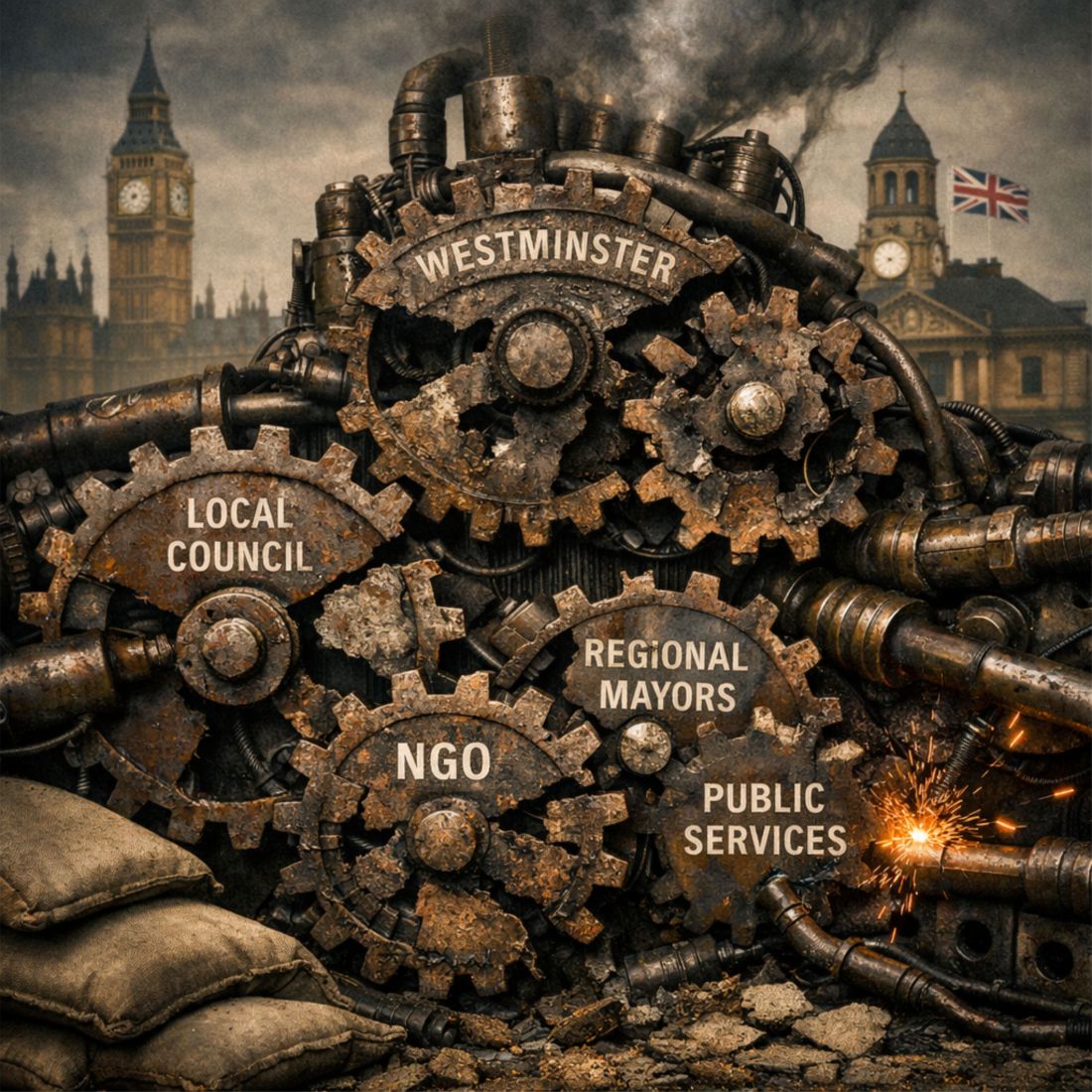
The system is now the constraint
There was a time when governments could survive their own contradictions because the country still had enough spare capacity to absorb them. There was enough productive depth, enough institutional memory, enough social resilience, and enough fiscal room to muddle through.
That space has gone.
What remains is a money-centric, extractive system that has treated real productivity as something to be consumed rather than renewed. It has hollowed out capacity, captured too much of what once created value, and left the state managing consequences it no longer has the strength to resolve.
That is why the problem now feels different. It is not just that politicians face difficult choices. It is that almost every serious choice now carries a chain reaction.
Cut spending too hard, and social stability breaks.
Raise taxes too far, and the remaining productive base strains.
Borrow too much, and market confidence becomes a constraint.
Reform too quickly, and overloaded institutions fracture.
Every lever is now attached to something else. Every promise is surrounded by consequences. Every attempt to move decisively risks exposing how little room remains.
This is what politicians discover as they get closer to power. From the outside, politics still looks like choice. From the inside, it looks increasingly like constraint management.
That is the truth the public is not being told clearly enough.
The politician’s dilemma
This leaves every ambitious politician with the same dilemma.
To reach power, they must still sound as though change is available on familiar terms. They must offer energy, direction, confidence and action. They must persuade voters that the next government can do what the last government failed to do, even as the system they hope to inherit is leaving less and less space for any of it.
That is why policy language often becomes slippery at this stage of the cycle. It sounds like change to the untrained ear, but often reflects the reality facing a politician close enough to power to see the limits clearly: announcements narrow, promises become conditional, radicalism becomes sequencing, and transformation becomes delivery reform.
Burnham’s recent positioning matters in that context. The precise policies are less important than the direction of travel. The language still needs to sound active and ambitious, but it is increasingly shaped by the reality that awaits anyone who gets the keys to Number 10, or gets close enough to understand what those keys actually mean: no money without consequences, no reform without resistance, no easy cut that does not land somewhere human, and no decisive move that does not set off movement elsewhere.
That reality has faced successive governments. It is now facing this one. It will face the next one too. The pattern is brutally simple: they arrive promising movement, meet the constraint, narrow the promise, and are judged as if the constraint did not exist.
Only now, the cycle is compressing.
The honesty people are likely to misread
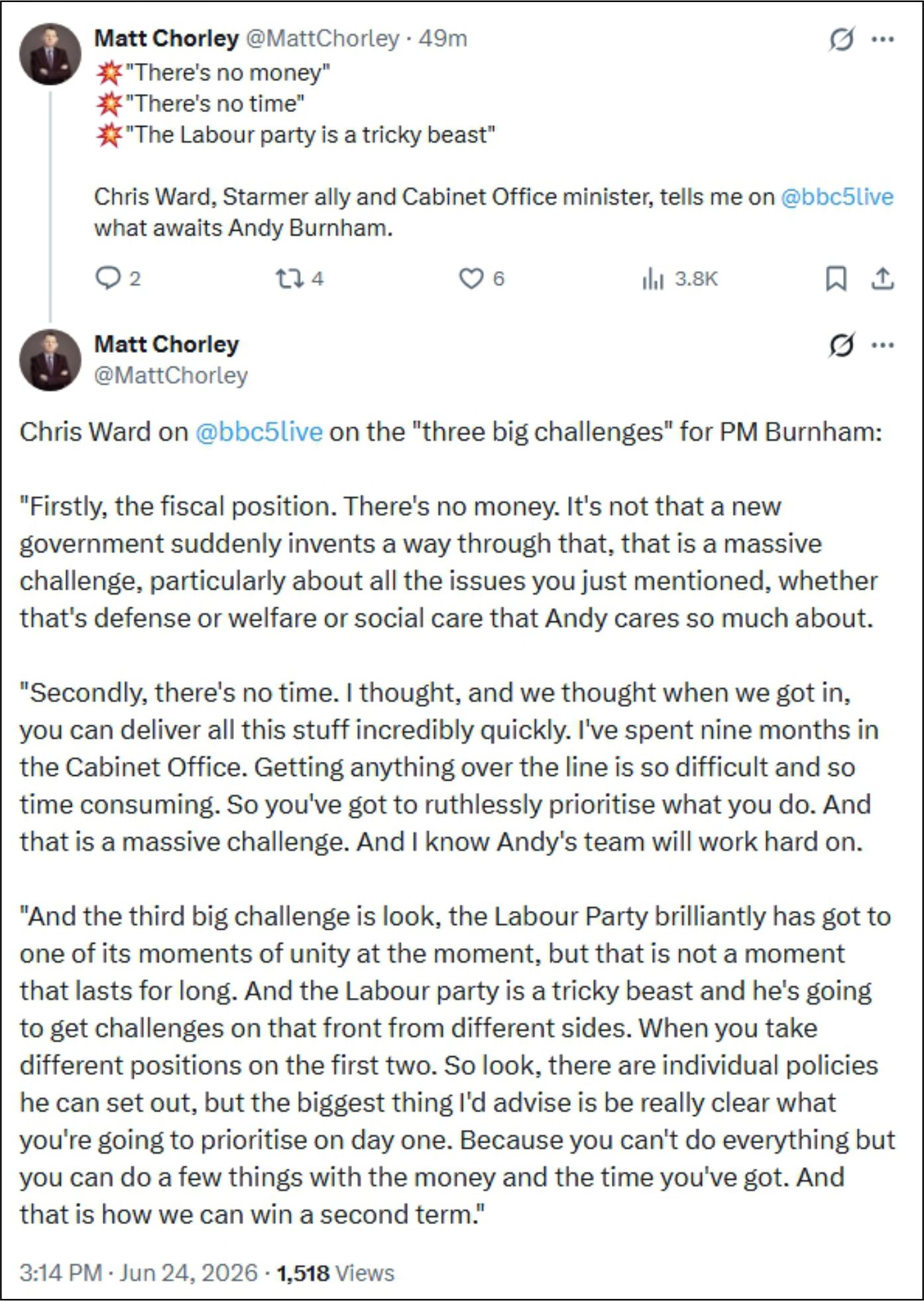
When Matt Chorley shared Chris Ward’s remarks on BBC 5 Live, the thread was instantly read as a comment on Labour’s internal challenges. The emojis, the shorthand – “no money, no time, tricky party” – made it sound like a partisan critique.
But the full exchange pointed to something bigger: a rare, candid description of the structural limits of government itself.
Ward wasn’t talking about Labour’s competence.
He was describing the physics now facing anyone who governs.
“There’s no money. It’s not that a new government suddenly invents a way through that – that is a massive challenge…
Secondly, there’s no time… Getting anything over the line is so difficult and so time‑consuming…
And the third big challenge is unity – that’s not a moment that lasts for long.”
Most people will hear that and think:
“Labour are struggling.”
But what he’s actually describing is the reality any government now faces.
The Conservatives hit the same wall – they just pretend they didn’t.
Labour are hitting it now.
Reform will hit it next.
The way the quote circulated online – stripped of context and reduced to emojis – is part of the problem. We keep mistaking structural reality for partisan failure. We keep reading honesty as weakness. We keep treating each turn of the wheel as a new story, when it is often the same system taking different actors back to the same place. And we keep missing the bigger message hiding in plain sight: the system itself is leaving government with nowhere to go.
That is what is killing what remains of our politics.
Why the next election may not resolve anything
There is a real chance that the current government is forced back to the country sooner than expected, or at least begins that process before the year is out. But even if that happens, it will not change the underlying reality.
Another election may change the personnel. It may change the mood. It may produce a different parliamentary arithmetic. It may even bring a Reform-led government, with or without a majority.
But it will not create room that does not exist.
The hardest truth is that no party can spend what the system no longer generates, cut what society now depends on without consequence, or restructure the state at speed without triggering effects elsewhere.
This is where much of the current rhetoric becomes dangerous. Bold plans appeal because they name real frustrations. But naming the frustration is not the same as creating capacity.
Large-scale fiscal shifts, rapid cuts, aggressive restructuring or dramatic executive action all assume that the system still has shock absorbers. It does not.
That is why another election could easily be followed by another crisis of legitimacy. A new government may arrive claiming a mandate to break the pattern, only to discover that the mandate does not change the machinery.
If the gap between promise and delivery opens quickly enough, the country could find itself back at the ballot box far sooner than anyone expects.
Why PR would not be the answer either
At that point, pressure for proportional representation may become overwhelming. That would be understandable. If people feel the system has failed repeatedly, they will look for a deeper democratic reset.
But PR would not answer the deepest problem.
It may improve representation, make Parliament feel more plural, and break the old duopoly completely. But it would not rebuild state capacity, restore productivity, create fiscal headroom, make overloaded services resilient, or reverse decades of extraction from the real economy.
PR changes how political power is distributed. It does not change the fact that the state is trying to do too much with too little, that too many people rely on systems already close to failure, or that the economic base beneath government has been weakened.
It would change the seating plan. It would not fix the building.
Why Reform would meet the same wall
Reform matters here because it may become the next major test of the illusion that political will is enough.
Its appeal is not mysterious. It speaks to people who feel ignored, overtaxed, under protected and patronised by a political class that has repeatedly failed to deliver.
Much of that frustration is real, and Reform offers urgency, clarity, punishment of the old order, and the feeling that someone might finally do something.
But urgency is not capacity.
Clarity is not room to manoeuvre.
A mandate, however large, cannot repeal the consequences of a system that has become too brittle to absorb shock.
Slashing benefits may sound attractive to people who do not currently need them. But benefits are not just a moral or fiscal question. In the country we have actually built, they are also holding back pressures created by wages that no longer allow many people to live independently, housing costs that absorb too much income, and services already stretched beyond design.
Pull that support away too quickly and the result is not simply savings. It is homelessness, crisis demand, public health pressure, social disorder, family breakdown, and costs reappearing elsewhere in the system.
That is what happens when the minimum wage is not enough for independent life, essentials become extraction points, and the state is left subsidising the consequences of an economy that no longer provides secure ground beneath people.
Reform would not escape that. No party would.
The deeper economic failure
This is why even the language of rescue now feels misleading. In the 1970s, an IMF intervention could still be understood against a country with a different productive structure beneath it. There were still industrial capacities, business forms, social expectations and economic relationships that could be reorganised around recovery.
Today, too much has been financialised, outsourced, consolidated and captured by systems that extract value rather than renew it.
That does not mean recovery is impossible.
It means recovery cannot be delivered by pretending the old tools still work in the old way.
The country has not simply run out of money. It has run out of the productive and institutional slack that once made political promises survivable.
That is the deeper reason government now has nowhere to go. It cannot easily tax, borrow, cut, spend, reform or delay without making another part of the system worse.
The global thread is even thinner
And all of this is before we even widen the lens.
The domestic system is already stretched thin. But it is not operating in a vacuum. It is exposed to energy shocks, market shocks, geopolitical escalation, supply-chain disruption, climate impacts, migration pressures, technological upheaval and the instability of a global order that itself looks increasingly brittle.
Any one of those could snap the thread.
That is why the political debate feels so unreal.
We are still arguing as if the question is which team can manage the old model better.
But the old model is the thing now failing.
Where this leaves us
If there is a thread running through all of this, it is that we keep mistaking political rotation for political escape. We change the faces, the slogans and the electoral maths, while leaving the underlying system untouched.
But the system is no longer merely inefficient. It is closing in.
That is why no one in UK politics today can escape it. Not because they lack ambition, slogans, advisers, strategies, reforms or mandates, but because the space those things require no longer exists in the way we pretend it does.
Another election may accelerate the reckoning. A Reform government may expose it. A push for PR may follow it. A fiscal crisis may sharpen it. A global shock may detonate it.
But none of those things, by themselves, fix the underlying problem, because none of them rebuild the productive, institutional and social capacity the system has consumed.
The system is not simply failing to deliver the future politicians keep promising. It is consuming the capacity that would be needed to build one.
Until that is faced, every election will feel like change, every government will promise movement, and every cycle will tighten – not because we chose the wrong people, but because we never changed the system they were stepping into.