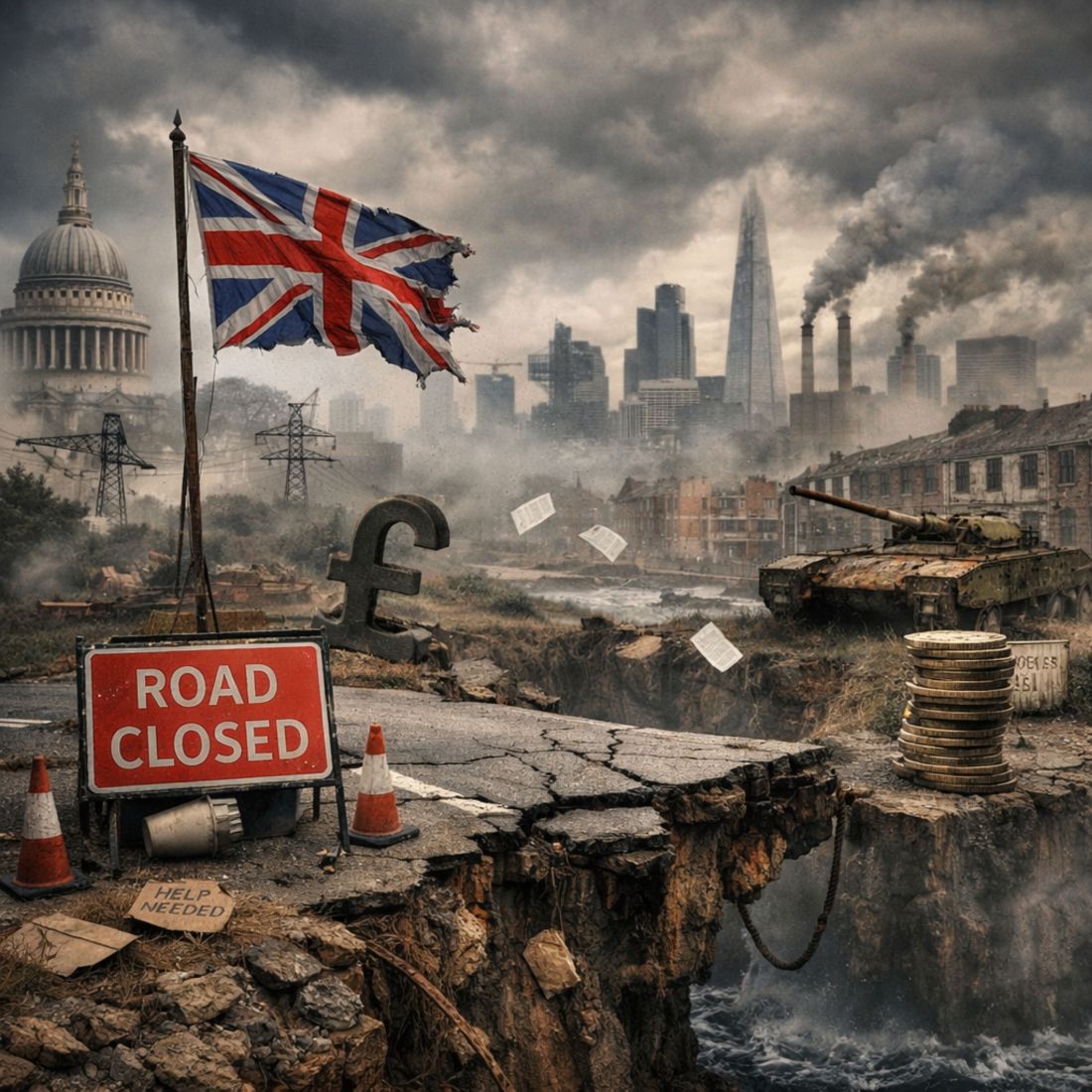
When the System Runs Out of Road | Britain’s benefits crisis, the defence dilemma, and the limits of an economy built on low wages and public subsidy.

Britain has reached the limits of its economic model. What looks, on the surface, like a dispute about welfare and defence spending is really something larger: a state trying to keep a fragile system operating without admitting that the system itself is failing.

There comes a point in every failing system when the people running it stop sounding confident and start sounding cornered. Britain is now in that moment.

The political class will not say this outright. It rarely does. But its actions give the game away: the sudden panic over defence spending, the renewed hostility towards benefit claimants, the insistence that “tough choices” must be made, and the growing desperation to find money anywhere except from those who have accumulated the most of it.

These are not the signs of a confident country making strategic decisions. They are the signs of a system that has run out of road.

The debate about cutting benefits is therefore not really a debate about welfare. It is a debate about whether government can keep the current economic model functioning without confronting the uncomfortable truth that it no longer works.

1. The illusion of choice: why wages alone cannot fix the crisis

Politicians love to talk about raising wages. They talk about “making work pay”, “rewarding effort” and “restoring dignity to labour”. There is truth in that language: wages are too low for millions of people. But there is also a deeper problem.

The current economic structure makes sustained, genuinely liveable wage growth extremely difficult without major consequences elsewhere.

This is not simply a matter of political will. It is structural.

Britain has allowed too many essential sectors to operate on the assumption that wages can remain low while the state, households and debt absorb the difference.

If wages rose rapidly across low-paid sectors without wider reform, the pressure would move through the economy quickly:

  • small businesses would be forced to raise prices or close
  • big businesses would automate, offshore, or cut staff
  • supply chains would pass every cost increase to consumers
  • inflation would spike
  • the Bank of England would respond by suppressing demand
  • and the government would end up increasing benefits anyway

The system is designed so that wages stay low, costs stay high, and the gap between them is filled by:

  • benefits
  • debt
  • charity
  • and the quiet desperation of millions of households

This is why the phrase “people should just earn more” is inadequate.

In sectors such as social care, retail, hospitality and logistics, the problem is not merely individual pay. It is a business model in which low wages, high housing costs and public support have become intertwined.

The system does not merely tolerate low pay. In too many places, it relies on it.

2. Benefits are not generosity – they are the subsidy keeping the economy upright

Public debate often treats benefit claimants as if they are separate from the economy: outside it, dependent on it, or somehow choosing not to participate in it.

That framing is misleading.

Universal Credit and related support are not just moral or social policies. They are economic infrastructure.

Official statistics show millions of people and households rely on Universal Credit, including many households with children and many people whose incomes are shaped by work, care, illness or housing costs.

In practice, benefits help support:

  • landlords charging rents that wages cannot cover
  • supermarkets pricing food at levels households cannot afford
  • energy companies extracting profits from a captive market
  • employers who rely on the state to top up wages
  • local economies that would collapse without benefit‑driven spending
  • the tax base that depends on people staying afloat

Remove or sharply reduce that support, and the effect does not stop with claimants. It moves through landlords, shops, employers, councils, schools, the NHS and local economies.

Benefits are the pressure valve that stops the system exploding. Cut that valve, and the pressure does not disappear – it erupts somewhere else.

3. Defence spending exposes the borrowing wall

For decades, Britain has dealt with structural weakness by borrowing, deferring and patching.

Borrowing has helped fund services, subsidise low wages, smooth over weak growth and avoid a more honest reckoning with the economic model underneath.

But every fiscal strategy has limits. Rising defence commitments have made those limits more visible.

The panic over defence spending is not about global threats alone. It is also about a government discovering that higher spending promises must be made inside a tighter fiscal box, with bond markets, debt costs and fiscal rules narrowing the room for manoeuvre.

This creates a brutal political reality:

  • the government can only justify spending on things that multiply through the economy
  • defence does not multiply
  • defence is a fiscal dead end

Housing, infrastructure, skills and local investment can generate wider economic returns when they are well designed.

Defence can support jobs and industry, but much of its value is strategic rather than directly regenerative for household incomes or local demand.

That distinction matters. If a government funds defence by cutting the income floor beneath millions of households, it may strengthen one form of security while weakening another.

So when politicians say benefits must be cut to fund defence, what they are really saying is:

The system has run out of room, and the only place left to squeeze is the people already at breaking point.

This is not a strategy for national renewal. It is a symptom of fiscal desperation.

4. Cutting benefits to fund defence may create the instability defence is meant to prevent

Supporters of benefit cuts often argue that the welfare bill is too high, that work incentives matter, and that government must prioritise national security.

Those arguments deserve to be heard. No state can spend without limits, and defence is not optional in a dangerous world.

But the problem is what happens when cuts are made inside a society already carrying high rents, insecure work, stretched public services and fragile household finances.

In that context, benefit cuts do not simply reduce expenditure. They transfer pressure into other parts of the state.

The likely consequences include:

  • rising homelessness
  • rising crime
  • rising illness
  • collapsing local economies
  • labour shortages in essential sectors
  • overwhelmed councils
  • overwhelmed NHS services
  • social unrest
  • a shrinking workforce
  • a destabilised society

In time, government would be forced to spend money managing the domestic crisis it had helped create – through emergency housing, policing, healthcare, local authority support and crisis intervention.

This is the irony at the heart of the current debate:

Cutting benefits to fund defence risks forcing the state to spend defence money managing the fallout of cutting benefits.

It is the fiscal equivalent of setting your own house on fire to save on heating.

5. The real divide: those still keeping up and those already falling behind

One of the most dangerous illusions in Britain today is the belief that the crisis only affects “other people”.

Those who are just about keeping up – homeowners, stable earners, people with savings or secure jobs – can be tempted to look away from those who have already fallen behind.

Not necessarily because they are cruel, but because acknowledging the truth means acknowledging their own vulnerability.

So they cling to comforting narratives:

  • “People just need to work harder.”
  • “Benefits are too generous.”
  • “The system is fine – it’s the people who are broken.”

But when the world feels unstable and war looms, defence suddenly becomes real. The government’s inability to fund its own priorities becomes visible. The fragility of the system can no longer be ignored.

The uncomfortable truth is that the defence crisis and the benefits crisis are connected.

Both expose the same weakness:

A system that extracts more than it creates eventually has nothing left to extract.

6. What happens if nothing changes

If politicians cut benefits without rebuilding the system beneath them, Britain risks deepening the problems it claims to be solving:

  • a shrinking workforce
  • a collapse in essential services
  • a surge in debt defaults
  • a rise in civil disorder
  • a widening regional divide
  • a breakdown in social cohesion
  • a government forced to spend more on crisis management than it ever saved

This is not inevitable, but it is foreseeable. A country cannot endlessly squeeze household incomes, underfund essential services, demand higher defence spending and still expect social cohesion to hold.

The question is not whether Britain can make “tough choices”. It is whether it is willing to make honest ones.

7. The truth at the heart of the crisis

Britain cannot fix this crisis by treating symptoms as causes.

It will not be solved by:

  • cutting benefits
  • raising wages
  • tweaking taxes
  • increasing defence spending
  • punishing claimants
  • lecturing the poor

Each of these may be part of a political argument, but none of them reaches the core problem.

The core problem is a model that has depended for too long on low pay, high private costs, public subsidy, household debt and political denial.

Until that changes, everything else is noise.

Conclusion: Britain needs a system that works

Britain is not simply in a benefits crisis. It is in a system crisis.

Benefits are not the cause of that crisis. They are one of the mechanisms preventing it from becoming more visible in the streets, in hospitals, in councils, in schools, in courts and in every community already stretched close to breaking point.

If Britain wants a future that works, it needs more than spending cuts, slogans and scapegoats.

It needs an economic settlement in which work pays enough to live on, housing costs do not swallow household incomes, public services are treated as national infrastructure, and security means more than weapons alone.

The question is no longer whether the existing system can be preserved. It is what replaces it – and whether Britain is honest enough to begin that conversation before the road runs out completely.

Why MPs Can Afford to Give Away Their Salaries – And Voters Can’t

The idea of paying Members of Parliament was once rooted in a simple democratic principle: no one should be excluded from representing their community because they lacked personal wealth.

A wage ensured that ordinary people – not just landowners, industrialists, or the independently wealthy – could afford to serve. It was never intended to be a reward, a perk, or a pathway to personal enrichment. It was a mechanism to level the playing field.

Yet the modern reality looks very different. Today, MPs receive salaries two to three times the national average, despite the fact that the major costs associated with fulfilling their duties – accommodation, travel, staffing, and constituency office expenses – are already covered. The original justification for paying MPs has not simply faded; it has been inverted.

A Debate Reopened – But Not for the Reasons People Think

The recent attention on Andy Burnham’s pledge to donate 15% of his salary to charity if elected as MP for Makerfield on 18 June has reignited the conversation.

Whether his gesture is entirely sincere or partly strategic is irrelevant. What matters is what it reveals: MPs can afford to give away a portion of their income without compromising their ability to live comfortably.

Rupert Lowe, the sitting MP for Great Yarmouth, already donates his entire salary to local charities. As a former high‑profile businessman, he is in a position to do so. Again, the point is not to praise or criticise him. The point is that the system allows – even enables – such gestures because the salary is not essential to the role for many who occupy it.

Meanwhile, many of the people MPs represent cannot afford to live independently on full‑time wages. That contrast alone should give Parliament pause. It rarely does.

The Role of an MP: Job, Career, or Responsibility?

Being an MP was never meant to be a job in the conventional sense. It is not a profession with a career ladder, performance bonuses, or a corporate hierarchy. It is a responsibility – a vocation grounded in representation, judgement, and service.

Yet the way Parliament functions today makes it easy to mistake the role for a career. Party structures, internal hierarchies, and the pursuit of ministerial positions have created a political class that behaves more like a managerial workforce than a body of independent representatives. Advancement often depends on compliance, not courage; on loyalty to party leadership, not loyalty to constituents.

In such an environment, the salary begins to resemble a reward for participation in the system rather than a support mechanism for public service.

The Misconception of “Attracting the Right People”

A long‑standing argument insists that higher pay attracts “better” candidates. But what does “better” mean? Bankers? Teachers? Former military officers? Small business owners? People with lived experience? Parliament already includes individuals from all these backgrounds.

The issue is not who enters Parliament. It is what happens to them once they get there.

Most MPs – unless they reach the upper tiers of government – have limited influence over policy. Party discipline often dictates how they vote. Constituents may assume they elect individuals, but the system encourages MPs to behave as extensions of their party machine. The result is a structure where independence is discouraged, and representation becomes secondary.

Leadership vs. Management

Westminster is filled with people who are mistaken for leaders because they hold positions of authority. But leadership is not the same as authority. Leadership requires independence of thought, moral courage, and a willingness to put the public interest above personal ambition.

Those qualities are not cultivated by a system that rewards conformity. Nor are they dependent on a six‑figure package.

Genuine representatives are not defined by their CVs, their networks, or their public profiles. They are defined by their ability to understand life as it is lived by the people they serve – and by their willingness to act on that understanding, even when it is inconvenient.

The Pay Gap That Exposes the System’s Blindness

The national minimum wage – £12.71 per hour, or £26,436.80 a year for a full‑time worker – is less than a third of an MP’s salary. And that minimum wage is widely acknowledged as insufficient for independent living without debt, charity support, or state benefits.

Many MPs argue that those benefits should be reduced.

This is not an attack on individuals. It is a reflection of a system that has become breathtakingly detached from the realities of everyday life. A system in which public money is treated as an abstract resource rather than the product of millions of people’s labour. A system where the financial pressures facing ordinary citizens are acknowledged rhetorically but rarely understood in practice.

A Vocation, Not a Pay Packet

If MPs have their essential needs met – and they do – then the argument for high salaries collapses.

The role should attract those motivated by service, not status. Those who seek to represent others should do so with a clear understanding that the responsibility is the reward.

This does not mean MPs should be out of pocket. It means they should not be enriched by a role that exists to serve the public.

Until Parliament reconnects with the realities of the people it represents, the debate over MPs’ pay will continue to symbolise something deeper: a political culture that has lost sight of what public service is supposed to mean.

Plastic Productivity and the Debt Trap: What the November Budget Won’t Fix

Governments do not collapse in the same way that individuals or businesses do. If they did, the United Kingdom would have gone under financially long ago. Instead, the state continues to function by rolling debt forward, reshaping obligations, and presenting the appearance of stability. For ordinary people, however, the rules are very different. When we cannot meet our commitments, we fail – unless someone steps in to bail us out.

Meeting financial obligations requires honesty. You must know whether you can truly pay your debts or whether survival depends on wishful thinking. Throughout history, people and businesses have thrived or failed for both good and bad reasons. As long as they appear to function, few question what lies beneath.

For tradesmen, small business owners, and entrepreneurs, the reality is harsh. None of us are “too big to fail.” Once obligations can no longer be met, collapse follows unless a benefactor intervenes.

We like to believe the same standards apply to everyone, whether sweeping streets or running government. Yet elites have always bent rules to their advantage. They forget that all people, high or low, share the same human experience. Power corrupts, and politicians often forget they were elected simply to fill a seat, not because they are uniquely qualified to decide what is best for everyone.

The shift to fiat money in 1971 changed everything. It allowed governments, banks, and corporations to manipulate the system, creating the illusion of endless funds. Behind closed doors, decisions were shaped by business and banking interests, while politicians no longer had to worry about the true responsibilities of leadership.

Debt became hidden behind GDP figures. Growth and transaction volumes disguised the reality of an exploding debt pile. To the untrained eye, it looked as though debt was shrinking, when in fact it was spiralling out of control.

This illusion was sustained by what might be called “plastic productivity.”* Assets and infrastructure were bought cheaply, production was outsourced overseas, and consumers were encouraged to buy more and more goods they didn’t need. People became indebted to the same banks that lent to government, yet could just about service their loans. It seemed as though prosperity was endless, and few questioned the narrative.

But the system was never sustainable. Its architects knew it would transfer wealth and ownership to a small elite. By making money and material wealth addictive, they ensured control. With industries hollowed out, productivity now depends almost entirely on expanding debt – by government, business, and individuals alike.

Politicians face a broken system. To keep the machinery of government running, they must tax normal people more heavily. Yet much of public spending delivers little benefit. Policies have been rewritten, words twisted, and meanings changed to allow politicians to cling to power while the wealthy grow richer. Assets of real value have been transferred to people who could never have owned them otherwise.

If the system collapses, the establishment will impose new rules. They may impoverish citizens further, leaving people no choice but to accept whatever is dictated. Many politicians may not even understand the system they oversee. They follow instructions blindly, blamed for decisions that are not theirs, lacking the skills to lead differently.

The situation could drag on for months or years. Collapse may come when the public finally says “enough,” or when the establishment has drained the country dry. Even if a new government is elected – Reform UK, Nigel Farage, or anyone else – they will face the same reality. Cutting spending or taxes cannot fix a nation that is broke and owns nothing. Wealth has already been transferred to lenders.

The system is broken. We must either accept subjugation under a corrupt structure built on trickery, or take a leap of faith and start again from scratch.

***

*”Plastic productivity” refers to the illusion of economic growth created by outsourcing production, encouraging over‑consumption, and sustaining debt, rather than building genuine, sustainable value. It’s not about plastics as a material, but about a system that mimics productivity while hollowing out real industries and transferring wealth.

The Harmful Hidden Meaning of ‘Growth’

We hear the term growth coming from the mouths of politicians so often that the word now sounds like it’s all government is about.

And yes, it is true that growth today is all that the government is about.

“Great!” say businesses and business owners. “The government are out to help us grow!”

And that is exactly the kind of growth most of us outside Westminster think of – and believe we are hearing – when politicians use the term. But it is not what they actually mean when they talk about “growth”, at least not the politicians who are in the know.

GDP (Gross Domestic Product)
The growth that politicians keep talking about is not the kind of growth most of us imagine when we hear them use the word.

Politicians – and the advisers around them – know perfectly well what the public thinks they mean, and they also know that what they mean is something quite different.

For politicians, growth does not mean business growth in the way most of us understand it. While it still includes the kind of growth we think of, that aspect matters far less to them today than it once did.

For politicians, growth means the growth of Gross Domestic Product, or GDP.

GDP is the size of the economy – the total amount of financial activity that has taken place across every form of business or trading activity involving measurable financial transactions. These transactions are recorded across the entire country by the Office for National Statistics from all the businesses and organisations it monitors.

“Measurable” is the key word here. It is the act of measuring so much of life because it has a financial value that has had such a negative influence on how we now value almost everything in purely monetary terms.

The Devil is in the Detail
GDP is critically important to politicians today because it is the benchmark figure that allows them to hide the true breadth and depth of public spending and public debt.

Yet GDP is really a measure of private‑sector or “commercial” activity, rather than the financial activity of public‑sector organisations.

Public borrowing figures matter because we have been conditioned to believe they have a direct relationship with the “economy”.

This is why they are always presented to us as a proportion or percentage of GDP.

If GDP grows quickly or significantly, the true financial position of the UK becomes easier to conceal.

Furthermore, this form of “creative accounting” can make the amount of money the government is spending, borrowing or creating appear smaller or less significant.

This sleight of hand works effectively because the narratives we hear from politicians and the media always frame public spending and public debt in terms of how “big” the economy is and how much it has “grown”.

Politicians and the money ‘creators’ are making our world unrecognisable whilst we are all being robbed
GDP is a very clever tool – and it was certainly designed to be. But it is also a double‑edged sword.

A quick recap:

Politicians can hide or even obscure public debt and “reduce” the amount they appear to be spending by “growing the economy”.

This is why politicians are obsessed with “growth”.

“Growing the economy” in this sense means increasing the amount of financial activity, or the total money spent or transferred through measurable activities during any defined period of time.

How “growth” works:

Political “growth” is typically achieved through an increase in private‑sector financial transactions and an increase in the volume of money in circulation (essentially the total of all the money sitting in every open bank account at any given moment).

Money is created by private banks and financial institutions – not by government.

While each pound is counted when it is created for GDP purposes, the real “magic” or sleight of hand lies in the fact that the same pound is counted again every time it changes hands in a new financial transaction at each point in a supply chain.

Housebuilding is perhaps the best example of how GDP – and therefore “growth” – can be increased, because large volumes of newly created money and the long chain of financial transactions it triggers can quickly be added to the UK’s balance sheet.

A good example of ‘Growth’ – in the way politicians need it to be:
To build a house requires private banks to create the money needed to buy the land and then to fund the entire building process. This includes the supply chains involving all the different businesses that produce building materials, the machinery used, the fuel required, the specialist tradesmen, and the surveyors.

Once the houses are built, they must be sold, which gives another private bank the opportunity to create the money for the mortgage. The mortgage lender charges a fee, the removal company gains business, the landscaper installs a garden, and so on.

Beyond this specific chain come the ongoing requirements: council tax for each home, which local councils automatically charge; utility accounts; increased demand for bus services; and the list continues.

Every one of the businesses involved provides data to the Office for National Statistics about their performance and turnover. Each set of figures is added to the country’s “productivity”, no matter how many times the same money has changed hands – meaning its value in GDP terms may be multiplied many times over.

Things to bear in mind – The System
It is important to understand that GDP functions as the “credible” measurement of economic activity precisely because it hides the creation of money behind the walls of private banks and finance houses.

Most people still believe that banks simply hold money for individuals or businesses and then lend that money to others – including governments – in return for interest, which is then shared with the original depositors.

While this may have been true in some limited ways historically, today money is created by private banks and finance houses as easily as an employee entering digits into a spreadsheet.

Many of the rules that once regulated and constrained these activities have been watered down or removed entirely under the banner of “deregulation” and “free markets”.

For The System to keep functioning, the amount of money available must keep growing, and the number of recorded financial transactions must keep increasing.

This is why the use – and increasing reliance – on credit, digital banking, and financial‑transaction tracking has become so important.

Cash transactions cannot be monitored or recorded in the same way digital transactions can. This is one of the key reasons cash is being phased out: cash, or any non‑digital transaction, is one of the few remaining tools of genuine financial independence.

Private banks and finance houses also “buy” the bonds that the government “sells” when it needs to “borrow” money to fund public policies and public‑sector delivery.
It is important to recognise that if the total amount of money in circulation were to remain fixed within this FIAT‑based economic and financial system, the value of transactions taking place would naturally fall.

The System was designed – and continues to operate – on the basis that money created within it automatically flows into the pockets of the rich. From there, it is invested in assets such as property, infrastructure, and business ownership, where it is used to generate even more credit‑creation opportunities.

In the FIAT system, money flows back to its source: those who are already very rich – the bubble where it was created in the first place.

Where our reality becomes VERY uncomfortable – just to support politicians’ ‘Growth’
To counteract the perverse nature of an economic system deliberately created to enrich and benefit those who created, manage and understand it (the creators), it becomes necessary for money to be created for new reasons and in an ever‑increasing number of ways. This ensures that money keeps flowing, keeps “multiplying”, and continues to appear as “growth”.

Deregulation allowed the same interests that create money to use even more of that created money to buy up almost everything they would never have been able to acquire otherwise – all because we have been encouraged to believe that the money they use is actually real.

This created, effectively “fake”, money has been used to buy or gain control of everything we recognise as real, typically so it can then be rented back to us – increasingly using more borrowed, created money on which we must pay interest.

Meanwhile, the money used for public spending is considered “dead money” because it generally pays wages and incomes rather than generating long chains of financial transactions that boost GDP. This creates a major problem for government, because running public services requires constant spending that does not produce the kind of measurable, repeatable financial activity that The System depends on. As a result, the government can no longer borrow enough to cover existing bills, especially as the UK has been stripped of its assets and productive capacity by the very same interests that create the money.

In contrast, large infrastructure projects are still politically attractive because they do generate the long supply‑chain activity that inflates GDP. Every stage – planning, contracting, materials, labour, machinery, financing, and eventual operation – produces measurable transactions that can be counted again and again. This makes such projects appear “affordable” or even “profitable” within the GDP‑driven framework, even when the government cannot sustainably fund day‑to‑day public services. Infrastructure spending therefore becomes a preferred tool not because it serves the public best, but because it props up the illusion of growth that The System requires.

More food for thought
Unfortunately for us, the creation of money out of nothing does not correspond in any meaningful way with the real value of what people and businesses across the UK own and produce.

Our politicians have helped to entrench this situation because adopting this system appeared to make life much easier for them.

This means that the real value of whatever money we possess – or expect to receive as income – falls each time even a single pound is “created” by politicians or by the banks.

The value of the pound in our pockets or in our bank accounts declines in proportion to the total amount of money in circulation.

The way The System attempts to counteract or mask this fall in monetary value is through what we know as inflation.

Inflation is the rise in prices that becomes necessary for anyone who owns or produces anything, simply so they can keep up with how “growth” is actually pushing the value of everything down.

How Inflation hurts us

We – the people and consumers – sit at the very end of the supply chain. We do not sell on what we buy, so we have no way to recoup the losses that government policy and economic distortions create across the wider economy.

Everything is driven by money, greed and profit.

As a result, we experience falling living standards because wages and incomes cannot rise fast enough to match the deficit that GDP‑driven “growth” creates for us at the level of everyday life.

Are we the victims of the biggest crime mankind has inflicted upon itself?
If you begin unpicking the layers of this economic onion – layers that have been deliberately obscured by narratives designed to deter anyone from looking too closely – you uncover some very uncomfortable truths that have been hiding in plain sight.

The biggest of these is that The System can only function by steadily impoverishing the masses, making people increasingly dependent on credit simply to exist.

When MMT, neoliberal economics and the FIAT monetary system were implemented in the early 1970s, it was already inevitable that those on the lowest incomes would eventually be unable to live without assistance – preferably in the form of credit.

That credit would be more of the same created money, lent back to us at interest, while our creditworthiness – and therefore our compliance – is monitored.

The government’s current push for welfare reform is not a sign that people want to live off the state. It is a sign that cracks are appearing in this bogus economy, and the fissures have widened so far that new “corporation‑friendly” policies can no longer hide them.

Although few of us trust politicians, most of us have not agreed on why.

What we should recognise is that – deliberate or not – everything politicians have done for the money creators over at least five decades has slowly destroyed the fabric of our society.

The uncomfortable truth is that we have all been robbed
The System has been created and maintained to benefit the few, while the many have been deliberately misled into believing that everything is fair, normal and simply “the way things are supposed to be”.

In reality, we have been robbed of our financial independence, our security, our opportunities, our communities, our public services and our ability to live without fear.

We have been robbed of the value of our labour, the value of our money, the value of our homes and the value of our time.

We have been robbed of the ability to live meaningful lives without being forced into debt, dependency or compliance.

We have been robbed of the truth.

We have been robbed of our peace.

And the worst part is that most people still don’t realise it.

Where we go from here
The harmful hidden meaning of “growth” becomes impossible to ignore once you understand how The System works. What politicians celebrate as “growth” is not the expansion of real prosperity, but the expansion of financial activity that extracts value from ordinary people and concentrates it elsewhere.

It is a cycle that demands ever‑greater debt, ever‑greater dependency and ever‑greater pressure on the real economy that people actually live in.

Growth is important to today’s political class because their political future depends on it. Without the appearance of growth, the economic narrative they rely on begins to collapse – and with it, the credibility of the system they defend.

Recognising this is the first step toward reclaiming what has quietly been taken from us.

The System only survives because we have been conditioned not to question it, not to challenge it and not to imagine that anything different is possible. But once the illusion is exposed, its power begins to fade.

Real change will not come from the same political class that helped build and protect this machinery of extraction. It will come from people who understand that a society cannot thrive when its citizens are reduced to consumers, debtors or data points in a spreadsheet.

We do not have to accept a future defined by insecurity, dependency or manufactured scarcity.

We can choose to rebuild an economy that values people over profit, communities over corporations and reality over the convenient fictions that have been sold to us for decades.

The truth may be uncomfortable, but it is also liberating. Once we understand how “growth” has been used as a tool of extraction, we can begin the work of creating something better – something fair, sustainable and genuinely human.

The theft only continues for as long as we fail to see it.

Awareness is the beginning of the end.

This Blog was first published on 6 December 2024. Updated on 28 April 2026 with minor revisions for clarity and relevance.