End of the ‘Duopoly’ – or the Slow Death of the Entire UK Political System?

Public narratives have increasingly been used to shape how we interpret major events – often subtly, often through fear, and often in ways that encourage us to accept outcomes that might never have emerged if we had been left to form our own conclusions.

Whether it’s the breathless insistence that an AI takeover is inevitable or the framing of political change as something predetermined, narratives have become tools for steering public belief long before reality has settled.

Sometimes these narratives are deliberately crafted. Other times, even those repeating them may not fully understand the consequences of the stories they help spread.

Either way, the effect is the same: they shape how we see the world during a period that is already turbulent and uncertain.

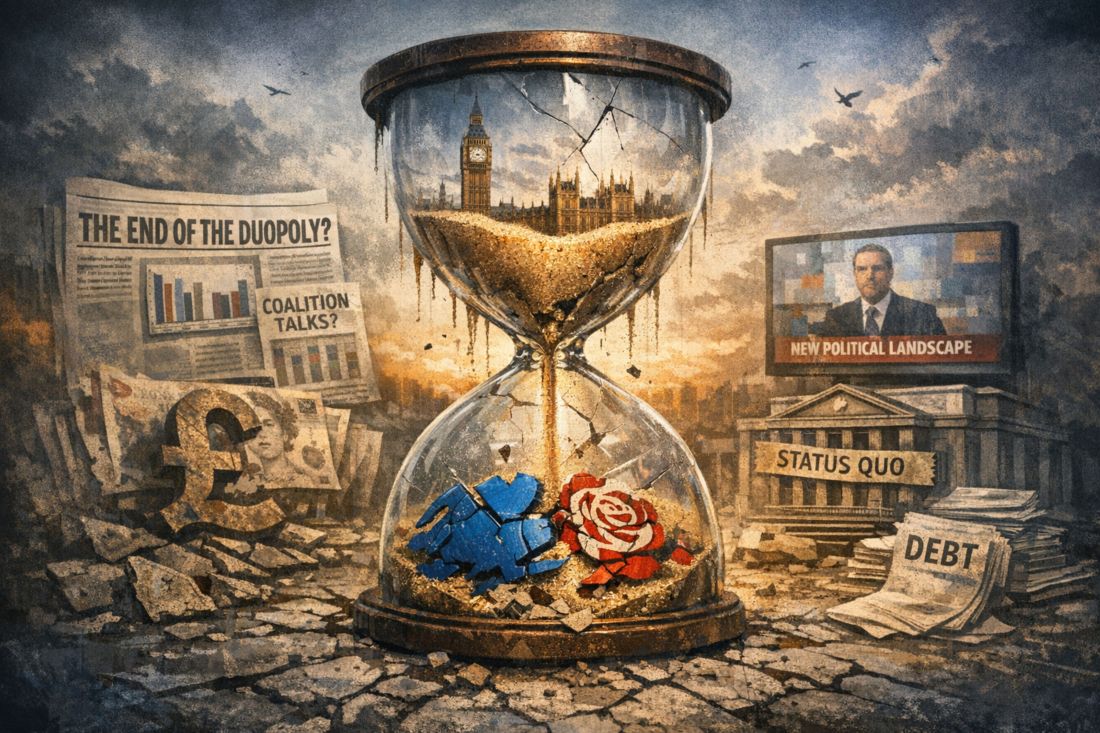
The New Post‑Election Narrative: “The End of the Duopoly”

In the hours following the 2026 UK local election results, a striking uniformity appeared across political commentary. The phrase “end of the duopoly” – referring to the supposed collapse of Labour–Conservative dominance – began appearing everywhere at once.

Even early on Saturday 9 May, with all results declared, the framing had already solidified: the UK is entering a new era of multi‑party politics, with Reform UK positioned as the emerging force.

But what does this narrative actually mean? And more importantly – what does it leave out?

Contextualising the Claim

The UK has never been a strict two‑party system, but the electoral mechanics of First Past the Post have historically produced two dominant blocs.

The new narrative suggests:

  • Labour and the Conservatives are losing their structural dominance.
  • Reform UK is becoming the largest force in a fragmented landscape.
  • A European‑style multi‑party system is emerging.

Specialist pollsters have already produced “like‑for‑like” general‑election projections based on the local‑election vote shares.

These projections – while not predictions – suggest that Reform could become the largest party but still fall short of a majority, requiring cooperation with the Conservatives to govern.

This would conveniently provide an explanation for any undelivered promises: coalition constraints, market pressures, or the need for “stability”.

A Straightforward Interpretation – But an Incomplete One

Yes, the Greens also performed strongly, though not at the levels some earlier polling suggested. Yes, the Conservatives and Labour both suffered significant losses. And yes, this could be read as the new normal for British politics.

But the deeper question is whether this is truly a political realignment – or simply the next step in a much longer, more fundamental breakdown.

The Systemic Problem Beneath the Party Shifts

Most people see politics only at the surface level: parties, personalities, and promises.

But the problems facing the UK today are not primarily the result of individual politicians or even individual parties.

They are the consequences of a system that has been allowed to drift into dysfunction.

The UK’s political‑economic model – neoliberal, globalised, market‑centric, and dependent on fiat‑money expansion – has:

  • extracted productivity and resilience from the economy
  • created a bloated but underperforming public sector
  • generated unsustainable levels of public and private debt
  • masked deepening poverty through an ever‑expanding benefits system
  • reduced political leadership to managerialism rather than representation

The expected to be outgoing Prime Minister may be an extreme example of the political class at its worst, but he is not an outlier. His behaviour, motivations, and priorities are symptoms of a political culture that has lost its connection to public service.

Different parties may sound different, but they operate within – and are shaped by – the same system.

Their incentives, constraints, and worldview are aligned far more closely than their rhetoric suggests.

Is This Really a “Shift” – or the Last Gasp of a Failing Model?

What is unfolding may not be a realignment at all. It may be the final attempt by political actors to fix systemic problems using the same tools, rules, and assumptions that created those problems in the first place.

Reform UK could, in theory, be a vehicle for genuine change. But the evidence so far suggests they may simply continue the trajectory set by Labour and the Conservatives – not necessarily because they lack intent, but because once confronted with the realities of governing within the existing system, they will face the same constraints.

The brief premiership of Liz Truss is a cautionary tale: the system can eject a government faster than voters can.

The Bigger Picture

The real seismic shift may not be the 2026 local elections or even the next general election. It may be the slow, grinding collapse of a political‑economic system that no longer works – and the emergence of something new that none of the current political class is prepared for.

The “end of the duopoly” may be less a new beginning and more a sign that the old system is running out of road.

What Happens When Reform Cannot Deliver Either?

It’s the day after the local elections, and the results coming in from across the country suggest a seismic shift in British politics – one that could shape the next Westminster government in ways we have not yet fully grasped.

Yet we talk as if both the causes and the consequences of this shift are already understood. People speak with a confidence that suggests the answers are obvious. But the questions that actually matter – why this is happening, how far it goes, what it really means, and where it stops – are barely being touched. And when you actually look inside the political “can” we’ve opened, the reality is nothing like the branding most people think they recognise.

A big part of the problem is that many do not really understand the political choices in front of us. The problems seem easy to understand; the solutions appear logical and the answer for many really does to come in the shape of Reform UK.

On the face of it, Reform have come from nowhere. But they have not appeared out of thin air. Reform grew out of the Brexit Party, which grew out of UKIP, which itself followed earlier formations such as the Anti-Federalist League.

What looks new is, in part, simply the latest evolution of something that has been developing for decades. They have a charismatic leader who seems to connect effortlessly with the disenfranchised and the angry. Their polling, media presence and narrative momentum all suggest that voting Reform is becoming, for many, the clearest available expression of a desire for change.

But that is all it is: an expression of desire. And once you widen the lens, the picture becomes clearer.

Commentators discussing today’s results talk as if Reform are achieving something UKIP never managed. But pre-referendum UKIP was an openly single-issue party and did not pretend otherwise. Reform is different in form, but not in kind. It is the next evolution: playing the same game as everyone else in politics, talking up this and that, while the reality would look very different if and when the responsibility of government ever became theirs.

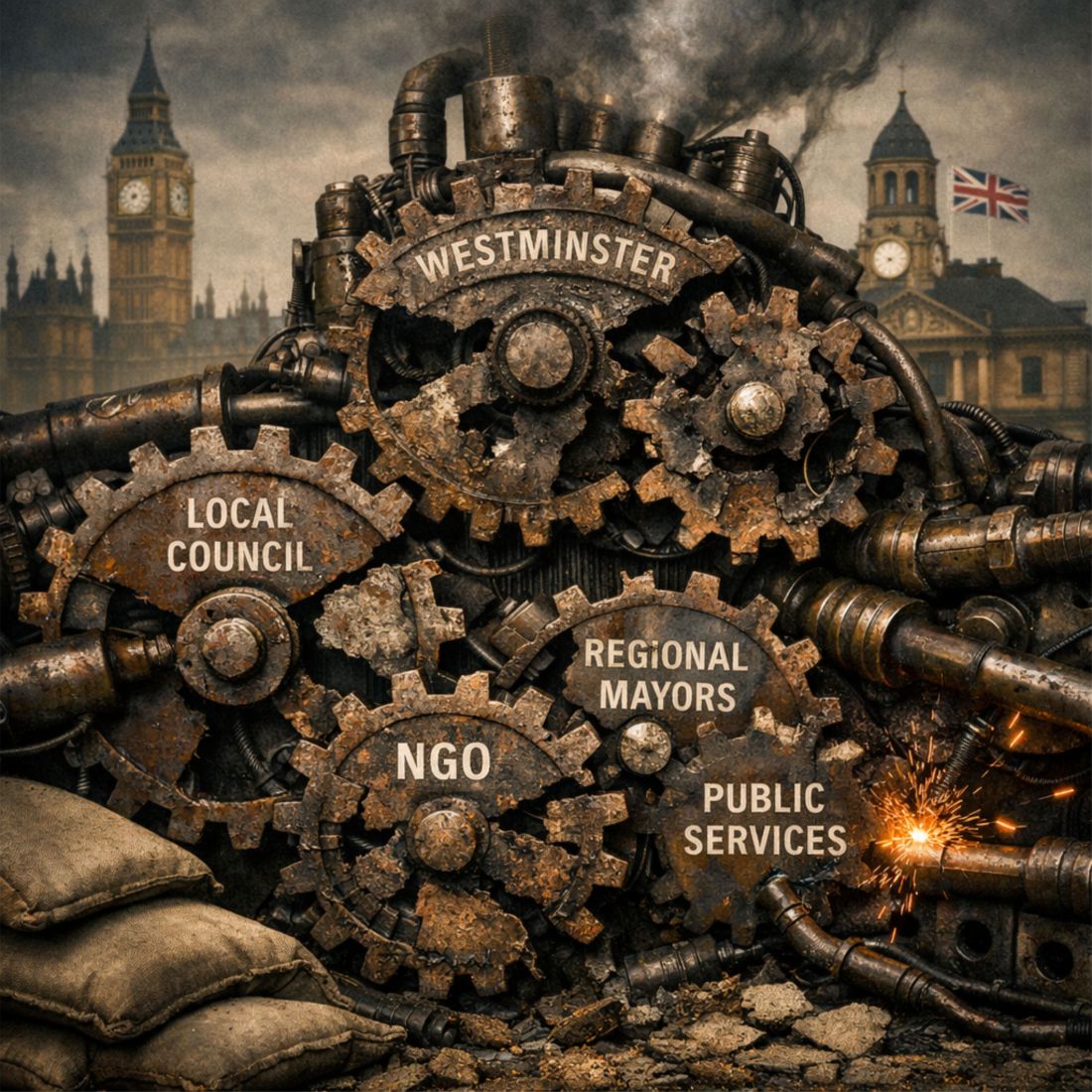
However, the problems the UK faces can no longer be solved by the political system we have, because the issues are now systemic – rooted in the way power, money, institutions and incentives are arranged – and our political system is itself part of the problem.

Once you accept that, you can begin to see that we have passed the point where any government can do anything meaningful without confronting the entire structure head-on.

Anything else is just throwing stones at symptoms while claiming to treat the cause.

The way we think about politics mirrors the way our politicians think about the world.

That shared mindset blinds us to the mechanics of a system that continues to function only because key parts of it remain hidden: where power really sits, how responsibility is displaced, and how failure is managed politically rather than resolved.

Even politicians with the best motives cannot act against a structure that survives under the mantra: “this is just the way it is”.

This is why the questions around Reform’s candidate selection, their approach to local governance, and what happens when they take control of councils matter – but not in the way people assume.

The collapse of local government is already baked into the system through financial strain, hollowed-out capacity and deep dependence on central government, regardless of who runs it. Yet this is obscured by the familiar narrative that Westminster is where everything happens, leaving local government to look irrelevant even as it quietly fails.

And that brings us to the national picture. Local government is not separate from Westminster so much as an early warning of the same underlying limits. It is only if and when Reform hold power nationally that we will truly see what they can – and, more importantly, cannot – do.

No matter the talk about “the blob”, out-of-control civil servants or schemes like DOGE, the penny will drop quickly. The promises, whether plausible or not, will collide with the same structural limits that constrained Labour before them and the Conservatives before that: institutional inertia, fiscal pressure, market dependence, and a state far less free-moving than political rhetoric suggests.

They cannot use the power entrusted to them unless they are prepared to challenge the entire system – and nothing suggests they are.

In reality, Reform’s expanding establishment credentials and growing comfort within the system are already visible at almost every turn: in the broadening of their appeal, in the professionalisation of their pitch, and in the familiar gap between political language and political reality. And if the system has not already collapsed – through the actions of this government, through global events linked to conflict, or through something like market failure – by the time they reach government – if indeed they can, Reform will simply become the next set of public figureheads seen to be in control, right up until collapse arrives from whichever direction it eventually comes.

This is the real tragedy. The journey of misplaced hope that so many are now on is not inevitable. With the support Reform clearly have, they could be agents of genuine change – if they were willing to live up to the responsibility they seek and turn their rhetoric about putting the country first into something arguably more than lip service.

But none of the parties are offering anything fundamentally different. They are all offering variations of the same approach, shaped by the same assumptions, constrained by the same machinery.

Until we have a political movement that isn’t trying to “do politics” in the way we currently understand it, our direction remains set. The problems will continue to deepen, and sooner or later they will spiral beyond control.

When that moment comes, we will be left at the mercy of whoever can shout loudest – and facing a future far darker than anything most people currently imagine when they hear the name Reform.

Reform, Restore, Recycle: Britain’s Politics is Stuck on Endless Repeat

At the beginning of 2025, I wrote about what was becoming a slow‑motion tragedy on the political right.

I said then that the Conservatives and Reform UK would eventually have to face a truth they’ve spent years avoiding: if they ever wanted to achieve anything meaningful, they would have to work together.

Instead, they’ve done the opposite.

Back then, the loudest voices talking about new right‑leaning movements were Andrew Tate and Dominic Cummings. Both have since drifted away. Into the vacuum has stepped Rupert Lowe MP with his Restore concept – and with the launch of the Restore Britain Party over the weekend, the whole thing has taken on a shape that is chaotic, predictable, and depressingly familiar.

And let’s be honest: even the supposed “amalgamation” with Advance UK hasn’t been confirmed. That alone tells you everything about the egos involved. Even when the opportunity to unite is staring them in the face, they still can’t bring themselves to compromise.

Everyone wants to lead. Nobody wants to work together. It’s the same behaviour that caused this mess in the first place.

Meanwhile, the Conservatives – who bear as much responsibility for the state of the country as the current government – are quietly reinventing themselves. They are using the passage of time as camouflage, hoping the public forgets that many of the very people speaking for them today were the ones making the decisions yesterday. And now, in a twist that should surprise nobody, a steady stream of Conservatives have jumped to Reform.

If anything exposes the illusion that Reform is “anti‑establishment,” it’s that.

You cannot build the future with the architects of the past.

Yet here they are – simply moving to a new office and repainting the sign above the door.

People already disillusioned with Reform have rushed to declare that the “real solution” has finally arrived. And Lowe has certainly played to that crowd, posting content all weekend that feels like a direct challenge to Nigel Farage – almost a competition to see who can best bottle the private frustrations being whispered at breakfast tables across the country. The things people genuinely worry about but would never dare say out loud for fear of being cancelled or whatever sharpened edge of political correctness the establishment decides to use next.

Alex Phillips – both a Reform‑aligned commentator and a Talk Radio presenter – probably captured best what many on the right were thinking. Her view was blunt: the damage is done, and splitting the vote like this may simply hand a coalition of the left an easy win.

But here’s the part nobody wants to hear.

The idea that only the left can make things worse after the next general election is a fantasy. Because no matter which party, group or ideology we’re offered at the ballot box in the system we have today, the outcomes for real people, businesses and communities end up being exactly the same.

Supporters of Reform, Restore or any new right‑leaning movement will insist otherwise.

They’re different! They’ll put us first! They know what we need!

But these are the same lines you’ll hear from supporters of the Conservatives, Labour, the Lib Dems, the Greens. It’s what you’ll hear from every party that claims to be offering something new or different while operating inside the same political culture and the same centralised system.

And while all eyes are glued to the chaos on the right – the personalities, the posturing, the endless parade of “new movements” – the political landscape is shifting beneath our feet. The reinstated local elections, the Gorton & Denton by‑election, the daily realignments and defections – they’re not the story. They’re the timestamp. They’re the scenery that shows how fast everything is moving.

The left is wobbling too – but the right is louder.

The spectacle is drowning out the substance. And that’s the point.

The fragmentation of the right is not the cause of our political crisis. It is the symptom.

The cause is the paradigm that every party – left, right and everything in between – is trapped inside.

And unless we confront that, nothing changes.

These are the things anyone who wants genuine change has to think about:

Why Nothing Changes – No Matter Who You Vote For

If you want to understand why nothing changes, start here:

1. The Political Class

  1. Politicians care more about holding power than delivering outcomes.
  2. Parties choose candidates precisely because they’ll obey, not because they’ll represent.
  3. Politics today is about process, performance and control – not results.
  4. When ego enters the room, truth leaves it.
  5. Anyone who wants to “be a leader” instead of serving the outcome is unfit to lead.

2. The System We’re Trapped In

  1. Every party serves the establishment because they’re all chained to the same tool: money.
  2. The system is built on centralisation – and centralisation kills real democracy.
  3. Every part of the political machine is shaped by money and the power culture around it.
  4. You can have a money‑centric system or a people‑centric system – but never both.
  5. Capitalism and socialism both end up in the same place: centralised control of everyone and everything.

3. Representation and Decision‑Making

  1. Decisions are always better when made by the people they affect.
  2. We don’t need national parties; we need power returned to the local level.
  3. Politicians rely on theories about how the world should work instead of how it actually does.

4. Society and Power

  1. People know best, but politicians stopped listening long ago.
  2. Crushing the independence of others is the reflex of the weak, not the strong.

The Paradigm Is the Problem

The fragmentation of the right isn’t the story. It’s the warning sign.

What’s happening on the right is simply the first place the cracks are showing. It’s the most visible example of a much deeper problem – the same problem that affects every party, every ideology and every attempt at “reform.”

All political solutions today are sold as different, but they’re built on the same foundations. They all operate inside the same paradigm. They all accept the same assumptions about value, power, centralisation and the money‑centric system that shapes everything.

And because they all share the same foundation, they all produce the same outcomes.

This is why nothing ever changes.

This is why every “new movement” ends up looking like the old one.

This is why the right is tearing itself apart – not because its ideas are unique, but because its solutions are indistinguishable from the system it claims to oppose.

The real divide in politics isn’t left versus right anymore. It’s paradigm versus paradigm.

Until we recognise that the system itself – the assumptions beneath it, the structures that shape it, the money‑centric worldview that defines it – is the problem, no election, no party and no new political brand will deliver meaningful change.

The right can keep rearranging the furniture.

The left can keep repainting the walls.

Everyone can keep arguing about where the chairs should go.

But the room is still the same room. And the room is the problem.

The only way anything truly changes is by stepping beyond the paradigm we’re trapped in – and finally walking through the doorway we’ve been ignoring for far too long.

Further Reading:

Strategy or Happenstance? Reform UKs London Mayoral Choice and the Dynamics Left Unspoken

Reform UK’s decision to put forward Laila Cunningham as its candidate for London Mayor marks an unexpected turn in the capital’s political landscape. The announcement immediately drew attention – not only because Cunningham is a relatively new figure in frontline politics, but because her selection comes at a time when both major parties have struggled to understand the unique dynamics of London’s electorate.

For years, the Conservatives have attempted to unseat Sadiq Khan with candidates who, regardless of their individual strengths, were never positioned to succeed. London’s mayoral race is shaped by a distinctive blend of demographics, political culture, and electoral behaviour that the party has repeatedly misread. The result has been a series of campaigns that failed to resonate with the city’s diverse and often unpredictable voter base.

Against this backdrop, Reform UK’s choice of Cunningham raises questions. Ant Middleton, who had openly expressed interest in the role, had long understood that the decision would not fall in his favour. Cunningham’s media visibility may have played a part, but Reform’s leadership appears to believe her candidacy offers something more -perhaps a chance to broaden the party’s appeal or to challenge assumptions about who speaks for London. This is a bold calculation, especially with polling currently placing Reform at 19%, well behind Labour’s 32%.

The reaction to Cunningham’s Muslim background was swift and, in many quarters, hostile. It reflects a broader climate of suspicion that has grown around anything involving Muslims in public life. A counter‑establishment narrative has taken hold in parts of the electorate, one that frames Muslims as central to every perceived societal problem and warns of an imminent cultural takeover. These fears, though unfounded, have become politically potent.

Compounding the issue is the behaviour of public institutions. Across the UK, officials have often responded to sensitive cultural or religious matters with caution bordering on paralysis. This has created the impression – fair or not – that Muslims receive special treatment or are shielded from scrutiny. In such an environment, the emergence of a Muslim woman as a high‑profile political candidate becomes, for some, a symbol of the very anxieties they already hold.

Yet this interpretation overlooks a more grounded reality: many Muslims in Britain want to contribute to a future rooted in the country’s historic values and civic culture.

Cunningham’s candidacy could, if handled well, offer an opportunity to rethink the role of Muslims in public life and to challenge the simplistic narratives that have dominated recent debate.

Understanding the tension between perception and reality requires examining how Britain’s current image of Islam was formed. Over decades, geopolitical events, media coverage, and political rhetoric have shaped a picture that often bears little resemblance to the lived experiences of most Muslims.

The same system that has left many British citizens feeling ignored or exploited has also inflicted deep harm on communities abroad, pushing some toward ideologies that would otherwise hold little appeal.

Commentators such as Douglas Murray have highlighted a central challenge within Islam: its foundational texts were written for a world vastly different from today, and some interpretations insist these texts are immutable.

This creates a tension between traditionalist readings and the expectations of a modern, pluralistic society.

But this challenge is not unique to Islam; all religions grapple with the task of reconciling ancient teachings with contemporary realities.

Historically, religions have served as social frameworks – systems that guide behaviour, shape norms, and maintain order. They have been used to protect communities, but also to control them.

When people look back at periods in which Islamic empires flourished, they often point to eras when religious teachings were applied most literally. For some Muslims, this reinforces the belief that returning to those values is the path to renewal.

However, the rise of Islamic militancy cannot be understood without acknowledging the role of Western intervention. Wars, regime changes, resource extraction, and the installation of compliant leaders have destabilised regions and eroded local cultures.

While Western societies were encouraged to embrace consumerism and individualism, other nations experienced upheaval, corruption, and violence – often with Western support or involvement.

In this context, strict religious frameworks can become appealing to those who feel their societies have been dismantled.

This dynamic has fuelled a misconception in the West: that the conflict is between Muslims and non‑Muslims.

In reality, the tension lies between militant interpretations of Islam and the global systems – economic, political, and military – that have shaped the modern world.

Yet many people struggle to distinguish between extremists and ordinary Muslims, just as they struggle to see how Western policies have contributed to the anger and disillusionment that some now express.

The absence of political leadership on these issues has only deepened the divide. Few leaders are willing to speak openly about the historical and structural forces at play.

Silence has become the norm, not because the issues are too complex, but because acknowledging them would challenge the interests of those who benefit from the status quo.

Meanwhile, the system that created these tensions is showing signs of strain. Economic instability, cultural fragmentation, and declining trust in institutions suggest that a new approach is needed – one rooted in community, shared values, and a commitment to the common good.

Such a future must include Muslims who are willing to reinterpret their faith in ways that align with a modern, secular society.

In this context, Reform UK’s selection of Laila Cunningham may prove more significant than it first appears.

Whether by strategic design or political opportunism, the party has taken a step that could reshape public debate. Whether they are ready for the responsibility – or whether they will ever win the chance to exercise it – is another question entirely.

Plastic Productivity and the Debt Trap: What the November Budget Won’t Fix

Governments do not collapse in the same way that individuals or businesses do. If they did, the United Kingdom would have gone under financially long ago. Instead, the state continues to function by rolling debt forward, reshaping obligations, and presenting the appearance of stability. For ordinary people, however, the rules are very different. When we cannot meet our commitments, we fail – unless someone steps in to bail us out.

Meeting financial obligations requires honesty. You must know whether you can truly pay your debts or whether survival depends on wishful thinking. Throughout history, people and businesses have thrived or failed for both good and bad reasons. As long as they appear to function, few question what lies beneath.

For tradesmen, small business owners, and entrepreneurs, the reality is harsh. None of us are “too big to fail.” Once obligations can no longer be met, collapse follows unless a benefactor intervenes.

We like to believe the same standards apply to everyone, whether sweeping streets or running government. Yet elites have always bent rules to their advantage. They forget that all people, high or low, share the same human experience. Power corrupts, and politicians often forget they were elected simply to fill a seat, not because they are uniquely qualified to decide what is best for everyone.

The shift to fiat money in 1971 changed everything. It allowed governments, banks, and corporations to manipulate the system, creating the illusion of endless funds. Behind closed doors, decisions were shaped by business and banking interests, while politicians no longer had to worry about the true responsibilities of leadership.

Debt became hidden behind GDP figures. Growth and transaction volumes disguised the reality of an exploding debt pile. To the untrained eye, it looked as though debt was shrinking, when in fact it was spiralling out of control.

This illusion was sustained by what might be called “plastic productivity.”* Assets and infrastructure were bought cheaply, production was outsourced overseas, and consumers were encouraged to buy more and more goods they didn’t need. People became indebted to the same banks that lent to government, yet could just about service their loans. It seemed as though prosperity was endless, and few questioned the narrative.

But the system was never sustainable. Its architects knew it would transfer wealth and ownership to a small elite. By making money and material wealth addictive, they ensured control. With industries hollowed out, productivity now depends almost entirely on expanding debt – by government, business, and individuals alike.

Politicians face a broken system. To keep the machinery of government running, they must tax normal people more heavily. Yet much of public spending delivers little benefit. Policies have been rewritten, words twisted, and meanings changed to allow politicians to cling to power while the wealthy grow richer. Assets of real value have been transferred to people who could never have owned them otherwise.

If the system collapses, the establishment will impose new rules. They may impoverish citizens further, leaving people no choice but to accept whatever is dictated. Many politicians may not even understand the system they oversee. They follow instructions blindly, blamed for decisions that are not theirs, lacking the skills to lead differently.

The situation could drag on for months or years. Collapse may come when the public finally says “enough,” or when the establishment has drained the country dry. Even if a new government is elected – Reform UK, Nigel Farage, or anyone else – they will face the same reality. Cutting spending or taxes cannot fix a nation that is broke and owns nothing. Wealth has already been transferred to lenders.

The system is broken. We must either accept subjugation under a corrupt structure built on trickery, or take a leap of faith and start again from scratch.

***

*”Plastic productivity” refers to the illusion of economic growth created by outsourcing production, encouraging over‑consumption, and sustaining debt, rather than building genuine, sustainable value. It’s not about plastics as a material, but about a system that mimics productivity while hollowing out real industries and transferring wealth.