Why the Appearance of Renewal Can Prevent Genuine Change
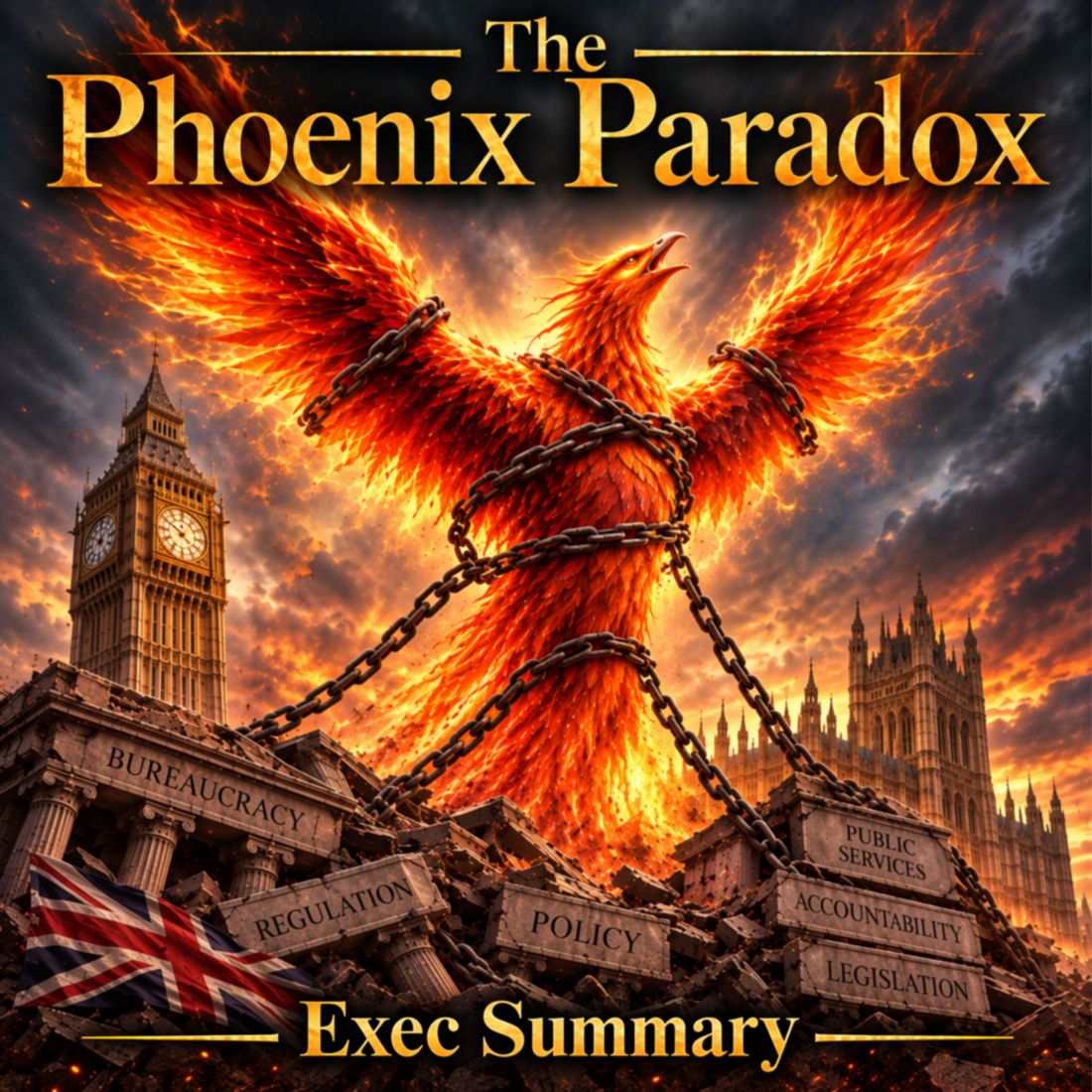
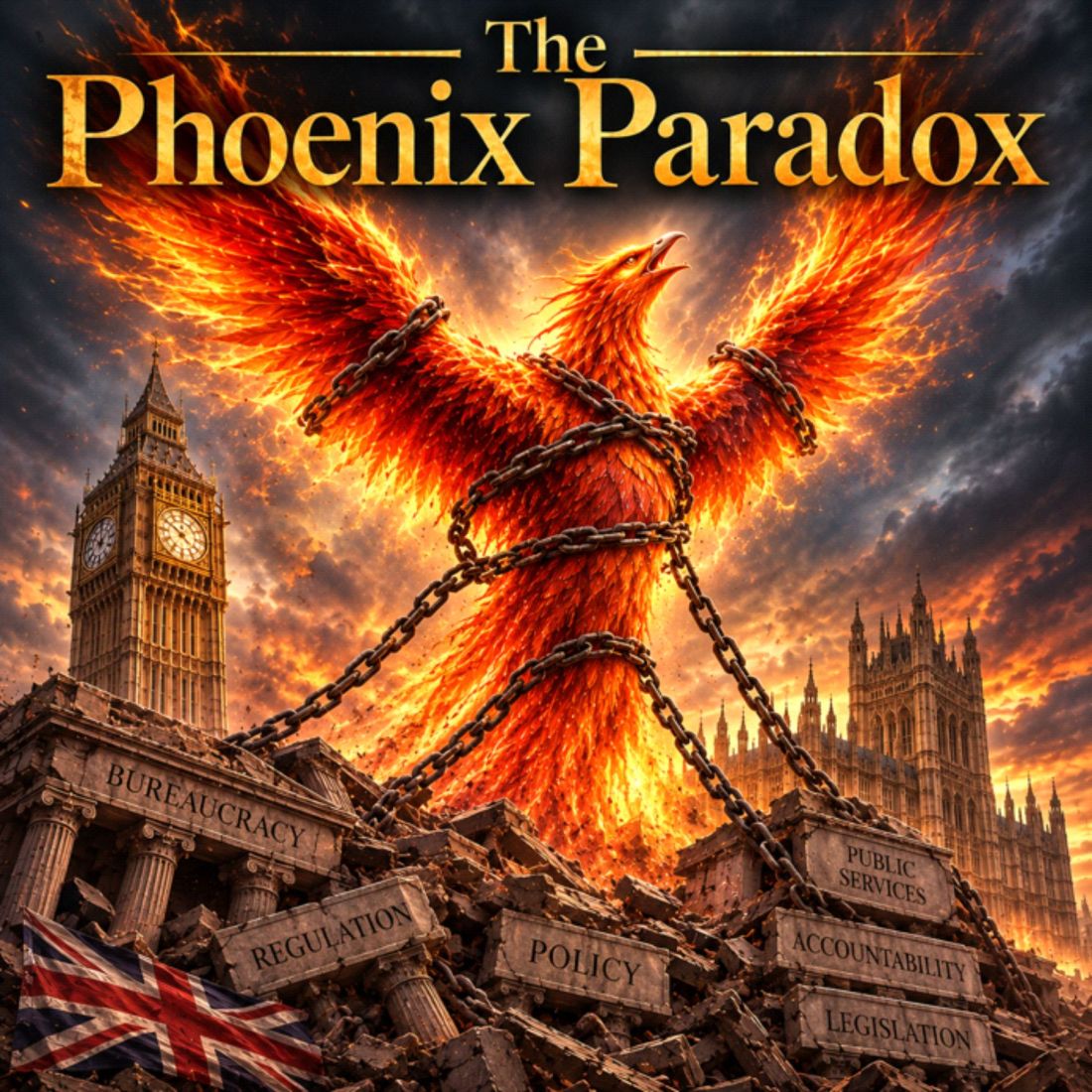
The Phoenix Paradox is a model for understanding why genuine social, political, economic, and institutional problems often persist despite repeated attempts to address them.
Its central argument is that problems do not survive solely because they are ignored, denied, or misunderstood. In many cases, they survive because inadequate solutions discredit accurate diagnoses.
The paradox is simple:
The appearance of renewal can become the greatest obstacle to genuine renewal.
When a problem is identified, public pressure often demands action. A reform is introduced, a policy is implemented, or a movement promises change. To observers, progress appears to be occurring. Yet the underlying conditions that produced the problem may remain largely unchanged.
If the intervention subsequently fails, public confidence is frequently directed not only against the solution but against the diagnosis itself. Society concludes, “We tried that and it didn’t work,” even when what was attempted was incomplete, symbolic, poorly implemented, or fundamentally inadequate.
The Phoenix Paradox describes this dynamic through several related concepts:
The Phoenix Trap – the belief that removing a failing system will naturally produce a better replacement.
The False Cure Effect – when a failed solution causes people to lose faith in the original diagnosis.
The Charlatan’s Legacy – the long-term damage created when inadequate solutions make future reform more difficult.
The Straw Remedy – a visible but ineffective response that creates the appearance of action while leaving underlying problems unresolved.
The Preservation Paradox – the tendency of systems to resist meaningful adaptation until doing so becomes significantly more disruptive.
Underlying these dynamics is Paradigm Blindness: the inability to question the assumptions through which problems are interpreted. As a result, societies may become trapped between institutional self-preservation and ineffective reform, while genuine problems continue to grow.
The central insight of the Phoenix Paradox is that failed solutions are not always neutral. They can reduce public confidence, weaken future reform efforts, and ultimately extend the life of the very problems they were intended to solve.
Its core proposition is:
The greatest long-term threat to solving a genuine problem is often not denial of the problem, but the appearance that the problem has already been addressed when the underlying causes remain.
The challenge is therefore not simply to identify what is wrong, nor merely to oppose existing systems, but to understand what must replace them, how transition occurs, and how genuine learning can continue when initial attempts fall short.
In this sense, the Phoenix Paradox is not a theory of failure alone. It is a framework for understanding why societies confuse the performance of change with change itself, and why genuine renewal requires more than ashes, intentions, or appearances.
This document attempts to explain a recurring phenomenon that appears across politics, economics, institutions, organisations, and social movements.
History is full of genuine problems that persist despite repeated attempts to solve them.
Conventional explanations typically assume one of two causes:
The problem was never properly identified.
The people responsible lacked the will to act.
While both explanations are sometimes true, they do not adequately explain why some problems appear to survive successful diagnoses, major public attention, repeated reform efforts, and widespread acknowledgement.
The Phoenix Paradox proposes a different possibility:
Problems sometimes survive because inadequate solutions discredit accurate diagnoses.
Under this model, society can become trapped between defenders of the existing system and critics who correctly identify flaws but incorrectly diagnose how genuine change occurs.
The result is a cycle in which real problems persist, public confidence declines, reform becomes harder, and existing systems become more entrenched even as they become less effective.
Intellectual Foundations
The Phoenix Paradox is not presented as a claim of wholly original thought.
It draws upon, extends toward and touches ideas found in:
Edmund Burke’s observations about institutions and unintended consequences.
Public choice theory and incentive-based political analysis.
Systems theory and complexity theory.
Institutional economics.
The concept of path dependency.
Thomas Kuhn’s work on paradigms.
Historical analyses of revolutions and reform movements.
Organisational theories of institutional inertia.
The contribution of this work is not the discovery of entirely new components.
Its contribution lies in connecting these observations into a single causal model explaining how failed remedies can increase the longevity of the very problems they were intended to solve.
The Core Observation
Most people assume:
Problem → Solution → Improvement
The Phoenix Paradox argues that another sequence is often present:
Problem → Inadequate Solution → Failure → Loss of Confidence → Problem Persists
In some cases:
Problem → Inadequate Solution → Failure → Loss of Confidence → Increased Problem Persistence
The crucial insight is that failed solutions may not leave society where it started.
They may actively reduce society’s future capacity to solve the problem.
The Phoenix Paradox
The work takes its name from the myth of the phoenix: a creature that dies in fire and is reborn from its own ashes.
The phoenix represents one of humanity’s most enduring assumptions: that destruction naturally produces renewal.
In politics, institutions, organisations, and social movements, this assumption appears whenever people believe that identifying a problem and acting against it will inevitably produce improvement.
The Phoenix Paradox challenges that assumption.
The paradox can be stated simply:
The appearance of renewal can become the greatest obstacle to genuine renewal.
Or more formally:
Actions intended to solve a problem may make that problem harder to solve if those actions create the illusion that meaningful change has already occurred.
A failing system may be challenged.
A reform may be launched.
A policy may be implemented.
A movement may achieve power.
To observers, renewal appears to be taking place.
Yet the underlying conditions that produced the original problem may remain largely unchanged.
In such cases, the visible signs of reform create a powerful illusion of progress while leaving the underlying causes intact.
When the reform fails, the resulting disappointment often damages public confidence not only in the reform itself but in the possibility of future reform.
Paradoxically, an attempt at renewal can therefore strengthen the very conditions it sought to overcome.
This insight forms the foundation of the Phoenix Paradox and provides the basis for the concepts explored throughout this document: the Phoenix Trap, the False Cure Effect, the Charlatan’s Legacy, the Straw Remedy, and the Preservation Paradox.
Proposition 1: Systems Exist for Reasons
Every enduring system performs functions.
Those functions may be desirable, undesirable, or mixed.
A system may simultaneously:
solve problems;
create problems;
distribute resources;
create inequalities;
provide stability;
generate inefficiencies.
The existence of dysfunction does not mean the system performs no useful role.
This creates an important distinction:
Criticising a system is not the same as understanding why it exists.
For example:
Many people critique money, markets, governments, bureaucracies, corporations, political parties, or regulatory structures.
The critique may be entirely valid.
However:
A successful critique does not automatically provide a replacement.
The question is never merely:
What should be removed?
The more difficult question is:
What function must still be performed afterwards?
The Phoenix Trap
Definition
The Phoenix Trap is the belief that removing a defective system, structure, policy, institution, or paradigm will naturally result in a superior replacement.
It assumes that destruction creates renewal.
It assumes a phoenix will emerge from the ashes.
The trap lies in confusing diagnosis with succession.
The Mechanism
The reformer identifies something real:
corruption;
inequality;
financial dysfunction;
institutional stagnation;
democratic failure;
environmental degradation.
The diagnosis may be substantially correct.
However, they then assume:
Because I can see the problem, I understand the solution.
This is the critical error.
The underlying forces remain:
incentives;
scarcity;
power;
status;
self-interest;
cultural habits;
institutional dependencies.
Removing a structure does not remove the pressures that created it.
Historical Pattern
Many revolutions follow the same pattern:
A genuine problem exists.
Existing institutions lose legitimacy.
Reformers identify real failures.
Existing structures are challenged or removed.
The underlying conditions remain.
Similar structures reappear in different forms.
The names change.
The rhetoric changes.
The symbols change.
The underlying dynamics often survive.
The Replacement Principle
A genuine solution must answer two questions.
Diagnostic Question
What is wrong?
Successor Question
What replaces it?
Many movements answer the first.
Few fully answer the second.
The Phoenix Paradox argues that a proposal should not be judged solely by its ability to dismantle existing systems.
It should also be evaluated according to its capacity to perform the essential functions that remain necessary afterwards.
The False Cure Effect
Definition
The False Cure Effect occurs when a failed solution causes people to lose faith in the original diagnosis.
This is the central insight of the Phoenix Paradox.
The Sequence
A real problem exists.
↓
A prominent figure identifies it.
↓
A solution is proposed.
↓
The solution fails.
↓
The public loses confidence.
↓
Future reform becomes harder.
The Critical Mistake
People often reason as follows:
The solution failed.
Therefore the diagnosis was wrong.
However:
The failed solution may simply have been inadequate.
This distinction is enormously important.
A failed cure does not prove the illness was imaginary.
Yet societies frequently act as if it does.
Example Structure
Suppose:
a housing problem exists;
a monetary problem exists;
a governance problem exists;
an institutional problem exists.
An inadequate reform is introduced.
The reform fails.
Public memory eventually becomes:
“We tried that.”
What disappears is the distinction between:
trying the right solution badly;
trying the wrong solution;
trying a diluted version of the right solution;
trying a symbolic version of the right solution.
The failure becomes attached to the diagnosis itself.
The Charlatan’s Legacy
Definition
The Charlatan’s Legacy is the long-term damage created when inadequate solutions discredit legitimate concerns.
The charlatan’s greatest harm is often not immediate failure.
It is the future scepticism that failure creates.
Why it Matters
The original problem survives.
But now something else has appeared:
public exhaustion;
public cynicism;
reform fatigue;
distrust.
Future reformers inherit a harder environment than existed before.
The problem remains.
Confidence disappears.
The Paradox
The individual who attempted to challenge the system may inadvertently become one of its greatest protectors.
Not because they intended to.
But because their failure made future challenges less credible.
The Charlatan’s Legacy is the long-term residue of the Phoenix Paradox.
The original problem survives while confidence in solving it declines.
Controlled Failure
Until now, the model assumes failure emerged through misunderstanding.
The analysis becomes more troubling when incentives are considered.
Not all failures are necessarily accidental.
The Straw Remedy
Definition
A Straw Remedy is a solution that appears responsive but lacks the capacity to address the underlying problem.
It is the policy equivalent of a straw man argument.
Instead of attacking a weakened version of an opponent’s argument, a weakened version of a solution is implemented.
Characteristics
A Straw Remedy is:
highly visible;
politically marketable;
symbolically significant;
structurally insufficient.
Its greatest strength is often appearance.
Its greatest weakness is effectiveness.
Political Incentives Behind Controlled Failure
The Phoenix Paradox does not require conspiracy.
Incentives alone may be sufficient.
Politicians operate within competing pressures.
A genuine solution may:
threaten powerful interests;
create disruption;
impose short-term costs;
require unpopular trade-offs;
challenge deeply held assumptions.
A symbolic solution often avoids these risks.
It allows politicians to claim:
We listened.
We acted.
We tried.
If the measure fails, responsibility can be shifted onto the proposal itself.
The Political Logic
The sequence becomes:
Public concern grows.
↓
Pressure to act increases.
↓
A limited solution is introduced.
↓
The solution fails.
↓
The issue loses political momentum.
↓
The underlying problem survives.
This creates a powerful incentive structure.
Sometimes solving the problem is politically useful.
Sometimes neutralising the issue is politically useful.
Those objectives are not always identical.
The Straw Remedy represents one of the most common mechanisms through which the Phoenix Paradox manifests itself.
The appearance of action creates the perception of renewal while preserving many of the conditions that produced the original problem.
Paradigm Blindness
The Phoenix Paradox operates within a wider phenomenon: paradigm blindness.
Most people assume paradigm blindness means:
People cannot see problems.
Often the opposite is true.
People see the symptoms clearly.
What they cannot see are the assumptions operating underneath them.
Paradigms define:
what is realistic;
what is respectable;
what is possible;
what is discussable.
Solutions outside those boundaries are frequently dismissed before they are evaluated.
Paradigm blindness often enables the Phoenix Paradox by causing institutions and reformers alike to mistake visible change for meaningful change.
Establishment as a Mindset
Within this model, establishment is not principally a class of people.
It is a pattern of thinking.
The establishment mindset prioritises:
continuity;
stability;
predictability;
preservation of assumptions.
The mindset can appear anywhere:
governments;
corporations;
activists;
academics;
media organisations;
religious institutions;
reform movements themselves.
Any group can become establishment once preserving its assumptions becomes more important than confronting reality.
The Preservation Paradox
Definition
The harder a system works to preserve itself without addressing the forces undermining it, the greater the eventual disruption required to preserve what was valuable within it.
Attempts to avoid change can increase future instability.
The refusal to adapt is itself a form of adaptation failure.
In many cases, the Preservation Paradox and the Phoenix Paradox reinforce one another.
Systems resist meaningful adaptation while inadequate reforms create the illusion that adaptation has already occurred.
Distinguishing Failure from the False Cure Effect
One of the dangers of any framework concerned with failed reform is the temptation to treat every unsuccessful intervention as evidence of incompetence, deception, or bad faith.
The Phoenix Paradox does not make this claim.
Not all failed reforms are false cures.
Not all ineffective policies are straw remedies.
Not all disappointing outcomes are the result of paradigm blindness or institutional self-preservation.
Complex systems are difficult to change.
Good ideas can fail.
Necessary reforms can produce unintended consequences.
Competent leaders can make reasonable decisions that do not achieve their intended outcomes.
The question is therefore not:
Did the reform fail?
The question is:
What happened after it failed?
The False Cure Effect occurs when the failure of a particular intervention is used, consciously or unconsciously, to discredit the underlying diagnosis itself.
A genuine failure should lead to questions such as:
Was the diagnosis correct?
Was the solution appropriate?
Was implementation sufficient?
Were important variables overlooked?
Does another approach exist?
The False Cure Effect emerges when these questions are replaced by:
“We tried it. Therefore the problem was not what we thought.”
This distinction matters because learning and adaptation require the ability to separate diagnosis from intervention.
A society capable of learning treats failed attempts as information.
A society trapped by the False Cure Effect treats failed attempts as closure.
The purpose of the Phoenix Paradox is therefore not to discourage experimentation, reform, or bold solutions.
Its purpose is to encourage more rigorous evaluation by ensuring that failed remedies do not prematurely discredit genuine problems or prevent future generations from pursuing better solutions.
The Phoenix Paradox Cycle
The complete model can be expressed as follows:
Stage 1
A genuine problem emerges.
Stage 2
Public awareness grows.
Stage 3
Existing institutions struggle to respond.
Stage 4
Reformers identify the problem.
Stage 5
The Phoenix Trap occurs.
Diagnosis is confused with solution.
Stage 6
A solution is implemented.
Either accidentally inadequate or deliberately symbolic.
Stage 7
Failure occurs.
Stage 8
The False Cure Effect emerges.
The failed solution damages belief in the diagnosis.
Stage 9
The Charlatan’s Legacy accumulates.
Future reform becomes harder.
Stage 10
The original problem survives.
Stage 11
System preservation intensifies.
Stage 12
Pressure continues to build.
The cycle repeats.
Central Thesis
The Phoenix Paradox suggests that the greatest long-term threat to solving a genuine problem is often not denial of the problem, but the appearance that the problem has already been addressed when the underlying causes remain.
When inadequate solutions are presented as definitive cures, the resulting failure can weaken confidence in future reform, strengthen existing systems, and allow genuine problems to persist beneath the illusion of renewal.
Denial preserves the debate.
A false cure can end the debate while leaving the problem untouched.
That is why societies may become trapped between false prophets, symbolic reform, institutional self-preservation, and paradigm blindness, while the underlying problems affecting people, communities, economies, and environments continue to grow.
The central challenge therefore is neither blind preservation nor blind disruption.
It is understanding what must change, what must survive, and how transition can occur without allowing the appearance of renewal to undermine the possibility of genuine renewal.
Closing Reflection
The Phoenix Paradox does not argue for preserving existing systems, nor does it argue for their destruction.
It argues for understanding.
Its central claim is that societies are most vulnerable when they confuse diagnosis with solution, symbolism with reform, or failure with proof that no solution exists.
If genuine problems are to be addressed, societies must become capable of asking not only what is wrong, but what comes next, how transition occurs, and how learning can continue when initial attempts fall short.
The alternative is a cycle in which real problems survive both their defenders and their critics, while confidence in change itself gradually disappears.
We often look for a moment when everything changed.
A document. A leader. A law. A decision.
History becomes easier to understand when it appears to have a beginning.
Yet the deeper we look, the more difficult beginnings become to find. What seem like origins often turn out to be moments when longer processes become visible.
The question is not simply where something started.
The question is what made it possible.
The illusion of beginnings
The essay makes a distinction between two very different things:
The beginning of an arrangement
and
The beginning of all the conditions that made that arrangement possible.
The two are rarely the same.
A law may come into force on a particular day.
An institution may have a founding date.
A memorandum may propose a new strategy.
Yet the assumptions, interests, habits and circumstances that made those things possible often stretch back decades or centuries.
What we call a beginning is often a point in the middle of a longer story.
How assumptions survive
Ideas do not survive only because people keep repeating them.
Often they become embedded in the world around us.
They appear in:
systems
incentives
measurements
routines
institutions
Over time they can stop looking like assumptions and start looking like reality.
One generation establishes them.
The next generation inherits them.
The generation after that may treat them as obvious.
Direction without destiny
The essay rejects two simple explanations of history.
The first is that everything happens according to some hidden master plan.
The second is that everything happens by accident.
Reality is usually more complicated.
People make decisions.
Those decisions create incentives, institutions and expectations.
Future decisions are then made within the world those earlier decisions helped create.
Patterns emerge.
Trajectories develop.
Yet nobody possesses complete knowledge of where they will lead.
A question worth asking
When an arrangement seems inevitable, ask:
Is this genuinely necessary, or have we simply become accustomed to it?
Familiarity is often mistaken for necessity.
History reminds us that they are not the same thing.
The challenge of responsibility
None of us begins with a blank page.
We inherit:
institutions
traditions
debts
opportunities
assumptions
Inheritance explains part of the story.
It does not remove responsibility.
We may not have chosen the circumstances we receive, but we still influence the circumstances we leave behind.
Two silences
At the centre of the essay sit two simple observations:
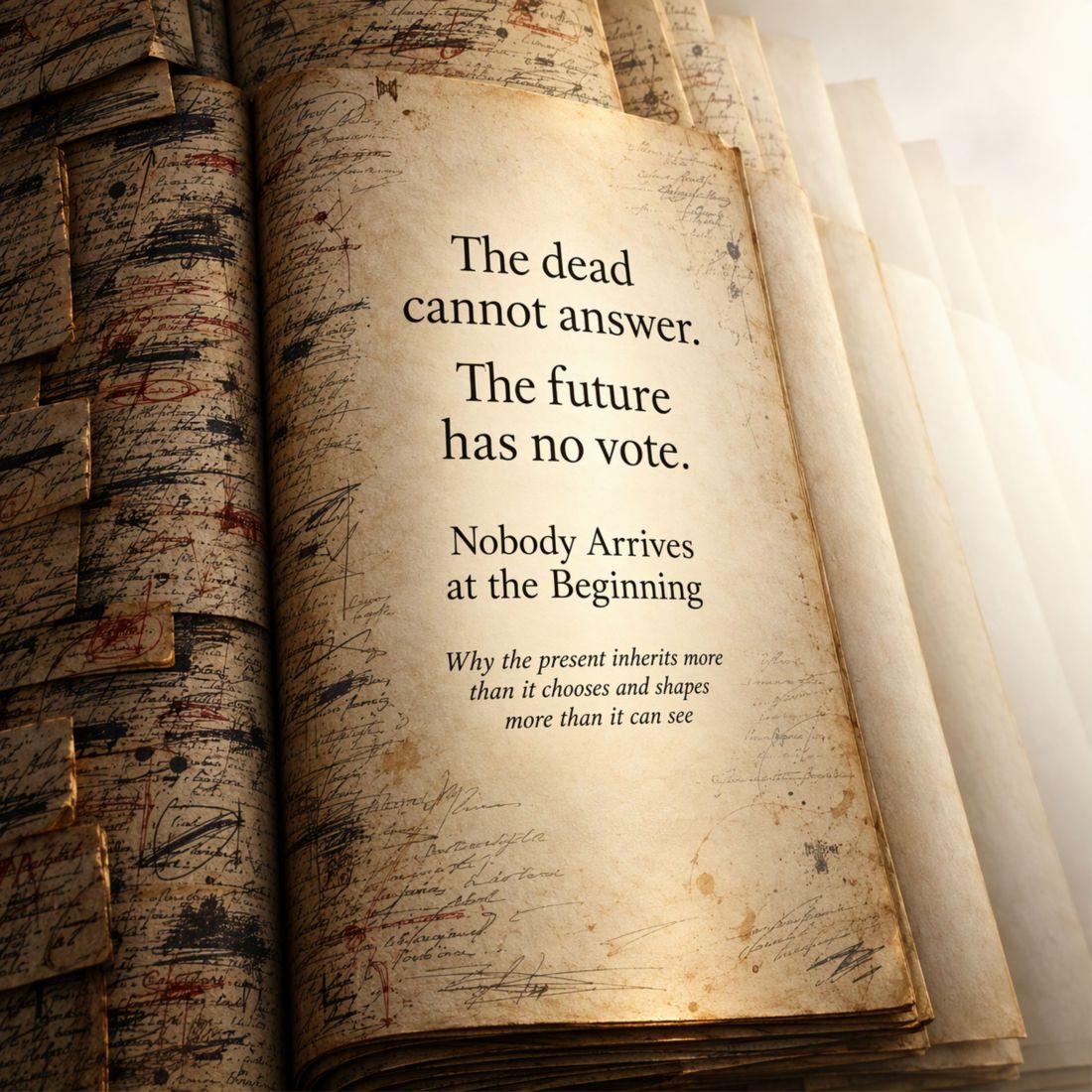
The dead cannot answer.
The future has no vote.
The first reflects a limitation of historical understanding.
We can study the past, but we cannot ask it to respond.
The second reflects a limitation of political responsibility.
Future generations may live with the consequences of today’s decisions, but they cannot participate in making them.
Between those two silences sits the present.
Nobody arrives at the beginning
The deeper the inquiry goes, the harder it becomes to find anyone standing at the start of the road.
The people of the past inherited a world they did not create.
So do we.
Every generation enters the story in the middle.
Every generation mistakes some assumptions for reality.
Every generation leaves something behind.
The challenge is not to find the beginning.
The challenge is to understand our place within the process.
A final reflection
Future generations may look back on some of our assumptions the way we now look back on assumptions held by those who came before us.
The uncomfortable question is not whether this will happen.
The uncomfortable question is:
Which of our own assumptions will seem obvious, unquestioned and mistaken to those who come after us?
Why the present inherits more than it chooses and shapes more than it can see
Introduction
As the results of the November 2026 United States midterm elections began to come in, I was listening to James Talarico’s appearance on The Diary of a CEO with Steven Bartlett. The interview had been recorded on 8 September, while Talarico was campaigning for the United States Senate in Texas. By the time I began writing, NBC News had projected his victory. Yet it was a reference to a much older document, rather than the election itself, that stayed with me.
The conversation ranged across affordability, inequality and the relationship between money and political power. During it, Talarico mentioned the Powell Memorandum. I had never heard of it. Curiosity, rather than agreement with any particular account of its influence, led me to read further.
What I found was a confidential memorandum written by Lewis F. Powell, Jr. on 23 August 1971 for Eugene B. Sydnor, Jr., chair of the Education Committee of the U.S. Chamber of Commerce. Its title was Attack on American Free Enterprise System. Powell believed that business faced a broad challenge to its legitimacy and urged a more organised response. The document has since attracted sharply differing interpretations of its importance.
Initially, I thought I was investigating a memorandum. Then I noticed the date.
1971.
That year had appeared repeatedly in my own explorations of money, debt, institutions, governance and the relationship between people and systems. It seemed to sit near several changes that mattered to the world I was trying to understand. Finding it again made me wonder whether I had encountered an explanatory turning point: a place where the present might begin to make sense.
But there was a problem with that thought. Even if Powell’s memorandum had been extraordinarily influential, why had he written it? His concerns, his assumptions and the institutions through which he sought to act already had histories of their own.
What began as a question about one document became a question about the way I was reading history. Was I recognising a significant moment – or mistaking significance for a beginning?
These were consequential developments. Their proximity in time, however, does not establish that they shared a cause, formed a single programme or explain everything that followed. A date can organise an inquiry without answering it. I needed to distinguish what the historical record showed from the connections I was tempted to draw.
The appeal of an origin is easy to understand. It offers a place to begin the story and somewhere to locate responsibility. A document, an organisation or a decision can turn a complicated process into a sequence that feels manageable: first this happened, then the world changed.
Sometimes that is a useful simplification. Institutions have founding dates. Laws come into force. Decisions can close one route and open another. There is no need to deny these beginnings in order to question the larger claim that one of them marks the origin of the present.
The distinction is between the beginning of a particular arrangement and the beginning of all the conditions that made it possible. Powell could propose a strategy, but he did not create the business interests, educational institutions or political disputes to which he was responding. A new organisation can alter a debate without inventing the problems that brought its members together. Industrialisation can transform a society while drawing upon developments already underway.
Nor does an inherited context make an event merely a symptom. A turning point can accelerate a process, consolidate an advantage or produce a genuine break. The question is not whether it mattered, but how it mattered: what it changed, what it carried forward and what would plausibly have happened without it.
The history of Bretton Woods offers a concrete reminder. Nixon’s decision was dramatic, but the pressures behind it were not new. The Federal Reserve’s account describes years of attempts to defend the dollar and sustain confidence in gold convertibility. Even after August 1971, governments tried to preserve fixed exchange rates through the Smithsonian Agreement. The transition continued into 1973. A moment that looks decisive in retrospect was also one stage in a prolonged struggle to maintain, then replace, an inherited arrangement.
This did not make 1971 less interesting. It made my question more precise. Rather than looking for the moment everything started, I began asking which processes became visible there – and how choices made within them could influence a future nobody could fully know.
Direction Without Design
If no single event supplies an absolute origin, why do some historical patterns persist? Why can institutions, incentives and familiar ways of thinking survive the people who established them?
By direction, I do not mean that history has one purpose or moves inevitably towards one destination. I mean something more limited: a recognisable tendency within a particular process. A system can repeatedly favour certain choices without everyone participating in it agreeing about the outcome.
There is a temptation to treat that consistency as evidence of comprehensive design. If similar interests benefit repeatedly, perhaps someone must have planned the whole result. Yet the alternative is not to insist that everything happened by accident. Between a finished blueprint and pure chance lies a world of deliberate decisions, inherited constraints, competing interests and unforeseen consequences.
A blueprint specifies a destination. A trajectory describes a course whose destination may remain unknown. The distinction is useful, but it must not become an excuse to ignore actual planning. People organise, exercise power and pursue long – term goals. The absence of complete foresight neither disproves coordination nor diminishes the influence of those with the resources to act.
Likewise, inheriting a world does not mean inheriting an equal share of power over it. A business leader, a policymaker and a worker may all operate within existing institutions, but their ability to change those institutions can differ greatly. Any account of historical direction needs to ask whose choices count, whose interests are protected and whose objections are excluded.
What inheritance helps explain is why even deliberate strategies do not operate on a blank canvas. People act through institutions that already exist, using concepts and expectations they did not invent. Their plans interact with other plans, with resistance and with circumstances beyond their control. The eventual result can differ from the intentions of every participant.
Continuity can also arise without renewed commitment to the original purpose. An arrangement becomes easier to extend than to replace. Skills, resources and expectations accumulate around it. Later decisions are made within the possibilities it has created, and those decisions may reinforce its course even when the people making them have different ambitions.
This is a way of understanding persistence, not a law that makes change impossible. Institutions can fail. Assumptions can be challenged. Political struggles can redirect a process. The fact that a route has been travelled does not mean it must be followed indefinitely.
History, viewed this way, is neither an elaborate plan executed across generations nor a collection of unrelated accidents. Its larger patterns can emerge from choices that are intentional in their immediate purposes but incomplete in their understanding of what comes next.
The question then becomes more concrete. What connects those choices across time? What do people inherit that makes some possibilities seem sensible, others impractical and others almost unthinkable?
What Gets Passed Forward?
Ideas, policies and institutions are part of the answer. But the thread I found most useful was the assumption: a judgement about how the world works, or what matters within it, that helps determine which decisions appear reasonable.
Some assumptions are stated openly and defended. Others are embedded in rules, incentives and routines. They are not necessarily unconscious, and they are not necessarily wrong. Their importance lies in how easily they can become the starting point of a decision rather than its subject.
Consider a hypothetical institution that judges success principally by the volume of work completed. Initially, this may be a practical response to a backlog. It then designs its reporting around volume, rewards staff for increasing it and allocates resources accordingly. New managers inherit those measures and use them to demonstrate improvement. Eventually, the question “Are we completing more?” can displace the question “Are we completing the right things well?”
No one needs to have intended that displacement. The original measure may have served a legitimate purpose. But once it shapes reporting, rewards and resources, it begins to structure the choices of people who were not involved in selecting it. An assumption about what counts as success has acquired institutional consequences.
The example is illustrative, not evidence about a particular organisation. It shows the mechanism I have in mind: a judgement becomes a rule; the rule shapes behaviour; the resulting behaviour makes the judgement seem natural. Later participants encounter not just an idea, but a working environment built around it.
Such continuity need not depend on universal agreement. Someone may question a measure and still be required to report against it. A policymaker may doubt an inherited arrangement while finding its replacement costly or politically difficult. What persists is not always a belief held equally by everyone, but the influence of a belief already built into the terms of participation.
This also complicates the distinction between an assumption and the reality it helped create. If an institution consistently rewards one kind of behaviour, people adapt to it. Their adaptation can then be presented as proof that the institution was responding to human nature all along. An outcome partly produced by a rule becomes a reason to keep the rule.
That possibility is why examining assumptions matters. It asks us to distinguish necessity from familiarity, evidence from convention and an arrangement’s present effects from its original justification. It also reminds us that inheritance is selective. People resist, reinterpret and discard what they receive; continuity is something to explain, not simply presume.
My interest in the Powell Memorandum changed at this point. Rather than asking it to explain the whole subsequent world, I wanted to see which assumptions it expressed, how they supported its recommendations and what evidence would be needed to trace their later influence.
The Powell Memorandum Revisited
Returning to Powell’s memorandum, I could see more clearly why it had caught my attention. It records both an interpretation of the world and a proposal to act upon that interpretation.
Its opening presents the American economic system as being under broad attack. Powell’s concern extends beyond explicitly revolutionary opponents to criticism from universities, the media, religious institutions and other established parts of society. These are Powell’s assessments, not neutral descriptions that a reader must accept. Their value for this inquiry is that they make his premises visible.
For Powell, defending the enterprise system was an urgent task. From that premise followed the case for an organised business response. The movement from diagnosis to action is the important point: what he believed was threatened shaped what he thought should be done.
It would therefore be misleading to say the memorandum was only a snapshot and not a plan. It was a snapshot of assumptions expressed through a strategic intervention. Deliberate action and historical inheritance coexist within the same document. The question is how far that intervention reached, not whether intention was present.
That gives us evidence of circulation and of implementation as reported by the Chamber. It does not, by itself, establish the memorandum as the cause of everything later associated with corporate political influence. Similarities between a recommendation and a later development require investigation: who adopted it, through which institution, with what resources, and alongside what other influences?
Hindsight can illuminate consequences, but it can also make intentions look more comprehensive than they were. The fact that later events resemble an earlier proposal does not mean its author foresaw their full form. Equally, the absence of such foresight does not make the proposal harmless or irrelevant.
For me, the memorandum became a waypoint rather than an absolute origin: a place where a particular set of assumptions and ambitions can be inspected. Its importance need not rest on its ability to explain the whole road. It can help us understand one consequential attempt to influence the route.
And that is what makes it uncomfortable to read. The people of the past do not have a monopoly on assumptions that seem reasonable from within their own moment. Reading theirs raises a question about ours.
The Future Has No Vote
It is easier to notice an assumption once we can see some of its consequences. A historical document lets us compare what its author believed with what later happened. We have no equivalent vantage point from which to inspect the full consequences of our own decisions.
That limitation should encourage humility, but not moral indifference. Understanding the circumstances in which people acted does not settle whether their actions were justified. A person can inherit an assumption, sincerely believe it and still be responsible for how it is used. Nor must a decision’s consequences be wholly unforeseeable simply because its most distant effects remain unknown.
The task is to distinguish what could reasonably have been recognised at the time from what becomes apparent only afterwards. Who warned of a risk? Whose experience challenged the prevailing account? What alternatives were available? These questions preserve responsibility without granting historical actors knowledge they could not have possessed.
They also prevent a reflective account of history from becoming too generous to power. Saying that everyone operates within inherited conditions is true of both those who impose a decision and those who bear its costs. It does not erase the difference between them.
The thought that kept returning to me was this:
The dead cannot answer.
The future has no vote.
The first line names a limit of historical interpretation. We can examine surviving records, compare accounts and challenge conclusions, but we cannot ask those who are gone to respond. Their silence should not become permission to assign them either perfect foresight or motives unsupported by evidence.
The second names a problem of responsibility. People not yet born cannot participate in today’s decisions, although they may live with their consequences. The future is not entirely absent from public discussion – people can argue on its behalf – but its eventual inhabitants cannot tell us directly what they need.
Between those two limits sits the present. We inherit consequences we did not choose, and we contribute to consequences others will not have chosen. That does not require us to predict everything. It does require us to take the limits of our perspective seriously.
Perhaps the most useful way to think about this is as navigation rather than the construction of a finished destination. We must choose a route without knowing every condition ahead. Good judgement then involves more than confidence in our current map. It involves listening to those who encounter different terrain, noticing when evidence contradicts our expectations and preserving the ability to change course.
For me, that gives the inquiry a practical edge. What do our institutions count as success? Which costs fall outside their measures? Whose interests are treated as obstacles rather than evidence? Which arrangements do we call inevitable because we have become accustomed to them? And how readily could those who follow us revise the choices we are making?
These questions do not guarantee better answers. But they make assumptions available for examination before they harden into the terms on which everyone else must act. They move responsibility beyond the search for a culprit in the past and towards scrutiny of the choices available now.
History cannot place us outside the process. It can only help us recognise our position within it.
Nobody Arrives at the Beginning
One thought continued to return throughout this inquiry. Whenever I believed I had found a starting point, it proved to be another stage.
The Powell Memorandum responded to circumstances that already existed. So did Bretton Woods, industrialisation and the Fabian Society. The deeper I looked, the harder it became to find anyone standing at the beginning of the road. Instead, I found people joining a process already underway.
This distinction changes how responsibility appears. Historical narratives encourage us to search for the decisive person, document or decision: the point at which somebody understood what was happening and set everything else in motion. Real life rarely offers such clarity.
The people living through 1971 did not experience it as a completed historical period. They faced uncertainty, disagreement and incomplete information, just as we do. The same was true of those who drafted constitutions, built institutions or designed economic systems. They were not standing outside history and directing it from above. They were responding to the circumstances they could see.
Perhaps that is the value of a historical milestone. It need not begin a process to make that process visible.
The Powell Memorandum is one such moment. It records assumptions while they were still being stated and defended. It captures people attempting to influence a future they could not see, allowing us to observe historical direction from within rather than only through its consequences.
Every generation enters the story in the middle. It inherits assumptions it did not create, mistakes some of them for reality and contributes something of its own. In doing so, it leaves the road different from the way it found it.
The people who came before us never possessed the complete picture.
Neither do we.
Conclusion: Standing in the Middle
The Powell Memorandum did not provide the beginning I had gone looking for. It provided something more useful: a view of people acting within history rather than outside it.
The dead cannot answer.
The future has no vote.
Between those limits lies our responsibility: not to stand outside history and explain it once and for all, but to participate in it with greater care. We cannot know the whole destination, but we can question the assumptions guiding our route and preserve room for those who follow to choose differently.
Future generations may see limitations in our assumptions that remain difficult for us to recognise. They may ask how we mistook a particular arrangement for the way the world had to be. We cannot supply their answer in advance. We can begin by asking the question ourselves.
Sources and Notes
This is a reflective essay, not a comprehensive history of corporate influence or monetary change. The historical sources below support its factual frame; the broader argument about inheritance, assumptions and responsibility is an interpretation. Temporal proximity is not offered as proof of a shared cause. The institutional example in “What Gets Passed Forward?” is hypothetical.
These are the essays, frameworks, stories and proposals that best represent my thinking. Together they explore personal sovereignty, human flourishing, local resilience, governance, economics, technology, and our relationship with each other and the living world. While I have written many articles, these are the works I believe form the foundation of everything else.
Start Here: Four Foundational Works
If you’re new to my work, these four pieces provide the clearest introduction to the ideas that run through everything else. Together they explore personal sovereignty, economic dignity, community resilience and the responsible use of technology.
Personal Sovereignty
What does it mean to govern your own life in a world increasingly shaped by institutions, technology, narratives and external pressures? This essay explores autonomy, responsibility and self-authorship.
The individual is the starting point for all meaningful change. Before we can transform our communities, institutions or societies, we must first understand ourselves.
Personal Sovereignty
The foundation of individual freedom, responsibility and self-authorship.
A reflection on narrative ownership and lived experience. Nobody can fully understand your journey from the outside. The person best placed to understand your life is the one who has lived it.