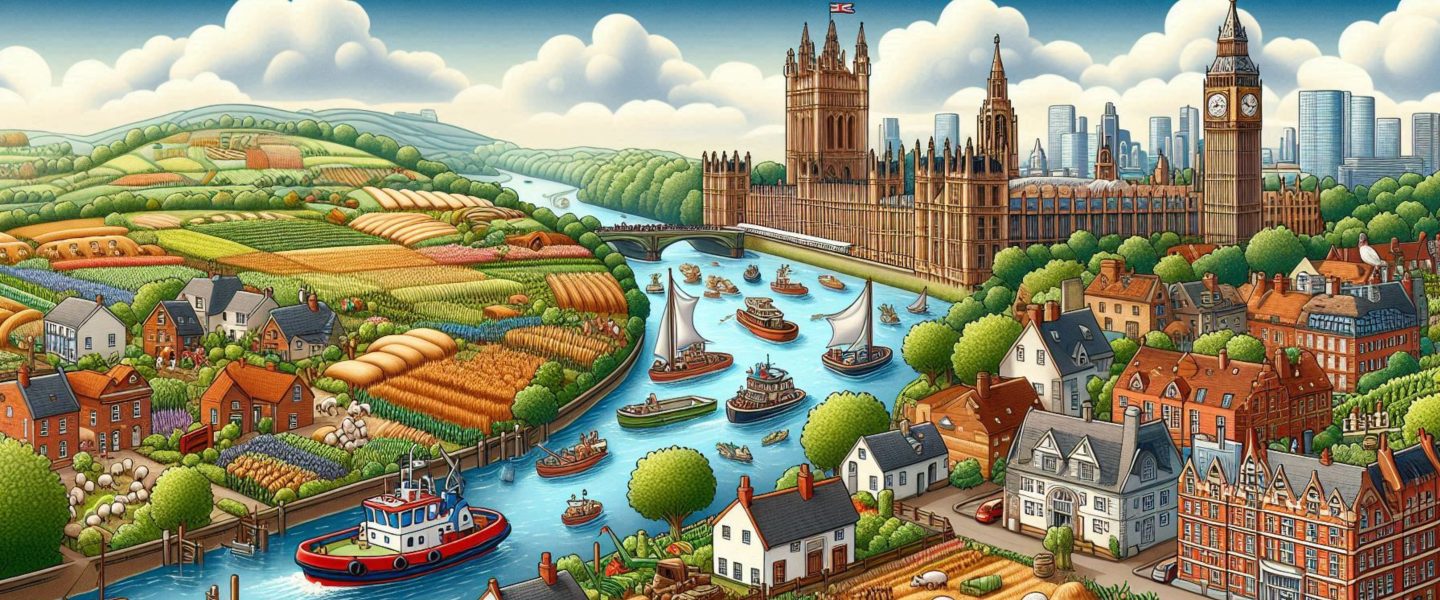

The Real Two‑Tier Britain: The Split We Still Refuse to See

We like to believe that if something is real, we would see it. That a divide in society would be obvious, visible, tangible.

But the most profound changes in a nation rarely announce themselves. They creep in quietly, shaping lives long before anyone realises what has happened.

Today, Britain is already a split society – not becoming one, not drifting toward one, but living fully inside one. And the reason most people cannot see it is simple: we have been conditioned to look at the wrong differences.

The real divide is structural, economic, and existential. It is the difference between those the system rewards and those it punishes. And the split is widening every day.

The Blindfold of Visible Differences

We live in a culture obsessed with what can be seen. Identity, labels, categories, tribes – the system elevates these differences because they are emotional, dramatic, and endlessly distracting.

Diversity, in its current institutionalised form, has become a paradox. It celebrates difference while deepening division. It elevates identity markers that have no bearing on power, security, or opportunity, while ignoring the structural forces that determine all three.

These visible differences become the battlegrounds of public life. They stir emotion. They create polarity. They keep people fighting each other instead of questioning the system that shapes them both.

Meanwhile, the real difference – the one that defines who thrives and who suffers -remains invisible.

The Narrative That Keeps Us Looking the Wrong Way

We have reached a point where people believe only the stories told by the “right” voices.

Narratives have become truth, and truth has become whatever fits the narrative.

“Two‑tier Britain” is a perfect example. It is used as a political weapon, usually to attack public services or to frame cultural grievances.

But this version of the divide is superficial. It points at symptoms, not causes. It directs attention toward institutions and away from the system that governs them all.

Partial truths are accepted because they feel familiar. But they stop people from seeing the bigger picture – the one that explains why life feels harder, more insecure, and more exhausting for almost everyone.

The Emotional Logic of Those Who Still Think They’re Safe

What makes the real divide even harder to see is the way people who appear to be “doing fine” respond when the conversation turns to money.

For example, mention that the minimum wage is not enough to live on, and many small business owners – themselves squeezed by rising costs, falling margins, and relentless pressure – immediately reframe the issue in terms of what a higher wage would do to them.

Their fear is real. Their anxiety is justified. But it also reveals something deeper: they sense, at an emotional level, how close they are to the edge. And that fear blinds them to the lived reality of those who have already been pushed across the divide.

Instead of seeing a system that is failing everyone, they see a threat to their own fragile stability.

Their reaction is not selfishness; it is survival. But it illustrates the wider truth: the problems faced by those on the “wrong side” of the divide are directly connected to the pressures felt by those who still believe they are on the right side.

Everyone is being squeezed – just at different stages of the same process.

This is the interdependence nobody talks about: the suffering of one group is the shadow cast by the insecurity of another.

The Money System: The Quiet Engine of the Real Divide

Here is the truth that sits beneath everything else:

The system can only make some wealthy by progressively making everyone else poor.

This is not ideology. It is mechanics.

The modern economic model is not a rising tide. It is an extraction machine.

Wealth does not trickle down; it is pulled upward. Gains at the top require losses at the bottom. The system rewards accumulation, not contribution.

And because of this, financial dependence is not a personal failure – it is a structural inevitability.

People are not poor because they made bad choices. They are poor because the system needs them to be.

The national minimum wage for a standard working week is not enough to live independently. That is not an accident. It is a design.

Most people receiving benefits are working. They are contributing. They are doing everything society told them to do. And yet they cannot survive without support, charity, or debt.

Instead of questioning why the system produces this outcome, society blames the people trapped inside it. They are ostracised, shamed, and treated as morally defective – all while the system quietly ensures they can never escape dependence.

This is not a bug. It is a feature.

The Myth of Meritocracy: The System’s Favourite Lie

We are told that life follows a simple formula:

Qualifications → career → money → status → happiness

This story is comforting. It suggests fairness. It suggests control. It suggests that success is earned and failure is deserved.

But it is a myth.

Many people are vocational, not academic. Many never had the stability, support, or freedom to pursue qualifications. Many grew up in environments where survival came before study.

Yet the system values what is measurable, not what is meaningful.

Experience is devalued because it cannot be quantified.

Human ability is replaced by credentialism.

Entire generations are left behind not because they lack talent, but because they lack paperwork.

And then they are blamed for it.

Keeping Up: The New Survival Game

Even those who appear to be “doing well” are trapped.

The system moves the ground beneath everyone’s feet. Standing still means falling behind.

People who earn good salaries must run faster each year just to maintain the same life.

Mortgages, rents, bills, childcare, transport – everything rises except the sense of security.

Values shift.

Money becomes the only measure of worth.

Success becomes survival.

And survival becomes a full‑time job.

This is not living. It is coping.

The Psychological Toll of a System That Never Stops Taking

The mental health crisis is not a mystery. It is the emotional footprint of an economic system that demands more than human beings can give.

Chronic insecurity becomes normal.

People internalise systemic failure as personal failure.

Shame becomes a constant companion.

Those who fall behind are blamed.

Those who keep up are exhausted.

Those who succeed are anxious about losing everything.

Peace of mind becomes a luxury good.

The Tech Future People Fear Is Already Here – Just Not in the Way They Think

Many people worry that society is drifting toward a tech‑driven future where the “haves” accelerate into a world of automation, AI, and abundance, while the “have‑nots” are left behind in a wasteland of low‑paid work and shrinking opportunity.

But the irony is stark:

The split they fear tomorrow is the split they are already living inside today.

The future people dread – a world divided by access, opportunity, and agency – is not waiting for us. It is here. It has simply been hidden behind distraction, narrative, and the comforting illusion that the playing field still exists.

Lift the stone, shine a light beneath it, and the truth is there in black and white:

A society already divided by a system that sorts people long before technology ever gets the chance.

And the most striking part is how little those on the “right side” of the divide understand the consequences of their own beliefs and actions.

Many genuinely cannot see the damage being done to those already on the wrong side – not because they are cruel, but because the system has insulated them from the realities it creates.

They believe the rules are fair because the rules have worked for them. They believe effort determines outcome because effort has always been rewarded in their world. They believe the system is meritocratic because they have never had to live in the parts of it that are not.

But the ground is shifting.

The split is moving.

And the very people who defend the system most fiercely may soon find themselves on the wrong side of it.

The AI revolution – designed, championed, and accelerated by those currently insulated from harm – is already reshaping the labour market in ways that will not spare them.

Be it through the AI Revolution or as a result of other events, same extractive logic that has hollowed out the lives of the most vulnerable will, in time, turn its attention to the middle layers of society: the professionals, the knowledge workers, the people who once believed they were safe.

They may discover, too late, that they have become part of the same “left behind” Britain they once viewed from a distance.

Not because they changed, but because the system did – and because they never saw the split that was already there, hidden in plain sight.

Why We Don’t See It – And Why We Must

The system hides the real divide behind a theatre of false differences.

It keeps people fighting over identity while it quietly determines their destiny.

It rewards a few by extracting from the many.

It blames the victims and protects the structure.

And because the split is invisible, people suffer alone, believing their struggle is personal rather than systemic.

But the truth is simple:

This divide affects almost everyone.

It is widening.

And it will not close on its own.

To rebuild a society grounded in human values, we must first see the system for what it is – and recognise the split that has already taken hold.

Only then can we begin to close it.

Benefits Culture, and System-Locked Politics: Why Ending Welfare Without Structural Reform Will Backfire

There is a growing danger in British politics today, and it doesn’t come from any one party, personality, or ideology. It comes from something deeper: system‑locked politics – a form of governance where every political actor, no matter how sincere or radical they believe themselves to be, is trapped within the architecture of a system that cannot produce the outcomes people need.

This isn’t about attacking any party, politician, or ideological camp. The point is simpler: most political actors, no matter how sincere or radical they believe themselves to be, are trying to solve structural problems using tools that were designed by the very system that created those problems in the first place.

The problem is not the people. The problem is the system.

And nowhere is this clearer than in the renewed rhetoric around “benefits culture.”

The headline problem: a simple story for a complex reality

Recent headlines have amplified claims suggesting that the only real divide in the UK is “between those who work and those who don’t.” Commentators have asked whether a future government could “end benefits culture.”

But the term ‘benefits culture’ itself reveals the misunderstanding at the heart of system‑locked politics. It reflects a belief – shared by many politicians and much of the public – that poverty is primarily a behavioural issue, not a structural one. It assumes that people on benefits are choosing not to work, and that the minimum wage is enough to live on.

Both assumptions are wrong.

And both assumptions are symptoms of a political class that has become system‑locked – unable to see the economic reality that millions live in because the system itself blinds them to it.

The minimum wage myth: a benchmark that never matched reality

The minimum wage is treated as if it were a scientifically calculated threshold for the cost of living. The quiet assumption is that if the government sets the rate, it must reflect what a person needs to survive independently.

But this is a myth.

The minimum wage has never been tied to actual living costs. It has always been a political number, not an economic one.

And in a system where:

• rents rise faster than wages

• inflation erodes purchasing power

• essential goods outpace income

• insecure work is widespread

• and regional inequality is entrenched

the minimum wage becomes a symbol, not a solution.

This is why millions of people in work still rely on benefits. Not because they refuse to work – but because the system makes full independence impossible for many, even when they do everything “right.”

The extractive system: why poverty persists even when people work

The UK’s economic model is fundamentally extractive.

It relies on:

• the continual devaluation of currency

• the upward transfer of wealth

• the erosion of real wages

• and the normalisation of financial insecurity

People are encouraged to believe that this erosion is natural – that they must work harder, earn more, and accumulate endlessly just to stay in place.

This is not a moral failing. It is a structural design.

And because the system is designed this way, benefits are not a sign of laziness – they are a pressure valve for a system that would collapse without them.

Successive governments have quietly tolerated rising benefit dependency because confronting the real cause – the system itself – would require a level of political courage that system‑locked politics cannot produce.

Why people don’t “just get a job”

For many people, taking a minimum‑wage job does not remove the need for benefits. Unless they work close to the maximum legal hours, they remain dependent on the state. And even then, many still fall short.

The incentives are broken:

• A minimum‑wage job may not cover rent.

• Working more hours may reduce benefits without increasing net income.

• The transition from benefits to work is often financially punishing.

• The jobs available may be insecure, temporary, or vanishing.

And this is happening at a time when:

• companies are closing

• better‑paid work is disappearing

• AI is replacing roles for profitability, not necessity

• global instability threatens economic shocks

Even if every barrier were removed, there may simply not be enough jobs for everyone who needs one.

This is not a behavioural issue. It is a structural one.

Why system‑locked politics misdiagnoses the problem

Politicians across the spectrum – new and old – fall into the same trap. They treat poverty as a matter of personal responsibility because the system encourages them to.

It is easier, safer, and more politically rewarding to blame individuals than to confront the architecture of the economy.

This is why the idea of a “benefits culture” is so convenient:

• It shifts blame downward.

• It hides the failures of the system.

• It creates division between people who are victims of the same forces.

• It allows politicians to appear decisive without addressing root causes.

This is system‑locked politics in action: a politics that treats symptoms because it cannot reach causes.

The danger of punitive welfare reform in a fragile economy

If a future government – any government – were to withdraw benefits from those labelled as “refusing to work,” the consequences could be severe.

The UK could see:

• rising homelessness

• tent encampments

• slum‑like conditions

• widespread destitution

• social fragmentation

• and a collapse in public trust

These are not exaggerations. They are the predictable outcomes of removing support without fixing the causes of need.

The safety net is already thin. Pulling it away without structural reform would be like breaching a dam that has been holding back a flood.

Why new and upcoming political parties won’t escape the trap

Many people are now turning to newer or smaller political movements with the genuine hope that the next government will finally “get it right.”

But system‑locked politics means that once in power:

• the incentives change

• the constraints tighten

• the system asserts itself

• and the same patterns repeat

What looks radical in opposition becomes impossible in government.

This is not necessarily because politicians are weak or dishonest. It is because the system they inherit is stronger than the people who enter it.

Real change requires a paradigm shift – not a new political party

The problems we face cannot be solved within the current framework.

They require:

• a shift away from money‑centrism

• a people‑first approach to policy

• a rethinking of value, productivity, and wellbeing

• and a willingness to confront the extractive nature of the system itself

This is not something system‑locked politics can deliver. It will only happen when the system reaches a point where it can no longer sustain itself – and we may be closer to that point than many realise.

Removing millions from benefits could accelerate that collapse. So could global shocks. So could economic contraction.

The question is not whether the system will change, but how.

Conclusion: the real divide is not between workers and non‑workers

The real divide is between:

• those who understand that the system is already failing

• and those who still believe it can be fixed from within

The political views currently shaping public discourse, like many before them, reflect a system‑locked view of society – one that misdiagnoses the problem and risks making it worse.

Ending “benefits culture” without addressing the structural causes of need will not create a stronger country. It will create a more fragile one.

And unless we confront the system itself, every party – old or new – will remain locked inside it.

The Myth of Innocent Wealth: How Human‑Made Inequality Threatens the Foundations of Society

Wealth is the only major difference between human beings that humans themselves create, manipulate, and distribute. We do not choose our biology, our innate abilities, or the circumstances of our birth. But wealth – its accumulation, its distribution, and its meaning – is entirely a human invention. And because it is human‑made, it is also subject to human abuse.

Across history, whenever wealth has been allowed to concentrate excessively, societies have fractured. Today, we are witnessing the same pattern repeat on a global scale. The imbalance created by extreme accumulation is no longer just an economic issue; it is a structural risk to the stability of communities, nations, and even the long‑term viability of humanity.

Excess Wealth Is Never Neutral

Those who display an excess of material wealth rarely acquire it through neutral means.

The ability to accumulate far beyond one’s needs almost always depends on taking more than is necessary, inflating value beyond what is reasonable, or benefiting from systems that reward disproportionate gain.

This is not an argument against wealth itself. It is an argument against the illusion that extreme wealth can be innocent.

Common sense tells us that nobody needs luxury versions of goods, services, or experiences. A cheaper alternative would meet the same purpose.

The difference between the two is not necessity – it is access. And access is determined by systems that allow some to accumulate far more than others.

History Shows What Happens When Wealth Concentrates

Extreme inequality has destabilised societies for thousands of years.

In ancient civilisations, concentrated land ownership displaced ordinary people and contributed to political collapse.

In pre‑revolutionary France, privilege and wealth were held by a tiny minority while the majority struggled, fuelling unrest that reshaped the nation.

During the Industrial Revolution, vast fortunes were built on the back of exploited labour, leading to social upheaval and demands for reform.

Periods of extreme wealth concentration have repeatedly coincided with instability, unrest, and systemic breakdown.

The pattern is consistent: when wealth becomes too concentrated, societies become fragile.

Wealth as a Human‑Made Difference

Unlike physical ability, intelligence, or personality, wealth is not a natural trait. It is a social construct. It exists because humans invented it, assigned value to it, and built systems around it.

This means:

  • Wealth can be redistributed
  • Wealth can be regulated
  • Wealth can be hoarded
  • Wealth can be weaponised

And when it is abused – as it has been throughout history – it creates divisions that threaten the stability of society itself.

The Modern Wealth Divide Is Not Accidental

Today’s wealth divide is not the result of individual virtue or failure. It is the product of systems that reward accumulation over contribution, speculation over labour, and ownership over participation. Markets, tax structures, labour practices, and financial mechanisms all play a role in concentrating wealth upward.

When someone accumulates far beyond their needs, that surplus does not appear from nowhere. It is extracted – from labour, from communities, from the environment, and from future generations.

The Cost of Excess Is Now Impossible to Ignore

We are living in a moment where the consequences of extreme wealth concentration are visible everywhere:

  • Housing markets distorted by investment capital
  • Essential workers priced out of the communities they serve
  • Environmental damage driven by patterns of overconsumption
  • Political systems influenced by wealth rather than democratic will
  • Social fragmentation as inequality erodes trust and cohesion

There is no innocent way to consume or possess far beyond one’s needs when the social and environmental costs are so clear.

A Threat to the Foundations of Mankind

When wealth becomes the primary measure of human worth, and when access to it becomes increasingly unequal, the result is instability.

History shows that societies cannot sustain extreme inequality indefinitely. Eventually, the imbalance becomes too great, and the system breaks – through revolution, collapse, or transformation.

Wealth is the only major human difference that humans themselves control. When we allow that difference to grow unchecked, we create a hierarchy that undermines the very idea of shared humanity.

The question is no longer whether inequality is unfair. The question is whether it is survivable.