Political Cuckooism: How Today’s Politicians Occupy Seats, Reject Responsibility, and Leave Representative Democracy to Fail

For generations, representative democracy relied on a simple, unspoken contract: those who win seats must use them.

Not occupy them. Not perform within them. Not protect them. But use them – to act, to decide, to govern, to take responsibility for the present.

Yet in today’s politics, that contract has quietly collapsed.

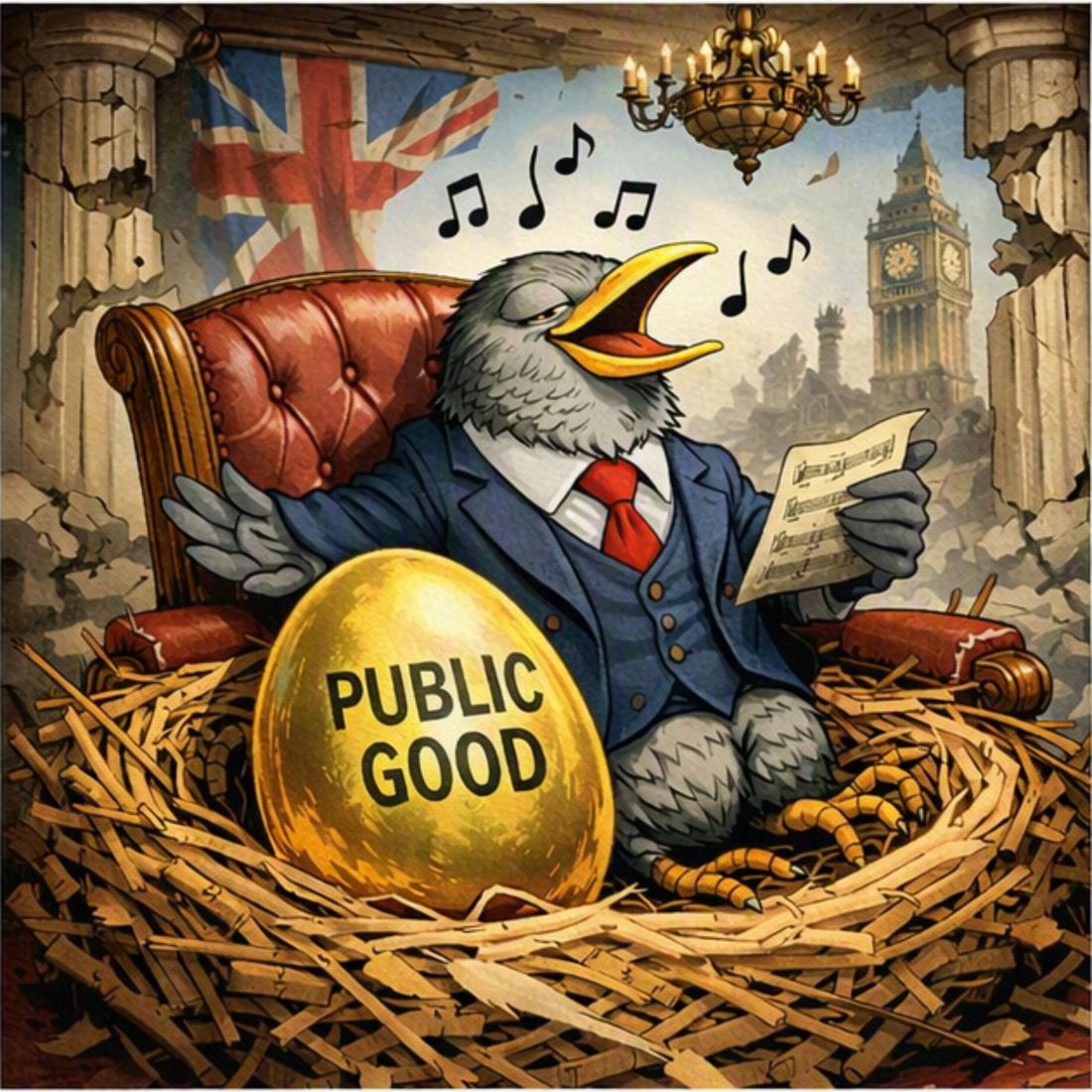
A new behaviour has taken root in Westminster and beyond. It is subtle, structural, and deeply corrosive. It is the habit of taking over seats simply to occupy them – to be seen to be there, to enjoy the insulated safety of incumbency – while rejecting the golden egg that comes with the role: the opportunity, and the responsibility, to do what is right for everyone now.

This is political cuckooism.

Like the cuckoo that lays its eggs in another bird’s nest, today’s political class lays its promises, its reforms, its responsibilities, and its obligations into the future – the next Parliament, the next cycle, the next government. The present becomes a perch. The future becomes a dumping ground.

And representative democracy is the real victim.

1. What Political Cuckooism Really Means

Political cuckooism is not procrastination. It is not caution. It is not long‑term planning.

It is the deliberate practice of deferring meaningful policy into the next Parliament so that incumbents can enjoy safety today.

It works like this:

  • take the seat
  • occupy the role
  • perform competence
  • announce reform
  • schedule it for “next time”
  • avoid consequences
  • avoid responsibility
  • and repeat

It is leadership without action. Authority without obligation. Presence without purpose.

It is the political class behaving as if the seat itself is the achievement – not the work that must be done from it.

2. The Golden Egg: The Opportunity They Refuse to Hatch

Every seat in representative democracy comes with a golden egg: the chance to act in the present.

To make decisions that matter. To confront reality. To govern.

But political cuckoos reject the egg.

They sit in the nest. They enjoy the perch. They protect the seat. They perform the role. But they refuse to hatch the egg.

Instead, they push every meaningful decision into the future:

  • tax reform
  • public service restructuring
  • constitutional change
  • welfare redesign
  • infrastructure investment
  • economic strategy
  • democratic renewal

All of it becomes “next time”.

The egg remains unhatched. The nest remains occupied. The seat remains safe.

And democracy remains unfed.

3. How We Got Here: The End of Britain’s Operating Model

Political cuckooism did not appear out of nowhere. It is the late‑stage behaviour of a political system whose operating model has already failed.

For forty years, Britain relied on a Thatcher‑era framework built on:

  • deregulation
  • privatisation
  • asset inflation
  • consumption‑driven growth
  • and the belief that markets could solve structural problems

That model worked – until it didn’t.

By the mid‑2010s, the machinery was visibly failing. By the early 2020s, it was exhausted. By the mid‑2020s, it was no longer capable of delivering meaningful outcomes.

The system now produces obligations rather than opportunities, constraints rather than choices, and risk rather than capacity.

Political cuckooism is the behavioural adaptation to that failure.

When the system can no longer deliver meaningful reform, politicians stop trying to deliver meaningful reform. They start performing it instead.

They occupy the seat. They protect the seat. They defer the egg.

And the system continues to fail.

4. The Contemporary Politicians’ Dilemma: The Mechanism Behind Cuckooism

Once in office, politicians discover a truth that the public never sees:

the system cannot absorb meaningful action – yet they must still appear to act.

They learn that:

  • every lever they pull has unintended consequences
  • every reform destabilises something else
  • every decision carries risks they cannot control
  • every structural change threatens the machinery
  • and every attempt at real‑time governance exposes the system’s fragility

So they face a choice:

Act meaningfully and risk collapse, or act symbolically and remain safe.

They choose safety.

They choose symbolism. They choose narrative. They choose performance.

And they choose to defer meaningful policy into the future – where it cannot hurt them.

This is political cuckooism’s engine.

5. The Rise of Performance Politics

Performance politics emerged because:

  • the machinery no longer responds to real‑time decisions
  • the levers of government no longer produce predictable outcomes
  • the public finances no longer support meaningful reform
  • and the political class no longer understands the system they are managing

So politicians adapted.

They learned to:

  • narrate competence
  • perform direction
  • announce future reform
  • avoid present‑tense responsibility

Performance became the product. Narrative became the tool. The future became the nest.

Political cuckooism is performance politics applied to policymaking.

6. Paradigm Blindness: Why Leaders Keep Looking Backwards

When leaders cannot imagine a new model, they cling to the old one. When they cannot act in the present, they promise action in the future. When they cannot confront structural reality, they narrate structural optimism.

This is why so many reforms are framed for “the next Parliament”. It is not strategy. It is not vision. It is not long‑term planning.

It is the inability to act now.

Paradigm blindness turns the future into a storage unit for every difficult decision.

Political cuckooism is the behavioural expression of that blindness.

7. Leadership in a Failing System

Leaders cannot lead if the system cannot respond.

When the machinery is failing:

  • leadership becomes symbolic
  • decision‑making becomes performative
  • accountability becomes abstract
  • and responsibility becomes deferrable

This is why today’s leaders occupy seats rather than use them.

They are not lazy. They are not cowardly. They are not incompetent.

They are trapped.

The system cannot absorb meaningful action, so leaders stop attempting meaningful action.

Political cuckooism is the survival instinct of leaders inside a system that no longer works.

8. They Sing All the Right Songs

They sing all the right songs. They say all the right things. They perform all the right gestures.

But the actions at the heart of everything tell us the only story we all need to know:

they will not act now.

They will not hatch the egg. They will not confront the present. They will not use the seat for what it is meant for.

They will only occupy it.

This is political cuckooism in its purest form – the performance of leadership without the practice of leadership.

9. The Media’s Role: Mistaking the Nest for the Egg

Political cuckooism thrives because the media consistently misreads future‑facing commitments as present‑tense policy.

The media still reports politics as if:

  • the system works
  • timelines are meaningful
  • governments have agency
  • and policy announcements reflect real‑time decisions

So when politicians announce reforms “for the next Parliament”, the media treats them as if they are happening now.

This creates:

  • the illusion of action
  • the illusion of direction
  • the illusion of leadership

It allows political cuckoos to occupy the nest without ever hatching the egg.

10. Representative Democracy Cannot Survive Without Present‑Tense Action

Representative democracy relies on one fundamental principle:

Governments must act in the present.

Not the next Parliament. Not the next manifesto. Not the next cycle.

The present is where accountability lives. The present is where consequences exist. The present is where democracy happens.

Political cuckooism destroys this.

When governments push meaningful policy into the future:

  • accountability evaporates
  • consequences disappear
  • mandates become meaningless
  • elections become theatre
  • and representation becomes symbolic rather than functional

Democracy becomes a ritual rather than a mechanism.

People vote for change. Politicians promise change. The system defers change.

And the public is left with the performance.

11. The Nest Is Full of Cuckoos – And No One Is Hatching Anything

The problem is not one or two individuals behaving this way. The problem is that the nest is full of cuckoos.

Every seat becomes a perch. Every Parliament becomes a holding pattern. Every government becomes a caretaker administration. Every manifesto becomes a list of future eggs.

And none of them hatch.

The political class has become a colony of cuckoos – each one eager to take control of the seat, each one unwilling to take responsibility for the egg.

The nest is occupied. The egg is ignored. The system is failing.

12. What Happens When “Next Time” Finally Arrives?

Political cuckooism works only as long as the future remains abstract.

But eventually, “next time” becomes this time.

Eventually, the deferred reforms pile up. Eventually, the structural failures converge. Eventually, the system runs out of future.

And when that moment arrives, the political class will face a crisis they cannot defer.

A crisis they cannot narrate. A crisis they cannot perform their way through. A crisis they cannot push into the next Parliament.

Political cuckooism is not sustainable. It is a temporary survival mechanism inside a system that is already failing.

And when it fails, representative democracy will face its reckoning.

13. The Only Honest Conclusion

Political cuckooism is the defining behaviour of the modern political class.

It is the habit of taking over seats simply to occupy them – to be seen to be there – while rejecting the golden egg: the opportunity to do what is right for everyone now.

It is the survival instinct of a political class that no longer knows how to govern.

It is the performance of leadership without the practice of leadership.

They sing all the right songs. They say all the right things. But the actions at the heart of everything tell us the only story we all need to know.

The future has become the nest. The present has become the performance. And democracy has become the victim.

Further Reading

To understand how Britain’s political, economic, and cultural systems have evolved – and why they now appear to be reaching a breaking point – the following essays offer a structured path through Adam’s analysis.

They begin with the broad systemic shift, then move through establishment dynamics, political behaviour, economic assumptions, and finally the personal dilemmas facing today’s leaders.

1. The End of Britain’s Current Operating Model: Thatcherism’s Forty‑Year Reign and the Beginning of the Post‑Thatcher Era

URL: https://adamtugwell.blog/2026/08/01/the-end-of-britains-current-operating-model-thatcherisms-forty-year-reign-and-the-beginning-of-the-post-thatcher-era-full-text/

A foundational essay explaining how Thatcherism shaped the UK’s political and economic architecture for four decades – and why its underlying assumptions are now collapsing. This piece provides essential context for all the others, outlining the structural shift Britain is entering.

2. The Establishment Is Not What You Think It Is: Why the Modern Establishment Is a Worldview, Not a Class – and Why That Makes It So Hard to Escape

URL: https://adamtugwell.blog/2026/07/15/the-establishment-is-not-what-you-think-it-is-why-the-modern-establishment-is-a-worldview-not-a-class-and-why-that-makes-it-so-hard-to-escape/

This essay reframes the “establishment” as a shared worldview rather than a social elite. Adam argues that the real power structure is cultural and psychological, not institutional – making it far more pervasive and difficult to challenge.

3. The Performance of Politics: Why Power No Longer Serves People

URL: https://adamtugwell.blog/2026/06/18/the-performance-of-politics-why-power-no-longer-serves-people/

A critique of modern political behaviour, exploring how politics has become performative rather than functional. Adam shows how leaders increasingly prioritise narrative, branding, and spectacle over meaningful public service.

4. We Can’t Fix Society Because We Won’t Question Money

URL: https://adamtugwell.blog/2026/01/22/we-cant-fix-society-because-we-wont-question-money/

An exploration of how deeply‑rooted assumptions about money limit society’s ability to solve major problems. Adam argues that economic orthodoxy has become a cultural belief system that prevents genuine reform.

5. The Contemporary Politician’s Dilemma

URL: https://adamtugwell.blog/2024/12/05/the-contemporary-politicians-dilemma/

A shorter, more personal reflection on the pressures facing modern politicians. It highlights how systemic constraints, public expectations, and party dynamics trap leaders in cycles of reactive decision‑making.
Why We Keep Looking for Answers in the Direction That Created the Problem

Every time Britain runs into serious difficulty, we seem to have the same conversation. The names change. The parties change. The faces around the Cabinet table change. The language of renewal, seriousness and responsibility is refreshed for the latest political moment. Yet the assumptions beneath the debate remain remarkably consistent.

People can now see that something is wrong. That is no longer really the issue. The point of disagreement is no longer whether Britain has problems, but what kind of problems they are. Debt, stagnant living standards, unaffordable housing, degraded public services, weak productivity, falling trust and social fragmentation are all now visible enough to be discussed across the political spectrum. But they are still treated, again and again, as separate management failures rather than as symptoms of the same underlying system.

That is the real tragedy. Many of the people diagnosing the crisis genuinely know that something is badly wrong. Some may even know, at some level, that the old answers are exhausted. But they have nowhere else to go intellectually, professionally or politically except back to the same place they have always looked: finance, markets, business experience, managerial competence, fiscal discipline, GDP growth and the language of economic credibility.

So every crisis produces the same merry-go-round. First, the system produces outcomes that are increasingly difficult to defend. Then commentators, politicians and professional observers acknowledge the symptoms. Then the search begins for the people deemed “serious”, “qualified”, “experienced” or “credible” enough to fix them. More often than not, those people are drawn from the same worldview that helped produce the outcomes in the first place.

The latest reshuffle, party conference season and the first real glimpse of the UK’s latest prime minister have simply offered the newest version of this old pattern. The commentariat and Opinionati have been busy sticking badges on Westminster’s latest cast list, praising or dismissing people according to whether they understand big business, the markets, money and the supposedly hard realities of government. It would be interesting if it were not so desperately detached from the deeper causes of the problems they can see only at surface level.

Perhaps I am being unfair. Some of them may understand more than they are willing to say. It is not difficult to see why few high-profile journalists, economists, politicians or commentators would not want to be the first to say publicly that the entire operating model has reached its limits. That is not a career-enhancing move. But perhaps I am also being optimistic. The harder possibility is that many really cannot see it, because the system has trained them not to look in the right place.

This is what I have increasingly described as paradigm blindness, or cognitive capture. It is not stupidity, corruption or malice. It is the condition that arises when the assumptions of a system become so familiar, rewarded and professionally reinforced that they stop appearing to be assumptions at all. They simply feel like reality.

That is why the argument that the best MPs are those who have been in business, finance or the markets needs to be challenged at its root. This is not a new phenomenon. We have heard versions of it for years. The country is in trouble, so we are told we need people who have run companies, handled money, understood the markets, balanced books, managed large organisations or dealt with the “real world”.

But this assumes precisely what should be under scrutiny. A country is not a corporation. Citizens are not customers. Communities are not balance sheets. Public value is not the same thing as shareholder value. Government is not elected to optimise returns, impress markets or manage people as units of cost. It is elected to serve the public interest.

This does not mean that business experience is useless, or that financial knowledge has no place in government. Of course leaders need access to expertise. Government operates inside financial constraints, and anyone pretending otherwise is avoiding reality.

But genuine leadership is not the same as technical expertise. A genuine leader does not need to be the country’s best economist, financier, accountant or bond trader. A genuine leader needs to ask the right questions, gather the necessary information, listen beyond a single discipline, understand consequences, and make decisions in the interests of people rather than in defence of a model.

That distinction matters because expertise is rarely neutral. Economists are largely trained within the existing economic model. Business schools largely teach people how to succeed within the existing business environment. Financial professionals are trained to understand and operate the existing monetary and market system. None of that makes them bad people. But it does mean they are usually specialists in operating the paradigm, not necessarily in questioning whether the paradigm itself is failing.

This is the heart of the problem. We have become so accustomed to money being part of everything that it becomes almost impossible for many people to see money as part of the problem. The captured mind says, “It cannot be money, because money is involved in everything.” But that is precisely the point. When money becomes the organising principle of everything, everything begins to bend around it.

Money is no longer merely a tool that society uses. It has become the measure by which society judges almost everything: policy, success, failure, seriousness, responsibility, productivity, worth, even human dignity. Market confidence becomes more important than lived experience. Financial efficiency becomes more important than resilience. GDP-style growth becomes more important than whether ordinary people can afford homes, raise families, access care, build security, or live in communities that still function.

This is why the current debate is so inadequate. Across the political spectrum, many now agree that the UK is financially precarious, if not already in serious trouble. But the explanations remain scattered: the wrong government, the wrong prime minister, immigration, benefit claimants, public sector waste, weak management, insufficient growth, too much borrowing, too little discipline. Each explanation may touch some fragment of reality. None explains the whole.

The deeper possibility is that these are not isolated failures at all. They are connected outcomes of a worldview that has progressively subordinated people, communities, public services, local economies and the natural environment to financial logic.

Because the system prioritises money, it teaches us to judge everything else in monetary terms. In doing so, we have surrendered forms of value that cannot be properly measured by markets but without which society cannot remain healthy.

That blindness has allowed a massive transfer of wealth, declining quality of life for many, the weakening of communities, the degradation of public services, the hollowing out of productive capacity and the dismantling or sale of shared structural and infrastructural assets. The harms are then treated as unfortunate side effects, or as the personal failings of those who cannot keep up, rather than as predictable consequences of the system itself.

Those who need benefits, debt, handouts or support are too often ridiculed as the architects of their own misfortune. But a system built around extraction, competition and monetary valuation could only ever push more people towards the margins. The fact that this is now happening at scale should tell us something important. It is no longer credible to pretend that all of this is merely bad management.

The strongest objection is obvious and deserves to be taken seriously. People will say that no government can ignore money, borrowing, markets or budgets. They will say that expertise matters, that institutions matter, that stability matters, and that the alternative to financial discipline may be chaos.

They are right to say that competence matters. They are right that government cannot simply wish away the current system. But that objection only goes so far.

Understanding how to operate a system is not the same as understanding whether it still works.

Expertise in navigating a failing model should not be confused with leadership capable of questioning the model itself.

If the economic and monetary framework has helped create unaffordable housing, insecure work, weak productivity, degraded services, concentrated wealth and exhausted communities, then appointing people who are fluent in that framework is not automatically a solution. It may simply be another turn of the merry-go-round.

This is the anti-establishment paradox too. Many politicians and commentators claim to oppose the Establishment while continuing to operate entirely within its worldview.

They challenge the personnel of the system but not its assumptions. They denounce elites while judging seriousness by market confidence. They promise disruption while accepting the same definitions of success: growth, efficiency, competitiveness, credibility and control. In some cases, they do not challenge the Establishment at all. They intensify it.

That is why this moment matters. We are entering a critical phase in which more people can see that the old answers are failing, but many of those with the biggest platforms still cannot name the deeper problem.

They know the country is in difficulty. They know trust is weakening. They know the numbers do not add up. They know the usual levers no longer deliver what they once promised. But cognitive capture leaves them interpreting system failure as a management problem.

So we get calls for better managers, more business-minded MPs, tougher fiscal rules, more efficient public services, renewed growth strategies, fresh economic credibility and new faces to operate the same machinery.

The possibility that the machinery itself is producing the outcomes barely enters the conversation.

The problems we now face cannot and will not be solved simply by cutting spending, borrowing more, chasing GDP-style growth, finding another managerial class, or appointing MPs whose main qualification is fluency in the financial language of the existing system.

The extractive model appears to have reached its limits. Its promises of efficiency, prosperity and competent management are harder to reconcile with the reality experienced by millions of people.

The system is over. It simply has not finished its ending yet. And the last people we need making futile attempts to save a system whose impacts they do not understand are those who still believe it is the only possible way.

The question now is not whether Westminster has enough people who understand money. It is whether Westminster has enough people willing to ask why money has become the lens through which every public problem must be viewed.

Genuine leadership begins there: not in pretending money does not matter, but in refusing to let it be the only thing that matters.

If the challenge is one of worldview as much as policy, then the next step cannot simply be another leader, party, slogan or economic forecast. It has to involve rebuilding the capacity to think and act differently: restoring productive local economies, reconnecting institutions with lived reality, asking how value is created and circulated in communities, and developing forms of governance that serve people rather than forcing people to serve the abstractions of the system.

For a more practical exploration of that direction, see: The Local Economy & Governance System.

Policy: The Missing Link in Britain’s Political Breakdown

For most of modern British politics, elections have offered a reassuring sense of choice. Parties compete, leaders rise and fall, and voters decide who should take the reins. It feels dynamic. It feels consequential. It feels as if the direction of the country hinges on who wins and who loses.

But beneath that familiar surface lies a more uncomfortable truth: the outcomes we live with are shaped far more by policy frameworks than by the personalities who temporarily occupy office. And because those frameworks barely change from one government to the next, the political choices we make often deliver results that look remarkably similar.

This is the part of politics we rarely talk about.

It is also the part that matters most.

Why Voters Don’t See the Real Problem

It’s not that voters are apathetic or foolish. It’s that the system is designed to make policy almost invisible.

  • Personalities dominate the media because they’re easier to package into stories.
  • Policy operates in slow motion, so cause and effect rarely line up neatly.
  • Institutions constrain governments, making radical shifts difficult even when promised.
  • Parties benefit from keeping policy obscure, because it shields them from accountability.

So voters naturally focus on what they can see: the people.

And they act on what feels intuitive: keeping certain politicians out, tactically voting, or chasing the next leader who “sounds different”.

But this instinct leads to a predictable trap.

The Misdiagnosis That Keeps the System Stuck

When voters believe the problem is who gets into power, they behave as if blocking one politician will automatically produce a better outcome. Yet because the underlying policy assumptions remain the same, the “law of unintended consequences” takes over:

  • A vote cast to stop one outcome simply empowers another version of the same system.
  • The new government inherits the same constraints and produces the same frustrations.
  • Voters feel betrayed, and the cycle repeats.

This is why British politics feels increasingly circular.

We keep changing the cast, but the script never changes.

Parties Respond With Presentation, Not Substance

The traditional parties understand this dynamic better than they admit.

Instead of rethinking policy, they compete on image.

This is why rising figures are often chosen for their communication skills rather than their policy depth. Kemi Badenoch’s apparently planned promotion of younger, social‑media‑savvy MPs like Katie Lam is a clear example: it signals renewal without requiring the party to confront the deeper question of whether its policy programme still fits the world it operates in.

Rebranding is easier than rebuilding.

But it doesn’t solve the problem.

Meanwhile, the World Has Moved On

The most destabilising force in British politics today isn’t ideology or partisanship. It’s the widening gap between:

  • a rapidly changing world, and
  • a policy framework built for a different era.

Energy markets are volatile.

Food supply chains are fragile.

Geopolitical tensions are rising.

Economic assumptions that held for decades no longer apply.

These pressures expose the limits of a system that has been patched, stretched, and repackaged – but not fundamentally updated. Even though real people are getting hurt.

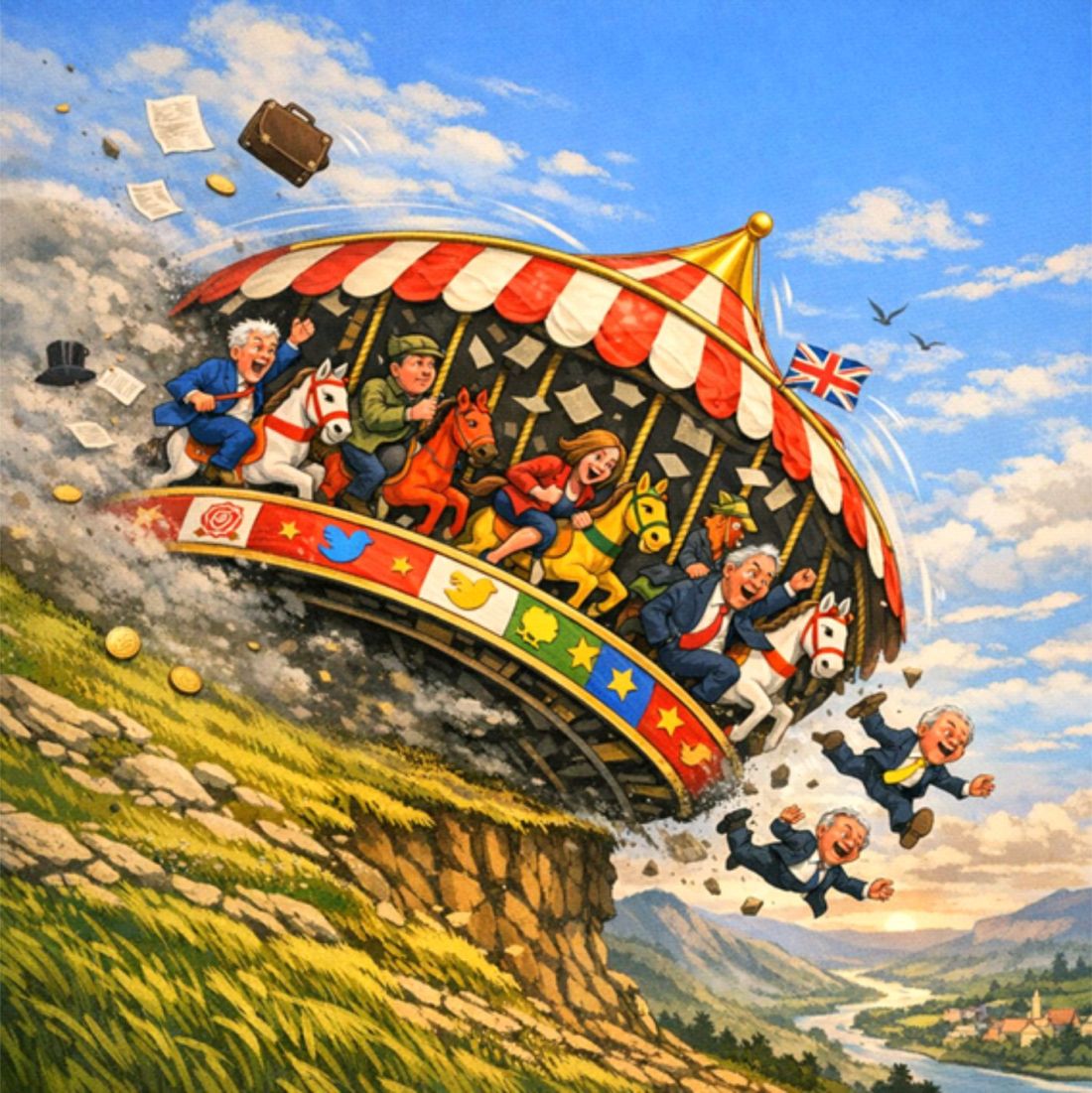
The Merry‑Go‑Round Has Already Broken Loose

For years, voters have treated elections like choosing a different horse on a familiar ride. The movement felt predictable, the risks manageable, the outcomes contained.

But the merry‑go‑round has already rusted off its hinge.

It is on its side, picking up speed, racing downhill.

And yet we continue to behave as if staying on the ride – or switching horses – will somehow change where it’s heading.

The danger is not that we choose the wrong rider.

The danger is that we fail to see the ride itself is no longer stable.

Why Newer Parties Are Rising

The Greens and Reform are gaining ground not because they have more charismatic personalities, but because they offer something the traditional parties have avoided: policy divergence.

They challenge the shared assumptions that have defined British politics for decades.

Whether voters agree with them or not, they represent a break from the consensus that has kept outcomes so uniform.

This is why the traditional three parties are in turmoil.

They are fighting a communications war in a world that now demands a policy rethink.

The Only Way to Change Course

Real change will not come from:

  • blocking certain politicians
  • swapping leaders
  • or chasing the next “fresh face”

It will come from recognising that the foundations of the system – the policy frameworks that shape every decision – need to be rebuilt.

The most radical act a voter can take today is not to switch parties, but to question the assumptions all parties share.

Because until those assumptions change, the outcomes won’t.

And the merry‑go‑round will keep accelerating toward the edge.