

Wherever we begin – in privilege or in struggle – success should be earned despite it, not granted because of it

We are living through a moment where the meaning of meritocracy has become confused. What was once a principle designed to ensure fairness – that people rise according to their ability, character, and contribution – has been reshaped into something far more superficial.

Today, success is often granted not because someone has demonstrated competence, but because their story fits a narrative the culture wants to tell.

This shift is not progress. It is misalignment. And it is taking us in a dangerous direction – one where people are placed in roles for the wrong reasons, where organisations are weakened by symbolic appointments, and where society as a whole becomes less stable, less effective, and less fair.

Beginnings are not merit

Where someone begins in life – in privilege or in struggle – is a matter of circumstance, not achievement. Yet modern society has developed a habit of treating beginnings as qualifications in themselves.

On one side, privilege still acts as a silent elevator, lifting people into positions they have not earned simply because they were born into the right networks.

On the other side, hardship has become a symbolic credential. A difficult backstory is treated as evidence of capability, even when capability has not been demonstrated.

Both distortions replace merit with something else. Both undermine fairness. And both ultimately harm the very people they claim to help.

The misuse of social mobility

Social mobility was meant to remove barriers, not erase standards.

It was designed to ensure that those with talent, drive, and potential could rise – not to guarantee that everyone would.

But somewhere along the way, the concept was repurposed into a banner under which almost any elevation can be justified. The assumption seems to be that if someone from a disadvantaged background is not succeeding, prejudice must be the reason. And if prejudice is the reason, then the solution is to elevate them – regardless of whether the role fits their abilities, temperament, or aspirations.

This is not equality. It is overcorrection. And overcorrection is simply bias in the opposite direction.

But these distortions are symptoms, not causes.

To understand why this keeps happening, we need to look deeper.

The system values the wrong things – and conditions us to do the same

We have built a society that is not designed around people, communities, or human flourishing. It is designed around money, power, centralisation, and control. And because the system values these things, it conditions us to value them too.

People are encouraged to believe that their worth depends on having high‑status, high‑paid, influential jobs. The cultural narrative suggests that unless you are climbing toward prestige, you are falling behind. The extractive nature of the system reinforces this: it rewards visibility, not contribution; status, not service.

Yet the truth is very different.

The person who empties the bins each morning, the barista who hands us a coffee, the mechanic who keeps us on the road – these people support our daily lives in ways that are immediate, essential, and irreplaceable. Their contribution is not less important than that of a doctor or a CEO. In many ways, it is more constant, more tangible, and more foundational.

A humane meritocracy would recognise this. It would value contribution, not status. It would understand that importance is not measured by salary or spotlight, but by the role a person plays in the wellbeing of others.

Potential is real – but timing is uneven

If meritocracy is to mean anything, it must recognise that potential cannot flourish without stability.

Some young people face circumstances that consume their emotional capacity simply to survive:

  • chaotic home lives
  • caring responsibilities
  • trauma
  • instability
  • poverty
  • violence
  • neglect
  • mental health struggles

In those conditions, emotional capacity is not available for self‑development. Their potential is not absent – it is deferred.

Yet our system mistakes delayed readiness for lack of ability, and punishes those who cannot perform on schedule.

This is not a failure of the individual. It is a failure of a system that expects everyone to mature at the same pace, in the same way, under the same conditions.

Recognising delayed readiness is not lowering standards. It is understanding that merit develops through time, support, and opportunity.

The academic myth: a prejudice disguised as aspiration

One of the most damaging assumptions in modern culture is that academic achievement is the only legitimate route to success.

We funnel young people – especially those from disadvantaged backgrounds – into A‑levels and university, regardless of whether these paths suit their strengths or their stage of development.

This is not equality of opportunity. It is a failure of imagination.

Some young people are practically minded. Some are gifted with their hands. Some are natural problem‑solvers, builders, makers, technicians, creators. Some simply need more time before academic study becomes meaningful.

But instead of offering an equally respected vocational route from 14 to 21 – one that is rigorous, structured, and valued – we push everyone through the same narrow gate.

And when they struggle, we blame prejudice rather than the system that forced them into the wrong shape.

This is how we fail the disadvantaged:

Not by denying them opportunity, but by denying them the right opportunity.

The jigsaw puzzle of human worth

Recognising the equal worth of every person does not mean pretending we are all the same. We are not.

We bring different strengths, different temperaments, different capacities.

We are the pieces of a vast jigsaw puzzle – each shaped differently, each fulfilling a role no other piece can fill.

A healthy society does not force every piece into the same space, nor does it elevate one shape above another.

It values each for what it contributes. It understands that the picture only appears when the pieces fit together.

Equality is not sameness. It is belonging.

And merit is not about ranking human worth – it is about placing people where their abilities allow them to serve the whole.

Why leadership matters most

Leadership is one piece of the puzzle – not more valuable, but more consequential.

It requires a specific shape: competence, clarity, courage, and the ability to act for the good of others.

These qualities do not come from privilege, nor from hardship. They come from character and capability.

We do not honour people by placing them in roles they cannot fulfil.

We do not help society by elevating individuals because their story is inspiring.

And we do not strengthen institutions by choosing leaders for symbolic reasons.

A leader should rise because they can carry the weight of responsibility – not because their background makes for a compelling narrative.

The cost of abandoning merit

When we abandon merit, we do not create fairness.

We create fragility.

Institutions weaken.

Public trust erodes.

Progress stalls.

And the people who most need competent leadership – the vulnerable, the marginalised, the unheard – suffer the most.

A society that elevates people for the wrong reasons is not compassionate.

It is negligent.

A call to return to what works

If we want a society that is fair, functional, and genuinely equal, we must return to a simple principle:

Wherever you begin – in privilege or in struggle – success should be earned despite it, not granted because of it.

This is not harsh. It is humane.

It recognises the dignity of every person, the diversity of human strengths, and the necessity of placing people where they can truly contribute.

Merit is not elitism. It is responsibility.

It is the recognition that a complex world requires competence.

It is the belief that every person has value – but not every person has the same role.

Rebuilding meritocracy begins not with systems, but with how we choose to see one another.

And it is the only foundation on which a fair and flourishing society can stand.
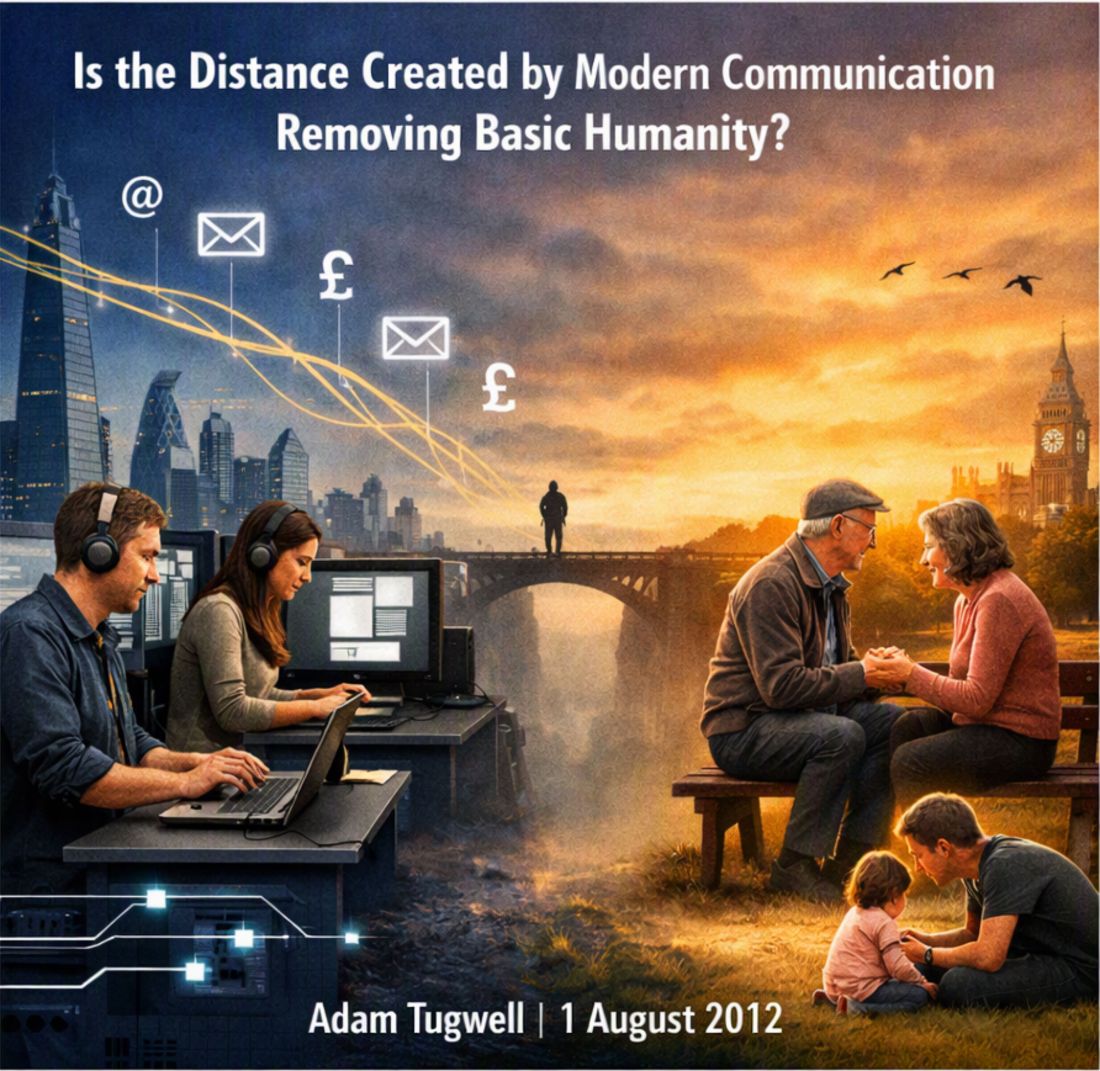
Is the distance created by modern communication and business methods removing basic humanity from our relationships and has the time come for a whole new set of rules?

So what motivates you at work or within your business? Is it doing the very best job that you can; or is it simply to earn the greatest amount as quickly as possible and perhaps keep yourself in that lucrative job that you already have, maybe progressing you to an even better paying or profiled position?

Whilst admitting that it leaves a bad taste in the mouth just as soon as the realisation dawns that other people may have noticed; for a growing number today it will be the latter and for very practical reasons that they may never really have even considered at that. Perhaps strange then that it’s a feeling of guilt which often accompanies that understanding when it arrives, as few will ever argue that we would all like to earn more or have a better lifestyle if given the option to do so.

The reality is of course that people feel bad about making money when questioned, if they hadn’t realised that it has become the purest motivation or aim in what they do, rather than being the very healthy side-effect of a career undertaking or vocation, and then doing it damn well.

With a growing concern about the ethics employed within business, not least of all illustrated by the Libor scandal, one must ask if a loss of conscience is one of the very negative aspects that the distance created by increasingly elaborate supply chains and the rise of the Internet have created?

Many of us have simply adapted and in many cases thrived from the changes and opportunities brought into being by the rise of the Communication Age.  So workers within Internet and information technology reliant businesses are perhaps excusably less aware of the fallout hitting customers they may never even see from decision making which is without a tangible fear or concern for the ‘human factor’. One also wonders if they are therefore insulated from the future catastrophes they now have the power to create in what may seem little more than parallel lives, which to the more aware would only ever be dressed as distant elephants that look less than the size of a gnat on their horizon.

To perhaps emphasise the downside of distance more effectively, I will take a step back to an industry that we all love to hate. A profession that has always had the benefit of distance between business and customer once they have been commissioned; but a distance which is also created by time and process rather than by the remote contact of a broadband cable.

Within the property market, many are quick to become cynical of the inflation-setting-overpricing of houses and wonder how they find themselves unable to afford even a modest home.

Some would blame the gargantuan super-tanker that was ‘right-to-buy’ as set in motion by Margaret Thatcher, but can quickly forget how it was that very act in the first place which encouraged massive property ownership within parts of society where people would never have dared even dream of being homeowners before her tenure, and perhaps led to those very same people being able to aspire to making such dreams their reality to begin with.

Others would look perhaps more accurately to the realms of Estate Agents who have ruthlessly pushed prices up and up, month-after-month and year-after-year in order to secure greater and greater percentage based sales fees.

Estate Agents actually do a job that they could choose to do very well on sensible margins – even in a good market. But repeat custom is to them a very long game and if someone else is saying they can sell a house for more, it doesn’t take much excuse to follow or to lose out because the risks to them seem very distant indeed.

After all, very few owners will willingly lose many thousands of pounds on a sale just because one agent tells them what its actually worth, when another says different. The agent who ‘does what it says on the can’ will have ‘priced to sell’ and done what they were commissioned to do, whereas the second agent plays the long game, watching the market rise to the price they suggested, thereby getting the fee they want but paying little note of the pain that their customer experiences in the meantime. No wonder then, that so many Estate Agency businesses have stopped trading or been forced to make substantial cutbacks during the economic crisis.

The long-term effects of such business practices are potentially incalculable and one can only speculate on just how overpriced our homes now actually are, and how far back in time standards of living and subsequent social mobility could actually be pushed as a result of the out-pricing of starter homes for young people; a situation created purely on the basis of making higher and higher margins for just a few without any apparent risk to the many from doing so.

So with the rise of the Internet and information technology, many more businesses now find themselves enjoying a distance between themselves and  customers which is to such a degree that the abuse of such apparently lucrative opportunities could create all manner of future problems, which may only ever become apparent much further down the line.

For instance, a once heavily hands-on recruitment industry which only a few years ago interacted with perhaps every candidate who made the effort to post them a CV, has been replaced by one which has discovered a seemingly bombproof level of security from risk of losing fees by targeting ‘perfect fit’ or tick box candidates, simply by focusing on electronic advertising and administration techniques. 800 applications through an Internet Job Board sounds a lot to handle; but not if you have set up a machine to identify perhaps a minimum of 8 ‘keywords’ or phrases from 10 in those CV’s before the hand of a human with any kind of feeling will go anywhere near them.

Nobody talks about the longer-term threat to hiring businesses of all shapes and sizes that comes from recruiting candidates from what by default effectively becomes a closed field of applicants who only know and understand a specific discipline within business, illustrated by the use of a series of words. Words which may themselves actually just be buzzwords or the esoteric ensemble of a recent graduate.

And why in purest profitability terms should recruiters care when today’s bottom line is secure and they achieved it with the benefit of never having to even speak to perhaps 3 times as many candidates as they actually did. Candidates who may have provided the recruiter’s customer with benefits and untold added value which they never had the chance to see but paid for nonetheless.  A situation leaving perhaps the best candidates finding themselves removed from the running by a software package that reduced the time involved for the recruiter to all but a mere fraction of what they would have ‘wasted’ otherwise.

It is quite concerning that labour and cost saving technology for one business can itself create the opposite effect not just for one, but potentially many others. But then if you also look at the dark-art-creativity of the financial sector and money-making ideas such as cereal futures and funds that own shares in supermarkets and dairy processors, you can quickly begin to see just how the mechanics of distance and its ability to negatively affect the lives of many people actually are. After all, what is 1p on the price of a pint of milk every couple of days when you had a £1 Million bonus last year?

On the one hand, technical advances and the heralding of an information-based communication age encouraging openness and sharing is driving a potentially buyer-led age where businesses have no option but to sell on the basis of making ‘just enough’ profit and delivering quality on time every time.

On the other, the opening of doors to many more  ‘golden-egg’ opportunities which are great for those picking up the product as it is found, but like the ever expanding and deepening ripples from a tiny stone tossed into a still pond, can cause mayhem and disaster in places that they had never even considered.

So the question needs to be asked; Is the distance created by modern communication and business methods removing basic humanity from our relationships and has the time come for a whole new set of rules?

This article was converted to PDF and its accompanying image was updated on 10 October 2026. The original text remains unchanged.