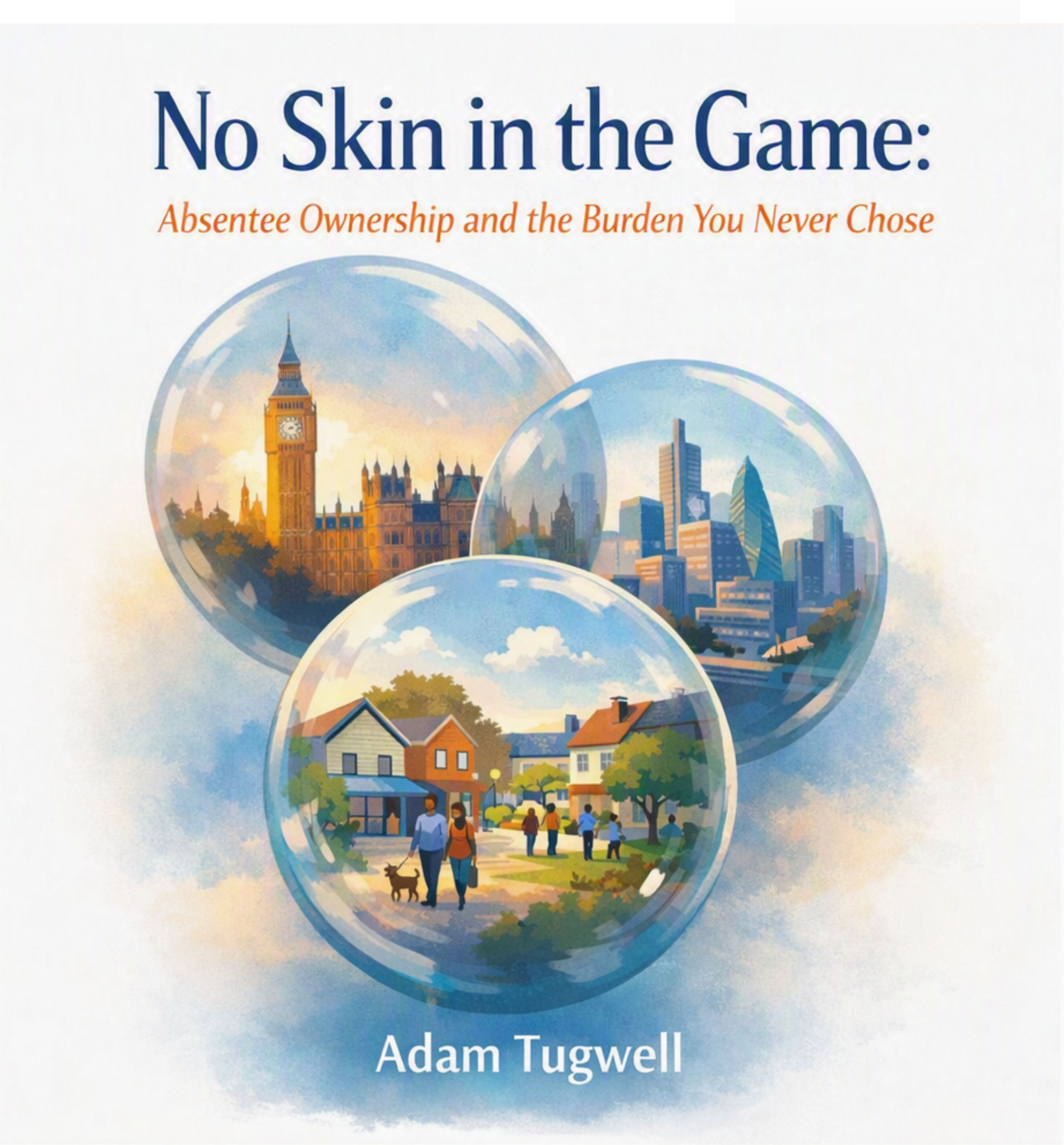

Introduction: The Twin Bridges
We live in a world that feels increasingly out of shape. Problems show up in different places and at different scales, yet they all seem to follow the same underlying pattern. Decisions are made far away from the people who live with their consequences. Ownership has drifted from presence. Responsibility has drifted from action. And the distance between the two is where most of our everyday trouble begins.
This book builds two bridges. The first is a bridge of understanding – a way of seeing the world as it actually works, rather than as we assume it does. The second is a bridge of possibility – a case for an alternative that puts ownership, decision‑making, and consequence back in the same place. Not a slogan, not a quick fix, but a structure that works because the parts belong together.
What follows is an attempt to make both bridges visible: the one that explains the world we have, and the one that shows the world we could build.
Part I – Today’s World
1. The World We Think We Live In
Most people believe they live in a world that more or less makes sense. A world where hard work leads to reward, where investment is a responsible thing to do, where owning a little more than you need is a sign of prudence, and where the economy – whatever that word really means – is something that grows because clever people somewhere are making good decisions.
It’s a comforting picture. It’s also a very incomplete one.
We’ve been taught to see the modern economy as a kind of neutral machine. You put effort in at one end, and you get reward out at the other. You invest money, and it grows. You buy a property, and it pays for itself. You put your savings into a pension fund, and it multiplies quietly in the background while you get on with your life.
The whole thing feels clean, efficient, and almost automatic. And because it feels automatic, it feels harmless.
But the truth is that the modern economy isn’t a neutral machine. It’s a cultural construction – a worldview – and it shapes how we think about ownership, responsibility, and consequence.
Most of us don’t notice this because we’ve grown up inside it. We speak its language without realising it. We repeat its assumptions without ever questioning where they came from.
We think we’re describing reality. But we’re really describing a system.
And that system has taught us a very specific way of seeing the world.
It has taught us that profit is a sign of success. It has taught us that investment is responsible. It has taught us that passive income is smart. It has taught us that bigger is better. It has taught us that distance is professionalism. It has taught us that markets are truth. It has taught us that growth is progress.
None of these ideas are natural. None of them are inevitable. None of them are universal.
They are simply the rules of the game we were born into.
And because we were born into them, we rarely stop to ask whether the game itself makes sense – or whether it’s fair, or whether it’s even safe.
Most people don’t ask those questions because the system gives them just enough comfort to feel secure, and just enough distance to avoid seeing the consequences of how it really works.
Distance is the most powerful tool the system has. It hides everything that matters.
It hides the harm. It hides the cost. It hides the fragility. It hides the extraction. It hides the people who pay the price.
Distance is what makes absentee ownership feel harmless. Distance is what makes passive income feel clever. Distance is what makes economies of scale feel efficient. Distance is what makes investment feel responsible.
Distance is what makes the modern world feel normal.
And because it feels normal, we rarely question it.
Most people genuinely believe the system is fair because it feels fair. They believe the rules are neutral because they look neutral. They believe the outcomes are deserved because they appear to follow effort, intelligence, or good judgement.
But the modern economy doesn’t reward effort. It rewards position.
It doesn’t reward contribution. It rewards ownership.
It doesn’t reward responsibility. It rewards distance.
And it doesn’t reward skin in the game. It rewards being insulated from consequence.
This is the world we think we live in. It’s familiar. It’s comfortable. It’s coherent.
But it’s not real.
It’s a worldview – and we need to understand that worldview before we can understand why the system behaves the way it does, why absentee ownership feels harmless, and why the harm it causes has become invisible.
That’s where we go next.
2 – Absentee Ownership as “Responsible” Modern Behaviour
If you ask most people what “being responsible with money” looks like, they’ll give you a list that sounds sensible enough on the surface. Buy a house. Maybe buy another one if you can. Put money into a pension. Invest in a few companies. Build a portfolio. Diversify. Let your money “work for you.”
It’s presented as maturity. As prudence. As adulthood.
It’s the kind of advice people give each other with a tone that suggests they’re passing down ancient wisdom, even though the whole thing is barely a few decades old.
And because everyone repeats it, it feels normal. It feels harmless. It feels like the responsible thing to do.
But what we call “responsible” today is really just a set of behaviours that make perfect sense inside the current system – and almost no sense outside it.
Take buy‑to‑let. It’s framed as a smart move. A way to secure your future. A way to “get ahead.” A way to build a nest egg. People talk about it as if it’s a kind of public service: “I’m providing housing.” “I’m helping people who can’t buy.” “I’m investing in the community.”
But the truth is simpler: buy‑to‑let is absentee ownership. It’s ownership without contribution. Ownership without presence. Ownership without responsibility. Ownership without skin in the game.
And the only reason it feels normal is because the system has been designed to make it normal.
The same is true of shareholding. Most people who own shares have never set foot in the companies they “own.” They don’t know the workers. They don’t know the customers. They don’t know the communities affected by the company’s decisions. They don’t know the environmental impact. They don’t know the supply chain. They don’t know the risks.
They don’t need to. The system doesn’t ask them to. The system rewards them for not knowing.
The less involved they are, the safer they feel. The more distant they are, the more profitable it becomes.
Absentee ownership is not an accident. It’s the design.
And because it’s the design, it has been wrapped in a cultural story that makes it feel virtuous. We call it “investing.” We call it “planning for the future.” We call it “building wealth.” We call it “being responsible.”
But none of these phrases describe what’s actually happening.
What’s actually happening is extraction. Quiet, normalised, socially accepted extraction.
And the people doing the extracting rarely see it that way, because the system has given them a language that hides the reality. It’s not “extracting rent from people who can’t afford to buy.” It’s “property investment.” It’s not “profiting from a company you don’t contribute to.” It’s “shareholder value.” It’s not “benefiting from someone else’s labour.” It’s “passive income.”
Passive income is perhaps the clearest example of how deeply the worldview has embedded itself. The phrase sounds harmless. It sounds clever. It sounds like something you’d hear in a seminar about financial literacy.
But think about what it actually means: income without effort. income without contribution. income without responsibility. income without presence.
Income without skin in the game.
And yet, in today’s world, this is held up as the pinnacle of financial intelligence. It’s the dream. The goal. The thing people aspire to.
We’ve built a culture where the highest reward goes to the people who do the least – as long as they own something.
Ownership has replaced contribution. Ownership has replaced responsibility. Ownership has replaced work. Ownership has replaced presence.
And because the system rewards this behaviour, people believe it must be right. They believe it must be fair. They believe it must be sensible. They believe it must be responsible.
But it isn’t responsible. It’s just normalised.
And it’s normalised because the system has been captured by a worldview that treats ownership as inherently virtuous, even when the owner has no involvement in the thing they own.
Absentee ownership feels responsible because the system has taught us to see it that way. It feels harmless because the system hides the harm. It feels fair because the system hides the cost. It feels inevitable because the system hides the alternatives.
And it feels like adulthood because the system hides the truth.
The truth is simple: Absentee ownership is only possible because distance hides consequence. And distance is the mechanism that makes the modern world feel normal.
We’ll explore that mechanism in Section 4. But first, we need to look at the idea that makes absentee ownership feel efficient – the myth of economies of scale.
3 – Economies of Scale: The Myth of Efficiency
If you ask people why big companies, big landlords, big investors, big supply chains, and big institutions dominate the modern world, they’ll usually give you the same answer: economies of scale.
It’s one of those phrases that sounds technical enough to shut down further questioning. It has the tone of something that’s been proven, measured, and universally accepted.
“Economies of scale” is the kind of idea that gets repeated so often it becomes a reflex. Bigger is cheaper. Bigger is more efficient. Bigger is more competitive. Bigger is more secure. Bigger is more modern. Bigger is progress.
But like most things that sound obvious, it’s only obvious because we’ve been taught to see the world through a very specific lens – a money‑centric one.
In a money‑centric worldview, efficiency is measured in pounds and pence. If something costs less to produce at scale, then scale must be good. If something generates more profit at scale, then scale must be smart. If something grows faster at scale, then scale must be progress.
But this is only one way of looking at the world. And it’s a very narrow one.
When you measure everything in money, you stop measuring everything else. You stop measuring the human cost. You stop measuring the environmental cost. You stop measuring the community cost. You stop measuring the long‑term cost. You stop measuring the fragility that scale creates. You stop measuring the consequences that scale hides.
Economies of scale don’t make things efficient. They make things distant.
And distance is the mechanism that hides the harm.
Take supermarkets. People assume they’re efficient because they’re big. They assume they’re competitive because they’re big. They assume they’re modern because they’re big. But the scale of a supermarket only looks efficient if you ignore everything it displaces: local producers, local shops, local relationships, local resilience, local knowledge, local responsibility.
Scale replaces people with systems. And systems don’t care about consequence.
The same is true of large landlords. A landlord with hundreds of properties is seen as successful, professional, and efficient. But that efficiency only exists because the landlord is distant. They don’t know the tenants. They don’t know the communities. They don’t know the impact of their decisions. They don’t know the harm caused by rent increases, evictions, or neglect.
Scale makes ignorance look like professionalism.
And the system rewards that ignorance because it keeps the machine running smoothly. If landlords had to be present, responsible, and accountable, the model wouldn’t work. The scale wouldn’t work. The profit wouldn’t work. The distance wouldn’t work.
Economies of scale are not a natural phenomenon. They are a cultural permission slip.
They allow people to benefit from things they don’t participate in. They allow people to profit from things they don’t contribute to. They allow people to own things they don’t understand. They allow people to make decisions without consequence.
Scale is the architecture of absentee ownership.
And because scale is framed as efficiency, nobody questions it. Nobody asks whether the efficiency is real. Nobody asks who pays for it. Nobody asks what gets lost. Nobody asks what gets hollowed out. Nobody asks what gets weakened. Nobody asks what gets broken.
We’ve been taught to see scale as progress. But scale is really just distance with a marketing department.
It’s distance dressed up as innovation. Distance dressed up as modernity. Distance dressed up as intelligence. Distance dressed up as inevitability.
And because distance hides consequence, scale hides harm.
This is why absentee ownership feels harmless. This is why passive income feels clever. This is why investment feels responsible. This is why profit entitlement feels justified.
Scale makes extraction look like efficiency. Scale makes fragility look like strength. Scale makes harm look like progress.
And because the system rewards scale, people believe it must be right.
But scale only works in a system where distance is allowed to replace responsibility. And distance only works in a system where owners never have to see the consequences of their decisions.
That’s where we go next.
4 – Distance: The Invisible Shield That Hides Consequence
If there is one idea that explains why the modern world behaves the way it does, it’s distance. Not physical distance, although that plays a part. I mean the kind of distance that sits quietly between people and the consequences of their decisions. The kind of distance that lets someone benefit from something without ever having to see the cost. The kind of distance that makes harm feel like an abstraction rather than a reality.
Distance is the invisible shield that protects the modern economy from accountability. It’s the mechanism that makes absentee ownership possible. It’s the reason passive income feels harmless. It’s the reason economies of scale feel efficient. It’s the reason investment feels responsible. It’s the reason profit entitlement feels justified.
Distance is the architecture of the worldview we explored earlier. And once you see it, you can’t unsee it.
Think about landlords who never meet their tenants. They don’t see the mould. They don’t see the stress. They don’t see the overcrowding. They don’t see the fear of eviction. They don’t see the trade‑offs people make to pay rent. They don’t see the impact of a £50 increase. They don’t see the consequences of neglect.
They don’t see any of it because the system has made sure they don’t have to.
Distance turns human lives into numbers on a spreadsheet. And numbers don’t cry, complain, or ask for help.
The same is true of shareholders. Most people who own shares have no idea what the companies they “own” actually do. They don’t see the working conditions. They don’t see the supply chain. They don’t see the environmental damage. They don’t see the community impact. They don’t see the layoffs. They don’t see the pressure placed on workers to meet targets.
They don’t see any of it because the system has made sure they don’t have to.
Distance turns responsibility into abstraction. And abstraction never asks awkward questions.
Even governments operate at a distance. Policies are made by people who will never experience the consequences of those policies. Decisions are taken by people who will never meet the people affected. Regulations are written by people who will never see the harm they enable. Legislation is passed by people who will never live under the rules they create.
Distance turns power into insulation. And insulation makes anything feel permissible.
This is why the modern world feels normal. This is why harm feels invisible. This is why extraction feels harmless. This is why fragility feels like strength. This is why scale feels like progress. This is why absentee ownership feels responsible.
Distance hides everything that matters.
It hides the people who pay the price. It hides the communities that get hollowed out. It hides the environments that get damaged. It hides the fragility that gets built into the system. It hides the consequences that accumulate quietly over time.
Distance is the reason the modern economy can behave in ways that would be unthinkable if everyone involved had to be present.
If a landlord had to live in the same building as their tenants, the model would collapse. If shareholders had to work in the companies they own, the model would collapse. If investors had to experience the consequences of their decisions, the model would collapse. If policymakers had to live under the policies they create, the model would collapse.
Distance is the glue that holds the current system together. It’s also the solvent that dissolves responsibility.
And here’s the uncomfortable truth: Distance doesn’t just hide harm – it creates permission for it.
When you don’t see the consequences of your decisions, you start to believe there aren’t any. When you don’t experience the cost of your choices, you start to believe the cost doesn’t exist. When you don’t meet the people affected by your actions, you start to believe your actions are harmless.
Distance makes good people behave in ways they never would if they were present.
It’s not malice. It’s not greed. It’s not cruelty.
It’s insulation.
And insulation is the quiet, structural reason why the modern world feels the way it does.
Distance is the final piece of the worldview puzzle. It’s the mechanism that makes absentee ownership feel normal. It’s the mechanism that makes economies of scale feel efficient. It’s the mechanism that makes passive income feel clever. It’s the mechanism that makes investment feel responsible. It’s the mechanism that makes profit entitlement feel justified.
Distance is the reason the modern world works the way it does – and the reason it cannot continue to work this way forever.
Now that we’ve explored the world people think they live in, we can move into Part II, where we look at the worldview that keeps people defending the system even when it harms them.
Part II – The Worldview Trap
1 – The Establishment Is a Worldview, Not a Class
If you ask people who “the Establishment” is, they’ll usually picture a small group of powerful individuals somewhere out of sight. Politicians. Bankers. CEOs. People in expensive suits who attend meetings in rooms the rest of us never enter.
It’s a convenient image. It gives the impression that the system is controlled by a handful of elites who pull the strings while everyone else simply tries to get by.
But the modern Establishment isn’t a group of people. It’s a worldview.
It’s a way of seeing the world that has become so normal, so familiar, and so deeply embedded in everyday life that most people don’t even realise they’re using it.
It’s the software running quietly in the background of the modern economy – shaping how we think, how we behave, and what we believe is possible.
And because it’s a worldview rather than a class, it doesn’t belong to a small group of elites. It belongs to everyone.
It’s shared by people who benefit from the system and people who are harmed by it. It’s shared by landlords and tenants, investors and workers, policymakers and voters. It’s shared by people who have wealth and people who have none.
The Establishment worldview is the cultural lens through which the modern world is interpreted. And once you see it, you realise how much of today’s behaviour makes sense only because of that lens.
This worldview teaches us that:
- profit is a sign of success
- investment is responsible
- passive income is smart
- bigger is better
- distance is professionalism
- markets are objective
- growth is progress
- debt is normal
- ownership is virtue
None of these ideas are natural. None of them are universal. None of them are timeless.
They are simply the beliefs that the current system needs people to hold in order for the system to function.
And because the system rewards people for holding these beliefs, they become invisible. They feel like common sense. They feel like reality.
This is why people defend the system even when it harms them. They’re not defending elites. They’re defending the worldview they believe is the world.
It’s not malice. It’s not ignorance. It’s not stupidity.
It’s conditioning.
People defend absentee ownership because they believe ownership is inherently responsible. People defend passive income because they believe income without effort is a sign of intelligence. People defend economies of scale because they believe bigger is always more efficient. People defend investment culture because they believe money should grow without contribution. People defend profit entitlement because they believe profit is deserved simply because someone owns something.
These beliefs didn’t appear out of nowhere. They were taught – quietly, consistently, and over decades – through legislation, policy, media, education, and cultural reinforcement.
The modern Establishment isn’t a conspiracy. It’s a worldview that has been normalised.
And because it has been normalised, people rarely question it. They rarely ask where it came from. They rarely ask who benefits from it. They rarely ask whether it makes sense. They rarely ask whether it’s fair. They rarely ask whether it’s safe.
They simply assume it’s the way things are.
This is why the modern system is so hard to escape. You can’t escape a worldview by changing a few policies. You can’t escape a worldview by adjusting interest rates. You can’t escape a worldview by tweaking regulations. You can’t escape a worldview by reforming institutions.
You escape a worldview only by seeing it clearly – and recognising that it is a worldview, not reality.
Once you see the worldview, you begin to understand why the system behaves the way it does. You begin to understand why harm is invisible. You begin to understand why extraction feels harmless. You begin to understand why fragility feels like strength. You begin to understand why scale feels like progress. You begin to understand why absentee ownership feels responsible.
You begin to understand why people defend the system even when it destroys them.
And you begin to understand why the system cannot be fixed from within.
This is the first step in escaping the worldview trap. The next step is understanding why harm remains invisible even when people experience it directly.
That’s where we go next.
2 – Why Harm Is Invisible Even When We Experience It
One of the strangest things about the modern world is how often people suffer from problems that they can describe perfectly – rising rents, insecure work, debt pressure, shrinking communities, environmental damage – yet still struggle to connect those problems to the system that causes them.
They know something is wrong. They feel it every day. They talk about it with friends. They worry about it at night. But when it comes to understanding why it’s happening, they often reach for explanations that sit comfortably inside the worldview they already know.
“It’s just the market.” “It’s just how things are now.” “It’s just the cost of living.” “It’s just the economy.” “It’s just progress.” “It’s just modern life.”
These phrases don’t explain anything. They simply make the harm feel inevitable.
And inevitability is one of the most powerful tools the worldview has.
When something feels inevitable, people stop questioning it. When something feels normal, people stop challenging it. When something feels universal, people stop imagining alternatives. When something feels natural, people stop seeing the harm.
This is why people can experience harm directly and still struggle to recognise its cause.
The worldview gives them a story that makes the harm feel like weather – something that happens to everyone, something nobody controls, something nobody can change.
But harm doesn’t come from weather. It comes from structure.
And structure is invisible when you’re standing inside it.
Take housing. People know rents are rising. They know buying is impossible. They know landlords have more power than tenants. They know the system feels stacked against them. But instead of seeing the structural cause – absentee ownership – they reach for explanations that fit the worldview.
“There’s not enough supply.” “Demand is too high.” “People aren’t saving enough.” “Interest rates are the problem.” “Builders aren’t building.” “Councils aren’t planning.”
These explanations feel sensible because they’re familiar. They’re part of the worldview’s vocabulary. They’re the phrases people hear on the news, in politics, in conversation.
But none of them touch the real mechanism. None of them touch distance. None of them touch extraction. None of them touch absentee ownership.
The worldview gives people a language that hides the truth. And when the language hides the truth, the harm becomes invisible.
The same thing happens with work. People know their wages haven’t kept up with costs. They know their jobs feel insecure. They know productivity demands keep rising. They know burnout is everywhere. But instead of seeing the structural cause – profit entitlement – they reach for explanations that feel safe.
“Technology is changing everything.” “Competition is fierce.” “Globalisation is unavoidable.” “Companies have to stay competitive.” “Everyone has to work harder now.”
These explanations feel neutral. They feel objective. They feel like the kind of thing a sensible person would say.
But they’re not explanations. They’re worldview placeholders.
They fill the gap where the truth should be.
The truth is simple: People experience harm every day, but the worldview gives them a story that makes the harm feel normal, inevitable, and impersonal.
And when harm feels impersonal, people stop seeing the people who cause it. When harm feels normal, people stop seeing the system that enables it. When harm feels inevitable, people stop seeing the alternatives that could replace it.
This is why people defend the system even when it destroys them. They’re not defending harm. They’re defending the story they’ve been taught about how the world works.
And that story is powerful because it’s comforting.
It tells people that the system is neutral. It tells people that the system is objective. It tells people that the system is fair. It tells people that the system is unavoidable. It tells people that the system is reality.
When you believe something is reality, you don’t question it. You adapt to it. You endure it. You rationalise it. You normalise it.
You live inside it even when it hurts you.
This is the worldview trap. It keeps people inside a system that harms them by giving them a story that makes the harm feel like life itself.
And once you understand that, you can understand the next part of the trap: why people struggle to imagine anything different.
That’s where we go next.
3 – Why Alternatives Feel Dangerous or Unrealistic
If you’ve ever suggested a different way of doing things – a different way of organising work, or housing, or money, or ownership – you’ll know how quickly people react. Not with curiosity, but with discomfort. Sometimes even hostility.
It’s strange, because most people know the current system isn’t working for them. They feel the pressure. They feel the insecurity. They feel the unfairness. They feel the fragility. They feel the harm.
And yet, when you suggest something different, they recoil.
“Be realistic.” “That would never work.” “You can’t change human nature.” “The economy doesn’t work like that.” “People won’t accept it.” “It’s too idealistic.” “It’s too risky.” “It’s too disruptive.” “It’s too complicated.” “It’s too political.” “It’s too radical.” “It’s too utopian.”
These reactions aren’t about the idea itself. They’re about the worldview.
The worldview has taught people that the current system is the only system that can exist. Not because it’s perfect. Not because it’s fair. Not because it’s safe. But because it’s familiar.
Familiarity is one of the strongest psychological forces in human behaviour. People will tolerate almost anything if it feels familiar. They will endure harm if it feels familiar. They will defend fragility if it feels familiar. They will rationalise injustice if it feels familiar.
And they will reject alternatives simply because they are unfamiliar.
This is why alternatives feel dangerous. Not because they are dangerous, but because the worldview has made the current system feel like reality itself.
When you believe something is reality, anything outside it feels like fantasy.
This is why people say “be realistic” when you describe a system that doesn’t rely on absentee ownership. It’s why they say “that would never work” when you describe a world where profit isn’t a right. It’s why they say “people won’t accept it” when you describe a system where everyone has skin in the game. It’s why they say “it’s too idealistic” when you describe a basic living standard. It’s why they say “it’s too radical” when you describe local currencies. It’s why they say “it’s too utopian” when you describe contribution culture.
They’re not reacting to the idea. They’re reacting to the worldview.
The worldview has created a boundary around what people believe is possible. Inside the boundary is “realistic.” Outside the boundary is “unrealistic.”
And the boundary has nothing to do with logic. It has nothing to do with practicality. It has nothing to do with feasibility. It has nothing to do with morality. It has nothing to do with fairness.
It has everything to do with conditioning.
People have been conditioned to believe that:
- markets are natural
- debt is normal
- absentee ownership is responsible
- passive income is intelligent
- profit entitlement is deserved
- scale is efficient
- distance is professionalism
- growth is progress
- extraction is invisible
- fragility is strength
- inequality is inevitable
- alternatives are dangerous
This conditioning is so deep that people often defend the current system even when they know it’s harming them. They defend it because they can’t imagine anything else. They defend it because they fear the unknown. They defend it because the worldview has made the unknown feel unsafe.
And this fear isn’t irrational. It’s learned.
People have been taught – quietly, consistently, and over decades – that alternatives lead to chaos. That alternatives lead to instability. That alternatives lead to poverty. That alternatives lead to conflict. That alternatives lead to failure.
But the truth is simpler: Alternatives feel dangerous because the current system has made sure they do.
The system doesn’t need to convince people that alternatives are bad. It only needs to convince them that alternatives are unrealistic. Once something feels unrealistic, it doesn’t matter whether it’s good or bad. It simply becomes unthinkable.
This is the worldview trap. It keeps people inside a system that harms them by making the alternatives feel impossible.
And once you understand that, you can understand why the next part of the book matters so much: the hidden mechanisms that make the worldview feel true.
Because the worldview isn’t just psychological. It’s structural. It’s reinforced by the mechanics of the system itself.
That’s where we go next.
Part III – The Hidden Mechanisms
1 – FIAT, MMT, and the Illusion of Money
Most people think they understand money. Not in a technical sense, but in a practical one. They know they get paid, they know they spend, they know they save, they know they borrow. They know money comes in and money goes out. They know they have to manage it. They know they have to be careful with it. They know it’s important.
But almost nobody understands where money actually comes from. And that’s not their fault. The system is designed that way.
We’re taught to think of money as something scarce – something governments collect through taxes, something banks hold in vaults, something businesses earn through trade. We imagine money as a finite resource that must be carefully distributed, saved, and protected.
But modern money doesn’t work like that. Modern money is created.
Not earned. Not saved. Not stored. Created.
Every time a bank issues a loan, new money enters the system. Every time a government spends beyond its tax revenue, new money enters the system. Every time an asset inflates, new money enters the system. Every time debt expands, new money enters the system.
Money is not a thing. It’s a permission slip.
And once you understand that, you begin to see why the modern economy behaves the way it does – and why absentee ownership became possible on a scale that would have been unimaginable in any previous era.
FIAT money (money created by decree) and MMT (the recognition that governments can create money freely) didn’t just change how economies work. They changed who gets to benefit from the system and who gets trapped by it.
They created a world where:
- debt is normal
- borrowing is encouraged
- asset prices rise endlessly
- ownership expands without limit
- profit becomes a right
- investment becomes a necessity
- extraction becomes invisible
- fragility becomes structural
And because this world feels normal, people rarely question it.
But the truth is simple: The modern money system doesn’t reward contribution. It rewards access.
Access to credit. Access to assets. Access to ownership. Access to distance.
This is why absentee ownership exploded. It wasn’t because people suddenly became more entrepreneurial. It wasn’t because people suddenly became more responsible. It wasn’t because people suddenly became more financially literate.
It was because the money system made it possible.
When money can be created endlessly, ownership can expand endlessly. When ownership can expand endlessly, extraction can expand endlessly. When extraction can expand endlessly, harm can expand endlessly. When harm can expand endlessly, fragility becomes inevitable.
And fragility is exactly what we see today.
People think the economy is fragile because of globalisation, or technology, or competition, or politics. But the fragility comes from something much simpler: a money system that rewards ownership without contribution and extraction without responsibility.
FIAT money didn’t just change the economy. It changed the moral structure of society.
It made it possible for people to benefit from things they don’t participate in. It made it possible for people to profit from things they don’t understand. It made it possible for people to own things they don’t contribute to. It made it possible for people to extract value from people they never meet.
It made distance profitable. And distance is the mechanism that hides consequence.
This is why the modern world feels the way it does. This is why harm feels invisible. This is why absentee ownership feels responsible. This is why passive income feels clever. This is why economies of scale feel efficient. This is why profit entitlement feels justified.
The money system created the worldview. The worldview protects the money system. And together, they create the illusion that the modern economy is natural, inevitable, and fair.
But once you see how money actually works, you begin to see the next mechanism – the belief that profit is a right.
That’s where we go next.
2 – Profit Is Not a Right: The Core Distortion
If you ask people why businesses exist, they’ll usually say something about providing goods or services. If you ask why investors invest, they’ll say something about supporting growth. If you ask why landlords buy property, they’ll say something about securing their future.
These answers sound reasonable. They sound responsible. They sound like the kind of things sensible adults say when they’re explaining how the world works.
But underneath all these explanations sits a belief so deeply embedded in the modern worldview that most people don’t even realise they hold it:
Profit is a right.
Not a possibility. Not a gamble. Not a reward for contribution. A right.
People believe they are entitled to profit simply because they own something. They believe profit should be guaranteed. They believe profit should be protected. They believe profit should be prioritised. They believe profit should be insulated from risk.
And the system has been designed to make that belief feel normal.
You can see it everywhere. Landlords expect rent to rise. Shareholders expect dividends to grow. Investors expect returns to compound. Banks expect interest to flow. Corporations expect margins to increase. Pension funds expect assets to inflate.
These expectations aren’t treated as hopes or ambitions. They’re treated as obligations.
If profit doesn’t rise, something is “wrong.” If returns don’t grow, something is “broken.” If margins don’t expand, something is “failing.” If assets don’t inflate, something is “unstable.”
Profit entitlement has become the moral centre of the modern economy. Everything else – wages, communities, environments, stability – is secondary.
And because profit entitlement is treated as a right, the system bends itself around that right. It restructures itself. It rewrites rules. It reshapes behaviour. It redefines responsibility. It redistributes risk.
Risk used to belong to owners. Now it belongs to everyone else.
Workers carry the risk of layoffs. Tenants carry the risk of rent increases. Customers carry the risk of rising prices. Communities carry the risk of instability. Governments carry the risk of bailouts. The environment carries the risk of extraction.
Owners carry almost none of it. And they believe that’s how it should be.
Profit entitlement has quietly inverted the moral logic of the economy. Instead of owners being responsible for the consequences of their decisions, the consequences are pushed onto everyone else. Instead of owners absorbing risk, risk is absorbed by the people who have the least power to manage it. Instead of owners contributing to the systems they benefit from, the systems are redesigned to protect their benefits.
Profit entitlement is the reason absentee ownership feels normal. It’s the reason passive income feels clever. It’s the reason economies of scale feel efficient. It’s the reason investment feels responsible. It’s the reason distance feels professional.
Profit entitlement is the worldview’s anchor. It’s the belief that makes everything else feel inevitable.
And once you understand that profit entitlement is a right only because the system says it is, you begin to see the next distortion: the numbers we use to measure the economy aren’t telling the truth.
That’s where we go next.
3 – The Impoverishment Index: The Truth Behind the Numbers
If you listen to the way governments and financial institutions talk about the economy, you’d think everything was ticking along nicely. The headlines are always reassuring: GDP is growing, inflation is under control, employment is strong, wages are rising. It’s a steady drumbeat of confidence, as if the numbers themselves are proof that the system is healthy.
But if you step outside the official story and look at how people actually live, the picture is very different.
Most people feel like they’re running harder just to stay in the same place. They feel squeezed, stretched, and increasingly uncertain about the future. They see their rent rising faster than their wages. They see their savings evaporate the moment something unexpected happens. They see debt becoming a permanent feature of life rather than a temporary bridge.
And yet, the numbers insist everything is fine.
That gap – the space between the official story and lived experience – is where the truth sits. It’s where you find the real measure of the modern economy, and it’s where the Impoverishment Index begins.
The Impoverishment Index isn’t a statistic you can look up. It’s not a chart or a percentage. It’s a pattern. It’s the accumulation of small losses that don’t show up in GDP or inflation reports. It’s the erosion of stability, the thinning of resilience, the quiet hollowing out of everyday life.
You can see it in housing. People aren’t just paying more – they’re paying more for less. Less space. Less security. Less control. Less future.
You can see it in work. Jobs haven’t disappeared, but the quality of work has changed. Hours are unpredictable. Contracts are fragile. Pressure is constant. The margin for error is shrinking.
You can see it in time. People have less of it. Less time for family, for rest, for community, for anything that isn’t directly tied to survival.
You can see it in health. Stress is rising. Burnout is normal. Anxiety is everywhere. And the cost of staying well keeps climbing.
None of this shows up in the official numbers because the official numbers weren’t designed to measure it. GDP doesn’t care whether people are exhausted. Inflation doesn’t care whether essentials are becoming unaffordable. Employment figures don’t care whether jobs are secure. Wage statistics don’t care whether people can actually live on what they earn.
The numbers tell a story that protects the worldview. The Impoverishment Index tells the story of what the worldview is doing.
And once you see that story, you realise something important: the modern economy isn’t failing by accident. It’s failing by design. It’s failing because the metrics that define success were built for a world where ownership carried responsibility and profit required contribution – a world that no longer exists.
Today’s metrics reward expansion, not stability. They reward activity, not wellbeing. They reward growth, not resilience. They reward extraction, not contribution.
And because the system is measured this way, it behaves this way.
This is why people feel poorer even when the numbers say they’re not. This is why communities feel weaker even when the economy is “strong.” This is why life feels more precarious even when employment is “high.”
The official story is written in numbers. The real story is written in people’s lives.
And once you understand that, you’re ready for the next mechanism – the one that explains how the system became morally inverted in the first place: the replacement of morality with legality.
That’s where we go next.
4 – Legality Replaced Morality: Why Today’s Ownership Has No Ethical Foundation
One of the quietest shifts in modern life – and one of the most consequential – is the way legality has replaced morality.
It didn’t happen overnight. It wasn’t announced. Nobody voted for it. But over time, the idea of what is “right” has been slowly redefined to mean whatever is “allowed.”
If something is legal, people assume it must be acceptable. If something is permitted, people assume it must be fair. If something is within the rules, people assume it must be justified.
And this shift has had a profound effect on how ownership works.
There was a time when ownership carried a moral weight. If you owned something, you were responsible for it. You were accountable for what it did, how it behaved, and how it affected others. Ownership meant presence. It meant involvement. It meant skin in the game.
But as the modern economy expanded – fuelled by FIAT money, debt, and the pursuit of scale – ownership became something else entirely. It became abstract. It became distant. It became legal rather than moral. And once ownership became legal rather than moral, the responsibilities that used to come with it quietly disappeared.
A landlord doesn’t need to know their tenants. A shareholder doesn’t need to know the company. An investor doesn’t need to know the community. A corporation doesn’t need to know the environment. A policymaker doesn’t need to know the people affected.
The law doesn’t require it. And because the law doesn’t require it, the system treats the absence of responsibility as normal.
This is how legality replaces morality: it creates a world where harm is permitted as long as it fits within the rules.
You can raise rents to the point where families break apart – and it’s legal. You can pressure workers until they burn out – and it’s legal. You can extract value from a community until it collapses – and it’s legal. You can pollute an environment until it’s unrecognisable – and it’s legal. You can inflate asset prices until entire generations are locked out – and it’s legal.
Legality has become a shield. It protects owners from consequence. It protects institutions from accountability. It protects the worldview from scrutiny.
And because legality is treated as morality, people rarely question the ethics of what they’re doing. They don’t ask whether it’s fair. They don’t ask whether it’s harmful. They don’t ask whether it’s responsible. They don’t ask whether it’s sustainable. They only ask whether it’s allowed.
This is why absentee ownership feels legitimate. Not because it’s moral – but because it’s legal.
The law doesn’t require landlords to be present. The law doesn’t require shareholders to contribute. The law doesn’t require investors to carry risk. The law doesn’t require corporations to protect communities. The law doesn’t require banks to behave responsibly.
The law requires almost nothing of owners. And because it requires almost nothing, the system treats ownership as a right rather than a responsibility.
This is the moral inversion at the heart of the modern economy: ownership has been stripped of its ethical foundation and rebuilt as a legal entitlement.
And once ownership becomes a legal entitlement, profit becomes a legal entitlement. And once profit becomes a legal entitlement, extraction becomes a legal entitlement. And once extraction becomes a legal entitlement, harm becomes a legal entitlement.
This is why the system behaves the way it does. It’s not because people are cruel. It’s not because people are greedy. It’s not because people are malicious.
It’s because the rules allow harm – and the worldview tells people that allowed harm isn’t harm at all.
Legality has replaced morality so completely that many people genuinely believe they are acting responsibly even when their actions cause damage. They believe they are doing the right thing because they are doing the permitted thing. They believe they are being sensible because they are following the rules.
But rules are not morality. Rules are not ethics. Rules are not fairness. Rules are not responsibility.
Rules are simply the boundaries of what the system will tolerate.
And the modern system tolerates harm as long as the harm benefits owners.
This is the final mechanism in the worldview layer. It’s the reason the system feels legitimate even when it behaves destructively. It’s the reason people defend the system even when it harms them. It’s the reason alternatives feel dangerous even when they’re necessary.
And it’s the reason the next part of the book matters so much: the simple fix that would correct all of this – if the system were capable of accepting it.
That’s where we go next.
Part IV – The Simple Fix
1 – The 50% Rule: Ownership Must Carry Risk
If you strip the modern economy down to its essentials – remove the jargon, remove the politics, remove the narratives – you’re left with a very simple truth: ownership without risk is extraction.
It doesn’t matter whether the owner is a landlord, a shareholder, a bank, or a corporation. If they can benefit from something without carrying the consequences of its failure, the system becomes unstable.
This isn’t a moral argument. It’s a structural one.
Systems only work when the people who make decisions are exposed to the outcomes of those decisions. That’s how responsibility forms. That’s how accountability works. That’s how stability is created.
When owners are insulated from risk, they behave differently – not because they’re bad people, but because insulation changes incentives.
If you can’t lose, you behave as if you can’t harm. If you can’t fail, you behave as if you can’t break anything. If you can’t be affected, you behave as if consequences don’t exist.
The modern economy is built on the idea that owners should be protected from risk. The simple fix is the opposite: owners must carry risk.
This is where the 50% Rule comes in.
The 50% Rule says that if you want to own something, you must be present enough to carry at least half of the risk associated with it. Not half the paperwork. Not half the legal responsibility. Half the actual risk – the lived, practical, consequential risk.
If you want to own a home that someone else lives in, you must share the risk of that home. If you want to own a business, you must share the risk of that business. If you want to own shares, you must share the risk of the company. If you want to lend money, you must share the risk of the loan.
This rule doesn’t punish owners. It simply restores balance.
It makes ownership meaningful again. It makes ownership responsible again. It makes ownership real again.
And it does something even more important: it removes the incentive for absentee ownership.
Absentee ownership only exists because owners can benefit without being present. Remove the insulation, and absentee ownership collapses naturally.
Landlords who never meet their tenants would disappear. Shareholders who never understand the companies they own would disappear. Investors who never carry risk would disappear. Banks that profit without participating would disappear.
The system would shift from extraction to contribution. From distance to presence. From entitlement to responsibility.
The 50% Rule doesn’t require ideology. It doesn’t require revolution. It doesn’t require tearing down institutions.
It simply requires owners to behave like owners.
And once you see how elegant this fix is, you begin to see the next part of the solution – the idea that profit itself must be redefined.
That’s where we go next.
2 – Nobody Has the Right to Make a Profit
If you say to someone, “Nobody has the right to make a profit,” they’ll often react as if you’ve said something outrageous. It sounds confrontational. It sounds ideological. It sounds like you’re attacking the very idea of business, or ambition, or progress. But the statement isn’t ideological at all. It’s structural. It’s about how systems behave, not how people feel.
Profit is not a right. It never has been. It only became treated as one when ownership became detached from responsibility.
In any healthy system, profit is a signal. It’s a sign that someone has created value – real value – for other people. It’s a sign that they’ve contributed something meaningful, something useful, something that improves life in some way. Profit is supposed to be the outcome of contribution.
But in the modern economy, profit has been redefined. It’s no longer a signal. It’s an entitlement.
People expect profit simply because they own something. They expect it whether or not they contribute. They expect it whether or not they’re present. They expect it whether or not they carry risk. They expect it whether or not the profit comes at someone else’s expense.
Profit has become disconnected from contribution. And once profit becomes disconnected from contribution, it becomes extraction.
This is why the system feels the way it does. It’s why rents rise even when wages don’t. It’s why companies cut staff even when revenues grow. It’s why asset prices inflate even when communities weaken. It’s why debt expands even when productivity stagnates.
Profit entitlement forces the system to behave in ways that harm the very people who keep it running. Not because owners are malicious, but because the system tells them they’re entitled to profit regardless of consequence.
If profit is a right, then anything that threatens profit becomes a threat to the system. And the system responds accordingly.
Workers become a cost to minimise. Tenants become a revenue stream to maximise. Communities become an externality to ignore. Environments become a resource to extract. Governments become a backstop to rely on.
Profit entitlement reshapes every relationship in the economy. It turns contribution into a burden. It turns responsibility into a risk. It turns presence into a disadvantage. It turns distance into an asset.
And because the system rewards distance, absentee ownership becomes the dominant model.
But here’s the simple fix: Profit should only exist when contribution exists.
Not contribution in the abstract sense – contribution in the real, practical, human sense. Profit should be the outcome of being present, being responsible, carrying risk, and adding value.
If you contribute, you can profit. If you don’t contribute, you can’t.
It’s that simple.
This isn’t anti‑business. It’s pro‑reality.
It’s a return to the basic logic that every stable system relies on: reward follows contribution, not ownership.
Once you remove profit entitlement, the system begins to correct itself. Absentee ownership loses its incentive. Extraction loses its justification. Distance loses its value. Presence becomes meaningful again. Responsibility becomes unavoidable again. Contribution becomes central again.
Profit becomes what it was always supposed to be – a sign that someone has created value, not a sign that someone owns something.
And once you see how simple this fix is, you begin to understand the next part of the solution: the Basic Living Standard – the foundation that makes the entire system stable.
That’s where we go next.
3 – The Fix That Would Work, and the System That Cannot Accept It
If you look at everything we’ve covered so far – absentee ownership, profit entitlement, distance, fragility, extraction – it all points to one simple truth: the modern economy behaves the way it does because owners are insulated from the consequences of their decisions. That insulation is the root of the harm. It’s the structural flaw. It’s the thing that makes everything else possible.
And the fix for that flaw is obvious. It’s elegant. It’s compatible with the worldview people already have. It doesn’t require new beliefs, new values, or new systems.
You simply reintroduce skin in the game.
You make ownership mean responsibility again. You make profit require contribution again. You make risk belong to the people who make the decisions again.
The 50% Rule would stabilise the entire system almost overnight. It would make absentee ownership unprofitable. It would make extraction impossible. It would make distance irrelevant. It would make responsibility unavoidable. It would make fragility evaporate.
It’s the fix people think the system already has.
And that’s the point.
The fix doesn’t require a new paradigm. It simply requires the system to behave the way people assume it behaves.
But here’s the problem: the current paradigm cannot accept the fix.
Absentee ownership isn’t a side effect of the system. It’s the foundation of the system.
Distance isn’t an accident. It’s the architecture.
Profit entitlement isn’t a distortion. It’s the organising principle.
The modern economy is built on the absence of skin in the game. It depends on it. It requires it. It cannot function without it.
If you reintroduce skin in the game, the system doesn’t reform – it collapses.
Not because the fix is radical, but because the system is incompatible with responsibility.
This is the uncomfortable truth:
The fix that would solve everything is the fix the system cannot survive.
And once you see that, you realise something important: the moment you reintroduce skin in the game, the paradigm changes automatically.
Not because you’re trying to change it. Not because you’re pushing for a new model. But because the current model cannot operate under the conditions of responsibility.
The simple fix exposes the system’s dependency on irresponsibility. It reveals the architecture of distance. It shows how much of the modern economy only works because owners are protected from consequence.
And once you see that, you’re ready for the next part of the book – the part where we stop talking about the system we have, and start talking about the system that emerges when responsibility returns.
That’s where we go next.
4 – The Moment the Paradigm Breaks
The strange thing about the 50% Rule is that it doesn’t look radical. It doesn’t sound revolutionary. It doesn’t challenge anyone’s worldview. It doesn’t require new beliefs or new values. It simply asks the system to behave the way people assume it should behave.
If you tell someone that owners should carry risk, they nod. If you tell someone that profit should follow contribution, they agree. If you tell someone that responsibility should match power, they say of course. Nothing about the fix feels extreme.
And that’s exactly why it’s so revealing.
The fix is simple. The fix is obvious. The fix is compatible with the current worldview. The fix would stabilise everything.
But the moment you try to implement it, the paradigm breaks.
Not slowly. Not gradually. Not over decades.
Immediately.
Because the current paradigm is built on the absence of skin in the game. It depends on it. It requires it. It cannot function without it.
If owners must carry risk, absentee ownership collapses. If profit requires contribution, extraction collapses. If responsibility is unavoidable, distance collapses. If consequences return, fragility collapses.
The system doesn’t reform – it loses the very conditions it needs to exist.
This is the moment people realise something uncomfortable:
The fix is not incompatible with reality. It’s incompatible with the paradigm.
The paradigm cannot survive responsibility. It cannot survive presence. It cannot survive consequence. It cannot survive fairness.
The paradigm can only survive if owners remain insulated.
And that’s why the fix cannot be implemented inside the current system. Not because the fix is impossible, but because the system is incompatible with the fix.
This is the point where the reader finally sees the truth:
The system isn’t broken. It’s working exactly as designed.
And that design cannot coexist with responsibility.
The moment you reintroduce skin in the game, the paradigm ends. Not because you’re trying to end it, but because the paradigm cannot operate under the conditions of responsibility.
The fix is the collapse. The collapse is the fix.
And once you understand that, you’re ready for the next part of the book – the part where we stop talking about the system that cannot survive responsibility, and start talking about the system that emerges when responsibility returns.
That’s where we go next.
Part V – The New Model
1 – When Responsibility Returns
The moment you reintroduce skin in the game, the world doesn’t transform all at once. It doesn’t erupt into chaos. It doesn’t reorganise itself overnight. What happens first is quieter, simpler, and far more fundamental: people begin behaving differently.
Responsibility changes incentives. It changes decisions. It changes priorities. It changes what people pay attention to. It changes what people ignore. It changes what people can get away with.
When owners can no longer insulate themselves from consequences, they stop acting like distant beneficiaries and start acting like participants. Not because they suddenly become virtuous, but because the structure of the world no longer rewards irresponsibility.
The first thing that disappears is distance.
Distance only works when consequences don’t travel. Distance only works when risk can be outsourced. Distance only works when harm can be absorbed by someone else.
Once owners must carry risk, distance becomes expensive. Absentee ownership becomes impractical. Extraction becomes unprofitable. Speculation becomes fragile.
People move closer to the things they own – physically, financially, emotionally, operationally. They have to. Presence becomes cheaper than absence. Understanding becomes cheaper than ignorance. Contribution becomes cheaper than extraction.
The second thing that disappears is fragility.
Fragility is what happens when responsibility is missing. It’s the accumulation of risks that nobody is carrying. It’s the instability created by decisions made from afar. It’s the brittleness that comes from systems built on insulation.
When responsibility returns, fragility evaporates. Not because people suddenly become careful, but because they can’t afford not to be. Risk becomes visible again. Consequences become real again. Stability becomes valuable again.
The third thing that disappears is the illusion of growth.
Growth, in the old paradigm, was often just expansion without responsibility – more assets, more leverage, more distance, more extraction. It looked impressive on paper, but it was hollow underneath. Once responsibility returns, that kind of growth collapses. It can’t survive contact with consequence.
What replaces it isn’t “degrowth” or “sustainability” or any ideological alternative. What replaces it is real growth – growth that comes from contribution, not extraction. Growth that comes from presence, not distance. Growth that comes from value creation, not value transfer.
The fourth thing that disappears is precarity.
Precarity is a by‑product of absentee ownership. It’s what happens when the people who depend on something carry all the risk, while the people who control it carry none. It’s what happens when responsibility is inverted.
When responsibility returns, precarity loses its purpose. It stops being profitable. It stops being useful. It stops being a tool of control.
People become more stable because the system no longer rewards instability.
And the final thing that disappears is the worldview itself.
The worldview that shaped the modern economy – the worldview built on distance, entitlement, insulation, and extraction – cannot survive responsibility. It collapses under its own contradictions. It loses the conditions it needs to exist.
What emerges in its place isn’t a utopia. It isn’t a revolution. It isn’t a grand redesign.
It’s simply a world where responsibility is normal again.
A world where ownership means presence. A world where profit means contribution. A world where risk belongs to the people who make decisions. A world where stability is a shared interest. A world where value circulates instead of leaking away. A world where communities strengthen instead of hollow out.
This is the beginning of the new model. Not a blueprint – a consequence.
And once you understand what responsibility does, you’re ready to see the next part of the transformation: the collapse of distance.
That’s where we go next.
2 – The Collapse of Distance
When responsibility returns, the first thing that breaks is distance. Not because anyone sets out to dismantle it, but because the structure that once supported it simply stops working.
Distance only functions when consequences don’t travel. It only functions when risk can be outsourced. It only functions when harm can be absorbed by someone else. It only functions when ownership is treated as a legal entitlement rather than a practical role.
Once owners must carry risk, distance becomes expensive. Absence becomes dangerous. Ignorance becomes costly. Extraction becomes fragile.
The entire logic of absentee ownership collapses under its own weight.
A landlord who lives hundreds of miles away suddenly has to care about the condition of the property, the wellbeing of the tenant, the stability of the neighbourhood. Not because they’ve become more compassionate, but because the consequences of neglect now land on their own doorstep.
A shareholder who once treated a company as a line on a spreadsheet suddenly has to understand what the company actually does, how it behaves, how it treats people, how it impacts the world. Not because they’ve become more curious, but because their profit now depends on contribution rather than entitlement.
A bank that once lent money without participating in the outcome suddenly has to care about the viability of the borrower, the sustainability of the project, the long‑term health of the community. Not because it has become more ethical, but because risk can no longer be outsourced.
Distance stops being an asset. It becomes a liability.
And when distance becomes a liability, people move closer to the things they own – physically, financially, operationally, emotionally. They have to. Presence becomes cheaper than absence. Understanding becomes cheaper than ignorance. Contribution becomes cheaper than extraction.
This shift doesn’t require ideology. It doesn’t require activism. It doesn’t require political will.
It’s simply what happens when responsibility becomes unavoidable.
The collapse of distance changes everything.
It changes how businesses operate. It changes how communities function. It changes how value circulates. It changes how decisions are made. It changes what people prioritise. It changes what people ignore.
It changes the shape of the economy itself.
When distance collapses, value stops leaking out of communities. It stops flowing upward into absentee ownership structures. It stops disappearing into places where it does nothing for the people who created it.
Value begins to circulate locally again – not because of policy, but because the structure of responsibility makes local circulation the most stable, sensible, and profitable behaviour.
Communities become less fragile because the people who benefit from them are the same people who carry their risks. Businesses become more resilient because the people who profit from them are the same people who understand them. Systems become more stable because the people who make decisions are the same people who experience the consequences.
Distance collapses. Presence returns. And with presence comes something the old paradigm could never produce: stability.
Not imposed stability. Not engineered stability. Not ideological stability.
Natural stability – the kind that emerges when responsibility and consequence occupy the same space.
And once you understand how distance collapses, you’re ready for the next part of the new model: the emergence of stability itself.
That’s where we go next.
3 – The Emergence of Stability
When distance collapses, something unexpected happens. Not dramatic. Not ideological. Not engineered. Just quiet, steady, structural stability – the kind that hasn’t existed in the modern economy for decades – begins to reappear.
Stability doesn’t arrive because someone designs it. It doesn’t arrive because someone mandates it. It doesn’t arrive because someone believes in it.
It arrives because instability stops being profitable.
Instability only works when owners can avoid consequences. It only works when risk can be pushed downward. It only works when fragility can be absorbed by people who have no power to change the conditions that create it.
Once responsibility returns, instability becomes expensive. It becomes a burden. It becomes a liability. It becomes something owners can no longer outsource.
And when instability becomes a liability, stability becomes the cheapest, safest, most rational behaviour available.
This is the moment the economy begins to reorganise itself.
People stop making decisions that create chaos for others, because those decisions now create chaos for themselves. People stop tolerating fragility, because fragility now threatens their own position. People stop prioritising short‑term extraction, because extraction now carries long‑term risk they can’t escape.
Stability becomes the path of least resistance.
You can see it in housing. When landlords carry real risk, they stop treating tenants as revenue streams and start treating them as partners in the stability of the property. Maintenance becomes cheaper than neglect. Long‑term tenancy becomes cheaper than churn. Community health becomes cheaper than neighbourhood decline.
You can see it in business. When owners carry real risk, they stop treating workers as disposable. Training becomes cheaper than turnover. Wellbeing becomes cheaper than burnout. Sustainable operations become cheaper than reckless expansion.
You can see it in finance. When lenders carry real risk, they stop pushing debt onto people who can’t sustain it. Prudence becomes cheaper than speculation. Understanding becomes cheaper than abstraction. Long‑term viability becomes cheaper than short‑term gain.
Stability emerges because responsibility makes instability unprofitable.
And as stability emerges, something deeper begins to shift: people’s time expands.
Instability consumes time. It eats attention. It drains energy. It forces people to live in a state of constant reaction.
Stability frees time. It creates margin. It creates space. It creates the conditions for planning, for contribution, for presence.
This is the foundation of the new model – not abundance, not luxury, not ideology, but time.
Time to think. Time to act. Time to participate. Time to contribute. Time to carry responsibility without being crushed by it.
Stability gives people back the one resource the old paradigm constantly stole from them: the ability to live beyond the next crisis.
And once people have time, something else becomes possible – something the old paradigm could never produce:
local value.
Not as a programme. Not as a currency. Not as a political idea.
As a structural consequence of responsibility and stability.
And that’s where we go next.
4 – The Return of Local Value
When stability emerges, something subtle but profound begins to happen: value stops leaking away. Not because anyone has designed a mechanism to keep it local, and not because anyone has imposed rules or restrictions. It happens because the conditions that once allowed value to escape simply no longer exist.
In the old paradigm, value flowed upward – away from the places where people lived and worked, and toward the places where ownership was concentrated. It didn’t matter how vibrant a community was, how hard people worked, or how much activity took place. The moment money entered a local system, it began looking for the nearest exit.
It flowed to landlords who lived somewhere else. It flowed to shareholders who lived somewhere else. It flowed to corporations headquartered somewhere else. It flowed to banks that operated somewhere else.
Distance made extraction easy. Absentee ownership made extraction profitable. Insulation made extraction safe.
But once responsibility returns, extraction becomes fragile. Distance becomes expensive. Absentee ownership becomes impossible.
And when those conditions disappear, value begins to behave differently.
It stays.
Not because it’s forced to stay, but because the structure of responsibility makes staying the most stable, sensible, and profitable behaviour available.
You can see it in the way businesses operate. When owners must carry risk, they stop treating communities as disposable markets and start treating them as ecosystems they depend on. They invest in the places where they operate because those places now determine their own stability.
You can see it in the way people spend. When value circulates locally, people begin to notice the difference. Money spent in their community strengthens the very conditions that support their own lives. It becomes obvious – not ideological – that local circulation is more beneficial than distant extraction.
You can see it in the way relationships form. When presence becomes cheaper than absence, people begin to rely on one another again. They build networks of trust, cooperation, and mutual responsibility. These networks become the infrastructure of the new model – not designed, not mandated, but grown.
Local value isn’t a currency. It isn’t a programme. It isn’t a political idea.
It’s a behaviour – the natural behaviour of a system where responsibility and consequence occupy the same space.
And as local value returns, something else becomes possible: communities begin to stabilise themselves.
Not through policy. Not through ideology. Not through central planning.
Through the simple fact that value now circulates among the people who create it.
This circulation becomes the backbone of the new model. It creates resilience. It creates trust. It creates shared interest. It creates the conditions for long‑term thinking. It creates the foundation for contribution to become the dominant economic logic.
And once local value returns, the final transformation becomes visible – the emergence of an economy built not on extraction, but on contribution.
That’s where we go next.
5 – The Contribution Economy
Once responsibility returns, and once distance collapses, and once stability begins to emerge, the economy undergoes a quiet but fundamental transformation. It stops behaving like a system built on extraction and starts behaving like a system built on contribution.
Not because anyone has imposed a new ideology. Not because anyone has rewritten the rules. Not because anyone has designed a new economic model.
It happens because contribution becomes the only behaviour that works.
Extraction only functions when owners can avoid consequences. It only functions when risk can be outsourced. It only functions when harm can be absorbed by someone else. It only functions when distance protects the extractor from the extracted.
Once responsibility returns, extraction collapses under its own weight.
You can’t profit from neglect if you carry the cost of the damage. You can’t profit from speculation if you carry the risk of the collapse. You can’t profit from distance if you carry the consequences of absence. You can’t profit from fragility if you carry the instability it creates.
Extraction becomes too expensive to sustain.
Contribution becomes the cheapest behaviour available.
You see it first in business. When owners carry risk, they stop treating workers as costs and start treating them as partners. Training becomes cheaper than turnover. Wellbeing becomes cheaper than burnout. Long‑term planning becomes cheaper than short‑term extraction.
You see it in housing. When landlords carry risk, they stop treating tenants as revenue streams and start treating them as co‑stewards of the property. Maintenance becomes cheaper than neglect. Stability becomes cheaper than churn. Community health becomes cheaper than neighbourhood decline.
You see it in finance. When lenders carry risk, they stop pushing debt onto people who can’t sustain it. Understanding becomes cheaper than abstraction. Prudence becomes cheaper than speculation. Sustainable projects become cheaper than reckless expansion.
Contribution becomes the path of least resistance.
And as contribution becomes the dominant behaviour, something deeper shifts: the meaning of profit changes.
Profit stops being a right. It stops being an entitlement. It stops being the automatic reward for ownership.
Profit becomes a signal again – a sign that someone has created value for others. Not abstract value. Not financialised value. Real value.
Value that strengthens communities. Value that stabilises systems. Value that improves lives. Value that reduces fragility. Value that carries responsibility.
Profit becomes the outcome of contribution, not the justification for extraction.
This shift doesn’t require moral reform. It doesn’t require cultural change. It doesn’t require new beliefs.
It’s structural.
When responsibility returns, contribution becomes profitable. When contribution becomes profitable, contribution becomes normal. When contribution becomes normal, the economy reorganises itself around contribution.
This is the contribution economy – not a utopia, not a theory, not a manifesto, but the natural behaviour of a system where responsibility and consequence occupy the same space.
And once contribution becomes the organising principle, something else becomes possible – something the old paradigm could never produce:
a new worldview.
Not imposed. Not taught. Not argued for.
A worldview that emerges naturally from living in a system where responsibility is normal, stability is common, value circulates locally, and contribution is rewarded.
That’s where we go next.
Alright Adam – let’s bring this home with Section 6, the final section of Part V. This is where the reader finally sees how the worldview itself changes – not because anyone teaches it, not because anyone argues for it, but because living inside a system built on responsibility naturally produces a different way of seeing the world.
This is the quiet, human, psychological transformation that makes the new model durable.
Here we go.
6 – The New Worldview
A worldview doesn’t change because someone writes a manifesto. It doesn’t change because someone wins an argument. It doesn’t change because someone proves a point.
A worldview changes when the conditions that shaped the old one disappear.
The modern worldview – the one people have lived inside for decades – was shaped by distance, fragility, precarity, and extraction. It taught people to see the world as unstable, competitive, zero‑sum, and indifferent. It taught people to expect volatility, to fear change, to cling to whatever security they could find.
It taught people to survive, not to participate.
But when responsibility returns, and when distance collapses, and when stability emerges, and when value begins circulating locally, the worldview that once made sense begins to dissolve.
People stop seeing the world as something that happens to them. They start seeing it as something they are part of.
They stop seeing ownership as entitlement. They start seeing it as stewardship.
They stop seeing profit as a right. They start seeing it as the outcome of contribution.
They stop seeing communities as fragile. They start seeing them as networks of shared responsibility.
They stop seeing risk as something to avoid. They start seeing it as something to carry wisely.
They stop seeing time as a scarce resource. They start seeing it as the foundation of participation.
This shift doesn’t feel ideological. It feels practical. It feels obvious. It feels like the world finally makes sense again.
People begin to trust what they can see. They begin to rely on the people around them. They begin to plan further ahead. They begin to invest in relationships. They begin to value presence over abstraction. They begin to understand that stability is not a luxury – it’s a shared responsibility.
The new worldview isn’t optimistic. It isn’t pessimistic. It isn’t utopian.
It’s grounded.
It’s built on the simple recognition that systems work best when the people who make decisions carry the consequences of those decisions. It’s built on the understanding that value is strongest when it circulates among the people who create it. It’s built on the experience that stability emerges naturally when responsibility is shared. It’s built on the reality that contribution is more profitable than extraction.
This worldview doesn’t need to be taught. It emerges from lived experience.
People don’t adopt it because they’re persuaded. They adopt it because it works.
And once a worldview is shaped by responsibility, stability, presence, and contribution, it becomes very difficult to return to a system built on distance, fragility, and extraction. Not because people resist it ideologically, but because it no longer makes sense.
The new worldview is simply the natural outcome of living in a world where responsibility is normal again.
And that worldview is the foundation for everything that comes next.
ADDENDUM – Key Structural Concepts
This book introduces several structural ideas that emerge naturally from the return of responsibility. They are not “programmes” or “policies.” They are simply the mechanisms that become visible once skin in the game is restored.
Below is a brief outline of these concepts and where they appear in the book.
1. The 50% Rule (Skin in the Game)
Principle: Anyone who owns something must carry at least half of the real, practical risk associated with it.
Purpose: Eliminates absentee ownership and restores responsibility.
Appears: Part IV – Section 1
2. Ownership Only of What You Need
Principle: Ownership is responsibility, not entitlement. You should only own what you can be present for and accountable for.
Purpose: Ends speculative ownership and hoarding.
Appears: Part IV – Section 1 (implicitly) Part V – Section 2 (structurally)
3. Banks as 50% Co‑Owners of Risk
Principle: Every loan becomes a shared‑risk agreement. Banks must carry the same risk as the borrower.
Purpose: Ends predatory lending and financial fragility.
Appears: Part IV – Section 1 (implicitly) Part V – Sections 1, 2, 5
4. LEGS – Local Economic Governance Structures
Principle: Communities manage their own stability, risk, and value circulation.
Purpose: Replaces absentee governance with presence‑based governance.
Appears: Part V – Sections 2–4 (implicitly)
5. BLS – Basic Living Standard
Principle: Stability is infrastructure. People need a baseline of security to carry responsibility.
Purpose: Removes scarcity as a behavioural driver.
Appears: Part V – Section 3
6. Local Currencies
Principle: Value created locally should circulate locally.
Purpose: Prevents value leakage and strengthens communities.
Appears: Part V – Section 4
7. Contribution Economy
Principle: Profit follows contribution, not ownership.
Purpose: Aligns incentives with stability and responsibility.
Appears: Part V – Section 5
8. Collapse of Absentee Ownership
Principle: Distance becomes too expensive when owners carry risk.
Purpose: Ends extraction and restores presence.
Appears: Part IV – Section 3 Part V – Section 2
9. End of Profit Entitlement
Principle: Profit is not a right. It must be earned through contribution.
Purpose: Eliminates extraction and restores value creation.
Appears: Part IV – Section 2 Part V – Section 5
10. The New Worldview
Principle: Worldviews follow lived conditions. Responsibility produces a worldview built on presence, stability, and contribution.
Purpose: Makes the new model durable.
Appears: Part V – Section 6


One thought on “No Skin in the Game: Absentee Ownership and the Burden You Never Chose”