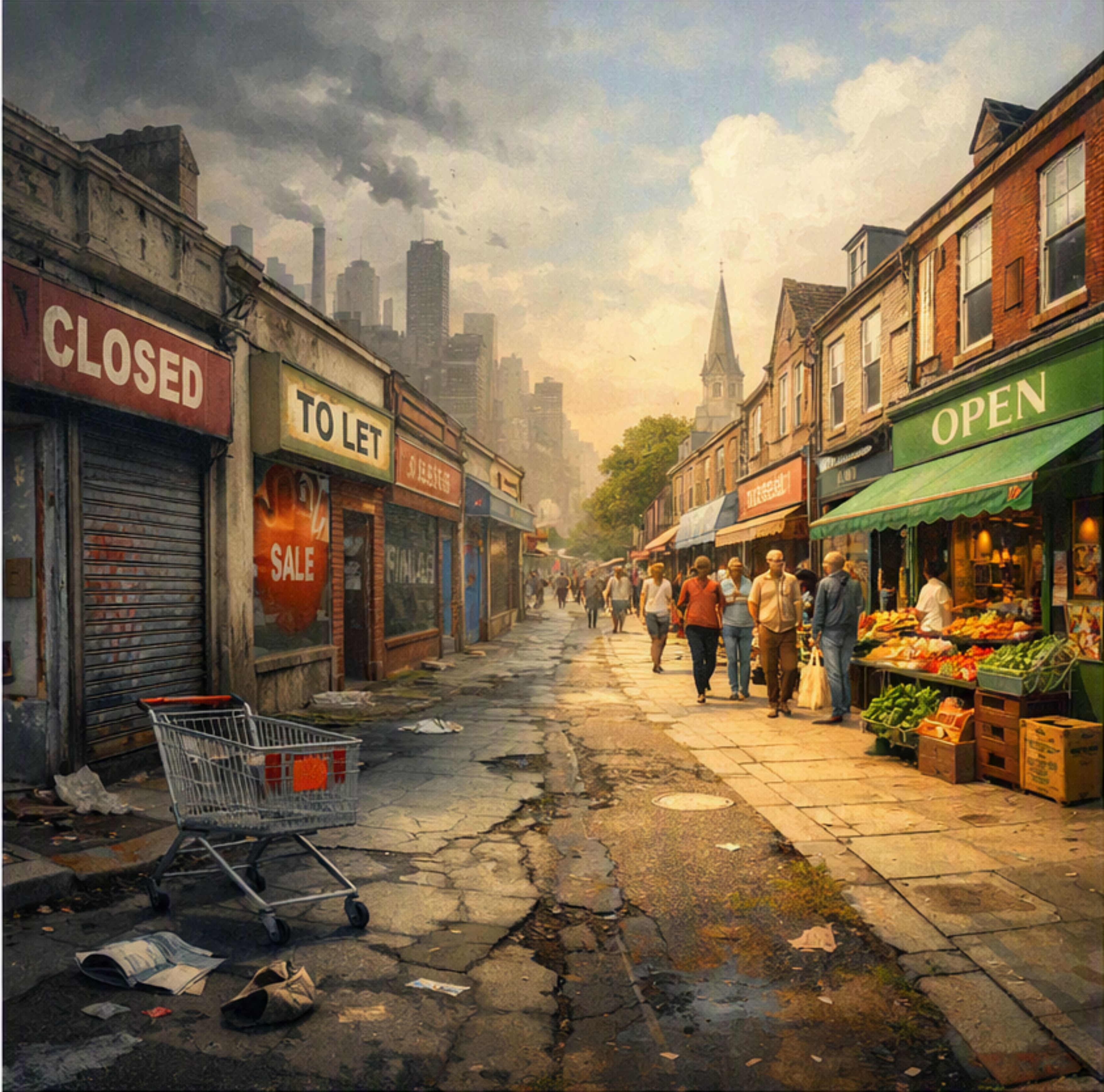

The empty shop is not the disease. It is an early warning sign of a money-centric system running out of road.
High streets are not failing because people suddenly stopped caring about them. They are failing because the economic system that once made them possible has changed so profoundly that the traditional high street no longer fits within it.
The familiar explanations are well known: online shopping, out-of-town retail parks, high rents, business rates, parking, poor planning, and changing consumer habits.
Each of these factors matters. But each is also a consequence of something deeper: a value system that has placed money, return, scale, and efficiency above human participation, local capability, and community life.
The decline of the high street is therefore not just a retail story. It is a visible expression of a wider economic direction. The same system that has hollowed out town centres is now beginning to hollow out work, ownership, contribution, and the human role in economic life itself.
That is why the empty high street matters. It shows us where the system has been, what it has already broken, and where it is now heading.
To understand the problem, we have to follow the chain properly: from local circulation, to financialisation, to centralisation, to digitalisation, to automation, to the false promise of Universal Basic Income, and finally to the question of whether a money-centred system can survive once people are no longer able to participate in it.
The answer begins with the high street, but it ends with the future of society itself.
The high street was built for a different kind of economy
For most of modern history, the high street worked because everyday life was organised locally. People lived near where they shopped. Money moved between households, independent businesses, local trades, nearby suppliers, and community institutions.
Shops were not just places of transaction; they were part of the social infrastructure of a town.
That system depended on local circulation. A pound spent with a local butcher, baker, café, repair shop, market trader, or family-run store was more likely to remain in the area, supporting other local work and relationships.
The high street was therefore sustained not only by demand, but by a pattern of life in which people, money, services, and trust repeatedly moved through the same place.
This is what is meant by a human-scale economy: an economy small enough for people to see the consequences of their choices, know who they are dealing with, and feel that their town is something they participate in rather than merely pass through.
The old high street was not perfect, and it should not be romanticised. But it did reflect a structure in which local presence mattered. That structure has been steadily dismantled.
Financialisation changed the rules
Over recent decades, the economy has shifted away from production, local exchange, and community resilience towards financialisation.
Financialisation means the process by which financial returns, asset values, debt, speculation, and shareholder value become more important than the practical usefulness of the things being financed.
In a financialised economy, the question changes. Instead of asking, “What does this place need in order to thrive?”, the system increasingly asks, “What produces the highest return?”
- Efficiency is rewarded more than resilience.
- Scale is rewarded more than locality.
- Profit is rewarded more than community benefit.
- Growth is rewarded more than stability.
- Centralisation is rewarded more than distributed local ownership.
Once those incentives dominate, decline becomes less mysterious. Supermarkets replace local food shops because they operate at scale. Retail parks draw trade away from town centres because they fit car-based convenience. Online platforms bypass local businesses because they can centralise stock, data, logistics, and profit. Landlords and investors may treat property as an asset class before they treat it as part of a living town.
This does not mean every closure is caused by one villain or one policy. It means the wider system increasingly incentivises behaviour that drains value away from local places.
That is what extraction means in this context: value is created in one place, by real people and real communities, but is captured elsewhere by systems, owners, platforms, or institutions that are distant from the consequences.
Financialisation is not the root cause
Financialisation itself did not appear from nowhere. It emerged from a deeper value system that places money at the centre of every part of life.
When money becomes the primary measure of success, institutions begin organising themselves around its accumulation. Communities become markets. Citizens become consumers. Local capability becomes less important than financial efficiency.
The decline of the high street therefore reveals more than a retail problem. It shows what happens when the economy stops asking what creates healthy places and starts asking only what produces measurable financial return.
Digital convenience accelerated the collapse
Digitalisation did not create the underlying problem, but it accelerated it dramatically.
Online retail, delivery apps, automated logistics, targeted advertising, and platform marketplaces all make it easier for spending to leave our towns and communities without ever touching the local economy.
The promise is convenience. The cost is disconnection.
A purchase that once involved a walk or bus ride into town, a conversation, a shopfront, a local wage, and perhaps another local supplier can now become a silent transfer to a centralised platform where no other human being will ever be seen.
The behaviour feels small and therefore insignificant at the level of the individual, but multiplied across millions of transactions it transforms the physical life of towns and cities too.
The high street is expected to compete, but it is not competing on equal terms. It is being measured against businesses that can exploit scale, data, automation, global supply chains, and financial backing that local shops rarely possess.
This is why decline often feels like a one-way street. The system increasingly makes local presence optional, then wonders why local places become vulnerable, underused, and out of step with the economic world being built around them.
Why some high streets still thrive
Some high streets still work, and their existence is important because it proves that decline is not inevitable.
In many places, especially where communities remain socially dense and locally connected, independent businesses continue to play a central role in daily life.
Part of the reason appears to be stronger social cohesion, local spending habits, walkable routines, and community networks. These are not minor details. They are the social conditions that allow local businesses to survive.
Thriving local economies often depend on behaviours such as:
- regular walking routes through local shops and services
- dense social networks that create trust and repeat custom
- loyalty to community-run or family-run businesses
- localised spending patterns
- multi-generational knowledge of place
- a sense that the high street belongs to the community, not only to landlords and retailers
These behaviours naturally sustain local shops because they keep money, attention, and relationships circulating within the area.
The lesson is not that some communities are immune to economic pressure. It is that high streets need more than buildings, grants, or branding exercises.
High streets and urban centres need the social and economic infrastructure that gives people a reason to use them every day.
Where that infrastructure remains, high streets remain more resilient. Where it has been stripped away, regeneration becomes much harder. This is why the answer cannot be limited to retail strategy. The problem is deeper than shopping, and so the solution has to be deeper too.
The high street is the warning, not the destination
The mistake is to treat the decline of the high street as an isolated problem.
It is not. It is an early warning sign of a much larger direction of travel.
The same forces that reduced the need for local shops are now reducing the need for human involvement elsewhere. Automation, artificial intelligence, platform systems, and machine-led logistics all follow the same basic logic: remove friction, reduce cost, increase efficiency, centralise control, and maximise return.
For those who own the platforms, technologies, data, and infrastructure, this appears rational. It looks like progress. But the contradiction is obvious once we look at the system as a whole: a money-centric economy only functions if people continue to earn, spend, consume, and generate returns.
If technology removes the economic role of growing numbers of people, the system does not become magically abundant. It becomes unstable.
The customers, workers, taxpayers, tenants, borrowers, and consumers who are supposed to keep the machinery turning are the same people whose incomes and agency are being eroded.
This is the direction the empty high street points towards. First local shops become unnecessary. Then local ownership becomes unnecessary. Then local labour becomes unnecessary. Eventually, human participation itself is treated as an inefficiency to be managed.
Why UBI has entered the conversation
This is why Universal Basic Income, or UBI, has become attractive to some of the people building the technological future as we are being led to understand it.
They can see that a problem is coming. They can see that automation and artificial intelligence may leave many people without a reliable route to income. They can see that a system built on employment and consumption faces a serious problem if employment becomes scarce.
But recognising that a problem is coming is not the same as understanding the mechanics of the system that created it.
Proposing UBI as the solution assumes that a collapsing money-centric system can be preserved by giving people enough money to keep consuming. It assumes that the same structure that has concentrated ownership, transferred wealth, extracted value, weakened local capability, and reduced human participation can somehow provide a secure income to a population it no longer needs economically.
That is the contradiction. A system built on wages, debt, rent, consumption, tax, and returns cannot sustain a permanently kept population if the people expected to fund and circulate value no longer have stable incomes. Even if the intention were compassionate, the mechanism does not hold.
UBI may soften the appearance of collapse for a time, but it does not reverse the underlying direction. It does not restore local ownership. It does not rebuild capability. It does not give people a meaningful role in production, governance, or community life. It keeps the money-centred frame intact while the social and economic foundations beneath it continue to weaken.
The problem is not that people need support. They do. The problem is believing that support can be delivered through the same system that created the dependency in the first place.
The alternative: LEGS, BLS, and a people-centred economy
If the high street is a symptom of a deeper economic failure, then saving it cannot mean simply filling empty units with new tenants. Nor can it mean relying on another short-term regeneration scheme, marketing campaign, subsidy, or welfare mechanism that leaves the underlying structure untouched.
What is needed is a revaluation: a shift away from treating money as the centre of value and towards treating human wellbeing, contribution, dignity, place, community resilience, and environmental responsibility as the things an economy is supposed to serve.
This is where the Local Economy & Governance System, or LEGS, becomes relevant. LEGS is not simply an economic policy. It is a different operating system for society: one that begins with people, community, and the environment rather than money, growth, and extraction.
Its purpose is to restore local capability, local decision-making, shared responsibility, and meaningful contribution.
Instead of asking how people can be kept alive inside a system that no longer needs them, it asks how society can be organised so that people remain necessary, valued, secure, and sovereign.
The Basic Living Standard, or BLS, is central to that alternative. Unlike UBI, it is not simply a payment distributed within the existing system. It is a structural guarantee that people can meet the essential costs of living through a normal week’s contribution, without debt, charity, or dependency.
It links security to dignity, participation, and a fair structure of life rather than to passive receipt within a collapsing model.
In practical terms, this means rebuilding local economic life around:
- local capability, so towns can meet more of their own needs
- local production and repair, so value is created close to where people live
- local supply chains, so businesses support one another rather than depend entirely on distant systems
- local ownership, so wealth does not immediately leave the area
- local governance, so decisions are made closer to their consequences
- local value circulation, so money, skills, trust, and responsibility move through the community rather than out of it
This is not a call to go backwards. It is a call to re-scale forwards: to use technology, planning, enterprise, and governance in ways that strengthen human capability rather than replace it.
A healthy high street cannot be created by nostalgia. It can only be created by an economy that gives people a real reason, and real ability, to participate locally. The same is true of society as a whole.
The real message of the empty high street
The decline of the high street matters because it exposes a much deeper problem. It shows what happens when financial efficiency becomes more important than human value, local capability, and community resilience.
Empty shops are not the disease. They are the symptom.
The question is therefore not simply how to save the high street. The question is whether we want to keep organising life around a system that produces dependency, centralisation, extraction, and fragility – or whether we are willing to build systems that restore capability, participation, dignity, sovereignty, and belonging.
The difficulty is not that alternatives such as LEGS and the BLS are impossible to understand. The difficulty is that most of us have been conditioned to believe that a money-centred system is the only way life can work.
We have learned to treat money as value itself, rather than as a tool that should serve life.
That is the real lesson of the high street. It is not asking to be saved as a memory. It is asking whether we still value the kind of society that made it possible – and whether we are willing to build a people-centred future before the money-centred one collapses under its own weight.
Further reading: where to go next
The argument in this article is part of a wider body of work exploring value, local economies, technology, governance, and the need for a people-centred alternative to the money-centric system.
The following pieces are best read in this order, as each one builds on the last.
1. The Basic Living Standard Explained
https://adamtugwell.blog/2025/10/24/the-basic-living-standard-explained/
This piece explains the Basic Living Standard, or BLS, which sits at the heart of the people-centred alternative discussed above. It sets out why security should not depend on charity, debt, insecure employment, or passive state support, but on a fair structure that allows people to meet the essentials of life through meaningful contribution.
2. The Local Economy & Governance System
https://adamtugwell.blog/2025/11/21/the-local-economy-governance-system-online-text/
This is the core alternative framework model referred to as LEGS. It develops the practical structure of a local, participatory, people-centred system built around local capability, local governance, shared responsibility, and the restoration of real economic participation.
3. The Power of Local Communities
https://adamtugwell.blog/2026/03/31/the-power-of-local-communities/
This article expands the social side of the argument. It explores why strong local communities matter, how participation and belonging are created, and why local relationships are not sentimental extras but essential infrastructure for any healthy society.
4. When AI Builds a Machine World, This Economy Can No Longer Sustain
https://adamtugwell.blog/2026/07/20/when-ai-builds-a-machine-world-this-economy-can-no-longer-sustain/
This piece follows the direction of travel beyond the high street into automation, artificial intelligence, and the future of work. It explains why a money-centric economy becomes unstable when the people expected to earn, spend, borrow, pay rent, and consume are increasingly removed from meaningful economic participation.
Taken together, these works show the wider arc: the high street reveals the failure of local circulation; the BLS defines the foundation of security; LEGS provides the structural alternative; local communities explain the social basis; and the AI piece shows why the present direction of travel makes a people-centred system increasingly necessary.

