The debate over tariffs on Chinese electric vehicles has been bubbling across social media, and what’s striking is not the policy detail but the discomfort it creates among the market‑orientated commentariat.
These are people who have spent decades insisting that globalisation is the only sensible economic model, that markets should always set the rules, and that any interference – especially by governments – is a step backwards.
Now, faced with the reality that the UK may need to work with EU partners to protect domestic manufacturers, they are being forced into intellectual contortions that reveal just how brittle their worldview has become.
The friction here is not really about cars. It is about the deeper assumption that the economic model we have – a model built on global supply chains, financial expansion, and the relentless pursuit of growth – is the only one that makes sense.
That assumption rests on a one‑directional pull toward opening trade as far as conceivably possible, because that’s supposedly where growth will be found. And growth, in this worldview, is not about people becoming better off. It is about the creation of yet more money, usually through debt, which pushes up GDP and keeps the financial system ticking over.
This obsession with growth hides a fundamental truth: the growth that markets obsess over is not the same growth that most people experience.
GDP can rise while living standards fall. Productivity can increase while wages stagnate. Asset values can soar while home ownership collapses.
Many people still cling to the myth that political growth will make things better – or at least return life to how it used to be – but the numbers have been going up for years while the lived reality has been going down.
To understand why protectionism now makes sense, we have to understand the money system that made globalisation seem inevitable.
The Money System Behind the Illusion
Modern economies run on fiat money – money created not from physical value but from government authority and, crucially, from debt. When banks issue loans, they create new money. When governments borrow, they expand the money supply. Growth, in the political sense, is simply the expansion of this created money.
For decades, this system worked because the newly created money was tied to expanding production. Factories were built. Goods were made. Jobs were created. Communities thrived. The money had something real behind it.
But once production was moved overseas, the link between money creation and real economic activity broke. We kept creating money – but we no longer created the goods, jobs, or value that once justified it. Instead, the West became dependent on consumption funded by debt, while production was concentrated in China and a handful of other countries.
This is where extraction enters the story.
Extraction: The Hidden Cost of Globalisation
Globalisation didn’t just move factories abroad. It extracted value from every part of Western society:
Extraction of jobs – manufacturing, engineering, logistics, and skilled trades hollowed out.
Extraction of wages – pay stagnated while costs rose.
Extraction of communities – towns built around industry lost their purpose.
Extraction of environmental stability – long supply chains increased emissions and resource depletion.
Extraction of political agency – decisions moved from local hands to global markets.
Extraction of national wealth – profits and production flowed outward, not inward.
Above all, globalisation extracted economic power from people and transferred it to corporations, financial markets, and foreign production hubs.
This wasn’t accidental. It was the design. Globalisation was sold as efficiency, but it functioned as a massive wealth transfer mechanism.
Wealth Transfer: The Real Story
The wealth transfer happened in several layers:
1. From wages to profits
When production moved abroad, labour costs collapsed. The savings didn’t go to consumers – they went to corporations and financial markets.
2. From communities to global supply chains
Local businesses couldn’t compete with imported goods. Wealth drained outward.
3. From national economies to China
The West consumed; China produced. The money followed the production.
4. From real economy to financial economy
As production declined, financial speculation replaced industry as the main driver of “growth.”
5. From future generations to the present
Debt expanded to maintain consumption levels that wages could no longer support.
This is why the system feels hollow: because it is.
The Illusion of Efficiency
Globalisation was sold as efficient. But efficiency is fragile.
Efficiency removes redundancy. Redundancy is what makes systems resilient.
Here, redundancy doesn’t mean job losses. It means resilience. In systems terms, redundancy is the spare capacity, backup options, and local alternatives that keep things functioning when something goes wrong. A resilient economy has multiple sources of essential goods, local production alongside imports, and enough slack in its supply chains to absorb shocks. Globalisation removed this kind of redundancy – not by cutting jobs, but by stripping away the buffers that once protected communities, industries, and national security.
Local supply chains, local production, and local skills were once buffers against shocks. Globalisation removed those buffers. It replaced resilience with fragility, and called it progress.
When shocks hit – a pandemic, a war, an energy crisis – the system broke exactly where it had been hollowed out.
The Curious Love Affair With China
This is where the love affair that politicians, industry aficionados and financial players have with China becomes so curious. They praise China’s industrial might, its manufacturing efficiency, and its ability to produce goods at scale and at speed. But they are blind to the realities underpinning the Chinese powerhouse – just as they are blind to how things really work economically here at home.
China’s industrial strength is real, but its economic model is fragile. It is heavily dependent on exports, deeply entangled in debt, and centrally managed in ways that hide structural weaknesses. The property sector has been in crisis for years. Domestic consumption is too weak to sustain growth. And the country’s manufacturing dominance relies on a global system that assumes stability, cheap energy, and constant demand – none of which can be taken for granted.
Yet Western economies outsourced their industrial base to China under the assumption that globalisation was permanent, stable, and mutually beneficial. They believed that moving production overseas would always be cheaper, always be efficient, and always be safe. But globalisation was never a natural law. It was a confidence game – a system that works only as long as everyone believes it will continue working.
Calling globalisation a Ponzi scheme might be too simple, but calling it a worldwide confidence trick is not far off. It requires constant expansion. It depends on trust rather than resilience. It shifts production far from consumption. And it leaves countries vulnerable if supply chains break, energy prices spike, or geopolitical tensions rise.
The truth that must be reckoned with is this: transferring every conceivable part of industrial production to the other side of the world leaves a serious question hanging in the air. What happens here – and what happens there – when the money system that is the lifeblood of this one-directional process comes to a grinding halt?
AI: The Final Blow to the Globalised Model
If globalisation hollowed out production, AI is now hollowing out what is left of the wage‑earning capacity that once kept the system going.
For decades, the global model relied on a simple loop:
The West consumed goods made abroad.
People earned wages to buy those goods.
Governments and banks created money to keep consumption rising.
China produced the goods that consumption demanded.
But AI breaks this loop. It displaces jobs across sectors – not just manufacturing, which was already offshored, but services, administration, logistics, design, media, and even parts of professional work. The very wage base that kept the consumption‑debt cycle alive is eroding.
We now face a situation where:
We no longer produce the goods.
We no longer earn the wages.
We still create the money – but it has nothing real to attach to.
This is the point where the global system begins to fail. You cannot sustain a consumption‑driven economy when the capacity to earn wages is collapsing. You cannot sustain a debt‑driven money system when the underlying productive base has been hollowed out. And you cannot sustain globalisation when the domestic economy no longer has the means to participate in it.
AI is not the cause of the crisis – it is the accelerant that exposes how fragile the system already was.
The Collapse of Demand
The global system requires:
constant production
constant consumption
constant money creation
constant debt expansion
But:
production moved abroad
wages stagnated
AI reduces earning power
debt has reached saturation
demand is collapsing
Once demand collapses, the entire global system fails – and protectionism becomes not ideological, but practical.
EVs: A Redirection, Not a Solution
EVs are being sold as a technological fix, but they are built on the same flawed logic: extract resources, extract labour, extract wealth, and hope the system holds.
The deeper issue is not the fuel that vehicles use. It is the assumption that we need so many vehicles in the first place – an assumption created by an economic system built around long‑distance commuting, centralised employment, fragmented supply chains, and consumer lifestyles that depend on mobility rather than locality.
EVs change the technology but not the underlying logic.
The System Is Failing – And Protectionism Is Becoming Necessary
We cannot continue like this. Soon we will not be able to.
The system that pointed everything toward China, foreign production, and EVs is falling to its knees. The question is whether we wake up in time to address the real issues while we still have a choice – or whether events will push everything we know straight to the floor.
In this context, protectionism not only makes sense – it becomes essential. Not just for cars, but for everything people genuinely need each and every day.
Media discussions about “upsetting China” are irrelevant compared to the question of more pressing matters such as whether everyone can continue to eat during a prolonged crisis.
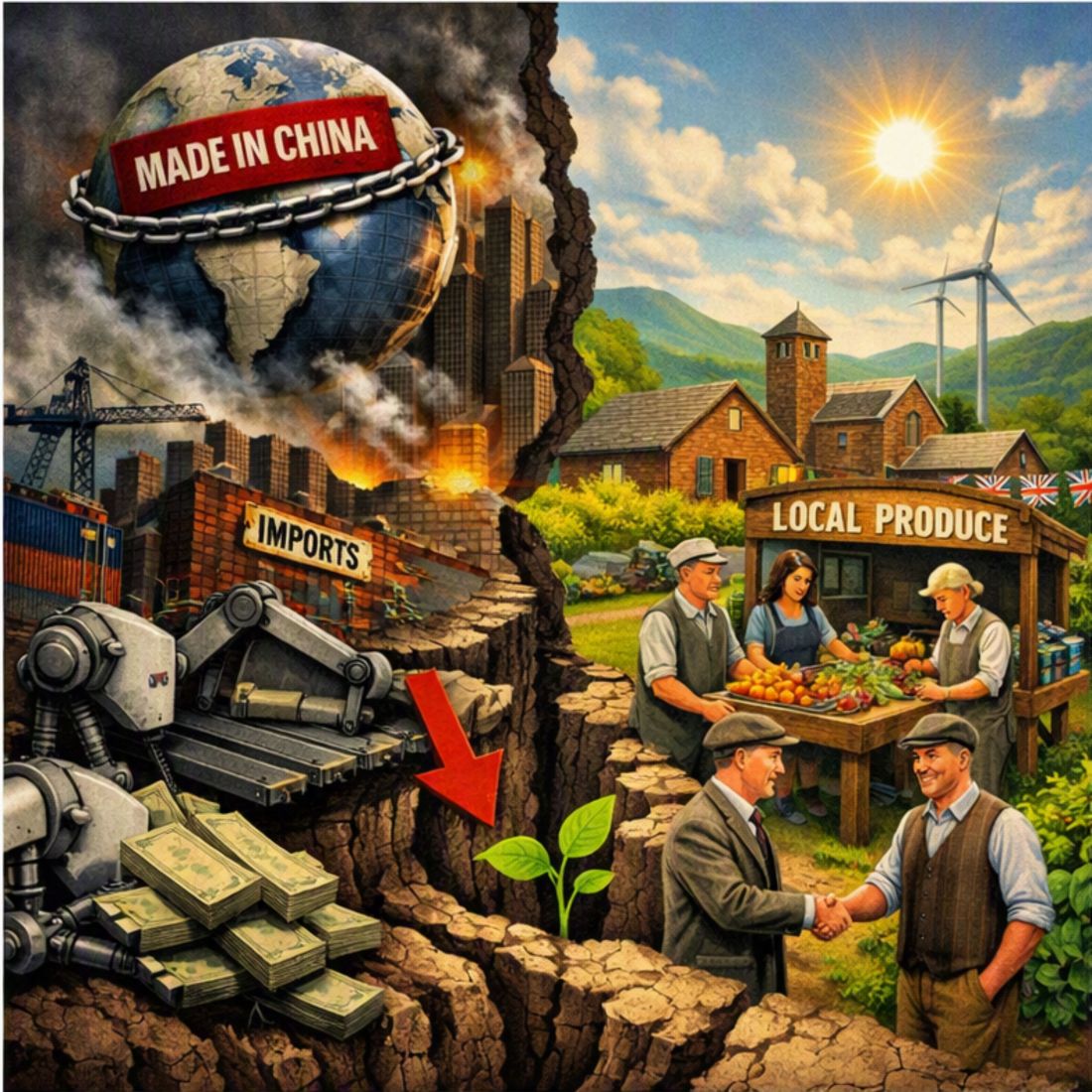
Like so many other forms of essential production and supply we have hollowed out the UK’s ability to feed itself. Politicians may say we produce around 60% of our own food, but that figure is misleading. Much of that production depends on imported inputs: fertiliser, feed, energy, machinery, labour. If borders fully closed, the real amount of food ready to go directly to the table is closer to 11%.
That means in a real, ongoing crisis, we could feed roughly one in ten people. And this would potentially be the baseline for as long as it would take to change, develop and reestablish UK systems to produce enough food to meet everyone’s basic and essential needs.
To call this situation stupid would be an understatement. It is a growing structural vulnerability that has been ignored for decades because it was easier to believe that global supply chains were permanent and that crises only ever happened somewhere else.
The Only Viable Path Forward
Locality, localism, and an entirely different system – one that puts people first rather than money first – is now the only answer. And it’s the same for everyone else too.
Protectionism, in this context, is not about nationalism or nostalgia. It is about resilience. It is about ensuring that essential goods are produced close to where they are consumed. It is about rebuilding the capacity to feed, clothe, transport, and sustain ourselves without relying on fragile global systems.
This does not mean closing borders or rejecting trade. It means recognising that trade should complement domestic capability, not replace it. It means building systems that can withstand shocks rather than collapse under them. It means prioritising the basics – food, energy, manufacturing, infrastructure – over abstract financial growth.
The globalised model didn’t fail because of ideology. It failed because it extracted too much, transferred too much, hollowed out too much, and left too little behind.
Protectionism isn’t a political choice. It’s a survival strategy.
Further Reading
Understanding why protectionism now makes sense requires stepping back and seeing the wider system that shaped our economy, our politics, and our everyday lives.
The following pieces explore the deeper mechanics behind growth, money creation, economic fragility, AI disruption, and the urgent need for localism.
Each article expands on themes raised in the essay and offers a clearer view of how we reached this point – and how we can move forward.
1. Understanding the Growth Illusion
Why Politicians Obsess Over Growth – And Why It Has Nothing To Do With You
A clear explanation of why political “growth” is not the same as real‑world improvement. This piece shows how GDP has become a political performance metric rather than a measure of public wellbeing, and why the obsession with growth continues even when life gets harder for ordinary people.
The Harmful Truths That Are Hidden Behind Political Growth
This piece exposes the hidden mechanics of an economy that works against normal life. It explains how wage stagnation, rising costs, and the collapse of local industry were engineered by a system designed to extract value rather than support people.
Why Britain Feels Like We Are Being Priced Out of Everyday Life
An explanation of why everyday life has become unaffordable. It challenges the mainstream narratives about inflation and cost‑of‑living pressures, showing how the real causes lie in decades of economic policy that hollowed out domestic resilience.
A guide to understanding economic and political turbulence without falling into panic or misinformation. It helps readers see the structural issues clearly and avoid the fear‑driven narratives that often dominate public debate.
3. Fragility, AI, and the Collapse of the Old Model
The Age of Circular Fragility – Why AI and the World Economy May Now Rise and Fall Together
A crucial exploration of how AI accelerates the fragility already built into the global economy. It explains why job displacement, collapsing demand, and global supply chain dependence form a circular system where shocks amplify each other.
A foundational piece outlining what a people‑first economic system would look like. It explains how money, governance, and local production can be redesigned to serve communities rather than financial markets.
A practical framework for how local economies can be structured, governed, and sustained. It shows how localism can replace global fragility with community‑level resilience and democratic control.
A clear explanation of a baseline living standard that ensures everyone has access to essentials. It connects economic design with human dignity and outlines how a fair, sustainable system can be built from the ground up.
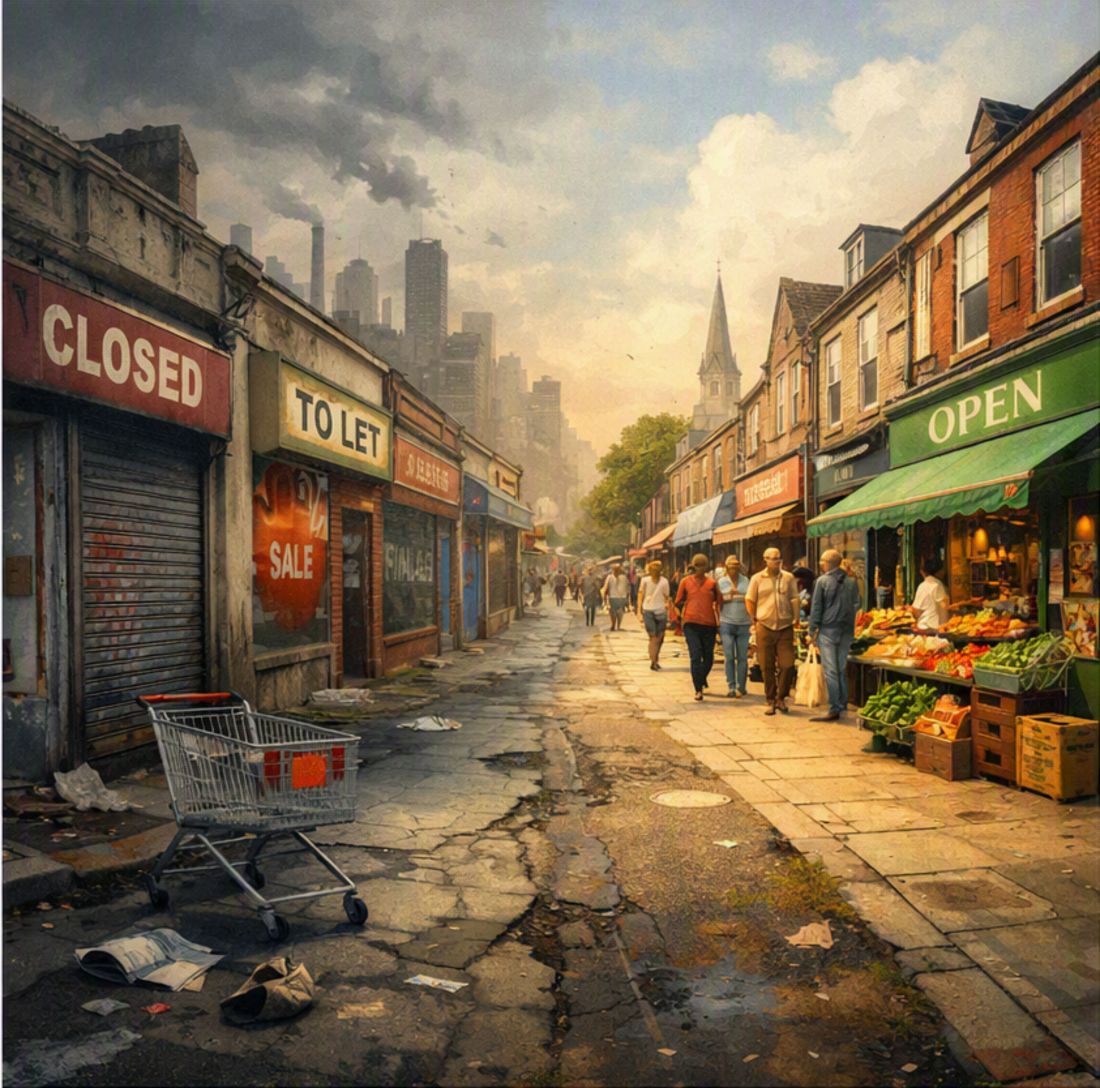
The empty shop is not the disease. It is an early warning sign of a money-centric system running out of road.
High streets are not failing because people suddenly stopped caring about them. They are failing because the economic system that once made them possible has changed so profoundly that the traditional high street no longer fits within it.
The familiar explanations are well known: online shopping, out-of-town retail parks, high rents, business rates, parking, poor planning, and changing consumer habits.
Each of these factors matters. But each is also a consequence of something deeper: a value system that has placed money, return, scale, and efficiency above human participation, local capability, and community life.
The decline of the high street is therefore not just a retail story. It is a visible expression of a wider economic direction. The same system that has hollowed out town centres is now beginning to hollow out work, ownership, contribution, and the human role in economic life itself.
That is why the empty high street matters. It shows us where the system has been, what it has already broken, and where it is now heading.
To understand the problem, we have to follow the chain properly: from local circulation, to financialisation, to centralisation, to digitalisation, to automation, to the false promise of Universal Basic Income, and finally to the question of whether a money-centred system can survive once people are no longer able to participate in it.
The answer begins with the high street, but it ends with the future of society itself.
The high street was built for a different kind of economy
For most of modern history, the high street worked because everyday life was organised locally. People lived near where they shopped. Money moved between households, independent businesses, local trades, nearby suppliers, and community institutions.
Shops were not just places of transaction; they were part of the social infrastructure of a town.
That system depended on local circulation. A pound spent with a local butcher, baker, café, repair shop, market trader, or family-run store was more likely to remain in the area, supporting other local work and relationships.
The high street was therefore sustained not only by demand, but by a pattern of life in which people, money, services, and trust repeatedly moved through the same place.
This is what is meant by a human-scale economy: an economy small enough for people to see the consequences of their choices, know who they are dealing with, and feel that their town is something they participate in rather than merely pass through.
The old high street was not perfect, and it should not be romanticised. But it did reflect a structure in which local presence mattered. That structure has been steadily dismantled.
Financialisation changed the rules
Over recent decades, the economy has shifted away from production, local exchange, and community resilience towards financialisation.
Financialisation means the process by which financial returns, asset values, debt, speculation, and shareholder value become more important than the practical usefulness of the things being financed.
In a financialised economy, the question changes. Instead of asking, “What does this place need in order to thrive?”, the system increasingly asks, “What produces the highest return?”
Efficiency is rewarded more than resilience.
Scale is rewarded more than locality.
Profit is rewarded more than community benefit.
Growth is rewarded more than stability.
Centralisation is rewarded more than distributed local ownership.
Once those incentives dominate, decline becomes less mysterious. Supermarkets replace local food shops because they operate at scale. Retail parks draw trade away from town centres because they fit car-based convenience. Online platforms bypass local businesses because they can centralise stock, data, logistics, and profit. Landlords and investors may treat property as an asset class before they treat it as part of a living town.
This does not mean every closure is caused by one villain or one policy. It means the wider system increasingly incentivises behaviour that drains value away from local places.
That is what extraction means in this context: value is created in one place, by real people and real communities, but is captured elsewhere by systems, owners, platforms, or institutions that are distant from the consequences.
Financialisation is not the root cause
Financialisation itself did not appear from nowhere. It emerged from a deeper value system that places money at the centre of every part of life.
When money becomes the primary measure of success, institutions begin organising themselves around its accumulation. Communities become markets. Citizens become consumers. Local capability becomes less important than financial efficiency.
The decline of the high street therefore reveals more than a retail problem. It shows what happens when the economy stops asking what creates healthy places and starts asking only what produces measurable financial return.
Digital convenience accelerated the collapse
Digitalisation did not create the underlying problem, but it accelerated it dramatically.
Online retail, delivery apps, automated logistics, targeted advertising, and platform marketplaces all make it easier for spending to leave our towns and communities without ever touching the local economy.
The promise is convenience. The cost is disconnection.
A purchase that once involved a walk or bus ride into town, a conversation, a shopfront, a local wage, and perhaps another local supplier can now become a silent transfer to a centralised platform where no other human being will ever be seen.
The behaviour feels small and therefore insignificant at the level of the individual, but multiplied across millions of transactions it transforms the physical life of towns and cities too.
The high street is expected to compete, but it is not competing on equal terms. It is being measured against businesses that can exploit scale, data, automation, global supply chains, and financial backing that local shops rarely possess.
This is why decline often feels like a one-way street. The system increasingly makes local presence optional, then wonders why local places become vulnerable, underused, and out of step with the economic world being built around them.
Why some high streets still thrive
Some high streets still work, and their existence is important because it proves that decline is not inevitable.
In many places, especially where communities remain socially dense and locally connected, independent businesses continue to play a central role in daily life.
Part of the reason appears to be stronger social cohesion, local spending habits, walkable routines, and community networks. These are not minor details. They are the social conditions that allow local businesses to survive.
Thriving local economies often depend on behaviours such as:
regular walking routes through local shops and services
dense social networks that create trust and repeat custom
loyalty to community-run or family-run businesses
localised spending patterns
multi-generational knowledge of place
a sense that the high street belongs to the community, not only to landlords and retailers
These behaviours naturally sustain local shops because they keep money, attention, and relationships circulating within the area.
The lesson is not that some communities are immune to economic pressure. It is that high streets need more than buildings, grants, or branding exercises.
High streets and urban centres need the social and economic infrastructure that gives people a reason to use them every day.
Where that infrastructure remains, high streets remain more resilient. Where it has been stripped away, regeneration becomes much harder. This is why the answer cannot be limited to retail strategy. The problem is deeper than shopping, and so the solution has to be deeper too.
The high street is the warning, not the destination
The mistake is to treat the decline of the high street as an isolated problem.
It is not. It is an early warning sign of a much larger direction of travel.
The same forces that reduced the need for local shops are now reducing the need for human involvement elsewhere. Automation, artificial intelligence, platform systems, and machine-led logistics all follow the same basic logic: remove friction, reduce cost, increase efficiency, centralise control, and maximise return.
For those who own the platforms, technologies, data, and infrastructure, this appears rational. It looks like progress. But the contradiction is obvious once we look at the system as a whole: a money-centric economy only functions if people continue to earn, spend, consume, and generate returns.
If technology removes the economic role of growing numbers of people, the system does not become magically abundant. It becomes unstable.
The customers, workers, taxpayers, tenants, borrowers, and consumers who are supposed to keep the machinery turning are the same people whose incomes and agency are being eroded.
This is the direction the empty high street points towards. First local shops become unnecessary. Then local ownership becomes unnecessary. Then local labour becomes unnecessary. Eventually, human participation itself is treated as an inefficiency to be managed.
Why UBI has entered the conversation
This is why Universal Basic Income, or UBI, has become attractive to some of the people building the technological future as we are being led to understand it.
They can see that a problem is coming. They can see that automation and artificial intelligence may leave many people without a reliable route to income. They can see that a system built on employment and consumption faces a serious problem if employment becomes scarce.
But recognising that a problem is coming is not the same as understanding the mechanics of the system that created it.
Proposing UBI as the solution assumes that a collapsing money-centric system can be preserved by giving people enough money to keep consuming. It assumes that the same structure that has concentrated ownership, transferred wealth, extracted value, weakened local capability, and reduced human participation can somehow provide a secure income to a population it no longer needs economically.
That is the contradiction. A system built on wages, debt, rent, consumption, tax, and returns cannot sustain a permanently kept population if the people expected to fund and circulate value no longer have stable incomes. Even if the intention were compassionate, the mechanism does not hold.
UBI may soften the appearance of collapse for a time, but it does not reverse the underlying direction. It does not restore local ownership. It does not rebuild capability. It does not give people a meaningful role in production, governance, or community life. It keeps the money-centred frame intact while the social and economic foundations beneath it continue to weaken.
The problem is not that people need support. They do. The problem is believing that support can be delivered through the same system that created the dependency in the first place.
The alternative: LEGS, BLS, and a people-centred economy
If the high street is a symptom of a deeper economic failure, then saving it cannot mean simply filling empty units with new tenants. Nor can it mean relying on another short-term regeneration scheme, marketing campaign, subsidy, or welfare mechanism that leaves the underlying structure untouched.
What is needed is a revaluation: a shift away from treating money as the centre of value and towards treating human wellbeing, contribution, dignity, place, community resilience, and environmental responsibility as the things an economy is supposed to serve.
This is where the Local Economy & Governance System, or LEGS, becomes relevant. LEGS is not simply an economic policy. It is a different operating system for society: one that begins with people, community, and the environment rather than money, growth, and extraction.
Its purpose is to restore local capability, local decision-making, shared responsibility, and meaningful contribution.
Instead of asking how people can be kept alive inside a system that no longer needs them, it asks how society can be organised so that people remain necessary, valued, secure, and sovereign.
The Basic Living Standard, or BLS, is central to that alternative. Unlike UBI, it is not simply a payment distributed within the existing system. It is a structural guarantee that people can meet the essential costs of living through a normal week’s contribution, without debt, charity, or dependency.
It links security to dignity, participation, and a fair structure of life rather than to passive receipt within a collapsing model.
In practical terms, this means rebuilding local economic life around:
local capability, so towns can meet more of their own needs
local production and repair, so value is created close to where people live
local supply chains, so businesses support one another rather than depend entirely on distant systems
local ownership, so wealth does not immediately leave the area
local governance, so decisions are made closer to their consequences
local value circulation, so money, skills, trust, and responsibility move through the community rather than out of it
This is not a call to go backwards. It is a call to re-scale forwards: to use technology, planning, enterprise, and governance in ways that strengthen human capability rather than replace it.
A healthy high street cannot be created by nostalgia. It can only be created by an economy that gives people a real reason, and real ability, to participate locally. The same is true of society as a whole.
The real message of the empty high street
The decline of the high street matters because it exposes a much deeper problem. It shows what happens when financial efficiency becomes more important than human value, local capability, and community resilience.
Empty shops are not the disease. They are the symptom.
The question is therefore not simply how to save the high street. The question is whether we want to keep organising life around a system that produces dependency, centralisation, extraction, and fragility – or whether we are willing to build systems that restore capability, participation, dignity, sovereignty, and belonging.
The difficulty is not that alternatives such as LEGS and the BLS are impossible to understand. The difficulty is that most of us have been conditioned to believe that a money-centred system is the only way life can work.
We have learned to treat money as value itself, rather than as a tool that should serve life.
That is the real lesson of the high street. It is not asking to be saved as a memory. It is asking whether we still value the kind of society that made it possible – and whether we are willing to build a people-centred future before the money-centred one collapses under its own weight.
Further reading: where to go next
The argument in this article is part of a wider body of work exploring value, local economies, technology, governance, and the need for a people-centred alternative to the money-centric system.
The following pieces are best read in this order, as each one builds on the last.
1. The Basic Living Standard Explained https://adamtugwell.blog/2025/10/24/the-basic-living-standard-explained/ This piece explains the Basic Living Standard, or BLS, which sits at the heart of the people-centred alternative discussed above. It sets out why security should not depend on charity, debt, insecure employment, or passive state support, but on a fair structure that allows people to meet the essentials of life through meaningful contribution.
2. The Local Economy & Governance System https://adamtugwell.blog/2025/11/21/the-local-economy-governance-system-online-text/ This is the core alternative framework model referred to as LEGS. It develops the practical structure of a local, participatory, people-centred system built around local capability, local governance, shared responsibility, and the restoration of real economic participation.
3. The Power of Local Communities https://adamtugwell.blog/2026/03/31/the-power-of-local-communities/ This article expands the social side of the argument. It explores why strong local communities matter, how participation and belonging are created, and why local relationships are not sentimental extras but essential infrastructure for any healthy society.
4. When AI Builds a Machine World, This Economy Can No Longer Sustain https://adamtugwell.blog/2026/07/20/when-ai-builds-a-machine-world-this-economy-can-no-longer-sustain/ This piece follows the direction of travel beyond the high street into automation, artificial intelligence, and the future of work. It explains why a money-centric economy becomes unstable when the people expected to earn, spend, borrow, pay rent, and consume are increasingly removed from meaningful economic participation.
Taken together, these works show the wider arc: the high street reveals the failure of local circulation; the BLS defines the foundation of security; LEGS provides the structural alternative; local communities explain the social basis; and the AI piece shows why the present direction of travel makes a people-centred system increasingly necessary.
“Locality is the natural scale of human life. Everything else is a managed simulation.”
A Note from Adam
This essay sits within a wider body of work that includes The Local Economy & Governance System, The Basic Living Standard, The Revaluation, The Contribution Culture, Foods We Can Trust – A Blueprint’ and Centralisation Only Rewards Those at the Centre.
All of these pieces are attempts to describe something that should be obvious, but has become strangely difficult to see: that the world we live in today is not built on real life, but on layers of abstraction that have replaced it.
The tragedy – and the reason this work is necessary – is that when people are raised inside an abstract world, the real world begins to look abstract.
Locality looks naïve.
Community looks unrealistic.
Contribution looks idealistic.
Real food looks nostalgic.
Real governance looks impossible.
Real value looks imaginary.
Real life looks like a fantasy.
This inversion is not accidental. It is the predictable outcome of a system that has normalised distance, centralisation, and money as the organising principles of life.
When the abstract becomes normal, the real becomes suspicious.
People reject the very things that would make them healthy, grounded, connected, and free – not because they are wrong, but because they have been conditioned to believe that the real is impractical, inefficient, or outdated.
This rejection is not a rational act. It is a form of self‑harm.
It is the moment when a person turns away from the only scale of life that can sustain them – the local, the human, the grounded – and chooses instead the familiar discomfort of the abstract world.
This essay is written to break that spell.
It is written to help people see the abstract world clearly, perhaps for the first time. It is written to show how the real world has been hidden in plain sight. It is written to reveal why the real feels abstract, and why the abstract feels real. It is written to open the doorway back to a life that makes sense.
If the ideas inside this essay feel unfamiliar, strange, or even unsettling, that is not a sign that they are wrong. It is a sign of how deeply the abstract world has shaped our perception.
The work that follows – including LEGS, the Basic Living Standard, and the wider architecture of a local, human or people-first economy – is not an attempt to invent a new world.
It is an attempt to return to the only world that has ever truly worked.
A world where life is lived at the scale of human beings. A world where value is real. A world where community is lived. A world where food is understood. A world where governance is accountable. A world where health is natural. A world where meaning is visible. A world where people are whole.
This essay is the beginning of that return.
Stepping Out of the Abstract: Why This Essay Exists
We live in a world where almost everything that matters has been lifted out of daily life and placed somewhere distant, managed by people we never meet, shaped by systems we never see, and justified by narratives we never question.
This distance has become so normal that most people no longer recognise it as distance at all.
They mistake abstraction for reality because they have never known anything else.
This is the quiet tragedy of the money‑centric, centralised world:
When you are raised inside the abstract, the real begins to look abstract.
Locality – the natural scale of human life – begins to feel naïve. Community begins to feel unrealistic. Contribution begins to feel idealistic. Real food begins to feel nostalgic. Real governance begins to feel impossible. Real value begins to feel imaginary.
And because the abstract world is all we have been shown, many people reject the real world when they first encounter it – not because it is wrong, but because it feels unfamiliar.
This rejection is not a failure of intelligence.
It is a consequence of conditioning.
It is also a form of self‑harm.
Because the real world – the local, the human, the grounded – is the only place where health, meaning, agency, and freedom can genuinely exist.
This essay is written for the moment when people begin to sense that something is wrong, even if they cannot yet name it.
It is written for the moment when the abstract world stops feeling natural. It is written for the moment when the doorway to the real world becomes visible – even if only faintly.
It draws on the wider body of work – including Centralisation Only Rewards Those at the Centre – to show how the abstract world hides in plain sight, how it shapes our behaviour without our consent, and how it convinces us to reject the very things that would make our lives whole again.
This essay is not an argument.
It is an invitation.
An invitation to see clearly. An invitation to understand deeply. An invitation to step back into the real.
SECTION 1 – Life Inside the Abstract
Most people can feel that something is wrong with the world today, even if they can’t quite name it. There is a sense of disconnection running through everything – work, community, politics, food, even our relationship with ourselves.
Life feels harder than it should be. Nothing seems to add up. And yet, when we look around, the structures that shape our lives appear normal, familiar, even inevitable.
The truth is far more uncomfortable.
We are not living real lives anymore.
We are living in an abstract world – a world built on systems, narratives, and mechanisms that sit outside our direct experience, yet govern almost every part of it.
We have been conditioned to treat these abstractions as reality, even when they bear no resemblance to the lives we actually live.
We mistake the abstract for the real because we have forgotten what real life feels like.
Real life is local.
Real life is human.
Real life is experienced directly – through people, places, relationships, and the natural world.
But the world we inhabit today is mediated through layers of distance, bureaucracy, digital interfaces, centralised systems, and economic structures that most of us never see.
We live inside a world of processes we do not control, rules we did not write, and decisions made by people we will never meet.
We have been taught to believe that this is normal.
It isn’t.
It is simply the result of a system that has replaced lived experience with abstraction – and then convinced us that the abstraction is real.
This is why so many people feel exhausted, anxious, or powerless. It is why work feels meaningless. It is why communities feel hollow. It is why food feels fragile. It is why politics feels distant. It is why life feels precarious.
We are trying to live real lives inside an abstract world.
And the abstract world is collapsing.
To understand why – and to understand the alternative – we must first see the architecture of the abstract world clearly. Because once you see it, you cannot unsee it. And once you understand how abstraction has replaced reality, you begin to understand why the only real solution is to return life to the scale where humans actually exist.
That scale is the local.
And the system that makes that return possible is the Local Economy & Governance System (LEGS).
But before we can reach that point, we must first understand how the abstract world was built – and why it has taken us so far away from the lives we were meant to live.
SECTION 2 – How Abstraction Shapes Daily Life
One of the most important things we have to recognise – and perhaps the hardest – is just how much of the world we take for granted without ever questioning how it really works.
We assume that because something is familiar, it must also be real. We assume that because something is normal, it must also be natural. And we assume that because something has always been presented to us in a certain way, that way must be the truth.
But much of what we now treat as “real life” is nothing of the sort.
We are living in an abstract world – a world built on ideas, systems, and processes that sit far outside our direct experience, yet shape almost everything we do. And because these abstractions have been with us for so long, we rarely notice them. They hide in plain sight, precisely because we have stopped looking for anything else.
But the question itself reveals something much deeper.
Because we already have compulsory subjects in schools.
And yet almost none of them connect children to real life.
They are taught in the abstract.
They are delivered through textbooks, screens, worksheets, and exam specifications – not through lived experience. Children learn about the world through representations of the world, not through the world itself. They learn about life without ever touching life.
So when we say “make food education compulsory,” we are really saying “add food to the list of things we teach abstractly.”
We don’t even notice the contradiction.
We don’t notice that the very structure of schooling has become abstract – detached from the realities of life, detached from the skills that sustain us, detached from the communities we live in. We don’t notice that the way we teach children about the world is itself part of the problem.
We don’t notice because abstraction has become normal.
We have been conditioned to believe that learning happens in classrooms, not in fields, kitchens, workshops, or communities.
We have been conditioned to believe that knowledge comes from institutions, not from experience.
We have been conditioned to believe that the abstract version of life is the real one – and that the real one is somehow outdated, inefficient, or unnecessary.
This is how deeply the abstract world has embedded itself.
We no longer see the distance between the representation and the reality. We no longer see the gap between what we are taught and what we need. We no longer see that the systems we rely on are not built around life at all.
Food education is just one example – but it is the example that exposes the whole pattern.
Because food is not abstract.
Food is life. Food is local. Food is real.
And yet most people now understand food only through the abstract lens of supermarkets, supply chains, packaging, and price labels.
They understand food as something they buy, not something they grow, prepare, preserve, or share.
They understand food as a product, not a relationship.
So when we talk about teaching food in schools, we are really talking about teaching the abstract version of food – the version that fits neatly into a curriculum, not the version that sustains life.
This is the heart of the problem.
We are trying to fix the consequences of abstraction by adding more abstraction.
We are trying to reconnect people to real life through systems that are themselves disconnected from real life.
We are trying to solve a problem we have not yet recognised.
Because the problem is not that children don’t understand food.
The problem is that children – and adults – no longer live in a world where real life is visible.
We live in the abstract. We think in the abstract. We learn in the abstract. We work in the abstract. We eat in the abstract. We govern in the abstract.
And because abstraction has become normal, we no longer see what it has taken from us.
But once you begin to see it – once you notice how much of life has been lifted out of reality and placed into distant systems – you begin to understand why so much feels wrong, disconnected, or hollow.
You begin to understand why the sums no longer add up.
You begin to understand why people feel lost.
You begin to understand why communities feel empty.
You begin to understand why the world feels fragile.
And you begin to understand why the only real solution is to return life to the scale where it actually exists.
The local.
The human.
The real.
SECTION 3 – Food: The Evidence for Local Reality
If there is one place where the difference between real life and the abstract world becomes impossible to ignore, it is food. Food exposes the truth that sits beneath everything else:
Local is real. Local is healthy. Local is human.
Abstract is false. Abstract is unhealthy. Abstract is dehumanising.
Food shows us this more clearly than anything else because food cannot be understood in the abstract. You cannot learn food from a worksheet. You cannot respect food from a PowerPoint. You cannot understand food from a supermarket shelf.
Food is something you learn by living with it.
For most of human history, food was part of daily life. Children didn’t need lessons about food – they absorbed it simply by being present.
They saw seeds planted, animals cared for, bread made, meals prepared, leftovers preserved, and seasons change.
They learned respect for food because they saw the work, the patience, the skill, and the care that food requires.
Food was not a subject. Food was a relationship. Food was real.
And because food was real, it made life real.
It grounded people physically, mentally, emotionally, and socially. It connected them to nature, to community, and to themselves.
This is what locality does.
Locality makes life real.
Locality makes life healthy.
But today, food has been lifted out of daily life and placed into the abstract.
Most people no longer grow food. Most people no longer prepare food from scratch. Most people no longer understand where food comes from or what it takes to produce it.
Instead, food arrives through a system that is distant, centralised, and invisible. We experience food through packaging, branding, supply chains, and price labels. We “know” food only as something we buy – not something we understand.
And because food has become abstract, our relationship with life has become abstract.
We no longer see the soil. We no longer see the seasons. We no longer see the labour. We no longer see the community. We no longer see the meaning.
We see only the abstraction – and we mistake it for reality.
This is why the suggestion that food production should be compulsory in schools misses the point so completely. It assumes that the problem is lack of information. It assumes that the solution is more teaching. It assumes that adding food to the curriculum will reconnect children to real life.
But compulsory subjects are already taught in the abstract.
They are delivered through screens, worksheets, and exam specifications – not through lived experience. They are disconnected from the world they claim to describe. They teach children about life without ever letting them touch life.
So when we say “teach food in schools,” we are really saying “teach the abstract version of food.”
We don’t even notice the contradiction because abstraction has become normal.
But food refuses to be abstract.
Food exposes the lie.
Food reveals the truth.
Because food can only be understood locally.
Food can only be respected locally.
Food can only be lived locally.
And when food is local, life becomes local.
When food is real, life becomes real.
When food is part of daily life, people become grounded, connected, and healthy – physically and mentally.
This is the deeper truth hiding in plain sight:
Anything that is real must be lived locally.
Anything that is abstract becomes unhealthy – for people, for communities, and for the world.
Food shows us this with absolute clarity.
When food is local, people are independent.
When food is local, communities are resilient.
When food is local, life makes sense.
But when food becomes abstract, people become dependent.
Communities become hollow. Skills disappear. Respect disappears. Meaning disappears. Health – physical and mental – declines.
Food is the proof that abstraction is not just a philosophical idea.
It is a lived experience with real consequences.
And it is also the proof that the way back to a healthy, grounded, human life is through locality.
Because food cannot be centralised without becoming abstract. And life cannot be centralised without becoming abstract.
Food shows us the truth we have forgotten:
Local is real. Local is healthy.
Abstract is false. Abstract is unhealthy.
And once you see this in food, you begin to see it everywhere.
SECTION 4 – When Abstraction Disrupts Meaning
Once you begin to see how food reveals the difference between the real and the abstract, something else becomes clear: the reason so much of life feels confusing, unstable, or unhealthy today is because we are trying to live real lives inside systems that are not real.
When life is local, it is grounded.
When life is local, it is human.
When life is local, it makes sense.
But when life becomes abstract, it becomes distorted. It becomes stressful. It becomes unhealthy – physically, mentally, emotionally, socially.
And because abstraction has become normal, we rarely connect the dots.
We feel the symptoms, but we don’t see the cause.
We feel overwhelmed, but we don’t see the distance that created it. We feel powerless, but we don’t see the systems that removed our agency. We feel disconnected, but we don’t see how far we’ve been pulled from real life. We feel anxious, but we don’t see that the world we live in is built on instability. We feel lost, but we don’t see that the map we were given was abstract all along.
Food shows us this clearly.
When food was part of daily life, people understood the world around them. They understood seasons, weather, soil, animals, and the rhythms of nature. They understood effort, patience, and consequence. They understood community, because food required community.
This understanding created stability – not just physical stability, but mental and emotional stability too.
Locality grounds people.
Locality gives life shape.
Locality gives life meaning.
But when food becomes abstract, that grounding disappears.
People no longer understand the rhythms of life. They no longer see the connection between effort and outcome. They no longer experience the satisfaction of contribution. They no longer feel part of anything bigger than themselves. They no longer feel capable of providing for themselves.
This creates a deep, quiet anxiety – the kind that sits beneath everything else.
Because when the most essential part of life becomes abstract, everything else becomes abstract too.
Work becomes abstract – disconnected from purpose. Community becomes abstract – disconnected from place. Governance becomes abstract – disconnected from people. Value becomes abstract – disconnected from meaning. Identity becomes abstract – disconnected from reality.
And when everything becomes abstract, life stops making sense.
People feel like they are constantly running but never arriving. They feel like they are constantly working but never secure. They feel like they are constantly consuming but never satisfied. They feel like they are constantly connected but never seen. They feel like they are constantly informed but never understanding.
This is not a personal failing. It is the predictable outcome of living in a world that has replaced reality with abstraction.
A world where:
food is a product, not a relationship
work is a transaction, not a contribution
community is a slogan, not a lived experience
governance is a bureaucracy, not a responsibility
value is a price tag, not a truth
identity is a profile, not a person
A world where the things that should be local – food, work, community, governance, meaning – have been centralised, standardised, and abstracted.
A world where the things that should be lived have been turned into things that are managed.
A world where the things that should be experienced have been turned into things that are consumed.
A world where the things that should be human have been turned into things that are economic.
And because this world is abstract, it is unhealthy.
It is unhealthy for bodies. It is unhealthy for minds. It is unhealthy for communities. It is unhealthy for the environment. It is unhealthy for democracy. It is unhealthy for life.
Locality is not a lifestyle choice.
Locality is the natural scale of human existence.
When life is local, it becomes real again. When life is local, it becomes healthy again. When life is local, it becomes meaningful again.
Food shows us this. Food proves this. Food is the doorway into this understanding.
And once you see how food reveals the truth about locality and abstraction, you begin to see the deeper structure behind it – the mechanism that created the abstract world and keeps it in place.
That mechanism is centralisation.
And centralisation only ever rewards those at the centre.
SECTION 5 – How Centralisation Sustains Abstraction
Once you see how abstraction pulls life away from the local, the next questions become unavoidable:
Why has so much of life been lifted out of the local in the first place?
Who benefits from life becoming abstract?
And why does the system keep moving further away from the real?
The answer is centralisation.
Centralisation is not an accident. It is not a side‑effect. It is not an unfortunate by‑product of “modern life.”
Centralisation is the mechanism that makes the abstract world possible.
It is the structure that takes power, ownership, and decision‑making away from the local – away from the people who live with the consequences – and moves it upward, into the hands of those who benefit from distance.
And once you understand centralisation, you understand why the world feels the way it does.
Centralisation grows because abstraction feeds it
The money‑centric system we live in today is built on a simple equation:
Money → Wealth → Power → Control → Centralisation
Everyone understands the first step.
Even people with very little money know that money gives them more control over their own lives.
But as you move up the hierarchy, the dynamic changes.
Money no longer gives control over your own life – it gives control over other people’s lives.
And once that dynamic exists, centralisation becomes inevitable.
Because the more centralised a system becomes, the easier it is for those at the centre to extract value from everyone else.
Centralisation rewards the centre.
Abstraction hides the extraction.
Locality is the only thing that resists it.
This is why the system keeps pulling life away from the local.
Locality is real. Locality is human. Locality is healthy. Locality is accountable.
And centralisation cannot survive in a world where people live real, local lives.
Centralisation always removes the local – and replaces it with the abstract
You can see this pattern everywhere once you know what to look for.
Food used to be local. Now it is controlled by global supply chains, supermarket monopolies, and distant corporations.
Work used to be local. Now it is shaped by national policy, global markets, and corporate structures that have no relationship to the communities they affect.
Governance used to be local. Now decisions are made by people who will never meet those they govern.
Education used to be rooted in community life. Now it is delivered through standardised curricula designed far away from the children they are meant to serve.
Health used to be grounded in local knowledge, local relationships, and local responsibility. Now it is managed through centralised systems that treat people as data points.
In every case, the pattern is the same:
Centralisation removes life from the local and replaces it with the abstract.
And because abstraction is unhealthy – physically, mentally, socially, environmentally – centralisation always harms the people furthest from the centre.
Centralisation creates distance – and distance removes empathy
When decisions are made locally, they are made by people who see the consequences.
When decisions are made centrally, they are made by people who never do.
This is why centralised systems feel cold, bureaucratic, and indifferent.
It is not because the people inside them are bad.
It is because the structure itself removes the human connection that makes good decisions possible.
A policymaker in Westminster does not see the farmer whose livelihood is destroyed by a regulation. A supermarket executive does not see the community that loses its last local shop. A global corporation does not see the soil degraded by its supply chain. A distant official does not see the child who never learns where food comes from.
Centralisation makes harm invisible – and therefore easy.
Centralisation is the opposite of locality – and the opposite of health
Locality is real. Locality is grounding. Locality is healthy.
Centralisation is abstract. Centralisation is distancing. Centralisation is unhealthy.
Locality connects people to life. Centralisation disconnects people from life.
Food shows us this more clearly than anything else.
When food is local, people are healthy – physically and mentally.
When food is abstract, people become dependent, disconnected, and unwell.
This is not a coincidence. It is the structure of the system.
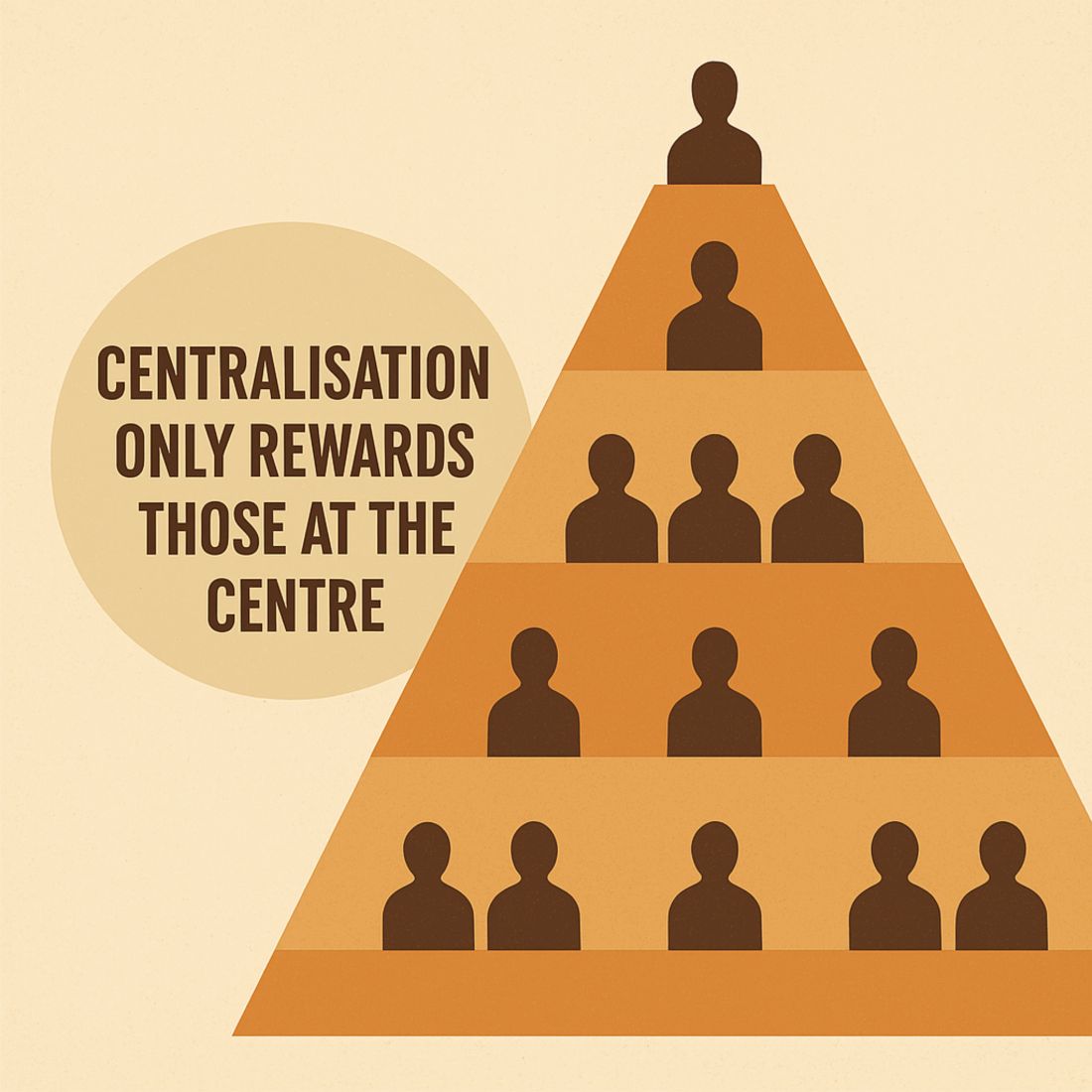
Centralisation only rewards those at the centre
This is the truth that sits beneath everything:
Centralisation always rewards the centre and always harms the local.
It cannot do anything else.
Because centralisation is built on extraction – the extraction of wealth, power, autonomy, and meaning from the many to benefit the few.
And the only way to maintain that extraction is to keep life abstract.
Because abstraction hides the mechanism. Abstraction hides the harm. Abstraction hides the loss of agency. Abstraction hides the loss of independence. Abstraction hides the loss of community. Abstraction hides the loss of health.
Once you see this, you understand why nothing will change until we stop living in the abstract and return life to the local.
And that is where the doorway opens.
Because if centralisation is the engine of the abstract world, then locality is the engine of the real one.
And LEGS is the structure that makes that return possible.
SECTION 6 – Locality: Where Life Becomes Real
Once you understand how abstraction pulls life away from the real, and how centralisation keeps everything abstract, the next truth becomes impossible to ignore:
Real life only exists at the local scale.
Everything else is a managed simulation.
This isn’t ideology. It isn’t nostalgia. It isn’t a romantic longing for the past.
It is simply how human beings work.
Locality is the natural scale of human life because it is the only scale where life can be experienced directly – through our senses, our relationships, our responsibilities, and our contributions.
Locality is where we see the consequences of our actions.
Locality is where we understand the world around us.
Locality is where we feel connected to something bigger than ourselves.
Locality is where we experience meaning.
Locality is where we experience health – physical, mental, emotional, social.
Locality is real. Locality is grounding. Locality is human. Locality is healthy.
And food shows us this more clearly than anything else.
Food proves that locality is the natural scale of life
When food is local, it is part of daily life.
You see it. You touch it. You smell it. You prepare it. You share it. You understand it.
Food becomes a relationship – not a product.
And because food is real, life becomes real.
People who live close to their food systems are more grounded, more resilient, more connected, and more mentally healthy.
They understand the rhythms of nature. They understand the value of effort. They understand the meaning of contribution. They understand the importance of community.
Local food systems create local understanding. Local understanding creates local agency. Local agency creates local resilience. Local resilience creates local freedom.
This is why every healthy society in history has been rooted in locality.
Not because people were primitive. Not because they lacked technology. But because locality is the only scale where life can be lived fully.
Abstraction destroys the grounding that locality provides
When food becomes abstract, life becomes abstract.
People no longer understand the world around them. They no longer feel connected to anything real. They no longer feel capable of providing for themselves. They no longer feel part of a community. They no longer feel grounded in place. They no longer feel secure.
This is why anxiety rises. This is why depression rises. This is why loneliness rises. This is why communities fracture. This is why people feel lost.
It is not because people have changed. It is because the scale of life has changed.
We are trying to live human lives inside systems that are not human.
Locality restores what abstraction removes
When life returns to the local, everything changes.
People begin to feel connected again. They begin to feel capable again. They begin to feel responsible again. They begin to feel valued again. They begin to feel grounded again. They begin to feel healthy again.
Locality restores:
meaning
agency
contribution
community
resilience
identity
belonging
stability
health
Locality is not small. Locality is not limiting. Locality is not backward.
Locality is the scale at which human beings thrive.
And this is the doorway into the next part of the argument:
If locality is the natural scale of life, then we need a system that is built around locality – not around centralisation, abstraction, or money.
We need a system that:
restores real life
restores real value
restores real contribution
restores real community
restores real governance
restores real independence
restores real health
This is where LEGS enters the picture.
LEGS is not an idea. LEGS is not a theory. LEGS is not an ideology.
LEGS is the practical structure that makes locality work – economically, socially, and politically.
And the first step in that structure is the Basic Living Standard.
SECTION 7 – The Basic Living Standard: Security for Real Life
If locality is the natural scale of human life, then the next questions are simple:
What stops people from living locally today?
What prevents people from reconnecting with real life?
What keeps them trapped in the abstract world?
The answer is fear.
Not dramatic fear. Not panic. Not terror.
A quieter fear – the fear of falling.
The fear of not being able to pay the rent. The fear of not being able to heat the home. The fear of not being able to feed the family. The fear of losing work. The fear of losing stability. The fear of losing everything.
This fear is the glue that holds the abstract world together.
It is the mechanism that keeps people compliant, exhausted, distracted, and dependent. It is the reason people stay in jobs that drain them. It is the reason people accept systems that harm them. It is the reason people tolerate centralisation, even when it destroys their communities. It is the reason people cannot step back into real life, even when they can see the doorway.
Fear is the invisible chain that binds people to the abstract world.
And that is why the Basic Living Standard exists.
The Basic Living Standard removes the fear that keeps people trapped in the abstract
The Basic Living Standard (BLS) is not a benefit. It is not welfare. It is not charity. It is not a safety net.
It is the foundation of a healthy society – the point at which survival is no longer tied to employment, and life is no longer held hostage by money.
The BLS guarantees that every person who works a full week at the lowest legal wage can meet all of their essential needs:
food
housing
heat
water
clothing
healthcare
transport
communication
basic participation in community life
This is not generosity. This is not ideology. This is not utopian.
This is the minimum requirement for a real life.
Because without security, people cannot live locally. Without security, people cannot contribute freely. Without security, people cannot think clearly. Without security, people cannot be healthy – physically or mentally. Without security, people cannot resist centralisation. Without security, people cannot step out of the abstract world.
The BLS removes the fear that centralisation depends on.
It breaks the coercive link between survival and employment. It breaks the psychological link between money and worth. It breaks the structural link between centralisation and control.
It gives people the ground beneath their feet.
The BLS makes locality possible again
Locality is not just a preference. It is a way of living that requires stability.
You cannot grow food if you are terrified of losing your home. You cannot contribute to your community if you are working three jobs to survive. You cannot learn real skills if you are constantly firefighting your finances. You cannot participate in local governance if you are exhausted by insecurity. You cannot build a real life if you are trapped in the abstract one.
The BLS creates the conditions in which locality can flourish.
It gives people the freedom to:
choose meaningful work
contribute to their community
learn real skills
participate in local governance
grow food
support neighbours
build resilience
live with dignity
The BLS is not the end of the journey. It is the beginning.
It is the point at which people can finally lift their heads from the grind of survival and see the world around them – the real world, not the abstract one.
The BLS restores the meaning of contribution
In the abstract world, work is a transaction.
In the real world, work is a contribution.
The BLS makes this shift possible.
When survival is guaranteed, people no longer work out of fear. They work out of purpose. They work out of interest. They work out of ability. They work out of connection. They work out of contribution.
This is the foundation of a healthy local economy.
Not competition. Not scarcity. Not extraction. Not centralisation.
Contribution.
And contribution only becomes possible when people are no longer trapped in the abstract world by fear.
The BLS is the first structural step back into real life
Locality is the natural scale of human life. But locality cannot function without security.
The BLS provides that security.
It is the point at which:
fear dissolves
agency returns
contribution becomes possible
community becomes real
locality becomes viable
centralisation loses its grip
abstraction loses its power
The BLS is the foundation of LEGS because it is the foundation of real life.
It is the moment where the abstract world begins to fall away, and the real world begins to reappear.
And once the foundation is in place, the next step becomes clear:
Food is the clearest example of how life has been lifted out of the real and placed into the abstract. But it is only the doorway. Once you step through it, you begin to see the same pattern everywhere.
Because the truth is this:
We are not just eating in the abstract.
We are living in the abstract.
Food simply makes the invisible visible.
When you realise that your relationship with food has become abstract, you begin to notice that your relationship with almost everything else has too.
Work has become abstract
Work used to be something people did for each other – a contribution to the life of the community. You could see the value of your work. You could see who it helped. You could see the difference it made.
Today, work is defined by:
job titles
performance metrics
compliance systems
productivity dashboards
wages
contracts
HR policies
Work has become a transaction, not a contribution.
You don’t see who benefits. You don’t see the outcome. You don’t see the meaning. You only see the abstraction.
And because work is abstract, it is unhealthy – mentally, emotionally, socially.
Value has become abstract
Value used to be rooted in usefulness, skill, care, and contribution.
Today, value is defined by price – a number that often has no relationship to the real worth of anything.
A handmade loaf of bread is “worth” less than a factory loaf.
A neighbour who cares for an elderly parent is “worth” nothing in economic terms.
A farmer who grows real food is “worth” less than a corporation that processes it.
Price has replaced meaning. Money has replaced value. Abstraction has replaced reality.
Governance has become abstract
Governance used to be local, human, and accountable.
Decisions were made by people who lived among those affected by them.
Today, governance is:
distant
bureaucratic
centralised
opaque
unaccountable
Policies are written by people who will never meet the communities they shape.
Rules are imposed by people who will never experience their consequences.
Governance has become abstract – and therefore unhealthy.
Community has become abstract
Community used to be lived.
It used to be physical. It used to be relational. It used to be local.
Today, “community” is:
a slogan
a marketing term
a digital group
a brand identity
a political talking point
People live near each other, but not with each other.
They share space, but not life.
They share information, but not responsibility.
Community has become abstract – and therefore fragile.
Identity has become abstract
Identity used to be shaped by:
relationships
contribution
place
experience
responsibility
community
Today, identity is shaped by:
job titles
income brackets
digital profiles
algorithms
branding
labels
Identity has become abstract – and therefore unstable.
Food is not the whole story – it is the proof
Food is the example that exposes the pattern.
Because food cannot be abstract without consequences.
Food cannot be centralised without harm.
Food cannot be disconnected from daily life without disconnecting people from life itself.
And once you see this in food, you begin to see it everywhere.
You begin to see that the abstract world is not natural. You begin to see that the abstract world is not inevitable. You begin to see that the abstract world is not healthy. You begin to see that the abstract world is not sustainable. You begin to see that the abstract world is not human.
And you begin to see why life feels the way it does.
Food is the doorway. But the destination is understanding the entire structure of the abstract world – and why we must leave it behind.
And that brings us to the next step:
If abstraction is the problem, and locality is the solution, then we need a system built entirely around locality.
That system is LEGS.
SECTION 9 – LEGS: Rebuilding Real Life
By now, the pattern is clear:
The abstract world is unhealthy.
Centralisation keeps life abstract.
Locality is the natural scale of human life.
The Basic Living Standard removes the fear that keeps people trapped in the abstract.
But recognising the problem is only half the journey.
The next step is understanding the structure that replaces it.
Because locality is not just a feeling. It is not just a preference. It is not just a philosophy.
Locality requires a system – a practical, grounded, human system – that allows people to live real lives again.
That system is the Local Economy & Governance System (LEGS).
LEGS is not an ideology.
LEGS is not a political programme.
LEGS is not a utopian dream.
LEGS is a design – a structure built around the natural scale of human life.
It is the opposite of the abstract world. It is the opposite of centralisation. It is the opposite of the money‑centric system.
LEGS is what life looks like when it returns to the local.
LEGS begins with a simple truth: people are the value of the economy
In the abstract world, value is defined by money.
In the real world, value is defined by people.
LEGS restores this truth.
It recognises that:
people create value
people sustain communities
people maintain the environment
people are the economy
Money is not the centre.
People are.
This single shift changes everything.
Because when people are the value, the economy must be built around people – not the other way around.
LEGS restores the natural relationship between people, work, and community
In the abstract world, work is a transaction.
In the real world, work is a contribution.
LEGS makes this shift possible by:
removing fear through the Basic Living Standard
grounding work in the needs of the community
recognising contribution in all its forms
ensuring that work is visible, meaningful, and connected to real life
Work becomes something you do with your community, not something you do for a distant system.
This is how work becomes healthy again – mentally, physically, socially.
LEGS restores locality to the centre of economic life
The abstract world depends on distance.
LEGS depends on proximity.
It brings:
production
exchange
governance
responsibility
contribution
decision‑making
back to the scale where life is actually lived.
This is not small. This is not limiting. This is not backward.
This is the scale at which human beings thrive.
LEGS makes food local again – because food is the anchor of real life
Food is not the whole story, but it is the centre of the story.
Because food is the one part of life that cannot be abstract without consequences.
LEGS restores:
local food production
local food processing
local food exchange
local food skills
local food resilience
Food becomes part of daily life again – not a distant system controlled by people you will never meet.
And when food becomes local, life becomes local.
LEGS restores governance to the people who live with the consequences
In the abstract world, governance is distant and unaccountable.
In the real world, governance is local and human.
LEGS replaces:
hierarchy with participation
bureaucracy with responsibility
distance with proximity
abstraction with lived experience
Decisions are made by the people who live with the outcomes – not by distant institutions.
This is what real democracy looks like.
This is what real accountability looks like.
This is what real community looks like.
LEGS is not a theory – it is a practical system built on natural principles
LEGS works because it is built on the same principles that have sustained human life for thousands of years:
locality
contribution
reciprocity
transparency
shared responsibility
community
stewardship
human scale
These are not political ideas.
These are human truths.
LEGS simply gives them structure.
LEGS is the system that replaces the abstract world
The abstract world is collapsing – socially, economically, environmentally, psychologically.
LEGS is not a reaction to that collapse.
LEGS is the alternative that makes sense once you understand why the collapse is happening.
Because LEGS is:
local where the abstract world is centralised
real where the abstract world is false
human where the abstract world is mechanical
healthy where the abstract world is harmful
grounded where the abstract world is unstable
meaningful where the abstract world is empty
LEGS is not the future because it is new.
LEGS is the future because it is natural.
It is the structure that allows people to live real lives again – lives that are grounded, connected, meaningful, and healthy.
And once you see the abstract world clearly, LEGS stops looking radical.
It starts looking obvious.
SECTION 10 – The Revaluation: Seeing the Real World Anew
There is a moment – sometimes sudden, sometimes gradual – when the abstract world stops feeling normal.
A moment when the distance, the confusion, the instability, the disconnection, the exhaustion, the sense that life is happening somewhere else finally becomes visible.
A moment when you realise that the world you have been living in is not the real world at all – it is a constructed world, an abstract world, a world built on distance, centralisation, and money.
That moment is the beginning of The Revaluation.
The Revaluation is not a policy.
It is not a programme.
It is not a political movement.
The Revaluation is a shift in perception – a change in how you see value, meaning, contribution, community, and life itself.
It is the moment when you stop accepting the abstract world as inevitable, and begin to see it for what it is: a system built on distance, dependency, and fear.
And it is the moment when you begin to see locality – real life – again.
The Revaluation begins when you see the abstract world clearly
For most people, the abstract world is invisible because it is normal.
We grow up inside it. We are educated inside it. We work inside it. We consume inside it. We are governed inside it.
We mistake the abstract for the real because we have never known anything else.
But once you see the pattern – once you see how food has become abstract, how work has become abstract, how value has become abstract, how governance has become abstract – you cannot unsee it.
You begin to notice the distance everywhere.
You begin to notice the disconnection everywhere.
You begin to notice the centralisation everywhere.
You begin to notice the harm everywhere.
This is the first stage of The Revaluation: seeing clearly.
The Revaluation deepens when you understand what locality really means
Locality is not small. Locality is not nostalgic. Locality is not backward.
Locality is the natural scale of human life.
It is the scale at which:
meaning is created
relationships are formed
contribution is visible
responsibility is shared
governance is human
food is real
work is purposeful
value is grounded
identity is stable
health is supported
Locality is not a political idea.
Locality is a human truth.
And once you see locality clearly, you begin to understand what has been taken from you – and what can be restored.
This is the second stage of The Revaluation: understanding deeply.
The Revaluation becomes real when you recognise your own place in it
The abstract world teaches people to feel powerless.
It teaches people to believe that change is something done by others.
It teaches people to believe that systems are fixed, permanent, immovable.
But once you see the abstract world clearly, and once you understand locality deeply, something else happens:
You begin to feel your own agency again.
You begin to feel your own value again.
You begin to feel your own contribution again.
You begin to feel your own connection again.
You begin to feel your own responsibility again.
You begin to feel your own humanity again.
This is the third stage of The Revaluation: reclaiming yourself.
The Revaluation is the bridge between the abstract world and the real one
The Revaluation is not the end of the journey. It is the beginning.
It is the moment when:
the abstract world becomes visible
the real world becomes imaginable
locality becomes desirable
centralisation becomes unacceptable
fear becomes unnecessary
contribution becomes meaningful
community becomes possible
LEGS becomes obvious
The Revaluation is the shift in consciousness that makes the return to real life possible.
It is the moment when the reader – without being told – begins to feel:
“I want to live in the real world again.”
And that is the doorway into the final section.
Because once you see the abstract world clearly, and once you understand locality deeply, and once you recognise your own agency, the next questions become simple:
What does a real life actually look like?
And how do we build it?
That is where we go next.
SECTION 11 – What Local Life Truly Means
By now, the shape of the truth is visible.
You can see the abstract world for what it is: a system built on distance, centralisation, and money – a system that disconnects people from the real, from each other, and from themselves.
You can see how food exposes the pattern – not because food is the whole story, but because food refuses to be abstract without consequences.
You can see how centralisation maintains the abstract world by removing life from the local and placing it in the hands of people who never experience the outcomes of their decisions.
You can see how locality is the natural scale of human life – the scale at which meaning, health, contribution, and community become possible again.
You can see how the Basic Living Standard removes the fear that keeps people trapped in the abstract world.
You can see how LEGS provides the structure that allows real life to function again – economically, socially, and politically.
And you can see how The Revaluation is not a policy or a programme, but a shift in consciousness – the moment when the real world becomes visible again.
So what does a real, local, human life actually look like?
It looks like this:
A life where food is part of daily experience, not a distant system
You know where your food comes from. You know who grew it. You know how it was made. You know what it means.
Food becomes grounding again – physically, mentally, emotionally, socially.
Food becomes a relationship, not a product.
Food becomes the anchor of real life.
A life where work is contribution, not coercion
You work because you want to contribute, not because you fear falling.
You see the impact of what you do. You see who benefits. You see the meaning.
Work becomes human again.
Work becomes visible again.
Work becomes part of community life again.
A life where value is real, not abstract
Value is no longer defined by price.
Value is defined by usefulness, contribution, care, skill, and meaning.
A neighbour who helps an elder is valued. A farmer who grows real food is valued. A craftsperson who repairs what others throw away is valued. A parent who raises children is valued.
Value becomes grounded again.
A life where governance is local, human, and accountable
Decisions are made by people who live with the consequences.
Governance is not distant. Governance is not abstract. Governance is not bureaucratic.
It is participatory. It is transparent. It is relational. It is human.
This is what real democracy looks like.
A life where community is lived, not imagined
Community is not a slogan.
It is not a digital group. It is not a marketing term.
Community is the people you see, speak to, help, support, and rely on.
It is the people who share responsibility with you. It is the people who share the place with you. It is the people who share life with you.
Community becomes real again.
A life where identity is grounded, not constructed
Identity is no longer defined by job titles, income brackets, or digital profiles.
Identity is shaped by:
contribution
relationships
place
responsibility
experience
community
Identity becomes stable again.
A life where health is supported by the structure of daily living
Locality reduces stress.
Contribution reduces anxiety.
Community reduces loneliness.
Real food improves physical health.
Real relationships improve mental health.
Real responsibility improves emotional health.
Health becomes a natural outcome of real life – not a service purchased in the abstract world.
A life where the environment is cared for because people live close to it
When life is local, the environment is not an idea.
It is the place you live. It is the soil you depend on. It is the water you drink. It is the air you breathe.
Money does not dominate. Money does not accumulate. Money does not control.
Money becomes what it always should have been: a tool for exchange, nothing more.
A life where fear no longer dictates behaviour
The Basic Living Standard removes the fear of falling.
And when fear disappears, something else appears:
agency
dignity
contribution
creativity
responsibility
connection
meaning
Fear is the foundation of the abstract world.
Security is the foundation of the real one.
A life where the abstract world finally loses its power
Once you see the abstract world clearly, it stops feeling inevitable.
Once you understand locality deeply, it stops feeling small.
Once you recognise your own agency, you stop feeling powerless.
Once you see LEGS, you stop feeling trapped.
And once you experience even a glimpse of real life – grounded, local, human – the abstract world begins to feel as strange as it truly is.
This is a doorway
This essay is not the whole journey. It is a doorway.
It is the moment where the abstract world becomes visible, and the real world becomes imaginable.
It is the moment where you begin to see that the life you have been living is not the only life available.
It is the moment where you begin to understand that locality is not a step backward – it is the only step forward that makes sense.
It is the moment where LEGS stops looking radical and starts looking obvious.
It is the moment where The Revaluation begins.
And once you step through this doorway, the rest of the work – the deeper structures, the practical mechanisms, the full system – are waiting for you.
Not as theory. Not as ideology. Not as abstraction.
But as the architecture of a real, local, human life.
Closing Reflection
When the Real World Stops Looking Abstract
If you have reached this point, something important has already happened.
You have seen the abstract world clearly enough to recognise its shape.
You have seen how distance, centralisation, and money have replaced the real with the artificial.
You have seen how food reveals the pattern.
You have seen how locality restores what abstraction removes.
You have seen how the Basic Living Standard and LEGS make real life possible again.
But more importantly, you have felt something shift.
The real world – the local, the human, the grounded – no longer looks abstract.
It no longer looks naïve. It no longer looks unrealistic.
It looks obvious.
This is the beginning of The Revaluation – the moment when the real becomes visible again, and the abstract begins to lose its power.
It is the moment when you realise that rejecting the real was never a rational choice – it was a conditioned response.
It is the moment when you recognise that the systems we inherited were never designed for human wellbeing.
It is the moment when you understand that stepping back into the real is not a risk – it is a return.
A return to meaning. A return to agency. A return to contribution. A return to community. A return to health. A return to life.
This essay is not the end of the journey.
It is the threshold.
Beyond this point lies the deeper work – the full architecture of The Local Economy & Governance System, the Basic Living Standard, the Local Market Exchange, the redefinition of work, the restoration of value, the rebuilding of governance, and the practical steps that make a real, local, human life possible again.
If the abstract world once felt like the only world available, and the real world once felt like an abstraction, that illusion has now begun to dissolve.
You are standing at the doorway.
The rest of the journey is yours to choose.
Further Reading: Stepping Beyond Abstraction
The essay “Out of the Abstract” invites readers to step through a doorway – leaving behind a world shaped by distance, centralisation, and abstraction, and returning to a life grounded in locality, contribution, and real value.
The following readings are curated to guide you further along this path, each expanding on the foundational concepts and practical steps introduced in the essay.
Whether you seek philosophical context, practical frameworks, or blueprints for change, these resources offer a coherent continuation of the journey.
1. Foundations of a People-First Society
The Philosophy of a People-First Society https://adamtugwell.blog/2026/01/02/the-philosophy-of-a-people-first-society/ Summary: This piece lays the philosophical groundwork for a society that prioritises human wellbeing over abstract systems. It explores the values, principles, and mindset shifts necessary to move from centralised, money-centric structures to local, people-first communities. The essay provides context for why locality is not just preferable, but essential for meaningful, healthy lives.
2. The Architecture of Locality: LEGS and Its Ecosystem
The Local Economy & Governance System (LEGS) – Online Text https://adamtugwell.blog/2025/11/21/the-local-economy-governance-system-online-text/ Summary: This comprehensive resource details the LEGS framework, the practical system designed to restore locality as the natural scale of human life. It explains how LEGS re-centres value, work, and governance around people and communities, providing the structure for economic and social resilience.
Visit the LEGS Ecosystem https://adamtugwell.blog/2025/12/31/visit-the-legs-ecosystem/ Summary: This link offers a guided exploration of the LEGS ecosystem, showcasing real-world applications, solutions, and the impact of locality-driven systems. It’s an invitation to see how theory can become practice, and how communities can thrive when grounded in local principles.
The Contribution Culture: Transforming Work, Business, and Governance for Our Local Future with LEGS https://adamtugwell.blog/2025/12/30/the-contribution-culture-transforming-work-business-and-governance-for-our-local-future-with-legs/ Summary: This essay explores the shift from transactional work to meaningful contribution, showing how LEGS enables a culture where work is valued for its impact on community and wellbeing. It discusses the transformation of business and governance when contribution, not extraction, becomes the central principle.
4. Food, Security, and Community Resilience
Foods We Can Trust – A Blueprint for Food Security and Community Resilience in the UK https://adamtugwell.blog/2025/12/15/foods-we-can-trust-a-blueprint-for-food-security-and-community-resilience-in-the-uk-online-text/ Summary: Building on the essay’s theme that food is the anchor of real life, this blueprint offers practical strategies for restoring local food systems, ensuring food security, and strengthening community resilience. It demonstrates how food education, production, and sharing can reconnect people to the real world.
5. The Basic Living Standard: Security as Foundation
The Basic Living Standard Explained https://adamtugwell.blog/2025/10/24/the-basic-living-standard-explained/ Summary: This resource clarifies the concept of the Basic Living Standard (BLS), the foundation that removes fear and enables people to live locally. It explains how BLS guarantees essential needs, liberates individuals from the coercion of abstract systems, and creates the conditions for genuine contribution and community.
6. Centralisation and Its Consequences
Centralisation Only Rewards Those at the Centre https://adamtugwell.blog/2026/01/31/centralisation-only-rewards-those-at-the-centre/ Summary: This essay exposes the mechanisms and consequences of centralisation, showing how it perpetuates abstraction, distance, and inequality. It complements the main text’s argument by detailing why centralisation undermines locality and how reclaiming the local is essential for health, agency, and democracy.
Conclusion
Together, these readings form a coherent pathway for anyone seeking to move “out of the abstract” and into a reality that is local, human, and whole.
They offer philosophical depth, practical frameworks, and actionable blueprints – each one a step further into the architecture of a life that makes sense.
Frequently Asked Questions & Common Objections
1. Isn’t locality just nostalgia or romanticism?
Answer: Locality is not about longing for the past or rejecting progress. It’s the natural scale at which human beings thrive – where relationships, meaning, and health are experienced directly.
The argument for locality is grounded in practical realities: when life is lived locally, people are more resilient, communities are stronger, and systems are more accountable. Locality is not backward; it’s the foundation for a future that makes sense.
2. Is centralisation always bad?
Answer: Centralisation isn’t inherently evil, but when it becomes the dominant organising principle, it creates distance, removes empathy, and undermines accountability.
The problem arises when centralisation replaces local agency and turns lived experience into abstraction.
The goal is not to eliminate all central systems, but to restore balance – ensuring that decisions and value creation happen at the scale where people actually live.
3. Isn’t locality inefficient compared to global systems?
Answer: Efficiency is often measured in terms of speed, scale, or profit, but these metrics can hide the true costs: loss of meaning, health, and resilience.
Local systems may appear less “efficient” in narrow economic terms, but they excel at creating stability, agency, and wellbeing.
Locality is not small or limiting – it’s the scale at which human beings can flourish, adapt, and sustain themselves.
4. How can locality work in urban or highly connected environments?
Answer: Locality is not limited to rural areas. Urban communities can – and do – build local food systems, governance structures, and networks of mutual support.
The principles of locality apply wherever people live: grounding life in relationships, contribution, and shared responsibility.
Technology can be harnessed to strengthen local connections, not just to centralise control.
5. What about global challenges like climate change or pandemics?
Answer: Global challenges require cooperation across scales, but local resilience is essential for effective response.
Local systems are better able to adapt, mobilise, and care for their members.
The argument is not for isolation, but for restoring the capacity of communities to act meaningfully – while still collaborating globally where needed.
6. Isn’t the Basic Living Standard (BLS) just another form of welfare?
Answer: The BLS is not welfare, charity, or a safety net.
It’s a structural guarantee that every person who works a full week at the lowest legal wage can meet their essential needs.
The BLS removes the fear that keeps people trapped in the abstract world, enabling genuine contribution, agency, and community. It’s the foundation for a healthy society, not a handout.
7. How does LEGS differ from other economic or governance models?
Answer: LEGS – The Local Economy & Governance System – is not an ideology or utopian dream. It’s a practical structure built around the natural scale of human life.
LEGS centres value, work, and governance on people and communities, rather than money or distant institutions.
It restores visibility, accountability, and meaning to everyday life.
8. Isn’t this vision unrealistic in today’s world?
Answer: What’s truly unrealistic is expecting people to thrive in systems that disconnect them from meaning, agency, and community.
The abstract world is collapsing – socially, economically, and environmentally.
The vision of locality, BLS, and LEGS is not radical; it’s obvious once you see the costs of abstraction.
The journey begins with a shift in consciousness, and practical steps are possible for individuals, communities, and policymakers.
9. How do I start making my life more local and real?
Answer: Begin by noticing where abstraction has replaced reality in your daily life – food, work, relationships, governance.
Seek out opportunities to reconnect: grow or source local food, participate in community initiatives, support local businesses, and engage in local decision-making.
The journey is incremental, but every step toward locality restores meaning, agency, and health.
Glossary of Key Terms
Abstraction The process by which real, lived experiences are replaced by distant systems, representations, or mechanisms.
In the context of this book, abstraction refers to the way modern life is organised around concepts, structures, and processes that are removed from direct human experience.
Locality The natural scale of human life, where relationships, value, and meaning are experienced directly.
Locality emphasises living, working, and governing at the community or human scale, as opposed to distant or centralised systems.
Centralisation The concentration of power, decision-making, and resources in distant institutions or authorities, often at the expense of local agency and accountability.
Centralisation is identified as the engine that perpetuates abstraction and undermines local resilience.
Basic Living Standard (BLS) A structural guarantee that every person who works a full week at the lowest legal wage can meet all essential needs – food, housing, heat, water, clothing, healthcare, transport, communication, and basic participation in community life.
The BLS is designed to remove the fear that keeps people trapped in abstract systems.
Local Economy & Governance System (LEGS) A practical framework for organising economic and social life at the local scale.
LEGS centres value, work, and governance on people and communities, restoring visibility, accountability, and meaning to everyday life.
Contribution Work or effort that benefits the community or others, as opposed to transactional labour driven by fear or necessity.
Contribution is valued for its impact on wellbeing and community, not just its economic output.
Revaluation A shift in consciousness where individuals begin to see the abstract world clearly, understand the importance of locality, and reclaim agency, meaning, and connection.
The Revaluation marks the beginning of the journey back to real, local, human life.
Food Security The condition in which communities have reliable access to sufficient, safe, and nutritious food produced and distributed locally.
Food security is presented as a cornerstone of local resilience and wellbeing.
Community A group of people who share responsibility, relationships, and lived experience at the local scale.
Community is distinguished from abstract or digital groups by its grounding in place and mutual support.
Agency The capacity of individuals or communities to act meaningfully, make decisions, and shape their own lives.
Agency is diminished by abstraction and centralisation, but restored through locality and the Basic Living Standard.
Resilience The ability of individuals or communities to adapt, recover, and thrive in the face of challenges.
Local systems are described as more resilient than centralised ones because they are grounded in relationships and direct experience.
For months I’ve been writing about The Local Economy & Governance System (LEGS) and The Basic Living Standard. Yet I’m always aware of a deeper challenge: until people truly see the mechanics of the money‑centric system we live in – not just the symptoms, but the structure – the need for a paradigm shift can feel abstract.
The irony is that the evidence sits in front of us every day. The system hides in plain sight. But because we have been conditioned to treat money as the unquestionable centre of life, we rarely recognise how deeply it shapes our behaviour, our morality, our relationships, our communities, and even our understanding of what it means to be human.
Money today is not simply a medium of exchange. It has become the organising principle of society – the lens through which value is defined, the gatekeeper of freedom, the arbiter of worth, and the mechanism through which power is accumulated. And because money has been elevated to this position, the consequences extend far beyond currency itself. They reach into motivation, identity, governance, and the very structure of our lives.
This is why centralisation exists.
This is why it grows.
This is why it always rewards those at the centre – and harms everyone else.
The money–power–centralisation equation
The relationship is simple:
Money → Wealth → Power → Control → Centralisation
Everyone understands this at some level. Even those with the least money know that having money gives them more control over their own lives.
But as you move up the hierarchy of the money‑centric system, the dynamic changes. Money no longer gives control over your own life – it gives control over other people’s lives.
And once that dynamic exists, centralisation becomes inevitable.
Centralisation is not an accident.
It is not a side‑effect.
It is the natural outcome of a system built on scarcity, hierarchy, and accumulation.
The more money someone has, the more they can centralise power. The more power they centralise, the more money they can extract.
The cycle feeds itself.
This is the architecture of the money‑centric paradigm.
What centralisation really is
People often imagine centralisation as a simple chain of command. But in reality, it is a network of overlapping chains – each one transferring power, ownership, and influence upward, away from the people affected by decisions and toward a distant centre.
Every chain works the same way:
power flows upward
responsibility flows downward
accountability disappears
humanity is lost
And because these chains replicate across every sector – politics, business, food, media, technology, governance – they form a vast web of dependency and control.
Centralisation is not just structural.
It is psychological. It is cultural. It is economic. It is moral.
It is the mechanism through which the money‑centric system maintains itself.
The trick: centralisation is sold as “efficiency”
One of the most effective illusions of the money-centric system is the way centralisation is presented as:
reasonable
intelligent
cost‑effective
efficient
modern
inevitable
People are told that centralisation “reduces duplication”, “streamlines services”, “saves money”, or “improves coordination”.
But the truth is simple:
Centralisation always reduces the number of people with power.
It always increases the distance between decision‑makers and those affected.
It always concentrates wealth and influence in fewer hands.
And because distance removes empathy, centralisation always leads to dehumanisation.
Where we see centralisation at work
You can see the pattern everywhere:
Politics – power pulled upward into party machines, donor networks, and distant executives.
Government – “devolution” used as a cover for regional centralisation, reducing local representation and increasing control from Westminster.
Globalisation – local economies hollowed out as production and decision‑making move offshore.
Corporate structures – small businesses replaced by multinational giants.
Supply chains – farmers and producers trapped by supermarket monopolies.
In every case, the story is the same:
Centralisation removes local agency and transfers power upward.
The dehumanisation effect
As centralisation grows, the number of links between people and the centre increases. Each link removes a layer of humanity.
When decision‑makers have no direct contact with the people affected by their decisions, they stop seeing them as people at all.
This is why:
Policies harm communities without anyone taking responsibility
Corporations exploit workers and environments without remorse
Governments impose rules without understanding consequences
Systems become cold, bureaucratic, and indifferent
Centralisation creates distance.
Distance removes empathy.
Lack of empathy enables harm.
This is the psychological architecture of the money‑centric world.
The damage centralisation has caused
We have been told for decades that centralisation “makes life easier” and “reduces cost”. But the lived reality is the opposite:
People cannot afford to live independently on a minimum wage.
Communities have lost identity, cohesion, and purpose.
Local businesses have been replaced by corporate monoliths.
Supply chains have become fragile and exploitative.
The environment has been degraded for profit.
Wealth has been transferred upward at unprecedented speed.
Centralisation has not reduced cost.
It has redistributed cost – downward.
Onto the people least able to bear it.
This is not a glitch. It is the design.
Localisation: the antithesis of centralisation
Centralisation only exists because the system is built on hierarchy, scarcity, and accumulation.
Remove those foundations, and centralisation has no purpose.
This is why genuine localisation – not the fake “devolution” offered by governments, but true community‑level autonomy – is the natural alternative.
Local systems:
Operate without hierarchy
Are built on relationships
Are grounded in lived reality
Prioritise needs over profit
Are transparent and accountable
Reconnect people to the consequences of decisions
People trust local leadership because it is human, visible, and accountable.
They do not trust distant leaders they never meet, cannot reach, and did not choose.
Locality is the natural scale of human systems. Centralisation is the unnatural one.
Why this matters now
Centralisation is not just a political or economic issue.
It is the structural expression of the money‑centric worldview.
And because the money‑centric system is collapsing – financially, socially, environmentally, morally – the centralised structures built upon it are collapsing too.
This is the doorway moment.
We can continue rearranging the furniture inside a collapsing room.
Or we can step through the doorway into a new paradigm – one built on locality, contribution, community, and human dignity.
Centralisation is the problem.
Localisation is the solution.
LEGS is the structure that makes localisation possible.
The Basic Living Standard is the foundation that makes it humane.
The Revaluation is the shift in consciousness that makes it visible.
Once you see the doorway, you cannot unsee it.
And once you understand centralisation, you understand why nothing will change until we leave the old room behind.
Making sense of a system that isolates and divides – and building a fair, functional system that stands as a real alternative for everyone.
A Note from Adam
For nearly four years, I’ve been publishing books and blogs about change – why we need it, what’s wrong with the world as it stands, and why those wrongs keep repeating.
I’ve written knowing full well that only a small number of people were truly interested in the perspective I was offering. Not because the ideas lacked value, but because they don’t fit neatly within the way the world currently works. They challenge assumptions. They question the foundations. They ask us to look at the system itself, not just the symptoms.
And yet, despite the limited audience, I’ve felt compelled to keep writing.
Part of that comes from a long‑held understanding that the world we know has been living on borrowed time. The cracks have been visible for years – widening, deepening, accelerating – and it has been impossible for me to ignore them.
Much of the time, I didn’t even know that another book would follow the one I had just finished. I would wrap up a manuscript, thinking the work was complete, only for a new structure, a new purpose, a new piece of the puzzle to arrive almost immediately. And so I would begin again.
A few of you have been with me from the very beginning, quietly following each step of this journey.
Others have joined along the way. And now, more than ever, I sense a growing number of people recognising what I have felt for a long time: we cannot shape a new future by using the same shape that created everything that’s wrong.
After publishing The Basic Living Standard Explained, LEGS, and From Principle to Practice, it felt like the right moment to share a little more of the experience that has driven this work – the lived reality, the observations, the research, and the personal journey that have informed every page.
Not because my story is important in itself, but because I do not doubt that for many, understanding the path will help to illuminate the destination.
This work has become important – and yes, urgent – in ways I could never have anticipated when I began.
Even if only a few of you are reading, reflecting, and engaging with these ideas, that is enough. Change has always begun with those who are willing to see and lead by thinking differently.
My hope is that what follows here will give you a clear insight into how LEGS came into being, and perhaps offer a sense of the depth and scope of the thinking that has shaped it along the way.
Thank you for being here.
Thank you for reading.
And thank you for caring enough to imagine something better.
Introduction
This work did not begin with a single idea, a political moment, or a sudden revelation. It began with a pattern – one that kept appearing no matter where I stood or what role I was in.
Whether I was a councillor working with public policy, developing services for charities and local authorities, running businesses, or volunteering within communities, I kept seeing the same thing: people were being pushed, pulled, and shaped by forces they didn’t control and often couldn’t even see.
Problems were treated as isolated issues, when in reality they were symptoms of the same failing system. And the system itself – fragmented, money‑centric, hierarchical, and blind to human reality – had no idea it was failing.
At some point, the realisation became impossible to ignore:
I came to see that all of us are in different boats, shaped by our own circumstances, yet all being blown around by the same winds – economic forces, political decisions, and pressures we never chose.
Most people have no control over where they’re heading or even realise when they’re drifting toward danger.
LEGS and the Basic Living Standard are about giving people an engine of their own, the power to steer their own direction, and the ability to reach safe shores they define for themselves, where a new world that works for everyone can begin.
That image stayed with me because it captured exactly what I had witnessed throughout my life. People weren’t failing. They were navigating a storm in vessels that were never built for them, under a system that blamed them for every wave that hit.
My own childhood gave me the first glimpse of this truth. Growing up in a one‑parent family, I didn’t know we were “poor” until the world told me.
What I did know – even then – was that life felt harder than it should, and that the rules seemed to work differently for different people.
Later, when I found myself working with public policy, charity development, local government projects, business operations, and voluntary roles, that early awareness became a lens. I could see the system from both sides: the side that created the rules, and the side that lived with the consequences.
The more I saw, the clearer it became that the system wasn’t malfunctioning. It was functioning exactly as designed – and that design no longer works for the world we live in.
A research project on my Postgraduate Course in 2023 confirmed what experience had already taught me. Inside a Gloucestershire foodbank, I heard stories that revealed the same structural truth: people were not struggling because of personal failure, but because the system had made survival itself a calculation that no longer added up.
‘The minute you step away from the ground, everything becomes theoretical.’
And that is exactly how the system hides its own contradictions.
This four-years body of work – from Levelling Level to The Basic Living Standard, From Here to There Through Now, The Way of Awakened Politics, The Grassroots Manifesto, A Community Route, and the conceptual foundation I call The Revaluation – is the result of following that pattern to its root.
Each step revealed another layer. Each layer made the next step unavoidable. And together, they led to one conclusion:
You cannot fix a system that is designed to protect itself from change.
But you can build a new one.
LEGS – the Local Economy & Governance System – is that new system.
The Basic Living Standard is its foundation.
And the work that follows is the framework or map.
This introduction is not an argument for ideology. It is an invitation to see the world differently – to recognise that the future is not predetermined, and that the systems we live within are choices, not inevitabilities.
If we choose differently, if we choose people first, if we choose dignity, locality, fairness, and responsibility, then the world that follows will be one worth living in.
This is the beginning of that choice.
The Real Problem: A System That Fragments Everything
When people ask me why I’ve spent the past four years working on this – writing, researching, building, refining – the answer isn’t simple. It certainly isn’t ideological. And it didn’t arrive in a single moment of inspiration.
It came from years of watching the same pattern repeat itself in every direction I looked.
Whether I was working in public policy, regulatory environments, the voluntary sector, or running businesses and operations, the same truth kept revealing itself:
We treat every problem as if it exists in isolation.
But nothing in real life works that way.
We talk about the cost-of-living crisis as if it’s separate from housing.
We talk about housing as if it’s separate from wages.
We talk about wages as if they’re separate from business models.
We talk about business models as if they’re separate from governance.
We talk about governance as if it’s separate from values.
We talk about values as if they’re separate from community.
We talk about community as if it’s separate from the economy.
And on it goes – endlessly dividing, categorising, isolating.
This fragmentation is not accidental. It’s built into the way the system thinks.
A money‑centric system can only see problems in terms of:
cost
efficiency
productivity
risk
compliance
metrics
optics
It cannot see people. It cannot see relationships. It cannot see interconnectedness. It cannot see the whole.
And because it cannot see the whole, it cannot fix the whole.
So instead, it breaks everything into pieces – and then blames the people trapped in those pieces for the consequences.
If you’re struggling with rent, the problem is you. If you’re struggling with food, the problem is you. If you’re struggling with debt, the problem is you. If you’re struggling with work, the problem is you. If you’re struggling with mental health, the problem is you. If you’re struggling with anything at all, the problem is always you.
This is the great sleight of hand of the money‑centric paradigm:
It creates the crisis, then convinces you that you are the crisis.
And because every crisis is treated as a separate issue, the system never has to confront the truth:
All of these problems come from the same place.
They are symptoms of the same design.
They are outputs of the same worldview.
This is why I’m doing this.
Because once you’ve seen the interconnectedness – once you’ve watched the same pattern play out in public policy, in regulation, in business, in community life, in governance, in economics – you can’t unsee it.
And once you’ve seen it, you realise something else:
No amount of tinkering will fix a system that is designed to fragment reality.
The only solution is to build a system that sees the whole.
That is where this journey began.
How the System Turns Symptoms Into “Individual Problems”
One of the most revealing things I’ve learned – not just from research, but from many years of working with charities, in politics, regulatory environments, and business, is that the system has a remarkable ability to turn its own failures into your failures.
It doesn’t matter whether the issue is:
poverty
housing
food insecurity
debt
mental health
loneliness
precarious employment
small business collapse
community breakdown
environmental decline
The pattern is always the same.
The system creates the conditions.
The system produces the harm.
And then the system convinces the individual that they are the cause.
If you can’t afford rent, it’s because you “didn’t plan well enough.”
If you can’t afford food, it’s because you “budget badly.”
If you’re struggling with debt, it’s because you “made poor choices.”
If you’re overwhelmed, it’s because you “aren’t resilient enough.”
If you’re exhausted, it’s because you “aren’t working the right way.”
If you’re anxious, it’s because you “aren’t coping.”
If you’re drowning, it’s because “you didn’t swim fast enough.”
This is the quiet violence of a money‑centric system.
It isolates every problem. It personalises every struggle. It individualises every consequence.
And in doing so, it hides the truth:
These are not personal failures. They are systemic outputs.
They are the predictable, inevitable consequences of a system that:
prioritises money over people
treats human needs as market variables
reduces life to transactions
fragments every issue into separate categories
refuses to see the whole
refuses to take responsibility
And because each problem is treated as a standalone issue, the system never has to confront the deeper reality:
All of these crises are connected.
They come from the same root.
They are symptoms of the same design.
This is why people feel overwhelmed. This is why people feel alone. This is why people feel like they’re failing.
Because the system has trained us to see only the part we’re trapped in – not the whole structure that created it.
And this is where the cruelty becomes almost elegant in its simplicity:
When you’re struggling, the struggle becomes your entire world.
And that is exactly how the system keeps itself hidden.
If you’re fighting to pay rent, you don’t have the bandwidth to question why housing is unaffordable in the first place.
If you’re juggling three jobs, you don’t have time to question why wages don’t cover basic living costs.
If you’re relying on foodbanks, you don’t have the energy to question why food insecurity exists in a wealthy country.
If you’re drowning in debt, you don’t have the clarity to question why debt is built into the economic model.
If you’re exhausted, you don’t have the strength to question why the system demands exhaustion as a condition of survival.
This is not accidental. This is not incidental. This is not unfortunate.
This is structural.
A system that fragments problems keeps people fragmented.
A system that isolates problems keeps people isolated.
A system that personalises problems keeps people powerless.
And this is the point where my own lived experience – and later, my research – began to collide with everything I had seen in politics, government, charities and business.
Because once you recognise the pattern, you start to see it everywhere.
You see it in the way government talks about “helping the vulnerable” while designing systems that create vulnerability.
You see it in the way businesses talk about “opportunity” while structuring work so people can never get ahead.
You see it in the way regulators talk about “fairness” while enforcing rules that entrench inequality.
You see it in the way society talks about “personal responsibility” while ignoring the structural conditions that shape every choice people can make.
And you realise something that changes everything:
People are not failing.
The system is failing.
And people are carrying the cost.
This is the moment the narrative shifts. This is the moment the illusion cracks. This is the moment you stop seeing isolated problems and start seeing the architecture behind them.
And once you see the architecture, you can no longer pretend that any single issue – poverty included – can be solved on its own.
Because the truth is simple:
You cannot fix symptoms in a system that is designed to produce them.
You can only fix the system itself.
And that is where the next part of this story begins.
Seeing the System from the Inside: My Lived Experience
Long before I ever worked in charities, public policy, regulatory environments, politics or business, I had already seen the system from the ground level – not through theory, but through lived experience.
I grew up in a one‑parent family, in circumstances that would now be described as poverty. At the time, I didn’t have the language for it. I didn’t have the context. I didn’t have the comparisons. I simply lived it.
And that’s the thing about childhood poverty: you don’t know you’re “poor” until the world tells you.
You don’t feel deprived if you’ve never had the things other people take for granted.
You don’t feel different until someone points out the difference.
You don’t feel the weight of the system until it presses down on you.
Looking back, what strikes me most is not the lack of money – it’s the normality of it all.
The rituals of stretching every pound. The quiet calculations. The constant trade‑offs. The small victories that felt enormous. The moments of shame that arrived without warning.
But the most important part – the part that shaped everything that came later – was this:
When you grow up inside a system that doesn’t work for you, you learn to see the system differently.
You learn to notice the gaps.
You learn to feel the pressure points.
You learn to sense the contradictions.
You learn to recognise when something is being presented as “your fault” when it clearly isn’t.
You learn, very early on, that the world is not designed with everyone in mind.
And once you have it, that awareness never really leaves you.
It sits quietly in the background as you move through life.
It colours the way you see decisions being made.
It shapes the way you interpret policy.
It influences the way you understand power.
It sharpens your sense of fairness.
It makes you pay attention to the things other people overlook.
Later in life, whether I was chairing licensing hearings, building services for charities, developing operational models for a county council, running businesses, or volunteering in roles that put me shoulder‑to‑shoulder with people on the ground, I kept encountering the same pattern from different angles.
And the more I saw, the more I recognised the same pattern I had lived through as a child:
The system creates the conditions.
The system produces the harm.
And then the system tells people the harm is their fault.
Every part of life touched by the system carried the same signature.
And that’s when the realisation began to take shape – slowly at first, then with increasing clarity:
The problem isn’t the people.
The problem is the system.
And the system cannot see itself.
My lived experience didn’t give me the answers. But it gave me the ability to see the questions that weren’t being asked.
It gave me the ability to recognise when a policy was designed to look good rather than do good.
It gave me the ability to sense when a decision was made for optics rather than outcomes.
It gave me the ability to understand why people were struggling even when the numbers said they shouldn’t be.
It gave me the ability to see the human cost behind the spreadsheets, the metrics, the targets, the narratives.
And it gave me something else – something that would become essential later:
The understanding that lived experience is not subjective noise.
It is data.
It is evidence.
It is truth.
This is why, when I began writing Levelling Level in 2022, I wasn’t writing from theory.
I was writing from a lifetime of seeing the system from both sides – the side that suffers its consequences, and the side that creates them.
And that dual perspective became the foundation for everything that followed.
Contemporary Evidence of Systemic Failure: My 2023 Research
By the time I began my postgraduate research project in 2023, I had already spent years seeing the system from multiple angles – as a child living within its consequences, and later as an adult working in professional and voluntary roles reaching across the different sectors.
But nothing prepared me for how starkly the system would reveal itself when I stepped into a Gloucestershire foodbank as part of my project.
I didn’t go there to confirm a theory, or qualify my own experience from decades before.
I went there to understand the lived reality of poverty today – to see how it feels, how it functions, and how it is being experienced by the people who have no choice but to navigate it.
What I found was not simply a story about food insecurity. It was a window into the architecture of the entire system.
Because the foodbank wasn’t just a place where people came for food. It was a place where the consequences of the system gathered in one room.
And the experience I had there crystallised something I had sensed for years:
The system is failing people in real time, every day – and it cannot see that it is failing.
A comment I heard from just one of the many professionals supporting people through Foodbanks across the UK today still echoes in my mind:
Sometimes there just isn’t enough money to cover everything.
Not because people are irresponsible.
Not because they are lazy.
Not because they are making poor choices.
But because the system is designed in such a way that survival itself has become a calculation that no longer adds up.
Another stream of words struck me even harder:
The minute you are removed from the ground, it becomes theoretical.
This wasn’t just about politicians and public sector employees.
It was about the entire structure of decision‑making itself.
It was about the distance between those who design policy and those who live with its consequences.
It was about the blindness that comes from never having to experience the realities your decisions create.
It was about the way the system fragments problems so completely that even those working within it struggle to see the whole.
And then there was this:
What used to be a crisis is harder to get out of… we see people more regularly than we used to.
Foodbanks were never meant to be structural.
They were meant to be emergency support.
But the system has normalised crisis.
It has institutionalised scarcity.
It has made emergency provision part of the everyday landscape.
And the people who walk through those doors carry not just hunger, but shame, fear, exhaustion, and a sense of personal failure – even though the failure is not theirs.
One of the most revealing insights came when the foodbank worker said:
If you work with people, you can get almost anyone out of that crisis point… but sometimes there just isn’t enough money to cover everything.
This is the system in a single sentence:
The problem is not the person.
The problem is not the behaviour.
The problem is not the choices.
The problem is the structure.
The problem is the design.
The problem is the system itself.
And yet, the system continues to treat each case as an individual failing – a budgeting issue, a lifestyle issue, a motivational issue – anything except a structural issue.
This is the same pattern I had seen in every sector I’d worked in.
But here, in the foodbank, it was laid bare.
Poverty is not the cause.
Poverty is the evidence.
Poverty is the symptom of a system that no longer works.
And the most important realisation of all was this:
The experience of poverty becomes the entire world for the person living it.
And that is exactly how the system hides the bigger picture.
Because when you are fighting to survive, you cannot step back far enough to see the architecture that created the fight.
This research didn’t change my understanding.
It confirmed it.
It showed me that the fragmentation I had seen in government, politics, business, regulation, and community life was not theoretical.
It was lived.
It was real.
It was happening now.
And it was happening everywhere.
It showed me that the system is not broken in one place – it is broken in every place.
And because it is broken everywhere, it cannot see its own failures anywhere.
This was the moment the work I had been doing since February 2022 shifted from important to unavoidable.
Because once you have seen the system clearly – once you have seen how it behaves, how it hides, how it blames, how it fragments, how it isolates – you realise something that changes everything:
You cannot fix a system that is designed to produce the very problems it claims to solve.
You can only build a new one.
And that is where the next part of this story begins.
The Realisation: The System Cannot Be Fixed From Within
By the time I completed and submitted my research project in late 2023, something had become unmistakably clear:
the system wasn’t just failing – it was incapable of recognising its own failures.
And once you see that, you can no longer pretend that reform, tinkering, or “better management” will make any meaningful difference.
Because the truth is this:
You cannot fix a system from within when the system is designed to protect itself from change.
This wasn’t an abstract conclusion.
It was something I had watched unfold repeatedly across every environment I had worked in:
In politics, where decisions were shaped by narratives rather than needs.
In regulatory structures, where rules were written to preserve the system, not improve outcomes.
In charity development, where services existed to fill gaps the system refused to acknowledge.
In local government, where bureaucracy replaced responsibility.
In business operations, where profit dictated priorities even when it harmed people.
In voluntary roles, where the human cost of systemic failure was impossible to ignore.
Everywhere I looked, the same pattern emerged:
The system treats symptoms as isolated problems because acknowledging the cause would require changing itself.
This is why poverty is treated as a budgeting issue.
Why housing is treated as a supply issue.
Why food insecurity is treated as a charity issue.
Why debt is treated as a personal responsibility issue.
Why mental health is treated as an individual resilience issue.
Why community breakdown is treated as a behavioural issue.
Why governance failure is treated as a political issue.
Every problem is reframed in a way that keeps the system intact.
And this is where the realisation becomes unavoidable:
The system is not malfunctioning. It is functioning exactly as designed.
A money‑centric system will always:
prioritise money over people
fragment problems into isolated categories
blame individuals for structural failures
reward behaviours that harm the collective
centralise power away from communities
treat human needs as market variables
hide its own contradictions
resist any change that threatens its logic
This is why the system cannot be repaired.
It can only be replaced.
And this is the point where my earlier work – the books I had written since February 2022 – suddenly made sense as a single, coherent journey.
Levelling Level was the first attempt to articulate the breadth of the problem – to show that no issue exists in isolation, and that political soundbites like “Levelling Up” were distractions from the deeper systemic failures.
The Basic Living Standard emerged because I realised that dignity cannot depend on charity, debt, or government intervention – it must be built into the structure of the economy itself.
From Here to There Through Now explored the transition – the bridge between paradigms – because you cannot leap from a failing system to a new one without understanding the steps in between.
The Way of Awakened Politics for Good Government confronted the reality that governance itself must change – that unconscious decision‑making is the root of systemic harm, and that awakened, values‑based leadership is essential.
A Community Route provided the frameworks – the practical structures that allow communities to lead, decide, and shape their own futures without hierarchy or centralised control.
The Revaluation articulated the paradigm shift – the moment where we stop measuring life through money and begin valuing people, community, and environment as the foundations of a functioning society.
Each book was a step.
Each step revealed another layer.
Each layer exposed another truth.
And together, they led to the same conclusion:
The system cannot be fixed.
But a new system can be built.
A system that sees the whole.
A system that understands interconnectedness.
A system that puts people first.
A system that restores locality, dignity, and responsibility.
A system that treats human needs as non‑negotiable.
A system that values contribution over accumulation.
A system that works with human nature, not against it.
This is the moment where the idea of LEGS – the Local Economy & Governance System – stopped being a concept and became a necessity.
Not because it was perfect.
Not because it was easy.
Not because it was fashionable.
But because once you see the system clearly, you realise:
There is no alternative.
Not if we want a future that works for everyone.
And that is where the next part of this story begins.
The Journey Since February 2022: How Each Step Built the Foundations of LEGS
When I look back at the work I’ve produced since February 2022, it’s tempting to see each book as a separate project – a standalone piece responding to a particular moment or question.
But that isn’t what happened.
What actually unfolded was a process of discovery.
A gradual revealing.
A step‑by‑step evolution of understanding.
Each book was written because the one before it raised a deeper question.
Each question led to a clearer insight.
Each insight exposed another layer of the system. And each layer made the next step unavoidable.
None of this was planned.
It emerged.
It unfolded.
It evolved.
And that evolution is the reason LEGS exists at all.
Levelling Level – Seeing the System Clearly for the First Time
Levelling Level was the moment I became certain that the problems we face cannot be solved one at a time.
It exposed:
the fragmentation of public policy
the blindness of political soundbites
the illusion of “Levelling Up”
the failure of both Left and Right
the structural nature of inequality
the way money distorts every decision
It was the first time I articulated the truth that would underpin everything that followed:
You cannot fix a system by treating its symptoms.
You must understand the system as a whole.
Levelling Level was the diagnosis.
The Basic Living Standard – Defining the First Universal Framework
Once I understood the system, the next question was obvious:
What does fairness actually look like in practice?
The Basic Living Standard answered that question.
It introduced the idea that:
dignity must be built into the economic structure
survival cannot depend on charity, debt, or government intervention
the lowest legal wage must be enough to live on
the economy must serve people, not the other way around
This was the first practical framework – the first building block of a new system.
From Here to There Through Now – Understanding the Transition
The next question was equally unavoidable:
How do we get from a failing system to a functioning one?
From Here to There Through Now explored the transition – the bridge between paradigms.
It recognised that:
change is a process, not an event
people need a way to move from the old to the new
the system cannot be replaced overnight
the steps matter as much as the destination
This book was the bridge.
The Way of Awakened Politics for Good Government – Redefining Governance Itself
Once the transition was clear, another question emerged:
What kind of governance can actually deliver fairness, balance, and justice?
The Way of Awakened Politics for Good Government answered that.
It showed that:
unconscious decision‑making is the root of systemic harm
politics today is reactive, self‑interested, and blind
awakened, values‑based leadership is essential
governance must be human, not hierarchical
good government is a method, not an ideology
This book provided the philosophical foundation for a new form of governance.
The Grassroots Manifesto – The Turning Point
And then came the moment where everything shifted.
The Grassroots Manifesto was both a continuation of the journey and a turning point.
It was the first time I articulated:
a fully Grassroots‑Up model of democracy
Local Assemblies and Community Assemblies
the rejection of Top‑Down governance
the principle that power flows from the individual outward
the idea that communities must shape their own futures
the early frameworks that later became A Community Route
the recognition that the future must be built from the bottom up
This was the moment where the governance philosophy became a governance structure.
It was the moment where the idea of a new system stopped being conceptual and started becoming real.
A Community Route – The Practical Frameworks
Once the Grassroots model was clear, the next step was to define the practical structures that would make it work.
A Community Route introduced:
the 11 Principal Frameworks
Economic Localism
People First
No hierarchies
Local decision‑making
Fixed‑value currency
Technology as a tool, not a master
Community‑centred governance
This was the operational blueprint – the practical architecture of a new system.
The Revaluation – The Paradigm Shift (Unpublished but Foundational)
Alongside the published works, another body of thinking was developing – not as a book, but as a deeper conceptual foundation.
I called it The Revaluation.
It wasn’t written for publication.
It wasn’t structured as a standalone work.
It was a set of ideas, reflections, and insights that shaped everything else.
It explored:
the shift from money‑centric to people‑centric
the collapse of the old paradigm
the need to revalue everything
the centrality of community, locality, and stewardship
the philosophical foundation of LEGS
It was the internal work – the thinking beneath the thinking – that made the rest possible.
And then came LEGS – The Local Economy & Governance System
By the time all these pieces were in place, LEGS – developing from its first evolution Our Local Future, was not just an idea.
It was the inevitable conclusion of everything that had come before.
LEGS is:
the synthesis of the diagnosis
the application of the frameworks
the embodiment of the values
the structure of the governance
the architecture of the economy
the practical expression of the paradigm shift
It is the system that sees the whole.
The system that understands interconnectedness.
The system that puts people first.
The system that restores locality, dignity, and responsibility.
The system that works with human nature, not against it.
And it exists because the journey demanded it.
Introducing LEGS & the Basic Living Standard as the Systemic Alternative
By the time the journey had unfolded – through lived experience, professional experience, research, reflection, and the evolution of ideas across multiple works – one truth had become impossible to ignore:
The system we live in today cannot deliver fairness, balance, or dignity.
Not because the people within it are bad.
But because the system itself is built on the wrong foundations.
A money‑centric system will always:
prioritise accumulation over contribution
reward extraction over value
centralise power away from communities
fragment problems into isolated categories
blame individuals for structural failures
treat human needs as market variables
measure life in terms of cost rather than meaning
You cannot reform a system that is designed this way.
You cannot tweak it. You cannot patch it. You cannot “fix” it from within.
You have to build something different.
Something that starts from a different premise.
Something that begins with a different question.
Something that places value where value actually lives.
And that is where LEGS – the Local Economy & Governance System – comes in.
The LEGS Paradigm Shift
LEGS begins with one simple, radical shift: People First.
Not as a slogan. Not as a political promise. Not as a moral aspiration.
But as the structural foundation of the entire system.
In LEGS, people are not variables in an economic model.
They are not units of productivity. They are not cost centres. They are not data points.
They are the purpose of the system.
Everything else – the economy, governance, community structures, technology, currency – exists to serve people, not the other way around.
This is the inversion that changes everything.
The Basic Living Standard – The First Framework of a People‑First System
If people come first, then dignity must be non‑negotiable.
And dignity begins with the ability to live – not survive, not scrape by, not rely on charity or debt – but live a stable, healthy, balanced life.
That is what the Basic Living Standard guarantees.
It is not welfare. It is not subsidy. It is not a handout. It is not a political gesture.
It is a structural rule:
Anyone working the lowest legal full‑time wage must be able to afford all essential costs of living – without debt, without charity, without government intervention.
This single framework:
eliminates structural poverty
removes the need for foodbanks
restores dignity to work
stabilises communities
reduces dependency
rebalances the economy
forces businesses to operate ethically
aligns value with contribution
anchors prices to reality
prevents exploitation
removes the hidden subsidies that currently prop up the system
It is the foundation stone of a humane society.
And it is only the beginning.
LEGS is not a policy.
LEGS is a system.
A whole system.
A joined‑up system.
It integrates:
Economic Localism – because real life happens locally
People‑First Governance – because decisions must be made by those who live with the consequences
Grassroots Democracy – because power must flow from the individual outward
Fixed‑Value Currency – because money must be a tool, not a weapon
Community‑Centred Services – because people know what their communities need
Frameworks Instead of Rules – because principles endure, bureaucracy does not
Technology as a Tool – because innovation must serve humanity, not replace it
Local Markets & Supply Chains – because resilience begins at home
Values‑Based Decision‑Making – because the system must reflect what matters
LEGS is not a utopia. It is not abstract. It is not theoretical.
It is practical. It is grounded. It is human. It is achievable.
And it is built on the understanding that:
When you design a system around people, everything else begins to work.
Work becomes meaningful.
Communities become resilient.
Governance becomes accountable.
Economies become stable.
Technology becomes ethical.
Value becomes real.
Life becomes balanced.
Dignity becomes universal.
This is not a dream. It is a design.
A design that emerged not from ideology, but from experience. Not from theory, but from reality. Not from abstraction, but from lived truth.
And it is the only system that answers the question that began this entire journey:
How do we build a world that works for everyone?
LEGS is the answer.
The Future We Choose
When people ask why I’ve spent years working on this – writing, researching, building, refining – the answer isn’t found in any single moment, book, or experience.
It’s found in the pattern that emerged when all of those moments were placed side by side.
A pattern that revealed a simple truth:
The world we live in today is not inevitable.
It is designed.
And anything designed can be redesigned.
We have been conditioned to believe that the system is too big to change, too complex to understand, too entrenched to challenge.
But systems are not living things. They do not have consciousness. They do not have agency. They do not have power of their own.
People give systems power. People maintain them. People enforce them. People accept them.
And people can choose differently.
That is the quiet truth that sits beneath everything I’ve written, everything I’ve researched, everything I’ve lived:
We are not powerless. We have simply forgotten our power.
The system we have today – the money‑centric, fragmented, hierarchical, centralised system – is not the natural order of things.
It is one way of organising life. One interpretation. One design.
And it is failing.
Not because people are failing within it, but because the design itself no longer works for the world we live in.
It cannot see people. It cannot see communities. It cannot see interconnectedness. It cannot see value beyond money. It cannot see dignity beyond productivity. It cannot see humanity beyond metrics.
And so it produces outcomes that reflect its own blindness.
But the future does not have to be an extension of the present. It does not have to be a continuation of the same logic. It does not have to be a slightly improved version of what we already have.
We can choose differently.
We can choose a system that begins with people, not money.
A system that sees the whole, not the fragments.
A system that values contribution, not accumulation.
A system that restores locality, dignity, and responsibility.
A system that works with human nature, not against it.
A system that treats communities as the foundation, not the afterthought.
A system that understands that fairness is not a luxury – it is the basis of a functioning society.
That system is LEGS.
Not because it is perfect. Not because it is easy. Not because it is fashionable.
But because it is built on the only foundation that has ever worked:
People first. Always.
The Basic Living Standard ensures dignity.
Economic Localism ensures resilience.
Grassroots governance ensures accountability.
Frameworks ensure fairness.
Community ensures belonging.
Values ensure direction.
And together, they create something the current system cannot:
A future that works for everyone.
Not a utopia. Not a fantasy. Not a dream.
A practical, grounded, human future – built from the bottom up, shaped by the people who live in it, and guided by principles that endure.
This is why I’m doing this.
Not because I believe I have all the answers.
Not because I think I’m the one who will lead the change.
Not because I imagine myself at the centre of anything.
But because I believe in people.
I believe in communities. I believe in fairness. I believe in dignity. I believe in responsibility. I believe in the possibility of a better world.
And I believe that when people are given the tools, the frameworks, and the opportunity, they will build something extraordinary.
The future is not predetermined.
It is not fixed.
It is not written.
It is chosen.
And the choice begins now – with us, with our communities, with the way we think, the way we act, and the way we imagine what comes next.
The future we need begins with the values we choose today.
And if we choose well – if we choose people, community, dignity, fairness, and truth – then the world that follows will be one worth living in.
The Work Ahead
As you reach the end of this work, it’s worth pausing to recognise something important: nothing in these pages is theoretical. Nothing here is abstract. Nothing here is written for the sake of argument, ideology, or intellectual exercise.
Everything in this book comes from lived experience, from real people, from real communities, from real consequences, and from the realisation that the world we live in today is not the world we have to accept.
The system we inherited was not designed with us in mind. It was built for a different time, a different set of values, and a different understanding of what life should be.
It has served some, harmed many, and shaped all of us in ways we rarely stop to question.
But systems are not permanent. They are not natural laws. They are not immovable truths.
Systems are choices.
And choices can be changed.
LEGS and the Basic Living Standard are not the final answer. They are the beginning of a new conversation – one that starts with people, not power; with communities, not hierarchies; with dignity, not dependency.
They offer a way to rebuild the foundations of society so that everyone has the chance to live a stable, meaningful, and self‑directed life.
But no system, no framework, no set of ideas – no matter how well‑designed – can change the world on its own.
Change happens when people choose to see differently, think differently, act differently, and believe that a better future is not only possible, but necessary.
If this work has done anything, I hope it has shown you that the problems we face are not isolated, accidental, or inevitable. They are connected. They are structural. And because they are structural, they can be rebuilt.
The future will not be shaped by the loudest voices at the top, but by the quiet decisions made in communities, homes, workplaces, and everyday lives.
It will be shaped by people who refuse to drift any longer, who refuse to be pushed around by winds they never chose, and who decide to take hold of the engine that has always been theirs.
A new world does not begin with governments, institutions, or declarations.
It begins with people.
It begins with us.
The work ahead is not easy. It will not be quick. It will not be perfect. But it will be real. And it will be ours.
If we choose it.
This is the end of the LEGS story.
But it is the beginning of the journey itself.
Further Reading:
Seeing the System Clearly
Levelling Level https://adamtugwell.blog/2025/03/03/levelling-level-full-text/ This was where I first put words to the patterns I’d witnessed for years – the fragmentation, the blind spots, and the way our system keeps us from seeing the whole. If you want to understand why I believe no single issue can be solved in isolation, start here.