PART 1
The Climate Crisis: Why We’re Fighting the Wrong Enemy
We are living through a moment where almost every public conversation about climate change has become polarised, weaponised, and stripped of nuance.
People are shouting past each other, convinced that their interpretation is the only truth, and that anyone who disagrees must be ignorant, malicious, or ideologically possessed.
But beneath all of this noise lies a deeper, more uncomfortable reality:
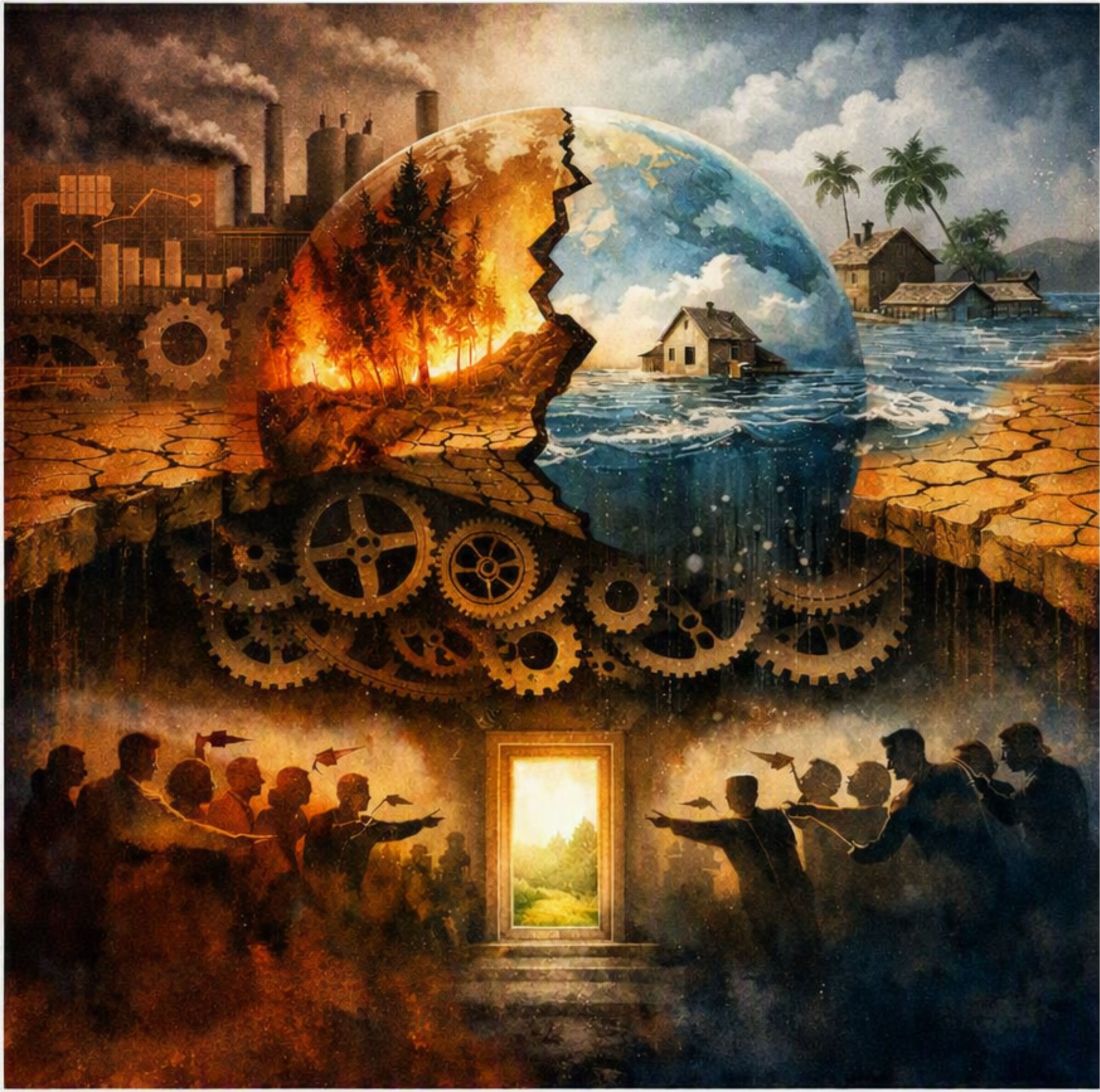
We are not fighting each other. We are fighting a system that none of us can see clearly because we are living inside it.
Climate change is real. The consequences are already unfolding. But the way we talk about it – the way we frame it, politicise it, deny it, catastrophise it, and moralise it – is shaped not by ideology, but by a global operating system that defines what we value, how we behave, and what we believe is possible.
Until we recognise that system, we will keep attacking each other instead of addressing the root cause.
The System We Don’t See
Most people assume that political conflict is driven by ideology: left versus right, progressive versus conservative, activist versus sceptic.
But ideology is only the surface layer.
Beneath it sits something more powerful because it is harder to see: a worldview so familiar that it feels like reality itself.
By “the system”, I do not mean a secret group of people or a single institution pulling every lever. I mean a shared operating system: a set of assumptions about what is realistic, responsible, modern and possible.
It is built around centralisation, financialisation and perpetual economic growth. It defines value through money, treats legality as morality, and interprets almost every problem through the logic of markets.
This matters because people often sense power before they can describe it. When they say “they won’t allow it”, “they’ve already decided”, or “they’ll never let that happen”, they are usually reaching for language to describe a force that feels real but dispersed.
The mistake isn’t in failing to sense that force. The mistake is assuming it must be a single hidden group, rather than a worldview operating through incentives, institutions, professional expectations and inherited assumptions.
The system:
- rewards extraction
- punishes restraint
- centralises power
- financialises nature
- moralises legality
- creates artificial scarcity
- generates polarisation
- and hides its own role behind ideological conflict
It is the system – not individuals – that shapes the climate crisis, the political response, and the public reaction.
This is why the system can behave as if it is coordinated even when no coordination is required. Institutions reward the same assumptions. Careers advance through the same definitions of competence. Policy is judged by the same measures of credibility. Media debate returns to the same narrow tests of seriousness.
Over time, alternative ways of thinking begin to sound naive, dangerous or unserious before they have even been examined.
Because we live inside this worldview, we become cognitively captured by it. That does not mean people are foolish, corrupt or incapable of independent thought. It means the system shapes what seems normal before argument even begins.
We mistake inherited assumptions for common sense. We see symptoms more easily than causes. We fight shadows because the structure casting them has become invisible.
A Common Behavioural Pattern
There is a familiar type of public thinker – found on the left, right, and centre – who is brilliant at analysing cultural narratives, moral language, and ideological excess.
They correctly identify distortions in how we talk about climate change. They see catastrophising, moralising, and political manipulation.
But because they interpret everything through ideology, they miss the deeper structural incentives shaping the crisis.
They critique the narrative layer while the system layer remains invisible.
This pattern is not unique to any one person. It is universal. It is what happens when intelligent people operate inside a paradigm they cannot see.
Fiji: A Reality That Cuts Through Ideology
Climate change is not theoretical. It is not ideological. It is not a culture‑war narrative. It is a lived reality for millions of people.
Fiji makes this impossible to ignore.
Across the islands, entire villages are already being relocated as rising seas swallow land that families have lived on for generations. Saltwater intrusion is contaminating drinking water. Food security is becoming more fragile. Tourism – the backbone of Fiji’s economy – is increasingly vulnerable. Infrastructure is being rebuilt. Trauma is being managed. Land ownership is complicating relocation.
Climate migration is no longer a future scenario. It is underway. And the challenge is not simply moving communities, but doing so in a way that is sustainable, culturally respectful and capable of continuing for decades.
This is what climate change looks like when ideology is stripped away. It is not a debate. It is not a narrative. It is not a political identity. It is reality.
Why Denialism Serves the System
Denying climate change does not help communities like those in Fiji. But it does help the system.
Denialism produces:
- distraction
- division
- paralysis
- tribal hostility
- ideological warfare
All of which keep people focused on each other instead of on the deeper structure driving the crisis.
The system does not care whether people deny climate change or catastrophise it. It only cares that attention stays locked on ideological conflict rather than on the paradigm itself.
Why This Matters
Unless we learn to see the structure beneath the argument, society will keep rearranging the furniture in the same room, convinced it is making progress while the walls quietly close in.
PART 2 – THE SYSTEM THAT SHAPES EVERYTHING
If climate change is real, and if its consequences are already unfolding, why does public debate feel so chaotic, hostile and confused? Why do people cling to partial truths, attack each other, and reject policies that might help? Why does every conversation collapse into ideology, even when the problem is clearly bigger than politics?
The answer lies in the system itself.
We live within a global operating system that shapes how we think, how we behave, and how we interpret the world.
It is so familiar, so normal, and so deeply embedded in daily life that most people never question it. Yet it is this system – not ideology, not individuals, not political parties – that drives both the climate crisis and the polarisation surrounding it.
The Establishment as a Worldview
The word “Establishment” is often used as if it refers to a fixed class of people: politicians, civil servants, financiers, media figures, experts or institutional insiders.
That older meaning still has some truth, but it no longer explains enough. The modern establishment is less visible and more pervasive. It is not only a hierarchy. It is a worldview that saturates the institutions through which society operates.
This worldview is not enforced mainly by conspiracy or command. It is enforced by incentives. People are rewarded for speaking its language, accepting its assumptions and treating its limits as realism. They are promoted for being credible within it. They are marginalised when they challenge it too directly. Eventually the worldview becomes the mental furniture of public life: so familiar that those inside it rarely experience it as ideology at all.
Climate change exposes this because the crisis demands a transformation in how society relates to energy, land, production, consumption, risk and responsibility. Yet the worldview through which we attempt to solve it is the same worldview that helped create it. That is the central tension of this paper.
A System Built on Growth, Centralisation and Financialisation
The modern economic system is built on three core principles:
1. Perpetual growth The economy must expand every year. More production, more consumption, more extraction, more throughput. Growth is treated as a non‑negotiable requirement for stability.
2. Centralisation of power Large institutions – governments, corporations, financial bodies – accumulate authority, resources and decision‑making capacity. Local autonomy shrinks as global coordination increases.
3. Financialisation of everything Nature, labour, housing, data, attention, even social relationships are increasingly measured, priced and turned into markets. Value becomes synonymous with money.
These principles shape every policy, every debate and every “solution” we attempt. They define what is considered realistic, responsible or necessary. They also define what is considered impossible, naive or radical.
This is the architecture beneath the climate crisis.
How the System Creates Environmental Degradation
The climate crisis is not an ideological project. It is a structural output.
A system built on perpetual growth requires:
- continuous resource extraction
- expanding energy use
- industrial agriculture
- global supply chains
- high‑throughput production
- large‑scale infrastructure
- increasing consumption
These activities produce:
- rising emissions
- soil depletion
- water scarcity
- biodiversity loss
- ocean acidification
- deforestation
- pollution
- ecosystem collapse
Climate change is not a moral failure. It is not a political conspiracy. It is not a cultural conflict.
It is the predictable consequence of a system that treats the planet as a resource to be consumed rather than a partner to be worked with.
How the System Shapes the Political Response
When the system produces a crisis, it also shapes the response.
Climate policy is framed through:
- markets
- finance
- regulation
- centralised governance
- measurable units
- monetisable mechanisms
This is why so many climate “solutions” take the form of:
- carbon credits
- offset schemes
- ESG scoring
- biodiversity markets
- natural‑capital accounting
- green investment vehicles
Some of these tools may have a useful role when carefully designed and democratically accountable. The problem is not measurement itself, or every market mechanism in every context. The problem is what happens when the system turns the living world primarily into units of financial management.
At that point, climate action risks becoming an extension of the same logic it is meant to challenge. The crisis creates new markets, new financial instruments, new regulatory frameworks and new opportunities for centralised control, while the deeper assumptions about growth, value and power remain largely untouched.
This is why many different people sense something is off – even if they cannot articulate it.
PART 3 – WHY EVERY ARGUMENT CONTAINS TRUTH
One of the most difficult aspects of the climate crisis is that almost every argument contains a fragment of truth.
This is not how public debate is supposed to work. We are used to thinking in binaries: right or wrong, true or false, good or bad.
But the climate crisis does not fit into those categories. It is a multilayered system issue, and system issues rarely produce clean, simple answers.
This is why people who oppose green policy often sound persuasive. It is also why people who support green policy often sound persuasive. Both sides are holding truths – but only partial ones.
And partial truths, when treated as total truths, become weapons.
The Truths Held by Those Who Oppose Green Policy
Many people who resist climate policy are responding to real pressures and real failures. Their concerns are not imaginary, and they are not simply “deniers.”
They are responding to truths such as:
Economic pressure Green policies often increase costs for households already struggling. This is a real truth.
Distrust of institutions Governments and corporations have a long history of broken promises. This is a real truth.
Centralisation of power Climate governance often concentrates authority in distant institutions. This is a real truth.
Inconsistent messaging Climate communication has been plagued by exaggeration, contradiction and moralising. This is a real truth.
Impact on rural and working‑class communities Policies often hit those least able to absorb the cost. This is a real truth.
Past policy failures Many environmental initiatives have been poorly designed or poorly implemented. This is a real truth.
These truths matter. They deserve to be heard. But they are not the whole picture.
The Truths Held by Those Who Support Green Policy
People who advocate for climate action also hold truths that cannot be ignored:
Climate change is real The physical evidence is overwhelming. This is a real truth.
Consequences are already unfolding Fiji is relocating villages. Saltwater is contaminating drinking water. Food security is under threat. This is a real truth.
Environmental degradation is accelerating Soil, water and biodiversity crises are measurable and worsening. This is a real truth.
Delay increases risk The longer action is postponed, the harder the problem becomes. This is a real truth.
Systemic change is necessary Incremental adjustments cannot solve a structural crisis. This is a real truth.
These truths matter. They deserve to be heard. But they are not the whole picture either.
The Problem: Partial Truths Become Total Truths
When people hold partial truths, they often mistake them for total truths. This is how polarisation begins.
A person sees one part of the problem clearly – and assumes it is the entire problem.
Another person sees a different part clearly – and assumes the same.
Each side becomes convinced that the other is blind, dishonest or dangerous. Each side becomes certain that its truth is the truth. Each side becomes hostile to nuance.
This is how public debate collapses into black‑and‑white thinking.
But the climate crisis is not black and white. It is not a binary problem. It is not a moral test. It is not an ideological battle.
It is a system issue – and system issues require multiple perspectives to be understood.
Why True/False Thinking Fails
True/false thinking works for simple problems. It does not work for complex systems.
Systems are:
- multicausal
- nonlinear
- interconnected
- layered
- dynamic
- unpredictable
In systems, truth is rarely singular. It is distributed.
This means:
- activists are right about physical risks
- sceptics are right about policy failures
- conservatives are right about centralisation risks
- progressives are right about ecological urgency
- economists are right about market incentives
- communities are right about local impacts
- Fiji is right about lived consequences
Everyone is right about something. Nobody is right about everything.
This is the uncomfortable reality that public debate cannot hold.
The Result: Partial Truth Without Shared Reality
The climate crisis is real. Its consequences are already unfolding. But the public conversation is stuck in a loop of partial truths, tribal certainty and systemic blindness.
Until we learn to hold multiple truths at once, we cannot build the shared reality needed to address the deeper structure that created the crisis.
PART 4 – HOW THE SYSTEM USES DIVISION TO PROTECT ITSELF
If the climate crisis is a structural problem, and if every argument contains a fragment of truth, why does public debate feel so relentlessly hostile? Why does every attempt at discussion collapse into accusation, outrage and tribal certainty? Why does division intensify even when the narrative insists that unity is essential?
The answer is uncomfortable: division is not merely a breakdown in public conversation. It is one of the ways the existing worldview protects itself from scrutiny.
A system built on centralisation, financialisation and perpetual growth cannot afford widespread public scrutiny. It cannot afford people recognising the deeper architecture beneath their disagreements. It cannot afford citizens questioning the assumptions that hold the paradigm together.
Division keeps that scrutiny at bay.
Division Distracts From Structural Issues
When people are fighting each other, they are not looking at the system. They are not questioning the growth model. They are not examining financial incentives. They are not challenging centralisation. They are not interrogating the logic that defines value, morality and legality.
Division turns citizens into combatants. Combatants do not analyse systems. They defend positions.
This is why climate debates feel so emotionally charged. The emotional charge is not evidence that people are irrational. It is evidence that real fears, real costs and real identities are being forced through a narrow ideological frame.
Division Turns Partial Truths into Weapons
Because every argument contains a fragment of truth, each side can use its truth to attack the other. This creates a cycle:
- A partial truth is identified.
- It is treated as the whole truth.
- It becomes a weapon.
- The opposing side responds with its own partial truth.
- That truth becomes a weapon too.
- The conflict escalates.
- The system remains untouched.
This cycle is self‑sustaining. It requires no conspiracy. It requires no coordination. It is simply what happens when a complex problem is forced into a binary frame.
Division Makes Systemic Critique Unthinkable
The most effective way to prevent people from questioning a system is to keep them focused on each other. When public attention is consumed by ideological conflict, systemic critique becomes:
- too abstract
- too complex
- too uncomfortable
- too slow
- too threatening
- too easily dismissed as “political”
People become so invested in defending their side that they lose the ability to step back and see the structure shaping both sides.
This is paradigm blindness – not because people are incapable of seeing the system, but because the system keeps them too distracted to look.
Division Protects Centralisation
Centralisation thrives when people are divided. When communities are fragmented, they cannot resist the consolidation of power. When citizens distrust each other, they turn to institutions for security. When political tribes fight, they inadvertently justify stronger governance.
This is why climate policy often results in:
- more centralised regulation
- more centralised data systems
- more centralised markets
- more centralised decision‑making
- more centralised infrastructure
Even when the narrative says the opposite.
Division can therefore create the conditions in which further centralisation appears necessary. A fragmented society is easier to manage from above than to rebuild from below.
Division Creates the Illusion of Choice
Left and right appear to offer different visions of the future. But beneath the surface, both operate within the same paradigm.
The progressive left often reaches for regulation, global coordination and technocratic management. The modern right often reaches for market expansion, deregulation and growth-led development. These approaches differ in language and priority, but both can remain inside the same deeper worldview if neither questions the assumptions beneath them.
The conflict between them is real, but it is often narrower than it appears. It is a fight over how to manage the existing model, not always a fight over whether the model itself should be reimagined.
Division creates the feeling of choice while leaving the deepest assumptions intact. The reader does not need to believe that both sides are identical. It is enough to notice how often the same measures of seriousness, credibility and success survive beneath opposing slogans.
Division Makes People Fear Each Other More Than the System
When people fear each other, they stop seeing the system as the source of their problems and start seeing other citizens as threats.
The Result: A Crisis We Cannot Solve While Divided
Climate change is real, and its consequences are already unfolding. But the public conversation remains trapped in a cycle of division that makes shared understanding harder and systemic change less imaginable.
Recognising that pattern does not require blaming ordinary people for being divided. It requires asking why division is so consistently rewarded, amplified and returned to whenever deeper structural questions begin to emerge.
PART 5 – THE STRONGEST OBJECTIONS
A serious argument must make room for serious objections. If the system is described too simply, the analysis can begin to sound like the very binary thinking it criticises. The point is not that institutions, markets, expertise or growth are always bad. The point is that a worldview built around them can become unable to recognise its own limits.
Objection 1: Markets and Growth Have Improved Lives
This objection is strong. Markets have coordinated activity at enormous scale. Economic growth has supported public services, innovation, infrastructure and rising living standards for many people. Any argument that ignores this becomes too easy to dismiss.
But acknowledging the achievements of growth is not the same as accepting growth as an unquestionable purpose. A tool becomes dangerous when it turns into a requirement. The question is not whether growth has ever produced benefits. It has. The question is whether a system that requires endless expansion of extraction, consumption and throughput can remain compatible with ecological stability on a finite planet.
Objection 2: Centralisation Can Solve Collective Problems
This is also true. Climate change is global, and global problems require coordination. National governments, international agreements, scientific institutions and regulatory bodies all matter. Localism alone cannot manage atmospheric carbon, global supply chains or transboundary risk.
The problem is not coordination. The problem is centralisation without accountability, distance without listening, and expertise detached from consequence. A healthy response to climate change needs both scale and rootedness: institutions capable of coordination, and communities trusted to shape decisions that affect their own land, livelihoods and futures.
Objection 3: Technology May Change the Equation
Technology matters. Renewable energy, storage, electrification, efficiency improvements, climate modelling, resilient infrastructure and better land management can all reduce harm. A systemic argument should not become anti-technology by default.
But technology cannot substitute for purpose. If new tools are deployed inside the same worldview of endless growth, centralised control and financial extraction, they may reduce some harms while reinforcing others. The question is not whether technology helps. The question is what kind of society technology is being asked to serve.
What This Changes
These objections do not weaken the argument. They sharpen it. The issue is not institutions versus people, markets versus nature, technology versus tradition, or growth versus decline. The issue is whether society can consciously choose the assumptions that guide its institutions, markets and technologies, rather than allowing inherited assumptions to make those choices invisibly.
PART 6 – WHAT CHANGING THE SYSTEM ACTUALLY MEANS
If the climate crisis is structural, and if division makes that structure harder to see, the next question is practical: what does changing the system actually mean?
The phrase can sound overwhelming. It can suggest collapse, revolution or ideological fantasy. But this paper is not arguing for destruction. It is arguing for reorientation: a conscious reassessment of the assumptions that govern public life.
It does not mean tearing society apart, abandoning technology, rejecting progress or choosing one ideology over another.
It means re-examining the assumptions that define how society works, and recognising that those assumptions are choices rather than laws of nature.
The First Assumption: Perpetual Growth
The modern world is built on the belief that the economy must grow every year. Growth is treated as essential for stability, prosperity and security. The problem is not growth in every form; it is the assumption that expansion must continue indefinitely regardless of ecological limits.
It guarantees:
- continuous extraction
- continuous consumption
- continuous waste
- continuous pressure on ecosystems
Growth is not inherently bad. But growth as a requirement is incompatible with long‑term environmental stability.
Changing the system means recognising that growth is a tool, not a purpose.
The Second Assumption: Centralisation
Centralisation is often justified as efficient, modern or necessary.
But centralisation also:
- concentrates power
- reduces local autonomy
- weakens community resilience
- increases dependency
- amplifies systemic fragility
Climate change exposes the limits of centralisation. When a village in Fiji must relocate, it is not a distant institution that understands the land, the culture or the needs of the community. It is the community itself.
Changing the system means rediscovering the value of local knowledge, local decision‑making and local resilience.
The Third Assumption: Financialisation
Financialisation turns everything into a market:
- nature
- labour
- housing
- data
- attention
- even environmental protection
This is why climate policy so often becomes:
- carbon credits
- offset schemes
- biodiversity markets
- natural‑capital accounting
These mechanisms may help in narrow circumstances, but they cannot carry the whole burden of transformation. If they become substitutes for ecological repair, democratic accountability and reduced extraction, they risk monetising the crisis rather than resolving it.
Changing the system means recognising that value cannot be reduced to price, and that not everything that matters can be measured in money.
The Fourth Assumption: Legality Equals Morality
In a financialised system, legality becomes moralised. If something is legal, it is assumed to be good. If something is profitable, it is assumed to be beneficial. If something is permitted, it is assumed to be safe.
But legality is shaped by the system. When guardrails are removed, legality expands – and morality shrinks.
Changing the system means separating legality from morality, and recognising that ethical responsibility cannot be outsourced to markets or institutions.
The Fifth Assumption: Humans Are Separate From Nature
Perhaps the most damaging assumption of all is the belief that humans exist outside the natural world.
This belief justifies:
- extraction
- exploitation
- domination
- short‑term thinking
- ecological neglect
But climate change is a reminder that the planet is not a backdrop. It is a partner. And partnership requires reciprocity.
Changing the system means recognising that human wellbeing is inseparable from planetary wellbeing.
Changing the System Does Not Mean Starting Again
Changing the system does not require revolution. It requires reorientation.
It means:
- shifting from extraction to regeneration
- shifting from centralisation to distributed resilience
- shifting from financialisation to stewardship
- shifting from perpetual growth to sustainable prosperity
- shifting from domination to partnership
These shifts are not ideological. They are practical.
They are not radical because they are unfamiliar. They are practical because they respond to the conditions we now face.
They are not about rejecting modernity. They are about ensuring modernity has a future.
PART 7 – WORKING WITH THE PLANET INSTEAD OF AGAINST IT
If changing the system begins with recognising its assumptions, the next step is to describe the direction of travel.
This is not a utopian blueprint, a technocratic masterplan or a party manifesto. It is a practical shift in relationship: from treating the planet as a storehouse of resources to recognising it as the living foundation of human wellbeing.
This is not a return to the past. It is not a rejection of modernity. It is not a denial of progress. It is a shift in relationship – from extraction to partnership.
The climate crisis is not only a scientific or technical problem. It is also a relational problem: a consequence of how modern societies have learned to relate to land, water, energy, food, labour and time.
Working with the planet means recognising that environmental stability is not an obstacle to human wellbeing – it is the foundation of it.
Working With the Planet Means Regeneration, Not Extraction
Extraction removes value from ecosystems. Regeneration restores it.
This does not mean abandoning industry. It means redesigning industry so that:
- soil is rebuilt rather than depleted
- water is protected rather than polluted
- biodiversity is supported rather than destroyed
- forests are restored rather than cleared
- oceans are replenished rather than exhausted
Regeneration is not a slogan. It is the practical work of restoring the systems that make life possible.
It is also a form of risk reduction. Healthy ecosystems store carbon, hold water, protect communities, support food systems and reduce the cost of future damage.
Working With the Planet Means Resilience, Not Fragility
Centralised systems are efficient – until they fail. Then they fail everywhere at once.
Distributed systems are slower – but they are resilient.
Resilience means:
- local food systems
- local energy generation
- local decision‑making
- local knowledge
- local autonomy
This does not mean isolation. It means balance.
A resilient society is one where communities can withstand shocks without waiting for distant institutions to intervene.
Climate change will test resilience everywhere. Fiji is already living that test.
Working With the Planet Means Stewardship, Not Financialisation
Financialisation turns nature into numbers. Stewardship turns nature into responsibility.
Stewardship is not anti‑market. It is anti‑exploitation.
It means:
- protecting ecosystems because they matter
- restoring landscapes because they sustain life
- managing resources because future generations depend on them
Stewardship is not a political position. It is a human one.
Working With the Planet Means Long‑Term Thinking, Not Short‑Term Gain
Short‑term thinking is built into the system:
- quarterly earnings
- election cycles
- rapid returns
- immediate consumption
But climate change operates on long timelines. So do ecosystems. So do cultures. So do communities.
Working with the planet means shifting from:
- short‑term profit to long‑term stability
- immediate gain to generational wellbeing
- reactive policy to proactive planning
This is not ideology. It is maturity.
Working With the Planet Means Partnership, Not Domination
The most profound shift is also the simplest: recognising that humans are part of the natural world, not separate from it.
Partnership means:
- listening to ecological limits
- respecting natural cycles
- designing systems that align with biology
- understanding that human health depends on planetary health
This is not spiritual. It is practical.
It is the difference between fighting the planet and cooperating with it.
PART 8 – FROM AWARENESS TO PRACTICE
If the crisis is structural, the next challenge is behavioural. The system does not only shape institutions. It shapes attention, identity, disagreement and the stories people tell about what is possible.
That means change cannot be only technical or legislative. It also requires a different way of thinking together: less certainty, more curiosity; less tribal performance, more shared reality.
Reclaiming Agency
The system encourages passivity:
- “This is just how things work.”
- “There is no alternative.”
- “The market will solve it.”
- “Technology will fix it.”
- “Someone else will deal with it.”
But agency begins with awareness. Awareness begins with clarity. Clarity begins with seeing the system.
Reclaiming agency does not mean overthrowing institutions. It means recognising that institutions are not the only source of power.
Communities have agency. Individuals have agency. Local knowledge has agency. Collective action has agency. Truth has agency.
1. Rebuild Local Resilience
Centralisation has made society efficient but fragile. Climate change will test that fragility.
Rebuilding resilience means:
- strengthening local food systems
- supporting local energy generation
- restoring local ecosystems
- investing in local skills
- empowering local decision‑making
Resilience is not isolation. It is independence within interdependence.
It is the ability of communities to withstand shocks without waiting for distant institutions to intervene.
2. Restore Ecological Foundations
Healthy ecosystems reduce risk, increase stability and support long‑term prosperity.
Restoration is not a luxury – it is infrastructure.
This means:
- rebuilding soil
- protecting water
- restoring wetlands
- replanting forests
- reviving biodiversity
- repairing damaged landscapes
These actions are not ideological. They are foundational.
They reduce vulnerability. They increase resilience. They create stability.
3. Reduce Dependency on Fragile Systems
Dependency is a form of vulnerability. The more dependent a society is on centralised systems, the more fragile it becomes.
Reducing dependency means:
- diversifying energy sources
- shortening supply chains
- strengthening local economies
- supporting community enterprises
- valuing local knowledge
This is not anti‑globalisation. It is anti‑fragility.
4. Support Regenerative Practices
Regeneration is the opposite of extraction. It restores value instead of removing it.
Regenerative practices include:
- regenerative agriculture
- sustainable forestry
- community‑managed fisheries
- circular resource systems
- nature‑based solutions
These practices reduce emissions, restore ecosystems and strengthen communities.
They also reduce reliance on financialised “solutions” that treat nature as a commodity.
5. Encourage Honest, Non‑Ideological Dialogue
The climate crisis cannot be solved by shouting. It cannot be solved by moralising. It cannot be solved by humiliation. It cannot be solved by tribal certainty.
Honest dialogue means:
- acknowledging partial truths
- recognising legitimate concerns
- rejecting binary thinking
- valuing complexity
- listening without defensiveness
- speaking without aggression
Dialogue is not weakness. It is strength.
It is the foundation of cooperation.
6. Build Coalitions Across Divides
The climate crisis affects everyone. It does not care about ideology. It does not care about political identity. It does not care about cultural narratives.
Coalitions can form around:
- shared risks
- shared values
- shared responsibilities
- shared futures
Coalitions do not require agreement on everything. They require agreement on what matters.
They require enough shared ground to act together where action is possible.
7. Recognise That Small Actions Are Not Small
Small actions are often dismissed as symbolic. But symbols shape behaviour. Behaviour shapes culture. Culture shapes systems.
Small actions include:
- reducing waste
- supporting local producers
- restoring small habitats
- engaging in community projects
- educating others
- questioning assumptions
These actions do not solve the crisis alone. But they create the conditions for systemic change.
They build awareness. They build agency. They build momentum.
8. Prepare for Systemic Change Before It Arrives
Systems change slowly – until they change quickly. When the moment arrives, societies must be ready.
Preparation means:
- building resilient communities
- restoring ecosystems
- strengthening local economies
- cultivating cooperation
- developing new narratives
- questioning old assumptions
These steps create the foundation for a future where the system can evolve without collapse.
A Shared Path Forward Is Possible
The climate crisis is real, its consequences are already unfolding, and the current system will not become capable of transformation simply because people argue more loudly.
The path forward requires clarity, cooperation and practical preparation: seeing the worldview clearly, rebuilding resilience where we can, and creating forms of action that do not depend entirely on the institutions that helped produce the crisis.
This is not ideology. It is responsibility.
PART 9 – THE DOORWAY WE KEEP MISSING
The climate crisis is real. Its consequences are already unfolding. Communities like those in Fiji are living through changes that cannot be denied, delayed or debated away.
Yet in much of the world, the public conversation remains trapped in a cycle of ideological conflict, partial truths and systemic blindness.
We are fighting each other instead of examining the worldview that shapes us. We are mistaking symptoms for causes, narratives for reality, and division for truth.
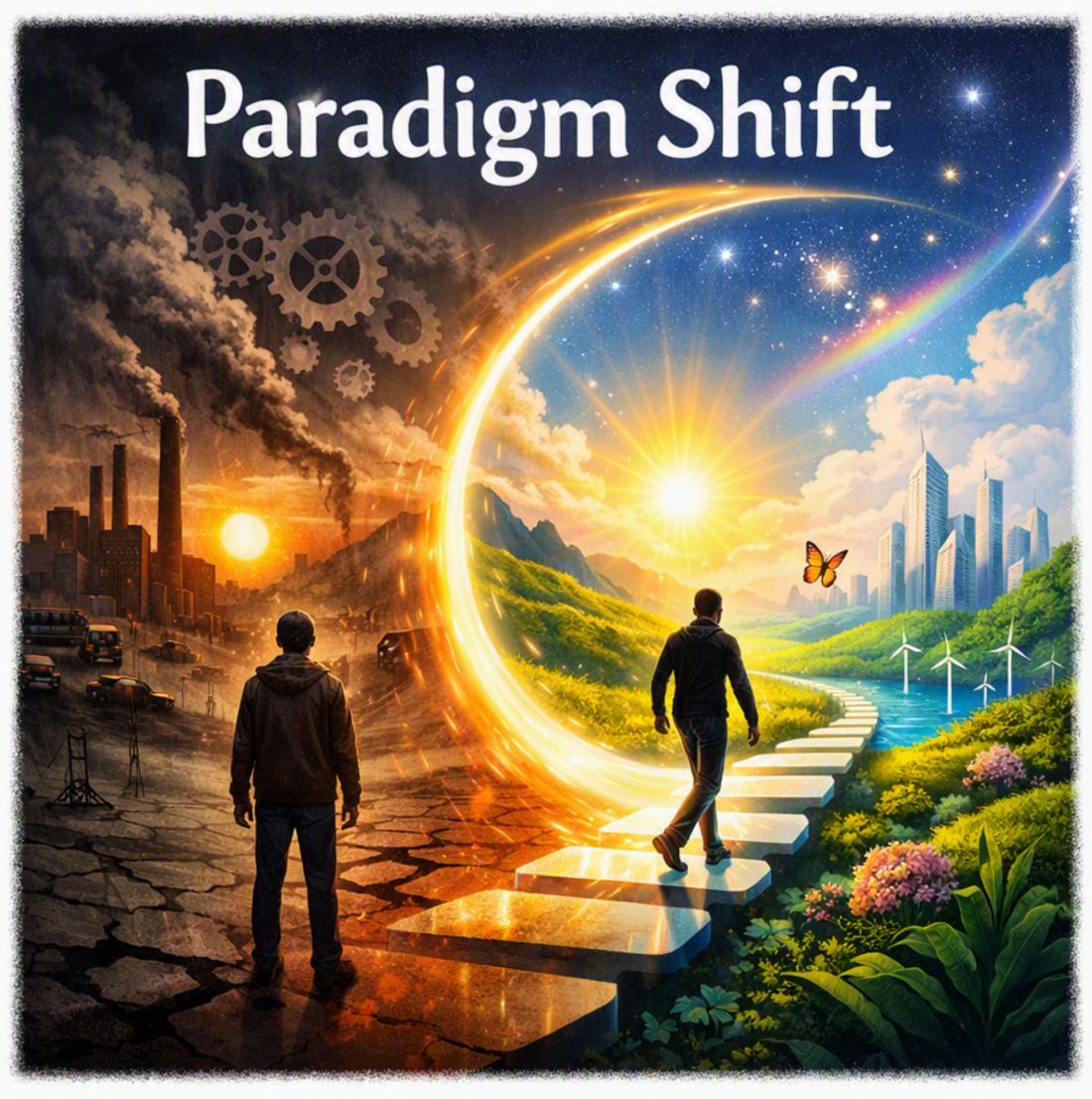
And in doing so, we keep missing the doorway that sits right in front of us.
The system is the set of assumptions that define how society works:
The Doorway is Seeing Clearly
Seeing clearly means learning to hold the whole picture: the physical reality of climate change, the legitimate fears created by poor policy, the partial truths on every side, and the deeper assumptions that turn shared problems into ideological conflict.
Clarity is not comfortable. It asks people to question assumptions that feel too normal to notice. But clarity is the beginning of agency, and agency is the beginning of change.
The Doorway is Responsibility
Responsibility does not belong to governments alone. It does not belong to corporations alone. It does not belong to activists alone. It does not belong to sceptics alone.
Responsibility belongs to everyone who can see the system clearly enough to recognise that the crisis is bigger than politics, bigger than ideology, and bigger than the narratives that dominate public debate.
The Doorway Is Open
The doorway has always been there. We have struggled to walk through it because the existing worldview taught us to confuse what is familiar with what is inevitable.
But the doorway is open.
We Can Walk Through the Doorway Together
The climate crisis is not a test of ideological victory. It is a test of awareness, maturity and cooperation: whether we can see beyond the system that shaped us, recognise the assumptions we inherited, and choose a way of living that gives both people and the planet a future.
The doorway is open. The work now is to walk through it together.