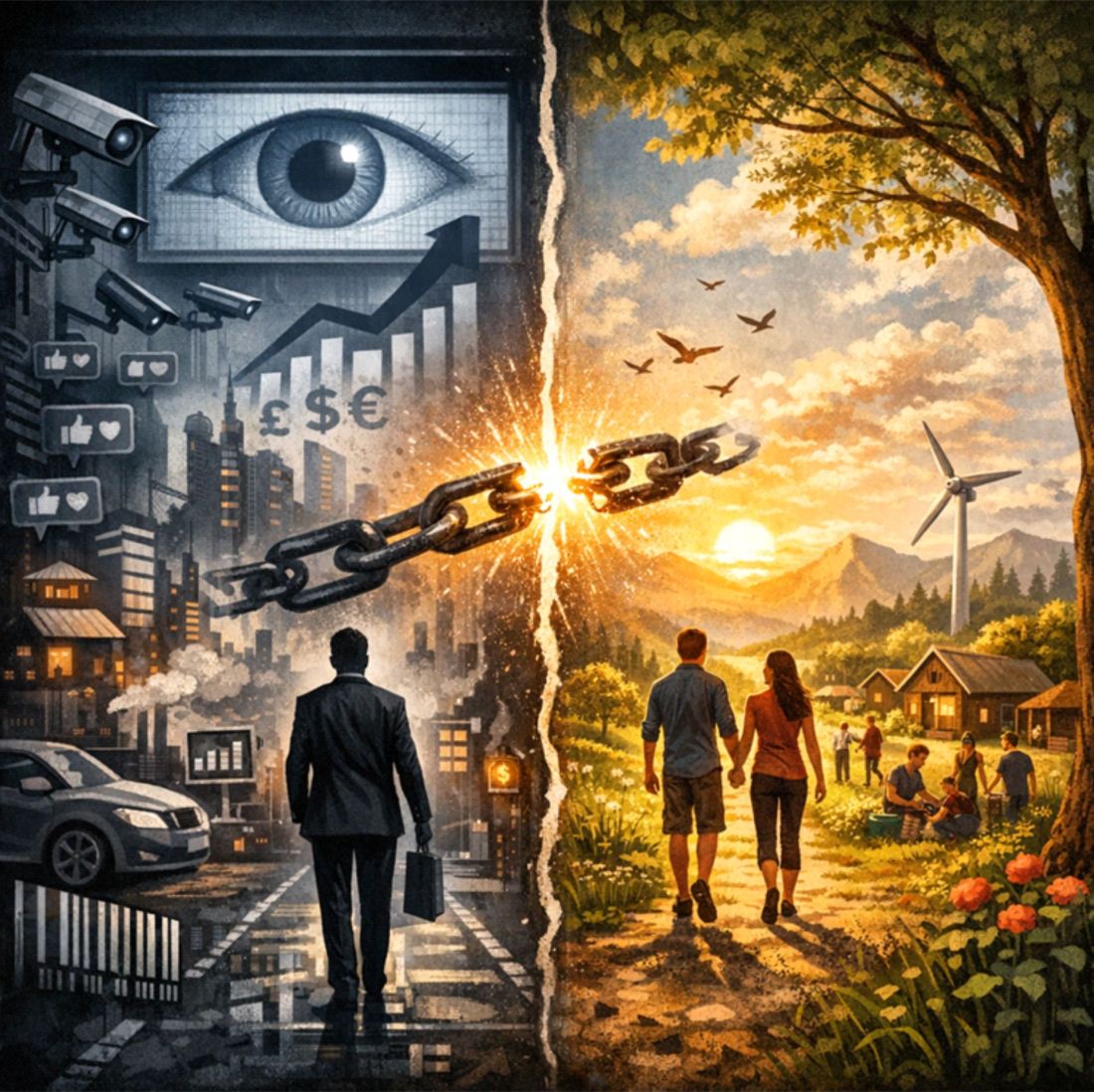
There is a deep irony shaping our world today: the very same ideas, technologies, and lifestyle changes that could genuinely liberate us are being deployed by the system in ways that make them feel threatening, manipulative, and coercive.
The problem is not the ideas themselves. It is the quiet, unspoken understanding that these ideas are being used as tools of control – and it is this instinctive recognition of control that triggers resistance in us all.
Many people sense that something is fundamentally wrong with the world we live in yet remain mentally tied to a money‑centric paradigm that shapes every part of life. We have been conditioned to believe that our security, identity, and worth depend on participating in a world where money is the organising principle of everything.
This conditioning is so deep that even when new ways of living could benefit us, we instinctively reject them because they appear to threaten the familiar structures we rely on.
This is the paradox:
We resist the very things that could free us, because the system is attempting to impose them through mechanisms of control.
The Conditioning That Keeps Us Trapped
Most of us have grown up believing that a “normal” or “successful” life requires an endless list of possessions, achievements, and external validations.
It’s not just the material things – it’s the psychological architecture that sits behind them. We have been conditioned to measure our worth through metrics that have nothing to do with who we really are.
We are told we need:
• A car for every adult
• A house for everyone
• The latest phone
• A giant TV
• Multiple streaming services
• Fast fashion
• Constant entertainment
• Takeaways delivered on demand
• Endless consumption to prove we are “keeping up”
But the conditioning goes much deeper than consumer goods. It extends into the very way we judge ourselves and others:
• The highest possible salary
• The most prestigious job title
• Promotions as proof of personal value
• The biggest house in the best postcode
• The most likes, followers, and subscribers
• The most impressive CV
• The most enviable holidays
• The most “productive” lifestyle
• The most polished online persona
• The appearance of success, even when it’s hollow
• The pressure to “achieve” constantly
• The fear of falling behind peers
• The belief that our worth is defined by external approval
These are not natural human needs. They are manufactured reference points – a system of external markers designed to keep us striving, comparing, competing, and consuming.
They ensure that our sense of identity is always tied to something outside of ourselves.
This is the real trap:
We have surrendered our internal compass to an external world that profits from our insecurity.
We judge ourselves – consciously or unconsciously – by how well we fit into a money‑centric system that was never designed to serve us. And because our sense of worth is tied to these external markers, any suggestion that we might not need them feels like a threat to our identity, not just our lifestyle.
This is why people resist change so fiercely.
Not because the change is bad, but because it challenges the framework through which they have been taught to measure their own value.
Why People Resist Changes That Could Actually Help Them
Try telling someone who has just woken up to the unfairness of the system that:
• We don’t all need to own cars
• We don’t all need to own property
• We don’t need constant consumption
• We don’t need to live isolated, individualised lives
• We don’t need to measure everything in money
They will likely resist – fiercely.
Not because these ideas are wrong, but because they have been weaponised by the system.
It may feel counterintuitive, but concepts like:
• Reduced car use
• Localised living
• Sustainable consumption
• Community‑based economies
• Reduced working hours
• Degrowth
• Circular economies
• Shared resources
• Public transport expansion
…could all be part of a healthier, more human‑centred future if they emerged organically and voluntarily.
But when these ideas are pushed top‑down, wrapped in surveillance, monitoring, behavioural nudging, and centralised control, people instinctively reject them – even when the underlying idea might be beneficial.
The system has taken potentially positive concepts and fused them with mechanisms of power.
So, people aren’t reacting to the ideas themselves. They’re reacting to the control embedded within them.
The Perfect Example: Artificial Intelligence
Artificial intelligence is perhaps the clearest example of this paradox.
AI could be one of the greatest tools humanity has ever created – a way to enhance human capability, reduce unnecessary labour, and support human flourishing.
Used wisely, it could:
• Free people from repetitive work
• Support creativity
• Improve decision‑making
• Strengthen communities
• Expand access to knowledge
• Reduce inequality
But that is not the direction we are currently heading.
Instead, AI is being developed and deployed in ways that:
• Replace human workers
• Concentrate power
• Increase dependency
• Reduce human agency
• Expand surveillance
• Amplify profit for a tiny minority
• Accelerate social fragmentation
The “AI takeover” is not a natural or inevitable outcome. It is a choice – a choice made by those who stand to gain from redundancy, dependency, and control.
The technology itself is not the threat.
The threat is the intention behind its use.
The Race for Control
As more human roles are automated and more decisions are handed to machines, human agency is being eroded.
Every day, more of our lives are mediated by systems we did not design, do not control, and cannot meaningfully influence.
This creates a sense of urgency for those who manage the system. If society is heading toward collapse – economically, socially, environmentally – then maintaining stability becomes their highest priority.
And the fastest way to maintain stability is to:
• Reduce personal independence
• Limit mobility
• Centralise decision‑making
• Monitor behaviour
• Shape public opinion
• Restrict dissent
• Manage consumption
• Control access to resources
This is why so many policies that could be positive are being implemented in ways that feel coercive. The system is not trying to build a better world. It is trying to preserve itself in a world that is rapidly becoming ungovernable.
The Return to Personal Sovereignty: Freedom Through Self‑Awareness and People‑Centric Living
If the conditioning of the current model traps us by tying our identity to external markers, then the antidote – the path back to genuine freedom – lies in reclaiming our internal point of reference.
Personal sovereignty is not a political slogan or a lifestyle trend. It is the natural state of a human being who no longer depends on external systems to define their worth, purpose, or direction.
Sovereignty begins the moment we stop measuring ourselves through the lens of money, status, or approval, and start recognising that our value is inherent, not earned. It grows when we reconnect with the things that make us human: relationships, contribution, community, creativity, purpose, and the physical experience of life itself.
A people‑centric way of living – one built around human needs rather than economic demands – naturally restores this sovereignty.
When life is organised around people instead of profit, several things begin to happen:
1. We rediscover intrinsic value
Worth is no longer tied to salary, job title, or social metrics. It comes from being human.
2. We stop outsourcing our identity
Decisions become grounded in personal truth rather than social expectation.
3. We regain agency over our lives
People become active participants in shaping their own lives and environments.
4. We reconnect with community
Support, collaboration, and shared purpose replace competition and comparison.
5. We experience freedom through simplicity
The absence of excess creates space for meaning.
6. We develop genuine self‑awareness
Without the noise of constant external validation, people begin to understand themselves more deeply.
7. We become resilient
Sovereign individuals and communities can adapt, create, and thrive even in times of crisis.
8. We stop being controlled by fear
When people no longer rely on external systems for identity or security, they become far harder to manipulate.
Why Sovereignty Feels So Threatening to the System
A population that is sovereign, self‑aware, and community‑rooted is a population that cannot be easily controlled.
They do not respond to fear‑based messaging. They do not depend on centralised systems. They do not measure their worth through consumption. They do not need constant management.
This is why the current model promotes versions of change that maintain dependency rather than reduce it.
It prefers:
• monitored communities, not empowered ones
• digital identities, not personal identities
• managed behaviour, not self‑direction
• controlled mobility, not voluntary simplicity
• AI‑driven oversight, not AI‑supported autonomy
• economic compliance, not human flourishing
The system fears the very thing that would heal society: people who no longer need it.
The Paradox Resolved
The future that looks threatening today – local living, reduced consumption, community‑based systems, shared resources, human‑centred technology – becomes liberating when it emerges from sovereignty rather than control.
The difference is simple but profound:
• Forced change removes freedom.
• Voluntary change restores it.
When people choose a simpler, more connected, more human way of living, they do not experience loss. They experience relief. They experience meaning. They experience themselves.
This is the future that is waiting beneath the collapse of the old system – a future built not on money, metrics, or manipulation, but on human beings rediscovering who they are when the noise of the external world finally fades.
Further Reading
If These Ideas Resonated, Here’s Where to Go Next
The Paradox of Control is part of a much wider conversation about how we’ve organised society – and why so many well‑intended changes now feel threatening instead of freeing.
If this piece struck a chord, the articles below explore the same themes from different angles. They move from questioning the role of money itself, through practical alternatives at a community level, and into the challenge of preserving human sovereignty in a world shaped by AI and automation.
You don’t need to read them all at once – they’re designed to be explored at your own pace.
We Can’t Fix Society Because We Won’t Question Money
This piece goes right to the root of the problem. Rather than blaming politics, culture, or technology, it asks a simpler but more uncomfortable question: what if money itself is shaping far more of our behaviour than we realise?
It explores how money quietly defines success, security, and self‑worth – and why real change remains impossible as long as money is treated as untouchable or neutral.
If money isn’t the best organising principle for human life, what could replace it?
This article explores a practical alternative: local, people‑centred systems designed around real needs rather than profit. It looks at how communities could organise work, contribution, resources, and care in ways that feel human, grounded, and meaningful – without relying on distant institutions or centralised control.
A Future of Communities: Building the New World Without Oil, Manipulated Money, and Centralised Control
This is a wider, more expansive look at where all of this could lead.
Rather than predicting collapse or offering a glossy utopia, this article explores how communities might naturally evolve as old systems become less viable.
It focuses on resilience, adaptability, and human connection – and what becomes possible when people stop trying to preserve systems that no longer serve them.
The Human Sovereignty Charter for Artificial Intelligence
Artificial intelligence sits at the heart of today’s control paradox.
This piece tackles the fear directly – not by rejecting AI, but by asking who it is really being built for.
It outlines a sovereignty‑based approach to AI governance, arguing that technology should strengthen human agency, not replace it or quietly manage behaviour behind the scenes.
How the End of Work Exposes the Crisis of a Broken System
The Collapse of the Money-centric System
Value is the foundation of human life. It shapes how we live, how we relate to one another, and what we believe matters. Wherever we place value – and whatever we collectively agree has value – becomes the organising principle of our behaviour, our systems, and ultimately our civilisation. The value set we adopt determines not only how we live today, but the consequences that unfold tomorrow.
For most of human history, and certainly in the world we share today, the dominant value set is built around money. Not human experience. Not community. Not contribution. Not wellbeing. Money.
Our governments, institutions, systems of governance, economies, and the very fabric of daily life all orbit this single construct. Everything has become transactional because the value of money – what it costs, what we earn, what we accumulate, what we attract, what we are given – has become the lens through which we make decisions about the present and the future. Our interpretation of how money works, or how it has worked in the past, has become the compass by which we navigate life.
But the problem with money is not new. It began the moment money stopped being a simple medium of exchange – a tool to facilitate trade – and instead became the store of value itself, the point and purpose of value, the thing we pursued for its own sake.
This shift was accepted because it appeared logical, even sensible. It seemed like common sense. Yet in reality, it was the easy option – the lazy option – and it became the pivot point that set humanity on a path that would eventually lead us away from ourselves.
What few people have ever recognised – and fewer still have been willing to challenge – is that once money became the centre of value, our focus shifted away from people and the human experience. Instead, we became fixated on money itself, and then on the power, position, control, and influence that money could buy.
Human life became stratified by how much or how little of it we possessed. Success became synonymous with wealth. Poverty became synonymous with failure. And the human experience was reduced to a spectrum between rich and poor.
Over time, this became normalised. Wealth and poverty have existed for so long, in so many forms and nuances, that most people accept the wealth divide as a natural feature of life. Many even believe it is acceptable – that some should thrive while others go without, that some should have more than they could ever need while others struggle to meet the basics of life.
The dynamic has only worsened. The transition from feudalism to industrialisation was celebrated as progress, but the underlying imbalance remained. The gap between those who have and those who have not continued to widen. Eventually, it reached a point where no rule, regulation, or law could meaningfully correct it. The imbalance had become embedded in the system itself.
And as always, more wants more. The existence of social classes, and the aspiration to climb them, was never enough.
A point came when the elites – those who already held power – realised that if they wanted to accumulate even more, they would have to change the rules of the game. And who was there to stop them? They already controlled everything.
People talk endlessly about new world orders, Fabianism, the WEF, and other groups. But regardless of the motivations or the plans behind these movements and those who run and influence any government, the reality is simple: any value system has a finite total value within it, even if it grows. That value moves depending on the actions – whatever the motivation and whether conscious or unconscious – of those who control the system.
Under a ring‑fenced money system, such as the gold standard, no new money can be created. The total value is fixed. Even if the scales of wealth are pushed to their limits, the wealthy cannot accumulate beyond the system’s natural ceiling. They can own a lot, but they cannot conjure the value out of thin air that would enable the few to own and control everything.
This system – flawed as it most certainly was – remained in place until 1971. And only when we understand what changed in that moment can we understand what has happened to us since.
The creation of the fiat money system, which allowed those in control to create money at will, enabled the greatest transfer of wealth in human history. It allowed the already wealthy to become unimaginably wealthier by creating money that could then be used to buy everything of real value – businesses, infrastructure, land, resources, and the essentials of community life.
Ownership and power were transferred to people who could never have acquired them under a value system grounded in reality. The new system was built on methods that were dishonest and fundamentally false.
Ordinary people didn’t question it. Why would they? Their value system – money – still looked the same. A pound was still a pound. A dollar was still a dollar. But the reality had changed completely.
This is why life today looks so different from life 60 or 70 years ago. There are anomalies everywhere. A single average wage once supported a family, bought a home, and provided security. Today, even the national minimum wage is not enough for one person to survive without benefits, charity, or debt.
Because money is the centre of value, people have been conditioned to believe that if they have what they want, everything is fine. So the consequences of the fiat system – what it has done to people, communities, and the environment – have not been treated as the priority they should have been.
The West has been told that the last 80 years have been peaceful, that there are no real problems ahead, and that nothing fundamental could ever change. Meanwhile, laws, working practices, and – most importantly – technology have changed at an accelerating pace. Everything has changed while we believed we were standing still.
We can see clearly what the Industrial Revolution did. We understand why the labour movement emerged. Industrialisation devalued human effort by replacing or reducing the need for human labour with machines wherever it could be done.
Yet we have failed to notice the evolution happening beneath our feet today. People believe the world still works as it did after the Second World War. Very few see the catastrophe unfolding around us: the next great technological shift – the rise and takeover of AI.
Just as people once accepted that machines would replace or reduce the need for manual labour, many now accept that AI will replace cognitive labour. And they assume this means nobody will have to work.
There is a dangerous collective assumption that technology has been created for the betterment of humanity. But the reality is that modern technology – especially AI – has been developed for profit and control, not for helping and supporting humanity.
If it had been created to improve life, we would already be living in a world where even the poorest had enough, where jobs were secure, and where technology enhanced life rather than replacing it.
Instead, we are living through a neoliberal, globalist model powered by fiat money – a model that extracts value from people and concentrates it in the hands of a few.
Even the architects of this system know it cannot work. That is why figures like Sam Altman now promote UBI – Universal Basic Income – as the supposed solution, for the fast-approaching time when for growing numbers, there will no longer be any kind of work.
The Fiat Era, AI, and the False Promise of UBI
UBI has been tested in small‑scale trials around the world. The idea is simple: everyone receives a set amount of income, regardless of what they do. It is appealing because it promises security in a world where jobs are disappearing. It reassures people that even if AI replaces their work, they will still be able to live the life they know today.
But this belief rests on a dangerous misunderstanding.
People assume UBI means they will continue to live as they do now – with the same homes, the same comforts, the same access to goods and services – simply without needing to work. They imagine a world where machines do everything, and humans simply enjoy the benefits.
This is fantasy.
UBI, in the context of the system we have today, is idealism built on a lie. It assumes that money can be endlessly created to pay off debts that already represent money that does not exist. It assumes that the system can continue functioning even as the economic role of billions of people disappears. It assumes that those who own everything will willingly fund the lives of those who own nothing.
The technological revolution – and the speed at which it has unfolded – was only possible because of the fiat money system. A system that survives only because enough people still believe in it. A system where most people already own nothing, and where the underlying structure is already broken.
The people who own everything – the corporations, the financial institutions, the elites who control the levers of power – cannot run a world where machines do all the work and billions of people contribute nothing.
The equation does not balance.
A system where everyone takes but no one contributes cannot function.
UBI is simply a tool to maintain the illusion that money still matters, that the system still works, and that people still need the very system that is failing them.
If we continue removing jobs at the current rate, a point will come – soon – when people outside the protected classes will have no means to survive. Not because they lack ability. Not because they lack willingness. But because the system will no longer have a place for them.
The question is not whether technology is good or bad. Technology can be used to advance humanity. But the reality we face is that AI has been developed to remove human involvement, not to improve human life. It has been built to maximise profit, minimise cost, and eliminate the “problem” of human labour.
And this is where the truth becomes unavoidable:
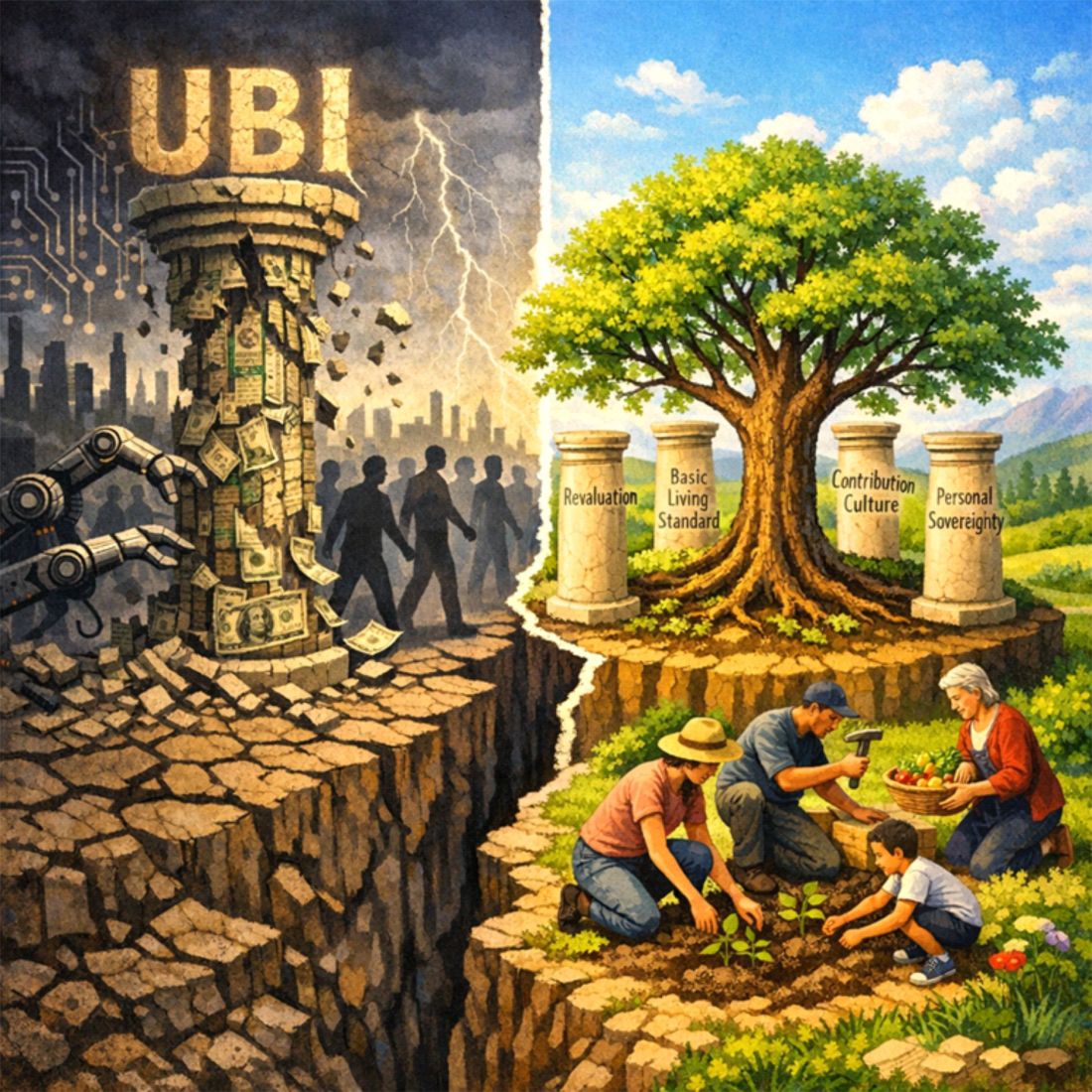
UBI will not save us. It cannot save us. It was never designed to.
UBI is the last tool of a dying system – a sticking plaster on a wound that requires surgery. It is the final illusion offered by a worldview that has already collapsed under its own contradictions.
The dam is cracking. The pressure is rising. And UBI cannot hold it back.
There is another way – a way of living that embraces technology without using it to replace or devalue people. A way built on local economies and local governance, with the Basic Living Standard at its heart. A way that restores human value, dignity, and sovereignty.
A time is approaching – sooner than most realise – when we will have to choose. We can continue sleepwalking down the path we are on, a path controlled by a few, where most will find neither benefit nor happiness. Or we can choose to walk a different way – a way where each of us contributes, participates, and lives with genuine freedom and sovereignty.
The alternative may flatten hierarchies, decentralise power, and remove the obscene concentrations of wealth that exist today. But it will also create lives worth living – lives grounded in peace, purpose, and the true human value that comes from within us, not from the money system that has defined us for far too long.
The Turning Point: Why UBI Cannot Save a Collapsing System
UBI is being sold as a compassionate solution, a stabiliser, a safety net for a world without work. But the truth is far more uncomfortable:
UBI is the final illusion of a system that has already collapsed in every meaningful way.
It is the last tool available to a worldview that cannot admit its own failure. It is the final attempt to preserve a structure that has been unravelling for decades – a structure built on false value, false scarcity, false growth, and false promises.
The destruction of jobs was not an accident. It was not an unfortunate by‑product of progress. It was a deliberate choice – a choice made by those who benefit from a world where human beings are no longer required.
The system has been moving toward this point for generations:
first by replacing physical labour with machines
then by replacing skilled labour with automation
now by replacing cognitive labour with AI
At each stage, the justification was the same: progress.
At each stage, the consequences were the same: displacement.
At each stage, the winners were the same: those who already held power.
And now, as the final stage unfolds, the system has run out of excuses – and out of time.
The truth is simple:
A society built on money cannot survive when people no longer earn it.
A society built on work cannot survive when people no longer have it.
A society built on consumption cannot survive when people cannot afford to consume.
UBI does not solve this. It cannot solve this. It was never designed to solve this.
UBI is a sedative – a way to keep people calm while the system collapses around them. It is a way to delay the moment when the public realises that the world they were promised no longer exists.
But the dam is cracking. The pressure is rising. And UBI cannot hold it back.
A world where billions of people have no economic role is not a world that can be stabilised with monthly payments.
It is a world that requires a complete rethinking of value, contribution, governance, and the purpose of human life.
And that is where the real alternative begins.
The Alternative: A System That Solves the Root Causes
If UBI is the last illusion of a dying system, then the question becomes unavoidable:
What replaces it?
Not a reform. Not a patch. Not a new policy within the old worldview.
What replaces it must be a new operating system for society – one that addresses the root causes of the crisis, not the symptoms. One that works with human nature, not against it. One that restores dignity, purpose, and sovereignty to every person.
That system exists.
It is called the Local Economy & Governance System (LEGS), and it is built on four pillars:
The Revaluation
The Basic Living Standard
The Contribution Culture
Personal Sovereignty
Together, they form a coherent, humane, practical alternative to the collapsing money-centric world.
1. The Revaluation: Changing What We Value
The crisis we face did not begin with fiat money. It did not begin with globalisation. It did not begin with AI.
It began with a value system that placed money above people.
The Revaluation is the shift from:
Money-centric value → human centric value
It is the moment we stop measuring life through:
price
profit
productivity
accumulation
and begin measuring it through:
wellbeing
contribution
community
dignity
sustainability
fairness
Without this shift, nothing else can work.
With it, everything else becomes possible.
2. The Basic Living Standard: Security as a Universal Right
The Basic Living Standard (BLS) is not UBI. It is not a handout. It is not dependency.
It is a guarantee that every person can meet their essential needs – food, shelter, energy, water, healthcare, and participation – from a normal week’s contribution.
It breaks the link between survival and employment. It removes fear, insecurity, and dependency. It ensures that no one can fall below the basics of life.
And unlike UBI, it is not funded by printing money or taxing a collapsing economy. It is built into the structure of the local economy itself.
The BLS is the economic foundation of a people‑first society.
3. The Contribution Culture: Work as Meaning, Not Survival
The Contribution Culture replaces the toxic idea that:
“If you don’t work, you don’t deserve to live.”
with:
“Everyone who can contribute, contributes – because contribution is meaningful, valued, and secure.”
In a Contribution Culture:
work is not coerced
work is not a punishment
work is not a transaction
work is not a competition
work is not a fight for survival
Work becomes:
participation
purpose
community
shared responsibility
a source of dignity
This is the cultural foundation of the alternative – and the antidote to the crisis of work in an AI‑dominated world.
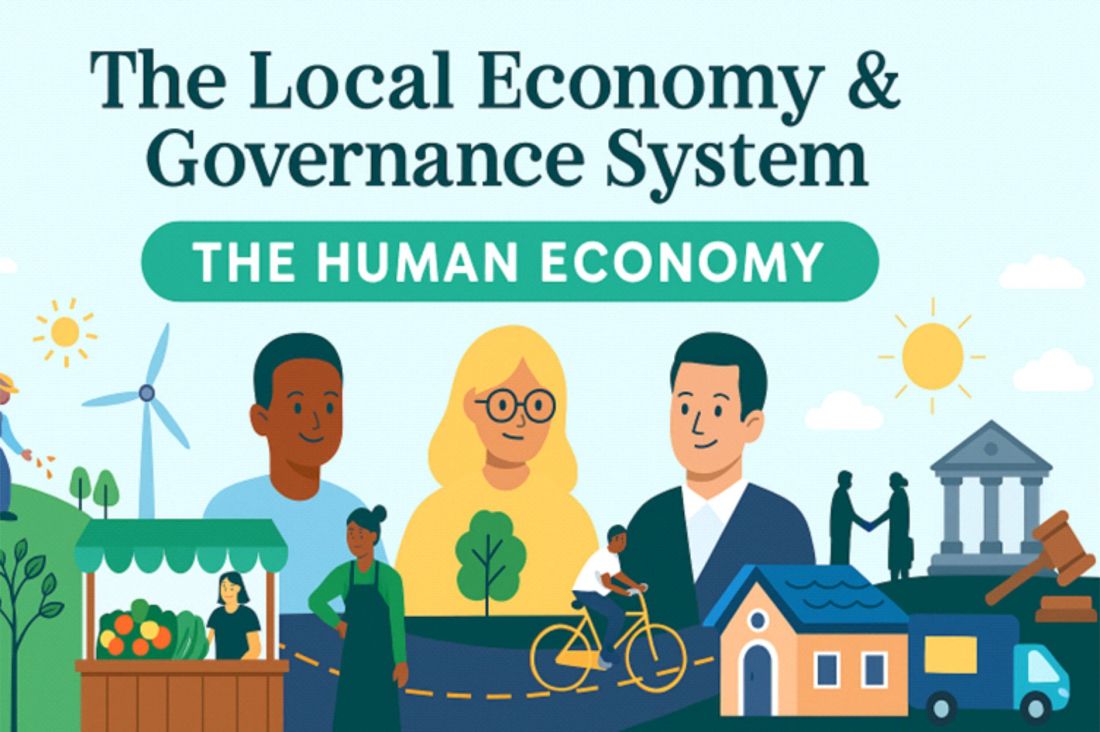
4. LEGS: The Local Economy & Governance System
LEGS is the structural foundation – the practical framework that makes the Revaluation, the BLS, and the Contribution Culture real.
It is built on:
local economies
local food systems
local governance
participatory democracy
shared responsibility
transparency
decentralisation
LEGS solves the problems that have existed since long before fiat:
centralised power
hierarchical control
distance between decision‑makers and consequences
systems that cannot see the ground
economies that treat people as units
governance that manages people instead of serving them
And it solves the problems that fiat accelerated:
extraction
inequality
speculation
debt dependency
the illusion of infinite value
And it solves the problems that AI will make catastrophic:
the removal of jobs
the collapse of income
the loss of agency
the erosion of sovereignty
the concentration of power in the hands of a few
LEGS is not a policy.
It is a new operating system for society.
5. Personal Sovereignty: The Human Foundation
Personal sovereignty is the right – and responsibility – of every individual to live as a free, ethical, self‑directed human being.
It is protected through:
security
transparency
locality
shared responsibility
meaningful contribution
The money-centric system destroys sovereignty by creating dependency through UBI.
LEGS restores sovereignty by creating participation.
Why LEGS Works Where UBI Cannot
UBI tries to preserve the old system. LEGS replaces it.
UBI depends on money. LEGS depends on contribution.
UBI centralises power. LEGS decentralises it.
UBI treats people as passive recipients. LEGS treats people as active participants.
UBI assumes scarcity. LEGS builds natural abundance.
UBI keeps people dependent. LEGS restores personal sovereignty.
UBI is temporary. LEGS is sustainable.
UBI is the illusion of security. LEGS is the reality of it.
The Choice Ahead
Humanity is approaching a moment where the old system will no longer function – not because of fiat, not because of politics, but because AI will remove the economic role of billions of people.
UBI cannot solve this.
It was never meant to.
The only real alternative is a system that:
restores human value
guarantees security
redefines work
decentralises power
rebuilds community
and places people first in every sense
That system exists.
It is coherent. It is humane. It is practical. It is necessary.
It is the Local Economy & Governance System, built on the Basic Living Standard, the Contribution Culture, and the Revaluation.
This is not a dream. It is not a theory. It is not a utopia.
It is the only path that deals with the root causes – not just the symptoms – of the unravelling we are living through.
And the time to choose it is now.
Further Reading:
1. An Overview of a People-First Society
https://adamtugwell.blog/2026/01/03/an-overview-of-a-people-first-society/ Why it’s critical: This article lays out the philosophical foundation for a people-centric society, directly addressing the shift away from money-centric values. It’s essential for grasping the big-picture vision that underpins all other proposals in this document.
2. The Local Economy & Governance System (LEGS): Online Text
https://adamtugwell.blog/2025/11/21/the-local-economy-governance-system-online-text/ Why it’s critical: This is the definitive resource on LEGS, the proposed alternative to the money-centric system that may soon look to UBI. It explains the system’s structure, principles, and practical mechanisms for replacing the current economic model. If you want to understand the practical solution, start here.
3. The Basic Living Standard: Explained
https://adamtugwell.blog/2025/10/24/the-basic-living-standard-explained/ Why it’s critical: This article clarifies the concept of the Basic Living Standard (BLS), a cornerstone of the LEGS system. It distinguishes BLS from UBI and explains why it’s a more sustainable and empowering approach.
4. The Contribution Culture: Transforming Work, Business, and Governance for Our Local Future with LEGS
One of the biggest misunderstandings of the time and culture we live in is the way we understand, respond to, and relate to what freedom really is.
Many of us believe that we are free: that we can do what we want, think what we want, say what we want, and be what we want.
Yet we all live under rules that must be followed – rules which few would deny are becoming more intrusive, more prescriptive, and increasingly powerful in the consequences they impose if we fail to use our “freedom” in the way someone else has dictated it must be perceived and lived.
The Everyday Policing of Speech
Some reading this may respond with something like “Tell me something I don’t know.” And that would be fair enough, given the growing body of anecdotal evidence confirming that freedom of speech is not what it seems.
Almost everyone we might consider “ordinary” – those without an agenda, simply wishing to get on with their lives – now finds themselves policing their own relationships and interactions with the outside world.
Speaking truths rooted in common sense, or even in the way things have always been, increasingly risks offending those who demand the world operate according to their own design.
The Marginalisation of Independent Thought
Even reflecting on what is, at best, the marginalisation of independent thinking – and at worst, the steady criminalisation of individual thought – opens up a maze of debates.
These debates inflame questions about the role, scope, and power of groupthink, and how establishment narratives are not only shaping, but increasingly dictating blueprints for how everyone must live their lives.
Encroachment by the Establishment
To believe we are free in a world, country, and culture where the establishment seeks not merely to encroach but to manage every part of life is alarming enough.
Yet it becomes even more disturbing when we recognise that these restrictions and attacks on freedom are not created for the common good, but to benefit someone else.
The Role of Money as Gatekeeper to Life, Peace, Happiness and Freedom that is Governed by Someone and Something Else
Freedom Defined by Money, Not Ourselves
Yes, we are already in a fight for those freedoms outlined above.
The fight is increasingly hard because a division has already been created between what we believe freedom is, and what we believe we already know it to be – which itself isn’t what we are experiencing.
That we continually look outside of ourselves for validation should make sense, because when we think about the difference between what we imagine freedom to be – doing whatever we want – and what society actually allows us to do, shaped by those who create the narratives that control society, we quickly begin to see that there is a significant difference involved.
The Manipulation of Meaning
Creating circumstances where somebody can change the meaning of something so that a word comes to mean something very different from what we know it to be could never happen in an environment where people are confident in who they are, their communities, their culture, and what it ultimately means just to be themselves.
We have now reached the point where even the term common sense is being brought into question, sometimes considered offensive or demeaning.
This is because the fundamental basics of life – the value set that upholds the framework for a good life – have been replaced by a system that places money at the heart of everything.
Money at the Centre of Every Choice
Money has become so ingrained in every part of life that, without even questioning our motives, it dictates the decisions and choices we make.
Everything in life is based on what we can afford, earn, save, accumulate, or the cost and risk of cost.
Jobs are about what we earn now and in the future. Insurance is about betting against risk. Education is about securing a career that pays more than a working wage. The house we live in depends on the mortgage and deposit we can save or borrow. What we own depends on money already earned or borrowed. Holidays depend on savings or loans. Cars depend on leases or borrowing, unless bought outright.
Contracts Before Basic Essentials
It doesn’t matter who we are or what we earn. The world now requires us to sign up, subscribe, or rent services and products we once simply bought.
These arrangements are backed by contracts that must be paid before any income can be considered disposable.
Only food and basic essentials remain in the realm of pay-as-you-go – and even those are increasingly tied to credit cards, buy-now-pay-later schemes, or payday loans.
Judgement Through Wealth and Appearance
We judge people by their appearance, their property, their clothes, or their transport – signals of “who the world tells us they are.” And when we consider how much future earnings and financial security matter, even ordinary people outside the elites evaluate partners and marriage commitments based on what a potential partner can afford.
The Private Turmoil of Dependence
Few can see just how powerful, overwhelming, and controlling money has become.
Fewer still talk about it comprehensively.
Yet the reality is that what we do, what we have, how we are perceived, and whether we are accepted or rejected all revolves around money.
This leaves us in private turmoil and pain – what some might call or know as hell – because parts of life, or what is respected as life today, are cut off or restricted by money’s role.
The System’s Sick Success
This system is not natural. It has been deliberately created for the benefit of those who already have much more than they will ever need.
Its success lies in convincing the masses that freedom and status are directly proportional to wealth.
Meanwhile, the mechanics of the system ensure that resources flow away from those who have every right to them, leaving them dependent on credit and enslaved by debt.
In return, people have unwittingly surrendered property, ownership, and the peace of mind that comes only from self-sufficiency.
Fear as the Final Driver
Everything in life is driven by money – or more precisely, by the fear of not having it.
Everyone, at every level, makes decisions and behaves according to financial implications.
When people or businesses are pushed into dependence on external finance, even reason itself is abandoned. Questions of viability or self-sufficiency are ignored, as survival becomes the only priority.
When this mindset dominates, it doesn’t matter who someone is or what position they hold. They become vulnerable to the power and control of whoever influences what happens next.
This is the world we live in today. The plans, strategies, and changes overtaking life – many of which defy common sense – have taken hold because someone, somewhere, intended and created it to be this way.
This Is by Design
Where this all becomes difficult to accept is in recognising that nothing about the journey which has brought the world to this point is accidental.
It is by design.
The reason is simple: people who know they are free, cannot be controlled.
Freedom Cannot Be Controlled
If people cannot be controlled, they will not accept, take part in, or contribute to a system that is stripping away everything from them.
Everything that should, and always will, remain naturally theirs.
The Drive to Own and Control
Those who want more – who want to control more, own more, and take everything from everyone else – cannot succeed unless they first control people themselves.
They cannot take everything away unless they make the process appear legitimate.
Control must come first, because without it, the system suffocates and then collapses, under the weight of its own injustice.
Freedom Does Not Look Like This
Because most of us are not physically imprisoned and we face each day with choices that seem to be ours, many believe we are free and living free lives.
However, what we are experiencing – where we are coerced by narratives, advertising, groupthink, the media, and even the “free-minded” influencers we follow online to keep up – is not freedom at all.
Coercion Disguised as Choice
Beyond the natural requirement to meet the basic and essential needs of maintaining human life, anything that influences our behaviour or sets frameworks for “acceptable” choices is not freedom.
It is an infringement upon freedom.
At its most basic level, it is simply doing what we are told.
Money as the Measure of Freedom
Because of the way the money system has been designed, people believe they are free if they have enough money to do what they want or to buy what they think will meet their needs, as the system suggests them to be.
But money has become the value itself – rather than the work, the products, the property, the services, or the people involved.
We now believe we can only have anything, whether it is to meet needs or wants, if we have or can obtain the money to pay for it – and that these things are all the same.
Our freedom is dictated entirely by our relationship with money.
The Illusion of Value
If money were as real as we believe it to be, the value of the money in our pockets or the salary we earn would not reduce without us doing anything that changes anything.
Yet it does.
And the value of our money changes, because money is under someone else’s control.
The game, or rather the whole deck of life, is stacked in someone else’s favour.
The Mathematics of Decline
In the UK, inflation typically reduces the value of the £Pound by 2–3% each year.
This means prices rise, and your money buys less over time.
Inflation is measured by the Consumer Price Index (CPI).
If inflation is 3%, £100 today will buy only what £97 did a year ago.
The effect compounds: after 5 years at 3% inflation, £100 is worth about £85.87 in real terms.
Year
Real Value (£100 Start)
0
£100.00
1
£97.00
2
£94.09
3
£91.27
4
£88.53
5
£85.87
To keep up, your income must rise at least as fast as inflation. Otherwise, your purchasing power declines each year. And in truth, when we look more closely at the figures against what it costs to buy the things that we rally need, inflation seems to be putting those prices up a whole lot more.
Running to Stand Still (Revised)
Because inflation in the UK typically reduces the value of the £Pound by at least 2–3% each year, you must increase your income by at least this amount just to maintain your current standard of living.
The effect compounds: after five years at 3% inflation, £100 is worth only about £85.87 in real terms.
This means you are running uphill simply to stay in the same place.
Of course, this is assuming the official rate of inflation is accurate – if the real rate is higher, the decline in purchasing power is even greater.
It Doesn’t Have to Be This Way – The Alternative Is The Basic Living Standard and an economy that puts People First
Because money sits at the heart of everything in life, very few of us can visualise a way of living that works differently. And as we’ve already discussed, you aren’t supposed to – because this is how you come to believe you are free, when in fact you have been enslaved.
Its genius lies in the way it convinces people to participate in, and even further, the very crime being committed against themselves.
In this system, money is the only god. But it is not benevolent or caring.
It is unjust, unfair, and strikes no balance when it comes to equity, equality, or what is good for mankind.
Two Masters Cannot Be Served
Man cannot have two masters.
For as long as money and the money system remain the only god, people, community, the environment, and basic human values will never be what life is truly about.
The system is designed to keep us dependent, fearful, and compliant. Whilst it slowly takes or destroys everything that is genuinely important and of value to us all.
The Alternative: The Basic Living Standard
There is an alternative. And although it may sound radical to suggest that one rule changes everything, the truth is that a future awaits where real freedom is not only possible for some, but becomes the way of the world for all.
The Basic Living Standard (BLS) is that rule.
It guarantees that everyone’s essential needs – food, shelter, energy, water, clothing, healthcare, and the means to participate in society – are met.
It is not charity, welfare, or a handout. It is a universal right, paired with universal responsibility.
Real Freedom Through Self-Sustainability
By meeting everyone’s basic and essential needs, the BLS creates the foundation for self-sustainability and genuine freedom.
It dismantles the false god of money by ensuring that survival is no longer dependent on debt, wages, or exploitation.
This is the only way to achieve real freedom: freedom to think, freedom to do, freedom to be, and personal sovereignty that gives peace to all.
What Financial Freedom Is and What It Means
The simple difference between the world that is destroying us and the world we need is this principle: We should only take what we need to meet our basic and essential needs, and reject completely the idea that there is anything good in accumulation, control, or influence beyond that.
No person or organisation should have the right to hold or control any more than they need for themselves or those they have direct and meaningful responsibility for.
Abundance
Natural abundance is the state of having our basic needs met and knowing they will continue to be met through our contribution and work – without interference or control from others.
Yet what we have come to believe abundance to be is wholly manufactured. It equates to accumulating, owning, and controlling as much as possible, regardless of the cost to others or to the environment.
When we recognise that true abundance is simply safety, security, health, happiness, and the basics that sustain them, we will also understand that these are the real foundations of inner peace. And peace is what abundance is really all about.
The Peace to Relax
Think carefully about how you feel when you no longer have to worry about what you will earn, borrow, or buy; how people will judge your clothes or job title; or anything else that creates fear of loss, anxiety about the future, or depression about what you think you may have already lost.
Yes, life has its own natural anxieties – relationships, health, and personal challenges.
But these are not manufactured to benefit someone else or a system that exploits us in every conceivable way.
When you have natural peace – because you are not in a constant race to keep up (while condemned to fall behind unless you add more than 3% value to your financial ‘worth’ each year) – if you are not already too far behind – you begin to see life through an entirely different lens.
Freedom to Think
When we have the freedom to think, we have the freedom to learn what life is really about.
We can be open to joys and pleasures that appear too simple or meaningless when we are trapped in pursuit of someone else’s agenda.
These joys hold value and meaning that help us grow into the human beings we truly are.
With this level of freedom, we see life’s mechanisms and systems in a healthier way.
Our expectations become simple. We develop patience with others and understand that we are not defined by what we have or earn, but by how we treat and respect others – even when there is no advantage to gain.
Freedom brings the ability to experience natural joy, not happiness sanctioned by someone else’s criteria.
It allows us to make and learn from mistakes, seeing them as value rather than cost – a perspective denied by the money-centric world.
Personal Sovereignty
Freedom on this level opens the door for us to be exactly who we are meant to be.
It facilitates personal sovereignty – the ability to make real, independent, and meaningful choices that affect only us, without fear of consequences from outside of ourselves.
This sovereignty exists beyond the participation and contribution required of us within the community to do our part, ensuring that everyone’s basic and essential needs are met.
It is the balance between individual freedom and collective responsibility, and it is the essence of financial freedom.
The Framework for a People-Centred Life
The Basic Living Standard is the formulaic basis of the life we all need.
It guarantees that everyone has access to everything necessary to meet their basic and essential needs, in return for each person contributing through work and activity to ensure that every necessary process – and yes, every business – is completed so that everyone’s needs are met.
Businesses That Serve Needs, Not Greed
The entire system revolves around this formula.
Businesses and organisations exist only where a basic or essential need must be met.
They never grow beyond the size necessary to serve the community in which they are located and involved.
This ensures that the purpose of business is not accumulation or profit, but service to people and the environment.
Technology as Support, Not Replacement
In this system, people are supported and aided — but not replaced — by technology and AI. The need for human contribution remains central, because participation is not about money or profit. It is about people, community, and the environment around which our lives revolve, and the experiences we share together.
The Same Rules Must Apply to Everyone
For fairness, balance, and justice to exist, the same rules must apply to all.
Part of the human condition is the instinct to survive – an instinct that quickly evolves into selfishness.
It drives us to use any advantage, whether through opportunity or design, to take more, hold more, or obtain power over more than we actually need.
We often justify this behaviour by believing it makes us special compared to others, or by using it to visibly demonstrate superiority.
Survival Instinct vs. Shared Responsibility
Yes, it can be argued that this is how humanity naturally behaves.
But just because it appears to be the default response to fear of lack, it does not mean it is right.
When there is enough of everything for everyone, and when we have the knowledge and understanding to build and manage a world that works for all – as we now have, the pursuit of excess is neither natural nor justified.
The True Depth of the Basic Living Standard
In this sense, the Basic Living Standard is not just a benchmark or guarantee of dignity and financial independence.
It is also a framework that requires everyone and everything to function with its principles in mind.
Every process, system, and mechanism must flow from and to its implementation.
The BLS is not simply about meeting needs – it is about ensuring that the way society operates is aligned with fairness and responsibility.
No Special Rules, No Hierarchies, No Excerptions
There can be no special rules for anyone. No exceptions or hierarchies where some hold more power or influence than others. No materially based differences that allow one person to be perceived as fundamentally different from another.
Only when everyone and everything plays by these basic but essential rules, can the integrity of the system be assured.
Integrity Between Person, Community, and Environment
Ultimately, it is the integrity of the relationship between person, community, and environment that must be protected.
This integrity ensures that fairness is not just an ideal, but a lived reality – one that sustains balance and justice for all.
The Local Economy & Governance System (LEGS)
The Local Economy & Governance System offers the framework and societal structure that enables the Basic Living Standard to function.
It ensures that everyone can thrive and enjoy the freedom to think, to be, and to do – the personal sovereignty that guarantees peace for all.
A Human Economy
LEGS is a human economy.
Everyone who can, works or contributes, and contribution replaces currency as the foundation of exchange.
This means that the value of each person’s effort is measured not in money, but in the way it sustains people, community and the environment.
The End of Inequality
Most of the social issues we experience today are the effects of inequality – wealth inequality, social inequality, and the distortions created by a money-centric system.
In LEGS, these issues disappear. They no longer exist because the system is built on fairness and the natural law of cause and effect: when everyone contributes and takes fairly, everyone’s needs are met.
Businesses That Serve Communities
As described in the Basic Living Standard framework, businesses and organisations exist only to meet essential needs.
They remain the size necessary to serve their communities, never expanding into monopolies or profit-driven empires.
This ensures that resources are not hoarded, and that abundance is measured by access, not accumulation.
Technology as a Partner, Not a Master
Technology and AI support people but do not replace them.
The purpose of contribution is not profit, but participation.
Work is about sustaining life, community, and environment – not about chasing growth or accumulation.
In this way, LEGS ensures that human dignity and responsibility remain at the centre of society.
A System Built for People
The Basic Living Standard cannot work within the collapsing money-centric system that we have today.
It requires a new foundation – and LEGS provides that foundation.
By reorienting governance and economy around people, community, and environment, LEGS makes possible a society where freedom is real, sovereignty is respected, and peace is shared.
Benefits of the Basic Living Standard and LEGS
The benefits of the Basic Living Standard (BLS) and the Local Economy & Governance System (LEGS) are wide-ranging.
They work not only at the individual level, but also across communities and the environment.
Together, they create a framework where fairness, responsibility, and sustainability replace fear, inequality, and exploitation.
Reducing Crime
When everyone’s essential needs are guaranteed, desperation disappears.
Crime rooted in poverty, scarcity, or inequality declines because survival is no longer at stake.
Contentment and Peace of Mind
True abundance is not accumulation, but having enough.
By ensuring that everyone has what they need, BLS and LEGS foster contentment.
People are free to live without constant anxiety about money, status, or survival, creating peace of mind and stability across society.
Removing the Mental Health Crisis
Much of today’s mental health crisis is driven by insecurity, debt, and the relentless pressure to “keep up.”
With BLS, those pressures dissolve. Freedom to think, be, and do allows people to experience natural joy, rather than manufactured happiness tied to wealth or possessions.
Ending the Benefits Problem
The current welfare system is built on dependency and stigma.
BLS replaces this with a universal guarantee: everyone has what they need, and everyone contributes what they can.
This ends the cycle of benefits, bureaucracy, and inequality, creating dignity and independence for all.
Sustainable Living and the End of Overuse
Because businesses under LEGS exist only to meet essential needs, they never grow beyond the size and capacity required by the communities they serve.
This prevents monopolies, overproduction, and exploitation of resources.
Communities consume sustainably, and the environment is protected.
Work and Contribution as Valid Beyond Pay
Contribution replaces currency. Work is valued not by wages, but by its role in sustaining the community.
Whether paid or not, every contribution matters – from caring for others to maintaining essential services.
Valuing Every Kind of Work
In a system where survival is guaranteed, people see the value in every kind of work.
No job is “beneath” anyone, because all jobs contribute to sustaining life.
Happiness in Any Role
People become happy and content to do any kind of job, because work is no longer about survival or status.
It is about contribution, community, and purpose.
Experience as a Shared Tool
Life experience itself becomes valued as a tool for the benefit of all.
Wisdom, skills, and lessons learned are shared within communities, enriching collective wellbeing.
Care Rooted in Community
Care for those who may be too young, too old or unable to contribute for any other reason is carried out by members of the community who are best able, and who still receive what they need to meet their basic and essential needs.
This ensures that care is not commodified or dependent on profit, but is a natural part of community life.
A System That Benefits All
The benefits of BLS and LEGS extend beyond individuals.
They strengthen communities, restore dignity to work, protect the environment, and create peace of mind.
By removing scarcity, inequality, and fear, they build a society where freedom, sovereignty, and justice are not privileges, but universal realities.
Life Beyond Survival
Freedom Creates Time for Life
When freedom and personal sovereignty are real — when the compulsion to “keep up” is gone – something remarkable happens. Time and space open up.
Social activities, sports, and hobbies stop being luxuries or calculated uses of “spare” time that isn’t really spare at all. They become normal parts of everyday life.
The Basic Living Standard and LEGS make this possible by removing the constant pressure of survival and competition.
Instead of chasing money or status, people can invest their energy in pursuits that bring joy, health, and connection.
Communities thrive when individuals have the freedom to play, to create, and to participate in activities that enrich life rather than drain it.
Yet the greatest gift of this freedom is not only the chance to do more, but the chance to be more.
With peace of mind and comfort secured, people gain the space to think differently and expansively about who they are and what their existence really means.
Freed from fear and scarcity, we can explore our true selves, discover new perspectives, and embrace the human experience in full.
Rediscovering Real Relationships
Equally important is the refocusing and repurposing of face-to-face, in-person, real-life relationships.
In the money-centric system, digital interactions and transactional exchanges have all too often replaced genuine human connection. But under the Basic Living Standard, relationships regain their rightful place at the centre of life.
The priceless social skills and social learning that come from real-world interaction equip every person for a happy, healthy life.
They foster empathy, cooperation, and understanding – qualities that cannot be replicated by algorithms or screens.
When survival is guaranteed and competition is replaced by contribution, people are free to build communities rooted in trust and shared experience.
This is not just a benefit of the system; it is its very purpose.
Human beings are not data points or consumers. We are social creatures, and our wellbeing depends on the strength of our relationships.
Conclusion: A Future Built on Real Freedom
The journey through this essay has shown that what we call freedom today is little more than an illusion.
Rules, narratives, and the money system have combined to create a world where survival is dictated by fear, debt, and inequality.
Yet this system is not natural – it is by design, and it benefits only those who already have more than they will ever need.
The Basic Living Standard and the Local Economy & Governance System offer a different path.
Together, they dismantle the false god of money and replace it with a framework built on fairness, contribution, and sustainability.
They guarantee that everyone’s essential needs are met, that businesses serve communities rather than greed, and that technology supports rather than replaces people.
The benefits of this transformation are not limited to crime reduction, mental health, or dignity in work. They reach far wider – across personal wellbeing, community strength, and environmental sustainability.
They reshape how we understand abundance, how we value relationships, and how we live in balance with the world around us.
They restore the integrity of the relationship between person, community, and environment, ensuring that freedom is not just an individual experience but a shared reality.
Beyond these practical gains, BLS and LEGS deliver something even greater – the freedom to live fully.
Time for hobbies, sports, and social activities becomes normal, not a luxury. Real relationships are rediscovered, and the social skills that equip us for happy, healthy lives are restored.
This is not utopia. It is a practical, people‑centred system that aligns with the natural law of cause and effect: when everyone contributes, everyone’s needs are met.
It is a vision of a world where freedom is not defined by money, but by sovereignty; where justice is not a privilege, but a universal reality; and where peace is not manufactured, but lived.
The choice before us is simple. We can continue down the path of fear, inequality, and exploitation and the destruction of humanity that it guarantees. Or we can embrace the Basic Living Standard and LEGS, and build a future where freedom, fairness, and community are the foundations of life.
The Basic Living Standard and LEGS create a human economy, where balance, fairness, and justice underpin life. They place people before money, with priorities fixed upon community and environment. The BLS is the simple benchmark rule — the rule of all rules – upon which all systems of trade and commerce are aligned. By recognising abundance in its natural form, where everyone has enough to meet their needs but not their wants, the dynamics of life are transformed. Every need beyond the tangible can then be met, because peace, freedom, and personal sovereignty flow from financial independence. This is what allows each of us to enjoy and learn from the human experience in full.
Glossary of Key Terms
Basic Living Standard (BLS): A universal framework that guarantees everyone’s essential needs—such as food, shelter, energy, water, clothing, healthcare, and the means to participate in society—are met. It is not charity or welfare, but a right paired with responsibility.
Local Economy & Governance System (LEGS): A proposed societal structure that replaces currency with contribution, ensuring that the value of each person’s effort is measured by its impact on people, community, and environment. LEGS supports the BLS and aims to eliminate inequality and exploitation.
Personal Sovereignty: The ability to make real, independent, and meaningful choices that affect only oneself, without fear of external consequences. It is the balance between individual freedom and collective responsibility.
Contribution Economy: An economic system where work and participation are valued by their role in sustaining the community, not by monetary reward. Contribution replaces currency as the foundation of exchange.
Universal Rights and Responsibilities: The principle that everyone has the right to have their basic needs met, and the responsibility to contribute to the wellbeing of the community so that others’ needs are also met.
Abundance (Natural): A state where basic needs are met and will continue to be met through contribution and work, without interference or control from others. True abundance is defined by safety, security, health, and happiness—not accumulation or control.
Money-Centric System (Moneyocracy): A societal structure where money is at the heart of every decision, relationship, and opportunity, often leading to inequality, dependence, and loss of freedom.
Groupthink: The tendency for collective narratives or establishment views to shape and dictate how individuals think and behave, often at the expense of independent thought and personal freedom.
Self-Sustainability: The ability for individuals and communities to meet their own basic needs without reliance on debt, wages, or exploitation. It is a foundation for genuine freedom.
Universal Guarantee: A commitment that everyone’s essential needs will be met, removing the stigma and dependency associated with traditional welfare systems.
Further Reading:
To help deepen understanding of the ideas behind the Basic Living Standard (BLS) and the Local Economy & Governance System (LEGS), the following resources are grouped by theme.
This structure will help you explore the foundational critiques, proposed solutions, mindset shifts, economic mechanisms, and personal perspectives that underpin the vision for a fairer, people-centred society.
Each link includes a brief summary to guide your reading.
The Basic Living Standard Explained Introduces the BLS framework, guaranteeing everyone’s essential needs are met, and explains how it differs from charity or welfare by emphasizing universal rights and responsibilities. https://adamtugwell.blog/2025/10/24/the-basic-living-standard-explained/
There is growing disquiet, fear, and quiet concern about the turbulence we are experiencing in the world, alongside a deep, intrinsic sense that nothing is as it should be – and that it will never be the same again.
Yet at the heart of this unsettling feeling lies confusion. The prevailing narratives insist that with AI now here, and the technology it commands about to permeate every conceivable part of our lives, humanity should be grateful.
We are told we stand on the cusp of a new age, where surrendering to AI will deliver a dream life unlike anything mankind has ever known.
Some are already suspicious, beginning to question what the rollout of this digital revolution will truly mean.
Others believe the only way to progress – or to feel in control of either the real or digital worlds – is to recapture what they perceive as the “good times,” attempting to fix everything as if it were possible to freeze life and live forever in a single moment of the past.
Uncomfortable as it may be, the time has arrived for everyone to begin asking the hard questions: what happens next, and where will we find ourselves in a future that is no longer a distant shadow on the horizon, but already towering above us right now.
The Watershed Moment We Cannot Ignore
The Coming Crisis of Agency & Survival
The answer to the question so many wish to avoid is that, if we continue on our current path, ordinary people will be left with no means to provide for themselves. They will have no income to pay others to do so, and neither government nor business will exist with the resources or the intent to supply even the basic essentials necessary for the masses to survive.
Everything we know – whether or not we recognise its connection to our current reality – has been moving in this direction for as long as most of us have been alive.
There has been a steady erosion of agency, independence, and self‑resourcefulness for ordinary human beings, first through the transfer of all forms of wealth, and now, taking place through the progressive takeover of every aspect of working life and function by both existing and rapidly emerging forms of AI.
Whilst many today spend quiet moments fearing the apparent opening of immigration floodgates and the erasure of Western culture, society, and life as we know it, others, for reasons seemingly unknown, appear to have embraced a suicidal empathy that insists the only correct behaviour of Western society is to destroy itself in order to prioritise all others.
AI’s Encroachment on Everyday Life
Yet everyone fails to see that the impending and critical threat to everything we hold dear has already been welcomed into our governments, our businesses, our technology, and the very functionality of daily life, and is so deeply embedded that it now resides in our computers and our phones.
The Myth of Effortless Utopia
AI, along with the robotics and technology now emerging to support it, is becoming the option of choice for carrying out the majority – if not all – tasks across what we currently understand as life.
This development will soon mean that, for the majority of us, there will soon be no reason for work to continue to exist.
Exploitation and Systemic Transformation
Whilst many of us hear talk of the AI takeover, the reduction in new hiring and training opportunities across numerous professions and industries, and the replacement of jobs of all kinds, we fail to connect these developments with the rising welfare bill as people find themselves with no choice but to accept a life of unemployment.
The New Divide: Inclusion and Exclusion
Nor do we pause for a moment to consider the pressing question: What does it mean when there is no job left for you?
The Last Chance for Human Agency
Yes, many truly believe the stories openly shared by members of the elite community driving this change – that in no time at all, life will become cheap and effortless for everyone because AI and machines can do everything.
The Value of Effort and Contribution
People really do believe we are about to step into a new and previously unrecognisable utopia, where the system has eliminated the need for human industry, effort, and value in the form of contribution, and instead provides everything we can imagine, free of charge and experienced as if life were one giant, permanent holiday for us all.
Historic Patterns and Systemic Endgame
Such benevolence, hinted at in the form of words from these few, and the feeling it inspires about our future, is one that few can fail to imagine.
Indeed, the words and the ease with which life now comes at us makes it very easy to accept the disproportionate levels of wealth for the few that has been encouraged by the progress of this new technical revolution.
People are taking for granted that once the evolution of everything needed to perform every task that human beings carried out across all functions of life is complete, these are the very same few who will then happily smile and sit back while everything they own and have developed works and provides for all of us in return for absolutely nothing. All whilst we continually maintain an ever‑improving standard of life and receive a universal basic income that covers every requirement beyond the luxurious permanence of 24‑hour leisure, which is somehow ever present and that we somehow believe we would actually enjoy.
In truth, we do not need to understand how or why we arrived here to see the situation for what it really is. The fundamental truths are already available for us all to observe, consider, and comprehend, hiding in plain sight: the masses have been used and exploited to create the very means that will ultimately be implemented to destroy humanity as we know it.
As this has all progressed, we have all been fed and indoctrinated with stories, technology, forms of easy wealth, and advances convincing us that things can only ever improve along this path and that a golden age awaits.
At the same time, we have given our consent to puppet politicians who have willingly changed and enforced every rule necessary to facilitate this under the veil of progress -driven not by principle, but by submission to those with power and self‑serving agendas, lured by promises of glory and gain that appeal to their true, hidden selves.
Many struggle to believe that those we have elected, and those who have grown rich or benefitted so greatly from the rewards of leadership in a modern world and society, could truly be so cruel. Yet does it matter whether we – or even they – accept that as truth, when the outcome fast approaching, without a change in our direction, will inevitably be exactly the same?
Within the world and its structures – The System as it operates, functions, and controls every part of life today – the true divide of them and us lies between those whom the system will continue to carry and cater for once the concept of human independence no longer exists, and the masses who have no further use, whom the system will either choose to exclude or find some means to remove.
This is neither a horror story nor a work of fiction. The only uncertainty – without a change in direction – lies in when and how events will unfold that bring about the critical period of transition.
Today, humanity still possesses agency, choice, and the power to pursue an alternative pathway – even though so many of us are sleep‑running toward the end of freedom’s existence, actively embracing and welcoming the very tools that will soon replace the need for us within our own lives.
The fundamental truth of any life worth living is that there can be no reward without effort, and that effort itself is the pathway to reward when life is grounded in truth.
We hold no value to anyone or anything if we do not contribute or participate when we are able. There are no free rides for anyone or anything, unless they come in the form of charity – or unless we ourselves assume the role, if deemed desirable, of pets.
History repeats this truth time and again. We need only look further to see how power is abused by the powerful—how they seek to control everything they find useful, and how quickly they dispose of it when they do not.
Everything about the moneocratic, money‑centric, top‑down, centralised, hierarchical, and patriarchal system was ultimately designed to end this way.
The arrival of technology – and finally AI – has brought humanity to a genuine watershed moment, an endgame in which we must either abandon the unsustainable way of life to which we have become addicted and embrace one that restores balance, fairness, and justice for all, or continue living the lie created by those who profit from our subservience.
If we choose the latter, we will participate in it until the moment we realise we no longer hold any value, and the destiny imposed upon us by others has arrived.
The Alternative Pathway
The temptation for many, upon realising what has happened and what is happening, is to believe that all we need to do is step back a few years and remove the most corrosive technological advances that have entered our lives.
As simple as the removal of AI might seem – even if we were able to overhaul politics and replace politicians with those who agree – the real damage to society and culture has not come from technology or its advances themselves. It comes from the reasoning, motives, intent, and forms of control behind them.
These forces have long been at work, reshaping how everything functions across society – manipulating and redirecting life so that what we have already become is accepted as normal.
The way we live, work, conduct business, relate to others, and even relate to ourselves must return, rediscover, and recreate a way of being that transforms our system of values.
Our entire value set must shift so that we understand and expect meaning from life in ways that, by today’s standards, may seem counterintuitive or even alien.
The Human Value Imperative:
We must embrace the reality that everyone is equal, and that the only difference between us lies in our roles, functions, and contributions within society—roles that are always dynamic and open to change.
We all need to accept that differences do not make us different when it comes to what is ethically, morally, and fundamentally right.
We all need to accept, understand, and embrace that no person should be advantaged over another by circumstances beyond their own efforts or control.
We must accept that deviation or allowances beyond these principles will always lead to growing unfairness—even when special circumstances seem justified or privileges are believed not to be abused.
We must accept that hierarchies are not a natural system of order, even though the need for order in society means that some will naturally take the lead.
We all need to share responsibility and take part in collective choices that shape the aspects of life we share.
We all need to contribute to the community in whatever ways we can.
We all need to work and actively contribute to shared life whenever we are genuinely able.
We must live by the principle that the responsibility we have toward others is the same responsibility we owe to ourselves.
We all need to accept that once our needs are met, nothing is gained if any one of us seeks to have, take, or control more.
We must accept that true abundance means having as much as we need, not everything we want.
We must accept that people are the greatest source of value, and that real economics should be centred on that value.
We must embrace the reality that full employment is both natural and normal when employment is defined by all forms of contribution, not just financial return.
We must welcome and protect the truth that locality, and the transparency it brings to every kind of relationship, is key to maintaining and benefiting from a system we can trust to be fair, balanced, and just.
We must ensure that AI and all technologies are used only to support human life and enhance working practices—not to replace jobs or create circumstances in which any human being is considered useless.
When we commit to all of these principles, we can begin to envision a society and way of life that truly functions as it should with equity, equality and accountability for all – one that is transformed in almost every possible way.
The Turning Point: Choosing Freedom and a Better Future
For many of us, the uncomfortable reality we must face is that passive inaction – or continuing to accept life under the control of others, believing things will simply carry on as they are – poses an existential threat that is all too real. It is a danger that extends beyond the confines of Orwell’s 1984 and, for those who truly value their lives, could mean something far worse.
The choice – while we still have one- is to not only accept but to embrace an alternative path.
This path, though carrying forward some familiar aspects of the world around us, demands that every part of our lives be lived in a fundamentally different way: a way where people, community, and the environment come first; where power rests with the individual, their freedom, and their personal sovereignty; and where the whole experience of life unfolds in a completely new direction.
The Local Economy & Governance System Framework: A Path to Empowerment
Exploring the Local Economy & Governance System
Visualising a different world – how it operates, what it requires of us, what we must give, how we work together, and how frameworks of rules function (rather than laws that micromanage every part of life, as is increasingly the case today) – may sound simple. Yet their adoption, interpretation, and our response to them within a system centred on empowering every person, rather than controlling them in every conceivable way, will be fundamentally different.
This shift will inevitably provoke resistance, not least because we have become addicted to the unsustainable, money‑centric way of living that dominates our lives today.
The Local Economy & Governance System provides a detailed picture of these frameworks, showing how this new people‑centric model will look and how it can be implemented.
Perhaps the most important element of this new world is that it will be built upon direct, participatory democracy – a system entirely unlike the hollow or pretend democracy that defines the moneyocratic world we currently inhabit.
Participatory Democracy: Power in the Hands of People
Participatory democracy means that everyone takes part in the decision‑making processes that shape public policy.
It ensures that we all hold the power to change or remove the public representatives we choose and appoint.
This requires a level of accountability and participation that is not only regular and personal, but far greater than the limited choice we currently have – voting every four or five years for candidates selected by someone else.
There is much to consider about the processes that enable true participatory democracy and how it can work effectively and diligently.
One of the most striking differences between this future system and what we have today is that there will be no political parties.
Instead, public representatives will be chosen directly by the community – respected individuals with proven commitment to serving the best interests of everyone involved.
From Possibility to Reality: A System That Works for Everyone
The Local Economy & Governance System will work because it prioritises people, community, and the environment in ways that may seem inconceivable today.
It places value on personal sovereignty and the freedom that comes from living lives defined by who we truly are, rather than by external factors and reference points that remain under someone else’s control.
Yes, the practical mechanics of LEGS will work – and they will work well – if we choose to embrace them.
After all, the dysfunctional world we inhabit today has appeared to “work” only because we came to believe in it, even as it has harmed so many of us.
We must not underestimate the ability, ingenuity, and creativity of humankind to deliver and implement solutions that succeed under any circumstances, when motivated and convinced it is right to do so.
Together, we can reclaim power and value and build a new world and system that functions with equity, equality, and open accountability for everyone – just as a truly civilised society always should.
Together, we can turn possibility into reality and create a society that truly works for everyone.
The Choice Before Us
We stand at a decisive moment in human history.
The turbulence we feel, the erosion of agency, and the encroachment of systems that strip away our independence are not distant threats. They are realities already shaping our lives.
The arrival of AI and the technologies that support it has brought us to a genuine watershed: either we continue down the path of dependency and control, or we choose to reclaim balance, fairness, and justice through new systems built on empowerment, community, and sovereignty.
The Local Economy & Governance System, grounded in participatory democracy and people‑centric values, offers a practical and principled alternative.
It is not a utopia promised by elites, nor a nostalgic return to the past, but a framework for living that restores meaning to contribution, accountability, and shared responsibility.
Human ingenuity has always risen to meet the greatest challenges. If we believe it right to do so, we can build a society that works for everyone – where equity, equality, and open accountability are not ideals but lived realities.
The choice is ours. To continue sleepwalking into a future where humanity holds no value, or to awaken and embrace the possibility of a new civilisation. One that honours freedom, restores dignity, and ensures that life itself remains worth living.
In a world increasingly shaped by the pursuit of economic growth and the dominance of monetary values, our understanding of what truly matters has become distorted.
The language of economics, once intended to serve human wellbeing, now often justifies systems that place money above all other forms of value.
This Local Economy & Governance System (LEGS) challenges the prevailing money-centred worldview, exposing the myths that underpin it and the consequences for individuals and society.
By re-examining the purpose of the economy and redefining value at the level of the individual, we offer a blueprint for transformation – one that places human needs, freedom, and wellbeing at the heart of economic life.
The following pages invite you to reconsider what it means to live well, to recognise the moral costs of excess, and to envision an economy built on natural abundance, justice, and personal sovereignty.
The Rise of a Money‑Centred Worldview
Over time, the words economy, economics, economic policy, and economic theory have been shaped by a money centred worldview.
They became part of a language and narrative designed to justify systems that placed money above all other forms of value.
This worldview gradually embedded itself into culture, until money was positioned at the centre of almost every aspect of life and treated as the primary measure of worth.
How Policy Reinforced the Myth of Economic Growth
Governments, politicians, and established institutions reinforced this belief by placing the economy at the heart of public policy.
They encouraged the idea that a good life was only possible if the economy was considered healthy and growing.
Measures such as GDP were promoted as the ultimate indicators of national wellbeing, and people were led to believe – often without explanation – that their personal success was somehow tied to the financial success of the economy itself.
Reducing Human Value to Economic Data
By turning everything of tangible value into something economic, measurable, and defined only in relation to the economy, society gradually stripped away the inherent value of each person.
Individuals became reduced to data points – digits on a screen – an effect amplified by digital tracking and the rapid development of AI.
The Hidden Myth of External Power
The central myth that upheld this money centric system was not only the false belief that money is inherently valuable.
The deeper, more powerful myth was the idea – never openly stated but widely accepted – that real power lies outside the individual.
Because money appears external to us, it became easy to believe that our worth and our agency also exist outside ourselves.
The Illusion of Money as Value
In truth, money has no intrinsic value. It is simply a tool for exchange.
The belief that money is value created the foundation for many of society’s problems.
The FIAT System and the Concentration of Power
This belief was further exploited through the rise of the modern FIAT monetary system, which used complexity, misplaced trust, and practices that would otherwise be considered unethical or criminal to shift wealth – and therefore power – from the many to the few.
All of this was presented as progress. As the natural direction of a modern world.
The Moral Cost of Excess
Yet in any genuinely civilised society, there is no moral justification for one person to hold more than they need when that excess comes at the expense of others.
When someone accumulates far beyond their needs, someone else – often someone they will never meet – is forced to go without the essentials required for a life free from deprivation.
How Scarcity Is Manufactured
Taking more than we need, in any form, inevitably creates shortage elsewhere.
Possession alone does not justify allowing others to suffer lack.
No individual has the fundamental right to hold more than they require when doing so directly or indirectly harms others.
Economics as a Tool of Justification
In this way, the language of economics became a tool to legitimise imbalance and injustice.
It normalised greed and elevated the pursuit of material wealth and power to something admirable – something to be celebrated above all else.
The Local Economy & Governance System: Defining the Economy and Economics for a Humane Existence and Way of Life
Real value does not exist within money itself, nor within the material possessions that money – despite having no intrinsic substance – can be used to persuade others to “buy or sell.”
True value can only be defined at the level of the individual. It arises from the meaning and importance a person attributes to something from within themselves, not from any external price tag or monetary label.
Money is simply a practical tool. Its purpose is to make the exchange of value easier when direct barter or exchange – trading goods, services, or labour – is not possible or convenient.
Money is a facilitator. Not the source of value itself.
In reality, people are the economy.
People are the reason the economy exists, the purpose behind it, and the driving force within it.
Every meaningful economic activity begins and ends with human needs, human choices, and human wellbeing.
With this understanding, the LEGS interpretation of economy can be defined as follows:
Economy is the collective presence, activity, and contribution of people working together to provide and supply all the goods, services, and forms of support that are essential for every individual within a community to live well.
Its purpose is to ensure that no person experiences need or scarcity severe enough to undermine the natural state of abundance – a condition in which all basic and essential needs are reliably met.
In this state of abundance, individuals are freed from the pressures of deprivation or want, allowing them to experience a form of personal freedom that is not compromised by the struggle to secure the necessities of life.
Thus, the economy is not merely a system of production and exchange, but a shared human effort to sustain the conditions that make genuine freedom, well‑being and the experience of Personal Sovereignty possible for all.
Summary
These pages challenge the prevailing money-centred worldview, revealing how economic language and policy have often placed monetary value above human wellbeing.
They expose the myths that underpin this system – especially the illusion that real power and value exist outside the individual – and highlight the moral costs of excess and manufactured scarcity.
The Local Economy & Governance System (LEGS) offers a transformative blueprint: it redefines the economy as a collective human effort, focused on meeting essential needs and fostering abundance, justice, and personal sovereignty.
True value, as argued here, arises from within each person – not from external price tags or monetary labels.
Money is a facilitator, not the source of value itself.
By placing human needs, freedom, and wellbeing at the heart of economic life, The Local Economy & Governance System envisions an economy where no individual suffers deprivation, and everyone is empowered to live well.
The path forward is one of re-examining our assumptions, recognising the moral imperative to share resources fairly, and building systems that sustain genuine freedom and wellbeing for all.