The November budget, with its push toward higher taxation, is not simply a matter of fiscal policy. It is a warning sign, a flare in the night sky that tells us the system we live under is running out of road.
Few people recognise what this shift truly signals, and fewer still are willing to confront it. That blindness is not accidental. Our economy has been carefully designed to mislead, to disguise its fragility, and to keep even the sharpest minds chasing illusions.
For decades, governments have expanded the flow of money, not by creating genuine value, but by inflating the system.
They bailed out the banks that caused the crash of 2007- 08, rewarding failure with public funds. Later, they unleashed torrents of money during the Covid pandemic, not to rebuild resilience, but to keep the machine ticking over.
These interventions did not repair the foundations; they merely propped up a broken structure. The result is a distorted reality in which the government can no longer borrow what it needs to sustain public services. Instead, it faces crises that today’s politicians are neither prepared nor equipped to lead us through.
To keep the illusion alive – to make it appear that everything is functioning as normal – the government must find money somewhere.
If banks cannot provide it (and in truth, they never had it to lend in the first place), then the state will take it from us. Taxation becomes not a tool of governance but a desperate grab for survival, a way to scrape together whatever can be found to keep the plates spinning.
This is the trap of the political class. They value their positions and the power they believe they hold more than the consequences of their choices.
Whether they admit the truth now or continue draining the public first, the end is the same: collapse.
The system is already hurting millions, and it cannot endure indefinitely. The only uncertainty is whether we lose what remains of our wealth before the collapse, or when it finally arrives.
The bitter irony is that our money is tied to nothing of real value. That emptiness is what has allowed politicians and elites to manipulate the system for so long. Could anyone become an overnight billionaire if wealth were grounded in tangible worth? Of course not. Their fortunes exist because people buy into offerings with money that, in essence, does not even exist.
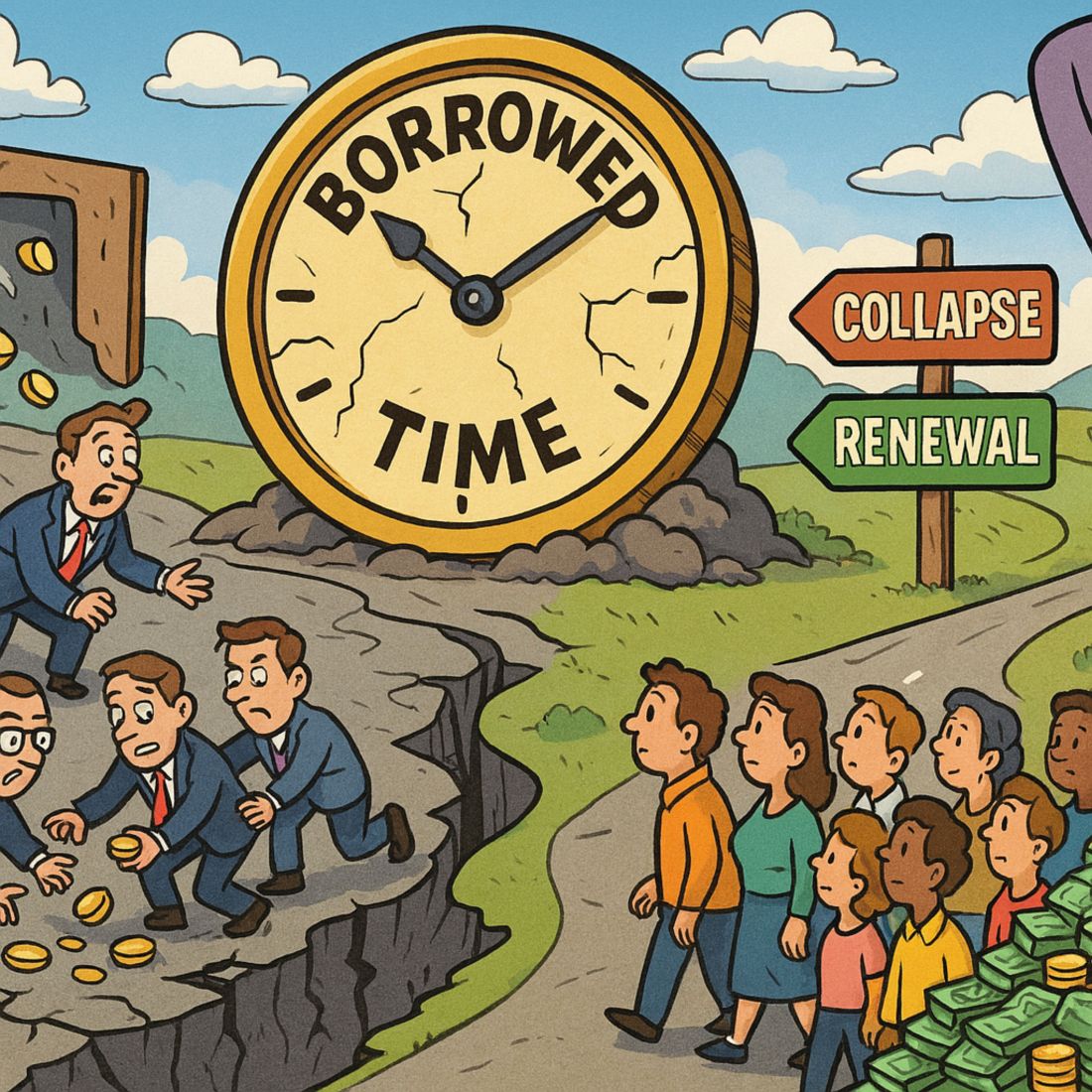
This government – and likely the next one too – is living on borrowed time. Real change will only come when leaders emerge who understand the true nature of the crisis and are willing to act decisively to rebuild on solid ground.
Until then, the charade continues – as does the damage that it causes.
Few will welcome the upheaval that is coming, but it is inevitable: the world will soon operate very differently than it does today.
That shift need not be catastrophic. We still have choices, and we still have the chance to take a better path.
But this requires honesty. It requires accepting that the obsession with money at the centre of everything must end.
Unlike the politicians driving the UK bus towards the cliff, we must recognise that we have already reached a place called stop.
From here, the only way forward is to put people first.
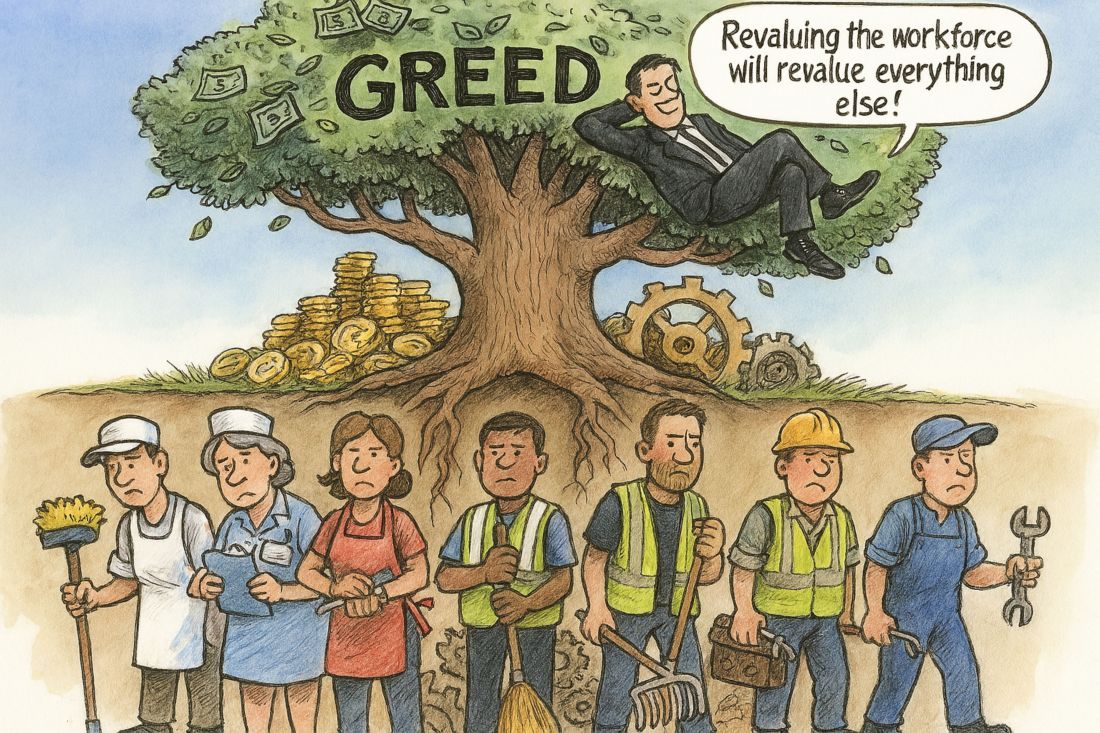
Life didn’t become expensive because it had to be. It became expensive because too many people wanted more than they needed, and in chasing profit they made freedom unaffordable for millions.
That greed has shaped the way we live, the way we work, and even the way we imagine what’s possible.
The Illusion of Permanence
We’ve been conditioned to accept the system as if it has always been this way and always will be.
For those who benefit, that’s convenient blindness. For those who suffer, it’s a kind of brainwashing – convincing them that change is impossible.
But everyday life tells a different story. Anyone who shops regularly knows how quickly prices rise.
A £3 item can jump by 30p in a week, far beyond the official inflation rate. At Christmas, tins of chocolates are dressed up as “reduced,” even though they cost 20 to 50% more than they did a year ago. And energy bills keep climbing even when wholesale prices fall. These aren’t natural increases; they’re engineered.
The Myth of Big
This manipulation is reinforced by another illusion: the myth of big.
We’re told that scale equals legitimacy, that size equals strength. But “big” doesn’t mean better. It means the system has grown so vast that exploitation can hide behind its scale.
The bigger it gets, the smaller we feel – and the easier it becomes to believe we can’t change it.
The Machinery of Exploitation
Once you see through the myth, the machinery becomes clearer.
Supply chains and hierarchies strip away accountability, amplifying selfishness until exploitation feels normal.
At the heart of it all sits money – created, policed, and controlled by those with power.
Profit comes first, people last, and the system is designed to make us accept it as normal.
The Human Cost
This isn’t about people failing. It’s about people being failed.
Lives are destroyed not because individuals did something wrong, but because others took more than they needed.
The uncomfortable reality is that we don’t have to live like this.
There is another way.
Redefining What We Value
We’ve been taught to believe success means others must lose, that material wealth defines worth.
That’s the great lie. It externalises our humanity, making us dependent on possessions instead of recognising our intrinsic value.
To change course, we have to learn to value who we are, not what we own.
Putting People First
Imagine a system where everyone’s basic needs are guaranteed.
This isn’t a pipe dream or a challenge to the “law of the jungle.” It’s simply the right thing to do.
A good life depends on the contributions we all make together, knowing that at the end of the week we’ve done our part and received what we need.
Beyond Division
We are not isolated individuals. We are members of the human race.
Hierarchies and divisions are tools of oppression, legitimising greed and selfishness.
Those who benefit from them do so only by exploiting the needs of others, however distant those others may seem.
A Framework for Fairness
Enshrining the Basic Living Standard in law would be the transformative step toward a society where dignity and security are guaranteed for all.
This principle ensures that every individual’s essential needs are met, fostering resilience and social stability.
The adoption of the Local Economy & Governance System and the framework it offers would strengthen communities by decentralising decision-making and empowering local actors.
Such a system encourages sustainable growth, supports small businesses, and keeps resources circulating within the community, thereby reducing dependency on distant, impersonal structures.
Together, these frameworks dismantle exploitation, promote fair contribution, and prevent the concentration of wealth and power that undermines collective prosperity.
By prioritising fairness and local empowerment, society will lay the foundations for enduring economic vitality and shared well-being.
As the cost of living continues to climb across the United Kingdom, many households find themselves struggling to maintain even the most basic standards of financial independence.
With impending tax rises on the horizon, the pressure on those already living near the edge is set to intensify, pushing even greater numbers below the threshold of self-sufficiency.
This is not a temporary crisis, but a symptom of a deeper, systemic failure—a collapsing economic model that now survives only by extracting more from those who can afford it least.
The money-centric economic system that we have – The “Moneyocracy” – perpetuates itself by shifting the burden onto workers and taxpayers, while the promise of prosperity grows ever more distant for the majority.
Against this backdrop, it is essential to confront a fundamental question – one that exposes the uncomfortable realities at the heart of our economy.
A Question:
Do you believe the minimum wage is enough for a full-time worker to live on – and if so, why?
The answer to this question, which varies depending on one’s relationship with the minimum wage, reveals uncomfortable truths about the foundations of our economy and the way work is valued in this country.
What is not surprising is that those who already have financial security often agree in principle that low-paid workers should earn more. Yet when confronted with the implications of paying every worker enough to live independently, many recoil. Why? Because such a change would disrupt their own relationship with the economy.
The Minimum Wage Reality
Let us be clear: the national minimum wage in the UK is not enough for anyone working a full-time 40-hour week to live independently—free from reliance on benefits, charity, or debt.
The widespread acceptance of this wage stems from government and establishment narratives.
What is legally mandated is presented as morally and practically sufficient.
Yet, in truth, the minimum wage is a carefully placed rock covering a pit of myths and lies.
Those who benefit from the system prefer not to lift that rock, because doing so would expose their complicity in maintaining the illusion.
The Employee
A worker earning the minimum wage – currently £12.21 per hour, equating to £488.40 per week or £25,396.80 annually – cannot afford the basic essentials required for independent living.
The gap between what they earn and what they need is effectively the amount by which they are underpaid.
Employers exploit workers by failing to cover the true cost of living.
Regardless of how the deficit is filled—through benefits, charity, or debt—someone else is subsidising both the employee and the employer.
The Employer (Small Business)
Small business owners often insist they pay fairly because they comply with the law. Yet compliance does not equate to fairness.
Paying the legal minimum is not the same as paying enough for employees to live independently.
Common justifications include:
• “They can top up with benefits.”
• “I can’t pay more or I’ll go out of business.”
But these arguments miss the point. The government—and by extension, taxpayers—should not subsidise businesses that cannot afford to pay workers a living wage.
In reality, small businesses are also exploited: they cannot operate independently within the current economic system, because they too are constrained by models that undervalue their work.
The Employer (Big Business)
Large corporations differ because they can afford to pay more.
Supermarkets and other major employers of minimum-wage staff generate enormous profits – even during a cost-of-living crisis, like the one we are experiencing now.
They could easily pay wages that allow workers financial independence, if boards and shareholders accepted smaller returns.
Instead, big businesses exploit both employees and taxpayers. Workers are underpaid, while the government subsidises wages through benefits.
This allows corporations to maximise profits while keeping the mechanics of exploitation hidden from public debate.
The Government
Why does the government subsidise wages so small businesses can survive and big businesses can thrive? Why not simply set a minimum wage that reflects the true cost of living?
The answer is stark: doing so would collapse the system.
The economy functions by undervaluing the majority of jobs deemed “low-skilled” or of “little value.”
If wages reflected reality, the house of cards would fall.
The Taxpayer
The system is a con. The complex machinery of what can be called a Moneyocracy manipulates trust and deference so effectively that taxpayers rarely ask basic questions.
Why, in an economy where corporations make billions annually, must taxpayers top up their employees’ wages through taxes?
Why are we threatened with price hikes whenever government policy shifts, while corporate profits remain largely unscrutinised?
Following the money reveals the truth: wealth is funnelled in one direction, made possible only by exploiting workers, taxpayers, and weak governments.
Corporations profit by underpaying staff, then spin narratives that justify charging consumers more.
Reality Bites
Exploitation of normal people has gone too far. The system enriches the few by exploiting the many – sometimes multiple times over – so profits can grow while wages stagnate or reduce in real terms.
The Moneyocracy survives by perpetuating the myth that it is acceptable for many to grow poorer while a few grow disproportionately rich.
The promise dangled before workers – that if they play the game long enough, they too might “live the dream” – is false.
Humanity is destroying itself chasing a dream that continually recedes, because playing the game requires forgetting our true worth.
The basic equation of the Moneyocracy is simple: for some to be rich, most must be poor.
This is neither humane nor true.
The Alternative
There is another way. A system built on real values – where people, communities, and the environment come first – can replace the current money-centric model.
This alternative requires transparency, local systems, and a commitment to prioritising human worth over profit. Instead of hiding self-interest behind complex structures, society must embrace a model where business and life are conducted openly, sustainably, and with fairness at the core.
The choice is absolute: continue with a Moneyocracy that exploits us all or build a future centred on people.
Path Forward
The Local Economy & Governance System provides the foundational framework for a truly people‑centric future – one where People, Community, and Environment sit at the heart of every decision.
At its core lies a new benchmark: The Basic Living Standard, a guarantee that every individual receives a weekly wage sufficient to cover all essential needs.
This principle of equity and equality is not an optional add‑on, but the priority that guides every part of the system.
By shifting away from exploitation and toward fairness, transparency, and sustainability, this model offers a pathway to rebuild trust and resilience in our economic and social structures.
To explore how this vision can be realised and what it means for the future, please follow these links:
Who Controls Our Food Controls Our Future, authored by Adam Tugwell and first published on 14 November 2024, explores the critical issue of food control and its impact on the future of society, particularly in the UK.
Written in response to the changes in Inheritance Tax Relief for Farmers in the UK October 2024 Budget, it aims to reveal the complex layers of the food chain, the collapse of farming, the disappearance of food security, and the myths that obscure these realities from consumers.
Key Themes and Points
1. The Importance of Food and Food Security
Food is as essential as water and air for health and survival, yet its importance is often overlooked until access is threatened.
UK food security is fragile; political decisions and global dependencies have made the nation vulnerable to shortages if borders close or supply chains are disrupted.
2. Food Quality and Nutrition
There is a widespread misconception that all food is healthy, regardless of its source or processing.
Highly processed, low-nutrition foods have become normalised, driven by global business models and marketing narratives that prioritise profit over health.
3. The Food Chain Onion: Layers and Stakeholders
The document uses the metaphor of an “onion” to describe the multilayered food chain, each with distinct interests and influences:
Consumers
Consumers are key stakeholders but often feel and are treated as powerless, accepting what is available or affordable without questioning their influence.
Retailers (Supermarkets)
Supermarkets prioritise profit, using data and contracts to control farmers and manipulate consumers through loyalty schemes and pricing strategies.
Processors and Manufacturers
Processing has shifted from traditional, healthy methods to industrial, profit-driven practices that often harm health and undermine local food systems.
Manufacturers create addictive, unhealthy foods and collaborate with retailers to maximise profits.
Merchants and Landowners
Merchants and landowners add layers of profit and control, often prioritising investment over food production and community needs.
Money Markets, Financiers, and Corporations
Financial interests and big corporations have manipulated regulations and markets to maximise profit, often at the expense of farmers and consumers.
Politicians and Public Sector
Politicians and government officers lack understanding and leadership, often serving party, personal or hidden interests rather than public good.
Lobbyists, Activists, and Academia
Lobbyists and activists influence policy, sometimes without practical understanding.
Academia fails to champion necessary paradigm shifts, remaining anchored to the current money-centric system, which ‘pays the bills’.
Membership and Advocacy Organizations
The behaviour of big advocacy organisations like the NFU suggests they are more aligned with the establishment, rather than the industry and membership itself, often prioritising relationships with government over genuine change.
Farmers
Farmers have lost control and are pressured by external interests, subsidies, and contracts that undermine their independence, the viability of local food production and any willingness to embrace farm-led change.
4. Narratives, Myths, and Shibboleths
Who Controls Our Food Controls Our Future identifies powerful narratives and myths that shape public perception and policy, including:
Globalisation makes food cheaper (a myth that hides the true costs and vulnerabilities).
Cost is the only important thing to the consumer (ignoring nutrition, provenance, and community impact).
“BIG” farming is the only viable model (marginalising small, family or local farms).
Money can solve every problem (overlooking the root causes of the problems that the food chain is experiencing that were created by money-centric systems).
Various other myths about food supply, farming, supermarkets, and political interests are also debunked, emphasising the need for local, transparent, and community-driven food systems.
5. Perceptual Barriers and Solutions
Situational bias and group gaslit isolation prevent people from recognising problems and acting for change.
Who Controls Our Food Controls Our Future argues that profit should not be a right, especially in essential supply chains like food.
The proposed alternative is a farmer and community-led food chain revolution, rebuilding local food systems and local circular economies with food production at the centre, to restore control, independence, and food security.
Review of Key Messages of Who Controls Our Food Controls Our Future
Food control is central to societal well-being and future security.
The current food system is dominated by profit-driven interests, complex layers, and misleading narratives that undermine health, local economies, and food security.
Consumers and farmers must reclaim influence, challenge myths, and rebuild local food chains.
Real change requires a paradigm shift away from money-centric thinking to people-centric values, prioritizing food as a public good.
Leadership must come from the grassroots, with communities and farmers working together to create resilient, transparent, and equitable food systems.
Who Controls Our Food Controls Our Future closes by inviting readers to learn more, discuss, and remain open to new ideas, emphasizing that solutions must be collective and rooted in genuine understanding and community action.
Actions For Consumers
1. Recognise Your Influence
Consumers are one of the two key stakeholders in the food chain. You have more influence than you realise over what food is produced and how it is supplied.
2. Prioritise Healthy, Local Food
Seek out food that resembles its original form or source, and support traditional, local, and minimally processed foods.
Challenge the narrative that only processed or globalised food is affordable or convenient.
3. Question Narratives and Myths
Be sceptical of marketing, supermarket offers, and the myth that cost is the only important factor. Consider nutrition, provenance, and community impact.
Understand that “cheap” food often comes at the expense of quality, health, and local economies.
4. Support Local Farmers and Businesses
Build direct relationships with local farmers and small businesses. This is the only form of food chain that can be genuinely trusted.
Choose local, fresh, and traditionally processed foods whenever possible.
5. Advocate for Change
Engage in community discussions, challenge situational bias, and be open to new learning and perspectives.
Actions For Farmers
1. Reclaim Leadership and Independence
Farmers must recognise their role as business leaders, not just contractors, employees or recipients of subsidies and grants.
Accept that change must begin with farmers themselves if they want change that will benefit them.
2. Build Direct Relationships with Consumers
Focus on direct relationships with local consumers and small local businesses, rather than relying on contracts with supermarkets, processors, or global supply chains.
3. Shift Away from Profit-Driven Models
Challenge the myth that “BIG” farming is the only viable way. Small, local, family farms are vital for food security and community resilience.
Prioritize food quality, environmental stewardship, and community needs over maximising profit.
4. Lead the Food Chain Revolution
Farmers have the power to catalyse change by working with local communities to rebuild local food chains and circular economies.
Take the risk to initiate change, even if it means stepping away from established systems and subsidies.
5. Advocate for Policy and Paradigm Shifts
Engage with advocacy organisations, but push for genuine change rather than playing along with establishment interests and paying lip service to everything else.
Support a paradigm shift from money-centric to people-centric values, treating food as a public good.
Summary of Actions
Consumers and farmers must work together to rebuild trust, transparency, and resilience in the food chain.
Direct, local relationships are the foundation for a healthy, secure, and equitable food system.
Challenging myths, narratives, and profit-driven models is essential for meaningful change.
Grassroots leadership and community action are the keys to restoring food security and independence for all.
In recent years, mounting challenges have threatened not only the livelihoods of farmers but also the nation’s ability to control its own food supply.
As policies and industry practices increasingly sideline independent food production, farmers face a pivotal choice: continue operating within a system that undermines their independence, or take bold steps to reclaim control and rebuild the UK food chain from the ground up.
This article explores the urgent need for change, the systemic issues facing agriculture, and the powerful impact that farmers’ decisions will have on the future of food security, communities, and the environment.
Farmers’ Choice: Reclaiming Control of the UK Food Chain
Farmers in the UK face a critical decision: either take back control of the nation’s food chain now, or risk losing everything—including the freedom that comes from managing our own food supply.
Background
In the summer of 2023, I published The Glos Community Project, which later evolved into An Economy for the Common Good.
Originally written as a book, The Future is Local, this project explored localising the supply of essential goods and services when our current system collapses.
It offered a practical vision for local communities, emphasising business models that prioritise people, communities, and the environment over profit. The central idea was to shift away from money as the core value and put people first.
Food and food security have always been central themes since I wrote Levelling Level in 2022. Through examining food production within a localised, circular economy, I realised just how pivotal food is to our future.
Unfortunately, the UK food chain’s importance is being sidelined and overlooked today.
The State of UK Agricultural Academia
My focus on UK food security led me to postgraduate study at the Royal Agricultural University in late 2023, where my concerns about the establishment’s approach to agriculture were only amplified.
There are glaring contradictions in the current system – contradictions that academic institutions seem unwilling to address. This reluctance raises questions about the true purpose of agricultural academia if it won’t challenge the status quo.
However, this malaise isn’t unique to agriculture; it reflects a broader trend in UK higher education, which has shifted from providing world-class centres of learning to institutions focused primarily on turnover and getting every student they can through the door.
Challenges Facing Farmers
The experience at the RAU mirrors the state of UK farming today. There is widespread recognition that something is fundamentally wrong, yet calls for change are often muted and deferential to the establishment.
Many across the industry still believe that government, the public sector, and corporate players will prioritise the needs of small businesses and farmers. However, history shows that this is rarely the case.
While farmers, industry speakers, and advocacy groups continue to speak out, their efforts often amount to little more than noise. Many hope that politicians will eventually address the industry’s difficulties, or that a change in government will bring solutions.
But the reality is that UK food security is not being treated as a matter of common sense or urgency.
Who Controls Our Food Controls Our Future
The Farm Inheritance Tax issue highlighted how every part of the UK food chain lacks the priorities that working family farmers and the public deserve.
The system is rigged against independent UK food production because the establishment resists any sector that could foster independence from the current system.
Sadly, instead of helping, advocacy organisations often reinforce the myth that government supports UK farming by prioritising the relationship they have with politicians and officials, even as policies make it increasingly difficult for independent producers to survive.
The reality is that no matter how they are presented, the changes are all designed to encourage the end independent food production in the UK.
Control over the food supply is power. Like other productive industries, UK farming has been systematically undermined under the guise of progress, innovation, and economic policy.
This process began with the adoption of the Neoliberal FIAT money system and the push for global business, and deliberately misled previous generations into believing that joining the Common Market and making increasing commitments to the EU methodologies would benefit everyone.
The Consequences of Inaction
For decades, we have been distracted by consumer culture and promises of continuous improvement, while key industries have been hollowed out.
This has allowed a small group of wealthy individuals and corporations to consolidate control over land, businesses, and resources, often through changes in rules and regulations that once existed to support people, communities and the environment.
While some may dismiss these concerns as conspiracy theories, the evidence is clear: the consequences of these actions have been real and damaging. Many still struggle to believe that such harm could be inflicted for the sake of control and profit.
The Reality Today
Food and our food supply are critically important, yet many fail to grasp this.
Some policymakers believe traditional farming is obsolete and that future food will be produced in factories, regardless of the health or freedom implications.
Reports on farming profitability are rarely taken seriously, as the industry’s problems are symptoms of long-term, deliberate changes.
Governments of all parties are invested in a collapsing system, unable or unwilling to enact meaningful change.
Their solution is now to tax everything in hopes of reviving that failing system, but this approach is unsustainable too.
The Choice for Farmers
Farmers now face a pivotal choice: continue operating within a system that works against them, or walk away from government and industry expectations.
By starting anew and rebuilding the UK food system from scratch, farmers can reclaim control and create a future that prioritizes people, communities, and the environment.
Key Points Summary
Urgency for Farmers: UK farmers must act now to reclaim control of the food chain, or risk losing their livelihoods and the nation’s food security.
Local, People-Focused Economy: We must shift from profit-driven business models to ones that prioritise people, communities, and the environment, as outlined in the newly published Local Economy & Governance System.
Systemic Issues in Agriculture: There are deep-rooted problems in UK agriculture and academia, with institutions reluctant to challenge the status quo, and a broader trend of prioritising financial gain over genuine learning and improvement.
Government and Industry Inaction: Despite widespread recognition of problems, calls for change are often muted. Many in the industry hope for government intervention, but history shows that politicians rarely prioritise farmers’ needs.
Control and Power: The UK food system is structured to prevent independent food production, consolidating control among a small group of powerful interests. Advocacy organisations often reinforce the myth of government support, even as policies undermine farmers.
Consequences of Policy: Decades of policy have hollowed out key industries, transferring land, resources, and businesses to wealthy corporations and individuals, leaving communities and the environment vulnerable.
Dismissal of Concerns: While some may dismiss these issues as conspiracy theories, most recognise that the negative impacts are real and significant.
Misguided Beliefs: Policymakers increasingly believe traditional farming is obsolete, favouring factory-produced food without considering health or freedom implications. Reports and studies on farming profitability and the problems the industry faces are rarely taken seriously.
System Collapse: The current system is unsustainable, and governments are unable or unwilling to enact meaningful change, resorting to increased taxation in a failing attempt to keep the system afloat.
A New Path Forward: Farmers are encouraged to reject the expectations of government and industry, and to rebuild the UK food system from scratch, prioritising independence, community, and sustainability.