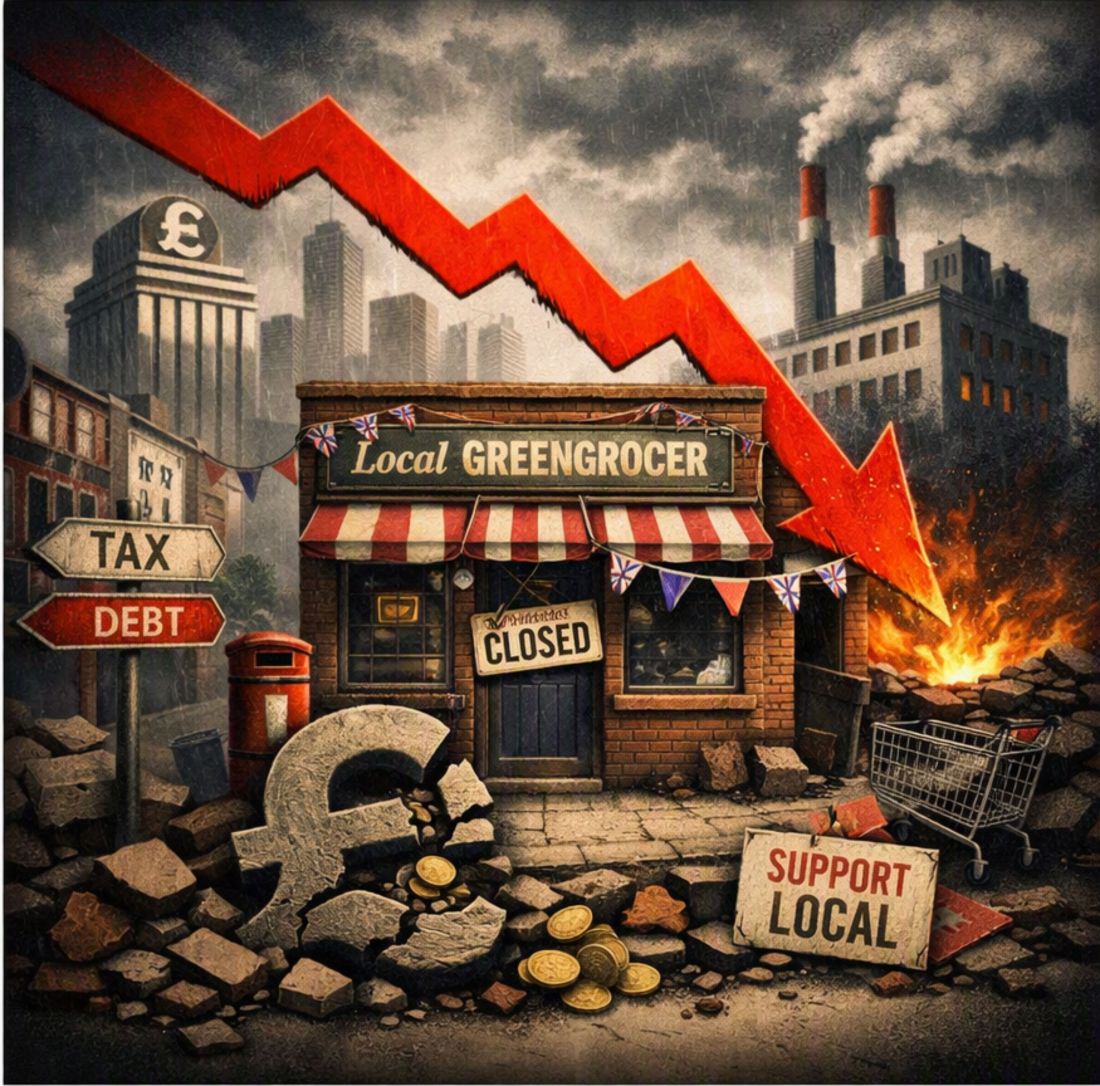
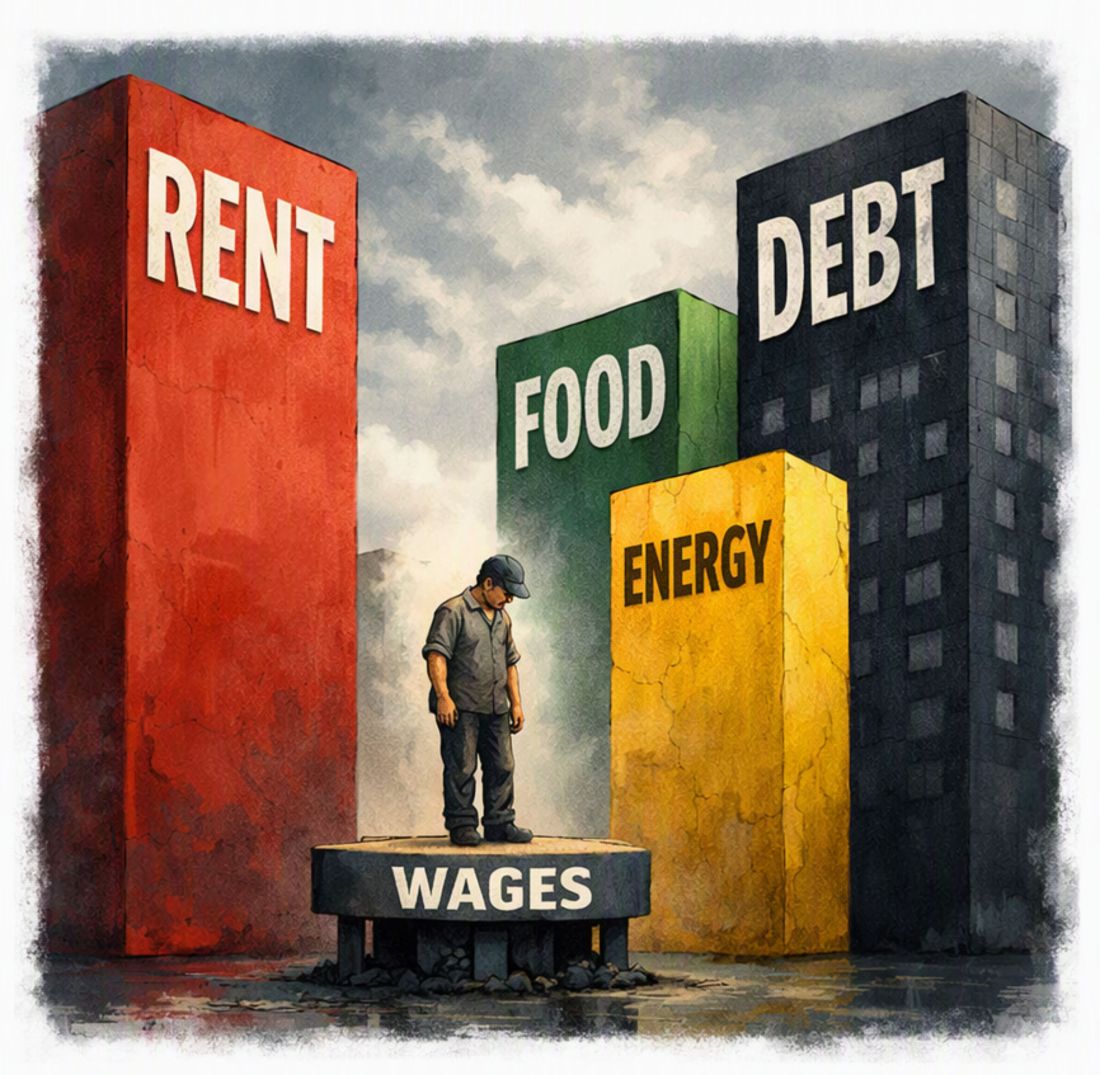
Ask people why small businesses are struggling today and you’ll hear a long list of familiar answers. Taxes. Business rates. Parking. VAT rules. Tourist exemptions. Energy costs. rent. The price of labour. The price of everything. And for the people dealing with those pressures, each one feels painfully real.
But none of them explain what’s really going on.
Because the truth is that the crisis facing small businesses today didn’t begin in July 2024. It didn’t begin with the current government. It didn’t begin with the last one either. What’s happening now is the result of decades of structural change – slow at first, then accelerating, then suddenly impossible to ignore.
And the hardest part to accept is this: the system we live in wasn’t built to support small businesses. It was built to extract from them.
That’s why every “fix” people argue about feels too small. That’s why every debate feels circular. That’s why every solution seems to miss the point. Because the point is buried much deeper than the symptoms we see on the surface.
The long hollowing‑out
For more than forty years, the UK economy has been reshaped around one central idea: that money should move freely, markets should dominate, and growth should come from scale. It sounds modern. Efficient. Sensible. But underneath, it created a system where value flows upward and responsibility flows downward.
Big corporations gained access to cheap credit, global supply chains, and financial backing that allowed them to expand at a pace no local business could ever match.
They could open stores at a loss, undercut prices, buy land, buy competitors, and buy market share. They could operate in ways that looked like “success” but were really just the product of financial engineering.
Small businesses, meanwhile, were increasingly left to survive on margins so thin they could barely absorb a bad month, let alone a bad year.
Communities changed too. As wages stagnated and housing costs soared, people had less time, less money, and less stability. They shopped for convenience, not connection. They chose the cheapest option because they had no choice. And slowly, the conditions that once made local businesses possible began to disappear.
This is why high streets are failing. Not because people suddenly stopped caring about them, but because the system changed what people could afford, how people lived, and where value flowed.
Corporate capture and the illusion of choice
The rise of supermarkets and chains is the clearest example. They used financialised expansion to wipe out local shops, then returned years later with “express” stores – selling back the convenience they had taken, but at a premium.
They didn’t win because they were better. They won because they were backed by a system that gave them every advantage.
Online platforms did the same. They centralised choice, centralised supply, centralised power – and left local businesses competing not with each other, but with global corporations that could dictate prices, terms, and margins.
This wasn’t a market. It was a takeover.
And it happened slowly enough that most people didn’t notice until the damage was already done.
The role of money – and why this part matters most
Underneath all of this sits the part people rarely talk about: the role of money itself.
For decades, the economy has been fuelled by created money – credit, liquidity, financial instruments, and investment flows that allowed large corporations to grow in ways no small business ever could.
This wasn’t organic growth. It was engineered growth. Growth built on debt, speculation, and financial leverage.
Small businesses don’t have access to that world. They operate in the real economy – the one where money has to be earned before it can be spent, where margins matter, where cashflow is survival, where a bad quarter can end everything.
The system didn’t just favour big business. It was designed around them.
Covid didn’t break the system – it exposed who the system really serves
On 20 March 2020, three days before the first lockdown, I wrote that the only humane response to what was coming was simple: pause the bills, freeze the interest, and make sure people had enough to eat and stay clean. Not loans. Not subsidies. Not grants. Just a temporary halt to the machinery so ordinary people and small businesses could survive the shock.
It wasn’t complicated. It wasn’t radical. It was practical.
But that kind of solution was never going to happen – not because it was impossible, but because it would have required government to prioritise people over markets. And that is the one thing the system cannot do.
The idea of pausing the system was treated as unrealistic, not because the logic was flawed, but because the narrative we all live inside teaches us something very specific:
The system cannot be stopped. The system rules. The system must be protected at all costs.
And the cost has been enormous.
Government could have paused the machinery. It could have frozen the costs. It could have protected households and small businesses long enough for everyone to survive the shock.
But it didn’t – because government doesn’t face the public. Government faces the markets.
When crisis hits, the priorities are not communities, not workers, not small businesses – but the financial architecture that sits above them. That is who government answers to. That is who government fears. That is who government protects.
Covid didn’t break the system. It revealed it.
It showed that the system has no built‑in mechanism for protecting ordinary people. It showed that the political class either doesn’t understand the structural reality or is too constrained by it to act differently.
It showed that the real economy – the one made of people, communities, and small businesses – is treated as collateral damage.
Covid wasn’t a stress test. It was a moment of truth.
And what was written on 20 March 2020 captured that truth clearly: government could have protected people, but the system it serves meant it wouldn’t.
Why people think the problem is political
Most people believe the crisis today began with the government elected in 2024 because politics is the part they can see.
They see the headlines, the rhetoric, the decisions being made right now. They see the tax changes, the budgets, the announcements. They see the chaos.
What they don’t see are the decades of structural change underneath:
the financialisation of everything
the consolidation of supply chains
the rise of monopoly power
the dependence on low wages
the hollowing out of communities
the shift from value creation to value extraction
So they blame the nearest political actor. They assume the crisis is recent. They assume it can be reversed with an election.
But the truth is that every government since the 1980s has been operating inside the same model. Some accelerated it. Some managed it. None reversed it. And now the model is reaching the point where it can no longer hide its consequences.
That’s why tax has become the obsession. It’s the only lever left. Everything else has been handed over to the market.
Why some small businesses don’t recognise this immediately
Not every small business owner sees themselves in this story. Some are still doing well. They have loyal customers. They have strong reputations. They operate in niches that haven’t been swallowed by centralised models. They serve communities that value them. They offer things that can’t easily be scaled, automated, or replicated.
Their success is real. But it is also fragile.
Even they can feel the shift:
footfall is different
customers are more cautious
costs rise faster than prices
competition feels less local and more corporate
the old stability has gone
They may not be collapsing – but they know the “glory days” are over. They can sense that something deeper has changed, even if they don’t yet have the language for it.
The honest conclusion
Small businesses are not struggling because they’re doing anything wrong. Workers are not struggling because they’re lazy or entitled. Taxpayers are not angry because they’re cruel.
Everyone is struggling because the system we live in was designed to extract value from the bottom and middle to feed the top – and it has been doing so for decades.
Covid exposed it. 2024 accelerated it. But the roots go much deeper.
Until people understand that, they will keep looking in the wrong direction for answers – and blaming the wrong people for the consequences.
The truth isn’t comfortable. But it is necessary. Because once people see what’s really happening, they can finally stop blaming themselves – and start recognising the system that has been shaping their lives for far too long.
Further Reading
If you want to explore the deeper forces behind the struggle facing small businesses today, the following pieces offer a clear path through the last six years of economic and political change.
Each one captures a different part of the story – from the moment the system was exposed in 2020, to the pressures that intensified in the years that followed, to the structural realities now shaping life in 2026.
Together, they show how we arrived here, and why the problems we face today run far deeper than anything that began in July 2024.
1. “We need bills & interest put on hold…” (20 March 2020)
Summary: Written three days before the first lockdown began, this piece argues that the only humane response to the coming crisis was to pause the financial machinery – bills, interest, and basic costs – so people could survive.
It explains why loans and subsidies were never going to protect the real economy, and why government decisions during Covid revealed who the system truly serves. This is the moment where the deeper structural truth becomes visible.
2. “Small business cannot afford escalating wage growth…” (20 September 2021)
Summary: This piece explores the widening gap between wage expectations and the financial reality facing small businesses. It shows how government‑fuelled wage inflation collided with a system already funnelling money upward, leaving small businesses unable to raise pay without collapsing.
It highlights the early signs of the financial crisis that would later become unavoidable.
3. “Why high streets are really failing” (19 August 2026)
Summary: A clear explanation of why high streets are collapsing – not because people stopped caring, but because the conditions that once made local retail possible have been dismantled.
This piece connects wage stagnation, housing costs, corporate expansion, and community hollowing to the disappearance of local choice. It shows how the high street’s decline is a symptom of a much deeper structural shift.
4. “When tax is the only tool they have left” (22 September 2026)
Summary: This piece explains why modern governments increasingly rely on tax changes as their primary response to economic problems.
It argues that tax has become the only lever left because most other tools – wages, prices, supply chains, investment, land, energy – have been absorbed into a market model government no longer controls.
It shows why political decisions today feel disconnected from real‑world needs.
Why these pieces matter
Read together, these articles trace the journey from the moment the system was exposed in 2020, through the pressures that intensified in the years that followed, to the structural realities now shaping life in 2026.
They show that the crisis facing small businesses is not recent, not political in the narrow sense, and not caused by the issues people argue about most loudly.
They reveal the deeper truth: this is a systemic problem decades in the making – and understanding it is the first step toward changing it.
When I first wrote about Royal Mail privatisation back in 2013 and 2014, I wasn’t trying to be prophetic. I wasn’t waving a flag or trying to score political points. I was simply describing what I’d seen in my own working life: that some services only work because they’re treated as services that should always be accessible for everyone, not as markets. And that once you start pulling at the threads that hold them together, the whole thing begins to unravel.
Those early pieces were written at the moment the Government was pushing ahead with privatisation. I remember thinking then – and writing openly – that the people making these decisions didn’t understand the mechanics of the thing they were dismantling. They didn’t understand how universal access works. They didn’t understand cross‑subsidy. They didn’t understand what happens when you take a service built on obligation and drop it into a world built on profit.
A decade later, Royal Mail has become the perfect example of what happens when you ignore all of that.
The moment you replace obligation with profit, the service changes
A universal postal service is one of the simplest ideas we have: everyone gets a delivery, wherever they live.
It’s not complicated. It’s not ideological. It’s not even particularly political. It’s just a basic commitment to treat everyone equally.
But once Royal Mail was privatised, that commitment became something else. It became a cost. A burden. A legacy obligation that had to be managed rather than honoured. And when you start looking at a hilltop village or a remote farm through the lens of profitability, they stop being communities and start being problems.
This isn’t about blaming Royal Mail’s leadership or its workforce. It’s about recognising that with privatisation, the logic changed – and once it changed, everything else followed.
Competition didn’t modernise Royal Mail – it carved it up
With privatisation came the ‘promise of competition’. Competition was sold as a way to “open up the market” and “drive innovation”. But competition only ever appeared where profit existed: bulk mail, parcels, urban logistics. It never appeared in the places universalism actually lives: rural routes, remote communities, low‑volume areas.
So what happened?
Private operators took the profitable parts. Royal Mail was left with the expensive ones, or supporting other companies that were taking a cut.
That’s not a failure of the market. That’s the market doing exactly what markets do.
The failure was political – applying competition to a sector where competition cannot function without destroying universality.
Royal Mail didn’t fall because of one thing – it fell because of three kinds of capture
This is the part people rarely talk about, but it’s central to the story.
Royal Mail didn’t just suffer from privatisation. It suffered from three different forms of capture, each pulling it away from its purpose.
Corporate capture
Once privatised, Royal Mail’s priorities shifted. Not because anyone was malicious, but because that’s what happens when shareholders enter the room. The universal service obligation became something to minimise, not something to uphold.
Union capture
Before privatisation, Royal Mail had the opposite problem: union leverage that made modernisation difficult, protected inefficiencies, and often put internal priorities ahead of public need. Again, not malicious – just another form of self‑interest shaping a service that was supposed to serve everyone.
Centralised political capture
And then there was the political layer: competition policy that hollowed out the profitable core, privatisation that removed public purpose, regulation that slowly retreated from protecting universality.
Each form of capture distorted the organisation in a different way. Royal Mail had all three pulling at it, one after another.
That’s why the decline feels so deep. It wasn’t caused by one decision – it was caused by a sequence of decisions that all pointed in the same direction.
Regulators didn’t protect the service – they managed its decline
Ofcom didn’t set out to weaken Royal Mail. But once the organisation was privatised and competition was introduced, the regulator’s job changed.
Instead of protecting universal access, Ofcom became responsible for keeping the privatised operator afloat. That meant relaxing standards, reducing delivery days, tolerating higher prices, and approving structural shrinkage.
Regulation became decline management.
This is exactly what happens when you try to regulate a universal service as if it were a competitive market.
The hollowing‑out wasn’t an accident – it was the destination
The redundancies, the rising stamp prices, the slower deliveries – none of this is accidental. It’s the logical end point of a sector redesigned around competition, shareholder value, and centralised political decisions.
Royal Mail didn’t “fail”. It was reshaped.
And what it has become – a parcel company with a legacy obligation – is exactly what the policy framework was always going to produce.
This is why I’ve been writing about these issues for so long
Over the years, I’ve written about local governance, contribution culture, basic living standards, and people‑first thinking.
Those pieces weren’t about Royal Mail specifically, but they were about the same underlying problem:
Essential services fail when they’re designed around power, profit, or central control rather than people, place, and purpose.
Royal Mail is the proof. It’s the example that shows:
why centralisation erodes identity
why privatisation erodes universality
why union capture erodes accountability
why competition erodes economic viability
why regulators cannot protect universalism in a market framework
It’s not about mail. It’s about how we organise essential services – and what happens when we get it wrong.
What we should take from the Royal Mail example
Three things stand out:
Universal access cannot survive under market logic
Essential services cannot be treated as markets
Capture – corporate, union, or political – always distorts purpose
These aren’t abstract ideas. They’re lived consequences. And they’re playing out exactly as expected.
Royal Mail isn’t the Only Warning – It’s Just the One We Can’t Ignore
And the thing is, Royal Mail isn’t some strange outlier. It’s not a one‑off collapse or a freak accident of bad management. It’s part of a pattern that’s been unfolding across every essential service we rely on.
If you look at water, energy, transport – even the basic infrastructure that keeps daily life ticking over – you’ll see the same hollowing‑out happening in different ways and at different speeds.
Water companies that treat rivers and coastlines like drains because investment eats into dividends. Energy networks that talk about resilience while whole regions face outages. Transport systems that cost more every year but deliver less, leaving communities cut off and commuters exhausted.
Different sectors, same story.
Once the goalposts were moved through privatisation, the markets became the master. And once money became the priority, people inevitably became the cost.
A service can prioritise people or money – never both. And the moment we pretended it could do both, we set ourselves up for exactly what we’re living through now: rising bills, falling standards, shrinking access, and a growing sense that the basics of daily life are becoming harder, not easier.
Some people look at all this and say, “Well, renationalise it then.” And on the surface, that sounds like the obvious fix. But nationalisation on its own doesn’t solve the problem, because it keeps the centralisation that caused half the issues in the first place. It puts everything back under political control – distant, slow, often out of touch – and it opens the door straight back to union capture, where the threat of strikes becomes a permanent bargaining chip.
You end up with a service that’s still vulnerable, still distorted, still not centred on the people it’s supposed to serve.
And the unions aren’t wrong when they say management is out of touch. How could it not be? When decisions are made hundreds of miles away by people who never experience the consequences, of course they’re out of touch.
That argument disappears when stewardship sits with the people who rely on the service every day.
When communities – everyone in them – are responsible for the essential services they depend on, the dynamic changes completely. There’s no distant management. No corporate boardroom. No union hierarchy negotiating with people who don’t live there. Just local responsibility, local accountability, and local understanding.
Royal Mail shows us what happens when essential services are designed around profit, power, and distance. Water shows us what happens when environmental responsibility becomes secondary to shareholder returns. Energy shows us what happens when resilience is treated as a cost rather than a duty. Transport shows us what happens when access is treated as a commodity rather than a lifeline.
Different sectors, same lesson.
This isn’t just a story about mail. It’s a story about how we treat the things that hold our lives together. And it’s a story about what happens when we forget who those services are supposed to be for.
Further Reading
If the Royal Mail story resonates with you – not just as a postal issue, but as a sign of how essential services can be reshaped in ways that quietly undermine the people they’re supposed to serve when they are privatised and controlled by the markets – you may find the following pieces helpful.
They track this pattern over time, across different sectors, and from different angles. Some were written more than a decade ago, long before the consequences became visible. Others explore the deeper dynamics that sit behind the hollowing‑out we’re now seeing everywhere from mail to water to energy.
Together, they form a kind of timeline: how we got here, what we missed, and what these examples reveal when you look at them closely.
1. Royal Mail Privatisation: It’s Called Privatisation for a Good Reason
A clear, early warning about what happens when a universal service is handed over to private ownership.
This piece explains why privately owned organisations inevitably prioritise shareholders over the public, and why the universal service obligation becomes a burden rather than a mission once profit enters the equation.
It’s striking now because everything it warned about has since played out.
2. Royal Mail Privatisation: The Coalition Might Be Wise to Reconsider Reinventing the Wheel
Written even earlier, this piece lays out the basic mechanics of universal access – cross‑subsidy, obligation, and the simple truth that some routes will always cost more than they earn.
It explains why competition in essential services doesn’t create efficiency; it creates fragmentation.
This work steps back from Royal Mail and looks at the wider question of how everything essential to us all should be governed.
It explains why centralisation creates distance, why nationalisation alone doesn’t fix the problem, and why local stewardship – with proper guardrails – is the only way to keep essential services aligned with the people they serve.
A deeper look at how work, responsibility, and service can be organised around contribution rather than extraction.
This piece helps explain why union capture and corporate capture both distort essential services – and why neither model can deliver universality or accountability on their own.
This piece sets out the idea of a guaranteed baseline of essentials – not as a political slogan, but as a practical foundation for fairness and resilience.
It connects directly to the Royal Mail story by showing how universal access should work when it’s designed around people rather than profit or centralised control.
A powerful parallel to the Royal Mail example. This essay shows how water – another essential service – has been hollowed out by the same mix of market logic, distant decision‑making, and the prioritisation of money over people.
It’s a case study in how environmental responsibility collapses when profit becomes the organising principle, and why communities end up paying the price.
The debate over tariffs on Chinese electric vehicles has been bubbling across social media, and what’s striking is not the policy detail but the discomfort it creates among the market‑orientated commentariat.
These are people who have spent decades insisting that globalisation is the only sensible economic model, that markets should always set the rules, and that any interference – especially by governments – is a step backwards.
Now, faced with the reality that the UK may need to work with EU partners to protect domestic manufacturers, they are being forced into intellectual contortions that reveal just how brittle their worldview has become.
The friction here is not really about cars. It is about the deeper assumption that the economic model we have – a model built on global supply chains, financial expansion, and the relentless pursuit of growth – is the only one that makes sense.
That assumption rests on a one‑directional pull toward opening trade as far as conceivably possible, because that’s supposedly where growth will be found. And growth, in this worldview, is not about people becoming better off. It is about the creation of yet more money, usually through debt, which pushes up GDP and keeps the financial system ticking over.
This obsession with growth hides a fundamental truth: the growth that markets obsess over is not the same growth that most people experience.
GDP can rise while living standards fall. Productivity can increase while wages stagnate. Asset values can soar while home ownership collapses.
Many people still cling to the myth that political growth will make things better – or at least return life to how it used to be – but the numbers have been going up for years while the lived reality has been going down.
To understand why protectionism now makes sense, we have to understand the money system that made globalisation seem inevitable.
The Money System Behind the Illusion
Modern economies run on fiat money – money created not from physical value but from government authority and, crucially, from debt. When banks issue loans, they create new money. When governments borrow, they expand the money supply. Growth, in the political sense, is simply the expansion of this created money.
For decades, this system worked because the newly created money was tied to expanding production. Factories were built. Goods were made. Jobs were created. Communities thrived. The money had something real behind it.
But once production was moved overseas, the link between money creation and real economic activity broke. We kept creating money – but we no longer created the goods, jobs, or value that once justified it. Instead, the West became dependent on consumption funded by debt, while production was concentrated in China and a handful of other countries.
This is where extraction enters the story.
Extraction: The Hidden Cost of Globalisation
Globalisation didn’t just move factories abroad. It extracted value from every part of Western society:
Extraction of jobs – manufacturing, engineering, logistics, and skilled trades hollowed out.
Extraction of wages – pay stagnated while costs rose.
Extraction of communities – towns built around industry lost their purpose.
Extraction of environmental stability – long supply chains increased emissions and resource depletion.
Extraction of political agency – decisions moved from local hands to global markets.
Extraction of national wealth – profits and production flowed outward, not inward.
Above all, globalisation extracted economic power from people and transferred it to corporations, financial markets, and foreign production hubs.
This wasn’t accidental. It was the design. Globalisation was sold as efficiency, but it functioned as a massive wealth transfer mechanism.
Wealth Transfer: The Real Story
The wealth transfer happened in several layers:
1. From wages to profits
When production moved abroad, labour costs collapsed. The savings didn’t go to consumers – they went to corporations and financial markets.
2. From communities to global supply chains
Local businesses couldn’t compete with imported goods. Wealth drained outward.
3. From national economies to China
The West consumed; China produced. The money followed the production.
4. From real economy to financial economy
As production declined, financial speculation replaced industry as the main driver of “growth.”
5. From future generations to the present
Debt expanded to maintain consumption levels that wages could no longer support.
This is why the system feels hollow: because it is.
The Illusion of Efficiency
Globalisation was sold as efficient. But efficiency is fragile.
Efficiency removes redundancy. Redundancy is what makes systems resilient.
Here, redundancy doesn’t mean job losses. It means resilience. In systems terms, redundancy is the spare capacity, backup options, and local alternatives that keep things functioning when something goes wrong. A resilient economy has multiple sources of essential goods, local production alongside imports, and enough slack in its supply chains to absorb shocks. Globalisation removed this kind of redundancy – not by cutting jobs, but by stripping away the buffers that once protected communities, industries, and national security.
Local supply chains, local production, and local skills were once buffers against shocks. Globalisation removed those buffers. It replaced resilience with fragility, and called it progress.
When shocks hit – a pandemic, a war, an energy crisis – the system broke exactly where it had been hollowed out.
The Curious Love Affair With China
This is where the love affair that politicians, industry aficionados and financial players have with China becomes so curious. They praise China’s industrial might, its manufacturing efficiency, and its ability to produce goods at scale and at speed. But they are blind to the realities underpinning the Chinese powerhouse – just as they are blind to how things really work economically here at home.
China’s industrial strength is real, but its economic model is fragile. It is heavily dependent on exports, deeply entangled in debt, and centrally managed in ways that hide structural weaknesses. The property sector has been in crisis for years. Domestic consumption is too weak to sustain growth. And the country’s manufacturing dominance relies on a global system that assumes stability, cheap energy, and constant demand – none of which can be taken for granted.
Yet Western economies outsourced their industrial base to China under the assumption that globalisation was permanent, stable, and mutually beneficial. They believed that moving production overseas would always be cheaper, always be efficient, and always be safe. But globalisation was never a natural law. It was a confidence game – a system that works only as long as everyone believes it will continue working.
Calling globalisation a Ponzi scheme might be too simple, but calling it a worldwide confidence trick is not far off. It requires constant expansion. It depends on trust rather than resilience. It shifts production far from consumption. And it leaves countries vulnerable if supply chains break, energy prices spike, or geopolitical tensions rise.
The truth that must be reckoned with is this: transferring every conceivable part of industrial production to the other side of the world leaves a serious question hanging in the air. What happens here – and what happens there – when the money system that is the lifeblood of this one-directional process comes to a grinding halt?
AI: The Final Blow to the Globalised Model
If globalisation hollowed out production, AI is now hollowing out what is left of the wage‑earning capacity that once kept the system going.
For decades, the global model relied on a simple loop:
The West consumed goods made abroad.
People earned wages to buy those goods.
Governments and banks created money to keep consumption rising.
China produced the goods that consumption demanded.
But AI breaks this loop. It displaces jobs across sectors – not just manufacturing, which was already offshored, but services, administration, logistics, design, media, and even parts of professional work. The very wage base that kept the consumption‑debt cycle alive is eroding.
We now face a situation where:
We no longer produce the goods.
We no longer earn the wages.
We still create the money – but it has nothing real to attach to.
This is the point where the global system begins to fail. You cannot sustain a consumption‑driven economy when the capacity to earn wages is collapsing. You cannot sustain a debt‑driven money system when the underlying productive base has been hollowed out. And you cannot sustain globalisation when the domestic economy no longer has the means to participate in it.
AI is not the cause of the crisis – it is the accelerant that exposes how fragile the system already was.
The Collapse of Demand
The global system requires:
constant production
constant consumption
constant money creation
constant debt expansion
But:
production moved abroad
wages stagnated
AI reduces earning power
debt has reached saturation
demand is collapsing
Once demand collapses, the entire global system fails – and protectionism becomes not ideological, but practical.
EVs: A Redirection, Not a Solution
EVs are being sold as a technological fix, but they are built on the same flawed logic: extract resources, extract labour, extract wealth, and hope the system holds.
The deeper issue is not the fuel that vehicles use. It is the assumption that we need so many vehicles in the first place – an assumption created by an economic system built around long‑distance commuting, centralised employment, fragmented supply chains, and consumer lifestyles that depend on mobility rather than locality.
EVs change the technology but not the underlying logic.
The System Is Failing – And Protectionism Is Becoming Necessary
We cannot continue like this. Soon we will not be able to.
The system that pointed everything toward China, foreign production, and EVs is falling to its knees. The question is whether we wake up in time to address the real issues while we still have a choice – or whether events will push everything we know straight to the floor.
In this context, protectionism not only makes sense – it becomes essential. Not just for cars, but for everything people genuinely need each and every day.
Media discussions about “upsetting China” are irrelevant compared to the question of more pressing matters such as whether everyone can continue to eat during a prolonged crisis.
Like so many other forms of essential production and supply we have hollowed out the UK’s ability to feed itself. Politicians may say we produce around 60% of our own food, but that figure is misleading. Much of that production depends on imported inputs: fertiliser, feed, energy, machinery, labour. If borders fully closed, the real amount of food ready to go directly to the table is closer to 11%.
That means in a real, ongoing crisis, we could feed roughly one in ten people. And this would potentially be the baseline for as long as it would take to change, develop and reestablish UK systems to produce enough food to meet everyone’s basic and essential needs.
To call this situation stupid would be an understatement. It is a growing structural vulnerability that has been ignored for decades because it was easier to believe that global supply chains were permanent and that crises only ever happened somewhere else.
The Only Viable Path Forward
Locality, localism, and an entirely different system – one that puts people first rather than money first – is now the only answer. And it’s the same for everyone else too.
Protectionism, in this context, is not about nationalism or nostalgia. It is about resilience. It is about ensuring that essential goods are produced close to where they are consumed. It is about rebuilding the capacity to feed, clothe, transport, and sustain ourselves without relying on fragile global systems.
This does not mean closing borders or rejecting trade. It means recognising that trade should complement domestic capability, not replace it. It means building systems that can withstand shocks rather than collapse under them. It means prioritising the basics – food, energy, manufacturing, infrastructure – over abstract financial growth.
The globalised model didn’t fail because of ideology. It failed because it extracted too much, transferred too much, hollowed out too much, and left too little behind.
Protectionism isn’t a political choice. It’s a survival strategy.
Further Reading
Understanding why protectionism now makes sense requires stepping back and seeing the wider system that shaped our economy, our politics, and our everyday lives.
The following pieces explore the deeper mechanics behind growth, money creation, economic fragility, AI disruption, and the urgent need for localism.
Each article expands on themes raised in the essay and offers a clearer view of how we reached this point – and how we can move forward.
1. Understanding the Growth Illusion
Why Politicians Obsess Over Growth – And Why It Has Nothing To Do With You
A clear explanation of why political “growth” is not the same as real‑world improvement. This piece shows how GDP has become a political performance metric rather than a measure of public wellbeing, and why the obsession with growth continues even when life gets harder for ordinary people.
The Harmful Truths That Are Hidden Behind Political Growth
This piece exposes the hidden mechanics of an economy that works against normal life. It explains how wage stagnation, rising costs, and the collapse of local industry were engineered by a system designed to extract value rather than support people.
Why Britain Feels Like We Are Being Priced Out of Everyday Life
An explanation of why everyday life has become unaffordable. It challenges the mainstream narratives about inflation and cost‑of‑living pressures, showing how the real causes lie in decades of economic policy that hollowed out domestic resilience.
A guide to understanding economic and political turbulence without falling into panic or misinformation. It helps readers see the structural issues clearly and avoid the fear‑driven narratives that often dominate public debate.
3. Fragility, AI, and the Collapse of the Old Model
The Age of Circular Fragility – Why AI and the World Economy May Now Rise and Fall Together
A crucial exploration of how AI accelerates the fragility already built into the global economy. It explains why job displacement, collapsing demand, and global supply chain dependence form a circular system where shocks amplify each other.
A foundational piece outlining what a people‑first economic system would look like. It explains how money, governance, and local production can be redesigned to serve communities rather than financial markets.
A practical framework for how local economies can be structured, governed, and sustained. It shows how localism can replace global fragility with community‑level resilience and democratic control.
A clear explanation of a baseline living standard that ensures everyone has access to essentials. It connects economic design with human dignity and outlines how a fair, sustainable system can be built from the ground up.
This e‑book reflects the author’s observations, experiences, and interpretations of water‑related events and infrastructure challenges. It is not a technical manual, nor a substitute for professional advice in areas such as flood risk, water management, or emergency planning.
Although care has been taken to ensure accuracy, water systems are complex and constantly evolving, and readers should verify information independently where necessary.
The author and publisher accept no responsibility for any actions taken on the basis of this material.
Author’s Note
Water We Can Trust is the natural progression from Foods We Can Trust. Not a replacement. Not a diversion. And in no way less important.
Both pieces of work come from the same foundation: that the essentials we depend on every day should be understood, respected, and stewarded by the people who rely on them most.
Foods We Can Trust began that conversation by challenging how distant, commercial, and opaque our relationship with food has become. Water We Can Trust continues it by turning to the element that underpins everything else – our health, our homes, our communities, our food system, and the resilience of the country itself.
This work aligns closely with the LEGS and EFCG approach: responsibility rooted in place, capability built from the ground up, and stewardship that belongs to communities rather than distant interests. The principles are the same. The motivation is the same. The commitment to rebuilding trust is the same.
The only difference is the subject – and the urgency.
Like Foods We Can Trust, this is not a finished framework. It is a direction of travel, a foundation for thinking, and an invitation to begin the work together now.
It asks us to look again at something essential that has been allowed to drift out of sight, and to rebuild a relationship with water that is worthy of the generations who will depend on it after us.
This is the continuation of the same promise: that the basics of life should be trusted, protected, and never taken for granted.
Introduction
Most people rarely think about water.
We turn on a tap and expect it to flow. We flush a toilet and assume the system behind it will continue to work. We see rivers, reservoirs, and rainfall as background features of everyday life. Water is so fundamental to our existence that it has largely become invisible.
That invisibility is part of the problem.
Water is not simply a utility. It is not simply a service. It is not simply another commodity to be bought, sold, priced, managed, or regulated. Water is one of the foundations of life itself.
Every person depends on it. Every community depends on it. Every economy, every food system, every ecosystem, and every civilisation depends upon its availability and its health.
Yet despite its importance, many of us have lost our relationship with water. We no longer know where it comes from. We rarely consider how it is stored, protected, treated, or shared.
Decisions about water have increasingly become distant from the people who depend upon it most, while the systems that support it have become hidden from public view.
The purpose of the Water We Can Trust series is to challenge that disconnect.
This series is not simply about water companies, reservoirs, regulation, or infrastructure. It is about our relationship with water itself.
It is about responsibility, stewardship, resilience, and the role communities should play in protecting the resources they depend upon.
Throughout these documents, a simple proposition is explored:
Water is a natural power, not a product.
If that principle is accepted, a series of important questions follow.
What does a healthy relationship with water look like?
What responsibilities do households, communities, and the nation share?
How should water be governed?
How should water infrastructure be managed?
How do we build resilience in an age of climate uncertainty, environmental pressure, and increasing demand?
And perhaps most importantly:
How do we ensure that future generations inherit water systems that deserve their trust?
The Water We Can Trust series does not claim to offer a finished answer to every challenge. Instead, it provides a foundation for discussion, a framework for action, and a direction of travel.
The series is structured in four parts:
Part One: Why Water We Can Trust
An examination of our current relationship with water, how essential systems have become increasingly detached from the communities they serve, and why water security should matter to everyone.
Part Two: What Water We Can Trust Means
The principles, values, and policy commitments that define the Water We Can Trust approach.
Part Three: The Water We Can Trust Blueprint
A practical exploration of responsibility, capability, stewardship, and resilience, from households and communities through to national infrastructure.
Part Four: Governance, Delivery and Operation
A framework for how Water We Can Trust could function in practice, including ownership, stewardship, funding, accountability, professional expertise, and long-term resilience.
Taken together, these documents are intended to form a coherent vision for a future in which water is respected, protected, shared, and trusted.
Because ultimately, the question is not whether water matters.
Why Water We Can Trust
The three things most essential for life are also the same things we all take for granted. Air, food and water keep us alive not only daily, but in every moment, yet we have allowed the control and health of both our food supply and our water to be captured by commercial interests.
The only reason air has escaped the same fate is because restricting and measuring the supply of what we breathe every second is, for now at least, beyond reach.
This isn’t conspiracy. It isn’t cynicism. It’s a systemic truth.
The food and water we consume every day – their supply, their quality, what they contain, what they don’t, and everything else about them – is under the influence of someone seeking to make a profit from our access to them, unless we are literally taking water from a spring or growing and preparing our own food without relying on any external supply of any kind.
Food is a complex issue in its own right. Few of us really think about how food gets to us, what it contains, where those ingredients come from or why they are there, who makes it, what their motivation is, how far it travels, how it is stored, preserved, flavoured, or why it may be harming us even as we obsess only over its practical cost.
Yes, “food security” is a term we are starting to hear more often – heatwaves, droughts, supply shocks and increasing discussion about UK Farming have forced it into the conversation. But very few people think about what food security actually means, and even fewer look beyond the accepted narratives about how food secure the UK currently is.
To put it bluntly, those narratives are at best misleading, and in terms of food resilience – knowing everyone would have enough to eat in a crisis – they are fundamentally wrong.
And this is where the problem with our access to essential basics really begins to show itself, because food is only one of the three essentials.
The one we should now be thinking about in no less important terms is water – and how everything about our relationship with water is broken down and how every part is now focused on benefiting somebody somewhere else.
Culturally and historically, we know how important water is. Given the terrible history of water‑borne disease and poor health that the UK struggled with until relatively recently, it is frightening that we have lost respect for something so essential and allowed its stewardship to be moved away from people towards profit instead.
The brilliance and magnitude of our domestic water system – clean, chlorinated water from the tap, the shower, the toilet – has become invisible to us. We treat it as one of those things that will always be there, just like food, and we forget why it was brilliant in the first place.
And it’s important not only to recognise what we have or have already had available to us, because water isn’t just another essential – it’s one we can’t go a moment without.
The water system – or water as a utility – that was built by previous generations was brilliant because it was built on human equity and universality of supply. It was equitable because it rested on the principle that every single person should have access to the same resources and the same quality of water. And it wasn’t just about drinking, washing or flushing. It was about the whole circular system – taking care of the other side of the water coin, where our wastewater goes, what it contains, and ensuring that whatever can harm us in what we drink or even in what we eat (because all food needs water too) cannot and will not harm us as it circles its way back – however long or convoluted that journey might be.
Public services that exist only to serve the public don’t look at every part of this process in terms of cost, because people are what the service is about. Regrettably, too many people have lost sight of this and some of them should have known a lot better.
Once the water boards were sold off to private companies and shareholders, that priority shifted. Delivery to people and care of the related utility cycle itself became secondary. Profit became the focus.
Out of sight, out of mind – and with a political mindset that has favoured markets and big commercial interests for decades – cost‑cutting became easy.
Regrettably, the idea that free markets cannot do wrong has given cover to behaviours that have led to the deterioration of our water system. Extraction, pollution, diminishing storage, reduced care for watercourses – these are just parts of a wider picture of neglect driven by the extraction of profit from an essential service that should never have been given up.
Most of us don’t think about water because we’ve never had to. We assume the tap will run tomorrow because it ran today. But that assumption is now a risk to us all.
The sale and shipment of bottled water is no better. It is a clear example of how detached we have become from the reality that water is a natural power and a resource that should be available to all without gatekeeping of any kind.
Water should not – and never should – be about grades, different qualities, brands or fashion, or considered at any level to be a luxury. It should simply be a basic essential that is always accessible to us all.
Today, water security is as important and as pressing an issue as food security – yet most people don’t even know there’s a problem. When water fails, everything else stops. Not gradually – immediately. A society without reliable water isn’t a society with problems. It’s a society that cannot function.
As things stand, we are at risk of massive shortages, and with questions over infrastructure and storage capacity only becoming more urgent as time moves forward, we must begin a major rethink about our relationship with water.
That rethink has to happen not only at a strategic national level, but regionally, locally within our communities, and yes – within our own homes too.
We’ve trusted the water system without ever checking whether the water system we have still deserves that trust. And this is the point where we have to stop assuming and start looking at what’s actually happening.
As things stand, we are at risk of a catastrophic breakdown in the supply of water and in the processes that keep society healthy and clean.
We all have a part to play in how our future relationship with water unfolds from here.
A Clear Principle: What Water We Can Trust Is About
Water We Can Trust is about ensuring every person has regular, reliable and universal access to fresh, healthy water that supports life – without any restrictions on access, without fear of cost, and without qualifications or conditions that people cannot meet.
This is the foundation. Everything else builds from here.
Water We Can Trust is a way of thinking. It’s a direction and a motivation that, like food, puts our relationship with water at the centre of everything we do.
Our health and our essential daily needs will always matter, and it is not overstating things to say that if we don’t rethink and repair our relationship with water – and quickly – nothing else will really matter. Everything else will simply fall into insignificance.
What Water We Can Trust Means
What is Water We Can Trust?
Water We Can Trust is the idea that water should be something you never have to worry about. Not because a government promises it. Not because a company sells it. Not because a regulator oversees it. But because the people who live closest to the water – the people who depend on it every day – are the ones who look after it.
It’s the belief that water is a natural power, not a product. It’s the understanding that water belongs to communities, not corporations or distant bureaucracies. It’s the commitment that every person has a right to clean, safe, local water without exploitation, scarcity pricing, or political games.
Water We Can Trust is simple:
water is respected
water is protected
water is shared
water is never owned
water is never financialised
water is never used as leverage
water is never treated as a commodity
It means households understand their water. It means communities steward their water. It means the nation rebuilds resilience from the ground up – not from the top down.
It means reservoirs are restored, not sold off. It means rivers run clean, not brown. It means wetlands are revived, not drained. It means floodplains are respected, not built over. It means water companies stop behaving like extraction machines. It means water becomes part of everyday life again – visible, understood, and valued.
Water We Can Trust is not a slogan. It’s a standard. It’s a set of responsibilities. It’s a set of protections. It’s a set of limits. It’s a promise that water will never again be treated as a revenue stream instead of a lifeline.
This is what Water We Can Trust means. And these are the policies that make it real.
The Water We Can Trust Policy List
1. Water is a natural power, not a product
Water behaves according to nature, not markets. It must be respected, protected, and shared. It must never be owned.
2. Water belongs to communities
Water belongs to the place it comes from. It belongs to the people who live there. No private interest should ever control access to water.
3. Natural access to water is a birthright
Every person has the right to clean, safe, local water. Access cannot depend on wealth, geography, or corporate decisions.
4. Communities must have direct access to their natural water supply
Communities should draw from their own rivers, springs, aquifers, and catchments. Where water is scarce, water‑rich communities support water‑poor ones.
5. No one should own more water than they need
Water cannot be hoarded or controlled for profit. Excess water must be shared. Water rights cannot be traded or sold.
6. Water companies must not treat water as a revenue stream
Scarcity must never be monetised. Bills must reflect service, not shareholder returns. Infrastructure must be maintained for resilience, not dividends.
7. Reservoirs and national storage must be reclaimed
Reservoirs sold off or decommissioned must return to community stewardship. Storage capacity must be rebuilt to protect against droughts, floods, and infrastructure failure.
8. Catchments, wetlands, and floodplains must be restored
Natural water‑holding landscapes must be revived. Wetlands must be protected. Floodplains must be respected.
9. Pollution of rivers and waterways must end
Rivers cannot be treated as drains. Sewage dumping must stop. Industrial pollution must be strictly limited.
10. Communities must steward their local water
Communities protect rivers, streams, wetlands, and floodplains. They challenge harmful decisions. They organise restoration. They defend water assets from sale or neglect.
11. Households must become water‑literate
People must understand where their water comes from and how much they use. They must store small amounts for emergencies. They must avoid harmful chemicals. They must recognise leaks early.
12. Communities must work together across boundaries
Water crosses borders – responsibility must too. Communities coordinate, support each other, and build shared resilience.
13. National resilience must be rebuilt from the ground up
Infrastructure must serve people, not profit. Storage must be restored. Catchments repaired. Wetlands revived. Rivers protected.
14. Water infrastructure must be transparent
Communities must know the state of their water systems. Failures must be reported openly. Investment decisions must be public.
15. Water must be prioritised above profit
People first. Community next. Environment always. Industry only when it fits those priorities.
16. Water scarcity must never be used as leverage
No punitive pricing during droughts. No exploitation of shortages. No community left vulnerable because infrastructure was neglected.
17. Water decisions must be made locally
Communities must have a say in how their water is managed. Local knowledge must guide land use, flood planning, and restoration.
18. Water must be visible again
People must see water as part of their environment, not just a tap. Rivers, reservoirs, and wetlands must be part of community life.
19. Emergency water security must be guaranteed
Households need basic emergency storage. Communities need emergency plans. National coordination must support crisis response.
20. Water justice must be protected
No community should be disadvantaged by geography. Pricing must be fair and stable. Vulnerable households must be protected.
21. Water systems must adapt to climate realities
Infrastructure must be designed for extremes – drought, flood, seasonal shifts. Resilience must be proactive, not reactive.
22. Land use must support water health
Agriculture must protect soil and water. Urban planning must respect natural water flow. Development must avoid water‑critical areas.
23. Accountability must be enforceable
Strict penalties for pollution. Mandatory restoration after damage. Community oversight powers. Removal of licences for repeated harm.
24. Anti‑capture safeguards must be built in
No corporate capture. No union capture. No political capture. No activist capture. Water governance must remain genuinely local.
You cannot be sovereign if you depend on distant entities for water. Water security is foundational to autonomy. Water literacy is part of sovereignty.
28. The future of water must be chosen consciously
We stop drifting. We stop assuming water will always be there. We rebuild trust through stewardship, restoration, and shared responsibility.
How Water We Can Trust Actually Works
People will read the policies and think, “This sounds good, but how does it work?” And the answer is simple: community ownership and genuine localism.
Not the version of “local” that gets thrown around in politics. Not the version that means “a regional office 80 miles away.” Not the version that means “a public body with a union hierarchy.” Not the version that means “a private company with a customer service line.”
Localism means the people who live closest to the water are the ones who run the water.
It means:
decisions made at parish level
stewardship boards drawn from the community
transparent accounts
open meetings
no hierarchy
no profit motive
no extraction
no distance
It means water is managed by people who can walk to the river, the reservoir, the spring, the treatment works – and who actually care what happens to them.
It means the end of centralisation – because centralisation always serves those hidden by distance.
It means the end of the myth of “economies of scale” – because scale has only ever delivered fragility, not resilience.
It means the end of corporate capture – because corporations cannot own water.
It means the end of union capture – because unions cannot control community utilities.
It means the end of political capture – because water governance is not a political prize.
It means water becomes part of the local economy – not the national marketplace.
It means communities coordinate with each other, not compete with each other.
It means water becomes something people understand again – not something hidden behind pipes, billing systems, and distant decision‑making.
This is how Water We Can Trust works. It’s not theoretical. It’s not utopian. It’s not abstract. It’s practical, grounded, and achievable – because it’s built on the simplest idea of all:
The people who depend on the water should be the ones who look after it.
Water We Can Trust: This document is not the finished blueprint. It is the starting point.
It is a statement of values, a direction of travel, and an invitation to rethink what water is, who it belongs to, and how it should be protected.
The detailed structures, governance models, and implementation frameworks will follow. First, we must decide what we believe water is for.
The Water We Can Trust Blueprint
Part I – How We Lost Sight of Water
Water is one of those things we all rely on without ever really stopping to think about it. It’s there when we turn on the tap, so we assume it’ll always be there.
We forget that it’s part of the land, the weather, the soil, the rivers that run through our towns. And we certainly forget that it’s a force of nature, not a service.
If you’ve ever experienced a water system fail – and I mean fail properly – you don’t forget it. I haven’t. And plenty of people around Gloucestershire haven’t either.
Because in July 2007, we didn’t face one water problem. We didn’t even face two. We faced three, each one compounding the last.
1. The extreme rainfall – the sky opens
The first demonstration of water’s power came on a Friday afternoon, when an extreme rainfall (pluvial) event dumped more water than the land or the drainage network could cope with.
Natural drainage, utility drainage, roadside gullies, culverts, ditches – all of it was overwhelmed. So the storm water simply abandoned the routes engineered for it and carved its own pathways toward the river system.
By the next morning, the landscape looked like something out of War of the Worlds: cars flipped onto their backs, others nose‑down in ditches. The water had simply gone where it wanted to go. It wasn’t going to be stopped as it headed for its destination, and flooding appeared in places where water simply shouldn’t have been. It was a stark demonstration of what happens when development, drainage, and land management fail to account for the way water naturally moves across the landscape.
2. The fluvial flood – the rivers rise
Then came the second problem. As the Severn and Avon swelled, fluvial flooding swept across Tewkesbury and down toward Gloucester. This wasn’t surface water anymore – this was the river system itself pushing back. And the volume of water converging on the Severn floodplain was more than enough to reach places that were never supposed to be touched.
This included the Mythe Water Treatment Plant.
3. The infrastructure failure – the taps run dry
The third reminder was the one nobody expected: the moment the Mythe Water Treatment Plant flooded near Tewkesbury, and the water supply for a huge part of Gloucestershire disappeared. Not because the country lacked water, but because the infrastructure we depend on proved far less resilient than people assumed. The system lacked sufficient protection and backup to withstand an event of that scale.
The event demonstrated that water security depends not only on the availability of water itself, but also on the resilience of the infrastructure used to treat and distribute it.
For a time, it was touch‑and‑go whether a key Gloucester electricity substation would flood too – a possibility that could have turned a serious crisis into something far worse if the electricity supply to thousands of homes had also been cut off by the floodwaters.
As it was, people spent more than two weeks collecting bottled water and queuing at bowsers just to meet basic needs.
And that’s the point
Water isn’t guaranteed. It never was. It behaves according to nature, not according to whatever plan a company or a government has drawn up – even when they’ve already assessed or modelled the risks as they see them and have ‘contingencies’ baked in.
If we don’t look after water, water won’t look after us. It’s as simple as that.
Perception is Everything
Events like Floods are hard enough to consider because they are as serious in the moment as they are no more than an afterthought once left behind.
However, what’s harder to reckon with is the reality that we’ve allowed ourselves to drift away from our everyday relationship with water without even noticing.
Once water went behind pipes and meters, it became invisible. Once it became invisible, it became easy to treat it like a product. Once it became a product, it became something people could profit from. And once profit entered the picture, the priorities completely changed.
That’s how we ended up in a situation where clean water is something you pay more for, polluted rivers are shrugged off, and reservoirs – public assets in every practical sense – can be decommissioned, repurposed, neglected, or removed from meaningful strategic use when they no longer fit a commercial model.
Anything genuinely good for us now comes with a premium label. Anything essential is treated as a revenue stream.
It’s not that people stopped caring. It’s that water was taken out of sight, and once it was out of sight, it was easy for the people with the wrong priorities to take control of it.
We need to bring water back into view. Back into the community. Back into the conversation.
Water belongs to the place it comes from. It should be managed in the public interest by and for the communities that depend on it.
No private interest should ever be able to decide who gets water and who doesn’t. No company should be able to profit from scarcity. No shareholder should be able to dictate access to something people need every single day.
Every community should have direct access to its natural water supply. And where a community doesn’t have enough, the ones that do should share. Not because it’s charitable, but because that’s how communities survive and support each other.
Water flows across boundaries, and our responsibility to each other should too.
This isn’t ideology. It’s common sense. It’s fairness. It’s how people have always lived when things are done properly.
Water is a natural power. It must be respected. It must be protected. It must be shared. But it must never be owned.
That’s the foundation. Everything else we build has to sit on top of that.
Part II – Building Water Stewardship
If Part I was about how we drifted away from water without noticing, this part is about how we find our way back. Not through glossy strategies or distant promises, but through stewardship: the everyday responsibility of households, communities, and communities acting together.
Most people think water responsibility belongs to governments, regulators, or companies. It does not. It begins where water is actually used: the home. Every tap, every flush, every drain, every appliance is part of the relationship we either have with water or have been encouraged to forget.
Households: Restoring Water Literacy
In many homes, that relationship has almost disappeared. People often do not know where their water comes from, what happens when it leaves, how much they use, how fragile the supply is, or how their habits affect the rivers around them.
None of this is their fault – the system was designed to keep water out of sight and out of mind. But if we want communities to be resilient, households have to become water literate again.
That doesn’t mean turning every kitchen into a science lab. It means understanding the basics: how water behaves in your area, what your local risks are, how much you actually use, and what small changes make a big difference.
It means noticing leaks instead of ignoring them, thinking twice about what goes down the drain, keeping a modest supply of stored water for emergencies, and treating water as something we are responsible for rather than something we simply receive.
When households do that, communities become stronger before any formal plan is written.
Communities: Protecting Local Water
A community can do what an individual household cannot. It can look after a river, protect a floodplain, restore a wetland, challenge a water company when something is wrong, protect water storage assets that should never have been lost to communities, and make decisions about land use that respect water instead of fighting it.
These are not abstract ideas. They are practical choices that make the difference between a place that copes and a place that suffers. But they only work when households are already paying attention.
Community stewardship cannot be built on household indifference.
Capability: Knowing What to Look After
Responsibility only becomes real when it turns into capability. A capable household does not need to become a bunker or a laboratory. It simply understands water well enough to make sensible choices: where it comes from, where it goes, how much is used, how problems appear, how a small emergency supply can help, and how local land behaves when it floods, dries out, or swings between the two.
A capable community builds on that awareness. It knows its rivers and streams. It knows where water gathers and where it disappears. It knows which fields act as natural floodplains, which wetlands matter, which reservoirs and storage assets are at risk, and when something is wrong: a river running low, a stream running brown, a wetland drying out, or a water asset being quietly removed from meaningful public use.
A capable community does not wait passively for someone else to fix things. It organises, restores, protects, challenges, and pays attention.
It understands that water is part of the place, and if the place is going to stay healthy, the water has to be healthy too.
Collective Action: Resilience from the Ground Up
Beyond households and individual communities sits a bigger shared responsibility: rebuilding national water storage, restoring strategic reservoirs and storage sites that were decommissioned, neglected, repurposed, or removed from public use, restoring catchments that were drained, and undoing the damage caused by decades of treating water as something to monetise rather than protect.
That cannot be done by one household or one village. It has to be done by communities acting together, because the water system is national even though water itself is local.
Households look after their own water. Communities look after their local water. Communities together look after national water.
None of these responsibilities replace the others. They stack, reinforce each other, and create resilience from the bottom up instead of pretending resilience can be delivered from the top down.
This is how we rebuild our relationship with water: from the inside out.
Part III – Reclaiming What Was Lost and Rebuilding National Resilience
Once households are paying attention and communities are organised, the national picture becomes impossible to ignore. Some of the greatest weaknesses in the water system are not natural at all. They are the result of choices made over decades.
Choices to decommission reservoirs and reduce strategic storage. Choices to neglect, repurpose, or remove water assets from meaningful public use. Choices to drain catchments. Choices to treat water infrastructure as something that could be stripped for parts or profit. Choices made by organisations that should never have been allowed that degree of control over something so essential.
The result is a country far more vulnerable than it needs to be.
Households can become water aware. Communities can protect rivers, wetlands, and floodplains. But if national storage has been hollowed out, everything sits on shaky ground. You cannot build resilience on missing infrastructure.
So this part is about putting back what was taken away.
Restoring strategic water storage isn’t nostalgia. It’s common sense. Many of these sites were built for a reason. They held water when rivers ran low. They protected communities during droughts. They buffered the system when demand spiked. They gave the country breathing room. When storage is decommissioned, neglected, repurposed, or allowed to fall out of strategic use, that breathing room is lost.
The same goes for catchments that were drained or abandoned. These places weren’t just bits of land – they were natural storage. They held water in the soil, in the vegetation, in the landscape itself. When you remove that, you don’t just lose storage. You lose stability. You lose the ability to cope with extremes. You lose the natural balance that keeps rivers flowing and communities protected.
Rebuilding national resilience is not about endless new mega‑projects or pouring concrete everywhere. It is about restoring what already worked, putting back the pieces that were removed, and recognising that water storage is not optional. It is the backbone of the whole system.
And here’s the important part: this isn’t something government will do on its own. It’s not something companies will volunteer for. It’s something communities will have to push for, together.
When enough communities say “we need strategic water storage restored”, things start to move.
When enough communities say “stop treating public water assets as disposable”, things change.
When enough communities say “restore the catchments you drained”, the pressure becomes impossible to ignore.
National resilience does not come from the top alone. It grows from the ground up, through people who refuse to let essential infrastructure be treated as disposable property.
This part of the blueprint is about that refusal: reclaiming what was lost, rebuilding the foundation that households and communities depend on, and making sure the country never again finds itself one flooded treatment works away from crisis.
Part IV – The Future We Choose
By this point, the picture is clear. We know how we lost sight of water. We know how stewardship begins at home, grows through communities, and becomes powerful when communities act together. We know what needs to be reclaimed and rebuilt.
So the last part is really about choice.
None of this happens automatically. It will not happen because a company suddenly discovers a conscience, or because a government writes another strategy, or because people wait quietly for someone else to act.
It happens when people decide they are no longer willing to live in a country where water is treated as a commodity, rivers are treated as drains, reservoirs disappear from public life, scarcity is managed as a commercial problem rather than a shared risk, and resilience is only discussed after a crisis.
It happens because communities decide they want something better.
And the future splits into two very different paths.
One path is the one we are already on: more shortages, more pollution, more rivers running dry, more water storage disappearing from public life, higher bills, greater dependence on fragile infrastructure, more moments like Gloucestershire 2007, and more people realising too late that water was never guaranteed.
The other path is the one we build ourselves: households that understand water, communities that protect it, catchments restored, wetlands revived, floodplains respected, strategic storage rebuilt, water companies held to account, and water treated as a natural power rather than a product.
That future isn’t perfect. But it’s stable. It’s fair. It’s resilient. It’s something you can pass on to the next generation without apologising for what was left behind.
It starts with a simple decision: to stop assuming water will always be there, and to start treating it as something worth looking after.
Everything in this blueprint comes down to that choice. Not a dramatic one. Not a political one. A human one.
Do we keep drifting? Or do we pay attention?
Do we let water be something sold back to us? Or do we take back what should never have been lost?
Do we wait for another crisis? Or do we build resilience now, while we still can?
The future isn’t written. But the direction is ours to set.
And if we choose the right one, we end up with something simple and powerful:
Water we can trust.
Water We Can Trust: Governance, Delivery and Operation
Introduction
The purpose of Water We Can Trust is not simply to change who owns water infrastructure. It is to change the relationship between people, communities, and water itself.
The previous documents established three things.
First, that water is a natural power, not a product.
Second, that responsibility for water begins with households and grows outward through communities and ultimately across the nation.
Third, that resilience depends on stewardship, capability, and long-term thinking rather than profit extraction and short-term economics.
This document explains how those principles are put into practice.
It describes how Water We Can Trust is governed, funded, operated, maintained, and protected.
Part I – The Principle of Subsidiarity
The central organising principle of Water We Can Trust is simple:
The people most directly affected by water decisions should have the greatest influence over them.
Water management should happen at the lowest practical level.
National decisions should only occur when genuinely national coordination is required.
Regional decisions should only occur when communities cannot reasonably act alone.
Everything else should remain local.
This creates accountability, transparency, and connection between people and the water they depend upon.
Part II – The Four Layers of Stewardship
Water We Can Trust operates through four connected layers.
Layer One: Households
Households remain the foundation of resilience.
Their responsibilities include:
understanding local water sources
using water responsibly
reporting leaks
avoiding unnecessary pollutants
maintaining basic emergency reserves
participating in water literacy initiatives
Households do not manage infrastructure.
Their role is awareness, preparedness, and participation.
Layer Two: Community Stewardship
Every community forms a Water Stewardship Board.
These boards are responsible for:
local monitoring
catchment protection
community engagement
resilience planning
environmental restoration
safeguarding local water assets
Board meetings are open.
Financial records are public.
No profits may be extracted.
No private ownership interests may dominate decision making.
The purpose of stewardship boards is guardianship, not administration for its own sake.
Layer Three: Regional Coordination
Water crosses boundaries.
Aquifers serve multiple settlements.
Rivers flow through numerous communities.
Reservoirs often support entire regions.
For this reason, neighbouring communities form Regional Water Partnerships.
Their role is to coordinate:
drought management
flood response
major infrastructure
technical expertise
inter-community water sharing
emergency planning
Regional structures exist to support communities, not replace them.
Layer Four: National Resilience
Certain responsibilities must remain national.
These include:
water quality standards
emergency coordination
scientific research
climate modelling
national infrastructure planning
strategic water storage
long-term resilience forecasting
National bodies exist to provide support, standards, and coordination.
They do not exist to centralise control.
Part III – Ownership and Public Trust
Water itself cannot be owned.
Infrastructure can only be held in trust.
Major water assets include:
reservoirs
treatment works
pumping stations
strategic pipelines
emergency storage systems
major catchment infrastructure
These assets are held for public benefit.
They cannot be:
sold for profit
used as speculative investments
leveraged as financial assets
stripped for short-term gain
Water infrastructure exists to provide resilience and security.
Its purpose is service.
Part IV – Professional Expertise
Stewardship does not mean amateur management.
Water systems are complex.
They require:
engineers
treatment operators
hydrologists
ecologists
planners
scientists
maintenance teams
These professionals remain essential.
Water We Can Trust does not remove expertise from the system.
It changes who that expertise serves.
Professionals serve the public interest and support community stewardship rather than shareholder returns.
National standards remain rigorous.
Public safety remains paramount.
Part V – Funding the System
Water systems require investment.
Pipes require maintenance.
Reservoirs require upkeep.
Treatment works require skilled operation.
Funding therefore remains essential.
Revenue can be generated through:
service charges
infrastructure contributions
resilience funds
environmental restoration programmes
public investment
The key principle is simple:
Money raised through water remains within the water system.
No dividends.
No extraction.
No financial engineering.
No transfer of public value into private gain.
Every pound collected serves resilience, maintenance, improvement, or restoration.
Part VI – Transparency and Accountability
Trust requires visibility.
Communities should always know:
the condition of their infrastructure
local water quality
leakage levels
storage capacity
planned investments
pollution incidents
resilience risks
Annual reports must be publicly available.
Meetings must be open.
Independent audits must be mandatory.
Commercial confidentiality must never be used to conceal failures affecting public water security.
Part VII – Responding to Failure
No system is perfect.
Failures will occur.
The difference is how they are handled.
Where stewardship bodies fail:
independent reviews are triggered
improvement plans are implemented
external support is deployed
temporary administration may be introduced when necessary
The goal is always restoration of effective local stewardship.
Intervention exists to protect communities, not to permanently remove local responsibility.
Part VIII – Drought, Flood, and Emergency Planning
Water We Can Trust treats resilience as a permanent responsibility.
Every community must maintain plans for:
drought
flooding
contamination incidents
infrastructure failure
temporary loss of supply
Preparedness includes:
restored reservoirs
healthy catchments
protected wetlands
emergency storage
mutual aid agreements
coordinated response procedures
The objective is simple:
When disruption occurs, communities cope rather than collapse.
Part IX – The Transition
The move toward Water We Can Trust cannot happen overnight.
It must happen in stages.
Stage One: Visibility
Full transparency of water assets, infrastructure, storage, and resilience.
Stage Two: Community Capacity
Creation of stewardship boards and water literacy programmes.
Stage Three: Asset Protection
Prevention of further loss of storage, catchments, reservoirs, and strategic infrastructure.
Stage Four: Restoration
Recovery of degraded rivers, wetlands, reservoirs, and natural storage systems.
Stage Five: Resilience
Full operation of a stewardship-based system capable of supporting future generations.
Conclusion
Water We Can Trust is neither a return to the past nor an extension of the present.
It is a practical framework for reconnecting people with the water they depend upon.
It combines household responsibility, community stewardship, professional expertise, regional cooperation, and national resilience.
It recognises that water is too important to be managed purely for profit, too essential to be neglected, and too fundamental to be treated as just another commodity.
The purpose is not control.
The purpose is trust.
The goal is not ownership.
The goal is stewardship.
And the outcome is simple:
Water that is respected. Water that is protected. Water that is shared. Water We Can Trust.
Water We Can Trust | Conclusion
This series began with a simple observation: the things most essential to life are often the things we think about least.
Water is one of them.
For generations, we have benefited from systems that delivered water so reliably that many of us stopped noticing it altogether. We stopped seeing the rivers, reservoirs, wetlands, catchments, pipes, treatment works, and people that make modern life possible. We stopped thinking about where water comes from, where it goes, and what happens when the systems supporting it begin to fail.
The result is not simply a technical problem. It is a relationship problem.
We have become disconnected from something fundamental to our survival.
That disconnect has consequences. It makes it easier to neglect infrastructure. Easier to tolerate pollution. Easier to overlook diminishing resilience. Easier to accept the idea that water is just another commodity, another service, another invoice arriving through the letterbox.
But water is none of those things.
Water is a natural power. It sustains life, shapes landscapes, supports communities, and underpins every other system we depend upon. Without reliable access to clean water, nothing else functions for long.
That understanding sits at the heart of Water We Can Trust.
Throughout this series, we have explored how our relationship with water has changed, why stewardship matters, how responsibility begins at home and grows outward through communities, and how resilience can be rebuilt through local knowledge, shared responsibility, professional expertise, and long-term thinking.
The purpose has never been to create another slogan or another policy platform.
The purpose has been to propose a different way of thinking.
A way of thinking that sees water as something to be protected rather than exploited.
A way of thinking that values stewardship over extraction.
A way of thinking that prioritises resilience over short-term gain.
A way of thinking that places communities closer to the resources upon which they depend.
Most importantly, it is a way of thinking that recognises trust must be earned.
Water systems deserve trust when they are transparent. When they are resilient. When they are accountable. When they exist to serve people and places rather than distant interests. When communities understand them, participate in them, and help protect them.
The future described throughout these documents is not inevitable.
Neither is the alternative.
We can continue to drift, assuming that water will always be available, always be affordable, and always be someone else’s responsibility.
Or we can choose a different path.
We can rebuild our understanding of water.
We can strengthen our households, communities, and infrastructure.
We can restore the rivers, wetlands, catchments, and reservoirs that support us.
We can create systems designed not only to meet today’s needs but to endure for generations.
The choice is ultimately a simple one.
Will we treat water as a commodity to be managed?
Or as a shared foundation of life to be respected, protected, and passed on?
The answer to that question will shape far more than our water systems. It will shape the resilience of our communities, the health of our environment, and the legacy we leave behind.
Water We Can Trust is not the end of that conversation.
It is the beginning.
Because the goal has always been simple:
Water that is respected.
Water that is protected.
Water that is shared.
Water We Can Trust | Executive Summary
Water We Can Trust is a series of documents exploring how society can rebuild a healthier, more resilient relationship with water.
The series begins from a simple principle:
Water is a natural power, not a product.
Water is essential to life, public health, food production, communities, and the natural environment. Yet modern society has largely become disconnected from where water comes from, how it is managed, and how vulnerable the systems that support it can be.
This disconnect has contributed to declining resilience, environmental degradation, infrastructure neglect, and a growing tendency to treat water primarily as an economic commodity rather than a shared public necessity.
The purpose of Water We Can Trust is to propose an alternative approach based on stewardship, responsibility, transparency, resilience, and community participation.
The series argues that:
Water should be respected, protected, and shared.
Access to clean, safe water should be universal and reliable.
Communities should play a central role in protecting and stewarding local water resources.
Households should become more water literate and resilient.
Rivers, wetlands, catchments, and reservoirs should be restored and protected.
Water infrastructure should exist to serve people and places, not profit extraction.
Long-term resilience should be prioritised over short-term economic interests.
The series is structured in four parts:
Part One: Why Water We Can Trust examines the challenges facing modern water systems and the growing risks associated with complacency, underinvestment, and the commercialisation of essential resources.
Part Two: What Water We Can Trust Means defines the principles, values, and policy commitments that underpin the Water We Can Trust approach.
Part Three: The Water We Can Trust Blueprint explores how responsibility for water begins with households, extends through communities, and contributes to wider national resilience.
Part Four: Governance, Delivery and Operation sets out how a stewardship-based water system could function in practice through community governance, professional expertise, transparent funding, regional coordination, and long-term infrastructure planning.
Taken together, these documents present a vision for a future in which water is treated as a shared foundation of life rather than merely a utility, and where resilient communities play an active role in safeguarding one of society’s most essential resources.
Water We Can Trust | Key Points Summary
1. Water is a Natural Power, Not a Product
The series is built around a single foundational principle:
Water should be respected, protected, and shared rather than treated as a commodity for profit.
Water is essential to life and should not be viewed primarily through commercial, financial, or market-based interests.
2. Society Has Become Disconnected from Water
Modern water systems have made water largely invisible.
Most people:
Don’t know where their water comes from.
Don’t know where it goes.
Don’t understand how vulnerable supplies can be.
Assume water will always be available.
This disconnect has weakened public awareness, stewardship, and resilience.
3. Water Security Is as Important as Food Security
Reliable access to water underpins:
Public health
Food production
Economic activity
Environmental health
Community resilience
When water systems fail, the impacts are immediate and far-reaching.
4. Responsibility Starts at Home
Water stewardship begins with individuals and households.
Capable households:
Understand their local water sources.
Use water responsibly.
Recognise leaks and waste.
Avoid unnecessary pollution.
Maintain basic emergency preparedness.
Develop water literacy.
5. Communities Are the Natural Stewards of Water
Communities are best placed to:
Protect local rivers and streams.
Restore wetlands and floodplains.
Challenge harmful decisions.
Monitor environmental health.
Safeguard local water assets.
The people closest to the water should have the strongest voice in its care and management.
6. Resilience Must Be Rebuilt from the Ground Up
The series argues that resilience is created through:
Informed households
Capable communities
Cooperation between communities
National support and coordination
Resilience is strongest when responsibility is distributed rather than concentrated.
7. Natural Water Systems Must Be Restored
Key priorities include:
Restoring wetlands
Rebuilding catchments
Protecting aquifers
Respecting floodplains
Improving river health
Recovering natural water storage
Healthy landscapes are seen as part of the water system itself.
8. Water Infrastructure Exists to Serve People
Water infrastructure should be managed for:
Reliability
Resilience
Public benefit
Long-term sustainability
Rather than:
Short-term profit
Asset extraction
Financial speculation
9. Professional Expertise Remains Essential
The series does not reject technical expertise.
Engineers, scientists, operators, hydrologists, and planners remain critical.
The argument is that expertise should serve communities and water security rather than shareholder returns.
10. Governance Should Be Local Where Possible
The proposed model operates across four levels:
Households
Communities
Regional partnerships
National resilience institutions
Decision-making should occur as close as possible to the people affected by it.
11. Transparency and Accountability Are Essential
Water systems should provide:
Open reporting
Public accounts
Infrastructure transparency
Water quality information
Independent oversight
Trust depends upon visibility and accountability.
12. The Future Is a Choice
The series concludes that society faces two paths:
Continue treating water as a commodity while accepting increasing fragility and dependence.
Rebuild a culture of stewardship, resilience, and community responsibility.
The central message throughout the series is simple:
Water should be respected, protected, shared, and trusted.
Water We Can Trust | Key Messages in Brief
Core Principle
Water is a natural power, not a product.
The Problem
Society has become disconnected from water.
Water has become invisible, commodified, and taken for granted.
Resilience has been weakened by neglect, underinvestment, and profit-driven priorities.
Water security is as important as food security.
The Vision
Clean, safe water should be available to everyone.
Water should be respected, protected, and shared.
Water should never be treated primarily as a financial asset.
Communities should have a meaningful relationship with the water they depend upon.
The Foundation
Responsibility starts at home.
Capable households:
Understand their water.
Use it responsibly.
Avoid waste and pollution.
Prepare for emergencies.
Develop water literacy.
The Community Role
Communities are the natural stewards of water.
Communities should:
Protect rivers and streams.
Restore wetlands and floodplains.
Safeguard local water assets.
Monitor environmental health.
Build local resilience.
The National Role
Resilience must be rebuilt from the ground up.
This includes:
Restoring reservoirs.
Protecting catchments.
Rebuilding storage capacity.
Improving drought resilience.
Improving flood resilience.
Governance Principles
Local decision-making wherever possible.
Regional coordination where necessary.
National support for strategic resilience.
Open reporting and transparency.
Accountability at every level.
Professional Expertise
Engineers, scientists, and operators remain essential.
Expertise serves communities and resilience.
Safety and quality standards remain high.
Funding Principle
Money raised through water stays within the water system.
Funds support:
Infrastructure
Maintenance
Restoration
Resilience
Emergency preparedness
The Long-Term Goal
To create a society where:
Households understand water.
Communities protect water.
Infrastructure supports resilience.
Natural systems are restored.
Future generations inherit water systems they can trust.
In One Sentence
Water We Can Trust is a stewardship-based vision for rebuilding resilient communities and resilient water systems through responsibility, transparency, local involvement, and long-term care of one of life’s most essential resources.
I haven’t written this because I’ve only just begun to understand these problems. I’m doing so because explaining them has never been easy. Even many academics and economists are so committed to the system we have that they simply cannot see another way. It has always been easier for them to believe that those who are struggling brought it on themselves than to confront the alternative – that the system they defend may feel stable for those who benefit from it, but it is not fair, and it is not how things should be.
The reason for writing this now is simple: people everywhere can feel that things no longer add up. There is a shared concern about what happens next, and we will all face difficult choices in the years ahead. Those choices become harder – and the times become more confusing – if we still don’t understand what is happening or what has caused so many of the problems we now need to move beyond and leave behind.
This essay is an attempt to make that understanding easier. Not to assign blame, not to provoke anger, but to give people a clearer picture of the forces shaping their lives. If we can see the system for what it is, we can begin to imagine something better.
1. The world people think they live in
Money sits at the heart of everything. Every decision, every direction, every journey, every relationship we have today relates to money in some way and at some level, to the point that we don’t even see it or consciously think about it being there anymore.
We think about money in simple terms: as a store of value, and more significantly as the measurement of value for everything we do, need, own and imagine for the future – because that’s the way money works; right?
To many of us, money is real, quantifiable and tangible. It’s like the coins and notes we sometimes still use, and we assume the digital version-the figures on a bank statement, the numbers that move when we tap a card-is just the same thing in another form. We build our lives, our hopes, our sense of security on that assumption.
We are also quietly told a story: that if we work hard, manage our money, avoid “bad choices”, the system will look after us. That wages are fair, that prices are natural, that debt is a personal failing, that the economy is something that happens “out there” while we get on with our lives.
This is the world people believe they inhabit. Familiar. Rational. Moral. And it’s the world that allows the real system to operate without being seen.
2. The first crack in the illusion
What we don’t think about-or in many cases don’t realise-is that the relationship and understanding of money we have is not the same for everyone, and that the way we interact, use, value and respect money makes us vulnerable to its influence, power and presence.
Historically, there was a time when banking really did look like the story we still tell ourselves: deposits, lending, interest, savings. But in the 20th century, something fundamental changed. We moved away from a system where the money in circulation had to relate directly to the amount of gold held-the gold standard-and into a system called fiat, where money is created at will.
Fiat simply means: “let it be so”. Money exists because the system declares it exists.
Today, every pound enters the economy as someone’s debt. Money is not a pile of coins waiting to be lent out; it is a number typed into existence when a loan is made, a bond is issued, or a government borrows.
Yes, you heard that correctly – money today is actually debt.
Most people never realise this. Not because they are foolish, but because nobody ever told them.
While they were living their lives, trusting the system, the system was quietly reshaping the world around them using a logic they were never allowed to see.
The first crack in the illusion appears when you ask simple questions:
If every country is in debt, who is the creditor?
If banks lend money they don’t already have, what exactly are we borrowing?
If money can be created from nothing, why is anyone going without?
Once you see that money is created as debt, you can no longer pretend the system is neutral.
3. The reveal: how the system actually works
Modern money is not mined, earned, or discovered. It is created-conjured into existence through government borrowing, bank lending, and central‑bank intervention.
Every pound enters the economy as someone’s debt; every debt becomes someone else’s asset.
In plain language:
Fiat money: Money that exists because the system says it does, not because it is backed by anything physical.
Credit creation: When a bank types new numbers into your account and calls it a loan. The money did not exist before that moment.
Debt as money: The numbers we call “money” in the system are, in reality, records of who owes what to whom.
Interest: The extra amount that must be paid back on top of the loan. This is not created with the loan; it must be extracted from somewhere else in the real economy.
Every loan requires:
principal
interest
fees
None of that interest is created with the original money. It has to come from someone’s labour, someone’s time, someone’s sacrifice.
So the system works like this:
Money is created as debt. Debt must be repaid with interest. Interest must be taken from the real economy.
The more money is created, the more extraction is required.
This is why:
wages stagnate
public services collapse
housing becomes unaffordable
debt becomes permanent
inequality skyrockets
People are not suffering because the system is broken. They are suffering because the system is working exactly as it should.
4. The consequence: how money creation bought the real world
Before money, people traded directly: food, labour, tools, shelter. Value was agreed in the moment, between people who could see each other and the reality of what they were exchanging.
There were always those who abused power-leaders, warriors, officials who took more than they needed-but they were limited by what physically existed.
Fiat money and credit creation removed that limit.
Money created from nothing has been used to buy everything real.
Banks, asset managers, private‑equity firms, and multinational corporations have used newly created credit to acquire:
public infrastructure
utilities
housing stock
farmland
logistics networks
media companies
technology platforms
entire industries
These purchases were not funded by savings or productive profit. They were funded by credit creation-money that did not exist until the moment it was lent.
Massive swathes of public infrastructure, private property, businesses, and capital ownership have been transferred into private hands not because those buyers had earned the wealth, but because the system gave them access to unreal money with real purchasing power.
Ordinary people, earning wages, paying bills, could never compete with that.
This is why:
housing became an investment class instead of a human necessity
private equity owns half the high street
utilities and transport were sold off and now charge the public for access to what was once collectively owned
monopolies exploded, and “markets” quietly turned into systems of rent‑seeking
At the same time, people at the bottom of this system are told that the minimum wage is enough to live on.
It isn’t.
A wage that cannot cover rent, food, transport, heating, clothing, and basic security is not a living wage; it is a survival wage.
Survival for those on the minimum wage is only possible through:
benefits
charity
debt
No amount of budgeting can fix a wage that was never designed to cover the cost of living. Yet those who struggle are treated as if they are responsible for the plight they are in-told to “manage better”, “work more”, “stop wasting money”-while the system quietly ensures that their struggle continues.
The hardship is manufactured. The shame is manufactured. The dependence is manufactured.
And now, the same mechanism is inflating the AI bubble.
Vast flows of credit are pouring into AI companies whose current productivity and wage‑earning capacity cannot justify their valuations.
The system is funding the very technology that threatens to remove jobs, reduce wages, and undermine the income streams required to service the debt that created the bubble in the first place.
It is the snake eating its own tail: a debt‑based system financing tools that erode the labour base that keeps that system alive.
This is why some of the loudest voices in technology have suddenly begun talking about “AI takeover”, “existential risk”, and “superintelligence”. These narratives function as brakes-attempts to slow down a bubble that could become the straw that breaks the system’s back, if something else doesn’t get there first.
5. The betrayal: people were told this was “responsible economics”
None of this was sold to the public as extraction. It was sold as responsibility.
People were told:
austerity is necessary
inflation is accidental
debt is dangerous (for them)
privatisation is efficient
markets are natural
minimum wage is enough
benefits are a safety net, not a dependency trap
They were told that if they struggled, it was because they had failed-failed to work hard enough, failed to manage money, failed to be “responsible”.
In reality:
debt enriches creditors
inflation enriches asset holders
austerity protects the financial system
credit creation fuels monopolies
monopolies extract from the public
low wages and high costs create permanent dependence on benefits, charity, or debt
People weren’t stupid. They were never shown how the system works. They were never told that money is created as debt, that interest requires extraction, that asset bubbles are funded by credit, that their wages are structurally insufficient by design.
They paid the price for that ignorance in stress, in hardship, in lost opportunities, in lives shortened by deprivation-while others played a game with the system that enriched them far beyond anything they could ever need.
The system creates the struggle. Then it blames the struggling.
That is the betrayal.
6. The moral truth: legalised criminality
Calling this “legalised criminality” is not hyperbole. It is a description of the gap between legality and morality.
The system is legal because the law was written to protect it. The system is criminal in the human sense because it produces harm as a function of its design.
It has cost lives. It has denied peace of mind to millions. It has pushed people into debt, into hunger, into cold homes, into permanent anxiety, simply so that those playing a game with the system can make more and have more than they will ever need themselves.
Many of those who have picked up the intergenerational baton of financial control may not have been fully cognisant of the real‑world consequences of what they were doing. They may have believed the narratives of stability, responsibility, inevitability.
But ignorance is no excuse.
Power comes with responsibility. Paradigm blindness is no longer any kind of excuse when the consequences are fast becoming clear for all to see.
When belief sustains harm, and harm sustains wealth, legitimacy becomes a weapon.
People are suffering not because the system malfunctioned, but because it is functioning exactly as designed: to transfer wealth upward, to protect those who benefit, and to keep those who pay the price believing it is all somehow their fault.
7. The final question: can a system built on harm serve the public good?
The modern financial system is not a neutral tool. It is not a passive framework. It is not a natural evolution.
It is a mechanism-engineered, refined, and defended-that transfers wealth upward under the guise of legitimacy.
Its power comes from belief. Its consequences are real. Its impact is visible everywhere: in debt, in inequality, in collapsing services, in rising hardship, and in the ownership of the physical world.
People have been duped into thinking this is stability. But stability for the system has meant instability for everyone else.
So the question is no longer whether the system is moral.
The question is whether a system built on belief, extraction, and harm can ever truly serve the public good-and if not, what we are prepared to do once we finally see it for what it is.
A Reflection
It would have been very easy to write something that simply tears the economy apart, lists everything that is wrong, and leaves people with nothing but frustration – as too many still do. But that has never been my purpose. I am a solutions person. I believe in something better for everyone, and I have believed that for a long time.
I’ve been on the wrong end of the system myself, and my time as a councillor and local government officer brought me face to face with the cold, hard reality that the “legitimacy” of the system has carried enormous weight. It has taken many otherwise intelligent and caring people with it, convincing them that the harm it causes is somehow necessary, deserved, or is simply unavoidable.
I don’t agree.
The turbulence we are beginning to experience – and the uncertainty of what lies ahead – may offer humanity an opportunity for change of a kind it has never had before. That is why I have spent years developing structures and systems like the Basic Living Standard and the Local Economy and Governance System: practical foundations for a people‑first system rather than a money‑first one. These ideas are not abstract theories; they are workable designs for a fairer future.
I hope readers will take time to explore the work I have published, and I will always be happy to answer any questions I can. Understanding what has gone wrong is only the first step. What matters most is what we choose to build next.