Writing about people, systems and the realities that shape our lives
Category: Wealth Inequality
Discussing the wealth divide, wealth inequality, the cost of living, the cost of living crisis, poverty, hunger, disadvantage, social exclusion, social mobility issues, being underpaid, unemployment,
Most people want the same basic things: to work, pay their bills, handle life’s shocks, and have enough left over to build some kind of future.
Yet across Britain, more people are discovering that doing everything expected of them is no longer enough.
They work. They budget. They cut back. They try harder. And still the numbers do not add up.
So public debate keeps asking the same question: why are so many people dependent on welfare?
But that may be the wrong question.
The better question is: why are so many people no longer financially independent?
Because welfare did not create that problem. Welfare was built because that problem already existed.
It was built to contain problems that wages, housing, work, and the wider economy had failed to solve.
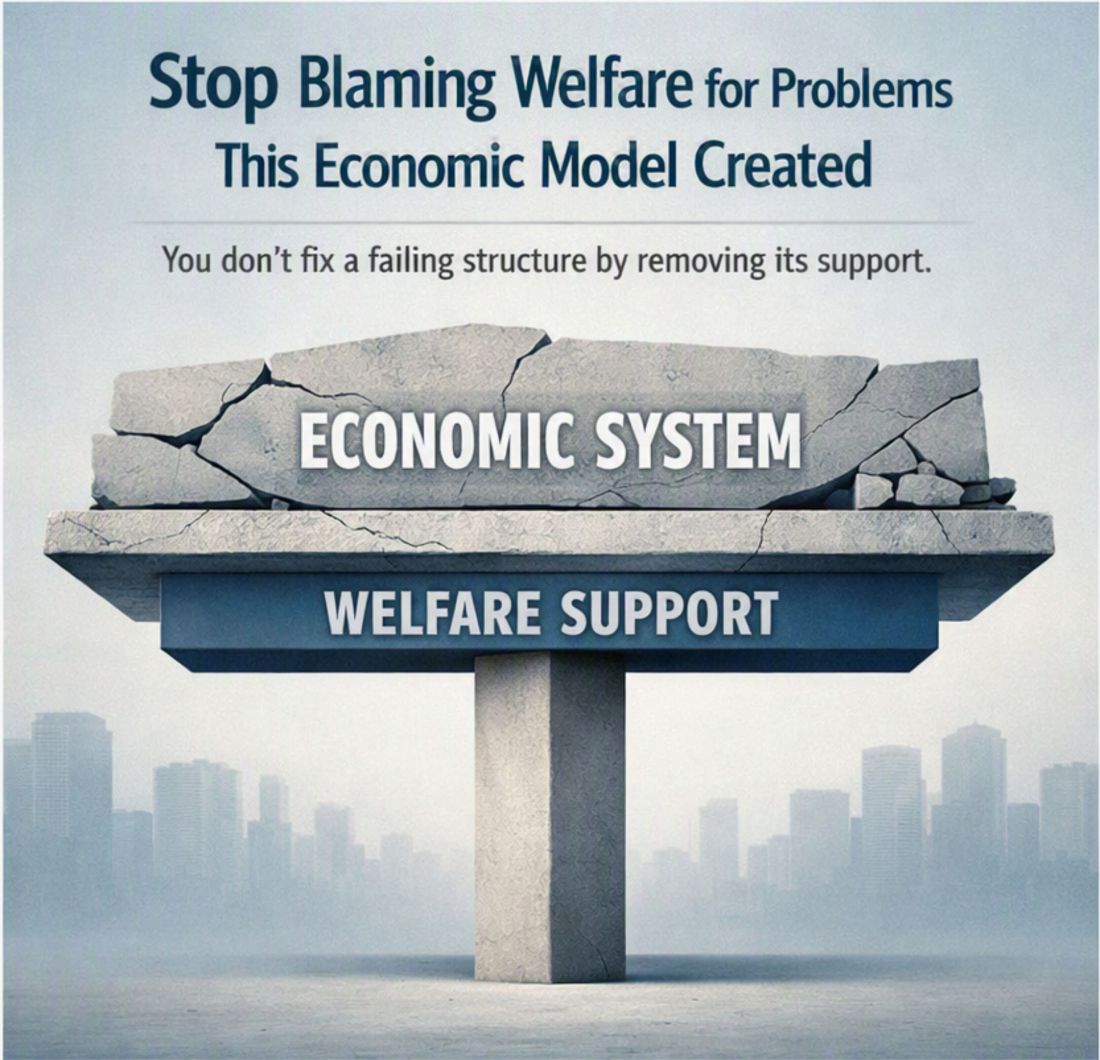
That is why blaming welfare for rising hardship is like blaming a thermometer for a fever. It may show that something is wrong, but it did not cause the illness.
1. The real crisis is the loss of independence
For years, poverty has been discussed mainly through income lines, benefit levels, and official measures. Those figures matter, but they do not capture the basic reality most people understand immediately.
Poverty begins where independence ends.
A person is not truly secure if they cannot meet essential costs without debt, charity, family help, or state support. They may be working. They may not appear destitute. They may not fit the image of poverty commonly used in political debate. But if one normal setback can push them into crisis, they are not independent.
This is the difference the current debate keeps missing.
Millions of people are not simply below or above a poverty line. They are living on a trap door: just about managing until the rent rises, the car fails, the hours are cut, the child needs new shoes, or the energy bill lands.
That is not a welfare problem. It is an independence problem.
Welfare becomes visible only because independence has already failed.
2. Work is supposed to provide security. Too often, it no longer does.
The old promise was simple: if you worked hard, you could stand on your own feet.
That promise has broken down for too many people.
Imagine a single adult working full time on the legal minimum wage. They are not refusing work. They are not living extravagantly. They are doing exactly what the system asks them to do.
Then the ordinary costs of life arrive: rent, council tax, transport, energy, food, phone, clothing, basic household goods, and the need to save something for emergencies.
The margin disappears. There is no cushion. No real resilience. No room for a broken boiler, a rent rise, a period of illness, or a costly journey to keep a job.
At that point, welfare is not replacing work. It is making low-paid work survivable.
Cutting welfare does not fix low pay. It exposes people to the consequences of low pay.
3. The mechanics are simple: support rises when independence falls
Welfare demand does not rise in a vacuum. It rises when the rest of the system stops giving people enough security to stand without help.
Independence falls when wages lag behind essential costs, when housing consumes more of income, when work becomes insecure, when savings disappear, and when one ordinary shock becomes unaffordable.
The result is predictable. More people need support — not because they changed, but because the arithmetic changed.
Yet political debate often reverses cause and effect. It treats the demand for support as the problem, instead of asking why support became necessary.
That is why welfare is not the source of instability. It is the scaffolding holding up a weakened structure.
4. Cutting the scaffolding does not repair the building
Nobody is saying the welfare system is perfect. Nobody is saying dependency is desirable. Nobody is saying reform is unnecessary.
But if reform begins with cuts before it understands what welfare is currently holding up, it mistakes the prop for the problem.
For many households, benefits are not an optional extra sitting on top of a stable income. They are part of the structure that allows rent to be paid, food to be bought, children to be clothed, and work itself to continue.
Remove that support without first repairing wages, housing, essential costs, job security, and household resilience, and the pressure does not disappear. It moves elsewhere: into arrears, debt, food banks, family strain, ill health, homelessness, and crisis services.
That is basic systems thinking. You do not remove load-bearing support from a failing structure and call the collapse reform. You reinforce first. Then, and only then, can you reduce the need for the support.
5. Dependency is real – but welfare is not the only cause
Critics are right to say that dependency matters. A society should not be comfortable with large numbers of people needing external support to survive.
But dependency is not created by welfare alone. It emerges when income, essential costs, housing, transport, childcare, health, and resilience no longer align.
If work cannot provide independence, cutting welfare does not remove dependency. It merely changes its form: from state support to debt, insecurity, charity, family pressure, ill health, or crisis.
Reform should therefore reduce dependency by restoring independence, not by withdrawing support before independence is possible.
6. Growth can look healthy while people become poorer
This is one of the great failures of modern economic debate. The headline numbers can look reasonable while ordinary life becomes harder.
GDP can rise while households become poorer. Inflation can fall while essentials remain unaffordable. Employment can rise while independence collapses.
That is why so many official explanations ring hollow. People are not rejecting reality. They are comparing national claims with their own bank accounts.
They are told the economy is growing, but their rent takes more. They are told inflation is easing, but food is still expensive. They are told work is the answer, but work leaves them dependent on top-ups, debt, or family help.
The system can therefore appear to be improving while real-world independence continues to erode.
Cutting welfare does not reverse impoverishment. It accelerates it.
7. This is why trust breaks down
When institutions keep saying one thing and people keep experiencing another, trust does not disappear because the public is irrational. Trust disappears because official explanations no longer match lived reality.
People hear that work pays, but see workers needing support. They hear that growth means prosperity, but feel less secure. They hear that welfare is the burden, but know that without it many households would fall straight through the floor.
That is the trust crisis underneath the welfare debate. It is not simply political. It is mechanical. The public can feel the system failing before institutions are willing to name the failure.
8. The real danger now is misdiagnosis
When political actors believe the problem is simply “the wrong party in No. 10,” they reach for the wrong tools:
welfare cuts
sanctions
conditionality
punitive measures
behavioural interventions
But the problem is not behaviour. It is independence.
And independence cannot be restored through reduction. It can only be restored through equipping.
Welfare is not the cause of instability. It is the last remaining support in a system where work no longer provides independence.
Cutting it without strengthening independence is not reform. It is destabilisation.
9. The answer is to rebuild independence
The solution is not to pretend that welfare can carry forever what the economy no longer provides. Nor is it to remove support and call the resulting hardship discipline.
The answer is to rebuild the conditions that allow people to stand independently: wages that meet essential costs, housing people can actually afford, work that is stable enough to plan around, local economies that retain value, and public systems designed to equip people rather than merely manage their failure.
10. The message that needs to be heard
People are not asking for luxury.
They are asking for stability: the ability to work, pay their bills, absorb life’s shocks, and build a future without living permanently one step from crisis.
For generations, that was the promise at the heart of the social contract. Today, for growing numbers of people, that promise no longer holds.
That is why welfare demand continues to rise. Not because dependency has become desirable, but because independence has become harder to achieve.
Until we understand that distinction, we will keep treating symptoms while the underlying condition worsens.
The real question is not how quickly welfare can be cut.
The real question is how quickly independence can be rebuilt.
That is where the future of economic security will be decided.
Further Reading
For readers who want to go deeper, the pieces below build the wider framework behind this argument: first the immediate crisis, then the living standard and independence test, then the economic evidence, human reality, and longer-term reform model.
1. When the System Runs Out of Road Britain’s benefits crisis, defence dilemma, and low-wage economy The best starting point for the wider argument. It explains why welfare pressure is connected to a national economic model built on low wages, public subsidy, and postponed reform.
7. The Contribution Culture Transforming work, business, and governance through contribution This develops the positive alternative: a society organised around contribution, capability, and participation rather than narrow employment statistics or punitive conditionality.
3. The Independence Threshold A new definition of poverty for a modern economy This develops the central test used here: whether people can meet essential needs and absorb normal shocks without external support.
4. Tax Cuts and Universal Credit Why tax cuts do not automatically restore independence This explains why headline tax changes can fail to help households trapped by Universal Credit dynamics, taper rates, low wages, and high essential costs.
6. How Would You Feel If It Were You? A human lens on policy, hardship, and judgement This adds the human reality behind the systems argument, showing why policy debates must begin with lived experience rather than abstract judgement.
8. The Local Economy & Governance System A wider model for rebuilding economic resilience locally This places the welfare argument inside a broader approach to local economic renewal, governance reform, and long-term systems repair.
A plain-English worked example showing why a headline tax giveaway can become a much smaller household gain once Universal Credit is taken into account
Introduction: why headline tax cuts can feel different in household budgets
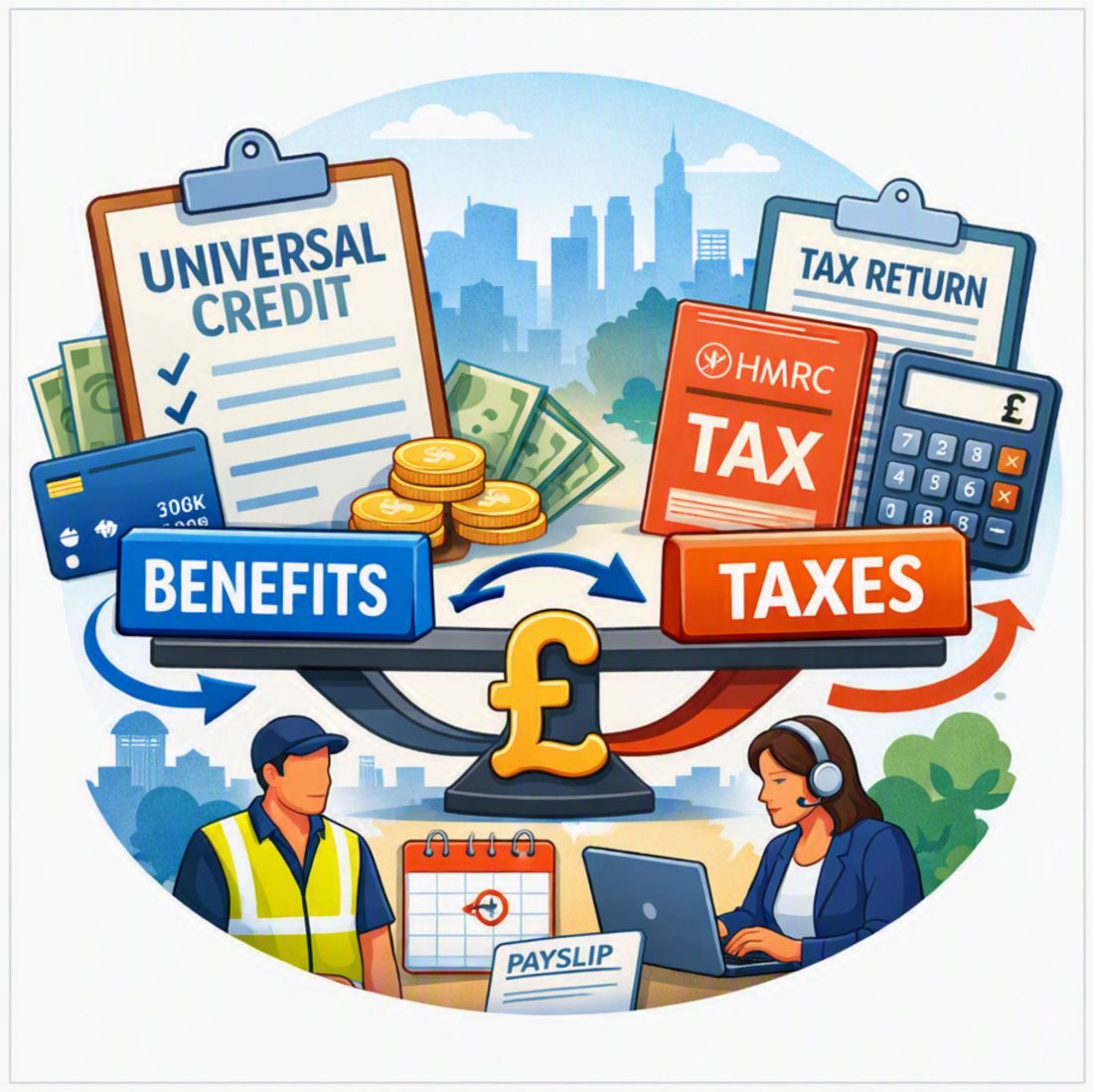
This paper examines a simple but often overlooked question: what happens when a headline tax cut meets the Universal Credit system in a real household budget?
It was written in response to Reform UK’s proposal to raise the income tax personal allowance to £15,000, with a longer-term ambition to reach £20,000. The proposal has been presented as a major gain for workers. For many taxpayers, that may be true in a straightforward tax sense. But for workers who also receive Universal Credit, the position is more complicated.
Universal Credit is designed to reduce as earnings rise. This means that when a worker’s take-home pay increases, part of that increase can be offset by a lower Universal Credit award. The worker is still better off, but not by the full headline amount.
The central finding of this paper is therefore not that the tax cut has no value. It does. The central finding is that the advertised gain can be substantially reduced by the benefit system, leaving both the worker and the public purse with only a modest net change.
The deeper issue is wages. If a person can work 40 hours a week on the statutory minimum wage and still need Universal Credit, then the benefits bill is not only a welfare problem. It is also a low-pay problem. Policies that adjust tax thresholds may improve the appearance of work incentives, but they do not by themselves solve the structural fact that full-time minimum-wage work may still fail to provide financial independence.
This report is intended for a broad readership. It avoids technical language where possible and explains each calculation step by step. The aim is to test a political claim against household reality: not what the policy sounds like, but what it actually leaves in someone’s bank account.
Executive Summary
This report tests a simple claim against a real household budget: whether a headline tax cut delivers the full advertised gain to a worker who also receives Universal Credit.
Policy tested
Increase the income tax personal allowance from £12,570 to £15,000.
Worker tested
Single renter, working 40 hours per week on the April 2026 National Living Wage, receiving Universal Credit.
Headline tax saving
£40.50 per month.
Universal Credit reduction
£22.28 per month.
Actual household gain
£18.22 per month.
Main finding
The worker is better off, but remains on Universal Credit and receives less than half of the headline tax saving as additional disposable income.
In plain English: the policy helps the worker, but it does not transform their position. The household remains dependent on Universal Credit, and the public purse recovers part of the tax cut through a lower benefit award. The deeper unresolved issue is that full-time work at the legal minimum wage can still require means-tested support.
Section 1: The household used in this worked example
This is a realistic illustrative case rather than a claim to represent every Universal Credit household. Actual entitlement depends on age, household composition, rent, Local Housing Allowance, health status, childcare, savings, deductions and assessment-period earnings.
Single adult
Renting in Cheltenham
Working 40 hours/week
April 2026 National Living Wage: £12.71/hour
Gross annual income: £26,436.80
Gross monthly income: £2,203.07
Assumed age: 25 or over
Household type used for UC work allowance: single adult with limited capability for work or another qualifying basis for a work allowance, and receiving help with housing costs
This person is working full time on the legal wage floor for workers aged 21 and over. That matters because this is not an example of unemployment or unwillingness to work. It is an example of someone already doing what the policy narrative asks them to do: working full time, paying tax and National Insurance, renting privately, and still needing means-tested support.
Sources and assumptions used. The National Living Wage figure of £12.71 per hour from April 2026 is taken from GOV.UK. The Universal Credit taper rate of 55p for every £1 of earnings is taken from GOV.UK guidance on Universal Credit and earnings. The April 2026 Universal Credit standard allowance used here is £424.90 for a single claimant aged 25 or over, based on Citizens Advice guidance on 2026 changes. The housing element is treated as an assumption and should be checked against the relevant Local Housing Allowance rate and the claimant’s actual eligible rent.
The key point is that the example assumes the worker qualifies for a Universal Credit work allowance. That is not true for every single adult. A person with no children and no limited capability for work would normally have no work allowance, which would make the Universal Credit reduction larger. The assumption used here is therefore not designed to exaggerate the result; if anything, it gives the tax proposal a clearer chance to show a positive household gain.
Section 2: Current position before the tax change
Income tax
National Insurance
(£26,436.80 − £12,570) × 8% = £1,109.34 per year = £92.45 per month
Net pay
£2,203.07 − £231.11 − £92.45 = £1,879.51 per month
Universal Credit
Work allowance used in this example: £427 per month, because the claimant is assumed to qualify for a work allowance and to receive help with housing costs.
Earnings above allowance:
£1,879.51 − £427 = £1,452.51
UC taper (55%):
0.55 × £1,452.51 = £798.88
UC before taper:
£424.90 standard allowance + £675 assumed housing element = £1,099.90
UC after taper:
£1,099.90 − £798.88 = £301.02
Total income (current system)
£1,879.51 + £301.02 = £2,180.53 per month
Section 3: What changes under a £15,000 personal allowance
Income tax
Net pay
£2,203.07 − £190.61 − £92.45 = £1,920.01 per month
Universal Credit
Earnings above allowance:
£1,920.01 − £427 = £1,493.01
UC taper:
0.55 × £1,493.01 = £821.16
UC after taper:
£1,099.90 − £821.16 = £278.74
Total income (Reform UK £15k)
£1,920.01 + £278.74 = £2,198.75 per month
Net gain
£2,198.75 − £2,180.53 = £18.22 per month
The worker keeps £18.22 more per month. That is a real gain, but it is far smaller than the headline tax saving because the Universal Credit award falls as net earnings rise.
The Exchequer recovers £22.28 per month through the lower Universal Credit award, but still gives up £40.50 per month in income tax. The net fiscal cost in this example is therefore £18.22 per month.
This is the central policy lesson. The tax cut does not simply transfer the full saving to the worker. Nor does it simply save the state money. Instead, the gain is split: part reaches the household, and part is recovered through a lower Universal Credit payment. The result is modest for both sides.
Section 4: Beyond the calculation – what the numbers mean in real life
The calculations in Sections 2 and 3 answer the immediate policy question. They show how much tax falls, how much Universal Credit falls, and how much extra money the worker actually keeps.
But the calculation alone does not fully explain the household reality. It tells us the worker is £18.22 per month better off, but it does not tell us whether that change is large enough to alter their financial position in any meaningful way.
This is why the paper now moves from arithmetic to interpretation. The next question is not simply, “Did the worker gain?” The answer to that is yes. The more important question is: “Did the policy create enough extra disposable income to reduce fragility, build independence, or move the household away from Universal Credit?”
To answer that, the paper uses a simple diagnostic framework. The diagnostic is not introduced as a second set of evidence competing with the calculation. It is a way of translating the calculation into plain-English questions about financial security.
The broader Impoverishment Index was created to examine the gap between positive economic narratives and lived experience at a national level. The Universal Credit version applies the same idea at household level: it asks whether a policy that sounds generous actually changes the lived financial reality of someone affected by the benefits system.
The diagnostic looks at four practical questions, followed by a separate narrative mismatch test:
How much of the headline gain does the worker actually keep?
How much of the gain is offset through the Universal Credit taper?
How much of the household’s income is already committed to essentials?
How much room is left to absorb shocks, save, or become financially independent?
How large is the gap between the headline claim and the lived result?
In that sense, the diagnostic is not the main claim of the report. The main claim remains the worked calculation. The diagnostic simply helps readers understand why a real but modest gain may still leave the household financially constrained.
Section 5: Measuring the real household impact
By this point, the arithmetic has already shown the immediate result: the worker gains £18.22 per month, not the full headline tax saving. The purpose of this section is to ask what that means in practice.
A small gain can still matter. For someone living on a tight budget, £18.22 is not nothing. But public policy should also ask whether a change is large enough to alter the underlying situation. Does it reduce dependence on Universal Credit? Does it create breathing room? Does it help the household build savings, absorb shocks, or move closer to financial independence?
To answer those questions, this report uses a simple household impact diagnostic. It is called a diagnostic because it is not trying to produce an official poverty measure or a scientific ranking. It is trying to diagnose what the policy actually changes inside a monthly budget.
Where a score is used, it is only a shorthand for the explanation that comes before it. A higher number means the policy has created more real household resilience. A lower number means the household remains more financially constrained. The score is therefore a communication aid, not the evidence itself.
The 0–10 scale should be read in plain terms:
0–2: very weak household resilience; the policy does little to change dependence or vulnerability.
3–4: limited improvement; the household gains something, but remains materially constrained.
5–6: moderate improvement; the policy makes a noticeable difference, but does not resolve the underlying pressure.
7–8: strong improvement; the household is significantly more secure.
9–10: very strong improvement; the policy substantially changes the household’s financial position.
This means the reader should not treat the number as a standalone claim. The explanation in each subsection comes first; the score then summarises that explanation in a compact form.
1. How much of the headline tax gain does the worker actually keep?
The first question is simple: if the policy is advertised as a tax gain, how much of that gain actually reaches the household after Universal Credit adjusts?
Result: 4.5/10. The worker keeps 45% of the headline tax gain.
This means work and tax reduction do improve the household’s position, but less than half of the headline saving reaches the worker as additional disposable income.
2. How much of the gain is lost through Universal Credit?
The second question looks at why the headline tax saving does not reach the worker in full. Universal Credit is means-tested. As net earnings rise, the Universal Credit award falls. This is the taper mechanism.
Tax: 20%
NI: 10%
UC taper: 55%
Total: 85%
Diagnostic result: 1.5/10. This is low because only a small share of each additional pound meaningfully improves household living standards once tax, National Insurance and Universal Credit withdrawal are considered together.
This is not a cliff edge and it is not a punishment; it is the design of the system. But it does mean that headline gains are diluted before they reach the household budget.
3. How much income is already committed to essentials?
The third question asks whether the household has enough room in the budget for the tax gain to make a practical difference. This matters because £18.22 has a different meaning in a household with spare income than in one where most income is already committed before the month begins.
Rent: £800
Utilities + council tax: £200
Food: £300
Transport: £150
Other essentials: £150
Total: £1,600/month
Essentials ratio = £1,600 ÷ £2,180.53 ≈ 0.73
Score = 10 × (1 − 0.73) = 2.7
Diagnostic result: 2.7/10. This is low because around three-quarters of income is already committed to essentials, leaving limited room for savings, emergencies or ordinary financial resilience.
In this scenario, around three-quarters of monthly income is already committed to basic costs. That leaves little room for savings, emergencies, debt reduction, household replacement costs, or ordinary participation in social life.
4. How much room is left for unexpected costs?
The fourth question asks whether the household has enough margin to cope with normal financial shocks: a rent rise, a reduced shift pattern, a delayed payment, an unexpected bill, a broken appliance or a higher winter energy bill.
Savings: < £500
Debt repayments: ~£150/month
High volatility: rent increases, UC reassessments, variable hours
Diagnostic result: 2/10. This is low because the scenario describes a household with little capacity to absorb disruption. This score is illustrative rather than directly measured.
Because this paper does not use verified household-level evidence about this individual’s savings, debts or monthly volatility, the Stability Deficit score is treated as a scenario assumption. It should not be read as a measured fact about any named person.
5. How large is the gap between the headline and the lived result?
The final question brings the diagnostic together. It asks how far the public-facing story differs from the result inside the household budget. In this example, the headline is a tax cut for workers. The lived result is a much smaller gain, continued Universal Credit entitlement and no major change in financial independence.
Core average = (4.5 + 1.5 + 2.7 + 2) ÷ 4 = 2.675
Inverted:
Narrative mismatch = 10 − 2.675 = 7.3
Diagnostic result: 7.3/10, reported separately. This indicates a large mismatch between the apparent generosity of the headline proposal and the modest improvement in household resilience shown by the worked example.
The narrative mismatch score is not included in the core Index average, because it is derived from the other scores. Reporting it separately avoids double-counting.
Overall result: the household remains financially constrained
Interpretation: The overall diagnostic result is low because the underlying position has not changed very much. The worker is still working full time, still receiving Universal Credit, still facing high essential costs, and still left with limited space to build financial independence. The tax cut helps, but it does not transform the household’s financial reality.
The diagnostic supports the same conclusion as the worked calculation: the proposal produces a real but modest gain, while leaving the worker financially constrained and still dependent on Universal Credit.
Section 6: What the policy appears to do – and what the calculation shows
At headline level, a higher personal allowance sounds simple and attractive. It can be described as:
“A tax cut for workers.”
“A reduction in welfare dependency.”
“A shrinking welfare bill.”
The worked example shows a more complicated but more honest picture:
1. The worker is better off, but not by the headline amount.
The tax cut increases net pay, but the Universal Credit award then falls. In this example, the worker keeps £18.22 per month from a £40.50 monthly tax saving.
2. The Universal Credit award falls because net earnings rise – not because the household has become independent of support.
The household still receives Universal Credit after the tax change. The lower award does not mean the worker has escaped benefit dependency; it means the benefit system has adjusted to their slightly higher net earnings.
3. Disposable income barely changes.
An extra £18.22 per month may still matter to someone on a tight income. But it is not a transformational change. It is unlikely, on its own, to provide financial independence, build resilience, or remove the need for Universal Credit.
4. The household impact diagnostic remains low.
The diagnostic result remains low because the underlying household pressures remain in place: high essential costs, limited slack, and continued reliance on means-tested support.
5. The Exchequer recovers more than half of the income tax cut through reduced Universal Credit.
The government does not save money overall in this example: it gives up £40.50 in tax and recovers £22.28 through lower Universal Credit, leaving a net fiscal cost of £18.22 per month.
This is the essence of the policy problem:
A tax policy can improve a worker’s position while still leaving their day-to-day financial security largely unchanged. If full-time minimum-wage work still requires Universal Credit, then the unresolved issue is not only tax or welfare design. It is the adequacy of wages themselves.
Conclusion: the real issue is not only tax – it is low pay
This paper shows why tax policy cannot be judged by headline figures alone. For a worker receiving Universal Credit, a higher personal allowance can increase take-home pay, but the benefit system then adjusts because Universal Credit is withdrawn as net earnings rise.
In this worked example, the worker is better off by £18.22 per month after the personal allowance rises to £15,000. The policy therefore helps, but only modestly. The worker does not receive the full headline tax saving, and the household remains on Universal Credit afterwards.
That matters because it reveals the elephant in the room. A benefits system cannot be expected to shrink sustainably if the legal minimum wage for full-time work does not produce financial independence for many households. In that situation, Universal Credit is not simply supporting people who are out of work. It is also subsidising a labour market in which work at the legal minimum can still leave people below the level needed to live independently.
work can increase income, but the effective gain may be much smaller than the headline wage or tax change suggests;
Universal Credit can provide important support, but it also reduces as earnings rise;
tax cuts should be assessed using household-level calculations, not only the headline value of the tax reduction;
public claims about making work pay are strongest when they show who gains, by how much, and after which benefit interactions.
The household impact diagnostic is therefore best understood as a translation tool. It takes a policy headline and asks what it means in a real household budget. Used carefully, it can make public debate more concrete, more transparent and easier for non-specialist readers to understand.
The conclusion is not that tax cuts are meaningless. Nor is it that Universal Credit should not taper as earnings rise. The conclusion is narrower and more important: headline tax changes are not a substitute for confronting low pay, high essential costs and the structural reasons why millions of working households remain reliant on means-tested support.
Methodological note
The calculations in this report use rounded monthly figures, so totals may differ by a few pence from payroll software, HMRC tools, DWP systems or a full benefits calculator. The worked example assumes no pension contributions, no student loan repayments, no benefit cap effect, no deductions for advances or sanctions, and no council tax reduction. It also assumes the person qualifies for a Universal Credit work allowance; a single adult with no children and no limited capability for work would not normally receive one. The figures should therefore be read as an illustrative policy test, not as personal entitlement advice.
This report contains illustrative calculations intended to explain how changes to income tax thresholds may interact with Universal Credit awards under current UK welfare rules. All figures, examples and scenarios are provided for general information only. They do not constitute financial advice, legal advice, welfare entitlement advice or professional guidance.
Universal Credit entitlement varies according to individual circumstances, including household composition, age, disability status, childcare costs, rent, Local Housing Allowance, savings, deductions, assessment‑period earnings and council tax liability. The examples in this report use simplified assumptions to demonstrate the interaction between net earnings and the Universal Credit taper. Actual awards may differ from those produced by official Department for Work and Pensions systems, accredited benefits calculators or payroll software.
While reasonable efforts have been made to ensure accuracy at the time of writing, no guarantee is given that the information is complete, up to date or free from error. Policy details, thresholds and rates may change without notice. No liability is accepted for any loss, damage or inconvenience arising from reliance on the contents of this report. Readers should verify all relevant details using authoritative sources such as GOV.UK, Citizens Advice or qualified welfare and tax professionals.
The household impact diagnostic described in this report is a conceptual tool created for illustrative and educational purposes. It is not an official measure of poverty, financial resilience or welfare adequacy. Scores generated using this diagnostic are scenario-based and rely on assumptions that may not reflect any specific household’s circumstances.
This report does not endorse, oppose or promote any political party, policy or proposal. It is intended solely to support public understanding of how tax and welfare systems may interact in practice.
Every time Britain runs into serious difficulty, we seem to have the same conversation. The names change. The parties change. The faces around the Cabinet table change. The language of renewal, seriousness and responsibility is refreshed for the latest political moment. Yet the assumptions beneath the debate remain remarkably consistent.
People can now see that something is wrong. That is no longer really the issue. The point of disagreement is no longer whether Britain has problems, but what kind of problems they are. Debt, stagnant living standards, unaffordable housing, degraded public services, weak productivity, falling trust and social fragmentation are all now visible enough to be discussed across the political spectrum. But they are still treated, again and again, as separate management failures rather than as symptoms of the same underlying system.
That is the real tragedy. Many of the people diagnosing the crisis genuinely know that something is badly wrong. Some may even know, at some level, that the old answers are exhausted. But they have nowhere else to go intellectually, professionally or politically except back to the same place they have always looked: finance, markets, business experience, managerial competence, fiscal discipline, GDP growth and the language of economic credibility.
So every crisis produces the same merry-go-round. First, the system produces outcomes that are increasingly difficult to defend. Then commentators, politicians and professional observers acknowledge the symptoms. Then the search begins for the people deemed “serious”, “qualified”, “experienced” or “credible” enough to fix them. More often than not, those people are drawn from the same worldview that helped produce the outcomes in the first place.
The latest reshuffle, party conference season and the first real glimpse of the UK’s latest prime minister have simply offered the newest version of this old pattern. The commentariat and Opinionati have been busy sticking badges on Westminster’s latest cast list, praising or dismissing people according to whether they understand big business, the markets, money and the supposedly hard realities of government. It would be interesting if it were not so desperately detached from the deeper causes of the problems they can see only at surface level.
Perhaps I am being unfair. Some of them may understand more than they are willing to say. It is not difficult to see why few high-profile journalists, economists, politicians or commentators would not want to be the first to say publicly that the entire operating model has reached its limits. That is not a career-enhancing move. But perhaps I am also being optimistic. The harder possibility is that many really cannot see it, because the system has trained them not to look in the right place.
This is what I have increasingly described as paradigm blindness, or cognitive capture. It is not stupidity, corruption or malice. It is the condition that arises when the assumptions of a system become so familiar, rewarded and professionally reinforced that they stop appearing to be assumptions at all. They simply feel like reality.
That is why the argument that the best MPs are those who have been in business, finance or the markets needs to be challenged at its root. This is not a new phenomenon. We have heard versions of it for years. The country is in trouble, so we are told we need people who have run companies, handled money, understood the markets, balanced books, managed large organisations or dealt with the “real world”.
But this assumes precisely what should be under scrutiny. A country is not a corporation. Citizens are not customers. Communities are not balance sheets. Public value is not the same thing as shareholder value. Government is not elected to optimise returns, impress markets or manage people as units of cost. It is elected to serve the public interest.
This does not mean that business experience is useless, or that financial knowledge has no place in government. Of course leaders need access to expertise. Government operates inside financial constraints, and anyone pretending otherwise is avoiding reality.
But genuine leadership is not the same as technical expertise. A genuine leader does not need to be the country’s best economist, financier, accountant or bond trader. A genuine leader needs to ask the right questions, gather the necessary information, listen beyond a single discipline, understand consequences, and make decisions in the interests of people rather than in defence of a model.
That distinction matters because expertise is rarely neutral. Economists are largely trained within the existing economic model. Business schools largely teach people how to succeed within the existing business environment. Financial professionals are trained to understand and operate the existing monetary and market system. None of that makes them bad people. But it does mean they are usually specialists in operating the paradigm, not necessarily in questioning whether the paradigm itself is failing.
This is the heart of the problem. We have become so accustomed to money being part of everything that it becomes almost impossible for many people to see money as part of the problem. The captured mind says, “It cannot be money, because money is involved in everything.” But that is precisely the point. When money becomes the organising principle of everything, everything begins to bend around it.
Money is no longer merely a tool that society uses. It has become the measure by which society judges almost everything: policy, success, failure, seriousness, responsibility, productivity, worth, even human dignity. Market confidence becomes more important than lived experience. Financial efficiency becomes more important than resilience. GDP-style growth becomes more important than whether ordinary people can afford homes, raise families, access care, build security, or live in communities that still function.
This is why the current debate is so inadequate. Across the political spectrum, many now agree that the UK is financially precarious, if not already in serious trouble. But the explanations remain scattered: the wrong government, the wrong prime minister, immigration, benefit claimants, public sector waste, weak management, insufficient growth, too much borrowing, too little discipline. Each explanation may touch some fragment of reality. None explains the whole.
The deeper possibility is that these are not isolated failures at all. They are connected outcomes of a worldview that has progressively subordinated people, communities, public services, local economies and the natural environment to financial logic.
Because the system prioritises money, it teaches us to judge everything else in monetary terms. In doing so, we have surrendered forms of value that cannot be properly measured by markets but without which society cannot remain healthy.
That blindness has allowed a massive transfer of wealth, declining quality of life for many, the weakening of communities, the degradation of public services, the hollowing out of productive capacity and the dismantling or sale of shared structural and infrastructural assets. The harms are then treated as unfortunate side effects, or as the personal failings of those who cannot keep up, rather than as predictable consequences of the system itself.
Those who need benefits, debt, handouts or support are too often ridiculed as the architects of their own misfortune. But a system built around extraction, competition and monetary valuation could only ever push more people towards the margins. The fact that this is now happening at scale should tell us something important. It is no longer credible to pretend that all of this is merely bad management.
The strongest objection is obvious and deserves to be taken seriously. People will say that no government can ignore money, borrowing, markets or budgets. They will say that expertise matters, that institutions matter, that stability matters, and that the alternative to financial discipline may be chaos.
They are right to say that competence matters. They are right that government cannot simply wish away the current system. But that objection only goes so far.
Understanding how to operate a system is not the same as understanding whether it still works.
Expertise in navigating a failing model should not be confused with leadership capable of questioning the model itself.
If the economic and monetary framework has helped create unaffordable housing, insecure work, weak productivity, degraded services, concentrated wealth and exhausted communities, then appointing people who are fluent in that framework is not automatically a solution. It may simply be another turn of the merry-go-round.
This is the anti-establishment paradox too. Many politicians and commentators claim to oppose the Establishment while continuing to operate entirely within its worldview.
They challenge the personnel of the system but not its assumptions. They denounce elites while judging seriousness by market confidence. They promise disruption while accepting the same definitions of success: growth, efficiency, competitiveness, credibility and control. In some cases, they do not challenge the Establishment at all. They intensify it.
That is why this moment matters. We are entering a critical phase in which more people can see that the old answers are failing, but many of those with the biggest platforms still cannot name the deeper problem.
They know the country is in difficulty. They know trust is weakening. They know the numbers do not add up. They know the usual levers no longer deliver what they once promised. But cognitive capture leaves them interpreting system failure as a management problem.
So we get calls for better managers, more business-minded MPs, tougher fiscal rules, more efficient public services, renewed growth strategies, fresh economic credibility and new faces to operate the same machinery.
The possibility that the machinery itself is producing the outcomes barely enters the conversation.
The problems we now face cannot and will not be solved simply by cutting spending, borrowing more, chasing GDP-style growth, finding another managerial class, or appointing MPs whose main qualification is fluency in the financial language of the existing system.
The extractive model appears to have reached its limits. Its promises of efficiency, prosperity and competent management are harder to reconcile with the reality experienced by millions of people.
The system is over. It simply has not finished its ending yet. And the last people we need making futile attempts to save a system whose impacts they do not understand are those who still believe it is the only possible way.
The question now is not whether Westminster has enough people who understand money. It is whether Westminster has enough people willing to ask why money has become the lens through which every public problem must be viewed.
Genuine leadership begins there: not in pretending money does not matter, but in refusing to let it be the only thing that matters.
If the challenge is one of worldview as much as policy, then the next step cannot simply be another leader, party, slogan or economic forecast. It has to involve rebuilding the capacity to think and act differently: restoring productive local economies, reconnecting institutions with lived reality, asking how value is created and circulated in communities, and developing forms of governance that serve people rather than forcing people to serve the abstractions of the system.
For a more practical exploration of that direction, see: The Local Economy & Governance System.
Poverty has always been difficult to define. Governments use income thresholds. Charities use deprivation indicators. Economists use consumption models. But none of these definitions capture the lived reality of poverty in a modern, high‑income country like the United Kingdom.
They measure symptoms.
They do not measure the condition itself.
The Independence Threshold Definition of Poverty begins from a different starting point – one that reflects how poverty actually works in real life.
Poverty begins where independence ends.
A person is in poverty when they cannot meet their essential needs without external support – whether that support comes from the state, charity, family, or debt.
This definition is simple, but it changes everything.
Poverty is always relative to its own economy
Global institutions often define poverty in ways that evoke extreme deprivation – the kind associated with low‑income countries and subsistence economies.
This framing is useful for international development, but it becomes misleading when applied to wealthy nations.
Poverty is not a universal condition.
Poverty is an economic condition.
Poverty must be understood relative to the economy it exists within.
In the UK, poverty is shaped by:
UK housing costs
UK energy prices
UK transport needs
UK childcare costs
UK wages
UK debt structures
UK public services
UK labour markets
A person can be in poverty in the UK even if they have electricity, sanitation, and a roof over their head – because the cost of maintaining independence within the UK economy may exceed their income or capacity.
Physical conditions differ between economies.
Poverty does not.
Poverty is not defined by physical conditions
Different economies produce different physical environments:
Sanitation
transport systems
infrastructure
heating
water access
housing quality
digital access
public services
These are environmental features, not indicators of independence.
A person can have:
running water
paved roads
electricity
a smartphone
a bus route
a supermarket nearby
…and still be in poverty if they cannot sustain themselves within the economic system that surrounds them.
This is why arguments like:
“People here live like kings compared to country X,”
“They have TVs, so they’re not poor”
“They have sanitation, so they’re fine”
are structurally false.
They confuse material environment with economic independence.
Poverty is exclusion – and exclusion is universal
When a person cannot sustain themselves within their own economy, they experience exclusion.
This exclusion is not abstract – it is lived, daily, and universal across all societies.
Loss of independence leads to:
Hardship
Instability
mental health deterioration
social isolation
loss of dignity
loss of agency
loss of future planning
loss of resilience
These outcomes occur in:
wealthy countries
developing countries
rural areas
urban areas
different cultures
different infrastructures
The physical environment changes.
The exclusion does not.
This is why poverty must be defined by independence, not by conditions.
Why traditional definitions fail
Traditional poverty lines are based on income.
But income alone does not determine independence.
Two people earning the same amount can have completely different levels of stability depending on:
housing costs
childcare costs
transport needs
health conditions
debt burdens
regional prices
insecure work patterns
Income‑based definitions hide millions of people who are not officially “in poverty” but cannot survive independently.
These are the people living on the poverty trap door – above the line, but one shock away from falling through it.
The Independence Threshold Definition makes them visible.
A definition for policy, research, and public understanding
This definition is not ideological.
It is not tied to any political party.
It is not designed to support or oppose any policy.
It is a lens – a way of seeing poverty clearly.
It can be used by:
Policymakers
Researchers
Charities
Journalists
Economists
Social Scientists
Community Organisations
And by anyone who wants to understand the real structure of poverty today.
The Independence Threshold Definition of Poverty
Poverty begins where independence ends.
A person is in poverty when they cannot meet their essential needs without external support – whether that support comes from the state, charity, family, or debt.
Poverty is always relative to the economy it exists within.
Physical conditions – sanitation, transport, infrastructure, heating, water, housing quality – differ between economies, but they do not define poverty.
Poverty is defined by the inability to sustain oneself within one’s own economic environment.
When independence is lost, people experience exclusion: hardship, instability, mental strain, and social isolation. These outcomes are universal, regardless of the physical surroundings.
Poverty is not about global deprivation standards or material conditions.
Poverty is about independence – and the loss of it.
Social mobility is often presented as a simple moral project: remove barriers, widen opportunity, and allow people from disadvantaged backgrounds to rise.
It is a noble ambition, and one that any fair society should pursue. Yet the way social mobility is currently understood – and operationalised – contains a structural flaw that is rarely acknowledged.
It is a two‑edged sword, capable of empowering genuine talent, but equally capable of elevating individuals for their narrative value rather than their capability.
When this happens, the system not only fails the individuals it seeks to help; it also undermines trust in the very idea of social mobility itself.
At the heart of this problem lies a fundamental confusion between help and hand‑up.
Help is empowering. It equips individuals with confidence, skills, and the ability to step forward on their own merit. A hand‑up, by contrast, is elevating. It places individuals into positions they have not yet earned, often because their background fits a narrative that institutions find symbolically useful.
These two approaches are not merely different; they produce entirely different outcomes.
Help opens a metaphorical door. It says: you have value, you have ability, and we will remove the barriers that prevent you from showing it. A hand‑up opens a literal door and pushes someone through it, often without ensuring they are ready for what lies on the other side. Help respects agency and capability. A hand‑up risks creating fragility, because it confers status without building the foundation required to sustain it.
This distinction becomes dangerous when institutions begin selecting individuals who fit a hero‑mould – dramatic adversity, visible difference, a compelling story – rather than those who possess genuine capability.
Hero narratives are emotionally powerful and politically convenient. They allow institutions to demonstrate progress, inspire audiences, and signal virtue. But hero narratives reward the story, not the skill.
When someone is elevated primarily because their background is narratively useful, two predictable consequences follow. First, they may struggle to perform at the level to which they have been elevated. Second, their struggle becomes a referendum on social mobility itself. Critics generalise from the individual to the group, and from the group to the entire project.
The collateral damage is severe. Exceptional talent gets left behind. Many disadvantaged individuals possess extraordinary capability precisely because of their formative experiences.
They have developed resilience, adaptability, emotional intelligence, and problem‑solving skills that cannot be taught in classrooms. But because their adversity is not dramatic enough, or because they do not perform their hardship in a way that fits the hero narrative, they are overlooked.
Meanwhile, individuals whose wounding – whether true, exaggerated, or misunderstood – is narratively compelling are elevated. Their trauma becomes their currency. Their background becomes their qualification. Their story becomes their evidence.
This dynamic is intensified by the way society has come to value education. In a wealth‑centric system, financial productivity becomes the measure of human worth. Academic qualifications correlate with income, so they become the primary gateway to opportunity.
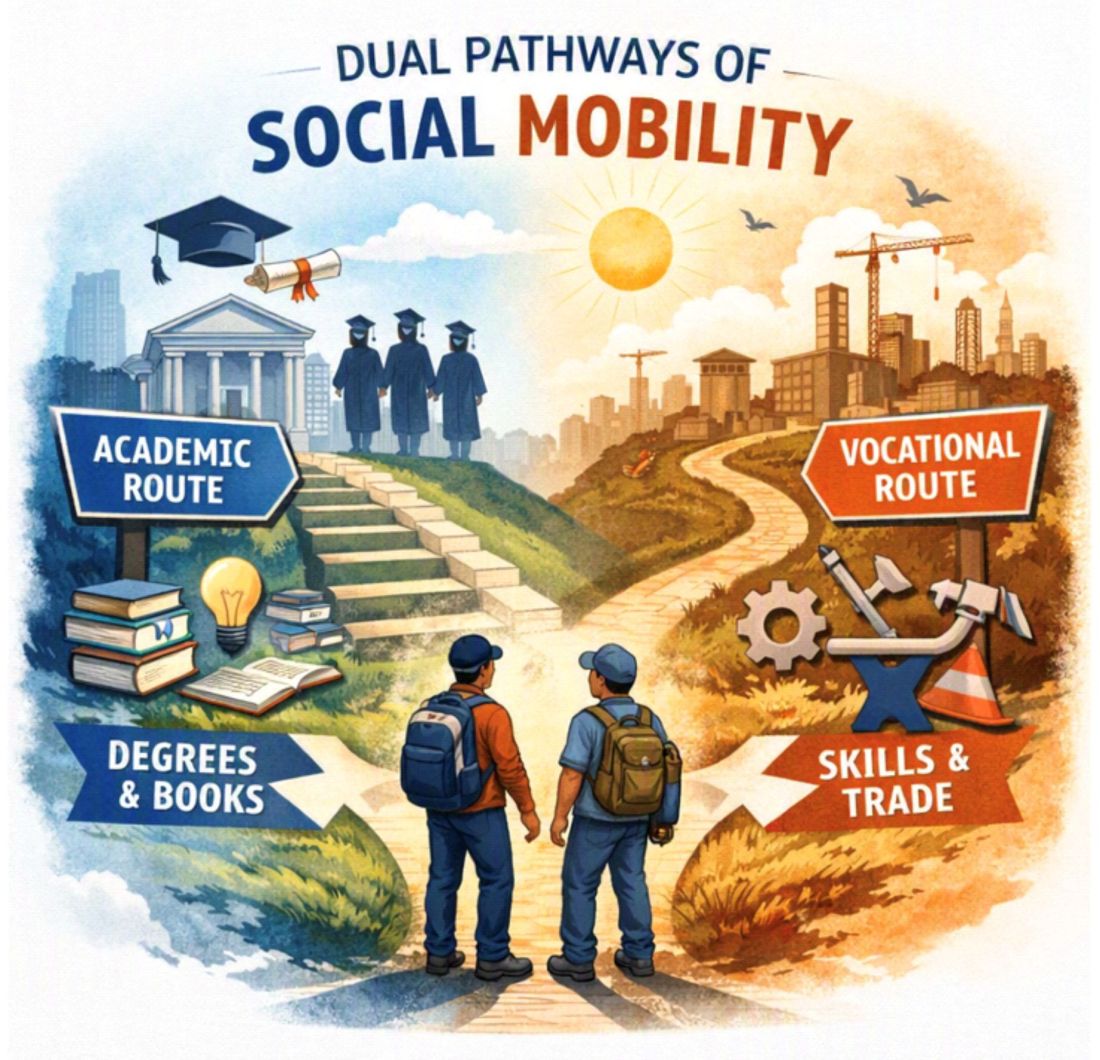
The result is an educational system weighted almost entirely toward academic achievement. The narrative that “everyone should get a degree” sounds egalitarian, but it is built on a false assumption: that academic learning is the universal route to success.
It isn’t. Many people are not academic or consciously cerebral learners. They are experiential, practical, hands‑on – individuals whose intelligence expresses itself through doing rather than theorising.
These young people are not less capable; they are differently capable. Yet the current system treats them as failures because it only recognises one form of intelligence.
A genuinely vocational pathway – beginning at 14 and continuing to 21 – would allow thousands of young people to thrive in ways no degree can replicate. By the time they finish, they would possess experience, maturity, and professional identity that academic pathways cannot provide.
The tragedy is that the system also fails traumatised young people who could be academic. Growing up in poverty, instability, or survival‑mode environments means that adolescence is not a time for learning; it is a time for coping. These young people may have academic potential, but they cannot access it because their teenage years are spent navigating chaos rather than studying. The system punishes them for circumstances they did not choose.
All of this makes social mobility far more complicated than it needs to be. The bottleneck is not so much the lack of opportunity; it is the narrowness of the educational model and the hero‑mould narrative that sits on top of it.
When society values only academic achievement and visible adversity, it elevates the wrong people and overlooks the right ones. It confuses narrative with merit, background with capability, and trauma with qualification.
Fixing this is not a matter of adding certificates or tweaking qualifications. It requires a fundamental shift in how we value people. We must stop treating wealth as the primary marker of worth, academic credentials as the only legitimate pathway, and adversity as the currency of mobility.
We must start recognising all forms of human capability – practical, vocational, emotional, experiential, and intellectual. When we do this, the number of people genuinely being held back becomes far smaller, and far easier to support.
Social mobility should be about empowerment, not optics. It should uncover talent, not manufacture heroes. It should build capability, not confer status.
And it should recognise that human potential comes in many forms – most of which cannot be measured by degrees, narratives, or the visible markers of wealth.