 Equality is one of the greatest aims for any Country to have, whilst perhaps one of the most misinterpreted and therefore destructive concepts that that the UK has embraced.
Negative forms of discrimination have made many thinkers believe that the solution comes in the form of their positive counterparts. Yet the point has been severely missed that prejudicial forms of discrimination always relate to a form of favouritism or bias as a flipside on the other, and that this inevitable partnership necessarily follows wherever a form of positive discrimination may be used.
Just as racism and colour prejudice, sexism, discrimination against the elderly or disabled have and arguably in some cases continue to been a problem for many, giving special treatment or creating favourable circumstances for specific or what some prefer to call ‘underrepresented groups’ can be equally destructive and in some cases will actually affect many more, through little more than a legitimised form of disadvantage which many are simply too afraid to even talk about.
Social engineering is nothing new. But the silent subjugation which hides beneath the velvet glove of political correctness and an often misguided war for equalities is something entirely different. It now risks the identity of culture which has been at the heart of British life for many generations and which arguably kept us at the forefront of world industry, science and learning well in to the 20th Century.
Of all the parts of life where we should be getting the fight for the equality of opportunity ‘right’, Education is probably the most essential, because of the key role that it plays for individuals, communities, industries and therefore the evolution of our entire culture – en-masse.
But at some point, somebody somewhere confused practicality with idealism. They exchanged the reality that being fair to everyone by giving them the educational opportunities that most fit individual need will give us all the best start in life, with the idealist view that putting everyone in the same environment and using the same forms of education, would somehow lead to everyone turning out the same.
It doesn’t. And the reason it doesn’t is because the only difference that should matter when it comes to education is that whatever the circumstances or how we are physically perceived by others, we are all different and we all learn differently.
So no matter what background we come from; whether we are rich or poor; black or white; male or female; able bodied or disabled, we all accumulate knowledge in different ways and will only achieve the very best that we as individuals can, if diversity within educational opportunities matches the diversity that exists with learning ability and indeed counters the factors which are external to learning but upon which learning and the ability to learn have been for too long so foolishly placed.
Whilst ‘dumbing-down’ or developing an educational standard based upon little more than ‘the lowest common denominator’ fills those who abhor anything even perceptively elitist in nature with complete joy, lowering academic standards for the more-academically-inclined simply reduces the numbers of those who would otherwise excel and therefore contribute differently and arguably more greatly to our society as a whole.
However, the real tragedy in all this is based upon all those who are not academically attuned at school age. Many who are unequipped to rise to such theoretical standard, perhaps because of nothing more than circumstances in their lives. Many, who just need their learning to be more practically and vocationally inclined – perhaps only at that time.
We all lose from the approach that has been adopted, as what is in effect manifest ignorance of those whose ability lies not with their heads but with their hands, is or has created a lost generation which unwittingly and in most cases unwillingly lend themselves to many of the welfare, benefits and crime statistics that so many of us know to be so wrong, but have to accept as being just the way that it is.
The lack of foresight and basic understanding of our fellow man that has led these socialist agendas which have pursued this ideology of everyone being the same, are not only destroying the lives and future chances of individuals who could make a considerable contribution to our society – were they given the fullest opportunity to do so; they are contributing to the creation an entire sub-culture of socially disadvantaged, socially inept and socially immobile people who are blighted by the media propagated caricatures that have been landed upon them by the same libertarian and quixotic idealists who inadvertently put those same people there.
Glorification of celebrity, fame, sensationalism and money have led many of us to forget that the very basic forms of all occupations are about us; about life; about putting food on the table; about being healthy; about being happy; about getting us where we need to go. Our values have somehow gone wrong and we have forgotten that every job or occupation is important and that we should all value them as such for the contribution that they make in our lives and the value that they bring to our society.
The ironies of this saga do not stop there. If we continue to flat-line the contribution that we make to the opportunities we give to the up-and-coming generations in the form of free education, the best opportunities really will be left as the preserve of the financially rich who can arguably afford a tailored level of education for their children which simply becomes unavailable anywhere else. If you are of those who think that Politics is skewed in favour of a privately educated elite right now, look what could soon begin to follow in the not too distant future.
Both socialism and liberalism as they exist are flawed. They are little more than idealistic philosophies that make no allowance for the realities of cause and effect, and if we don’t address this failure to address the need for balance in every aspect of life and policy that Government touches soon, the results simply do not bear thinking about.
The role that education plays in all our lives and how it reaches and extends into all parts of our culture, make it probably the very best place to start in addressing what could easily be called the regressive steps that the drive for ill-considered forms of equality have so far engineered.
Every part of the education system needs reform, which will only be controversial for those who continue to put their own ideas first, above the needs and requirements of others. Perhaps we could:
Reintroduce Grammar Schools in every District: The pathway of education for children to which so many parents aspire, Grammar Schools offer a benchmark in education and discipline that it has become unfashionable to appreciate vocally. This social anathema should be dispelled for the foolishness that it is and the opportunity should exist for all academically able children to gain a place at a Grammar School if they can attain the examination standards required and do not have alternative means to access a like-for-like education.
Reintroduce the 11+: With Numeracy and Literacy Skills at a low point, we simply must return to an acceptable level of basic education at this key age so that children are equipped to engage fully during adolescence in our increasingly information-based age, and employers can be sure that young people can not only understand, but also be understood. (Please follow this link for an insight on the 11+.)
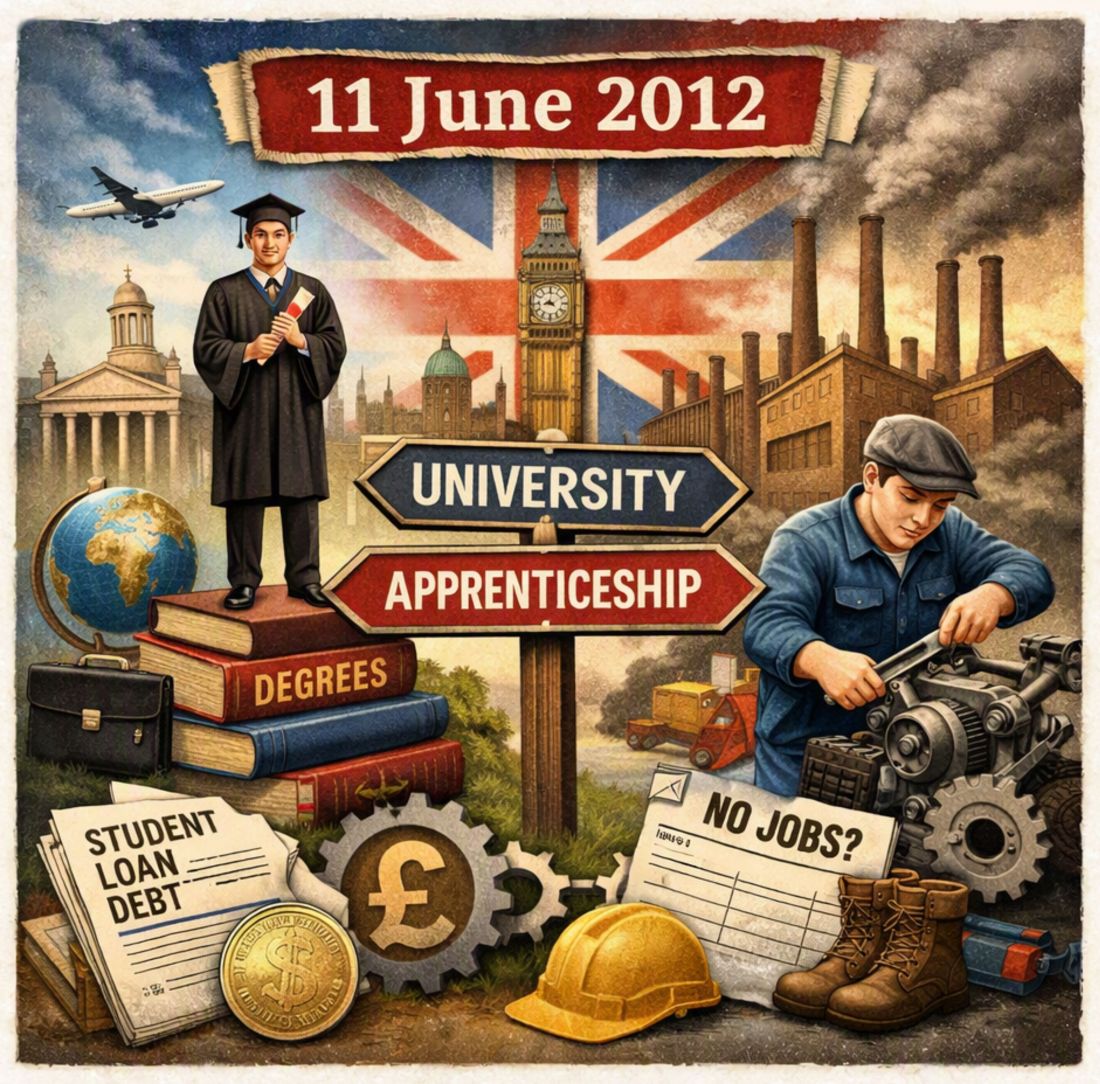
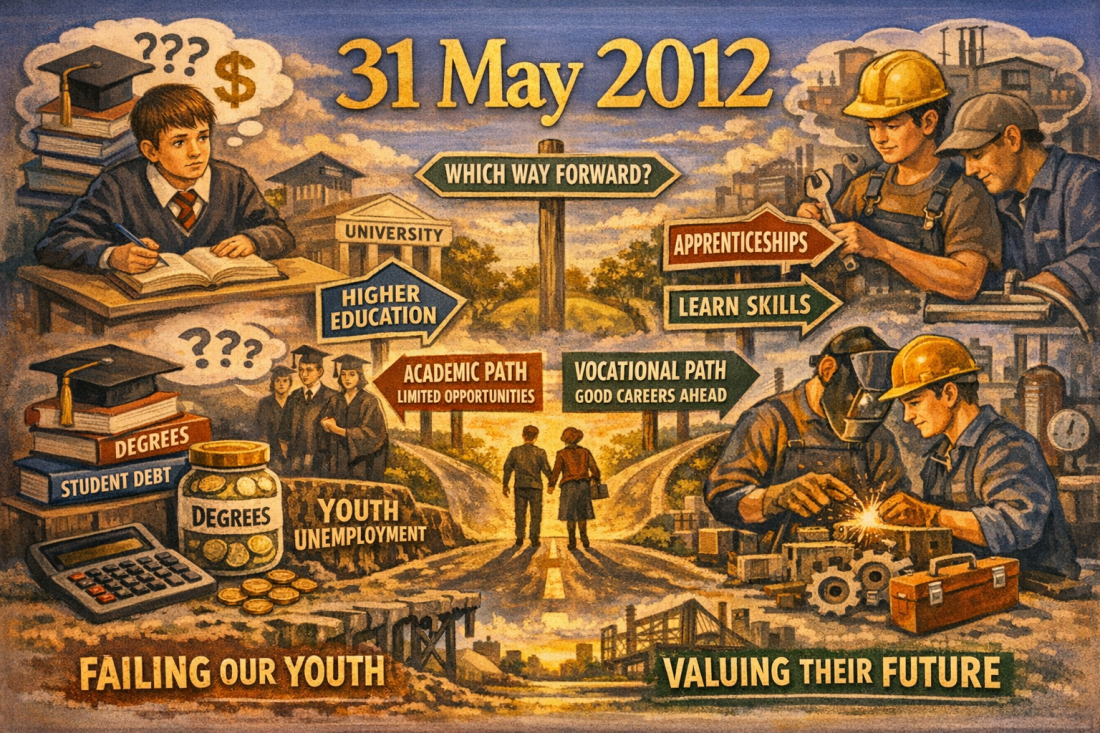
Reintroduce real and vocationally based Apprenticeships at 14: Probably the most vital step that needs to be taken is to recognise that not all children are academically inclined and that the system today is failing too many young people because it has not nurtured them in a way which fits their learning processes. In simple terms, children are usually ‘head or hands’ and therefore more theoretically or practically able in their learning processes. In isolation, neither of these qualities is a sign of intelligence, yet children who simply aren’t academically able to make the best of the school environment are all too often considered disruptive and can of course be an unnecessary distraction for those who are suited to school learning. As we grow older, we can all appreciate how little we knew but how much we thought we knew when we were in our teens and providing a stewarded environment from 14 for young people who are better suited to life outside the academic environment would give them the opportunity to take guided steps into the adult world, whilst earning an appropriate level of pay and giving a staffing option to commerce and industry that could make a significant difference to business. Either subsidising roles or supporting complimentary training courses at Tertiary Colleges could still deliver a saving in real terms, whilst providing an investment in the individual, taking them off the streets, whilst supporting British industry with a potentially parallel vocational route to age 21 that would more than adequately make up in time-served experience and the hands-on accumulation of skills for life what academically biased young people gain via a complete route of full-time education.
Reintroduce National Service: With a break or shorter form of Apprenticeship, those young people taking the vocational route could perhaps choose to finish their training in the Armed Services from 18-21, with the option being there as a requirement to attend for all young people not being in education or Apprenticed vocational training between those ages. Those ‘finishing’ training could bring skills from industry that the armed services need at a time that a pool of such experience could be highly beneficial. Either way and however those young people came to join, there is no question that a military grounding would provide a sense of value and self-worth for people who might otherwise never receive it. Such a pathway could open the door either to an extended military career or to the motivation and direction to move forward and make the best of the other opportunities that are on offer to those who value themselves and what they will inevitably gain to do it.
Return to more challenging forms of Exams at 16 and 18: The earlier part of this Coalition Government saw a series of attempts by Education Secretary Michael Gove to reform exams and return to the former O’ Level and A ‘Level or Baccalaureate standards. It’s a desperate shame that he was prevented from doing so as the realities of the flaws in our Education system would quickly become evident and would perhaps highlight just how severely our children are being failed by a system which is currently geared to treating everyone as if they were exactly the same; a system that is benchmarked for its quality not by aspiration, but by the rule of the lowest common denominator. Life is by its very nature challenging and the exams that we take at 16 and 18 should genuinely represent the milestones that they are, rather than just being something that we do. If degrees are to again have the meaning to industry that they once had, it necessarily follows that these checkpoints of the educational pathway should be high on expectation too.
Restructure the way that Higher Education is funded: The Government cannot afford to fund the number of places within Higher Education that the drive to give everyone a degree has required. The fallout from this has of course been the creation of Tuition Fees which in themselves are creating lifetimes of debt for students who may have been a great deal happier taking other routes to learning. The fragility of funding streams has driven many Higher Education establishments to behave more and more like businesses as their focus moves from providing the best education for students to ensuring the survival of the organisations – and the jobs that they provide. This does not contribute to society on a wider level and the focus needs to return to providing the best Degrees possible and not necessarily the ones that generate the best fees from providing them. Bringing the return of value to pre-University level and parallel vocational forms of education would counter much of this, but as with areas such as the NHS and Local Government, there has to be a recognition of the need for overall change as part of a new bigger and reforming picture. This could realistically mean the loss of University Status or even closure for some institutions. But what was really wrong with polytechnics anyway.
Refocus on exam-based scholarship entry opportunities to all private schools for children whose families would otherwise be unable to afford them: Whilst some would happily see the demise of private schools in much the same way as Grammars have all but disappeared, Private Schools should always have their place, if nothing more than to allow those who can afford to pay the choice to do so. However, such institutions should also be available to children who would thrive with the support of such an environment and the schools themselves should be required to make a certain number of places available through exam-based scholarships each year for children who have the academic ability to meet the standards of each specific school, but would otherwise be held back by lack of financial resources.
Stop bringing the blame-claim-culture into schools and let teachers get on with educating: Parents do have a role to play too and I will not be alone in remembering the absolute horror which our parents would experience upon learning that we had been in trouble or had been reprimanded for being disruptive in school. The balance has changed and there is now an unwritten expectation that all children are perfect and that they can never be at fault. The complaints culture and accompanying insinuation that a complaint is just a step away from a claim is paralysing disciplinary standards with the creation of fear on the part of Teachers to act against unruly children who only 30 years ago would have had a string of detentions or worse from the school, along with a right good rollocking from their parents just as soon as they returned home.
Introduce standard educational apps on all electronic devices which will be used by children: Technology and the influence that it has upon us all is marching ahead at a hellish pace. Children are already using tablet computers before they can do many other things. We are currently missing the opportunity to work with manufacturers and potential sponsors to utilise these devices which immediately make fascinated children a captive audience. The development of standard apps which can be used to develop reading, language and other skills for the benefit of children and that of the education system which will very soon follow could be immeasurable. There is no doubt that Government should be working closely with manufacturers and Companies such as Google, to develop acclimatised software which is included within the operating platform of the machines at the point of sale and makes the very best of the learning opportunity which is literally presented for them there at hand.
Education by its very nature is supposed to assist the evolution of people, rather than becoming a tool which does little more than help a society to regress. Great ideas will not help all people if they are not developed with the needs of every single person in mind and education is currently failing in the UK because the system we have in place today is based on the flawed idea that Equality is about sameness.
It’s time that we stopped trying to force people to change in ways that they simply cannot be changed; accept the good that exists in the real differences between us, and start giving each and every one of our children and young people their very best shot.

Source of top Image unknown