We are all thinking about what happens next. Quietly or otherwise, people find predictions irresistible. We know they are usually wrong. We know the future rarely behaves itself. But predictions give us something we understandably crave: reassurance. They offer the sense that someone, somewhere, has a map, even if the map is little more than a sketch drawn in the sand.
I write about the future often, but not in the way pundits do. I do not make fixed predictions about elections, because doing so is usually a fool’s errand. The political runes only ever speak clearly in the moment you read them, and even then they whisper rather than shout. What I try to do instead is look beneath the events themselves and ask what the deeper forces shaping them make possible, likely, or unavoidable.
Right now, those deeper forces are telling us something uncomfortable: the next general election cannot really be “won”, at least not in the way people imagine. And the election that follows may matter even more, if world events don’t intervene first.
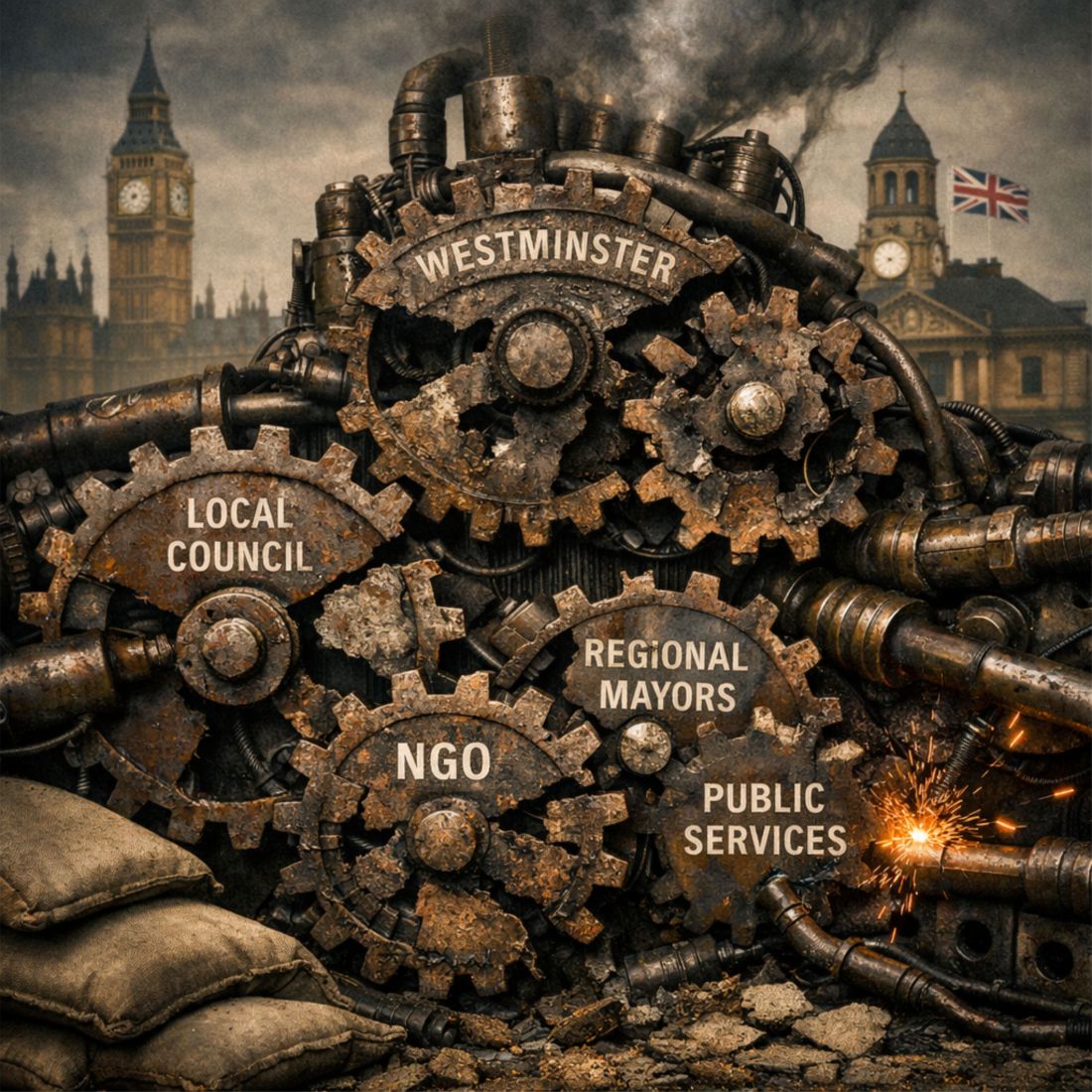
To understand why, we need to step back from the daily noise and look at the operating system beneath British politics: a system that has become fragile, hollowed out, and increasingly unable to produce meaningful change.
The System Behind the System
One of the clearest windows into this reality came in The Contemporary Politician’s Dilemma (2024), where I described a moment when newly elected or returning MPs who have found themselves with power discover how government actually works.
They arrive in Westminster full of promises, only to be told – often within days – that everything the previous government was doing, no matter what it said publicly, was the only way to keep the machinery of state running. The alternative was to risk first the economy, then government itself, and then the public services people rely on.
This is the moment the illusion cracks. Politicians realise that every social issue – housing, immigration, inflation, the cost of living, benefits, productivity – is tied to the economic model. The economic model depends on growth. Growth depends on spending. Spending depends on narrative. Narrative depends on performance. And performance depends on maintaining decline in a way that looks like progress.
The practical consequences are visible everywhere. Housing cannot be fixed without confronting land, debt, planning, wages, infrastructure and the financial model that sits beneath them. Welfare cannot be discussed honestly without asking why so many people in work still cannot live independently on what work pays. Public services cannot be restored simply by changing the minister or the slogan above the department. Each problem is treated as separate, yet each is tied to the same economic and institutional framework.
Governments still hold office, pass laws and make announcements. But their room for meaningful manoeuvre has narrowed dramatically. They increasingly manage decline rather than reverse it. That is why so many governments end up looking alike. That is why promises evaporate. That is why legitimacy drains away.
The Establishment Is Not What People Think It Is
In July 2026, I wrote The Establishment Is Not What You Think It Is, which explains the deeper mechanism behind this paralysis.
People imagine the Establishment as a group – elites, mandarins, financiers, media, “the blob”. But the real Establishment is not a class. It is a worldview. A mental operating system. A set of assumptions about what is “realistic”, “responsible”, “credible” and “possible”.
This worldview saturates everything: politics, media, finance, public services, professional norms, institutional culture. It shapes how people think without them realising it, because it feels like reality. It rewards conformity, punishes deviation, and treats alternatives as naive or dangerous. It is enforced not by conspiracy, but by incentives.
This is why even anti‑establishment actors end up reinforcing the system. Reform, Restore, and even parts of the Conservatives behave as if they are fighting the Establishment, yet their actions reveal that they operate fully within its worldview. They judge success by market confidence, treat narrative as power, and assume that centralised management, competitive funding and measurable outputs are the only acceptable forms of action.
The Establishment is not something you overthrow. It is something you wake up inside.
The Right’s Fragmentation Is a Symptom, Not a Cause
In What is the Right Really For? (June 2026), I argued that the right is not divided because its factions have different philosophies. It is divided because they are all trying to reclaim a conservatism that the modern political system no longer allows to exist.
Traditional conservatism depends on locality, community, stewardship, continuity, identity and self‑governance. But the Establishment worldview depends on centralisation, corporatism, globalisation, managerialism, technocracy and distant authority. These two worldviews cannot coexist. The right is not fighting over ideology. It is fighting over something unreachable.
This is why the Conservatives defend a system that is no longer conservative. Reform tries to break the system without knowing what to replace it with. Restore tries to revive conservatism in a landscape where conservatism cannot function. Their conflict is not ideological. It is existential.
The Behaviour of Parties Reveals the Fragility of the System
The strain was already visible up to a year ago. Labour reshuffled repeatedly to manage perception. Reform behaved like a brand rather than a governing force, staging conferences that looked more like victory rallies than policy events. The Conservatives clung to relevance through messaging rather than substance. Farage mistook momentum for capability. Quasi‑Tories migrated to Reform expecting instant change.
This is the behaviour of a system running out of room. Parties behave as if optics equal authority, narrative equals power, and performance equals legitimacy. They chase headlines because they struggle to deliver outcomes. They polish the surface because they cannot repair the structure. They fight over the steering wheel of a vehicle that no longer responds properly to steering.
The Global Dominoes
The next election could be overtaken by events long before polling day. The list is not short: the Strait of Hormuz, financial instability (including Japan), a potential AI‑driven bubble burst, geopolitical escalation, supply chain fragility, food security, energy shocks. Any one of these could expose how vulnerable the UK has become.
A world‑derived crisis could very easily reveal just how fragile the UK really is – not only economically, but institutionally and politically. It could expose weak spots like food security, supply chains, and over‑reliance on imports. And it could make the result of the next general election a moot point, because we simply do not have politicians or leaders capable of operating in an environment that requires real leadership rather than performance.
Yes, this may be pessimistic. Britain has endured crises before: economic shocks, constitutional upheavals, wars, strikes, deindustrialisation, party collapses and social fracture. Institutions can bend without breaking, and electorates can tolerate more discomfort than commentators often assume.
But the question is not whether Britain has survived crises before. It is whether the present system still contains the intellectual, economic and institutional capacity to renew itself from within.
That is far less clear.
The Legitimacy Crisis
Burnham’s legitimacy problem is therefore not merely personal. It is systemic. He may have arrived in No.10 through legitimate processes, but legitimacy is not produced by process alone. It is produced by capability, consent and a credible sense of direction. Those things are difficult to generate when the same worldview sets the limits of what any leader is permitted to imagine.
This is why Reform can look triumphant, the Conservatives nostalgic, Labour managerial, and Restore principled but powerless. Each speaks to a real dissatisfaction. Yet none has convincingly shown how it would escape the assumptions that created the dissatisfaction in the first place.
The Next Election Cannot Really Be “Won”
Polling today suggests that no party can comfortably expect a working majority. The right is fragmented. The left may form a coalition. Reform may surge. Conservatives may revive slightly. Restore may remain fringe. But these are surface‑level dynamics.
The deeper truth is that even a working majority cannot govern in any meaningful sense if the system itself is at its limit. The next government, whatever its shape, will face the same dilemma as the newly elected MP who discovers that the machinery of state permits far less change than the campaign suggested. It may manage decline, or it may disturb the settlement enough to expose how fragile that settlement has become.
The Lifetime of the Next Government
The next government will inherit a fragile economic model, a saturated worldview, degraded public services, brittle institutions, exhausted narratives, declining legitimacy and global volatility. Its tools will be limited. Its room for manoeuvre will be narrow. Its philosophical foundations will be uncertain. Its institutional capacity will be stretched. Its public trust will be weak.
This is why governments now appear to fail faster. Expectations remain high, but capacity is lower. Promises are larger, but delivery is weaker. Narratives are louder, but reality intervenes sooner.
It is possible that the next administration may have months, not years, before it too is forced to admit that it cannot find a way out of the mess using the tools it inherited.
What Happens When the System Can No Longer Continue
Sooner or later, someone near power will have to say what the system currently cannot say: we cannot continue like this anymore.
That moment need not be revolutionary in the dramatic sense. It may simply be the moment when the worldview breaks, the operating system fails, the Establishment loses coherence, and the political map begins to dissolve enough for new possibilities to emerge.
The Establishment is not something you defeat. It is something you outgrow.
What Renewal Requires
If renewal is possible, it will require a return to locality, community‑rooted economies, stewardship, identity grounded in place, governance by the governed, and institutions that serve people rather than systems. This is not nostalgia. It is the foundation of a functioning society.
Conclusion: The Election Is Not the Story – The System Is
The next election matters. But it cannot be “won” in any meaningful sense. The real story is the system itself: its worldview, its fragility, its limits, its contradictions, its saturation, and its inability to solve the problems it created.
The question is not simply who wins. The question is what happens when the system can no longer hide its own failures. And the deeper question is whether enough people can see clearly enough to imagine something better: not merely a different leader, party or slogan, but a different set of assumptions about how economies, institutions and communities should function.
That is the real choice ahead. Not whether the Establishment can be defeated, but whether it can finally be outgrown.
Britain is living through a moment that feels familiar on the surface but strangely hollow underneath. The routines still run, the language still sounds steady, and the noise of certainty still fills the air – yet something essential has slipped out of view.
This work is an attempt to see that reality honestly: the fragility behind the performance, the worldview that has run out of road, and the quiet point the country has reached where the old logic no longer works.
It’s a guide to noticing what we’ve been taught not to notice, and to imagining how we might begin again once we can finally see clearly.
Chapter One – Learning to See
If we’re going to talk honestly about where Britain is right now, we have to start with something simple that nobody ever admits: most of us aren’t really seeing what’s going on. Not because we’re stupid or distracted or unwilling – but because the world we’re living in makes it incredibly hard to see anything clearly.
Every day, we’re surrounded by noise. Not just the obvious stuff – the headlines, the outrage, the endless commentary – but the subtler kind too. The kind that comes from people talking with absolute certainty about things that are far more complicated than they sound. The kind that fills the space where quiet thinking used to be.
Noise isn’t the opposite of truth. It’s what happens when truth becomes too quiet to hear.
And the problem is, we’ve all grown used to it. We’ve grown used to mistaking volume for clarity, confidence for competence, and narrative for reality. It’s not a moral failing. It’s just the environment we’ve been living in for a long time.
But underneath all that noise, something else is happening – something quieter, something more important. The system we’ve been relying on for decades is creaking. The worldview that shaped everything from our politics to our public services is running out of road. And if we’re going to understand what comes next, we have to learn how to see past the noise and into the structure.
That’s harder than it sounds, because none of us see the world directly. We see it through a kind of mental lens – a worldview – that tells us what’s normal, what’s credible, what’s possible. Most of the time, that lens is useful. It helps us make sense of things quickly. But when a system reaches its limits, the same lens that once helped us can suddenly stop us seeing what’s right in front of us.
It’s like trying to spot cracks in a wall while wearing glasses that blur anything uncomfortable.
So the first step – before talking about collapse, or fragility, or reconstruction – is learning to notice when we’re being shown a story rather than the thing itself. Not because stories are bad. Stories help us cope. But when the story becomes louder than the reality, we lose the ability to understand what’s actually happening.
This is what I mean when I talk about “myth‑catching”. It’s not about cynicism. It’s not about assuming everyone is lying. It’s simply the ability to pause and ask: Is this explanation helping me understand the world, or is it helping someone else avoid telling me how complicated it really is?
That idea is explored more fully in The Myth-Catcher, which sits behind this chapter as a kind of practical companion: not a theory of politics, but a method for staying clear-headed when politics becomes noisy, theatrical and overconfident.
It’s a quiet skill. It’s a personal skill. And it’s the only way to make sense of a moment like the one Britain is in now.
Because if we can’t see clearly, we can’t understand clearly. And if we can’t understand clearly, we can’t act clearly. And if we can’t act clearly, someone else will act for us.
This chapter is about learning to see – not perfectly, not completely, but honestly. Everything else in this essay depends on that.
Chapter Two – The Inversion
If you really want to understand why Britain feels so strange right now – why things don’t quite add up, why problems seem to multiply faster than solutions, why every promise sounds thinner than the last – you have to look at something that almost nobody talks about directly.
It’s the quiet inversion that’s taken place between the public and the system.
For most of us, the assumption has always been simple: government exists to serve the public. That’s the basic democratic contract. We elect people, they run things on our behalf, and the whole arrangement only works because the direction of service is clear.
But over time – slowly, subtly, and without any dramatic announcement – that direction has flipped. Government still talks as if it serves the public, but in practice, the public now serves the system. We serve its processes, its priorities, its limitations, its fears. We serve its need to appear stable, even when it isn’t. We serve its need to avoid admitting fragility, even when fragility is everywhere.
Nobody designed this inversion. It wasn’t a conspiracy. It wasn’t a single decision. It was drift – decades of it – until one day the purpose of government quietly became government itself.
And once that happens, something very strange follows: people stop expecting honesty. Not because they’re cynical, but because they’ve learned that honesty is no longer part of the system’s job. The system’s job is to maintain the appearance of continuity. To reassure. To perform stability. To keep the lights on and the language familiar, even when the underlying machinery is grinding.
This is why so many people struggle to see fragility. It’s not that they’re blind. It’s that the system they rely on is performing strength even when it’s weak.
When a government’s first priority becomes protecting its own credibility, it can’t admit when it’s out of road. It can’t say, “We don’t know how to fix this.” It can’t say, “The tools we’ve used for forty years don’t work anymore.” It can’t say, “The worldview we’ve been living inside is exhausted.”
So instead, it keeps talking in the language of continuity – the language of plans, frameworks, strategies, announcements, consultations, reviews. The language of “we’ve got this”, even when it hasn’t.
And because that language is familiar, people assume the underlying reality must still be familiar too.
This is how the inversion hides fragility. It hides it behind routine.
People see the routine and assume the system is fine. They see the announcements and assume the capacity is there. They see the confidence and assume the competence is real.
But underneath all that, the system is struggling. Not because the wrong people are in charge, but because the worldview that shaped the system has reached its limits.
This is why Chapter One matters so much. If you can’t see clearly, you can’t see the inversion. And if you can’t see the inversion, you can’t understand why everything feels stuck.
The truth is simple, but uncomfortable:
Britain hasn’t just run out of money or ideas. It has run out of worldview. And the system built on that worldview is now performing stability instead of delivering it.
Once you see that, everything else in this essay will start to make sense.
Chapter Three – Fragility
Before we get to Stop, we have to be clear about one thing: fragility is not the same as weakness.
A weak system may look obviously broken. A fragile system may still look normal. It may still have offices, uniforms, websites, procedures, meetings, targets, announcements, and all the outward signs of competence. The trains may still run. The schools may still open. The bins may still be collected. But the difference is what happens when pressure arrives.
A strong system absorbs pressure. A fragile system transmits it. A strong system can take a mistake, a shock, a bad decision, a winter crisis, a strike, a scandal, a flood, a market wobble, and still keep enough slack in the machinery to recover. A fragile system has no slack left. It can keep going only if everything else behaves.
That is the crucial point. Fragility is sensitivity to disruption. It is not collapse. It is the condition that makes collapse, panic, overreaction, and sudden political change more possible than they used to be.
This is why fragile systems are so difficult to talk about honestly. If you point to them on an ordinary day, people can say, quite reasonably, “But look, it’s still working.” And they’re right. It is still working. But it is working in the same way an overstretched bridge is still standing. The question is not whether it is standing now. The question is what happens when the weight changes.
This is where the argument turns. The danger is not that everything fails at once. The danger is that the system loses its ability to absorb surprise. And once that happens, history starts to behave differently. Processes matter less than they used to. Moments matter more.
In a resilient country, a bad decision is corrected, a failure is contained, a foolish leader is limited by institutions, and public anger has somewhere to go. In a fragile country, the same things can cascade. A bad decision becomes a legitimacy crisis. A failure becomes a symbol. A foolish leader becomes a danger. Public anger stops moving through institutions and starts looking for a way around them.
That is why learning to see fragility matters. Not because it means disaster is inevitable. It does not. Fragility is a warning, not a prophecy. But it tells us that the old assumptions are no longer safe. It tells us that the system may still look familiar while behaving in unfamiliar ways. And it tells us that when the moment comes, it may arrive faster than the people inside the old worldview are able to understand.
And once systems become fragile, history stops behaving like a process and starts behaving like a series of moments.
Chapter Four – A Place Called Stop
If you’ve ever pushed something too far – a car, a relationship, a job, even your own patience – you’ll know there’s a moment when it doesn’t matter how much effort you put in, it just won’t go any further. You can press the accelerator, you can try to reason with it, you can pretend it’s fine, but deep down you know you’ve reached the limit.
Britain feels like that now.
Not in a dramatic, apocalyptic way. More in the sense of a system that’s been stretched, patched, repurposed, and talked‑up for so long that it’s quietly run out of road.
We’re still going through the motions – elections, budgets, announcements, promises – but the underlying machinery isn’t responding the way it used to.
It’s as if the country has arrived at a place called Stop. Not because someone slammed on the brakes, but because the engine simply can’t push any harder.
For decades, we built everything around the idea that you could squeeze more out of less. More productivity from fewer workers. More public services from smaller budgets. More growth from thinner foundations. And for a while, it looked like it worked. Britain became very good at appearing efficient.
But efficiency has a habit of turning into extraction when you keep pushing it. You start pulling capacity out of institutions faster than you replace it. You start relying on goodwill instead of structure. You start assuming resilience instead of building it. And eventually, you end up with systems that look intact from the outside but are hollowed out on the inside.
That’s where the dependency creeps in. Not the kind people talk about in political slogans – the real kind. The kind where hospitals depend on staff doing unpaid overtime just to keep the doors open. The kind where councils depend on volunteers to run services that used to be funded. The kind where government depends on narrative because it no longer has the tools to deliver what it promises.
And once a system becomes dependent, it becomes fragile. Not fragile in the sense of imminent collapse – fragile in the sense that everything works only if nothing unexpected happens.
But unexpected things always happen.
The problem is, most people don’t see this fragility because the surface still looks familiar. The trains still run. The schools still open. The bins still get collected. The news still talks about “plans” and “strategies” and “frameworks” as if the underlying capacity is still there.
It’s like living in a house where the walls have quietly rotted behind the paint. You don’t notice until you lean on one.
This is what I mean by Stop. It’s not collapse. It’s not even crisis, at least not at first. Stop is the point at which a system can no longer solve its problems using the assumptions that created them.
It’s the moment when the old logic – the logic of efficiency, extraction, and dependency – stops working, but the system keeps pretending it does. It’s the moment when the public starts feeling that something is wrong but can’t quite explain it. It’s the moment when politics becomes more about performance than problem‑solving because the tools backstage don’t work anymore.
And it’s the moment when people start looking for voices that sound confident. Not because confidence is the answer, but because confidence is the only thing the system still knows how to produce.
This is the landscape the false prophets walk into. Not because they caused it. Not because they’re malicious. But because the system has reached Stop, and the public is desperate for someone – anyone – who sounds like they know the way forward.
But Stop isn’t a place you escape by following the old map. It’s a place you leave by admitting you need a new one.
The longer essay A Place Called Stop develops this diagnosis in more detail, especially the way efficiency can become extraction, extraction can become dependency, and dependency can leave institutions unable to absorb the shocks they were created to withstand.
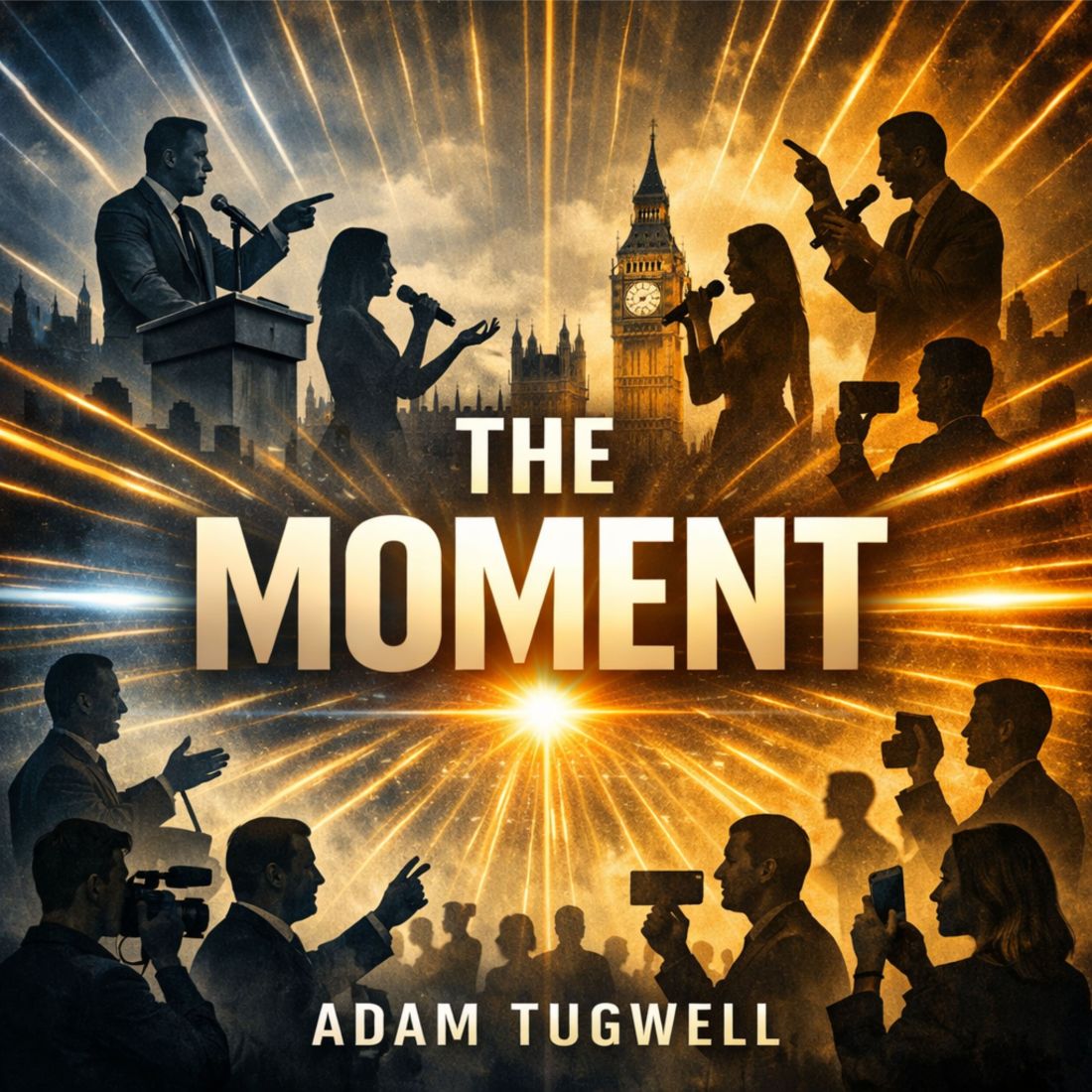
Chapter Five – The Moment
If you’ve ever watched something go wrong in real time – a fight breaking out, a car losing control, a crowd suddenly shifting – you’ll know how strange those moments feel.
Everything seems normal right up until the second it isn’t. There’s no warning. No countdown. No neat chain of events. Just a sudden change when things go sideways that nobody saw coming until it was already happening.
History works like that more often than people realise.
We’re taught to think of big changes as the result of long processes: debates, movements, elections, negotiations. And sometimes they are. But just as often, the real turning point is a moment – a single moment – when someone acts while others hesitate.
That does not mean history is made only by great individuals. It means something more unsettling. Structures create the conditions. Moments decide which of the possible futures becomes real.
Most of the time, individual actions are absorbed by the system. Speeches fade. Decisions are delayed. Errors are corrected. Crowds disperse. Institutions bend and then return to shape. But when the system is fragile, absorption fails. A gesture, a refusal, a speech, a rumour, a resignation, a police decision, a vote, a march, or a single act of courage can suddenly carry more weight than it would have carried the day before.
The moment is not the cause of everything. It is the point at which everything that has been building becomes visible.
The Russian Revolution is the classic example. It wasn’t inevitable. It wasn’t planned in the way people imagine. It wasn’t the logical end of a tidy sequence of events.
The real ‘moment’ hinged on Lenin deciding to move when others were still arguing about what to do. That decision did not create the whole crisis. War, hunger, exhaustion, legitimacy, organisation, fear and hope were already there. But his significance was that he recognised a moment had arrived and acted while others hesitated.
And this is the part false prophets never see.
They think in terms of order. They think in terms of steps. They think in terms of “first this, then that”. They think in terms of plans unfolding the way plans are supposed to unfold.
They believe the system will behave the way it used to. They believe institutions will respond predictably. They believe people will stay calm. They believe collapse, if it comes, will be rational and wait for everything to catch up – as their experience suggests that it should.
But when a system reaches Stop, it doesn’t behave like that anymore. It behaves like something under strain – brittle, unpredictable, sensitive to pressure. And when something brittle is under pressure, it doesn’t crack gradually. It cracks suddenly.
That’s the moment.
The moment when public order shifts. The moment when institutions freeze. The moment when people look around for someone who seems to know what to do. The moment when hesitation becomes dangerous. The moment when confidence – any confidence – becomes magnetic.
And the person who steps forward in that moment isn’t always the one who’s been talking the loudest beforehand. It’s often someone who wasn’t even part of the conversation. Someone who sees an opening. Someone who acts quickly. Someone who understands that the system is too fragile to resist.
False prophets don’t see that possibility. They’re too busy believing they’ll be the ones leading when the moment arrives. They’re too busy believing the moment will wait for them. They’re too busy believing the moment will unfold in a way that makes sense.
But moments don’t care about sense. Moments care about timing.
And this is why the danger isn’t always the false prophets themselves. It’s the space they create – the space where people stop thinking for themselves because someone else sounds certain. The space where public imagination narrows. The space where, when the moment arrives, people are unprepared to question whoever steps forward.
That person might not be the confident voice they’ve been listening to. It might be someone far less benign. It might even be someone already in power, offering safety in exchange for freedoms because the public is frightened and the system is out of road.
And that’s why understanding this matters. Not to scare anyone. Not to predict anything. But to recognise that when a system reaches Stop, the future doesn’t unfold gradually. It arrives suddenly – in moments – and those moments are shaped by whoever is ready and able to act.
Chapter Six – The False Prophets
When a country reaches a point like this – a kind of national pause where nothing quite works but everything still pretends it does – certain voices start to stand out. You’ve probably noticed them. They’re the ones who sound absolutely sure of themselves when everyone else is quietly wondering what on earth is going on.
And the thing is, most of these people aren’t charlatans. They’re not trying to manipulate anyone. They genuinely believe they’ve seen something others haven’t. They look at the mess, they look at the frustration, and they think, almost instinctively, “I could sort this out. I know what’s wrong. I know what to do.”
It’s a very human reaction. But it’s also where the trouble begins.
Because when a system has reached its limit – when it’s running on fumes and habit rather than capacity – the people who sound confident become incredibly appealing. Not because confidence is the answer, but because confidence is the only thing the system still knows how to produce.
The problem is that these voices almost always see the situation as a matter of personnel. To them, the issue isn’t structural. It isn’t about the worldview running out of road. It isn’t about fragility or exhaustion or the quiet hollowing‑out of institutions. It’s simply that the wrong people are in charge, and if the right people were in charge – usually meaning themselves – everything would start working again.
That is why they are so compelling. They are often right about the feeling and wrong about the cause. They sense exhaustion. They sense drift. They sense that the country is no longer being governed by a living idea. But they translate all of that into a simpler story: bad people, bad choices, weak leadership, betrayal, incompetence. Sometimes those things are real. But they are not enough to explain what is happening.
They’re not lying. They really believe this.
And because they believe it, they stop noticing the deeper reality. They stop seeing how thin the system has become. They stop recognising how quickly public order can shift when pressure builds. They stop imagining how fast things can unravel when the old logic stops working. They stop seeing how fragile everything really is.
They think in terms of steps and sequences. They think in terms of plans. They think in terms of “if we do this, then that will happen.”
They believe the system will behave the way it used to. They believe institutions will respond predictably. They believe people will stay calm. They believe collapse, if it comes, will be orderly.
And that’s exactly why they can’t see the danger.
Because when a system reaches Stop, things don’t unfold in order anymore. They don’t wait for the right leader to take charge. They don’t follow neat chains of events. They hinge on moments – sudden, unpredictable moments where hesitation matters, where confidence matters, where someone steps forward while everyone else freezes.
History is full of these moments. They’re rarely planned. They’re rarely expected. They’re rarely rational.
They are moments where the entire direction of a country can shift because a fragile system has made individual action unusually consequential.
False prophets don’t see those moments coming. Not because they’re foolish, but because their worldview doesn’t contain the possibility that everything could change in an instant.
They assume they’ll be the ones leading when the moment arrives. But moments don’t reward sincerity. Moments reward whoever acts first.
And that’s the danger.
Not the false prophets themselves – but the vacuum they unintentionally create. A vacuum where people stop thinking for themselves because someone else sounds certain. A vacuum where public imagination narrows. A vacuum where, when the moment comes, people are unprepared to question whoever steps forward.
And that person might not be the confident voice they’ve been listening to. It might be someone far less benign. It might even be someone already in power, offering safety in exchange for freedoms because the public is frightened and the system is out of road.
False prophets don’t see that possibility. They’re too busy believing they’re the answer.
And that’s why being able to identify false prophets matters. Not to criticise them. Not to attack them. But to understand the role they play in a system that has quietly reached Stop – and the risks that come with mistaking confidence for clarity.
The next chapter is about those moments themselves – the ones that change history not because they were planned, but because someone acted while others hesitated. It’s about what people can do before those moments arrive – not to control them, but to be ready for them.
Chapter Seven – The Preparation
When a system is under strain, people often assume the important decisions will be made somewhere far away – in government buildings, in boardrooms, in institutions that still look solid from the outside.
But when change arrives in moments rather than processes, the most important decisions aren’t made by systems at all. They’re made by individuals, in the way they think, the way they react, and the way they interpret what’s happening around them.
That’s why preparation, in a moment like this, doesn’t look like stockpiling or strategising or waiting for instructions. It looks like clarity. It looks like learning to see the world without the filters that used to make sense. It looks like recognising that the old logic has run out of road and that the new logic hasn’t yet arrived.
Most people don’t realise how much of their understanding of the world comes from habit. They assume institutions will behave the way they used to. They assume public order will hold the way it always has. They assume the future will unfold in roughly the same shape as the past. And when those assumptions stop being reliable, the first instinct is often to cling to them even harder.
But preparation begins with letting go of the idea that continuity is guaranteed.
It means noticing when explanations feel too neat. It means recognising when confidence is being performed rather than earned. It means understanding that fragility isn’t a prediction – it’s a condition. It means accepting that moments, not processes, shape turning points.
And it means thinking independently, especially when the noise becomes overwhelming.
That’s harder than it sounds. Noise is comforting. It gives people something to hold onto. It offers certainty at the exact moment certainty becomes impossible. It fills the space where quiet thinking should be. And when false prophets step into that space – with their simple stories and their confident tones – it becomes even harder to resist the pull.
But preparation is the opposite of that pull. It’s the willingness to pause. To question. To notice. To think.
It’s the ability to look at a situation and ask whether the explanation being offered is actually connected to the structure underneath, or whether it’s just a story designed to make the moment feel less frightening.
Preparation isn’t dramatic. It isn’t heroic. It isn’t loud.
It’s quiet. It’s personal. It’s internal.
It’s the kind of preparation that makes someone less vulnerable when the moment arrives – not because they can control it, but because they can see it clearly.
They’re not paralysed by surprise. They’re not swept along by someone else’s certainty. They’re not caught in the vacuum created by voices who sound confident but don’t understand the fragility of the system they’re speaking into.
They’re simply ready to think.
And that matters, because when a system reaches Stop, the people who can think clearly become the anchor points for everyone around them. They’re the ones who don’t panic when the ground shifts. They’re the ones who don’t mistake confidence for competence. They’re the ones who can tell the difference between a moment that needs action and a moment that needs calm.
They’re the ones who help others stay steady.
Preparation, in the end, is about imagination – the ability to imagine that the future might not look like the past, and to stay grounded anyway. It’s about seeing the system as it is, not as the worldview insists it must be. It’s about recognising that fragility doesn’t mean inevitability, and that moments don’t have to lead to chaos if people are able to think clearly when they arrive.
The system may be out of road. But people aren’t.
And that’s where reconstruction begins – not with institutions, not with plans, but with individuals who have learned to see clearly in a world that no longer behaves the way it used to.
Chapter Eight – Reconstruction
If preparation is personal, reconstruction is collective. It begins inside individuals, but it cannot end there. Seeing clearly matters because people who see clearly can begin to build differently.
Reconstruction does not mean returning to the old normal. That is the temptation whenever a system reaches its limit: to imagine that the task is simply to restore what has been lost. But the old normal is part of the problem. It is the worldview that taught us to confuse efficiency with resilience, management with government, activity with purpose, and continuity with health.
So reconstruction has to begin with different questions. Not “How do we make the old system work again?” but “What kind of system can survive reality?” Not “How do we preserve the appearance of stability?” but “What would genuine resilience look like?” Not “Who can fix this for us?” but “What habits, institutions, responsibilities and forms of trust would make us less dependent on someone else’s certainty?”
That will not come from slogans. It will not come from another strategy document written in the old language. It will come from the slow rebuilding of capacity: in public services, in local institutions, in democratic habits, in the willingness to tell the truth about limits, and in the courage to stop pretending that every problem can be solved by one more announcement.
This is also where questions of future governance become unavoidable. If the old model has reached its limit, then reconstruction cannot simply mean better management of the same assumptions. It has to mean designing forms of local, civic and economic governance that are capable of learning, adapting and holding trust under pressure.
The point of seeing clearly, then, is not to become detached or superior. It is to become useful. Useful to your family, your community, your workplace, your town, your country. Useful because you are less easily panicked. Useful because you can recognise false certainty when it appears. Useful because you know that a fragile moment does not have to become a destructive one if enough people remain capable of thinking.
This is the hopeful part, although it is not an easy hope. Systems can run out of road. Worldviews can exhaust themselves. Institutions can hollow out. But people can learn. They can notice what they have been taught not to notice. They can stop mistaking performance for strength. They can build new habits before new institutions fully exist.
That is where reconstruction begins: not with a master plan, but with a different kind of attention. The ability to see the cracks without worshipping collapse. The ability to recognise fragility without surrendering to fear. The ability to prepare for moments without longing for them.
And perhaps that is the real task now. Not to predict the moment. Not to wait for the prophet. Not to demand that the old map become true again. But to learn to see clearly enough that, when the ground shifts, we are not merely frightened by it. We are ready to build.
Conclusion – The Work Ahead
There’s a point in any honest look at a country where the conversation stops being about diagnosis and starts being about direction. Not in the sense of a plan, or a programme, or a list of things that need to happen, but in the quieter sense of recognising what the moment asks of people.
Britain is fragile. Not because it is doomed, and not because it is weak, but because the worldview that carried it for forty years has reached its limit. The system built on that worldview is still performing stability, but performance isn’t the same as capacity. And when capacity thins, moments matter more than they used to.
That’s the landscape we’re in.
The point of seeing clearly isn’t to predict what comes next. It isn’t to panic. It isn’t to wait for collapse or to assume it. It’s simply to understand the shape of the moment we’re living through – a moment where the old logic has stopped working and the new logic hasn’t yet arrived.
Reconstruction won’t begin with a manifesto. It won’t begin with a speech. It won’t begin with a leader who claims to know the way forward. It will begin wherever people stop mistaking noise for clarity and start paying attention to the structure underneath.
That’s not a call to action. It’s just the reality of how fragile systems recover: slowly, locally, through people who have learned to see the world without the filters that used to make sense.
The system may be out of road. But people aren’t.
And that’s where the work ahead begins – not with certainty, not with confidence, but with the quiet recognition that clarity is the first form of resilience, and that resilience is the first form of reconstruction.
Further Reading
The following pieces develop the argument from different angles. They are best read not as separate essays, but as companion works: one explains how to see clearly, one examines the inversion between public and system, one develops the idea of Stop, and one points towards the question of future governance and reconstruction.
1. Do We Exist Only to Serve Government, or Does Government Exist to Serve Us? https://adamtugwell.blog/2026/07/17/do-we-exist-only-to-serve-government-or-does-government-exist-to-serve-us/ This piece expands the argument in Chapter Two. It explores the inversion at the centre of the democratic contract: the slow drift from government serving the public to the public being expected to serve the system’s needs, processes and limitations. It gives the reader a deeper route into the essay’s claim that modern governance often protects the appearance of stability before it protects the public purpose that justified it.
2. A Place Called Stop: How Britain Reached the Limits of a System Built on Efficiency, Extraction and Dependency – and Why Reconstruction Begins with Honesty https://adamtugwell.blog/2026/07/18/a-place-called-stop-how-britain-reached-the-limits-of-a-system-built-on-efficiency-extraction-and-dependency-and-why-reconstruction-begins-with-honesty/ This is the closest companion to Chapters Three and Four. It develops the essay’s central diagnosis: that Britain has reached a limit point created by efficiency turning into extraction, extraction becoming dependency, and dependency producing fragility. It is the bridge between the conceptual argument about seeing clearly and the political argument about what happens when a system can no longer solve problems using the assumptions that created them.
3. The Local Economy & Governance System https://adamtugwell.blog/2025/11/21/the-local-economy-governance-system-online-text/ This work points beyond diagnosis towards reconstruction. It is most relevant to the final chapter because it asks what future governance might look like when old assumptions about central control, efficiency and institutional capacity are no longer enough. It helps move the argument from seeing the failure of the old map towards imagining the first outlines of a new one.
4. The Myth-Catcher: A Quiet Guide to Discovering Clarity in an Age of Noise https://adamtugwell.blog/2026/07/02/the-myth-catcher-a-quiet-guide-to-discovering-clarity-in-an-age-of-noise-full-text/ This is the practical foundation for Chapter One. It develops the habit of noticing when a public explanation has become too neat, too confident, or too useful to the people offering it. In the context of this essay, myth-catching is the first discipline of preparation: the ability to stay mentally independent when noise, certainty and narrative are doing the thinking for everyone else.
Disclaimer
This book offers analysis and interpretation of political, institutional and cultural conditions in Britain. It is not intended as professional advice, legal guidance, financial instruction or a prediction of future events. The arguments and observations reflect the author’s own examination of public systems and the pressures acting upon them.
Readers should apply their own judgement when considering the ideas presented here. Nothing in this work should be taken as a call for specific political action, nor as an endorsement of any party, candidate or policy. All examples and descriptions of institutions are used to illustrate structural dynamics, not to make claims about individual actors.
Declining trust, institutional fragility, and the danger of mistaking symptoms for causes.
Trust in political institutions is falling, public frustration is rising, and many people increasingly feel that politics offers different language but the same underlying direction. The slogans change. The faces change. The promises change. But the choices in front of us often seem to lead back to the same narrow set of answers.
This is why politics feels broken to so many people. It is not only because of scandal, incompetence, polarisation, or distrust, although all of those matter. It is because the political system itself appears to be losing its ability to adapt. Institutions feel brittle. Public debate feels repetitive. Outsider movements rise, but often carry the same assumptions as the establishment they criticise.
The risk of the moment is not simply anger, division, or frustration. It is misdiagnosis: the danger that a complex, systemic crisis will be treated as if it were a single problem with a single solution.
Why Does Politics Feel Broken?
Politics feels broken because people are experiencing several overlapping pressures at once: declining institutional trust, economic insecurity, cultural fragmentation, political polarisation, and a governing system that struggles to respond to complex problems. When these pressures are interpreted as one-dimensional failures – corruption, incompetence, weak leadership, or bad ethics – the proposed solutions rarely reach the deeper causes.
Collapse, in this context, does not mean sudden breakdown. More often it means the gradual loss of adaptive capacity: institutions becoming less able to absorb pressure, public trust becoming harder to sustain, and familiar political tools becoming less effective at solving emerging problems.
Why Everything in Politics Feels the Same
The political system is not just struggling. It is running out of room. Many parties, campaigns, and “new” options still draw from the same restricted deck: the same assumptions about markets, competition, growth, individual responsibility, and institutional management. That is why it can be difficult to see genuine daylight between them.
When a political system narrows, the public naturally looks elsewhere. Outsider movements become attractive because they sound fresher, less compromised, and more willing to say what established figures avoid. But unfamiliar is not the same as new.
Many outsider movements rise by naming real failures, but they often remain shaped by the same deeper instincts as the system they oppose. They may reject the tone of the establishment while keeping its underlying logic: competition as the default answer, market discipline as the main tool, and self-interest reframed as principle.
This is the restricted deck problem. A movement can appear disruptive on the surface while still being constrained by the same limited tools underneath. It can criticise the system without escaping the logic that made the system brittle.
The Perception Gap: Symptoms Are Easier to See Than Systems
Most people experience political crisis through its visible symptoms: arguments, scandals, headlines, personalities, broken promises, and day-to-day drama. These symptoms matter, but they are not the whole story.
The deeper problems are quieter. They sit inside institutions, economic pressures, cultural tensions, and the erosion of public trust. They do not fit neatly into interviews, slogans, or campaign messages, so they are often left unnamed.
This creates the perception gap: people feel system-level instability, but they mostly see surface-level conflict.
Someone may feel a loss of security and see only incompetence. They may feel institutional fragility and see only political theatre. They may feel economic pressure and see only blame. The deeper structure remains hidden behind the noise.
When people see only one dimension of collapse, they naturally look for one-dimensional explanations. They want someone who can point to a single cause and offer a single fix. That is why simple narratives are so powerful: not because they are accurate, but because they are comforting.
The danger is that people then choose solutions that match the part they can see. They try to fix a system problem with personality politics, institutional fragility with anger, cultural tension with slogans, and economic pressure with blame. None of these responses reaches the deeper causes.
Why Outsider Movements Rise – and Why They Often Fail
Outsider movements rise when established politics no longer feels capable of interpreting the moment. They gain traction because they appear to break the repetition. They speak plainly. They name frustration. They offer clarity when public life feels foggy.
But there is a crucial transition point when a movement stops being a protest and starts becoming a possible alternative. At that point it must evolve. It has to move from naming failure to understanding complexity, from expressing anger to building capacity, from opposing the system to explaining how a different system would work.
If it cannot make that transition, the opportunity is lost. The movement may still win attention, followers, seats, or headlines, but the deeper chance to change the direction of public life disappears.
When that happens, a vacuum opens. People remain frustrated, but the movement that could have organised that frustration into something constructive has failed to deepen. The space is then filled by movements that sound calm, confident, and certain – even when their certainty is built on oversimplification.
The Danger of Simple Explanations
Simple explanations become powerful in exhausted societies. They reduce complexity to a manageable story. They identify a culprit, promise a remedy, and make the future feel controllable again.
If people believe the crisis is only about ethics, they look for ethical heroes. If they believe it is only about incompetence, they look for competent managers. If they believe it is only about corruption, they look for clean hands. If they believe it is only about mismanagement, they look for stronger leadership.
All of these may be desirable. But none is sufficient on its own. A crisis of institutional trust, democratic legitimacy, economic pressure, and cultural fragmentation cannot be solved by fixing only one visible fault line.
This is how misinterpretation deepens collapse. The surface problem is addressed while the underlying system continues to lose capacity. The noise is treated, but not the structure. The drama is managed, but not the direction. The symptom is soothed, but the disease remains.
As research into political trust has repeatedly shown, declining confidence in representative institutions can make democratic systems more fragile and make it harder for governments to respond to shared problems. That does not mean every institution deserves automatic trust. It means that once legitimacy erodes, societies need more than better messaging. They need institutions capable of earning trust again.
What a Systemic Crisis Looks Like
A systemic crisis is rarely experienced as one dramatic event. It is more often experienced as a pattern: promises that do not land, institutions that struggle to absorb pressure, public debate that becomes more reactive, and citizens who feel that nothing quite changes even when everything seems urgent.
It can appear as declining trust in government, parliament, media, parties, expertise, or public administration. It can appear as polarisation, disengagement, cynicism, or the repeated rise of anti-establishment politics. It can appear as economic pressure being translated into cultural blame, or cultural anxiety being translated into institutional hostility.
The crucial point is that these are not separate stories. They interact. Economic insecurity weakens trust. Low trust makes compromise harder. Weak compromise makes institutions less effective. Ineffective institutions deepen frustration. Frustration creates demand for simple narratives. Simple narratives then make the system even harder to repair.
This is why the crisis feels larger than ordinary political disagreement. Democracies are built to contain disagreement. They are not built to function well when the public no longer believes the system can hear, process, or respond to pressure.
Seeing the Whole Picture
If the risk of the moment comes from misdiagnosis, then the way through begins with seeing the whole picture. Not the noise alone. Not the personalities alone. Not the scandals, slogans, or surface explanations alone. The task is to understand how institutions, economics, culture, trust, and political behaviour reinforce one another.
That does not require specialist expertise. It requires resisting the temptation to make the moment smaller than it is.
Once collapse is understood as multi-layered, the appeal of single-layer solutions weakens. One person cannot fix it. One party cannot fix it. One slogan cannot fix it. One moral diagnosis cannot fix it. A system problem requires system-level understanding.
This does not mean giving up on clarity. It means refusing false clarity. The strongest analysis is not the analysis that makes everything simple. It is the analysis that makes complexity understandable without pretending it has disappeared.
The greatest danger is not political disagreement. Democracies are designed to accommodate disagreement. The greater danger is misdiagnosis: treating a complex, systemic crisis as if it were a single problem with a single solution.
When societies misunderstand the nature of their challenges, they choose remedies that intensify the underlying condition. They mistake confidence for competence, simplicity for truth, and visibility for understanding.
Understanding the whole picture is therefore not a luxury. It is a prerequisite for responding effectively to the moment we are living through.
There are political moments when the noise briefly clears and the real problem underneath becomes visible. This is one of them. Not the daily drama, not the personalities, not the tactical argument of the week, but the deeper truth:
UK politics is now operating inside constraints so tight that real deviation risks bringing the whole structure down.
The issue is no longer simply that governments disappoint people. It is that government itself has increasingly nowhere to go. There is too little fiscal space, too little executive capacity, too little institutional resilience, and too much fragility built into almost everything the state now touches.
That is why the current political situation matters so much. The promises still sound large. The rhetoric still suggests choice. The next election still appears to offer a reset. But the system any government would inherit is already so tightly wound that the space between promise and reality has almost disappeared.
This is not just a story about Labour, the Conservatives, Reform, or any other party waiting for its turn. It is a story about a system that has exhausted the productive base, social resilience and institutional slack it once relied on, while still pretending politics can carry on as if those foundations remain intact.
The present moment is not a reset
The danger is that we keep reading each new political moment as a fresh beginning: a new leader, a new party, a new slogan, a new set of promises. But the deeper pattern is now harder to avoid. Each actor enters the same machinery, meets the same limits, and is then judged as if those limits were personal or partisan failures.
That is why recent honesty from inside Labour matters. Not because it reveals something uniquely damaging about Labour, but because it says out loud what every recent government has encountered, and what every future government will encounter unless the system itself is confronted.
The system is now the constraint
There was a time when governments could survive their own contradictions because the country still had enough spare capacity to absorb them. There was enough productive depth, enough institutional memory, enough social resilience, and enough fiscal room to muddle through.
That space has gone.
What remains is a money-centric, extractive system that has treated real productivity as something to be consumed rather than renewed. It has hollowed out capacity, captured too much of what once created value, and left the state managing consequences it no longer has the strength to resolve.
That is why the problem now feels different. It is not just that politicians face difficult choices. It is that almost every serious choice now carries a chain reaction.
Cut spending too hard, and social stability breaks.
Raise taxes too far, and the remaining productive base strains.
Borrow too much, and market confidence becomes a constraint.
Reform too quickly, and overloaded institutions fracture.
Every lever is now attached to something else. Every promise is surrounded by consequences. Every attempt to move decisively risks exposing how little room remains.
This is what politicians discover as they get closer to power. From the outside, politics still looks like choice. From the inside, it looks increasingly like constraint management.
That is the truth the public is not being told clearly enough.
The politician’s dilemma
This leaves every ambitious politician with the same dilemma.
To reach power, they must still sound as though change is available on familiar terms. They must offer energy, direction, confidence and action. They must persuade voters that the next government can do what the last government failed to do, even as the system they hope to inherit is leaving less and less space for any of it.
That is why policy language often becomes slippery at this stage of the cycle. It sounds like change to the untrained ear, but often reflects the reality facing a politician close enough to power to see the limits clearly: announcements narrow, promises become conditional, radicalism becomes sequencing, and transformation becomes delivery reform.
Burnham’s recent positioning matters in that context. The precise policies are less important than the direction of travel. The language still needs to sound active and ambitious, but it is increasingly shaped by the reality that awaits anyone who gets the keys to Number 10, or gets close enough to understand what those keys actually mean: no money without consequences, no reform without resistance, no easy cut that does not land somewhere human, and no decisive move that does not set off movement elsewhere.
That reality has faced successive governments. It is now facing this one. It will face the next one too. The pattern is brutally simple: they arrive promising movement, meet the constraint, narrow the promise, and are judged as if the constraint did not exist.
Only now, the cycle is compressing.
The honesty people are likely to misread
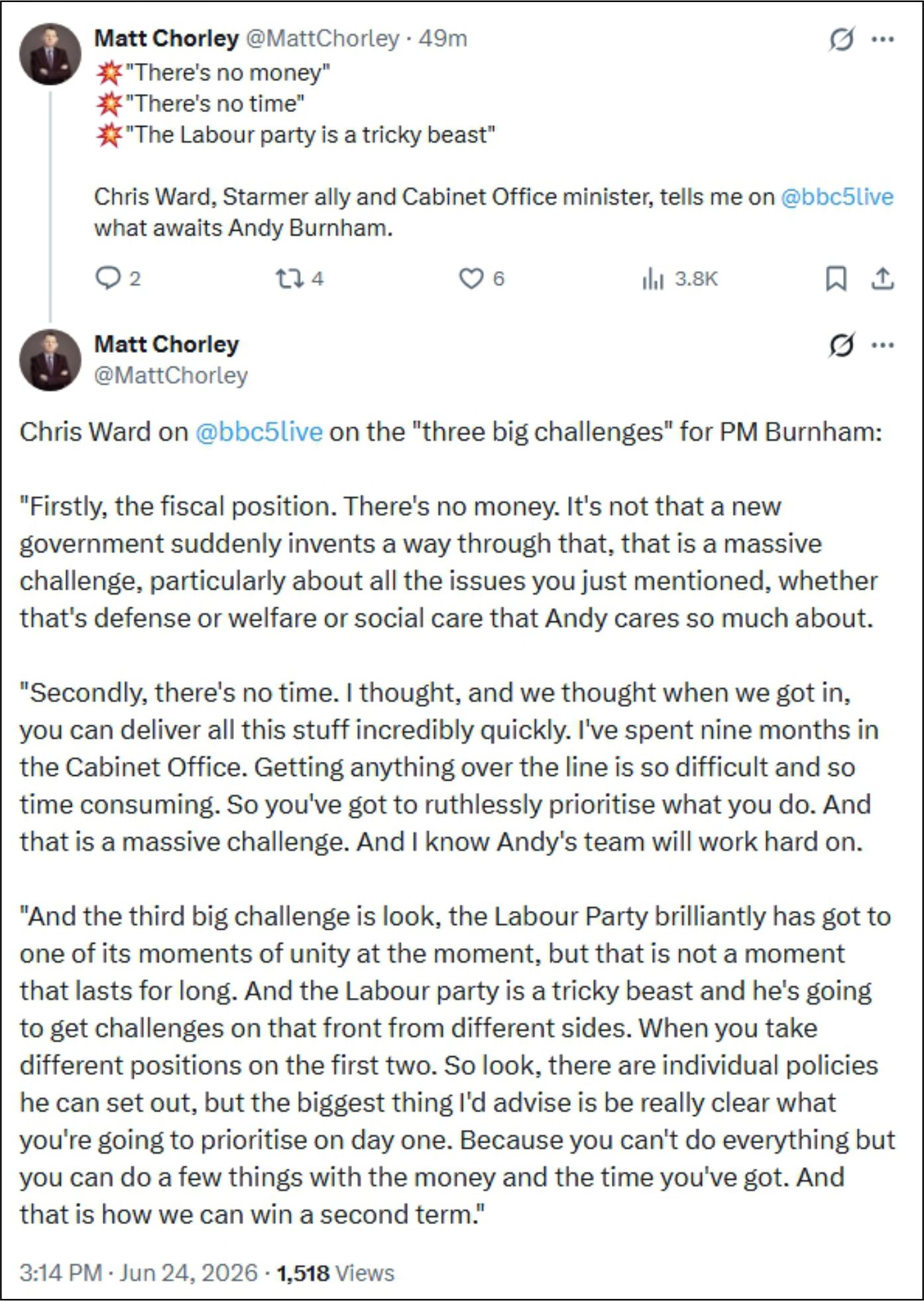
When Matt Chorley shared Chris Ward’s remarks on BBC 5 Live, the thread was instantly read as a comment on Labour’s internal challenges. The emojis, the shorthand – “no money, no time, tricky party” – made it sound like a partisan critique.
But the full exchange pointed to something bigger: a rare, candid description of the structural limits of government itself.
Ward wasn’t talking about Labour’s competence.
He was describing the physics now facing anyone who governs.
“There’s no money. It’s not that a new government suddenly invents a way through that – that is a massive challenge…
Secondly, there’s no time… Getting anything over the line is so difficult and so time‑consuming…
And the third big challenge is unity – that’s not a moment that lasts for long.”
Most people will hear that and think:
“Labour are struggling.”
But what he’s actually describing is the reality any government now faces.
The Conservatives hit the same wall – they just pretend they didn’t.
Labour are hitting it now.
Reform will hit it next.
The way the quote circulated online – stripped of context and reduced to emojis – is part of the problem. We keep mistaking structural reality for partisan failure. We keep reading honesty as weakness. We keep treating each turn of the wheel as a new story, when it is often the same system taking different actors back to the same place. And we keep missing the bigger message hiding in plain sight: the system itself is leaving government with nowhere to go.
That is what is killing what remains of our politics.
Why the next election may not resolve anything
There is a real chance that the current government is forced back to the country sooner than expected, or at least begins that process before the year is out. But even if that happens, it will not change the underlying reality.
Another election may change the personnel. It may change the mood. It may produce a different parliamentary arithmetic. It may even bring a Reform-led government, with or without a majority.
But it will not create room that does not exist.
The hardest truth is that no party can spend what the system no longer generates, cut what society now depends on without consequence, or restructure the state at speed without triggering effects elsewhere.
This is where much of the current rhetoric becomes dangerous. Bold plans appeal because they name real frustrations. But naming the frustration is not the same as creating capacity.
Large-scale fiscal shifts, rapid cuts, aggressive restructuring or dramatic executive action all assume that the system still has shock absorbers. It does not.
That is why another election could easily be followed by another crisis of legitimacy. A new government may arrive claiming a mandate to break the pattern, only to discover that the mandate does not change the machinery.
If the gap between promise and delivery opens quickly enough, the country could find itself back at the ballot box far sooner than anyone expects.
Why PR would not be the answer either
At that point, pressure for proportional representation may become overwhelming. That would be understandable. If people feel the system has failed repeatedly, they will look for a deeper democratic reset.
But PR would not answer the deepest problem.
It may improve representation, make Parliament feel more plural, and break the old duopoly completely. But it would not rebuild state capacity, restore productivity, create fiscal headroom, make overloaded services resilient, or reverse decades of extraction from the real economy.
PR changes how political power is distributed. It does not change the fact that the state is trying to do too much with too little, that too many people rely on systems already close to failure, or that the economic base beneath government has been weakened.
It would change the seating plan. It would not fix the building.
Why Reform would meet the same wall
Reform matters here because it may become the next major test of the illusion that political will is enough.
Its appeal is not mysterious. It speaks to people who feel ignored, overtaxed, under protected and patronised by a political class that has repeatedly failed to deliver.
Much of that frustration is real, and Reform offers urgency, clarity, punishment of the old order, and the feeling that someone might finally do something.
But urgency is not capacity.
Clarity is not room to manoeuvre.
A mandate, however large, cannot repeal the consequences of a system that has become too brittle to absorb shock.
Slashing benefits may sound attractive to people who do not currently need them. But benefits are not just a moral or fiscal question. In the country we have actually built, they are also holding back pressures created by wages that no longer allow many people to live independently, housing costs that absorb too much income, and services already stretched beyond design.
Pull that support away too quickly and the result is not simply savings. It is homelessness, crisis demand, public health pressure, social disorder, family breakdown, and costs reappearing elsewhere in the system.
That is what happens when the minimum wage is not enough for independent life, essentials become extraction points, and the state is left subsidising the consequences of an economy that no longer provides secure ground beneath people.
Reform would not escape that. No party would.
The deeper economic failure
This is why even the language of rescue now feels misleading. In the 1970s, an IMF intervention could still be understood against a country with a different productive structure beneath it. There were still industrial capacities, business forms, social expectations and economic relationships that could be reorganised around recovery.
Today, too much has been financialised, outsourced, consolidated and captured by systems that extract value rather than renew it.
That does not mean recovery is impossible.
It means recovery cannot be delivered by pretending the old tools still work in the old way.
The country has not simply run out of money. It has run out of the productive and institutional slack that once made political promises survivable.
That is the deeper reason government now has nowhere to go. It cannot easily tax, borrow, cut, spend, reform or delay without making another part of the system worse.
The global thread is even thinner
And all of this is before we even widen the lens.
The domestic system is already stretched thin. But it is not operating in a vacuum. It is exposed to energy shocks, market shocks, geopolitical escalation, supply-chain disruption, climate impacts, migration pressures, technological upheaval and the instability of a global order that itself looks increasingly brittle.
Any one of those could snap the thread.
That is why the political debate feels so unreal.
We are still arguing as if the question is which team can manage the old model better.
But the old model is the thing now failing.
Where this leaves us
If there is a thread running through all of this, it is that we keep mistaking political rotation for political escape. We change the faces, the slogans and the electoral maths, while leaving the underlying system untouched.
But the system is no longer merely inefficient. It is closing in.
That is why no one in UK politics today can escape it. Not because they lack ambition, slogans, advisers, strategies, reforms or mandates, but because the space those things require no longer exists in the way we pretend it does.
Another election may accelerate the reckoning. A Reform government may expose it. A push for PR may follow it. A fiscal crisis may sharpen it. A global shock may detonate it.
But none of those things, by themselves, fix the underlying problem, because none of them rebuild the productive, institutional and social capacity the system has consumed.
The system is not simply failing to deliver the future politicians keep promising. It is consuming the capacity that would be needed to build one.
Until that is faced, every election will feel like change, every government will promise movement, and every cycle will tighten – not because we chose the wrong people, but because we never changed the system they were stepping into.