
Nobody grows up wanting to depend on support.
Most people want the same basic things: to work, pay their bills, handle life’s shocks, and have enough left over to build some kind of future.
Yet across Britain, more people are discovering that doing everything expected of them is no longer enough.
They work. They budget. They cut back. They try harder. And still the numbers do not add up.
So public debate keeps asking the same question: why are so many people dependent on welfare?
But that may be the wrong question.
The better question is: why are so many people no longer financially independent?
Because welfare did not create that problem. Welfare was built because that problem already existed.
It was built to contain problems that wages, housing, work, and the wider economy had failed to solve.
That is why blaming welfare for rising hardship is like blaming a thermometer for a fever. It may show that something is wrong, but it did not cause the illness.
1. The real crisis is the loss of independence
For years, poverty has been discussed mainly through income lines, benefit levels, and official measures. Those figures matter, but they do not capture the basic reality most people understand immediately.
Poverty begins where independence ends.
A person is not truly secure if they cannot meet essential costs without debt, charity, family help, or state support. They may be working. They may not appear destitute. They may not fit the image of poverty commonly used in political debate. But if one normal setback can push them into crisis, they are not independent.
This is the difference the current debate keeps missing.
Millions of people are not simply below or above a poverty line. They are living on a trap door: just about managing until the rent rises, the car fails, the hours are cut, the child needs new shoes, or the energy bill lands.
That is not a welfare problem. It is an independence problem.
Welfare becomes visible only because independence has already failed.
2. Work is supposed to provide security. Too often, it no longer does.
The old promise was simple: if you worked hard, you could stand on your own feet.
That promise has broken down for too many people.
Imagine a single adult working full time on the legal minimum wage. They are not refusing work. They are not living extravagantly. They are doing exactly what the system asks them to do.
Then the ordinary costs of life arrive: rent, council tax, transport, energy, food, phone, clothing, basic household goods, and the need to save something for emergencies.
The margin disappears. There is no cushion. No real resilience. No room for a broken boiler, a rent rise, a period of illness, or a costly journey to keep a job.
At that point, welfare is not replacing work. It is making low-paid work survivable.
Cutting welfare does not fix low pay. It exposes people to the consequences of low pay.
3. The mechanics are simple: support rises when independence falls
Welfare demand does not rise in a vacuum. It rises when the rest of the system stops giving people enough security to stand without help.
Independence falls when wages lag behind essential costs, when housing consumes more of income, when work becomes insecure, when savings disappear, and when one ordinary shock becomes unaffordable.
The result is predictable. More people need support — not because they changed, but because the arithmetic changed.
Yet political debate often reverses cause and effect. It treats the demand for support as the problem, instead of asking why support became necessary.
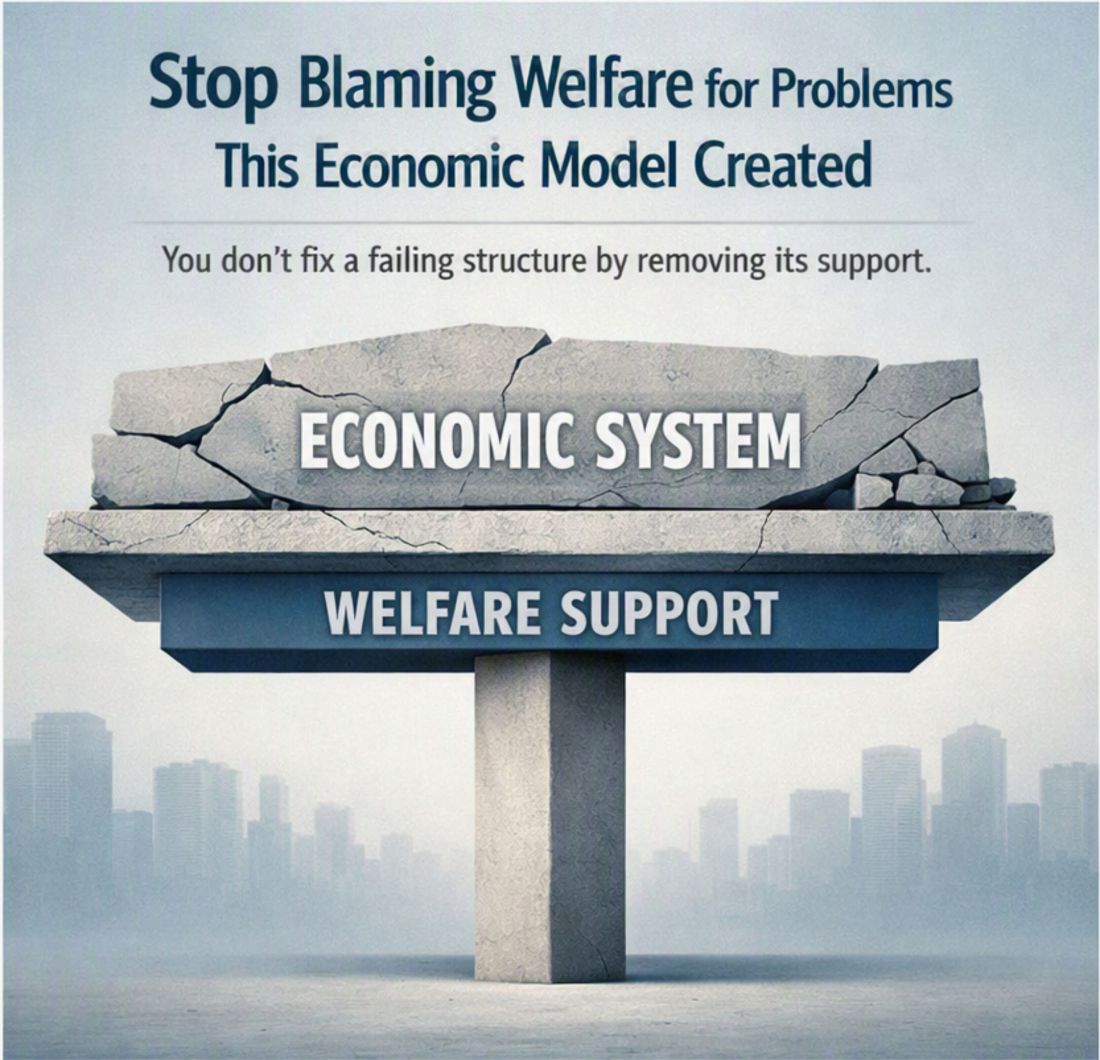
That is why welfare is not the source of instability. It is the scaffolding holding up a weakened structure.
4. Cutting the scaffolding does not repair the building
Nobody is saying the welfare system is perfect. Nobody is saying dependency is desirable. Nobody is saying reform is unnecessary.
But if reform begins with cuts before it understands what welfare is currently holding up, it mistakes the prop for the problem.
For many households, benefits are not an optional extra sitting on top of a stable income. They are part of the structure that allows rent to be paid, food to be bought, children to be clothed, and work itself to continue.
Remove that support without first repairing wages, housing, essential costs, job security, and household resilience, and the pressure does not disappear. It moves elsewhere: into arrears, debt, food banks, family strain, ill health, homelessness, and crisis services.
That is basic systems thinking. You do not remove load-bearing support from a failing structure and call the collapse reform. You reinforce first. Then, and only then, can you reduce the need for the support.
5. Dependency is real – but welfare is not the only cause
Critics are right to say that dependency matters. A society should not be comfortable with large numbers of people needing external support to survive.
But dependency is not created by welfare alone. It emerges when income, essential costs, housing, transport, childcare, health, and resilience no longer align.
If work cannot provide independence, cutting welfare does not remove dependency. It merely changes its form: from state support to debt, insecurity, charity, family pressure, ill health, or crisis.
Reform should therefore reduce dependency by restoring independence, not by withdrawing support before independence is possible.
6. Growth can look healthy while people become poorer
This is one of the great failures of modern economic debate. The headline numbers can look reasonable while ordinary life becomes harder.
GDP can rise while households become poorer. Inflation can fall while essentials remain unaffordable. Employment can rise while independence collapses.
That is why so many official explanations ring hollow. People are not rejecting reality. They are comparing national claims with their own bank accounts.
They are told the economy is growing, but their rent takes more. They are told inflation is easing, but food is still expensive. They are told work is the answer, but work leaves them dependent on top-ups, debt, or family help.
The system can therefore appear to be improving while real-world independence continues to erode.
Cutting welfare does not reverse impoverishment. It accelerates it.
7. This is why trust breaks down
When institutions keep saying one thing and people keep experiencing another, trust does not disappear because the public is irrational. Trust disappears because official explanations no longer match lived reality.
People hear that work pays, but see workers needing support. They hear that growth means prosperity, but feel less secure. They hear that welfare is the burden, but know that without it many households would fall straight through the floor.
That is the trust crisis underneath the welfare debate. It is not simply political. It is mechanical. The public can feel the system failing before institutions are willing to name the failure.
8. The real danger now is misdiagnosis
When political actors believe the problem is simply “the wrong party in No. 10,” they reach for the wrong tools:
- welfare cuts
- sanctions
- conditionality
- punitive measures
- behavioural interventions
But the problem is not behaviour. It is independence.
And independence cannot be restored through reduction. It can only be restored through equipping.
Welfare is not the cause of instability. It is the last remaining support in a system where work no longer provides independence.
Cutting it without strengthening independence is not reform. It is destabilisation.
9. The answer is to rebuild independence
The solution is not to pretend that welfare can carry forever what the economy no longer provides. Nor is it to remove support and call the resulting hardship discipline.
The answer is to rebuild the conditions that allow people to stand independently: wages that meet essential costs, housing people can actually afford, work that is stable enough to plan around, local economies that retain value, and public systems designed to equip people rather than merely manage their failure.
10. The message that needs to be heard
People are not asking for luxury.
They are asking for stability: the ability to work, pay their bills, absorb life’s shocks, and build a future without living permanently one step from crisis.
For generations, that was the promise at the heart of the social contract. Today, for growing numbers of people, that promise no longer holds.
That is why welfare demand continues to rise. Not because dependency has become desirable, but because independence has become harder to achieve.
Until we understand that distinction, we will keep treating symptoms while the underlying condition worsens.
The real question is not how quickly welfare can be cut.
The real question is how quickly independence can be rebuilt.
That is where the future of economic security will be decided.
Further Reading
For readers who want to go deeper, the pieces below build the wider framework behind this argument: first the immediate crisis, then the living standard and independence test, then the economic evidence, human reality, and longer-term reform model.
1. When the System Runs Out of Road
Britain’s benefits crisis, defence dilemma, and low-wage economy
The best starting point for the wider argument. It explains why welfare pressure is connected to a national economic model built on low wages, public subsidy, and postponed reform.
2. The Basic Living Standard Explained
The minimum conditions required for work to provide dignity and security
This sets out the baseline beneath the article: full-time work should cover essential costs without leaving people dependent on debt, charity, family help, or state subsidy.
7. The Contribution Culture
Transforming work, business, and governance through contribution
This develops the positive alternative: a society organised around contribution, capability, and participation rather than narrow employment statistics or punitive conditionality.
3. The Independence Threshold
A new definition of poverty for a modern economy
This develops the central test used here: whether people can meet essential needs and absorb normal shocks without external support.
4. Tax Cuts and Universal Credit
Why tax cuts do not automatically restore independence
This explains why headline tax changes can fail to help households trapped by Universal Credit dynamics, taper rates, low wages, and high essential costs.
5. The Impoverishment Index
The widening gap between official economic narratives and lived experience
This supports the claim that the economy can appear to grow while household security continues to weaken.
6. How Would You Feel If It Were You?
A human lens on policy, hardship, and judgement
This adds the human reality behind the systems argument, showing why policy debates must begin with lived experience rather than abstract judgement.
8. The Local Economy & Governance System
A wider model for rebuilding economic resilience locally
This places the welfare argument inside a broader approach to local economic renewal, governance reform, and long-term systems repair.


