
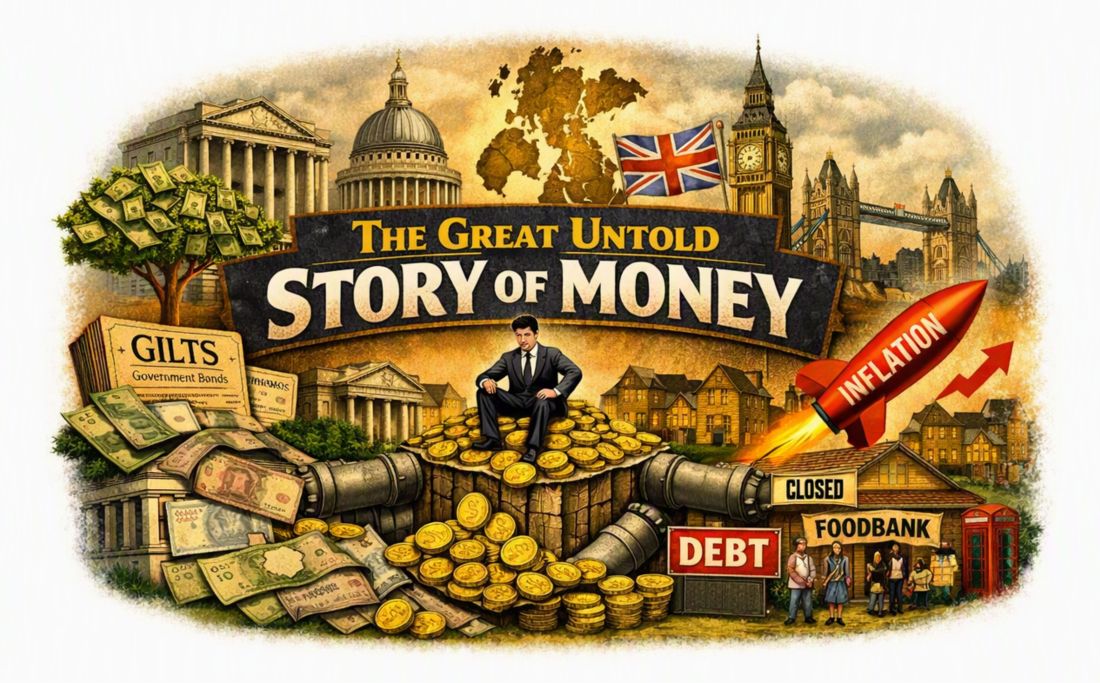
The Great Untold Story of Money
For most of modern history, people have lived inside a simple, reassuring story about how the economy works. It’s the story you hear in school, in politics, and in everyday conversation.
You earn money. You save some of it. Banks lend those savings to others. Governments collect taxes and spend them. If governments need more money, they borrow from savers. Inflation is just prices rising. Markets reflect real value. Wages follow the cost of living. Benefits are for people who don’t work.
It’s a tidy picture. It feels moral. It feels stable. And it is almost entirely wrong.
The real system is stranger, more fragile, and far more extractive than people realise.
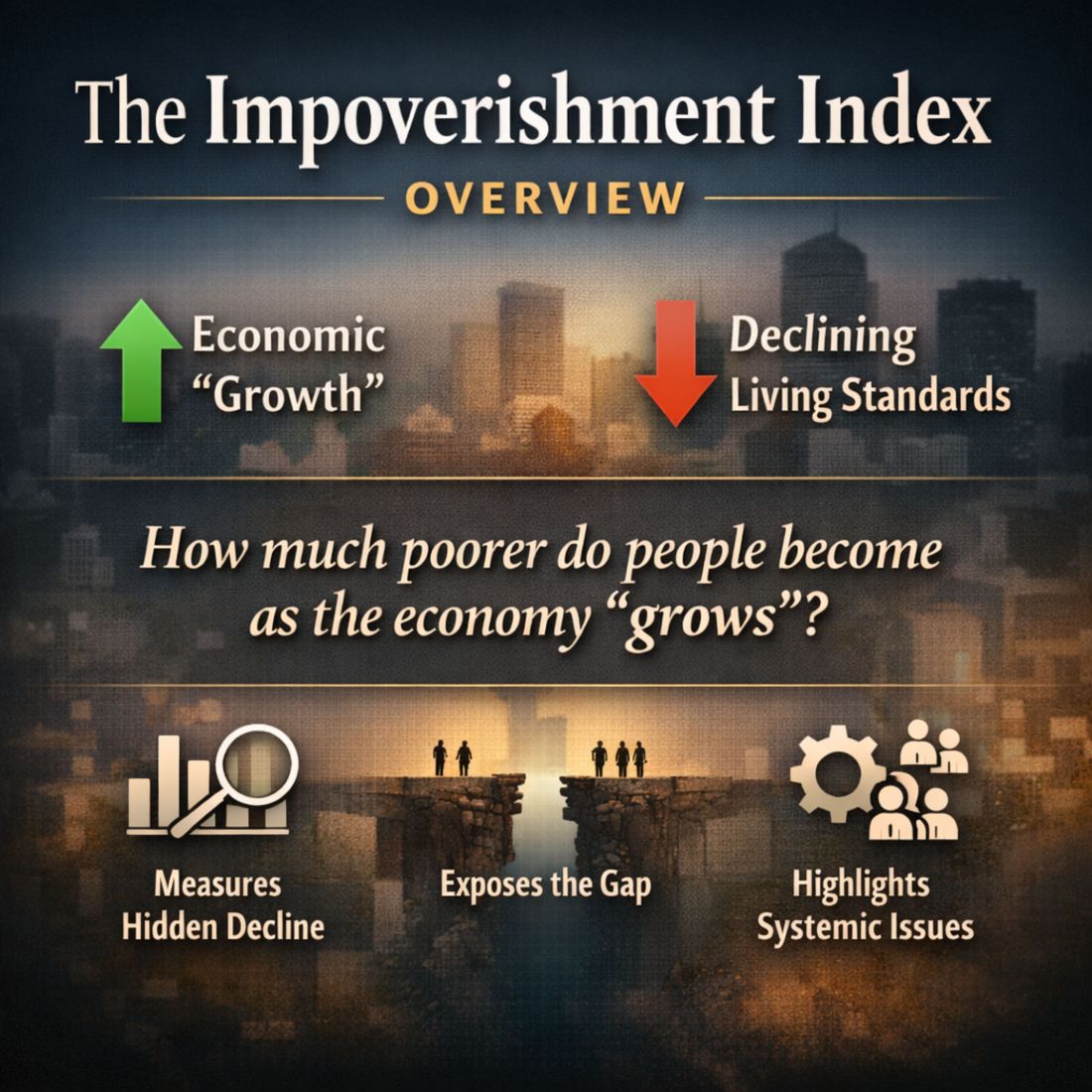
Once you see how it actually works, the cost of living crisis stops being mysterious. It becomes inevitable.
This is the story of how money really works – and why Britain has become a place where even full‑time workers can’t afford everyday life.
1. The first truth: most money is created by private banks
The biggest misconception in the public mind is also the simplest: banks do not lend out your savings.
When you take out a loan, the bank does not move money from someone else’s account. It does not use savers’ money. It does not “find” the money. It simply creates new money by typing numbers into your account.
That’s it. A few keystrokes, and the money exists.
This is not a metaphor. It is the actual accounting. More than 90% of the money in the economy is created this way – by private banks issuing private debt.
It is the first thing people need to understand, and the first thing that makes them say: “That can’t be right.”
But it is.
2. Public debt vs private debt – the difference that changes everything
Understanding the economy requires understanding two very different kinds of debt.
Private debt is created by banks. Every loan creates new money. Every repayment destroys money. Interest payments transfer wealth upward. Households and businesses carry the burden.
Private debt is the engine of money creation.
Public debt is created when the government spends more than it taxes. It is structured through gilts – government bonds.
Public debt does not create money by itself. It is not repaid the way private debt is. It is held by pension funds, banks, insurance companies, and foreign investors.
Public debt is the engine of financial stability.
The key insight is simple: private debt creates money; public debt organises money.
Most people have never been told this distinction. Once they see it, everything else starts to click.
3. How government money creation actually works
People imagine government finances as a household budget: taxes come in, spending goes out, and if there’s a shortfall, the government borrows from savers.
But that is not how it works.
Government spends first
When the government pays salaries, pensions, or contractors, the Bank of England credits bank accounts. New deposits appear. New reserves appear. Government spending adds money to the economy.
Gilts come after spending
Gilts are IOUs the government sells to investors. When investors buy gilts, they use money that already exists – money created earlier by private banks or by government spending itself.
The government’s account at the Bank of England is credited. No new money is created. Investors simply swap cash for government IOUs.
Gilts do not fund spending. They record the deficit and provide safe assets to the financial system.
QE is where money creation and gilts intersect
When the Bank of England buys gilts, it creates new reserves. Investors receive new deposits. This does create new money. And that money often flows into assets – property, shares – pushing up prices.
This is why QE inflates asset prices.
The missing piece: private bank money flows into gilts
The money investors use to buy gilts is the same money that banks created earlier through lending. Private banks create the water; the government builds the pipes. Gilts are how the state absorbs, stores, and stabilises the money created in the private sector.
This is the part most explanations leave out – and without it, the system doesn’t make sense.
4. Inflation: not “prices rising,” but money losing value
People feel inflation is wrong because the official numbers don’t match reality. But inflation is not simply “things getting more expensive.”
It is your money being diluted.
Inflation happens when banks create more money through lending, when government spending adds money, when QE adds money, and when production is hollowed out. Supply chains are fragile. Asset prices rise faster than wages.
Inflation feels like theft because it is a transfer of value from people who hold money to people who create money.
5. Globalisation: the hollowing‑out engine
Globalisation wasn’t just trade. It was a restructuring of where value is created.
Manufacturing moved abroad. Supply chains centralised. Local businesses couldn’t compete. Profits flowed to multinational corporations. Towns lost their economic purpose. Communities weakened. Wages stagnated. Dependence on imports rose.
Britain didn’t just lose jobs. It lost the ability to generate real value.
Once that happened, the country had to rely on finance, property, consumption, and debt.
This is the hollowing out.
6. Markets: not value systems, but expectation systems
People think shares represent real company value, dividends are slices of profit, and markets reward good businesses.
In reality, shares represent claims on future expectations. Prices move based on liquidity, interest rates, and fund flows. Dividends are capital distribution decisions.
Companies can lose money and have rising share prices. Companies can be profitable and have falling share prices.
Markets are giant betting systems, not value systems.
7. The rise of extraction economics
When a country stops producing real value, it must extract value.
Britain chose to extract from housing, wages, public services, small businesses, and future generations.
Homes became financial assets. Prices were pushed up deliberately. Rent became a wealth transfer mechanism.
Wages stagnated because companies could outsource labour abroad. Workers lost bargaining power.
Public services were cut, forcing people to pay privately – another extraction channel.
Small businesses were crushed by global supply chains, supermarket monopolies, online giants, rising rents, and rising energy costs.
The local economy died.
8. The minimum wage trap: the part almost nobody talks about
Here is the piece that makes the whole system morally and economically unsustainable.
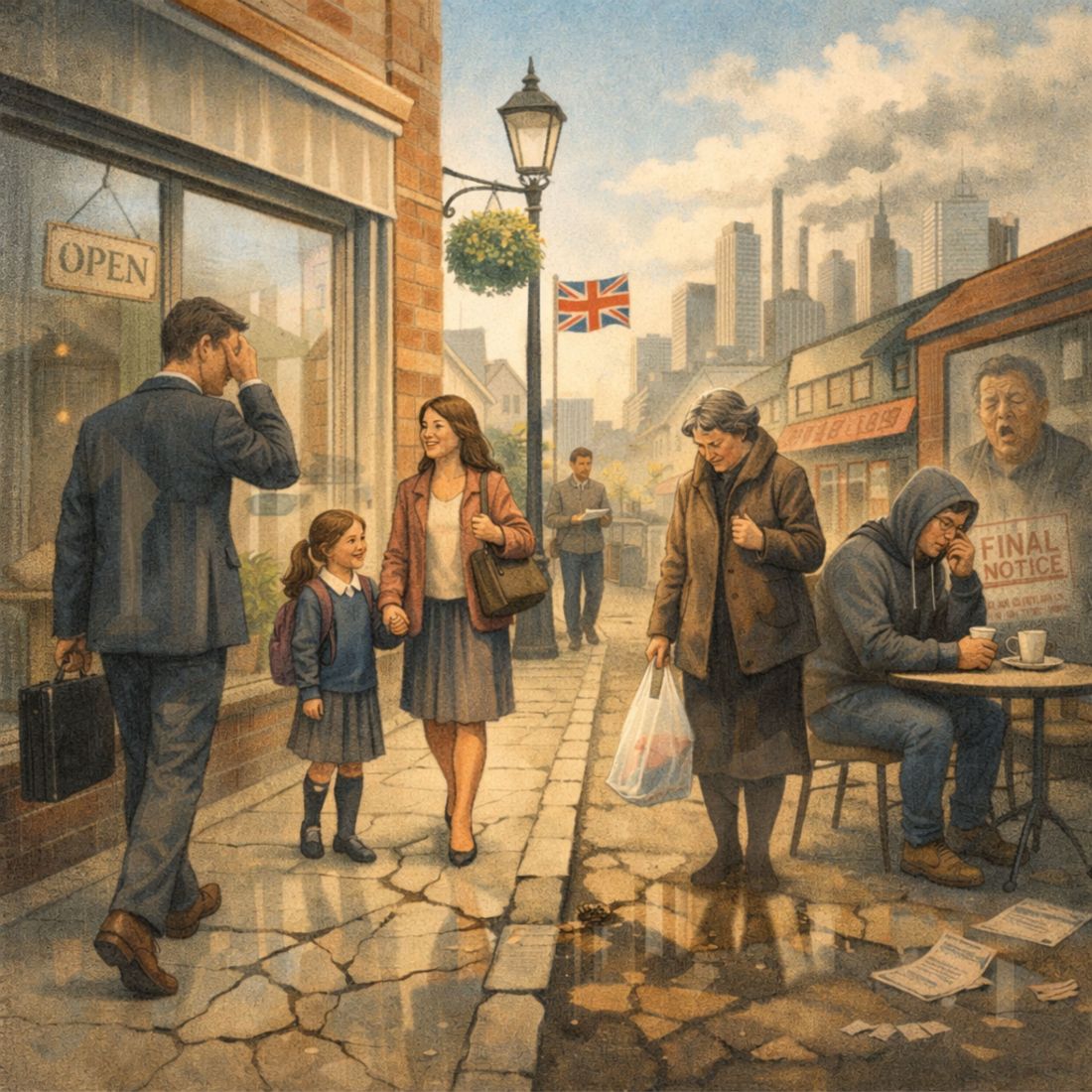
A full‑time worker on minimum wage cannot afford rent in most of the country. They cannot build savings. They cannot cover unexpected costs. They cannot support a family without external help.
This is not an opinion. It is a structural fact.
The minimum wage is not a living wage. It is a political number.
In‑work poverty is now normal. Most benefits claimants are working. They work full time or multiple jobs and still cannot afford rent, food, transport, childcare, or energy.
This is not a personal failure. It is a system failure.
Benefits have become a subsidy for low‑pay employers.
When wages are too low to live on, the government steps in with Universal Credit, housing benefit, tax credits, and childcare support.
Taxpayers cover the gap between what employers pay and what life costs.
This is not a welfare system. It is a corporate subsidy system.
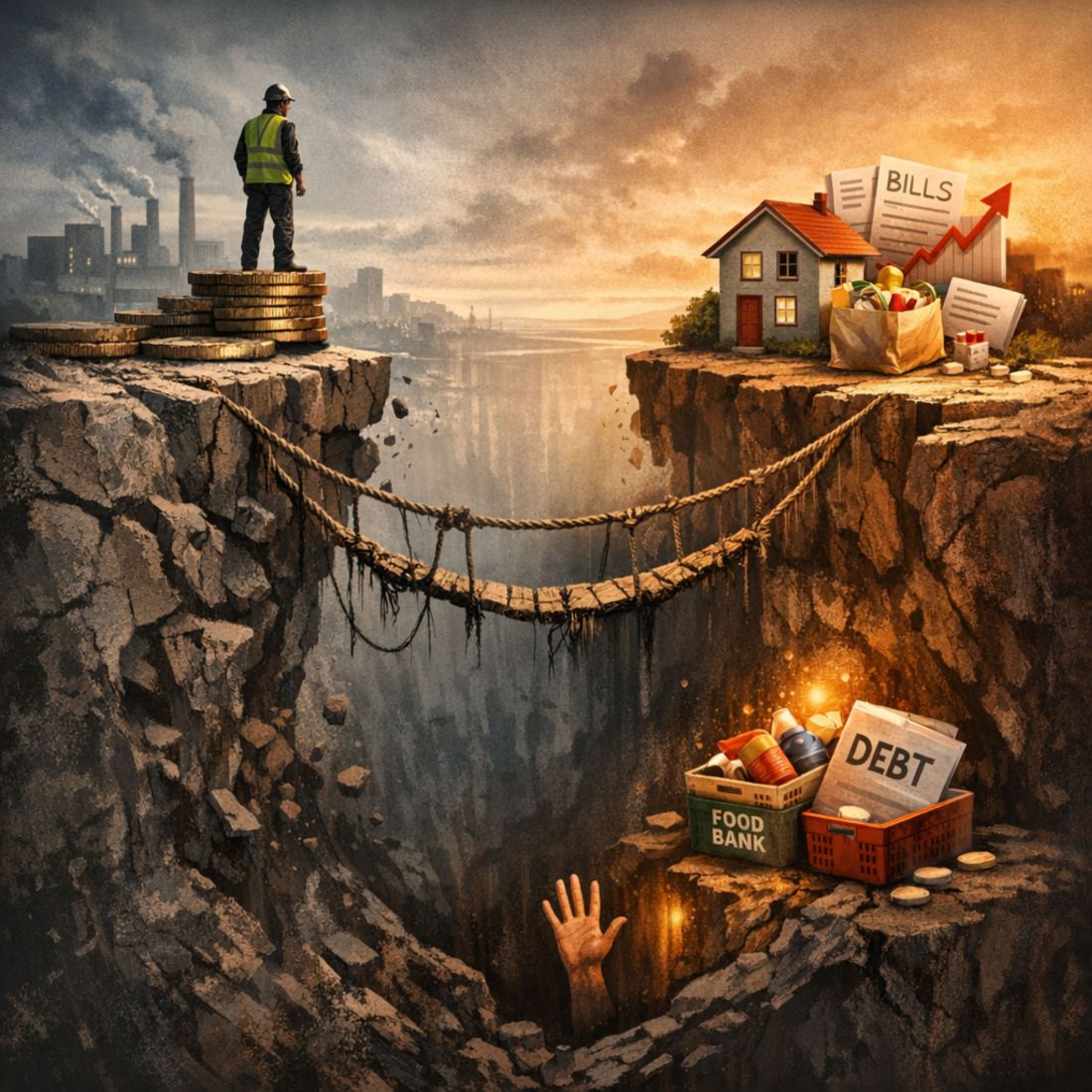
Debt and foodbanks fill the remaining gap. Debt becomes a survival tool. Foodbanks become part of the infrastructure.
This is not normal. It is a financial death spiral.
And the psychological trick is simple: people are told that if they fall behind, it’s their fault – they should work harder, budget better, make better choices.
This narrative protects the system. It keeps people blaming themselves instead of the structure that is failing them.
9. Why Britain feels “priced out of everyday life”
Because the system has hit its limit.
The model relied on rising house prices, rising private debt, cheap imports, low wages, shrinking public services, foreign investment, and government subsidies for low‑pay employers.
All of these are breaking down.
Prices rise because money is constantly created. Wages don’t rise because global labour is cheaper. Housing is unaffordable because it’s an investment product. Public services collapse because they’ve been strip‑mined. Small businesses die because they can’t compete with global giants. Communities weaken because their economic base vanished. Workers cannot live on their wages. Benefits subsidise employers instead of protecting citizens. Debt fills the gap until it can’t.
This isn’t a temporary crisis. It’s the end of a model.
10. The credibility constraint: governments cannot go bankrupt – but they can lose trust
Here is the final piece of the puzzle.
A government that issues its own currency cannot run out of money. It cannot go bankrupt. It cannot involuntarily default. It creates the currency. It settles payments through the Bank of England. It cannot run out of the thing it creates.
But it can lose credibility.
And credibility is the oxygen of a fiat system.
Investors buy gilts not because the government needs their money, but because gilts are supposed to be safe. They anchor interest rates. They stabilise pension funds. They act as the plumbing of the financial system.
If investors lose confidence in the government’s ability to manage the economy – even though the money they use was created by banks – they can refuse to buy gilts. Not because the government is insolvent, but because they no longer trust the system’s stability.
This is exactly what happened in 2022 when Liz Truss was Prime Minister. Markets briefly refused long‑dated gilts. The government wasn’t bankrupt. But trust evaporated. The Bank of England had to intervene to stop pension funds from collapsing.
This is the real constraint on government: not solvency, but credibility.
And credibility becomes harder to maintain when the real economy weakens, public services decline, politics becomes unstable, and the financial system grows more fragile.
11. The simplest possible explanation
Britain built an economy where money is created easily, but real value is not.
The country stopped producing and started extracting.
Now there’s nothing left to extract, so everyday life has become unaffordable – even for people who work full time.