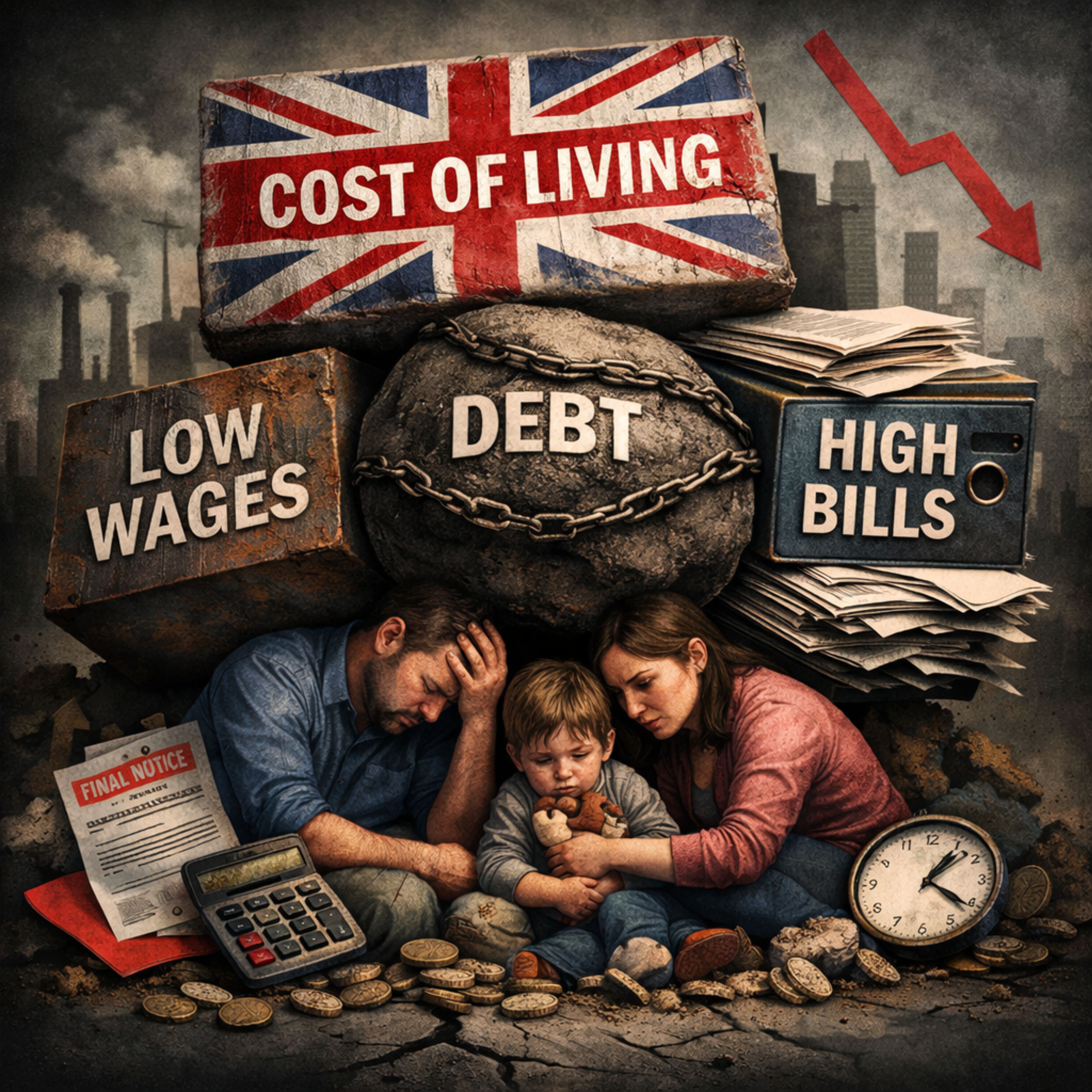

When Work Isn’t Enough examines whether UK households can realistically meet their basic living costs through full‑time work supplemented by tax‑free overtime, as proposed by Reform UK in 2026.
Using detailed modelling based on real prices in Cheltenham, the report concludes that the expectations placed on working households are mathematically impossible to meet under current economic conditions.
The analysis compares real‑world living costs with government/ONS assumptions, integrates Universal Credit (UC) dynamics, and models three household types:
- a single adult living independently,
- two adults sharing,
- two adults with one child.
Key Findings
1. Real‑world costs far exceed government assumptions
Across all household types, real costs are 50–60% higher than ONS figures. As the report states, “Government/ONS assumptions are about half of real world costs.”
This gap underpins the structural shortfall faced by workers.
2. Minimum wage is structurally insufficient
Even with full‑time hours, minimum‑wage workers cannot meet basic needs:
- Single adult needs £31,488/year but earns £22,554 net.
- Required net hourly rate: £15.13/hr vs minimum wage £12.71/hr.
- Result: “A single adult must work over 50 hours per week to meet basic needs without debt.”
3. Shared living helps – but not enough
Two adults sharing still require £24,420 net per adult, above minimum‑wage earnings.
Even with economies of scale, each must work 42 hours/week to break even.
4. Families with children face unavoidable deficits
Childcare, transport, and housing costs push required household income to £60,456 net/year.
Per adult requirement: £30,228 net → £14.54/hr net.
One parent must work 57.46 hours/week in the central case.
The report notes: “A family with one child requires £60,456 net per year… Minimum wage is not close.”
5. Tax‑free overtime does not solve the problem
Even at £16.90/hr tax‑free, overtime cannot close the gap because:
- UC tapering removes 55% of additional earnings.
- Effective gain per overtime hour: £7.61.
- Childcare costs can reduce this to £0 or negative.
- Benefit cliffs (e.g., loss of free school meals) can wipe out gains entirely.
As the report states: “Overtime does not deliver £16.90/hour… It delivers £7.61/hour. And sometimes less than £0/hour after childcare.”
6. Time poverty becomes inevitable
In realistic scenarios, one parent must work 57–66 hours/week, leaving no time for rest, family life, or progression.
The report concludes: “This is not a sustainable model for any society.”
7. The system’s expectations are mathematically impossible
The combined effect of:
- underestimated living costs
- insufficient wages
- UC tapering
- childcare and housing shortfalls
- benefit cliffs
- insecure work patterns
…creates a situation where households are blamed for failing to achieve outcomes that cannot be achieved through work alone.
The report summarises this bluntly:
“The expectations being placed on working households are often mathematically impossible to meet.”
Overall Conclusion
The UK’s cost‑of‑living framework is fundamentally misaligned with the real economic pressures faced by households.
The National Minimum wage, even with tax‑free overtime, cannot provide financial independence for single adults, shared households, or families with children.
Benefits partially fill the gap but introduce tapering and cliffs that neutralise the value of overtime.
The result is a system that produces structural deficits, time poverty, and instability, not self‑reliance.
Disclaimer
This report has been prepared solely to illustrate the economic dynamics at work between real‑world living costs, wage levels, benefit structures, and the expectations implied by recent policy proposals.
The analysis is intended to highlight the structural pressures faced by individuals and households under current conditions, and to examine whether the expectations being placed upon working people are realistic within those conditions.
All figures, calculations, and assumptions used in this report are provided for informational purposes only.
Anyone wishing to rely on, reproduce, or further use any part of this analysis should independently verify all data, methodology, and conclusions.
No responsibility or liability is accepted by the author for any loss, action, or consequence arising from the use of the information contained herein.

