
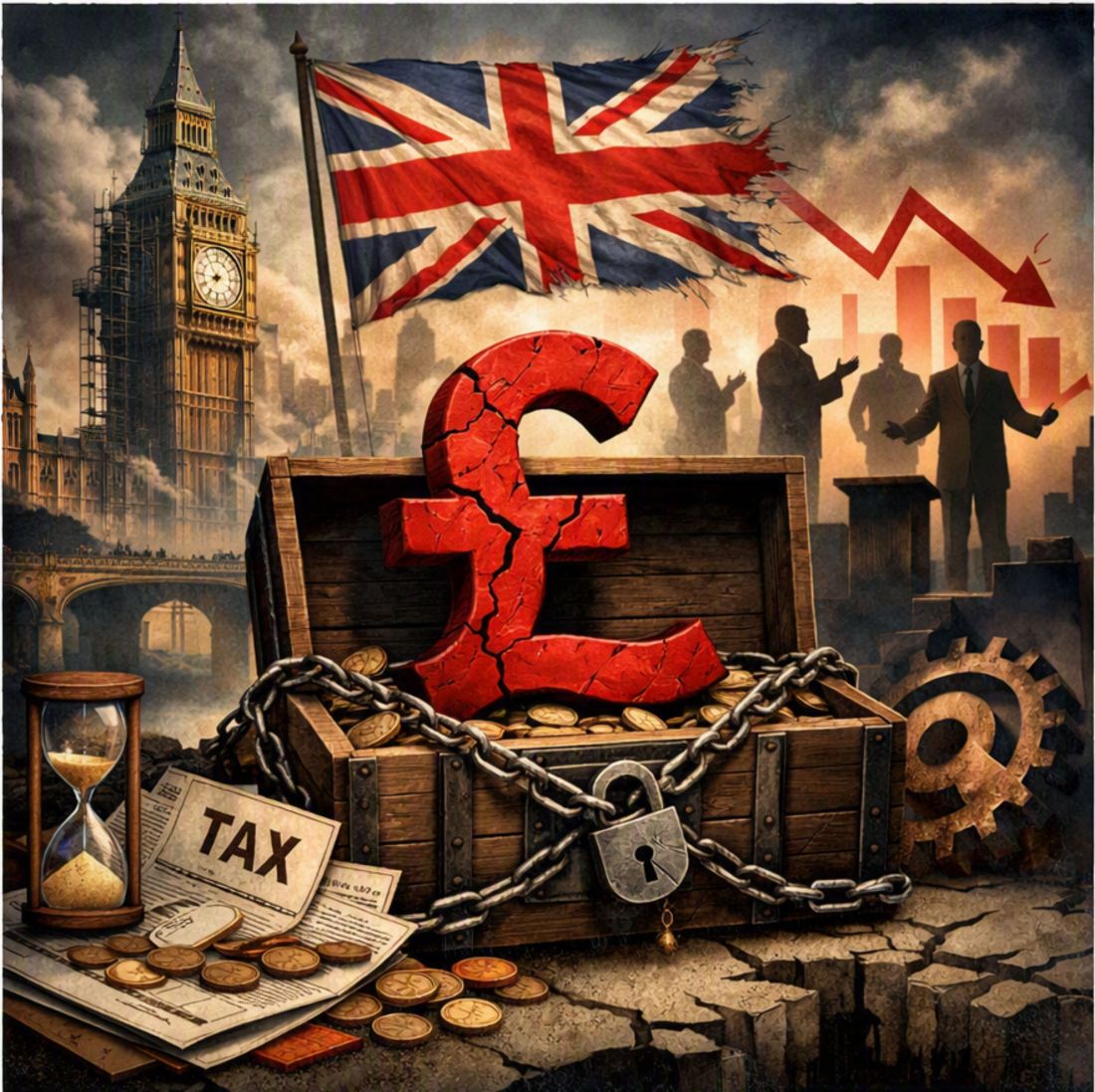
A conversation about how Britain reached a point where taxation is no longer a political choice, but a structural necessity.
Noticing the feeling that something has changed
If you talk to people across the UK – in cafés, on trains, at work – you’ll hear a similar sentiment: “It feels like everything is getting difficult.” Not just financially, but structurally.
Public services feel stretched. Infrastructure feels tired. Politics feels stuck. And when a new government arrives and immediately reaches for tax rises, many people instinctively fall back on familiar narratives: “Well, that’s Labour for you.”
But if we slow down, take a breath, and look carefully at the mechanics underneath, a different picture emerges – one that isn’t about party ideology at all. It’s about a country that has gradually run out of road, and a government that has fewer tools available than at any point in modern history.
This isn’t a story about blame. It’s a story about understanding.
Why the old political story no longer fits
For decades, British politics has been framed around a simple rhythm: Conservatives lower taxes, Labour raises them. It was never entirely true, but it was familiar enough that people accepted it.
Yet the data tells us something different. The UK’s tax burden was already heading toward an 80‑year high before the most recent General Election in the summer of 2024, driven by structural pressures rather than ideology.
Even under Conservative governments, taxes rose steadily – partly through explicit measures, partly through “fiscal drag,” where thresholds fail to rise with inflation and more people are pulled into higher tax bands.
So when the Labour Government raises taxes now, it’s not because they are following a party tradition. It’s because the system they’ve inherited leaves them almost no alternative.
This is the first key idea: taxation today is not ideological – it is mechanical.
The broken toolbox: understanding what governments used to rely on
To understand why tax is the only tool left, imagine the UK government as a mechanic with a toolbox. For decades, that toolbox contained several reliable instruments:
- Borrowing – cheap debt allowed governments to smooth over problems.
- Spending cuts – austerity was used to rebalance budgets.
- Privatisation – selling state assets brought in quick cash.
- Growth – rising productivity and investment expanded the tax base.
- Efficiency drives – squeezing public services for savings.
But each of these tools has worn out.
Borrowing is no longer cheap
Public debt has nearly tripled since the 2008 global financial crisis (GFC). Markets are more sensitive. Interest rates are higher. Borrowing now comes with real consequences.
Spending cuts have reached their limit
After a decade of austerity, public services are visibly strained. The Resolution Foundation describes the UK as stuck in a “fiscal funk” where cuts no longer fix anything – they simply break things further.
Privatisation has run out of road
Most sellable assets have already been sold. What remains is either essential or politically untouchable.
Growth has stalled
The Institute of Economic Affairs notes that Britain’s long-term growth slowdown is deeply structural, tied to low investment and productivity. Growth can no longer be relied on to “fix” the public finances.
Efficiency savings are a fiction
Public services have been squeezed so hard that further “efficiencies” often mean service reductions, not improvements.
When every tool in the box is broken, the mechanic reaches for the only one left – even if it’s blunt, unpopular, or overused.
That tool is taxation.
The extractive system: how Britain hollowed itself out
To understand why the toolbox is empty, we need to look at the deeper structure of the UK economy – not in a technical way, but in a human way.
For many years, Britain relied on a model that extracted value rather than created it. This wasn’t malicious; it was gradual, almost invisible.
Fiat money and the illusion of prosperity
The UK operates on fiat money – currency backed by trust rather than physical assets.
This allowed governments to borrow cheaply, expand credit, and inflate asset prices.
For a while, this created the feeling of prosperity: rising house prices, booming financial markets, easy credit.
But it didn’t create productivity. It didn’t create resilience. It didn’t create the kind of growth that strengthens a nation.
Financialisation: when money makes more money than work does
Over time, the economy shifted toward financial activity – property, banking, asset management – and away from production, innovation, and infrastructure. The IEA notes that tax policy increasingly discouraged investment, contributing to lower productivity growth.
This meant Britain became very good at moving money around, but less good at building things that last.
The hollowing-out effect
As extraction replaced creation, several things happened:
- Public services weakened.
- Infrastructure aged.
- Local government struggled.
- Real wages stagnated.
- Social mobility slowed.
- Trust in institutions eroded.
People felt the country becoming thinner – not collapsing, but hollowing.
Performance politics: when the story matters more than the substance
Fiat money didn’t just shape the economy. It shaped politics.
For years, governments could rely on cheap borrowing and rising asset values to appear effective. They could announce new initiatives, promise investment, and project confidence – even when the underlying machinery was weakening.
This created what we might call performance politics: politics focused on narrative rather than outcomes.
The ICAEW describes the UK tax system as “trapped by politics,” with reforms blocked because politicians fear creating visible “losers.” This leads to short-term fixes, rushed announcements, and complexity – all symptoms of a system performing rather than governing.
And now we’ve reached the zenith of that performance.
The tragedy: the actors keep performing even though the stage is collapsing
Here is the part that is hardest to talk about, but most important to understand.
Politicians – of all parties – are trapped in a story that no longer works.
They inherited a system that relied on tools that no longer function. They face public expectations shaped by decades of performance politics. And they know that admitting the truth would be politically devastating.
So they keep performing.
They keep promising growth. They keep announcing reforms. They keep projecting confidence.
And when all other tools fail, they reach for taxation – not because they want to, but because it is the only lever that still moves when pulled.
It is immediate. It is predictable. It does not require market confidence. It does not require waiting for growth. It does not require selling assets that no longer exist.
Taxation is the last functioning mechanism in a system that has run out of alternatives.
A fair conclusion: understanding without blaming
This is not a story about Labour. It is not a story about the Conservatives. It is not a story about ideology.
It is a story about Britain – about how decades of structural choices, economic shifts, political incentives, and fiscal pressures have brought us to a point where taxation is no longer a preference, but a necessity.
The wheels of the country are still turning. But they are turning because the government is extracting more from the public than ever before – not out of malice, but out of structural reality.
Understanding this doesn’t make the situation easier. But it does make it clearer.
And clarity is the first step toward imagining something better.
What this means for the future – without predicting anything
It’s important to be clear: this isn’t about forecasting or claiming to know what any government will do next. Politics is human, circumstances change, and unexpected events can reshape the landscape overnight. But when a system reaches a point where taxation is the only reliable tool left, certain patterns tend to emerge – not because of ideology, but because of the mechanics of the situation.
Think of it less as prediction and more as understanding the direction of travel when no other levers are available.
1. Taxation becomes the default response to pressure
When borrowing is constrained, growth is weak, and public services are fragile, governments often turn to tax because it is the only mechanism that produces immediate revenue. This doesn’t mean taxes will rise endlessly; it simply means tax becomes the first tool reached for when something needs funding.
2. The tax base broadens rather than deepens
Instead of dramatic headline tax rises, governments often rely on quieter forms of extraction:
- frozen thresholds
- expanded eligibility
- new categories of taxable activity
- adjustments that affect more people rather than a few
These changes feel subtle, but they accumulate.
3. Public services stabilise, but rarely improve
When tax is used to keep the wheels turning, the goal often becomes maintenance, not transformation. Services may avoid collapse, but they struggle to regain strength. The system focuses on preventing failure rather than enabling progress.
4. Political debate becomes narrower
When the toolbox is empty, political arguments often revolve around:
- how to tax
- who to tax
- when to tax rather than deeper questions about structural reform. This isn’t because politicians lack imagination; it’s because the system limits what is realistically possible.
5. The public feels the pressure more directly
As extraction increases, people notice it in everyday life:
- higher effective tax rates
- reduced disposable income
- slower improvements in services
- a sense that the state is asking more while delivering less
This isn’t a prediction – it’s simply what tends to happen when a government is forced to rely heavily on a single tool.
6. The system continues until it reaches a natural limit
Every extractive model has a point where it can no longer extract more without causing harm. That point varies by country, by economy, and by political choices. But the principle is simple: a system that relies on taxation alone eventually reaches a point where there is nothing left to tax without changing the model itself.
Again, this is not a forecast. It is an explanation of how systems behave when they run out of alternatives.
A closing thought
None of this is inevitable. None of it is guaranteed. None of it is a prediction.
It is simply the shape of the landscape when a country reaches a moment where taxation is the last remaining lever.
Understanding that shape helps us see the present more clearly – and perhaps imagine a different future more honestly.

