Young People, Politics, and the System That is Failing All of Us | Why youth disengagement is not apathy, but a rational response to distant, hollowed-out governance – and why rebuilding democracy must begin locally.

There is a persistent and dangerous myth in British politics: that young people are disengaged, apathetic, or uninterested in shaping the future.

The truth is more uncomfortable. Young people are not disconnected from politics because they do not care. Many are disconnected because the system itself has become distant, performative, and detached from everyday life – and that detachment is not confined to the young. It affects everyone.

We have reached a point where Westminster can place individuals with limited experience of community governance into positions of enormous responsibility, while insulating them from the direct consequences of the decisions they make.

They enter a system where relationships are abstract, accountability is delayed, and governance is often performed through layers of bureaucracy rather than lived reality.

We pretend this is normal. Yet if a group of 18-year-olds were placed in charge of government tomorrow with no grounding in community life and no experience of governance, we would rightly call it absurd.

The uncomfortable question is why we tolerate the same absence of rooted experience when it appears inside the political class.

The problem is not young people. The problem is the system that asks them to believe in politics while giving them so little reason to trust it.

The Disconnect: Why Young People Walk Away

Young people are not blind to politics. They see the gap between political theatre and real life. They see leaders making decisions about communities they seldom experience firsthand. They see policy made at a distance, often without any visible understanding of its consequences.

They also see a political culture that often rewards performance over competence, messaging over understanding, and loyalty over responsibility.

So some walk away from formal politics, while others redirect their energy into campaigning, community action, mutual aid, social media advocacy, or issue-based movements.

That is not the same as apathy. It is often a judgement about where their effort is likely to matter.

The evidence increasingly supports this distinction. The John Smith Centre’s UK Youth Poll 2025 found that many young people still value democracy and want a say, even while 63% agreed that democracy in the UK is in trouble. The Diana Award’s 2024 Youth Voice in Politics report found that only 20% of young people agreed that politics takes young people’s voices seriously, while UK Youth reported that 88% of children and young people surveyed believed it was important to have a say in public decisions.

The issue, then, is not whether young people care. The issue is whether the system gives their care a serious route into responsibility, influence, and decision-making.

Why Young People Matter – and Why the Current System Cannot Use Their Contribution

Young people bring clarity, urgency, and direct experience of the realities shaping modern life. They understand the world they are inheriting because they are living its consequences now – in education, housing, employment, mental health, technology, and community life.

But the current system struggles to integrate their contribution meaningfully. It is centralised, distant, insulated, and slow. It is built more around hierarchy than participation, more around institutional process than direct relationship, and more around national performance than local responsibility.

This matters because youth participation cannot be reduced to consultation exercises, photo opportunities, or carefully managed listening events. If young people are only invited to speak after decisions have already been shaped elsewhere, they are not participating in governance. They are providing decoration for it.

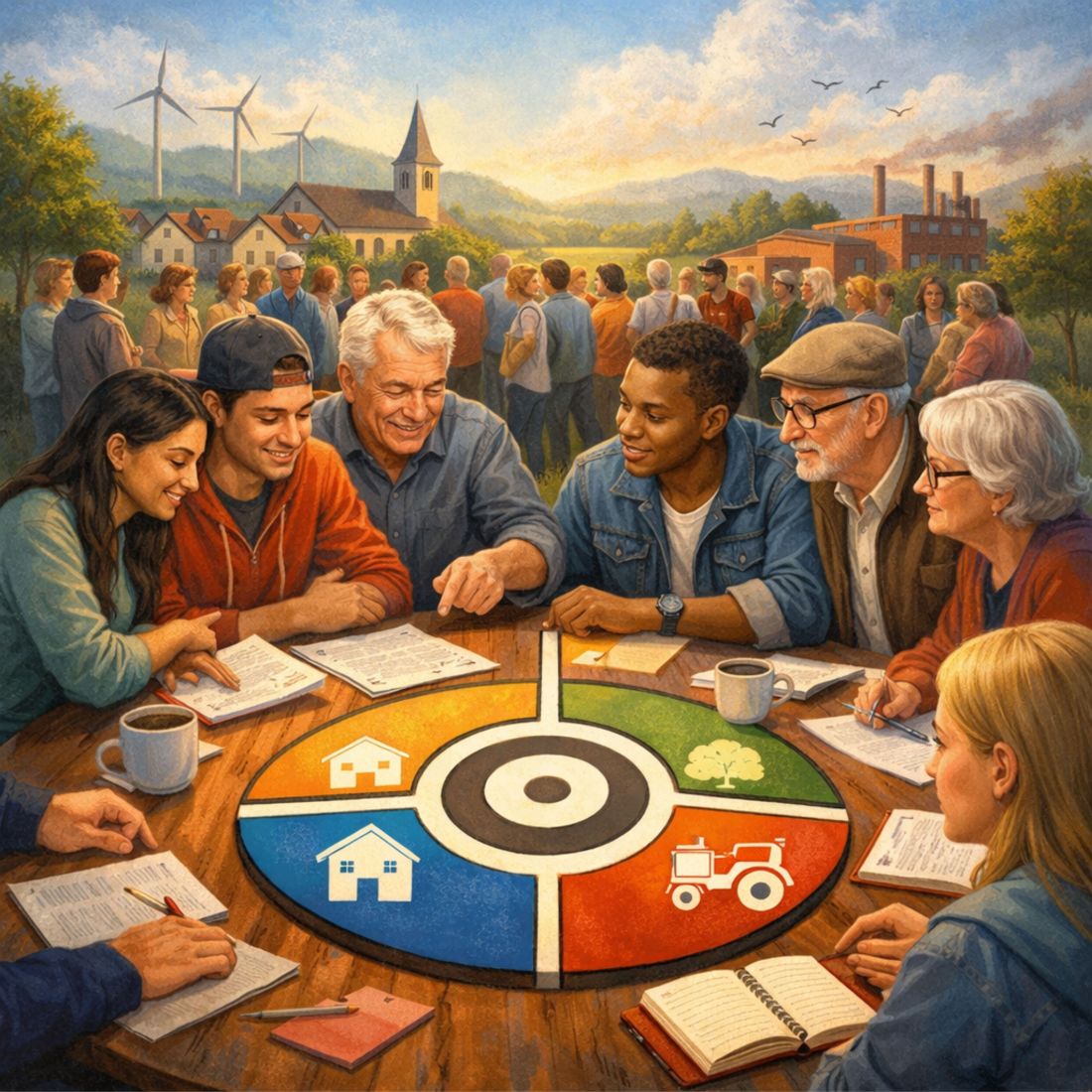
This is why the Local Economy & Governance System (LEGS) and the Circumpunct model matter. They attempt to relocate responsibility closer to the people affected by decisions, creating a structure in which participation is not occasional, symbolic, or distant, but practical, local, and continuous.

The Westminster Problem: Governance Without Proximity

The critical weakness of Westminster is distance.

There is distance between leaders and communities, between decisions and consequences, and between policy language and lived reality.

That distance creates insulation. Over time, insulation becomes detachment, and detachment produces dysfunction.

Young people sense this quickly. They see politics as something done to communities, not with them. They see leaders who rarely experience the outcomes of their own decisions. They see governance become unreal – a performance rather than a practice.

Their rejection of that system is not irresponsibility. It is a rational response to a politics that too often treats them as an audience rather than participants.

The Circumpunct and LEGS: A System Built for Real Participation

The Local Economy & Governance System (LEGS) and the Circumpunct model offer a fundamentally different approach: governance rooted in proximity, relationships, and shared responsibility. Instead of asking people to place blind trust in remote institutions, they seek to create structures where responsibility is visible and participation is practical.

Local people making local decisions for local lives.

This means governance in real time, with real accountability and visible consequences.

Young people can be integrated naturally.

Not through tokenistic youth councils, staged consultations, or symbolic representation, but through direct participation in the decisions that shape community life.

Experience and youth coexist instead of competing.

Older generations provide grounding, continuity, memory, and wisdom. Young people provide energy, clarity, imagination, and urgency. Healthy governance requires both.

Responsibility becomes shared, not delegated.

Young people learn responsibility by doing, not by watching. Older generations remain relevant by guiding, not gatekeeping.

This is governance that works because relationships are direct and consequences are visible. It is governance that teaches young people how to contribute meaningfully while ensuring that experience remains central to decision-making.

It is governance that builds communities rather than managing them from afar.

A Necessary Objection: What About National Coordination?

A local system does not mean abandoning national coordination. Defence, infrastructure, fiscal policy, legal standards, and national rights still require wider frameworks. The argument is not that every decision should be made locally. It is that decisions should be made at the closest responsible level possible, with higher levels supporting rather than replacing local responsibility.

This distinction matters. Central government should provide coordination, safeguards, resources, and standards. Communities should provide knowledge, relationships, accountability, and direct experience. A healthier system would connect these levels rather than allowing one to dominate the other.

The Warning: The System Is Failing Them Today – and Failing Us All Tomorrow

Young people are inheriting a world shaped by decisions they did not make, systems they did not design, and crises they did not cause. Yet they are expected to carry the consequences, repair the damage, and navigate a future built on the failures of the past.

If we continue to exclude them from meaningful responsibility, we should not be surprised when they withdraw from formal politics. If we lose their trust, we lose more than a voting bloc. We lose imagination, continuity, legitimacy, and the future capacity of communities to govern themselves.

The system is failing young people today. Because it is failing them today, it is failing all of us tomorrow.

The Path Forward: Rebuilding Governance from the Ground Up

The solution is not to “get young people more interested in politics.” The solution is to build a system worth their interest, trust, and effort.

A system where:

  • Governance is local, direct, and human.
  • Responsibility is shared, not hoarded.
  • Experience is valued, not weaponised.
  • Youth is included, not patronised.
  • Community is the centre, not the afterthought.
  • Decisions are made by people who live with their consequences.

This is the promise of LEGS. This is the power of the Circumpunct. It offers a way to rebuild political culture by restoring seriousness to participation: people take their role seriously when the system takes them seriously.

Young people are not the problem. They are part of the solution – but only if we build a system capable of receiving their contribution and sharing responsibility across generations.

The future of democracy will not be secured through better messaging, larger bureaucracies, or more sophisticated political theatre. It will be secured when people once again have a meaningful stake in the decisions that shape their lives. That begins locally. It begins with proximity. It begins with responsibility shared across generations. It begins with governance that is real.

Reader Takeaway

Youth disengagement should not be mistaken for indifference. It is a warning sign that political structures have become too distant from the people they claim to serve.

If democracy is to regain trust, it must move closer to everyday life and create real roles for people of all generations in shaping the communities they share.

Further Reading

The Local Economy & Governance System: Online Text
https://adamtugwell.blog/2025/11/21/the-local-economy-governance-system-online-text/
This companion text sets out the wider LEGS framework in more detail, explaining how local economic organisation, community governance, and shared responsibility can be brought together into a practical model for rebuilding democratic life from the ground up.

Life for the Many, or Money for the Few?

A common reaction to this question is, “how about more money for everyone?”

And that response alone should already be telling us something important about what we all need to recognise.

A Grim Outlook as 2026 Begins

As we roll into 2026, it’s difficult to picture anyone feeling genuinely happy or hopeful about the year ahead. Few would disagree that the road in front of us looks bleak.

That feeling alone would be reason enough for concern. But when we look ahead from the wide range of perspectives, backgrounds and political standpoints that even the quietest or least informed among us hold, very few believe there is an obvious solution that will make life feel good again in the months and years to come.

The only exception might be those who believe that gaining power for themselves will somehow deliver positive change for everyone – simply because they assume their own improved circumstances would be mirrored across society.

What We’re Told… and What We’re Not

Through the lens of the mainstream media (including many who insist they are anything but), the picture is stark.

Tax rises from every direction. Food prices climbing while we’re told inflation is falling. Thousands crossing the Channel seeking a better life that the state can no longer afford to provide. Digital ID policies creeping in through every possible back door. A government full of incompetents who barely bother to hide their ambitions for power. And now, even they openly appear to admit – just as the recently ousted Tories have done so – that civil servants don’t listen to them anyway.

Then there’s what isn’t being discussed openly, yet sits in plain sight the moment you look behind the sofa and chairs of this same living room.

The price of silver has surged. The current US administration’s approach to global policy resembles an economic war on everyone else. Iran may be on the verge of a revolution that many elsewhere may soon find themselves wishing for. And behind all of this lies the deeper reality: the harm caused by the West’s obsession with a money‑centric system that ignores the human cost, and the understandable desire of the rest of the world to have their own moment – once the West falls and they believe their time has come.

Hope in the Wrong Places

Yes, there is hope. But for most people, that hope is pinned on the idea that the same system and the same tools that brought us here will somehow save us – just as long as they are placed in different hands.

And this is where the dose of reality must come in.

Why Changing Politicians Won’t Change the System

There is a hard truth that many people are still trying to avoid: changing the politicians will not change the system.

Even the newest parties, even the ones that claim to be different, even the ones people are now pinning their hopes on – such as Reform – are still trying to work with the same broken tools.

They are still operating within a framework built around money, competition, corruption, centralisation and control. And no matter how sincere their intentions, no matter how fresh their faces, they cannot escape the reality that a system designed around money will always produce outcomes that serve money first.

Even if a party like Reform managed to sort out its recruitment problems, its leadership problems, its internal contradictions – it would still be trapped. Because the problem isn’t the personnel. It’s the operating system they are all trying to ‘win’ within.

And you cannot fix a failing operating system by installing new users.

You have to replace the system itself.

Money Can No Longer Solve the Problems Money Created

Because money – and more specifically the value of money – sits at the heart of everything we say, think and do, it feels natural to assume that money is also where the solutions lie.

Be honest with yourself, as so many now need to be: if you simply had more money -enough to pay for everything you want as well as everything you need – you believe that you’d feel happier about life, and it wouldn’t matter who was in charge, would it?

That’s how it feels to many of us. The solution appears simple, the outcomes easy to imagine. And that is precisely why we have become addicted to an unsustainable way of living that destroys everyone and everything to make a very small number of people very wealthy, while pushing aside everything that once held real value to humankind.

Money – and this money‑centric system of Moneyocracy – is responsible for almost every practical problem the world faces. Yet our so‑called leaders and elites, obsessed with it, continue trying to use it to create solutions when solutions that help all of us no longer exist within that framework.

The Illusion of Progress

As long as the system continues to function, we will still be able to earn, borrow or obtain more money. But because the deck is stacked and the flow of money is rigged, the numbers may rise while the value stays the same – or more likely, falls.

This paradox allows politicians to use doublespeak and gaslighting to convince us that things are, or will be better than ever.

In monetary terms – figures on a page – there will always be a way to manipulate statistics or analysis to argue that point with a straight face. But a system that can only succeed by impoverishing the many to benefit the few can only ever produce outcomes measured in money.

The real, non‑financial cost to humanity is beyond calculation, and it is spiralling out of control.

Everything about humanity and the human experience has been trashed so that money can rule, and those who benefit from the system can consolidate their control and keep making more.

A System That Has Reached Its End

The problem is that there is no “more” left for them to make. They already own everything that once had real value.

Now they are using that ownership to box everyone else into a corner through laws and regulations crafted for this very purpose – laws created by usefulidiot politicians like too many of those we have today, replacing the protections that once existed to prevent exactly this kind of tyranny being inflicted upon us, as they are now under the Moneyocracy.

This is not happiness.

Lack is not happiness.

Always feeling pressure to better ourselves is not happiness.

Mental health crises are not happiness.

Joblessness is not happiness.

Division is not happiness.

Financial servitude is not happiness.

Poverty is not happiness.

Yet we are expected to believe these things don’t matter – so long as we aren’t experiencing them personally.

What LEGS and BLS Offer That the Old System Never Can

This is where the Basic Living Standard and the Local Economy & Governance System stand apart.

They are not about swapping one set of politicians for another. They are not about trying to make a money‑centric system behave like a people‑centric one.

They are about building a foundation where people, community and environment come first – not as slogans, but as the structural basis of how life works.

LEGS and BLS don’t pretend that everyone is the same.

They make everyone the same in the only way that matters:

by ensuring that every person has the freedom, resources and security to meet their needs without fear, without servitude, and without dependence on the whims of markets or the ambitions of politicians.

This is personal sovereignty in the truest sense. Not the fantasy version sold by the money centric system. But the lived reality of having enough to live, enough to contribute, and enough to participate fully in the decisions that shape your community.

It is a contribution culture rather than a consumption culture.

A participatory democracy rather than a spectator democracy.

A system where value is measured in human terms, not monetary ones.

A Kind of Freedom Nobody Alive Today Has Truly Experienced

Because this system puts people first, not money, it offers something that almost nobody alive today has ever naturally experienced:

the feeling of being free simply because your needs are met, your community is strong, and your life is not defined by debt, scarcity or competition.

Most of us have only ever had a false version of that feeling – a temporary illusion created by credit, convenience or consumption.

But real freedom, the kind that comes from security, dignity and shared purpose, is something entirely different. And it is only possible when the foundations of society are built around people rather than profit.

We Still Have a Choice

The truth beneath all of this is that we do have a choice.

None of this would have been possible without generations of us blindly going along with it and playing our part.

We have already chosen money – and money as we know it is coming to its end.

If we do not choose life instead, life in any sense that has meaning will end with it.

***

Further Reading: Expanding the Conversation

The challenges outlined above – rising inequality, political stagnation, and the dominance of a money-centric system – are not isolated issues. They are deeply interconnected, shaping every aspect of our lives and the choices available to us.

To truly understand the roots of these problems and explore meaningful alternatives, it’s essential to look beyond headlines and political soundbites, and engage with broader perspectives and deeper analysis.

The following selection of articles and essays offers a structured journey through the wider context: from the origins and consequences of our current system, through the political and social dynamics that sustain it, to the human cost and the possibilities for genuine change.

Each piece is accompanied by a short summary to help you navigate the themes and insights they provide.

Whether you’re seeking to understand how we arrived at this crossroads or looking for practical ideas to help build a better future, these readings will help illuminate the path ahead.

1. Understanding the Core Problem: The Money-Centric System

2. The Consequences: Collapse, Exploitation, and Social Harm

3. Political Dynamics and the Illusion of Change

4. The Human and Social Cost

5. Alternatives and Solutions: Building a People-Centric Future