

The Time for Performance is Over

The time for performance is over. The music has stopped, and the old system no longer has a chair.

For years, British politics has carried on as if the stage were still set in the old way. Leaders step forward, deliver their lines and reassure us that the familiar rhythms still apply: make the right choices, pull the right levers, announce the right reform, and the country will respond as it once did.

But the stage has changed. The machinery behind it has changed too, and many of the people standing beneath the lights have not yet grasped how completely.

What I Mean by ‘the System’

By ‘the system’, I mean two things that have fused into one. The first is Britain’s post-1980 operating model: an economy organised around growth, consumption, finance, property, flexible labour, centralised fiscal control and the promise that market incentives will allocate resources better than public institutions can. The second is the establishment worldview that treats this arrangement not as one political settlement among others, but as common sense itself.

That worldview is not simply a club of powerful people. It is a shared mental map, carried through the Treasury, Whitehall, political parties, business, the media and much of public life. It assumes that growth will return, that fiscal management is the first test of seriousness, that decisions are safest at the centre, that incentives can repair most failures, and that institutional continuity is preferable to disruptive change.

For a long time, those assumptions worked well enough to look like laws of nature. Growth created room for compromise. Cheap energy and dependable supply chains kept costs down. Borrowing and rising asset values softened conflict. Public services could be asked to do more because the wider model usually produced enough movement to disguise what was being lost.

That is the causal chain at the heart of this essay. The old assumptions shaped the institutions; the institutions narrowed the choices available to government; repeated use of those choices weakened capacity and resilience; and, as the world became less stable, a model built for continuity became less able to absorb change. What looks like a failure of individual leadership is often the final, visible consequence of a much deeper design failure.

This is why capable people can enter government with good intentions and still end up making versions of the same decisions. They are trained to operate the inherited machinery, not to question the worldview that designed it.

The Human Tragedy

If there is a tragedy here, it is not that politicians have suddenly become uniquely foolish or uncaring. It is that they were prepared for a world that is disappearing.

They learned how to build teams, negotiate policy, manage a news cycle and communicate through a crisis. Those skills mattered in a system with functioning levers and thick enough buffers to absorb mistakes. They matter less when the levers are no longer connected to the outcomes they are meant to produce.

So they do what they know. They perform. They reassure. They reorganise a department, rename a programme, launch a review and promise delivery. When the policy meets depleted local capacity, fragile supply chains, high costs or Treasury limits, it slows, shrinks or quietly disappears. The announcement survives longer than the action because the state can still produce language more easily than results.

You can see the strain in the repetition. Every government arrives promising renewal and leaves speaking of ‘tough choices’. Every minister discovers that the service they were asked to reform is tied to half a dozen other systems already under pressure. Pull one thread and the fabric does not become neater; it begins to tear.

None of this absolves leaders of responsibility. People in power still make choices, and choices still have consequences. But blame on its own explains very little. The more useful question is why different people, parties and temperaments are repeatedly funnelled towards the same narrow set of answers.

The answer is that the system does not merely constrain action. It defines what respectable action is allowed to look like.

The Structural Reality

Britain’s operating model depended on conditions that were never permanent: affordable energy, stable geopolitics, reliable imports, manageable debt, rising or at least tolerable living standards, and public institutions with enough spare capacity to absorb shocks.

As those conditions weakened, the model did not adapt. It compensated. Low pay was supported through benefits. Housing costs were carried through household debt and public subsidy. Local government was asked to preserve social stability with fewer resources. Infrastructure maintenance was deferred. Public services pursued efficiency until efficiency became the removal of every margin that might once have absorbed a bad year.

Each response made sense within the worldview of the system. Together, they made the country more vulnerable. When wages lagged behind costs, support payments prevented immediate hardship but also became indispensable to the functioning of the lower half of the economy. When local capacity was cut, central control appeared more necessary. When growth disappointed, more weight was placed on the next forecast of growth. The remedy for each weakness deepened dependence on the model that had created it.

The pandemic exposed this structure and temporarily concealed it. Government could still write cheques on a scale large enough to hold everyday life together. That spending bought time and prevented far worse damage, but it did not rebuild the underlying capacity. It left a more indebted state facing the same structural problems in a harsher fiscal and geopolitical climate.

Today, governments have less room to borrow, institutions have less room to improvise and households have less room to absorb another rise in costs. The runway is shorter because the margins have been spent.

This is why politics feels repetitive and strangely weightless. The language of control remains, but the capacity behind it has thinned. Ministers speak as if the machine were merely jammed. In reality, many of its parts were removed in the name of efficiency, while others were designed for conditions that no longer exist.

The Domino Field

People naturally ask what will set the next crisis off. Energy? Food? Debt markets? Supply chains? AI? A geopolitical event nobody has yet named?

At this stage, the first domino matters less than the field on which it falls. A resilient system contains failure. It has stores, slack, alternative suppliers, institutional memory and people with permission to act. A vulnerable system transmits failure.

Britain has spent decades tightening the connections while thinning the buffers. Energy feeds into food and transport; food and transport feed into inflation; inflation feeds into interest costs and household distress; those pressures feed into public services and political legitimacy. A shock travels because there are fewer places left for it to stop.

The danger is therefore not one spectacular event but a chain: an external pressure raises costs; households and firms cut back; tax receipts weaken while demand for support rises; fiscal rules narrow the response; public and local institutions are asked to carry more with less; delays and failures multiply; trust falls; and the state becomes even less able to mobilise consent for the changes it needs.

AI belongs in this picture as one dependency among many, not as a magical cause or a singular villain. It may raise capability in some places and fragility in others. What matters is whether the systems around it have the energy, skills, governance and resilience to use it without becoming more exposed.

The next crisis will be defined less by where it starts than by what it lands on.

What This Argument Is – and Is Not

This is not a prediction of imminent collapse. Systems can limp on for a long time. Britain remains wealthy, capable and institutionally resourceful, and decline is never a straight line. Nor is this generic declinism: the comforting habit of declaring that everything was better before and that national failure is inevitable.

The argument is more specific. A particular operating model is losing its ability to turn inputs into the outcomes it promises, while the worldview around it keeps excluding alternatives. That can produce sudden crisis, but it can also produce years of drift, uneven deterioration and local adaptation. The point is not to forecast a date. It is to recognise the mechanism while there is still time to change it.

Nor does acknowledging fragility mean denying agency. Quite the opposite. If the problem were simply fate, there would be little to do. If it lies in institutions, assumptions and the distribution of power, then those things can be redesigned.

The Lament

There is no satisfaction in watching the old assurances lose their force. No vindication. Only the weight of what it means for people who rely on services already stretched, for households with no cushion, and for public servants asked to hold together systems that no longer have the strength to hold themselves.

A lament is not despair. It is the honest recognition of what has been lost: spare capacity, local knowledge, institutional confidence, time to think, and the belief that public action can shape the future rather than merely manage decline.

It also asks us to see the people inside the system as people. They are neither all villains nor all fools. Many are conscientious, intelligent and trapped inside incentives that reward continuity. They reach for the familiar because the familiar is what their institutions recognise as serious.

That recognition is painful, but it clears the ground. Once the performance stops, we can ask not how to revive the old rhythm, but what kind of country could function without depending on it.

The Opportunity That Still Exists

The alternative is not a grand blueprint lowered from Whitehall. It is a different distribution of security, capacity and power: a national state strong enough to guarantee a floor and coordinate what must be shared, alongside local institutions trusted and funded to solve what must be rooted in place.

Start with security. A basic living standard would establish a reliable floor beneath income, housing, energy, food and essential services. The purpose would not be to withdraw people from economic life, but to remove the permanent emergency that prevents them from participating in it. Security gives households room to plan, workers room to retrain, carers room to care and communities room to organise.

Then rebuild local capacity. Give councils and community institutions dependable multi-year resources rather than short competitive grants. Let places retain more of the value they create. Restore teams able to plan housing, energy, transport, care and skills together, because those systems meet in real lives even when Whitehall keeps them in separate departments.

Make resilience a practical test of policy. Ask not only whether a service is cheap in a normal year, but whether it still works in a difficult one. Maintain strategic stocks where dependence is dangerous. Support diverse suppliers instead of single brittle chains. Invest in repair, maintenance and redundancy. Treat spare capacity not as waste, but as insurance.

Use national policy to create common standards and long horizons, then allow local variation in how they are met. A coastal town, a former industrial city and a rural county do not need identical institutions. They do need equal dignity, clear rights, accountable decision-making and access to the resources required to act.

Change the measures that govern decisions. Growth can remain useful without being the sole proof of success. Security, health, ecological stability, household resilience, institutional capacity and the time people have to live should matter too. What we measure becomes what officials are permitted to defend.

None of this is quick, and none of it removes the need for hard choices. It changes what those choices are for. Instead of repeatedly sacrificing capacity to preserve the appearance of control, we would invest in the ability of people and places to withstand shocks, learn and adapt.

The new model would be more distributed, but not abandoned to postcode luck; more local, but held within national guarantees; less dependent on endless consumption, but not hostile to enterprise; more cautious about concentrated power, but more ambitious about public purpose.

That is the opportunity hidden inside this moment: not a promise of perfection, but the possibility of building something that works in the world as it is.

The Chair Is Gone

There is a moment in any long performance when the audience realises the actors are still speaking but the play has already ended. The lines continue, the gestures continue, the familiar choreography continues – but the story has moved on.

That is where Britain is now. The rituals of politics remain, but the system that once gave those rituals meaning no longer has the same strength beneath it. The chair the old model relied on – growth, stability, buffers and room to manoeuvre – has been pulled away.

This is not a moment for triumph or fatalism. It is a moment for honesty: about the limits of the inherited model, about the worldview that keeps it in place, about the human cost of pretending, and about the work required to build something else.

The performance is over. The music has stopped. The old system no longer has a chair.

What comes next depends on whether we keep reciting the old lines, or finally face the silence and begin building a system that fits the world as it is – not the world as we once hoped it would remain.

Further Reading

The essays below develop the argument from different directions. Begin with the worldview that defines what the system considers possible, then move through the operating model and its structural consequences before turning to practical alternatives. URLs are shown in full so every source remains usable even where an earlier search-generated link was malformed.

Defining the System and Its Worldview

The Establishment Is Not What You Think It Is

Why the Modern Establishment Is a Worldview, Not a Class – and Why That Makes It So Hard to Escape

Defines the establishment as a shared worldview rather than a social club, and explains why its assumptions survive changes of personnel and party.

The System Is the Problem

Explains why governments with different intentions repeatedly encounter the same constraints and converge on similar decisions.

The Performance of Politics

Shows how political performance becomes a substitute for effective power when institutions can still announce but struggle to deliver.

How the Operating Model Was Hollowed Out

The End of Britain’s Current Operating Model

Sets out how the post-1980 settlement reached its limits and what that means for Britain’s political, economic and social future.

Borrowing Into Oblivion

Traces how debt-fuelled growth concealed the erosion of Britain’s economic foundations and reduced the room available for the next crisis.

The Finger in the Dam

Examines the benefits system as an essential support for a low-wage, high-cost economy, and the consequences of treating it as an isolated expense.

Why Alternatives Are So Easily Dismissed

That Wouldn’t Work

Explores the assumptions that make unfamiliar proposals seem impossible before they have been seriously considered.

Building a Different Future

A New Way Forward

Introduces a more local, resilient and humane direction without pretending that transition will be simple or immediate.

The Basic Living Standard (BLS)

Proposes a secure social floor designed to give people the stability required to participate, plan and withstand shocks.

The Local Economy Governance System (LEGS)

Offers a framework for decentralised governance built around local knowledge, capacity and accountability.

From Principle to Practice

Moves from the principles behind LEGS to the practical work of implementing durable local systems.

The Wider Context

The Age of Circular Fragility

https://adamtugwell.blog/2026/08/28/the-age-of-circular-fragility-why-ai-and-the-world-economy-may-now-rise-and-fall-together

Considers the mutual dependence of AI and the wider economy, and asks how capability can amplify fragility when resilience is neglected.
Human‑Scale Leadership Theory: A Framework

Introduction: The Crisis of Leadership

Modern societies face a profound leadership crisis. Public institutions struggle to act decisively, political systems fail to solve problems, and communities feel increasingly disconnected from the decisions that shape their lives.

This crisis is not caused by a lack of talented individuals, nor by a decline in public virtue. It is caused by systems that elevate managers instead of leaders.

Human‑Scale Leadership Theory offers a different understanding of how leadership works, why it has collapsed, and how it can be restored.

It argues that leadership is a human phenomenon that can only function at human scale – and that centralised, managerial systems make genuine leadership impossible.

Part I: Understanding Leadership

1. Leadership as a Human Act

Leadership is the act of taking responsibility for the wellbeing and direction of others. It is grounded in service, courage, empathy, and accountability.

Leadership is not created by titles or hierarchy; it emerges through action and is recognised by those who benefit from it.

A leader is someone who:

  • accepts responsibility rather than avoiding it
  • acts in the interests of others rather than themselves
  • provides direction rather than merely maintaining the status quo
  • builds trust through consistent, visible behaviour

Leadership is relational. It requires proximity, understanding, and direct accountability.

2. What Leadership Is Not

Leadership is often mistaken for:

  • management (maintaining systems)
  • authority (holding power)
  • charisma (attracting attention)
  • expertise (possessing knowledge)
  • hierarchy (occupying a senior role)

These qualities may support leadership, but they do not constitute it.

When systems confuse these traits with leadership, they elevate individuals who lack the capacity to lead.

Part II: Why Leadership Has Collapsed

3. Systems Shape Behaviour

People behave according to the incentives and pressures around them.

When systems reward compliance, they produce compliant individuals.

When systems punish courage, they eliminate leaders.

The failures of public life are not personal accidents; they are structural outcomes.

4. Centralisation Makes Leadership Impossible

As systems grow in size and complexity:

  • decision‑makers become distant from the people affected
  • consequences become abstract
  • accountability becomes diffused
  • processes replace judgement
  • risk‑avoidance becomes rational
  • self‑preservation becomes necessary

These conditions force individuals into managerial behaviour.

Leadership cannot survive in environments where proximity, visibility, and accountability are absent.

5. The Political Party System Manufactures Non‑Leaders

Political parties pre‑select candidates long before voters see them.

They filter for:

  • malleability
  • predictability
  • loyalty to the party
  • willingness to comply
  • lack of threat to existing power

Insecure non‑leaders then select even weaker successors, creating a downward spiral of capability.

Those who rise to positions requiring leadership are those least able to lead.

6. The Alliance Between Wealth and Centralised Power

Centralised political systems depend on wealth for influence and stability. Wealth depends on centralised systems for access and control.

This alliance shapes priorities and behaviour, reinforcing managerialism and excluding genuine leadership, which threatens both sides.

Part III: The Principles of Human‑Scale Leadership Theory

Human‑Scale Leadership Theory rests on the following principles:

  1. Leadership is a human act, not a structural role.
  2. Systems shape behaviour more than individuals do.
  3. Centralised systems inevitably produce managers, not leaders.
  4. Real leadership can only function at human scale.
  5. The political party system manufactures non‑leaders.
  6. Managerialism is self‑reinforcing and self‑protecting.
  7. Wealth and centralised power form a symbiotic relationship.
  8. The public has forgotten what leadership looks like.
  9. Decentralisation is essential for restoring leadership.
  10. The purpose of governance is service, not control.

These principles form a coherent explanation of why leadership has collapsed and how it can be restored.

Part IV: How Leadership Emerges at Human Scale

7. Leadership Requires Human Scale

Human scale refers to environments where:

  • people know one another
  • consequences are visible
  • accountability is direct
  • relationships are real
  • trust can form
  • responsibility cannot be avoided

Leadership thrives only in such environments.

When systems exceed human scale, leadership collapses and managerialism fills the void.

8. Communities as the Natural Home of Leadership

Leadership emerges naturally in communities facing real challenges. It arises when someone steps forward to take responsibility and others recognise the authenticity of that act.

This process cannot be manufactured by institutions or imposed from above.

Leadership is:

  • recognised, not declared
  • earned, not granted
  • sustained by trust, not enforced by rules

9. Decentralisation as the Path to Renewal

To restore leadership, power must return to the smallest viable unit where human relationships exist.

Decentralised, community‑rooted governance reconnects decision‑makers with the people they serve. It replaces abstraction with understanding and managerialism with responsibility.

Part V: A Vision for Human‑Scale Governance

10. Governance Designed Around People

Human‑scale governance is built on:

  • local decision‑making
  • direct accountability
  • transparent consequences
  • community participation
  • leadership emerging from service

It does not reject organisation or coordination; it rejects centralisation that removes decision‑making from real life.

11. The Role of Larger Structures

Larger structures still exist, but they serve communities rather than control them. Their purpose is to support, coordinate, and enable – not to dictate, manage, or centralise power.

12. A Society Built on Leadership

A society grounded in human‑scale leadership is one where:

  • people are empowered
  • communities are resilient
  • public life is grounded in responsibility
  • leadership is visible and real
  • systems serve people, not the other way around

Reclaiming Leadership

Human‑Scale Leadership Theory offers a clear explanation for the leadership crisis of modern society and a coherent path toward renewal. It argues that leadership is a human act that can only exist at human scale – and that centralised, managerial systems make leadership impossible.

By returning power to communities and designing governance around human needs and human limits, leadership can be restored, and public life can be rebuilt on a foundation of responsibility, trust, and service.

The Road We Are On is Broken – And We Built It Ourselves

The solutions we need won’t come from anything we already do. Because it’s everything we already do that caused the problems.

The Familiar Path That Led Us Here

Right now, people believe they’re seeing the full picture. They believe they understand the crisis, the chaos, the uncertainty – because the surface‑level symptoms are impossible to ignore.

But the deeper reality is still being missed. Not because it’s hidden, but because most people aren’t yet in a place where they can recognise what they’re looking at.

Perspectives shape perception. And when perspectives are shaped by habit, fear, conditioning, or the comfort of familiar narratives, they filter out the very things that matter most.

That’s why so many warning signs are dismissed. Why so many contradictions go unchallenged. Why people can feel informed while still being completely unaware of what’s actually unfolding.

Understanding doesn’t come from information alone. It comes from readiness – from the moment when someone’s internal landscape shifts enough for them to finally see what was always there.

Until that readiness arrives, even the clearest truth will look like noise, exaggeration, or irrelevance.

And that’s the challenge we face: not just to speak truth, but to recognise that truth only lands when the conditions allow it to.

Seeing Through the Fog of Perspectives

In times like these, people assume they’re fully aware of what’s happening around them.

The noise is loud, the chaos is visible, and the headlines never stop. It creates the illusion of clarity – as if simply noticing the disruption means understanding its cause.

But awareness and understanding are not the same thing.

Much of what matters is still out of view. Not because it’s hidden, but because most people aren’t yet equipped to recognise the patterns behind the events.

They see the symptoms, not the structure.

They see the fallout, not the forces shaping it.

They see the drama, not the design.

That’s why so many explanations sound far‑fetched to those who aren’t ready for them. Why warnings are dismissed. Why truths are labelled extreme until the moment they become obvious.

And this is the danger: when people believe they already see everything, they stop looking for what they’ve missed.

Rattles in the Vehicle We Thought Was Safe

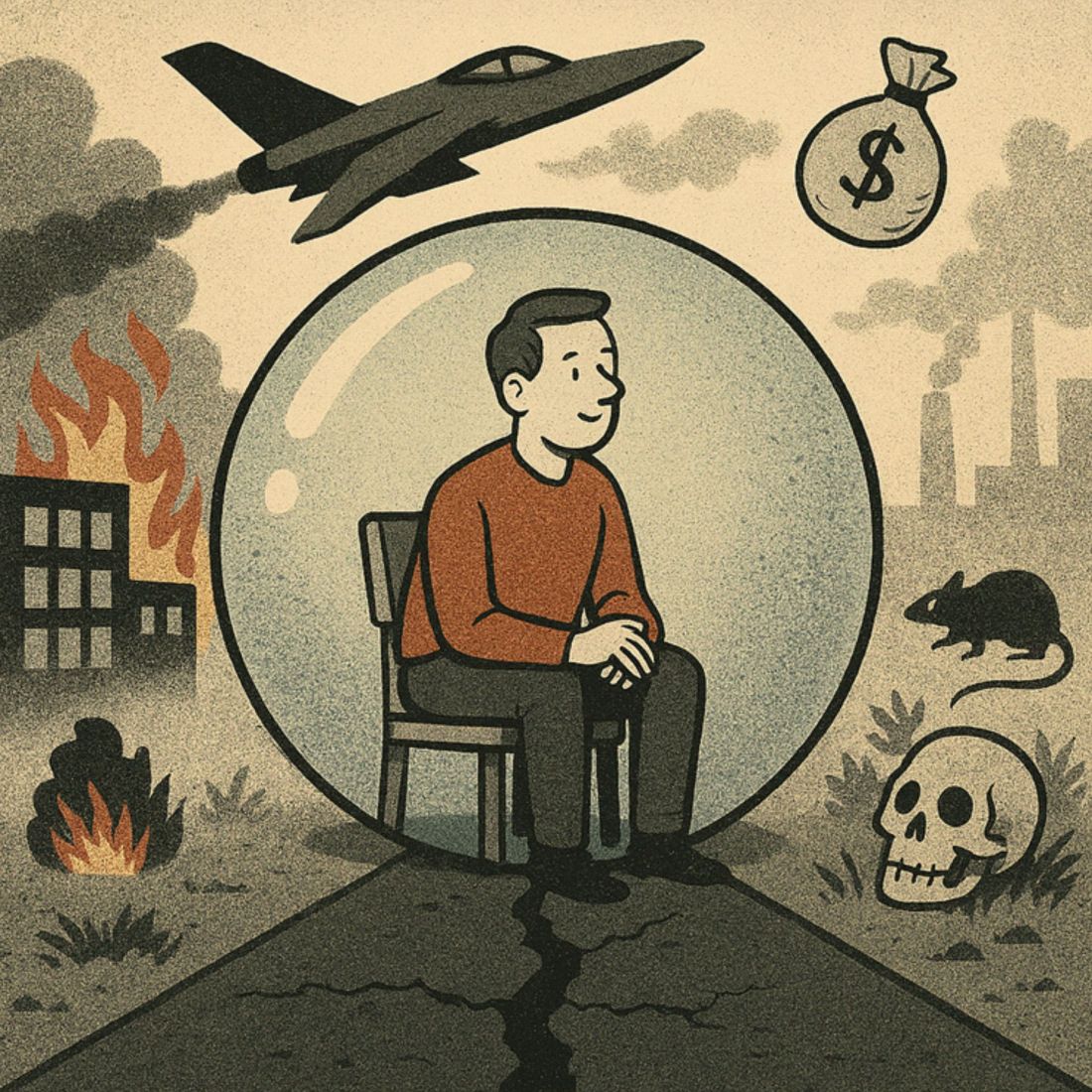
We are, metaphorically speaking, passengers in a vehicle we don’t realise is breaking or already broken.

We race along, ignoring the rattles, because it’s still moving.

We convince ourselves everything’s fine, right up until the moment it stops and we’re forced to accept that we’ve broken down.

The warning signs are everywhere. No matter your business, sector, or situation, the red flags are waving from every direction in plain sight. But because the wheels are still turning – or appear to be – we keep believing that a change of driver or a quick pit stop is all we need.

We imagine that after a brief pause, the journey will resume, more comfortable than before, with a better seat and a better view.

But the vehicle – whether you can picture it as a car, train, or bus – represents everything we do and everything we believe we’ve always done.

The road beneath it is the path we’ve been set upon, shaped by our behaviours, expectations, attitudes, approaches, and the values we’ve allowed to guide us.

The Quiet Ways We All Contributed

And here’s the uncomfortable truth: no matter what problem you’re facing, no matter what crisis is unfolding, if it involves decisions made by others, then yes – you can probably identify who’s responsible. But at some level, we all share responsibility. We all helped build the road.

Even if we didn’t make the active choices that led us here, into this mess, we made choices nonetheless.

When we avoided risk, chose the easy option, kept quiet to avoid rocking the boat, ignored the truth, or failed to do what was right – we took action. And often, that action was simply allowing those with hidden agendas to get their way.

Everything has a cost.

For decades, we’ve been conditioned by manipulation, sleight of hand, and narratives designed to convince us that non‑conformity leads to isolation.

But the real cost has been far greater.

Everything that once held value – our businesses, workplaces, sports, social spaces, food, water, money, communication, education, jobs, reputations – has been diminished.

Not by accident, but by design. So it could be reformed, centralised, and ultimately placed under someone else’s control – even while we still believe we own it.

This includes the institutions people still trust by default: government, the public sector, and the systems built around them. They were supposed to safeguard society, yet they’ve become part of the machinery that has allowed decline, mismanagement, and manipulation to take root. Not because everyone within them is corrupt, but because the structures themselves are no longer fit for purpose – and haven’t been for a long time.

Understanding Comes Only When We’re Ready

The problems we face — in farming, hospitality, industry, with people, community, the environment, government, the public sector – all stem from the same system. From all the “everythings” each and every one of us do.

No matter our background or bubble, it all adds up to the same thing: the trouble the world is now in.

And what we’ve done and been doing so far cannot or will not fix it.

It doesn’t matter if we wait for a change in government while continuing to elect candidates chosen by people we don’t know.

It doesn’t matter if we keep believing the establishment is structured to serve us, or that it has the integrity to do so.

It doesn’t matter if we trust the financial system, or believe that inflation and the cost of living are beyond anyone’s control.

If we don’t change the fundamental building blocks – of life, economics, and governance – then no matter who’s in charge, things will only get worse.

And we’ll keep being told they’re getting better.

Crisis as Catalyst

Today, life just happens to us.

Business, money, governance – they’re systems we’re expected to show up for, participate in, and conform to. That’s it.

But conformity is what brought us here. And we’re standing at the doorway of something that, once we step through it, may quickly reveal that there is no way back.

It’s only this way and we only got here because we surrendered our power – more often than not without ever realising that we had even given it up.

Building Something That Puts People First

If we want to change anything – even the smallest thing – in the world around us, we must participate. We must play our part. That’s what living a proper life demands.

And if we want things not just to improve, but to become truly better, then we must all get involved.

The collapse we’re experiencing offers something rare: the chance to see and experience life differently. A chance that wouldn’t have come if things had continued as they were. Which they no longer can.

As circumstances worsen and reality begins to speak for itself, we have a choice.

We can take back our power. We can work with the people we know – the people we share our lives with – to reclaim genuine control. To put people, community, and the environment first.

The Local Economy & Governance System (LEGS) – built upon The Basic Living Standard – offers a new structure for the future.

LEGS isn’t a shortcut, and it isn’t a promise that someone else will fix things for us.

LEGS is simply a framework that puts people, community, and the environment back at the centre of life – where they always should have been.

What comes next won’t be shaped by governments, institutions, or systems that have already failed us. It will be shaped by the choices we make now, the conversations we have with the people around us, and the willingness we each find to choose and step through the doorway in front of us, that leads to a Future that no one else can define.

The world we knew is ending. But what replaces it is still ours to decide.

Further Reading

1. Awakening & How We Perceive the Crisis

Understanding how people ‘wake up’ to what’s really happening

There’s No Fast‑Track to Awakening

Link: https://adamtugwell.blog/2026/01/05/theres-no-fast-track-to-awakening/
A reflection on why meaningful awareness can’t be forced or rushed. People don’t see deeper truths until they are personally ready, no matter how clear the evidence appears.

Beliefs We Accept as Our Own Are Destroying Everything — Including Who We Really Are

Link: https://adamtugwell.blog/2025/09/16/beliefs-we-accept-as-our-own-are-destroying-everything-including-who-we-really-are/
Explores how inherited assumptions shape society’s decline and block real understanding or change.

The Choice – A Waking Up Story (Full Text)

Link: https://adamtugwell.blog/2025/07/19/the-choice-a-waking-up-story-full-text/
A narrative‑style exploration of what it feels like to realise the system doesn’t work the way we once believed.

2. The Hidden System Behind Society’s Problems

What’s really driving the chaos people can see – but don’t fully understand

The War Behind the World We Know

Link: https://adamtugwell.blog/2026/01/05/the-war-behind-the-world-we-know/
Examines the unseen mechanisms and competing interests that shape global events and public perception.

Safe Shores – The Pathway That Led to the Local Economy Governance System and the Basic Living Standard

Link: https://adamtugwell.blog/2025/12/29/safe-shores-the-pathway-that-led-to-the-local-economy-governance-system-and-the-basic-living-standard/
Shows how decades of systemic decline created the conditions that make new governance ideas not just desirable, but necessary.

After the Collapse – Who Gets the Blame?

Link: https://adamtugwell.blog/2025/11/12/after-the-collapse-who-gets-the-blame/
Explains why the wrong people and causes tend to be blamed when systems fail, and why this delays real solutions.

Choosing Outcomes Over Comfort – A Path to a Better Future

Link: https://adamtugwell.blog/2025/11/13/choosing-outcomes-over-comfort-a-path-to-a-better-future/
Looks at how comfort, convenience, and avoidance prevent individuals and communities from acting differently – even when change is essential.

3. Economics, Collapse & the Global Order

Why the economic system is failing – and what’s really behind it

Facing the Economic Collapse – The Real Crisis Behind Money, Wages, and Freedom

Link: https://adamtugwell.blog/2025/11/14/facing-the-economic-collapse-the-real-crisis-behind-money-wages-and-freedom/
Explores how wages, inflation, money creation, and governance combine into a crisis much deeper than people realise.

Money Is the Greatest Crime of Our Time

Link: https://adamtugwell.blog/2025/11/12/money-is-the-greatest-crime-of-our-time/
Reveals how the monetary system has been manipulated to serve central interests at the expense of the public.

Desperate Times, Desperate Resets

Link: https://adamtugwell.blog/2025/03/24/desperate-times-desperate-resets/
Discusses major societal “resets” and why moments of crisis are exploited to reshape systems from the top down.

The BRICS Money Bomb – Will a New Gold‑Backed Currency Flip the Global Order?

Link: https://adamtugwell.blog/2023/08/14/the-brics-money-bomb-will-a-new-gold-backed-currency-and-monetary-system-really-flip-the-global-order-or-does-the-end-of-world-peace-lie-immediately-ahead-essay/
Analyses the potential shift in global power if BRICS nations introduce a hard‑asset‑backed currency.

Trump’s Reset – Catalyst for Change, Doorway to Cataclysm, or Both?

Link: https://adamtugwell.blog/2025/04/29/trumps-reset-catalyst-for-change-doorway-to-cataclysm-or-both/
Investigates the destabilising ripple effects of political “resets” and their global economic consequences.

4. Politics, Institutions & Public Misunderstandings

Why political systems fail – and why people keep expecting them to work

The Contemporary Politician’s Dilemma

Link: https://adamtugwell.blog/2024/12/05/the-contemporary-politicians-dilemma/
Shows why modern politicians cannot meaningfully fix systemic problems — even when they want to.

Government Is Broken – Collapse Now or Collapse Later?

Link: https://adamtugwell.blog/2025/11/05/government-is-broken-collapse-now-or-collapse-later/
Explains why existing government structures are no longer fit for purpose and cannot deliver sustainable solutions.

Any Fool Can Be a Politician

Link: https://adamtugwell.blog/2025/10/07/any-fool-can-be-a-politician/
A sharp look at how politics attracts the wrong incentives, creating leaders unsuited to solving real‑world challenges.

Why People Can’t “Just Get a Job”

Link: https://adamtugwell.blog/2025/11/04/why-people-cant-just-get-a-job/
Breaks down the structural economic and social barriers that make simplistic advice meaningless.

5. The Local Economy & Governance System (LEGS) and the Basic Living Standard (BLS)

Practical frameworks for rebuilding society from the ground up

The Basic Living Standard – Freedom to Think, Freedom to Do, Freedom to Be

Link: https://adamtugwell.blog/2025/12/15/the-basic-living-standard-freedom-to-think-freedom-to-do-freedom-to-be-with-personal-sovereignty-that-brings-peace-to-all/
Introduces BLS as a foundation for genuine human freedom, community wellbeing, and resilience.

The Basic Living Standard Explained

Link: https://adamtugwell.blog/2025/10/24/the-basic-living-standard-explained/
A straight‑forward breakdown of what the BLS is, why it matters, and how it functions.

The Local Economy Governance System (Online Text)

Link: https://adamtugwell.blog/2025/11/21/the-local-economy-governance-system-online-text/
A reference version of the LEGS framework for those seeking a structural model for local governance.

From Principle to Practice – Bringing LEGS to Life (Full Text)

Link: https://adamtugwell.blog/2025/12/27/from-principle-to-practice-bringing-the-local-economy-governance-system-to-life-full-text/
A detailed, practical guide on implementing LEGS within a community context.